Pacific
Islands
Monthly
March 16th 1934
6 d
[Registered at the G.P.O., Sydney, for transmission by post as a newspaper.]
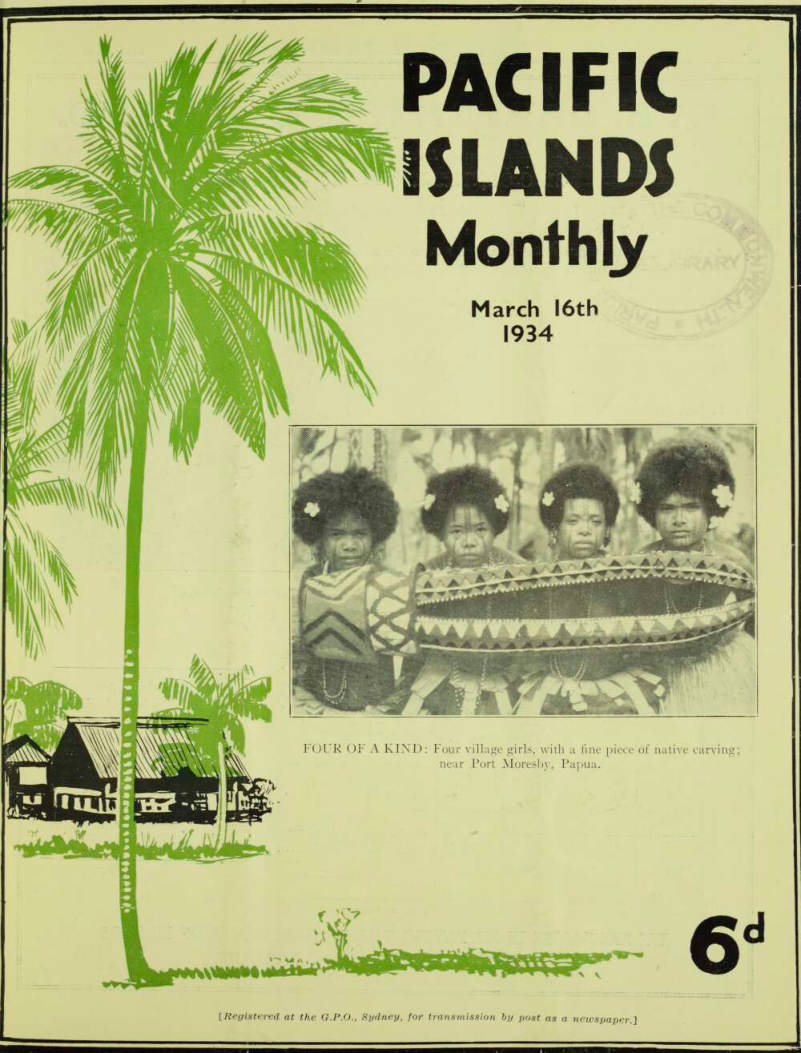
FOUR OF A KIND: Four village girls, with a fine piece of native carving; near Port Moresby, Papua.
Advertisements & other items, p. 2 (1 item)
W. R. Carpenter & Co. Ltd.
Head Office:
19-21 O’CONNELL STREET - - SYDNEY
Branches at: RABAUL (New Britain), KAVIENG (New Ireland), MADANG (New Guinea), SALAMAUA, WAU (New Guinea), TULAGI (Solomon Islands), and other Pacific Islands; and in LONDON.
Agents for Australian, European and American Manufacturers, and Distributors of Every Description of Merchandise. Complete Range of all stocks carried.
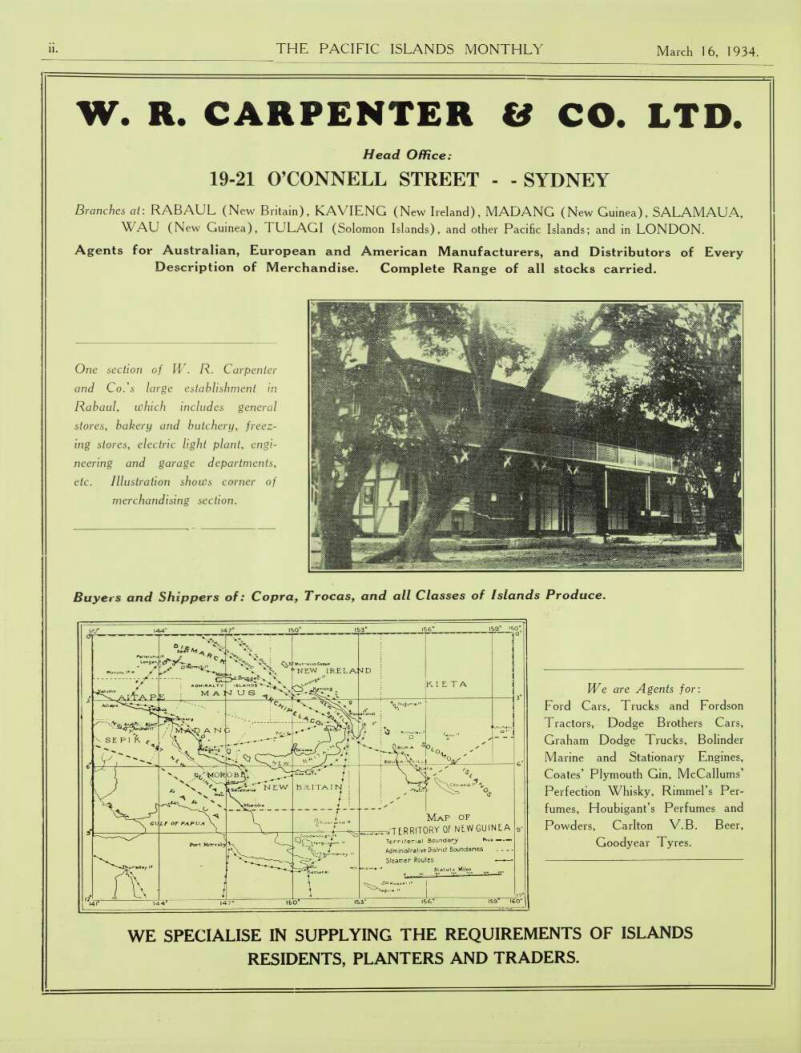
One section of W. R. Carpenter and Co.'s large establishment in Rabaul, which includes general stores, bakery and butchery, freezing stores, electric light plant, engineering and garage departments, etc. Illustration shows corner of merchandising section.
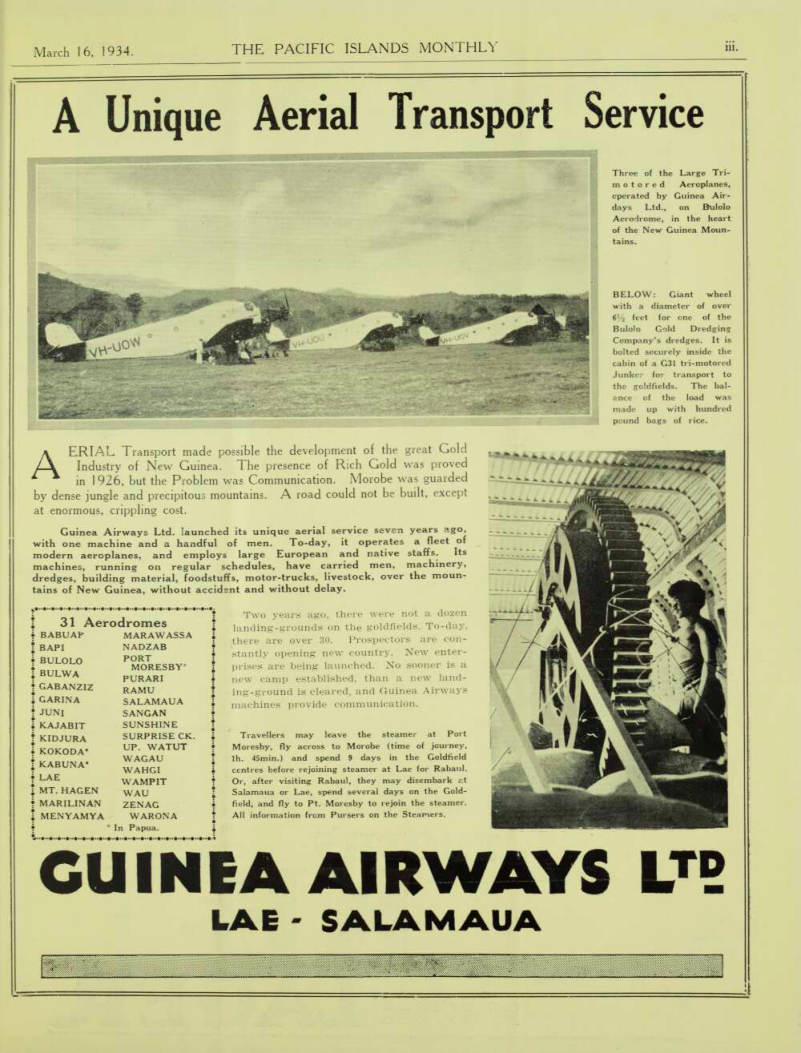
Buyers and Shippers of: Copra , Trocas, and all Classes of Islands Produce.
We are Agents for: Ford Cars, Trucks and Fordson Tractors, Dodge Brothers Cars, Graham Dodge Trucks, Bolinder Marine and Stationary Engines, Coates’ Plymouth Gin, McCallums’
Perfection Whisky, Rimmel’s Perfumes, Houbigant’s Perfumes and Powders, Carlton V.B. Beer, Goodyear Tyres.
WE SPECIALISE IN SUPPLYING THE REQUIREMENTS OF ISLANDS
RESIDENTS, PLANTERS AND TRADERS.
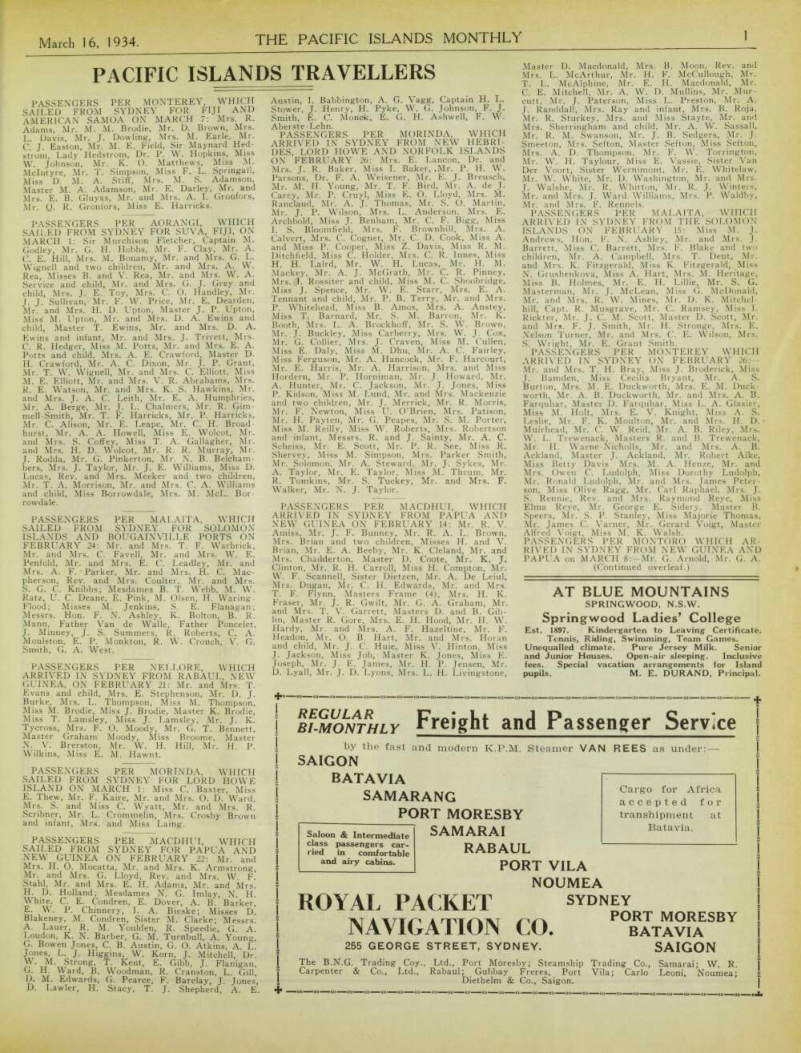
Pacific Islands Travellers
Passengers Per Monterey, Which
Sailed From Sydney For Fiji And
AMERICAN SAMOA ON MARCH 7: Mrs. R.
Adams, Mr. M. M. Brodie, Mr. D. Brown, Mrs.
L. Davis, Mr. J. Dowling, Mrs. M. Earle, Mr.
C. J. Easton, Mr. M. E. Field, Sir Maynard Hed strom, Lady Hedstrom, Dr. P. W. Hopkins, Miss W. Johnson, Mr. K. O. Matthews, Miss M.
McIntyre, Mr. T. Simpson, Miss F. L. Springall, Miss D. M. A. Stiff, Mrs. M. S. Adamson, Master M. A. Adamson, Mr. E. Darley, Mr. and Mrs. E. B. Gluyas, Mr. and Mrs. A. I. Gronfors, Mr. Q. R. Gronfors, Miss E. Harricks.
Passengers Per Aorangi, Which
SAILED FROM SYDNEY FOR SUVA, FIJI, ON MARCH 1: Sir Murchison Fletcher, Captain M.
Godley, Mr. G. H. Hobbs, Mr. F. Clay, Mr. A.
C. E. Hill, Mrs. M. Bonamy, Mr. and Mrs. G. L.
Wignell and two children, Mr. and Mrs. A. W.
Rea, Misses B. and V. Rea, Mr. and Mrs. W. A.
Service and child, Mr. and Mrs. G. J. Grey and child, Mrs. J. E. Toy, Mrs. C. O. Handley, Mr.
J. J. Sullivan, Mr. F. W. Price, Mr. E. Dearden, Mr. and Mrs. H. D. Upton, Master J. P. Upton, Miss M. Upton, Mr. and Mrs. D. A. Ewins and child, Master T. Ewins, Mr. and Mrs. D. A.
Ewins and infant, Mr. and Mrs. J. Trivett, Mrs.
C. R. Hedger, Miss M. Potts, Mr. and Mrs. E. A.
Potts and child, Mrs. A. E. Crawford, Master D.
H. Crawford, Mr. A. C. Dixon, Mr, J. P. Grant, Mr. T. W. Wignell, Mr. and Mrs. C. Elliott, Miss M. E. Elliott, Mr. and Mrs. V. R. Abrahams, Mrs.
R. E. Watson, Mr. and Mrs. K. S. Hawkins, Mr. and Mrs. J. A. C. Leith, Mr. E. A. Humphries, Mr. A. Berge, Mr. J. L. Chalmers, Mr. R. Gim mell-Smith, Mr. T. F. Harricks, Mr. P. Harricks, Mr. C. Alison, Mr. E. Leape, Mr. C. H. Broad hurst, Mr. A. A. Howell, Miss E. Wolcot, Mr. and Mrs. S. Coffey, Miss T. A. Gallagher, Mr. and Mrs. H. D. Wolcot, Mr. R. R. Murray, Mr.
J. Rodda, Mr. G. Pinkerton, Mr. N. B. Belcham bers, Mrs. J. Taylor, Mr. J. E. Williams, Miss D.
Lucas, Rev. and Mrs. Meeker and two children, Mr. T. A. Morrison, Mr. and Mrs. C. A. Williams and child, Miss Borrowdale, Mrs. M. McL. Bor rowdale.
Passengers Per Malaita, Which
Sailed From Sydney For Solomon
Islands And Bougainville Ports On
FEBRUARY 24; Mr. and Mrs. T. F. Warbrick, Mr. and Mrs. C. Favell, Mr. and Mrs. W. E.
Penfold, Mr. and Mrs. E. C. Leadley, Mr. and Mrs. A. F. Parker, Mr. and Mrs. H. C. Mac pherson, Rev. and Mrs. Coulter, Mr. and Mrs.
S. G. C. Knibbs; Mesdames B. T. Webb, M. W.
Ratz, U. C. Deane, E. Pink, M. Olsen, H. Waring- Flood; Misses M. Jenkins, S. E. Flanagan; Messrs. Hon. F. N. Ashley, K. Bolton, B. R.
Mann, Father Van de Walle, Father Poncelet, J. Minney, J. S. Summers, R. Roberts, C. A.
Moulston, E. P. Monkton, R. W. Crouch, V. G.
Smith, G. A. West.
Passengers Per Nellore, Which
Arrived In Sydney From Rabaul, New
GUINEA, ON FEBRUARY 21: Mr. and Mrs. T.
Evans and child, Mrs. E. Stephenson, Mr. D. J.
Burke, Mrs. L. Thompson, Miss M. Thompson, Miss M. Brodie, Miss J. Brodie, Master K. Brodie, Miss T. Lamsley, Miss J. Lamsley, Mr. J. K.
Tycross, Mrs. F. O. Moody, Mr. G. T. Bennett, Master Graham Moody, Miss Broome, Master N. V. Brerston, Mr. W. H. Hill, Mr. H. P.
Wilkins, Miss E. M. Hawnt.
Passengers Per Morinda, Which
Sailed From Sydney For Lord Howe
ISLAND ON MARCH 1: Miss C. Baxter, Miss E. Thew, Mr. F. Kaire, Mr. and Mrs. O. D. Ward, Mrs. S. and Miss C. Wyatt, Mr. and Mrs. R.
Scribner, Mr. L. Crommelin, Mrs. Crosby Brown and infant, Mrs. and Miss Laing.
Passengers Per Macdhui, Which
Sailed From Sydney For Papua And
NEW GUINEA ON FEBRUARY 22: Mr. and Mrs. H. O. Mocatta, Mr. and Mrs. K. Armstrong, Mr. and Mrs. G. Lloyd, Rev. and Mrs. W. F.
Stahl, Mr. and Mrs. E. H. Adams, Mr. and Mrs.
H. D. Holland; Mesdames N. G. Imlay, N. H.
White. C. E. Condren, E. Dover, A. B. Barker, E. W. P. Chinnery, I. A. Bieske; Misses D.
Blakeney, M. Condren, Sister M. Clarke; Messrs.
A. Lauer, R. M. Youlden, R. Speedie, G A.
Loudon, K. N. Barber, G. M. Turnbull, A. Young, G. Bowen Jones, C. B. Austin, G. O. Atkins, A. L.
Jones, L. J. Higgins, W. Korn, J. Mitchell, Dr.
W. M. Strong, T. Kent, E. Gibb, J. Flanigan, G. H. Ward, B. Woodman, R. Cranston, L. Gill, D. M. Edwards, G. Pearce, F. Barclay, J. Jones, D. Lawler, H. Stacy, T. J. Shepherd, A. E.
Austin, I. Babbington, A. G. Vagg, Captain H. L.
Slower, J. Henry, H. Pyke, W. G. Johnson, F. J.
Smith, E. C. Monck, E. G. H. Ashwell, F. W.
Aberste-Lehn.
Passengers Per Morinda, Which
Arrived In Sydney From New Hebri
Des, Lord Howe And Norfolk Islands
ON FEBRUARY 26: Mrs. E. Lancon, Dr. and Mrs. J. R. Baker, Miss I. Baker, ,Mr. P. H. W.
Parsons, Dr. F. A. Weisener, Mr. E. J. Breusch, Mr. M. H. Young, Mr. T. F. Bird, Mr. A. de J.
Carey, Mr. P. Cruyl, Miss E. O. Lloyd, Mrs. M.
Ranclaud, Mr. A. J. Thomas, Mr. S. O. Martin, Mr. J. P. Wilson, Mrs. L. Anderson, Mrs. E.
Archbold, Miss J. Benham, Mr. C. F. Bigg, Miss I. S. Bloomfield, Mrs. F. Brownhill, Mrs. A.
Calvert, Mrs. C. Cognet, Mr. C. D. Cook, Miss A. and Miss P. Cooper, Miss Z. Davis, Miss R. M.
Ditchfield, Miss C. Holder, Mrs. C. R. Innes, Miss H. H. Laird, Mr. W. H. Lucas, Mr. H. M.
Mackey, Mr. A. J. McGrath, Mr. C. R. Pinney, Mrs. I. Rossiter and child, Miss M. C. Shoobridge, Miss J. Spence, Mr. W. E. Starr, Mrs. E. A.
Tennant and child, Mr. P. B. Terry, Mr. and Mrs.
P. Whitehead, Miss B. Amos, Mrs. A. Anstey, Miss T. Barnard, Mr. S. M. Barron, Mr. K.
Booth, Mrs. L. A. Brockhoff, Mr. S. W. Brown, Mr. J. Buckley, Miss Carberry, Mrs. W. J. Cox, Mr. G. Collier, Mrs. J. Craven, Miss M. Cullen, Miss E. Daly, Miss M. Dhu, Mr. A. C. Fairley, Miss Ferguson, Mr. A. Hancock, Mr. F. Harcourt, Mr. E. Harris, Mr. A. Harrison, Mrs. and Miss Hordern, Mr. P. Horniman, Mr. J. Howard, Mr.
A. Hunter, Mr. C. Jackson, Mr. J. Jones, Miss P. Kidson, Miss M. Lund, Mr. and Mrs. Mackenzie and two children, Mr. J. Merrick, Mr. R. Morris, Mr. F. Newton, Miss U. O’Brien, Mrs. Patison, Mr. H. Payten, Mr. G. Peapes, Mr. S. M. Porter, Miss M. Reilly, Miss W. Roberts, Mrs. Robertson and infant, Messrs. R. and J. Sainty, Mr. A. C.
Scheiss, Mr. E. Scott, Mr. P. R. See, Miss R.
Shervey, Miss M. Simpson, Mrs. Parker Smith, Mr. Solomon, Mr. A. Steward, Mr. J. Sykes, Mr.
A. Taylor, Mr. E. Taylor. Miss M. Thrum, Mr.
R. Tomkins, Mr. S. Tuckey, Mr. and Mrs. F.
Walker, Mr. N. J. Taylor.
Passengers Per Macdhui, Which
Arrived In Sydney From Papua And
NEW GUINEA ON FEBRUARY 14: Mr. R. V.
Amiss, Mr. J. F. Bunney, Mr. R. A. L. Brown, Mrs. Brian and two children, Misses H. and V.
Brian, Mr. E. A. Beeby, Mr. K. Cleland, Mr. and Mrs. Chadderton, Master D. Coote, Mr. K. J.
Clinton, Mr. R. H. Carroll, Miss H. Compton, Mr.
W r . F. Scannell, Sister Dietzen, Mr. A. De Leiul, Mrs. Dugan, Mr. C. H. Edwards, Mr. and Mrs.
T. F. Flynn, Masters Frame (4), Mrs. H. K.
Fraser, Mr. J. R. Gwilt, Mr. G. A. Graham, Mr. and Mrs. T. V. Garrett, Masters D. and B. Gib lin, Master R. Gore, Mrs. E. H. Hood, Mr. H. W.
Hardy, Mr. and Mrs. A. F. Hazeltine, Mr. F.
Headon, Mr. O. B. Hart, Mr. and Mrs. Horan and child, Mr. J. C. Huie, Miss V. Hinton, Miss J. Jackson, Miss Job, Master K. Jones, Miss E.
Joseph, Mr. J. E. James, Mr. H. P. Jensen, Mr.
D. Lyall, Mr. J. D. Lyons, Mrs. L. H. Livingstone,
Master D. Macdonald, Mrs. B. Moon, Rev. and Mrs. L. McArthur, Mr. H. F. McCullough, Mr.
T. L. McAlphine, Mr. E. H. Macdonald, Mr.
C. E. Mitchell, Mr. A. W. D. Mullins, Mr. Mur cutt, Mr. J. Paterson, Miss L. Preston, Mr. A.
J. Randdall, Mrs. Ray and infant, Mrs. B. Roja, Mr. R. Sturkey, Mrs. and Miss Stayte, Mr. and Mrs. Sherringham and child, Mr. A. W. Sassall, Mr. R. M. Swanson, Mr. J. B. Sedgers, Mr. J.
Smeeton, Mrs. Sefton, Master Sefton, Miss Sefton, Mrs. A. D. Thompson, Mr. F. W. Torrington, Mr. W. H. Taylour, Miss E. Vassie, Sister Van Der Voort, Sister Wernimont, Mr. E. Whitelaw, Mr. W. White, Mr. D. Washington, Mr. and Mrs.
J. Walshe, Mr. R. Whitton, Mr. R. J. Winters, Mr. and Mrs. J. Ward Williams, Mrs. P. Waldby, Mr. and Mrs. F. Rennels.
Passengers Per Malaita, Which
Arrived In Sydney From The Solomon
ISLANDS ON FEBRUARY 15: Miss M. J.
Andrews, Hon. F. N. Ashley, Mr. and Mrs. J.
Barrett, Miss C. Barrett, Mrs. F. Blake and two children, Mr. A. Campbell, Mrs. T. Dent, Mr. and Mrs. K. Fitzgerald, Miss K. Fitzgerald, Miss N. Grushenkova, Miss A. Hart, Mrs. M. Heritage, Miss B. Holmes, Mr. E. H. Lillie, Mr. S. G.
Masterman, Mr. J. McLean, Miss G. McDonald, Mr. and Mrs. R. W. Mines, Mr. D. K. Mitchel hill, Capt. R. Musgrave, Mr. C. Ramsey, Miss 1.
Rickter, Mr. J. C. M. Scott, Master D. Scott, Mr. and Mrs. F. J. Smith, Mr. H. Stronge, Mrs. E.
Nelson Turner, Mr. and Mrs. C. E. Wilson, Mrs.
S. Wright, Mr. E. Grant Smith.
Passengers Per Monterey Which
Arrived In Sydney On February 26:
Mr. and Mrs. T. H. Bray, Miss J. Broderick, Miss J. Bamden, Miss Cecilia Bryant, Mr. A. S.
Burton, Mrs. M. E. Duckworth, Mrs. E. M. Duck worth, Mr. A. B. Duckworth, Mr. and Mrs. A. B.
Farquhar, Master D. Farquhar, Miss L. A. Glasier, Miss M. Holt, Mrs. E. V. Knight. Miss A. S.
Leslie, Mr. F. K. Moulton, Mr. and Mrs. H. D.
Muirhead, Mr. C. W. Reid. Mr. A. B. Riley, Mrs.
W. L. Trewenack, Masters R. and B. Trewenack, Mr. H. Warne-Nicholls, Mr. and Mrs. A. B.
Ackland, Master J. Ackland, Mr. Robert Alke, Miss Betty Davis, Mrs. M. A. Henze, Mr. and Mrs. Owen C. Ludolph, Miss Dorothy Ludolph, Mr. Ronald Ludolph, Mr. and Mrs. James Peter son, Miss Olive Ragg, Mr. Carl Raphael, Mrs. J.
S. Rennie, Rev. and Mrs. Raymond Reye, Miss Elma Reye, Mr. George E. Sidery, Master B.
Speers, Mr. S. P. Stanley, Miss Majorie Thomas, Mr. James C. Varner, Mr. Gerard Voigt, Master Alfred Voigt, Miss M. K. Walsh.
Passengers Per Montoro Which Ar-
RIVED IN SYDNEY FROM NEW GUINEA AND PAPUA on MARCH 8:-Mr. G. Arnold, Mr. G. A. (Continued overleaf.)
Bayer, Mr. Ian Cook, Mr. W. Dupain, Mrs. D. E.
English, Miss G. English, Mr. M. V. Gibson, Mr.
T. Griffith, Mr. H. T. Hammond, Mrs. M. Ham mond, Mr. J. Hinchcliffe, Mrs. S. Hogan, Miss G. M. Hogan, Mr. G. A. M. Heydon, Mr. J. G.
Hides, Miss J. E. Hart, Mr. R. Robson, Mr. M.
P. Kennedy, Mr. R. King, Mr. and Mrs. Laws, Mrs. O. Leek, Mr. W. G. Mitchell. Mrs. S. Mit chell, Miss B. Mitchell, Mr. W. F. Mitchell, Sir Hubert Murray, Mr. H. L. Murray, Mr. H. Me- Farlane, Mrs. A. McFarlane, Mr. J. Norris, Mr.
N. C. Pennington, Mr. E. Peterson, Mr. S. E.
Radford, Miss H. Rundnagel, Mr. C. Scribner, Mrs. J. G. Sturkey, Mr. L. C. Spindler, Mr. F. H.
Taylor, Mr. G. Thrasher, Mr. W. H. Thomson, Mrs. D. Whitehead, Miss C. H. Wedgwood, Miss E. Wilde, Mr. J. Williamson, Mr. J. D. Wilkinson.
Passengers Per Morinda Which Ar
Rived In Sydney From Lord Howe
ISLAND ON MARCH 5: —Mrs. Borrison, Miss G.
Chadwick, Mr. and Mrs. H. Connabee, Mr. R.
Dobinson, Miss I. Eichmann, Miss M. Frost, Mrs.
Germaine, Mr. R. Gifford, Mrs. L. Harford and child, Mr. E. and Mrs. R. V. Hines, Miss A. John son, Mr. E. B. Jukes, Miss McNally, Mrs. T. W.
Payten, Mrs. F. Payten and two children, Mr. A.
Quintal, Mr. E. C. Rickman, Miss T. Smith, Mrs.
R. H. Oakes, Mr. W. Whiffen, Mrs. L. Williams, Miss J. Wilson, Mr. and Mrs. F. Winn, Miss K.
Summers.
Passengers Per Morinda Which
Sailed From Sydney For Norfolk
ISLAND AND NEW HEBRIDES ON MARCH 8: Mr. H. Alexander, Mr. R. Bruce, Mr. D. Black, Mr. W. Court, Mrs. P. Court, Miss M. Court, Mr. C. Collins, Miss B. Chisholm, Mrs. E. T.
Dixon, Miss R. Day, Mr. and Mrs. S. Everett, Mrs. Elwin, Mr. B. P. Fielder, Mrs. L. Fenton, Miss Fraser, Mrs. Grayson, Mr. H. Hall, Mrs.
Henry, Miss P. Hinkley, Miss Hotten, Mr. A. R.
Jackson, Mrs. Johnston and child, Mr. F. Kairle, Mrs. Kelly, Mr. Lober, Mr. G. Murray, Mr. R.
Morris, Mr. J. McMahon, Mr. J. Morrison, Miss O. Mackenzie, Miss Mackenzie, Miss Mortlock, Miss F. Masters, Miss L. McGuire, Miss E. L.
Mortimer, Miss Moppett, Mr. W. J. OBrien, Mr.
H. L. Piper, Miss O. Pye, Miss R. M. Robinson, Miss V. Savage, Mrs. D. Searby, Mrs. H. Street, Miss Soiling, Miss E. M. Smythe, Mr. J. Tanner, Mrs. E. Thew, Miss E. Tweedie, Miss M. Valli, Mrs. H. G. Wilston, Miss L. Wilston, Miss M.
Wilston, Miss J. Weekes, Mrs. E. Harvey, Miss E. Vincent.
Advertisements & other items, pp. 3-4 (1 item)
Freight and Passenger Service
AT BLUE MOUNTAINS
SPRINGWOOD, N.S.W.
Springwood Ladies’ College
Est. 1897. Kindergarten to Leaving Certificate.
Tennis, Riding, Swimming, Team Games.
Unequalled climate. Pure Jersey Milk. Senior and Junior Houses. Open-air sleeping. Inclusive fees. Special vacation arrangements for Island pupils. M. E. DURAND, Principal.
Freight and Passenger Service
REGULAR
B1-MONTHLY
by the fast and modern K.P.M. Steamer VAN REES as under;
SAIGON
BATAVIA
SAMARANG
PORT MORESBY
SAMARAI
Saloon & Intermediate class passengers carried in comfortable and airy cabins.
RABAUL
PORT VILA
Cargo for Africa accepted for transhipment at Batavia.
ROYAL PACKET
NAVIGATION CO.
255 GEORGE STREET, SYDNEY. SAIGON
The B.N.G. Trading Coy., Ltd., Port Moresby; Steamship Trading Co., Samarai; W. R.
Carpenter & Co., Ltd., Rabaul; Gubbay Freres, Port Vila; Carlo Leoni, Noumea; Diethelm & Co., Saigon.
NOUMEA
SYDNEY
PORT MORESBY
BATAVIA
Advertisement
Contents
Page Pacific Islands Travellers 1 Concerning Monopolies .. .. .. 3, 4 Papuan Patrol Officer’s Feat . . . . 5 Aust.-Pacific Administrators’ Con ference .- 7 Fashions for Islands Women . . . . 8 Police Clash with N.G. Natives . . 9, 10 How Capt. McGrath was Killed . . . . 11 Tropicalities 32 Norfolk Island Notes 13 Papuan News 14 Tahiti Tourist Association 16 Japanese Shell Poadhers 18
Page Hon. H. Champion, C.B.E 21 Conditions in New Hebrides 22 Tung Oil Cultivation 24 Fiji Banana Trade 24 Other Crops for Islands Planters . . 26 High Commissioner for W. Pacific . . 29 About Islands People 30, 21 New Guinea Laws 33 O. F. Nelson Exiled from Samoa . . 35 New Guinea News 3(5 Market Quotations 37 Exchange Rates 33 Shipping Services in the Pacific . . 39, 40
Advertisers
Page Antinea Drug Co. .. 19 Arnott's Biscuits .. 27 Ausoline Co 29 Bank of N.S.W. .. 16 Broomfields, Ltd. .. 28 Bruce, Robert .. 22, 36 Brunton’s Flour .. 26 Burns, Philp & Co. 2 Burns, Philp (S.S.) Co 15 B.P. Magazine .. 32 Buzacott, Ltd 35 Cover H.
Central Q’land Meat Co. .. 17 Chapman & Sherack 28 Chartres, Stott & Hoare 20
Page Dangar, Gedye, Ltd. 25 Delicia Food Co. .. 14 Excelsior Stipply .. 14 Exito Co 40 Fletcher & Sons .. 32 Ford, W. M. 12 For Sale, Store .. 34 Flynn, Mrs. W. .. 11 Garrett & Davidson 23 Gillespie’s Flour .. 20 Goshen Pt Hospital 10 Grahame, C 36 Halvorsen. L. 37 Harper, M 34 Holbrooks, Ltd. .. 26 Holden’s Air T. ..40
I.C.I.A.N.Z., Ltd. .. 11
Page Joyce Biscuits .. .. 15 Kodak, Ltd 10 Kopsen & Co 22 Lane & Girvan .. 23 Lessey’s D.Y.S. .. 9 McIlrath’s, Ltd. .. 29 Metro. Bus. College 34
N.D.L 39
Nelson & Robertson 8, 38 New Brit. Express 10 Nolan, Spencer .. 23 Noyes Bros 9 Pacific Is. Ass’n. .. 27 Baton Burns .. .. 24 Pike Bros 8 Prescott, Ltd 18 Rabaul Carr’g. Co... 32 Ransomes, Ltd. .. 22 Rohu, Sil 24
Page Royal Packet N. Co. 1 Russell, S 24 Ruston & Hornsby 33 Springwood L. Col. 1 Steamships T. Co., Ltd 40 “Stillholme” .. .. 21 Sunshine Harvester 31 Swallow and Ariell, Ltd 13 “Talkeries” .. .. 11 Taubman’s Paints.. 21 Thomas, G. & Co. .. 40 Thompson’s Eng’g. 30 Pillock & Co., Ltd. 31 Tooth & Co iv.
Wallaringa Mansions 37 Wills, W. D. &H. O. 36 Wright & Co 34 Wunderlich, Ltd. .. 12
The Pacific Islands Monthly
The Newspaper-Magazine Of The South Seas
[Registered at G.P.O., Sydney, for transmission by post as a newspaper.]
Published Once Each Month and Circulated in Australia and New Zealand and in the following Pacific Territories and Islands Groups:
Crown Colony of Fiji.
Australian Territory of Papua.
Mandated Territory (Australia) of New Guinea, Bismarck Archipelago, and Northern Solomon Islands.
Mandated Territory (Japan) of Marshall, Caroline and Mariana Islands.
American Territory of Guam.
Mandated Territory of Nauru.
British Crown Colony of Gilbert and Ellice Islands.
French Territory of New Caledonia.
British and French Condominium of New Hebrides.
American Territory of Eastern Samoa.
Mandated Territory (New Zealand) of Samoa.
British Solomon Islands Protectorate.
British Protectorate of Tongan Islands.
New Zealand Territory of Cook Islands.
Australian Territory of Norfolk Island.
French Colony of Oceania (Tahiti, etc.).
American Territory of Hawaiian Islands.
Owned and Produced by Pacific Publications, Ltd., Union House, 247 George Street, Sydney.
Telephone Bw 5037
P.O. Box 3408 R
Contributions Articles, Stories, and Photographs dealing with Pacific Islands Subjects are invited, and will be paid for on publication at usual rates.
Subscription Rates
Per Annum, within British Empire, Prepaid Post Free 6/- Per Annum, elsewhere, prepaid, Post Free .. 8/- Single Copies 6d.
Editor and Publisher:
R. W. Robson.
Advertisements Advertising rates furnished on application.
Colours, etc. by Arrangement.
Process Blocks made at Advertiser’s expense when required. Screen, 100.
Changes of Advertising Copy should reach this Office by 8th of each month, otherwise previous advertisement may be repeated.
Registered Address for Radiograms and Cables; “PACPUB” Sydney Agents The following are authorised to receive subscrip tions for “The Pacific Islands Monthly”— Islands Branches of Burns, Philp & Co., Ltd., and Burns, Philp (South Seas) Co., Ltd.
Islands Branches of W. R. Carpenter & Co., Ltd.
All Branches of Morris, Hedstrom & Co., Ltd.
G. Thomas & Co., Raubaul.
Whitten Bros., Ltd., Samarai.
P. Costello, Suva, Fiji.
All Branches and Representatives of W. H. Grove and Sons, Ltd., Auckland.
S. Russell, Papeete, Tahiti.
Cook Islands Trading Co., Rarotonga.
Mrs. M. Campbell, Cascades, Norfolk Island.
Vol. IV., No. 8.
Sydney, March 16, 1934.
Price 6d. Per Copy Prepaid: 6/- p.a.
Concerning Monopolies
CONDENSED report of the pro ceedings of the new Legislative Council of New Guinea is published in another column. It will be seen that the Council adopted two motions of a drastic character —one relating to the operations of the Unilever combine and their effect on the world’s copra markets; and the other to the shipping position, as it is seen from the viewpoint of New Guinea.
Those two resolutions have a bearing upon Pacific affairs generally, and they should not be published to the world without some comment and a little ex
planation.
We dealt in our February number with the world copra market and the activities of Unilever. There is not much to be added to that. The figures which we then published, showing world pro duction of copra, are supported by a special compilation made by Mr. Harrop, of Sydney, which will be published in next issue.
It would be unwise to underestimate the power which Unilever exercises in the world market. Without any doubt,
this huge international combine is taking advantage of conditions imposed by over production and world depression, and the effect of its operations is to make a sick primary industry even more sick.
But it would be equally unwise to overestimate the effect of Unilever operations. Planters must recognise that their industry, in common with all other primary industries, is suffering from an economic condition which is world-wide and mysterious, and which has pushed down the prices of all primary products to levels seldom known before in history, On top of that, there is another difficulty that is peculiar to the copra industry. It is impossible to overestimate the import ance of those recent scientific discoveries which permit coarse vegetable oils and whale oil to be purified and deodorized, in such a manner that they become active competitors of coconut oil in fields where coconut oil formerly was supreme.
Then, there has been over-production, During the boom years, all over the tropics, coconuts were planted in a scien tific and efficient manner, calculated to
secure the largest possible production per acre; and in recent years those new plantations have been coming into bear ing. Planters all over the world have resisted a shrinking income, due to re duced prices, by producing double and treble the quantity of copra. In conse quence, there has been huge over-produc tion, poured on to a market which was suffering already from a definitely re duced demand.
These are facts which are apparent to any intelligent student of world affairs.
Obviously, therefore, it is wrong to lay all the blame for the unhappy state of the coconut industry upon the shoulders of Unilever. The intelligent observer, instead, should try to make a careful survey of all these conditions, and allot blame, respectively, to: (a) general de pression; (b) new scientific processes; (c) over-production; (d) the existence of the Unilever combine.
Although we place Unilever in the fourth position we do not say that Uni lever is the least blameworthy. On the contrary, it may be that Unilever is the most vicious of the four factors enum erated; but it obviously would be wrong
to urge an international attack upon Unilever without giving due considera tion and weight to the other factors re ferred to. If that is not done, it is per fectly clear that Unilever can escape blame for its market manipulations by sheltering itself behind a well-authenti cated claim that planters are suffering from conditions with which Unilever has nothing at all to do.
The Legislative Council’s resolution about shipping clearly is aimed at Messrs. Burns, Philp & Co., Ltd. As everyone knows, the B.P. steamer ser vices between Australia and New Guinea, Papua, Solomons, New Hebrides, etc., are carried on under subsidy from the Commonwealth Government. The sub sidy is paid as a protection of Australian trading interests in the Pacific Islands.
The B.P. steamers carry mails, provide an excellent and regular passenger ser vice, and they hold for Australian inter ests a first class market for foodstuffs and manufactured goods. In recent years, two German steamers of the N.D.L. line have been running down from China to New Guinea and Solomon Islands ports on a regular schedule, picking up copra and other products, and bringing in merchandise from Europe and Asia which, on a price basis, offers very sharp competition to Australian goods and services.
In consequence, there have developed two schools of thought, in direct conflict one with the other. There are those who argue that the Pacific Islands, within the Australian zone, should be a close preserve for Australian trade and ship ping, seeing that the administrative and
shipping services are a heavy charge
upon Australia. There are others who argue, with equal force, that it is in the best interests of the Territories that a concern like the German shipping com
pany should be allowed to offer free competition in shipping and trading, and thereby check any evils that might arise out of the virtual monopoly enjoyed by Messrs. Burns, Philp & Co., Ltd.
We have, heard those two points of view argued on many occasions; and it is very difficult to say that either is wholly correct. But this may be said — that whereas there are several men in New Guinea of outstanding ability, who argue in favour of freedom of trade and the continuance of the N.D.L. service, there is seldom a word said in favour of Messrs. Burns, Philp & Co., Ltd. And much may be said in its favour. It is an extraordinarily silent firm. It goes grimly along in its efficient way, provid ing the Islands communities with ade quate shipping and trading services, and making no reply to its critics.
Because it is an Australian firm, the B.P. steamers have to be staffed and run under Australian conditions; which are the most expensive in the world. The B.P. steamers carry Australian crews.
Other steamers which cut into their freight and passenger traffic are partly staffed by Asiatics. Owing to the world condition of the copra market, most of the copra is shipped direct from the Islands to Europe and America. The B.P. steamers, which necessarily are built for two-ways freight traffic, now pick up very little copra and come down from the Islands half empty, bucking uncom fortably into the south-east trade-wind.
The ships from all the world take into the Islands the cheapest goods of Asia and Europe. The B.P. steamers, being under definite obligations to Australia, are expected to carry Australian-made goods to compete with the products of Japanese factories.
As everyone knows, the B.P. firm has huge planting and trading interests in the Islands. It requires no imagination to see the heavy economic burdens with
which the firm is now faced. The fact that the firm is able to make a profit under these conditions and carry on its valuable services is not an indication that a blood-sucking monopoly exists, but rather is a tribute to the vision and efficiency with which this huge business has been conducted in the past.
We hold no brief for Messrs. Burns, Philp & Co., Ltd. If a well-conducted newspaper is permitted to hate, we can say that we hate combines and monopo lies in every shape and form. We sub scribe to the view that the existence in the world to-day of ruthless combines and trusts of an international character is undermining the very structure of what we call Western civilisation. Messrs.
Burns, Philp & Co., Ltd., while a very large, all-embracing organisation, is not a monopoly in the usual sense of the term. On the contrary, it is quite open to competition. Its mail-carrying and steamer contracts are obtained under a system of tender every few years. It has done more than any other firm to extend Australian influence and Australian trading activities over the Pacific Ocean.
It adheres rigidly to Australian ideals and Australian industrial conditions.
Above all, it is dumb.
It is for that reason that, in view of the resolution recently passed in New Guinea, we have taken it upon ourselves to present the B.P. point of view, which to an extent is the Australian point of view. The great majority of people who know anything about the Pacific Islands will understand and sympathise with the New Guinea planters in the action they have taken, and will commend their courage. But their views will go further and be treated with the great respect they deserve, if they will recognise that, when
condemning so-called monopolies, they
should take very full cognisance of the arguments that may be presented by the other side.
Co. To Investigate Banks
Is. Sulphur
A SYDNEY syndicate has decided to take steps to thoroughly investigate the extensive sulphur deposits on the Island of Vanua Lava, in the Banks Group, New Hebrides; and Messrs. D. S. Askew and R. Welch are leaving by the Morinda on March 20 to carry out the work. It is expected that they will be away four or five months. Their camp will be estab lished at Port Patteson. There are only two other Europeans on this island. It is expected that the Sydney syndicate will register itself as a company at an early date.
There are huge sulphur deposits on Vanua Lava, which formerly were worked
by French interests; and there is now a steady and improving market for this commodity.
Memorial Notice
In loving memory of our dear friend, Gladys Margaret Chivers, wife of Frank, and mother of Billy, who was “called home,” 8th April, 1927, Roviana, Solomon Islands.
“She is not dead, this friend; not dead, But on some road, which mortals tread, Got some few trifling steps ahead, And nearer to the end.
So that we, too, once past the bend, Shall meet again, as face to face, This friend we fancy dead.
She has but turned a corner.” —Inserted by L. and R. B., Melbourne.
Papuan Plantation Sold
The well-known Mamai plantation at Port Glasgow, in Papua, was purchased outright, in February, as a going concern, by Steamships Trading Co. Ltd., of Port Moresby.
The property consists of 550 acres of full-bearing coconuts and 160 acres bear ing rubber: and the purchase includes all stocks, such as 200 cattle, all plant, motor lorries, rubber machinery, etc. The new owners propose to actively continue the operation of the plantation and the former manager, Mr. Blundell, will continue with the new owners as manager.
As Captain Fitch’s organisation has all the necessary equipment for carrying on this class of business —ships, stores, labour, etc.- —the new development should prove profitable.
Midnight Pounce On Village
How Papuan Official Took 15 Murderers and Marched Them 250 Miles
One of the most interesting feats in the history of Aus tralian-Pacific administration was performed recently in Papua, when a patrol officer penetrated into the heart of untamed Papua, sprang into a village at midnight, seized three chiefs and 15 commoners on charges of murder and cannibalism, and marched them 250 miles into Port Moresby. This is the story.
From Our Own Correspondent
Pt. Moresby, Feb. 26.
WHEN Patrol Officer Jack Hides ar rived in Port Moresby early in Feb ruary, with his little band of police and fifteen prisoners, overland from the Lolo ipa Valley, 250 miles away in the wild in terior of Papua, he brought with him a breath of primitive simplicity and strength even though it came in shackles.
Accused of killing and eating members of a neighbouring tribe, these men showed no signs of guilt, but only a mild and wondering surprise at the unforeseen re sult of what they considered a common place procedure of their lives.
Port Moresby, to them, was a perplex ity, incomprehensible. They gazed round in wonder at the motor cars, houses and white people, for it was their first intro duction to civilisation. Only once had they seen a white man, and then at a distance, long ago, when a patrol made its way slowly past their valley, for the north.
On being asked what they thought of Port Moresby, their chief, Gopa, replied that he had thought and thought about all the things he saw, until he could not think any more, so bewildered he was by the Court of Justice, the white men and their ways. But before he left, under es cort, on the return to his valley, he had gathered clearly that killing and eating other men were “not done” and he gave promises to the Government for himself and his people that there would be no more massacres in his district.
The Loloipa Valley, a large fertile dis trict, lies S.E. of Mt. Strong, near the
border of New Guinea, running parallel to the Kunimaipa Valley, though more to the south. It lies among difficult country, where ranges tower one above another and torrents of wind tortuously in and out through the precipitous ravines, until they meet the larger streams flowing down to the coast.
The whole area is inhabited by virile tribes, at war with one another, but gradually coming under control, as of ficial patrols, with steady persistence, penetrate ever further among them, Mr. Hides was on patrol in search of murderers at Karipa, further to the east, when word reached him of the raiding at Kariarita, in the Loloipa Valley; and, as his easiest route to the district lay by the Mission Station at Mafula, inland from Yule Island, he set off with his police to attend to this matter first, de ciding to visit Kariapa later, on his re turn journey.
He struck across country to the east, until he reached the Aurope River, near the Pole Range. Here, he climbed over steep broken limestone country, until the village of Kalibulu was reached. There, he found food prepared for his patrol by members of the injured tribe, who had sought help from the Government, From Kalibulu, the patrol climbed to the crown of the spur, at an altitude of 7000 ft., and pushed on by scattered dwel lings until they reached the village of Kariarita, the scene of the raid. From Kariarita, a magnificent view of the Lo loipa Valley could be seen, stretching for mile upon mile, until it became lost to view behind limestone ridges and hills.
Here, Chief Gapelu waited, with a large crowd of natives, to escort the patrol to the village of the raiders.
On being questioned, Gapelu swore that his people had been eaten by the people of Lanivave, of the Loloipa tribe, and amongst those slain were their two chiefs, who controlled the villages of Poreta and Kariarita. He, Gapelu, after the raid, had taken their place as chief of the tribe.
At once, the patrol moved off for Lani vave, accompanied by Chief Gapelu and six of his tribesmen. Towards dusk, they reached a spot where they looked down across a deep ravine onto the home of the raiders and they hid among a growth of Pandanus palm until late in the even ing. Then they climbed down, and com menced the steep ascent to the village, which they reached about midnight.
The moon was high and, in its clear light, the stockade surrounding the vil lage showed plainly. But the entrance was blocked by stout poles, driven well into the ground and lashed firmly to gether. These had to be removed, and grave risk of awakening the slumbering raiders.
Chief Gapelu worked them loose, and then the patrol crawled silently through the opening. Each policeman, according to instructions, stationed himself at the barred doors of each dwelling.
Soon, as the inhabitants awakened and realised there was something unusual abroad, there was chaos and confusion.
Bedlam broke loose. Spears rained from all directions. Chief Gapelu, making a desperate attempt to gain an advantage, received an arrow in his brain and died almost immediately.
The important position in the village, Chief Gopa’s house, was guarded by three police, and was held well, though Gopa and his men made frantic attempts to escape through the walls and the roof.
They slashed at the police with long
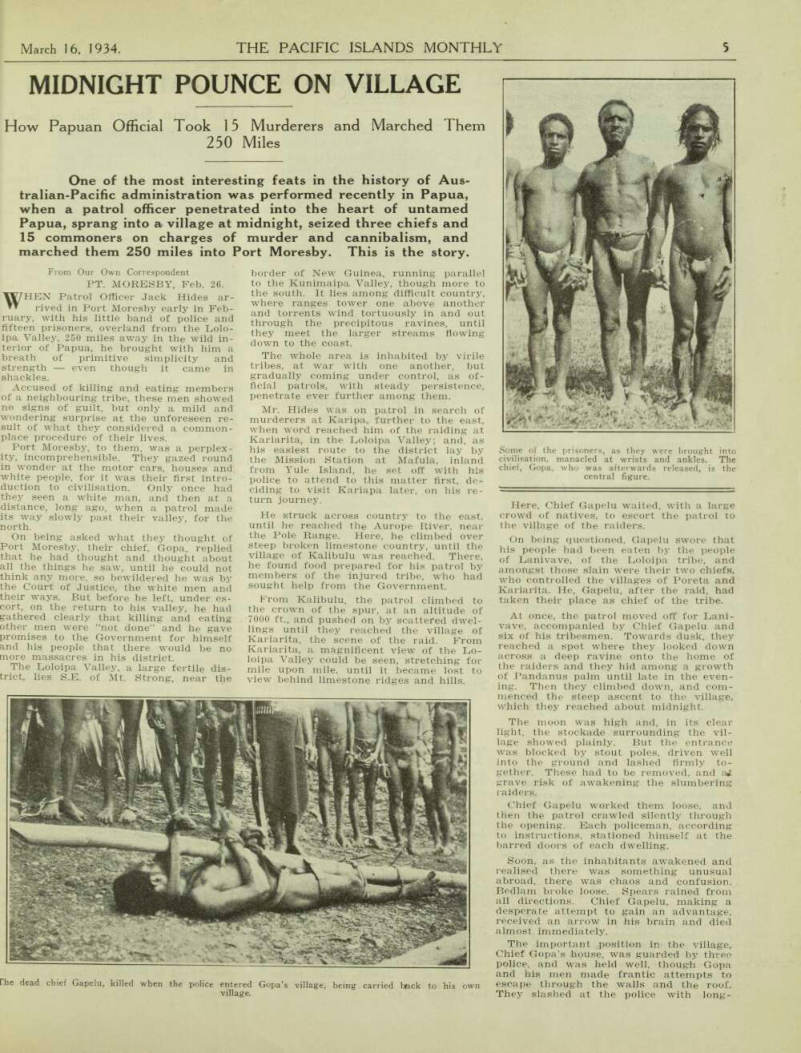
The dead chief Gapelu, killed when the police entered Gopa’s village, being carried black to his own village.
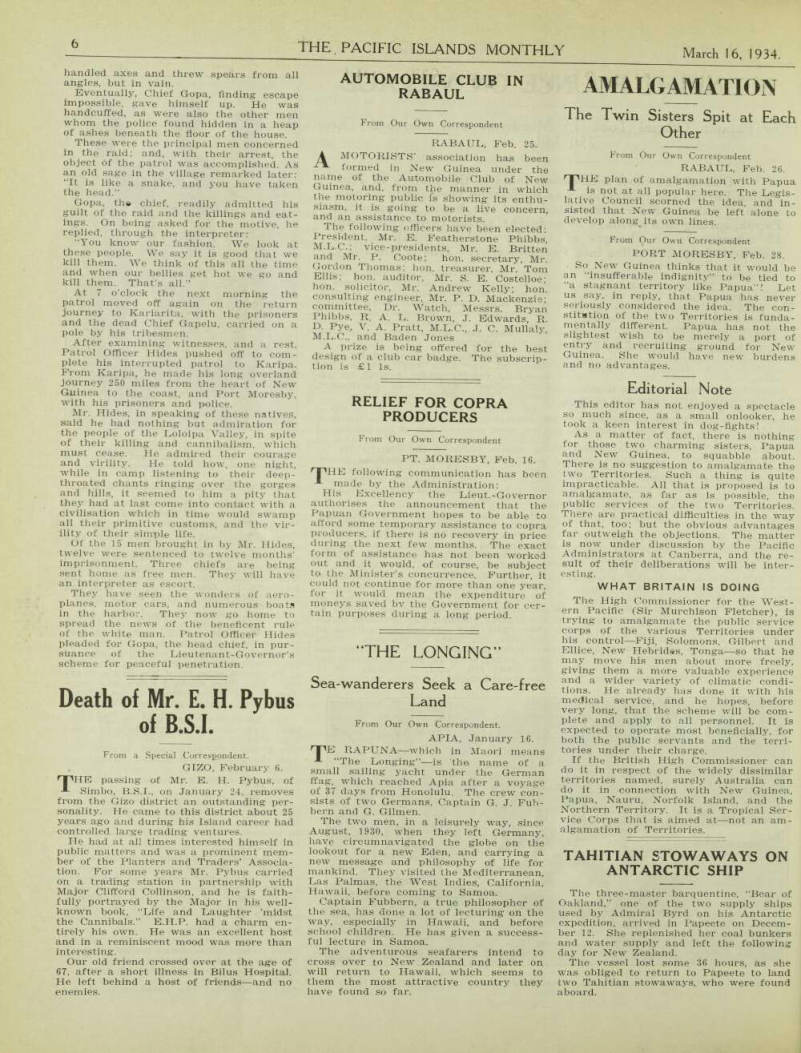
Some of the prisoners, as they were brought into civilisation, manacled at wrists and ankles. The chief, Gopa, who was afterwards released, is the central figure.
handled axes and threw spears from all angles, but in vain.
Eventually, Chief Gopa, finding escape impossible, gave himself up. He was handcuffed, as were also the other men whom the police found hidden in a heap of ashes beneath the floor of the house.
These were the principal men concerned in the raid; and, with their arrest, the object of the patrol was accomplished. As an old sage in the village remarked later: “It is like a snake, and you have taken the head.”
Gopa, the chief, readily admitted his guilt of the raid and the killings and eat ings. On being asked for the motive, he replied, through the interpreter: “You know our fashion. We look at these people. We say it is good that we kill them. We think of this all the time and when our bellies get hot we go and kill them. That’s all.”
At 7 o’clock the next morning the patrol moved off again on the return journey to Kariarita, with the prisoners and the dead Chief Gapelu, carried on a pole by his tribesmen.
After examining witnesses, and a rest, Patrol Officer Hides pushed off to com plete his interrupted patrol to Karipa.
From Karipa, he made his long overland journey 250 miles from the heart of New Guinea to the coast, and Port Moresby, with his prisoners and police.
Mr. Hides, in speaking of these natives, said he had nothing but admiration for the people of the Loloipa Valley, in spite of their killing and cannibalism, which must cease. He admired their courage and virility. He told how, one night, while in camp listening to their deep throated chants ringing over the gorges and hills, it seemed to him a pity that they had at last come into contact with a civilisation which in time would swamp all their primitive customs, and the vir ility of their simple life.
Of the 15 men brought in by Mr. Hides, twelve were sentenced to twelve months’ imprisonment. Three chiefs are being sent home as free men. They will have an interpreter as escort.
They have seen the wonders of aero planes, motor cars, and numerous boats in the harbor. They now go home to spread the news of the beneficent rule of the white man. Patrol Officer Hides pleaded for Gopa, the head chief, in pur suance of the Lieutenant-Governor’s scheme for peaceful penetration.
Advertisements & other items, p. 8 (1 item)
of B.S.I.
Death of Mr. E. H. Pybus of B.S.I.
From a Special Correspondent.
GIZO, February 6.
THE passing of Mr. E. H. Pybus, of Simbo, B.S.I., on January 24, removes from the Gizo district an outstanding per sonality. He came to this district about 25 years ago and during his Island career had controlled large trading ventures.
He had at all times interested himself in public matters and was a prominent mem ber of the Planters and Traders’ Associa tion. For some years Mr. Pybus carried on a trading station in partnership with Major Clifford Collinson, and he is faith fully portrayed by the Major in his well known book, “Life and Laughter ’midst the Cannibals.” E.H.P. had a charm en tirely his own. He was an excellent host and in a reminiscent mood was more than interesting.
Our old friend crossed over at the age of 67, after a short illness in Bilus Hospital.
He left behind a host of friends—and no enemies.
Rabaul
Automobile Club In
From Our Own Correspondent
Rabaul, Feb. 25.
A MOTORISTS’ association has been formed in New Guinea under the name of the Automobile Club of New Guinea, and, from the manner in which the motoring public is showing its enthu siasm, it is going to be a live concern, and an assistance to motorists.
The following officers have been elected- President, Mr. E. Featherstone Phibbs, M.L.C.; vice-presidents, Mr. E. Britten and Mr. P. Coote; hon. secretary, Mr.
Gordon Thomas; hon. treasurer, Mr. Tom Ellis; hon. auditor, Mr. S. E. Costelloe; hon. solicitor, Mr. Andrew Kelly; hon. consulting engineer, Mr. P. D. Mackenzie; committee, Dr. Watch, Messrs. Bryan Phibbs, R. A. L. Brown, J. Edwards, R.
D. Pye, V. A. Pratt, M.L.C., J. C. Mullaly, M.L.C., and Baden Jones A prize is being offered for the best design of a club car badge. The subscrip tion is £1 1s.
Producers
Relief For Copra
From Our Own Correspondent
Pt. Moresby, Feb. 16.
THE following communication has been made by the Administration: His Excellency the Lieut.-Governor authorises the announcement that the Papuan Government hopes to be able to afford some temporary assistance to copra producers, if there is no recovery in price during the next few months. The exact form of assistance has not been worked out and it would, of course, be subject to the Minister’s concurrence. Further, it could not continue for more than one year, for it would mean the expenditure of moneys saved bv the Government for cer tain purposes during a long period.
“The Longing”
Sea-wanderers Seek a Care-free Land
From Our Own Correspondent.
APIA, January 16.
TE RAPUNA—which in Maori means “The Longing”—is the name of a small sailing yacht under the German flag, which reached Apia after a voyage of 37 days from Honolulu. The crew con sists of two Germans, Captain G. J. Fub bern and G. Oilmen.
The two men, in a leisurely way, since August, 1930, when they left Germany, have circumnavigated the globe on the lookout for a new Eden, and carrying a new message and philosophy of life for mankind. They visited the Mediterranean, Las Palmas, the West Indies, California, Hawaii, before coming to Samoa.
Captain Fubbern, a true philosopher of the sea, has done a lot of lecturing on the way, especially in Hawaii, and before school children. He has given a success ful lecture in Samoa.
The adventurous seafarers intend to cross over to New Zealand and later on will return to Hawaii, which seems to them the most attractive country they have found so far.
Amalgamation
The Twin Sisters Spit at Each
Other
From Our Own Correspondent
Rabaul, Feb. 26.
THE plan of amalgamation with Papua is not at all popular here. The Legislative Council scorned the idea, and in sisted that New Guinea be left alone to develop its own lines.
From Our Own Correspondent
Port Moresby, Feb. 28.
So New Guinea thinks that it would be an “insufferable indignity” to be tied to “a stagnant territory like Papua”! Let us say, in reply, that Papua has never seriously considered the idea. The con stitution of the two Territories is funda mentally different. Papua has not the slightest wish to be merely a port of entry and recruiting ground for New Guinea. She would have new burdens and no advantages.
Editorial Note
This editor has not enjoyed a spectacle so much since, as a small onlooker, he took a keen interest in dog-fights!
As a matter of fact, there is nothing for those two charming sisters, Papua and New Guinea, to squabble about.
There is no suggestion to amalgamate the two Territories. Such a thing is quite impracticable. All that is proposed is to amalgamate, as far as is possible, the public services of the two Territories.
There are practical difficulties in the way of that, too; but the obvious advantages far outweigh the objections. The matter is now under discussion by the Pacific Administrators at Canberra, and the re sult of their deliberations will be inter esting.
What Britain Is Doing
The High Commissioner for the West ern Pacific (Sir Murchison Fletcher), is trying to amalgamate the public service corps of the various Territories under his control—Fiji, Solomons, Gilbert and Ellice, New Hebrides, Tonga—so that he may move his men about more freely, giving them a more valuable experience and a wider variety of climatic condi tions. He already has done it with his medical service, and he hopes, before very long, that the scheme will be com plete and apply to all personnel. It is expected to operate most beneficially, for both the public servants and the terri tories under their charge.
If the British High Commissioner can do it in respect of the widely dissimilar territories named, surely Australia can do it in connection with New Guinea, Papua, Nauru, Norfolk Island, and the Northern Territory. It is a Tropical Ser vice Corps that is aimed at —not an am algamation of Territories.
Tahitian Stowaways On
Antarctic Ship
The three-master barquentine, “Bear of Oakland,” one of the two supply ships used by Admiral Byrd on his Antarctic expedition, arrived in Papeete on Decem ber 12. She replenished her coal bunkers and water supply and left the following day for New Zealand.
The vessel lost some 36 hours, as she was obliged to return to Papeete to land two Tahitian stowaways, who were found aboard.
Australian Pacific Administrators Confer At Canberra
The conference of Australian Pacific
Administrators was formally opened at
Canberra on Monday, March 12, and
concluded on March 1 3.
THE conference was entirely a private one. The agenda was published in our February number. It is not possible to give any outline of its delibe rations in this issue, but we hope to have some details of decisions made for the April issue.
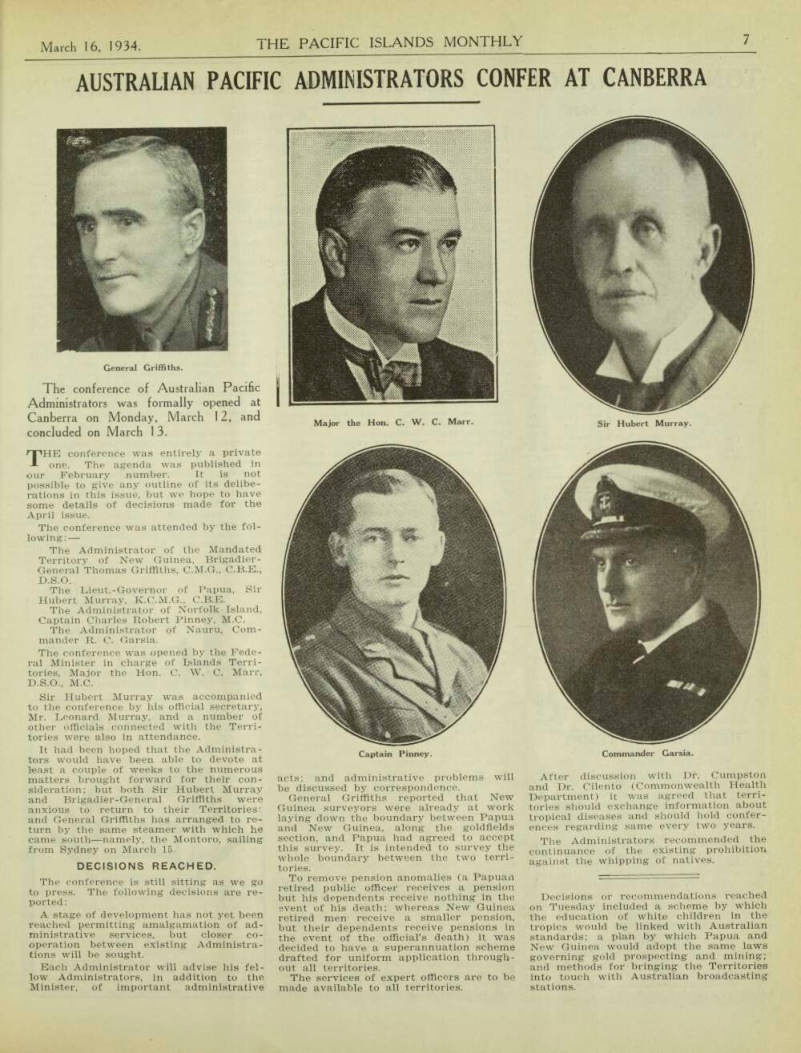
The conference was attended by the fol lowing:— The Administrator of the Mandated Territory of New Guinea, Brigadier- General Thomas Griffiths, C.M.G., C.B.E.,
D.S.O.
The Lieut.-Governor of Papua, Sir Hubert Murray, K.C.M.G., C.B.E.
The Administrator of Norfolk Island, Captain Charles Robert Pinney, M.C.
The Administrator pf Nauru, Com mander R. C. Garsia.
The conference was opened by the Fede ral Minister in charge of Islands Terri tories, Major the Hon. C. W. C. Marr,
D.S.O., M.C.
Sir Hubert Murray was accompanied to the conference by his official secretary, Mr. Leonard Murray, and a number of other officials connected with the Terri tories were also in attendance.
It had been hoped that the Administra tors would have been able to devote at least a couple of weeks to the numerous matters brought forward for their con sideration; but both Sir Hubert Murray and Brigadier-General Griffiths were anxious to return to their Territories: and General Griffiths has arranged to re turn by the same steamer with which he came south —namely, the Montoro, sailing from Sydney on March 15.
Decisions Reached.
The conference is still sitting as we go to press. The following decisions are re ported: A stage of development has not yet been reached permitting amalgamation of ad ministrative services, but closer co operation between existing Administra tions will be sought.
Each Administrator will advise his fel low Administrators, in addition to the Minister, of important administrative
acts; and administrative problems will be discussed by correspondence.
General Griffiths reported that New Guinea surveyors were already at work laying down the boundary between Papua and New Guinea, along the goldfields section, and Papua had agreed to accept this survey. It is intended to survey the whole boundary between the two terri tories.
To remove pension anomalies (a Papuan retired public officer receives a pension but his dependents receive nothing in the event of his death; whereas New Guinea retired men receive a smaller pension, but their dependents receive pensions in the event of the official’s death) it was decided to have a superannuation scheme drafted for uniform application through out all territories.
The services of expert officers are to be made available to all territories.
After discussion with Dr. Cumpston and Dr. Cilento (Commonwealth Health Department) it was agreed that terri tories should exchange information about tropical diseases and should hold confer ences regarding same every two years.
The Administrators recommended the continuance of the existing prohibition against the whipping of natives.
Decisions or recommendations reached on Tuesday included a scheme by which the education of white children in the tropics would be linked with Australian standards: a plan by which Papua and New Guinea would adopt the same laws governing gold prospecting and mining; and methods for bringing the Territories into touch with Australian broadcasting stations.
General Griffiths.
Major the Hon, C. W. C. Marr.
Captain Pinney.
Sir Hubert Murray.
Commander Garsia.
Tonga's Finance
Improvement on 1932
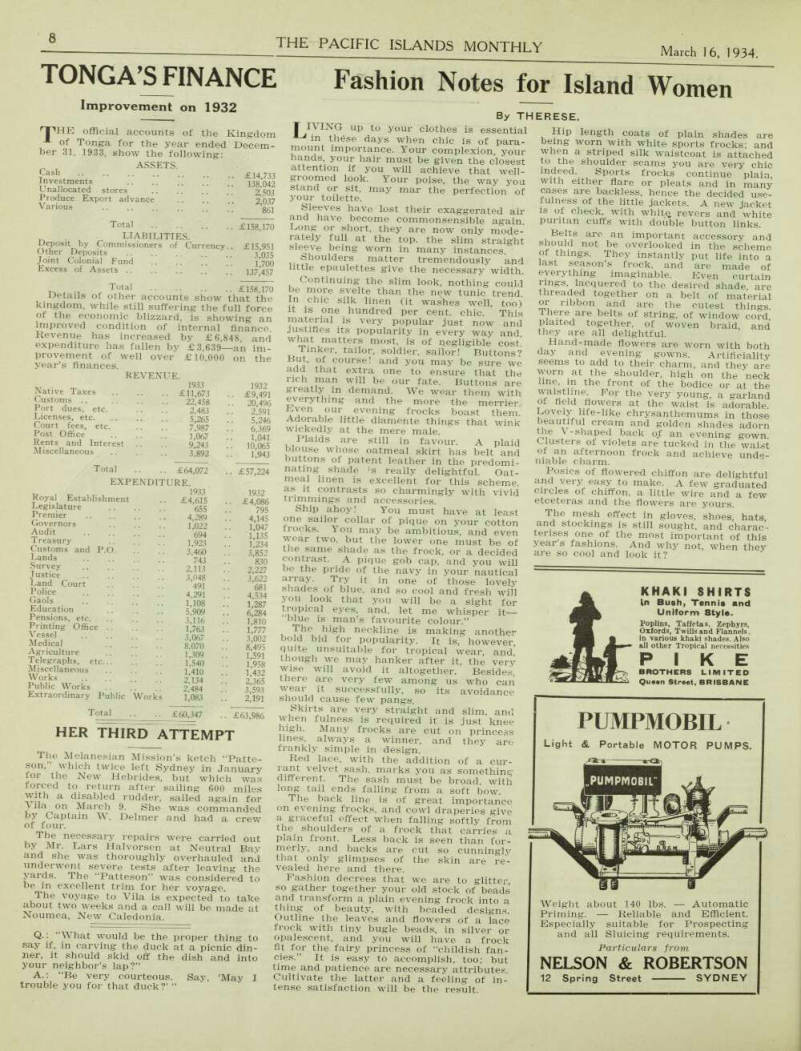
THE official accounts of the Kingdom of Tonga for the year ended December 31, 1933, show the following:
Details of other accounts show that the kingdom, while still suffering the full force of the economic blizzard, is showing an improved condition of internal finance.
Revenue has increased bv £6,848, and expenditure has fallen by £3,639—an im provement of well over £10,000 on the year’s finances.
Assets.
Cash Investments . £14,733 . 138,042 2,503 2,037 861 Unallocated stores Produce Export advance Various Total . £158,170 Liabilities.
Deposit by Commissioners of Currency., Other Deposits . £15,951 3,035 1,700 137,457 Joint Colonial Fund Excess of Assets ..
Total £158,170
Revenue.
Native Taxes Customs ..
Port dues, etc. . 1933 £11,673 22,458 2,483 1932 £9,491 .. 20,496 2,591 Licenses, etc. 5,265 6,369 1,041 .. 10,065 1,943 Court fees, etc. 7,987 Post Office 1,067 Rents and Interest 9,243 Miscellaneous 3,892 Total £64,072 .. £57,224
Expenditure.
Royal Establishment Legislature Premier Governors Audit Treasury 1933 £4,615 655 4,289 1,022 694 1,923 1932 .. £4,086 795 4,145 1,047 1,135 1,234 3,852 830 • • 2.227 3,622 681 4,534 1,287 6,284 1,810 1,777 3,002 8,495 1,591 1,958 1,432 2,365 3,593 2,191 Customs and P.O.
Lands Survey Justice Land Court Police Gaols Education Pensions, etc. 3,460 743 2,113 3,048 491 4,291 1,108 5,909 3,116 Printing Office ..
Vessel Medical Agriculture 1,763 3,067 8,070 1,309 Telegraphs, etc... 1,540 Miscellaneous Works Public Works 1,410 2,134 2,484 Extraordinary Public Works 1,083 Total £60,347 .. £63,986
Her Third Attempt
The Melanesian Mission’s ketch “Patte son, which twice left Sydney in January for the New Hebrides, but which was forced to return after sailing 600 miles with a disabled rudder, sailed again for Vila on March 9. She was commanded by Captain W. Delmer and had a crew of four.
The necessary repairs were carried out by Mr. Lars Halvorsen at Neutral Bay and she was thoroughly overhauled and underwent severe tests after leaving the yards. The “Patteson” was considered to be in excellent trim for her voyage.
The voyage to Vila is expected to take about two weeks and a call will be made at Noumea, New Caledonia.
Q.: “What would be the proper thing to say if, in carving the duck at a picnic din gier, it should skid off the dish and into your neighbor’s lap?”
A.: “Be very courteous. Say, ‘May I trouble you for that duck?’ ”
Fashion Notes for Island Women
By Therese.
LIVING up to your clothes is essential in these days when chic is of para mount importance. Your complexion, your hands, your hair must be given the closest attention if you will achieve that well groomed look. Your poise, the way you stand or sit, may mar the perfection of your toilette.
Sleeves have lost their exaggerated air and have become commonsensible again.
Long or short, they are now only mode rately full at the top. the slim straight sleeve being worn in many instances. shoulders matter tremendously and little epaulettes give the necessary width.
Continuing the slim look, nothing could be more svelte than the new tunic trend.
In chic silk linen (it washes well, too) it is one hundred per cent. chic. This material is very popular just now and justifies its popularity in every way and what matters most, is of negligible cost.
Tinker, tailor, soldier, sailor! Buttons?
But, of course! and you may be sure we add that extra one to ensure that the rich man will be our fate. Buttons are greatly in demand. We wear them with everything and the more the merrier Even our evening frocks boast them.
Adorable little diamente things that wink wickedly at the mere male.
Plaids are still in favour. A plaid blouse whose oatmeal skirt has belt and buttons of patent leather in the predomi nating shade is really delightful. Oatmeal linen is excellent for this scheme, as it contrasts so charmingly with vivid trimmings and accessories.
Ship ahoy! You must have at least one sailor collar of pique on your cotton frocks. You may be ambitious, and even wear two, but the lower one must be of the same shade as the frock, or a decided contrast. A pique gob cap, and you will be the pride of the navy in your nautical array. Try it in one of those lovely shades of blue, and so cool and fresh will you look that you will be a sight for tropical eyes, and. let me whisper it — "blue is man’s favourite colour.”
The high neckline is making another bold bid for popularity. It is, however quite unsuitable for tropical wear, and though we may hanker after it, the very wise will avoid it altogether. Besides, there are very few among us who can wear it successfully, so its avoidance should cause few pangs.
Skirts are very straight and slim, and when fulness is required it is just knee high. Many frocks are cut on princess lines, always a winner, and they are frankly simple in design.
Red lace, with the addition of a cur rant velvet sash, marks you as something different. The sash must be broad, with long tail ends falling from a soft bow.
The back line is of great importance on evening frocks, and cowl draperies give a graceful effect when falling softly from the shoulders of a frock that carries a plain front. Less back is seen than for merly, and backs are cut so cunningly that only glimpses of the skin are re vealed here and there.
Fashion decrees that we are to glitter so gather together your old stock of beads and transform a plain evening frock into a thing of beauty, with beaded designs.
Outline the leaves and flowers of a lace frock with tiny bugle beads, in silver or opalescent, and you will have a frock fit for the fairy princess of “childish fan cies.” It is easy to accomplish, too; but time and patience are necessary attributes.
Cultivate the latter and a feeling of in tense satisfaction will be the result.
Hip length coats of plain shades are being worn with white sports frocks; and when a striped silk waistcoat is attached to the shoulder seams you are very chic indeed. Sports frocks continue plain, with either flare or pleats and in many cases are backless, hence the decided use fulness of the little jackets. A new jacket is of check, with whitq revers and white puritan cuffs with double button links.
Belts are an important accessory and should not be overlooked in the scheme of things. They instantly put life into a last season’s frock, and are made of everything imaginable. Even curtain rings, lacquered to the desired shade are threaded together on a belt of material or ribbon and are the cutest things.
There are belts of string, of window cord plaited together, of woven braid, and they are all delightful.
Hand-made flowers are worn with both day and evening gowns. Artificiality seems to add to their charm, and they are worn at the shoulder, high on the neck line, in the front of the bodice or at the For the very young, a garland of field flowers at the waist is adorable.
Lovely life-like chrysanthemums in those beautiful cream and golden shades adorn the V-shaped back of an evening gown Clusters of violets are tucked in the waist of an afternoon frock and achieve unde niable charm.
Posies of flowered chiffon are delightful and very easy to make. A few graduated circles of chiffon, a little wire and a few etceteras and the flowers are yours.
The mesh effect in gloves, shoes, hats, and stockings is still sought, and charac terises one of the most important of this year’s fashions. And why not, when thev are so cool and look it?
Advertisements & other items, p. 10 (1 item)
Pumpmobil
KHAKI SHIRTS
In Bush, Tennis and Uniform Style.
Poplins, Taffetas, Zephyrs, Oxfords, Twills and Flannels, in various khaki shades. Also all other Tropical necessities
PIKE
BROTHERS LIMITED
Queen Street, BRISBANE
PUMPMOBIL
Light & Portable MOTOR PUMPS.
Weight about 140 lbs. Automatic Priming. Reliable and Efficient.
Especially suitable for Prospecting and all Sluicing requirements.
Particulars from
NELSON & ROBERTSON
12 Spring Street SYDNEY
Clashes With New Guinea Natives
Official Police Kill 19 When Seeking Murderers in “Uncontrolled” Areas
There has been a series of clashes between New Guinea administrative forces and wild bush natives in the region that lies north-west of the Morobe goldfield. One well-known mining man has been killed and, in a six hours’ battle between official police and the natives, 19 natives were killed. 17 wounded and District Officer E. Taylor and three of his native police were wounded by arrows.
NORTH-WESTWARD of the Morobe goldfield is the wild, rough, partly explored country that lies around the headwaters of three rivers—the Purari, which flows south-westward into Papua and on into the Gulf of Papua; the Ramu, which flows north-westward through New Guinea and reaches the sea far to the north of Madang; and the smaller Markham, which flows south-eastward into Huon Gulf. This region is labelled “uncontrolled” by the Administration; which means that Europeans enter it at their own risk.
During the past couple of years Euro peans have been pushing out into this country from the Morobe goldfield in in creasing numbers. It is believed that there is rich gold in the watersheds of the upper Purari and upper Ramu. The country, although officially uncontrolled, has been regarded as reasonably safe. It has been penetrated by a considerable number of prospectors and, since landing places have been cleared in various re mote spots, it has been flown over to an increasing extent by the aeroplanes which carry on the goldfields transport services, and keep in touch with prospectors.
In recent months, there was formed in Melbourne a company called Purari Al luvials (New Guinea), N.L., with head
quarters in Melbourne. This company recently sent to New Guinea a small prospecting expedition, led by Captain Ber nard McGrath, mining engineer. Captain McGrath lost no time in pushing through to the company’s claim on the Dunantima River, on the Purari Divide, north-west of Morobe. He was accompanied by a miner, Mr. Robert Dugan, and at least a dozen natives. Captain McGrath, at the end of February, reported to headquarters in Melbourne that he had reached the Du nantima (otherwise called the Karuma nantina) River, and that he expected to commence boring operations immediately.
It was reported that an option had been given to an influential company and an agreement posted.
The next development was tragic. On February 17, while Mr. Dugan and some of the native laborers were absent, Cap tain McGrath and the remainder of his natives were suddenly attacked by a large party of bush natives, and the leader was killed. Some of his laborers escaped.
The first news of the tragedy appears to have come from Messrs. Mick and Dan Leahy, well-known prospectors, who are leading a prospecting expedition in that region. They had found the body of Captain McGrath. It was then reported
that Mr. Dugan was missing, and it was feared that he had been killed. Imme diately thereafter Cadet T. H. Aitchison, in charge of a small patrol, met Leahy Bros.’ expedition, and they jointly appear to have made some move against the hos tile natives.
Immediately he got the news, District Officer E. Taylor flew from Salamaua, over the affected district. He located the camp of Mr. Aitchison and Messrs. Leahy, and communicated with them by signal, and was informed that Mr. Dugan was safe with them.
D.O. Taylor immediately organised a small expedition, consisting of himself, Cadet Black and 16 native police, and they joined the party led by Cadet Aitchi son and Messrs. Leahy.
(Continued overleaf.)
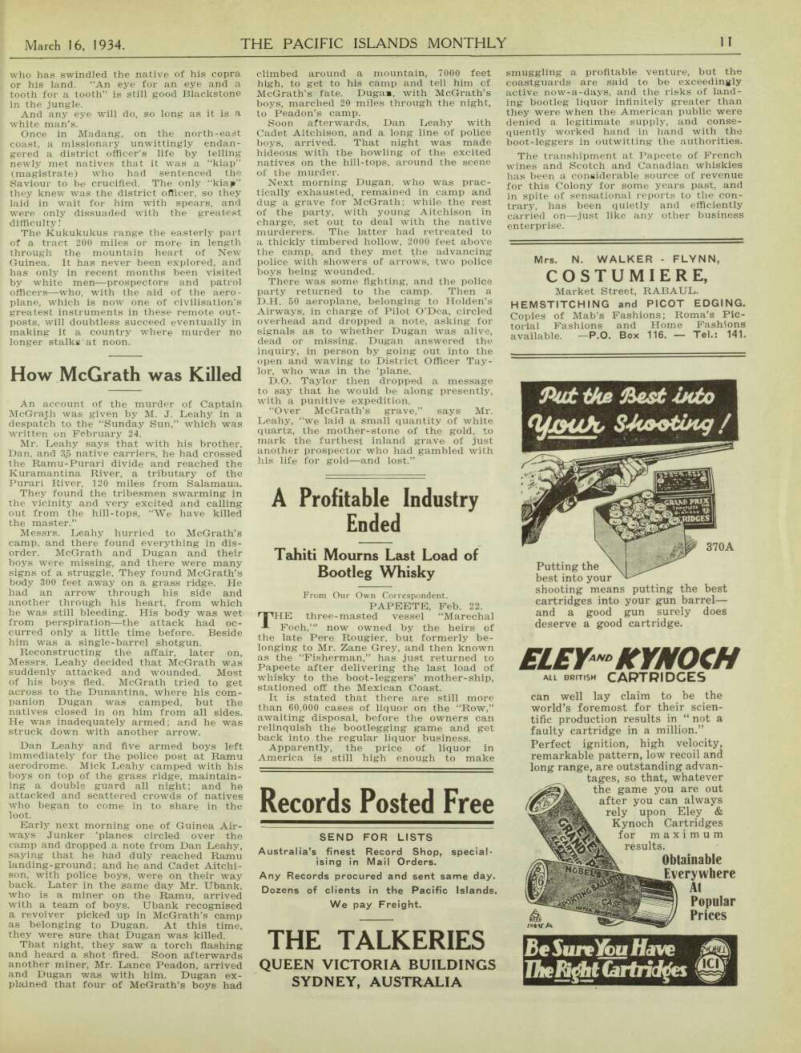
Mr. Mick Leahy.
Some other miners gave assistance; and the whole party then advanced to deal with the native position as it had developed.
They appear immediately to have met with hostility, and they soon found the bush natives in a natural stronghold, to which they retreated with every indica tion that they intended to offer resist ance.
D.O. Taylor, skilfully assisted by Messrs. Leahy and the two young Cadets, deployed his police so that he was able to confine the natives to their stronghold, and attack them there. This was on Feb ruary 22—only five days after Captain McGrath was murdered.
The fight lasted for six hours. The natives used only their primitive weapons, but they were present in large numbers and they fought with great resolution.
The official party, however, gradually overwhelmed them, and, finally, after suffering severe losses, the natives sur rendered.
It was then found that 19 bush natives had been killed and 17 wounded. District Officer Taylor and three of his native police were wounded by arrows, but not seriously.
The bush natives then obeyed instruc
tions to report at the Government camp; and D.O. Taylor held an official enquiry into the whole of the circumstances sur rounding the murder of Captain McGrath and the subsequent fighting. It is un ders f ood that, as a result, certain natives were taken into custody.
Cadet Black, with a force of 10 native police, remained in the locality; and D.O.
Taylor and his party returned to the coast.
The latest report was that the natives had returned to their villages and normal conditions prevailed.
The Minister for Territories, Major C. W.
C. Marr, warmly praised the achievement of D.O. Taylor. “He is one of our most reliable and trustworthy officers,” said Major Marr. “He was sent from Kokopo to take charge of the Morobe district be cause of his great experience, tact and ability.” Mr. Marr laid emphasis on the fact that the district in which the fight occurred is officially labelled “uncon trolled,” and Europeans enter it at their own risk.
Our Rabaul correspondent referring to this matter, praises the good service given to the Administration on this and other occasions, by Messrs. Leahy.
The Melbourne office of Purari Alluvi als, N.L., has been advised of Captain
McGrath’s death; and Mr. J. O’Neill, who was formerly associated with Captain McGrath, has been instructed to take charge of the expedition.
Previous Attack
Writing in the Melbourne “Star” on February 21, Mr. Alan W. Dawes says: The exact scene of the murder of Ber nard McGrath, the latest victim, is not indicated in messages from Rabaul, but it is reported that it is in the same area as that in which the prospector Eric Baum met his death in 1931, and in which the Leahy brothers were attacked about a year ago.
Baum was clubbed to death by the Kukukukus, the most savage natives in New Guinea. They felled him with stone clubs after some trifling argument about payment for food supplies—yams and taro —they were bringing to his camp.
They cut off his head and opened up his body, and danced triumphantly around it.
His native carriers—“boys” from distant parts—stood apart shivering with fear and surrounded by menacing Kukukukus, who, on a sudden impulse, leapt upon them also with spears and clubs. Only three of the 12 natives escaped.
The country which the intractable Kukukukus people occupy is perhaps the roughest in the world. The broken moun tains are torn with bottomless gorges hidden treacherously by the calamus bound jungle, and boiling torrents foam turgidly through crevasse-like valleys.
The Kukukuku warriors roam these mountain fastnesses, garbed from head to toe in strange capes of tapa cloth and in short grass petticoats like those the women wear in more accessible parts of the Territory.
The most unaccountable feature of many of these murders at the hands of natives is their apparent motivelessness.
A white man who has seemingly done no harm and threatened no harm is sud denly spitted with a black palm spear or savaged with a club, while a surging throng of natives yell their approval and delight.
The fact is that the motive is often deep-seated and logical only from the simple viewpoint of the savage. One white man is as good as another to mur der when revenge for some ancient wrong is sought, and the innocent often suffers for the guilty—the recruiter who has forced unwanted labour upon a tribe, the degenerate who has not scrupled to seize a native woman, the weakling who has allowed his native servants to pillage and rape in their progress through the vil lages, the unscrupulous trader or planter
who has swindled the native of his copra or his land. “An eye for an eye and a tooth for a tooth” is still good Blackstone in the jungle.
And any eye will do, so long as it is a white man’s.
Once in Madang, on the north-east coast, a missionary unwittingly endan gered a district officer’s life by telling newly met natives that it was a “kiap” (magistrate) who had sentenced the Saviour to be crucified. The only “kiap" they knew was the district officer, so they laid in wait for him with spears, and were only dissuaded with the greatest difficulty!
The Kukukukus range the easterly part of a tract 200 miles of more in length through the mountain heart of New Guinea. It has never been explored, and has only in recent months been visited by white men—prospectors and patrol officers —who, with the aid of the aero plane, which is now one of civilisation’s greatest instruments in these remote out posts, will doubtless succeed eventually in making it a country where murder no longer stalks at noon.
Advertisements & other items, pp. 11-12 (1 item)
Stromberg-Carlson
When Visiting Sydney
Send a Wire to
LESSEY’S
Drive Yourself
Box 8, Post Office,
PADDINGTON,
and an up-to-date car will meet you at the boat, which you can hire on very reasonable terms to
DRIVE YOURSELF.
Head Office and Service Station at
RUSH CUTTER’S BAY
(Near Stadium). Tel.; F 3196.
Radio Address: “Lessey’s,” Paddington, Sydney.
Stromberg-Carlson
SUPERHETERODYNES
Inquiries relating to these famous Superheterodynes should be sent to Noyes Bros. (Sydney), Ltd., who will be pleased to supply illustrated folders and full details of their range of Broadcast Receivers, including the new Battery Operated Receivers 403 & 704. Full stocks of every class of radio component parts carried.
NOYES BROS. [Sydney] Ltd.
Wholesale Distributors 115 Clarence Street, SYDNEY. Showrooms: 78 Clarence Street, SYDNEY. ’Phone: B 7581 (10 lines) 11 WATT STREET, NEWCASTLE. ELIZABETH STREET, BRISBANE.
KODAK PHOTOGRAPHY FOR ALL
at NEW
POPULARITY PRICES
KODAK MEETS THE TIMES!
A Campaign for the Further Popularity of Photography !
To enable thousands more to take up this delightful hobby, Kodak has reserved stocks of these two high-grade models and while they last, will release them at GIFT PRICES !
Folding Hawk-Eyes Pocket Kodaks From Get yours
for
Easter.
FROM
FOLDING HAWK-EYES
POCKET KODAKS For pictures 2¼ x 3¼ inches: For pictures z\ x 3 i inches: No. 2> Rapid Rect ilinear Lens, 23/6 No. 1, Meniscus Achromatic, 26/- No. 1, f/7,9 Kodar Lens - 32/- For pictures z\x 4! inches: For pictures z\ x inches: No. 2A, Meniscus Achromatic 24/6 No. iA, Meniscus Achromatic, 28/- No. 2A, Rapid Rectilinear Lens 26 6
OF ALL KODAK DEALERS, AND
KODAK (Australasia) PTY LTD.
379 GEORGE STREET, SYDNEY. And all States.
New Britain Express Delivery.
GENERAL OVERSEAS AGENTS.
GENERAL CARRIERS, BAGGAGE AGENTS
and FORWARDING AGENTS.
Reliable Cars and Trucks.
We aim to give quick and reliable Service at reasonable costs. P.O. Box 116. Telephone 141.
W. WALKER-FLYNN, Proprietor, Market Street, Rabaul, T.N.G.
GOSHEN PRIVATE
HOSPITAL
(Sister E. W. TEAMAN),
37 Gloucester Road,
Hurstville, Sydney
General and Private Wards. Spacious Grounds. High and Cool Situation.
Moderate Fees.
How McGrath was Killed
An account of the murder of Captain McGrath was given by M. J. Leahy in a despatch to the “Sunday Sun,” which was written on February 24.
Mr. Leahy says that with his brother, Dan, and 35 native carriers, he had crossed the Ramu-Purari divide and reached the Kuramantina River, a tributary of the Purari River, 120 miles from Salamaua.
They found the tribesmen swarming in the vicinity and very excited and calling out from the hill-tops, “We have killed the master.”
Messrs. Leahy hurried to McGrath’s camp, and there found everything in dis order. McGrath and Dugan and their boys were missing, and there were many signs of a struggle. They found McGrath’s body 300 feet away on a grass ridge. He had an arrow through his side and another through his heart, from which he was still bleeding. His body was wet from perspiration—the attack had oc curred only a little time before. Beside him was a single-barrel shotgun.
Reconstructing the affair, later on, Messrs. Leahy decided that McGrath was suddenly attacked and wounded. Most of his boys fled. McGrath tried to get across to the Dunantina, where his com panion Dugan was camped, but the natives closed in on him from all sides.
He was inadequately armed; and he was struck down with another arrow.
Dan Leahy and five armed boys left immediately for the police post at Ramu aerodrome. Mick Leahy camped with his boys on top of the grass ridge, maintain ing a double guard all night; and he attacked and scattered crowds of natives who began to come in to share in the loot.
Early next morning one of Guinea Air ways Junker ’planes circled over the camp and dropped a note from Dan Leahy, saying that he had duly reached Ramu landing-ground; and he and Cadet Aitchi son, with police boys, were on their way back. Later in the same day Mr. Ubank, who is a miner on the Ramu, arrived with a team of boys. Ubank recognised a revolver picked up in McGrath’s camp as belonging to Dugan. At this time, they were sure that Dugan was killed.
That night, they saw a torch flashing and heard a shot fired. Soon afterwards another miner, Mr. Lance Peadon, arrived and Dugan was with him. Dugan ex plained that four of McGrath’s boys had
climbed around a mountain, 7000 feet high, to get to his camp and tell him of McGrath’s fate. Dugap, with McGrath’s boys, marched 20 miles through the night, to Peadon’s camp.
Soon afterwards, Dan Leahy with Cadet Aitchison, and a long line of police boys, arrived. That night was made hideous with the howling of the excited natives on the hill-tops, around the scene of the murder.
Next morning Dugan, who was prac tically exhausted, remained in camp and dug a grave for McGrath; while the rest of the party, with young Aitchison in charge, set out to deal with the native murderers. The latter had retreated to a thickly timbered hollow, 2000 feet above the camp, and they met the advancing police with showers of arrows, two police boys being wounded.
There was some fighting, and the police party returned to the camp. Then a D.H. 50 aeroplane, belonging to Holden’s Airways, in charge of Pilot O’Dea, circled overhead and dropped a note, asking for signals as to whether Dugan was alive, dead or missing. Dugan answered the inquiry, in person by going out into the open and waving to District Officer Tay lor, who was in the ’plane.
D.O. Taylor then dropped a message to say that he would be along presently, with a punitive expedition.
“Over McGrath’s grave,” says Mr.
Leahy, “we laid a small quantity of white quartz, the mother-stone of the gold, to mark the furthest inland grave of just another prospector who had gambled with his life for gold—and lost.”
A Profitable Industry
Ended Tahiti Mourns Last Load of Bootleg Whisky
From Our Own Correspondent.
Papeete, Feb. 22.
THE three-masted vessel “Marechal Foch,”’ now owned by the heirs of the late Pere Rougier, but formerly be longing to Mr. Zane Grey, and then known as the “Fisherman,” has just returned to Papeete after delivering the last load of whisky to the boot-leggers’ mother-ship, stationed off the Mexican Coast.
It is stated that there are still more than 60,000 cases of liquor on the “Row,” awaiting disposal, before the owners can relinquish the bootlegging game and get back into the regular liquor business.
Apparently, the price of liquor in America is still high enough to make
smuggling a profitable venture, but the coastguards are said to be exceedingly active now-a-days, and the risks of land ing bootleg liquor infinitely greater than they were when the American public were denied a legitimate supply, and conse quently worked hand in hand with the boot-leggers in outwitting the authorities.
The transhipment at Papeete of French wines and Scotch and Canadian whiskies has been a considerable source of revenue for this Colony for some years past, and in spite of sensational reports to the con trary, has been quietly and efficiently carried on—just like any other business enterprise.
Advertisements & other items, p. 13 (1 item)
Records Posted Free
Mrs. N. WALKER - FLYNN,
COSTUMIERE,
Market Street, RABAUL.
HEMSTITCHING and PICOT EDGING.
Copies of Mab’s Fashions; Roma’s Pictorial Fashions and Home Fashions available. —P.O. Box 116. Tel.: 141.
370 A Putting the best into your shooting means putting the best cartridges into your gun barrel— and a good gun surely does deserve a good cartridge.
ELEYKYNOCH
ALL BRITISH CARTRIDGES
can well lay claim to be the world’s foremost for their scientific production results in “ not a faulty cartridge in a million.”
Perfect ignition, high velocity, remarkable pattern, low recoil and long range, are outstanding advantages, so that, whatever the game you are out after you can always rely upon Eley & Kynoch Cartridges for maximum results.
Obtainable
Everywhere
At
Popular
Prices Be Sure You Have The Right Cartridges
Records Posted Free
SEND FOR LISTS
Australia's finest Record Shop, specialising in Mail Orders.
Any Records procured and sent same day.
Dozens of clients in the Pacific Islands.
We pay Freight.
THE TALKERIES
QUEEN VICTORIA BUILDINGS
SYDNEY, AUSTRALIA
Tropicalities
Mr. Gordon Sinclair, The Canad-
ian junior reporter, concerning whose libellous rubbish on Papua and New Guinea we said a few words last year, has been “Footloose in India.” That is the title of a book he has written, after fully eleven days spent in the ancient Empire. He does not think very much of India or the Indians, and he is quite illit erately scornful, at their expense. He decides that the romance of the immem orial east is a "‘washout,” and that he must “de-bunk” India; and he does it with the finest collection of American slang ever seen in one volume. It is a priceless example of puppyish journal ism, lacking either use or ornament, but probably it will amuse some of the illiter ate millions of North America. Perhaps the best comment on the book is provided by a photograph of the author him self. We see the young gentleman beautifully posed, hands on slim hips, open necked shirt, a sun-helmet on his head and a holster, containing a real revolver, around his waist. He spent an hour jeer ing at Gandhi; and he used his revolver to take pot-shots at turtles from the top of the Taj-Mahal. “A Hoodlum In India” would be a better title.
THIS occurred recently in a town in South Queensland: During the year the class had been given a lesson on the habits and customs of the Pacific Islands natives. On the occa sion of the periodical visit of the inspec tor, this subject came up for question and the following information was proffered by a promising lad, much to the chagrin of the school master: “The Pacific Island er eats very little and has an empty look.
When he beats on his tum-tum, it makes a hollow sound, which can be heard for miles.” A bright young thing, gifted with a sense of humour, blushed and giggled.
KINDLY little letters from friends all over the world, bearing witness to the interest and value of the P.I.M., are frequently received, but are not publicly acknowledged, for obvious reasons. There is one letter to hand in the last mail, however, over which we must publicly compliment ourselves.
Mr. J. C. Barley, the newly appointed Administrator of the Gilbert and Ellice Colony, recently received congratulations on his appointment from an old friend who has been wandering in out-of-the way places in Europe. This friend says that he learned of Mr. Barley’s new move from a copy of the “Pacific Islands Monthly” which he happened to pick up in the ante-room of a German doctor’s place in Berlin. Mr. Barley kindly re marks that this is somewhat startling evidence of the very considerable circula tion of the P.I.M.
As a matter of fact, the P.I.M. now has a surprisingly large circulation in Great Britain, Germany, Holland, Prance, the Far East and the United States. Not long ago a London firm advertised a special brand of whisky for sale. Writing to us recently, they said that they thought they were advertising to secure Pacific Is lands business; and they naturally were astonished to receive replies to their ad vertisement from residents of the western States of America. It just happened that the advertisement received publicity at the time that U.S.A. abandoned prohibi tion, and people in America were looking for sources from which they might secure regular whisky supplies.
ALL the civil-service superannuation schemes in Australia and M.L. have been described, at one time or another, as “actuarily unsound”; and Papua has come into the picture. During the last two financial years nearly £7000 has had
to be appropriated from general revenue to meet pensions, and if all retired who are entitled to retire another £12,000 would be required in the first year. The fund was launched in 1917. One officer paid £590 into it. He has retired on a pension of £530; and he is still a com paratively young man.—Sydney Bulletin.
IN reply to a good deal that has appeared in Australian newspapers lately on the subject of refractory natives Mr. J. T.
Bensted, late Director of Public Works in Papua, made an effective point. Writing to the “Sydney Morning Herald” on Janu ary 25, he said: “I think the answer to these complaints, or criticisms, may be found in the fact that the white man and his wife and children were not molested in this manner in the early days, nor was it found necessary to inflict corporal punishment upon one’s servants or em ployees. Then there was far less ‘protec tion’—no town patrols or European con stables, and the residences were more isolated—yet there was an entire absence of the class of offence now complained of.
In the opinion of many, who by experience should know, the cause of the present trouble is to be found in the conduct of many of the residents themselves, and the cure in the same direction.”
There is no doubt that immeasurable harm to white prestige has been done in the Islands by “cheap whites,” who adopt an attitude of easy familiarity with na tives; and also by cheap politicians who try to put into practice their mad-headed notion that all men are equal, irrespective of quality, colour or education.
IRRESPONSIBLE makers of talkies have joined irresponsible journalists in libelling the Pacific Islands. An American mass producer of travel pictures, Mr.
Fitzpatrick, has given us a film on Papua; and Sydney audiences have recently been informed in cinema fashion that, except for a strip along the coast, Papua is in habited by headhunters and cannibals.
The other day Sir Hubert Murray, Lieut.- Governor of Papua, who may fairly claim that a white man armed with a walking stick can walk in safety from one end of the Territory to the other, was in the audience and heard the fruity American gentleman “advertise” Papua, His Excel lency is a philosopher, and therefore merely looked pained. If he had been an ordinary Australian, he would have used language likely to cast aspersions upon the picture-producers’ parentage—and no one would have blamed him.
Holden’S Air Transport
At a directors’ meeting of Holden’s Air Transport Services Ltd. (New Guinea), held on February 28 in Sydney, a divi dend of 2s. per share was declared. This is regarded as a very gratifying result of operations by a very young concern.
Advertisements & other items, p. 14 (2 items)
Durabestos
BUILD NOW WITH DURABESTOS
Island Homebuilders can now erect an everlasting Home easily and economically by using “DURABESTOS” (Asbestos Cement) Building Sheets to line the exterior walls and interior walls and ceilings.
Economical to transport, easy to fix, and fireproof.
Send for Prices and Free Catalogue, “DURABESTOS HOMES OF colourful beauty," containing plans, designs and suggestions for Homebuilders.
WUNDERLICH LIMITED
BOX 474 AA, G.P.O., SYDNEY
DURABESTOS
BUILDING SHEETS
Inquiries.
W. M. FORD
SHIP, YACHT, AND BOAT BUILDER,
BERRY’S BAY, NORTH SYDNEY
(Established 1870.) BUILDERS of all kinds of Islands Craft from Dinghies to Auxiliary Schooners of any tonnage.
New and Second-hand Islands Craft of various types in stock.
PLEASE SEND ON YOUR
INQUIRIES.
On Sunny Norfolk Island
Macdhui Shows Them How-Some Distinguished Visitors and a Perfect Yacht
From Our Own Correspondent
Norfolk Island, Jan. 10.
AS idle as a painted ship upon a paint ed ocean,” the B.P. motor vessel Macdhui, diverted from her usual run for a tourist cruise, lay off our shores for 38 hours at New Year.
This is the first time that a visitor of such calibre has dared risk a night at anchor in our open waters, where weather conditions change as swiftly as woman’s mind and it is necessary to keep steam up and be ready to shift seaward at a moment’s notice. But Captain Rothery, commanding, and Captain Perry, serving for this special trip as chief officer, are familiar with local peculiarities, and were thus able to take risks that other com panies would not dare.
Not only did they allow their passeng ers to stay ashore for a most democratic dance at the Rawson Hall—attended by a large party from Government House and also by a muster of cooks, stewards and members of the crew of the Macdhui — but all night long, under a brilliant moon, over the sleeping sea, the dancers were transported to and fro without a splash to mar the splendour of fragile frocks and immaculate dress suits.
Laughter and song echoed over the water and strangely conjured up before the mental vision of the thoughtful on looker, pictures of other passengers com ing ashore a hundred years ago; rowing in over the same reef, coming alongside the same stone jetty. Gaunt, hollow eyed, wolfish convicts, shot with broad arrows, clanking with chains; landing never to sail again, but to work like driv en beasts as long as life might last under these alien skies and to die at last un cared for and unmourned —in many, many cases, upon the gallows that their own hands had helped to rear.
Notable Visitors
Among the visitors were the Premier of New South Wales and his family, snatch ing a hasty holiday, and they were enter tained at Government House, where Sir Hubert and Lady Murray were spending a few weeks in a climate a good deal more enjoyable than that of Papua at this time of year.
Sir Hubert has been quartering the is land with our own Administrator and has shown the keenest interest in the prob lems that beset Captain Pinney and his able staff. It must be intriguing for Sir Hubert to compare the bold, immense canvas of Papua, splashed in sheer black and white with the small intricate samp ler that is Norfolk —picked out in shades of varying green, patterned with pine trees and dotted with obstinate little human figures defying change and chal lenging every innovation.
He will have realised that at this par ticular stage of our development it may well be a more difficult task to take cau tious stitches in a sampler without dis turbing the balance and values of the whole design, than to make the sweeping gesture that introduces another shining band of white among the prevailing dark ness of his own territory.
New Zealand Yacht
For ten days past the little auxiliary yacht Morewa, just off the stocks in Auckland, and built for cruising among
the Pacific Islands, has been lying in turn off every anchorage around Norfolk. She really ran down here merely to try out her engines and to secure her ocean-go ing ticket- —if that is what you call it; but her owners, Mr. and Mrs. Macarthur, are having such a good time on the is land exchanging hospitalities with New Zealanders resident here that they can not persuade each other to leave.
Everybody interested in yachts or strangers has been welcome aboard and has come ashore again deeply envious and dissatisfied with their own drab lot.
Not only is the vessel herself a beautiful job—comparable, in the opinion of a resi dent yachtsman of world wide experience, to the best of her size and anywhere in English or American waters —a credit
to her builders, the Wilde Brothers, of Auckland —but her internal fittings are wonderful. There are electric stoves and refrigeration, a powerful wireless set, both for sending and receiving, a comprehensive library, and a baby cinema in stallation for the projection of pictures taken by Mrs. Macarthur as they wander about.
One can imagine no more agreeable lotus life than idling perpetually upon the deck of the Morewa while she sails in and out and round about the beautiful isles and islets of the blue Pacific.
To us, left sorting beans and grading bananas in exchange—as often as not — for debit notes, it is a picture calculated to turn us Bolshevik and Direct Action ists in a body.
Mr. M. Harper, a well-known trader and recruiter of Mandoliana, Solomon Islands, has purchased the A. V. Trader, a twin-screw vessel of 15 tons register, for use in connection with his work. As he now owns three small ships, he is known in his part of the Group as “Inch cape the Second.” Mr. Harper was in Sydney last year undergoing medical treatment, and appears to have made a complete recovery.
Advertisements & other items, pp. 15-16 (1 item)
Swallow & Ariell's
CANTERBURY
CAKES—
are
UNSURPASSED
Preserved Ginger, Sultana, Cherry Ripe, Genoa, Each Cake is enclosed, by special process, in air-tight tin, and is warranted to keep its condition for a considerable period.
Fruit, Plain, Seed, Plum.
Almond.
Delicia
Food Products
PURE MALT VINEGAR
TOMATO SAUCE
JELLY CRYSTALS
PURE FLAVOURING
ESSENCE
CHUTNEY
BAKED BEANS with Pork, in Tomato Sauce SPAGHETTI in Tomato Sauce
Delicia Food Products
Co.
DANKS STREET, WATERLOO,
N.S.W.
EXCELSIOR SUPPLY CO. LTD
The most extensive Manufacturers in the British Empire of
RUBBER STAMPS.
INKS, STENCILS.
Marking Devices.
ACME STAMP PADS
We have a big range of Special
FRUIT CASE MARKING SETS
We also Manufacture or Supply a complete line of
Spraying Machines
for all purposes.
Let us know your requirements end we will quote you by return. Ask for our Big Catalogue.
Sole Australasian Distributors of the World Famous SHEAFFER FOUNTAIN
PENS and PENCILS.
EXCELSIOR SUPPLY CO. LTD.
Head Office 160 GEORGE STREET WEST.
SYDNEY. N.S.W.
Papuan News
From Our Own Correspondent PORT MORESBY, January 19.
THE Port Morseby Golf Club held its an nual dinner on December 15, when the various cups won during the season were presented by the president. The Gore Cup was won by Mr. C. N. Perry, the Guttridge and Fitch Cups both fell to the prowess of Mr. Roy Field, while the Club Champion ship trophy went to Mr. E. B. Bignold.
The nine-hole course is improving very rapidly, and has been in good playing con dition during the whole of the season. The grass greens promise to be a great success, and already are a vast improvement on the stony surfaces which were responsible for so much poetic fervour two years ago.
Insect Collector
Miss L. E. Cheeseman, who for the last eight months has been making a collection of insects in the eastern parts of Papua for the British Museum, has completed her work at that end of the Territory, and went west by the “Papuan Chief” on December 2 to investigate the extensive coastal flats in the Gulf and Western Divisions.
Explorer Leaves Papua
Mr. J. W. Vandercook returned from his trip through the Purari Delta early in December, and left for the Solomon Islands via Rabaul. Mr. Vandercook, who was accompanied by his wife, secured a large number of unique photographs and expressed his satisfaction at having examined what he declares to be a unique district.
After seeing most of the delta systems of the world, Mr. Vandercook declares that there is nothing that can be compared with the Purari Delta in extent, in interest, or in the vast number of its navigable water ways.
He hopes to return to Papua after visiting the Solomons.
Native Village Destroyed
The native village of Aluguni, near Hula, some sixty miles south-east of Port Moresby, was completely destroyed by fire. No loss of life is reported, but many rare old carved timbers were destroyed, of a kind that is not produced in modern times.
On Mt. Albert Edward
Messrs. R. Archbold (mammalogist), A.
L. Rand (ornithologist) and L. J. Brass (botanist) have returned from their three weeks’ sojourn on the summit of Mount Albert Edward and have gone west to search for new specimens in the mainland round the region of the Fly River. New specimens were found by each of these scientists on Mount Albert Edward, and the party were delighted by the climate and surroundings.
At an elevation of over 13,000 ft. they experienced frost practically every night, and found the scenery unique in its variety and beauty.
Whitten Bros., Ltd.
Port Moresby Store Sold
From Our Own Correspondent
Port Moresby, Jan. 19.
IT was with genuine regret that the older inhabitants of Port Moresby learned that the local branch of Whitten Brothers Limited has changed hands, and that the well-known name is to be with drawn from the business premises which have known it for so many years.
William Whitten came out on the “Governor Blackall’’ with Sir Peter Scratchley, first Administrator of Papua, in 1885. He soon left the Government service, attracted by trading prospects to the east, and sailed his own schooner among the islands and along the coast of the mainland round and beyond Samarai.
As trade and settlement progressed, William Whitten established a store at Samarai and was joined by his brother, R. F.
Whitten, the present manager of the business, about 1893.
The Whittens were intimately concerned with the development of the Yodda goldfield. For many years they undertook the greater part of the transport between the Yodda and the coast, recruited labourers for work on the field, and established branch stores first at Buna on the coast, and later on the Yodda itself. They were always the friends of the miners, and have helped and grubstaked many a man who was at the end of his tether; and the firm has more acts of generosity to its credit than any other business concern in the history of the Territory.
William Whitten died some 20 years ago, since when the whole of the firm’s interests, which are extensive, have been cared for by R. F. Whitten, a popular and trusted figure whom Port Moresby residdents will be sincerely sorry to lose.
Mr. Whitten will carry on his Samarai business, which he has not sold.
M.V. Malaita On Sydney-Solomons-Rabaul Run
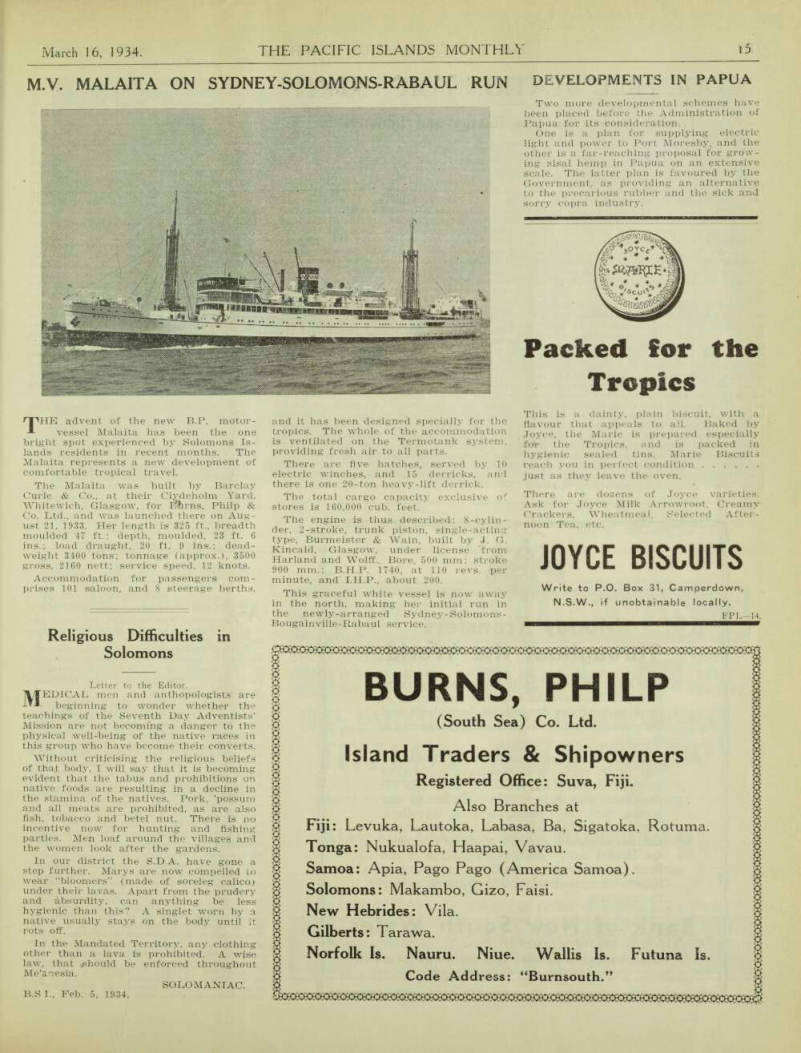
THE advent of the new B.P. motor vessel Malaita has been the one bright spot experienced by Solomons Is lands residents in recent months. The Malaita represents a new development of comfortable tropical travel.
The Malaita was built by Barclay Curie & Co., at their Clydeholm Yard, Whitewich, Glasgow, for Bbrns, Philp & Co. Ltd., and was launched there on Aug ust 21, 1933. Her length is 325 ft., breadth moulded 47 ft.; depth, moulded, 23 ft. 6 ins.; load draught, 20 ft. 9 ins.; dead weight 3400 tons; tonnage (approx.), 3500 gross, 2160 nett; service speed, 12 knots.
Accommodation for passengers com prises 101 saloon, and 8 steerage berths,
and it has been designed specially for the tropics. The whole of the accommodation is ventilated on the Termotank system, providing fresh air to all parts.
There are five hatches, served by 10 electric winches, and 15 derricks, and there is one 20-ton heavy-lift derrick.
The total cargo capacity exclusive of stores is 160,000 cub. feet.
The engine is thus described: 8-cylin der, 2-stroke, trunk piston, single-acting type, Burmeister & Wain, built by J. G.
Kincaid, Glasgow, under license from Harland and Wolff. Bore, 500 mm; stroke 900 mm.; B.H.P. 1740, at 110 revs, per minute, and I.H.P., about 200.
This graceful white vessel is now away in the north, making her initial run in the newly-arranged Sydney-Solomons- Bougainville-Rabaul service.
Solomons
Religious Difficulties in Solomons
Letter to the Editor.
MEDICAL men and anthopologists are beginning to wonder whether the teachings of the Seventh Day Adventists’
Mission are not becoming a danger to the physical well-being of the native races in this group who have become their converts.
Without criticising the religious beliefs of that body, I will say that it is becoming evident that the tabus and prohibitions on native foods are resulting in a decline in the stamina of the natives. Pork, ’possum and all meats are prohibited, as are also fish, tobacco and betel nut. There is no incentive now for hunting and fishing parties. Men loaf around the villages and the women look after the gardens.
In our district the S.D A. have gone a step further. Marys are now compelled to wear “bloomers” (made of soreleg calico,) under their lavas. Apart from the prudery and absurdity, can anything be less hygienic than this? A singlet worn by a native usually stays on the body until it rots off.
In the Mandated Territory, any clothing other than a lava is prohibited. A wise law, that should be enforced throughout Me’anesia.
Solomaniac.
B.S.I., Feb. 5, 1934.
Developments In Papua
Two more developmental schemes have been placed before the Administration of Papua for its consideration.
One is a plan for supplying electric light and power to Port Moresby, and the other is a far-reaching proposal for grow ing sisal hemp in Papua on an extensive scale. The latter plan is favoured by the Government, as providing an alternative to the precarious rubber and the sick and sorry copra industry.
Advertisements & other items, p. 17 (1 item)
Burns, Philp
Packed (or the
Tropics
This is a dainty, plain biscuit, with a flavour that appeals to all. Baked by Joyce, the Marie is prepared especially for the Tropics, and is packed in hygienic sealed tins. Marie Biscuits reach you in perfect condition just as they leave the oven.
There are dozens of Joyce varieties.
Ask for Joyce Milk Arrowroot, Creamy Crackers, Wheatmeal, Selected Afternoon Tea, etc.
JOYCE BISCUITS
Write to P.O. Box 31, Camperdown, N.S.W., if unobtainable locally.
FPL—I4.
BURNS, PHILP
(South Sea) Co. Ltd.
Island Traders & Shipowners Registered Office: Suva, Fiji.
Also Branches at Fiji : Levuka, Lautoka, Labasa, Ba, Sigatoka, Rotuma.
Tonga : Nukualofa, Haapai, Vavau.
Samoa: Apia, Pago Pago (America Samoa).
Solomons: Makambo, Gizo, Faisi.
New Hebrides: Vila.
Gilberts: Tarawa.
Norfolk Is. Nauru. Niue. Wallis Is. Futuna Is.
Code Address: “Burnsouth.”
Cool Hill Station For Tahiti
Tourist Association Has Energy and Initiative
From Our Own Correspondent
Papeete, Feb. 4.
THE annual general meeting of the Syndicate D'Initiative (Tourist Association) was held recently in the Mairie at Papeete. His Excellency Gouverneur Montagne was present by invitation. The attendance was a representative one and included the Mayor of Papeete (Mr.
George Bambridge), the Commandant and Officers of the training ship Zeelee, and most of the business men of the community.
Monsieur L’Herbier, who succeeded the late Pere Rougier as President of the Association, presented a resume of operations covering the preceding twelve months. In the course of this he stated that the Tourist Bureau established on the wharf at Papeete had amply justified its expense by the good work already accomplished. Foreign tourists unacquainted with the French language were now able to secure assistance in passing their baggage through the Customs, and in other formalities of entry. They could also get reliable information as to what accommodation was available ashore.
With regard to the various Committees charged with special branches of the Association's work, the President said that these were functioning satisfactorily, and
he particularly laid stress on the results achieved by the Committee des Strang ers. Under the stimulus of propaganda, and of prizes offered by the Association and by private donators, this Committee had been successful in arousing the en thusiasm of the natives in the work of beautifying their districts. In some localities, flower gardening had become a craze, unsightly fences were being re placed with hedges of coloured plants, and flowering trees planted along the roadside. This sort of work took time and effort and the importance of it from a tourist standpoint was not easy to bring home to the native mind. A splendid beginning had been made, the value of which would become more apparent as tlme went on.
At this juncture a letter was read from the Committee des Etrangers drawing at tention to the mutilation of shade trees along the water front and other places in Papeete, which was stated to be neces sary for extension of the telephone sys tern and for drainage improvements. It was decided to discuss this question with the municipal authorities and endeavour to find a solution.
On the question of a suitable site for a hill station, the President said that after
several ineffectual excursions into differ ent parts of the Island a location had been decided upon near Mount Touhi, where, at an altitude of 900 metres, there was sufficient land and water available for the carrying out of the project. The ap proach to this plateau would be from a point in the Punaavia district about 12 kilometres from Papeete. No bridges would be necessary and he was advised that there existed no great obstacles to the construction of an automobile road when funds were available for the pur pose. In the meantime a bridle track could be cut on an easy gradient at no great expense.
Several minor matters having been dis posed of, M. L’Herbier dealt with the financial situation of the Association which, considering the present economic difficulties throughout the world and the general falling off of all business, he re garded as a satisfactory one. After allo cating a portion of the available funds for various purposes, there would still re main a substantial cash balance, which it was proposed to contribute towards the expense of deepening the Papeete Pass, so that large tourist vessels could enter with safety: he anticipated that the work would be completed during the coming year.
H.E. The Gouverneur, who has shown great interest in the various projects of the Association for the development of the Colony’s tourist resources, made a sympathetic response on the matters which had been raised at the meeting.
He said that it was intended to take up the important work of deepening the Pa peete Pass at an early date, and arrange ments for a bridle track to the proposed hill station were also under way.
“Co-Habiting”
From Our Own Correspondent.
Rarotonga, Jan. 27.
ANOTHER co-habiting case involving a European, was brought to court recently. This makes the third recent pro secution of the kind.
Native co-habiting cases are too nu merous to mention. A choice of marriage in two weeks, or a fine, is the sentence; and, times being as they are, marriage is usually selected.
Some, queer unions are being formed, which can bring nothing but trouble later on. Many of these unconventional mat ings happen more through necessity than affection. A youth from an outer island, say, often gets in touch with a much older woman who cooks and washes for him, quite happy in having a man about the kainga to chop wood, etc. Neither has any intention of making a lasting union —she knowing quite well that when he can afford it he will arrange a marriage with a girl of his own age and kind. Then the police arrive, and the result is a hasty wedding, in preference to facing court and a 25/- fine.
EDITORIAL NOTE. —So far as we know, the N.Z. administration in the Cook Islands is the only Pacific authority which attempts to enforce a “cohabiting” law; and to that extent the N.Z.
Government is ridiculous. There would be some justification for preventing promiscuousness be tween Europeans and natives; but the effort to impose our ideas of Victorian morality upon the Polynesian people themselves is ludicrous. The Polynesians, all through the ages, have permitted a casual relationship between unmarried men and women, and —as residents of these islands well know —official attempts to prevent it lead only to hypocrisy and nastiness. The thing is not stopped, but is driven underground, and an evil is created thereby where none need exist.
Advertisements & other items, p. 18 (1 item)
Money Transfers
Throughout the World
The Bank of New South Wales makes complete facilities available for the transaction of banking business throughout Australasia and between Australia and all other parts of the world.
The Bank establishes commercial credits by mail or by cable. It issues drafts and makes money transfers by letter or telegraph. It negotiates and collects Bills of Exchange and issues, for the convenience of travellers, Letters of Credit available all over the world.
Exchange quotations direct on all countries are issued daily and trained officers of the Bank are always available to advise customers on matters relating to overseas money transactions.
Bank of New South Wales
(ESTABLISHED 1817)
with which the Western Australian Bank and The Australian Bank of Commerce Ltd. are amalgamated. 67
Respected Missionary Retires
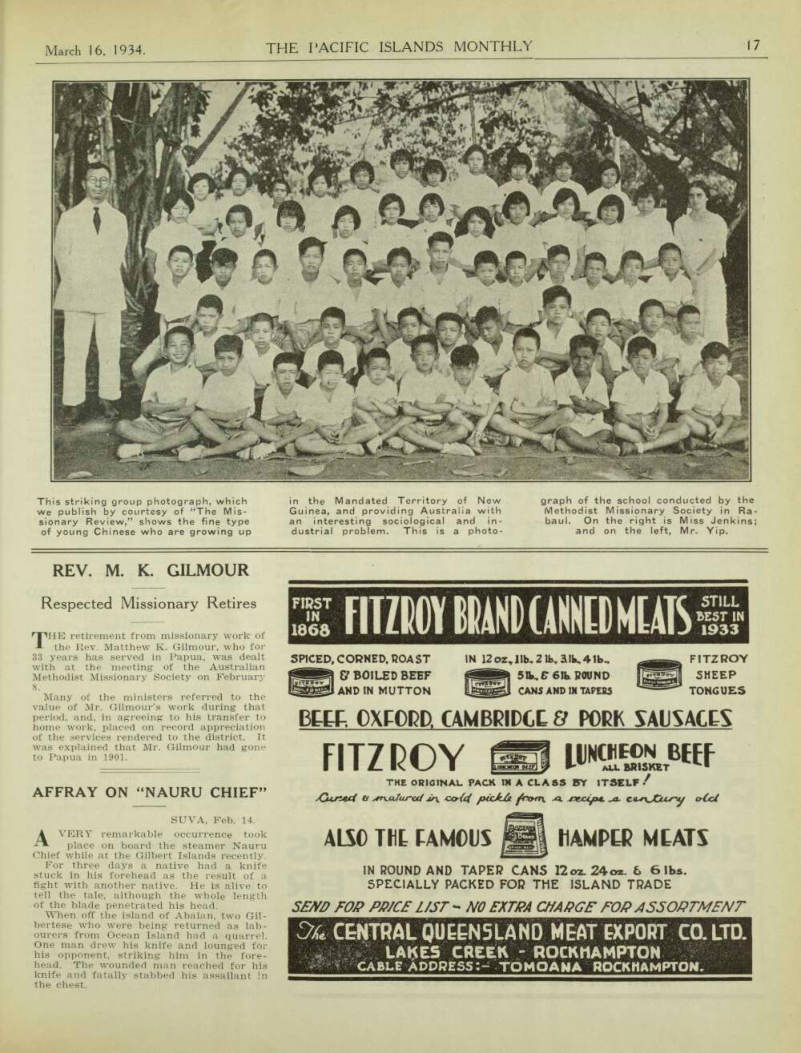
Rev. M. K. Gilmour
THE retirement from missionary work of the Rev. Matthew K. Gilmour, who for 33 years has served in Papua, was dealt with at the meeting of the Australian Methodist Missionary Society on February 8.
Many of the ministers referred to the value of Mr. Gilmour’s work during that period, and, in agreeing to his transfer to home work, placed on record appreciation of the services rendered to the district. It was explained that Mr. Gilmour had gone to Papua in 1901.
This striking group photograph, which we publish by courtesy of “The Mis sionary Review,” shows the fine type of young Chinese who are growing up
in the Mandated Territory of New Guinea, and providing Australia with an interesting sociological and in dustrial problem. This is a photo-
graph of the school conducted by the Methodist Missionary Society in Ra baul. On the right is Miss Jenkins; and on the left, Mr. Yip.
Affray On “Nauru Chief”
Suva, Feb. 14.
AVERY remarkable occurrence took place on board the steamer Nauru Chief while at the Gilbert Islands recently.
For three days a native had a knife stuck in his forehead as the result of a fight with another native. He is alive to tell the tale, although the whole length of the blade penetrated his head.
When off the island of Abaian, two Gil bertese who were being returned as lab ourers from Ocean Island had a quarrel.
One man drew his knife and lounged for his opponent, striking him in the fore head. The wounded man reached for his knife and fatally stabbed his assailant in the chest.
Advertisements & other items, p. 19 (1 item)
Fitzroy
FIRST
IN 186 ft
STILL
BEST IN
1933
SPICED, CORNED. ROA ST
& BOILED BEEF
AND IN MUTTON
IN 12 oz y 11b, 2 lb, Slk, 4lb„
CANS AND IN TAPEBS
FITZROY
SHEEP
TONGUES
EKE OXFORD. CAMBBILCL 8 PCKK SAISACtS
FITZROY
THE ORIGINAL PACK W A CLASS BY ITSELF
ALSO THt EAMOUS
HAMPER MEATS
IN ROUND AND TAPER CANS 12oz. 240 z. 6 6 lbs.
SPECIALLY PACKED FOR THE ISLAND TRADE
SEND FOP PP/CF L/ST - NO EXTPA FOP ASSORTMENT DU CENTRAL QUEENSLAND MEAT EXPORT CO. LTD.
LAKES CREEK - ROCKHAMPTON
CABLE ADDRESS:- TOMOANA ROCKHAMPTON,
Japanese Shell Poachers
How Evil Has Grown In and Around Torres Straits
ANOTHER of the fast and elusive Japanese shell-poaching sampans was reported in Torres Straits on January 31.
It disappeared, at high speed, when sighted.
The representative of the “Melbourne Herald,” writing from Darwin in January, supplied the following summary of the position in and around the western end of Torres Straits:— The decision of the Federal Government to station a seaplane permanently at Dar win to check the activities of foreign poachers in northern waters draws atten tion to the great amount of poaching that has been done in recent years.
The first attempt to poach on a big scale was detected in 1931, when a white man in Darwin applied for a licence for a pearl ing lugger. When his application was re fused, because it was believed that he was only dummying for a Japanese diver, this diver left Darwin with the lugger for which the white man had applied for a licence, and from headquarters at the Aroe Islands, fished the Bathurst Island grounds for that season. His success was imme diately followed up by a Japanese com pany, which fitted out at the Caroline islands two big 30-ton luggers, twice the size of any boats operating in Darwin, and through the 1932 season joined the other Japanese in poaching at Bathurst Island.
Prices Fall
Last year two more 30-tonners from Prahoe in the Caroline Islands appeared on the beds, and as each 30-tonner worked four divers the fleet took such a quantity of shell that there was a big fall in price when it was marketed at the same time as the shell fished by the Darwin fleet. This fleet of five was reinforced by five other boats, Dutch-owned, from the Aroe Islands, making the poaching fleet 10.
Darwin pearlers fear that this year they will be faced with competition from at least 20 poaching luggers because word has been received from divers in the Aroe Islands poaching boats that the Celebes Island Trading Company, which owns the
pearling concession at the Aroe Islands, intends to build 10 big fast luggers to fish the new rich beds recently found off Bathurst Island.
Raids On Camps
There is also a possibility that other lug gers will be built at the Caroline Islands, so in that case the poaching fleet will far outnumber the Darwin fleet. Pearling, Customs and inlmigration authorities in the past three years found themselves unable to check poaching because there was not available in Darwin a boat fast enough to surprise the poachers at anchorage in ter ritorial waters and catch them before they gained the safety of the high seas.
Half a dozen raids were made on the shore camps of the poachers on Bathurst and Melville Islands, but the only success was the seizure of about six tons of shell in a poacher’s camp. On all other occa sions the raiding boat with officials on board was sighted and outdistanced.
Trafficking In Lubras
Some of these raids were made following complaints by the Roman Catholic Mission at Bathurst Island that the Japanese were openly trafficking in lubras in mission ter ritory. These complaints were borne out when, in one raid, the police surprised the crews of Darwin boats with lubras on board. These Japanese were subsequently fined in Darwin.
Mission authorities state that it is the usual practice for both poaching and Dar win crews to fraternise with the natives when they return to their camps on Bathurst Island when the tides are too strong on the pearling grounds, and a great number have native women whom they have purchased from the tribes there.
Darwin pearlers believe that an aerial patrol will effectively put a stop to the poaching because the fear of arrest and seizure of boats found in territorial waters should be sufficient to deter poachers from venturing ashore. Without the respite of a shore camp, they doubt whether the crews will face a spell of several months at sea 200 miles from their headquarters.
Northern Shell Beds Ruined
theft of pearl-shell from Austra lian waters by Japanese poachers is assuming serious proportions; and is at this moment the subject of an inter national discussion.
So many fast, well-equipped Japanese vessels have come down from the Caro line Islands and the East Indies to the coasts of the Mandated Territory, Papua, and the Solomons, and have carried off so
much pearl-shell, both mature and imma ture, that the beds have been practically ruined for years to come. This develop ment has taken place at a time when the European planters have been hard hit by the slump in copra prices and many of them were counting on a certain supply of shell to help them over the depression.
Representations of a most urgent char acter have been made to the Federal Gov ernment. It has been disclosed, for in stance, that the well-known Manus firm of Kramer and Burrows, which held an important contract with Messrs. W. R.
Carpenter & Co. Ltd., for the supply of shell, has had to inform the latter firm that it cannot carry out its contract, be cause Japanese poachers have been along the Manus coast and carried away all the shell that is worth while, and virtually destroyed the beds. Messrs. Kramer and Burrows, as a result, find their living gone and they are asking whether they should not look to the Mandatory (the Commonwealth Government) for compen sation.
Early in March, it was reported in Ra baul that a strange seaplane had been sighted over the Witu Islands (which lie off the north coast of New Britain, some 200 miles west of Rabaul). A steamer, so far unidentified, was also cruising in the vicinity. There is little doubt that this is another Japanese poaching expedi tion. The Japanese are using very mod ern equipment and, apparently, the sea plane is used to locate the best fishing reefs.
The “Pacific Islands Monthly” has asked the Federal authorities for a state ment, but none is forthcoming. We un derstand that discussions of an important character have been proceeding for some time with the British and Japanese Gov ernments, and that the Commonwealtn authorities do not wish to disturb their progress by making any public state ments at this stage.
Zane Grey In Tahiti
Seeking A Record
From Our Own Correspondent.
Papeete, Jan. 29.
MR. ZANE GREY, the celebrated big game fisherman, arrived in Papeete by the S.S. “Makura” on December 30 to make another attempt to catch monstrous sword-fish which are now known to exist in these waters.
Mr. Grey made his world record here when he landed a marlin of 1040 lbs. in 1930, which measured 14 ft. 2 ins. in length, and his fishing partner, the late Captain Mitchell, hooked and lost a much larger fish which he estimated at 22 to 23 ft., long.
There are native accounts of sword-fish 30ft. in length which are not to be lightly discarded, and this time Mr. Grey is bringing special tackle in the hope of landing one of them and thus putting up a new record.
Search Dutch N.G.
Australian Prospectors to Search Dutch N.G.
London correspondent of the Syd ney “Morning Herald” cabled in Feb ruary that an Australian gold-mining company, which is interested in prospect ing in Dutch New Guinea, has, it is un derstood, secured the co-operation of a committee of leading Dutch mining com panies. This was necessitated by a by law forbidding foreign prospecting on Dutch territory. The Australian negotia tor is reported to be proceeding to Am sterdam.
Advertisements & other items, p. 20 (1 item)
Prescott Ltp Sussex St Sydney
are sole wholesale agents for
PINEAPPLE BACON & HAMS
DAISY BRAND BUTTER
FRESCO BRAND BUTTER
LEA & PERRINS’ SAUCE
ANN CAIRD’S MARMALADE.
Strain Of Government In Tonga
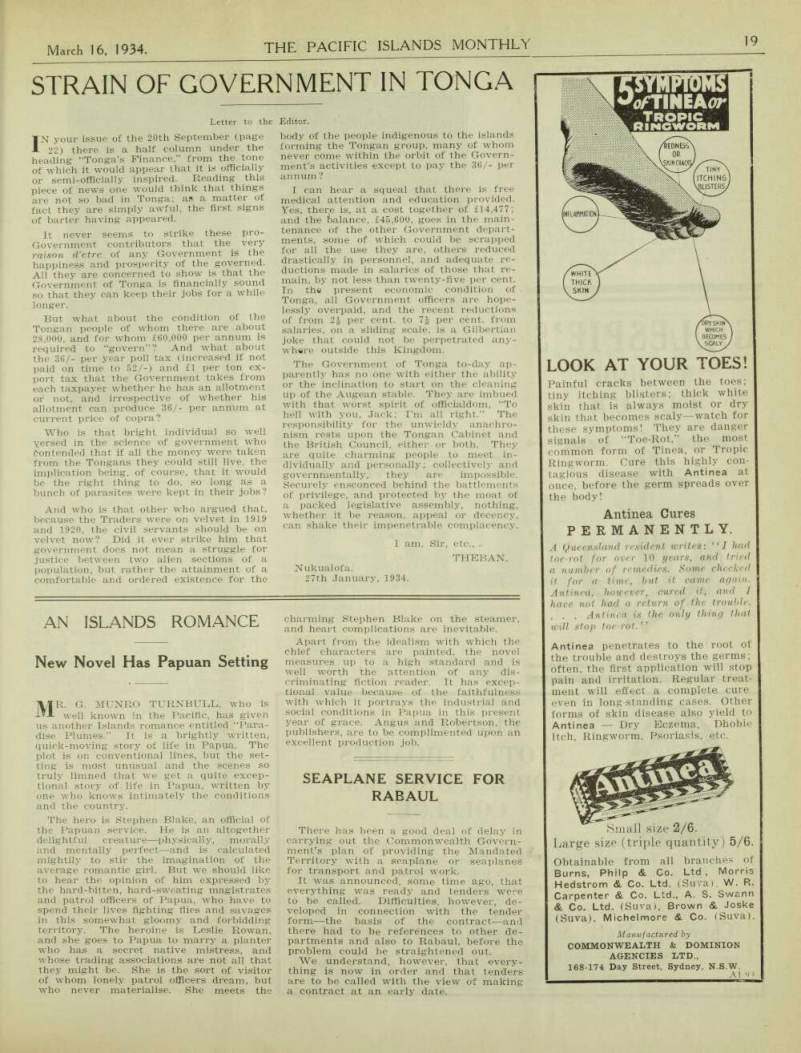
Letter to the Editor.
IN your issue of the 20th September (page 22) there is a half column under the heading “Tonga’s Finance,” from the tone of which it would appear that it is officially or semi-officially inspired. Reading this piece of news one would think that things are not so bad in Tonga; as a matter of fact they are simply awful, the first signs of barter having appeared.
It never seems to strike these pro- Government contributors that the very raison d’etre of any Government is the happiness and prosperity of the governed.
All they are concerned to show is that the Government of Tonga is financially sound so that they can keep their jobs for a while longer.
But what about the condition of the Tongan people of whom there are about 28,000, and for whom £60,000 per annum is required to “govern”? And what about the 36/- per year poll tax (increased if not paid on time to 52/-) and £1 per ton ex port tax that the Government takes from each taxpayer whether he has an allotment or not, and irrespective of whether his allotment can produce 36/- per annum at current price of copra?
Who is that bright individual so well yersed in the science of government who Contended that if all the money were taken from the Tongans they could still live, the implication being, of course, that it would be the right thing to do, so long as a bunch of parasites were kept in their jobs?
And who is that other who argued that, because the Traders were on velvet in 1919 and 1920, the civil servants should be on velvet now? Did it ever strike him that government does not mean a struggle for justice between two alien sections of a population, but rather the attainment of a comfortable and ordered existence for the
body of the people indigenous to the islands forming the Tongan group, many of whom never come within the orbit of the Govern ment’s activities except to pay the 36/- per annum ?
I can hear a squeal that there is free medical attention and education provided.
Yes, there is, at a cost together of £14,477; and the balance, £45,600, goes in the main tenance of the other Government depart ments, some of which could be scrapped for all the use they are, others reduced drastically in personnel, and adequate re ductions made in salaries of those that re main, by not less than twenty-five per cent.
In the present economic condition of Tonga, all Government officers are hope lessly overpaid, and the recent reductions of from 2½ per cent, to per cent, from salaries, on a sliding scale, is a Gilbertian joke that could not be perpetrated any where outside this Kingdom.
The Government of Tonga to-day ap parently has no one with either the ability or the inclination to start on the cleaning up of the Augean stable. They are imbued with that worst spirit of officialdom, “To hell with you, Jack; I’m all right.” The responsibility for the unwieldy anachro nism rests upon the Tongan Cabinet and the British Council, either or both. They are quite charming people to meet in dividually and personally; collectively and governmentally, they are impossible.
Securely ensconced behind the battlements of privilege, and protected by the moat of a packed legislative assembly, nothing, whether it be reason, appeal or decency, can shake their impenetrable complacency.
I am, Sir, etc.,
Theban.
Nukualofa. 27th January, 1934.
An Islands Romance
New Novel Has Papuan Setting
Mr. G. Munro Turnbull, Who Is
well known in the Pacific, has given us another Islands romance entitled “Para dise Plumes.” It is a brightly written, quick-moving story of life in Papua. The plot is on conventional lines, but the set ting is most unusual and the scenes so truly limned that we get a quite excep tional story of life in Papua, written by one who knows intimately the conditions and the country.
The hero is Stephen Blake, an official of the Papuan service. He is an altogether delightful creature —physically, morally and mentally perfect—and is calculated mightily to stir the imagination of the average romantic girl. But we should like to hear the opinion of him expressed by the hard-bitten, hard-sweating magistrates and patrol officers of Papua, who have to spend their lives fighting flies and savages in this somewhat gloomy and forbidding territory. The heroine is Leslie Rowan, and she goes to Papua to marry a planter who has a secret native mistress, and whose trading associations are not all that they might be. She is the sort of visitor of whom lonely patrol officers dream, but who never materialise. She meets the
charming Stephen Blake on the steamer, and heart complications are inevitable.
Apart from the idealism with which the chief characters are painted, the novel measures up to a high standard and is well worth the attention of any dis criminating fiction reader. It has excep tional value because of the faithfulness with which it portrays the industrial and social conditions in Papua in this present year of grace. Angus and Robertson, the publishers, are to be complimented upon an excellent production job.
Seaplane Service For
Rabaul
There has been a good deal of delay in carrying out the Commonwealth Govern ment’s plan of providing the Mandated Territory with a seaplane or seaplanes for transport and patrol work.
It was announced, some time ago, that everything was ready and tenders were to be called. Difficulties, however, de veloped in connection with the tender form—the basis of the contract—and there had to be references to other de partments and also to Rabaul, before the problem could be straightened out.
We understand, however, that every thing is now in order and that tenders are to be called with the view of making a contract at an early date.
Advertisements & other items, p. 21 (1 item)
Look At Your Toes!
ITCHING
WHITE
THICK
SKIN
LOOK AT YOUR TOES!
Painful cracks between the toes; tiny itching blisters; thick white skin that is always moist or dry skin that becomes scaly—watch for these symptoms! They are danger signals of “Toe-Rot,” the most common form of Tinea, or Tropic Ringworm. Cure this highly contagious disease with Antinea at once, before the germ spreads over the body!
Antinea Cures
PERMANENTLY.
A Queensland resident writes : “I had toe-rot for over 10 years, and tried a number of remedies. Some checked it for a time, hut it came again.
Antinea, however, cured it, and I have not had a return of the trouble. . . Antinea is the only thing that will stop toe-rot."
Antinea penetrates to the root of the trouble and destroys the germs; often, the first application will stop pain and irritation. Regular treatment will effect a complete cure even in long-standing cases. Other forms of skin disease also yield to Antinea Dry Eczema, Dhobie Itch. Ringworm, Psoriasis, etc.
Small size 2/6.
Large size (triple quantity) 5/6.
Obtainable from all branches of Burns, Philp & Co. Ltd, Morris Hedstrom & Co. Ltd. (Suva). W. R.
Carpenter & Co. Ltd., A. S. Swann & Co. Ltd. (Suva), Brown & Joske (Suva). Michelmore & Co. (Suva).
Manufactured by
COMMONWEALTH & DOMINION
AGENCIES LTD.,
168-174 Day Street, Sydney, N.S.W,
What Native Caddies
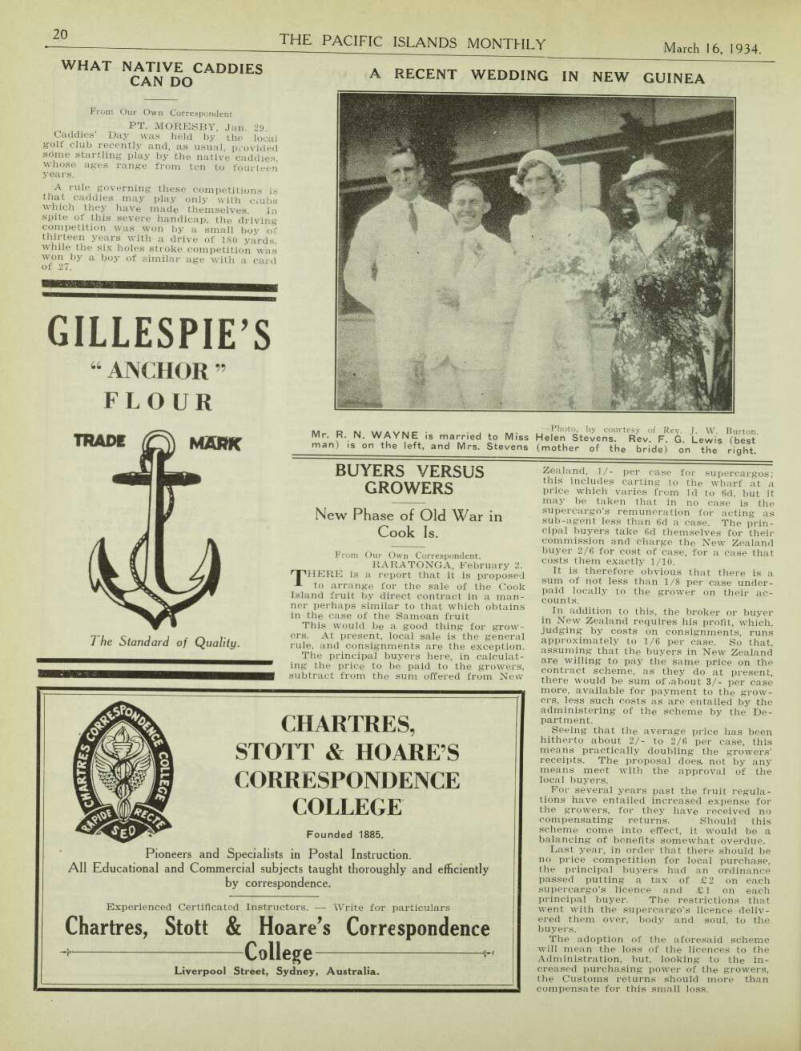
Can Do
From Our Own Correspondent
Pt. Moresby, Jan. 29.
Caddies Day was held by the local golf club recently and, as usual, provided some startling play by the native caddies whose ages range from ten to fourteen years.
A rule governing these competitions is that caddies may play only with clubs which they have made themselves. In spite of this severe handicap, the driving competition was won by a small boy of thirteen years with a drive of 180 yards, while the six holes stroke competition was won by a boy of similar age with a card of 27.
A Recent Wedding In New Guinea
-Photo, by courtes y of Rev. J. W. Burton.
Mr. R. N. WAYNE is married to Miss Helen Stevens. Rev. F. G. Lewis (best man) is on the left, and Mrs. Stevens (mother of the bride) on the right.
Growers
Buyers Versus
New Phase of Old War in Cook Is.
From Our Own Correspondent.
RARATONGA, February 2.
THERE is a report that it is proposed to arrange for the sale of the Cook Island fruit by direct contract in a man ner perhaps similar to that which obtains in the case of the Samoan fruit.
This would be a good thing for grow ers. At present, local sale is the general rule, and consignments are the exception.
The principal buyers here, in calculat ing the price to be paid to the growers, subtract from the sum offered from New
Zealand, 1/- per case for supercargos; this includes carting to the wharf at a price which varies from 1d to 6d, but it may be taken that in no case is the supercargo’s remuneration for acting as sub-agent less than 6d a case. The prin cipal buyers take 6d themselves for their commission and charge the New Zealand buyer 2/6 for cost of case, for a case that costs them exactly 1/10.
It is therefore obvious that there is a sum of not less than 1/8 per case under paid locally to the grower on their ac counts.
In addition to this, the broker or buyer in New Zealand requires his profit, which, judging by costs on consignments, runs approximately to 1/6 per case. So that, assuming that the buyers in New Zealand are willing to pay the same price on the contract scheme, as they do at present, there would be sum of .about 3/- per case more, available for payment to the grow ers, less such costs as are entailed by the administering of the scheme by the De partment.
Seeing that the average price has been hitherto about 2/- to 2/6 per case, this means practically doubling the growers’ receipts. The proposal does, not by any means meet with the approval of the local buyers.
For several years past the fruit regula tions have entailed increased expense for the growers, for they have received no compensating returns. Should this scheme come into effect, it would be a balancing of benefits somewhat overdue.
Last year, in order that there should be no price competition for local purchase, the principal buyers had an ordinance passed putting a tax of £2 on each supercargo’s licence and £1 on each principal buyer. The restrictions that went with the supercargo’s licence deliv ered them over, body and soul, to the buyers.
The adoption of the aforesaid scheme will mean the loss of the licences to the Administration, but, looking to the in creased purchasing power of the growers, the Customs returns should more than compensate for this small loss.
Advertisements & other items, p. 22 (1 item)
Gillespie's
“ANCHOR”
FLOUR
TRADE
MARK
The Standard of Quality.
CHARTRES,
STOTT & HOARE’S
CORRESPONDENCE
COLLEGE
Founded 1885.
Pioneers and Specialists in Postal Instruction.
All Educational and Commercial subjects taught thoroughly and efficiently by correspondence.
Experienced Certificated Instructors. Write for particulars Chartres, Stott & Hoare’s Correspondence
College
Liverpool Street, Sydney, Australia.
Hon. H. Champion, C.B.E.
Fine Record of Senior Papuan Official
From Our Own Correspondent PT. MORESBY, January 30.
ON January 1, the many friends of the Hon. H. W. Champion were delighted to learn that he had been included in the New Year’s Honours List, and given the rank of Commander in the Order of the British Empire in recognition of his many years of valuable work in the Public Ser vice of Papua.
Mr. Champion came to Port Moresby in the service of Burns, Philp and Co. in May, 1898, and abandoned his position with that firm on March 1, 1902, to join the Papuan Public Service as Government Storekeeper.
In 1905 he assumed also the duties of Ac countant to the Treasury, and served as Acting Treasurer from December of that year.
He is one of the original members of the Executive Council as re-constituted in September, 1906, under the provisions of the Papua Act of 1905. He was made Treasurer on January 1, 1908, and per formed the duties of the Government Sec retary during that officer’s absence on leave in 1911. Early in May, 1914, he was transferred permanently to the Govern ment Secretary’s Department as Acting Government Secretary, and was confirmed in that position on February 12, 1916.
During the eighteen years that Mr.
Champion has filled the position of Govern ment Secretary he has also been a member of the Lands Board, and has acted tem porarily as Commissioner for Lands, as suming that position permanently on July, 1933, in addition to his duties as Govern ment Secretary.
He has also been Acting Administrator and Acting Lieutenant-Governor, for twelve separate periods, since 1915.
During his 32 years of public service, Mr. Champion has enjoyed the complete confidence of the Lieutenant-Governor, of the officers under his control, and of all residents in the Territory. As Govern ment Secretary he has played an import ant part in organising the many success ful patrols which have brought so much honour to the Magisterial Department of Papua. To him is due a large share of credit for the efficiency of the Native Armed Constabulary; and the general spirit of faith and loyalty which actuates the officers under his control is in great measure the result of his tactful and ef ficient administration of his important department.
Mr. Champion has three sons, two of whom are in the Papuan Service and carrying on its high traditions as would be expected of them. One of them, Ivan Champion, accompanied Karius on his famous patrol up the Fly River to its source and across the almost impassable tableland which forms the heart of New Guinea, down through quite unknown country to the headwaters of the Sepik River and out to the north-east coast.
Taking all elements into consideration, this was one of the most successful achievements in the whole history of Aus tralian exploration: and Ivan Champion’s book on the subject has had wide sales in England and Australia.
Mr. Champion himself is still a com paratively young man, and has many years of useful work ahead of him.
In offering him their sincere congratu lations on the honour accorded to him. his many friends in Papua hope that he will continue to hold for many more years his position in a Service which could ill af ford to lose him.
Combating Cruel Rites
Missionary’s Work In New Britain
SOME barbaric customs of New Britain natives were described by Rev. V.
H. Sherwin, Melanesian Missionary at Sag Sag, New Guinea, before he left Syd ney in February by the “Ormonde” on his way to London on furlough.
“I found that 100 per cent, of the par ents killed their first born, because they believed that, if it lived, it would be come bewitched, and that all disease was due to witchcraft,” he said. “So, for the sake of the children to follow, the first was sacrificed, by placing the infant in a hole and crushing its life out with a stone.
Wives who lost their husbands insisted on being strangled, so that they could enter the spirit land with him.
“To-day only about 15 per cent, of the parents in the mission district slay their first born; and the other practices of sui cide and head-hunting are decreasing.”
Mr. Sherwin told how children, from a week old, have their heads tightly bound with tapa cloth, to produce an elongated skull —a mark of native beauty. The ef fect, however, was to cause malformation of the brain.
This intrepid missionary has been working 200 miles distant from the near est District Office. The natives there never saw a white man until they saw
him. He has been their physician, health inspector, and teacher, as well as min ister.
Perhaps his greatest coup was when he won over to Christianity the chief of all the territory among the 30 villages in his district. To-day the chief’s son is a worker beside Mr. Sherwin, and there are hopes that this young native will become an ordained minister.
Under the missionary’s guidance the natives are being taught to eat more health-giving food; to observe sanitation laws; and to give up their superstitions, some of which are dying hard. The chil dren are also being taught the simpler elements of Christianity.
Mr. Sherwin will return to his work after furlough. He will, however, have a white companion, for the Bishop of Melanesia has laid it down that hence forth each minister must be accompanied to remote districts by a lay missionary.
Advertisements & other items, p. 23 (1 item)
Paint
“STILLHOLME”
Convalescent and Rest Home
81 MUSTON ST., MOSMAN
SYDNEY
Sunny Rooms, Verandahs, Harbour Views, Lawns.
Centrally Situated, handy to Trams, Ferries, and City.
Sisters RAINSFORD and HILL Y 1655.
DOCKERS
SUN BRAND
PAINT
Made expressly to keep a lustrous, full gloss finish
against the varying con-
ditions of moist weather exposure, and prevent the decaying ravages of rain and extreme heat by
giving a long lasting pro-
tection to all surfaces.
SUN PROOF
RAIN PROOF
*Stronger than the Weather”
W. R. CARPENTER
& CO. LTD.
New Guinea, Solomon Islands, n and all other South Sea Islands.
How Four Women Were
Their Amazing Luck!
How Four Women Were Rescued
SUVA, February 14.
IT was a lucky thing for four Fijian female fishers that Mr. Alfred Lee, of the Public Works Department, took his launch a short cut over the coral flats, en route to Waidoi, along the south coast from Suva.
When about seven miles from Suva, Mr.
Lee noticed what at first looked like “horses’ heads” on the main reef. These are sharp outcrops of coral. As he drew closer he saw that they were human heads.
There was no sign of a boat or canoe and the tide was coming in strongly over the reef, on which the seas broke savagely.
He altered the course and soon found that four native women were standing up to their necks in water. They were taken on board, and said that they were fishing on the reef and did not notice that their boat had drifted away. They were just able to keep their heads above water, and their position was desperate, as the main land was a considerable distance away. Mr.
Lee conveyed them to safety.
New Hebrides
Financial Crisis In
French Government Anxious About Commitments
CONFIDENTIAL information to hand from the New Hebrides indicates that economic conditions in the Condo minium are bad.
The group, as is well-known, depends largely for its sustenance on the products of the plantations—mostly copra and cocoa, with a fair amount of cotton —and those are the products which are suffer ing so badly to-day on the world’s mar kets. In consequence, planters have suf fered severely.
Furthermore, there have been compli cating factors in the New Hebrides. Dur ing the boom years—and partly during the period when Britain was on the gold standard—the French were very eager to purchase plantations from the British.
The prices they offered were high and many sales took place, with the natural result that French financial and commer cial predominance in the group became more marked.
Not only has the price of copra and
cocoa fallen to calamitous levels, but the primary producers thus affected are suf fering from the fact that, while Britain and other nations have abandoned the gold standard, France is adhering to it.
Another complicating factor lies in the responsibility of the French Government for French investments in the Condomin ium. During the good years the Admin istration assisted its nationals in finance to a marked extent.
The net result of it all is that the French Government and the Bank of In do-Chine have heavy obligations in the New Hebrides and, owing to the slump, there is very little prospect of their get ting their money back. Practically none of the planters can pay interest, let alone principal, and, in fact, some of them have difficulty in meeting the bare cost of liv ing.
An important official recently arrived in the New Hebrides from France to take whatever action was necessary. Our in formation is that he found an economic situation that caused him alarm; with the result that the steamer Bucephale was sent specially to Noumea to bring the French Governor of the Condominium to Bila. He was expected there early in March.
Some of the big French trading firms have gone into liquidation during the past three years. Others, with greater re serve strength, have survived the crisis; but one of the biggest of them is severely affected by New Hebrides conditions, and a very drastic overhaul of its internal or ganisation is now proceeding.
“Tagua” In Tahiti
From Our Own Correspondent.
Papeete, Jan. 7.
THE Cook Island schooner “Tagua” ar rived in Papeete recently with a load of copra for shipment to London by the next Messageries steamer. The ves sel is now on the slip at Fareute under going her periodical overhaul, after which she will proceed to Penrhyn and the Northern Islands of the Cook Group.
Our old friend, Capt. Andy Thomson, is still in command.
Advertisements & other items, p. 24 (2 items)
Ransomes
SHIP CHANDLERY
W. Kopsen & Co. Limited
Manufacturers of PIONEER BRAND ASH OARS AND IMPLEMENT HANDLES.
Sole Agents for: KOPSEN’S SPECIAL YELLOW METAL SHEATHING AND NAILS.
Large Stocks of Chains, Anchors, Manilla and Wire Ropes, Wood and Iron Blocks, Oakum, Tar, Pitch, Oils, Paints, Leads, Zincs, Varnishes, Shackles, Rigging, Screws, Sheathing, Felt, Lampware, etc.
Special Under Bond Prices for Island trade.
68-70 CLARENCE STREET, SYDNEY
Cables: “Kopsen.” ’Phone: BW 1114-5
The popular
light steel
"THE VICTORY”
Combines maximum strength with minimum weight and draught. Turns a furrow up to 6ins. deep by 10ins. wide.
Weight, 851bs.
We also supply numerous other types of ploughs and implements meeting all requirements, as well as lawn mowers, aerodrome equipment,, steam engines, boilers, etc.
Illustrated Catalogues and all information on application.
Agents for: Fiji, Samoa, and Tonga:
MORRIS, HEDSTROM, LTD.,
Suva, Lautoka, and Ba.
RANSOMES, SIMS & JEFFERIES,
LTD.,
IPSWICH. :: ENGLAND
Ransomes
PLOUGHS
and
IMPLEMENTS
The Robert Bruce.
CERTAIN PILE REMEDY.
Has been tested and proved completely successful In scores of long-standing cases.
THE LABORATORY,
20 and 22 Napoleon Street, Sydney, March 14th, 1933
ROBERT BRUCE, Esq.
Dear Sir, —The formula of your pile cure submitted to me could have no effect other than beneficial. I gave your sample to a Client who had suffered many years, and before he had used half the bottle he reported himself completely cured.
Faithfully yours,
GROVE JOHNSON, F.C.S; (Lond.),
Analytical and Consulting Chemist.
Obtainable from the following Chemists:—W. G.
Cains, Ltd., 51 Pitt St., Sydney; McCredie’s Drug Stores, 3828 Pitt St., Sydney; M. N. Tomlin, 148 Blue’s Point Rd., Sydney; M. McCallum, 101 George St. West, Sydney; A. E. Sharpe, 197 Oxford St., Sydney; Redmond-Fuss, 665 George St., Sydney; Ward Smith, 62 Miller St., North Sydney; H. J. Parker, 94 William St., Sydney.
Wedding At Lae
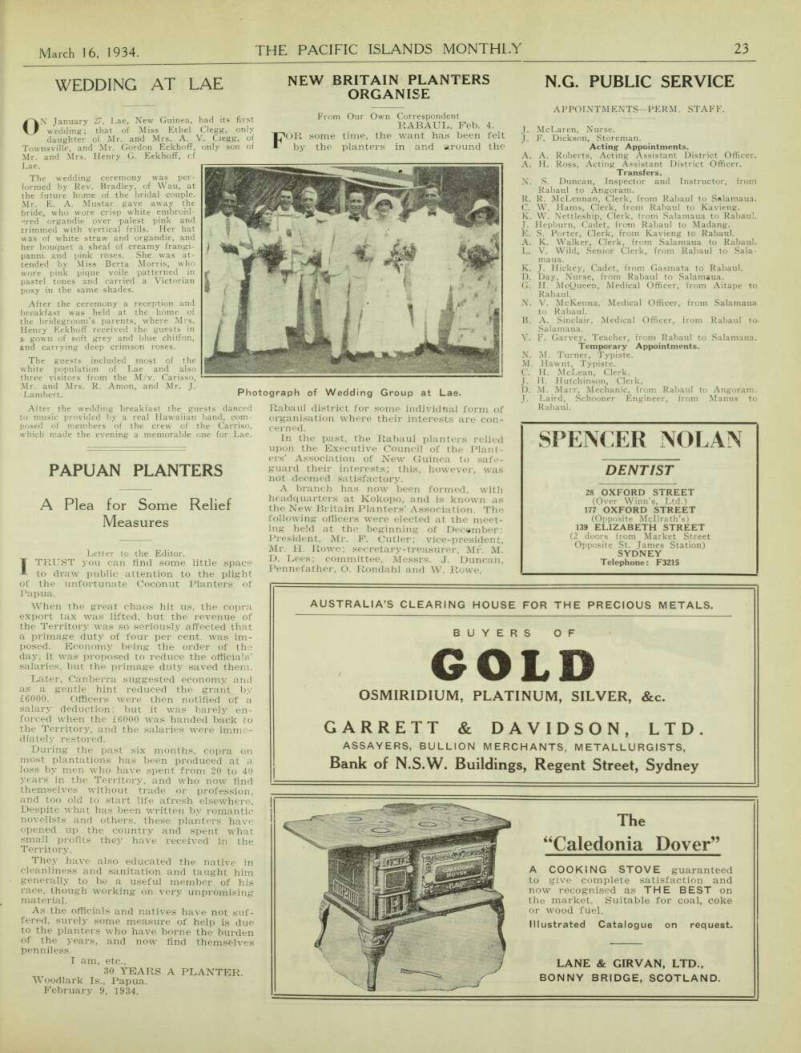
ON January 27, Lae, New Guinea, had its first wedding; that of Miss Ethel Clegg, only daughter of Mr. and Mrs. A. V. Clegg, of Townsville, and Mr. Gordon Eekhoff, only son of Mr. and Mrs. Henry G. Eekhoff, of
Lae.
The wedding ceremony was per formed by Rev. Bradley, of Wau, at the future home of the bridal couple.
Mr. E. A. Mustar gave away the bride, who wore crisp white embroid ered organdie over palest pink and trimmed with vertical frills. Her hat was of white straw and organdie, and her bouquet a sheaf of creamy frangi panni and pink roses. She was at tended by Miss Berta Morris, who wore pink pique voile patterned in pastel tones and carried a Victorian posy in the same shades.
After the ceremony a reception and breakfast was held at the home of the bridegroom’s parents, where Mrs.
Henry Eekhoff received the guests in a gown of soft grey and blue chiffon, and carrying deep crimson roses.
The guests included most of the white population of Lae and also three visitors from the M/v. Carisso, Mr. and Mrs. R. Amon, and Mr. J.
Lambert.
After the wedding breakfast the guests danced to music provided by a real Hawaiian band, com posed of members of the crew of the Carriso, which made the evening a memorable one for Lae.
Papuan Planters
A Plea for Some Relief Measures
Letter to the Editor.
I TRUST you can find some little space to draw public attention to the plight of the unfortunate Coconut Planters of Papua.
When the great chaos hit us, the copra export tax was lifted, but the revenue of the Territory was so seriously affected that a primage duty of four per cent, was im posed. Economy being the order of the day, it was proposed to reduce the officials’ salaries, but the primage duty saved them.
Later, Canberra suggested economy and as a gentle hint reduced the grant by £6000. Officers were then notified of a salary deduction: but it was barely en forced when the £6000 was handed back to the Territory, and the salaries were imme diately restored.
During the past six months, copra on most plantations has been produced at a loss by men who have spent from 20 to 40 years in the Territory, and who now find themselves without trade or profession, and too old to start life afresh elsewhere.
Despite what has been written by romantic novelists and others, these planters have opened up the country and spent what small profits they have received in the Territory.
They have also educated the native in cleanliness and sanitation and taught him generally to be a useful member of his race, though working on very unpromising material.
As the officials and natives have not suf fered, surely some measure of help is due to the planters who have borne the burden of the years, and now find themselves penniless.
I am, etc.,
30 Years A Planter.
Woodlark Is., Papua.
February 9, 1934.
New Britain Planters
Organise
From Our Own Correspondent
Rabaul, Feb. 4.
some time, the want has been felt by the planters in and around the
Rabaul district for some individual form of organisation where their interests are con cerned.
In the past, the Rabaul planters relied upon the Executive Council of the Plant ers’ Association of New Guinea to safe guard their interests; this, however, was not deemed satisfactory.
A branch has now been formed, with headquarters at Kokopo, and is known as the New Britain Planters’ Association. The following officers were elected at the meet ing held at the beginning of December: President, Mr. F. Cutler; vice-president, Mr. H. Rowe; secretary-treasurer, Mr. M.
D. Lees; committee, Messrs. J. Duncan, Pennefather, O. Rondahl and W. Rowe.
Photograph of Wedding Group at Lae.
N.G. Public Service
Appointments —Perm. Staff.
J. McLaren, Nurse.
J. F. Dickson, Storeman.
Acting Appointments.
A. A. Roberts, Acting Assistant District Officer.
A. H. Ross, Acting Assistant District Officer.
Transfers.
N. S. Duncan, Inspector and Instructor, from Rabaul to Angoram.
R. R. McLennan, Clerk, from Rabaul to Salamaua.
C. W. Hams, Clerk, from Rabaul to Kavieng.
K. W. Nettleship, Clerk, from Salamaua to Rabaul.
J. Hepburn, Cadet, from Rabaul to Madang.
E. S. Porter, Clerk, from Kavieng to Rabaul.
A. K. Walker, Clerk, from Salamaua to Rabaul.
L. V. Wild, Senior Clerk, from Rabaul to Sala maua.
K. J. Hickey, Cadet, from Gasmata to Rabaul.
D. Day, Nurse, from Rabaul to Salamaua.
G. H. McQueen, Medical Officer, from Aitape to Rabaul.
N. V. McKenna, Medical Officer, from Salamaua to Rabaul.
B. A. Sinclair, Medical Officer, from Rabaul to Salamaua.
V. F. Garvey, Teacher, from Rabaul to Salamaua.
Temporary Appointments.
N. M. Turner, Typiste.
M. Hawnt, Typiste.
C. H. McLean, Clerk.
J. H. Hutchinson, Clerk.
D. M. Marr, Mechanic, from Rabaul to Angoram.
J. Laird, Schooner Engineer, from Manus to Rabaul.
Advertisements & other items, p. 25 (1 item)
Gold
SPENCER NOLAN
DENTIST
28 OXFORD STREET
(Over Winn’s, Ltd.)
177 OXFORD STREET
(Opposite Mcllrath’s)
139 ELIZABETH STREET
(2 doors from Market Street Opposite St. James Station)
SYDNEY
Telephone: F 3215
AUSTRALIA’S CLEARING HOUSE FOR THE PRECIOUS METALS.
BUYERS OF
GOLD
OSMIRIDIUM, PLATINUM, SILVER, &c.
GARRETT & DAVIDSON, LTD.
ASSAYERS, BULLION MERCHANTS, METALLURGISTS,
Bank of N.S.W. Buildings, Regent Street, Sydney
The
“Caledonia Dover”
A COOKING STOVE guaranteed to give complete satisfaction and now recognised as THE BEST on the market. Suitable for coal, coke or wood fuel.
Illustrated Catalogue on request.
LANE & GIRVAN, LTD.,
BONNY BRIDGE, SCOTLAND.
Tung Oil
Cultivation In America
THE present disastrous price of copra is causing Pacific Islands planters to in vestigate the possibilities of other crops.
Further information is to hand regarding tung oil (or China wood oil, as it is better known). The main supplies come from China, where Hankow wood-oil is regarded as the world’s best. The price at present is approximately £35 per ton.
According to an English trade journal, much attention is being paid to the in dustry in the United States. While culti vation has been carried on for some years in Florida and Louisana, the greatest activity appears to have been in Missis sippi, where on the Gulf Coast one planta tion alone exceeds 10,000 acres, and is being extended. A lumber company in Louisana has been planting its barren, unproductive land with Aleurites (Fordii) securing from a 65 acre plantation, eight tons of fruit in the fourth year, and 50 tons in the fifth.
There, and in the Mississippi, it is said that the yield per acre is double that of sugar cane, while the cost of upkeep and reaping is less than one-tenth the cost of cane cultivation.
Both the Aleurites, and the Eloeococca (or Montana) flourish on waste land and rocky soil, provided there is sufficient rain fall. The trees, which grow to 30 to 40 ft. high, need very little care, although they
respond to a certain amount of cultivation by bigger yields. The process of oil ex traction is fairly simple, not calling for expensive machinery, the essentials being presses and good filters. The nuts, when ripe, are split open, the seeds extracted, roasted, ground, and pressed.
The Empire Marketing Board (London) say that land suitable for cultivation of tung oil trees can be found within the Empire, whose requirements could be met if 400,000 acres were planted. The oil of the tung tree is used in the manufacture of varnish and paints. The East Indian tree, apart front its oil, provides a fine hard timber.
The question of selling the oil from Aus- Territories would depend on price offered, and the quality of seeds. Freight on this product works out at about 70/9 per ton from Melbourne/Sydney to London.
Tung Oil seed at 6d per lb., requiring 25lbs. of seed to the acre, may be obtained from the Director of Agriculture, Rabaul, New Guinea.
Sesame Oil Seeds
Here again it is a question of competing with products of India, China and East Africa. The prospects of business are not very favorable for this commodity from the Islands. Freight on this is about 63/per ton to London. As Chinese Sesame seed, whidh is most in favor, is offering without success at £11 per ton, Australian Sesame seed would have to compete at a very low price in order to find any market in Europe.
Hurricane In N. Hebrides
A hurricane visited a section of the New Hebrides on January 16 and lasted for several hours. The lowest point reg istered by the barometer was 29.5.
A correspondent, writing from Ambrym, says that for once the hurricane did no damage at that Island—its centre ap peared to have been 20 or 30 miles away.
Fiji Banana
Trade
Australian Attitude More Reasonable
IMPORTANT conversations concerning the Fiji-Australian banana trade took place late in February, during the visit of the Governor of Fiji, Sir Murchison Flet cher, to Sydney. By a fortunate coinci dence, Sir Maynard Hedstrom, of Fiji, was in Australia at the same time, on his way home from Europe, and these two made joint representations to various Australian interests which are almost certain to prove satisfactory to the Fijian growers.
The matter was discussed by the Gover nor and Sir Maynard Hedstrom with cer tain Federal Ministers in Melbourne; but real progress was made in the solution of the difficulty when the two Fijian repre sentatives reached Sydney.
Mr. A. S. Burton, who is the representa tive of important Sydney exporting in terests, had been in Suva a few weeks before, and there had learned something of the Fijian mercantile community’s interest in this matter of Fijian-Australian trade.
He had several discussions with leading business men, and formed the opinion that, unless Australia met Fiji in a reasonable fashion, Fiji unquestionably would re arrange its tariff so that it would place Australian goods at a disadvantage.
Mr. Burton thereupon communicated his views to his principals, with the result that urgent representations were made to the Sydney Chamber of Manufactures.
Following on that, the Chamber was in strumental in arranging a round-table conference between Sir Murchison Fletcher and Sir Maynard Hedstrom, on the one side, and leading Sydney shippers on the other.
There was a frank discussion, in which it was shown that Fiji provides a yearly market for anything from £400,000 to £750,000 worth of Australian products and manufactured goods; whereas in the past Australia has purchased Fiji goods to the value of less than £75,000 per annum. The Governor of Fiji, speaking in plain lan guage, said that such a position could not be contemplated with equanimity. It was the duty of the Fiji Government to see that, if Canada, for instance, bought £200,000 worth of Fiji products, Fiji should purchase her corresponding requirements in Canada rather than in other countries.
The Chamber of Manufactures was much impressed with the position as presented to them by the Fiji men, and the result is likely to be seen in strong representations to the Federal Government.
It may be said, however, that already the Federal Government has seen the light.
Most of the burdens which have been placed upon the banana trade in Australia —some by the automatic operation of foolish laws, and some as the result of deliberate en gineering by the banana growing interests in northern New South Wales —will be re moved at an early date.
Cocoa Growers’ Con
Ference
The British Government announced in February that it proposes to convene a conference of representatives of cocoa producing countries to discuss, among other matters, whether they should at tempt to raise the world price of cocoa by a greater measure of co-operation in mar keting.
Advertisements & other items, p. 26 (1 item)
Paton, Burns & Co.,
SAMUEL RUSSELL
ESTATE AND GENERAL AGENT.
P.O. Box 64, Papeete, Tahiti
Real Estate. Investments. Estate Management and Administration. Valuations and Reports. Houses and Lands for Lease or Sale.
Sole Proprietor: TAHITI PERFUMES Cables: Russell, Tahiti (Bentley’s Code)
“OUR HANDS MAKE GOOD ARMS.”
QUALITY
You get that feeling of satisfaction when you purchase your SHOOT- ING & FISHING WANTS from the Firm that has a REPUTATION FOR
QUALITY GOODS & SERVICE.
The Greatest Variety of Shooting & Fishing Tackle in Australia.
Write for Catalogue.
SIL ROHU (late A.I.F.),
IMPORTER OF HIGH-GRADE FIREARMS AND FISHING TACKLE SPECIALIST 143 ELIZABETH STREET, SYDNEY (near Market Street).
“FISHING TACKLE TO TACKLE FISHING”
Repairs.
BIG CROPS
can be depended upon from land that has been liberally fertilised with
P. B. MANURES
The best for all purposes. Send for our Free Booklet.
“RATIONAL MANURING,” it contains interesting information.
PATON, BURNS & CO.,
52 KING STREET SYDNEY
Wau, T.N.G.
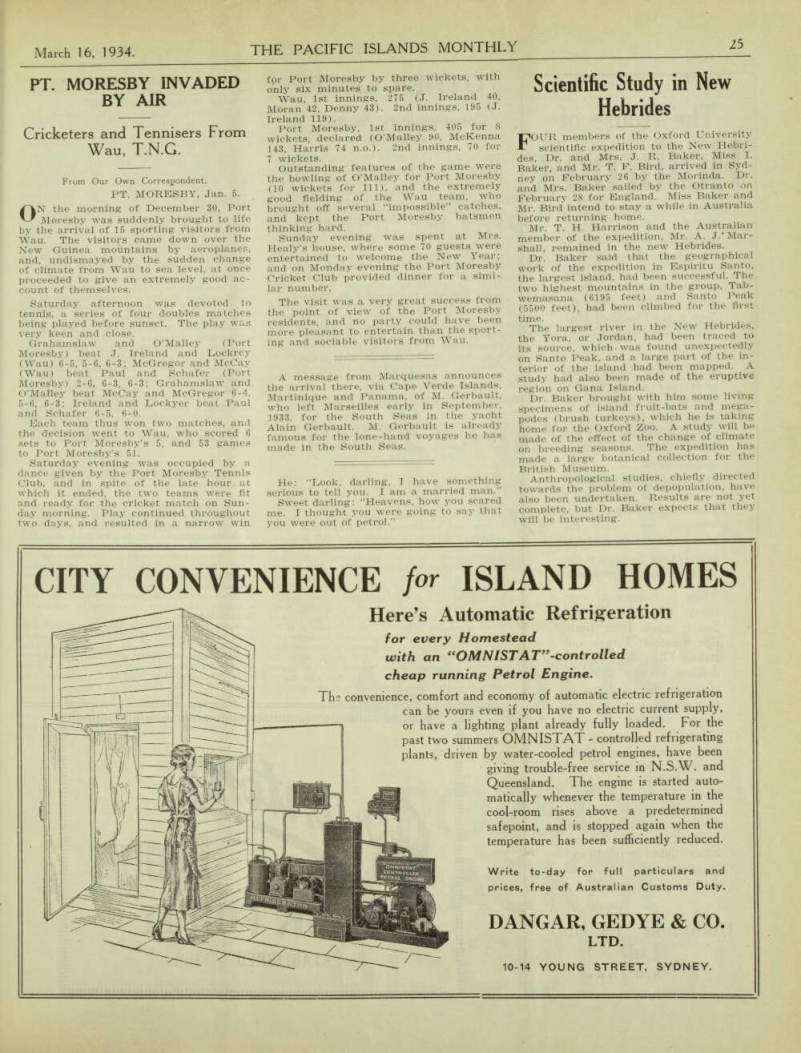
Pt. Moresby Invaded
By Air
Cricketers and Tennisers From Wau, T.N.G.
From Our Own Correspondent,
Pt. Moresby, Jan. 5.
ON the morning of December 30, Port Moresby was suddenly brought to life by the arrival of 15 sporting visitors from Wau. The visitors came down over the New Guinea mountains by aeroplanes, and, undismayed by the sudden change of climate from Wau to sea level, at once proceeded to give an extremely good ac count of themselves.
Saturday afternoon was devoted to tennis, a series of four doubles matches being played before sunset. The play was very keen and close.
Grahamslaw and O’Malley (Port Moresby) beat J. Ireland and Lockrey (Wau) 6-5, 5-6, 6-3; McGregor and McCay (Wau) beat Paul and Schafer (Port Moresby) 2-6, 6-3, 6-3; Grahamslaw and O’Malley beat McCay and McGregor 6-4, 5-6, 6-3; Ireland and Lockyer beat Paul and Schafer 6-5, 6-0.
Each team thus won two matches, and the decision went to Wau, who scored 6 sets to Port Moresby’s 5, and 53 games to Port Moresby’s 51.
Saturday evening was occupied by a dance given by the Port Moresby Tennis Club, and in spite of the late hour at which it ended, the two teams were fit and ready for the cricket match on Sun day morning. Play continued throughout two days, and resulted in a narrow win
for Port Moresby by three wickets, with only six minutes to spare.
Wau, Ist innings, 275 (J. Ireland 40, Moran 42, Denny 43). 2nd innings, 195 (J.
Ireland 119).
Port Moresby, Ist innings. 405 for 8 wickets, declared (O’Malley 90. McKenna 143, Harris 74 n. 0.). 2nd innings, 70 for 7 wickets.
Outstanding features of the game were the bowling of O’Malley for Port Moresby (10 wickets for 111), and the extremely good fielding of the Wau team, who brought off several “impossible” catches, and kept the Port Moresby batsmen thinking hard.
Sunday evening was spent at Mrs.
Healy’s house, where some 70 guests were entertained to welcome the New Year; and on Monday evening the Port Moresby Cricket Club provided dinner for a simi lar number.
The visit was a very great success from the point of view of the Port Moresby residents, and no party could have been more pleasant to entertain than the sport ing and sociable visitors from Wau.
A message from Marquesas announces the arrival there, via Cape Verde Islands, Martinique and Panama, of M. Gerbault, who left Marseilles early in September, 1933, for the South Seas in the yacht Alain Gerbault. M. Gerbault is already famous for the lone-hand voyages he has made in the South Seas.
He: “Look, darling, I have something serious to tell you. I am a married man.”
Sweet darling: “Heavens, how you scared me. I thought you were going to say that you were out of petrol.”
Scientific Study in New
Hebrides
FOUR members of the Oxford University scientific expedition to the New Hebri des, Dr. and Mrs. J. R. Baker, Miss I.
Baker, and Mr. T. F. Bird, arrived in Syd ney on February 26 by the Morinda. Dr. and Mrs. Baker sailed by the Otranto on February 28 for England. Miss Baker and Mr. Bird intend to stay a while in Australia before returning home.
Mr. T. H. Harrison and the Australian member of the expedition, Mr. A. J. Marshall, remained in the new Hebrides.
Dr. Baker said that the geographical work of the expedition in Espiritu Santo, the largest island, had been successful. The two highest mountains in the group, Tab wemasana (6195 feet) and Santo Peak (5500 feet), had been climbed for the first time.
The largest river in the New Hebrides, the Yora, or Jordan, had been traced to its source, which-was found unexpectedly on Santo Peak, and a large part of the in terior of the island had been mapped. A study had also been made of the eruptive region on Gana Island.
Dr. Baker brought with him some living specimens of island fruit-bats and mega podes (brush turkeys), which he is taking home for the Oxford Zoo. A study will be made of the effect of the change of climate on breeding seasons. The expedition has made a large botanical Collection for the British Museum.
Anthropological studies, chiefly directed towards the problem of depopulation, have also been undertaken. Results are not yet complete, but Dr. Baker expects that they will be interesting.
Advertisements & other items, pp. 27-28 (1 item)
City Convenience Island Homes
Here’s Automatic Refrigeration
for every Homestead with an “OMNISTAT”-controlled cheap running Petrol Engine, The convenience, comfort and economy of automatic electric refrigeration can be yours even if you have no electric current supply, or have a lighting plant already fully loaded. For the past two summers OMNISTAT- controlled refrigerating plants, driven by water-cooled petrol engines, have been giving trouble-free service in N.S.W. and Queensland. The engine is started automatically whenever the temperature in the cool-room rises above a predetermined safepoint, and is stopped again when the temperature has been sufficiently reduced.
Write to-day for full particulars and prices, free of Australian Customs Duty.
DANGAR, GEDYE & CO.
LTD.
10-14 YOUNG STREET. SYDNEY.
The House of
Holbrook
In the old world village of Stourport, Worcestershire, England, just at the point where the River Stour empties itself into the Severn, the House of Holbrook was founded 133 years ago.
In 1919 a factory was established in Sydney, N.S.W., to supply the requirements of Australia, New Zealand and the Pacific Islands. Here are manufactured a wide variety of table delicacies, as well as Holbrook’s Sauces and Pure Malt Vinegar, for which the House of Holbrook has been famous throughout the world for many generations.
There is Essence of Anchovy for fish, Tomato Sauce, made from fresh, ripe tomatoes; French and Italian Olive Oil, with a delicate, creamy taste —so nice with the salad and of such nutritious value for invalids, French Capers, Olives, in many varieties, from Spain; tiny sweet Gherkins and little White Onions, Fish and Meat Pastes, Flavouring Essences and endless other delicacies.
Holbrooks’ Baked Beans, with Pork and Tomato Sauce; tinned Spaghetti and Soups are also tasty and delicious.
Holbrooks (A/sia.)
Ltd.
WATERLOO, N.S.W.
Other Crops
Copra-growers Seeking an Alternative
NOW that it is practically impossible to produce copra at a profit, planters throughout the South Seas are urgently asking whether there are any other crops which they may profitably handle, and so assist themselves over this bad period.
Coffee is receiving a good deal of atten tion in Papua and the Mandated Territory of New Guinea. A good many people already are growing the low country coffee (Robusta) in both Territories and there is a market —though not a very eager one—for the product in Australia.
We have heard recently that a coffee has been grown on the high country near Wau in the goldfields area of New Guinea.
Samples which have reached Sydney have pleased buyers very much. They say that it is equal to the Blue Mountain coffee of Jamaica, which is worth to the planter 1/- per lb. It is worth remembering that coffee entering Australia from countries other than Australian Territories is sub ject to a duty of 4d per lb. That is to say, that the coffee producer in Papua and New Guinea should receive for his product in Australia a price that will return him at least 3d per lb more than is received by the producer in other countries.
Other planters have been giving atten tion to cocoa, and there is some produc tion of this commodity at present in New Guinea, and, in varying degrees, in the other groups. The world price of cocoa is low but so far as New Guinea is con cerned there is a bounty of 4d per lb, paid directly by the Commonwealth Government to the producer, and this helps the planter considerably. The cocoa bounty will last until 1938, at least.
There has been attention given recently in Papua and New Guinea to rice-grow ing. Large quantities of rice are now imported to both Territories —mostly for feeding native labour. The Papuan A.R.M. (Mr. Austin) in the Trobriand Islands re cently introduced rice-growing among the natives—mainly to provide them with an article to export which would enable them to pay their taxes. The natives have taken up the new crop with some enthu
siasm, and it appears likely that they will grow rice presently as a means of aug menting their own food supply.
The District Officer in the Talasea dis trict of New Britain (T.N.G.), Mr. Ellis, appears to have been very successful in his long-cherished scheme of inducing the natives there to grow rice. The industry is growing and it is reported that there is now a likelihood that the Government there will establish a rice-mill at an early date. This may become an important industry in New Guinea, which in a nor mal year imports rice of the value of £90,000, from India, Burma, and China. it is worth noting that rice-growing has become an important industry in Fiji in recent years, having been taken up on a large scale by the Indian peasants.
Another industry recently promoted in New Guinea is that of tobacco-growing for the local manufacture of native twist.
In a normal year New Guinea imports from £30,000 to £40,000 worth of trade tobacco, and twist tobacco is practically a currency item in the Territory. The Territory grows large quantities of native leaf and a small manufacturing company has now been formed, and has established a factory near Rabaul, where twist is being made. The main difficulty, prob ably, will be an adequate supply of suit able leaf. Some of the planters in that end of New Britain are now giving atten tion to tobacco production, with a view to keeping the factory supplied.
Navigation Devices
The introduction of the Holmes master compass and the Chernikieff log line in the motor ship Manoora, which is shortly to be constructed for the Adelaide S.S. Co.
Ltd., for the Australian coastal service, has been recommended by Captain T.
Arundel, a construction and navigation expert. Captain Arundel came to Austra lia by the nevv Burns, Philp motor ship Malaita as a third party observer for the builders. He hopes to return to Australia in the Manoora.
Captain Arundel said the Chernikieff log line was worked electrically, and auto matically registered on a chart in the engine room the speed per minute and per hour and the distance travelled. The auto-gyro and the standard compass are embodied in the Holmes.
Economies!
Letter to the Editor.
DESPITE the depression and the exces sive low price of copra, Unilever, Ltd., still continues to make big profits, and one wonders, in view of this, why a branch of Unilever, Ltd., engaged in the production of copra should make small economies at the expense of the man on the plantation.
The latest move on the part of those in authority, is to make all their employees engaged on plantation work supply their own soap, starch and blue. Granted, it is not a great sacrifice, but will it stop at that, or will other things follow?
Of course, it is highly gratifying to feel that even in a small way one is assisting to combat the depression. Yet, every day, we see the boys throwing away their issue of maize-meal, as a protest against the change to that food from rice. Assuming that this is being done on the 22 or so estates controlled by Levers, the cost must run into many hundreds of pounds.
Surely the greatest soap manufacturers in the world can continue to supply soap to their own employees, who produce the raw material for them. “Petty economies” of this nature are absurd, taking into con sideration the wastes in other directions I am, etc.,
B.S.I., Feb. 6, 1934.
Aussie.
Portable Transmitter
Operates Successfully in N.G.
ADVICES received in February by Am algamated Wireless Ltd. from New Guinea indicate that surprisingly good results have been achieved with the small transmitter recently manufactured by Amalgamated Wireless for use in the in terior with motor power supplied by a native “boy.” This transmitter has proved capable of sending spoken com munications for a distance of 350 miles, the transmission having been received by the wireless operator on the “Macdhui,” at sea near Kavieng.
The transmitter was developed by A.W.A. for demonstration purposes in New Guinea and Papua. The whole equipment weighs only 200 lbs. including a bicycle-like framework upon which a native “rides,” thus providing the re quired power. It can be carried, in sec tions, into the roughest country and will no doubt prove valuable, not only to the Administration officials and Patrol Of ficers of the Territories, but also to pri vate pioneering enterprises in search of gold or trade.
“Sunshine’S” Successes.
“The old order changeth, giving place to the new.”
Wally Cordon, of Wau, T.N.G., whose ponies, horses and mules have carried much cargo and many passengers to Edie Creek from Wau, has not been so cheer ful lately, owing to the fact that three motor lorries now travel the historic track to the famous goldfields. Mr. Cor don tops the list of transport pioneers oi New Guinea; his has been no light task.
Since Boxing Day Mr. Cordon’s cheer ful grin has returned. The secret? “Sun shine,” one of his horses, won three out of the six cups at the initial meeting of the Morobe Turf Club at Wau.
His hand has been wrung congratula torily so many times that it reminds one of a man in similar circumstances who remarked after it was all over that he felt like the Prince of Wales. “But,” he added naively, “not so good looking.”
LADY HEDSTROM, of Suva, who was formerly Miss Joyce Beauchamp, of Sydney, arrived in February in Melbourne with her husband, Sir Maynard Hed strom, after an interesting twelve months’ trip abroad. An outstanding impression of the trip, she says, was a motor tour through Sweden. Stockholm she found a delightful city and its people with a cos mopolitan outlook; England the most prosperous country she had visited, Lon
don gay and engaging; Paris dull and dead, with its famous hotels such as the Ritz and the Mirabeau almost empty.
Lady Hedstrom is looking forward to re turning home to Fiji, which she describes as the housewife’s paradise with no ser vants problems and a good cook always available. Before returning to Suva, Lady Hedstrom spent a few days in Sydney seeing old friends.
Advertisements & other items, p. 29 (1 item)
Arnotts
PACIFIC ISLANDS ASSOCIATION.
Headquarters and Clubrooms:
MILLIONS HOUSE, ROWE STREET, SYDNEY
Telephone: B 4971 Founded in 1931 to Advance the Interests of Residents of the Pacific; Assist Island Trade; Provide Information for Tourists; and Promote the Welfare of the Native Races.
All Pacific Islands residents visiting Sydney are invited to call at Millions House and sign the Visitors’ Book kept at the Association’s office on the first floor.
Secretary’s Office: NATIONAL MUTUAL BUILDING, 350 GEORGE STREET, near G.P.O., SYDNEY, AUSTRALIA :: Telephone: B 5067 Cable Adress: “CERTAC," Sydney.
IDEAL for SAVOURIES
Made to break into three fingers of ideal size and shape, the perfect base for savoury items. They are new — different —delightful. Be wise, have a tin in the pantry.
ARNOTTS
FAMOUS
POPSO
CRACKER
New Patrol Officer
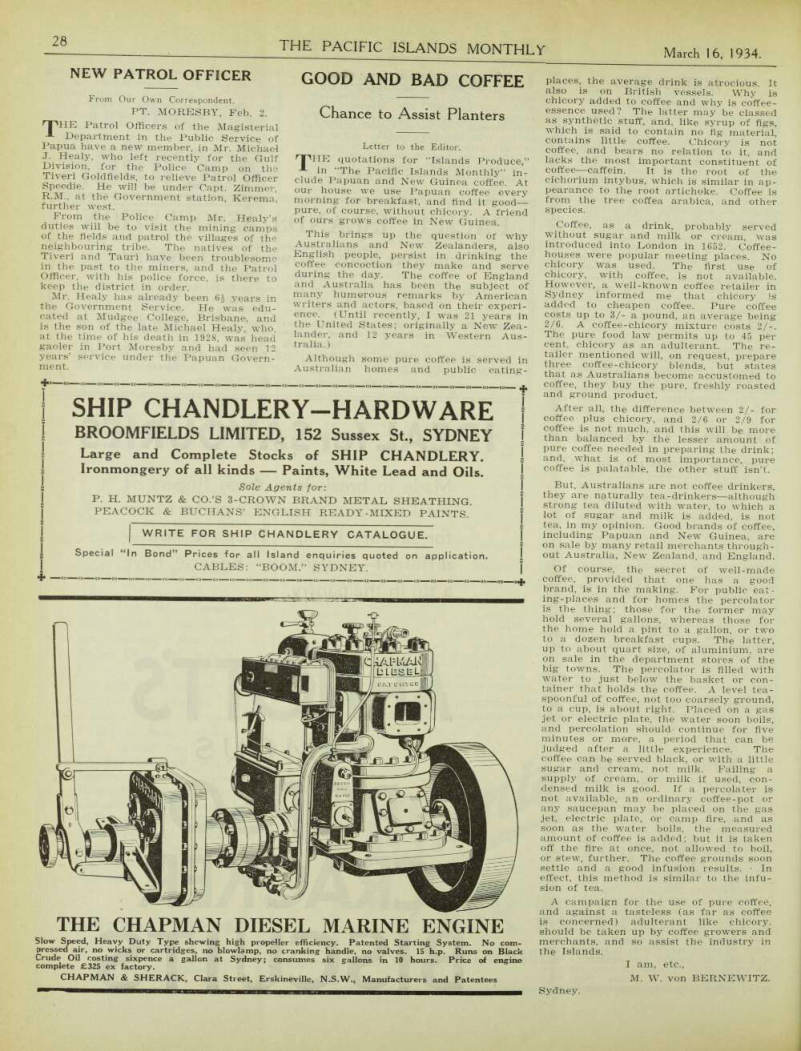
From Our Own Correspondent.
Pt. Moresby, Feb. 2.
Patrol Officers of the Magisterial Department in the Public Service of Papua have a new member, in Mr. Michael J. Healy, who left recently for the Gulf Division, for the Police Camp on the Tiveri Goldfields, to relive Patrol Officer Speedie. He will be under Capt. Zimmer, R.M., at the Government station, Kerema, further west.
From the Police Camp Mr. Heay's duties will be to visit the mining camps of the fields and patrol the villages of the neighbouring tribe. The natives of the Tiveri and Tauri have been troublesome in the past to the miners, and the Patrol Officer, with his police force, is there to keep the district in order.
Mr. Healy has already been 6½ years in the Government Service. He was educated at Mudgee College, Brisbane, and is the son of the late Michael Healy, who, at the time of his death in 1928, was head gaoler in Port Moresby and had seen 12 years’ service under the Papuan Government.
Good And Bad Coffee
Chance to Assist Planters
Letter to the Editor.
THE quotations for “Islands Produce,” in “The Pacific Islands Monthly” in clude Papuan and New Guinea coffee. At our house we use Papuan coffee every morning for breakfast, and find it good pure, of course, without chicory. A friend of ours grows coffee in New Guinea.
This brings up the question of why Australians and New Zealanders, also English people, persist in drinking the coffee concoction they make and serve during the day. The coffee of England and Australia has been the subject of many humorous remarks by American writers and actors, based on their experi ence. (Until recently, I was 21 years in the United States; originally a New Zea lander, and 12 years in Western Aus tralia.) Although some pure coffee is served in Australian homes and public eating
places, the average drink is atrocious. It also is on British vessels. Why is chicory added to coffee and why is coffee essence used? The latter may be classed as synthetic stuff, and, like syrup of figs, which is said to contain no fig material contains little coffee. Chicory is not coffee, and bears no relation to it, and lacks the most important constituent of coffee—caffein. It is the root of the cichorium intybus, which is similar in ap pearance to the root artichoke. Coffee is from the tree coffea arabica, and other species.
Coffee, as a drink, probably served without sugar and milk or cream, was introduced into London in 1652. Coffee houses were popular meeting places. No chicory was used. The first use of chicory, with coffee, is not available.
However, a well-known coffee retailer in Sydney informed me that chicory is added to cheapen coffee. Pure coffee costs up to 3/- a pound, an average being 2/6. A coffee-chicory mixture costs 2/-.
The pure food law permits up to 45 per cent, chicory as an adulterant. The re tailer mentioned will, on request, prepare three coffee-chicory blends, but states that as Australians become accustomed to coffee, they buy the pure, freshly roasted and ground product.
After all, the difference between 2/- for coffee plus chicory, and 2/6 or 2/9 for coffee is not much, and this will be more than balanced by the lesser amount of pure coffee needed in preparing the drink; and, what is of most importance, pure coffee is palatable, the other stuff isn't.
But, Australians are not coffee drinkers, they are naturally tea-drinkers —although strong tea diluted with water, to which a lot of sugar and milk is added, is not tea, in my opinion. Good brands of coffee, including Papuan and New Guinea, are on sale by many retail merchants through out Australia, New Zealand, and England.
Of course, the secret of well-made coffee, provided that one has a good brand, is in the making. For public eat ing-places and for homes the percolator is the thing; those for the former may hold several gallons, whereas those for the home hold a pint to a gallon, or two to a dozen breakfast cups. The latter, up to about quart size, of aluminium, are on sale in the department stores of the big towns. The percolator is filled with water to just below the basket or con tainer that holds the coffee. A level tea spoonful of coffee, not too coarsely ground, to a cup, is about right. Placed on a gas jet or electric plate, the water soon boils, and percolation should continue for five minutes or more, a period that can be judged after a little experience. The coffee can be served black, or with a little sugar and cream, not milk. Failing a supply of cream, or milk if used, con densed milk is good. If a percolator is not available, an ordinary coffee-pot or any saucepan may be placed on the gas jet, electric plate, or camp fire, and as soon as the water boils, the measured amount of coffee is added; but it is taken off the fire at once, not allowed to boil, or stew, further. The coffee grounds soon settle and a good infusion results. In effect, this method is similar to the infu sion of tea.
A campaign for the use of pure coffee, and against a tasteless (as far as coffee is concerned) adulterant like chicory, should be taken up by coffee growers and merchants, and so assist the industry in the Islands.
I am, etc.,
M. W. Von Bernewitz.
Sydney.
Advertisements & other items, p. 30 (1 item)
Ship Chandlery-Hardware
BROOMFIELDS LIMITED, 152 Sussex St., SYDNEY
Large and Complete Stocks of SHIP CHANDLERY.
Ironmongery of all kinds Paints, White Lead and Oils.
Sole Agents for: P. H. MUNTZ & CO.’S 3-CROWN BRAND METAL SHEATHING.
PEACOCK & BUCHANS’ ENGLISH READY-MIXED PAINTS.
WRITE FOR SHIP CHANDLERY CATALOGUE.
Special “In Bond” Prices for all Island enquiries quoted on application.
CABLES: “BOOM.” SYDNEY.
THE CHAPMAN DIESEL MARINE ENGINE
Slow Speed, Heavy Duty Type shewing high propeller efficiency. Patented Starting System, pressed air, no wicks or cartridges, no blowlamp, no cranking handle, no valves. 15 h.p. Rum No comh j «i ' • . . — r, a . —.— ... Runs on Black Crude Od costing sixpence a gallon at Sydney; consumes six gallons in 10 hours. Price of engine complete £325 ex factory, CHAPMAN & SHERACK, Clara Street, Erskineville, N.S.W., Manufacturers and Patentees
West Pacific
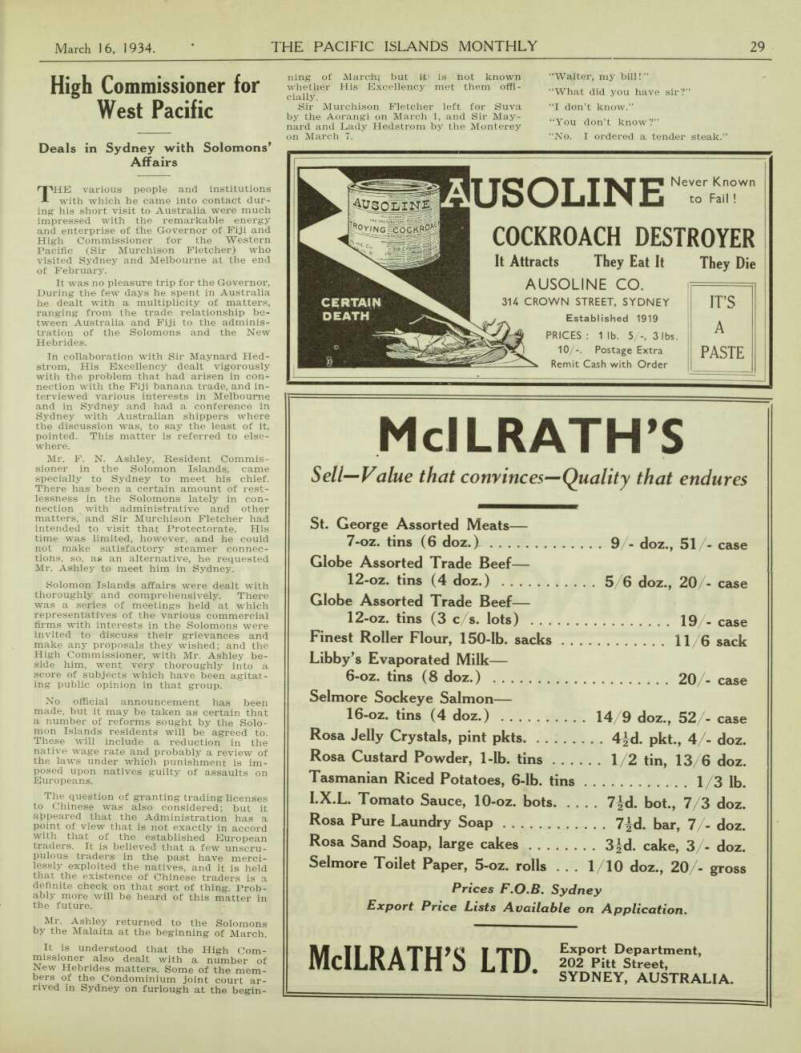
High Commissioner for West Pacific Deals in Sydney with Solomons' Affairs
THE various people and institutions with which he came into contact dur ing his short visit to Australia were much impressed with the remarkable energy and enterprise of the Governor of Fiji and High Commissioner for the Western Pacific (Sir Murchison Fletcher) who visited Sydney and Melbourne at the end of February.
It was no pleasure trip for the Governor, During the few days he spent in Australia he dealt with a multiplicity of matters, ranging from the trade relationship be tween Australia and Fiji to the adminis tration of the Solomons and the New Hebrides, In collaboration with Sir Maynard Hed strom, His Excellency dealt vigorously with the problem that had arisen in con nection with the Fiji banana trade, and in terviewed various interests in Melbourne and in Sydney and had a conference in Sydney with Australian shippers where the discussion was, to say the least of it, pointed. This matter is referred to else where.
Mr. F. N. Ashley, Resident Commis sioner in the Solomon Islands, came specially to Sydney to meet his chief.
There has been a certain amount of rest lessness in the Solomons lately in con nection with administrative and other matters, and Sir Murchison Fletcher had intended to visit that Protectorate. His time was limited, however, and he could not make satisfactory steamer connec tions, so, as an alternative, he requested Mr. Ashley to meet him in Sydney.
Solomon Islands affairs were dealt with thoroughly and comprehensively. There was a series of meetings held at which representatives of the various commercial firms with interests in the Solomons were invited to discuss their grievances and make any proposals they wished; and the High Commissioner, with Mr. Ashley be side him, went very thoroughly into a score of subjects which have been agitat ing public opinion in that group.
No official announcement has been made, but it may be taken as certain that a number of reforms sought by the Solo mon Islands residents will be agreed to.
These will include a reduction in the native wage rate and probably a review of the laws under which punishment is im posed upon natives guilty of assaults on Europeans.
The question of granting trading licenses to Chinese was also considered; but it appeared that the Administration has a point of view that is not exactly in accord with that of the established European traders. It is believed that a few unscru pulous traders in the past have merci lessly exploited the natives, and it is held that the existence of Chinese traders is a definite check on that sort of thing. Prob ably more will be heard of this matter in the future.
Mr. Ashley returned to the Solomons by the Malaita at the beginning of March.
It is understood that the High Com missioner also dealt with a number of New Hebrides matters. Some of the mem bers of the Condominium joint court ar rived in Sydney on furlough at the begin
ning of March, but it is not known whether His Excellency met them offl- Sir Murchison Fletcher left for Suva by the Aorangi on March 1, and Sir Maynard and Lady Hedstrom by the Monterey on March 7.
“Waiter, my bill!”
"What did you have sir?"
“I don’t know.”
"You don't know?"
“No. I ordered a tender steak.”
Advertisements & other items, p. 31 (1 item)
Mcilrath’S
CERTAIN
DEATH
AUSOLINE
Never Known to Fail !
COCKROACH DESTROYER
It Attracts They Eat It They Die
AUSOLINE CO.
3U CROWN STREET, SYDNEY
Established 1919 PRICES : 1 lb. 5/-, 3 lbs 10/-. Postage Extra Remit Cash with Order
IT’S
PASTE
McILRATH’S
Sell—Value that convinces—Quality that endures St. George Assorted Meats— 7-oz. tins (6 doz.) 9/- doz., 51/- case Globe Assorted Trade Beef— -12-oz. tins (4 doz.) 5/6 doz., 20/- case Globe Assorted Trade Beef— -12-oz. tins (3 c/s. lots) 19/- case Finest Roller Flour, 150-lb. sacks 11/6 sack Libby’s Evaporated Milk— 6-oz. tins (8 doz.) 20/- case Selmore Sockeye Salmon— -16-oz. tins (4 doz.) 14/9 doz., 52 - case Rosa Jelly Crystals, pint pkts pkt., 4/- doz.
Rosa Custard Powder, 1-lb. tins 1/2 tin, 13/6 doz.
Tasmanian Riced Potatoes, 6-lb. tins 1/3 lb.
I.X.L. Tomato Sauce, 10-oz. bots 7id. bot., 7/3 doz.
Rosa Pure Laundry Soap bar, 7/- doz.
Rosa Sand Soap, large cakes cake, 3/- doz.
Selmore Toilet Paper, 5-oz. rolls . . . 1/10 doz., 20/- gross Prices F.O.B. Sydney Export Price Lists Available on Application.
McILRATH’S LTD.
Export Department, 202 Pitt Street,
SYDNEY, AUSTRALIA.
About Islands People
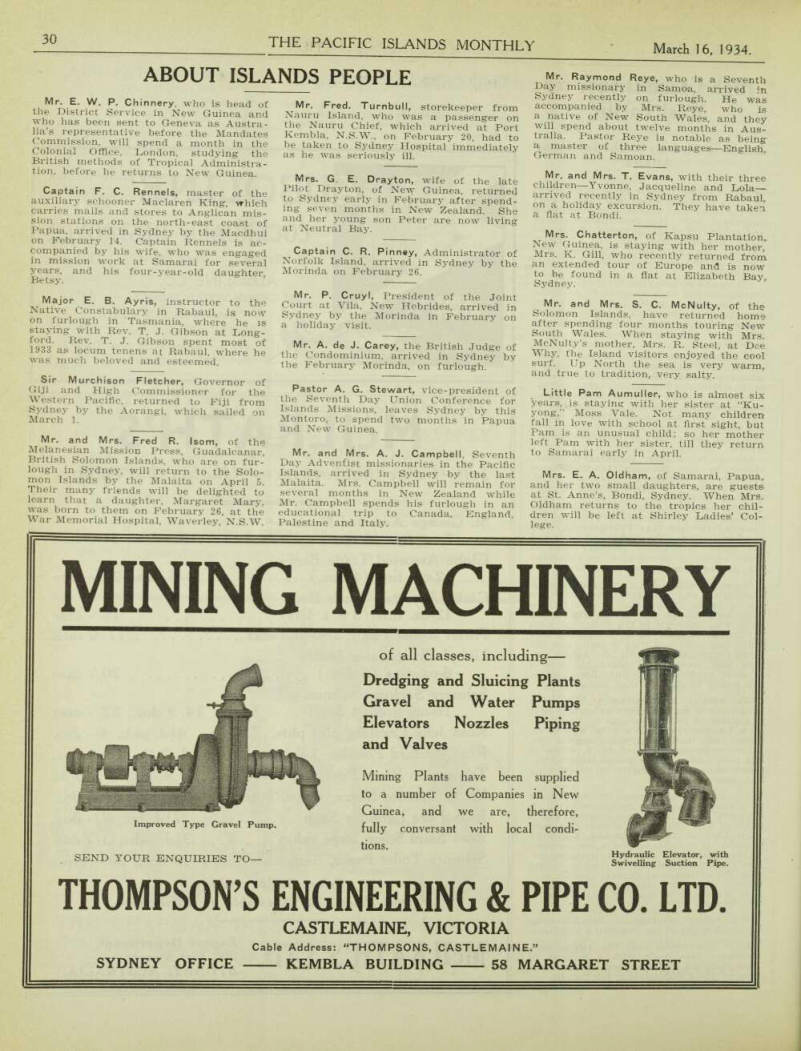
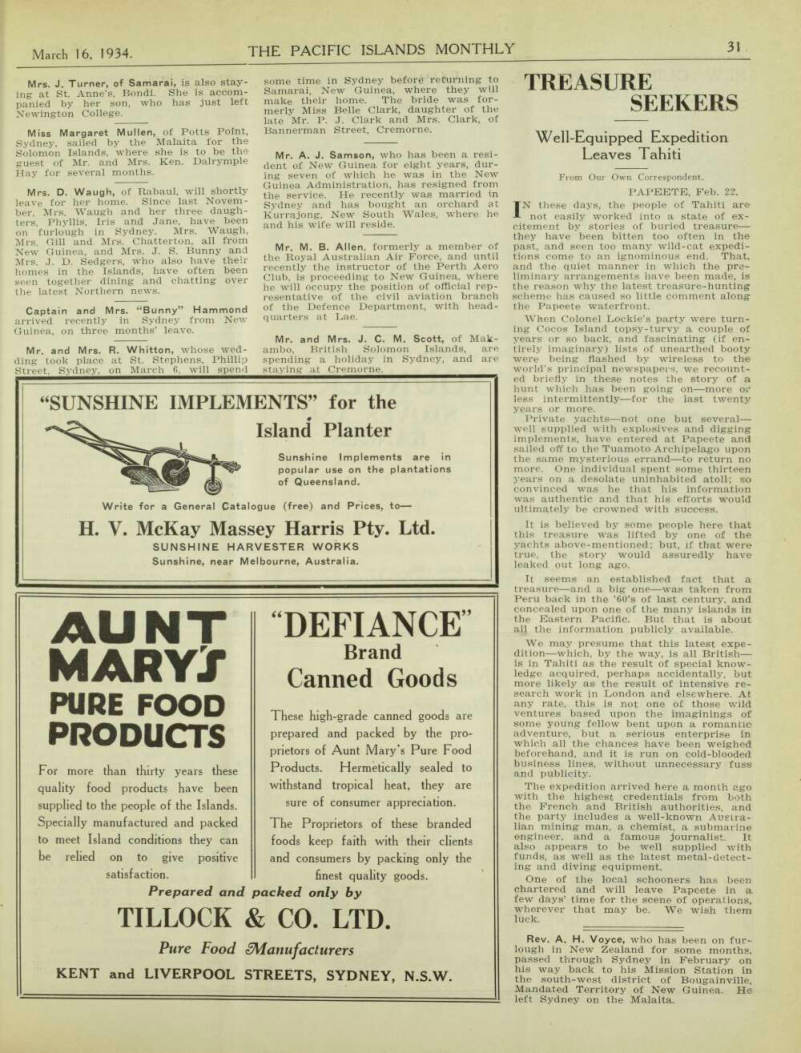
Mr. E. W. P. Chinnery, who is head of the District Service in New Guinea and who has been sent to Geneva as Austra lia’s representative before the Mandates Commission, will spend a month in the Colonial Office, London, studying the British methods of Tropical Administra tion, before he returns to New Guinea.
Captain F. C. Rennels, master of the auxiliary schooner Maclaren King, which carries mails and stores to Anglican mis sion stations on the north-east coast of Papua, arrived in Sydney by the Macdhui on February 14. Captain Rennels is ac companied by his wife, who was engaged in mission work at Samarai for several years, and his four-year-old daughter Betsy.
Major E. B. Ayris, instructor to the Native Constabulary in Rabaul, is now on furlough in Tasmania, where he is staying with Rev. T. J. Gibson at Long ford. Rev. T. J. Gibson spent most of 1933 as locum tenens at Rabaul, where he was much beloved and esteemed.
Sir Murchison Fletcher, Governor of Giji and High Commissioner for the Western Pacific, returned to Fiji from Sydney by the Aorangi, which sailed on March 1.
Mr. and Mrs. Fred R. Isom, of the Melanesian Mission Press, Guadalcanar, British Solomon Islands, who are on fur lough in Sydney, will return to the Solo mon Islands by the Malaita on April 5.
Their many friends will be delighted to learn that a daughter, Margaret Mary, was born to them on February 26, at the War Memorial Hospital, Waverley, N.S.W.
Mr. Fred. Turnbull, storekeeper from Nauru Island, who was a passenger on the Nauru Chief, which arrived at Port Kembla, N.S.W., on February 20, had to be taken to Sydney Hospital immediately as he was seriously ill.
Mrs. G. E. Drayton, wife of the late Pilot Drayton, of New Guinea, returned to Sydney early in February after spend ing seven months in New Zealand. She and her young son Peter are now living at Neutral Bay.
Captain C. R. Pinney, Administrator of Norfolk Island, arrived in Sydney by the Morinda on February 26.
Mr. P. Cruyl, President of the Joint Court at Vila, New Hebrides, arrived in Sydney by the Morinda in February on a holiday visit.
Mr. A. de J. Carey, the British Judge of the Condominium, arrived in Sydney by the February Morinda, on furlough.
Pastor A. G. Stewart, vice-president of the Seventh Day Union Conference for Islands Missions, leaves Sydney by this Montoro, to spend two months in Papua and New Guinea.
Mr. and Mrs. A. J. Campbell, Seventh Day Adventist missionaries in the Pacific Islands, arrived in Sydney by the last Malaita. Mrs. Campbell will remain for several months in New Zealand while Mr. Campbell spends his furlough in an educational trip to Canada, England, Palestine and Italy.
Mr. Raymond Reye, who is a Seventh Day missionary in Samoa, arrived in Sydney recently on furlough. He was accompanied by Mrs. Reye, who is a native of New South Wales, and they will spend about twelve months in Aus tralia. Pastor Reye is notable as being a master of three languages—English, German and Samoan.
Mr. and Mrs. T. Evans, with their three children—Yvonne, Jacqueline and Lola— arrived recently in Sydney from Rabaul, on a holiday excursion. They have taken a flat at Bondi.
Mrs. Chatterton, of Kapsu Plantation, New Guinea, is staying with her mother, Mrs. K. Gill, who recently returned from an extended tour of Europe and is now to be found in a flat at Elizabeth Bay, Sydney, Mr. and Mrs. S. C. McNulty, of the Solomon Islands, have returned home after spending four months touring New South Wales. When staying with Mrs.
McNulty’s mother, Mrs. R. Steel, at Dee Why, the Island visitors enjoyed the cool surf. Up North the sea is very warm, and true to tradition, very salty.
Little Pam Aumuller, who is almost six years, is staying with her sister at “Ku yong,” Moss Vale. Not many children fall in love with school at first sight, but Pam is an unusual child; so her mother left Pam with her sister, till they return to Samarai early in April.
Mrs. E. A. Oldham, of Samarai, Papua, and her two small daughters, are guests at St. Anne’s, Bondi, Sydney. When Mrs.
Oldham returns to the tropics her chil dren will be left at Shirley Ladies’ Col lege.
Mrs. J. Turner, of Samarai, is also stay ing at St. Anne’s, Bondi. She is accom panied by her son, who has just left Newington College.
Miss Margaret Mullen, of Potts Point, Sydney, sailed by the Malaita for the Solomon Islands, where she is to be the guest of Mr. and Mrs. Ken. Dalrymple Hay for several months.
Mrs. D. Waugh, of Rabaul, will shortly leave for her home. Since last Novem ber, Mrs. Waugh and her three daugh ters, Phyllis, Iris and Jane, have been on furlough in Sydney. Mrs. Waugh, Mrs. Gill and Mrs. Chatterton, all from New Guinea, and Mrs. J. S. Bunny and Mrs. J. D. Sedgers, who also have their homes in the Islands, have often been seen together dining and chatting over the latest Northern news.
Captain and Mrs. “Bunny” Hammond arrived recently in Sydney from New Guinea, on three months’ leave.
Mr. and Mrs. R. Whitton, whose wed ding took place at St. Stephens, Phillip Street, Sydney, on March 6, will spend
some time in Sydney before returning to Samarai, New Guinea, where they will make their home. The bride was for merly Miss Belle Clark, daughter of the late Mr. P. J. Clark and Mrs. Clark, of Bannerman Street, Cremorne.
Mr. A. J. Samson, who has been a resi dent of New Guinea for eight years, dur ing seven of which he was in the New Guinea Administration, has resigned from the service. He recently was married in Sydney and has bought an orchard at Kurrajong, New South Wales, where he and his wife will reside.
Mr. M. B. Allen, formerly a member of the Royal Australian Air Force, and until recently the instructor of the Perth Aero Club, is proceeding to New Guinea, where he will occupy the position of official rep resentative of the civil aviation branch of the Defence Department, with head quarters at Lae.
Mr. and Mrs. J. C. M. Scott, of Mak ambo, British Solomon Islands, are spending a holiday in Sydney, and are staying at Cremorne.
Advertisements & other items, pp. 32-33 (1 item)
Mining Machinery
Improved Type Gravel Pump.
SEND YOUR ENQUIRIES TO—
of all classes, including—
Dredging and Sluicing Plants
Gravel and Water Pumps Elevators Nozzles Piping and Valves Mining Plants have been supplied to a number of Companies in New Guinea, and we are, therefore, fully conversant with local conditions.
Hydraulic Elevator, with Swivelling Suction Pipe.
THOMPSON’S ENGINEERING & PIPE CO. LTD.
CASTLEMAINE, VICTORIA
Cable Address: “THOMPSONS, CASTLEMAINE.”
SYDNEY OFFICE KEMBLA BUILDING 58 MARGARET STREET
“SUNSHINE IMPLEMENTS” for the
Island Planter
Sunshine Implements are in popular use on the plantations of Queensland.
Write for a General Catalogue (free) and Prices, to— H. V. McKay Massey Harris Pty. Ltd.
SUNSHINE HARVESTER WORKS
Sunshine, near Melbourne, Australia.
AUNT
MARY'S
PURE FOOD
PRODUCTS
For more than thirty years these quality food products have been supplied to the people of the Islands.
Specially manufactured and packed to meet Island conditions they can be relied on to give positive satisfaction.
Prepared and
“DEFIANCE
Brand
Canned Goods
These high-grade canned goods are prepared and packed by the proprietors of Aunt Mary’s Pure Food Products. Hermetically sealed to withstand tropical heat, they are sure of consumer appreciation.
The Proprietors of these branded foods keep faith with their clients and consumers by packing only the finest quality goods. packed only by
TILLOCK & CO. LTD.
Pure Food 3M
KENT and LIVERPOOL STREETS, SYDNEY, N.S.W.
Seekers
Treasure
Well-Equipped Expedition Leaves Tahiti
From Our Own Correspondent.
Papeete, Feb. 22.
IN these days, the people of Tahiti are not easily worked into a state of ex citement by stories of buried treasure — they have been bitten too often in the past, and seen too many wild-cat expedi tions come to an ignominous end. That, and the quiet manner in which the pre liminary arrangements have been made, is the reason why the latest treasure-hunting scheme has caused so little comment along the Papeete waterfront.
When Colonel Lockie’s party were turn ing Cocos Island topsy-turvy a couple of years or so back, and fascinating (if en tirely imaginary) lists of unearthed booty were being flashed by wireless to the world’s principal newspapers, we recount ed briefly in these notes the story of a hunt which has been going on—more or less intermittently—for the last twenty years or more.
Private yachts—not one but several— well supplied with explosives and digging implements, have entered at Papeete and sailed off to the Tuamoto Archipelago upon the same mysterious errand—to return no more. One individual spent some thirteen years on a desolate uninhabited atoll; so convinced was he that his information was authentic and that his efforts would ultimately be crowned with success.
It is believed by some people here that this treasure was lifted by one of the yachts above-mentioned: but, if that were true, the story would assuredly have leaked out long ago.
It seems an established fact that a treasure—and a big one—was taken from Peru back in the ’6o’s of last century, and concealed upon one of the many islands in the Eastern Pacific. But that is about all the information publicly available.
We may presume that this latest expe dition—which, by the way, is all British — is in Tahiti as the result of special know ledge acquired, perhaps accidentally, but more likely as the result of intensive re search work in London and elsewhere. At any rate, this is not one of those wild ventures based upon the imaginings of some young fellow bent upon a romantic adventure, but a serious enterprise in which all the chances have been weighed beforehand, and it is run on cold-blooded business lines, without unnecessary fuss and publicity.
The expedition arrived here a month ago with the highest credentials from both the French and British authorities, and the party includes a well-known Austra lian mining man, a chemist, a submarine engineer, and a famous journalist. It also appears to be well supplied with funds, as well as the latest metal-detect ing and diving equipment.
One of the local schooners has been chartered and will leave Papeete in a few days’ time for the scene of operations, wherever that may be. We wish them luck.
Rev. A. H. Voyce, who has been on fur lough in New Zealand for some months, passed through Sydney in February on his way back to his Mission Station in the south-west district of Bougainville, Mandated Territory of New Guinea. He left Sydney on the Malaita.
Notes
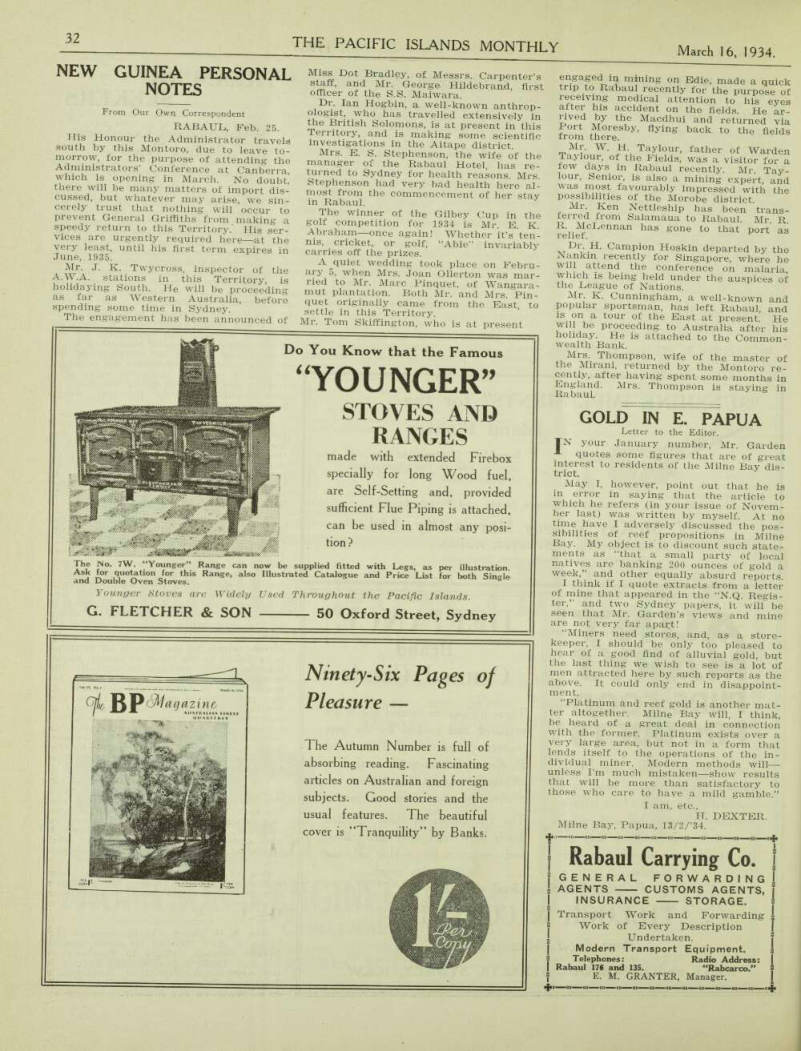
New Guinea Personal
From Our Own Correspondent
Rabaul, Feb. 25.
His Honour the Administrator travels south by this Montoro, due to leave to morrow, for the purpose of attending the Administrators Conference at Canberra, which is opening in March. No doubt, there will be many matters of import dis cussed, but whatever may arise, we sin cerely trust that nothing will occur to prevent General Griffiths from making a speedy return to this Territory. His services are urgently required here—at the very least, until his first term expires in June, 1935.
Mr. J. K. Twycross, inspector of the A.W.A. stations in this Territory, is holidaying South. He will be proceeding as far as Western Australia, before spending some time in Sydney, The engagement has been announced of
Miss Dot Bradley, of Messrs. Carpenter’s staff, and Mr. George Hildebrand, first officer of the S.S. Maiwara.
Dr. Ian Hogbin, a well-known anthropologist, who has travelled extensively in the British Solomons, is at present in this Territory, and is making some scientific investigations in the Aitape district.
Mrs. E. S. Stephenson, the wife of the manager of the Rabaul Hotel, has re turned to Sydney for health reasons. Mrs.
Stephenson had very bad health here al most from the commencement of her stay in Rabaul.
The winner of the Gilbey Cup in the golf competition for 1934 is Mr. E. K.
Abraham once again! Whether it’s ten nis, cricket, or golf, “Abie” invariably carries off the prizes.
A quiet wedding took place on Febru ary 5, when Mrs. Joan Ollerton was mar ried to Mr. Marc Pinquet, of Wangara mut plantation. Both Mr. and Mrs. Pin quet originally came from the East to settle in this Territory.
Mr. Tom Skiffington, who is at present
engaged in mining on Edie, made a quick trip to Rabaul recently for the purpose of receiving medical attention to his eyes after his accident on the fields. He ar rived by the Macdhui and returned via Port Moresby, flying back to the fields from there.
Mr. W. H. Taylour, father of Warden Taylour, of the Fields, was a visitor for a tew days in Rabaul recently. Mr. Tay lour, Senior, is also a mining expert, and was most favourably impressed with the possibilities of the Morobe district.
Mr Ken Nettleship has been trans ferred from Salamaua to Rabaul. Mr. R R. McLennan has gone to that port relief.
Dr. H. Campion Hoskin departed by the Nankin recently for Singapore, where he will attend the conference on malaria, which is being held under the auspices of the League of Nations.
Mr. K. Cunningham, a well-known and popular sportsman, has left Rabaul, and is on a tour of the East at present. He will be proceeding to Australia after his holiday. He is attached to the Common wealth Bank.
Mrs. Thompson, wife of the master of the Mirani, returned by the Montoro re cently, after having spent some months in England. Mrs. Thompson is staying in Rabaul.
Gold In E. Papua
Letter to the Editor.
IN your January number, Mr. Garden quotes some figures that are of great interest to residents of the Milne Bay dis trict.
May I, however, point out that he is in error in saying that the article to which he refers (in your issue of Novem ber last) was written by myself. At no time have I adversely discussed the pos sibilities of reef propositions in Milne Bay. My object is to discount such state ments as “that a small party of local natives are banking 200 ounces of gold a week,” and other equally absurd reports.
I think if I quote extracts from a letter of mine that appeared in the “N.Q. Regis ter,” and two Sydney papers, it will be seen that Mr. Garden’s views and mine are not very far apart!
“Miners need stores, and, as a store keeper, I should be only too pleased to hear of a good find of alluvial gold, but the last thing we wish to see is a lot of men attracted here by such reports as the above. It could only end in disappoint ment, “Platinum and reef gold is another mat ter altogether. Milne Bay will, I think, be heard of a great deal in connection with the former. Platinum exists over a very large area, but not in a form that lends itself to the operations of the in dividual miner. Modern methods will— unless I’m much mistaken—show results that will be more than satisfactory to those who care to have a mild gamble.”
I am, etc.,
H. Dexter.
Milne Bay, Papua, 13/2/’34.
Advertisements & other items, p. 34 (2 items)
“Younger”
The No. 7W. “Younger” Range can now be Do You Know that the Famous
STOVES AND
RANGES
made with extended Firebox specially for long Wood fuel, are Self-Setting and, provided sufficient Flue Piping is attached, can be used in almost any position? supplied fitted with Legs, as per illustration.
Ask for quotation for this Range, also Illustrated Catalogue and Price List for both Single and Double Oven Stoves.
Younger Stoves are Widely Used Throughout the Pacific Islands.
G. FLETCHER & SON 50 Oxford Street, Sydney
Ninety-Six Pages of
Pleasure
The Autumn Number is full of absorbing reading. Fascinating articles on Australian and foreign subjects. Good stories and the usual features. The beautiful cover is “Tranquility” by Banks.
Rabaul Carrying Co.
GENERAL FORWARDING
AGENTS CUSTOMS AGENTS,
INSURANCE STORAGE.
Transport Work and Forwarding Work of Every Description Undertaken.
Modern Transport Equipment.
Telephones: Radio Address: Rabaul 176 and 135. “Rabcarco.”
E. M. GRANTER, Manager.
N. Guinea Laws
Some Important Changes
From Our Own Correspondent.
Rabaul, Feb. 17.
THE Legislative Council of New Guinea opened its second session on February 5, when all the members were present with the exception of the Government Secre tary Harold Page (furlough), and non official member A. N. McLennan (leave of absence). Director of Public Works Knox was appointed temporarily to fill the vacancy caused by Mr. Page’s absence.
In all, 34 bills were placed on the busi ness paper for the session, and 32 bills were assented to. The bill relating to the Native Labor Ordinance was laid aside until the next session, and a bill to amend the Motor Traffic Ordinance 1928-33 was withdrawn.
The Customs Tariff Ordinance was amended to provide for the free export of copra when the assessed value is less than £5/15/-. This amendment was made retrospective to November 1, 1933.
The Judiciary Ordinance now provides that the Central Court shall be known as the Supreme Court; judges shall hold office until they attain the age of 65.
Other bills included legislation for de serted wives and children, legitimation of children, divorce, and an amendment to the Explosives Ordinance which enables an employer to have four approved em ployees’ names on a permit to use explo sives for the sum of £1.
Perhaps one of the most important ana far-reaching bills passed wasi that to grant relief to mortgagors and for like purposes. This provides that no fore closures or re-possession of lands, the sub ject of a mortgage, may be carried out
without the sanction of the Supreme Court, and this Court has, in the event of the mortgagor being able to show suffi cient cause as to hardship and inability to pay, the right to defer such payment until such time as it deems just. This protection applies only to agricultural lands and does not apply to mining tene ments or leases granted under the Mining Ordinance.
The idea, broadly, is to protect the in terests of the planting community, and more especially those who hold ex-enemy properties and are financed by the big commercial firms. By this bill it is hoped that the planter may have a greater in centive to “carry on” during these hard times.
Five resolutions were carried by the Council, which are of general import, as they have a bearing on the feeling exist ing in the Territory.
The resolutions were moved by Mr.
Mullaly, the senior non-official member, and related to the Council’s opposition to the idea of an amalgamation or federa tion of the Territory of New Guinea with the Territory of Papua.
The Council “was strongly opposed to any action by the Commonwealth Govern ment which may remove or interfere with the power of this Council to legislate in relation to matters affecting this Terri tory.”
The Council was also “opposed to the Public Health Department of the Terri tory being removed from the control of the Administration of this Territory or placed under the supervision of an officer of the Commonwealth Department of Health.”
Another resolution dealt with the mat ter of the Commonwealth Government re questing the British Government to insti tute enquiries “into the ramifications of the Unilever Combine and its subsidiary
and associated companies with the object of regulating, and if necessary, curtailing the profits of that company within reason able limits; that this action should be taken by the Commonwealth Government in view of the undue control exercised by Unilever Associated Companies over the marketing of the world’s vegetable oil products, which control has been instru mental in maintaining the price paid to producers of oil products below cost of production, thereby reducing numbers of Australian residents of this Territory, en gaged in the production of copra—princi pally resident returned soldier purchasers
of expropriated properties from the Com monwealth Government—to practical bank ruptcy.”
The last resolution dealt with shipping and read as follows: “That this Council protests against the placing of any unnecessary restrictions upon shipping facilities—foreign or other wise—now or in the future likely to be made available to this Territory, either overseas or inter-island as such restric tions would be inimical to the best in terests of the Territory and its future economic development.
“That it is the opinion of this Council that it is unnecessary and contrary to the interests of the Territory that the Com monwealth Government and/or this Terri tory in collaboration or otherwise with any other Territory should either directlv or indirectly subsidise any shipping ser vice or company operating for the purpose of carrying cargo and/or passengers to and from the Territory and Australia or any other country.”
On the last day of the session, a few moments before the Council adjourned, Mr. R. L. Clark, non-official member, de livered a somewhat scathing attack on the Administration policy in respect to native welfare, making reference to
maternity homes and twilight sleep for stone-age mothers and comparing these conditions with the unhygienic conditions prevailing in villages in close proximity to Rabaul. Reference was also made to the projected trip of the Director of District Services to attend an anthropological con ference to be held in London this year.
The institution of a Hansard staff at the sittings of this session was a new step, and a verbatim report of the pro ceedings is now available to those in terested.
It is anticipated that the next session will be held on August or September.
Advertisements & other items, pp. 35-36 (1 item)
Machinery
ALBERT GREGORY
107 York Street, Sydney.
Saddlery,
Saddler’s Ironmongery
Leather and Paint Merchant.
LEATHERS— Art Work, Sole, Harness, Roans, Suedes, Bag, Kangaroo, Bridles, Belts, Spurs, Stirrups, Breastplates. SADDLES Race, Exercising, Park and Stock.
Leather Belting and Pump Cups.
Paint Merchant.
For House and Roofs, ready mixed . . . . 13/6 gallon Special Value House Paint 10/6 gallon Brushes, Kalsomine, White Lead and Oil.
Samples of Leathers on Application.
Excavating & Dredging
Machinery
The Range includes: Alluvial Mining Dredges; Suction, Dipper and Placer Dredges; Gravel Pumps; Tower Excavators; Draglines; Shovels; Dragshovels; Skimmers; Cranes; Grabs; Oil Locomotives; &c., &c.
“AN EXCAVATOR FOR EVERY EXCAVATING JOB ”
Sole Distributors for Australia and the Islands:
RUSTON & HORNSBY
(AUSTRALIA) PTY. LTD.
Registered Office; 174-180 KING ST., MELBOURNE
Cables: “HORNSBYS,” MELBOURNE
Branches at SYDNEY (10-14 Young St.) and BRISBANE (Barry Parade) Cables: “RUSTHORN,” SYDNEY Cables: “RUSTON HORNSBY,” BRISBANE
M. HARPER,
MAN DOLI AN A ISLAND,
NORTH GELA, B.S.I.
Postal Address: P.O. Box 6, Tulagi, Solomon Islands.
Recruiting Contracts Undertaken.
Auxiliary vessel “Papari” available for Charter.
Full details of Services from
BURNS PHILP (S.S.) CO., LTD.,
Makambo (B.S.I.) and Sydney.
‘‘BEING READY CREATES OPPORTUNITY.”
Remember what Lincoln said: “I am going home to study.
Some day my chance will come ”
FOR 38 YEARS we have been helping people like you to better positions.
Write for Details, Results, etc.
6 DALLEY ST.,
SYDNEY
Accountancy, Shorthand.
Typing.
MATRICULATION
General Education.
COURSES.
Company Secretarial.
Costing Clerks’ Course.
Coci Accountancy and Factory Administration.
Metropolitan Business College Ltd.
WE teach wherever mails reach
FOR STRENGTH, RIGIDITY, RESISTANCE TO CORROSION, DURABILITY.
The Perfection of Straightness to which Monel Metal Shafting is drawn ensures Dynamic Balance—its remarkable rigidity minimises vibration and whipping.
Monel Metal is also stocked in Sheets, Wire, Flats, Hexagon, Tubes and Woven Wire insect screen. Monel Metal Shafting up to 3 inches diameter on hand. iirn ftiT c* riAun auv si clarence street, Sydney ▼▼ IllVn 1 WXTI* /in A Cables; “CORNRIGHT,” SYDNEY
For Sale
The business of general merchants and agents, known as Goldfields Supply Co., in the centre of the rich and prosperous Morobe Goldfields, New Guinea.
The premises occupy a prominent posi tion in the principal business area of Wau town, and are near the aerodrome and District and Warden’s offices.
The buildings are newly constructed, and consist of store, office, and manager’s residence, with a floor area of approxi mately 1830 super feet.
The land which is held under the usual tenure of residence and business lease is rated at £20 per annum. Area, 23 acres 27 metres.
Price (cash) for land, building, and fit tings, £1,550; stock at cost subject to revaluation (present stock approximately £1,500).
This is a splendid opportunity for a progressive business man or company to acquire an enterprise of great possibilities.
Owner desires to relinquish business owing to ill-health.
Apply: Manager, Goldfields Supply Company, Wau, New Guinea; or A.
Thompson, “Pine View,” Wau, New Guinea.
South Seas Fiction
Letter to the Editor.
MISS GRIMSHAW—in telling me that she is the author of thirty-four books —has unfortunately missed the point of my remarks. When I said, ‘What is really wanted from writers of South Seas fic tion?” I ought perhaps to have said, “What should authors of South Sea fiction write about?” for that is certainly what I meant. My interest was more in what ought to be written than in the financial reactions of the public.
In bombarding me quantitatively, Miss Grimshaw must not expect to have made any qualitative impression, and I still maintain that those of us who have the good fortune of living—and writing—in these often-maligned, frequently-rhapso dised-over but always fascinating parts of the world, should endeavor as far as possible to impart a flavor of reality to our work.
As an author Miss Grimshaw ought not to feel personally affronted by the imper sonal criticism of one who, seeking more substantial fare, appears dissatisfied with even a thirty-four course menu, largely composed of literary eclairs.
I am, etc.,
R. Julian Dashwood.
Rakahanga, Cook Islands, 20/2/’34.
Mosquitoes Checked
From Our Own Correspondent.
Pt. Moresby, Feb. 27.
PORT MORESBY has been remarkably free from mosquitoes this north-west season, and the reason has been found in the untiring efforts of the Medical Officer of the Territory (Dr. E. Giblins) to introduce the larvae-eating fish Gam busia into the swamps and creeks around the district of Port Moresby.
Papuan Medical Students Return
From Our Own Correspondent.
Pt. Moresby, Feb. 27.
DR. WALTER M. STRONG is expected back by the Macdhui on March 2. He has with him the twelve native medical students who have spent six months at the Sydney University, attending a course of lectures to fit them out for medical patrols throughout the Territory, without the supervision of European assistants.
Their arrival is awaited with interest.
Good reports of their work at the Univer sity have come to hand; and it is ex pected that they will be available imme diately for medical patrols.
Dredge Plans In Papua
From Our Own Correspondent, ,
Pt. Moresby, Feb. 27.
SIX applications for gold dredging leases were lodged with tfie Warden in Port Moresby early in February for an area totalling 1,530 acres on Fish Creek, in the Lakekamu goldfield.
The area applied for covers 11½ miles along the rivers. The applications were made by Messrs. C. F. Duchatel, F. W.
Clark, A, E. Bethune, and V. P. Hides — all well-known men in the Territory.
The Lakekamu lately has been attract ing attention. In 1931, the Papuan Go vernment engaged Mr. B. Dunstan, the Government geologist from Queensland, to report on the field when it was re opened in 1930, and he reported that, apart from quite a number of gold-bearing reefs, large and small gold existed all over the watershed, and small leaders, some of which yielding quite rich prospects, shed gold on the creeks in the district. On his way up to the field he also noticed large areas of old conglomerate which he thought would be worth investigating, and he considered that the lower flats of the Tiveri were likely to produce a consider able amount of gold by dredging methods.
The Tiveri Gold Dredging Co., a new company floated in March, 1933, has started operations this year, and is situ ated not far from the newly acquired areas.
Payable gold was first discovered on the Lakekamu in June, 1909, when the well known miners, Mah Crow and F, and J.
Pryke made a prospecting trip across country from the Yodda fields in search of new fields.
Years
Banished For Ten
Mr. O. F. Nelson, of Samoa, Guilty of Sedition
The Chief Court of Western Samoa, on March 1, convicted Mr. Olaf Frederick Nelson of three charges of being con nected with the activities of the Mau— which is tantamount to a conviction of sedition —and he was sentenced to eight months’ imprisonment on each charge (the sentences to be concurrent) and to 10 years’ exile from Samoa.
This marks the end of the latest devel opment in connection with the Mau. It is the last of a series of incidents which commenced about the middle of 1933.
In 1933, Mr. Nelson returned to Samoa from a period of banishment amounting to five years (which expired at the end of 1932); a serious attempt was made to arrange a round-table conference be tween the Administrator and the Man; considerable progress was made towards this end, but a deadlock occurred when the Mau insisted on having Mr. Nelson as one of their delegates to the conference and the Administrator refused to receive him in that capacity; then, towards the end of the year it was suspected that Mr. Nelson and the Mau were engaged in certain activities with a view to over throwing the Governmental authority, and proclamations were issued banning the Mau as a seditious and illegal organi sation; several police raids were made suddenly upon the Mau headquarters, Mr.
Nelson’s house, etc., and evidence was obtained showing clearly that illegal activities were under way; numerous ar rests were made and a number of Mau leaders were convicted and fined or sen tenced to terms of imprisonment; and, finally, in December, Mr. Nelson himself stood trial on serious charges. The trial was very protracted owing to lengthy cross-examination of witnesses. Mr.
Nelson conducted his own defence, in which the Government afforded him every facility.
In pronouncing sentence the Judge said that comprehensive and overwhelming evidence proved that the true intention of Nelson’s activities was to give Samoans control of the country. Follow ing the breakdown of negotiations be tween the Mau and the Administration, Nelson obviously cast restraint aside and began a secret movement to organise quietly in order to gain control. Nelson himself had written, “This course is bound to result in a clash of some kind sooner or later.”
In view of the fact that the evidence disclosed that the Mau chiefs, who were recently sentenced, had been deceived by Nelson, the Judge is recommending the Administration to remit the remainder of their sentences.
An application by Mr. Nelson for leave to appeal against his conviction was re fused, and he was placed on board a steamer for New Zealand, where his sen tence of eight months’ imprisonment will be served.
“Have you ever driven a car?” the lady applicant for a license was asked.
“One hundred and twenty thousand miles,*” interjected her husband, bitterly, “and never had a hand on the wheel.”
Advertisements & other items, p. 37 (1 item)
Razaco||o
Machinery Productions of High Merit
To sell only products of such high merit and value that the simple truth will be their best recommendation, has always been the policy of BUZACOTT & CO., LTD. The name of “BUZACOTT” is a guarantee of quality goods at a reasonable price.
“Buzacott” Engines are noted for low operating costs, absolute efficiency and dependability.
“Buzacott” Pumps ensure an adequate and economical water supply. All sizes and types available.
“Buzacott” Pumper an ideal Windmill Auxiliary that fits any mill pump.
“Buzacott” Gates and Fencing. Easy to erect, and most durable. A host of different types available.
“Better” Crude Oil Engines, Marine and Stationary types. Reliable, simple, and cheap to run. Spare parts stocked.
“Alston” Windmills. Recent reductions in price for these famous Windmills bring them within everyone’s reach.
Electric Light from the Wind. The “Gilco” lighting plant gives you free Electricity at a low initial cost.
Razaco||o
We shall be glad to send you, post free, and without obligation, full particulars of any lines in which you are interested.
7-11 MARKET STREET, SYDNEY, A’LIA.
Anti-Unilever
The New Guinea Campaign
THE New Guinea planters, it is reported, are pursuing vigorously their demand that there shall be a Governmental inves tigation of the operations of the Unilever Combine, which, they allege, is partly re sponsible for the present calamitous con dition of the copra market. The follow ing is from the “Rabaul Times” of Feb ruary 2: “It is a recognised fact that Unilever buys and controls the copra market of the world; its power and influence in copra buying is greater than Inchcape’s is in regard to shipping, or Rockefeller’s where oil is concerned. It is one of the many big modern mergers, whose activities are the greatest fillip to present-day Com munism and general economic distress.
“These huge mergers of the super-capi talistic combines are bleeding the world’s producers to death and any government in any country is not only entitled, but should consider it its immediate bounden duty, to step in and protect those who are unable to protect themselves against the exploitation of huge concerns, whose huge capital and immense profits make them an economic power in the land.
“With regard to Unilever it is particu larly interesting to note that at the time
when the merger between Lever Bros, and the Margarine Union Limited, was mentioned by the chairman of the latter (Earl Bessborough) on December 10, 1929, the price of copra was £21/17/6, London; a year later it stood at £15/15/-, and so on down the scale until now it has reached the £8 mark. The net profits of the con cern have increased and in connection with all this one must not forget the re marks of the Earl when he said: “ ‘Though low, raw material prices con stituted a direct benefit to the concern, the directors realised the necessity of a reasonable profit to native and other pro ducers.’
“The most suitable reply to that remark necessitates the adoption of an Ameri canism: ‘Oh, yeah’!”
“Courageous Gesture.”
From a Special Correspondent.
Pt. Moresby, Feb. 27.
Mr. R. L. Clarke’s courageous gesture in the New Guinea Legislative Council, when he demanded that the Common wealth Government take some steps to wards getting other nations into line, to check the Unilever octopus, has caused delight among planters here. We are all hoping most eagerly that the Federal Government will be bold enough to make a move.
But some are doubtful. “None of the politicians have the backbone to chal lenge Unilever and the others,” said one cynic. “This sort of thing will go on until we find a Hitler to clean them up, or until we are all driven into Bolshevism, and start chucking bombs about.”
There are quite a few thinking people who can see only Communism and violence as the logical end to monstrous growths like Unilever.
Anyway, good luck to R. L. Clarke. As the Papuan Courier says: “Clarke’s may be only a very small squeak in a very noisy world, but it may start something.”
Mrs. L. W. S. White, wife of the Dis trict Officer at Aola, Solomon Islands, returned to Sydney by the Malaita on February 15, after eight months in the group. Her island home was about four miles from Tulagi, her nearest white neighbour being more than a mile away.
In spite of the loneliness she said she enjoyed the life.
Notes from New Guinea
From Our Own Correspondent
Rabaul, Feb. 25.
THE bullion exported from the Morobe goldfields for the month of December amounted to 15,520 ounces, valued, at £78,819 (Australian currency).
Preparations are already well in hand for the entertainment of the tourists due to arrive by the Orient liner “Otranto” on June 14.
Mr. E. Banks, who, for some years, was manager of the Rabaul Hotel, is taking over the management of the Hotel Pacific as from March 1.
During the month of January 7308 tons of copra were exported. Of this amount nearly 6000 tons was shipped in British bottoms, while 1367 tons were shipped in the German freighter “Friderun.” The most of the copra was consigned to France (2581 tons), Italy (1598 tons), Op tional ports (1358 tons), Holland (1050 tons), Germany (516 tons), and Australia (204 tons).
The radio-telegraphic and telephone service, linking up Buka Passage, will be opened for public use as from March 1.
The Morobe Turf Club is holding an Easter meeting at the Wau on March 31 and April 2. Some good races are ad vertised.
The Kokopo District Sports Club is holding a race meeting on April 2, at the Kinigunan racecourse. Mr. Les Corfe has been elected hon. secretary.
All exposed copra from the Territory is allowed to go out duty free when the assessed value of copra is below the price of £5/15/-. The ordinance is retrospec tive and dates from November 1, 1933.
The assessed value represents the price paid for it in Rabaul.
Peanuts are now admitted free into Australia from New Guinea and Papua.
They are, however, subject to a primage duty of 10 per cent, ad valorem.
At the annual meeting of the Rabaul Recreations, Ltd., the directors decided to distribute a five per cent, dividend. The nett profit for the year ending December 31, 1933, was £482/16/1. The authorised capital is £5000; 885 shares, however, are unallotted.
B.P. Magazine for March
THE March issue of the always attractive B.P. Magazine is to hand. The main feature of this issue of the magazine is the series of excellently reproduced photographs of the Dutch East Indies. These beautiful illustrations give quaint and fascinating glimpses of Java and Bali and the picturesque people who dwell in those colourful isles.
There are a number of interesting travel articles, including an illustrated sketch by Mr. Harry Tighe, entitled, “Veiled Islands of the Solomon Group.” The short stories are entertaining, and provide some light reading for fiction enthusiasts.
A peaceful autumn landscape, entitled “Tran quality,” reproduced from John Banks’ delightful oil-painting is the subject of the front cover. As usual, the quarterly is faultlessly printed, and conforms to a high literary standard.
Advertisements & other items, p. 38 (2 items)
Capstan
A CERTAIN
REMEDY FOR PILES
This preparation has been on the market for several months, and it has effected a Cure in every case in which it has been tried. Cases of Long Standing generally Cured within One Month, with one bottle only.
For External Use only Transparent and Stainless. Painless and Odourless. Hygienic and Healing.
NO INCURABLE CASE FOUND YET. Should
there be one, Money will be Refunded in Full.
PRICE: 5/- PER BOTTLE. Posted, securely packed for 6/6 per bottle. Copies of Testimonials forwarded on request,
ROBERT BRUCE
Room 7, 2nd Floor,
15 Hunter Street, Sydney
CAPSTAN
NAVY CUT TOBACCO
CAPSTAN
CIGARETTES
CORK-TIPPED
OK PLAIN
TO PLANTERS—I am a Buyer of
CASTOR OIL SEED
IN ANY QUANTITY.
Send Sample for quote, stating quantity available.
Castor Seed Shellers, any capacity.
Advice and Instructions Regarding Planting, Harvesting, and Packing of Castor Oil Seeds given freely. Selected Seed for Planting available.
Note change of Address:
C. GRAHAME
4 DALLEY STREET SYDNEY.
Market Quotations
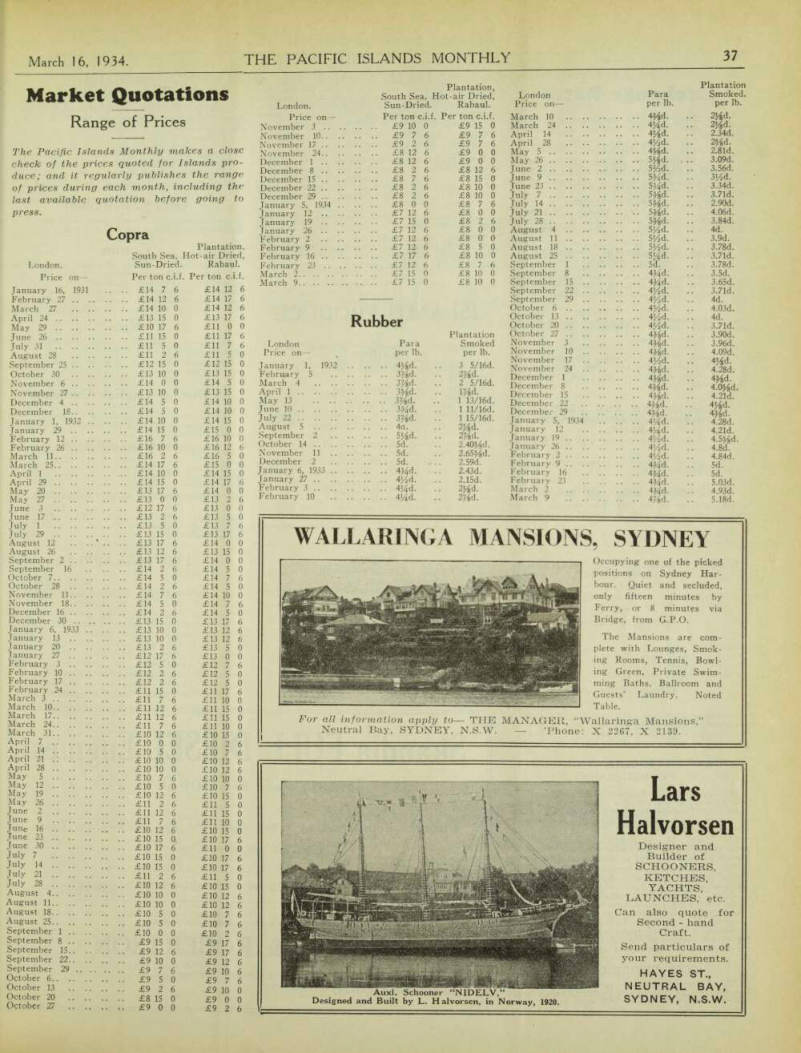
Range of Prices
The Pacific Islands Monthly makes a close check of the prices quoted for Islands pro duce; and it regularly publishes the range of prices during each month, including the last available quotation before going to press.
London Para Plantation Smoked.
Price on — per lb. per lb.
March 10 .. .. 4^d. zyd.
March 24 .. .. 4}4d. 2yd.
April 14 .. .. 4^d. 2.34d.
April 28 2yd.
May 5 .. .. 4^d. 2.81d.
May 26 .. .. 5j*d. , 3.09d.
June 2 .. .. 5^d. 3.56d.
June 9 .. .. 5Hd. 3yd.
June 23 .. .. sy 4 d. 3.34d.
July 7 .. .. 5&d. 3.71d.
July 14 .. .. Syd. 2.90d.
July 21 .. .. 5yd. 4.06d.
July 28 .. .. Syd. 3.84d.
August 4 .. .. 5/ 2 d. 4d.
August 11 .. .. syd. 3.9d.
August 18 .. .. 5/ 2 d. 3.78d.
August 25 ft 3.71d.
September 1 .. .. 3.78d.
September 8 .. .. .. .. 4J4d. 3.5d.
September 15 .. .. .. .. 4J4d. 3.65d.
September 22 .. .. .. .. 4«/ 2 d. 3.71d.
September 29 .. .. .. .. 4/ 2 d. 4d.
October 6 .. .. 4^d. 4.03d.
October 13 .. .. 4^d. 4d.
October 20 .. .. 4/ 2 d. 3.71d, October 27 3.90d.
November 3 .. .. 4Hd. 3.96d.
November 10 .. .. .. .. 4^d. 4.09d.
November 17 .. .. .. .. 4^d. 4yd.
November 24 .. .. .. .. 4Hd. 4^28d.
December 1 ... 4}id.
December 8 .. .. .. .. 4^d. 4.0yd.
December 15 .. .. .. .. 4Hd. 4.21d.
December 22 .. .. .. .. 4Hd. 4yd.
December 29 .. .. .. .. 4fid. 4yd.
January 5, 1934 .. .. 4>4d. 4 28d.
January 12 .. .. .. .. 4J4d. 4.21d.
January 19 .. .. 4yd. 4.5^d.
January 26 .. .. 4yd. 4.8d.
February 2 4.84d.
February 9 Sd.
February 16 .. .. 4?4d. 5d.
February 23 444d 5.03d.
March 2 4.93d.
March 9 .. .. 4yd. 5.18d.
South Sea,
Plantation,
Hot-air Dried, London.
Sun-Dried.
Rabaul.
Price on — Per ton c.i.f. Per ton c.i.f.
November 3 . .. £9 10 0 £9 15 0 November 10 . .. £9 7 6 £9 7 6 November 17 . .. £9 2 6 £9 7 6 November 24 . .. £8 12 6 £9 0 0 December 1 . .. £8 12 6 £9 0 0 December 8 . .. £8 2 6 £8 12 6 December IS . .. £8 7 6 £8 15 0 December 22 . .. £8 2 6 £8 10 0 December 29 . .. £8 2 6 £8 10 0 January 5, 1934 .. . . .. £8 0 0 £8 7 6 January 12 12 6 £8 0 0 January 19 . .. £7 15 0 £8 2 6 January 26 . .. £7 12 6 £8 0 0 February 2 . .. £7 12 6 £8 0 0 February 9 . .. £7 12 6 £8 5 0 February 16 . .. £7 17 6 £8 10 0 February 23 . .. £7 12 6 £8 7 6 March 2 £7 IS 0 £8 10 0 March 9 .. £7 15 0 £8 10 0
London
Rubber
Para Plantation Smoked Price on — per lb. per lb.
January 1, 1932 4>*d. 3 S/16d.
February S 3Hd. .. 2^d.
March 4 3^d. 2 5/16d.
April 1 Md. .. VAd.
May 13 .. .. 3fcd. 1 13/16d.
June 10 3^d. 1 ll/16d.
July 22 3^d. 1 lS/16d.
August 5 .. .. .. 2%d.
September 2 SHd. .. ??d.
October 14 .. .. 5d. 2.40^d.
November 11 .. 5d. 2.65^d.
December 2 5d. 2.59d.
January 6, 1933 .. 4J4d. 2.43d.
January 27 .. .. 4J^d. 2.15d.
February 3 .. .. 4J4d. .. 2j*d.
February 10 4tfd. .. 27^d.
Copra
South Sea, Plantation, Hot-air Dried, London.
Sun-Dried.
Rabaul.
Price on — Per ton c.i.f. Per ton c.i.f.
January 16, 1931 .. .. £14 7 6 £14 12 6 February 27 .. .. .. £14 12 6 £14 17 6 March 27 .. .. .. .. £14 10 0 £14 12 6 April 24 .. .. £13 15 0 £13 17 6 May 29 .. .. £10 17 6 £11 0 0 June 26 .. .. £11 15 0 £11 17 6 July 31 .. .. £11 5 0 £11 7 6 August 28 .. .. .. .. £11 2 6 £11 5 0
September 25 .. ..
.. .. £12 15 0 £12 15 0 October 30 .. .. .. .. £13 10 0 £13 15 0 November 6 .. .. .. .. £14 0 0 £14 5 0 November 27 .. .. .. £13 10 0 £13 15 0 December 4 .. .. .. .. £14 5 0 £14 10 0 December 18.. .. .. £14 5 0 £14 10 0 January 1, 1932 ..
January 29 .. .. .. .. £14 10 0 £14 15 0 .. .. £14 15 0 £15 0 0 February 12 .. .. .. .. £16 7 6 £16 10 0 February 26 .. .. .. .. £16 10 0 £16 12 6 March 11 .. .. £16 2 6 £16 5 0 March 25 .. .. £14 17 6 £15 0 0 April 1 £14 10 0 £14 15 0
April 29
.. .. £14 15 0 £14 17 6 May 20 .. .. £13 17 6 £14 0 0 May 27 .. .. £13 0 0 £13 2 6 June 3 .. .. £12 17 6 £13 0 0 June 17 .. .. £13 2 6 £13 5 0 July 1 .. .. £13 5 0 £13 7 6 July 29 .. .. £13 15 0 £13 17 6 August 12 .. .. 1 ‘ .. .. £13 17 6 £14 0 0 August 26 .. .. £13 12 6 £13 15 0
September 2 ..
.. .. £13 17 6 £14 0 0 September 16 .. .. £14 2 6 £14 5 0 October 7 .. .. £14 5 0 £14 7 6 October 28 .. .. .. .. £14 2 6 £14 5 0 November 11.. .. .. £14 7 6 £14 10 0 November 18.. .. .. £14 5 0 £14 7 6 December 16 .. .. .. .. £14 2 6 £14 5 0 December 30 .. .. .. .. £13 IS 0 £13 17 6 January 6, 1933 .. .. .. £13 10 0 £13 12 6 January 13 .. .. .. £13 10 0 £13 12 6 January 20 .. .. .. .. £13 2 6 £13 5 0 January 27 .. .. .. .. £12 17 6 £13 0 0 February 3 .. .. .. .. £12 5 0 £12 7 6 February 10 .. .. .. .. £12 2 6 £12 5 0 February 17 .. 6 £12 5 0 February 24 .. .. .. .. £11 15 0 £11 17 6 March 3 6 £11 10 0 March 10 6 £11 15 0 March 17 6 £11 15 0 March 24 6 £11 10 0 March 31 .. .. £10 12 6 £10 15 0 April 7 0 £10 2 6 April 14 0 £10 7 6 April 21 0 £10 12 6 April 28 0 £10 12 6 May 5 .. .. £10 7 6 £10 10 0
May 12
0 £10 7 6 May 19 6 £10 15 0 May 26 6 £11 5 0 June 2 6 £11 15 0 June 9 6 £11 10 0 June 16 6 £10 15 0 June 23 0 £10 17 6 June 30 6 £11 0 0 July 7 0 £10 17 6 July 14 0 £10 17 6 July 21 6 £11 5 0 July 28 6 £10 IS 0
August 4
0 £10 12 6 August 11 0 £10 12 6 August 18 0 £10 7 6 August 25 0 £10 7 6
September 1 .. ..
0 £10 2 6 September 8 .. .. .. £9 15 0 £9 17 6 September IS.. .. 6 £9 17 6
September 22.. ..
0 £9 12 6 September 29 .. .. 6 £9 10 6 October 6 0 £9 7 6 October 13 .. .. 6 £9 10 0 October 20 .. .. 0 £9 0 0 October 27 .. .. 0 £9 2 6
Advertisements & other items, p. 39 (1 item)
Halvorsen
WALLARINGA MANSIONS, SYDNEY
m Occupying one of the picked positions on Sydney Harbour. Quiet and secluded, only fifteen minutes by Ferry, or 8 minutes via Bridge, from G.P.O.
The Mansions are complete with Lounges, Smoking Rooms, Tennis, Bowling Green, Private Swimming Baths. Ballroom and Guests’ Laundry. Noted Table.
For all information apply to — THE MANAGER, “Wallaringa Mansions,”
Neutral Bay, SYDNEY, N.S.W. ’Phone: X 2267, X 2139.
Auxl. Schooner “NIDELV,"
Designed and Built by L. Halvorsen, in Norway, 1920.
Lars
Halvorsen
Designer and Builder of
SCHOONERS,
KETCHES,
YACHTS,
LAUNCHES, etc.
Can also quote for Second-hand Craft.
Send particulars of your requirements.
HAYES ST.,
NEUTRAL BAY,
SYDNEY, N.S.W.
Exchange Rates
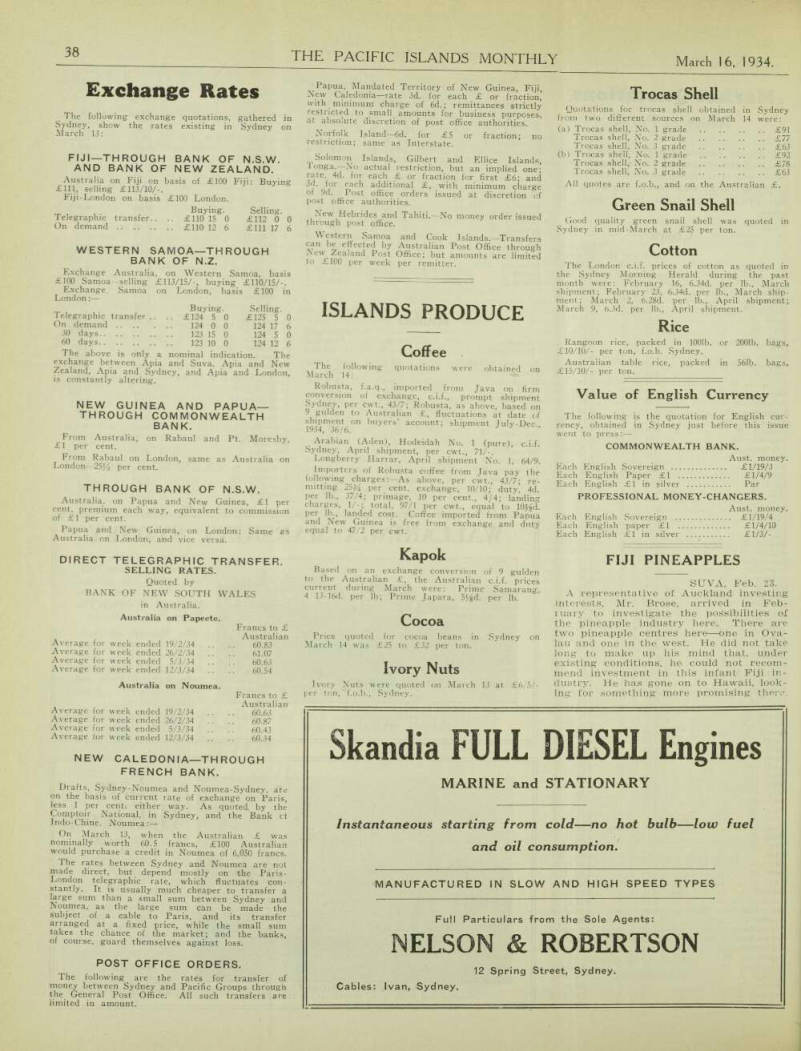
The following exchange quotations, gathered in Sydney, show the rates existing in Sydney on March 13 ;
Fiji—Through Bank Of N.S.W.
And Bank Of New Zealand.
Australia on Fiji on basis of £100 Fiji: Buying £111, selling £113/10/-.
Fiji-London on basis £100 London.
Western Samoa—Through
Bank Of N.Z.
Exchange Australia, on Western Samoa, basis £100 Samoa—selling £113/15/-, buying £110/15/-.
Exchange, Samoa on London, basis £100 in London:—
The above is only a nominal indication. The exchange between Apia and Suva, Apia and New Zealand, Apia and Sydney, and Apia and London, is constantly altering.
New Guinea And Papua
Through Commonwealth
Bank.
From Australia, on Rabaul and Pt. Moresby, £1 per cent.
From Rabaul on London, same as Australia on London— per cent.
Through Bank Of N.S.W.
Australia, on Papua and New Guinea, £1 per cent, premium each way, equivalent to commission of £1 per cent.
Papua and New Guinea, on London: Same as Australia on London, and vice versa.
Direct Telegraphic Transfer.
Selling Rates.
Quoted by
Bank Of New South Wales
in Australia.
New Caledonia—Through
French Bank.
Drafts, Sydney-Noumea and Noumea-Sydney, are on the basis of current rate of exchange on Paris, less 1 per cent, either way. As quoted, by the Comptoir National, in Sydney, and the Bank of Indo-Chine, Noumea:— On March 13, when the Australian £ was nominally worth 60.5 francs, £100 Australian would purchase a credit in Noumea of 6,050 francs.
The rates between Sydney and Noumea are not made direct, but depend mostly on the Paris- London telegraphic rate, which fluctuates con stantly. It is usually much cheaper to transfer a large sum than a small sum between Sydney and Noumea, as the large sum can be made the subject of a cable to Paris, and its transfer arranged at a fixed price, while the small sum takes the chance of the market; and the banks, of course, guard themselves against loss.
Post Office Orders.
The following are the rates for transfer of money between Sydney and Pacific Groups through the General Post Office. All such transfers are limited in amount.
Papua, Mandated Territory of New Guinea, Fiji, New Caledonia—rate 3d. for each £ or fraction, with minimum charge of 6d.; remittances strictly restricted to small amounts for business purposes, at absolute discretion of post office authorities.
Norfolk Island—6d. for £5 or fraction; no restriction; same as Interstate.
Solomon Islands, Gilbert and Ellice Islands, Tonga. No actual restriction, but an implied one; rate 4d. for each £ or fraction for first £6; and for each additional £, with minimum charge of 9d - Post office orders issued at discretion of post office authorities.
New Hebrides and Tahiti.—No money order issued through post office.
Western Samoa and Cook Islands.—Transfers can be effected by Australian Post Office through New Zealand Post Office; but amounts are limited to £100 per week per remitter.
Buying.
Selling.
Telegraphic transfer.. .. £110 15 0 £112 0 0 On demand .. £110 12 6 £111 17 6
Telegraphic transfer ..
Buying. .. £124 5 0 Selling. £125 5 0 On demand 124 0 0 124 17 6 30 days 124 5 0 60 days 123 10 0 124 12 6
Australia on Papeete.
Average for week ended 19/2/34 Francs to £ Australian 60.83 Average for week ended 26/2/34 61.07 Average for week ended 5/3/34 60.63 Average for week ended 12/3/34 60.54 Australia on Noumea.
Average for week ended 19/2/34 ..
Francs to £ Australian 60.63 Average for week ended 26/2/34 60.87 Average for week ended 5/3/34 60.43 Average for week ended 12/3/34 60.34
Islands Produce
Coffee
The following quotations were obtained on March 14: Robusta, f.a.q., imported from Java on firm conversion of exchange, c.i.f., prompt shipment Sydney, per cwt., 43/7; Robusta, as above, based on 9 gulden to Australian £, fluctuations at date of shipment on buyers’ account; shipment July-Dee., 1934, 36/6.
Arabian (Aden), Hodeidah No. 1 (pure), c.i.f.
Sydney, April shipment, per cwt., 71/-.
Longberry Harrar, April shipment No. 1, 64/9.
Importers of Robusta coffee from Java pay the following charges;—As above, per cwt., 43/7; re mitting per cent, exchange, 10/10; duty, 4d. per lb., 37/4; primage, 10 per cent., 4/4; landing charges, 1/-; total, 97/l per cwt., equal to P er , lb., landed cost. Coffee imported from Papua and New Guinea is free from exchange and duty equal to 47/2 per cwt.
Kapok
Based on an exchange conversion of 9 gulden to the Australian £, the Australian c.i.f. prices current during March were: Prime Samarang, 4 13-16 d. per lb; Prime Japara, per lb.
Cocoa
Price quoted for cocoa beans in Sydney on March 14 was £25 to £32 per ton.
Ivory Nuts
Ivory Nuts were quoted on March 13 at £6/5/per ton, f.o.b., Sydney.
Trocas Shell
Quotations for trocas shell obtained in Sydney from two different sources on March 14 were: (a) Trocas shell, No. 1 grade £91 Trocas shell, No. 2 grade £77 Trocas shell, No. 3 grade £63 (b) Trocas shell, No. 1 grade £92 Trocas shell,- No. 2 grade £78 Trocas shell. No. 3 grade £63 All quotes are f.0.b., and on the Australian £.
Green Snail Shell
Good quality green snail shell was quoted in Sydney in mid-March at £25 per ton.
Cotton
The London c.i.f. prices of cotton as quoted in the Sydney Morning Herald during the past month were: February 16, 6.34 d. per lb., March shipment; February 23, 6.34 d. per lb., March ship ment; March 2,6.28 d. per lb., April shipment; March 9,6.3 d. per lb., April shipment.
Rice
Rangoon rice, packed in 100lb. or 200lb. bags, £10/10/- per ton, f.o.b. Sydney.
Australian table rice, packed in 561 b. bags, £15/10/- per ton.
Value of English Currency
The following is the quotation for English cur rency, obtained in Sydney just before this issue went to press:—
Commonwealth
Bank.
Each English Sovereign £1/19/3 Each English Paper £1 £1/4/9 Each English £1 in silver Par Aust. money.
Professional Money-Changers.
Each English Sovereign £1/19/4 Each English paper £1 £1/4/10 Aust. money.
Each English £1 in silver £ 1/3/-
Fiji Pineapples
Suva, Feb. 23.
A representative of Auckland investing interests, Mr. Brose, arrived in Feb ruary to investigate the possibilities of the pineapple industry here. There are two pineapple centres here —one in Ova lau and one in the west. He did not take long to make up his mind that, under existing conditions, he could not recom mend investment in this infant Fiji in dustry. He has gone on to Hawaii, look ing for something more promising there.
Advertisements & other items, p. 40 (1 item)
Skandia FULL DIESEL Engines
MARINE and STATIONARY
Instantaneous starting from cold—no hot bulb—low fuel and oil consumption.
MANUFACTURED IN SLOW AND HIGH SPEED TYPES Full Particulars from the Sole Agents:
NELSON & ROBERTSON
12 Spring Street, Sydney.
Cables: Ivan, Sydney.
Shipping Services in the Pacific
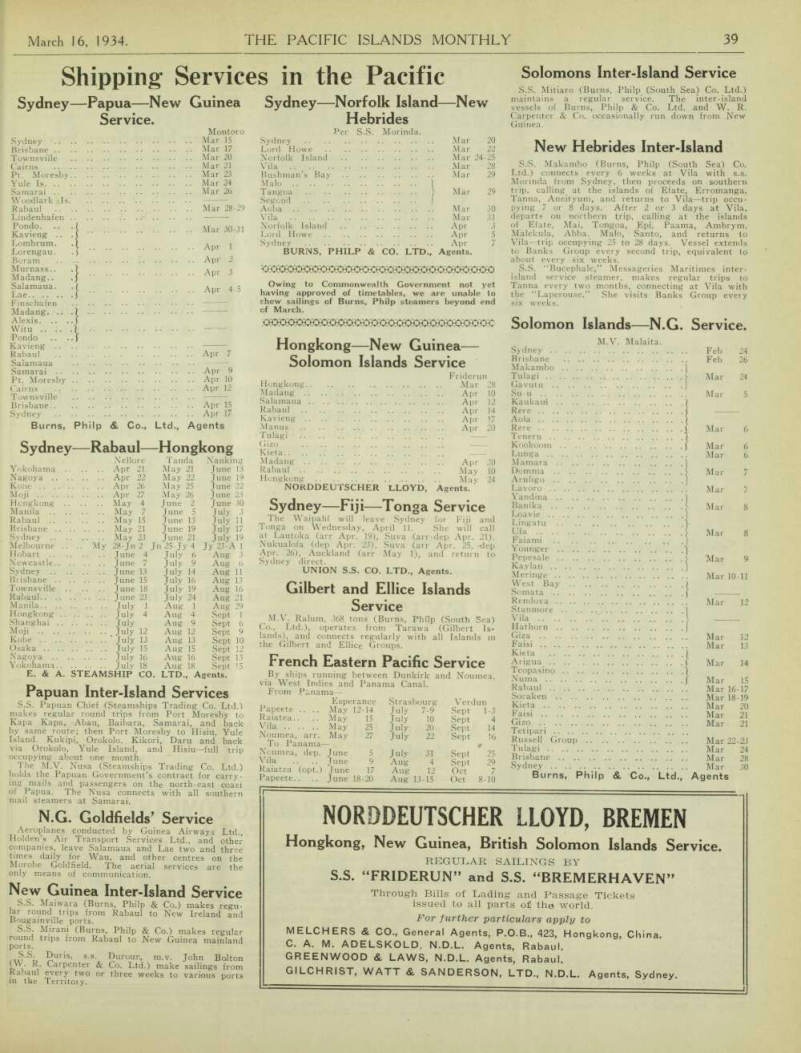
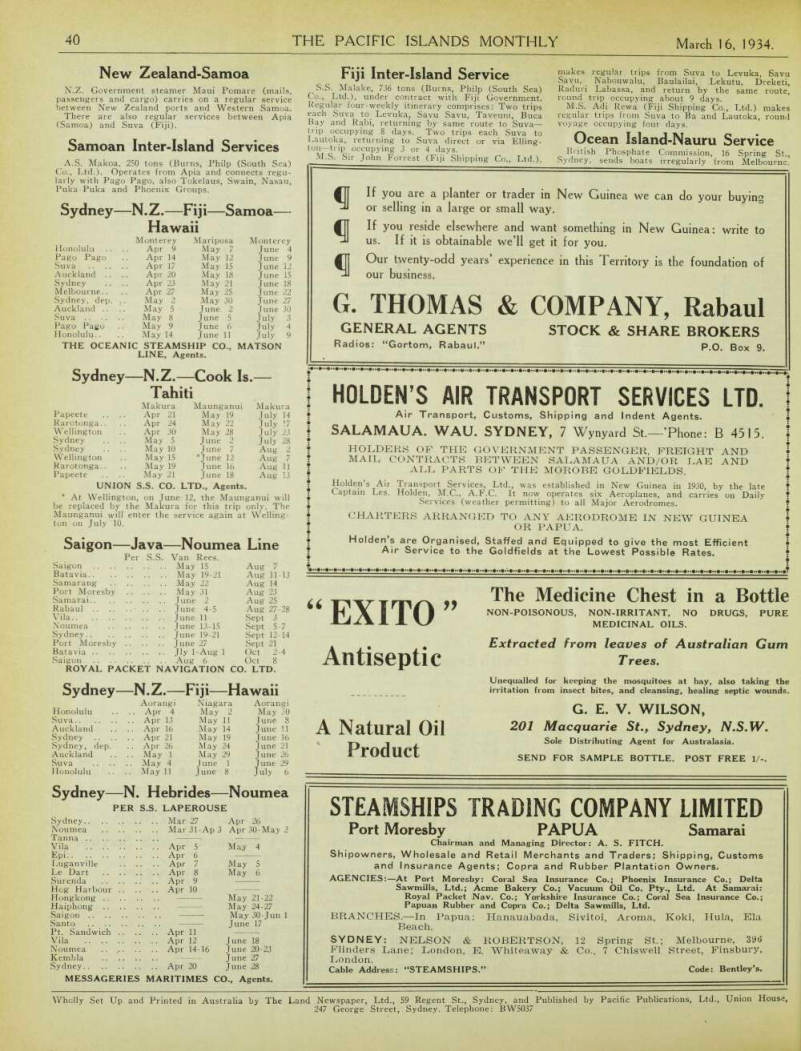
Sydney—Papua—New Guinea Sydney—Norfolk Island—New
Service.
Sydney—Rabaul—Hongkong
Papuan Inter-Island Services
S.S. Papuan Chief (Steamships Trading Co. Ltd. makes regular round trips from Port Moresby to Kapa Kapa, Abau, Baibara, Samarai, and back by same route; then Port Moresby to Hisiu, Yule Island. Kukipi, Orokolo, Kikori, Daru and back via Orokolo, Yule Island, and Hisiu —full trip occupying about one month.
The M.V. Nusa (Steamships Trading Co. Ltd.) holds the Papuan Government’s contract for carry ing mails and passengers on the north-east coast of Papua. The Nusa connects with all southern mail steamers at Samarai.
N.G. Goldfields’ Service
Aeroplanes conducted by Guinea Airways Ltd., Holden’s Air Transport Services Ltd., and other companies, leave Salamaua and Lae two and three times daily for Wau, and other centres on the Morobe Goldfield. The aerial services are the only means of communication.
New Guinea Inter-Island Service
S.S. Maiwara (Burns, Philp & Co.) makes regular round trips from Rabaul to New Ireland and Bougainville ports.
S.S. Mirani (Burns, Philp & Co.) makes regular round trips from Rabaul to New Guinea mainland ports.
S.S. Duris, s.s. Durour, m.v. John Bolton (W. R. Carpenter & Co. Ltd.) make sailings from Rabaul every two or three weeks to various ports in the Territory.
Hebrides
Owing to Commonwealth Government not yet having approved of timetables, we are unable to show sailings of Burns, Philp steamers beyond end of March.
Hongkong—New Guinea— Solomon Islands Service
Sydney—Fiji—Tonga Service
The Waipahi will leave Sydney for Fiji and Tonga on Wednesday, April 11. She will call at Lautoka (arr Apr. 19), Suva (arr-dep Apr. 21), Nukualofa (dep Apr. 23), Suva (arr Apr. 25, -dep Apr. 26), Auckland (arr May 1), and return to Sydney direct.
Union S.S. Co. Ltd., Agents.
Gilbert and Ellice Islands
Service
M.V. Ralum, 368 tons (Burns, Philp (South Sea) Co., Ltd.), operates from Tarawa (Gilbert Is lands), and connects regularly with all Islands in the Gilbert and Ellice Groups.
French Eastern Pacific Service
By ships running between Dunkirk and Noumea, via West Indies and Panama Canal.
From Panama—
Solomons Inter-Island Service
S.S. Mitiaro (Burns, Philp (South Sea) Co. Ltd.) maintains a regular service. The inter-island vessels of Burns, Philp & Co. Ltd. and W. R.
Carpenter & Co. occasionally run down from New Guinea.
New Hebrides Inter-Island
S.S. Makambo (Burns, Philp (South Sea) Co.
Ltd.) connects every 6 weeks at Vila with s.s.
Morinda from Sydney, then proceeds on southern trip, calling at the islands of Efate, Erromanga, Tanna, Aneityum, and returns to Vila—trip occu pying 7 or 8 days. After 2 or 3 days at Vila, departs on northern t,rip, calling at the islands of Efate, Mai, Tongoa, Epi, Paama, Ambrym, Malekula, Abba. Malo, Santo, and returns to Vila—trip occupying 25 to 28 days. Vessel extends to Banks Group every second trip, equivalent to about every six weeks.
S.S. ’‘Bucephale,” Messageries Maritimes interisland service steamer, makes regular trips to Tanna every two months, connecting at Vila with the “Laperouse.” She visits Banks Group every six weeks.
Solomon Islands—N.G. Service.
Sydney Brisbane .. ..
Townsville Cairns Pt. Moresby..
Yule Is. .. ..
Samarai ..
Woodlark Is.
Rabaul ..
Lindenhafen ..
Pondo. .. .
Kavieng ..
Lombrum. .
Lorengau.
Boram Murnass..
Madang..
Salamaua.
Lae J Finschafen Montoro Mar 15 Mar 17 Mar 20 Mar 21 Mar 23 Mar 24 Mar 26 Mar 28-29 Mar 30-31 Apr 1 Apr 2 Madang. ..
Alexis Witu Pondo .. ..
Kavieng .. ..
Rabaul .. ..
Salamaua Samarai .. .
Apr 9 Pt. Moresby .
Cairns Apr 12 Townsville Brisbane..
Apr 15 Sydney Apr 17
Burns, Philp & Co., Ltd., Agents
Nellore Tanda Nanking Yokohama .
Apr 21 May 21 June 13 Nagoya ..
Apr 22 May 22 June 19 Kobe .. ..
May 25 June 22 Moji .. ..
Apr 27 May 26 June 23 Hongkong .
June 2 June 30 Manila .. .
May 7 June 5 July 3 Rabaul .. .
June 13 July 11 Brisbane ..
June 19 July 17 Sydney ..
May 23 June 21 July 19 Melbourne .. . .. My 28-Jn 2 J n 25-Jy 4 Jy 23-A 1 Hobart .. .
July 6 Aug 3 Newcastle..
June 7 July 9 Aug 6 Sydney .. , June 13 July 14 Aug 11 Brisbane ..
July 16 Aug 13 Townsville .
June 18 July 19 Aug 16 Rabaul.. ..
July 24 Aug 21 Manila.. ..
July 1 Aug 1 Aug 29 Hongkong ..
July 4 Aug 4 .Sept i Shanghai ..
Aug 9 Sept 6 Moji .. ..
July 12 Aug 12 Sept 9 Kobe .. ..
' July 13 Aug 13 Sept 10 Osaka .. ..
Jul v 15 Aug 15 Sept 12 Nagoya ..
Aug 16 Sept 13 Yokohama..
July 18 Aug 18 Sept 15 E. & A. STEAMSHIP CO. LTD., Agents.
Papeete .. ..
Esperance Strasbourg Verdun May 12-14 July 7-9 Sept ] Sept 1-3 Raiatea..
May IS July 10 4 Vila May 25 July 20 Sept 14 Noumea, arr.
To Panama- May 27 July 22 Sept 16 Noumea, dep.
June 5 July 31 Sept 25 Vila June 9 Aug 4 Sept 29 Raiatea (opt.) June 17 Aug 12 Oct 7 Papeete..
June 18-20 Aug 13-15 Oct 8 10
Per S.S. Morinda.
Sydney Mar 20 Lord Howe 22 Norfolk Island 24-25 Vila .
Mar 28 Bushman’s Bay Malo Mar 1 29 Tangoa Segond
\ Mar
J 29 Aoba Mar 50 Vila Mar 31 Norfolk Island Apr 3 Lord Howe 5 Sydney
Burns, Philp & Co. Ltd., Agents.
7
Friderun Hongkong Mar 28 Madang Salamaua Rabaul Kavieng Manus Tulagi Gizo Kieta Madang Rabaul Hongkong
Norddeutscher Lloyd, Agents.
M.V. Malaita.
Sydney .. .
Feb 24 Brisbane Feb 26 Makambo .. 1 Tulagi .. .. 24 Gavutu ..
J Su -u Mar 5 Kaukaul ..
Rare Aola Rere 6 Teneru .. .
Kookoom .. 6 Lunga .. ..
Mar 6 Mamara ..
Dumma .. 7 Aruligo .. j Lavoro .. .. 7 Vandina ..
Banika .. . 8 Loavie .. ..
Lingatu ..
V Ufa .. .. 8 Faiami Younger 1 Pepesale .. 9 Kaylan .. .
Meringe .. . -11 West Bay Somata .. , Rendova ..
Mar 12 Stanmore ..
Vila .. ’I Hathorn .. : .. .. :: :j Giza .. .. 12 Faisi 13 Kieta .. .. t Arigua .. .. 14 Teopasino .. \ Numa .. .. ( Mar 15 Rabaul .. ..
Soraken .. -19 Kieta .. ..
Mar 20 Faisi .. .. 21 Gizo .. .. 21 Tetiuari .. .
Russell Group Tulagi .. ..
Mar 24 Brisbane ..
Mar 28 Sydney .. .
Mar 30 Burns, Philp & Co., Ltd., Agents
New Zealand-Samoa
N.Z. Government steamer Maui Pomare (mails, passengers and cargo) carries on a regular service between New Zealand ports and Western Samoa.
There are also regular services between Apia (Samoa) and Suva (Fiji).
Samoan Inter-Island Services
A.S. Makoa, 250 tons (Burns, Philp (South Sea) Co., Ltd.). Operates from Apia and connects regu larly with Pago Pago, also Tokelaus, Swain, Nasau, Puka-Puka and Phoenix Groups.
Sydney—N.Z.—Fij i—Samoa—
Hawaii
Sydney—N.Z.—Cook Is.— Tahiti
Saigon—Java—Noumea Line
Per S.S. Van Rees.
Saigon May 15 Aug 7 Batavia May 19-21 Aug 11-13 Samarang May 22 Aug 14 Port Moresby May 31 Aug 23 Samarai June 2 Aug 25 Rabaul .. .. June 4-5 Aug 27-28 Vila June 11 Sept 3 Noumea June 13-15 Sept 5-7 Sydney June 19-21 Sept 12-14 Port Moresby June 27 Sept 21 Batavia Jly 1-Aug 1 Oct 2-4 Saigon Aug 6 Oct 8
Royal Packet Navigation Co. Ltd.
Sydney—N.Z.—Fiji—Hawaii
Sydney—N. Hebrides—Noumea
Fiji Inter-Island Service
S.S. Malake, 736 tons (Burns, Philp (South Sea) Co., Ltd.), under contract with Fiji Government.
Regular four-weekly itinerary comprises: Two trips each Suva to Levuka, Savu Savu, Taveum, Buca Bay and Rabi, returning by same route to Suva— trip occupying 8 days. Two trips each Suva to Lautoka, returning to Suva direct or via Elling ton—trip occupying 3 or 4 days.
M.S. Sir John Forrest (Fiji Shipping Co., Ltd.),
makes regular trips from Suva to Levuka, Savu Savu, Nabouwalu, Baulailai, Lekutu, Dreketi, Raduri Labassa, and return by the same route, round trip occupying about 9 days.
M.S. Adi Rewa (Fiji Shipping Co., Ltd.) makes regular trips from Suva to Ba and Lautoka, round voyage occupying four days.
Ocean Island-Nauru Service
British Phosphate Commission, 16 Spring St,, Sydney, sends boats irregularly from Melbourne.
Honolulu Monterey Mariposa Monterey Apr 9 May 7 June 4 Pago Pago Apr 14 May 12 June 9 Suva May 15 June 12 Auckland ..
Apr 20 May 18 June 15 Sydney Apr 23 May 21 June 18 Melbourne..
Apr 27 May 25 June 22 Sydney, dep.
May 2 May 30 June 27 Auckland ..
May 5 June 2 June 30 Suva ..
May 8 June 5 July 3 Pago Pago May 9 June 6 July 4 Honolulu..
May 14 June 11 July 9
The Oceanic Steamship Co.,
LINE, Agents.
Matson
Makura Maunganui Makura Papeete Apr 21 May 19 July 14 Rarotonga..
Apr 24 May 22 July 27 Wellington Apr 30 May 28 July 23 Sydney May 5 June 2 July 28 Sydney May 10 June 7 Aug 2 Wellington May 15 *June 12 Aug 7 Rarotonga..
May 19 June 16 Aug 11 Papeete May 21 June 18 Aug 13
Union S.S. Co. Ltd., Agents.
* At Wellington, on June 12, the Maunganui will be replaced by the Makura for this trip only. The Maunganui will enter the service again at Wellington on July 10.
Aorangi Niagara Aorangi Honolulu .. Apr 4 May 2 May 30 Suva .. Apr 13 May 11 June 8 Auckland .. Apr 16 May 14 June 11 Sydney .. Apr 21 May 19 June 16 Sydney, dep. .. Apr 26 May 24 June 21 Auckland .. May 1 May 29 June 26 Suva .. ..
June 1 June 29 Honolulu .. May 11 June 8 July 6
Per S.S. Laperouse
Sydney .. Mar 27 Apr 26 Noumea Tanna Vila Apr 30-May 2 .. Apr 5 May 4 .. Apr 6 Luganville .. Apr 7 May 5 Le Dart .. Apr 8 May 6 Surenda .. Apr 9 Hog Harbour .. .. .. Apr 10 Hongkong May 21-22 Haiphong May 24-27 Saigon May 30-Jun 1 June 17 Santo Pt. Sandwich .. .. Apr 11 Vila .. Apr 12 June 18 Noumea .. Apr 14-16 June 20-23 Kembla June 27 June 28 Sydney .. Apr 20
Messageries Maritimes Co., Agents.
Advertisements & other items, pp. 41-44 (2 items)
Norddeutscher Lloyd, Bremen
Hongkong, New Guinea, British Solomon Islands Service.
REGULAR SAILINGS BY
S.S. “FRIDERUN” and S.S. “BREMERHAVEN”
Through Bills of Lading and Passage Tickets issued to all parts of the world.
For further particulars apply to MELCHERS & CO., General Agents, P. 0.8., 423, Hongkong, China.
C. A. M. ADELSKOLD, N.D.L. Agents, Rabaul.
GREENWOOD & LAWS, N.D.L. Agents, Rabaul.
GILCHRIST, WATT & SANDERSON, LTD., N.D.L. Agents, Sydney.
If you are a planter or trader in New Guinea we can do your buying or selling in a large or small way.
If you reside elsewhere and want something in New Guinea: write to us. If it is obtainable we’ll get it for you.
Our twenty-odd years’ experience in this Territory is the foundation of our business.
G. THOMAS & COMPANY, Rabaul
GENERAL AGENTS STOCK & SHARE BROKERS
Radios: “Gortom, Rabaul.” P.O. Box 9.
HOLDEN’S AIR TRANSPORT SERVICES LTD.
Air Transport, Customs, Shipping and Indent Agents.
SALAMAUA. WAU. SYDNEY, 7 Wynyard St.—’Phone: B 4313.
HOLDERS OF THE GOVERNMENT PASSENGER, FREIGHT AND MAIL CONTRACTS BETWEEN SALAMAUA AND/OR LAE AND
ALL PARTS OF THE MOROBE GOLDFIELDS.
Holden’s Air Transport Services, Ltd., was established in New Guinea in 1930, by the late Captain Les. Holden, M.C., A.F.C. It now operates six Aeroplanes, and carries on Daily Services (weather permitting) to all Major Aerodromes.
CHARTERS ARRANGED TO ANY AERODROME IN NEW GUINEA
OR PAPUA.
Holden’s are Organised, Staffed and Equipped to give the most Efficient Air Service to the Goldfields at the Lowest Possible Rates.
“EXITO”
Antiseptic
A Natural Oil
Product
The Medicine Chest in a Bottle
NON-POISONOUS, NON-IRRITANT, NO DRUGS, PURE
MEDICINAL OILS.
Extracted from leaves of Australian Gum Trees.
Unequalled for keeping the mosquitoes at bay, also taking the irritation from insect bites, and cleansing, healing septic wounds.
G. E. V. WILSON,
201 Macquarie St., Sydney, N.S.W.
Sole Distributing Agent for Australasia.
SEND FOR SAMPLE BOTTLE. POST FREE 1/-.
STEAMSHIPS TRADING COMPANY LIMITED
Port Moresby PAPUA Samarai
Chairman and Managing Director: A. S. FITCH.
Shipowners, Wholesale and Retail Merchants and Traders; Shipping, Customs and Insurance Agents; Copra and Rubber Plantation Owners.
AGENCIES:—At Port Moresby: Coral Sea Insurance Co.; Phoenix Insurance Co.; Delta Sawmills, Ltd.; Acme Bakery Co.; Vacuum Oil Co. Pty., Ltd. At Samarai: Royal Packet Nav. Co.; Yorkshire Insurance Co.; Cored Sea Insurance Co.; Papuan Rubber and Copra Co.; Delta Sawmills, Ltd.
BRANCHES.—In Papua: Hanauabada, Sivitoi, Aroma, Koki, Hula, Ela Beach.
SYDNEY: NELSON & ROBERTSON, 12 Spring St.; Melbourne, 39G Flinders Lane; London, E. Whiteaway & Co., 7 Chiswell Street, Finsbury, London.
Cable Address: “STEAMSHIPS.” Code: Bentley’s.
A Unique Aerial Transport Service
Three of the Large Trimotored Aeroplanes, operated by Guinea Airdays Ltd., on Bulolo Aerodrome, in the heart of the New Guinea Mountains.
BELOW: Giant wheel with a diameter of over feet for one of the Buiolo Gold Dredging Company’s dredges. It is bolted securely inside the cabin of a G31 tri-motored Junker for transport to the goldfields. The balance of the load was made up with hundred pound bags of rice.
AERIAL Transport made possible the development of the great Gold Industry of New Guinea. The presence of Rich Gold was proved in 1926, but the Problem was Communication. Morobe was guarded by dense jungle and precipitous mountains. A road could not be built, except at enormous, crippling cost.
Guinea Airways Ltd. launched its unique aerial service seven years ago, with one machine and a handful of men. To-day, it operates a fleet of modern aeroplanes, and employs large European and native staffs. Its machines, running on regular schedules, have carried men, machinery, dredges, building material, foodstuffs, motor-trucks, livestock, over the moun- g tains of New Guinea, without accident and without delay.
31 Aerodromes
BABUAP MARAWASSA
BAPI
BULOLO
BULWA
GABANZIZ
GARINA
JUNI
KAJABIT
KIDJURA
KOKODA*
KABUNA*
LAE
MT. HAGEN
MARILINAN
MENYAMYA
NADZAB
PORT
MORESBY*
PURARI
RAMU
SALAMAUA
SANGAN
SUNSHINE
SURPRISE CK.
UP. WATUT
WAGAU
WAHGI
WAMPIT
WAU
ZENAG
WARONA
In Papua.
Two years ago, there were not a dozen landing-grounds on the goldfields. To-day, there are over 30. Prospectors are constantly opening new country. New enterprises are being launched. No sooner is a new camp established, than a new landing-ground is cleared, and Guinea Airways machines provide communication.
Travellers may leave the steamer at Port Moresby, fly across to Morobe (time of journey, Ih. 45min.) and spend 9 days in the Goldfield centres before rejoining steamer at Lae for Rabaul.
Or, after visiting Rabaul, they may disembark ct Salamaua or Lae, spend several days on the Goldfield, and fly to Pt. Moresby to rejoin the steamer.
All information from Pursers on the Steamers.
GUINEA AIRWAYS ITS
LAE • SALAMAUA
He knows that as a thirstquencher and an appetiser nothing is so good as a glass of Tooth’s K.B.
TOOTH'S
KB
IN QUART BOTTLES
AND HALF BOTTLES
LAGER.
40
March 16, 1 934,
THE PACIFIC ISLANDS MONTHLY
Wholly Set Up and Printed in Australia by The Land Newspaper, Ltd., 59 Regent St., Sydney, and Published by Pacific Publications, Ltd., Union House, 247 George Street, Sydney. Telephone: 8W5037