Pacific
Islands
Monthly
August 26
1932
6 d
[Registered at G.P.O., Sydney, for transmission by post as a newspaper.]
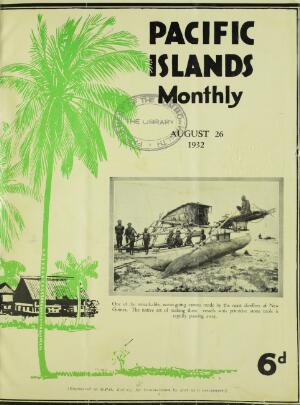
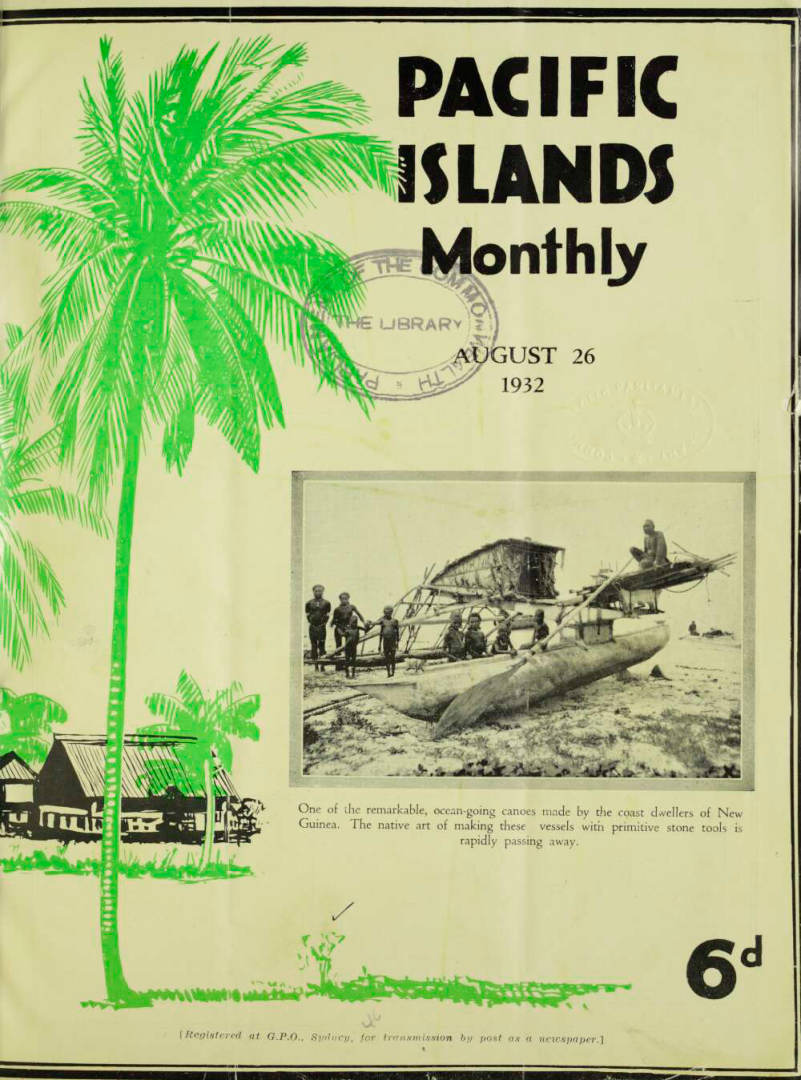
One of the remarkable, ocean-going canoes made by the coast dwellers of New Guinea. The native art of making these vessels with primitive stone tools is rapidly passing away.
Advertisements & other items, p. 2 (1 item)
W. R. Carpenter & Co. Ltd.
Head Office :
19-21 O’CONNELL STREET - - SYDNEY
Branches at : RABAUL (New Britain), KAVIENG (New Ireland), MADANG (New Guinea), SALAMAUA, WAU (New Guinea), TULAGI (Solomon Islands), and other Pacific Islands; and in LONDON.
WE SPECIALISE IN SUPPLYING THE REQUIREMENTS OF ISLANDS
RESIDENTS, PLANTERS AND TRADERS.
We are Agents for: Ford Cars, Trucks and Fordson Trac tors, Dodge Brothers Cars, Graham Dodge Trucks, Bolinder Marine and Stationary Engines, Coates’ Plymouth Gin, McCallums’ Perfection Whisky, Rimmel’s Perfumes, Houbigant’s Per fumes and Powders, Carlton V.B.
Beer, Goodyear Tyres.
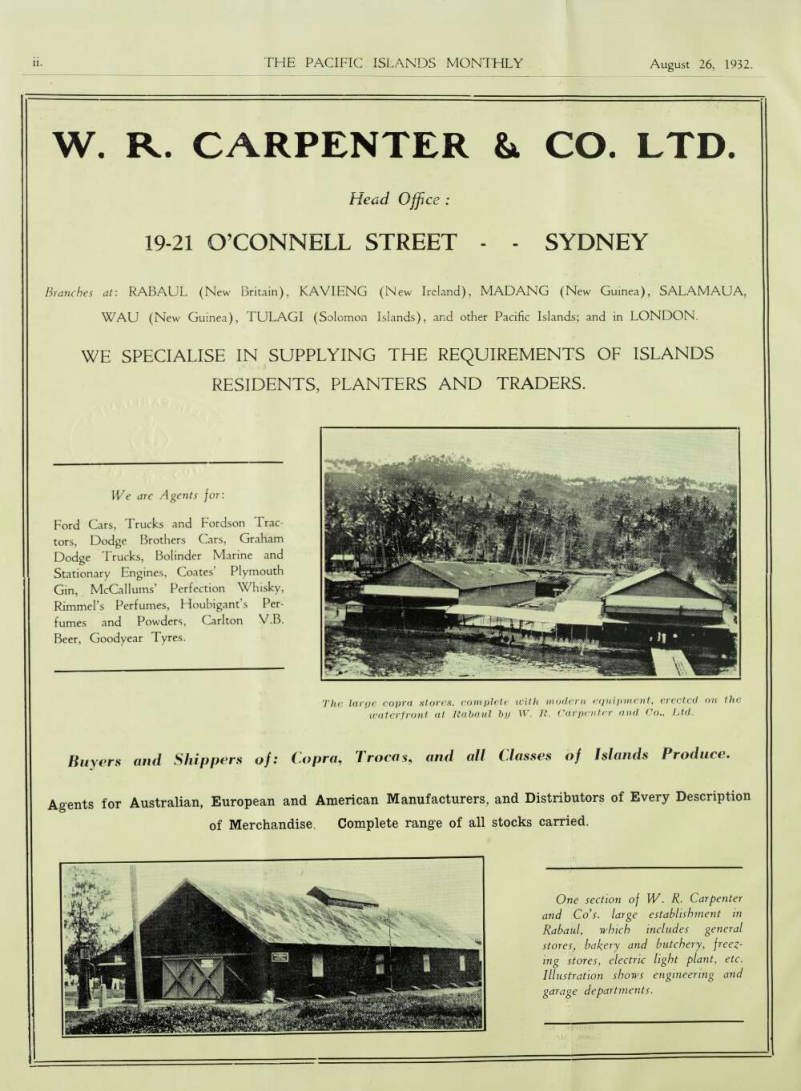
The large copra stores, complete with modern equipment , erected on the waterfront at Rabaul by W. R. Carpenter and Co., Ltd.
Buyers and Shippers of: Copra, Trocas, and Classes of Islands Produce.
Agents for Australian, European and American Manufacturers, and Distributors of Every Description of Merchandise. Complete range of all stocks carried.
One section of W. R. Carpenter and Co’s, large establishment in Rabaul, which includes general stores, bakery and butchery, freez ing stores, electric light plant, etc.
Illustration shows engineering and garage departments.
Islands Travellers
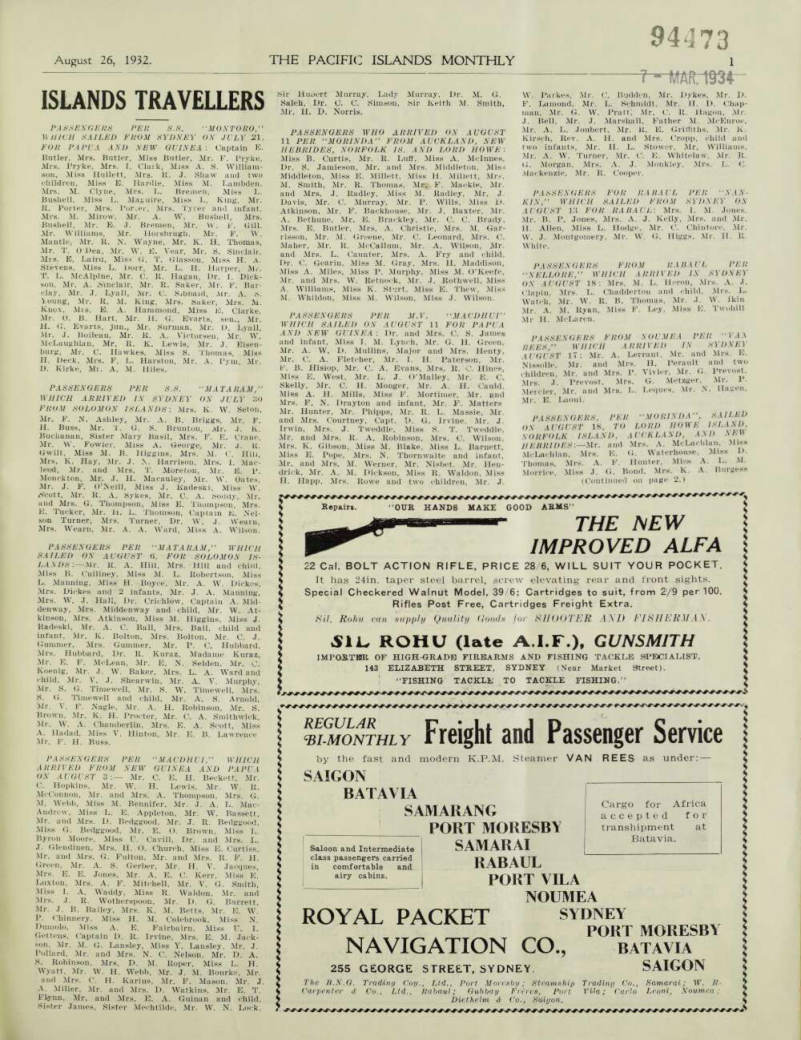
Passengers Per S.S. “Montoro,”
WHICH SAILED FROM SYDNEY ON JULY 21, FOR PAPUA AND NEW GUINEA : Captain E.
Butler, Mrs. Butler, Miss Butler, Mr. F. Pryke, Mrs. Pryke, Mrs. I. Clark, Miss A. S. William son, Miss Hullett, Mrs. K. J. Shaw and two children, Miss E. Hardie, Miss M. Lambden, Mrs. M. Clyne, Mrs. L. Bremen, Miss L.
Bushell, Miss L. Maguire, Miss L. King, Mr.
K. Porter, Mrs. Porter, Mrs. Tyrer and infant, Mrs. M. Mirow, Mr. A. W. Bushell, Mrs.
Bushell, Mr. E. J. Bremen, Mr, W. F. Gill, Mr. Williams, Mr. Horsbrugh, Mr. F. W.
Mantle, Mr. K. N. Wayne, Mr. K. H. Thomas, Mr. T. O'Dea, Mr. W. E. Vear, Mr. S. Sinclair, Mrs. E. Laird, Miss G. T. Glasson, Miss H. A.
Stevens, Miss L. Dorr, Mr. L. H. Harper, Mr.
T. L. McAlpine, Mr. C. R. Hagan, Dr. I. Dick son, Mr. A. Sinclair, Mr. R. Saker, Mr. F. Bar clay, Mr. J. Lyall, Mr. C. Sibbaid, Mr. A. S.
Young, Mr. R. M. King, Mrs. Saker, Mrs. M.
Knox, Mrs. E. A. Hammond, Miss E. Clarke, Mr. O. B. Hart, Mr. H. G. Ewarts, sen., Mr.
H. G. Evarts, jun., Mr. Surman, Mr. D. Lyall, Mr. J. Boileau, Mr. R. A. Victorseu, Mr. W.
McLaughlan, Mr. R. K. Lewis, Mr. J. Eisen burg, Mr. C. Hawkes, Miss S. Thomas, Miss H. Deck, Mrs. F. L. Harston, Mr. A. Pym, Mr.
D. Kirke, Mr. A. M. Hiles.
Passengers Per S.S. “Mataram,”
WHICH ARRIVED IN SYDNEY ON JULY 30 FROM SOLOMON ISLANDS: Mrs. K. W. Seton, Mr. F. N. Ashley, Mr. A. B. Briggs, Mr. F.
H. Buss, Mr. T. G. S. Brunton, Mr. J. K.
Buchanan, Sister Mary Basil, Mrs. F. E, Crane, Mr. W. Fowler, Miss A. George, Mr. J. R.
Gwilt, Miss M. B. Higgins, Mrs. M. C. Hill, Mrs. K. Hay, Mr. J. A. Harrison, Mrs. I. Mac leod, Mr. and Mrs. T. Moreton, Mr. E. P.
Monckton, Mr. J. H. Macauley, Mr. W. Oates, Mr. J. F, O’Neill, Miss J. Radeski, Miss W.
Scott, Mr. R. A. Sykes, Mr. C. A. Soddy, Mr. and Mrs. G. Thompson, Miss E. Thompson, Mrs.
E. Tucker, Mr. H. L. Thomson, Captain E. Nel son Turner, Mrs. Turner, Dr. W. J. Wearn, Mrs. Wearn, Mr. A. A. Ward, Miss A. Wilson.
Passengers Per “Mataram,” Which
SAILED ON AUGUST 6, FOR SOLOMON IS LANDS : —Mr. R. A. Hill, Mrs. Hill and child, Miss B. Culliney, Miss M. L. Robertson, Miss L. Manning, Miss H. Boyce, Mr. A. W. Dickes, Mrs. Dickes and 2 infants, Mr. J. A. Manning, Mrs. W. J. Hall, Dr. Crichlow, Captain A. Mid denway, Mrs. Middenway and child, Mr. W. At kinson, Mrs. Atkinson, Miss M. Higgins, Miss J.
Radeski, Mr. A. C. Ball, Mrs. Ball, child and infant, Mr. K. Bolton, Mrs. Bolton, Mr. C. J.
Glimmer, Mrs. Gummer, Mr. P. C. Hubbard, Mrs. Hubbard, Dr. R. Kuraz, Madame Kuraz, Mr. E. F. McLean, Mr. E. N. Selden, Mr. C.
Koenig, Mr. J. W. Baker, Mrs. L. A. Ward and child, Mr. V. J. Shearwin, Mr. A. V. Murphy.
Mr. S. G. Time well. Mr. S. W. Timewell, Mrs.
S. G. Timewell and child, Mr. A. S. Arnold, Mr. V. F. Nagle, Mr. A. H. Robinson, Mr. S.
Brown, Mr. K. H. Procter, Mr. C. A. Smithwick, Mr. W. A. Chamberlin, Mrs. E. A. Scott, Miss A. Hadad, Miss V. Hinton, Mr. E. B. Lawrence Mr. F. H. Buss.
Passengers Per “Macdhui,” Which
Arrived From New Guinea And Papua
ON AUGUST 3:— Mr. C. E. H. Beckett, Mr.
C. Hopkins, Mr. W. H. Lewis, Mr. W. R.
McConnon, Mr. and Mrs. A. Thompson, Mrs. G.
M. Webb, Miss M. Bennifer, Mr. J. A. L. Mac Andrew, Miss L. E. Appleton. Mr. W. Bassett.
Mr. and Mrs. D. Bedggood. Mr. J. R. Bedggood, Miss G. Bedggood, Mr. E. O. Brown, Miss L.
Byron Moore, Miss U. Cavill, Dr. and Mrs. L.
J. Glendinen, Mrs. H. O. Church, Miss E. Curtiss, Mr. and Mrs. G. Fulton, Mr. and Mrs. R. F. H.
Green, Mr. A. S. Gerber, Mr. H. V. Jacques, Mrs. E. E. Jones, Mr. A. E. C. Kerr, Miss E.
Luxton, Mrs. A. F. Mitchell, Mr. V. G. Smith, Miss I. A. Waddy, Miss R. Waldon, Mr. and Mrs. J. R. Wotherspoon, Mr. D. G. Barrett, Mr. J. B. Bailey, Mrs. K. M. Betts, Mr. E. W.
P. Chinnery, Miss H. M. Colebrook, Miss N.
Dumolo, Miss A. E. Fairbairn, Miss U. I.
Gettens, Captain D. R. Irvine, Mrs. E. M. Jack son, Mr. M. G. Lansley, Miss Y. Lansley, Mr. J.
Pollard, Mr. and Mrs. N. C. Nelson, Mr. D. A.
S. Robinson, Mrs. D. M. Roper, Miss L. H.
Wyatt, Mr. W. H. Webb, Mr. J. M. Bourke, Mr. and Mrs. C. H. Karins, Mr. F. Mason, Mr. J.
A. Miller, Mr. and Mrs. D. Watkins, Air. E. T.
Flynn, Mr. and Mrs. E. A. Guinan and child.
Sister James, Sister Alechtilde, Mr. W. N. Lock.
Sir Hubert Murray, Lady Murray, Dr. M. G.
Saleh, Dr. C. C. Simsou, Sir Keith M. Smith, Mr. H. D. Norris.
Passengers Who Arrived On August
11 Per “Morinda” From Auckland, New
HEBRIDES, NORFOLK IS. AND LORD HOWE : Miss B. Curtis, Mr. R. Luff, Miss A. McInnes, Dr. S. Jamieson, Mr. and Mrs. Middleton, Miss Middleton, Miss E. Millett, Miss H. Millett, Mrs.
M. Smith, Mr. R. Thomas, Mr. F. Mackie, Mr. and Mrs. J. Radley, Miss M. Radley, Mr. J.
Davis, Mr. C. Murray, Mr. P. Wills, Miss D.
Atkinson, Mr. F. Backhouse, Mr. J. Baxter, Mr.
A. Bethune, Mr. E. Brackley, Mr. C. C. Brady, Mrs. E. Butler, Mrs. A. Christie, Mrs. M. Gar risson, Mr. M. Greene, Mr. C. Leonard, Mrs. C.
Maher, M. R. McCallum, Mr. A. Wilson, Mr. and Mrs. L. Caunter, Mrs. A. Fry and child, Dr. C. Gearin, Miss M. Gray, Mrs. H. Maddison, Miss A. Allies. Miss P. Murphy, Miss M. O’Keefe, Mr. and Mrs. W. Retnock, Mr. J. Rothwell, Miss A. Williams, Miss K. Sturt, Miss E. Thew, Miss M. Whildon, Miss M. Wilson, Miss J. Wilson.
Passengers Per M.V. “Macdhui ”
WHICH SAILED ON AUGUST 11 FOR PAPUA AND NEW GUINEA : Dr. and Mrs. C. S. James and infant, Miss I. M. Lynch, Mr. G. H. Green, Mr. A. W. D. Mullins, Major and Mrs. Henty, Mr. C. A. Fletcher, Mr. I. H. Paterson, Mr.
F. B. Hislop, Mr. C. A. Evans, Mrs. K. C. Hines, Miss E. West, Mr. L. J. O’Malley, Mr. E. C.
Skelly, Mr. C. H. Monger, Mr. A. H. Cauld, Miss A. H. Mills, Miss F. Mortimer, Mr. and Mrs. F. N. Drayton and infant, Mr. F. Matters, Mr. Hunter, Mr. Phipps, Mr. R. L. Massie, Mr. and Mrs. Courtney, Capt. D. G. Irvine. Mr. J.
Irwin, Mrs. J. Tweddle, Miss S. T. Tweddle, Mr. and Mrs. R. A. Robinson, Mrs. C. Wilson, Mrs. K. Gibson, Miss M. Blake, Miss L. Barnett, Miss E. Pope, Mrs. N. Thornwaite and infant, Mr. and Mrs. M. Werner, Mr. Nisbet, Mr. Hen drick, Mr. A. M. Dickson, Miss R. Waldon, Miss H. Happ, Mrs. Rowe and two children, Mr. J.
W. Parkes, Mr. C. Budden, Mr. Dykes, Mr. D.
F. Lamoud, Me. L. Schmidt, Mr. H. D. Chap man, Mr. G. W. Pratt, Mr. C. R. Hagon, Mr.
J. Bell, Mr. J. Marshall, Father M. McEnroe, Mr. A. L. Joubert, Mr. R. E. Griffiths, Mr. K.
Kirsch, Rev. A. H. and Mrs. Cropp, child and two infants, Mr. H. L. Stower, Mr. Williams, Mr. A. W. Turner, Mr. C. E. Whitelaw, Mr. R.
G. Morgan, Mrs. A. J. Monkley, Mrs. L. C.
Mackenzie, Mr. R. Cooper.
Passengers For Rabaul Per “Nan
Kin," Which Sailed From Sydney On
AUGUST 13 FOR RABAUL. Mrs. I. M. Jones, Mr. B. P. Jones, Mrs. A. J. Kelly, Mrs, and Mr.
H. Allen, Miss L. Hodge. Mr. C. Chintore, Mr.
W. J. Montgomery, Mr. W. G. Higgs, Mr. H. R.
White.
Passengers From Rabaul Per
“Nellore,” Which Arrived In Sydney
ON AUGUST 18: Mrs. M. L. Heron, Mrs. A. J.
Clapin, Mrs. L. Chadderton and child, Mrs. L.
Watch, Mr. W. R. B. Thomas. Mr. J. W. Ikin, Mr. A. M. Ryan, Miss F. Ley, Miss E. Twohill, Mr H. McLaren.
Passengers From Noumea Per “Van
Rees,” Which Arrived In Sydney
AUGUST 17: Mr. A. Lerrant. Mr. and Mrs. E.
Nissolle, Mr. and Mrs. H. Perault and two children, Mr. and Mrs. P. Vivier, Mr. G. Prevost, Mrs. J. Prevost, Mrs. G. Metzger, Mr. P.
Mercier, Mr. and Mrs. L. Leques, Mr. N. Hagen, Mr. E. Laoui.
Passengers, Per “Morinda", Sailed
ON AUGUST 18, TO LORD HOWE ISLAND,
Norfolk Island, Auckland, And New
HEBRIDES :—Mr. and Mrs. A. McLachlan, Miss McLachlan, Mrs. E. G. Waterhouse, Miss D.
Thomas, Mrs. A. F. Hunter. Miss A. L. M.
Morrice, Miss J. G. Bond, Mrs. K. A. Burgess (Continued on page 2.)
and child, Mr. A. S. Walton, Mr. D. Wilkinson.
Mr. J. Payten. Mr. R. B. Dewey, Mr. G. Row lands, Mr T. A. Black, Mr. W. Eudey, Mr. W.
Ferguson, Mr. C. D. Cadwallader, Mr. W. N.
Cadwallader. Mrs. Nobos and child, Mr. and Mrs. E. H. Cherry, child and infant, Miss H.
Roper, Miss D. Alderson, Mr. and Mrs. G.
Kirby, Mrs. G. G. Clarke, Mrs. H. McCann, Mr. W. P. Lynch, Mr. and Mrs. H. M. Dalli more, Mrs A. Branch, Mr. R. Morris, Mr. H.
B. Douglas, Mrs. E. Pulle, Miss L. King, Miss K. Boland. Miss A. Virgona, Miss M. Easson, Mrs. M. Andrew, Miss L. Connellan, Miss A.
Reilly, Mrs. E. L. Atteridge, Mrs. I. Thorpe, Mr. A. H. H. Stevens, Mr. P. Wood, Mr. G.
A. Harrison, Mr. R. Rogers, Mr. F. Downs.
Advertisements & other items, p. 3 (1 item)
The New
Repairs.
“OUR HANDS MAKE GOOD ARMS’
IMPROVED ALFA
22 Cal. BOLT ACTION RIFLE, PRICE 28/6, WILL SUIT YOUR POCKET.
It has 24in. taper steel barrel, screw elevating rear and front sights.
Special Checkered Walnut Model, 39/6; Cartridges to suit, from 2/9 per 100.
Rifles Post Free, Cartridges Freight Extra.
Sil. Rohu can supply Quality Goods for SHOOTER AND FISHERMAN.
IMPORTER OF HIGH-GRADE FIREARMS AND FISHING TACKLE SPECIALIST, 143 ELIZABETH STREET, SYDNEY (Near Market Street).
“FISHING TACKLE TO TACKLE FISHING.”
RIL, ROHU (late A.I.F.), GUNSMITH
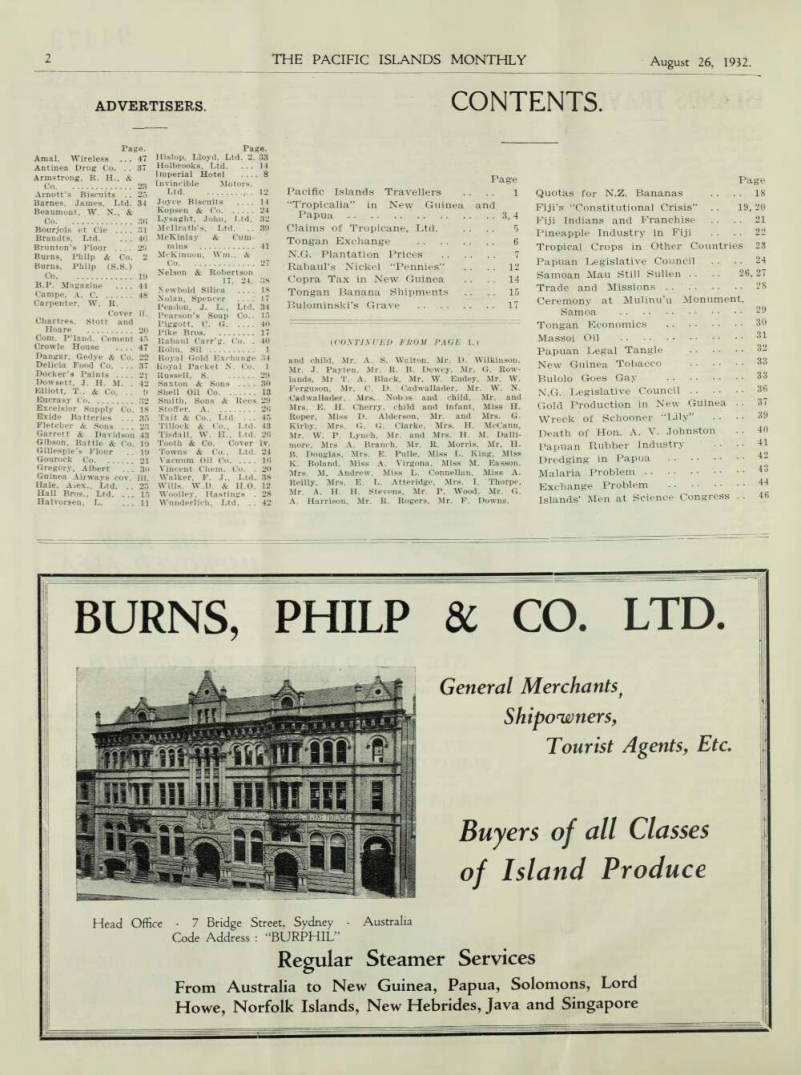
Advertisers.
Page.
Amal. Wireless ... 47 Antinea Drug Co. .. 37 Armstrong, R. H.. & Co 23 Arnott’s Biscuits .. 25 Barnes, James, Ltd. 34 Beaumont, W. N., & Co 36 Bourjois et Cie 31 Brandts, Ltd. ... 46 Brunton’s Flour ... 20 Burns, Philp & Co. 2 Burns, Philp (S.S.) Co 19 B.P. Magazine ... 44 Campe, A. C 48 Carpenter, W. R.
Cover ii.
Chartres, Stott and Hoare 20 Com. P’land. Cement 45 Crowle House ... 47 Hangar, Gedye & Co. 22 Delicia Food Co. ... 37 Docker’s Paints ... 2i Dowsett, J. H. M. . 42 Elliott, T., & Co. .. 9 Bucrasy Co 32 Excelsior Supply Co. IS Bxide Batteries ... 35 Fletcher & Sons ... 23 Garrett & Davidson 43 Gibson, Battle & Co. 19 Gillespie’s Flour .. 19 Gourock Co 21 Gregory, Albert ... 30 Guinea Airways cov. iii.
Hale, Aiex., Ltd. .. 25 Hall Bros., Ltd. ... 15 Halvorsen, L. ... 11
Page.
Hislop, Lloyd, Ltd. 2. 33 Holbrooks. Ltd. ... 14 Imperial Hotel ... 8 Invincible Motors.
Ltd ; . . 12 Joyce Biscuits ... 14 Kopsen & Co 24 Lysaght, John, Ltd. 32 McIlrath’s, Ltd. . . 30 McKinlay & Cum mins 41 McKinnon, Wm.. & Co 27 Nelson & Robertson 17, 24, 38 Newbold Silica 18 Nolan, Spencer ... . 17 Peadon, J. L., Ltd. 34 Pearson's Soap Co.. 15 Piggott, C. G 40 Pike Bros 17 Rabaul Carr’g. Co. . 40 Robu. Sil 1 Royal Gold Exchange 34 Royal Packet N. Co. 1 Russell, S 29 Saxton & Sons ... 30 Shell Oil Co 13 Smith, Sons & Rees 20 Stoffer, A 26 Tait & Co., Ltd. ... 45 Tillock & Co.. Ltd. 43 Tisdall, W. H.. Ltd. 26 Tooth & Co. Cover iv.
Towns & Co., Ltd. 24 Vacuum Oil Co 16 Vincent Chem. Co. . 20 Walker, F. J., Ltd. 38 Wills. W.D. & 11.0. 12 Woolley, Hastings . 28 Wunderlich, Ltd. .. 42
Contents.
Page Pacific Islands Travellers .. . . 1 “Tropicalia” in New Guinea and Papua 3,4 Claims of Tropicane, Ltd. .. .. 5 Tongan Exchange 6 N.G. Plantation Prices 7 Rabaul’s Nickel “Pennies” .. .. 12 Copra Tax in New Guinea .. .. 14 Tongan Banana Shipments .. . . 15 Bulominski’s Grave 17
Page Quotas for N.Z. Bananas .. .. 18 Fiji’s “Constitutional Crisis” .. 19, 20 Fiji Indians and Franchise . . . . 21 Pineapple Industry in Fiji . . . . 22 Tropical Crops in Other Countries 28 Papuan Legislative Council . . . . 24 Samoan Mau Still Sullen .. .. 26, 27 Trade and Missions 28 Ceremony at Mulinu’u Monument, Samoa . . . . 29 Tongan Economics 30 Massoi Oil 31 Papuan Legal Tangle 32 New Guinea Tobacco 33 Bulolo Goes Gay 33 N.G. Legislative Council 36 Gold Production in New Guinea .. 37 Wreck of Schooner “Lily” .. 39 Death of Hon. A. V. Johnston .. 40 Papuan Rubber Industry . . 41 Dredging in Papua 42 Malaria Problem .. 43 Exchange Problem 44 Islands’ Men at Science Congress . . 46
Advertisements & other items, p. 4 (2 items)
2
August 26, 1932.
THE PACIFIC ISLANDS MONTHLY
(CONTINUED FROM PAGE 1.)
Burns, Philp & Co. Ltd.
General Merchants ,
Shipowners,
Tourist Agents, Etc.
Buyers of all Classes
of Island Produce
Head Office - 7 Bridge Street, Sydney - Australia Code Address : “BURPHIL”
Regular Steamer Services From Australia to New Guinea, Papua, Solomons, Lord Howe, Norfolk Islands, New Hebrides, Java and Singapore
The Pacific Islands Monthly
THE NEWSPAPER - MAGAZINE OF THE SOUTH SEAS [Registered at G.P.O., Sydney, for transmission by post as a newspaper .]
Published Once Each Month and Circulated in Australia and New Zealand and in the following Pacific Territories and Island Groups:
Crown Colony of Fiji.
Australian Territory of Papua.
Mandated Territory (Australia) of New Guinea, Bismarck Archipelago, and Northern Solo mon Islands.
Mandated Territory (Japan) of Marshall, Caro line and Mariana Islands.
American Territory of Guam.
Mandated Territory of Nauru.
British Crown Colony of Gilbert and Ellice Islands.
French Territory of New Caledonia.
British and French Condominium of New Hebrides.
American Territory of Eastern Samoa.
Mandated Territory (New Zealand) of Samo British Solomon Islands Protectorate.
British Protectorate of Tongan islands.
New Zealand Territory of Cook Islands.
Australian Territory of Norfolk Island.
French Colony of Oceania (Tahiti, etc.) American Territory of Hawaiian Islands.
Owned and Produced by Pacific Publications Ltd., Union House, 247 George Street, Sydney TELEPHONE BW 5037 Editor and Publisher: Registered Address for Telegrams and CaUes^ P.O. BOX 3408 R R. W. ROBSON. “PACPUB”
Contributions
Articles, Stories and Photographs dealing with Pacific Islands Subjects are invited, and will be paid for on publication at usual rates.
Subscription Rates
Per Annum, within Postal Convention Territories, Prepaid, Post Free 6/- Per Annum elsewhere, Prepaid, Post Free 87- Single Copies 6d.
Advertisements
Advertising rates furnished on application.
Colours; etc. by Arrangement Process Blocks made at Advertiser’s expense when required. Screen, 100.
Changes of Advertising Copy should reach this Office by 8th of each month, otherwise previous advertisement may be repeated.
Agents
The following are authorised to receive sub scriptions for The Pacific Islands Monthly— Islands Branches of Burns, Philp & Co., Ltd., and Burns, Philp (South Seas) Co. Ltd, Islands Branches of W. R. Carpenter & Co., Ltd.
All Branches of Morris, Hedstrom & Co.. Ltd.
F. Robartson, Rabaul.
J. H. MacGregor Dowsett, Rabaul.
Whitten Bros., Ltd., Port Moresby & Samarai.
All Branches and Representatives of W. H.
Grove & Sons, Ltd., Auckland.
S. Russell, Papeete. Tahiti.
Cook Islands Trading Co., Rarotonga Mrs. M. Campbell, Cascades, Norfolk Island.
Vol. III.—No. 1.
Sydney, August 26, 1932.
6d.Per Copy Price prepaid: 6/- p.a.
“Tropicalia” And Other Things In New Guinea And Papua.
(By R. W. Robson.)
IT is impossible, within the compass of one magazine article, to deal adequately with the numerous subjects which came under my notice during a recent visit to Papua and New Guinea. At this stage, I can only summarise my impressions.
My chief feeling is one of relief that there has been a change in the Administratorship of New Guinea.
General Wisdom triumphed over so many of his earlier difficulties, and has left with so good a record, and is personally such a courteous, likeable man, that I should have been a most unwilling critic of his administration. As it is, he has retired, and a new policy is taking shape—so we may leave the past to bury its dead, and concern ourselves only with seeing that certain conditions which have developed in Rabaul in recent years are not perpetuated.
And, now, for some generalities.
The natural wealth of New Guinea has been barely touched, as yet.
The N.G. Administration has been singularly suc cessful in creating an efficient personnel out of nothing, within eleven years, and in bringing numer
ous large districts of dangerous savages under con trol. I went from one end of the Territory to the other, and I heard not one word impugning the per sonal honour and integrity of an official. I heard men, here and there, criticised for officiousness, fat headedness and tactlessness; but, for the most part, officials are esteemed, and almost all are personally respected. That is a remarkable record, and very creditable to Australia.
The N.G. Administration has done little, during eleven years, to encourage private enterprise to enter and develop the Territory. Its public works policy has been feeble, and its public health policy, insofar as it has sought to control the diseases which attack Europeans, is a wash-out.
The N.G. Administration, in recent years, has fallen under the domination of bureaucracy. Bureauc racy, plus that climatic weariness called “Tropi calia,” produced the exasperating condition known as “Rabaul inertia.” It has been seen in various forms—in high officialdom’s insistence on its exclu siveness and privileges; in its discouragement of en terprise and enthusiasm among subordinate officers;
in its stubborn centralisation; and in its maddening refusal to give prompt, businesslike decisions.
A broad-visioned policy, in which the encourage ment of private enterprise is not necessarily excluded by considerations of native welfare, has animated the Administration of Papua, where there is a well trained and highly efficient personnel, and a remark able esprit de corps.
Had there been no “depression,” Papua’s increas ing production would long since have given the Territory a permanently favourable trade balance, and so justified the heavy administrative cost. Under present conditions, the Territory is top-heavy, and its future administration is a problem for Australia.
Taking the broad view, there is a good deal to be said for the amalgamation of these Territories. Why not one big Territory, governed by Australia, and including New Guinea, Papua and the whole of the Solomon Islands? Conditions throughout these three countries are almost identical. They could be easily administered from a central point, like Rabaul or Samarai.
It would be easier to bring the administrative con ditions of the three Territories into line, while care fully observing the terms of the Mandate, than it would be to create a homogeneous Tropical Corps, under which one body of administrative officials would have to deal with three separate and widely differing sets of laws and regulations.
One big administrative organisation would stimu late the developmental impulse now stirring in New Guinea, and solve the administrative problems rep resented by top-heavy Papua and the languishing Solomons. I have recently met thoughtful men who say it can’t be done. I have still to learn why.
The copra-producers of Papua and New Guinea are the most comfortably-placed of any in the Pacific.
They have little or no taxation; they have an abun dance of cheap labour; the N.G. men on expropriated plantations are enjoying a moratorium; and they are getting the advantage of the Australian exchange— equal to a premium of at least 20 per cent, on copra prices.
The western end of New Guinea, under the in fluence of the rapidly developing goldfield, is in a condition of eager, healthy activity and feverish op timism. This is affecting the whole Territory where, under the inevitable stimulus of big-scale gold pro duction, a boom is anticipated.
A new era is dawning in New Guinea. The arrival of the Acting Administrator, Brig.-General Tom Griffiths, has had the effect of a fresh wind blowing through the Departments. A new conception of the responsibility of the Administration —the combined effect of a new interest at Canberra, a new hand on the helm at Rabaul, and new economic forces operat ing from the goldfield—will surely uproot Bureauc racy and dissipate Rabaul’s deadly inertia. New Guinea, as is right and proper, in the early future will provide Australia with abundant opportunities for the enterprise of her young men and the invest ment of her spare capital.
The N.G. Administration is under a definite obliga tion to provide the Territory with better transport
facilities and more healthy conditions of living. In recent times, it has been collecting, in Salamaua, Lae, and the goldfields centres, revenue at the rate of £100,000 per annum, in taxes, customs revenue and gold bounty; and has given, in return, practically nothing beyond the bare minimum of ordinary de partmental services.
The N.G. Administration has left the gold-mining companies to provide their own transport services. It would not even permit its goldfields warden to cut a track from Wau to Bulolo. It has not provided the 40 white women and children in Wau with any nurs ing assistance; yet it has sent two highly qualified nurses out into the wilds beyond Kokopo, to teach “child welfare” to the bush Marys. There are only two or three white policemen to look after Salamaua, Lae, Wau and Bulolo; yet in Rabaul, where the Euro pean population is not much in excess of that of the goldfield, there are so many white policemen that the thing is a joke and a by-word. A little energy in pile-driving and concrete-construction during the past two years would have prevented much costly sea-erosion at Salamaua. Nothing was done —yet the Administration wasted some hundreds of pounds on some utterly futile pile-driving on the Rabaul-Kokopo road. However, the foregoing is merely the result of an unchecked bureaucracy, and I believe that that deplorable condition has ended.
There are a dozen subjects of this nature with which one might deal, all tempting one into a some what pettifogging discussion of the late Administra tion’s sins of omission and commission. I think we should be more concerned with the future —with the vigorous, intelligent development of this amazingly rich Territory that has been handed over to Aus tralian administration. Australia’s record there is not bad. It has been, in certain respects, feeble and footling to the point of purposelessness, but it is not discreditable. And, so far as the protection and wel fare of the native inhabitants are concerned, it has been very successful. But that by no means repre sents a discharge of Australia’s obligations as a Man datory of the League of Nations.
One point remains for attention in this brief sum mary of the position as I saw it.
The N.G. Administration, although it has not lacked funds, has done practically nothing in a big way to seek control of the diseases which attack Europeans, and the pests which menace agriculture.
Malaria is New Guinea’s scourge. It reduces in dustrial efficiency by anything up to 30 per cent.
Without malaria, European adults might live quite comfortably in the Territory. I have searched through the Administrator’s reports covering several years, and I have found nothing to show that the Administration has even visualised a Territory prob lem regarding malaria, let alone made any attempt to handle it. The subject is too big and important to be dealt with here. We shall give it attention in an early issue.
There is nothing much wrong ivith New Guinea —nothing that cannot he easily remedied. But one gets the clear im pression that a few high officials have been a little too long in Rabaul. This ‘Tropicalia”!
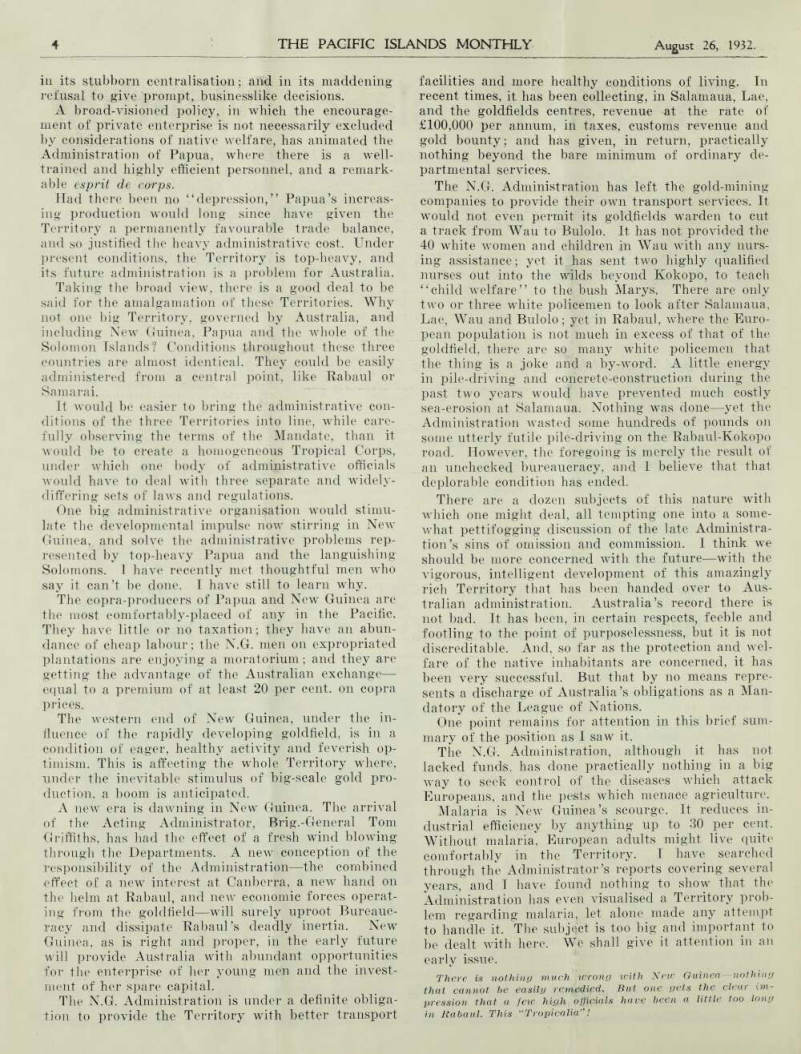
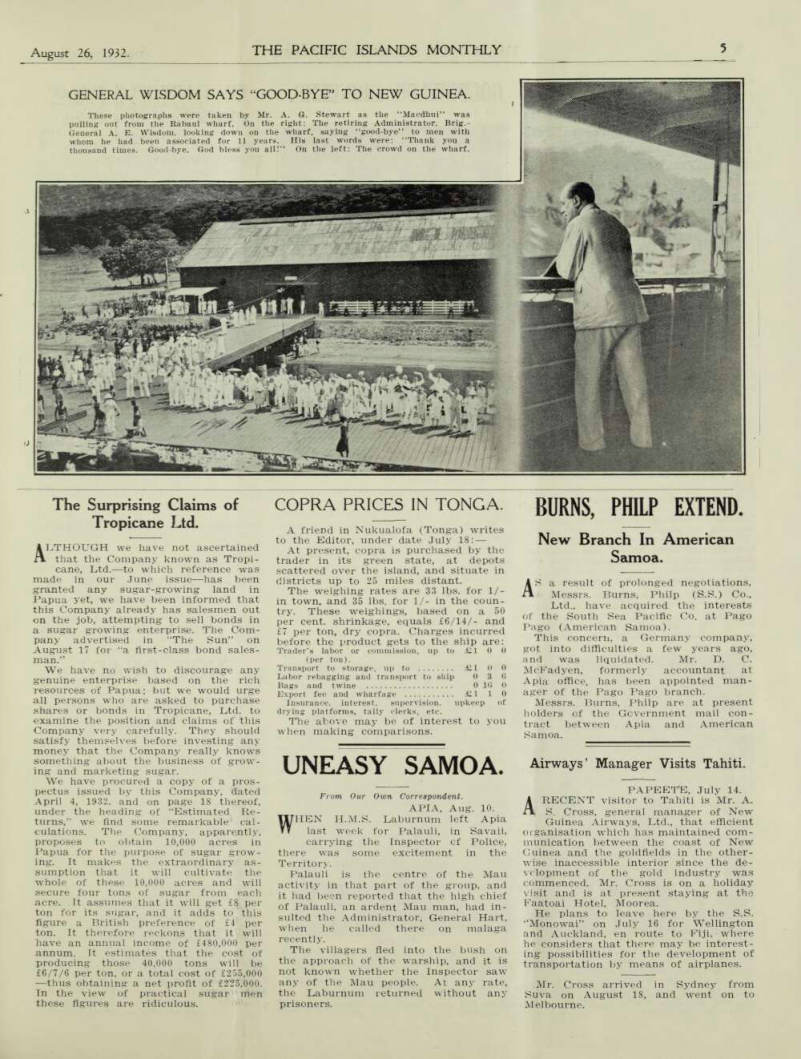
GENERAL WISDOM SAYS “GOOD-BYE” TO NEW GUINEA.
These photographs were taken by Mr. A. G. Stewart as the “Macdhui” was pulling out from the Rabaul wharf. On the right: The retiring Administrator, Brig.- General A. E. Wisdom, looking down on the wharf, saying “good-bye” to men with whom he had been associated for 11 years. His last words were: “Thank you a thousand times. Good-bye. God bless you all!” On the left: The crowd on the wharf.
The Surprising Claims of Tropicane Ltd
Tropicane Ltd.
ALTHOUGH we have not ascertained that the Company known as Tropi cane, Ltd. —to which reference was made in our June issue—has been granted any sugar-growing land in Papua yet, we have been informed that this Company already has salesmen out on the job, attempting to sell bonds in a sugar growing enterprise. The Com pany advertised in ‘‘The Sun” on August 17 for “a first-class bond sales man.'’
We have no wish to discourage any genuine enterprise based on the rich resources of Papua; but we would urge all persons who are asked to purchase shares or bonds in Tropicane, Ltd. to examine the position and claims of this Company very carefully. They should satisfy themselves before investing any money that the Company really knows something about the business of grow ing and marketing sugar.
We have procured a copy of a pros pectus issued by this Company, dated April 4, 1932, and on page 18 thereof, under the heading of “Estimated Re turns,’’ we find some remarkable cal culations. The Company, apparently, proposes to obtain 10,000 acres in Papua for the purpose of sugar grow ing. It makes the extraordinary as sumption that it will cultivate the whole of these 10,000 acres and will secure four tons of sugar from each acre. It assumes that it will get £8 per ton for its sugar, and it adds to this figure a British preference of £4 per ton. It therefore reckons that it will have an annual income of £480,000 per annum. It estimates that the cost of producing those 40,000 tons will be £6/7/6 per ton, or a total cost of £255,000 —thus obtaining a net profit of £225,000.
In the view of practical sugar men these figures are ridiculous.
Copra Prices In Tonga.
A friend in Nukualofa (Tonga) writes to the Editor, under date July 18: At present, copra is purchased by the trader in its green state, at depots scattered over the island, and situate in districts up to 25 miles distant.
The weighing rates are 33 lbs. for 1/in town, and 35 lbs. for 1/- in the coun try. These weighings, based on a 50 per cent, shrinkage, equals £6/14/- and £7 per ton, dry copra. Charges incurred before the product gets to the ship are: Trader’s labor or commission, up to £100 (per ton).
Transport to storage, up to £1 0 0 Labor rebagging and transport to ship 0 3 6 Bags and twine 0 16 0 Export fee and wharfage £1 1 0 Insurance, interest, supervision, upkeep of drying platforms, tally clerks, etc.
Tlie above may be of interest to you when making comparisons.
Uneasy Samoa.
From Our Own Correspondent.
Apia, Aug. 10.
WHEN H.M.S. Laburnum left Apia last week for Palauli, in Savaii, carrying the Inspector of Police, there was some excitement in the Territory.
Palauli is the centre of the Mau activity in that part of the group, and it had been reported that the high chief of Palauli, an ardent Mau man, had in sulted the Administrator, General Hart, when he called there on malaga recently.
The villagers fled into the bush on the approach of the warship, and it is not known whether the Inspector saw any of the Mau people. At any rate, the Laburnum returned without any prisoners.
Burns, Philp Extend.
New Branch In American Samoa.
AS a result of prolonged negotiations, Messrs. Burns, Philp (S.S.) Co., Ltd., have acquired the interests of the South Sea Pacific Co. at Pago Pago (American Samoa).
This concerix, a Germany company, got into difficulties a few years ago, and was liquidated. Mr. D. C.
McFadyen, formerly accountant at Apia office, has been appointed man ager of the Pago Pago branch.
Messrs. Burns, Philp are at present holders of the Government mail con tract between Apia and American Samoa.
Airways’ Manager Visits Tahiti.
Papeete, July 14.
A RECENT visitor to Tahiti is Mr. A.
S. Cross, general manager of New Guinea Airways, Ltd., that efficient organisation which has maintained com munication between the coast of New Guinea and the goldfields in the other wise inaccessible interior since the de velopment of the gold industry was commenced. Mr. Cross is on a holiday visit and is at present staying at the Faatoai Hotel, Moorea.
He plans to leave here by the S.S.
“Monowai” on July 16 for Wellington and Auckland, en route to Fiji, where he considers that there may be interest ing possibilities for the development of transportation by means of airplanes.
Mr. Cross arrived in Sydney from Suva on August 18, and went on to Melbourne.
Tangled Exchange.
Tonga Tackles Complicated Posi tion by Charging 15% for Transfers to N.Z.
THE Tongan Government, faced with an extraordinarily difficult and complex exchange position, has just raised the charge for Post Office orders, issued on New Zealand, to 3/- per £1.
That is to say, one must pay 23/- in Tonga for £1 in New Zealand; and one may not transfer more than £10 per month by this means.
Tonga has been using three curren cies—British silver (the same as New Zealand and Fiji), Australian silver (which has been ranking at par with British silver) and Tongan Treasury notes. There was no restriction on the circulation of the debased Australian coinage. One of our largest copra buyers recently brought in £6,000 worth of Australian coins, which have ranked equally with the British.
Most of the Kingdom’s goods are bought in New Zealand, and paid for by drafts through the Tongan Post Office.
To meet these drafts in N.Z. the Ton gan Government arranged a bank over draft in Auckland, for which it pays six per cent. It has £30,000 invested in N.Z.
The attempt to sell large quantities of Tongan bananas in New Zealand has failed, and, lacking other means of building up a credit there, and finding its bank overdraft steadily mounting, the Tongan Government was seriously embarrassed. It therefore has taken the steps described to reduce the transfer of money from Tonga to New Zealand.
The main trouble is the Australian silver in the Kingdom. The Tongan Treasury has issued notes nominally worth £1, supposedly backed by coin and a foreign investments. But the coin, when paid out by the Treasury in exchange for its note, usually proves to be 20 Australian shillings, which are worth only 16½ shillings in New Zea land, and 14 shillings in Britain. The triple currency worked well enough for purposes of internal trade; but the Tongan P.O. (the only banking system operating there) began to experience nightmares when, owing to the coun try’s decreased exports, New Zealand credits ran out and it started to use the currency (including a large proportion of Australian) for purposes of inter national exchange.
By far the biggest item of export, copra, is being bought largely by Aus tralian interests, and payment natur ally is being made in Australian money.
The Government has been lax in not drawing a clear distinction between Australian and British currency; so that, when the Tongans tried to make purchases in New Zealand with money earned in Australia, trouble inevitably arose.
The remedy, obviously, will be found by Tonga using Australian money to purchase Australian goods. The Nuku alofa merchant, loaded with Australian money, has been turned away from New Zealand, where Australian money is at a discount of 16 per cent. Inevit ably, he will buy from Australia, where he will get 20/- worth of goods for 20 Australian shillings.
Goldfields Pioneers.
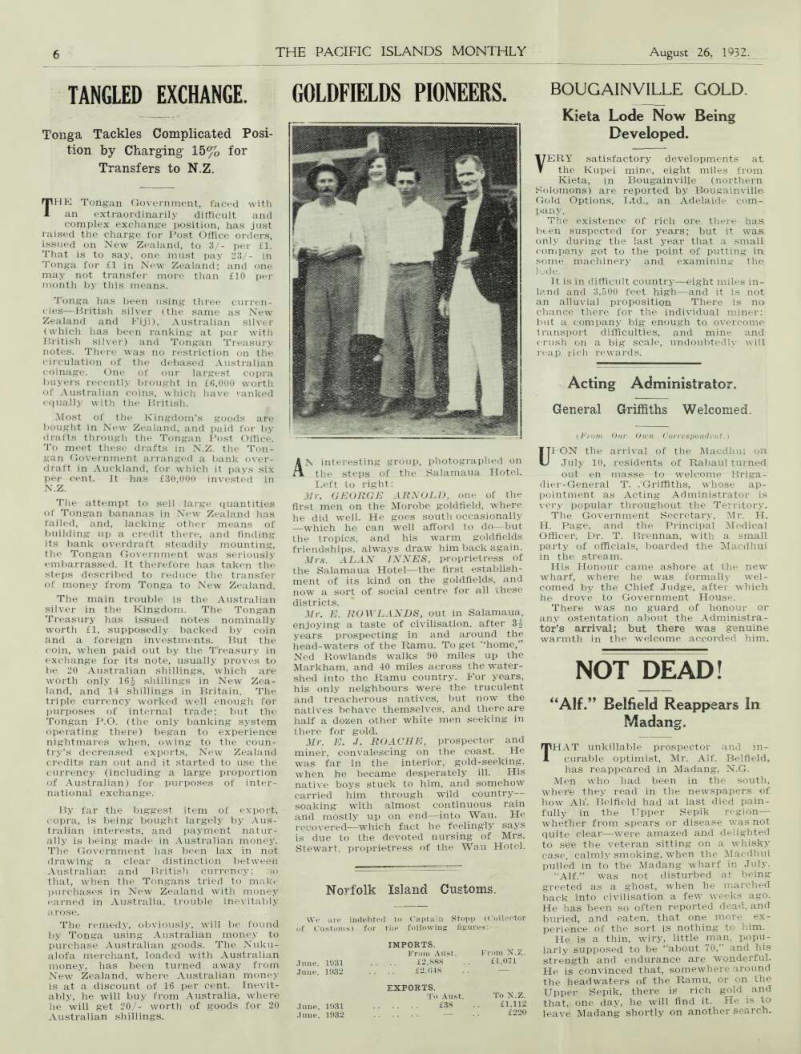
AN interesting group, photographed on the steps of the Salamaua Hotel.
Left to right: Mr. GEORGE ARNOLD, one of the first men on the Morobe goldfield, where he did well. He goes south occasionally —which he can well afford to do —but the tropics, and his warm goldfields friendships, always draw him back again.
Mrs. ALAN INNES, proprietress of the Salamaua Hotel—the first establish ment of its kind on the goldfields, and now a sort of social centre for all these districts, Mr. E. ROWLANDS , out in Salamaua, enjoying a taste of civilisation, after 34 years prospecting in and around the head-waters of the Ramu. To get “home,”
Ned Rowlands walks 90 miles up the Markham, and 40 miles across the water shed into the Ramu country. For years, his only neighbours were the truculent and treacherous natives, but now the natives behave themselves, and there are half a dozen other white men seeking in there for gold.
Mr. E. J. ROACHE, prospector and miner, convalescing on the coast. He was far in the interior, gold-seeking, when he became desperately ill. His native boys stuck to him, and somehow carried him through wild country— soaking with almost continuous rain and mostly up on end —into Wau. He recovered —which fact he feelingly says is due to the devoted nursing of Mrs.
Stewart, proprietress of the Wau Hotel.
Norfolk Island Customs.
We are indebted to Captain Stopp (Collector of Customs) for the following figures:—
Imports.
From Aust.
From N.Z.
June, 1931 . . .. £2,888 £1,071 June, 1932 . . .. £2,G48 —
Exports.
To Aust.
To N.Z.
June, 1931 £38 £1,112 June, 1932 £220
Developed.
Bougainville Gold.
Kieta Lode Now Being Developed.
VERY satisfactory developments at the Kupei mine, eight miles from Kieta, in Bougainville (northern Solomons) are reported by Bougainville Gold Options, Ltd., an Adelaide com pany.
The existence of rich ore there has been suspected for years; but it was only during the last year that a small company got to the point of putting in some, machinery and examining the lode.
It is in difficult country—eight miles in land and 3,500 feet high—and it is not an alluvial proposition There is no chance there for the individual miner: but a company big enough to overcome transport difficulties, and mine and crush on a big scale, undoubtedly will reap, rich rewards.
Acting Administrator.
General Griffiths Welcomed.
(From Our Own Correspondent.) UPON the arrival of the Macdhui on July 10, residents of Rabaul turned out en masse to welcome Briga dier-General T. Griffiths, whose ap pointment as Acting Administrator is very popular throughout the Territory.
The Government Secretary, Mr. H.
H. Page, and the Principal Medical Officer, Dr. T. Brennan, with a small party of officials, boarded the Macdhui in the stream.
His Honour came ashore at the new wharf, where he was formally wel comed by the Chief Judge, after which he drove to Government House.
There was no guard of honour or any ostentation about the Administra tor’s arrival; but there was genuine warmth in the welcome accorded him.
Not Dead!
“Alf.” Belfield Reappears In Madang.
THAT unkillable prospector and in curable optimist, Mr. Alf. Belfield,, has reappeared in Madang, N.G.
Men who had been in the south, where they read in the newspapers of how Alf Belfleld had at last died pain fully in the Upper Sepik region— whether from spears or disease was not quite clear —were amazed and delighted to see the veteran sitting on a whisky case, calmly smoking, when the Macdhui pulled in to the Madang wharf in July.
“Alf.” was not disturbed at being greeted as a ghost, when he marched back into civilisation a few weeks ago.
He has been so often reported dead, and buried, and eaten, that one more ex perience of the sort is nothing to him.
He is a thin, wiry, little man, popu larly supposed to be “about 70,” and his strength and endurance are wonderful.
He is convinced that, somewhere around the headwaters of the Ramu, or on the Upper Sepik, there is rich gold and that, one day, he will find it. He is to leave Madang shortly on another search.
Retired R.N. Officer Seeks
Gold Behind Madang.
IN some of the clubs of London and Sydney they will remember the name of Commander Wauhope, who had charge of certain small “hush-hush” ships during the War, who had a repu tation for successfully undertaking the maddest enterprises, and who retired from the Royal Navy some time ago, after 30 years’ service.
About once a year, in the Madang Hotel, on the edge of untamed New Guinea, one may meet the same Com mander Wauhope. Most people find only malaria and snarling savages on the Ramu and Sepik Rivers; but this navy officer seems to have discovered there the secret of eternal youth. His hair is snow-white, but his eyebrows are as dark as his eyes, and he has a boyish figure and restless, unquenchable energy.
It is reported that when he came to New Guinea and entered the wilderness he had a weary stoop and a pronounced middle-aged spread. He came out of the jungle, a year later, with a definite waist-line, fire in his eye, and gold and platinum in little bottles. Like a dozen others, he is searching in that harsh, inhospitable country for precious metals.
If he doesn’t find them, he will not worry: he knows of something that is more certain than Guinea gold. “By living in New Guinea I’m making £100 a year in exchange on an Admiralty pen sion,” says he, with a merry chuckle.
“Hurricane Money.”
French Compensated - But Nothing for British.
From Our Own Correspondent.
VILA, Julv 30.
THE contrast in the manner in which French and British nationals are treated by their respective Gov ernments in the New Hebrides is afforded in regard to compensation given for damage suffered in the recent hurricanes.
French planters of the New Hebrides who suffered in the February hurricane, received this month the first instalment of the money granted by the French Government. This is a great help, as the nuts and cocoa pods, which were blown down in the gale, have all gone, and practically no more produce will be available for about eighteen months.
British planters have not fared so well. One who suffered the most, on writing to Vila and asking what relief the British Government could offer, re ceived a reply conveying the deepest sympathy and regret of the Resident, on behalf of the British Government.
Bulk Benzine Stores For Fiji.
Suva, Aug. 10.
THE Vacuum Oil Company has de cided to instal a bulk storage plant for benzine at Suva, on re claimed land in Walu Bay. A pipe line will connect the bulk stores with the wharves. This decision is taken as an indication of the growing importance of the colony.
N.G. Plantations.
Scheme To Adjust Purchase Price to Changed Economic Conditions.
From Our Own Correspondent.
Rabaul, July 30.
THE annual council meeting of the Planters’ Association of New Guinea, which is at present being held in Rabaul, has had under consideration the question of relief to purchasers of Ex propriated Properties to enable them to meet the changed economic condi tions.
It is generally agreed that some more definite form or relief than the present arrangement, whereby the interest por tion of instalments is written off by the custodian and the principal portion de ferred indefinitely, is necessary.
The Association proposed to the cus todian and the Commonwealth Govern ment, in 1930, a scheme of permanent adjustment of instalments, based on the rise and fall in the price of copra in Rabaul from time to time, in compari son with the price prevailing at the time the properties were sold. That scheme was based wholly on the pur chaser’s ability to pay. The council of the Association, after very careful con sideration, has decided to again urge the custodian to adopt that scheme as being the best permanent way of re habilitating the planters of the Terri tory who hold expropriated properties, and of securing to the custodian in the form of reduced instalments, the maxi mum amount which the planter can pay.
Simultaneously, the council will submit to the custodian alternative proposals, one of which he will be asked to adopt should he be unfavourable to the prin cipal scheme.
The council is very conscious of the generous treatment which the planters
have received from the Government; but, nevertheless, members are con vinced that the best interests of all will be served if some definite scheme of adjustment to meet changed economic conditions is introduced. The present moratorium is of great immediate benefit: but, unfortunately, while it lasts, the purchaser’s equity remains stationary and the unpaid principal portion of instalments is accumulating and will eventually have to be met.
"Lone Tiger.”
A Gilbertian Situation in Tonga.
From Our Own Correspondent.
Nukualofa, Aug. 10.
A TRULY Gilbertian situation has de veloped here.
A long series of petty thefts and burglaries culminated in the head store of Mrs. E. M. Jones, in the centre of Nukualofa being entered one night in July, and cash and goods stolen.
The thieves left a note behind, writ ten in Tongan, defying law and author ity, and signed “The Lone Tiger.”
The insulted and indignant police left motor car tail-lights and hop-beer sellers alone for a while, and concen trated on the “Tiger.” They finally tracked down the stolen goods—cached in the local gaol!
It appears that several convicts, wearied of the humdrum life in durance vile, banded together under “The Lone Tiger”—a brainy, popular native—and regularly broke out of gaol at nights, entered whatever premises attracted them, took what they fancied, and re turned to their prison before the milk man was due.
The cold, official announcement that “the police department is holding an official inquiry” did nothing to subdue the laughter of the disrespectful people on the beach.
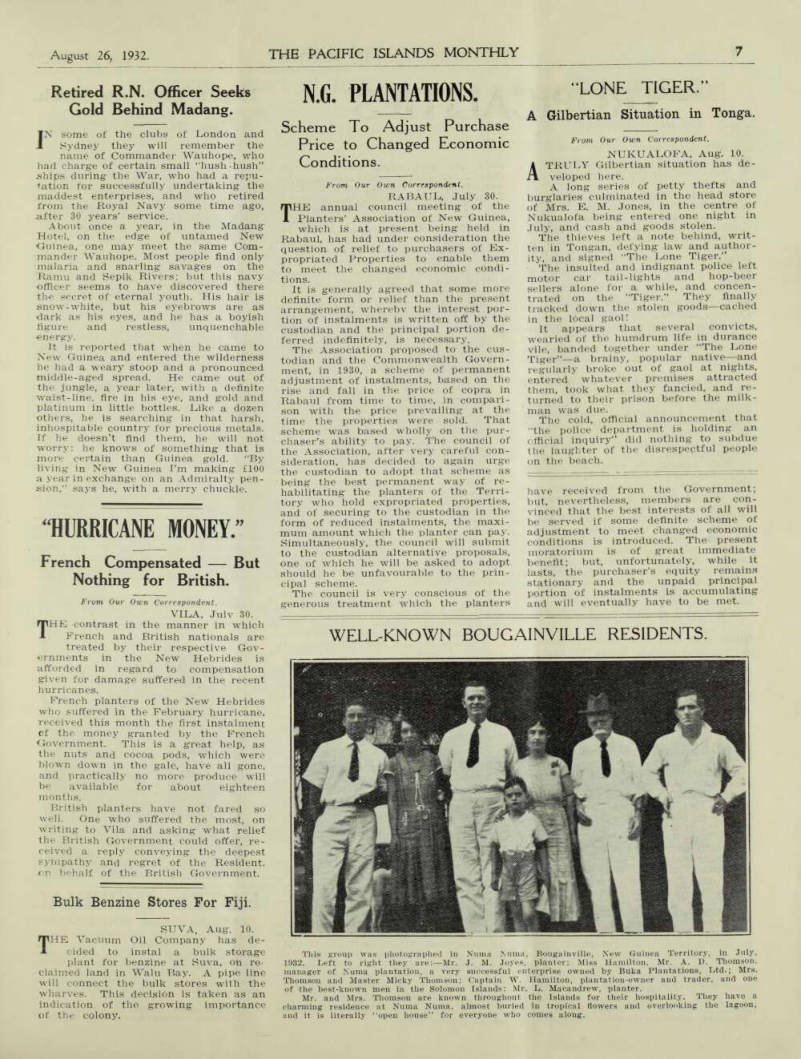
Well-Known Bougainville Residents.
This group was photographed in Numa Numa, Bougainville, New Guinea Territory, in July, 1932. Left to right they are:—Mr. J. M. Joyes, planter; Miss Hamilton, Mr. A. D. Thomson, manager of Numa plantation, a very successful enterprise owned by Buka Plantations, Ltd.; Mrs.
Thomson and Master Micky Thomson; Captain W. Hamilton, plantation-owner and trader, and one of the best-known men in the Solomon Islands; Mr. L. Macandrew, planter.
Mr. and Mrs. Thomson are known throughout the Islands for their hospitality. They have a charming residence at Numa Numa, almost buried in tropical flowers and overlooking the lagoon, and it is literally “open house” for everyone who comes along.
Tropicalities
THIS happened in the Salamaua Hotel, conducted by the dynamic Mrs. Alan Innes.
Old Timer (having reached the lach rymose state of bibulousness); Poor old Jock Davidson! He sat down in the soda-water (sea) and put a cap and dy namite into his mouth, and went out.
Mrs. Innes (briskly): And a very good thing, too. Think of the horrible mess he’d have made if he’d done it in a bed room! * * * NOT long ago, 1 went ashore from m.v. Macdhui to the beach at Lin denhaven (New Guinea), with the assistant district officer. He had several parcels, which he dumped into the boat, but there was one which he nursed tenderly.
"What’s this that you are guarding with your life?” I asked, finally.
“A bit of fresh meat,” said the A.D.O., lovingly. “I haven’t tasted anything except tinned stuff and blasted chickens for two months.”
“Must be monotonous,” I murmured, sympathetically.
“Monotonous!” he snorted. “If you only knew how a man out in these out stations gets to hate Mr. Hellaby, and Mr. Barnes, and Mr. Walker, and Mr.
Playfair, and all the other meat packers. I think it’s the deadly same ness of the stuff that comes out of the tin that drives men to the bottle, just for variety. They could make things much easier for us if they’d only paste on to their tins a few simple recipes, showing how to prepare these meats in new and attractive forms. You might tell them about it, will you?”
It has been done. * * * THE port doctor at Samarai owns a graceful launch, which he has ro mantically named “L’Espero.” It was inevitable, of course, that it should come to be known throughout that flip pant community as “The Aspro.” (Memo. for advertising manager: Charge the Nicholas Pty., of Melbourne, 7/- per inch for this advertisement.) * * * ONE nominates the native gaol in Port Moresby as unique in the world. Out of the 160 prisoners kept there, no less than 125 are offi cially classed as murderers. The “mur derers,” of course, are mostly native gentlemen of the old school, who be came involved in inter-tribal fights in districts outside European influence, “got their man’’ —and now, as a result of inquisitiveness by patrol officers, are temporarily in Port Moresby, learning something of the art of road mainten ance. * * * A BUNGALOW, 18 miles from Port Moresby, had to be connected by telephone with Port Moresby through a party line. Telephone Direc tor Boileau gave instructions to two native boys he had trained. They left at 6 a.m., carrying all necessary gear, about 400 yards of wire, and their kaikai (six plain biscuits). They walked 18 miles, wired up the house, put in in strument and earth-wire, tapped the
main line and made the connection, rang through at 3 p.m. to say the job was done, and walked back to town.
Total labour cost, 10d. —being wages for two “boys” at 4d. per day each, and 2d. worth of biscuits. The same job in Australia would have cost about 150 times that amount. The mechanics would have taken two days instead of one, they certainly would not have walked, and their wages would work out at about 4d. for ten minutes, in stead of 4d. per day. It is an eye opener, for those who believe chat the Papuan is a pretty hopeless savage, to discover that in Papua the trained natives can measure up a house for electric light and power, put in a com plete installation and work to blue prints, with very little white super vision. * * * A FORMER Thursday Island man, Mr.
A. J. Hockings, who visited Tahiti in 1846, tells in an old manuscript of a hat he sold to a native on his schooner in Papeete harbour.
When he arrived there, the natives swarmed round the vessel in their canoes, and one asked if he could buy a hat. A case was pulled out and the article changed hands, to the satisfac tion of the trader, who scented good business, as it had started so early.
Next day there came a summons to attend the court to “show cause,” etc.
To Mr. Hockings’ astonishment, he learned that he should have first taken out a trader’s licence. The case was presided over by “three or four very hungry-looking Frenchmen, and the in former, an American shopkeeper, who had been watching the proceedings on the schooner through a telescope.” The unfortunate defender was fined £30 —a poor return for the sale of a hat worth a few shillings.
It is not surprising that Mr. Hock ings’ narrative displays a sensation of relief when they sailed without further extortions; and that the author feel ingly remarks, “We began to under stand by this time that newcomers were looked upon as revenue-producing machines.” * * * THERE is, throughout the Pacific Islands. a noticeable differ ence in the rates of pay allowed for average native labour. Figures which have been recently quoted in this journal show the following: Papua—10/- per month.
Territory of New Guinea —8/- per month.
British Solomon Islands —20/- per month.
Fiji—20/- per month.
Gilbert Islands (for labour signed on for phosphate works at Nauru and Ocean Island) 32/- per month.
When it is remembered that the cur rency quoted in Papua and New Gmnea is Australian —which is worth 25 per cent, less than sterling —the ad vantage enjoyed by the Australian planters over their brethren in ad jacent groups is apparent. A Solomon Islands planter told the writer recently that he would “barrack” for transfer of the group to Australian administra tion, if that protectorate were to ob tain the same native labour conditions as in New Guinea.
Tonga to Close State Schools.
Missions Undertake Education.
From Our Own Correspondent
Nukualofa, Aug. 10.
THE only contentious matter before the Legislative Assembly, was a proposal that the State abandon its primary schools in favour of the Mis sions operating in the group.
Tonga has always been a happy hunting-ground for Missions —Wesleyan, Catholic, Mormon, Adventist, etc. —and it was argued that, as the Mission schools and State schools are jostling each other throughout the Kingdom, the cost of running them all was a con tinuous and unnecessary drain on the country’s resources.
The State supporters and the Mission, adherents in the House were evidently fairly evenly divided, for it is said that after several days’ stormy argument the proposal that the Government be instructed to bring in a measure, to effect the reform, was adopted by a majority of one.
It is understood that when the Mis sions take upon themselves the primary education of the Tongan child, the Gov ernment will come to their assistance by a system of grants-in-aid.
We gather that these aided Missions will be compelled to conform to the Government policy. Great care will have to be taken to avoid sectarian differ ences and possible friction.
The recommendation of the Educa tion Commission respecting the Tongan Government College, viz., to turn it into a technical institution, was not dealt with affirmatively by Parliament during the session just closed. Here again are obstacles that will call for skilful nego tiations.
Advertisements & other items, p. 10 (1 item)
Hotel Imperial
mi
Darlinghurst Road, KING’S CROSS.
Sydney's Acknowledged Leading Private Hotel.
TARIFF:
Inclusive, 10/- daily; 55/- to 63/- weekly. Room and Breakfast, 7/6 daily; 37/6 to 42/- weekly.
Running Hot and Cold Water in every Bedroom.
Electric Elevator. Garages adjacent. Nous parlous Francais. Address Correspondence to
MANAGER.
Telephone: FL 3051 (3 Lines).
Telegrams: Imperial-King’s Cross, Sydney,
Athletic Sport In Tonga.
The many Polynesian friends of the New Zealander, Sir Maui Pomare, will learn with deep regret that Tenaera Pomare, a son of the late Maori states man, was accidentally drowned while duck-shooting near the family property in the North Island of New Zealand.
The burial took place at Manukorihi Pa, at Waitara. Sir Maui Pomare was
an outstanding example of the fine qualities developed by high caste Poly neslans under European conditions. He was a qualified medical man, but entered politics and became a Minister in the Massey Government; and he was subsequently knighted in recognition of the good services given to the British forces by the Maori race during the War.
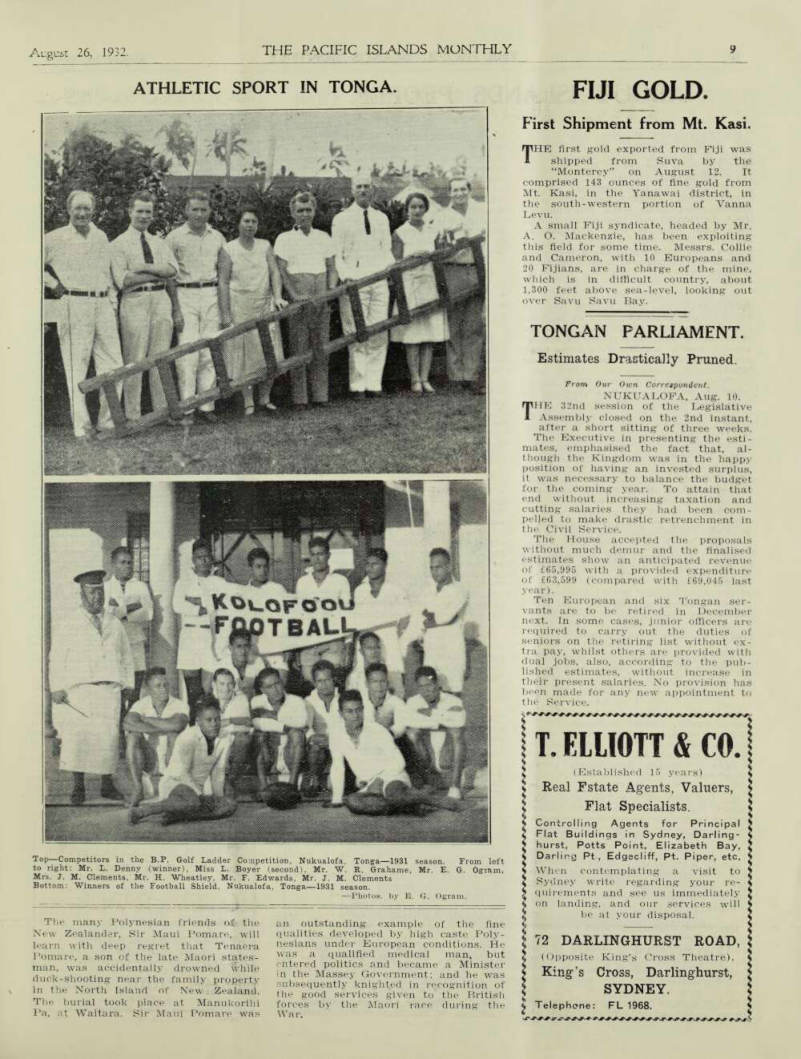
Top—Competitors in the B.P. Golf Ladder Competition, Nukualofa, Tonga—1931 season. From left to right; Mr. L. Denny (winner), Miss L. Boyer (second), Mr. W. R. Grahame, Mr. E. G. Ogram, Mrs. J. M. Clements, Mr. H. Wheatley, Mr. F. Edwards, Mr. J. M. Clements Bottom: Winners of the Football Shield, Nukualofa, Tonga—1931 season. -Photos, by B. G. Ogram.
Fiji Gold.
First Shipment from Mt. Kasi.
THE first gold exported from Fiji was shipped from Suva by the “Monterey” on August 12. It comprised 143 ounces of fine gold from Mt. Kasi, in the Yanawai district, in the south-western portion of Vanna Levu.
A small Fiji syndicate, headed by Mr.
A. O. Mackenzie, has been exploiting this field for some time. Messrs. Collie and Cameron, with 10 Europeans and 20 Fijians, are in charge of the mine, which is in difficult country, about 1,300 feet above sea-level, looking out over Savu Savu Bay.
Tongan Parliament.
Estimates Drastically Pruned.
From Our Own Correspondent.
Nukualofa, Aug. 10.
THE 32nd session of the Legislative Assembly closed on the 2nd instant, after a short sitting' of three weeks.
The Executive in presenting the esti mates, emphasised the fact that, al though the Kingdom was in the happy position of having an invested surplus, it was necessary to balance the budget for the coming year. To attain that end without increasing taxation and cutting salaries they had been com pelled to make drastic retrenchment in the Civil Service.
The House accepted the proposals without much demur and the finalised estimates show an anticipated revenue of £65,995 with a provided expenditure of £63,599 (compared with £69,045 last year).
Ten European and six Tongan ser vants are to be retired in December next. In some cases, junior officers are required to carry out the duties of seniors on the retiring list without ex tra pay, whilst others are provided with dual jobs, also, according to the pub lished estimates, without increase in their present salaries. No provision has been made for any new appointment to the Service.
Advertisements & other items, p. 11 (1 item)
T. Elliott & Co.
(Established 15 years) Real Fstate Agents, Valuers,
Flat Specialists.
Controlling Agents for Principal Flat Buildings in Sydney, Darling hurst, Potts Point, Elizabeth Bay, Darling Pt , Edgecliff, Pt. Piper, etc.
When contemplating a visit to Sydney write regarding your re quirements and see us immediately on landing, and our services will be at your disposal.
72 DARLINGHURST ROAD,
(Opposite King’s Cross Theatre),
King’s Cross, Darlinghurst,
SYDNEY.
Telephone: FL 1968.
About Islands People.
His Excellency M. Jore, new Gover nor of New Caledonia, en route from Tahiti to Noumea, landed unexpectedly from the mail steamer at Rarotonga in June, to pay an official call on Judge Ayson, Resident Commissioner of the Cook Islands. Despite heavy rain, all possible courtesies were tendered to the distinguished Frenchman; but Rarotongan officials were disappointed that, as they had had no previous notice, they were not able to introduce leading Europeans and native chiefs to M. Jore. * * * Mr. H. W. Gray, who was for four years manager for Messrs. Burns, Philp (South Sea) Co., Ltd., at Norfolk Island, has been appointed manager at Lautoka, Fiji. Mrs. Gray is spend ing six weeks’ holiday with her people at Mosman, Sydney, before joining Mr. Gray at Lautoka. * * * Mr. E. F. Bishton, who returned to Rabaul by the m.v. “Macdhui” in July, is at present employed as radio-tele graphist at Rabaul. He was a member of the original wireless corps, and served during the war in Mesopo tamia, India and Egypt. Mr. Bishton is noted among A.W.A. men as the pioneer of wireless communication on Edie Creek Goldfield. He is a member of the original Day Dawn Syndicate. * * * Mr. Norman H. Foxcroft has been in Sydney on leave from Bita Paka Radio, New Guinea, where he is second in com mand. Mr. Foxcroft has been attached to Bita Paka for 12 years, and was at Rabaul for two years before that.
Mr. C. H. Green, director of Buka Plantations and Trading Co., Ltd., left on August 11 by the Macdhui for a round tour of Papua and New Guinea. * * * Dr. Dickenson, Bishop of Melanesia — who, aged 32, is the youngest Bishop in the British Empire—is enjoying a well earned rest on Norfolk Island. * * * Sir Hubert Murray, Lieutenant-Gover nor of Papua, arrived in Sydney by the Macdhui on August 2 to preside at the annual conference of the Association for the Advancement of Science. Sir Hubert intends to return immediately to the Territory. * * * Mr. and Mrs. Arthur Thompson, well known residents of Wau, New Guinea, arrived in Sydney during the month. Mr.
Thompson is to undergo medical treat ment. * * * Mr. C. Mackellar, of Tabar, New Ire land, and Mr. Eric Rondahl, of Kokopo, New Britain, arrived in Sydney on fur lough, by the Temeraire, early in August. * * * Mr. W. R. Carpenter, head of Messrs.
W. R. Carpenter & Co., Ltd., paid a brief visit to Rabaul at the end of July.
He went north, and returned by the Temeraire, and was accompanied by Mrs. Carpenter. * * * Dr. Godard, a popular medical man. whose period of appointment has ex
pired, has left Santo, New Hebrides, for France. Dr. Alain, who arrived in Santo with his wife and son by the Laperouse, will take over Hr. Godard’s practice. * * * Dr. Laporte, of Norsup, New Hebrides, who was taken ill suddenly on July 16, was immediately conveyed to Vila hos pital by the French Mission schooner St. Joseph, and is now well on the way to recovery.
Mr. A. W. Bushbll, director of Bushells Ltd., accompanied by his wife and daughter, left Sydney by the “Mon toro” on July 21 for a holiday trip to Papua and New Guinea. * * * Messrs. W. P. A. Lapthorne and G.
Jeffrey, directors of Guinea Airways, Ltd., will leave for New Guinea by the “Macdhui” on September 22. * * * Mr. T. D. Harris, general manager of Placer Development Ltd. and Bulolo Gold Dredging, Ltd., arrived in Sydney by the “Niagara,’* after spending a short vacation in California and proceeded to New Guinea on the “Montoro.” He reached the Bulolo field on July 30. * * * Mr. Frank Griffin, a director of Placer Development Ltd. and Bulolo Gold Dredg ing Ltd., sailed from Sydney by the “Mariposa” on July 30, for San Fran cisco. * * * Mr. H. Cardew, Commissioner of Native Affairs in New Guinea, arrived in Sydney by the steamer “Nankin ’, in July, on a holiday visit. * * * Rev. G. Lassam, Methodist missionary, of East Cape, Papua, is booked to leave on furlough in late November. * * Captain E. Nelson Turner, comman dant of constabulary of the Solomon Islands, arrived in Sydney by the island liner “Mataram”, and went on by the “Balranald” for a holiday visit to Eng land. He is accompanied by Mrs.
Nelson Turner. * * * Mr. F. N. Ashley, Resident Commis sioner of the British Solomon Islands Protectorate, arrived in Sydney on July 30, by the “Mataram”. * * * Mr. H. V. Jaques, who represented Eastern Suburbs and Bondi con stituencies in the State Parliament for seven years, returned to Sydney on August 3, from a trip to Papua and New Guinea. * * * Mr. D. Watkins, M.P., and Mrs.
Watkins, who had been on a holiday trip to Samarai, where their son is a member of the Administrative Service, returned to Sydney by the “Macdhui" on August 13. * * * Mr. Roland Green, M.P., and Mrs.
Green, returned to Sydney by the “Macdhui” on August 3, after a visit to Papua and the Mandated Territory.
Mr. Green’s brother is attached to the staff of the New Guinea Department of Agriculture. * * * Mr. J. Cochet, general manager in Australia of the Messageries Maritimes,
returned to Sydney on August 11, after a two months’ visit to the New Hebrides, New Caledonia, and Tahiti. * * * Mr. L. J. Froggatt, Government En tomologist in New Guinea, and Mrs.
Froggatt, were passengers by the steamer “Nankin”, which left Sydney for the East on August 13. * * * Mr. R. N. Mayne, Methodist lay mis sionary, who succeeded Rev. H. J.
Williams at Nakanai, in New Britain, and has been on furlough returned to his work on July 21. * * * Rev. A. G. Adamson, M.A., of Fiji,, owing to ill-health has requested that he be allowed to take his furlough in December next.
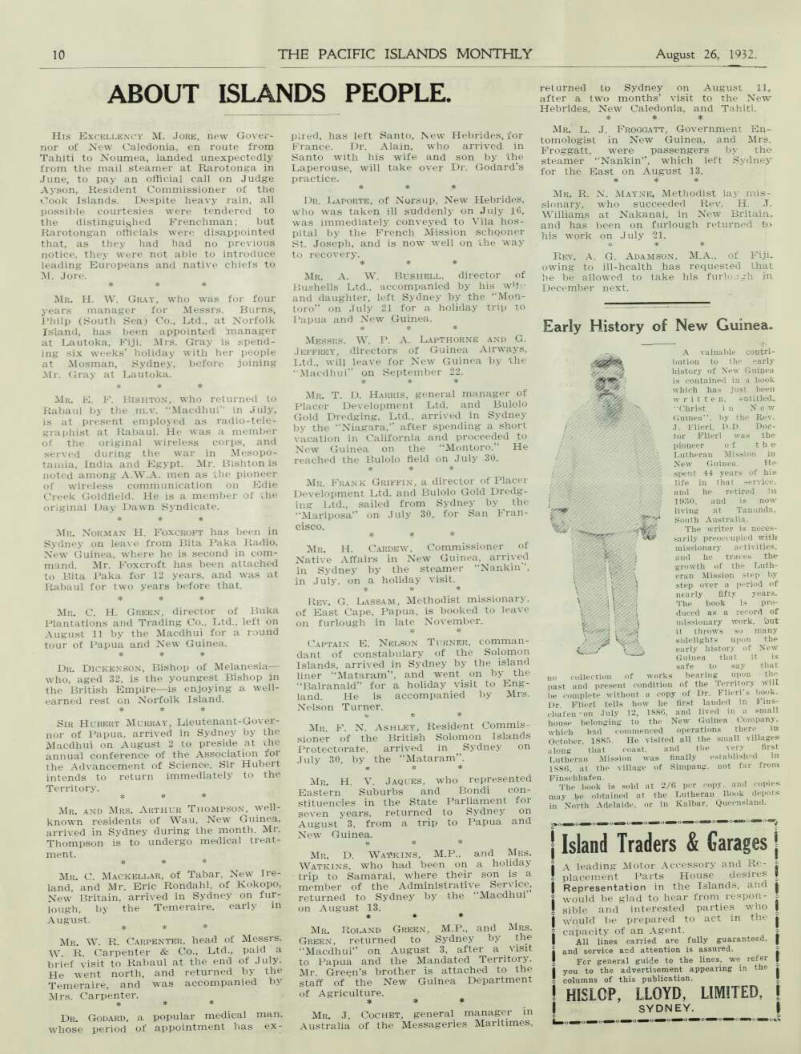
Early History of New Guinea.
A valuable contri bution to the early history of New Guinea is contained in a book which has just been written, entitled, "Christ in New Guinea’’, by the Rev.
J. Flierl, D.D, Doc tor Flierl was the pioneer of the Lutheran Mission in New Guinea. He spent 44 years of his life in that service, and he retired in 1930, and is now living at Tanunda, South Australia.
The writer is neces sarily preoccupied with missionary activities, and he traces the growth of the Luth eran Mission step by step over a period of nearly fifty years.
The book is pro duced as a record of missionary work, but it throws so many sidelights upon the early history of New Guinea that it is safe to say that
no collection of works bearing upon the, past and present condition of the Territory will be complete without a copy of Dr. Flierl’s book Dr Flierl tells how he first landed in Fins chafen-on July 12, 1886, and lived in a small house belonging to the New Guinea Company, which bad commenced operations there in October, 1885. He visited all the small villages along that coast, and the very first Lutheran Mission was finally established in 1886, at the village of Simpang, not far from Finschhafen.
The book is sold at 2/6 per copy, and copies may be obtained at the Lutheran Book depots in North Adelaide, or in Kalbar, Queensland.
Advertisements & other items, p. 12 (1 item)
Island Traders & Garages
A leading- Motor Accessory and Re placement Parts House desires Representation in the Islands, and would be glad to hear from respon sible and interested parties who would be prepared to act in the capacity of an Agent.
All lines carried are fully guaranteed, and service and attention is assured.
For general guide to the lines, we refer you to the advertisement appearing in the columns of this publication.
HISLOP, LLOYD, LIMITED,
SYDNEY.
"Now All Yolye.”
The Quaint Speech of Norfolk Is.
From Our Own Correspondent.
N.I. Aug. 5.
“NOW All Yolye Dees De Bas Sullen Fer Uklen.”
In other words: “Now then every body, these are the best people for us.”
The first line is the real Norfolk Island lingo, and must have been written by an islander. It appeared last week as a heading above a list of preferred candidates for our little local Executive Council, elected every year to deal with our domestic politics, and it introduced a charming touch of that “something different” that is rapidly and regrettably diminishing on the island.
With an increasing settlement of “mainlanders” and the passing of the eldest generation of islanders, there is something being lost that can never be restored, and when it is completely gone Norfolk Island will be but one of a stereotyped list of island communities situated in the South Pacific.
If the islanders would only realise that, while they remain a race apart, living their own lives, speaking in their soft, musical voices the quaint language that is a blend of old-world English and the Tahitian of their great-grand mothers, mixing with the newcomers as little as may be, they possess a charm and picturesqueness that will bring visitors across leagues of ocean to meet and mingle with them who would scarcely cross the road to make acquaintance with the ordinary “out sider”.
As it is, for some mistaken reason, they seem ashamed to live as their fathers and mothers did and to speak the tongue that is a thousand times superior to the ugly English they learn in the State school.
If they but knew it, they should pride themselves on their unique history, the knowledge of their ancestry for 150 years back, and their place in the Pacific, and should make no attempt to model themselves upon a passing popu lation of mainlanders who have come from Heaven knows where and who, many of them, have no knowledge of their forefathers more than a gener ation or so back. There are millions of people just like them, all over the world. Nowhere are there people just like the islanders of Norfolk Island.
Let them remember it, be proud of it, and make no attempt to change.
Newspaper For Norfolk
Island.
From Our Own Correspondent N. I., August 5.
WITHIN the last few weeks a trio of enterprising and capable young men have combined together to pro duce a weekly paper—“ The Norfolk Is land Weekly Times”—and it grows to strength with an ever-increasing circu lation. It certainly was long due and overdue on the island, where the barbed tongue of gossip had hitherto been the only means of circulation of news.
News Items In Brief.
“New Sin” For Rabaul.
A well-known Melbourne actor, Mr.
Norman Carter, intends to leave in Oc tober in an attempt to sail from Mel bourne to London in his yacht, Oimara.
His crew will include a photographer and a journalist and professional actors, and they intend to pay their way by staging plays at all ports where there is a fairly large English-speaking popu lation. Their first port of call will be Rabaul, where they will produce a play entitled, ‘‘The New Sin.”
Papuan Administrator.
We have received another letter from “Admirer” making reference to Mr. J.
T. Bensted’s letter in the June issue of “The Pacific Islands Monthly.” “Ad mirer” says: “Your correspondent is entirely wrong when he suggests that the successor to Sir Hubert Murray would have to possess experience in the Executive Council of Papua. It would be insulting to a learned judge for me to debate his qualifications with Mr.
Bensted. Suffice it for me to say that His Honor Judge Gore established his reputation at the University, the Bar and at the Great War before he saw Papua. . . Anyway, I hope that Sir Hubert Murray will not retire until he reaches the age of President Hinden burg.”
Fiji Exports And Imports.
The total imports into Fiji for the six months ended June 30, 1932, amounted to £353,383, as compared with £486,599 in the same period of 1931. The value of the exports in the same period (six months ended June 30) was £419,920, as compared with £351,759 in the same period of 1931. A little study of those figures will show the remark able soundness of Fiji. There have been substantial increases in the exports of sugar, bananas and trocas shell, but the value of copra exported has de clined by half.
Club For P.I. Association.
The membership of the Pacific Is lands’ Association continues steadily to increase. New members admitted at the last meeting included: C. E. Hart (Solomons), N. A. O’Dwyer (T.N.G.), Roger Greene (Ocean Is), A. St.C.
Compton (Ocean Is.), H. C. M. Stewart (Solo mons), H. A. Markham (Sol. Is.), C. H. V.
Hodgess (Sol. Is.), L. V. Waterhouse (Sydney), H. C. Cardew (T.N.G.), A. S. Meeks (Sydney), W. J. Hawthorne (Fiji).
The committee of the Pacific Islands’
Association is now engaged in negotia tions with the committee of a leading Sydney club, and it is hoped very
shortly to announce that membership of the Pacific Islands’ Association will automatically carry with it member ship of the club referred to, the full privileges of which will be available to Pacific Islands members whenever they make a visit to Sydney. The main ob ject in forming the Pacific Islands’ As sociation was to create an organisation which would advance the interests of Pacific Islands residents generally; but it is believed that this method of pro viding also first-class Sydney club facilities for members will be appre ciated.
The estimates for the current year of the Administrator of Samoa have not yet been published, but it is reported that by very drastic pruning of depart mental expenditure an amount has been saved equal to not less than £25,000 per annum. A very satisfactory output of cocoa and copra is expected during the year, and the prospects of a surplus, now, are not at all bad.
The net profit made by Messrs. Brown and Joske, Ltd., of Suva, Fiji, declined from £3,000 in the year ended March, 1931, to £302 in the year ended March. 1932. The company, however, was able to pay its full preference dividend from the amount of profit brought forward from the previous year. The last bal ance-sheet covered a period of extreme depression in regard to primary pro duction and general trading. The bal ance sheet figures show that the con dition of the company is extremely healthy. Capital is £69,000 and reserves are shown at over £10,000. Cash and investments amount to over £23,000, and the directors have decided to proceed with the erection of a new building in Suva. Latest figures from Fiji show that the Colony is making already a marked recovery from the general de pression.
The new Missionary vessel of the Melanesian Mission the Southern Cross —was dedicated at Greenwich, England, on July 26, in the presence of nine Bishops and 100 clergy. She is equipped as a school and hospital and she sailed for Auckland at the end of July with a large quantity of school requisites and hospital equipment. The new Bishop of Melanesia, the Rt. Rev.
W. H. Baddeley, will embark on the vessel at Auckland.
The Solomon Islands Development Company Limited showed a net profit of £1134 for the year ended March, 1931, compared with £869 for the previous year. The Directors were able to main tain a dividend from accumulated pro fits brought forward. The balance sheet figures show that the condition of the company generally is quite healthy.
Advertisements & other items, p. 13 (1 item)
Lars Halvorsen
Auxiliary Ketch built for Solomon Islands.
Designer and Builder of SCHOONERS, KETCHES, YACHTS, LAUNCHES, etc. Can also quote for Second-hand Craft. Send particulars of your requirements HAYES STREET, NEUTRAL BAY, SYDNEY, N.S.W.
Why Rabaul's Neat Little Nickel
Pennies Were Never Issued To Natives.
THREE years ago, someone connected with the Administration of the Ter ritory of New Guinea was over taken by a bright idea.
He had noticed that, in the native market in Rabaul, and among natives generally, the only money used was to bacco, in thin, treacly sticks. Australian coins were not in favour, mostly because the pocketless natives had to carry them in their mouths. Many of the Territory’s shillings are stained red — the result of a sojourn in the mouth of a chewer of betel-nut.
The Administration thought it out. A light nickel coin, about the size of a shilling; value to be one penny; with a hole through it, so that it could be strung around the neck.. There was no flaw in the argument.
The Administration ordered £500 worth of little nickel coins, with holes through them.
Two years ago, the coins arrived. The officials purred with satisfaction. A cheery young gentleman called on the banks and trading firms to see how many they wanted. He was greeted surlily by Messrs. Burns, Philp and Co. and Messrs. Carpenter and Co, The Bank of N.S.W. said it would take £5 worth, and the young gentleman ran away, wringing his hands.
The Administrator telephoned the bank. "This £5 worth of tokens," he said. "That is not many for issue to Rabaul."
"I'm not issuing them to Rabaul,” said the banker. “Those are for send ing away to numismatists and collec tors ”
The Administrator was indignant and angry. Why was his new currency being treated in this way?
The banker explained. He reminded his Honour that one of the principal pieces of money in New Guinea is the “£5 fusee” and that interference with the “fusee” would cause great confu sion. (A “£5 fusee,” it may be explained, is a roll of 100 shillings, in strong paper, and carrying the name of the firm which prepared the roll. Shillings— often called “marks” by the natives — are almost universal currency in the Territory; and the practice has de veloped of fastening 100 of them to gether, to make a handy £5. “Fusees” are largely employed by the big trading firms. A B.P. steamer, on her home ward run, may carry some scores of them.) “You have made your nickel penny exactly the same size as the shilling,” said the banker to the Administrator.
“The result will almost certainly be that, as they are of the same size and colour, they will find their way into the fusees.
Consequently we shall not be able to accept fusees; they will have to be broken open and counted, which will add enormously to the work of the trad ing firms. The firms, in consequence, won’t have the new coinage.”
The Administration argued about it, but could do nothing. The new pennies remained in their cases in Rabaul.
So far as is known, they are still there.
If the Administration had done the obvious thing, and consulted the com mercial firms and the banks before launching the new coinage, the difficulty need never have arisen. But that is the trouble: the Administration, in the past, has ignored the trading classes, where ever it could. It has regarded itself primarily as the protector of the na tives —and, therefore, it has been re luctant to seek the co-operation of the people who are trying to develop the rich resources of New Guinea in the nterests of the white race.
Early Papua.
(By Arthur I. Vogan, F.R.E.S., etc.)
JN the last issue of the “P.I.M.” ap peared some interesting facsimilis of letters written by that first European explorer to reach the summit of the famous Owen Stanley range (1887), the late Carl H. Hartmann, the noted botanist.
This has brought letters from various old-timers who knew Hartmann; and the sole surviving son of this remark able man has sent me an old photo
graph of his father, which is produced herewith.
Mr. S. Stephens, probably the best known and respected citizen of that eerie-town, wind-swept Toowoomba, found out for me Mr. Charles H. Hart mann, of Orchard Vale, Pittsworth, the only surviving child of the explorer who proved himself, in the rough old days, a worthy son of such a sire.
In 1885, when the writer was up the Fly and Strickland rivers, C.H.H , junior, accompanied his father on a gold-prospecting expedition to the Gulf of Carpentaria; and was afterwards with that famous Jardine (the first man to take cattle to the extreme North of Queensland) at romantically terrible and blood-stained Somerset.
The elder Hartmann made a second visit to New Guinea. There was no “Papua” then —a stupid, meaningless, un-historic name, apparently invented by Forrest, the old-time explorer (not “Sir John,” of course), out of his inner conscienceness! C.H.H. was the first to take “domesticated” bees, cats, and dogs to the new land. He contracted there; and died upon his return, at Brisbane, at the early age of 53.
Professor Denton, the well-known American geologist and anthropologist, accompanied him on this last trip.
Advertisements & other items, pp. 14-15 (2 items)
Tobacco
INVINCIBLE
Marine Motors
BENZINE - KEROSENE - CRUDE OIL
20 MODELS : 3 TO 160 H P.
INVINCIBLE MOTORS LIMITED
53 NORTH GEORGE STREET. SYDNEY. N S W
AND AT CHICAGO. ILLINOIS.
CIGARETTES
now
CORK TIPPED
OR PLAIN
TAN
NAVY CUT
TOBACCO
made from the
BEST VIRGINIA
LEAF
4-08 5-62
For the Warmer Weather.
DRAIN OUT
WINTER'S OLD OIL
and REFILL WITH Shell Motor Oil as Good as Shell Spirit
THE SHELL COMPANY LIMITED
Better Roads.
New Policy In Mandated Territory.
It is reported that one of the first de cisions of the new Acting-Administra tor in New Guinea (General Griffiths) was to order immediate repairs to the Territory’s roads. This action will be welcomed by the white population, who had been suffering much inconvenience from pot-holed highways.
In this connection, it may be noted that the following statement was made to “The Pacific Islands Monthly” re cently by an old resident of the Terri tory : — “The New Ireland road is not in nearly such good condition as it was in the German time. The Australians have lengthened the road considerably at the southern end; but they have not main tained it in good order. The same ap plies to the Kokopo road —it is not nearly in such good order as it was ten years ago.
“It is not that road-maintenance is expensive, or that there is not sufficient labour —it is just that no one seems to care.”
We forecast that road maintenance will receive all necessary attention under the new regime.
Copra Tax.
New Basis Causes Confusion In New Guinea.
IT was reported in New Guinea at the beginning of August that the export tax on copra had been reduced from 7/6 to 2/6 per ton.
Later information showed that the tax has been fixed, as from August 9, on a sliding scale. The tax is 2/6 per ton when the market price is under £11 per ton, and it rises as follows: Under £12 per ton 3/6 per ton £13 4/6 „ £14 5/6 £15 7/ £16 .. 8/6 £17 10/ £18 11/6 From £18 per ton onwards, the tax rises by 2/- per ton for each increase of £1 per ton in the market price.
The method of assessing the market price was announced in mid-August to be as follows: —The London price of hot-air dried copra is taken on the last day of the preceding month; to that is added the amount of the ex change; from that total £3 per ton is deducted; and the result is the price per ton on which the tax is calculated.
The New Guinea Administration each month is to announce the copra price on which tax is to be assessed and it is presumed that “The Sydney Morning Herald” weekly quotation is to be ac cepted for this purpose.
The announcement threw the New Guinea copra trade into confusion —first, owing to the uncertainty, from month to month, of the amount of the tax; and, secondly, owing to what was regarded as an incorrect method of cal culating the Rabaul parity on London price. The merchants argued that, as the £3 deduction represents the ap proximate cost (mostly freight) of sending the copra from New Guinea to London, and as such charges are cal culated in sterling, the amount of £3 should be taken from the London price before the exchange premium is added.
This made a considerable difference in the amount of taxation.
On August 20, it was officially an nounced that the method of calculation was: Take the London c.i.f. price; de duct £3 per ton to represent freight; add 25 per cent, to remainder, to repre sent conversion into Australian cur rency; deduct £3 per ton, to represent shrinkage and various charges; and assess tax on the balance. Taking the London price at £13/15/-, this meant that the value in Rabaul for export tax purposes was £10/7/9 per ton; and, as this was under £11 per ton, the tax 2/6 per ton.
This method of calculation, and the result, seems to have satisfied everyone.
Trading.
Anglicans Withdraw from Trading.
THE subject of mission trading was discussed in June by the Anglican missionaries in Papua, who held their annual meeting at Dogwia, in Eastern Papua. The Anglicans have been conducting three or four trading stations, but not in competition with traders. They decided, however, to cease trading operations entirely as from the end of the present year.
Samoan Official In Limelight.
From Our Own Correspondent.
Apia, Aug. 10
THE general manager of the Repar ations Estates, Mr. Goetz, has been much in the limelight lately.
He has actively opposed the growing public demand for the sub-division of the Estates; and he has been severely criticised for dismissing local em ployees and replacing them with men brought over from New Zealand — although there is much European un employment here.
Mr. Goetz and one of his overseers, Mr. Stewart, were charged in the Apia Court on August 3 with assaulting a plantation employee. The case against Goetz was dismissed; but Stewart was fined 20/-.
Karetu And Waipahi.
From a Special Correspondent .
Nukualofa, July 18.
The Union Co. contemplate taking the “Karetu” from this run, and are seek ing the permission of the Government to allow the ‘Waipahi” to enter the group from Apia—an embargo against this being in existence.
Up 1o the present, the Government have been right against it, as they are afraid of the introduction of the beetle.
Personally, I do not think there is much to fear, as no harm has been done by the vessel calling at Fiji, direct from Apia.
I hear that yesterday’s mail brought information from the U.S.S. Co., which will decide the Government to accede to there request, and the embargo will be lifted. If so, the run of the “Waipahi” will be Auckland to Auckland, via Suva, Apia, Vavau, Haapai, Nukualofa.
Advertisements & other items, p. 16 (2 items)
Holbrooks'
TABLE DELICACIES
WORCESTERSHIRE
SAUCE.
No. 2 SAUCE
(A thick, fruity sauce).
TOMATO SAUCE.
FRENCH OLIVE OIL.
SPANISH OLIVES
(Plain and Stuffed).
CAPERS.
FLAVOURING ESSENCES.
CHUTNEY.
PURE MALT VINEGAR.
JELLY CRYSTALS.
TINNED SOUPS.
BAKED BEANS AND
SPAGHETTI.
In Tomato Sauce.
A wide variety of Pickles, including Sweet Gherkins and Sjnall Pearl White Onions.
Holbrooks (A/sia.) Ltd.
WATERLOO, N.S.W.
Biscuits filled with
nuts
Fresh and fragrant, deliciously “short” and tender, Joyce Nutty Crisps are filled with mellow-flavoured, finely crumbled nuts. They’re baked to per fection, just like home-made.
Joyce
Nutty Crisps
Joyce Gold Medal Biscuits are carefully packed to preserve their freshness.
Write to P.O. Box 31, Camperdown, N.S.W., if unobtainable locally.
FPL 1.
Tragedy.
Tonga’S Banana
Contract Collapses and Growers Withhold Supplies.
From Our Own Correspondent.
Nukualofa, Aug. 10.
OUR banana industry is not, unfor tunately, making the progress we anticipated nine months ago.
In your November issue we said, “We understand that the Tongan Govern ment has accepted, for a short term, a satisfactory contract price offered by a Dominion firm of buyers,”
In November, growers were officially informed that a contract had been signed. The Director of Agriculture voyaged to New Zealand and, on his return, it was freely stated in all quar ters that he had arranged the contract to carry the Government through to the end of 1932. The price was 6/6 per case f.o.b. Nukualofa and two ship ments went forward to the Dominion at that figure.
Subsequently, growers were dumb founded to learn that whilst both the Government and the N.Z. buyers were apparently in accord with the terms of the contract, there had been a hitch and the delay had nullified the unsigned agreement. The contract called for the fruit being landed in Auckland at a certain date. It was not so landed and the firm (Messrs. Donald) refused to go on with the arrangement.
Growers and traders at present seem to be fairly unanimous that the Gov ernment (or the advisory body) is a “washout” as far as bananas are con cerned. The trader considers that he should now be allowed to have a shot at buying and selling the fruit himself.
The grower agrees, as he hopes for a better price.
The Government is paying the grower 1/- per case for the fruit, packed, at his nearest country packing station. The Government is getting 5/- per case for the packed product, f.o.b., port of Nu kualofa. Hence the Government, after paying for crates, nails, cartage, etc., get a return of 2/9 per case. They argue, that if the Government paid 2/instead of 1/- the Treasury would still have 9d. per case to offset any loss; put twice as much fruit money in cir culation; give an incentive the na tive grower to double his output and double the present ready money going into the New Zealand banks, where the Government badly needs it at present.
It is a fact that, owing to the low price, the natives are reluctant in re sponding. They refused to fill the quota last month. The July boat was 800 cases short of requirements and the “Karetu,” loading to-day, will probably be 1,000 short.
The fault is the Government’s. More fruit than was required was brought in in June, and the officials refused a con siderable proportion. Naturally, the native growers were indignant and that fact, combined with the low price, re sulted in a sharp falling-off in July and August deliveries. The trouble could have been avoided if the officials had given each group of producers an indi cation of the quantity required.
Fiji Banana Quotas.
The Fiji banana quota regulations, giving the Government power to exactly regulate the export of bananas to New Zealand, were gazetted on July 14. The quota will be an nounced by the Governor as occasion requires.
Our correspondent remarks that the regulations seem well-balanced and workmanlike; but the attitude of the Union Company is awaited with in terest. It looks as if the bananas for export will not be in sufficient quan tity to interest the shipping company.
New Industry For
Tahiti?
From Our Own Correspondent
Papeete, July 15.
RECENT reports from France indicate that the first shipments of prepared orange and pineapple juice from these islands have been successfully marketed, and that there is a prospect of a large and increasing demand for these products in France and elsewhere in Europe.
It is stated that a company is now in process of formation in France with the object of exploiting this industry, and that a qualified chemist will arrive by the next Messageries steamer to take charge of operations in Raiatea and other islands of the Leeward Group.
Some years ago, large shipments of oranges and pineapples were made re gularly to New Zealand from Raiatea by the intermediate steamers of the Union Line. These vessels also brought cases from New Zealand in the form of shocks, as well as other goods, so that there was a reciprocal trade between the two countries.
With the imposition by New Zealand of a heavy duty on foreign fruit, how ever, this business came to a standstill, the intermediate steamers ceased to run, and the fruit shipped nowadays only amounted to a few hundred cases per annum, at times when there is a scarcity in other islands and a suf ficiently high price in New Zealand to enable the importer to pay the high duty.
Fine oranges grow in a wild and semi wild state in all the valleys of the Lee ward Group, as well as in Tahiti, and there is also much land available for the raising of pineapples by native me thods of cultivation.
Mr. J. W. Anslow, who has been a resident of Madang, N.G., for a number of years, is at present an inmate of Brawood Private Hospital, Petersham, Sydney. He is making- satisfactory pro gress.
Advertisements & other items, pp. 17-18 (1 item)
Engine
The
“HB” 6 H.P.
4 Cycle
Marine
Engine
Made in Australia from the best materials.
Highest Class Workmanship throughout.
Four-inch Bore; 5-inch stroke.
One & three-quarter inch Crank shaft, accurately balanced.
Balanced Flywheel, machined all over.
Extra Large Valves, mechanically operated.
Offset Cylinder, which reduces vibration.
Valve Chamber entirely water jacketed.
Adjustable Tappets.
Detachable Hot-spot Manifold.
Robert Bosch Magneto.
Schebler Model D Carburettor, and many other modern features.
Suitable for boats 18 to 25 feet.
Made in two models.
Model A.C. with Free Engine Clutch Model A.R., with reverse £68 gear on extended base
HALL BROS. LTD.
(Established 41 years).
The Engine House,
CAREENING COVE,
WILSON’S POINT, NORTH SYDNEY,
N.S.W. - AUSTRALIA.
Cables: "Halbros,” Sydney.
CLEAN YOUR
LINOS . .
with Pearson’s Carbolic Sand Soap.
It brings out the full freshness of the colouring . . . removes every scrap of dirt. And the linos afterwards polish better and more easily than ever.
PEARSON’S CARBOLIC
SAND SOAP,
Made by Pearson Soap Co. Ltd.,
ROZELLE, N.S.W.
For Quality & Performance
PLUME & MOBILOIL
Set the Standard
Nearly 30 years stand behind Vacuum Service in the South Seas.
Over this period the quality of Vacuum Products has been maintained at a consistently high level.
Motorists who use Plume and Mohiloil enjoy the best performance their cars can give, with the addi tional result that greater economy is experienced.
For Best Results Insist On
PLU M E AND Mobiloil
VACUUM OIL COMPANY PTY. LTD.
Bulominski’S Grave.
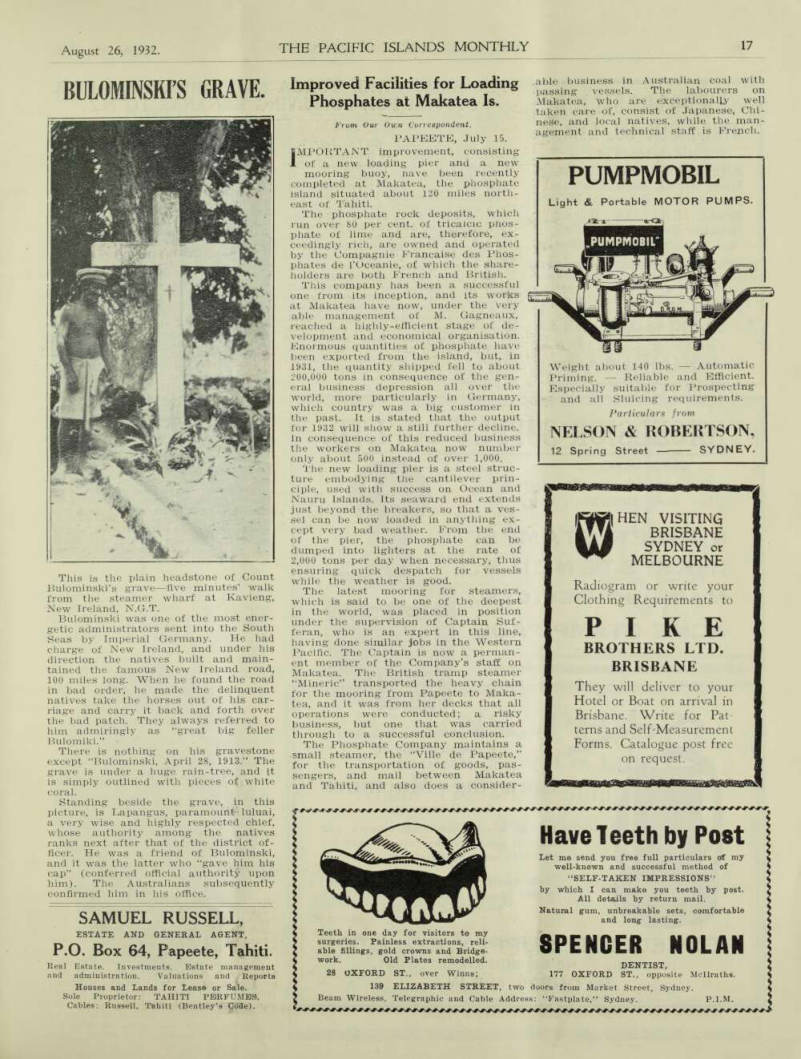
This is the plain headstone of Count Bulominski’s grave—five minutes’ walk from the steamer wharf at Kavieng, New Ireland, N.G.T.
Bulominski was one of the most ener getic administrators sent into the South Seas by Imperial Germany. He had charge of New Ireland, and under his direction the natives built and main tained the famous New Ireland road, 100 miles long. When he found the road in bad order, he made the delinquent natives take the horses out of his car riage and carry it back and forth over the bad patch. They always referred to him admiringly as ‘‘great big feller Bulomiki.”
There is nothing on his gravestone except ‘‘Bulominski, April 28, 1913,” The grave is under a huge rain-tree, and it is simply outlined with pieces of white coral.
Standing beside the grave, in this picture, is Lapangus, paramount luluai, a very wise and highly respected chief, whose authority among the natives ranks next after that of the district of ficer. He was a friend of Bulominski, and it was the latter who “gave him his cap” (conferred official authority upon him). The Australians subsequently confirmed him in his office.
Improved Facilities for Loading
Phosphates at Makatea Is.
From Our Own Correspondent.
Papeete, July 15.
IMPORTANT improvement, consisting of a new loading pier and a new mooring buoy, nave been recently completed at Makatea, the phosphate island situated about 120 miles north east of Tahiti.
The phosphate rock deposits, which run over 80 per cent, of tricaicic phos phate of lime and are, therefore, ex ceedingly rich, are owned and operated by the Compagnie Francaise des Phos phates de l’Oceanie, of which the share holders are both French and British.
This company has been a successful one from its inception, and its works at Makatea have now, under the very able management of M. Gagneaux, reached a highly-efflcient stage of de velopment and economical organisation.
Enormous quantities of phosphate have been exported from the island, but, in 1931, the quantity shipped fell to about 200,000 tons in consequence of the gen eral business depression all over the world, more particularly in Germany, which country was a big customer in the past. It is stated that the output for 1932 will show a still further decline.
In consequence of this reduced business the workers on Makatea now number only about 500 instead of over 1,000.
The new loading pier is a steel struc ture embodying the cantilever prin ciple, used with success on Ocean and Nauru Islands. Its seaward end extends just beyond the breakers, so that a ves sel can be now loaded in anything ex cept very bad weather. From the end of the pier, the phosphate can be dumped into lighters at the rate of 2,000 tons per day when necessary, thus ensuring quick despatch for vessels while the weather is good.
The latest mooring for steamers, which is said to be one of the deepest in the world, was placed in position under the supervision of Captain Suf feran, who is an expert in this line, having done similar jobs in the Western Pacific. The Captain is now a perman ent member of the Company’s staff on Makatea. The British tramp steamer “Mineric” transported the heavy chain for the mooring from Papeete to Maka tea, and it was from her decks that all operations were conducted; a risky business, but one that was carried through to a successful conclusion.
The Phosphate Company maintains a small steamer, the “Ville de Papeete,” for the transportation of goods, pas sengers, and mail between Makatea and Tahiti, and also does a consider
able business in Australian coal with passing- vessels. The labourers on Makatea, who are exceptionally well taken care of, consist of Japanese, Chi nese, and local natives, while the man agement and technical staff is French.
Advertisements & other items, pp. 19-20 (2 items)
Pumpmob1L
Light & Portable MOTOR PUMPS.
Weight about 140 lbs. — Automatic Priming. — Reliable and Efficient.
Especially suitable for Prospecting and all Sluicing requirements.
Particulars from
NELSON & ROBERTSON,
12 Spring Street SYDNEY.
WHEN VISITING
MELBOURNE
BRISBANE
SYDNEY or
Radiogram or write your Clothing Requirements to
PIKE
BROTHERS LTD.
BRISBANE
They will deliver to your Hotel or Boat on arrival in Brisbane. Write for Pat terns and Self-Measurement Forms. Catalogue post free on request.
Have Teeth by Poet
Let me send you free full particulars of my well-known and successful method of
“SELF-TAKEN IMPRESSIONS”
by which I can make you teeth by post.
All details by return mail.
Natural gum, unbreakable sets, comfortable and long lasting.
Teeth in one day for visitors to my surgeries. Painless extractions, reli able fillings, gold crowns and Bridge work. Old Plates remodelled. 28 OXFORD ST., over Winns;
SPENCER NOLAN
DENTIST,
177 OXFORD ST., opposite Mcllraths. 139 ELIZABETH STREET, two doors from Market Street, Sydney.
Beam Wireless, Telegraphic and Cable Address: “Fastplate,” Sydney. P.I.M.
NEWBOLD SILICA
FIRE-BRICK CO. LTD.,
Manufacturers of High Grade Refractories, Silica Bricks, High Alumina Fire Bricks, Siliceous Fire Bricks, Chrome Bricks, Bauxite Bricks, “Sealtite” (hot patching’ cement), Dia tomaceous insulation.
Enquirers are requested to give full particulars of temperatures and purposes for which refractories are required.
The Newbold Silica Fire-Brick Co. Ltd.
109 ELIZABETH ST., SYDNEY.
EXCELSIOR SUPPLY CO. LTD.
The most extensive Manufacturers in the British Empire of
RUBBER STAMPS,
INKS, STENCILS.
Marking Devices.
ACME STAMP PADS
We have a big range of Special
FRUIT CASE MARKING SETS
We also Manufacture or Supply a complete line of
Spraying Machines
for all purposes.
Let us know your requirements and we will quote you by return. Ask for our Big Catalogue.
Sole Australasian Distributors of the World Famous SHEAFFER FOUNTAIN
PENS and PENCILS.
EXCELSIOR SUPPLY CO. LTD.
Head Office:- 160 GEORGE STREET WEST,
SYDNEY, N.S.W.
Samuel Russell,
ESTATE AND GENERAL AGENT,
P.O. Box 64, Papeete, Tahiti.
Real Estate. Investments. Estate management and administration. Valuations and Reports Houses and Lands for Lease or Sale.
Sole Proprietor: TAHITI PERFUMES.
Cables: Russell, Tahiti (Bentley’s Code).
Fiji, Samoa And Tonga May Arrange Quota
System For Supplying Bananas To N.Z.
From Our Own Correspondent SUVA, July 7.
ONLY 9,000 cases of bananas were shipped by the “Waipahi” in May to Auckland. The prices realised were disastrous, and most shippers think themselves lucky if they get back 3/- a case from their Auckland agents.
As the cost of the case is 1/5d. the Government tax 5d., and the transport to Suva average 1/6d., there is nothing left over for the unfortunate shipper who has to buy the fruit from the Fijian at 1/6 a case.
The law of supply and demand re duced the shipment by the “Waipahi” in June to 7,400. Results are not to hand at time of writing, but even the most cheery optimist amongst shippers does not expect to get back more than 4/-. Admittedly, the price always de clines in winter, and the thought of a banana on a cold, slushy day is hardly likely to fill one with sufficient longing to purchase the fruit.
The “Aorangi” and the “Niagara” usually take 3,000 cases apiece, so that it amounts to this —New Zealand has only been able to absorb about 9,000 cases a month from Fiji and as high as 12,000 cases have been sent there.
This is a state of affairs which can not be expected to last. The Govern ment despatched the Hon. A. C. Barnes, our very capable and live wire Director of Agriculture, to New Zealand to in vestigate the position. He found that there was definite talk of placing some restriction or duty upon the entry of Fiji bananas into New Zealand, so that the New Zealand market could be re served for Samoa. If Fiji continued to pour in comparatively huge quantities of bananas into New Zealand, the mar ket would be kept continually sub merged and the prospects of action by the New Zealand Government brought continually closer.
After Mr. Barnes’ return, the Fiji Government acted promptly, and intro duced legislation at the last session of the Legislative Council, giving power to restrict the total shipments from Fiji to such a figure as seemed desir able. Regulations were accordingly drafted and have been kept most con fidential as yet.
The Director of Agriculture is to ad dress a meeting of shippers on July 8 and to lay the completed regulations before them. No banana shipper in Fiji has ever been known to agree with any other shipper for more than two min utes in succession, so that the Director of Agriculture and his efficient Inspec tor of Produce, Mr. Ackland, will doubt less be assailed by contrary opinions on this, that, and the other regulation.
However, the Director and his In spector of Produce are well endowed with that particular kind of philosophic humour which regards the abuse of banana shippers as one of the inci dentals of life, so that we do not im agine the meeting will develop into a Donnybrook.
Rumour has it that an arrangement has been arrived at in conjunction with the Governments of Tonga and of Samoa. The capacity of the New Zea land market is to be assessed and on a basis of a monthly absorption of 20,000 cases, Tonga’s proportion is to be 3,000 cases Samoa 7,000 cases, and Fiji 10,000 cases. However, these figures must be accepted with reserve, as the subject is still under discussion.
Apia.
B.P.’s To Erect New Store at Apia.
From Our Own Correspondent.
APIA, July 10.
Messrs, Burns, Philp (S.S.) Co., LTD., expect the architect of the firm, Mr. J. R. Brogan, to arrive shortly to make a survey of their Apia business premises, in preparation for the planned erection of new store and office buildings on their property, be tween the new Apia Post Office and Taufusi Street.
At the same time, the work will give relief to a considerable number of un employed carpenters, who are suffering from the complete stoppage of private and governmental building.
Crisis.”
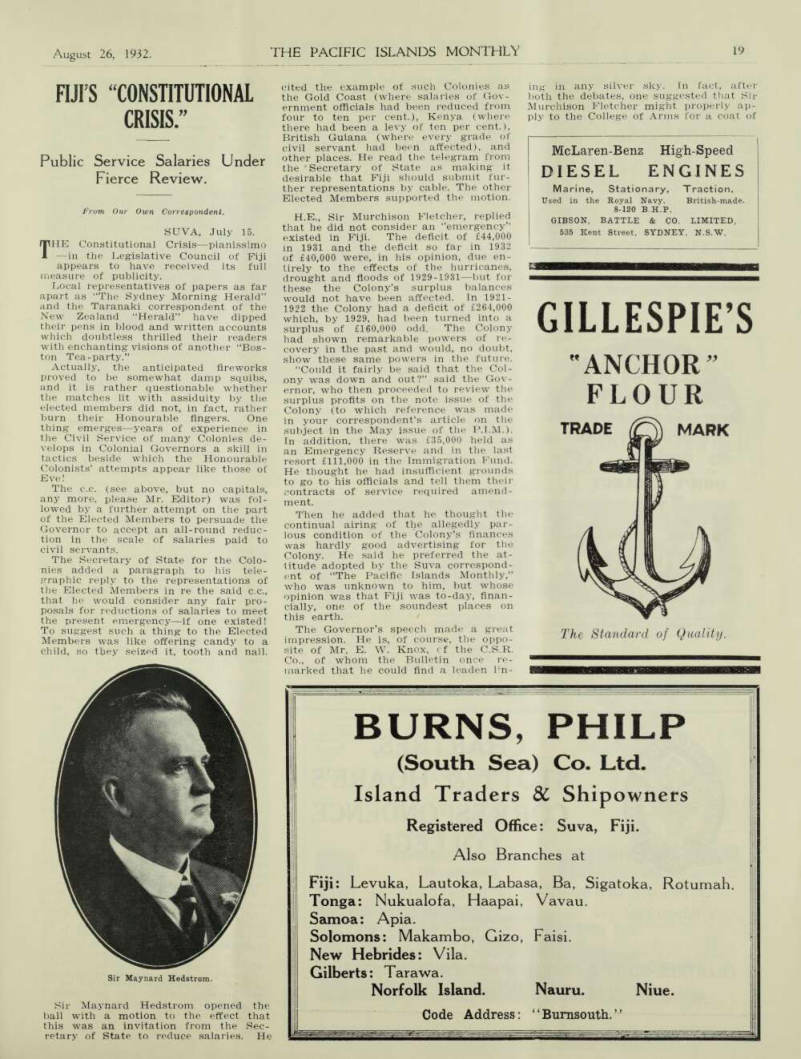
Fiji S “Constitutional
Public Service Salaries Under Fierce Review.
From Our Own Correspondent.
SUVA, July 15.
THE Constitutional Crisis —pianissimo —in the Legislative Council of Fiji appears to have received its full measure of publicity.
Local representatives of papers as far apart as “The Sydney Morning Herald” and the Taranaki correspondent of the New Zealand “Herald” have dipped their pens in blood and written accounts which doubtless thrilled their readers with enchanting visions of another “Bos ton Tea-party.”
Actually, the anticipated fireworks proved to be somewhat damp squibs, and it is rather questionable whether the matches lit with assiduity by the elected members did not, in fact, rather burn their Honourable fingers. One thing emerges—years of experience in the Civil Service of many Colonies de velops in Colonial Governors a skill in tactics beside which the Honourable Colonists’ attempts appear like those of Eve!
The c.c. (see above, but no capitals, any more, please Mr. Editor) was fol lowed by a further attempt on the part of the Elected Members to persuade the Governor to accept an all-round reduc tion in the scale of salaries paid to civil servants.
The Secretary of State for the Colo nies added a paragraph to his tele graphic reply to the representations of the Elected Members in re the said c.c., that he would consider any fair pro posals for reductions of salaries to meet the present emergency—if one existed!
To suggest such a thing to the Elected Members was like offering candy to a child, so they seized it, tooth and nail.
Sir Maynard Hedstrom opened the ball with a motion to the effect that this was an invitation from the Sec retary of State to reduce salaries. He
cited the example of such Colonies as the Gold Coast (where salaries of Gov ernment officials had been reduced from four to ten per cent.), Kenya (where there had been a levy of ten per cent.), British Guiana (where every grade of civil servant had been affected), and other places. He read the telegram from the Secretary of State as making it desirable that Fiji should submit fur ther representations by cable. The other Elected Members supported the motion.
H.E., Sir Murchison Fletcher, replied that he did not consider an “emergency” existed in Fiji. The deficit of £44,000 in 1931 and the deficit so far in 1932 of £40,000 were, in his opinion, due en tirely to the effects of the hurricanes, drought and floods of 1929-1931 —but for these the Colony’s surplus balances would not have been affected. In 1921- 1922 the Colony had a deficit of £264,000 which, by 1929, had been turned into a surplus of £160,000 odd. The Colony had shown remarkable powers of re covery in the past and would, no doubt, show these same powers in the future.
“Could it fairly be said that the Col ony was down and out?” said the Gov ernor, who then proceeded to review the surplus profits on the note issue of the Colony (to which reference was made in your correspondent’s article on the subject in the May issue of the P.I.M.).
In addition, there was £35,000 held as an Emergency Reserve and in the last resort £111,000 in the Immigration Fund.
He thought he had insufficient grounds to go to his officials and tell them their contracts of service required amend ment.
Then he added that he thought the continual airing of the allegedly par lous condition of the Colony’s finances was hardly good advertising for the Colony. He said he preferred the at titude adopted by the Suva correspond ent of “The Pacific Islands Monthly,” who was unknown to him, but whose opinion was that Fiji was to-day, finan cially, one of the soundest places on this earth.
The Governor’s speech made a great impression. He is, of course, the oppo site of Mr. E. W. Knox, cf the C.S.R.
Co., of whom the Bulletin once re marked that he could find a leaden lin
ing in any silver sky. In fact, after both the debates, one suggested that Sir Murchison Fletcher might properly ap ply to the College of Arms for a coat of
Sir Maynard Hedstrom.
arms as follows —Crest; A dove bearing in its beak a rapier; Arms: An inverted cornucopia spilling golden beans upon a field azure!
The debate terminated without a division. The Governor said he had forwarded a full despatch to the Sec retary of State, which would be due in London on July 28, so that he saw no necessity for cabling a precis. He pro mised to submit a summary of the views of the Elected Members to the Secretary of State.
To the outsider it seems that the better course would be for the Elected Members rigidly to scrutinise the civil establishment of the Colony. There are many posts which are redundant in these days, some of which need to be
abolished, and others to be pruned. The posts at the top of the tree are poorly paid, if we are to attract to the Colony the able administrators for whom we yearn. The Governor compared the higher posts in Fiji with those in the other colonies cited by Sir Maynard Hedstrom, vastly to the disadvantage of the financial allurement offered by Fiji. It is, alas, true that all commer cial folk have suffered a cut in salaries, whilst the poor coconut planter has had not merely a cut, but a complete dis appearance!
Advertisements & other items, pp. 21-22 (1 item)
Gillespie’S
McLaren-Benz High-Speed
DIESEL ENGINES
Marine, Stationary, Traction.
Used in the Royal Navy. British-made.
8-120 BH.P.
GIBSON, BATTLE & CO. LIMITED,
535 Kent Street, SYDNEY, N.S.W.
GILLESPIE’S
"ANCHOR"
FLOUR
TRADE MARK
The Standard of Quality.
BURNS, PHILP
(South Sea) Co. Ltd.
Island Traders 8C Shipowners Registered Office: Suva, Fiji.
Also Branches at Fiji: Levuka, Lautoka, Labasa, Ba, Sigatoka, Rotumah Tonga: Nukualofa, Haapai, Vavau.
Samoa: Apia.
Solomons: Makambo, Gizo, Faisi.
New Hebrides: Vila.
Gilberts: Tarawa.
Norfolk Island. Nauru. Niue.
Code Address: “Bumsouth.”
'Flu Complications
are brought about
by neglect.
DON’T NEGLECT
’FLU!
Take Genuine
PINK
POWDERS
& TABLETS
1/6 & 2/6 All Chemists and Stores or direct from Vincent Chemical Company, Sydney.
CHARTRES,
STOTT & HOARE’S
CORRESPONDENCE
COLLEGE
Founded 1885.
Pioneers and Specialists in Postal Instruction.
All Educational and Commercial subjects taught thoroughly and efficiently by correspondence.
Experienced Certificated Instructors. Write for particulars.
CHARTRES, STOTT & HOARE’S CORRESPONDENCE COLLEGE,
Liverpool Street, Sydney, Australia.
Members.
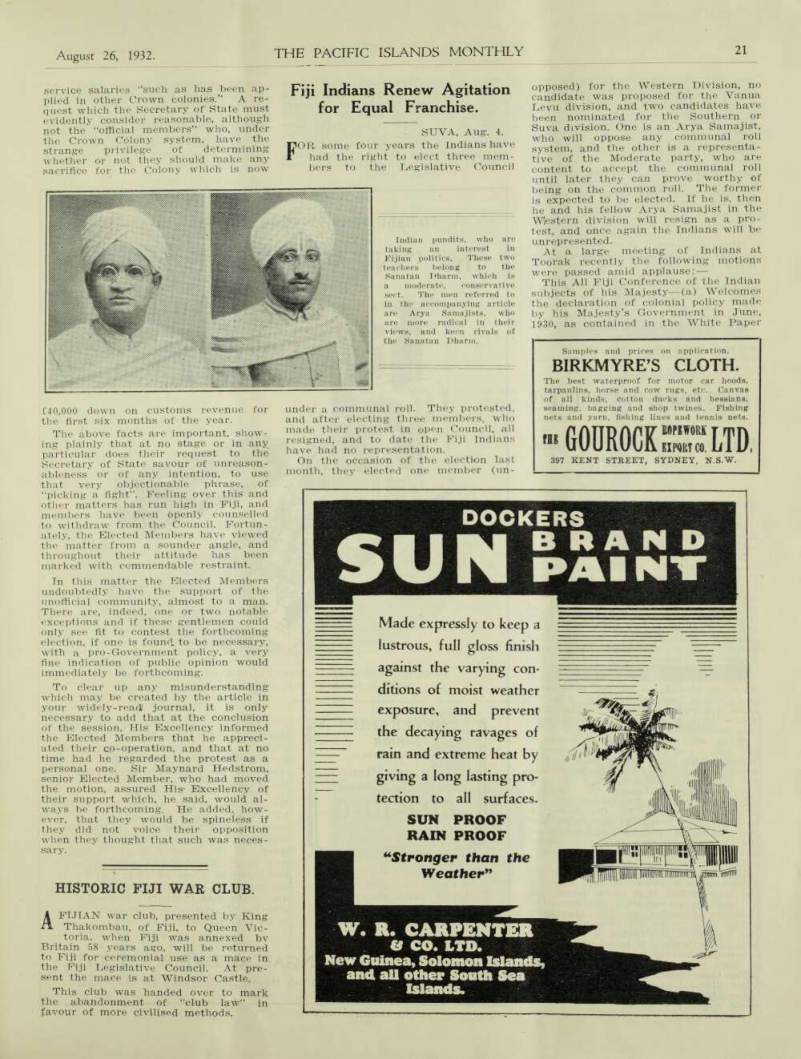
Position As Seen By Elected Members.
From a Special Correspondent.
AN article appearing in “The Pacific Islands Monthly” of June 23, under the heading of “Legislative Coun cil,” and a sub-heading entitled, “Is Fiji Council Picking a Fight with the Governor?” evidently written without full knowledge of the facts, obviously calls for some reply.
Obviously, because of the fact that the protest raised by the Elected Mem bers of the Fiji Legislative Council upon a vital principle of constitutional procedure has since been upheld by the Secretary of State for the Colonies, and also by reason of the fact that a maga zine such as “The Pacific Islands Monthly” must, in accordance with its very laudable policy and intentions, lend a serious ear to what is undoubt edly a genuine complaint upon the part of a very substantial majority of the unofficial residents of the Fiji Group.
In view of the space that would be involved in setting out the details of the position regarding the office of Sec retary of Native Affairs, in connection with which it has been shown that the Governor committed a breach of consti tutional procedure, this article must necessarily be confined to a brief sum mary of the position which should be sufficient to show that at no stage of the proceedings has there been any evi dence of what has been termed ‘Pick ing a fight”, but merely a reasonably worded protest against an infringement
of the few rights now possessed by the non-official section of the community, and which they must endeavour to maintain.
It is perhaps sufficient to mention the simple facts of the matter at issue. In June, 1931, the Governor set up an Economy Committee, which included the then Secretary for Native Affairs and the gentleman who was subse quently appointed to that position on the former’s retirement. One of the re sults of its investigations, which were warmly commended by the Governor, was to recommend the reduction of the salary of the Secretary of Native Af fairs upon the new appointment being made from £1,000 to £800, with increases of £25 to £1,000. This was approved by the Governor, who specially mentioned that the reductions “should result in no loss of efficiency and no prejudice to future development.” The recommenda tions were approved by Council and were embodied in the Estimates for the ensuing year.
It was not until approximately seven months later, when a question was asked in Council, that the information was given that the old salary of £1,000 had been reverted to. In explanation, it was stated that since the recom mendations of the Economy Committee and the passing of the Estimates the Governor had discovered that he had made a mistake in agreeing to the vari ation in the salary of the post, and that upon referring the matter to the Sec retary of State he had been instructed to revert to the original salary. In his reply to the Elected Members, the Governor apologised for omitting to in form them, stating that the matter had entirely escaped his memory.
In their protest the Elected Members respectfully drew the attention of the Secretary to communications from the then Secretary of State in 1922 and 1923 when pledges were given that in regard to financial matters no action would be taken in future without the Legislative Council being consulted.
They also pointed out that Regulations 281, 282 and 283 laid down definitely that the authority of the Legislative Council should be first obtained.
In his reply the Secretary of State upheld this principle, stating that the authority of the Legislative Council, in addition to the authority of the Secre tary of State, is required for all expen diture, and it is very desirable that this should be interpreted in the sense that the authority of the Legislative Coun cil shall, as a general rule, "be obtained in advance of all expenditure.”
It is impossible to read into this protest anything else than the reason able protest of reasonable and represen tative men against what they consider to be an infringement of the rights of the people whom they represent, and which under Crown Colony Government are indeed few enough. That their pro test was reasonable appears to have been recognised by the Secretary of State if not by the Governor and the nominated members who comprise the “mechanical official majority."
This “mechanical majority" was also used to vote out a Previous motion last year by the Elected Members for a re duction in civil service salaries. This fact is mentioned here because it is of interest to note that in his reply to the Elected Members in their consti tutional protest the Secretary of State, without any fresh request being made to him, and entirely unsolicited so to speak states that he will be prepared to consider an emergency cut in civil
service salaries “such as has been ap plied in other Crown colonies.” A re quest which the Secretary of State must evidently consider reasonable, although not the “official members” who, under the Crown Colony system, have the strange privilege of determining whether or not they should make any sacrifice for the Colony which is now
£40,000 down on customs revenue for the first six months of the year.
The above facts are important, show ing plainly that at no stage or in any particular does their request to the Secretary of State savour of unreason ableness or of any intention, to use that very objectionable phrase, of “picking a fight”. Feeling over this and other matters has run high in Fiji, and members have been Ppenly counselled to withdraw from the Council. Fortun ately, the Elected Members have viewed the matter from a sounder angle, and throughout their attitude has been marked with commendable restraint.
In this matter the Elected Members undoubtedly have the support of the unofficial community, almost to a man.
There are, indeed, one or two notable exceptions and if these gentlemen could only see fit to contest the forthcoming election, if one is founds to be necessary, with a pro-Government policy, a very fine indication of public opinion would immediately be forthcoming.
To clear up any misunderstanding which may be created by the article in your widely-read journal, it is only necessary to add that at the conclusion of the session, His Excellency informed the Elected Members that he appreci ated their co-operation, and that at no time had he regarded the protest as a personal one. Sir Maynard Hedstrom, senior Elected Member, who had moved the motion, assured His- Excellency of their support which, he said, would al ways be forthcoming. He added, how ever, that they would be spineless if they did not voice their opposition when they thought that such was neces sary.
Indian pundits, who are taking an interest in Fijian politics. These two teachers belong to the Sanatan Dharm, which is a moderate, conservative sect. The men referred to in the accompanying article are Arya Samajists, who are more radical in their views, and keen rivals of the Sanatan Dharm.
Historic Fiji War Club.
A FIJIAN war club, presented by King Thakombau, of Fiji, to Queen Vic toria. when Fiji was annexed bv Britain 58 years ago, will be returned to Fiji for ceremonial use as a mace in the Fiji Legislative Council. At pre sent the mace is at Windsor Castle.
This club was handed over to mark the abandonment of “club law” in favour of more civilised methods.
Fiji Indians Renew Agitation
for Equal Franchise.
Suva, Aug. 4.
FOR some four years the Indians have had the right to elect three mem bers to the Legislative Council
under a communal roll. They protested, and after electing three members, who made their protest in open Council, all resigned, and to date the Fiji Indians have had no representation.
On the occasion of the election last month, they elected one member (un
opposed) for the Western Division, no candidate was proposed for the Vanua Levu division, and two candidates have been nominated for the Southern or Suva division. One is an Arya Samajist, who will oppose any communal roll system, and the other is a representa tive of the Moderate party, who are content to accept the communal roll until later they can prove worthy of being on the common roll. The former is expected to be elected. If he is, then he and his fellow Arya Samajist in the Western division will resign as a pro test, and once again the Indians will be unrepresented.
At a large meeting of Indians at Toorak recently the following motions were passed amid applause;— This All Fiji Conference of the Indian subjects of his Majesty—(a) Welcomes the declaration of colonial policy made by his Majesty’s Government in June, 1930, as contained in the White Paper
No. 3574, that the establishment of a common electoral roll is the object to be aimed at and attained, with an equal franchise open to all races in colonies where there is a mixed population; (b) requests his Majesty’s Government to arrange consistent with this policy, for an early introduction of the system of common electoral roll in the Constitu tion of this colony; (c) reiterates the demand of the Indian community in Fiji for common and equal rights of citizen ship with other subjects of his Majesty resident in Fiji; and (d) adheres to the policy of non-participation in the Legis lative Council on communal basis.
There has been a good deal of feeling created by disappointed agitators who found they could not get all they wanted, and it is clear that while the Indian population at present is abso lutely unfit for inclusion on a common roll, they are determined to support those who clamour for this right.
It is only a few years ago that those asking for “equal rights” were coolies, working for a small wage, and even to day the literate are only a handful. —
Advertisements & other items, p. 23 (1 item)
Sun Brand Paint
Samples and prices on application.
BIRKMYRE’S CLOTH.
The best waterproof for motor car hoods, tarpaulins, horse and cow rugs, etc. Canvas of all kinds, cotton ducks and hessians, seaming, bagging and shop twines. Fishing nets and yarn, fishing lines and tennis nets.
GOUROCK ROPEWORK EXPORT CO. LTD .
397 KENT STREET, SYDNEY, N.S.W,
DOCKERS
SUN BRAND PAINT
Made expressly to keep a lustrous, full gloss finish
against the varying con
ditions of moist weather exposure, and prevent the decaying ravages of rain and extreme heat by
giving a long lasting pro
tection to all surfaces.
SUN PROOF
RAIN PROOF
"Stronger than the Weather”
W. R. CARPENTER
& CO. LTD.
New Guinea, Solomon Islands, and all other South Sea Islands.
Fiji’S Pineapple Industry
Future At Present Clouded.
Prom Our Own Correspondent.
SUVA, July 10.
THE future of the pineapple industry in Fiji has been rather clouded by the shutting down of two out of the three companies, which have interests here.
However, not too much importance need be attached to this news. The Hawaiian Pineapple Co. was only con ducting an experiment and, whilst it is understood that the results of that ex periment were successful in so far as the ability of Fiji to produce the high grade of pineapple required was suc cessfully demonstrated, circumstances entirely unconnected with Fiji have forced the Hawaiians to abandon the idea of extensive operation in Fiji.
It is rumoured that out of 13,000,000 cases of pineapples packed in Hawaii last season, something like 8,000,000 cases are still in store. The Hawaiian winter pack was simply not packed—it was destroyed.
What with the increase in value of the dollar and protective duties every where within the British Empire, Ha waiian prospects for the coming season are the reverse of golden.
The Fijian Pineapple Co. (mainly Auckland interests) has passed into the hands of a receiver for the debenture holders. It is common knowledge that the late Mr. Alfred Nathan guaranteed the Company for something over £20,000 and naturally, on his death, the guar antee has had to be called up.
The receiver hopes to dispose of the Company as a going concern, and, for the sake of Fiji, it is to be hoped that he will be successful. However, the Company operates on the plantation policy, i.e., grows its own pineapples, and, moreover, is situated in the wetter zone climatically. It has had a pretty substantial burden of overhead charges to carry right from the commencement.
For those reasons alone, it would be quite illogical and unfair to view un favourably the prospects of the pine apple industry in Fiji.
The fairer test of what the future holds is to be seen in the progress of West. Coast Pines, situated, as the name implies, on the west coast of the main island of Fiji. Nadi is in the dry zone (that is, comparatively and climatic ally!) and the pines are grown by ten ant farmers, the Company restricting itself to canning. The capital has been
almost entirely subscribed locally and the Board of Directors, management, etc, are entirely local people, It is literally true that at present the Company has more orders in hand than it can fill, has had nothing but praise of the quality of its article, and is ob taining what seems to be a remunera tive price.
Advertisements & other items, p. 24 (1 item)
the "NEVERTIRE” Junior
A 10-light Electric Plant for less than £100.
Semi-Automatic
Push-Button Starting
Automatic Stopping
THE BATTERY IS A SPECIAL EXIDE, built exclusively for this plant, 32 volt, 50 ampere-hour capacity.
“NEVERTIRE”
JUNIOR
Semi-Automatic
Lighting Plant,
Complete as illustrated.
This complete plant, driven by the worldfamous 11-h.p. Lister-Junior Engine, is ready to connect to house wiring, and for any installation of ten lights or less represents the greatest possible value on the market. £92-10-0 F.o.b. (under bond), Sydney.
Send for illustrated leaflet fully describing the plant and the sim plicity of its operation.
We can also supply all material needed for house wiring. For 20/- per point extra we will include wire, ceiling rose, drop flex, opal shade, lamp-holder and lamp. If you send a rough sketch of your house, marked with sizes of rooms and locations where lights are to go, we can supply all the material ready for use.
Any handy man can wire a house for use with the “Nevertire” Junior plant. Write us by next steamer.
DANGAR, GEDYE 8C CO. LTD.
G.P.O. Box 509 AA, “Malloch House,” 10-14 Young Street, Sydney.
N.G. Plantations.
Mr. Murray Gains Useful Informa tion in Other Countries.
From Our Own Correspondent
Rabaul, June 30.
THE Director of Agriculture, Mr.
George Murray, spent long leave recently in visiting, at his own ex pense, other Pacific Islands, the West Indies, Central and South America, the United States, Britain, various Con tinental countries, Egypt, Ceylon, Malaya, and the Dutch East Indies.
He closely investigated the conditions of tropical agriculture in every one of these many countries, and has re turned, in consequence, with a mass of information of much value to primary producers in this Territory.
Coffee Planting.
The possibility of large scale coffee production in New Guinea, under present world economic conditions, was investigated by Mr. Murray, during his visit to London. The ques tion was discussed at some length with one of the world’s recognised author ities, who said that there was abso lutely no market for poor quality coffee, which is a drug on the market, as can be seen by recent and present market quotations. Growers, however, need not be afraid of going in for coffee production, provided they produce quality coffee, for which there is always a good demand at remunerative prices.
Quite apart, however, from the over seas market, growers in New Guinea Territory have a reasonably large potential market for their output in Australia.
Ceylon Production.
The Director of Agriculture in Ceylon and his staff rendered every assistance in their power, and Mr.
Murray secured much useful informa tion.
Kunai Grass, or Illuk, as it is known in Ceylon, is indigenous in that country. But plantations have received such continuous care for scores of years that the weed is not the curse it is in New Guinea.
The old Ceylon practice of grazing cattle on limited areas still prevails on many estates, but quite a number of properties are now growing cover plants, as in Malaya and in the East Indies.
High Quality Copra.
As is well known, Ceylon produces copra of high quality, but expensive driers are not used for its prepar ation. The design of the average drier is very like that of the ordinary smoke drier, as used in this Territory, but it is built of substantial material—brick or cement walls, with sufficient air holes for ventilation.
The only fuel used is coconut shells, which must be bone dry, consequently there is no smoke.
In the cutting of copra generally, the method followed is to cut the half shell and often, when dry, into quarters, in the manner which the Melanesia Com
pany used to do on their plantations, and not to cut into “fingers”, as is now done in New Guinea. The latter method encourages the development of free fatty acids, which, in addition to meaning a lower value for the copra, makes extra labour.
Coir Fibre.
As the manufacture of coir fibre has been receiving the attention of planters in New Guinea, Mr. Murray made some investigations in Ceylon in this respect.
He formed the opinion that this is purely and primarily a native industry, and one of the most intelligent and progressive planters in Ceylon informed him that the husks were of greater value as manure on his plantation than they would be if he sold them to a mill for manufacture into coir fibre.
At one factory which Mr. Murrav inspected, 40,000 husks were handled daily, and the nett profit was only £300 per annum, and the highest paid labourer only cost 6sd. per day, and fed himself.
Although the labourers in Ceylon are much more intelligent and efficient than most of our natives, the planter and his assistants, like their brothers in the East generally, give constant supervision to the work, and that, with their readiness to try new methods, is why they are able to keep down costs.
In Malaya.
At Kuala Lumpur, capital of the Federated Malay States, Mr. Murray inspected the Serang Government Ex perimental Station and the Carey Island Estate. This station has a very fine dairy herd of Fresian cattle, crossed with Zebu, similar to the cross in Trinidad, and pasteurised milk is sold in sealed bottles to the public in Kuala Lumpur—a great blessing in a tropical country.
From this visit to Malaya, Mr.
Murray learned that the King coconut does not thrive on ideal coconut land, but does much better on a clay soil with a high water table.
A visit was made to investigate the preparation and manufacture of coir fibre at the Pekalongan Prison, in Java. The machinery used was of Eng lish manufacture, and seven machines, each requiring a 30 h.p. engine, manu factured by Larmuth Bullmer & Co., were used.
A quantity of fibre was also pre pared by hand labour, one prisoner producing about two kilogrammes per day of 10 hours’ work. Supervision was good, discipline strict, and prisoners had to work hard.
Advertisements & other items, p. 25 (1 item)
Steelo
EASIEST FOR.
ALUMINIUM
Light rubbing with Steelo gets every thing off alu minium and polishes it at the same time.
Good for baths, basins, sinks, too.
STEELO
Steelo is a fine steel wool, made up into pads and sold, with special soap, in cartons containing a month’s supply. If unobtain able locally, write for free sample to the manufacturers, R. H. ARMSTRONG & CO.. 44 King Street, St. Peters, N.S.W., stating your grocer’s name.
"Perfection in Cooking”
BY USING
YOUNGER
COOKING
STOVES AND
RANGES
made with extended Firebox specially for Long- Wood fuel.
These Stoves and Ranges are Self-Setting, therefore do not require to be built in brickwork.
The No. 7W. “Younger” Range can now he supplied fitted with Legs, as per illustration.
Send for a copy of our Illustrated Catalogue and Quotations for Single and Double Oven Ranges.
Younger Stoves are Widely Used Throughout the Pacific Islands.
G. FLETCHER & SON 50 Oxford Street, SYDNEY.
Papuan Legislative Council Makes New Laws
Relief For Native Labour Employers. — Superannuation Fund and P.S. Privileges Cause Brisk Discussion.
From Our Own Correspondent.
Port Moresby, July 16.
THE non-official members of the Legislative Council are in Port Moresby for the annual meeting of the Council.
They comprise the Hon. J G.
Nelsson, and the Hon. A. H. Bunting, from Samarai; the Hon. Arthur Jewell, from Lolorua; and the Rev. Lister- Turner, from the west of Papua.
The session opened on July 11, when His Excellency, the Lieut.-Governor, presided, and all members, both official and non-official, were present. The Hon. Rev. Lister-Turner took his seat for the first time on the Council, being the newly appointed member to repre sent Christian missions.
A Bill was passed to amend the Arms, Liquor and Opium Prohibition Ordinance. The amendment dealt with “shooting boys” in particular, with drawing the direct control of the person named in the Arms Permit, while the “shooting boy” is on duty.
Bills to amend the Land Ordinance, Native Taxes, and Electric Light and Power Ordinances were introduced; also a Bill to amend the Stamp Duties Ordinance. These were passed, with the exception of the Land Ordinance.
The Treasurer (Hon. E. C. Harris) submitted estimates for the current year, showing revenue at £129,502, and expenditure at £130,919.
The Bill to amend the Native Tax ation Ordinance, which was passed, provides for the release of a native im prisoned for non-payment of tax, on tendering the amount due, during im prisonment.
Native Labour.
The Commissioner for Native Affairs, in reply to the Hon. J. G. Nelsson, in regard to the additional fee imposed last year upon the signing on of native labour, stated it was the intention of the Government to abolish the fee.
This regulation was put into force last year. It added to the charge of 6/on making a contract of service with a native, a further charge of 3d. in the £ on the amount the native earned under the contract, bringing the fee for the signing-on of a native at 10/a month, for two years, up to 9/-. This measure was in addition to a former one, whereby employers unable to pro cure assured guarantees must pay their wages in advance, together with the native’s return passage to his village.
The measure, at the time, caused no little comment from planters and em ployers of native labour, and it will be a relief to them to learn of its withdrawal. At the time, the Govern ment announced the fee was to be placed to the credit of a separate fund, to provide against possible default by employers in the payment of their wages, and that it was an additional precaution only.
In the course of his budget speech, the Treasurer announced the Govern ment’s intention to remove the primage
tax from imports of rice and tinned meats.
This last measure, together with the removal of the labour fee, will be thoroughly appreciated by all em ployers of native labour, who have had an extremely difficult time the last year—with rubber and copra so low in market value.
Samarai Hospital.
Reference was made to the condition of the Samarai Hospital. The Hon. J.
G. Nelsson protested in regard to its neglect, and hopeless condition. The Director of Public Works (the Hon. A.
P. Lyons) stated that an examination of the building would be made, and if the repairs required more than the sum voted in the estimates, the erec tion of a new hospital would be considered.
Leave Allowances And
Superannuation Fund.
The question of long leave for the members of the civil service came be fore the Council, also the question of the reduction of deferred leave al lowance.
The Hon. J. G. Nelsson, unofficial member, saw no need of the former, and stated that the latter could be reduced a good deal. As regards the reduction of salaries of the service, Mr.
Nelsson said all the unofficial members would regret the necessity, but he con
sidered economies could be carried out in regard to long leave and deferred leave allowances during the present financial difficulties of the Territory.
Mr. Nelsson also pointed out that in the estimates, a payment of £3,250 from the revenue was granted to the super annuation fund, which he considered unwarranted. He failed to see why the public should be called upon to stand such an expenditure. It was a matter concerning public servants themselves, and it was never contem plated that it would be necessary to meet this expenditure out of revenue.
Mr. Nelsson pointed out that every member of the community had to make sacrifices up to date, except
public servants, and he considered that they should be only too pleased to bear the larger share of supporting the deficit in the superannuation fund.
The Hon. J. T. O’Malley, Commis sioner of Native Affairs, replying, said that up to the present time officers of the civil service had taken their full share by direct contributions from salaries and had paid £49,591 into the fund. Together with interest, this amounted to £69,354. In comparison, the public, who got loyal and efficient service, had contributed only £2,600 to the fund. He considered the officers of the service had done their full share.
The Hon. Arthur Jewell, unofficial member, expressed the view that no one wished to withhold any privileges from the public servants, but he con sidered, as the scheme was for their benefit entirely, it seemed the weak ness in the scheme was due to low contributions to the fund during the period of service.
Later in the discussion, Mr. O’Malley said the whole scheme was inaugurated by the Government, for the primary purpose of securing efficient, loyal, and continuous service. It was never in tended that the scheme would be sup ported solely by contributions of officers from their salaries. The officers were called upon to contribute 5 per cent, from their salaries, and the Government took the share of the financial responsibility by having the fund guaranteed by the public re venue. This responsibility, the Govern ment was legally bound to meet, when ever the necessity arose.
Advertisements & other items, p. 26 (1 item)
Penta
Famous Swedish Utility
OUTBOARD ENGINE,
3½-H.P. Double Cylinder.
Strong and Reliable. Silent.
Write for particulars.
NELSON & ROBERTSON,
12 SPRING STREET, SYDNEY.
Australasian Distributors.
R. TOWNS & CO
Established 1842.
31 REIBY PLACE - SYDNEY.
“LORD BEACONSFIELD” 26’s Island Twist Tobacco.
“EDGEWORTH” Extra High Grade Smoking Tobacco, in 2oz. vacuum airtight Tins, and 1lb. Glass Jars.
“CUTICURA” Soap, Ointment and Talcum Powder.
SHIPCHANDLERY.
W. Kopsen & Co. Limited
Manufacturers of PIONEER BRAND ASH OARS AND IMPLEMENT HANDLES.
Sole Agents for: KOPSEN’S SPECIAL YELLOW METAL SHEATHING AND NAILS.
Large Stocks of Chains, Anchors, Manilla and Wire Ropes, Wood and Iron Blocks, Oakum, Tar, Pitch, Oils, Paints, Leads, Zincs, Varnishes, Shackles, Rigging, Screws, Sheathing, Felt, Lampware, etc.
Prices and Particulars on Application.
68-70 CLARENCE STREET,
Cables: "Kopsen.”
SYDNEY.
'Phone; BW 1114-5.
Weak Fruit Market
Affects Cook Is.
From Our Own Correspondent.
Rarotonga, July 17.
THE Group’s fruit pulse continues to beat very feebly. Packing sheds re port buying prices (July 16 —“Monowai” shipment) at 1/6d. per case for oranges, 2/- for bananas, and 4/- for tomatoes.
No one except natives, living on the very edge of the barest economic standard and existing principally on a coconut —taro —fish diet, could possibly cultivate and deliver fruit to the pack ing sheds at these prices.
The appallingly low prices, with the resultant inability of the native to pur chase certain lines of European foods, which he has become accustomed to— bully beef, sugar, butter, etc.—no doubt accounts, to some extent at least, for the frequent thefts of foodstuffs which have been recently reported.
Copra making is now only a job that the native will trouble about in the Cook Group in order to buy a tin of bully beef or a twist of tobacco. More so than ever before copra has become a “last resource” —a “nothing in it” busi ness.
Despite the very poor price given for copra in the form of trade goods, the islanders at Rakahanga produce copra.
This is their one and only form of trad ing. In return for copra they are able to procure just the barest items of clothing and food from the outside world.
Penrhyn and Manihiki are pearl is lands and pearls from these islands are still dived for and sold in the world’s markets.
As we come south to the “fruit” is
lands, the idea of copra-making has almost disappeared, compared with what it once was.
Rarotonga Entertains N.Z.
Naval Units.
From Our Own Correspondent.
Rarotonga, July 18.
H.M.S. “Diomede” anchored off the reef at Avarua on Saturday, July 9, for a two days’ stay at Rarotonga.
With due naval precaution, the cruiser moored a flagged buoy at the entrance to the reef passage.
A salute of eleven guns was fired as the Resident Commissioner’s boat, manned by uniformed, native oarsmen, left the “Diomede” after Judge Ayson had" paid his official call on Commodore Burgess Watson.
Trucks of fruit, given principally by the native people, were awaiting deliv ery to the ship when the Commanding Officer’s speedy motor pinnace reached the jetty.
A formidable programme of sports events and entertainment awaited the officers and men who were able to come ashore.
Sporting events and mild festivities were continued at Rarotonga when H.M.S. “Laburnum” arrived from Pago Pago on July 14.
The “Laburnum” leaves for Mauke and Manuae (Lower Cook Group) on July 18, and then departs west for Niue.
Advertisements & other items, p. 27 (1 item)
Arnott's
Consult ALEX. HALE
ABOUT YOUR EYES.
Accurate Optical Service and Comfort for your Eyes.
All Optical Repairs and Broken Lenses Replaced by return post.
Send for Self-testing Eye Chart for Reading and Near Work Glasses.
All our Prices will please you.
Alex Hale Ltd
Optometrist Optician,
113 PITT STREET, SYDNEY.
Five other City Addresses. Est. over 30 years.
The Great Builder of Brain, Bone and Muscle in Growing Children Manufactured by William Arnott Limited, The Biscuit Specialists of sixty-four years’ experience.
ARNOTT'S
FAMOUS
MILK
Made in Australia, Financed by Australians, and produced by highly trained Australian workers.
BISCUITS
ASK YOUR STOREKEEPER FOR THEM.
Samoan Mau Is Still Sullen.
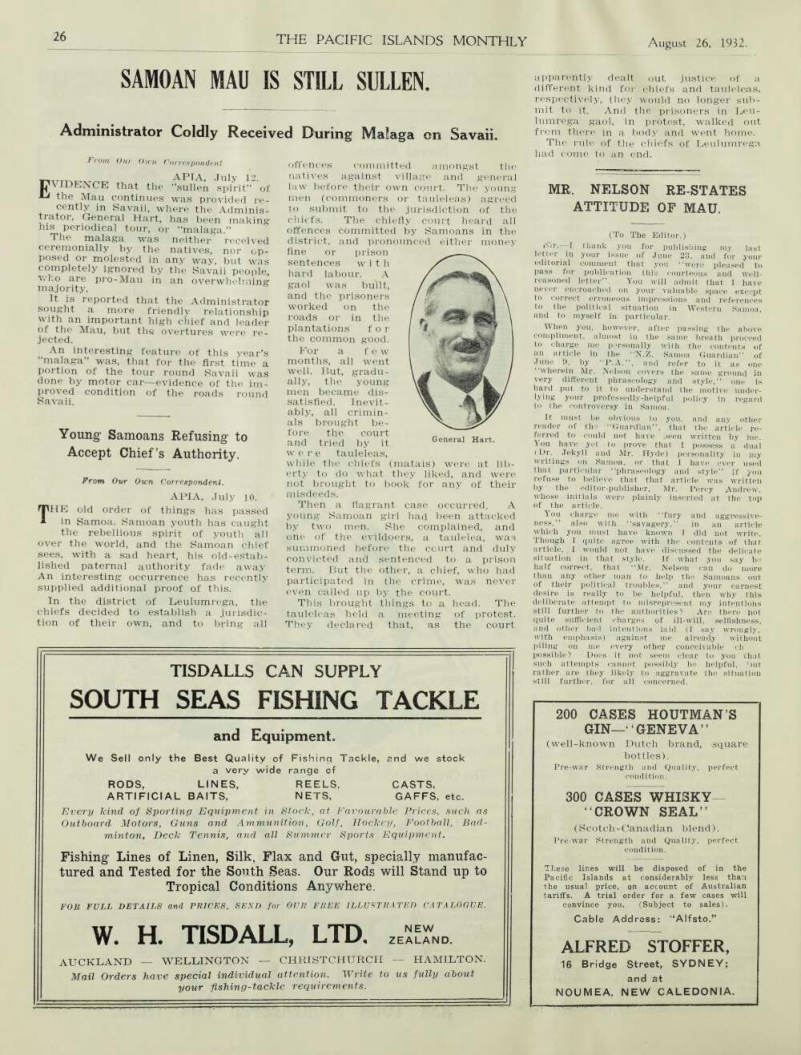
Administrator Coldly Received During Malaga on Savaii.
From Our Own Correspondent EVIDENCE that the "sullen spirit’" of the Mau continues was provided re cently in Savaii, where the Adminis trator, General Hart, has been making his periodical tour, or “malaga.”
The malaga was neither received ceremonially by the natives, nor op posed or molested in any way, but was completely ignored by the Savaii people, who are pro-Mau in an overwhelming majority.
It is reported that the Administrator sought a more friendlv relationship with an important high chief and leader of the Mau, but the overtures were re jected.
An interesting feature of this year’s “malaga” was, that for the first time a portion of the tour round Savaii was done by motor car—evidence of the im proved condition of the roads round Savaii.
Accept Chief’s Authority.
Young Samoans Refusing to Accept Chief’s Authority.
From Our Own Correspondent.
APIA, July 10.
THE old order of things has passed in Samoa. Samoan youth has caught the rebellious spirit of youth all over the world, and the Samoan chief sees, with a sad heart, his old-estab lished paternal authority fade away An interesting occurrence has recently supplied additional proof of this.
In the district of Leulumrega, the chiefs decided to establish a jurisdic tion of their own, and to bring all
offences committed amongst the natives against village and general law before their own court. The young men (commoners or tauleleas) agreed to submit to the jurisdiction of the chiefs. The chiefly court heard all offences committed by Samoans in the district, and pronounced either money
fine or prison sentences with hard labour. A gaol was built, and the prisoners worked on the roads or in the plantations for the common good.
For a few months, all went well. But, gradu ally, the young men became dis satisfied. Inevit ably, all crimin als brought be fore the court and tried by it were tauleleas,
while the chiefs (matais) were at lib erty to do what they liked, and were not brought to book for any of their misdeeds.
Then a flagrant case occurred. A young Samoan girl had been attacked by two men. She complained, and one of the evildoers, a taulelea, was summoned before the court and duly convicted and sentenced to a prison term. But the other, a chief, who had participated in the crime, was never even called up by the court.
This brought things to a head. The tauleleas held a meeting of protest.
They declared that, as the court
apparently dealt out justice of a different kind for chiefs and tauleleas, respectively, they would no longer sub mit to it. And the prisoners in Leu lumrega gaol, in protest, walked out from there in a body and went home.
The rule of the chiefs of Leulumrega had come to an end.
General Hart.
Attitude Of Mau.
Mr. Nelson Re-States
(To The Editor.) Sir,—I thank you for publishing my last letter in your issue of June 23, and for your editorial comment that you “were pleased to pass for publication this courteous and well reasoned letter”. You will admit that I have never encroached on your valuable space except to correct erroneous Impressions and references to the political situation in Western Samoa, and to myself in particular.
When you, however, after passing the above compliment, almost in the same breath proceed to charge me personally with the contents of an article in the “N.Z. Samoa Guardian” of June 9, by “P.A.”, and refer to it as one “wherein Mr. Nelson covers the same ground in very different phraseology and style,” one is hard put to it to understand the motive under lying your professedly-helpful policy in regard to the controversy in Samoa.
It must be obvious to you, and any other reader of the “Guardian”, that the article re ferred to could not have been written by me.
You have yet to prove that I possess a dual (Dr. Jekyll and Mr. Hyde) personality in my writings on Samoa, or that I have ever used that particular “phraseology and style” if you refuse to believe that that article was written by the editor-publisher, Mr. Percy Andrew, whose initials were plainly inserted at the top of the article.
You charge me with “fury and aggressive ness,” also with “savagery,” in an article which you must have known I did not write.
Though I quite agree with the contents of that article, I would not have discussed the delicate situation in that style. If what you say be half correct, that “Mr. Nelson can do more than any other man to help the Samoans out of their political troubles,” and your earnest desire is really to be helpful, then why this deliberate attempt to misrepresent my intentions still further to the authorities? Are there hot quite sufficient charges of ill-will, selfishness, and other bad intentions laid (I say wrongly, with emphasis) against me already without piling on me every other conceivable ch possible? Does it not seem clear to you that such attempts cannot possibly be helpful, but rather are they likely to aggravate the situation still further, for all concerned.
If I were the sole proprietor of the “N.Z.
Samoa Guardian”, as is implied in your editorial note, it might be of interest for you to know that even then the present editor would not write to orders from anyone. The position of the “Guardian” is clearly set out in its issue of this date. You will note therein that though I am one of the three directors, I hold only one-fifth of the stock, and the policy of the “Guardian” is guided by a large number of the friends of Samoa, who have contributed to the little paper in various ways.
You state that you “are not concerned with the past" and “are anxious only to deal with the position as it is”, but you add: “the trouble is that Mr. Nelson is preoccupied with the past. with its injustices and its failures”. You then go on to say that you “have appealed to Mr. Nelson to be generous, to forget the past, and to use his influence with his fellow Samoans to bring them closer to the New Zealand Administrators, so that there may be a compromise, and a settlement, with honour on both sides. But Mr. Nelson replies, savagely, that New Zealand is making no move towards compromise. . .”
These are serious allegations, for which you have established no proof whatever. You neither defend the Mandatory’s policies, which produced the prevailing unrest, nor do you offer any sug gestion of what the Government might do to wards that compromise which you advocate.
You merely take on to yourself the privilege to criticise the attitude of the Samoans and blame me for everything which makes sensational copy for your paper.
You say that I should “forget the past”, but you conveniently overlook the fact that I am still in enforced exile from my native country and the Samoans are still being imprisoned for an obsolete polltax. It is therefore not the past, but the “living present”, which you are asking the aggrieved side to forgive and forget: but to the other side, which holds all the power and authority to wipe out the past, you offer no advice or suggestion at all. Your latest contribution, making me appear blacker than ever in the eyes of the Mandatory authorities, cannot possibly bring a solution nearer; on the contrary, it can only tend to kill any prospect of “a compromise or a settlement with honour on both sides”.
In the concluding paragraph in your editorial note, you say that it is apparent that no ‘‘real sincere effort has been made to bring the Ad ministrator and the Mau together since General Hart took charge”. The respectful and polite letter from the Mau to General Hart, on his arrival in Samoa, ‘‘setting out very clearly the conditions and terms on which they would meet and confer with him” you say “is not the correct form of approach to a powerful and proud State”. You add, and I fully agree with you. that “this frightful muddle cannot be cleaned up unless both sides meet in a calm atmosphere, with open minds, free from all ‘conditions and terms’ ”.
The Mandatory alone, and not the Mau or myself, have the power to bring such a con ference about. If you will only take the trouble to recall to mind the many representations made by myself, and by many representative persons and bodies in New Zealand, to the New Zealand Government, and by the letter of the Mau to General Hart, you will find that it is the Government which has consistently refused to convene such a meeting.
It is on record that the Government have officially rejected the overtures made towards that end on several occasions. They say it was not necessary, as the Samoans did not know what they wanted. Yet you persist to throw the onus on the side which has not the power to bring about the compromise, which you sug gest, and omit to advise the other side, which has all the power and refuses to exercise it.
Would you suggest that the treatment of the Samoans, whether or not it was deserved, was the action of “a powerful and proud State”'?
After all, the interest you have taken in the Samoan situation is only part of your own self chosen policy, and the occupation of Western Samoa by New Zealand was, and still is, only to satisfy its own pecuniary interests, which you and they may relinquish at any time. In my ease (and that of every Samoan), however, it is—for want of a better name—purely ac cident of birth, for which I have no reason to be ashamed, and a lot to be proud. We have paid dearly in life and treasure, in money and kind, in wholesale slander and universal calumny inflicted on us by that “powerful and proud State”. Yet the Samoans can never be reduced to the relative position now held by
the Maoris in New Zealand. Samoa will never become a white man’s country in population; it will always remain predominantly Samoan.
Its climate is responsible for that, not the grace of the pakeha or white man. It must, therefore, be self-evident that neither your journal nor the Mandatory Government can be more anxious to have peace and tranquillity re stored in Samoa than the Samoans or myself.
These can only be lasting if produced by a “settlement with honour”, as suggested by you, and not by the arbitrary dictation of a “power ful and proud State”.
I am, etc.,
O. F. Nelson.
Auckland, July 7, 1932.
EDITORIAL NOTE. —Owing to my absence in New Guinea, publication of this letter was de layed until August.
We regret that we attributed to Mr. Nelson personally an article that was written by his able editor, Mr. Andrew. We carelessly had failed to notice the caption “By P.A.’’; and we confess that in any event we had regarded Mr.
Nelson as assuming personal responsibility for everything in “The Guardian,’’ because we understood that he was the owner. We stand corrected, and apologise for the error.
So far as the general position is concerned, we are beginning to fear that any appeal to a spirit of reason and compromise is useless. The future lies to a large extent in Mr. Nelson’s own hands: and Mr. Nelson’s outlook seems to be dominated and coloured by his hatred of New Zealand.
Why cannot Mr. Nelson face facts? The facts are that N.Z. is complying with the terms of the Mandate, and her administration will not be seriously interfered with by the League; that the only way out of the present impasse is by a proper approach by the Mau to the N.Z.
Government; and that it is no use Mr. Nelson approaching Wellington with Mau flags flying, and an effigy of the hated General Richardson borne on the pike-staffs of the Mau phalanx.
Mr. Nelson should remember that, while he may be up against bureaucracy, he is not up against the N.Z. people. The latter believe just as passionately as Mr. Nelson in the rights and liberties of small nations. —R.W.R.
Advertisements & other items, pp. 28-29 (2 items)
W. H. TISDALL, LTD. New Zealand.
TISDALLS CAN SUPPLY
SOUTH SEAS FISHING TACKLE
and Equipment*
We Sell only the Best Quality of Fishing Tackle, and we stock a very wide range of
RODS, LINES, REELS, CASTS,
ARTIFICIAL BAITS, NETS, GAFFS, etc.
Every kind of Sporting Equipment in Stock, at Favourable Prices, such as Outboard Motors, Guns and Ammunition, Golf, Hockey, Football, Bad minton, Deck Tennis, and all Summer Sports Equipment.
Fishing Lines of Linen, Silk, Flax and Gut, specially manufac tured and Tested for the South Seas. Our Rods will Stand up to
Tropical Conditions Anywhere.
FOR FULL DETAILS and PRICES, SEND for OUR FREE ILLUSTRATED CATALOGUE.
W. H. TISDALL, LTD. New Zealand.
AUCKLAND WELLINGTON CHRISTCHURCH HAMILTON.
Mail Orders have special individual attention. Write to us fully about your fishing-tackle requirements.
Alfred Stopper,
200 CASES HOUTMAN’S
GIN—"GENEVA”
(well-known Dutch brand, square bottles).
Pre-war Strength and Quality, perfect condition.
300 CASES WHISKY—
“CROWN SEAL”
(Scotch-Canadian blend).
Pre-war Strength and Quality, perfect condition.
These lines will he disposed of in the Pacific Islands at considerably less than ihe usual price, on account of Australian tariffs. A trial order for a few cases will convince you. (Subject to sales).
Cable Address: “Alfsto.”
ALFRED STOPPER,
16 Bridge Street, SYDNEY; and at
NOUMEA. NEW CALEDONIA.
Wm. McKINNON & CO. L TD
McKinnon’s No. 5 Size “Africa” Coffee Huller, Latest Ball-Rearing Model.
ONE OF THE MOST POPULAR MACHINES
PRODUCED BY THE HOUSE OF McKINNON.
Catalogue and full details on request.
MANUFACTURERS OF
GOLD MEDAL
PLANTATION MACHINERY
FOR THE PREPARATION OF
Coffee, Sugar, Rice and Cocoa
COMPLETE INSTALLATIONS
A SPECIALITY.
We Solicit Your Enquiries.
Estimates, Elans , etc., Gratis.
HEAD OFFICE AND WORKS:
SPRING GARDEN IRONWORKS,
ABERDEEN, SCOTLAND.
Established 1798.
Trade And Missions.
Samarai Man Asks “Why?”
[To the Editor.] Sir, —Badly hit as the planters may be, they are in a much more favourable position than the unfortunate traders.
To set aside the initial cost of planting, a planter may be said to get nuts for the trouble of picking them up; the trader has to buy either nuts or copra, and a reasonable profit is impossible at present prices.
Moreover, “brown brother” doesn’t make copra unless the price suits him.
He sells a few bundles of nuts now and then to keep himself in “smokes,” and the unused part of his crop just rots on the ground. Since 1929 the natives in the vicinity of this station have thrown away over 200 tons of copra in this manner, for which, even at the present low price, they could have received from £800 to £1000 in solid cash.
It seems ridiculous that the Papuan Government should compel these natives to plant coconuts, and yet allow them to waste the produce from trees al ready bearing. Apparently to compel the villager to clear land and plant coconuts is not unjust, as it is for his own benefit, and for the benefit of his children; but to compel him to make copra with his surplus nuts would be most unjust, because the local trader might become a bloated capitalist on the profit from that same copra.
The articles, letters, etc., on Mission Trading seems to leave a very bad smell. The same complaints appear to come from places so widely scattered as the Solomons, New Hebrides, and Papua, and two mission societies only appear to be involved, Methodist and Presbyterian. Living in the Methodist Mission district in Papua we have seen, in an experience of 23 years, many types of Methodist missionaries, and could fill a couple of , books, not on the trading they do, but with the various excuses they make for trading. How ever, as the Rev. J. W. Burton is deal ing with this matter, it is hardly a fair thing to pass criticism until we see what the Mission Board intends to do about it.
Finally, we beg to draw your atten tion to your “editorial note” in the May issue of your paper (see page 26). You write —“Similarly, it can be said that 95 per cent. of traders nowadays are straight goers, who treat the natives fairly and decently.” Good Heavens, man! This will never do! If you per sist in this, you are utterly damned.
Don’t you ever attend lectures on mis sionaries? If you don’t, please allow us to quote a few extracts: — Rev. M. K. Gilmour (Chairman, Papuan dis trict), at the Auburn Methodist Church:— Our early navigators blazed the trail to these islands, and soon afterwards our traders made that trail a highway, carrying with them the diseases of the white man, and his morals. The effects of these diseases were horrible, etc., etc.” (Culled from the ‘‘Sydney Morning Herald.”) Rev. J. F. Goldie (Chairman, Solomon Is. dis trict) at the Pitt Street Methodist Church.
Auckland, N.Z. ‘‘God pity them if the white man with his gun, his gin bottle, and his Euro pean diseases, gets there first.” ... “The words ‘blackbirder,’ ‘trader,’ and ‘beachcomber,' did not mean much to New Zealand ears, but they had a very real meaning to natives of the Solomons,” etc., etc.
Don’t you realise that the traders came to these islands, and, finding the unfortunate natives in a state of pris tine innocence, immediately set to work and converted them into ramping roar ing cannibals, making them so de bauched that they have even been known to kill and eat missionaries.
Where will Miss B. Grimshaw and J. M.
Turnbull get their “horrible examples” from if you start to whitewash traders in this fashion? How are missionaries going to find material for their lectures, and excuses for their presence here, if there are no “gin-sodden, debauched, low-down traders” to save brown brother from? Surely it was a mis print, and you meant 5 per cent.?
In conclusion, please explain to me this riddle: —I take up, say, a grocery business in Randwick. I buy goods at as low a figure as I can get them from the wholesale firms, and retail them again at a price that brings in a reas onable profit. (I believe quite large firms do the same thing.) I am looked
upon as an honest man, and can even aspire to be a sidesman in the local church.
Then I come to, say, Papua, take out a trading licence, and open up a store, buy and sell goods just as honestly, and fairly, as I did to the residents of Rand wick. But this is “exploiting the na tives.” The missionary watches me, tells his congregation that I am waxing rich on the proceeds of their copra (I achieved a loss of nearly £100 last year); the patrol officer calls regularly to make sure I haven’t murdered any of my labour-boys; in short, never re alised what a low-down thing “trade” is until I came to have business rela tions with “brown brother.”
But, why? Kindly explain that to me, Mr. Editor, and I’ll thank you.
I am, etc.,
E. W. Harrison.
Sebulugomura, Samarai, Papua, June 5, 1932.
Advertisements & other items, p. 30 (1 item)
What Kind Of A Man
ARE YOU?
Weakness of body robs a man of every chance of a life of happiness and success. His physical defects mark him as misfit and a weakling.
Look in the mirror, look inwardly to your con science. Ask yourself if you believe you are a manly man, who deserves success; ask yourself if you are getting the joys out of life which healthy and red-blooded and vigorous men get out of it. If you have acquired physical ailments which keep dragging you down physically and mentally, until you feel hopeless, I want to say to you that I hold out a helping hand. I can put you on your feet again.
DYNAMIC DEVELOPMENT
has helped thousands to overcome weakness and physical failings which affect so many.
SUPREME MUSCULAR
DEVELOPMENT
is brought about through my wonderful course.
There is no other training like dynamic development —no training for health and strength which is so thorough, so easily adapt able to special requirements or practical and successful in making all kinds of ordinary and weak fellows into men of punch.
POWER and PERSONALITY.—I will make you the man you wish to be. I give you solid, scientific train ing. No stunting. I build you up mentally as well
as physically.
WRITE TO-DAY FOR FULL PARTICULARS.
Cut out Coupon in this advertisement, sign it care fully, and post to me to-day. I will then send you full details, including my famous Book, MAN THE
MASTERPIECE.”
HASTINGS WOOLLEY,
Australia’s Recognised Health and Physical Expert, 1932, TO
COUPON
P.I.M.
HASTINGS WOOLLEY,
Institute of Dynamic Development
219 ELIZABETH ST., SYDNEY, N.S.W.
Kindly send me full particulars of your Dynamic Development Course, including your great hook, "Man the Masterpiece.” I enclose 4d. in stamps to help in cost of postage.
NAME
ADDRESS
Samoan Residents Honour German Dead.
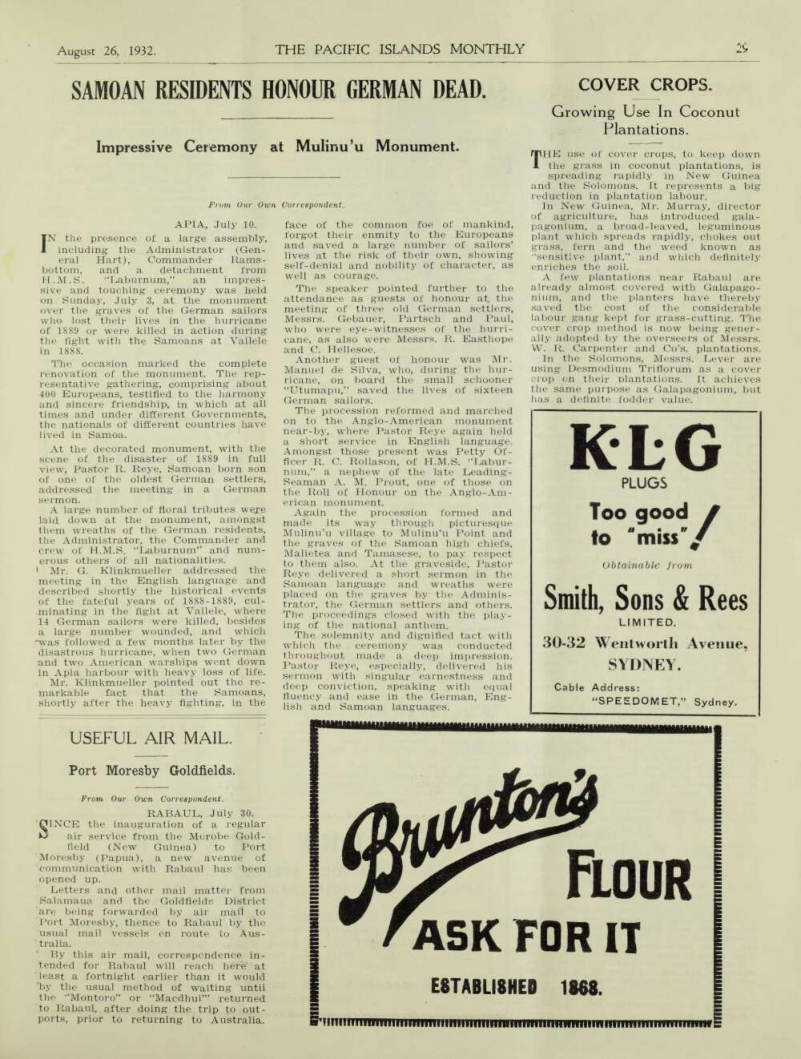
Impressive Ceremony at Mulinu’u Monument.
From Our Own Correspondent.
APIA, July 10.
IN the presence of a large assembly, including the Administrator (Gen eral Hart), Commander Rams bottom, and a detachment from H.M.S. “Laburnum,” an impres sive and touching ceremony was held on Sunday, July 3, at the monument over the graves of the German sailors who lost their lives in the hurricane of 1889 or were killed in action during the fight with the Samoans at Vailele in 1888.
The occasion marked the complete renovation of the monument. The rep resentative gathering, comprising about 400 Europeans, testified to the harmony and sincere friendship, in which at all times and under different Governments, the nationals of different countries have lived in Samoa.
At the decorated monument, with the scene of the disaster of 1889 in full view, Pastor R. Reye, Samoan born son of one of the oldest German settlers, addressed the meeting in a German sermon.
A large number of floral tributes were laid down at the monument, amongst them wreaths of the German residents, the Administrator, the Commander and crew of H.M.S. “Laburnum” and num erous others of all nationalities.
Mr. G. Klinkmueller addressed the meeting in the English language and described shortly the historical events of the fateful years of 1888-1889, cul minating in the fight at Vailele, where 14 German sailors were killed, besides a large number wounded, and which was followed a few months later by the disastrous hurricane, when two German and two American warships went down in Apia harbour with heavy loss of life, Mr. Klinkmueller pointed out the re markable fact that the Samoans, shortly after the heavy fighting, in the
face of the common foe of mankind, forgot their enmity to the Europeans and saved a large number of sailors’ lives at the risk of their own, showing self-denial and nobility of character, as well as courage.
The speaker pointed further to the attendance as guests of honour at, the meeting of three old German settlers, Messrs. Gebauer, Partsch and Paul, who were eye-witnesses of the hurri cane, as also were Messrs. R. Easthope and C. Hellesoe.
Another guest of honour was Mr.
Manuel de Silva, who, during the hur ricane, on board the small schooner “Utumapu,” saved the lives of sixteen German sailors.
The procession reformed and marched on to the Anglo-American monument near-by, where Pastor Reye again held a short service in English language.
Amongst those present was Petty Of ficer R. C. Rollason, of H.M.S. “Labur num,” a nephew of the late Leading- Seaman A. M. Prout, one of those on the Roll of Honour on the Anglo-Am erican monument.
Again the procession formed and made its way through picturesque Mulinu’u village to Mulinu’u Point and the graves of the Samoan high chiefs, Malietea and Tamasese, to pay respect to them also. At the graveside, Pastor Reye delivered a short sermon in the Samoan language and wreaths were placed on the graves by the Adminis trator, the German settlers and others.
The proceedings closed with the play ing of the national anthem.
The solemnity and dignified tact with which the ceremony was conducted throughout made a deep impression.
Pastor Reye, especially, delivered his sermon with singular earnestness and deep conviction, speaking with equal fluency and ease in the German, Eng lish and Samoan languages.
Useful Air Mail.
Port Moresby Goldfields
From Our Own Correspondent.
Rabaul, July 30.
SINCE the inauguration of a regular air service from the Morobe Gold field (New Guinea) to Port Moresby (Papua), a new avenue of communication with Rabaul has been opened up.
Letters and other mail matter from Salamaua and the Goldfields District are being forwarded by air mail to Port Moresby, thence to Rabaul by the usual mail vessels en route to Aus tralia.
By this air mail, correspondence in tended for Rabaul will reach here at least a fortnight earlier than it would by the usual method of waiting until the “Montoro” or “Macdhui”’ returned to Rabaul, after doing the trip to out ports, prior to returning to Australia.
Cover Crops.
Growing Use In Coconut Plantations.
THE use of cover crops, to keep down the grass in coconut plantations, is spreading rapidly in New Guinea and the Solomons. It represents a big reduction in plantation labour.
In New Guinea, Mr. Murray, director of agriculture, has introduced gala pagonium, a broad-leaved, leguminous plant which spreads rapidly, chokes out grass, fern and the weed known as “sensitive plant,” and which definitely enriches the soil.
A few plantations near Rabaul are already almost covered with Galapago nium, and the planters have thereby saved the cost of the considerable labour gang kept for grass-cutting. The cover crop method is now being gener ally adopted by the overseers of Messrs.
W. R, Carpenter and Co’s, plantations.
In the Solomons, Messrs. Lever are using Desmodium Triflorum as a cover crop on their plantations. It achieves the same purpose as Galapagonium, but has a definite fodder value.
Advertisements & other items, p. 31 (1 item)
Smith, Sons & Rees
KLG
PLUGS
Too good
to miss!
Obtainable from
Smith, Sons & Rees
LIMITED.
30-32 Wentworth Avenue,
SYDNEY.
Cable Address: “SPEEDOMET,” Sydney.
ask for it
ESTABLISHED 1868.
National Economics
In Tonga.
To the Editor.
Sir, —I have before me a copy of the June issue of “The Pacific Islands Monthly” and the contribution by your correspondent captioned, “Shall Mr. Cowley, of Tonga, Be Taken Seri ously,” calls for particular comment.
There is only one honest reply to this query, and the reply is—yes!
My first impression, after reading your cor respondent’s remarks, was one of depression— depression arising from the thought that such an excellent paper as “The Pacific Islands Monthly” should have been hoaxed by its cor respondent to publish such drivel.
Your correspondent’s remarks make an earnest man’s “blood boil.” The difference between the two contributors under discussion is that Mr.
Cowley’s article impresses one with its truthful air of righteous indignation in regard to the handling of the economic condition of Tonga; your correspondent’s article impresses one with the feeling that “a devil is in our midst.”
On the one hand we find a “gentleman” mak ing an earnest effort to assist this little Kingdom —on the other, a “person” deliberately abus ing the good work. Such a person is only fit for the good old tar and feathers!
As an instance of your correspondent’s un reliability: He ridicules Mr. Cowley’s state ment to the effect that three small shipments of kumaras glutted the New Zealand market.
Does your correspondent forget that it was he himself who stated that kumaras were one of Tonga’s “bow strings”? Does your correspond ent also fail to understand that Mr. Cowley is simply pointing out the foolishness of hoping for any economic uplift from such a source? I presume your correspondent possesses ordinary intellect, therefore his misrepresentation of Mr.
Cowley’s statement is the disgusting action of the knave. Mr. Cowley’s statement is not a bit humorous, although your correspondent pretends it is. After three shipments New Zealand buyers most definitely stated that they could not take further supplies for many, many months, as they had more than sufficient stocks.
Mention of your correspondent’s “bow strings” reminds one of another of the three he raved about. I refer now to bananas (copra was the remaining one). From the foregoing, it is ob vious how very weak the “kumara string” is.
The “banana string” is probably just as weak.
He stated last November that the industry would yield 20,000 cases per month. With a tremendous effort, the industry once yielded 9,000 odd. A few days ago it yielded 2,200 cases. Next month it will probably yield nil.
This is not because the banana season is finished —there are bananas pretty well all the year round—but, oh, sir, not 20,000 cases per month!
With reference to the third string—namely, copra. Well, we all know the pitiable state of the market. So much for your correspondents “three strings to the bow.”
Getting back to bananas, may I suggest that your correspondent make an endeavour to have certain of his literary sins pardoned by telling you the truth about this banana business?
Your correspondent’s final faux pas is his reference to “Charles and James of happy memory.” If the period during which these two kings reigned can be considered by your correspondent as one of “happy memory,” then may I suggest to him that if he intends to pursue his literary career of foolish endeavour he would lessen the likelihood of being classed absolutely hopeless (instead of merely hopeless) by refraining from historical references.
I am, etc.,
Observer.
Nukualofa, July 18.
Mr. Cowley Is Brief.
To the Editor.
Sir, —Kindly permit me to heartily congratu late your Tongan correspondent on his ingeni our and still more disingenious article in your current issue. June. The ingenuity is great, but it does not compare with the disingenous ness, which is superb.
Evidently, your correspondent places your readers in the same category as Carlyle’s 30 millions of English, “mostly fools.”
I am, etc.
A. Cowley.
Nukualofa, July 16.
Samoan News Budget.
From Our Own Correspondent.
Dispute Over Banana Inspection,
APIA, July 10.
THE banana shippers, Europeans and natives alike, received a very unpleasant surprise, when it became known, that the bananas, delivered to Apia wharf, were inspected, against all former procedure, not by the Samoan In spector of Produce, as usual, but by a represen tative of the Auckland buyers, Messrs. Turner and Growers, Mr. G. P. Bairston, who was travelling on the “Maui Pomare.”
Of the total deliveries of about 4,700 cases, some 1,800 cases were rejected by Mr. Bairston and left behind, though his decision was strongly disputed by the Administration here. The ship ment comprised only about 2,700 cases against a capacity of about 7,000 cases loaded previously on the steamer.
The dispute will very probably be decided in Court. Meanwhile, the natives are much dis satisfied and have complained to the Adminis trator.
Dynamite Seriously Injures
Fisherman.
Fishing with dynamite is generally practised by natives on the west coast of Upolu. It is not known where exactly they obtain the gelig nite they use for the purpose. But a serious accident that occurred a few days ago has drawn public attention to the dangers attendant on the indiscriminate use of explosives by inexperi enced people.
A native went out fishing on the reef off Leanvaa. He tied three sticks of gelignite together to increase the effect and used a very short and insufficient fuse. Apparently, after lighting the fuse, he was uncertain whether the fuse was burning or not. He kept the explosive in his hand, when suddenly it exploded with terrific force, shattering one side of his body and tearing one arm away. The man was still alive when brought to Apia Hospital, but his injuries are so serious that he is not expected to live.
It is hoped that the Administration will pro hibit the use of explosives for fishing, as was done in former years, owing to the frequent accidents.
New Passenger Service To Savaii.
Owing to the enterprise of the director of the Union Garage, Mr. J. Ah Mu, a new fast pas senger service by motor ’bus and launch has been started between Apia and Tuasivi (Savaii).
For the last few years, passengers from and to Savaii had to use the slow and irregular motor boats carrying copra, which have no special passenger accommodation. The new fast service is a great improvement and it is hoped that Mr. J. Ah Mu will succeed in his new venture.
Marketing Of Cocoa.
We are in the off season for cocoa now and very small quantities of the product will be delivered during the next few months.
The English market seems at present more favourable. Recent sales in London are reported to be ranging from £60 to £72 per ton, which, with the premium on exchange, should show a satisfactory profit to merchants. The American market seems demoralised; large stocks of Samoan cocoa are on hand and there is very little demand.
The cocoa buyers of Samoa have recently come to an agreement to distribute Samoan cocoa more evenly to the American and European markets, to facilitate selling and maintain a reasonable price standard. Formerly, large quantities of
cocoa beaus have been sent to one market, de pressing the price, while other markets showed a good demand, but were bare of stocks.
Collector Of Customs Farewelled.
A large gathering assembled to farewell our popular Collector of Customs, Mr. A. Mac Donald, who has relinquished his position and is returning by the “Maui Pomare’’ to take up new duties in Mew Zealand.
The sentiments of all present were ably ex pressed by Mr. R. H. Brown, manager of B.P. (S.S.) Co., Ltd., who voiced the sincere regret of the business community of Apia, to see the best Collector of Customs we have had for a long time, leave our shores, and who specially praised the zeal and courtesy with which Mr. Mac Donald has always fulfilled his onerous duties.
Mr. MacDonald, in reply, expressed his sin cere appreciation of the complimentary remarks made. He hoped that prosperity would soon be restored to Samoa’s shores and a roseate future would compensate all for the hardships of the present day.
Personal Notes.
Some well-known residents and officials are leaving our shores for good during the next few months. Amongst them is Mr. A. F. Small, manager of the Bank of New Zealand’s Apia branch, who has completed a three years’ term in Samoa. His successor has not so far been announced.
A well-known police official, Sergt. A. L.
Downes, of the Samoan Contabulary, left by the “Maui Pomare,’’ being transferred to the N.Z. Police. He has had four years’ service in Samoa. His place is being taken by Sergt.
Fell, formerly in the Constabulary and at pre sent a detective in the N.Z. Police Force.
Advertisements & other items, p. 32 (1 item)
Building
SUPPLIES
Complete Stocks of Seasoned Timber of all descriptions on hand for immediate shipment.
Galvanised Iron, Fibro- Cement, Glass, and Builders’ Ironmongery.
SEND FOR OUR CATALOGUE
OF READY-CUT HOMES AND
ISLAND BUNGALOWS.
A. C. SAXTON & SONS
LTD.,
Box 5, PYRMONT, SYDNEY.
ALBERT GREGORY
107 YORK STREET, SYDNEY
SADDLERS' IRONMONGERY, SADDLES, HARNESS,
SPURS, STIRRUPS, and WHIPS, &c.
EVERYTHING CONNECTED WITH THE TRADE.
Leather for Art Work. Basils, Roans, Suedes. Boot and Harness Leathers.
GREGOLINE— Raw, Pure and Pearl White. Nothing so good for the Home, Stable, and Dairy and a great rust preventive.
Distributing Agents for:
DOCKER’S AND BORTHWICK’S PAINTS.
CORRESPONDENCE SOLICITED.
Massoi Oil.
New Industry In The Territory.
AN interesting new industry—the dis tillation of a fine oil, used in mak ing essences, from the bark of the Massoi tree —has been started near Madang, in New Guinea, by two young Australians, Messrs. Murphy and Batsos.
The tree is found mostly among the foothills of the Finisterre Mountains, at the back of Madang—it is apparently allied to the cinnamon tree. Mr. Batsos knew of its existence, and he went to Madang in 1931 to look into the matter.
There he met Mr. Murphy, a young engineer, whose other enterprises had been laid low by the depression.
The two young men joined forces, and now they export about two drums of the oil by every steamer. Their dis tillation plant is on the coast, about 20 miles south of Madang, and they em ploy about 25 “boys.” Mr. Murphy ranges over the whole wide country side hereabouts, looking for suitable trees —only the very big ones are suit able-arid he strips the bark from them and brings it to the plant.
A Tongan Lament.
Dedicated to recent writers on Tongan affairs.
"The terrors of exposure are nil, even were there no shelter available.'’ — Fakamatala, in March 15.
“In fact . . . the only actual necessity for procuring money is to pay taxes and purchase luxuries.”—Fair Play, in P.I.M., March 15.
“The taxation shrinkage is not explainable, but no doubt is due to their sheer inability to pay.”
"Tonga’s Deficit,'' P.I.M., May 20.
Oh-! people of Tonga, 'tis grievous to ponder On the time that you waste and the money you squander On such trifles as houses, carts, harness and tools, Such conduct is clearly transgressing the rules.
You’ve even been known to buy spades, hoes and axes, And, sad to relate, shirk paying your taxes.
Such shocking, bad taste as this will not do, For quite a large number depend for their screw On the taxes, brown brother, they squeeze out of you; But what does it matter? Your wants are but few.
If requested to work their reply would be “Pooh!
We leave that delightful diversion to you.”
Some most friendly writers, but always “sub rose,”
E’en say you’d be happy sans shelter, sans clothes.
They wouldn’t much like it themselves, I sup pose— Their salaries are good, as everyone knows.
Such sapient counsel I fear is a pose To disguise that they lead you secure by the nose.
One shilling a case, five sov’reigns per ton— Banana and copra production is fun.
Should one of your readers desire to engage In this lucrative pastime, just write me a page; I’ll sell a plantation for one-half its cost, And he may grow rich on what I’ll have lost.
My muse, it grows feeble, alas and alack!
From the heights of Parnassus I have to come back To matters mundane, and still do my best By the sweat of my brow a scant living to wrest Where ’tis really most easy to lend, spend or give.
But in truth very hard by one’s own work to live.
A.C.
Nukualofa.
Advertisements & other items, pp. 33-34 (1 item)
Perfume
“Of
many
Roses"
Not alone the wondrous fragrance of the Marechal Kiel rose. And not the honeyed fragrance of the Sweet-briar. Nor the full rich odor of the old Red rose. And again, not the shy perfume of the Tea rose. Not one of these, nor of these alone. In “Ashes of Roses” Perfume, Monsieur Bourjois caught the elusive and joyous fragrance of a whole garden of roses, its spirit and its atmosphere.
Because of this, “Ashes of Roses” is famous throughout the world. While fashions come and fashions go, “Ashes of Roses” remains constant, ever new and delightful, presenting ever afresh its sensations of joy.—Always an added charm to beautiful womanhood!
Ashes of Roses
BOURJOIS —PARIS
Perfume
Sold by all Chemists, Perfumen, Coiffeurs and Stores.
A. BOURJOIS ET CIE, 177-9 Clarence St. & 47-49 King St., Sydney
BOURJOIS TOILET
PREPARATIONS
PERFUMES
COMPACT POWDER
BATH POWDER
BABY POWDER
FACE POWDER
TALCUM POWDER
VANISHING CREAM
NIGHT CREAM
Lip Stick
TOILET AND BATH SOAP
COLOGNE
To A. BOURJOIS et CIE (Aust.)Ltd.
Broughton House, 177-9 Clarence St., Sydney
The Famous Brands of
LYSAGHT
Galvanized Iron
ARE NOW MADE IN AUSTRALIA
At Newcastle, NS.W The first cost of these brands is so very little more than that of inferior Qualities that to buy
“ORB” or “QUEEN’S HEAD” is a
proved sound investment.
The 15th edition of “The Referee" a handbook of useful information, containing a ready-reckoner of much value to all engaged in building operations, may be obtained post free on application to John Lysaght (Aust.) Ltd., c/o. Box 196 D, G.P.O., Sydney.
CORRUGATED
PLAIN
Guaranteed
EUCRASY BANISHES ALL DESIRE FOR DRINK.
It is a priceless boon to all who use it, VOLUNTARILY or SECRETLY for their relatives or friends. If you suffer in any way through the liquor habit, let the voluntary testimonials of actual users convince you that EUCRASY will soon sober the drinker and make you happy.
Letter received: “I have been waiting to see if my husband would drink again. I safely say he has been cured by Eucrasy. It has made quite a different man of him. cannot speak too highly.—Mrs. B.L.”
EUCRASY Is guaranteed harmless, and can be given SECRETLY or Voluntan y.
COSTLY. Call or write to-day for FREE SAMPLE. Booklet and Testimonia s.
Dept. B., THE EUCRASY CO., CANBERRA HOUSE, 297 ELIZABETH ST., BY
Barstow Foundation Com
mittee Visits Samoa.
A COMMITTEE of the Barstow Foundation, which is endowed for the education of Samoan youth, left Honolulu, July 7, on the “Mari posa,” to visit American Samoa and lay plans for an educational pro gramme.
The committee includes Albert F.
Judd, chairman; Frank E. Midkiff, president of Kamehameha Schools, and Walter P. Frear, president of the Bishop Trust Co.
They are accompanied by Edwin R.
Embree, president of the Julius Rosen wald Fund, Mrs. Frear, Mrs. Midkiff, Albert Judd, Jnr., and John T. Water house. Mr. Embree was formerly sec retary of the Rockefeller Foundation, and has taken a deep interest in the Barstow Foundation plans. The main purpose of the foundation is to edu cate the Samoans in their own culture.
The group will spend 23 days in Samoa, consulting chiefs and officials. Except for Mr. Judd, none of the group has visited Samoa before. He has been there three times.
The Barstow Foundation was created last September, and endowed with £40,000.
Port Romilly Legal
Tangle.
To the Editor.
Sir, —With reference to a recent number of “The Pacific Islands Monthly,” I note an ac count of the case of the Port Romilly Sawmills, Ltd., in liquidation trouble.
It may be said that the particulars generally are somewhat misleading, owing to the accounts which have gone forward. To give you a better understanding of the actual case I include here with a true copy of the judgment given in the Central Court of Papua in the case of Mc Kinnon v. Port Romilly Sawmills, Ltd.
I was the liquidator in question, who sold the mill to McKinnon and a writ was issued accusing me of under value and collusion. I think if you will particularly scan the last two pages of this judgment you will find that the Judge remarked that all idea of fraud and fraudulent preference can be thrown to the four winds.
There are many other aspects in the case which are somewhat unpleasant, but I will not repeat them here. But I do ask you to give prominence to what I may term the clearance of my name—that is why the judgment is sent to you.
People who hardly know me have approached me with the P.I.M., and said that the report appears to be very harmful and not altogether in accordance with facts. For instance, I am totally unaware of anybody having approached the court for an examination of myself as re gards accounts. In fact, to the contrary, after the McKinnon delivery case, my case came on for the compulsory winding up by the Court of the Port Romilly Sawmills, Ltd. The other side had applied for winding-up under the sup ervision of the Court. The two petitions were taken together, with the result that my peti tion for the compulsory winding-up was granted, with costs. Mr. Kerr, the B.N.G. Trading Co s accountant, had been acting as liquidator but our nominee, Mr. James, was appointed liquida
tor by the Court.
I am, etc.,
A. S. Fitch.
Pt. Moresby, July 16, 1932.
EDITORIAL NOTE.—We acknowledge receipt of the copy of the judgment. We defy anyone, who has not followed this complicated case very closely, to summarise the Court’s pronounce ment. So, in justice to Captain Fitch we have published his letter, just as he wrote it—though probably it was not written for publication.
N.G. Tobacco.
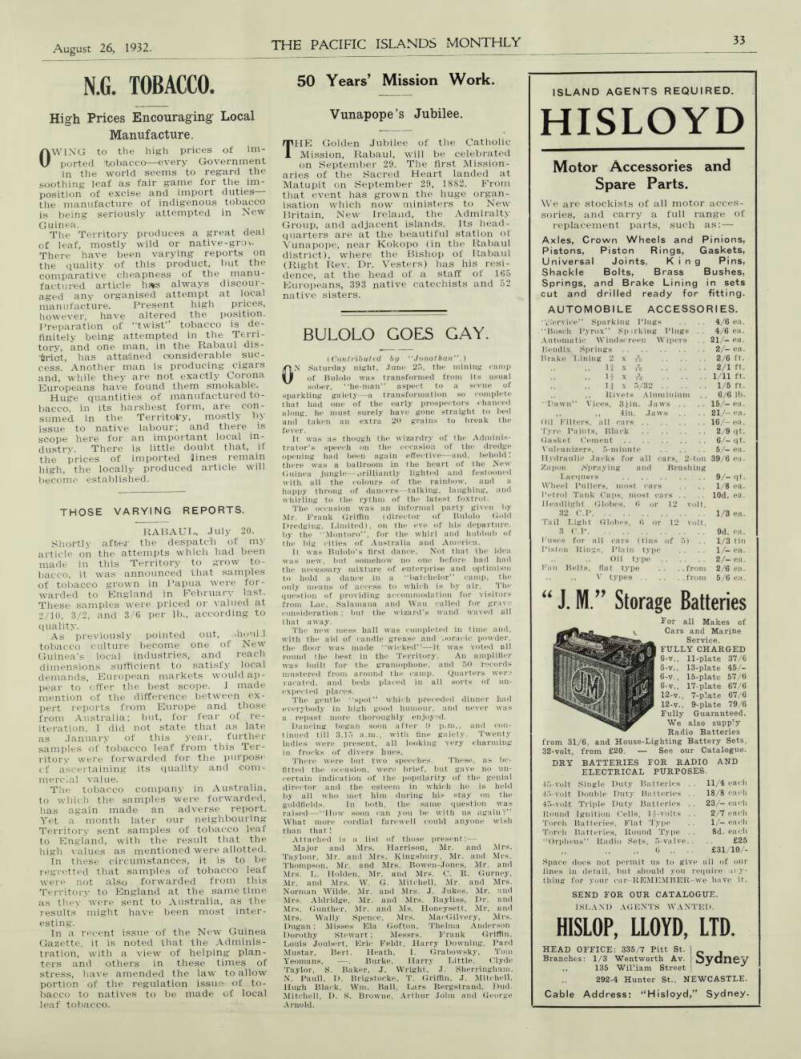
High Prices Encouraging Local Manufacture.
OWING to the high prices of im ported tobacco —every Government in the world seems to regard the soothing leaf as fair game for the im position of excise and import duties — the manufacture of indigenous tobacco is being seriously attempted in New Guinea.
The Territory produces a great deal of leaf, mostly wild or native-grow.
There have been varying reports on the quality of this product, but the comparative cheapness of the manu factured article always discour aged any organised attempt at local manufacture. Present high prices, however, have altered the position.
Preparation of “twist” tobacco is de finitely being attempted in the Terri tory, and one man, in the Rabaul dis tinct, has attained considerable suc cess. Another man is producing cigars and, while they are not exactly Corona Europeans have found them smokable.
Huge quantities of manufactured to bacco, in its harshest form, are con sumed in the Territory, mostly by issue to native labour; and there is scope here for an important local in dustry. There is little doubt that, if the prices of imported lines remain high, the locally produced article will become established.
Those Varying Reports.
Rabaul, July 20.
Shortly after the despatch of my article on the attempts which had been made in this Territory to grow to bacco, it was announced that samples of tobacco grown in Papua were for warded to England in February last.
These samples were priced or valued at 2/10, 3/2, and 3/6 per lb., according to quality.
As previously pointed out, should tobacco culture become one of New Guinea’s local industries, and reach dimensions sufficient to satisfy local demands, European markets would ap pear to offer the best scope. I made mention of the difference between ex pert reports from Europe and those from Australia: but, for fear of re iteration, I did not state that as late as January of this year, further samples of tobacco leaf from this Ter ritory were forwarded for the purpose cf ascertaining its quality and com mercial value.
The tobacco company in Australia, to which the samples were forwarded, has again made an adverse report.
Yet a month later our neighbouring Territory sent samples of tobacco leaf to England, with the result that the high values as mentioned were allotted.
In these circumstances, it is to be regretted that samples of tobacco leaf were not also forwarded from this Territory to England at the same time as they were sent to Australia, as the results might have been most inter esting.
In a recent issue of the New Guinea Gazette, it is noted that the Adminis tration, with a view of helping plan ters and others in these times of stress, have amended the law to allow portion of the regulation issue of to bacco to natives to be made of local leaf tobacco.
Vunapope’s Jubilee.
50 Years’ Mission Work.
THE Golden Jubilee of the Catholic Mission, Rabaul, will be celebrated on September 29. The first Mission aries of the Sacred Heart landed at Matupit on September 29, 1882. From that event has grown the huge organ isation which now ministers to New Britain, New Ireland, the Admiralty Group, and adjacent islands. Its head quarters are at the beautiful station of Vunapope, near Kokopo (in the Rabaul district), where the Bishop of Rabaul (Right Rev. Dr. Vesters) has his resi dence, at the head of a staff of 165 Europeans, 393 native catechists and 52 native sisters.
Bulolo Goes Gay.
(Contributed by “Jonathan” .) ON Saturday night. June 25, the mining camp of Bulolo was transformed from its usual sober, “he-man” aspect to a scene of sparkling gaiety—a transformation so complete that had one of the early prospectors chanced along, he must surely have gone straight to bed and taken an extra 20 grains to break the fever.
It was as though the wizardry of the Adminis trator’s speech on the occasion of the dredge opening had been again effective —and, behold! there was a ballroom in the heart of the New Guinea jungle—brilliantly lighted and festooned with all the colours of the rainbow, and a happy throng of dancers —talking, laughing, and whirling to the rythm of the latest foxtrot.
The occasion was an informal party given by Mr. Frank Griffin (director of Bulolo Gold Dredging, Limited), on the eve of his departure, by the “Montoro”, for the whirl and hubbub of the big cities of Australia and America.
It was Bulolo’s first dance. Not that the idea was new, but somehow no one before had had the necessary mixture of enterprise and optimism to hold a dance in a “batchelor” camp, the only means of access to which is by air. The question of providing accommodation for visitors from Lae, Salaraaua and Wau called for grave consideration; but the wizard’s wand waved all that away.
The new mess hall was completed in time and, with the aid of candle grease and noracic powder, the floor was made “wicked”—it was voted all round the best in the Territory. An amplifier was built for the gramophone, and 50 records mustered from around the camp. Quarters were vacated, and beds placed in all sorts of un expected places.
The gentle “spot” which preceded dinner had everybody in high good humour, and never was a repast more thoroughly enjoyed.
Dancing began soon after 9 p.m., and con tinued till 3.15 a.m., with fine gaiety. Twenty ladies were present, all looking very charming in frocks of divers hues.
There were but two speeches. These, as be fitted the occasion, were brief, but gave no un certain indication of the popularity of the genial director and the esteem in which he is held by all who met him during his stay on the goldfields. In both, the same question was raised—“ How soon can you be with us again?”
What more cordial farewell could anyone wish than that !
Attached is a list of those present:— Major and Mrs. Harrison, Mr. and Mrs.
Taylour, Mr. and Mrs. Kingsbury. Mr. and Mrs.
Thompson, Mr. and Mrs. Bowen-Jones, Mr. and Mrs. L. Holden, Mr. and Mrs. C. R. Gurney, Mr. and Mrs. W. G. Mitchell, Mr. and Mrs.
Norman Wilde, Mr. and Mrs. J. Jukes, Mr. and Mrs. Aldridge, Mr. and Mrs. Bayliss, Dr. and Mrs. Gunther, Mr. and Ms. Honeysett, Mr. and Mrs. Wally Spence, Mrs. MacGilvery, Mrs.
Dugan, Misses Ela Gofton, Thelma Anderson Dorothy Stewart; Messrs. Frank Griffin, Louis Joubert, Eric Feldt, Harry Downing, Pard Mustar, Bert. Heath, I. Grabowsky, Tom Yeomans, — Burke, Harry Little, Clyde Taylor, S. Baker, J. Wright, J. Sherringham, N. Pauli, D. Brigstocke, T. Griffin, J. Mitchell, Hugh Black, Wm. Ball, Lars Bergstrand, Pud.
Mitchell, D. S. Browne, Arthur John and George Arnold.
Advertisements & other items, p. 35 (1 item)
Hisloyd
ISLAND AGENTS REQUIRED.
Motor Accessories and
Spare Parts.
We are stockists of all motor acces sories, and carry a full range of replacement parts, such as: Axles, Crown Wheels and Pinions, Pistons, Piston Rings, Gaskets, Universal Joints. King Pins, Shackle Bolts, Brass Bushes, Springs, and Brake Lining in sets cut and drilled ready for fitting.
AUTOMOBILE ACCESSORIES.
“J. M.” Storage Batteries
For all Makes of Cars and Marine Service.
FULLY CHARGED
6-v., 11-plate 37/6 6-v., 13-plate 45/- 6-v., 15-plate 57/6 6-v., 17-plate 67/6 12-v., 7-p’ate 67/6 12-v., 9-plate 79/6 Fully Guaranteed.
We also supply Radio Batteries from 31/6, and House-Lighting Battery Sets, 32-volt, from £20. See our Catalogue.
DRY BATTERIES FOR RADIO AND
ELECTRICAL PURPOSES,
45-volt Single Duty Batteries . 45-volt Double Duty Batteries . 45-volt Triple Duty Batteries Round Ignition Cells, 14-volts .
Torch Batteries, Flat Type Torch Batteries, Round Type “Orpheus” Radio Sets, 5-valve. 11/4 each 18/8 each 23/- each 2/7 each 1/- each 8d. each £25 £31/10/- Space does not permit us to give all of our lines in detail, but should you require any thing for your car-REMEMBER-we have it.
SEND FOR OUR CATALOGUE.
ISLAND AGENTS WANTED.
HISLOP, LLOYD, LTD.
HEAD OFFICE: 335/7 Pitt St.
Branches; 1/3 Wentworth Av. ; SYDNEY 135 William Street 292-4 Hunter St., NEWCASTLE.
Cable Address: “Hisloyd,” Sydney.
Workers And Non
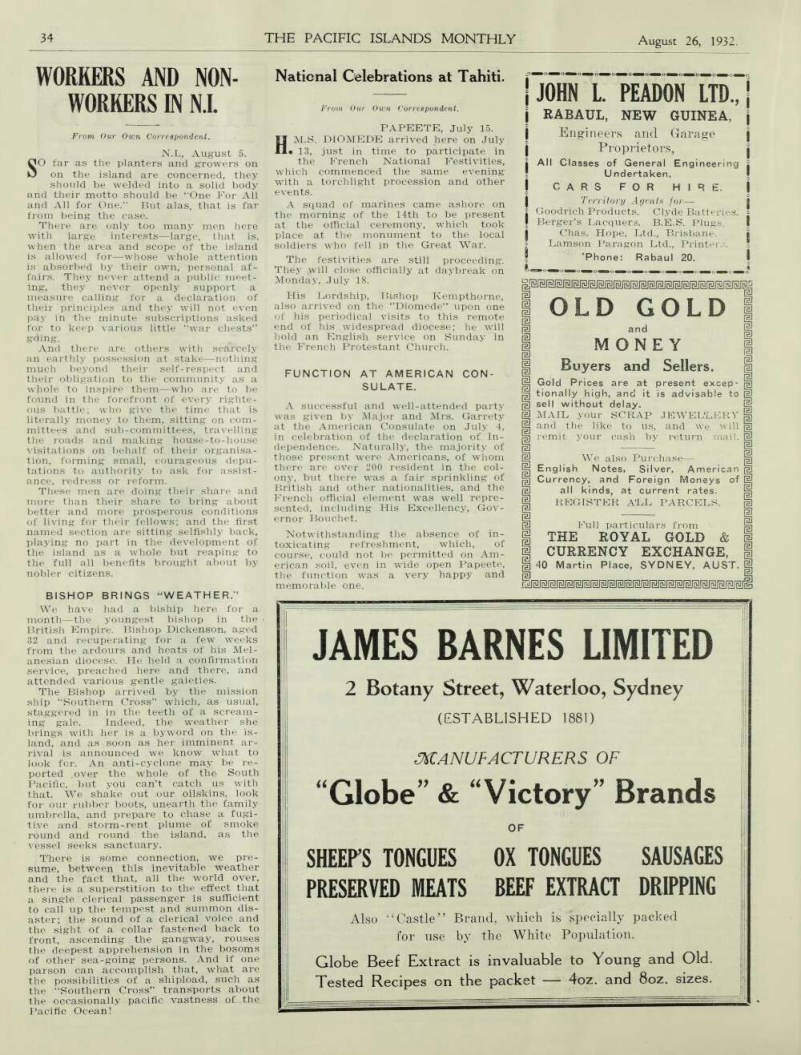
Workers In N.I.
From Our Own Correspondent.
N.I., August 5.
SO far as the planters and growers on on the island are concerned, they should be welded into a solid body and their motto should be ‘‘One For All and All for One.” But alas, that is far from being the case.
There are only too many men here with large interests—large, that is, when the area and scope of the island is allowed for—whose whole attention is absorbed by their own, personal af fairs. They never attend a public meet ing, they never openly support a measure calling for a declaration of their principles and they will not even pay in the minute subscriptions asked for to keep various little “war chests” going.
And there are others with scarcely an earthly possession at stake —nothing much beyond their self-respect and their obligation to the community as a whole to inspire them —who are to be found in the forefront of every righte ous battle; who give the time that is literally money to them, sitting on com mittees and sub-committees, travelling the roads and making house-to-house visitations on behalf of their organisa tion, forming small, courageous depu tations to authority to ask for assist ance, redress or reform.
These men are doing their share and more than their share to bring about better and more prosperous conditions of living for their fellows; and the first named section are sitting selfishly back, playing no part in the development of the island as a whole but reaping to the full all benefits brought about by nobler citizens.
Bishop Brings “Weather.”
We have had a biship here for a month —the youngest bishop in the British Empire. Bishop Dickenson, aged 32 and recuperating for a few weeks from the ardours and heats of his Mel anesian diocese. He held a confirmation service, preached here and there, and attended various gentle gaieties.
The Bishop arrived by the mission ship “Southern Cross” which, as usual, staggered in in the teeth of a scream ing gale. Indeed, the weather she brings with her is a byword on the is land, and as soon as her imminent ar rival is announced we know what to look for. An anti-cyclone may be re ported .over the whole of the South Pacific, but you can’t catch us with that. We shake out our oilskins, look for our rubber boots, unearth the family umbrella, and prepare to chase a fugi tive and storm-rent plume of smoke round and round the island, as the vessel seeks sanctuary.
There is some connection, we pre sume, between this inevitable weather and the fact that, all the world over, there is a superstition to the effect that a single clerical passenger is sufficient to call up the tempest and summon dis aster; the sound of a clerical voice and the sight of a collar fastened back to front, ascending the gangway, rouses the deepest apprehension in the bosoms of other sea-going persons. And if one parson can accomplish that, what are the possibilities of a shipload, such as the “Southern Cross” transports about the occasionally pacific vastness of the Pacific Ocean!
National Celebrations at Tahiti.
From Our Own Correspondent.
Papeete, July 15.
H.M.S. DIOMEDE arrived here on July 13, just in time to participate in the French National Festivities, which commenced the same evening with a torchlight procession and other events.
A squad of marines came ashore on the morning of the 14th to be present at the official ceremony, which took place at the monument to the local soldiers who fell in the Great War.
The festivities are still proceeding.
They will close officially at daybreak on Monday, July 18.
His Lordship, Bishop Kempthorne, also arrived on the “Diomede” upon one of his periodical visits to this remote end of his widespread diocese; he will hold an English service on Sunday in the French Protestant Church,
Function At American Con
Sulate.
A successful and well-attended party was given by Major and Mrs. Garrety at the American Consulate on July 4, in celebration of the declaration of In dependence. Naturally, the majority of those present were Americans, of whom there are over 200 resident in the col ony, but there was a fair sprinkling of British and other nationalities, and the French official element was well repre sented, including His Excellency, Gov ernor Bouchet.
Notwithstanding the absence of in toxicating refreshment, which, of course, could not be permitted on Am erican soil, even in wide open Papeete, the function was a very happy and memorable one.
Advertisements & other items, p. 36 (1 item)
James Barnes Limited
JOHN L PEADON LTD.,
RABAUL, NEW GUINEA.
Engineers and Garage
Proprietors,
All Classes of General Engineering Undertaken,
CARS FOR HIRE.
Territory Agents for — Goodrich Products. Clyde Batteries.
Berger’s Lacquers. B.E.S. Plugs.
Chas. Hope, Ltd., Brisbane.
Lamson Paragon Ltd., Printers.
'Phone: Rabaul 20.
OLD GOLD
MONEY
Buyers and Sellers.
Gold Prices are at present excep tionally high, and it is advisable to sell without delay.
MAIL your SCRAP JEWELLERY
and the like to us, and we will remit your cash by return mail.
We also Purchase — English Notes, Silver, American Currency, and Foreign Moneys of all kinds, at current rates.
REGISTER ALL PARCELS.
Full particulars from
THE ROYAL GOLD &
CURRENCY EXCHANGE,
40 Martin Place, SYDNEY, AUST.
JAMES BARNES LIMITED
2 Botany Street, Waterloo, Sydney
(ESTABLISHED 1881)
MANUFACTURERS OF
“Globe” & “Victory” Brands
OF
SHEEP’S TONGUES OX TONGUES SAUSAGES
PRESERVED MEATS BEEF EXTRACT DRIPPING
Also “Castle’’ Brand, which is specially packed for use by the White Population.
Globe Beef Extract is invaluable to Young and Old.
Tested Recipes on the packet 4oz. and 8oz. sizes.
Rabaul News.
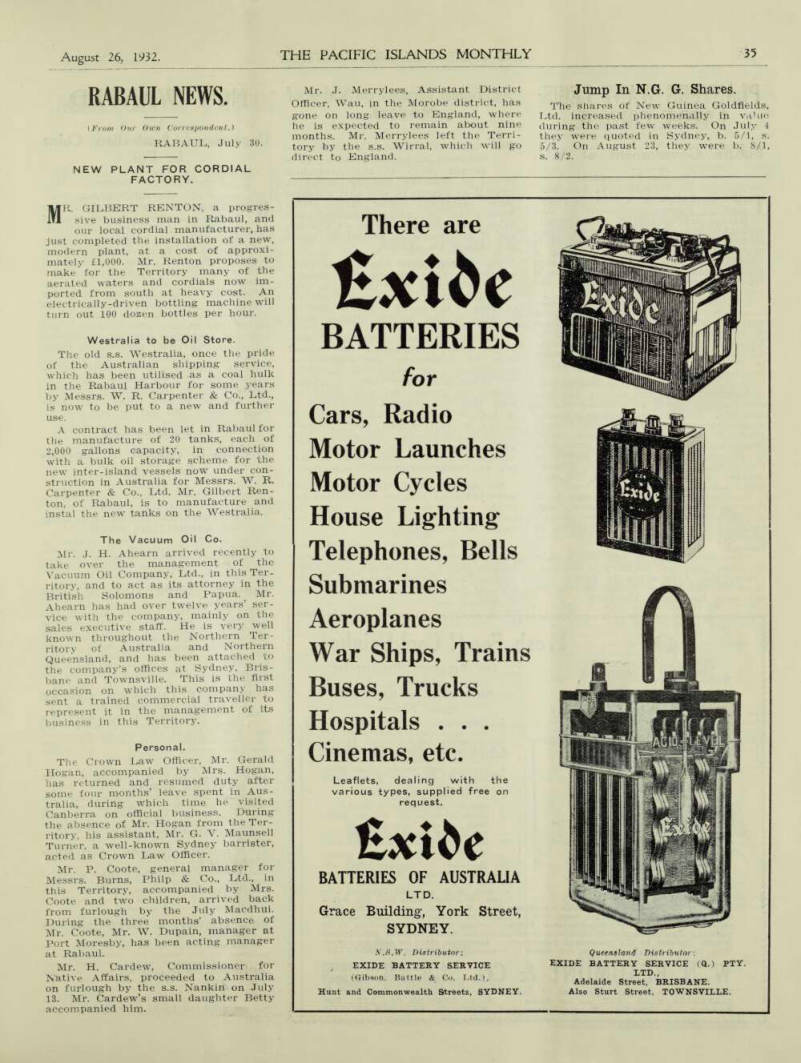
(From Our Own Correspondent.)
Rabaul, July 30.
New Plant For Cordial
Factory.
MR. GILBERT RENTON, a progres sive business man in Rabaul, and our local cordial manufacturer, has just completed the installation of a new, modern plant, at a cost of approxi mately £1,000. Mr. Renton proposes to make for the Territory many of the aerated waters and cordials now im ported from south at heavy cost. An electrically-driven bottling machine will turn out 100 dozen bottles per hour.
Westralia to be Oil Store.
The old s.s. Westralia, once the pride of the Australian shipping service, which has been utilised as a coal hulk in the Rabaul Harbour for some years by Messrs. W. R. Carpenter & Co., Ltd., is now to be put to a new and further use.
A contract has been let in Rabaul for the manufacture of 20 tanks, each of 2,000 gallons capacity, in connection with a bulk oil storage scheme for the new inter-island vessels now under con struction in Australia for Messrs, W. R.
Carpenter & Co., Ltd. Mr. Gilbert Ren ton, of Rabaul, is to manufacture and instal the new tanks on the Westralia.
The Vacuum Oil Co.
Mr. J. H. Ahearn arrived recently to take over the management of the Vacuum Oil Company, Ltd., in this Ter ritory, and to act as its attorney in the British Solomons and Papua. Mr.
Ahearn has had over twelve years’ ser vice with the company, mainly on the sales executive staff. He is very well known throughout the Northern Ter ritory of Australia and Northern Queensland, and has been attached to the company’s offices at Sydney, Bris bane and Townsville. This is the first occasion on which this company has sent a trained commercial traveller to represent it in the management of its business in this Territory.
Personal.
The Crown Law Officer, Mr. Gerald Hogan, accompanied by Mrs. Hogan, has returned and resumed duty after some four months’ leave spent in Aus tralia, during which time he visited Canberra on official business. During the absence of Mr. Hogan from the Ter ritory, his assistant, Mr. G. V. Maunsell Turner, a well-known Sydney barrister, acted as Crown Law Officer, Mr. P. Coote, general manager for Messrs. Burns, Philp & Co., Ltd., in this Territory, accompanied by Mrs.
Coote and two children, arrived back from furlough by the July Macdhui.
During the three months’ absence of Mr. Coote, Mr. W. Dupain, manager at Port Moresby, has been acting manager at Rabaul.
Mr. H. Cardew, Commissioner for Native Affairs, proceeded to Australia on furlough by the s.s. Nankin on July 13. Mr. Cardew’s small daughter Betty accompanied him.
Mr. J. Merrylees, Assistant District Officer, Wau, in the Morobe district, has gone on long leave to England, where he is expected to remain about nine months. Mr. Merrylees left the Terri tory by the s.s. Wirral, which will go direct to England.
Jump In N.G. G. Shares.
The snares of New Guinea Goldfields, Ltd. increased phenomenally in value during - the past few weeks. On July 4 they were quoted in Sydney, b. 5/1, s. 5/3. On August 23, they were b. 8/1, s. 8/2.
Advertisements & other items, p. 37 (1 item)
Batteries
There are
for
Cars, Radio
Motor Launches
Motor Cycles
House Lighting
Telephones, Bells
Submarines
Aeroplanes
War Ships, Trains
Buses, Trucks
Hospitals . . .
Cinemas, etc.
Leaflets, dealing with the various types, supplied free on request.
BATTERIES OF AUSTRALIA
LTD.
Grace Building, York Street,
SYDNEY.
N.S.W. Distributor: Exide Battery Service (Gibson, Battle & Co. Ltd.), Hunt and Commonwealth Srtreets, SYDNEY.
Queensland Distributor ;
EXIDE BATTERY SERVICE (Q.) PTY.
LTD.,
Adelaide Street, BRISBANE.
Also Sturt Street. TOWNSVILLE.
Planters Want Legis
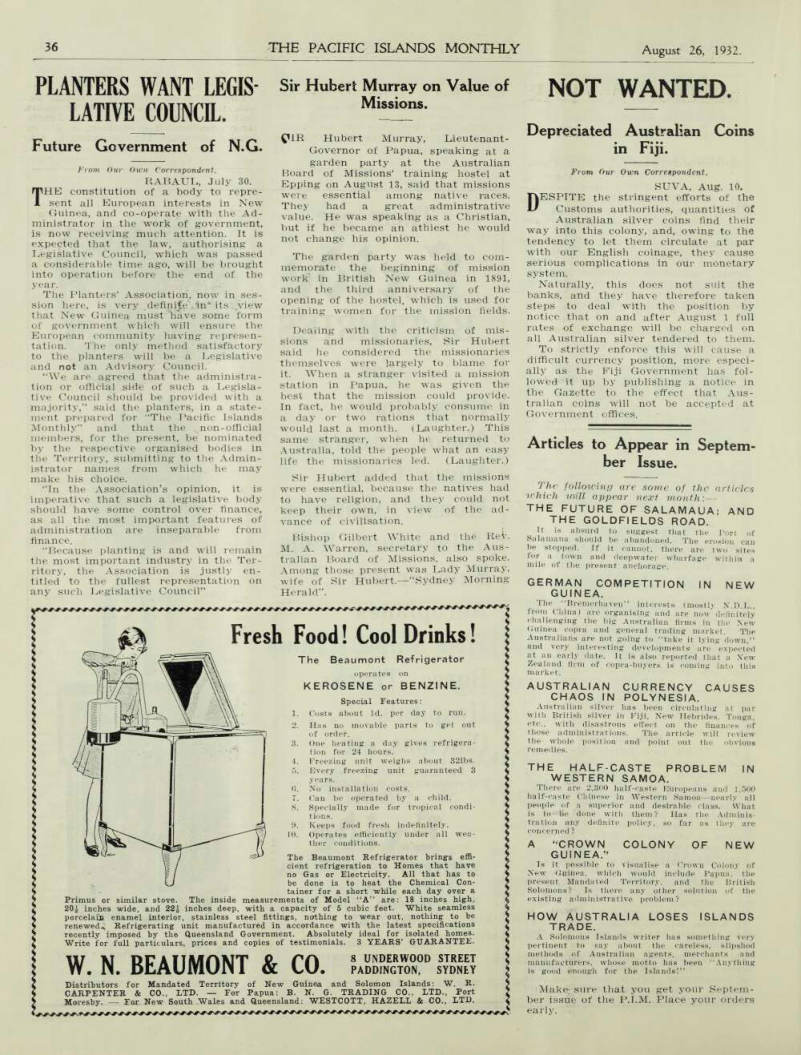
Lative Council.
Future Government of N.G.
From Our Own Correspondent.
Rabaul, July 30.
THE constitution of a body to repre sent all European interests in New Guinea, and co-operate with the Ad ministrator in the work of government, is now receiving much attention. It is expected that the law, authorising a Legislative Council, which was passed a considerable time ago, will be brought into operation before the end of the year.
The Planters’ Association, now in ses sion here, is very definite in its view that New Guinea must have some form of government which will ensure the European community having represen tation. The only method satisfactory to the planters will be a Legislative and not an Advisory Council.
“We are agreed that the administra tion or official side of such a Legisla tive Council should be provided with a majority,” said the planters, in a state ment prepared for “The Pacific Islands Monthly” and that the non-official members, for the present, be nominated by the respective organised bodies in the Territory, submitting to the Admin istrator names from which he may make his choice.
“In the Association’s opinion, it is imperative that such a legislative body should have some control over finance, as all the most important features of administration are inseparable from finance.
“Because planting is and will remain the most important industry in the Ter ritory, the Association is justly en titled to the fullest representation on any such Legislative Council”
Sir Hubert Murray on Value of Missions
Missions.
SIR Hubert Murray, Lieutenant- Governor of Papua, speaking at a garden party at the Australian Board of Missions’ training hostel at Epping on August 13, said that missions were essential among native races.
They had a great administrative value. He was speaking as a Christian, but if he became an athiest he would not change his opinion.
The garden party was held to com memorate the beginning of mission work in British New Guinea in 1891, and the third anniversary of the opening of the hostel, which is used for training- women for the mission fields.
Dealing with the criticism of mis sions and missionaries, Sir Hubert said he considered the missionaries themselves were largely to blame for it. When a stranger visited a mission station in Papua, he was given the best that the mission could provide.
In fact, he would probably consume in a day or two rations that normally would last a month. (Laughter.) This same stranger, when he returned to Australia, told the people what an easy life the missionaries led. (Laughter.) Sir Hubert added that the missions were essential, because the natives had to have religion, and they could not keep their own, in view of the ad vance of civilisation.
Bishop Gilbert White and the Rek M. A. Warren, secretary to the Aus tralian Board of Missions, also spoke.
Among those present was Lady Murray, wife of Sir Hubert. —“Sydney Morning Herald”.
Not Wanted.
Depreciated Australian Coins in Fiji.
From Our Own Correspondent.
Suva, Aug. 10.
DESPITE the stringent efforts of the Customs authorities, quantities of Australian silver coins find their way into this colony, and, owing to the tendency to let them circulate at par with our English coinage, they cause serious complications in our monetary system.
Naturally, this does not suit the banks, and they have therefore taken steps to deal with the position by notice , that on and after August 1 full rates of exchange will be charged on all Australian silver tendered to them.
To strictly enforce this will cause a difficult currency position, more especi ally as the Fiji Government has fol lowed it up by publishing a notice in the Gazette to the effect that Aus tralian coins will not be accepted at Government offices.
Articles to Appear in Septem
ber Issue.
The following are some of the articles which will appear next month :—
The Future Of Salamaua: And
The Goldfields Road.
It is absurd to suggest that the Port of Salamaua should be abandoned. The erosion can be stopped. If it cannot, there are two sites for a town and deepwater wharfage within a mile of the present anchorage.
German Competition In New
Guinea.
The “Bremerhaveu” interests; (mostly N.D.L., from China) are organising and are now definitely challenging the big Australian firms in the New Guinea copra and general trading market. The Australians are not going to “take it lying down,” and very interesting developments are expected at an early date. It is also reported that a New Zealand firm of copra-buyers is coming into this market.
Australian Currency Causes
Chaos In Polynesia.
Australian silver has been circulating at par with British silver in Fiji, New Hebrides. Tonga, etc., with disastrous effect on the finances of those administrations. The article will review the whole position and point out the obvious remedies.
The Half-Caste Problem In
Western Samoa.
There are 2,300 half-caste Europeans and 1,500 half-caste Chinese in Western Samoa —nearly all people of a superior and desirable class. What is to be done with them? Has the Adminis tration any definite policy, so far as they are concerned ?
A “Crown Colony Of New
Guinea.”
Is it possible to visualise a Crown Colony of New Guinea, which would include Papua, the present Mandated Territory, and the British Solomons? Is there any other solution of the existing administrative problem ?
How Australia Loses Islands
Trade.
A Solomons Islands writer has something very pertinent to say about the careless, slipshod methods of Australian agents, merchants and manufacturers, whose motto has been “Anything is good enough for the Islands!”
Make sure that you get your Septem ber issue of the P.I.M. Place your orders early.
Advertisements & other items, p. 38 (1 item)
Fresh Food! Cool Drinks!
The Beaumont Refrigerator operates on
KEROSENE or BENZINE.
Special Features: Costs about 1d. per day to run.
Has no movable parts to get out of order. 3. One heating a day gives refrigera tion for 24 hours. 4. Freezing unit weighs about 32lbs.
Every freezing unit guaranteed 3 years.
No installation costs.
Can be operated by a child.
Specially made for tropical condi tions. 9. Keeps food fresh indefinitely. 10. Operates efficiently under all wea ther conditions.
The Beaumont Refrigerator brings effi cient refrigeration to Homes that have no Gas or Electricity. All that has to be done is to heat the Chemical Con tainer for a short while each day over a Primus or similar stove. The inside measurements of Model “A” are: 18 inches high, 20½ inches wide, and 22½ inches deep, with a capacity of 5 cubic feet. White seamless porcelain enamel interior, stainless steel fittings, northing to wear out, nothing to be renewed. Refrigerating unit manufactured in accordance with the latest specifications recently imposed by the Queensland Government. Absolutely ideal for isolated homes.
Write for full particulars, prices and copies of testimonials, 3 YEARS’ GUARANTEE.
W. N. BEAUMONT & CO. PADDINGTON 00 SYDNEY Distributors for Mandated Territory of New Guinea and Solomon Islands: W. R.
CARPENTER & CO.. LTD. For Papua: B. N. G. TRADING CO., LTD., Port Moresby. - For New South Wales and Queensland: WESTCOTT, HAZELL & CO., LTD.
Million A Year.
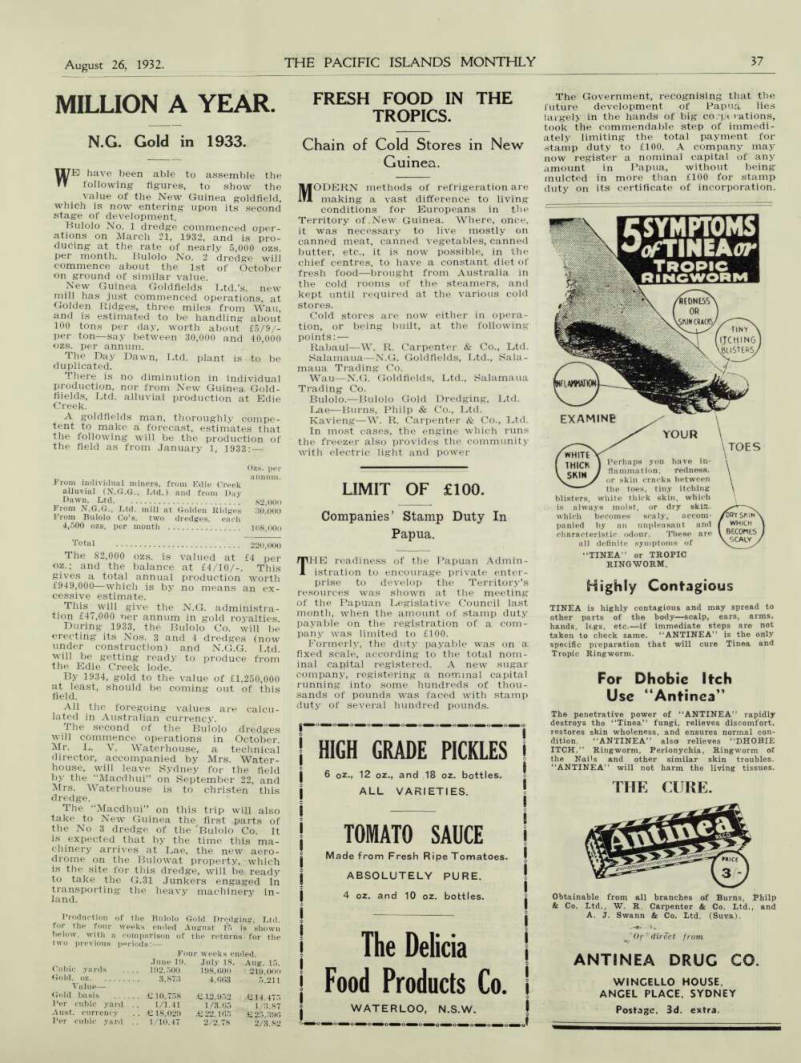
N.G. Gold in 1933.
WE have been able to assemble the following figures, to show the value of the New Guinea goldfield, which is now entering upon its second stage of development.
Bulolo No. 1 dredge commenced oper ations on March 21, 1932, and is pro ducing at the rate of nearly 5,000 ozs. per month. Bulolo No. 2 dredge will commence about the 1st of October on ground of similar value.
New Guinea Goldfields Ltd.’s, new mill has just commenced operations, at Golden Ridges, three miles from Wau, and is estimated to be handling about 100 tons per day, worth about £5/9/per ton—say between 30,000 and 40,000 ozs. per annum.
The Day Dawn, Ltd. plant is to be duplicated.
There is no diminution in individual production, nor from New Guinea Gold fields, Ltd. alluvial production at Edie Creek.
A goldfields man, thoroughly compe tent to make a forecast, estimates that the following will be the production of the field as from January 1, 1933: Ozs. per annum.
From individual miners, from Eidie Creek alluvial (N.G.G., Ltd.) and from Day Dawn, Ltd 82,000 From N.G.G., Ltd. mill at Golden Ridges 30,000 From Bulolo Co’s, two dredges, each 4,500 ozs. per month 108,000 Total 220,000 The 82,000 ozs. is valued at £4 per oz.; and the balance at £4/10/-. This gives a total annual production worth £949,000 —which is by no means an ex cessive estimate.
This will give the N.G. administra tion £47,000 ner annum in gold royalties During 1933, the Bulolo Co. will be erecting its Nos. 3 and 4 dredges (now under construction) and N.G.G. Ltd. will be getting ready to produce from the Edie Creek lode.
By 1934, gold to the value of £1,250,000 at least, should be coming out of this field.
All the foregoing values are calcu lated in Australian currency.
The second of the Bulolo dredges will commence operations in October.
Mr. L. V. Waterhouse, a technical director, accompanied by Mrs. Water house, will leave Sydney for the field by the “Macdhui” on September 22, and Mrs. Waterhouse is to christen this dredge.
The “Macdhui” on this trip will also take to New Guinea the first parts of the No 3 dredge of the 'Bulolo Co. It is expected that by the time this ma chinery arrives at Lae, the new aero drome on the Bulowat property, which is the site for this dredge, will be ready to take the G.31 Junkers engaged in transporting the heavy machinery in land.
Production of the Bulolo Gold Dredging, Ltd. for the four weeks ended August 15 is shown below, with a comparison of the returns for the two previous periods:— Four weeks ended.
June 19. July 18. Aug. 15.
Pubic yards 192,500 198,000 219,000 Gold. oz 3,873 4,003 5,211 Value— Gold basis £10,758 £12,952 £14,475 Per cubic yard . . 1/1.41 1/3.05 1/3.87 Aust. currency .. £18,029 £ 22,105 £25,390 Per cubic yard .. 1/10.47 2/2.78 2/3.82
Tropics.
Fresh Food In The
Chain of Cold Stores in New Guinea.
MODERN methods of refrigeration are making a vast difference to living conditions for Europeans in the Territory of New Guinea. Where, once, it was necessary to live mostly on canned meat, canned vegetables, canned butter, etc., it is now possible, in the chief centres, to have a constant diet of fresh food —brought from Australia in the cold rooms of the steamers, and kept until required at the various cold stores.
Cold stores are now either in opera tion, or being built, at the following points:— Rabaul —W. R. Carpenter & Co., Ltd.
Salamaua —N.G. Goldfields, Ltd., Sala maua Trading Co.
Wau —N.G. Goldfields, Ltd., Salamaua Trading Co.
Bulolo. —Bulolo Gold Dredging, Ltd.
Lae —Burns, Philp & Co., Ltd.
Kavieng—W. R. Carpenter & Co., Ltd.
In most cases, the engine which runs the freezer also provides the community with electric light and power
Papua.
Limit Of £100.
Companies’ Stamp Duty In Papua.
THE readiness of the Papuan Admin istration to encourage private enter prise to develop the Territory’s resources was shown at the meeting of the Papuan Legislative Council last month, when the amount of stamp duty payable on the registration of a com pany was limited to £100.
Formerly, the duty payable was on a fixed scale, according to the total nom inal capital registered. A new sugar company, registering a nominal capital running into some hundreds of thou sands of pounds was faced with stamp duty of several hundred pounds.
The Government, recognising that the future development of Papua lies largely in the hands of big corporations, took the commendable step of immedi ately limiting the total payment for stamp duty to £100. A company may now register a nominal capital of any amount in Papua, without being mulcted in more than £100 for stamp duty on its certificate of incorporation.
Advertisements & other items, p. 39 (1 item)
The Delicia
5 SYMPTOMS
of TINEA or
TROPIC
RINGWORM
Perhaps you have in flammation, redness, or skin cracks between the toes, tiny itching blisters, white thick skin, which is always moist, or dry skin, which becomes scaly, accom panied by an unpleasant and characteristic odour. These are all definite symptoms of
“TINEA” or TROPIC
RINGWORM.
WHICH
BECOMES
SCALY
Highly Contagious
TINEA is highly contagious and may spread to other parts of the body—scalp, ears, arms, hands, legs, etc. —if immediate steps are not taken to check same. “ANTINEA” is the only specific preparation that will cure Tinea and Tropic Ringworm.
For Dhobie Itch
Use “Antinca”
The penetrative power of “ANTINEA” rapidly destroys the “Tinea” fungi, relieves discomfort, restores skin wholeness, and ensures normal condition, “ANTINEA” alsoi relieves “DHOBIE ITCH,” Ringworm, Perionychia, Ringworm of the Nails and other similar skin troubles.
“ANTINEA” will not harm the living tissues.
THE CUKE.
Obtainable from all branches of Burns, Philp & Co. Ltd., W. R. Carpenter & Co. Ltd., and A. J. Swann & Co. Ltd. (Suva).
Or direct from
ANTINEA DRUG CO.
WINCELLO HOUSE.
ANGEL PLACE. SYDNEY
Postage. 3d. extra.
HIGH GRADE PICKLES
6 oz., 12 oz., and 18 oz. bottles.
ALL VARIETIES.
TOMATO SAUCE
Made from Fresh Ripe Tomatoes.
ABSOLUTELY PURE.
4 oz. and 10 oz. bottles.
The Delicia
Food Products Co.
WATERLOO, N.S.W.
Islands.
Shipping Difficulties in Cook Islands.
From Our Own Correspondent.
Rarotonga, July 17.
HOPE has been abandoned of the fruit steamer from Auckland (S.S. "Kanna”) visiting the Cook Group this year for oranges and other fruit.
Outcries against alteration in island shipping
services have appeared so often in the pages of the P.I.M. that it would be needless repeti tion to mention anything of the consequences to the islands of the Lower Group (namely, Aitu taki, Atiu, Mauke and Mangaia) of the disap pearance of the Auckland fruit-boat service.
The paltry prices offering for oranges for ship ment by the monthly mail steamers that call at Rarotonga are proof enough that the market is saturated.
Due to the enterprise of one or two of the larger local firms, two shipments of fruit from both Aitutaki and Mangaia went forward to Auckland direct, during the months of June and July, despite the glut.
The Union Company’s steamer “Waikawa” en route from San Francisco, was diverted to Man gaia and Aitutaki in June, and lifted some 8,000 cases of fruit, mostly oranges. (Similarly, the same Company’s motorship “Hauraki” was chartered to call at these two island's early in Juily. Approximately 8,000 cases were taken aboard for discharge at Auck land.
So far as fruit export is concerned, the in tercepting of route steamers is satisfactory but the difficulty lies in the four islands of Aitutaki, Atiu, Mauke and Mangaia obtaining goods—including shooks —direct from New Zea land and not via Rarotonga.
Of the two schooners operating in the Cook Group both are privately-owned —one by the Cook Islands Trading Company and the other by the old-established firm of Messrs. A. B. Donald, Ltd.
Other firms have branches at those islands and in the absence of the “Kanna” find them selves dependent upon rival firms for inter-island shipping space.
politan Sport.
Suva’s Varied and Cosmo politan Sport.
From Our Own Correspondent.
SUVA, July 7.
AS the clock strikes 1 o’clock on Saturday afternoon, the population of Suva heaves a sigh of relief, and looks forward to a little serious sport over the week-end as a compensation for the toil of the week.
The amenities of life in Suva are such that almost every branch of sport receives its due measure of attention. The common meeting ground is Albert Park, situated within a mile
of the Post Office, which presents to the visitor a wonderful expanse of green level turf.
During the cool season, the park is thronged with devotees of football, and there are no less than three football grounds side by side.
On one of these, European teams contend, whilst on the other two are to be seen the juniors and the Fijian teams. Rugby is the favourite, and the game is fast and strenuous. Our visitors often express amazement at the won derful kicking of the Fijian, who always plays barefooted.
Another portion of Albert Park are the grounds of the Suva Tennis Club, which has six excellent tennis courts. In addition, there are two hockey grounds, and particular keenness is shown by the Suva Ladies’ Hockey Association.
In summer, Albert Park is allotted to the Suva Cricket Club, and there is ample space for three cricket grounds. Albert Park, in fact, owes its origin to some kindly citizen who gave originally rough fields to the Suva Cricket Club, and to them belongs in large measure the credit for the wonderful playing ground, which Suva now possesses. It was on Albert Park that the Southern Cross landed on her memorable flight, in 1929, from San Francisco to Sydney.
In addition to the activities under the aus pices of the Suva Municipal Council on Albert Park, Suva boasts a golf course, which is de finitely strenuous. She has three bowling greens, on which, each year, the Pacific Bowling Carnival is held.
Then there are rifle clubs for both men and women, the latter being particularly keen, and turning out to practice with their miniature rifles regularly every Sunday morning. A little band of enthusiasts run a clay pigeon club, whose guiding spirit is Mr. P. J. Turner, who got 26 successive first barrel kills a few weeks ago.
Another small band of enthusiasts meet and play polo every Sunday, when the tide permits, on a stretch of beach towards Suva Point.
Usually, the ships of the Royal Navy, which visit Suva, are able to put up a team, and the Suva Polo Club looks forward to an annual match. In case this should give the idea of wealthy enthusiasts with their strings of polo ponies, it should be added that each particular member usually has only one pony, of the ‘con verted cab-horse variety” !
In other parts of Suva, on Saturday afternoons, will be seen Indians playing Soccer, or Chinese playing tennis —in fact, sport in Suva is varied and cosmopolitan.
France’S National
Holiday In New
Hebrides.
From Our Own Correspondent.
Port Vila, July 30.
France’s national day was fittingly observed in the condominium.
Vila.
On the afternoon of July 13 horse races were held at the Mele racecourse, attended by the entire population of Vila at its gayest. During the evening fireworks displays were held at the French Residence and also on board the St.
Andre, a French inter-island steamer anchored in the bay.
During the morning of the 14th (France’s Day) there was a 20 kilometre bicycle race and at 11 a.m. a brilliant reception at the French Residency. After lunch games and different sports were played at the Rossi Sports Ground, and at night the “Grand Ball” was held.
Api.
Owing to the depression caused by the re cent hurricane, the planters on Api did not celebrate the 14th as in past years. The Resi dence of the French Delegue is still in a state of reconstruction.
Santo.
A reception was held at the French Resi dence at Santo and for three days the French and English planters celebrated by holding gay parties, dances, etc., at various plantations at Santo, Aose and Malo.
Malekula.
As the French Delegue was ill, no reception was held at Port Sandwich, but at Norsup the Directeur of the Societe Coloniere des Neuvelles Hebrides invited English and French planters from surrounding plantations to celebrate with dining and dancing at his home, where a very enjoyable evening was spent.
Advertisements & other items, p. 40 (1 item)
Oil Engines
Skandia Marine and Stationary Instantaneous Starting
CRUDE
LATEST TYPE.
Delivery from Stock.
PARTICULARS—
NELSON & ROBERTSON,
SYDNEY.
1870. 1932
QUALITY STANDS
THE TEST OF TIME.
S.M.P.
“WAR
MEDAL”
BRAND
Specially packed
for Island Trade
CORNED BOILED, ROAST, BEEF OR MUTTON.
Packed in 12oz.. 1lb., 1½lb., 2lb., 3lb.. 4lb„ 5lb.. 6lb. tins.
SAUSAGES
BEEF
Tins fitted with Patent Key Opener.
S.M.P. MILESTONE BRAND.
Special Offer Assorted Fancy Meats:
MINCE COLLOPS
SHEEP TROTTERS
HARICOT MUTTON
STEAK & KIDNEY
MINER’S LUNCH
MINCE MEAT
BRAWN
IRISH STEW
CORNED OX
CHEEK
Case contains Four Dozen Tins in all.
Price, per case, 36/- f.o.b. Sydney.
F. J. WALKER LTD., 33 Macquarie Place, Sydney.
Sole Selling Agents for; THE SYDNEY MEAT PRESERVING CO. LTD.
Thursday Is. Notes.
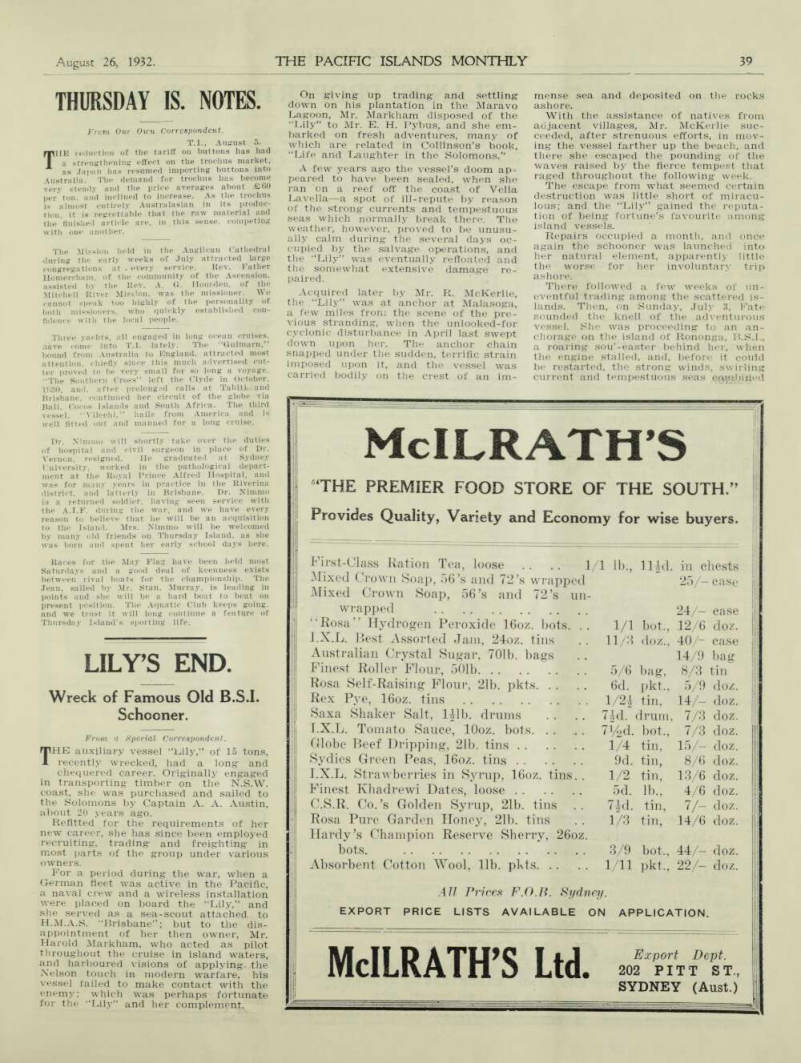
From Out Own Correspondent.
T. I., August 5.
THE reduction of the tariff on buttons has had a strengthening effect on the trochus market, as Japan has resumed importing buttons into Australia. The demand for trochus has become very steady and the price averages about £60 per ton. and inclined to increase. As the trochus is almost entirely Australasian in its produc tion, it is regrettable that the raw material and the finished article are, in this sense, competing with one another.
The Mission held in the Anglican Cathedral during the early weeks of July attracted large congregations at every service. Rev. Father Homersham, of the community of the Ascension, assisted by the Rev. A. G. Housden, of the Mitchell River Mission, was the missioner. We cannot speak too highly of the personality of both missioners, who quickly established con fidence with the local people.
Three vachts, all engaged in long ocean cruises, have come into T.I. lately. The "Gulmarn,” bound from Australia to England, attracted most attention, chiefly since this much advertised cut ter proved to be very small for so long a voyage.
"The Southern Cross” left the Clyde in October, 1930, and, after prolonged calls at Tahiti and Brisbane, continued her circuit of the globe via Bali, Cocos Islands and South Africa. The third vessel, "Vileehi,” hails from America and is well fitted out and manned for a long cruise.
Dr. Nimmo will shortly take over the duties of hospital and civil surgeon in place of Dr.
Vernon, resigned. He graduated at Sydney University, worked in the pathological depart ment at the Royal Prince Alfred Hospital, and was for many years in practice in the Riverina district, and latterly in Brisbane. Dr. Nimmo is a returned soldier, having seen service with the A.I.F. during the war, and we have every reason to believe that he will be an acquisition to the Island. Mrs. Nimmo will be welcomed by many old friends on Thursday Island, as she was born and spent her early school days here.
Races for the May Flag have been held most Saturdays and a good deal of keenness exists between rival boats for the championship. The Jean, sailed by Mr. Stan. Murray, is leading in points and she will be a hard boat to beat on present position. The Aquatic Club keeps going, and we trust it will long continue a feature of Thursday Island's sporting life.
Lily’S End.
Wreck of Famous Old B.S.I.
Schooner.
From n Special Correspondent.
THE auxiliary vessel “Lily,” of 15 tons, recently wrecked, had a long and chequered career. Originally engaged in transporting timber on the N.S.W. coast, she was purchased and sailed to the Solomons by Captain A. A. Austin, about 20 years ago.
Refitted for the requirements of her new career, she has since been employed recruiting, trading and freighting in most parts of the group under various owners.
For a period during the war, when a German fleet was active in the Pacific, a naval crew and a wireless installation were placed on board the “Lily," and she served as a sea-scout attached to H.M.A.S. “Brisbane”; but to the dis appointment of her then owner, Mr.
Harold Markham, who acted as pilot throughout the cruise in island waters, and harboured visions of applying the Nelson touch in modern warfare, his vessel failed to make contact with the enemy: which was perhaps fortunate for the “Lily” and her complement.
On giving up trading and settling down on his plantation in the Maravo Lagoon, Mr. Markham disposed of the “Lily" to Mr. E. H. Pybus, and she em barked on fresh adventures, many of which are related in Collinson’s book, “Life and Laughter in the Solomons."
A few years ago the vessel’s doom ap peared to have been sealed, when she ran on a reef off the coast of Vella Lavella —a spot of ill-repute by reason of the strong currents and tempestuous seas which normally break there. The weather, however, proved to be unusu ally calm during the several days oc cupied by the salvage operations, and the “Lily” was eventually refloated and the somewhat extensive damage re paired.
Acquired later by Mr. R. McKerlie, the “Lily” was at anchor at Malasoga, a few miles from the scene of the pre vious stranding, when the unlooked-for cyclonic disturbance in April last swept down upon her. The anchor chain snapped under the sudden, terrific strain imposed upon it, and the vessel was carried bodily on the crest of an im
mense sea and deposited on the rocks ashore.
With the assistance of natives from adjacent villages, Mr. McKerlie suc ceeded, after strenuous efforts, in mov ing the vessel farther up the beach, and there she escaped the pounding of the waves raised by the fierce tempest that raged throughout the following week.
The escape from what seemed certain destruction was little short of miracu lous; and the “Lily” gained the reputa tion of being fortune’s favourite among island vessels.
Repairs occupied a month, and once again the schooner was launched into her natural element, apparently little the worse for her involuntary trip ashore.
There followed a few weeks of un eventful trading among the scattered is lands. Then, on Sunday, July 3, Fate sounded the knell of the adventurous vessel. She was proceeding to an an chorage on the island of Rononga, B.S.I., a roaring sou’-easter behind her, when the engine stalled, and, before it couid be restarted, the strong winds, swirling current and tempestuous seas combined
to sweep the helpless vessel to destruc tion on the rock-bound shore.
Buffeted by wind and sea, nothing could be done to save the staunch old craft, and there she now lies, shattered beyond repair. The sou’-easter gale raged on, and the sea added one more victim to its ever-expanding list of casualties.
Fortunately, although Mr. McKerlie and his crew suffered severely in the crash when the vessel struck the rocks, and in the heavy pounding that fol lowed, they succeeded in reaching the shore in safety.
His friends extend their sympathy to Mr. McKerlie, who took justifiable pride in his ship, and expended considerable sums in refits and alterations to struc ture and rig, which greatly improved her appearance and added to her use fulness.
Advertisements & other items, p. 41 (1 item)
Mcilrath’S
"THE PREMIER FOOD STORE OF THE SOUTH"
Provides Quality, Variety and Economy for wise buyers.
First-Class Ration Tea, loose .. .. 1/1 lb., 11½d. in chests Mixed Crown Soap, 56’s and 72’s wrapped 25/- case Mixed Crown Soap, 56’s and 72’s unwrapped 24/- case “Rosa” Hydrogen Peroxide 16oz. hots. .. 1/1 bot., 12/6 doz.
I.X.L. Best Assorted Jam, 240 z. tins . . 11/8 doz., 40/- case Australian Crystal Sugar, 701 b. bags .. 14/9 bag Finest Roller Flour, 501 b 5/6 bag, 8/3 tin Rosa Self-Raising Flour, 21b. pkts 6d. pkt., 5/9 doz.
Rex Pye, 16oz. tins 1/2½ tin, 14/- doz.
Saxa Shaker Salt, 1½lb. drums . . .. 74d. drum, 7/3 doz.
I.X.L. Tomato Sauce, 10oz. hots 7½d. bot., 7/3 doz.
Globe Beef Dripping, 2lb. tins 1/4 tin, 15/- doz.
Sydies Green Peas, 16oz. tins 9d. tin, 8/6 doz.
I.X.L. Strawberries in Syrup, 16oz. tins. . 1/2 tin, 13/6 doz.
Finest Khadrewi Dates, loose 5d. lb., 4/6 doz.
C.S.R. Co.’s Golden Syrup, 2lb. tins .. 7½d. tin, 7/- doz.
Rosa Pure Garden Honey, 2lb. tins . . 1/3 tin, 14/6 doz.
Hardy’s Champion Reserve Sherry, 26oz. bots. 3/9 bot., 44/- doz.
Absorbent Cotton Wool, 1lb. pkts 1/11 pkt., 22/- doz.
All Prices F.O.B. Sydney.
EXPORT PRICE LISTS AVAILABLE ON APPLICATION.
McILRATH’S Ltd.
Export Dept.
202 PITT ST.,
SYDNEY (Aust.)
Hon. A. V. Johnston Dead.
Samoa Loses Popular Citizen.
From Our Own Correspondent APIA, July 10.
ONE of the most respected and popu lar citizens of Samoa, the Hon. A.
W. Johnston, first elected member of the Legislative Council of the Man dated Territory, died on June 15, fol lowing an attack of double pneumonia.
Mr. Johnston had been branch mana ger for Burns, Philp (S.S.) Co., Ltd., in the Saluafata district since 1920. He was born in Edinburgh, Scotland, on August 20, 1869, and entered the British Army at an early date, seeing active service in different parts of the world.
In 1902, together with his close friend, Sir George Richardson, he was sent to New Zealand as military instructor and he proceeded to Samoa in 1915 with the first reinforcement contingent. He re mained in the force till 1920, when he received his discharge.
He was elected M.L.C., first in 1926 and re-elected in 1929 when he received the largest number of votes and became senior elected member. He took an active part in the deliberations and discussions at the council meetings, besides which he frequently intervened on behalf of his constituents with the Administration.
Owing to Mr. Johnston’s long asso ciation with the Imperial Military Forces on active service, he was granted a military funeral, a squad of the con stabulary firing three rounds over the grave, after which a bugler sounded the “Last Post.”
Islands’ Properties For Sale.
Any property (plantation, store, manufacturing business, hotel, etc.) situated in any of the Pacific Islands may be advertised for sale in this section of “The Pacific Islands Monthly” at a specially low rate—namely, 15/- per insertion. Advertisers, when forwarding particulars, should give all details of the property, for the information of possible buyers; but —unless otherwise instructed —we shall advertise only essential information, and not indicate the location of the property.
Further details will be sent to genuine inquirers direct from this office; and, if such inquirers are interested, they will be referred to the advertiser.
Plantation For Sale.
Fiji Government Crown
LEASE, 99 years; 985 acres, ex road; 80 years to run, with a further renewal for 99 years. Normal ground rent, £49/5/- per annum, reduced to £15 per annum, for a period of two years, on account of hurricane damage, and low price for produce— Copra: 60/80 acres of young nuts bearing and commencing to bear; 28/30 tons copra per annum, increasing to 40 or 50 tons.
New homestead bungalow, concrete founda tions, with all woodwork securely bolted down to concrete with 12in. bolts, ½-in. thick. All plates tarred, and joints painted to prevent insect attacks, etc. Has withstood three hurricanes.
Nicely laid-out grounds, garden, lawn, fruit trees, kitchen and food garden. Fine panoramic view of sea, river and mountains.
Homestead near Government road. Very ac cessible, also by river and sea.
Copra equipment and shed, small punt, saddle horse, milking cows, 100 wild and semi-wild cattle, poultry, etc.; 28/30 tons copra per annum.
Fruit consists of 80/100 Tahitian seedling orange trees, several lemons, dwarf and semi dwarf mangoes, three kinds very large fruiting variety Tamarind trees, shaddocks. 800/1000 cayenne pineapples (Queen variety), 150/200 Ripleys and others, 200 bananas, four kinds breadfruit trees, and various other native fruits.
Tapioca, taro, kawais, sweet potatoes, etc Any amount of root foods in the bush; yams, etc., unlimited supply. Very well supplied with fruit—in fact, self-supporting.
Furniture, working tools, implements, etc., etc.; carpentering tools, guns, etc., etc. Excel lent shooting and fishing.
Permanent water supply from various creeks, springs and river. Fertile river flats, alluvial loamy soil, running almost whole length of property. Undulating hilly land, suitable for pineapples and sweet potatoes.
Shipping facilities: Various local cutters run ning at irregular intervals.
A going concern which will be hard to equal and which will stand strictest investigation.
Special reasons for selling.
Price: £2,000. Terms.
For further information, write to Plantation No. 4. Pacific Islands Monthly. Union House 247 George Street, Sydney.
Small Plantation For Sale.
In PAPUA, 500 acres, with a beach frontage; 114 acres planted with coco nuts, of which 84 acres are in bearing.
Ample room for extension or experi mental crops. Native foods and table vegetables grow well, and are in good demand. Land and rainfall suitable and climate healthy. Labour plentiful.
Shooting and fishing.
Suitable for resident owner. House and copra drier on estate. Price, £1,100 Cash. Terms to an approved applicant.
Godfrey Darling,
374 Little Collins St., MELBOURNE.
Advertisements & other items, p. 42 (2 items)
Rabaul Carrying Co.,
Coconut plantation for Sale in Group contiguous to Australia. Rain fall, over 100 inches annually.
Over 2,000 acres, mostly first-class land, 365 acres under coconuts in full bearing. Estimated yield is from 80 to 95 tons of copra annually.
Some trade in native-grown copra.
Buildings: Small bouse, suitable for bachelor.
Livestock: 300 head of cattle.
Labour; There is a good recruiting-ground near. Local natives live near the property, and there are bush natives inland.
Markets; Produce may he sold for cash aboard B.P. inter-island steamer; or shipped direct to Sydney; or direct to European or American port per Messageries steamer (freight to Marseilles is 420 francs); or sold to local trading firms.
There is a small store trade, which might be increased?
The B.P. steamer calls every six wrecks, and carries a large stock of general stores. Gen eral stores situated at centre, 24 miles away.
Price, walk in, walk out, £2,500. Terms may be arranged.
For further details, refer to Plantation No. 3, c/o. “Pacific Islands Monthly.”
POSITIONS WANTED,
Young lady, copying typist, ledgerkeeper, gen eral office experience, desires “Island Position.”
Willing assist store, or companion-help, planta tion. Reply “ADVERTISER,” c/o. Miss Nut tall, “Wakeley,” Gloucester Road, Hurstville,
N.S.W.
Young married man, no children, life experi ence in sheep and cattle farming, thorough knowledge of bush country, seeks position as manager on any island in Pacific. Write to W.M.A., care Burns, Philp (S.S.) Co., Norfolk Island.
RABAUL CARRYING CO.,
GENERAL FORWARDING
AGENTS, CUSTOMS AGENTS,
INSURANCE STORAGE.
Transport Work and Forwarding Work of Every Description Undertaken.
Modern Transport Equipment.
Telephones: Radio Address: Rabaul 176 and 135. “Rabcarco.”
B. M. GRANTER, Manager.
C. G. Piggott
Vitality and Health are the
Main Factors in Every-day Life.
Put vourself in the hands of Specialists who have made an intelligent ftudy of your requirements; it is vital to your health We are known everywhere as the Suppliers of the Right Goods and which put the VITAL into VITALITY. Thirty-five years is our record of supplying fresh Fruit, Vegetables and Produce to the leading Houses throughout the world.
GET FULLY ACQUAINTED WITH US.
Tel.- M A 4799; FX 4350 Private.. Cable Address: Pigs. Sydney. Code: Bentleys.
C. G. PIGGOTT
WHOLESALE FRUIT AND PRODUCE MERCHANTS
DIRECT IMPORTERS AND EXPORTERS SYDNEY.
Office: Bulk Stores and Packing House: Fruit Exchange, Sydney.
Sales Dept.: Fruit Exchange and City Markets, Sydney. Bank of N.S.W. Bankers.
Rubber Growers
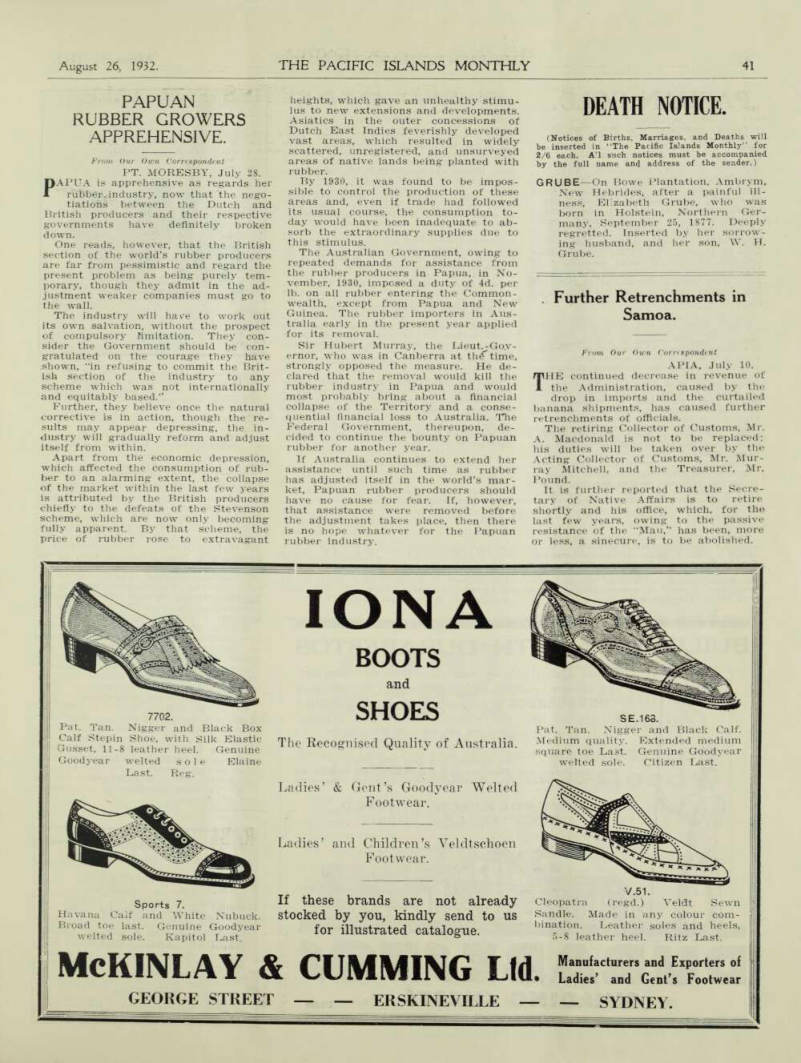
Papuan
Apprehensive.
From Our Own Correspondent
Pt. Moresby, July 28.
PAPUA is apprehensive as regards her rubber industry, now that the nego tiations between the Dutch and British producers and their respective governments have definitely broken down.
One reads, however, that the British section of the world’s rubber producers are far from pessimistic and regard the present problem as being purely tem porary, though they admit in the ad justment weaker companies must go to the wall.
The industry will have to work out its own salvation, without the prospect of compulsory limitation. They con sider the Government should be con gratulated on the courage they have shown, “in refusing to commit the Brit ish section of the industry to any scheme which was not internationally and equitably based.”
Further, they believe once the natural corrective is in action, though the re sults may appear depressing, the in dustry will gradually reform and adjust itself from within.
Apart from the economic depression, which affected the consumption of rub ber to an alarming extent, the collapse of the market within the last few years is attributed by the British producers chiefly to the defeats of the Stevenson scheme, which are now only becoming fully apparent. By that scheme, the price of rubber rose to extravagant
heights, which gave an unhealthy stimu lus to new extensions and developments.
Asiatics in the outer concessions of Dutch East Indies feverishly developed vast areas, which resulted in widely scattered, unregistered, and unsurveyed areas of native lands being planted with rubber.
By 1930, it was found to be impos sible to control the production of these areas and, even if trade had followed its usual course, the consumption to day would have been inadequate to ab sorb the extraordinary supplies due to this stimulus.
The Australian Government, owing to repeated demands for assistance from the rubber producers in Papua, in No vember, 1930, imposed a duty of 4d. per lb. on all rubber entering the Common wealth, except from Papua and New Guinea. The rubber importers in Aus tralia early in the present year applied for its removal.
Sir Hubert Murray, the Lieut.-Gov ernor, who was in Canberra at time, strongly opposed the measure. He de clared that the removal would kill the rubber industry in Papua and would most probably bring about a financial collapse of the Territory and a conse quential financial loss to Australia. The Federal Government, thereupon, de cided to continue the bounty on Papuan rubber for another year.
If Australia continues to extend her assistance until such time as rubber has adjusted itself in the world’s mar ket, Papuan rubber producers should have no cause for fear. If, however, that assistance were removed before the adjustment takes place, then there is no hope whatever for the Papuan rubber industry.
Death Notice.
(Notices of Births, Marriages, and Deaths will be inserted in “The Pacific Islands Monthly” for 2/6 each. All such notices must be accompanied by the full name and address of the sender.) GRUBE -On Bowe Plantation, Ambrym, New Hebrides, after a painful ill ness, Elizabeth Grube, who was born in Holstein, Northern Ger many, September 25, 1877. Deeply regretted. Inserted by her sorrow ing husband, and her son, W. H.
Grube.
Further Retrenchments in Samoa
Samoa.
From Our Own Cornspondrnt APIA, July 10.
THE continued decrease in revenue of the Administration, caused by the drop in imports and the curtailed banana shipments, has caused further retrenchments of officials.
The retiring Collector of Customs, Mr.
A. Macdonald is not to be replaced; his duties will be taken over by the Acting Collector of Customs, Mr. Mur ray Mitchell, and the Treasurer, Mr, Pound.
It is further reported that the Secre tary of Native Affairs is to retire shortly and his office, which, for the last few years, owing to the passive resistance of the “Mau,” has been, more or less, a sinecure, is to be abolished.
Advertisements & other items, p. 43 (1 item)
Iona
7702.
Pat. Tan. Nigger and Black Box Calf Stepin Shoe, with Silk Elastic Gusset, 11-8 leather heel. Genuine Goodyear welted sole Elaine Last. Reg.
Sports 7.
Havana Calf and White Nubuck.
Broad toe last. Genuine Goodyear welted sole. Kapitol Last.
IONA
BOOTS
and
SHOES
The Recognised Quality of Australia.
Ladies’ & Gent’s Goodyear Welted
Footwear.
Ladies’ and Children’s Veldtschoen
Footwear.
If these brands are not already
stocked by you, kindly send to us
for illustrated catalogue.
SE.163.
Pat. Tan. Nigger and Black Calf.
Medium quality. Extended medium square toe Last. Genuine Goodyear welted sole. Citizen Last.
V. 51.
Cleopatra (regd.) Veldt Sewn Sandle. Made in any colour com bination. Leather soles and heels, 5-8 leather heel. Ritz Last.
McKINLAY & GUMMING Lid.
GEORGE STREET ERSKINEVILLE SYDNEY.
Papuan Gold.
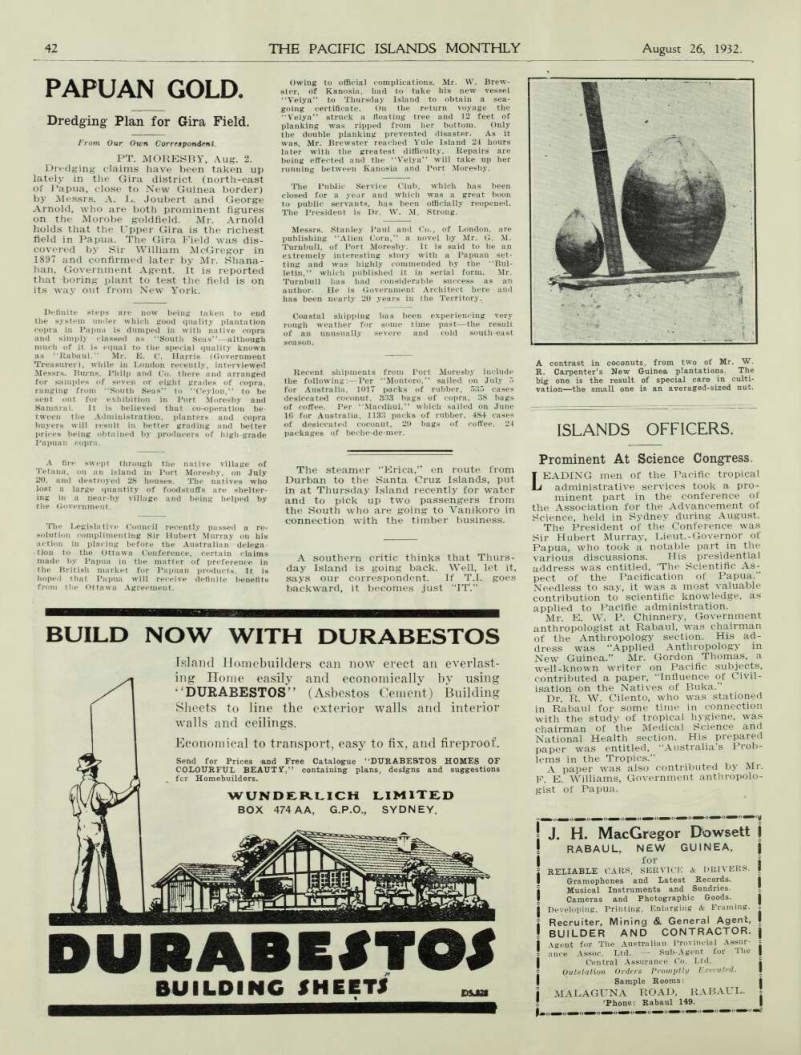
Dredging Plan for Gira Field.
From Our Own Correspondent.
Pt. Moresby, Aug. 2.
Dredging claims have been taken up lately in the Gira district (north-east of Papua, close to New Guinea border) by Messrs. A. L. Joubert and George Arnold, who are both prominent figures on the Morobe goldfield. Mr. Arnold holds that the Upper Gira is the richest field in Papua. The Gira Field was dis covered by Sir William McGregor in 1897 and confirmed later by Mr. Shana han, Government Agent. It is reported that boring plant to test the field is on its way out from New York.
Definite steps are now being taken to end the system under which good quality plantation copra in Papua is dumped in with native copra and simply classed as “South Seas” —although much of it is equal to the special quality known as “Rabaul.” Mr. E. C. Harris (Government Treasurer), while in London recently, interviewed Messrs. Burns, Philp and Co. there and arranged for samples of seven or eight grades of copra, ranging from “South Seas” to “Ceylon,” to be sent out for exhibition in Port Moresby and Samarai. It is believed that co-operation be tween the Administration, planters and copra buyers will result in better grading and better prices being obtained by producers of high-grade Papuan copra.
A fire swept through the native village of Tetana, on an island in Port Moresby, on July 20, and destroyed 28 houses. The natives who lost a large quantity of foodstuffs are shelter ing in a near-by village and being helped by the Government.
The Legislative Council recently passed a re solution complimenting Sir Hubert Murray on his action in placing before the Australian delega tion to the Ottawa Conference, certain claims made by Papua in the matter of preference in the British market for Papuan products. It is hoped that Papua will receive definite benefits from the Ottawa Agreement.
Owing to official complications, Mr. W. Brew ster, of Kanosia, had to take his new vessel “Veiya” to Thursday Island to obtain a sea going certificate. On the return voyage the “Veiya” struck a floating tree and 12 feet of planking was ripped from her bottom. Only the double planking prevented disaster. As it was, Mr. Brewster reached Yule Island 24 hours later with the greatest difficulty. Repairs are being effected and the “Veiya” will take up her running between Kanosia and Port Moresby.
The Public Service Club, which has been closed for a year and which was a great boon to public servants, has been officially reopened.
The President is Dr. W. M. Strong.
Messrs. Stanley Paul and Co., of London, are publishing “Allen Corn,” a novel by Mr. G. M.
Turnbull, of Port Moresby. It is said to be an extremely interesting story with a Papuan set ting and was highly commended by the “Bul letin,” which published it in serial form. Mr.
Turnbull has had considerable success as an author. He is Government Architect here and has been nearly 20 years in the Territory.
Coastal shipping has been experiencing very rough weather for some time past—the result of an unusually severe and cold south-east season.
Recent shipments from Port Moresby include the following:—Per “Montoro,” sailed on July 5 for Australia, 1017 packs of rubber, 535 cases desiccated coconut, 333 bags of copra, 38 bags of coffee. Per “Macdhui,” which sailed on June 16 for Australia, 1133 packs of rubber, 484 cases of desiccated coconut, 29 bags of coffee, 24 packages of beche-de-mer.
The steamer “Erica,” en route from Durban to the Santa Cruz Islands, put in at Thursday Island recently for water and to pick up two passengers from the South who are going to Vanikoro in connection with the timber business.
A southern critic thinks that Thurs day Island is going back. Well, let it, says our correspondent. If T.I. goes backward, it becomes just “IT.”
A contrast in coconuts, from two of Mr. W.
R. Carpenter’s New Guinea plantations. The big one is the result of special care in culti vation —the small one is an averaged-sized nut.
Islands Officers.
Prominent At Science Congress.
LEADING men of the Pacific tropical administrative services took a pro minent part in the conference of the Association for the Advancement of Science, held in Sydney during August.
The President of the Conference was Sir Hubert Murray, Lieut.-Governor of Papua, who took a notable part in the various discussions. His presidential address was entitled, ‘The Scientific As pect of the Pacification of Papua.”
Needless to say, it was a most valuable contribution to scientific knowledge, as applied to Pacific administration.
Mr. E. W. P. Chinnery, Government anthropologist at Rabaul, was chairman of the Anthropology section. His ad dress was “Applied Anthropology in New Guinea.” Mr. Gordon Thomas, a well-known writer on Pacific subjects, contributed a paper, “Influence of Civil isation on the Natives of Buka.”
Dr. R. W. Cilento, who was stationed in Rabaul for some time in connection with the study of tropical hygiene, was chairman of the Medical Science and National Health section. His prepared paper was entitled, “Australia’s Prob lems in the Tropics.”
A paper was also contributed by Mr.
F. E. Williams, Government anthropolo gist of Papua.
Advertisements & other items, p. 44 (2 items)
Durabestos
BUILD NOW WITH DURABESTOS
Island Homebuilders can now erect an everlast ing Home easily and economically by using “DURABESTOS” (Asbestos Cement) Building Sheets to line the exterior walls and interior walls and ceilings.
Economical to transport, easy to fix, and fireproof.
Send for Prices and Free Catalogue “DURABESTOS HOMES OF COLOURFUL BEAUT XV’ containing plans, designs and suggestions A for Homebuilders.
WUNDERLICH
BOX 474 AA, G.P.O.
limited
SYDNEY.
DURABESTOS
BUILDING
J. H. MacGregor Dowsett
RABAUL, NEW GUINEA.
for
RELIABLE CARS, SERVICE & DRIVERS.
Gramophones and Latest Records.
Musical Instruments and Sundries.
Cameras and Photographic Goods.
Developing, Printing. Enlarging & Framing.
Recruiter, Mining & General Agent,
BUILDER AND CONTRACTOR.
Agent for The Australian Provincial Assur ance Assoc. Ltd. Sub-Agent for The Central Assurance Co. Ltd.
Outstation Orders Promptly Executed.
Sample Rooms:
MALAGUNA ROAD, RABAUL.
’Phone: Rahaul 149.
Malaria Problem.
“The Bionomics of The Megarhines.”
THE following appeared in “The Syd ney Morning Herald” of August 7, 1929: — Air. C. L. Pemberton, an American entomolo gist, who has been engaged in research work in New Guinea for 16 months, arrived in Sydney by the "Calulu” on August 7, 1929, with 250 mosquito-killing insects, which he hopes will do a great deal to rid Hawaii of mosquitoes.
The insect itself is a type of mosquito, but does not suck blood, the adults living mostly on flowers. When in the wriggler or young stage they live on mosquito larvae, which keeps down the number of mosquitoes to a marked extent.
Mr. Pemberton first discovered these insects in the forest about ten miles from Rabaul, in New Britain. The eggs were laid in pockets of water which had gathered in the crevices of trees, and a novel method was employed to trap the wrigglers. Kerosene tins were nailed to trees in the forest and, being soon filled with rain, they made a good imitation of the natural haunt of the insect. The tins were soon visited by mosquitoes for depositing their larvae, and these in turn were followed by the enemy insect.
Mr. Pemberton was thus able to make a daily collection of the eggs of the parasitical insect.
Malaria is the greatest problem in New Guinea. Probably, it reduces the efficiency of the European population by 25 to 30 per cent.
Recently, Mr. W. R. Carpenter, head or the big Islands trading firm, asked the New Guinea authorities if anything had ever been done to make use of the parasite referred to by Mr. Pemberton.
This brought a statement from the Public Health Laboratory, Rabaul, to the effect that Mr. Pemberton’s preda cious mosquito was actually discovered and identified in Rabaul in 1923; that “the usual extravagant claims of the lay press," relative to Mr. Pemberton’s mosquito, had been noted in 1929: that “Mr. Pemberton may indeed have dis covered new facts in the bionomics of the megarhines, and even new species”; and that the predacious mosquitoes under notice were not found in ground water, and, therefore, were not consid ered of value in combating the an opheles mosquito, “which is exclusively a ground-water breeder.”
The gentleman who signed the report acknowledged, however, that the preda cious mosquito might be induced to change its habits; and that “it is pos sible that after generations of breeding in captivity a variant might be pro duced which might do this” (breed naturally in ground-water).
This is another outstanding example ot the maddening policy which has held sway in Rabaul for years. No attempt, evidently, has been made to ascertain whether Mr. Pemberton really did “dis cover new facts in the bionomics of the Megarhines”; or what was the result of Mr. Pemberton’s experiments with the mosquitoes he took away; or whether it is possible to develop, from the insect under notice, a species which will attack the anopheles in its breeds ing-places, and thus do something towards the solution of one of the world’s greatest problems.
The subject is likely to have attention at Canberra shortly; and possibly the Public Health Laboratory at Rabaul will be given something more to do than indulging in lofty scientific sneers about the “usual extravagances of art icles in the lay press.”
Islands.
Asiatic Labour and Solomon Islands.
[To the Editor.] Sir, —After reading the article entitled “Asiatics for Solomons,” appearing in the June issue of P.I.M. and signed “Solomonoo,” I suggest writer of same is a perverted human, who has used the desperate expedient of pseudonym to cover his retreat and is thus probably satisfied with his heroic attack upon the views expressed by Mr. G. E. Clift to the Editor of P.I.M. Every man is entitled to his own opinion and convic tions and Mr. G. E. Clift expressed his views in public, without having to re sort to deception.
“Solomonoo” asks pardon for his So cratical tendencies. What audacity and conceit! His tendencies are more like those of a Rabelais!
Copra is the main product of the Solomons, notwithstanding “Solomon oo’s” remarks. Shell, timber, ivory nuts, etc., are spasmodic, and not staple pro ductions. Although not in agreement with the introduction of Asiatics, yet one likes to see fair play and such drastic and sweeping claims (800 lbs. of green copra, collected and cut by a local unit) only emphasise the imbecility of “Solomonoo’s” ridiculous statements.
I am, etc..
H.C.S.
B.S.I., 20/7 32.
Papuan Sugar.
New Co. Leases 20,000 Acres.
A new company, known as N.S.W. and Associated Investments, Ltd., formed to grow sugar in Papua, has been regis tered in Pt. Moresby with a nominal capital of £600,000, and has been granted a lease of 20,000 acres near Keppel Pt., south of Tufi, on Collingwood Bay, on the north-east coast of Papua.
This was originally known as Mc Gown’s land; then a concern called Papuan Rural Products, Ltd., came into the picture: after that, the famous Mr.
Mond, and Mr. Beckett, became inter ested in this area as a basis for com pany promotion. Then it was aban doned, and the new company referred to, in which Senator Kingsmill, Mr.
Gus Nelson (a well-known Papua resi dent) and other reputable people are in terested, took up the area. They ap pear to be proceeding carefully with a big scheme.
There is nothing wrong with the land —it is admirably suited to its purpose —but it acquired a bad smell owing to the number of “wild cats” that were prowling around it.
Miss Hester Clark, a nursing sister, who has been about 20 years in the service of the Methodist Church as a missionary, mostly in Fiji, is spending part of her furlough, in Melbourne.
Her most recent station was India.
Advertisements & other items, p. 45 (1 item)
Mary's
AUSTRALASIA’S CLEARING HOUSE FOR THE PRECIOUS METALS.
BUYERS OF—
GOLD, OSMIRIDIUM, PLATINUM, SILVER, Etc.
GARRETT & DAVIDSON Ltd.
Assayers, Bullion Merchants, Metallurgists, BANK OF N.S.W. BUILDINGS. REGENT STREET. SYDNEY.
AUNT
MARY'S
PURE FOOD
PRODUCTS
These high-grade products are still supreme after thirty years’ trading with the Islands. Specially manufactured from the finest ingredients and packed to meet Island conditions.
Only goods of the very highest standard are packed by the Proprietors, ensuring satisfaction and confidence to all who purchase.
Aunt Mary’s Pure Pood Products and "Defiance” Brand Canned Goods are prepared and packed only by
“Defiance"
Brand
Canned
Goods
Packed by the Proprie tors of Aunt Mary’s Pure Food Products, these quality Canned Goods are hermetically sealed and specially prepared to withstand tropical heat, thus giving satisfaction to the consumer.
TILLOCK & CO. LTD.,
PURE FOOD
MANUFACTURERS
Kent and Liverpool Streets, SYDNEY, N.S.W.
Exchange Problem.
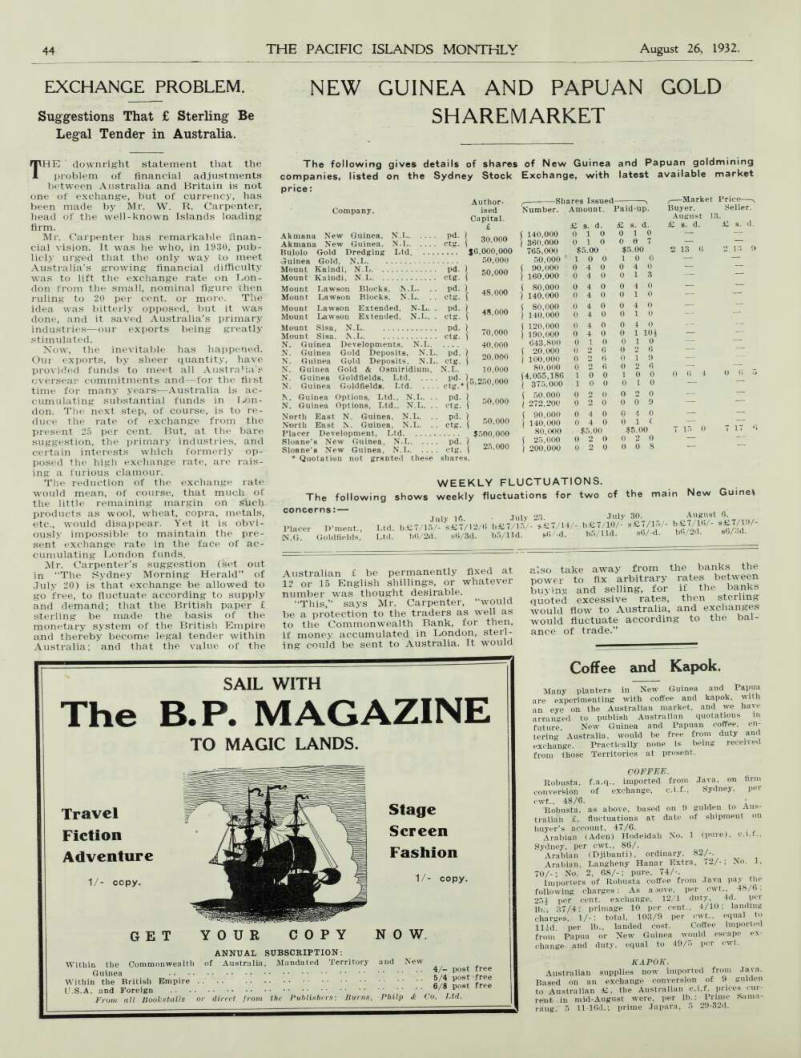
Suggestions That £ Sterling Be Legal Tender in Australia.
THE downright statement that the problem of financial adjustments between Australia and Britain is not one of exchange, but of currency, has been made by Mr. W. R. Carpenter, head of the well-known Islands loading firm.
Mr. Carpenter has remarkable finan cial vision. It was he who, in 1930, pub licly urged that the only way to meet Australia’s growing financial difficulty was to lift the exchange rate on Lon don from the small, nominal figure then ruling to 20 per cent, or more. The idea was bitterly opposed, but it was done, and it saved Australia’s primary industries —our exports being greatly stimulated.
Now, the inevitable has happened.
Our exports, by sheer quantity, have provided funds to meet all Australia’s overseas commitments and —for the first time for many years—Australia is ac cumulating substantial funds in Lon don. The next step, of course, is to re duce the rate of exchange from the present 25 per cent. But, at the bare suggestion, the primary industries, and certain interests which formerly op posed the high exchange rate, are rais ing a furious clamour.
The reduction of the exchange rate would mean, of course, that much of the little remaining margin on such products as wool, wheat, copra, metals, etc., would disappear. Yet it is obvi ously impossible to maintain the pre sent exchange rate in the face of ac cumulating London funds.
Mr. Carpenter’s suggestion (set out in “The Sydney Morning Herald” of July 20) is that exchange be allowed to go free, to fluctuate according to supply and demand; that the British paper £ sterling be made the basis of the monetary system of the British Empire and thereby become legal tender within Australia; and that the value of the
Australian £ be permanently fixed at 12 or 15 English shillings, or whatever number was thought desirable.
“This,” says Mr, Carpenter, “would be a protection to the traders as well as to the Commonwealth Bank, for then, if money accumulated in London, sterl ing could be sent to Australia. It would
also take away from the banks the power to fix arbitrary rates between buying and selling 1 , for if the banks quoted excessive rates, then sterling would flow to Australia, and exchanges would fluctuate according to the bal ance of trade.”
New Guinea And Papuan Gold
Sharemarket
The following gives details of shares of New Guinea and Papuan goldmining companies, listed on the Sydney Stock Exchange, with latest available market price:
Weekly Fluctuations.
The following shows weekly fluctuations for two of the main New Guinea concerns
Authorised Capital.
Shares Issued Market Price Buyer Seller.
August 13.
Company.
Number. Amount. Paid-up. £ £ s. d £ s. d. £ s. d. £ s. d.
Akmana New Guinea. N.I pd. 30,000 140,000 0 1 0 0 1 0 — — Akuiana New Guinea. N.I ctg. 360,000 0 1 0 0 0 7 — Bulolo Gold Dredging Ltd. $6,000,000 765,000 $5.00 0 $5.00 1 0 2 13 6 2 13 9 50,000 50,000 1 0 1 0 — Mount Kaindi. N.L pd. 50,000 90,000 0 4 0 0 4 0 — “ Mount Kaindi. N.L ctg. 160,000 0 4 0 0 1 3 Mount Lawson Blocks. N.L. . . pd. 48,000 80,000 0 4 0 0 4 0 — — Mount Lawson Blocks, N.L. . . ctg. 140,000 0 4 0 0 1 0 Mount Lawson Extended. N.L. . pd. 48,000 80,000 0 4 0 0 4 0 — — Mount Lawson Extended, N.L. . ctg. 140,000 0 4 0 0 1 0 Mount Sisa, N.L. pd. 70,000 120,000 0 4 0 0 4 0 — — Mount Sisa, N.L ctg. 190,000 0 4 0 0 1 104 — N. Guinea Developments, N.L 40,000 643,800 0 1 0 0 1 0 N. Guinea Gold Deposits, N.L. pd.
N. Guinea Gold Deposits, N.L. ctg. 20,000 20,000 100,000 0 0 o o 6 6 0 0 1 6 9 — — N. Guinea Gold & Osmiridium, N.L. 10,000 80,000 0 2 6 0 2 6 0 6 4 0 6 5 N. Guinea Goldfields, Ltd pd.
N. Guinea Goldfields, Ltd ctg. 4,055,186 375,000 1 1 0 0 0 0 1 0 0 1 0 0 — N. Guinea Options, Ltd., N.L. .. pd.
N. Guinea Options, Ltd., N.L. .. ctg. 50,000 50,000 272,200 0 0 2 2 0 0 0 0 2 0 0 9 — — North East N. Guinea, N.L. . . pd. 90,000 0 4 0 0 4 0 — North East N. Guinea, N.L. . . ctg. 50,000 140,000 0 4 0 0 1 0 15 0 7 17 6 Placer Development, Ltd. $500,000 80,000 $5.00 $5.00 7 15 0 Sloane's New Guinea. N.L pd. 25,000 0 2 0 0 0 — Sloane’s New Guinea, N.L ctg. 200,000 0 2 0 0 0 8 * Quotation not granted these shares.
Julv 16. July 23. July 30. August 6.
Placer D’ment., Ltd. b£7/15/- s£7/12/6 WJ7/15/- s£7/14/- b£7/10/- s£7/15/- s^[ 9/ " £N.G. Goldfields, Ltd. b0/2d. s6/3d. b5/lld. s6/-d. bo/lld. s6/-d. bb/2d. sb/40.
Coffee and Kapok.
Many planters in New Guinea and Papua are experimenting with coffee and kapok, with an eye on the Australian market, and we have arranged to publish Australian quotations in future. New Guinea and Papuan coffee, en tering Australia, would be free from duty and exchange. Practically none is being received from those Territories at present.
Coffee.
Robusta, f.a.q., imported from Java, on firm conversion of exchange, c.i.f., Sydney, per cwt., 48/6. ; Robusta, as above, based on 9 gulden to Aus tralian £. fluctuations at date of shipment on buyer’s account, 47/6.
Arabian (Aden) Hodeidah No. 1 (pure), c.i.f..
Sydney, per cwt., 86/.
Arabian (Djibanti), ordinary, 82/-.
Arabian, Langheny Hanar Extra, 72/-; No. 1. 70/-; No. 2, 68/-; pure, 74/-.
Importers of Robusta coffee from Java pay the following charges: As above, per cwt., 48/6: 25½ per cent, exchange, 12/1 duty, 4d. per lb, 37/4; primage 10 per cent., 4/10; landing charges, 1/-; total, 103/9 per cwt., equal to 11½d per lb., landed cost. Coffee imported from Papua or New Guinea would escape ex change and duty, equal to 49/5 per cwt.
Kapok.
Australian supplies now imported from Java.
Based on an exchange conversion of 9 gulden to Australian £, the Australian c.i.f. prices cur rent in mid-August were, per lb.: Prime Sama rang, 5 11-16 d.; prime Japara, 5 29-32 d.
Advertisements & other items, p. 46 (1 item)
The B.P. Magazine
SAIL WITH
GET YOUR COPY NOW.
ANNUAL SUBSCRIPTION:
Within the Commonwealth of Australia, Mandated Territory Guinea Within the British Empire U.S.A. and Foreign From all Bookstalls or direct from the Publishers: Burns, and New 4/- post free 5/4 post-free 6/8 post free Philp & Co. Ltd.
Market Quotations
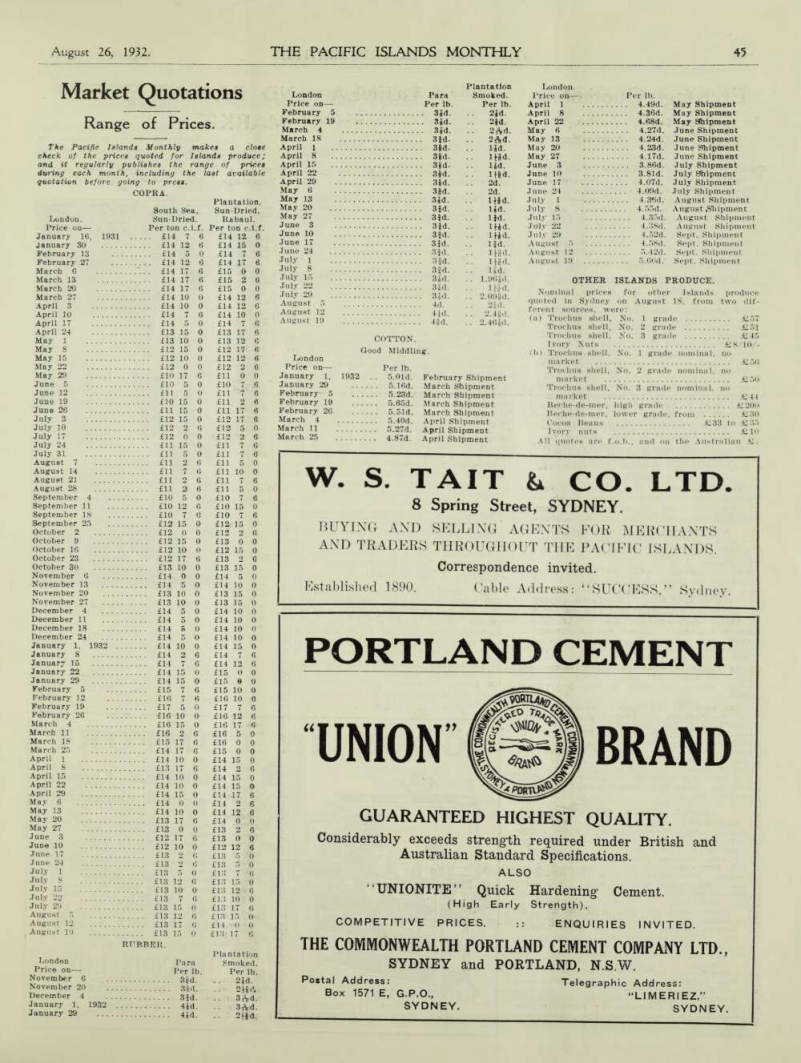
Range of Prices.
The Pacific Islands Monthly makes a close check of the prices quoted for Islands produce; and it regularly publishes the range of prices during each month, including the last available quotation before going to press.
Other Islands Produce.
Nominal prices for other Islands produce quoted in Sydney on August 18, from two dif ferent sources, were: (a) Trochus shell, No. 1 grade £57 Trochus shell, No. 2 grade £51 Trochus shell, No, 3 grade £45 Ivory Nuts £8/10/- (b) Trochus shell, No. 1 grade nominal, no market £56 Trochus shell, No. 2 grade nominal, no market £50 Trochus shell, No. 3 grade nominal, no market £44 Reche-de-mer, high grade £200 Beche-de-mer, lower grade, from £30 Cocoa Beans £33 to £35 Ivory nuts £10 All quotes are f.o.b., and on the Australian £.
London Price on— Per lb.
April 1 4.49d.
May Shipment April 8 4.36d.
May Shipment April 22 4.68d.
May Shipment May 6 4.27d.
June Shipment May 13 4.24d.
June Shipment May 20 4.23d.
June Shipment May 27 4.17d.
June Shipment June 3 3.86d.
July Shipment June 10 3.81d.
July Shipment June 17 4.07d.
July Shipment June 24 4.00d.
July Shipment July 1 4.3«d.
August Shipment July 8 4.55d.
August .Shipment July IS 4.3.">d.
August Shipment July 22 4.38d.
August Shipment July 20 4.52d.
Sept. Shipment August 5 4.58d.
Sept. Shipment August 12 0.420.
Sept. Shipment August 10 o.60d.
Sept. Shipment
Plantation London Para Smoked.
Price on— Per lb.
Per lb.
February 5 .. 3id. 2jd.
February 19 2jd.
March 4 .. 3Jd. .. 2*d.
March 18 . 3 Jd. 2Ad.
April l • 3«d.
Ijd.
April 8 IHd.
April 15 . 3|d. lid.
April 22 • 3|d. 1 JJd.
April 29 . 3Sd. 2d.
May 6 2d.
May 13 . 3id.
U»d.
May 20 . 3Jd. lid.
May 27 . 3 Jd.
IJd.
June 3 . 3 Jd.
IHd.
June 10 . 3 Jd.
IfJd.
June 17 . 3 Jd. .. 1Jd.
June 24 . 3 Jd. .. im.
July l . 3 Jd.
IJgd.
July 8 .. lid.
July 15 . 3Jd. .. 1.9«id.
July 22 . 3 jd. l}«d.
July 29 . 3jd. .. 2.09gd.
August 5 4d. 2Jd.
August 12 . 4Jd. .. 2.4id.
August 19 . 4gd. .. 2.46id.
Cotton.
Good Middling.
London Price on— Per lb.
January l, 1932 . . 5.01d.
February Shipment January 29 5.16d.
March Shipment February 5 5.23d.
March Shipment February 19 5.65d.
March Shipment February 26 5.51d.
March Shipment March 4 5.40d.
April Shipment March 11 5.27d.
April Shipment March 25 4.87d.
April Shipment
Copra.
South Sea, Plantation, Sun-Dried, London.
Stm-Dried.
Rabaul.
Price on — Per ton c.i.f.
Per ton c.i.f.
January 16. 1931 £14 7 6 £14 12 6 January 30 ... £14 15 0 February 13 £14 5 0 £14 7 6 February 27 £14 17 6 March 6 £15 0 0 March 13 £15 2 6 March 20 £14 17 6 £15 0 0 March 27 £14 12 6 April 3 £14 10 0 £14 12 6 April 10 £14 10 0 April 17 £14 5 0 £14 7 6 April 24 £13 15 0 £13 17 6 May 1 £13 10 0 £13 12 6 May 8 £12 15 0 £12 17 6 May 15 £12 12 6 May 22 £12 0 0 £12 2 6 May 29 £10 17 6 £11 0 0 June 5 £10 5 0 £10 7 ,6 June 12 £11 5 0 £11 7 6 June 19 £11 2 6 Juno 26 £11 15 0 £11 17 6 July 3 £12 15 0 £12 17 6 July 10 £12 5 0 July 17 £12 2 6 July 24 £11 15 0 £11 7 6 July 31 £11 5 0 £11 7 6 August 7 £11 2 6 £11 5 0 August 14 £11 7 6 £11 10 0 August 21 £11 2 6 £11 7 6 August 28 £11 2 6 £11 5 0 September 4 £10 5 0 £10 7 6 September 11 £10 15 0 September 18 £10 7 6 September 25 £12 15 0 £12 13 0 October 2 £12 0 0 £12 2 6 October 9 £12 15 0 £13 0 0 October 16 £12 10 0 £12 15 0 October 23 £12 17 6 £13 2 6 October 30 £13 10 0 £13 15 0 November 6 ... . £14 0 0 £14 5 0 November 13 ... £14 5 0 £14 10 0 November 20 . .. . £13 10 0 £13 15 0 November 27 . .. . £13 15 0 December 4 ... £14 10 0 December 11 . .. . £14 5 0 £14 10 0 December 18 . . . . £14 » 0 £14 10 0 December 24 ... £14 5 0 £14 10 0 January 1, 1932 . £14 10 0 £14 15 0 January 8 £14 2 6 £14 7 6 January 15 £14 12 6 January 22 £15 0 0 January 29 £15 9 0 February 5 £15 10 0 February 12 £16 10 0 February 19 £17 5 0 £17 7 6 February 26 £16 12 6 March 4 £16 15 0 £16 17 6 March 11 £16 5 0 March 18 £16 0 0 March 25 £14 17 6 £15 0 0 April l £14 10 0 £14 15 0 April 8 £14 2 6 April 15 £14 15 0 April 22 £14 15 0 April 29 £14 17 6 May 6 £14 0 0 £14 2 6 May 13 £14 12 6 May 20 £14 0 0 May 27 £13 2 6 June 3 £13 0 0 June 10 £12 12 6 June 17 £13 5 0 June 24 £13 5 0 July 1 £13 7 6 July 8 £13 15 0 July 15 £13 12 6 July 22 £13 7 6 £13 10 0 July 29 £13 17 6 August 5 £13 12 6 £13 15 0 August 12 £13 17 6 £14 (» 0 August 19 £13-17 0 London
Rubber.
Para Plantation Smoked.
Price on— Per lb.
Per lb.
November 6 2Jd.
November 20 ... 3ld. 2fSf , „ December 4 31'pd.
January 1, 1932 3Ad.
January 29 •• 2f|d.
Advertisements & other items, p. 47 (1 item)
"Union"
W. S. TAIT & CO. LTD.
8 Spring Street, SYDNEY.
BUYING AND SELLING AGENTS FOR MERCHANTS
AND TRADERS THROUGHOUT THE PACIFIC ISLANDS.
Correspondence invited.
Established 1890. Cable Address: “SUCCESS,” Sydney.
PORTLAND CEMENT
"UNION"
BRAND
GUARANTEED HIGHEST QUALITY.
Considerably exceeds strength required under British and Australian Standard Specifications.
ALSO
“UNIONITE” Quick Hardening” Cement. (High Early Strength).
COMPETITIVE PRICES. ENQUIRIES INVITED.
FHE COMMONWEALTH PORTLAND CEMENT COMPANY LTD.,
SYDNEY and PORTLAND, NS W.
Postal Address:
Box 1571 E, G.P.O.,
SYDNEY.
Telegraphic Address:
“LIMERIEZ,”
SYDNEY.
Exchange Quotations
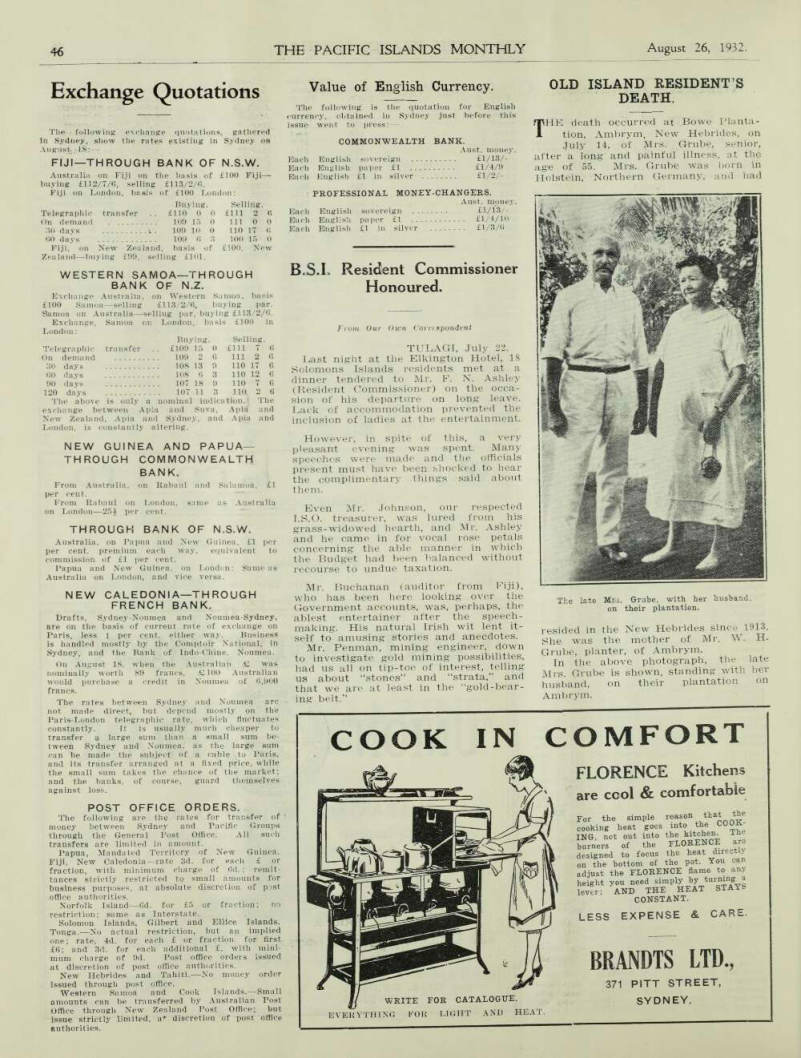
The following exchange quotations, gathered in Sydney, show the rates existing in Sydney oh August, 18:
Fiji—Through Bank Of N.S.W.
Australia on Fiji on the basis of £100 Fiji— buying £112/7/6, selling £113/2/6.
Fiji on London, basis of £100 London;
Western Samoa—Through
Bank Of N.Z.
Exchange Australia, on Western Samoa, basis £100 Samoa—selling £113/2/6. buying par.
Samoa on Australia—selling par, buying £113/2/0.
Exchange, Samoa on London, basis £100 in London:
New Guinea And Papua—
Through Commonwealth
Bank.
From Australia, on Rabaul and Salamoa, £1 per cent.
From Rabaul on London, same as Australia on London—25½ per cent.
Through Bank Of N.S.W.
Australia, on Papua and New Guinea, £1 per per cent, premium each way, equivalent to commission of £1 per cent.
Papua and New Guinea, on London: Same as Australia on London, and vice versa.
New Caledonia—Through
French Bank.
Drafts, Sydney-Noumea and Noumea-Sydney. are on the basis of current rate of exchange on Paris, less 1 per cent, either way. Business is handled mostly by the Comptoir National, in Sydney, and the Bank of Indo-Chine, Noumea.
On August 18, when the Australian £ was nominally worth 89 francs, £109 Australian would purchase a credit in Noumea of 6,900 francs.
The rates between Sydney and Noumea are not made direct, but depend mostly on the Paris-London telegraphic rate, which fluctuates constantly. It is usually much cheaper to transfer a large sum than a small sum be tween Sydney and Noumea, as the large sum can be made the subject of a cable to Paris, and its transfer arranged at a fixed price, while the small sum takes the chance of the market; and the banks, of course, guard themselves against loss.
Post Office Orders.
The following are the rates for transfer of money between Sydney and Pacific Groups through the General Post Office. All such transfers are limited in amount.
Papua, Mandated Territory of New Guinea, Fiji, New Caledonia —rate 3d. for each for fraction, with minimum charge of 6d.; remit tances strictly restricted to small amounts for business purposes, at absolute discretion of post office authorities.
Norfolk Island —6d. for £5 or fraction; no restriction; same as Interstate.
Solomon Islands, Gilbert and Ellice Islands, Tonga.—No actual restriction, but an implied one; rate, 4d. for each £ or fraction, for first £6; and 3d. for each additional £, with mini mum charge of 9d. Post office orders issued at discretion of post office authorities.
New Hebrides and Tahiti. —No money order issued through post office.
Western Samoa and Cook Islands.—Small amounts can be transferred by Australian Post Office through New Zealand Post Office; but issue strictly limited, at discretion of post office authorities.
Value of English Currency.
The following is the quotation for English currency, obtained in Sydney just before this issue went to press;—
Buying. Selling.
Telegraphic transfer . . £110 0 0 £111 2 6 On demand 109 15 0 111 0 0 30 days . . 109 10 0 110 17 0 60 days 109 6 3 100 15 0 Fiji, on New Zealand, basis of £100, New Zealand—buying £99, selling £101.
Buying.
Selling.
Telegraphic transfer £109 15 0 £111 7 6 On demand 109 2 6 111 2 6 30 days 108 13 9 110 17 6 60 days 108 6 3 110 12 6 90 days 107 18 9 110 7 6 120 days 107 11 3 110 2 6 The above is only a nominal indication. The exchange between Apia and Suva, Apia and New Zealand, Apia and Sydney, and Apia and London, is constantly altering.
Commonwealth Bank.
Aust. money.
Each English sovereign £1/13/- Each English paper £1 Each English £1 in silver . . £1/2/-
Professional Money-Changers.
Aust. money.
Each English sovereign £1/13/- Each English paper £1 £1/4/10 Each English £1 in silver £1/3/0
B.S.I. Resident Commissioner
Honoured.
From Our Own Correspondent
Tulagi, July 22.
night at the Elkington Hotel, 18 Solomons Islands residents met at a dinner tendered to Mr. F. N. Ashley (Resident Commissioner) on the occa sion of his departure on long leave.
Lack of accommodation prevented the inclusion of ladies at the entertainment.
However, in spite of this, a very pleasant evening was spent. Many speeches were made and the officials present must have been shocked to hear the complimentary things said about them.
Even Mr. Johnson, our respected I.S.O. treasurer, was lured from his grass-widowed hearth, and Mr. Ashley and he came in for vocal rose petals concerning the able manner in which the Budget had been balanced without recourse to undue taxation.
Mr. Buchanan (auditor from Fiji), who has been here looking over the Government accounts, was, perhaps, the ablest entertainer after the speech making. His natural Irish wit lent it self to amusing stories and anecdotes.
Mr. Penman, mining engineer, down to investigate gold mining possibilities, had us all on tip-toe of interest, telling us about “stones” and “strata,” and that we are at least in the “gold-bear ing belt.”
Old Island Resident's
Death.
THE death occurred at Bowe Planta tion, Ambrym, New Hebrides, on July 14, of Mrs. Grube, senior, after a long and painful illness, at the age of 55. Mrs. Grube was born in Holstein, Northern Germany, and had
resided in the New Hebrides since 1913.
She was the mother of Mr. W. H.
Grube, planter, of Ambrym.
In the above photograph, the late Mrs. Grube is shown, standing with her husband, on their plantation on Ambrym.
The late Mrs. Grube, with her husband, on their plantation.
Advertisements & other items, p. 48 (1 item)
Brandts Ltd.,
COOK IN COMFORT
FLORENCE Kitchens
are cool & comfortable
For the simple reason that the cooking heat goes into the COOK ING, not out into the kitchen. The burners of the FLORENCE are designed to focus the heat directly on the bottom of the pot. You can adjust the FLORENCE flame to any height you need simply by turing a
lever; AND THE HEAT STAYS
CONSTANT.
LESS FXPENSE & CARE.
BRANDTS LTD.,
371 PITT STREET,
WRITE FOR CATALOGUE.
EVERYTHING FOR LIGHT AND HEAT.
SYDNEY.
Shipping Services in the Pacific
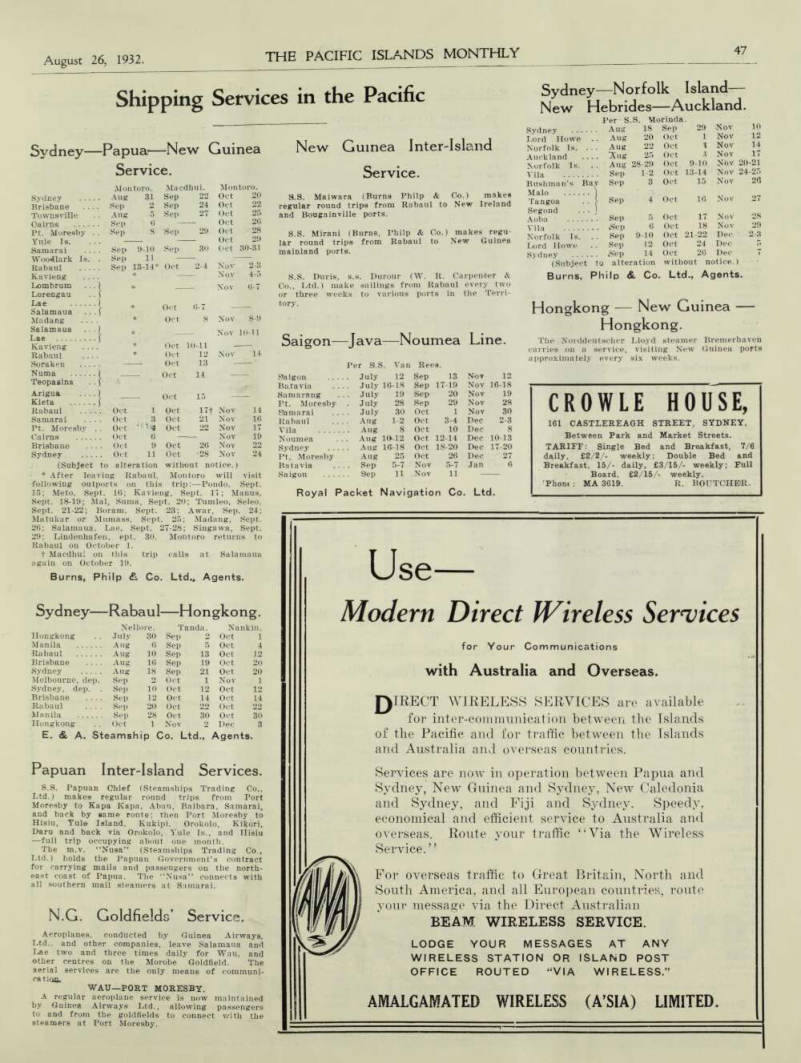
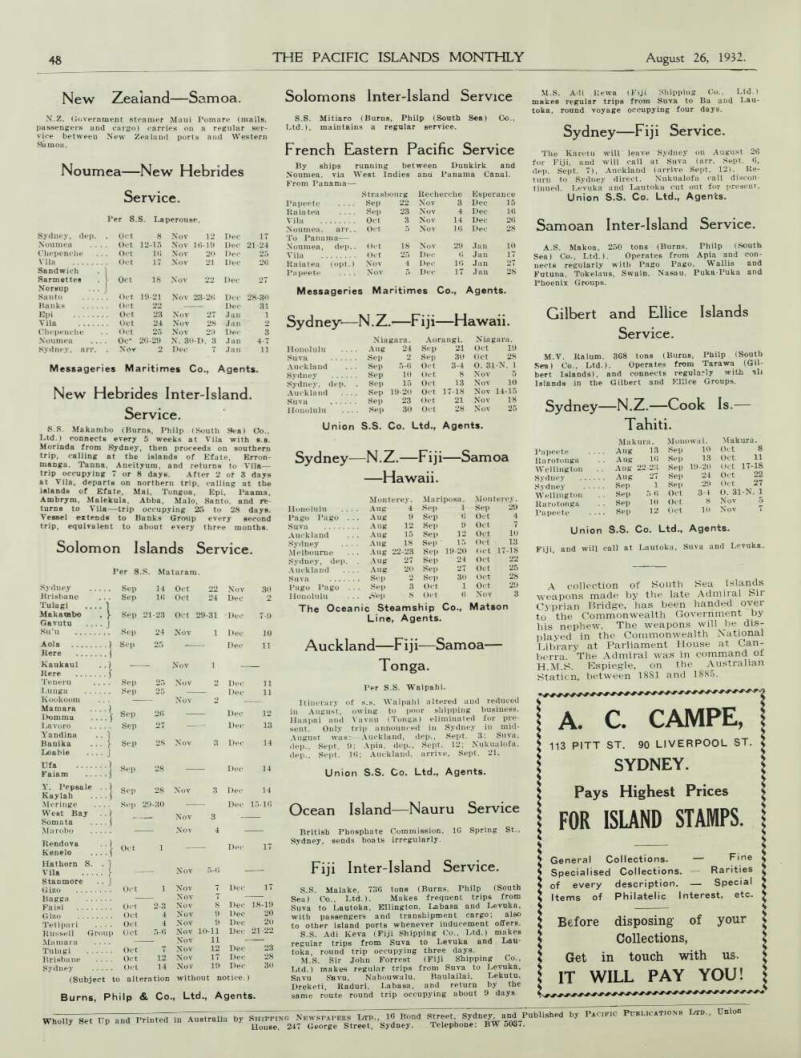
Sydney—Papua—New Guinea Service.
* After leaving Rabaul, Montoro will visit following outports on this trip:—Pondo, Sept. 15; Meto, Sept. 16; Kavieng, Sept. IT; Manus, Sept. 18-19; Mai, Suma, Sept. 20; Tumleo, Seleo, Sept. 21-22; Boram, Sept. 23: A war, Sep. 24; Matukar or Mnmass, Sept. 25; Madang, Sept. 26: Salamaua. Lae, Sept. 27-28; Singawa, Sept. 29; Lindenhafen, ept. 30. Montoro returns to Rabaul on October 1. t Macdhui on this trip calls at Salamaua again on October 19.
Burns, Philp & Co. Ltd., Agents.
Sydney—Rabaul—Hongkong.
Papuan Inter-Island Services.
S.S. Papuan Chief (Steamships Trading Cos..
Ltd.) makes regular round trips from Port Moresby to Kapa Kapa, Abau, Baibara, Samarai, and back by same route; then Port Moresby to Hisiu, Tule Island, Kukipi, Orokolo, Kikori, Daru and back via Orokolo, Yule Is., and Hisiu —full trip occupying about one month.
The m.v. “Nusa” (Steamships Trading Cos., Ltd.) holds the Papuan Government’s contract for carrying mails and passengers on the north east coast of Papua. The “Nusa” connects with all southern mail steamers at Samarai.
N.G. Goldfields’ Service.
Aeroplanes, conducted by Guinea Airways, Ltd., and other companies, leave Salamaua and Lae two and three times daily for Wau, and other centres on the Morobe Goldfield. The aerial services are the only means of communi cation,
Wau—Port Moresby.
A regular aeroplane service is now maintained by Guinea Airways Ltd., allowing passengers to and from the goldfields to connect with the steamers at Port Moresby.
New Guinea Inter-Island
Service.
S.S. Maiwara (Burns Philp & Co.) makes regular round trips from Rabaul to New Ireland and Bougainville ports.
S.S. Mirani (Burns, Philp & Co.) makes regu lar round trips from Rabaul to New Guinea mainland ports.
S.S. Duris, s.s. Durour (W. R. Carpenter & Co., Ltd.) make sailings from Rabaul every two or three weeks to various ports in the Terri tory.
Saigon—Java—Noumea Line.
Sydney—Norfolk Island — New Hebrides—Auckland.
Hongkong New Guinea
Hongkong.
The Norddeutscher Lloyd steamer Bremerhaven carries on a service, visiting New Guinea ports approximately every six weeks.
Montoro.
Aue 31 Macdhui.
Sep 22 Montoro.
Oct 20 Brisbane Townsville Sep Aug Sep Sep 2 5 G Sep Sep 24 27 Oct Oct Oct 22 25 26 Pt. Moresby . 8 Sep 29 Oct 28 Yule Is.
Samara!
Woodlark Is.
Oct Oct 20 Sep Sep Sep 9-10 Sep 30 30-31 13-14* Oct 2-4 Nov 2-3 Kavieng Nov 4-5 Lombrum Nov 6-7 Lorengau Lae Salamaua Madang Salamaua I ♦ - Oct Oct 6-7 8 Nov Nov 8-9 10-11 Lae Kavieng Rabaul ... * Hot 10-11 12 13 4c V/l L Oct Oct Nov 14 Numa Ant 14 Teopaaina Arigua ... 15 Kieta vv L Rabaul ...
Oct 1 Oct 17f Nov 14 Samarai Pt. Moresby . . Oct . Oct if, 4 Oct Oct 21 22 Nov Nov 16 17 Cairns Oct 6 Nov 19 Brisbane Sydney ... . Oct Oct 9 11 Oct Oct 26 •28 Nov Nov 22 24 (Subject to alteration without notice.)
Nellore.
Tanda.
Nankin.
Hongkong . . July 30 Sep 2 Oct 1 Manila . . . Aug G Sep 5 Oct 4 Rabaul . . . Aug 10 Sep 13 Oct 12 Brisbane Aug 16 Sep 19 Oct 20 Sydney .. . Aug 18 Sep 21 Oct 20 Melbourne, dep. Sep 2 Oct 1 Nov 1 Sydney, dep. . Sep 10 Oct 12 Oct 12 Brisbane Sep 12 Oct 14 Oct 14 Rabaul ... Sep 20 Oct 22 Oct 22 Manila 28 Oct 30 Oct 30 Hongkong .. Oct 1 Nov 2 Dec 3 E. & A. Steamship Co. Ltd Agents.
Per 9.S. Van Rees.
Saigon . . . July 12 Sep 13 Not 12 Batavia .. . July 10-18 Sep 17 -19 Nov 16-18 Samarang . . . July 19 Sep 20 Nov 19 Pt. Moresby . July 28 Sep 29 Nov 28 Samarai ... July 30 Oct 1 Nov 30 Rabaul . . . Aug 1-2 Oct 3-4 I>ec 2-3 Vila 8 Oct 10 Dec 8 Noumea . .. Aug 10-12 Oct 12 14 Dec 10-13 Sydney ... Aug 16-18 Oct 18-20 Dec 17 -20 Pt, Moresby Aug 25 Oct 20 Dec 27 Batavia . .. Sep 5-7 Nov 5-7 Jan 6 Saigon ... Sep 11 Nov 11 — Royal Packet Navigation Co. Ltd.
Per S.S. Morinda.
Svdney Aug 18 Sep 29 Nov 10 Lord Howe . .
Aug 20 Oct 1 Nov 12 Norfolk Is. ...
Aug 22 Oct Nov 14 Auckland ...
Aug
25 Oct Nov 17 Norfolk Is.
Aug 28-29 Oct 9 -10
Nov 20-21
Vila Sep 1-2 Oct 13 -14 Nov 24-25 Bushman’s Bay Sep 3 Oct 15 Nov 26 Malo
Tangoa ..
Sep 4 Oct 16 Nov 27
Segond ...
Aoba Sep 5 Oct 17 Nov 28 Vila Sep 6 Oct 18 Nov 29 Norfolk Is. ..
Sep 9-10 Oct 21-22 Dec 2-3 Lord Howe Sep 12 Oct 24 Dec- 5 Sydney Sep 14 Oct 26 Dec 7 (Subject to alteration without notice.) Burns, Philp & Co. Ltd., Agents.
NeW Zealand—Samoa.
N.Z. Government steamer Maui Pomare (mails, passengers and cargo) carries on a regular ser vice between New Zealand ports and Western Samoa.
Noumea—New Hebrides
Service.
New Hebrides Inter-Island.
Service.
S.S. Makambo (Burns, Philp (South Sea) Co., Ltd.) connects every 5 weeks at Vila with s.s.
Morinda from Slydney, then proceeds on southern trip, calling at the islands of Efate, Erron manga, Tanna, Aneityum, and returns to Vila— trip occupying 7or 8 days. After 2 of 3 days at Vila, departs on northern trip, calling at the islands of Efate, Mai, Tongoa, Epi, Paama.
Ambrym, Malekula, Abba. Malo, Santo, and re turns to Vila—trip occupying 25 to 28 days.
Vessel extends to Banks Group every second trip, equivalent to about every three months.
Solomon Islands Service.
Solomons Inter-Island Service
S.S. Mitiaro (Burns, Philp (South Sea) Co., Ltd.), maintains a regular service.
French Eastern Pacific Service
By ships running between Dunkirk and Noumea, via West Indies and Panama Canal.
From Panama-
Sydney-—N. Z.—Fiji—Hawaii.
Sydney—N. Z.—Fiji—Samoa —Hawaii.
Auckland —Fiji—Samoa—
Tonga.
Per S.S. Waipahi, Itinerary of s.s. Waipahi altered and reduced in August, owing to poor shipping business.
Haapai and Vavau (Tonga) eliminated for pre sent. Only trip announced in Sydney in mid- August was:—Auckland, dep., Sept. 3: Suva, dep., Sept. 9: Apia, dep., Sept. 12; Nukualofa, dep., Sept. 16; Auckland, arrive, Sept. 21.
Union S.S. Co. Ltd., Agents.
Ocean Island —Nauru Service
British Phosphate Commission, 16 Spring St., Sydney, sends boats irregularly.
Fiji Inter-Island Service.
S.S. Malake, 736 tons (Burns, Philp (South Sea) Co., Ltd.). Makes frequent trips from Suva to Lautoka, Ellington. Labasa and Levuka, with passengers and transhipment cargo; also to other island ports whenever inducement offers.
S.S. Adi Keva (Fiji Shipping Co., Ltd.) makes regular trips from Suva to Levuka and Lau toka, round trip occupying three days.
M.S. Sir John Forrest (Fiji Shipping Co., Ltd.) makes regular trips from Suva to Levuka, Savu Savu, Nabouwalu, Baulailai, Lekutu.
Dreketi, Raduri, Labasa, and return by the same route round trip occupying about 9 days
M.S. Adi Kewa (Fiji Shipping Co., Ltd.) makes regular trips from Suva to Ba and Lau toka, round voyage occupying four days.
Sydney—Fiji Service.
The Karetu will leave Sydney on August 26 for Fiji, and will call at Suva (arr. Sept. 6, dep. Sept. 7), Auckland (arrive Sept. 12). Re turn to Sydney direct. Nukualofa call discon tinued. Levuka and Lautoka cut out for present.
Union S.S. Co. Ltd., Agents.
Samoan Inter-Island Service.
A.S. Makoa, 250 tons (Burns. Philp (South Sea) Co., Ltd.). Operates from Apia and con nects regularly with Pago Pago, Wallis and Futuna. Tokelaus, Swain, Nasau, Puka-Puka and Phoenix Groups.
Gilbert and Ellice Islands
Service.
M.V. Ralum. 368 tons (Burns, Philp (South Sea) Co., Ltd.). Operates from Tarawa (Gil bert Islands), and connects regularly with all Islands in the Gilbert and Ellice Groups.
Sydney—N.Z.—Cook Is.—
Tahiti.
A collection of South Sea Islands weapons made by the late Admiral Sir Cyprian Bridge, has been handed over to the Commonwealth Government by his nephew. The weapons will be dis played in the Commonwealth National Library at Parliament House at Can berra. The Admiral was in command of H.M.S. Espiegle, on the Australian Station, between 1881 and 1885.
Per S.S. Laperouse.
Sydney, dep. . Oct 8 Nov 12 Dec 17 Noumea . Oet 12-15 Nov 16-19 Dec 21-24 Chepenelie . Oct 1G Nov 20 Dec 25 Vila . Oct 17 Nov 21 Dec 2G Sandwich Sarmettes
I Oc.
18 Nov 22 Dec 27 Noraup Santo ! Oe. 19-21 Nov 23-2G Dec 28-30 Banks . Oct 22 — Dec 31 Bpi , . Oct 23 Nov 27 Jan 1 Vila , . Oct 24 Nov 28 Jan 2 Chepenelie . Oct 25 Nov 29 Dec 3 Noumea . Oc* 2G-29 N. 30-D. 3 Jan 4-7 Sydney, arr. . Nor 2 Dec 7 Jan 11 Messageries Maritimes Co., Agents.
Per S.S. Mataram.
Sydney
Brisbane Tulagi Makauabo Gavutu Su'u ...
Sep Sep Sep Sep 14 16 21-23 24 Oct 22 Oct 24 Oct 29-31 Xnv 1 Nov Dec Dec Dec Dec 30 2 r-9 10 11 25 Rere 11 Kaukaul Nov 1 Teneru . , ..
Sep Sep 25 23 Nov 2 Dec Dec 11 Kookoom Mamara Dcmma Nov 2
] Sep
Son 26 27 Dec Dec 12 13 Yandina Hanika Loabie Sep 28 Nov 3 Dec 14 TTfn Sep 28 Dec 14 — Y. Pepsale Kaylah Meringe West Bay
Sep
Sep 28 29-30 Nov Nov Nov 3 3 Dec- Dec 15 14 ■10 Somata <i robo 4 Rendova
I Oct
1 Dec 17 Kenelo Hathorn S.
Vila Stanmore Gizo ...
j Oct
V D~\ Xt
5”0 J Oct 1 O V Nov 7 Dec 17 Bagga ..
Nov 7 Faisi . . . .
Oct 2-3 Nov 8 Dec 18-19 Gizo . . . . . Oct 4 Nov 9 Dec 20 Tetipari Russell G . Oct p Oct 4 5-6 Nov 9 Nov 10-11 Vav 1 1 Dec 20 Dec 21-22 Mamara Oct 7 Nov 12 Dec 23 Brisbane . Oct Oct 12 14 Nov Nov 17 19 Dec Dec 28 30 (Subject to alteration without notice. ) Burns Philp & Co., Ltd., Agents.
Strasbourg Recherche Esperance Papeete Sep 22 Nov 3 Dec 15 Kaiatea . Sep 23 Nov 4 Dec 16 Vila Oct 3 Nov 14 Dec 26 Noumea, an. . Oct 5 Nov 16 Dec 28 To Panama — Noumea, dep. . Oct 18 Nov 29 Jan 10 Vila Oct 25 Dec 6 Jan 17 Kaiatea (opt. ( Nov 4 Dec 16 Jan 27 Papeete . Nov 5 Dec 17 Jan 28
Messageries Maritimes Co., Agents.
Niagara.
Aorangi.
Niagara.
Honolulu ... Aug 24 Sep 21 Oct 19 Suva Sep 2 Sep 30 Oct 28 Auckland . .. Sep 5-6 Oct 3-4 0. 31-N . 1 Sydney Sep 10 Oct 8 Nov 5 Sydney, dep. . Sep 15 Oct 13 Nov 10 Auckland ... Sep 19-20 Oct 17-18 Nov 14-15 Suva ... Sep 23 Oct 21 Nov 18 Honolulu ... Sep 30 Get 28 Nov 25 Union S.S. Co. Ltd., Agents.
Monterey.
Mariposa, Monterey.
Honolulu ...
Aug 4 Sep 1 Sep 29 Pago Pago . ..
Aug 9 Sep 6 Oct 4 Suva Aug 12 Sep 9 Oct 7 Auckland Aug 15 Sep 12 Oct 10 Sydney ...
Aug 18 Sep 15 Oct 13 Melbourne Aug 22-23 Sep 19-20 Oct 17-18 Sydney, dep. .
Aug 27 Sep 24 Oct 22 Auckland ...
Aug 20 Sep 27 Oct 25 Suva Sep 2 Sep 30 Oct 28 Pago Pago ...
Sep 3 Oct 1 Oct 29 Honolulu •S'ep S Oct 0 Nov 3 The Oceanic Steamship Co., Matson
Line, Agents.
Makura.
Mouowai.
Makura.
Papeete Aug 13 Sep 10 Oct 8 Rarotonga Aug 10 Sep 13 Oct 11 Wellington Aug 22-23 Sep 19-20 Oct 17-18 Sydney . Aug 27 Sep 24 Oct 22 Sydney . • • • . Sep 1 Sep 29 Oct 27 Wellington . Sep 5-0 Oct 3-4 O. 31-N. 1 Rarotonga . Sep 10 Oct 8 Nov 5 Papeete . Sep 12 Oct 10 Nov 7 Union S.S Co. Ltd., Agents.
Fiji, and will call at Pautoka, Suva and Levuka.
Advertisements & other items, pp. 49-52 (2 items)
Crowle House,
161 CASTLEREAGH STREET, SYDNEY,
Between Park and Market Streets.
TARIFF; Single Bed and Breakfast, 7/6 daily, £2/2/- weekly: Double Bed and Breakfast. 15/- daily, £3/15/- weekly; Full Board, £2/15/- weekly.
Phom : MA 3619. R. BOUTCHER.
Use—
Modern Direct Wireless Services
for Your Communications with Australia and Overseas.
DIRECT WIRELESS SERVICES are available for inter-communication between the Islands of the Pacific and for traffic between the Islands and Australia and overseas countries.
Services are now in operation between Papua and Sydney, New Guinea and Sydney, New Caledonia and Sydney, and Fiji and Sydney. Speedy, economical and efficient service to Australia and overseas. Route your traffic “Via the Wireless Service. ”
For overseas traffic to Great Britain, North and South America, and all European countries, route your message via the Direct Australian
BEAM WIRELESS SERVICE.
LODGE YOUR MESSAGES AT ANY
WIRELESS STATION OR ISLAND POST
OFFICE ROUTED “VIA WIRELESS.”
AMALGAMATED WIRELESS (A’SIA) LIMITED
A. C. CAMPE,
113 PITT ST. 90 LIVERPOOL ST.
SYDNEY.
Pays Highest Prices
FOR ISLAND STAMPS.
General Collections. Fine Specialised Collections. Rarities of every description. Special Items of Philatelic Interest, etc.
Before disposing of your Collections, Get in touch with us.
IT WILL PAY YOU!
The Heaviest Single Piece
Ever Carried by Aeroplane
ABOVE is the top tumbler shaft for Bulolo’s first dredge being loaded into one of the two tri-motored G31 Junker Aircraft owned by
Bulolo Gold Dredging Company, and operated
by Guinea Airways.
It is the heaviest piece ever carried by air in the World, and weighs tons.
The dredge in which it is now working has a capacity of 8,000 cubic yards of gravel daily, and the Bulolo Gold Dredging Company are now operating it three shifts every day.
This circular photograph is a close-up of the same shaft, and graphic as it is gives hut a poor idea of the size and weight of this huge piece of machinery.
New Guinea Aerodromes
LAE
SALAMAUA
WATTUT
WAU
WAMPUT
SANGAN
BULOWAT
BULOLO
ZENAG
GUINEA AIRWAYS US
LAE - SALAMAUA
''Lower away ” —and what a welcome cargo it is!
Resch’s Pilsener—in the famous long bottle—the drink which eases the white man’s burden!
Call for a bottle to-night and relish its malt and
hop flavour.
RESCH'S
PILSENER
48
August 26, 1932.
THE PACIFIC ISLANDS MONTHLY
Wholly Set Up and Printed in Australia by Shipping Newspapers Ltd., 16 Bond Street, Sydney, and published by Pacific Publications Ltd., Union House, 247 George Street, Sydney. Telephone: BW 5037.