Pacific

Islands
Monthly
June 23
1932
6 d
[Registered at G.P.O., Sydney, for transmission by post as a newspaper.]
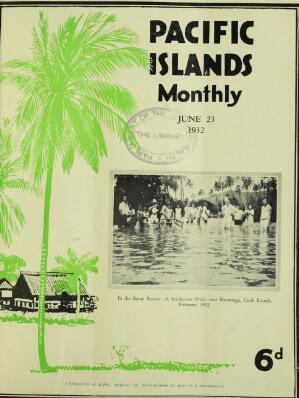
In the Rainy Season—A Freshwater Frolic near Rarotonga, Cook Islands, February, 1932.
Advertisements & other items, p. 2 (1 item)
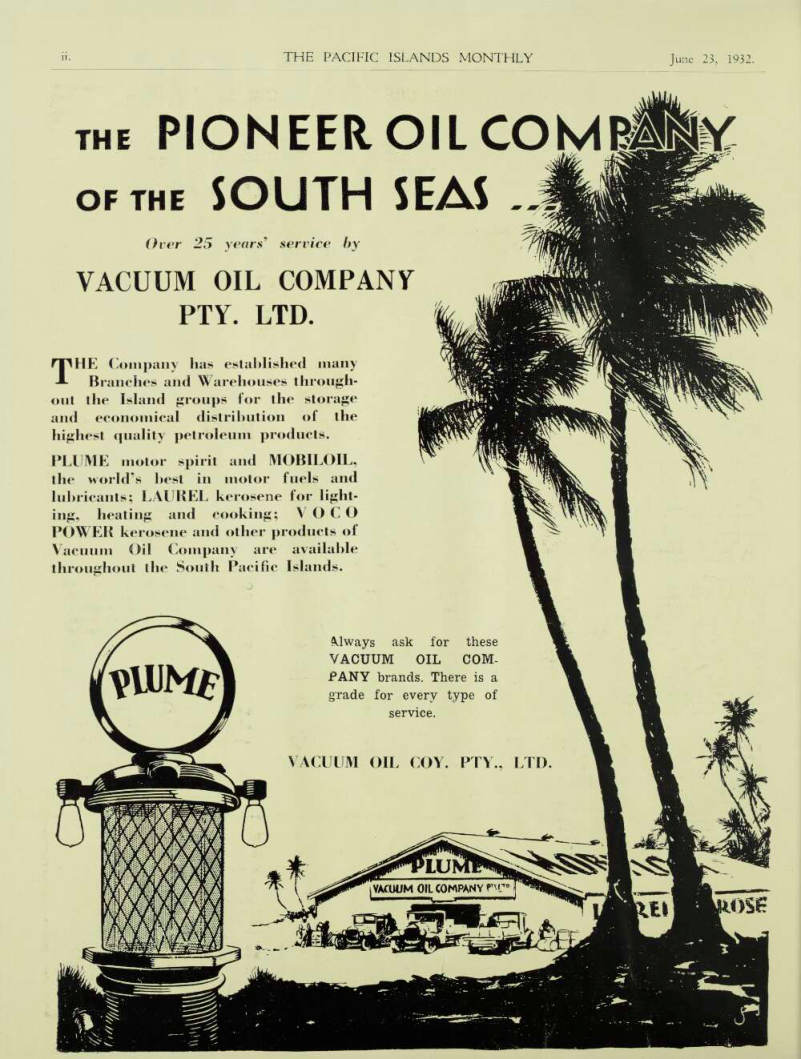
The Pioneer Oil
OF THE SOUTH SEAS
Over 23 years' service by
VACUUM OIL COMPANV
PTY. LTD.
The Company has established many Branches and Warehouses through out the Island groups for the storage and economical distribution of the
highest quality petroleum products.
PLUME motor spirit and MOBILOIL, the world’s best in motor fuels and lubricants; LAUREL kerosene for light ing, heating and cooking; VOCO POWER kerosene and other products of Vacuum Oil Company are available throughout the South Pacific Islands.
Mways ask for these
VACUUM OIL COM
PANY brands. There is a grade for every type of service.
VACUUM OIL COY. PTY., LTD.
VACUUM OIL COMPANY
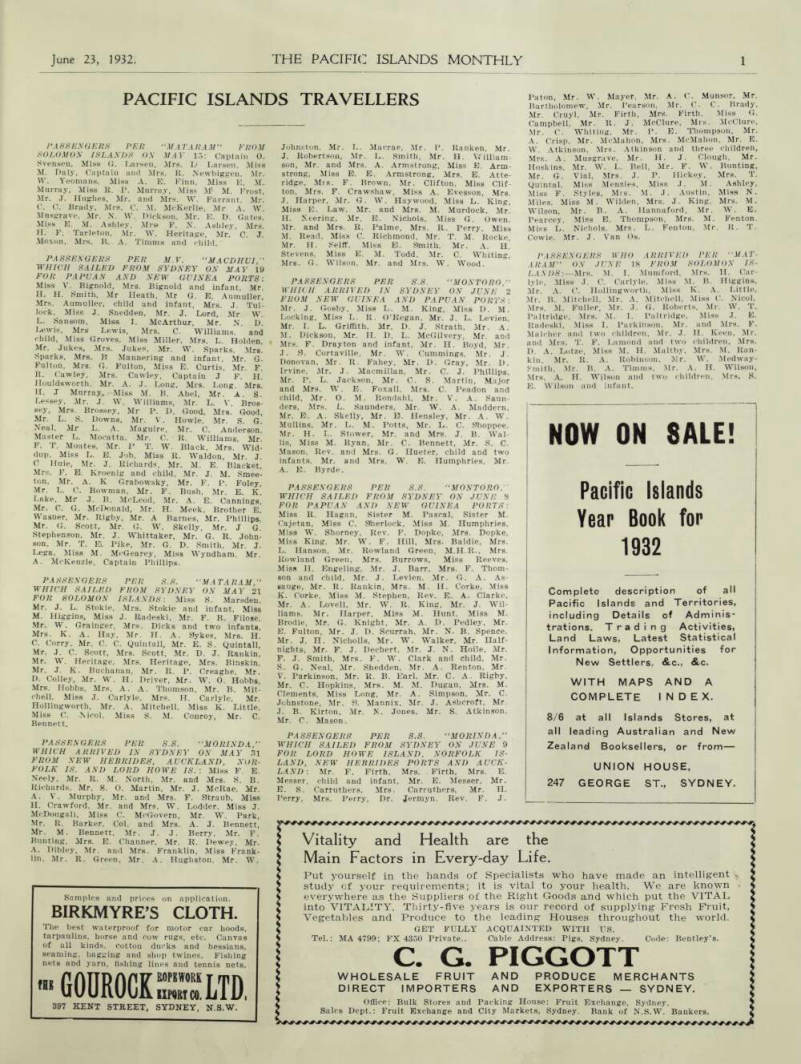
Pacific Islands Travellers
Passengers Per “Mataram” From
SOLOMON ISLANDS ON MAY 15; Captain 0.
Svensen, Miss G. Larsen, Mrs. L Larsen, Miss M. Daly, Captain and Mrs. R. Newbiggen, Mr.
W. Yeomans, Miss A. E. Finn, Miss E. M.
Murray, Miss R. P. Murray, Miss M. M. Frost, Mr. J. Hughes, Mr. and Mrs. W. Farrant, Mr.
C. C. Brady, Mrs. C. M. McKerlie, Mr A. W.
Musgrave, Mr. N. W. Dickson, Mr. E. D. Gates, Miss E. M. Ashley, Mrs. F. N. Ashley, Mrs.
H. F. Tarleton, Mr. W. Heritage, Mr, C. J.
Moxon, Mrs, B. A. Timms and child.
Passengers Per M.V. “Macdhui "
WHICH SAILED FROM SYDNEY ON MAY 19
For Papuan And New Guinea Ports:
Miss V. Bignold, Mrs. Bignold and infant, Mr.
H. H. Smith, Mr Heath, Mr G. E. Aumuller.
Mrs. Aumuller, child and infant, Mrs. J. Tul lock, Miss J. Snedden, Mr. J. Lord, Mr W.
L. Sansom, Miss I. McArthur, Mr. N. D.
Lewis, Mrs Lewis, Mrs. C. Williams, and child, Miss Groves, Miss Miller, Mrs. L. Holden, Mr. Jukes, Mrs. Jukes, Mr. W. Sparks. Mrs.
Sparks, Mrs. B Mannering and infant, Mr. G.
Fulton, Mrs. G. Fulton, Miss E. Curtis, Mr. F.
R. Cawley, Mrs. Cawley, Captain J F. H.
Houldsworth, Mr. A. J. Long, Mrs. Long, Mrs.
H. J Murray, Miss M. B. Abel, Mr. A. S.
Lessey, Mr. J. W. Williams, Mr. L. V. Bros sey, Mrs. Brossey, Mr P. D. Good, Mrs. Good, Mr. L. S. Downs, Mr. V. Howie, Mr. S. G.
Neal, Mr L. A. Maguire, Mr. C. Anderson, Master L. Mocatta, Mr. C. R. Williams. Mr.
F. T. Moates, Mr. P T. W. Black, Mrs. Wid dup, Miss L. E. Job, Miss R. Waldon, Mr. J.
C Huie, Mr. J. Richards, Mr. M. E. Blacket, Mrs. F. B. Kroenig and child, Mr. J. M. Smee ton, Mr. A. K Grabowsky, Mr. F. P. Foley, Mr. L. C, Bowman, Mr. F. Bush, Mr. E. K.
Lake, Mr J. B. McLeod, Mr. A. E. Cannings, Mr. G. G. McDonald, Mr. H. Meek, Brother E.
Wasner, Mr. Rigby, Mr. A Barnes, Mr. Phillips, Mr. G. Scott, Mr. G. W. Skelly, Mr. J G.
Stephenson, Mr. J. Whittaker, Mr. G. R. John son, Mr. T. El Pike, Mr. G. D. Smith, Mr. J.
Lega, Miss M. McGearey, Miss Wyndham, Mr.
A. McKenzie, Captain Phillips.
Passengers Per S.S. “Mataram,'’
WHICH SAILED FROM SYDNEY ON MAY 21 FOR SOLOMON ISLANDS: Miss S. Marsden, Mr. J. L. Stokie, Mrs. Stokie and infant, Miss M. Higgins, Miss J. Radeski, Mr. F. B. Filose, Mr. W. Grainger, Mrs. Dicks and two infants, Mrs. K. A. Hay, Mr. H. A. Sykes, Mrs. H.
C. Corry, Mr. C. C. Quintall. Mr. E. S. Quintall, Mr. J. C. Scott. Mrs. Scott, Mr. D. J. Rankin, Mr. W. Heritage, Mrs. Heritage, Mrs. Binskin.
Mr. J. K. Buchanan, Mr. R. P. Creaghe, Mr.
D. Colley, Mr. W. H. Driver, Mr. W. O. Hobbs, Mrs. Hobbs, Mrs. A. A. Thomson, Mr. B. Mit chell, Miss J. Carlyle, Mrs. H. Carlyle, Mr.
Hollingworth, Mr. A. Mitchell, Miss K. Little, Miss C. Nicol, Miss S. M. Conroy, Mr. C.
Bennett.
Passengers Per S.S. “Morinda “
WHICH ARRIVED IN SYDNEY ON MAY 31
From New Hebrides, Auckland, Nor
FOLK IS. AND LORD HOWE IS. : Miss F. E.
Neely, Mr. R. M. North, Mr. and Mrs. S. B.
Richards. Mr. S. O. Martin, Mr. J. McRae, Mr.
A. V. Murphy, Mr. and Mrs. F. Straub, Miss H. Crawford, Mr. and Mrs. W. Lodder, Miss J.
McDougall, Miss C. McGovern, Mr. W. Park, Mr. R. Barker, Col. and Mrs. A. J. Bennett, Mr. M. Bennett, Mr. J. J. Berry, Mr. F.
Bunting, Mrs. E. Channer, Mr. R. Dewey, Mr.
A. Dibley, Mr. and Mrs. Franklin, Miss Frank lin, Mr. R. Green, Mr. A. Hughston, Mr. W.
Johnston, Mr. L. Macrae, Mr. P. Ranken, Mr.
J. Robertson, Mr. L. Smith, Mr. H. William son, Mr. and Mrs. A. Armstrong, Miss E. Arm strong, Miss E. E. Armstrong, Mrs. B. Atte ridge, Mis. F. Brown, Mr. Clifton, Miss Clif ton, Mrs. F. Crawshaw, Miss A. Evesson, Mrs.
J. Harper, Mr. G. W. Haywood, Miss L. King, Miss E. Law, Mr. and Mrs. M. Murdock, Mr.
H. Neering, Mr. E. Nichols, Miss G. Owen, Mr. and Mrs. R. Palme, Mrs. R. Perry, Miss M. Read, Miss C. Richmond, Mr. T. M. Rocke, Mr. H. Selff, Miss E. Smith, Mr. A. H.
Stevens, Miss E. M. Todd. Mr. C. Whiting, Mrs. G. Wilson. Mr. and Mrs. W. Wood.
Passengers Per S.S. “Montoro "
WHICH ARRIVED IN SYDNEY ON JUNE 2
From New Guinea And Papuan Ports:
Mr. J. Gosby, Miss L. M. King, Miss D. M.
Locking, Miss L. R. O’Regan, Mr. J. L. Levien, Mr. I. L. Griffith, Mr. D. J. Strath, Mr. A.
M. Dickson, Mr. H. D. L. McGilvery, Mr. and Mrs. F. Drayton and infant, Mr. H. Boyd, Mr.
J. S. Cortaville, Mr. W. Cummings, Mr. J.
Donovan, Mr. R. Fahey, Mr. D. Gray, Mr. D.
Irvine, Mr. J. Macmillan, Mr. C. J. Phillips, Mr. P. L. Jackson, Mr. C. S. Martin, Major and Mrs. W. B. Foxall, Mrs. C. Peadon and child, Mr. O. M. Rondahl, Mr. V. A. Saun ders, Mrs. L. Saunders, Mr. W. A. Maddern, Mr. E. A. Skelly, Mr. E. Hensley, Mr. A. W.
Mullins, Mr. L. M. Potts, Mr. L. C. Shoppee.
Mr. H. L. Slower, Mr. and Mrs. J. B. Wal lis, Miss M. Ryan, Mr. C. Bennett, Mr. S. C.
Mason, Rev. and Mrs. G. Hueter, child and two infants, Mr. and Mrs. W. B. Humphries, Mr.
A. E. Byrde.
Passengers Per S.S. “Montoro.
WHICH SAILED FROM SYDNEY ON JUNE 8
For Papuan And New Guinea Ports:
Miss R. Hagan, Sister M. Pascal, Sister M.
Cajetan, Miss C. Sherlock, Miss M. Humphries, Miss W. Shorney, Rev. F. Dopke, Mrs, Dopke, Miss King, Mr. W. F. Hill, Mrs. Baldie, Mrs.
L. Hanson, Mr. Rowland Green, M.H.R., Mrs.
Rowland Green, Mrs. Burrows, Miss Reeves, Miss H. Emgeling, Mr. J. Barr, Mrs. F. Thom son and child, Mr. J. Levien, Mr. G. A. As sange, Mr. R. Rankin, Mrs. M. H. Corke, Miss K. Corke, Miss M. Stephen, Rev. E. A. Clarke, Mr. A. Lovell, Mr. W. R. King, Mr. J. Wil liams, Mr. Harper, Miss M. Hunt, Miss M.
Brodie, Mr. G. Knight, Mr. A. D. Pedley, Mr.
B. Fulton, Mr. J. D. Scurrah, Mr. N. B. Spence, Mr. J. H. Nicholls, Mr. W. Walker, Mr. Half nights, Mr. F. J. Dechert, Mr. J. N. Hoile, Mr.
F. J. Smith, Mrs. F. W. Clark and child, Mr.
S. G. Neal, Mr. Shedden, Mr. A. Renton, Mr.
V. Parkinson, Mr. R. B. Earl, Mr. C. A. Rigby, Mr. C. Hopkins, Mrs. M. M. Dugan, Mrs. M.
Clements, Miss Long, Mr. A. Simpson, Mr. C.
Johnstone, Mr. 9. Mannix, Mr. J. Ashcroft, Mr.
J. B. Kirton, Mr. N. Jones, Mr. S. Atkinson.
Mr. C. Mason.
Passengers Per S.S. “Morinda,”
WHICH SAILED FROM SYDNEY ON JUNE 9
For Lord Howe Island, Norfolk Is
Land, New Hebrides Ports And Auck
LAND : Mr. F. Firth, Mrs. Firth. Mrs. E.
Messer, child and infant, Mr. E. Messer, Mr.
E. S. Carruthers, Mrs. Carruthers, Mr. H.
Perry, Mrs. Perry, Dr. Jermyn. Rev. F. J.
Paton, Mr. W. Mayer, Mr. A. C. Munsor, Mr.
Bartholomew, Mr. Pearson, Mr. C. C. Brady, Mr. Cruyl, Mr. Firth, Mrs. Firth, Miss G.
Campbell, Mr. R. J. McClure, Mrs. McClure, Mr. C. Whiting, Mr. P. E. Thompson, Mr.
A. Crisp, Mr. McMahon, Mrs. McMahon, Mr. E.
W. Atkinson, Mrs. Atkinson and three children, Mrs. A. Musgrave, Mr. H. J. Clough, Mr.
Hoskins, Mr. W. L. Bell, Mr. F. W. Bunting, Mr. G. Vial, Mrs. J. P. Hickey. Mrs. T.
Quintal, Miss Menzies, Miss J. M. Ashley, Miss F. Styles, Mrs. M. J. Austin, Miss N.
Miles. Miss M. Wilden, Mrs. J. King, Mrs. M.
Wilson, Mr. B. A. Hannaford, Mr. W. E.
Pearcey, Miss E. Thompson, Mrs. M. Fenton.
Miss L. Nichols. Mrs. L. Fenton, Mr. R. T.
Cowie. Mr. J. Van Os.
Passengers Who Arrived Per "Mat
ARAM" ON JUNE 18 FROM SOLOMON IS LANDS: —Mrs. M. I. Mumford, Mrs. H. Car lyle, Miss J. C. Carlyle, Miss M. B. Higgins, Mr. A. C. Hollingworth, Miss K. A. Little, Mr. B. Mitchell, Mr. A. Mitchell, Miss C. Nicol, Mrs. M. Fuller, Mr. J. G. Roberts, Mr. W. T.
Paltridge, Mrs. M. I. Paltridge, Miss J. E.
Radeski, Miss I. Parkinson, Mr. and Mrs. F.
Malcher and two children, Mr. J. H. Keen, Mr. and Mrs. T. F. Lamond and two children, Mrs.
D. A. Lotze, Miss M. H. Maltby, Mrs. M. Ran kin, Mr. R. A. Robinson. Mr. W. Medway- Smith, Mr. B. A. Timms, Mr. A. H. Wilson, Mrs. A. H. Wilson and two children, Mrs. S.
E. Wilson and infant.
Advertisements & other items, p. 3 (1 item)
Now On Sale!
Pacific Islands
Year Book for
1932 Complete description of all Pacific Islands and Territories, including Details of Adminis trations. Trading Activities, Land Laws, Latest Statistical Information, Opportunities for New Settlers, &c., &c.
WITH MAPS AND A
COMPLETE INDEX.
8/6 at all Islands Stores, at all leading Australian and New Zealand Booksellers, or from—
UNION HOUSE,
247 GEORGE ST., SYDNEY.
Vitality and Health are the
Main Factors in Every-day Life.
Put yourself in the hands of Specialists who have made an intelligent study of your requirements; it is vital to your health. We are known everywhere as the Suppliers of the Right Goods and which put the VITAL into VITALITY. Thirty-five years is our record of supplying Fresh Fruit, Vegetables and Produce to the leading Houses throughout the world.
GET FULLY ACQUAINTED WITH US.
Tel.: MA 4799; FX 4350 Private.. Cable Address: Pigs, Sydney. Code: Bentley’s.
C. G. PIGGOTT
WHOLESALE FRUIT AND PRODUCE MERCHANTS
DIRECT IMPORTERS AND EXPORTERS SYDNEY.
Office: Bulk Stores and Packing House: Fruit Exchange, Sydney.
Sales Dept.: Fruit Exchange and City Markets, Sydney. Bank of N.S.W. Bankers.
Samples and prices on application.
BIRKMYRE’S CLOTH.
The best waterproof for motor car hoods, tarpaulins, horse and cow rugs, etc. Canvas of all kinds, cotton ducks and hessians, seaming, bagging and shop twines. Fishing nets and yarn, fishing lines and tennis nets.
GODROCK LTD,
397 KENT STREET, SYDNEY, N.S.W.
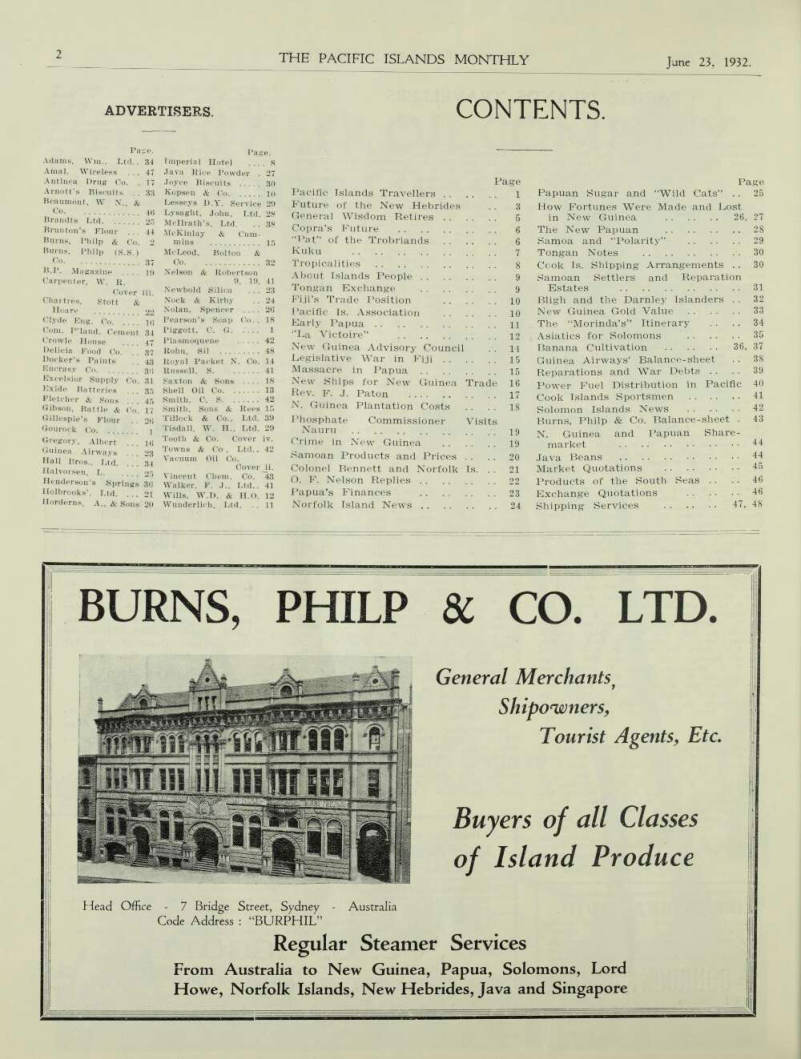
Advertisers.
Page.
Adams, Wm„ Ltd.. 34 Amal. Wireless ... 47 Antinea Drug Co. . 17 Arnott’s Biscuits . . 33 Beaumont, W N., & Co 46 Brandts Ltd 25 Brunton’s Flour ... 44 Burns, Philp & Co. 2 Burns, Philp (S.S.) Co 37 B.P. Magazine ... 19 Carpenter, W. R.
Cover iii.
Chartres, Stott & Hoare 22 Clyde Eng. CO. 16 Com. P’land. Cement 34 Crowle House ... 47 Delicia Food Co. . . 37 Docker’s Paints .. 43 Eucrasy Co 36 Excelsior Supply Co. 31 Exide Batteries ... 35 Fletcher & Sons .. . 45 Gibson, Battle & Co. 17 Gillespie’s Flour 26 Gourock Co 1 Gregory, Albert 16 Guinea Airways 23 Hall Bros., Ltd 34 Halvorsen, L. 25 Henderson's Springs 36 Holbrooks’. Ltd. ... 21 Horderns. A., & Sons 20
Page.
Imperial Hotel ... 8 Java Rice Powder . 27 Joyce Biscuits 30 Kopsen & Co 10 Lesseys D.Y. Service 29 Lysaght, John, Ltd 28 Mcllrath’s, Ltd. .. 38 McKinlay & Cum mins 15 McLeod, Bolton & Co 32 Nelson & Robertson 9, 19, 41 Newbold Silica ... 23 Nock & Kirby .. 24 Nolan, Spencer ... 26 Pearson’s Soap Co.. 18 pi SßOtt, C. G 1 Plasmoquene 42 Rohu, Sil 48 Royal Packet N. Co. 14 Russell. S 41 Saxton & Sons ... 18 Shell Oil Co 13 Smith, C. S 42 Smith, Sous & Rees 15 Tillock & Co., Ltd. 39 Tisdall, W. H., Ltd. 29 Tooth & Co ' Cover iv ' Towns & Co • Ltd - 42 Vacuum oil Co - Cover ii.
Vincent Chem. Co. 43 Walker, F. J.. Ltd.. 41 Wills, W.D. & H.O. 12 Wunderlich, Ltd. . . 11
Contents.
Page Pacific Islands Travellers 1 Future of the New Hebrides . . 3 General Wisdom Retires 5 Copra’s Future 6 “Pat” of the Trobriands 6 Kuku 7 Tropicalities g About Islands People 9 Tongan Exchange 9 Fiji’s Trade Position 10 Pacific Is. Association 10 Early Papua n “La Victoire” 12 New Guinea Advisory Council . . 14 Legislative War in Fiji 15 Massacre in Papua 15 New Ships for New Guinea Trade 16 Rev. F. J. Paton 17 N. Guinea Plantation Costs . . . . 18 Phosphate Commissioner Visits Nauru 19 Crime in New Guinea 19 Samoan Products and Prices . . . . 20 Colonel Bennett and Norfolk Is. . . 21 O. F. Nelson Replies 22 Papua’s Finances 23 Norfolk Island News 24
Page Papuan Sugar and “Wild Cats” .. 25 How Fortunes Were Made and Lost in New Guinea 26, 27 The New Papuan 28 Samoa and “Polarity” 29 Tongan Notes 30 Cook Is. Shipping Arrangements .. 30 Samoan Settlers and Reparation Estates 31 Bligh and the Darnley Islanders . . 32 New Guinea Gold Value 33 The “Morinda’s” Itinerary . . .. 34 Asiatics for Solomons 35 Banana Cultivation 36, 37 Guinea Airways’ Balance-sheet .. 38 Reparations and War Debts .. . . 39 Power Fuel Distribution in Pacific 40 Cook Islands Sportsmen 41 Solomon Islands News 42 Burns, Philp & Co. Balance-sheet . 43 N. Guinea and Papuan Share market 44 Java Beans 44 Market Quotations 45 Products of the South Seas . . . . 46 Exchange Quotations 46 Shipping Services 47, 48
Advertisements & other items, p. 4 (1 item)
Burns, Philp & Co. Ltd.
General Merchants,
Shipowners,
Tourist Agents, Etc.
Buyers of all Classes
of Island Produce
Head Office - 7 Bridge Street, Sydney - Australia Code Address ; “BURPHIL”
Regular Steamer Services From Australia to New Guinea, Papua, Solomons, Lord Howe, Norfolk Islands, New Hebrides, Java and Singapore
The Pacific Islands Monthly
THE NEWSPAPER - MAGAZINE OF THE SOUTH SEAS [Registered at G.P.O., Sydney, for transmission by post as a newspaper.]
Published about 15th of Each Month and Circulated in Australia and New Zealand and in the following Pacific Territories and Island Groups:
Crown Colony of Fiji.
Australian Territory of Papua.
Mandated Territory (Australia) of New Guinea, Bismarck Archipelago, and Northern Solo mon Islands.
Mandated Territory (Japan) of Marshall, Caro line and Mariana Islands.
American Territory of Guam.
Mandated Territory of Nauru.
British Crown Colony of Gilbert and Ellice Islands.
French Territory of New’ Caledonia.
British and French Condominium of New Hebrides.
American Territory of Eastern Samoa.
Mandated Territory (New Zealand) of Samoa.
British Solomon Islands Protectorate.
British Protectorate of Tongan Islands.
New Zealand Territory of Cook Islands.
Australian Territory of Norfolk Island.
French Colony of Oceania (Tahiti, etc.) American Territory of Hawaiian Islands.
Owned and Produced by ‘Pacific Publications Ltd., Union House, 247 George Street, Sydney
Telephone Bw 5037
P.O. Box 3408 R
Contributions
Articles, Stories and Photographs dealing with Pacific Islands Subjects are invited, and will be paid for on publication at usual rates.
Subscription Rates
Per Annum, within Postal Convention Territories, Prepaid, Post Free 6/- Per Annum elsewhere, Prepaid, Post Free 87- Single Copies 6d.
Editor and Publisher:
R. W. Robson.
Advertisements
Casual Advertising: £10 per page; £5/5/- per half page; £2/15/- per quarter page; £1/7/6 per eighth page; Casual Advertisements: 8/per inch. Contract rates by arrangement.
Colours; etc. —. by Arrangement Process Blocks made at Advertiser’s expense when required. Screen, 100.
Changes of Advertising Copy should reach this Office by 8th of each month, otherwise previous advertisement may be repeated.
Registered Address for Telegrams and Cables: “PACPUB” Sydney
Agents
The following are authorised to receive sub scriptions for The Pacific Islands Monthly — Islands Branches of Burns, Philp & Co., Ltd., and Burns, Philp (Sbuth Seas) Co., Ltd.
Islands Branches of W. K. Carpenter & Co., Ltd.
All Branches of Morris, Hedstrom & Co., Ltd.
Greenwood & Laws (Rabaul).
Whitten Bros., Ltd., Port Moresby & Samarai.
All Branches and Representatives of W. H.
Grove & Sons, Ltd., Auckland. 9. Russell, Papeete, Tahiti.
Cook Islands Trading Co., Rarotonga.
Mrs. M. Campbell, Cascades. Norfolk Island.
Vol. II —No. 11.
Sydney, June 23, 1932.
Price 6d Per Copy Prepaid: 6/- p.a.
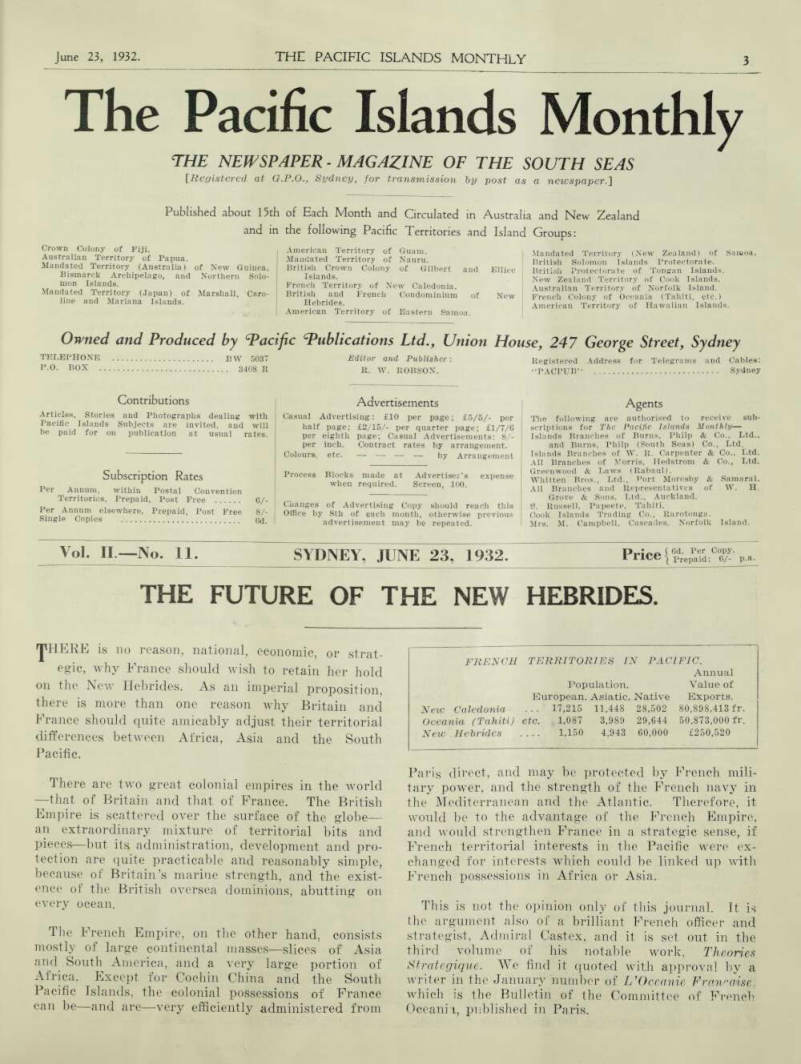
The Future Of The New Hebrides.
is no reason, national, economic, or strat egic, why France should wish to retain her hold on the New Hebrides. As an imperial proposition, there is more than one reason why Britain and France should quite amicably adjust their territorial differences between Africa, Asia and the South Pacific.
There are two great colonial empires in the world —that of Britain and that of France. The British Empire is scattered over the surface of the globe— an extraordinary mixture of territorial bits and pieces—but its administration, development and pro tection are quite practicable and reasonably simple, because of Britain’s marine strength, and the exist ence of the British oversea dominions, abutting on every ocean.
The French Empire, on the other hand, consists mostly of large continental masses—slices of Asia and South America, and a very large portion of Africa. Except for Cochin China and the South Pacific Islands, the colonial possessions of France can be—and are—very efficiently administered from
Paris direct, and may be protected by French mili tary power, and the strength of the French navy in the Mediterranean and the Atlantic. Therefore, it would be to the advantage of the French Empire, and would strengthen France in a strategic sense, if French territorial interests in the Pacific were ex changed for interests which could be linked up with French possessions in Africa or Asia.
This is not the opinion only of this journal. It is the argument also of a brilliant French officer and strategist, Admiral Castex, and it is set out in the third volume of his notable work, Theories Strategique. We find it quoted with approval by a writer in the January number of L’Oceanic Franraise, which is the Bulletin of the Committee of French Oceania, published in Paris.
Admiral Castex has made a careful study of the prob lem of developing and protecting the great Colonial Empire of France, and he takes the view that some of the French colonies—and particularly those in the Pacific—are a weakness and a danger to France as, in the event of an international war in which France could not command the Pacific Ocean, they would all be lost, as it would be impossible to defend them.
The Admiral urges France to concentrate her col onising activities in as few continents as possible, and to exchange her colonial interests elsewhere for new lands—in Africa, if practicable. He makes an interesting summary of the position in the South Seas.
In the course of his argument, Admiral Castex asks what imperial need is served by France retail ing her possessions in the Pacific. They are not re quired by economic interests nor in the interests of naval expansion. The acquirement of these Pacific territories, he says, was simply the result of rivalry between the Catholic missionaries of France, and the Protestant English missionaries of the London Mis sionary Society. Out of that arose the celebrated “affaire Pritchard,” as a result of which the French admiral, Dupetit-Thouars, annexed the Society Is lands in 1842, and the Marquesas, Gambier, Tuam otus, etc., in 1844. In 1853, Admiral Febvrier-Des pointes, in somewhat similar circumstances, raised the French flag in New Caledonia, which became a penal settlement between 1864 and 1896. In later times, France took possession of Wallis Island in 1912, and became a party to the establishment of the Condominium in the New Hebrides.
Admiral Castex declares that these several Pacific Groups are of little, if any, economic value to France.
Tahiti is French in title, but is American in regard to commercial affairs, and is a happy hunting-ground for American tourists and Protestant missionaries. What does not belong to American interests has been taken up by the Chinese. It is a beautiful and pleasant place to which to send French officials, and a fav ourite resort of writers and artists —but it is of little use to France. So far as New Caledonia is con cerned, says this writer, there is no question about its mineral riches, but the discontinuance of the deportation of criminals, and the decision to make it a colony for French freed convicts, have created a serious difficulty in regard to labour supplies for the mines, and much of the earlier promise of this colony has disappeared. A happier note is found in New Hebrides, where there has been remarkable de velopment; but this Group, says the admiral, “does not belong entirely to us, and Australia views with impatience our presence in that archipelago.”
The admiral proceeds: “The possibility of success fully defending these Pacific possessions is quite evi dently nil, owing to their distance and, owing to the naval effort that would be required to maintain com munication with them by sea. They are at the mercy of the United States, and the Australian Common
wealth, and of New Zealand, and their probable fate is clearly shown by what happened to New Guinea and Samoa when war broke out in 1914.”
For this reason, urges the admiral, it should not be difficult to make a satisfactory exchange of these Islands’ territories, which are very attractive to Australia and New Zealand, for territory in other parts of the world, which can be much more profit ably developed and defended by French Colonial administration.
We could not state the case more strongly than it has been presented by this French officer. The New Hebrides and New Caledonia mean little to France, commercially strategically, because of their distance from the' Mother Country, and because they are not near or on the way to any other French possession. But the two groups are of much import ance to Australia, because they are in close trading contact with the Australian territories, and because they form a part of that protective fringe of islands which stretch across thousands of miles of ocean, and interpose a barrier between Australia and the rest of the Pacific.
Much the same thing applies to French Oceania in relation to New Zealand; although New Zealand’s interests in Tahiti are not nearly so extensive and intimate as are those of Australia in New Hebrides and New Caledonia. It was hoped that, when the Panama Canal was opened, France might have done something to bring about settlement and develop ment in the Society, Tuamotu and Marquesas groups; but little has been done in that direction.
The territories concerned would lose nothing, there fore, and might possibly gain, by a change of ad ministration.
The only obstacle in the way of an amicable dis cussion of these matters between France and Britain, and a mutually satisfactory adjustment, is French national pride, and age-old suspicion of “perfidious Albion.” We have before us, for instance, a copy of “Le Neo Hebridais”—that excellent French news paper published in Vila —in which the editor spirit edly replies to our recent suggestion that it was time to consider the position and future of the New Heb rides. He sees the hand of the Presbyterian mission ary in our recent article; he insists (what is quite true) that French interests are predominant in the group; and he reminds us that France is “court eously” accepting the £ sterling and the £ Aus tralian in the group at par, and ignoring the fact that they are actually worth much less. This, also, is true; but we seem to recollect that Britain treated the franc with similar consideration when the exchange position was reversed some ten years ago.
All this, however, is beside the point. We must seek the big, imperial view—not the selfish, parochial one —and the big view has been very effectively pre sented by the French writer (Admiral Castex) from whom we have quoted.
French Territories In Pacific.
Annual Value of Exports.
Population.
European. Asiatic. Native New Caledonia . . . 17,215 11,448 28,502 80,898,413 fr.
Oceania (Tahiti) etc. 1,087 3,989 29,644 50,873,000 fr.
New Hebrides 1,150 4,943 60,000 £250,520
General Wisdom
Retires.
General Griffith goes to Rabaul.
JT has been officially announced
that Brig.-General Wisdom,
C.B., C.M.G., D.S.O., has decided to retire from the post of Adminis trator of the Mandated Territory of New Guinea, which he has held
since February 3, 1921, and that
he has entered upon long leave
prior to retirement. An acting Ad
ministrator has been appointed.
GENERAL WISDOM left Rabaul by the “Macdhui” on June 13, and is due in Sydney on June 22.
Brig.-Gen. Thomas Griffiths, C.M.G., C.B.E., D.S.O., has been appointed Act ing Administrator and is to leave Syd ney by the “Macdhui” for Rabaul on June 30.
General Griffiths is well-known in Rabaul. He held important adminis trative posts in the A.I.F. and was Commandant at Horseferry Road, in London, in 1918. Soon after he returned to Australia, he was appointed Military Administrator of the Territory of New Guinea and assumed duty there in 1920.
He held office there until General Wis dom took charge under the Civil Ad ministration in 1921, and, in that short period he gained an excellent reputa tion as a firm, just and capable Admin istrator. General Griffiths was ap
pointed Administrator of Nauru in February, 1921, and remained there for some years. Subsequently, he held ex ecutive positions in the Commonwealth service, and was a member of the War Pensions Appeal Tribunal, when asked to go temporarily to New Guinea.
Owing to the probable retirement of Sir Hubert Murray, Lieut.-Governor of Papua, and the retirement of General Wisdom from New Guinea, the oppor tunity is being taken by the Federal Government to review the whole ques tion of administrative organisation in those two Territories. No hurried de cision will be made. The objects which the Federal Government has in view, have been referred to previously in this journal, and are dealt with elsewhere in this issue. It will be seen that a problem of considerable magnitude has to be considered, and it is not likely that any hurried decision will be reached. In these circumstances, it is likely that General Griffiths will re main for some time at administrative headquarters in Rabaul. It is noted that General Griffiths is 67 years of age, and, therefore, is not seeking the permanent position of Administrator.
The announcement that he is going to New Guinea for the present was re ceived with marked approval in admin istrative and commercial circles inter ested in New Guinea.
General Wisdom’s decision to retire immediately was not unexpected. He has had a hard and gruelling ten years in the Territory, during the change from German to British administration and from military to civil occupation; and his task has been complicated by the serious economic depression, which has affected all countries of primary production. The strain has been accent tuated by the establishment in New Guinea of a new and very vigorous industry—gold-mining—which is likely to be a dominant factor in administra tive considerations in the early future.
General Wisdom had a severe bereave ment last year, in the untimely death of his wife, and this probably hastened his decision to retire.
General Wisdom leaves New Guinea with the best wishes of all interests there. He has at all times shown him self to be a kindly, just man, who has carried out very difficult duties fear lessly and efficiently. He has met a certain amount of hostile criticism, but that was to be expected in the cir cumstances —and that fact never de flected him by a hair’s-breadth from what he conceived to be his duty. He retires with an enviable record of ad ministration in Australia’s tropical ter ritories.
General A. E. Wisdom.
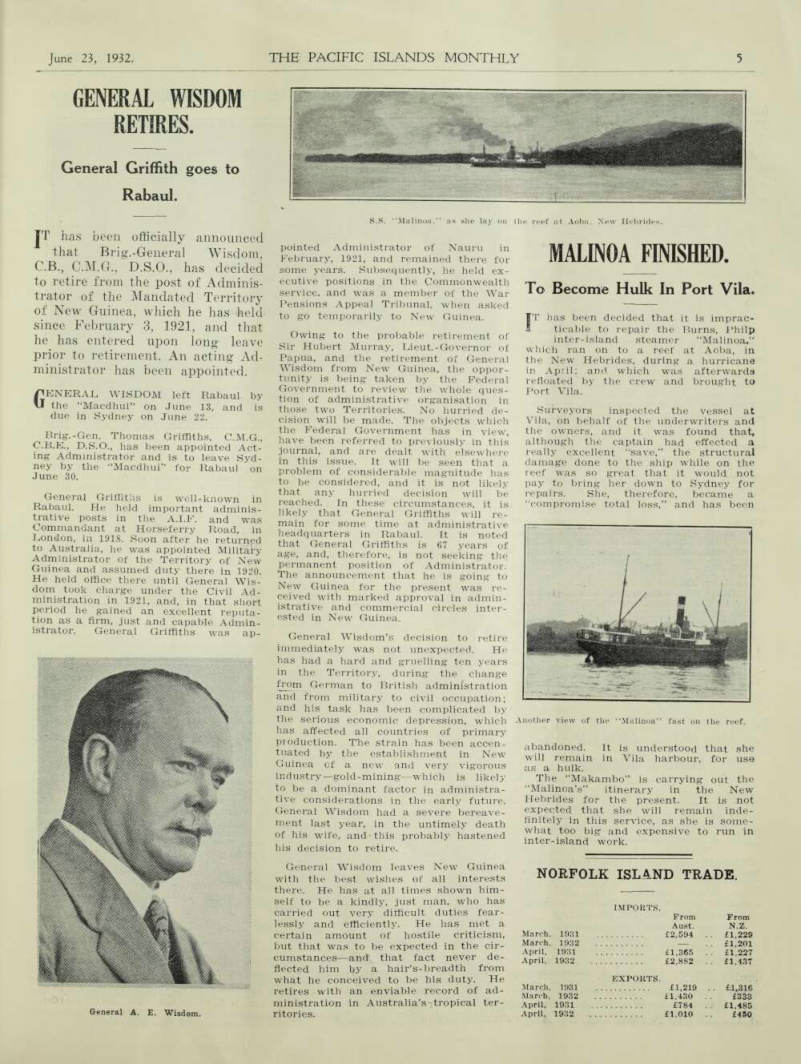
S.S. “Malinoa,” as she lay on the reef at Aoba, New Hebrides.
Malinoa Finished.
To Become Hulk In Port Vila.
IT has been decided that it is imprac ticable to repair the Burns, Philp inter-island steamer “Malinoa," which ran on to a reef at Aoba, in the New Hebrides, during a hurricane in April; and which was afterwards refloated by the crew and brought to Port Vila.
Surveyors inspected the vessel at Vila, on behalf of the underwriters and the owners, and it was found that, although the captain had effected a really excellent “save,” the structural damage done to the ship while on the reef was so great that it would not pay to bring her down to Sydney for repairs. She, therefore, became a “compromise total loss,” and has been
abandoned. It is understood that she will remain in Vila harbour, for use as a hulk.
The “Makambo” is carrying- out the “Malinoa’s” itinerary in the New Hebrides for the present. It is not expected that she will remain inde finitely in this service, as she is some what too big and expensive to run in inter-island work.
Another view of the “Malinoa” fast on the reef.
Norfolk Island Trade.
March, 1931
Imports,
From Aust. £2,594 From N.Z. £1,229 March, 1932 — £1,201 April, 1931 £1,365 £1,227 April, 1932 £2,882 £1,437 March, 1931
Exports.
£1,219 . . £1,316 March, 1932 £1,430 £333 April, 1931 £784 £1,485 April, 1932 £1,010 £450
"Obscure.”
Future Of Copra Is
AN interesting summary of the copra market, as seen by the London merchant, is contained in a recent letter received by the editor from Mr Roy Fischel, of Messrs. L. M. Fischel & Co., Ltd., 36 Mincing Lane, London. Mr.
Fischel says: “The copra market here, after being firm at the beginning of the year, has become rather dull during the past month or so, and prices, as you are fully aware, have reacted to a large ex tent from the highest prices of the year.
“Kiln-dried South Sea is being of fered in London to-day (end of April) for May/June shipment at £13/15/- to Marseilles, while for sundried South Sea there are possible buyers at £14/7/6 to London.
“The outlook generally is very ob scure, and one finds it impossible to take any view of the immediate future.
The great fall in all commodity and stock markets in America is continually affecting Europe to a great extent, and it is difficult to see when this depres sion in America is going to end. On the other hand, there are signs of slightly better times in England, and we hope, in the Empire as a whole.
“We have at last managed to balance our budget here by sacrifices of all sections of the community, and we think, if only some of the other coun tries—especially those who remain on the gold standard—were to be a little more helpful to the world as a whole, and not quite so selfish and money grabbing, the world would soon turn round and we would have better busi ness for all.
“Until this takes place we think it is left to the countries of the British Em pire to work together for each other’s benefit, and not for any one in particu lar. The writer feels that by doing this we should be able to keep our heads above water,’ and then wait until others come to their senses, and instead of being money-grabbing, try to be of service to the world as a whole.”
Mr. Reg. Hockings.
Death at Makassar.
THE death of Mr. Reg. Hockings, O.B.E., a very well-known iden tity of Torres Straits, occurred at Makassar, Dutch East Indies, on June 5, following an operation.
Mr. Hockings, who spent some 30 years in the East Indies and Thurs day Island, was the founder of the Wanetta Co., one of the leading Thurs day Island pearling companies. He was an expert in all matters relating to pearl shell and its recovery.
During the war, Mr. Hockings as sisted the naval authorities in an ad visory capacity, and was decorated for his services.
He was the owner of a plantation in the Celebes, and of recent years had spent most of his time between there and Thursday Island. At T.I., he acted as vice-consul for the Netherlands.
Deceased was about 60 years of age.
“Pat,” Of The Trobriands.
THE beautifully-illustrated “Woman’s Journal” (London) having as its cover picture this month a splendid coloured reproduction of the famous picture by Shannon, of Lady Diana Cooper, the most beautiful woman of her time, as a child, I venture to send you my photographic study of the most beautiful child I have met with in Aus tralasia —during thousands of miles of travel as artist for the “Illustrated London News,” or on scientific research work.
I offered this picture to the editor of the “Sydney Mail,” but he said, as it was not a picture of an Australian child (Papua is not Australian to him), it was of no interest to his public.
But the child struck me as being so like the subject of the above celebrated picture, that I wanted Australians to see what these lonely islands of the far north can produce: by parental care, the pure air of the S.E. trade-winds, and an ancient, aristocratic heredity.
When I saw this lovely child last August, I thought of Grace Crowell’s “Prayer After Pain”: How can he thank Thee, Lord, for the good grain Who has not conquered the thistle, briar and weed?
How can he thank Thee for the sweet, wild rain Who has not trod parched lands above dead seed ?
How can he lift a grateful heart for peace Who has not known some red-lit battlefield? 0 Lord, how can he comprehend release Who has not felt at last an old wound healed?
Out of earth’s agony white flowers shine; Above the old scarred fields wild grasses run; Out of the crushed fruits of the sun comes wine; Out of the night—the morning star, the Sun.
For every hour of pain that we have had Even for these—Lord, help us to be glad!
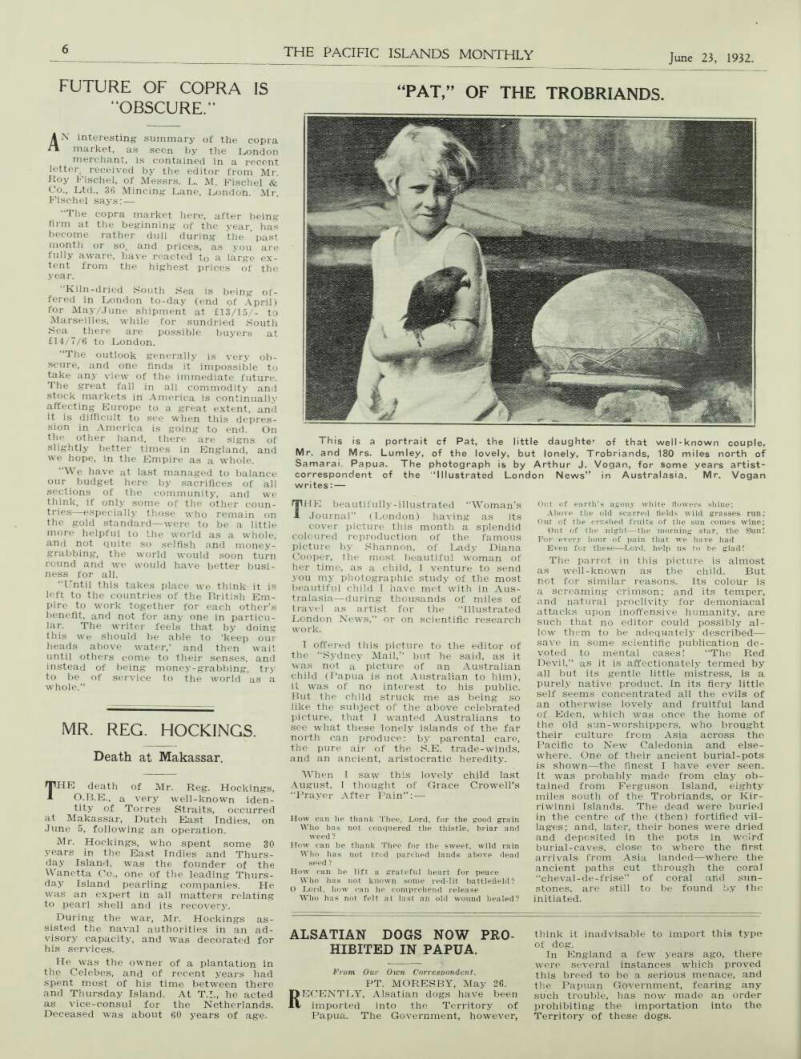
The parrot in this picture is almost as well-known as the child. But not for similar reasons. Its colour is a screaming crimson; and its temper, and natural proclivity for demoniacal attacks upon inoffensive humanity, are such that no editor could possibly al low them to be adequately described— save in some scientific publication de voted to mental cases! “The Red Devil,” as it is affectionately termed by all but its gentle little mistress, is a purely native product. In its fiery little self seems concentrated all the evils of an otherwise lovely and fruitful land of Eden, which was once the home of the old sun-worshippers, who brought their culture from Asia across the Pacific to New Caledonia and else where. One of their ancient burial-pots is shown —the finest I have ever seem It was probably made from clay ob tained from Ferguson Island, eighty miles south of the Trobriands, or Kir riwinni Islands. The dead were buried in the centre of the (then) fortified vil lages; and, later, their bones were dried and deposited in the pots in weird burial-caves, close to where the first arrivals from Asia landed —where the ancient paths cut through the coral “cheval-de-frise” of coral and sun stones, are still to be found by the initiated.
This is a portrait of Pat, the little daughter of that well-known couple, Mr. and Mrs. Lumley, of the lovely, but lonely, Trobriands, 180 miles north of Samarai Papua. The photograph is by Arthur J. Vogan, for some years artist correspondent of the ‘lllustrated London News” in Australasia. Mr. Vogan writes:
Alsatian Dogs Now Pro
Hibited In Papua.
From Our Own Corresvondent.
Pt. Moresby, May 26.
RECENTLY, Alsatian dogs have been imported into the Territory of Papua. The Government, however,
think it inadvisable to import this type of dog.
In England a few years ago, there were several instances which proved this breed to be a serious menace, and the Papuan Government, fearing any such trouble, has now made an order prohibiting the importation into the Territory of these dogs.
More Chinese Leave
Apia.
From Our Own Correspondent.
Apia, May 27.
ANOTHER batch of over 70 Chinese coolies was repatriated on May 26 by the French steamer “Ville de Verdun.”
These coolies had been mostly out of work for a considerable time, and loaf ing about the streets, sometimes steal ing poultry and foodstuffs, or living on tbeir compatriots.
Many planters have dismissed part of their labour staffs, as the cocoa crop is picked and, as the lean season is ooming, expenses have to be cut down to bedrock.
Pacific.
Phosphate From Central
IN the Senate, on May 12, Senator J.
B. Hayes made enquiries regarding phosphates supplied to Australia for the year 1930-31.
The questions asked by the Senator and the replies given were as follows: What is the number of tons of phosphates supplied by the Phosphates Commission to manu facturers in Australia during the year ended June 30, 1931? —393,000 tons (including 123,000 tons obtained from sources other than Nauru and Ocean Island).
What is the total price charged for same, f.o.b. at port of shipment?—Nauru, 19/6 per ton; Ocean Island, 22/- per ton. The total charge (including cost, freight and insurance) to manufacturers in Australia for phosphate sup plied from other sources was 45/- per ton.
What are the freight charges on same, per ton?—Freight and insurance, 20/9 per ton on phosphate from Nauru and Ocean Island, plus 3/6 per ton to cover excess cost of phosphate from other sources.
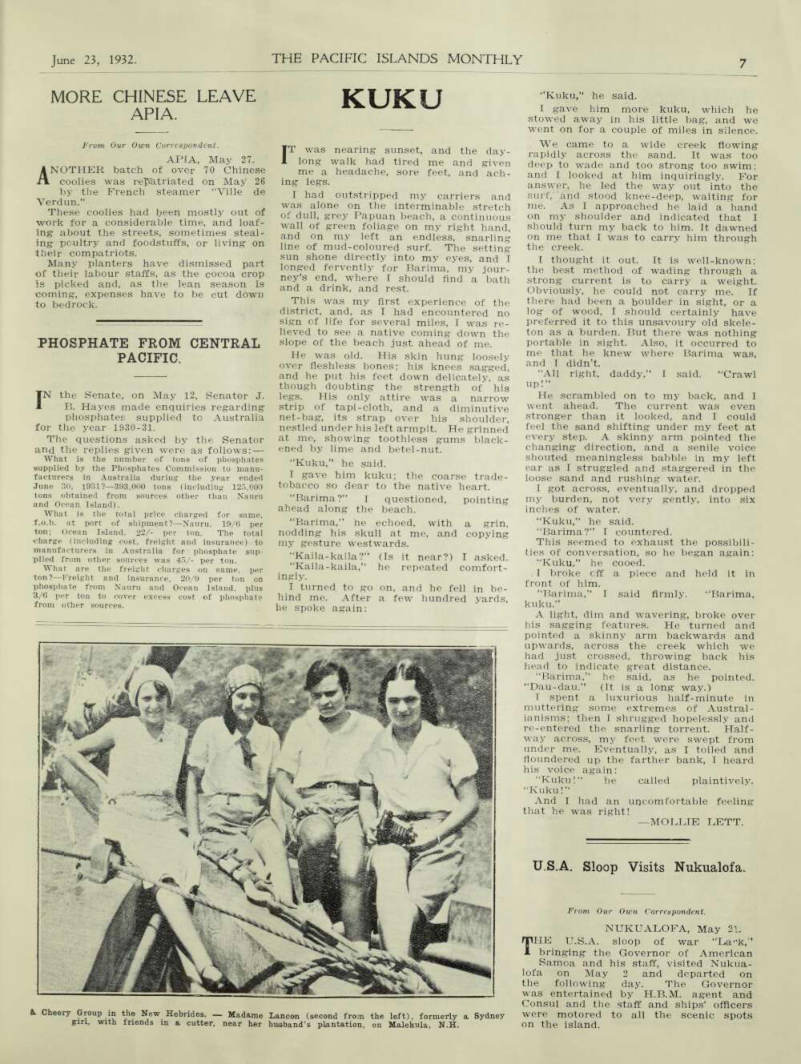
Cheery Group in the New Hebrides. Madame Lancon (second from the left), formerly a Sydney girl, with friends in a cutter, near her husband's plantation, on Malekula, N.H.
Kuku
IT was nearing sunset, and the day long walk had tired me and given me a headache, sore feet, and ach ing legs.
I had outstripped my carriers and was alone on the interminable stretch of dull, grey Papuan beach, a continuous wall of green foliage on my right hand, and on my left an endless, snarling line of mud-coloured surf. The setting sun shone directly into my eyes, and I longed fervently for Barima, my jour ney’s end, where I should find a bath and a drink, and rest.
This was my first experience of the district, and, as I had encountered no sign of life for several miles, I was re lieved to see a native coming down the slope of the beach just ahead of me.
He was old. His skin hung loosely over fleshless bones; his knees sagged, and he put his feet down delicately, as though doubting the strength of his legs. His only attire was a narrow strip of tapi-cloth, and a diminutive net-bag, its strap over his shoulder, nestled under his left armpit. He grinned at me, showing toothless gums black ened by lime and betel-nut.
“Kuku,” he said.
I gave him kuku; the coarse trade tobacco so dear to the native heart.
“Barima?” I questioned, pointing ahead along the beach.
“Barima,” he echoed, with a grin, nodding his skull at me, and copying my gesture westwards.
“Kaila-kaila?” (Is it near?) I asked.
“Kaila-kaila,” he repeated comfort ingly.
I turned to go on, and he fell in be hind me. After a few hundred yards, he spoke again:
“Kuku,” he said.
I gave him more kuku, which he stowed away in his little bag, and we went on for a couple of miles in silence.
We came to a wide creek flowing rapidly across the sand. It was too deep to wade and too strong too swim; and I looked at him inquiringly. For answer, he led the way out into the surf, and stood knee-deep, waiting for me. As I approached he laid a hand on my shoulder and indicated that I should turn my back to him. It dawned on me that I was to carry him through the creek.
I thought it out. It is well-known; the best method of wading through a strong current is to carry a weight.
Obviously, he could not carry me. If there had been a boulder in sight, or a log of wood, I should certainly have preferred it to this unsavoury old skele ton as a burden. But there was nothing portable in sight. Also, it occurred to me that he knew where Barima was, and I didn’t.
“All right, daddy,” I said. “Crawl up!”
He scrambled on to my back, and I went ahead. The current was even stronger than it looked, and I could feel the sand shifting under my feet at every step. A skinny arm pointed the changing direction, and a senile voice shouted meaningless babble in my left ear as I struggled and staggered in the loose sand and rushing water.
I got across, eventually, and dropped my burden, not very gently, into six inches of water.
“Kuku,” he said.
“Barima?” I countered.
This seemed to exhaust the possibili ties of conversation, so he began again: “Kuku,” he cooed.
I broke cff a piece and held it in front of him.
“Barima,” I said firmly. “Barima, kuku.”
A light, dim and wavering, broke over his sagging features. He turned and pointed a skinny arm backwards and upwards, across the creek which we had just crossed, throwing back his head to indicate great distance.
“Barima,” he said, as he pointed.
“Dau-dau.” (It is a long way.) I spent a luxurious half-minute in muttering some extremes of Austral ianisms; then I shrugged hopelessly and re-entered the snarling torrent. Half way across, my feet were swept from under me. Eventually, as I toiled and floundered up the farther bank, I heard his voice again: “Kuku!” he called plaintively.
“Kuku! ”
And I had an uncomfortable feeling that he was right!
Mollie Lett.
U S.A. Sloop Visits Nukualofa.
From Our Own Correspondent.
Nukualofa, May 21.
THE U.S.A. sloop of war “Lark,” bringing the Governor of American Samoa and his staff, visited Nukua lofa on May 2 and departed on the following day. The Governor was entertained by H.B.M. agent and Consul and the staff and ships’ officers were motored to all the scenic spots on the island.
Tropicalities
THLRSDAY ISLAND officials receive some weird letters occasionally. The following specimen was addressed to a certain department which has charge of natives’ money, and from which sup plies are drawn as required. The lib eral allowance of the word “please” in the letter is typical of the local Is lander, who is never more polite than when he is trying to get something out of the white man: “Please, Mr.—, I wanting some money, please. Please, my father and mother got no tucker or blankets and I want to buy some for them. Please, Mr.—, wives and children are easy got, but fathers and mothers—NO. . . .” * * * STRANGE how the name of Lang can act like a tonic, in some circum stances! Taxpayers in the Solomons, for instance, used considerable ink and some strong adjectives not long ago in presenting their wretched plight—much money to pay out, a sheltered public service to support, a policy of laissez faire to combat, and so on. Then it was suggested that the Solomons mignt be removed from the British Colonial Office control, and handed over to Aus tralia, to be administered along with New Guinea and Papua. Immediately, what a panic and scurry! “What!” cried the Solomon Islanders. “Be taken away from the kindly beneficent rule of Britain and handed over to that coun try of lunatic demagogues and bush rangers! Never! Why, if that man Lang hears that we’ve got £60,000 or £70,000 saved up against a rainy day— the result of our good government— nothing will save our Treasury from his minions. Let Australian learn to govern herself, before trying to govern us!” And appreciative and even affec tionate things are said about the Resi dent Commissioner, Mr. Ashley, whose term of office is drawing to an end.
All of which only goes to show how necessary it is to keep the Australian Islands administration clear of party politics, in every shape and form. * * * AS an example of the kind of nonsense that is published about the Pacific Islands, we reproduce the following paragraph. It was written by a recent visitor to Nauru, published in an Aus tralian journal, and re-published in the Mid-Pacific Magazine (Honolulu). Mem bers of the Stanley Expedition, par ticularly, will be interested in the ref erence to Rennel Island; while planters on Malaita will raise a loud cheer; A few days after passing Wreck Reef we came in sight of the Solomons, the first island we sighted being Rennel Island. It is densely wooded and very thickly populated. No white men have visited it since 1897, and the in habitants still practice cannibalism. Next morning we passed between two of the largest islands, San Christoval and Malaita. We saw some of the natives on Malaita, but when our ship’s siren was sounded, they turned and quickly bolted into the bush, evidently fright ened by the sound. It seems strange to us that though these islands were discovered 400 years ago, cannibalism and head-hunting still go on, but so it is.
THIS scribe entered, a city tea-room, and noted a table occupied by W.
R. Carpenter, J. A. Carpenter and A.
E. Barton. The latter, in his serious moments, is a well-known accountant.
“W.R.” gave a “view-halloa.” “Come here, Mr. Pacific Monthly,” he cried.
“Come and hear Barton’s new method of preventing malaria.”
I was all attention, immediately; and “J.A.” pricked up his ears.
“What’s this, Barton?” he demanded.
“Another new drug?”
“No,” said the solemn Mr. Barton.
“This is simple. When you are in danger of malaria, you get some grease —dripping or butter will do—and you smear it evenly over the exposed parts of your face and hands.”
“Sounds pretty messy,” remarked “J.A.” “What’s the idea, anyway?”
“Well, you see, the old lady mosquito comes along, and tries to dig in her beak, but her legs slip from under her, and she can’t get home any way. And so you don’t get malaria. See?”
“J.A.” eyes the criminal severely.
“Some day, Barton, you will die in a nasty way,” he said. “And it won’t be from malaria!”
“W.R.’s” shout of laughter was heard in O’Connell Street, and they hurried in to put out the fire. * * * THE shipping companies of other na tions continue to display a keen in terest in the Pacific carrying trade —one result of the depression, which has sent the transport organisations of every country on the hunt for anything which will earn bread and butter. The Americans are now catering vigorously for Fiji and Auckland; the French are already calling at Suva on their run from Tahiti to Noumea, and are now suggesting that they may call at Apia also; the Germans continue to run their cargo steamer, the “Bremer haven,” from China down to New Guinea; and the Dutch recently insti tuted a new service, by which their vessel from the East Indies, via Papuan and New Guinea ports, calls at New Hebrides and New Caledonia before proceeding to Sydney. * * * WE hear, almost daily, of the regis tration of new companies to exploit some alleged source of great wealth in the Islands. We have referred, in this and previous issues, to a number of them; but still they come. The lat est is Pacific-gold and Platinum, Ltd., with a nominal capital of £5,000, “to equip and despatch an expedition to in vestigate gold-bearing country in the British Solomon Islands.” The directors named are D. Wentworth, F. E. Wade and G. E. Bray; and the company re ceived a good deal of publicity because it was one of several companies re cently registered in Canberra —a sys tem now being followed to avoid the murderously heavy taxation in the various States.
AN example of New Guinea ingenuity was noted on a little canvas bag, containing 55 ounces of raw gold, received by Messrs. Burns, Philp and Co., Ltd., from the Morobe field the other day. The sender wanted to seal the package, but he had no seal—only wax. So he melted the wax into the tin-top of a beer-bottle, passed the string which bound the bag through the tin-top and the wax, and impressed upon it what appears to have been the triangular device on the top of a cer tain brand of tooth-paste. It looked most impressive—and it certainly served its purpose. * * * * WHALE Oil from the Antarctic is still an enormously disturbing factor in the world’s copra market. Pro duction has been reduced; but over production was so marked in 1930 and 1931 that huge stocks were accumu lated —much of which are still in exist ence—and the rate of production is still far greater than circumstances war rant. It is certain that, as the years pass, the Antarctic will be depleted of whales—just as all other oceans have been depleted—but that is poor con solation to the man who is trying to make his plantation pay in this present year of grace. The following is from a recent issue of the London “Times”: “The Whaling Companies’ Association, excluding Unilever, Laboremus, Ltd. (says the Oslo correspondent of The Times), has reached an agreement lim iting the coming season’s whale-oil pro duction to about 50 per cent, of the present capacity of the world whaling fleets. The total is expected to reach 2,000,000 barrels.”
Advertisements & other items, p. 10 (1 item)
Hotel Imperial
Darlinghurst Road, KING’S CROSS.
Sydney's Acknowledged Leading Private Hotel.
TARIFF:
Inclusive, 10/- daily; 55/- to 63/- weekly. Room and Breakfast, 7/6 daily; 37/6 to 42/- weekly.
Running Hot and Cold Water in every Bedroom.
Electric Elevator. Garages adjacent. Nous parlons Francais. Address Correspondence to
MANAGER.
Telephone: FL 3051 (3 Lines).
Telegrams: Imperial-King’s Cross, Sydney.
About Islands People.
Mr. Roland Green, M.P., accompanied by Mrs. Green, left for a trip to Papua and New Guinea by the Montoro, on June 8. * * * Mr. J. A. Carpenter, a director of Messrs. W. R. Carpenter and Company, Limited, returned to Sydney on the Nellore on May 20 from a tour of New Quinea. * * * Rev. Father J. McHardt, S.M., who for the past three years has been en gaged in Marist missionary work fn 1 the North Solomon Islands, returned to Sydney in May, and is now a patient in Lewisham private hospital * * * Lieutenant-Colonel J. Amalric, com mander of French troops in the Pacific Islands, and Madame Amalric arrived on June 1 by the Laperouse from Noumea to spend two months’ holiday in Sydney. * * * Captain Tramoni, commander of the Messageries Maritimes steamer La perouse, arrived at Sydney from Noumea in charge of that vessel on June 1 for the last time. With his family he left for France by the Eridan on June 7 to take command of a vessel trading from France. Captain R. Corenwinder is the new commander of the Laperouse. * * * Mr. P. F. Parkes, a director of W.
S. Tait and Co., Ltd., South Sea Island agents, of Sydney, Mr. J. O’Rourke, ac countant of a New Caledonia chrome mining company, and Mr. N. Hagen, planter and business man in the New Hebrides, arrived in Sydney by the La perouse from Noumea on June 1. * * * The Rev. G. H. and Mrs. Eastman, L.M.S. missionaries in the Gilbert Is lands, who are on long furlough, left Sydney for England by the Ballarat on June 7. * * * Rev. Susie J. Rankin, missionary for the L.M.S. at Saroa, Papua, sailed for England by the Ballarat on June 7. Her husband, the Rev. R. Rankin, returned to Saroa by the Montoro. * * * Lieut.-Col. Orde Lees, a journalist re presenting “The Japan Advertiser,’’ and formerly the correspondent in Japan for the London “Times,” left Papeete by the Ville de Verdun. The Colonel has been making an extensive tour of the Pacific Islands, having already visited all the western groups mandated to Japan, the Philippines, Dutch East Indies, Borneo, Papua, New Caledonia, and several other important islands. He has become a regular reader of the P.I. Monthly, and has stated that, without its aid, it would have been almost impossible to make the necessary steamship connections as expeditiously as he has been able to.
Captain A. Liston-Blyth, who has been in Papua for some years as resi dent manager of the property of the British, Australasian and Pacific Devel opment Co., Ltd., on the Paibuna River, Delta Division, arrived in Sydney early in May on business connected with the company. The original plans of the en terprise embraced the production of sago, and power alcohol from sago and nipa palms; but activities have hung fire somewhat owing to the depression and consequent difficulty in obtaining capital. * * * Mrs. Allen Innes, a well-known resi dent of Salamaua, New Guinea, is ac tively at work at the present time en deavouring to form an Islands Women’s Association. It is proposed, if the move ment is successful, to affiliate with the Country Women’s Association of Aus tralia. It is reported that Mrs. Innes is endeavouring to interest Mrs. Walstab, Mrs. Page and Mrs. Backhouse (of Rabaul), Mrs. Bunting (of Samarai), and Mrs. Lyons (of Port Moresby); and is endeavouring to get into communica tion with ladies resident in Fiji and Samoa, who might be interested in the idea.
Mr. C. V. Allom has been recently appointed Inspector-General for Messrs.
O. F. Nelson and Co., Ltd., Samoa. Mr.
Allom was for over 30 years in the em ploy of Messrs. Burns, Philp & Co., Ltd., for which firm he was manager at Apia for six years, prior to his taking over the management of their branch at Sourabaya, Java. Before entering the service of Burns, Philp & Co., Mr. Allom had ten years’ banking experience in Queensland.
Mr, J. Schroeder, who left the Solomon Islands at the end of last year, after having been, a resident there for over 28 years, has now taken up his resi dence at Kureelpa, near Nambour, in Queensland. * * * Mr. J. H. L. Waterhouse, F.R.G.S., a well-known botanist, arrived from Bougainville recently. He will return to New Guinea by the “Macdhui” on June 30, and will go on to Bougainville, to resume his work for the Royal Gardens at Kew, London. He will also collect specimens for the Yale University School of Forestry.
Fire Destroys Apia Home.
From Our Own Correspondent.
Apia. May 21.
A FIRE destroyed the residential home of Mr.
Y. Ah Mn, the director of the Union Gar age Co., Ltd., at Lobopa, Apia, on May 15.
The fire broke out at 10 p.m. during the absence of the owner and his family, who had gone to their country residence at Leauvaa.
Though the outbreak was apparently noticed very soon, and the police appeared on the scene promptly, nothing could be done to save the house, which was prettily, situated on the Gasegase Stream and was a roomy, two-storeyed building in very beautiful surroundings.
Tongan Exchange
Position Is Puzzling.
From Our Own Correspondent.
Nukualofa, May 1.
THE articles in the March number of the P.I.M., regarding- copra prices paid in Rabaul to producers, has made local planters put on their think ing caps, and they are wondering where the difference between the N.G. price (£13/10/-) and the Tongan price (£8) comes in.
The rather vague explanation has been offered that it is due to the ex change, but as the exchange seems al ways to operate against dummy, whether a buyer or a seller, he is still very much in the dark.
The exchange question, as far as Tonga is concerned, is extremely puz zling. Cheques on Sydney banks sent to Auckland are debited with about 20 per cent, exchange, while Auckland cheques sent to Sydney are credited with only 4 per cent, (my own experi ence), so who is the lucky one who makes the rake off.
Drafts on Sydney are obtainable locally at par, but on Auckland they are unprocurable. There certainly seems to be a catch in it somewhere.
To make matters worse, the Govern ment has decided to limit Post Office orders to £10 per person or firm on New Zealand, so the smaller traders are having great difficulty in transfer ring money to that country, but the big firms are taking it very philosophically, and no wonder.
Whether the prohibition is wise re mains to be seen, but the position of the Government is a difficult one, par ticularly now that the banana ship ments cannot be relied upon to produce funds in Auckland, as was hoped. The net result of the prohibition is that the general European public feels that the Government has acted inconsiderately and in a manner that may bring reper cussions from New Zealand.
Advertisements & other items, p. 11 (1 item)
Pumpmobil
Light & Portable MOTOR PUMPS.
Weight about 140 lbs. Automatic Priming. Reliable and Efficient.
Especially suitable for Prospecting and all Sluicing requirements.
Particulars from
NELSON & ROBERTSON,
12 Spring Street SYDNEY.
Fiji’S Strong Trade
Position.
RECENT reports disclose the extra ordinarily sound financial position of the Crown Colony of Fiji.
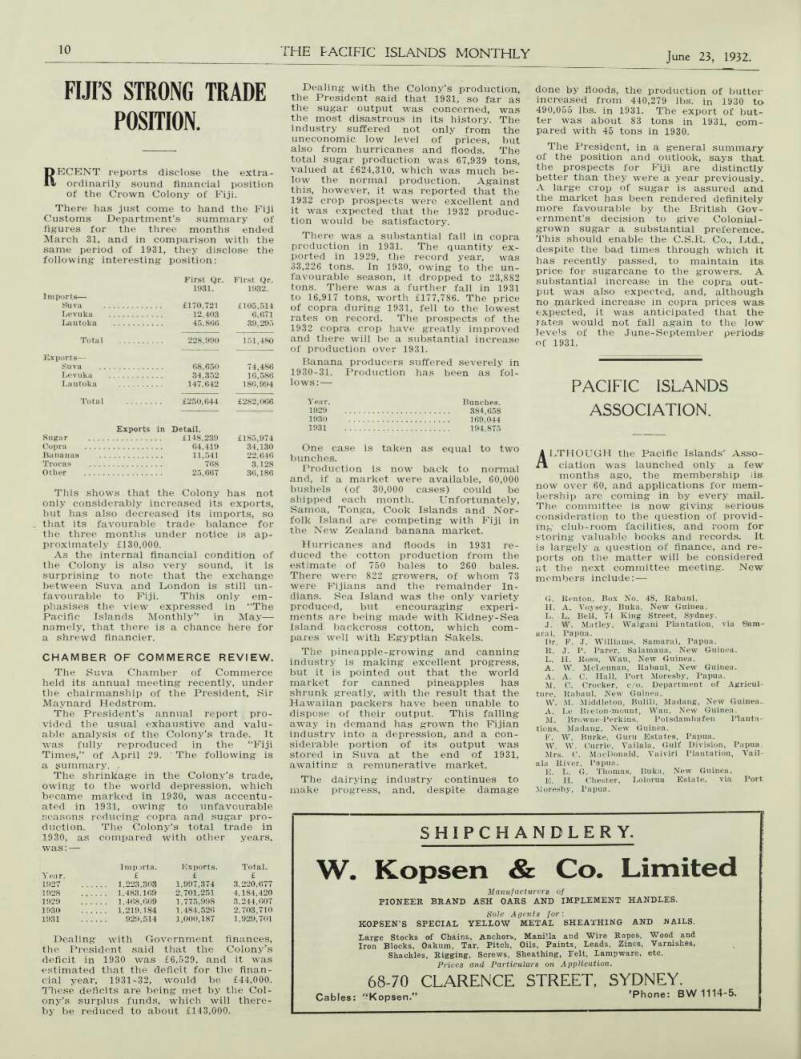
There has just come to hand the Fiji Customs Department’s summary of figures for the three months ended March 31, and in comparison with the same period of 1931, they disclose the following interesting position:
This shows that the Colony has not only considerably increased its exports, but has also decreased its imports, so that its favourable trade balance for the three months under notice is ap proximately £130,000.
As the internal financial condition of the Colony is also very sound, it is surprising to note that the exchange between Suva and London is still un favourable to Fiji. This only em phasises the view expressed in “The Pacific Islands Monthly” in May— namely, that there is a chance here for a shrewd financier.
Chamber Of Commerce Review.
The Suva Chamber of Commerce held its annual meeting recently, under the chairmanship of the President, Sir Maynard Hedstrom.
The President’s annual report pro vided the usual exhaustive and valu able analysis of the Colony’s trade. It was fully reproduced in the “Fiji Times,” of April 29. The following is a summary. .
The shrinkage in the Colony’s trade, owing to the world depression, which became marked in 1930, was accentu ated in 1931, owing to unfavourable seasons reducing copra and sugar pro duction. The Colony’s total trade in 1930, as compared with other years, was:
Dealing with Government finances, the President said that the Colony’s deficit in 1930 was £6,529, and it was estimated that the deficit for the finan cial year, 1931-32, would be £44,000.
These deficits are being met by the Col ony’s surplus funds, which will there by be reduced to about £143,000.
Dealing with the Colony’s production, the President said that 1931, so far as the sugar output was concerned, was the most disastrous in its history. The industry suffered not only from the uneconomic low level of prices, but also from hurricanes and floods. The total sugar production was 67,939 tons, valued at £624,310, which was much be low the normal production. Against this, however, it was reported that the 1932 crop prospects were excellent and it was expected that the 1932 produc tion would be satisfactory.
There was a substantial fall in copra production in 1931. The quantity ex ported in 1929, the record year, was 33,226 tons. In 1930, owing to the un favourable season, it dropped to 23,882 tons. There was a further fall in 1931 to 16,917 tons, worth £177,786. The price of copra during 1931, fell to the lowest rates on record. The prospects of the 1932 copra crop have greatly improved and there will be a substantial increase of production over 1931.
Banana producers suffered severely in 1930-31. Production has been as fol lows:
One case is taken as equal to two bunches.
Production is now back to normal and, if a market were available, 60,000 bushels (of 30,000 cases) could be shipped each month. Unfortunately, Samoa, Tonga, Cook Islands and Nor folk Island are competing with Fiji in the New Zealand banana market.
Hurricanes and floods in 1931 re duced the cotton production from the estimate of 750 bales to 260 bales.
There were 822 growers, of whom 73 were Fijians and the remainder In dians. Sea Island was the only variety produced, but encouraging experi ments are being made with Kidney-Sea Island backcross cotton, which com pares well with Egyptian Sakels.
The pineapple-growing and canning industry is making excellent progress, but it is pointed out that the world market for canned pineapples has shrunk greatly, with the result that the Hawaiian packers have been unable to dispose of their output. This falling away in demand has grown the Fijian industry into a depression, and a con siderable portion of its output was stored in Suva at the end of 1931, awaiting a remunerative market.
The dairying industry continues to make progress, and, despite damage
done by floods, the production of butter increased from 440,279 lbs. in 1930 to. 490,055 lbs. in 1931. The export of but ter was about 83 tons in 1931, com pared with 45 tons in 1930.
The President, in a general summary of the position and outlook, says that the prospects for Fiji are distinctly better than they were a year A large crop of sugar is assured and the market has been rendered definitely more favourable by the British Gov ernment’s decision to give Colonial grown sugar a substantial preference.
This should enable the C.S.R. Co., Ltd., despite the bad times through which it has recently passed, to maintain its price for sugarcane to the growers. A substantial increase in the copra out put was also expected, and, although no marked increase in copra prices was expected, it was anticipated that the rates would not fall again to the low levels of the June-September of 1931.
Imports— Suva First Qr. 1931. £170,721 First Qr. 1932. £105,514 6,671 39,295 Levuka 12,403 Lautoka 45,860 Total 228,990 151,480 Exports— Suva 68,650 74,486 10,586 186,994 Levuka 34,352 Lautoka 147,642 Total £250.644 £282,066 Sugar Exports in Detail, £148,239 £185,974 Copra 64,419 34,130 22,646 3.128 Bananas . . 11,541 Trocas 768 Other 25,667 36,186
Year.
Bunches. 1929 384,658 1930 169.044 1931
Imports. Exports. Total.
Year. £ £ £ 1927 1,223.303 1,997,374 3,220,677 1928 1.483.169 2,701,251 4,184,420 1929 1,468,609 1,775,998 3,244,607 1930 1,219,184 1.484,526 2.703,710 1931 929,514 1,000,187 1,929,701
Pacific Islands
Association.
ALTHOUGH the Pacific Islands’ Asso ciation was launched only a few months ago, the membership is now over 60, and applications for mem bership are coming in by every mail.
The committee is now giving serious consideration to the question of provid ing club-room facilities, and room for storing valuable books and records. It is largely a question of finance, and re ports on the matter will be considered at the next committee meeting. New members include: G. Kenton, Box No. 48, Rabaul.
H. A. Voysey, Buka, New Guinea.
L. L. Bell, 74 King Street, Sydney.
J. W. Matley, Waigani Plantation, via Sam arai, Papua.
Dr. F. J. Williams, Samarai, Papua.
R. J. P. Parer, Salamaua, New Guinea.
L. H. Ross, Wau, New Guinea.
A. W. McLennan, Rabaul, New Guinea.
A. A. C. Hall, Port Moresby, Papua.
M. C. Crocker, c/o. Department of Agricul ture, Rabaul, New Guinea.
W. M. Middleton, Bulili, Madang, New Guinea.
A. Le Breton-mount, Wau, New Guinea.
M. Browne-Perkins, Potsdamhafen Planta tions, Madang, New Guinea.
F. W. Burke, Guru Estates, Papua.
W. W. Currie, Vailala, Gulf Division, Papua Mrs. C. MacDonald, Vaiviri Plantation, Vail ala River, Papua.
E. L. G. Thomas, Buka, New Guinea.
E. H. Chester, Lolorua Estate, via Port Moresby, Papua.
Advertisements & other items, p. 12 (1 item)
W. Kopsen & Co. Limited
SHIPCHANDLERY.
Manufacturers of PIONEER BRAND ASH OARS AND IMPLEMENT HANDLES.
Sole Agents for: KOPSEN’S SPECIAL YELLOW METAL SHEATHING AND NAILS.
Large Stocks of Chains, Anchors, Manilla and Wire Ropes, Wood and Iron Blocks, Oakum, Tar, Pitch, Oils, Paints, Leads, Zincs, Varnishes, Shackles, Rigging, Screws, Sheathing, Felt, Lampware, etc.
Prices and Particulars on Application.
68-70 CLARENCE STREET, SYDNEY.
Cables: "Kopsen." 'Phone; BW 1114-5.
Early Papua.
An Old Newspaper and a Remarkable Coincidence.
THIS is the story of a somewhat re markable coincidence.
A friend in Melbourne sent to the editor of this journal a copy of a news paper, now defunct —The Australasian Sketcher, of December 16, 1885.
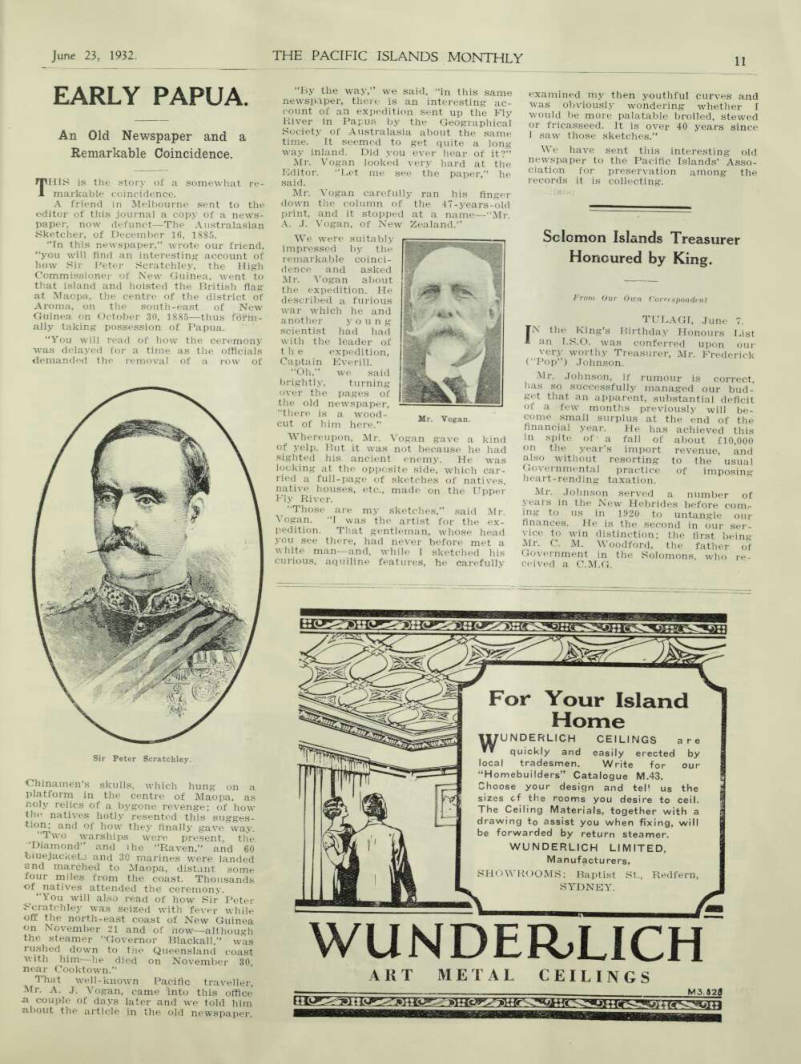
“In this newspaper,” wrote our friend, “you will find an interesting account of how Sir Peter Scratchley, the High Commissioner of New Guinea, went to that island and hoisted the British flag at Maopa, the centre of the district of Aroma, on the south-east of New Guinea on October 30, 1885 —thus form ally taking possession of Papua.
“You will read of how the ceremony was delayed for a time as the officials demanded the removal of a row of
Chinamen’s skulls, which hung on a platform in the centre of Maopa, as holy relics of a bygone revenge; of how the natives hotly resented this sugges tion; and of how they finally gave way.
“Two warships were present, the ‘Diamond” and ihe “Raven,” and 60 bluejackets and 30 marines were landed and marched to Maopa, distant some four miles from the coast. Thousands of natives attended the ceremony.
“You will also read of how Sir Peter Scratchley was seized with fever while off the north-east coast of New Guinea on November 21 and of how—although the steamer “Governor Blackall,” was rushed down to the Queensland coast with him—he died on November 30, near Cooktown.”
That well-known Pacific traveller, Mr. A. J. Vogan, came into this office a couple of days later and we told him about the article in the old newspaper.
“By the way,” we said, “in this same newspaper, there is an interesting ac count of an expedition sent up the Fly River in Papua by the Geographical Society of Australasia about the same time. It seemed to get quite a long way inland. Did you ever hear of it?”
Mr. Vogan looked very hard at the Editor. “Let me see the paper,” he said.
Mr. Vogan carefully ran his finger down the column of the 47-years-old print, and it stopped at a name—“ Mr.
A. J. Vogan, of New Zealand.”
We were suitably impressed by the remarkable coinci dence and asked Mr. Vogan about the expedition. He described a furious war which he and another young scientist had had with the leader of the expedition, Captain Everill.
“Oh,” we said brightly, turning over the pages of the old newspaper, “there is a wood cut of him here.”
Whereupon, Mr. Vogan gave a kind of yelp. But it was not because he had sighted his ancient enemy. He was looking at the opposite side, which car ried a full-page of sketches of natives, native houses, etc., made on the Upper Fly River.
“Those are my sketches,” said Mr.
Vogan. “I was the artist for the ex pedition. That gentleman, whose head you see there, had never before met a white man—and, while I sketched his curious, aquiline features, he carefully
examined my then youthful curves and was obviously wondering whether I would be more palatable broiled, stewed or fricasseed. It is over 40 years since I saw those sketches.”
We have sent this interesting old newspaper to the Pacific Islands’ Asso ciation for preservation among the records it is collecting.
Sir Peter Scratchley.
Mr. Vogan.
Honoured by King.
Solomon Islands Treasurer Honoured by King.
From Our Own Correspondent
Tulagi, June 7.
FN the King’s Birthday Honours List an I.S.O. was conferred upon our very worthy Treasurer, Mr. Frederick (“Pop”) Johnson.
Mr. Johnson, if rumour is correct, has so successfully managed our bud get that an apparent, substantial deficit of a few months previously will be come small surplus at the end of the financial year. He has achieved this in spite of a fall of about £10,000 on the year’s import revenue, and also without resorting to the usual Governmental practice of imposing
heart-rending taxation.
Mr. Johnson served a number of years in the New Hebrides before com ing to us in 1920 to untangle our finances. He is the second in our ser vice to win distinction; the first being Mr. C. M. Woodford, the father of Government in the Solomons, who re ceived a C.M.G.
Advertisements & other items, pp. 13-14 (2 items)
Wunder.Lich
For Your Island
Home
WUNDERLICH CEILINGS are
quickly and easily erected by local tradesmen. Write for our “Homebuilders” Catalogue M.43.
Choose your design and tell us the sizes cf the rooms you desire to ceil.
The Ceiling Materials, together with a drawing to assist you when fixing, will be forwarded by return steamer.
WUNDERLICH LIMITED,
Manufacturers, SHOWROOMS: Baptist St., Redfern,
SYDNEY.
WUNDER.LICH
ART METAL CEILINGS
M3.82fl
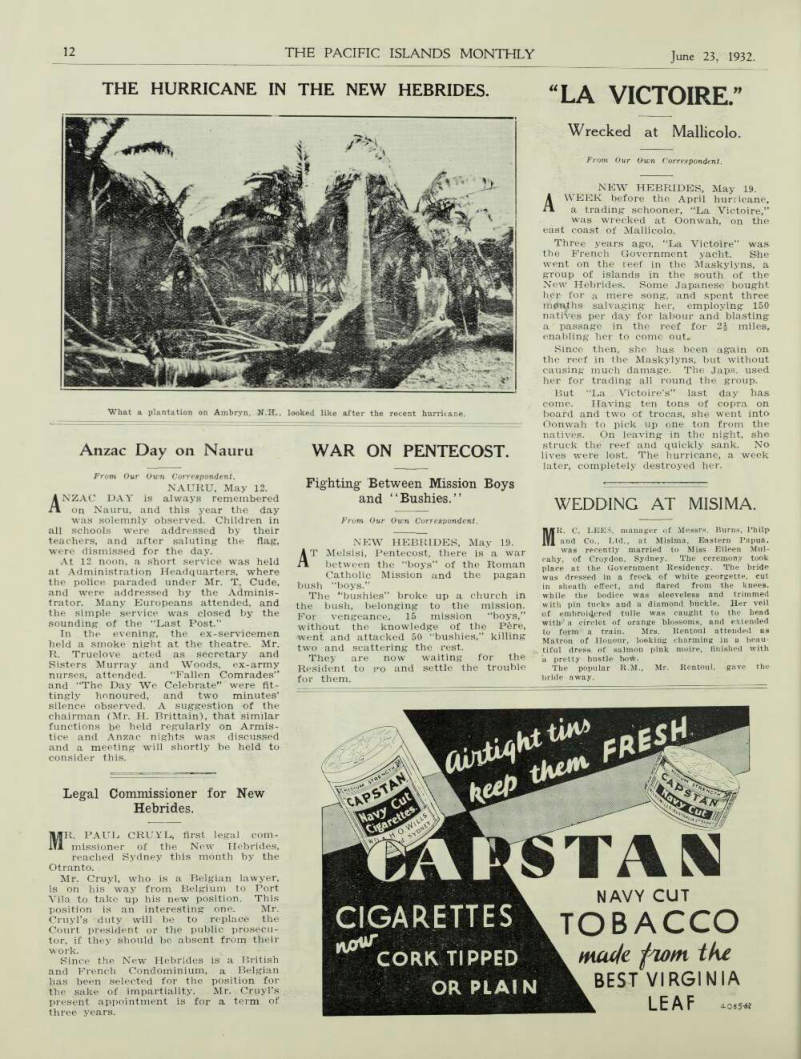
The Hurricane In The New Hebrides.
What a plantation on Ambryn, N.H., looked like after the recent hurricane.
Anzac Day on Nauru
From Our Own Correspondent.
Nauru, May 12.
ANZAC DAY is always remembered on Nauru, and this year the day was solemnly observed. Children in all schools were addressed by their teachers, and after saluting the flag, were dismissed for the day.
At 12 noon, a short service was held at Administration Headquarters, where the police paraded under Mr. T. Cude, and were addressed by the Adminis trator. Many Europeans attended, and the simple service was closed by the sounding of the “Last Post.”
In the evening, the ex-servicemen held a smoke night at the theatre. Mr.
R. Truelove acted as secretary and Sisters Murray and Woods, ex-army nurses, attended. “Fallen Comrades” and “The Day We Celebrate” were fit tingly honoured, and two minutes’ silence observed. A suggestion of the chairman (Mr. H. Brittain), that similar functions be held regularly on Armis tice and Anzac nights was discussed and a meeting will shortly be held to consider this.
Legal Commissioner for New
Hebrides.
MR. PAUL CRUYL, first legal com missioner of the New Hebrides, reached Sydney this month by the Otranto.
Mr. Cruyl, who is a Belgian lawyer, is on his way from Belgium to Port Vila to take up his new position. This position is an interesting one. Mr.
Cruyl’s duty will be to replace the Court president or the public prosecu tor, if they should be absent from their work.
Since the New Hebrides is a British and French Condominium, a Belgian has been selected for the position for the sake of impartiality. Mr. Cruyl’s present appointment is for a term of three years.
War On Pentecost.
Fighting Between Mission Boys and “Bushies.”
From Our Own Correspondent.
New Hebrides, May 19.
AT Melsisi, Pentecost, there is a war between the “boys” of the Roman Catholic Mission and the pagan bush “boys.”
The “bushies” broke up a church in the bush, belonging to the mission.
For vengeance, 15 mission “boys,” without the knowledge of the Pere, went and attacked 50 “bushies,” killing two and scattering the rest.
They are now waiting for the Resident to go and settle the trouble for them.
“La Victoire.”
Wrecked at Mallicolo.
From Our Own Correspondent.
New Hebrides, May 19.
A WEEK before the April hurricane, a trading schooner, “La Victoire,” was wrecked at Oonwah, on the east coast of Mallicolo.
Three years ago, “La Victoire” was the French Government yacht. She went on the reef in the Maskylyns, a group of islands in the south of the New Hebrides, Some Japanese bought her for a mere song, and spent three menths salvaging her, employing 150 natives per day for labour and blasting a passage in the reef for 2½ miles, enabling her to come out.
Since then, she has been again on the reef in the Maskylyns, but without causing much damage. The Japs, used her for trading all round the group.
But “La Victoire’s” last day has come. Having ten tons of copra on board and two of trocas, she went into Oonwah to pick up one ton from the natives. On leaving in the night, she struck the reef and quickly sank. No lives were lost. The hurricane, a week later, completely destroyed her.
Wedding At Misima.
MR. C. LEES, manager of Messrs. Burns, Philp and Co., Ltd., at Misima, Eastern Papua, was recently married to Miss Eileen Mui cahy, of Croydon, Sydney. The ceremony took place at the Government Residency. The bride was dressed in a frock of white georgette, cut in sheath effect, and flared from the knees, while the bodice was sleeveless and trimmed with pin tucks and a diamond buckle. Her veil of embroidered tulle was caught to the head with a circlet of orange blossoms, and extended to form a train. Mrs. Rentoul attended as Matron of Honour, looking charming in a beau tiful dress of salmon pink moire, finished with a pretty bustle boxL The popular R.M., Mr. Rentoul, gave the bride away.
Advertisements & other items, pp. 14-15 (1 item)
made fiom
CAPSTAN
CIGARETTES
CORK TIPPED
OR PLAIN
NAVY CUT
TOBACCO
made fiom
BEST VIRGINIA
LEAF 4-085
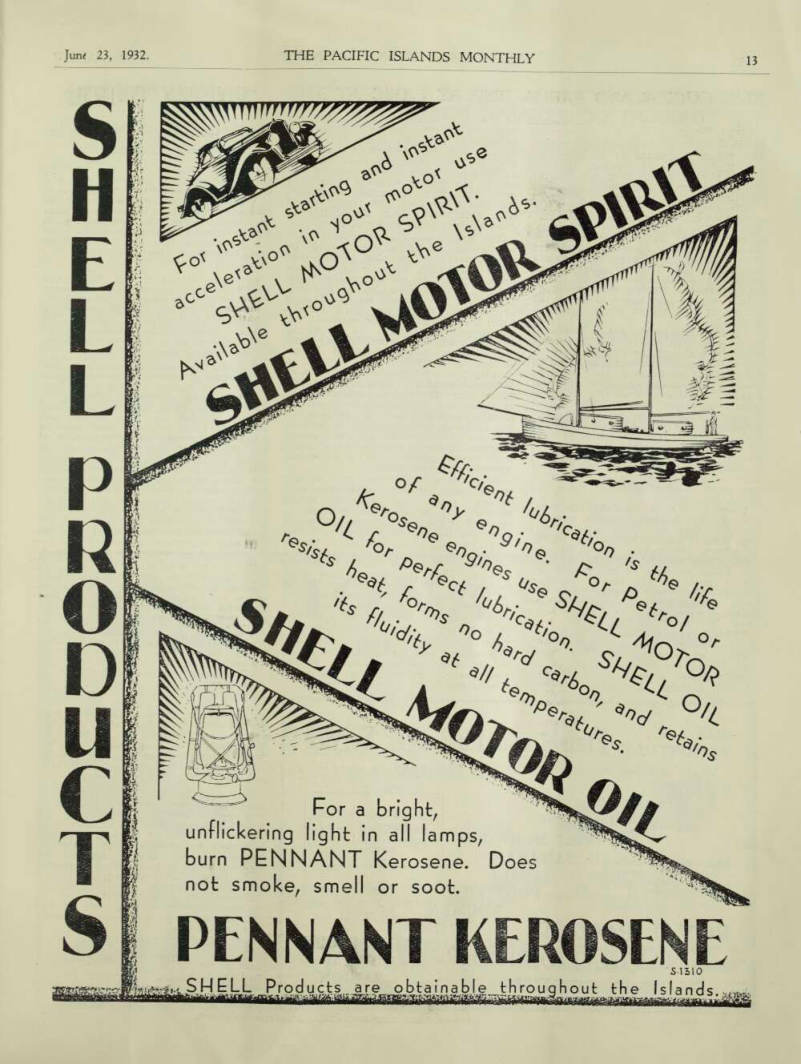
For instant starting and instant acceleration in your motor use
SHELL MOTOR SPIRIT
Available throughout the Islands
SHELL MOTOR SPIRIT
Efficient lubrication is the life of any engine. For Petrol or Kerosene engines use SHELL MOTOR OIL for perfect lubrication. SHELL OIL resists heat, forms no hard carbon, and retains its fluidity at all temperatures.
SHELL MOTOR OIL
For a bright, unflickering light in all lamps, burn PENNANT Kerosene. Does not smoke, smell or soot.
PENNANT KEROSENE
S 1310 ..SHELL Products are obtainable throughout the Islands
Thought Of Becoming Bedfellows.
NEW GUINEA AND PAPUA DISPLAY PANIC AT THE
REPORTS to hand indicate an extra ordinary amount of agitation in New Guinea and Papua, because of the alleged intention of the Federal authorities to “amalgamate” the two Territories.
The people of Papua say emphati cally that such an idea is not to their liking. The Returned Soldiers’ organ isation in New Guinea became so dis turbed over the so-called plan that they called a special meeting of Terri tory residents in Rabaul, on May 20, to consider the matter and make a strong protest to the Federal Government, It would be interesting to know the source of this report about “amalga mation.”
All that has happened—as indicated in the last issue cf “The Pacific Islands Monthly”—is that the Federal Govern ment has under serious consideration the plan of re-forming the adminis trative personnel of New Guinea, Papua, Northern Australia, Central Australia, Nauru and Norfolk Island, a special corps. The reasons for this proposal were set forth clearly in our last issue, and, from the point of view of efficiency and service, as well as the desirability of opening up opportunities for an attractive career for a good type of young man, it is difficult to see what possible objection there can be to the idea.
There is a further point to be con sidered, that Australia almost certainly will be asked, sooner or later, to ac cept added responsibilities in Pacific Islands administration. Without dis closing any secrets, we may say that the whole question of the future ad ministration of the British Solomon Islands is under consideration, and some official announcement in regard thereto may be made at a fairly early date, There is also the matter of the New 7 Hebrides. That thorny subject is dealt with elsewhere in this issue, but it may be said that the present position of the Condominium demands the attention of both Britain and Australia. If it
is possible to make some rearrange ment, whereby French pride and French commercial interests can be adequately protected, the obvious way out of the present impasse is to hand over the New Hebrides to British administration —and the task would fall, naturally, within the ambit of Australia’s Pacific responsibilities.
The suggestion that territories ad ministered by Australia should be amalgamated is palpably absurd —and could have been born only in ignor ance. Papua is an Australian terri tory. New Guinea is a territory owned for the present by the League of Nations, which has been handed over- to Australia, under mandate for administration. Nauru is in some what, though not exactly, a simi lar position, Norfolk Island is an Australian territory, but is not in exactly the same position as Papua or North Australia. The amalgamation of all these territories —apart from the fact that the mandates impose certain conditions —would not be practicable; but there is nothing at all to prevent the administrative officials being placed together in one corps, instead being kept, as at present, in a series of watertight compartments.
There is a report in “The Rabaul Times” to the effect that “It would appear that New Guinea, whose finances are in a sound position, in spite of world-wide depression, would have the burden of carrying a Terri tory (Papua), which has had to impose a four per cent, primage tax.” An examination of the two Territories does not show that one is verv much better than the other. Figures quoted in the Federal Parliament the other day show that Australia has given grants totalling no less than a quarter of a million to New Guinea since she took over the mandate.
However, nothing is to be gained by following up that subject, as the question of amalgamation has not arisen, nor is it likely to arise.
Advisory Council.
Early Constitution Likely in New Guinea.
SEVERAL matters connected with the administration of the Territories of New Guinea and Papua demand the personal attention of the Federal Min ister in Charge of Islands Affairs (Major C. W. C. Marr) and Major Marr had intended to visit the Territories by the “Macdhui,” leaving Sydney on June 30.
So many Ministers will be absent from Canberra during July, however, that Major M'arr found it impossible to arrange for his absence for five weeks, and had reluctantly to abandon his plan. It is very likely, however, that he will make a quick visit to the Terri tories in September or October.
The Minister wishes not only to dis cuss plans of administrative re-organ isation with leading officials concerned; but he is also anxious to consider on the spot the whole question of a Leg islative Council for New Guinea and the most effective steps that may be taken to stimulate the development of the Territories’ natural resources. It is felt that since the Territories are so fortunately placed in regard to primary resources, abundant labour supply and light taxation, they will offer oppor tunities sooner than the more closely settled countries of Australia and New Zealand for private enterprise and the investment of personal capital once the economic depression begins to lift.
The present Federal Government seems to be determined to revive and encourage private enterprise in develop mental activities during its term of office, whether in Australia or its Ter ritories.
Ever since Australia took over the Territory, in 1921, there has been a de mand for the appointment of a Legis lative Council, or Advisory Council, through which the wishes of Territory residents may be presented directly to the Administrator. There is no ma chinery in existence now by which this may be done. The Administrator, with in the limits imposed by the Federal Government, is a benevolent autocrat.
It is a system that cuts right across the principles of democracy—but it has worked very well —and no one who has lived long in Australia has any faith in democracy, anyhow.
The appointment of a council with legislative powers probably will not be regarded as feasible in a territory held under mandate; but the creation of an Advisory Council at an early date may be taken as certain. The method of appointing that Council is the real problem to be settled. What is wanted is a Council representing the several interests planting, trading, mining, missions and public service, for in stance —rather than a number of men elected by the now indigenous popula tion as a whole.
The matter is entirely open and will be settled by discussion; but we fore cast a council eventually that will be so constituted as to represent particu lar interests: apd partly nominative and partly elective, as in Fiji.
Advertisements & other items, p. 16 (1 item)
Freight and Passenger Service
REGULAR
BI-MONTHLY
by the fast and modern K.P.M. Steamer VAN REES as under:
SAIGON
BATAVIA
SAMARANG
PORT MORESBY
SAMARAI
RABAUL
PORT VILA
Saloon and Intermediate class passengers carried in comfortable and airy cabins.
Cargo for Africa accepted for transhipment at Batavia.
ROYAL PACKET
NOUMEA
SYDNEY
PORT MORESBY
NAVIGATION CO., batavia
255 GEORGE STREET, SYDNEY. SAIGON
Legislative War.
Is Fiji Council “Picking a Fight with the Governor.”
THERE has been an interesting little squabble in Fiji between the Gov ernor (Sir Murchison Fletcher) and
the Legislative Council—interesting be
cause it shows one of the difficulties of the Fijian system, which even now is under examination as a possible model for New Guinea.
The following report, written in Suva on June 2, was published in “The Syd ney Morning Herald”: There is strong feeling expressed in the streets at the action of the Governor in in creasing the salary of a newly-appointed Sec retary for Native Affairs from £800, as ap proved by the Government and the Elected Members when the Estimates were passed last October, to £1,000 without consulting the Leg islative Council, contrary to the terms of the Letters Patent. The Elected Members regarded this as an affront, and their leader, Sir Maynard Hedstrom, moved a censure motion in the Council.
The Governor (Sir A. G. M. Fletcher) said he pleaded guilty to a certain discourtesy to the members, for he should have informed them when he received the cable from the Secretary of State; but the matter had escaped his memory. He therefore expressed his regret.
On a division in the Legislative Council there were six for and 15 against, all the official and native members voting by instructions against the motion.
The Elected Members have since had a con ference, and are taking more drastic steps in the matter.
The non-resident of Fiji, knowing noth ing more of the circumstances than are set out above, receives a distinctly un
flattering opinion of the Fiji Legisla tive Council. The Governor appears to have been guilty of an oversight and an unintentional discourtesy; but he apologised, and that should have been the end of it.
It looks as if Fiji has reached the point when it wants a larger measure of definite self-governing rights, and a corresponding reduction of the Gov ernor’s power. It is a stage in the de velopment of all democracies—though, if democracies could only see it, they are infinitely better off under the rule of a wise and benevolent despot.
But if Fiji wants more power for its Legislative Council, there is a method of procedure available, that is very dif ferent from the one apparently being followed —namely, “picking a fight” with the Governor—and which is much more dignified.
Massacre.
Einht Natives Killed in Papuan Massacre.
NEWS has reached Port Moresby of the massacre, on June 11, of six female natives, one adult male na tive, and one small boy in their gardens close to the Kemp Welch River, in the Central Division of Papua.
The bodies were badly cut about and battered by the raiders, who, it is thought, it will be possible to identify.
One of the Kemp Welch women man aged to escape from the attackers by diving into the river.
Rev. Harold Short, of the London Missionary Society, at Hula, was the first to receive news of the massacre.
He informed Mr. Cridland, Assistant Resident Magistrate, stationed at Rigo, who speedily left in pursuit of the murderers.
It probably will be found that this massacre can be traced to natives of the Koiari tribe, who live in the hills on the Lower Astrolabe Range. These people have extraordinary homicidal beliefs and they have been responsible for previous attacks of this kind.
Advertisements & other items, p. 17 (1 item)
Lona
KLG
PLUGS
Too good
to miss!
Obtainable from
Smith, Sons & Rees
LIMITED.
30-32 Wentworth Avenue,
SYDNEY.
Cable Address: “SPEEDOMET,” Sydney.
V. 125.
Pat. Leather, Tan, Havana and Black Yearling Sandle, Crepe rub ber sole and heel. Veldtschoen soles. Romper last.
Sizes 3-6, 7-10, 11-1 V.118.
Reproduced Crocodile Derby Shoe, with full leather lining to toe. This shoe can be had in any colour.
Veldtschoen soles. Leather heels.
Romper last.
Sizes 3-6, 7-10, 11-1
lONA
BOOTS
and
SHOES
The Recognised Quality of Australia.
Ladies’ & Gent.’s Goodyear Welted Footwear.
Ladies’ and Children’s Veldtschoen Footwear, If these brands are not already stocked by you, kindly send to us for illustrated catalogue.
V. 78.
Twenty shades can be had in this colourful unlined Sandle, with Veldtschoen soles & Leather heels.
Romper last.
Sizes 3-6, 7-10, 11-1 V. 119.
Reproduced Crocodile 1-Bar Shoe, with full leather lining to toe. This shoe can be had in any colour.
Veldtschoen soles. Leather heels.
Romper last.
Sizes 3-6, 7-10, 11-1
McKINLAY & CUMMING Ltd.
GEORGE STREET
Ladies’ and Gent’s Footwear
ERSKINEVILLE SYDNEY.
Territory Trade.
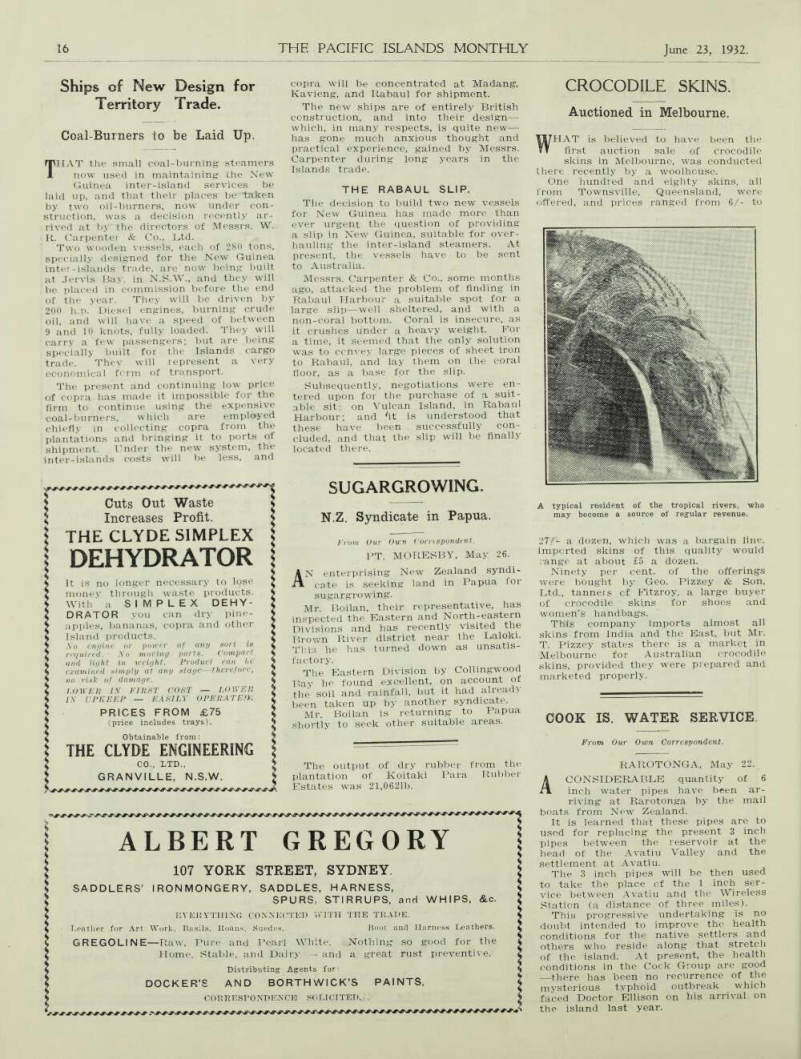
Ships of New Design for Territory Trade.
Coal-Burners to be Laid Up.
THAT the small coal-burning steamers now used in maintaining the New Guinea inter-island services be laid up, and that their places be taken by two oil-burners, now under con struction, was a decision recently ar rived at by the directors of Messrs. W.
R. Carpenter & Co., Ltd.
Two wooden vessels, each of 280 tons, specially designed for the New Guinea inter-islands trade, are now being built at Jervis Bay. in N.S.W., and they will be placed in commission before the end of the year. They will be driven by 200 h.p. Diesel engines, burning crude oil, and will have a speed of between 9 and 10 knots, fully loaded. They will carry a few passengers; but are being specially built for the Islands cargo trade. They will represent a very economical form of transport.
The present and continuing low price of copra has made it impossible for the firm to continue using the expensive coal-burners, which are employed chiefly in collecting copra from the plantations and bringing it to ports of shipment. Under the new system, the inter-islands costs will be less, and
copra will be concentrated at Madang, Kavieng, and Rabaul for shipment.
The new ships are of entirely British construction, and into their design— which, in many respects, is quite new— has gone much anxious thought and practical experience, gained by Messrs.
Carpenter during long years in the Islands trade.
The Rabaul Slip.
The decision to build two new vessels for New Guinea has made more than ever urgent the question of providing a slip in New Guinea, suitable for over hauling the inter-island steamers. At present, the vessels have to be sent to Australia.
Messrs. Carpenter & Co., some months ago, attacked the problem of finding in Rabaul Harbour a suitable spot for a large slip—well sheltered, and with a non-coral bottom. Coral is insecure, as it crushes under a heavy weight. For a time, it seemed that the only solution was to convey large pieces of sheet iron to Rabaul, and lay them on the coral floor, as a base for the slip.
Subsequently, negotiations were en tered upon for the purchase of a suit able site on Vulcan Island, in Rabaul Harbour; and it is understood that these have been successfully con cluded, and that the slip will be finally located there.
Sugargrowing.
N.Z. Syndicate in Papua
From Our Own Correspondent.
Pt. Moresby, May 26.
AN enterprising New Zealand syndi cate is seeking land in Papua for sugargrowing.
Mr. Boilan, their representative, has inspected the Eastern and North-eastern Divisions and has recently visited the Brown River district near the Laloki.
This he has turned down as unsatis factory.
The Eastern Division by Collingwood Bay he found excellent, on account of the soil and rainfall, but it had already been taken up by another syndicate.
Mr. Boilan is returning to Papua shortly to seek other suitable areas.
The output of dry rubber from the plantation of Koitaki Para Rubber Estates was 21,062lb.
Crocodile Skins.
Auctioned in Melbourne.
WHAT is believed to have been the first auction sale of crocodile skins in Melbourne, was conducted there recently by a woolhouse.
One hundred and eighty skins, all from Townsville, Queensland, were offered, and prices ranged from 6/- to
27/- a dozen, which was a bargain line.
Imported skins of this quality would range at about £5 a dozen.
Ninety per cent, of the offerings were bought by Geo. Pizzey & Son, Ltd., tanners of Fitzroy, a large buyer of crocodile skins for shoes and women’s handbags.
This company imports almost all skins from India and the East, but Mr.
T. Pizzey states there is a market in Melbourne for Australian crocodile skins, provided they were prepared and marketed properly.
A typical resident of the tropical rivers, who may become a source of regular revenue.
Cook Is. Water Service.
From Our Own Correspondent.
Rarotonga, May 22.
A CONSIDERABLE quantity of 6 inch water pipes have been ar riving at Rarotonga by the mail boats from New Zealand.
It is learned that these pipes are to used for replacing the present 3 inch pipes between the reservoir at the head of the Avatiu Valley and the Settlement at Avatiu.
The 3 inch pipes will be then used to take the place of the 1 inch ser vice between Avatiu and the Wireless Station (a distance of three miles).
This progressive undertaking is no doubt intended to improve the health conditions for the native settlers and others who reside along that stretch of the island. At present, the health conditions in the Cock Group are good —there has been no recurrence of the mysterious typhoid outbreak which faced Doctor Ellison on his arrival on the island last year.
Advertisements & other items, p. 18 (2 items)
Dehydrator
Cuts Out Waste
Increases Profit.
THE CLYDE SIMPLEX
DEHYDRATOR
It is no longer necessary to lose money through waste products.
With a SIMPLEX DEHY
DRATOR you can dry pine apples, bananas, copra and other Island products.
No engine or power of any sort is required. - No moving parts. Compact and light in weight. Product can be examined simply at any stage — therefore, no risk of damage.
LOWER IN FIRST COST LOWER
IN UPKEEP EASILY OPERATED.
PRICES FROM £75
(price includes trays).
Obtainable from;
THE CLYDE ENGINEERING
CO., LTD..
GRANVILLE, N.S.W.
Albert Gregory
107 YORK STREET, SYDNEY.
SADDLERS' IRONMONGERY, SADDLES, HARNESS,
SPURS, STIRRUPS, and WHIPS, &c.
EVERYTHING CONNECTED WITH THE TRADE.
Leather for Art Work. Basils, Roans, Suedes. Boot and Harness Leathers.
GREGOLINE — Raw, Pure and Pearl White. Nothing- so good for the Home, Stable, and Dairy and a great rust preventive.
Distributing Agents for-
DOCKER’S AND BORTHWICK’S PAINTS.
CORRESPONDENCE SOLICITED.
Rev. F. J. Baton.
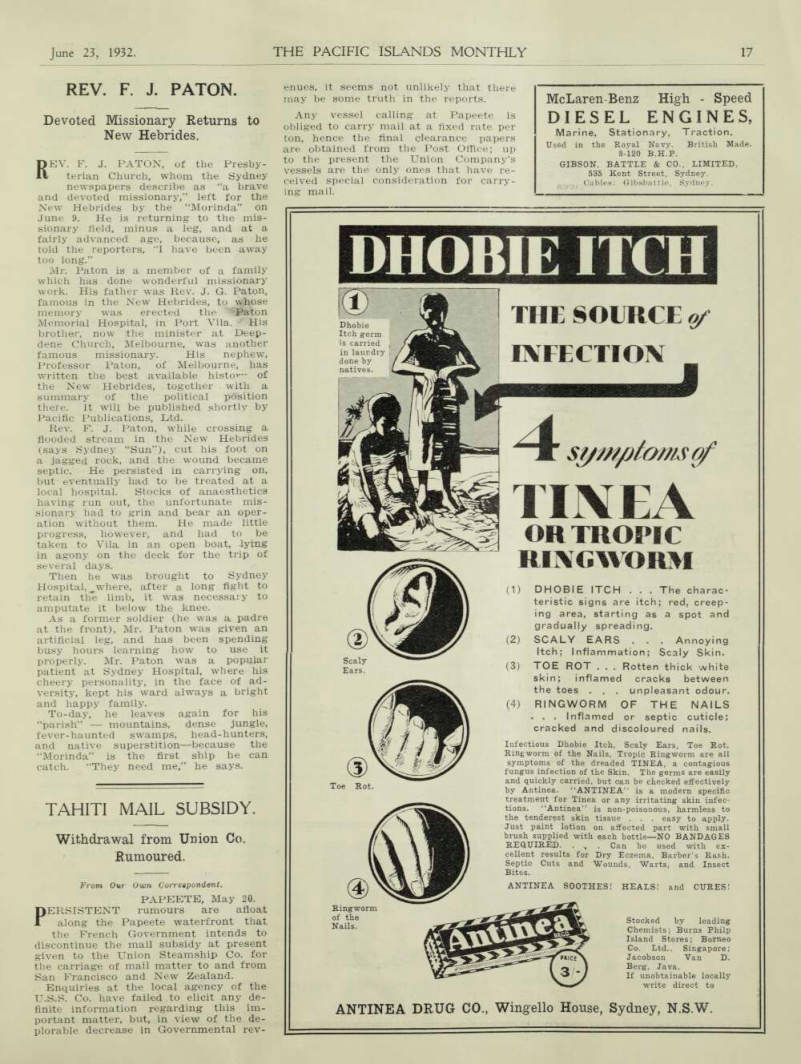
Devoted Missionary Returns to New Hebrides.
REV. F. J. PATON, of the Presby terian Church, whom the Sydney newspapers describe as “a brave and devoted missionary,” left for the New Hebrides by the “Morinda” on June 9. He is returning to the mis sionary field, minus a leg, and at a fairly advanced age, because, as he told the reporters, "I have been away too long.”
Mr. Paton is a member of a family which has done wonderful missionary work. His father was Rev. J. G. Paton, famous in the New Hebrides, to whose memory was erected the Paton Memorial Hospital, in Port Vila. His brother, now the minister at Deep dene Church, Melbourne, was another famous missionary. His nephew, Professor Paton, of Melbourne, has written the best available history of the New Hebrides, together with a summary of the political position there. It will be published shortly by Pacific Publications, Ltd.
Rev. F. J. Paton, while crossing a flooded stream in the New Hebrides (says Sydney “Sun”), cut his foot on a jagged rock, and the wound became septic. He persisted in carrying on, but eventually had to be treated at a local hospital. Stocks of anaesthetics having run out, the unfortunate mis sionary had to grin and bear an oper ation without them. He made little progress, however, and had to be taken to Vila in an open boat, lying in agony on the deck for the trip of several days.
Then he was brought to Sydney Hospital, where, after a long fight to retain the limb, it was necessary to amputate it below the knee.
As a former soldier (he was a padre at the front), Mr. Paton was given an artificial leg, and has been spending busy hours learning how to use it properly. Mr. Paton was a popular patient at Sydney Hospital, where his cheery personality, in the face of ad versity, kept his ward always a bright and happy family.
To-day, he leaves again for his “parish” mountains, dense jungle, fever-haunted swamps, head-hunters, and native superstition—because the “Morinda” is the first ship he can catch. “They need me,” he says.
Tahiti Mail Subsidy.
Withdrawal from Union Co.
Rumoured.
From Our Own Correspondent.
Papeete, May 20.
PERSISTENT rumours are afloat along the Papeete waterfront that the French Government intends to discontinue the mail subsidy at present given to the Union Steamship Co. for the carriage of mail matter to and from San Francisco and New Zealand.
Enquiries at the local agency of the U.S.S. Co. have failed to elicit any de finite information regarding this im portant matter, but, in view of the de plorable decrease in Governmental rev
enues, it seems not unlikely that there may be some truth in the reports.
Any vessel calling at Papeete is obliged to carry mail at a fixed rate per ton, hence the final clearance papers are obtained from the Post Office; up to the present the Union Company’s vessels are the only ones that have re ceived special consideration for carry ing mail.
Advertisements & other items, p. 19 (1 item)
Dhobie Itch
McLaren-Benz High - Speed
DIESEL ENGINES,
Marine, Stationary, Traction.
Used in the Royal Navy. British Made.
8-120 B.H.P.
GIBSON, BATTLE & CO.. LIMITED,
535 Kent Street, Sydney.
Cables: Gibsbattle, Sydney.
DHOBIE ITCH
(2) Scaly Ears. (4) Toe Rot.
Ringworm Nails
THE SOURCE
INFECTION
symptoms of
TUVEA
OR TROPIC
RINGWORM
DHOBIE ITCH . . . The charac teristic signs are itch; red, creep ing area, starting as a spot and
gradually spreading.
SCALY EARS . . Annoying Itch; Inflammation; Scaly Skin.
TOE ROT . . . Rotten thick white skin; inflamed cracks between the toes . . . unpleasant odour.
RINGWORM OF THE NAILS
. . . Inflamed or septic cuticle; cracked and discoloured nails.
Infectious Dhobie Itch, Scaly Ears., Toe Rot, Ringworm of the Nails, Tropic Ringworm are all symptoms of the dreaded TINEA, a contagious fungus infection of the Skin. The germs are easily and quickly carried, but can be checked effectively by Antinea. “ANTINEA” is a modern specific treatment for Tinea or any irritating skin infec tions. “Antinea” is non-poisonous, harmless to the tenderest skin tissue . . . easy to apply.
Just paint lotion on affected part with small brush supplied with each bottle —NO BANDAGES REQUIRED. . , Can be used with excellent results for Dry Eczema, Barber's Rash, Septic Cuts and Wounds, Warts, and Insect Bites.
ANTINEA SOOTHES! HEALS! and CURES!
Stocked by leading Chemists; Burns Philp Island Stores; Borneo Co. Ltd., Singapore; Jacobson Van D.
Berg, Java.
If unobtainable locally write direct to ANTINEA DRUG CO., Wingello House, Sydney, N.S.W.
Cost Of Running A N. Guinea Plantation.
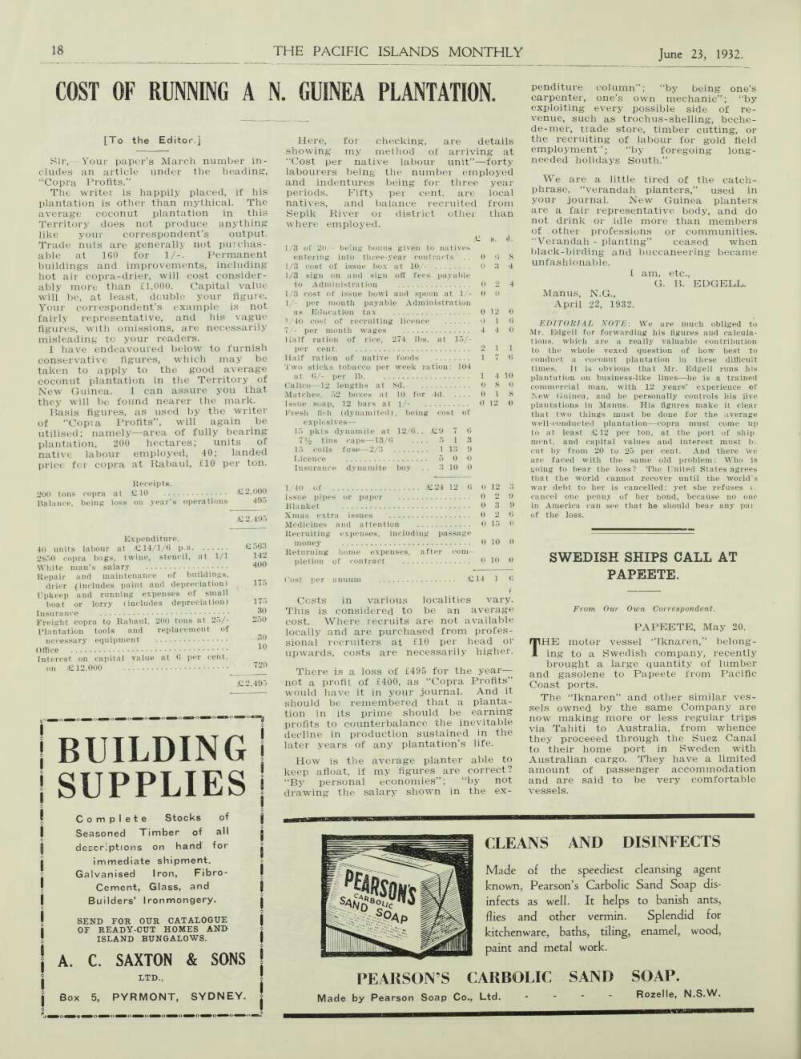
[To the Editor.] Sir, — Your paper’s March number in cludes an article under the heading, “Copra Profits.”
The writer is happily placed, if his plantation is other than mythical. The average coconut plantation in this Territory does not produce anything like your correspondent’s output.
Trade nuts are generally not purchas able at 160 for 1/-. Permanent buildings and improvements, including hot air copra-drier, will cost consider ably more than £1,000. Capital value will be, at least, double your figure.
Your correspondent’s example is not fairly representative, and his vague figures, with omissions, are necessarily misleading to your readers.
I have endeavoured below to furnish conservative figures, which may be taken to apply to the good average coconut plantation in the Territory of New Guinea. I can assure you that they will be found nearer the mark.
Basis figures, as used by the writer of ‘‘Copia Profits”, will again be utilised; namely—area of fully bearing plantation, 200 hectares; units of native labour employed, 40; landed price for copra at Rabaul, £10 per ton.
Here, for checking, are details showing my method of arriving at “Cost per native labour unit” —forty labourers being the number employed and indentures being for three year periods. Fifty per cent, are local natives, and balance recruited from Sepik River or district other than where employed.
Costs in various localities vary.
This is considered to be an average cost. Where recruits are not available locally and are purchased from profes sional recruiters at £10 per head or upwards, costs are necessarily higher.
There is a loss of £495 for the year— not a profit of £400, as “Copra Profits” would have it in your journal. And it should be remembered that a planta tion in its prime should be earning profits to counterbalance the inevitable decline in production sustained in the later years of any plantation’s life.
How is the average planter able to keep afloat, if my figures are correct?
“By personal economies”; “by not drawing the salary shown in the ex
penditure column”; “by being one’s carpenter, one’s own mechanic”; “by exploiting every possible side of re venue, such as trochus-shelling, beche de-mer, trade store, timber cutting, or the recruiting of labour for gold field employment’; “by foregoing long needed holidays South.”
We are a little tired of the catch phrase, “verandah planters,” used in your journal. New Guinea planters are a fair representative body, and do not drink or idle more than members of other professions or communities.
“Verandah - planting” ceased when black-birding and buccaneering became unfashionable.
I am, etc.,
G. B. Edgell.
Manus, N.G.,
April 22, 1932.
EDITORIAL NOTE: We are much obliged to Mr. Edgell for forwarding his figures and calcula tions, which are a really valuable contribution to the whole vexed question of how best to conduct a coconut plantation in these difficult times. It is obvious that Mr. Edgell runs his plantation on business-like lines —he is a trained commercial man, with 12 years’ experience of ftew Guinea, and he personally controls his five plantations in Manus. His figures make it clear that two things must be done for the average well-conducted plantation—copra must come up to at least £12 per ton, at the port of ship ment, and capital values and interest must b. cut by from 20 to 25 per cent. And there we are faced with the same old problem; Who is going to bear the loss? The United States agrees that the world cannot recover until the world’s war debt to her is cancelled: yet she refuses to cancel one penny of her bond, because no one in America can see that he should bear any par of the loss.
Receipts. 200 tons copra at £10 Balance, being loss on year’s operations £2,000 495 £2,495 Expenditure. 40 units labour at £14/1/6 p.a 2850 copra bags, twine, stencil, at 1/1 £563 142 400 Repair and maintenance of buildings, drier (includes paint and depreciation) Upkeep and running expenses of small boat or lorry (includes depreciation) 175 175 30 Freight copra to Rabaul, 200 tons at 2.»/- Plantation tools and replacement of 250 30 10 Interest on capital value at 6 per cent. on £12 000 720 £2,495
£ s. d. 1/3 of 20/- being bonus given to natives entering into three-year contracts 0 Q 8 0 3 4 1/3 sign on and sign off fees payable 0 2 4 1/3 cost of issue bowl and spoon at 1, - 0 0 1/- per month payable Administration as Education tax 0 0 12 0 1 40 cost of recruiting licence 1 6 4 4 0 Half ration of rice, 274 lbs. at 15/- 2 1 1 6 1 Two sticks tobacco per week ration: 104 1 4 10 0 s 0 Matches, 52 boxes at 10 for Id 0 1 8 0 12 0 Fresh fish (dynamited), being cost of explosives— 15 pkts dynamite at 12/6.. £9 7 6 7½ tins caps—13/6 ... 5 1 3 15 coils fuse—2/3 1 13 9 Licence 5 0 0 Insurance dynamite boy . . 3 10 0 1/40 of £24 12 6 0 12 3 Issue pipes or paper 0 9 Blanket 0 3 9 Xmas extra issues 0 2 6 Medicines and attention 0 15 0 Recruiting expenses, including passage money 0 10 0 Returning home expenses, after completion of contract 0 10 0 Cost ner annum £14 1 6
Swedish Ships Call At
Papeete.
From Our Own Correspondent.
Papeete, May 20.
THE motor vessel “Iknaren,” belong ing to a Swedish company, recently brought a large quantity of lumber and gasolene to Papeete from Pacific Coast ports.
The “Iknaren” and other similar ves sels owned by the same Company are now making more or less regular trips via Tahiti to Australia, from whence they proceeed through the Suez Canal to their home port in Sweden with Australian cargo. They have a limited amount of passenger accommodation and are said to be very comfortable vessels.
Advertisements & other items, p. 20 (2 items)
Building
SUPPLIES
Complete Stocks of Seasoned Timber of all descriptions on hand for immediate shipment.
Galvanised Iron, Fibro- Cement, Glass, and Builders’ Ironmongery.
SEND FOR OUR CATALOGUE
OF READY-CUT HOMES AND
ISLAND BUNGALOWS.
A. C. SAXTON & SONS
LTD.,
Box 5, PYRMONT, SYDNEY.
Cleans And Disinfects
Made of the speediest cleansing agent known, Pearson’s Carbolic Sand Soap disinfects as well. It helps to banish ants, flies and other vermin. Splendid for kitchenware, baths, tiling, enamel, wood, paint and metal work.
PEARSON’S CARBOLIC SAND SOAP.
Made by Pearson Soap Co., Ltd. ... - Rozelle, N.S.W.
Phosphate Commissioner
Inspects Nauru Workings.
From Our Own Correspondent.
Nauru, May 15.
THE British Phosphate Commissioner, Mr. Lodge, accompanied by Mrs.
Lodge, has been visiting the island on a tour of inspection.
As this was the first occasion on which a British Commissioner has visited the island, a round of enter tainments was provided, and Mr. and Mrs. Lodge entered fully into the fun.
On Saturday, April 30, the British Phosphate Commissioners entertained all European residents at a bridge evening, and, after supper, dancing was indulged in until the early hours. Mr. and Mrs. M. Thom introduced all guests and a thoroughly good time was spent. Mrs. Lodge presented the prizes won at the sports on New Year’s Day, and both she and Mr. Lodge took part in the entertainment provided.
In honour of our guests, “The Naughty Wife” was again presented at the local theatre on the night of May 8. The characters in this play were excellently portrayed by Mrs. A. Lamb, Mrs. Dillon, Mrs. H. Brittain, Mr. E.
Paul, Mr. S. Hill, Mr. H. Brittain, Mr.
F. Harmer and Mr. S. Wright. At the conclusion of the performance, the players were heartily congratulated on the success of their efforts. A special word of praise must be given to the producer, Mr. E. Compton, who, with the assistance of Mr. L. Martin, also built and decorated the very fine stage settings and to Mr. E. Paul, who was responsible for the lighting effects.
A few evenings later, the Adminis trator, assisted by Miss Newman and Miss Heather entertained 50 guests at bridge and dancing at the Residency.
Mr. Lodge was, unfortunately, unable to be present; but everyone spent a most enjoyable evening.
Mr. and Mrs. Lodge depart on the “T'riona” on the 16th. We are sorry they are leaving, for their charming personalities will be greatly missed, and in their short stay on the island they have endeared themselves to all, and will be pleasantly remembered by this small community.
Samoa.
Annual Meeting of L.M.S. in Samoa.
From Our Own Correspondent.
Apia, May 20.
THE yearly London Mission Society meeting is in progress at Malua at time of writing, and large numbers of natives have gathered from all parts of Upolu and Savaii, as well as from Tutuila, to take part in the proceedings.
The participation seems, however, not to be as strong as in preceding years. Financial contributions are col lected at the meeting, and the expen diture for school and mission work is discussed.
Many of the members of the church, however, have refrained from attend ing, owing to shortage of means, caused by the low copra price and the unpro fitable banana shipments. It may be safely predicted that the revenue of the London Mission Society will suffer ac cordingly.
Whites And Natives.
Records of Crime for New Guinea.
FURTHER information bearing upon the relationship between Europeans and natives in New Guinea was supplied to the Federal Parliament by the Prime Minister on May 23, as the result of inquiries asked by Mr. Roland Green.
It was stated that during the past two years 42 natives had been con victed of assaulting whites. Sentences of imprisonment, ranging from 7 days to two years, had been imposed, and in three cases a flogging had been ordered. In some cases, the natives were afterwards allowed to return to their villages; but, in this regard, each case was considered on its merits.
Eight Europeans had been murdered by natives in the past 10 years. Nine natives were sentenced to death for these crimes, and one to five years’ hard labour. Eight natives, also, had just been arrested on a charge of mur dering the prospector, Mr. Baum.
None of those murdered were officials of the Administration. Two whites had been convicted of murdering natives, and four of manslaughter.
One of the former was given two years’ hard labour and one ten years hard labour. The four convicted of manslaughter were thus punished: 1, year’s hard labour; 2, £10 fine; 3, six months’ hard labour and £50 fine; 4, fine of £500, or two years’ hard labour.
In the past two years, 101 whites had been convicted of assault. In 20 cases, they were cautioned: in 77 cases, they were fined 5/- to £20; in one case, a fine of £200, with year’s hard labour; in three cases, two years’ hard labour.
Official.
Death of Samoan Native Official.
From Our Own Correspondent.
Apia, May 20.
ONE of the best-known and most conscientious native officials of the Samoan Administration passed away recently, when Asi Maatusi, chief clerk of the Department of Justice, died, in his 38th year.
Asi has served over 20 years under the German, N.Z. Military and N.Z.
Civil Administrations and was well known and respected by Europeans and Samoans alike. He had spent a few years of service in New Zealand, work ing there in the Government Survey Department.
Advertisements & other items, pp. 21-22 (1 item)
Penta
Famous Swedish Utility
OUTBOARD ENGINE.
Double Cylinder.
Strong and Reliable. Silent.
Write for particulars.
NELSON & KOBEHTSON,
12 SPRING STREET, SYDNEY.
Australasian Distributors.
SAIL WITH
The B.P. MAGAZINE
TO MAGIC LANDS.
Travel Fiction Adventure 1/- copy.
GET
Stage Screen Fashion 1/- copy.
THE JUNE NUMBER.
ANNUAL SUBSCRIPTION;
Within the Commonwealth of Australia, Mandated Territory and New Guinea 4/- post free Within the British Empire . . . . 5/4 post free U.S.A. and Foreign 6/8 post free
“TRUTH IN ADVERTISING”—AIways at Anthony Horderns'.
SENT FREE
ON REQUEST!
Now!
Write
Anthony Horderns’ Mail Order Catalogue is compiled as one of the services that are maintained for the benefit of distant customers. It contains 128 pages, in which are described and illustrated specially chosen bargains embrac ing every need in standard quality merchandise. With a copy of this catalogue in your home you are no further from Anthony Horderns’ than the nearest Post Office.
Write for a copy now, and have it by you when writing out all your future orders.
A comprehensive Grocery Catalogue is specially prepared for our Island Customers, who should have a copy !
Anthony
Horderns'
THE SENIOR STORE.”
ANTHONY HORDERN & SONS LIMITED
Phone: M 2401.
Day and Night.
SYDNEY.
Postal Address:
Box 2712 C, G.P.O.
Tahiti Becomes “Movie-
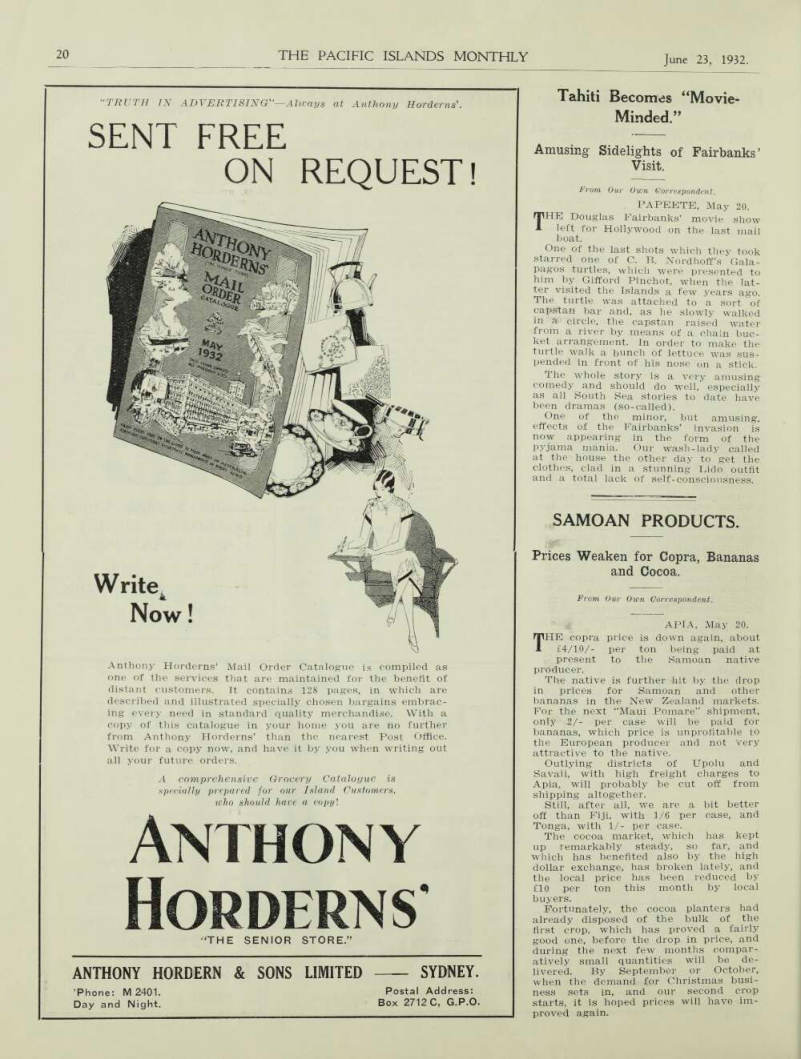
Minded”
Amusing Sidelights of Fairbanks’
Visit.
From Our Own Correspondent.
Papeete, May 20.
THE Douglas Fairbanks’ movie show left for Hollywood on the last mail boat.
One of the last shots which they took starred one of C. B. Nordhoff’s Gala pagos turtles, which were presented to him by Gifford Pinchot, when the lat ter visited the Islands a few years ago.
The turtle was attached to a sort of capstan bar and, as he slowly walked in ap circle, the capstan raised water from a river by means of a chain buc ket arrangement. In order to make the turtle walk a bunch of lettuce was sus pended in front of his nose on a stick.
The whole story is a very amusing comedy and should do well, especially as all South Sea stories to date have been dramas (so-called).
One of the minor, but amusing, effects of the Fairbanks’ invasion is now appearing in the form of the pyjama mania. Our wash-lady called at the house the other day to get the clothes, clad in a stunning Lido outfit and a total lack of self-consciousness.
Samoan Products.
Prices Weaken for Copra, Bananas and Cocoa.
From Our Own Correspondent.
Apia, May 20.
THE copra price is down again, about £4/10/- per ton being paid at present to the Samoan native producer.
The native is further hit by the drop in prices for Samoan and other bananas in the New Zealand markets.
For the next “Maui Pomare” shipment, only 2/- per case will be paid for bananas, which price is unprofitable to the European producer and not very attractive to the native.
Outlying districts of Upolu and Savaii, with high freight charges to Apia, will probably be cut off from shipping altogether.
Still, after all, we are a bit better off than Fiji, with 1/6 per case, and Tonga, with 1/- per case.
The cocoa market, which has kept up remarkably steady, so far, and which has benefited also by the high dollar exchange, has broken lately, and the local price has been reduced by £10 per ton this month by local buyers.
Fortunately, the cocoa planters had already disposed of the bulk of the first crop, which has proved a fairly good one, before the drop in price, and during the next few months compar atively small quantities will be de livered. By September or October, when the demand for Christmas busi ness sets in, and our second crop starts, it is hoped prices will have im proved again.
Colonel Bennett's Departure Ends
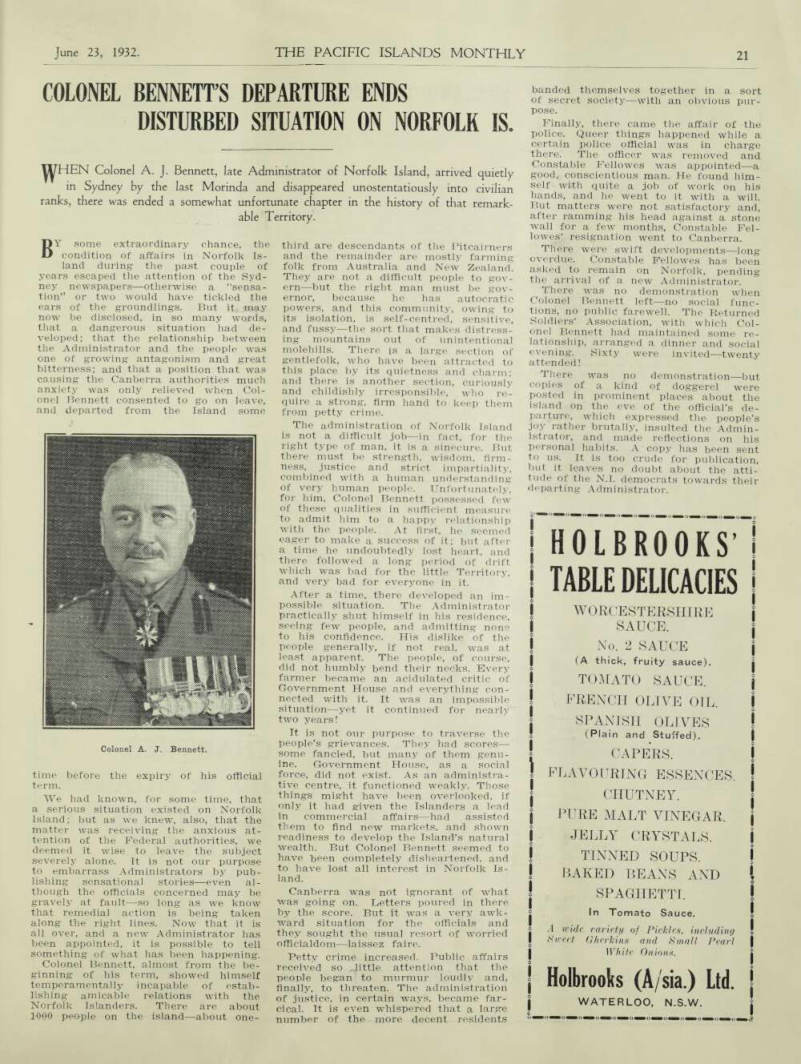
Disturbed Situation On Norfolk Is.
Colonel A. J. Bennett, late Administrator of Norfolk Island, arrived quietly in Sydney by the last Morinda and disappeared unostentatiously into civilian ranks, there was ended a somewhat unfortunate chapter in the history of that remark-
able Territory.
BY some extraordinary chance, the condition of affairs in Norfolk Island during the past couple of years escaped the attention of the Sydney newspapers—otherwise a “sensation” or two would have tickled the ears of the groundlings. But it may now be disclosed, in so many words, that a dangerous situation had developed; that the relationship between the Administrator and the people was one of growing antagonism and great bitterness; and that a position that was causing the Canberra authorities much anxiety was only relieved when Colonel Bennett consented to go on leave, and departed from the Island some
time before the expiry of his official term.
We had known, for some time, that a serious situation existed on Norfolk Island; but as we knew, also, that the matter was receiving’ the anxious attention of the Federal authorities, we deemed it wise to leave the subject severely alone. It is not our purpose to embarrass Administrators by publishing sensational stories —even although the officials concerned may be gravely at fault —so long as we know that remedial action is being taken along the right lines. Now that it is all over, and a new Administrator has been appointed, it is possible to tell something of what has been happening.
Colonel Bennett, almost from the beginning of his term, showed himself temperamentally incapable of establishing amicable relations with the Norfolk Islanders. There are about 1000 people on the island—about one-
third are descendants of the Pitcairners and the remainder are mostly farming folk from Australia and New Zealand.
They are not a difficult people to govern—but the right man must be governor, because he has autocratic powers, and this community, owing to its isolation, is self-centred, sensitive, and fussy—the sort that makes distressing mountains out of unintentional molehills. There is a large section of gentlefolk, who have been attracted to this place by its quietness and charm; and there is another section, curiously and childishly irresponsible, who require a strong, firm hand to keep them from petty crime.
The administration of Norfolk Island is not a difficult job—in fact, for the right type of man, it is a sinecure. But there must be strength, wisdom, firmness, justice and strict impartiality, combined with a human understanding of very human people. Unfortunately, for him, Colonel Bennett possessed few of these qualities in sufficient measure to admit him to a happy relationship with the people. At first, he seemed eager to make a success of it; but after a time he undoubtedly lost heart, and there followed a long period of drift which was bad for the little Territory, and very bad for everyone in it.
After a time, there developed an impossible situation. The Administrator practically shut himself in his residence, seeing few people, and admitting none to his confidence. His dislike of the people generally, if not real, was at least apparent. The people, of course, did not humbly bend their necks. Every farmer became an acidulated critic of Government House and everything connected with it. It was an impossible situation—yet it continued for nearly two years!
It is not our purpose to traverse the people’s grievances. They had scores— some fancied, but many of them genuine. Government House, as a social force, did not exist. As an administrative centre, it functioned weakly. Those things might have been overlooked, if only it had given the Islanders a lead in commercial affairs—had assisted them to find new markets, and shown readiness to develop the Island’s natural wealth. But Colonel Bennett seemed to have been completely disheartened, and to have lost all interest in Norfolk Island.
Canberra was not ignorant of what was going on. Letters poured in there by the score. But it was a very awkward situation for the officials and they sought the usual resort of worried officialdom—laissez faire.
Petty crime increased. Public affairs received so little attention that the people began to murmur loudly and, finally, to threaten. The administration of justice, in certain ways, became farcical. It is even whispered that a large number of the more decent residents
banded themselves together in a sort of secret society—with an obvious purpose.
Finally, there came the affair of the police. Queer things happened while a certain police official was in charge there. The officer was removed and Constable Fellowes was appointed—a good, conscientious man. He found himself with quite a job of work on his hands, and he went to it with a will.
But matters were not satisfactory and, after ramming his head against a stone wall for a few months, Constable Fellowes’ resignation went to Canberra.
There were swift developments—long overdue. Constable Fellowes has been asked to remain on Norfolk, pending the arrival of a new Administrator.
There was no demonstration when Colonel Bennett left—no social functions, no public farewell. The Returned Soldiers’ Association, with which Colonel Bennett had maintained some relationship, arranged a dinner and social evening. Sixty were invited—twenty attended!
There was no demonstration—but copies of a kind of doggerel were posted in prominent places about the island on the eve of the official’s departure, which expressed the people’s joy rather brutally, insulted the Administrator, and made reflections on his personal habits. A copy has been sent to us. It is too crude for publication, but it leaves no doubt about the attitude of the N.I. democrats towards their departing Administrator.
Colonel A. J, Bennett.
Advertisements & other items, p. 23 (1 item)
Holbrooks’
TABLE DELICACIES
WORCESTERSHIRE
SAUCE.
No. 2 SAUCE
(A thick, fruity sauce).
TOMATO SAUCE.
FRENCH OLIVE OIL.
SPANISH OLIVES
(Plain and Stuffed).
CAPERS.
FLAVOURING ESSENCES.
CHUTNEY.
PURE MALT VINEGAR.
JELLY CRYSTALS.
TINNED SOUPS.
BAKED BEANS AND
SPAGHETTI.
In Tomato Sauce.
A wide variety of Pickles, including Sweet Gherkins and Small Pearl White Onions.
Holbrooks (A/sia.) Ltd.
WATERLOO, N.S.W.
O. F. Nelson And New Zealand Government.
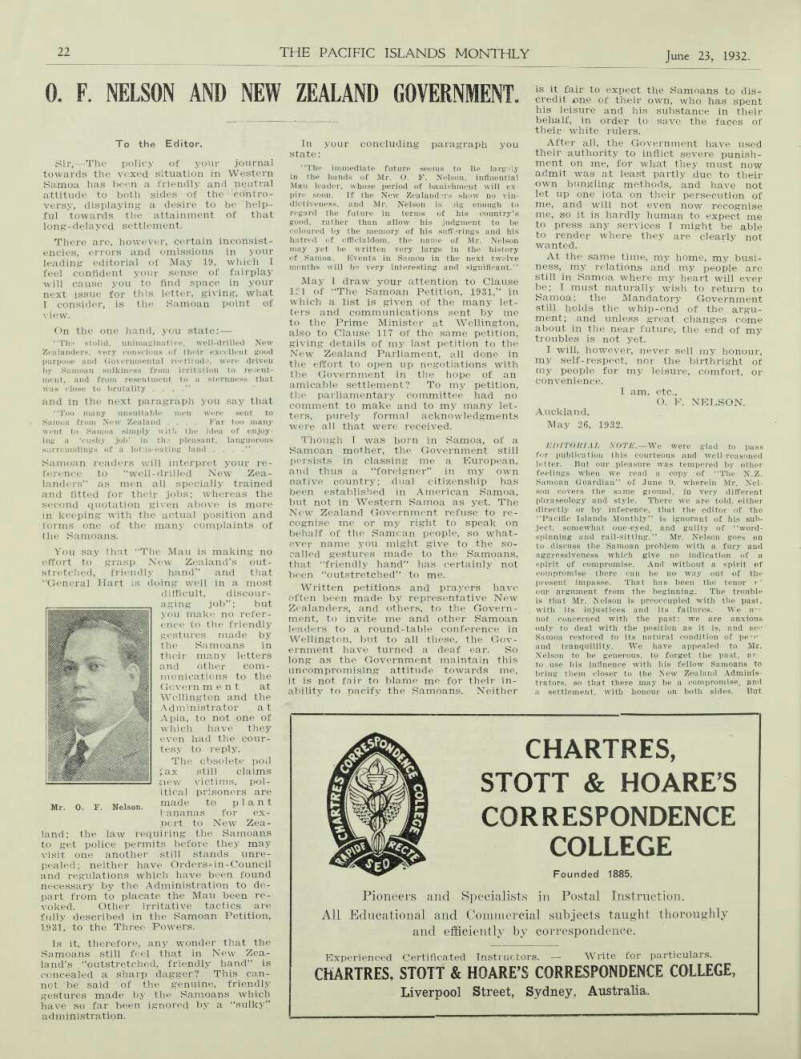
To the Editor.
Sir, —The policy of your journal towards the vexed situation in Western Samoa has been a friendly and neutral attitude to both sides of the contro versy, displaying a desire to be help ful towards the attainment of that long-delayed settlement.
There are, however, certain inconsist encies, errors and omissions in your leading editorial of May 19, which I feel confident your sense of fairplay will cause you to find space in your next issue for this letter, giving, what I consider, is the Samoan point of view.
On the one hand, you state: “Tha stolid, unimaginative, well-drilled New Zealanders, very conscious of their excellent good purpose and Governmental rectitude, were driven by Samoan sulkiness from irritation to resent ment, and from resentment to a sternness that was close to brutality . . . .” and in the next paragraph you say that “Too many unsuitable men were sent to Samoa from New Zealand ... Far too many went to Samoa simply with the idea of enjoy ing a ‘cushy job’ in the pleasant, languorous surroundings of a lotus-eating land . . . .”
Samoan readers will interpret your re ference to “well-drilled New Zea landers” as men all specially trained and fitted for their jobs; whereas the second quotation given above is more in keeping with the actual position and forms one of the many complaints of the Samoans.
You say that “The Mau is making no effort to grasp New Zealand’s out stretched, friendly hand” and that “General Hart is doing well in a most
difficult, discour aging job”; but you make no refer ence to the friendly gestures made by the Samoans in their many letters and other com munications to the Government at Wellington and the Administrator at Apia, to not one of which have they even had the cour tesy to reply.
The obsolete poll tax still claims new victims, pol itical prisoners are made to plant bananas for ex port to New Zea
land; the law requiring the Samoans to get police permits before they may visit one another still stands unre pealed; neither have Orders-in-Council and regulations which have been found necessary by the Administration to de part from to placate the Mau been re voked. Other irritative tactics are fully described in the Samoan Petition, 1931, to the Three Powers.
Is it, therefore, any wonder that the Samoans still feel that in New Zea land’s “outstretched, friendly hand” is concealed a sharp dagger? This can not be said of the genuine, friendly gestures made by the Samoans which have so far been ignored by a “sulky” administration.
In your concluding paragraph you state: “The immediate future seems to lie largely in the hands of Mr. O. F. Nelson, influential Mau leader, whose period of banishment will ex pire soon. If the New Zealanders show no vin dictiveness, and Mr. Nelson is big enough to regard the future in terms of his country’s good, rather than allow his judgment to be coloured by the memory of his sufferings and his hatred of officialdom, the name of Mr. Nelson may yet be written very large in the history of Samoa. Events in Samoa in the next twelve months will be very interesting and significant.”
May I draw your attention to Clause 121 of “The Samoan Petition, 1931,” in which a list is given of the many let ters and communications sent by me to the Prime Minister at Wellington, also to Clause 117 of the same petition, giving details of my last petition to the New Zealand Parliament, all done in the effort to open up negotiations with the Government in the hope of an amicable settlement? To my petition, the parliamentary committee had no comment to make and to my many let ters, purely formal acknowledgments were all that were received.
Though I was born in Samoa, of a Samoan mother, the Government still persists in classing me a European, and thus a “foreigner” in my own native country; dual citizenship has been established in American Samoa, but not in Western Samoa as yet. The New Zealand Government refuse to re cognise me or my right to speak on behalf of the Samoan people, so what ever name you might give to the so called gestures made to the Samoans, that “friendly hand” has certainly not been “outstretched” to me.
Written petitions and prayers have often been made by representative New Zealanders, and others, to the Govern ment, to invite me and other Samoan leaders to a round-table conference in Wellington, but to all these, the Gov ernment have turned a deaf ear. So long as the Government maintain this uncompromising attitude towards me, it is not fair to blame me for their in ability to pacify the Samoans. Neither
is it fair to expect the Samoans to dis credit pne of their own, who has spent his leisure and his substance in their behalf, in order to save the faces of their white rulers.
After all, the Government have used their authority to inflict severe punish ment on me, for what they must now admit was at least partly due to their own bungling- methods, and have not let up one iota on their persecution of me, and will not even now recognise me, so it is hardly human to expect me to press any services I might be able to render where they are clearly not wanted.
At the same time, my home, my busi ness, my relations and my people are still in Samoa where my heart will ever be; I must naturally wish to return to Samoa; the Mandatory Government still holds the whip-end of the argu ment; and unless great changes come about in the near future, the end of my troubles is not yet.
I will, however, never sell my honour, my self-respect, nor the birthright of my people for my leisure, comfort, or convenience.
I am, etc.,
O. F. Nelson.
Auckland,
May 26, 1932.
EDITORIAL NOTE.—We were glad to pass for publication this courteous and well-reasoned letter. But our pleasure was tempered by other feelings when we read a copy of “The N.Z.
Samoan Guardian’’ of June 9, wherein Mr. Nel son covers the same ground, in very different phraseology and style. There we are told, either directly or by inference, that the editor of the “Pacific Islands Monthly” is ignorant of his sub ject, somewhat one-eyed, and guilty of “word spinning and rail-sitting.” Mr. N'elson goes on to discuss the Samoan problem with a fury and aggressiveness which give no indication of a spirit of compromise. And without a spirit of compromise there can be no way out of the present impasse. That has been the tenor of our argument from the beginning. The trouble is that Mr. Nelson is preoccupied with the past, with its injustices and its failures. We are not concerned with the past: we are anxious only to deal with the position as it is, and see Samoa restored to its natural condition of and tranquillity. We have appealed to Mr.
Nelson to be generous, to forget the past, nr to use his influence with his fellow Samoans to bring them closer to the New Zealand Adminis trators, so that there may be a compromise, and a settlement, with honour on both sides. But
Mr. O. F. Nelson.
Mr. Nelson replies, savagely, that New Zealand is making no move towards compromise, and that "all the Man knows of that mailed list of New Zealand’s is that it still has a stranglehold on the throat of Samoa, and is trying to choke the very soul out of the people there.” And, again, ‘‘the New Zealand ostrich will not take its head out of the sand and face the facts.”
That is not being helpful—and it is not the language of compromise Has any real, sincere effort been made to bring the Administrator and the Mau together, since General Hart took charge Apparently not. The Mau, according to Mr. Nelson, ‘‘wrote him most respectfully and politely explaining why they had not accepted the official invitation to welcome him, and setting out very clearly the conditions and terms on which they would meet and confer with him.” But that is not the correct form of approach to a powerful and proud State. This frightful muddle cannot be cleaned up unless both sides meet in a calm at mosphere, with open minds, free from all “con ditions and terms.” Mr. Nelson can do more than any other man to help the Samoans out of their political troubles, but Mr. Nelson’s latest contribution to the discussion only emphasises our view that Western Samoa is “a continuing dis appointment.”
Advertisements & other items, p. 24 (1 item)
Chartres,
STOTT & HOARE’S
CORRESPONDENCE
COLLEGE
Founded 1885.
Pioneers and Specialists in Postal Instruction.
All Educational and Commercial subjects taught thoroughly and efficiently by correspondence.
Experienced Certificated Instructors. Write for particulars.
CHARTRES, STOTT & HOARE’S CORRESPONDENCE COLLEGE,
Liverpool Street, Sydney, Australia.
Papua’S Finances.
Review For 1930-31.
THE annual report of the Lieutenant- Governor of Papua (Sir Hubert Murray) for the year ended June, 1931, has been released.
Almost every item of revenue showed an increase compared with the previous year, also a decrease com pared with the sum estimated. The total estimated revenue for the year was £158,056; the revenue received was only £134,918, while that received in 1929-30 was £149,265. The “slump” in revenue necessitated a great re duction in expenditure, which made a saving of more than £20,000, or nearly one-sixth of the total estimate. The estimated expenditure for the year was £158,056, and the actual expendi ture was only £134,985.
Imports and exports decreased by £133,844 and £50,421 respectively. Im ports were the lowest since 1915-16, and exports the lowest since 1923-24.
The fall in prices accounted, for the diminution in exports. The expoit of rubber showed an increase in weight of 22 tons and a decrease in value (£47,036 as against £50,640). Copra showed a decrease both in weight and value (9436 tons and £93,710, as com pared with 11,693 tons and £176,485).
The decrease in weight was due partly to the increased export of desiccated coconut, and partly to a decrease in native copra, owing to the fall in price.
Only most essential public works were carried out during the year, owing to financial stringency, states the report.
Copra Prospects in Tonga.
From Our Own Correspondent.
Nukualofa, May 1.
WITH the passing of the hurricane season, the coconut crop appears to be a promising one in the southern islands of the group.
The blow in Vavau has probably re duced their output considerably, and I hear that the people of Niuafoou will be on rather short rations for a time, as a result of the same hurricane.
Pearling Industry.
Signs of Revival in Tahiti.
From Our Own Correspondent.
Papeete, May 20.
THE market for Tahiti pearl shell ap pears to be recovering to some ex tent and small shipments are being made to both New York and England.
As the result of representations made by the Papeete Chamber of Commerce, the Administration has decided to open the lagoons of Hikueru, Takume, and Raraka, all in the Tuamotu Archipelago, under the usual restrictions as to size of shell, and for a limited period only.
Both naked divers and machines will be allowed to operate, but the latter will have to wait till the natives have had a chance to clean out the shell in the shallower parts of the lagoons, where they can work most easily. The season will close when a maximum of 500 tons of shell has been secured.
Advertisements & other items, p. 25 (1 item)
Newbold Silica
FIRE-BRICK CO. LTD.,
Manufacturers of High Grade Refractories, Silica Bricks, High Alumina Fire Bricks, Siliceous Fire Bricks, Chrome Bricks, Bauxite Bricks, "Sealtite" (hot patching cement), Dia tomaceous insulation.
Enquirers are requested to give full particulars of temperatures and purposes for which refractories are required.
The Newbold Silica Fire-Brick Co. Ltd.
109 ELIZABETH ST., SYDNEY.
Organised to Serve . .. Well
Lae - - Salamaua The country over which Guinea Airways’ Aircraft daily fly is some of the worst in the world. It is so rough that overland transport is impossible, and many attempts at road building have been abandoned.
The Goldfields depend entirely on aircraft for maintenance, and it is the success of their service which makes Guinea Airways confident of their ability to organise and maintain dependable transport WHEREVER it is needed.
GUINEA AIRWAYS LTD
Norfolk Island Has Its Troubles.
Captain Pinney’s Big Task.
From Our Own Correspondent.
Norfolk Is., May 25.
BY the “Morinda,” to-morrow, homeward bound to Sydney, Colonel Alfred Josiah Bennett—for the past three years our Administrator— departs this island.
Several private entertainments have been given to take leave of him, but there has been nothing mooted in the nature of a public farewell.
Captain C. R. Pinney, late of Papua, takes up office as Administrator, and we have the most hopeful anticipations of his reign; but what this island really needs as governor or whatnot is a hardbitten retired police magistrate who would come and make and maintain a reputation for cold, calculating justice; who, having the law at his fingertips, would administer it without fear or favour; and who would be satisfied to have no friends, until he won us all as friends by the unswerving honesty of his purpose.
Such a man was Judge Herbert, who preceded Colonel Bennett, and lived amongst us only eight months, during which time he was handicapped by the illness that killed him in January, 1929.
His glance alone was sufficient to strike terror into the heart of the evildoer, while behind it was a depth of genuine kindliness that encouraged those oppressed to come to him with
hope and confidence. How many hundred times, since he died, has it been said here, “If only Judge Herbert had lived . . . !” Those words are his monument on Norfolk Island.
Progressive Policy Needed.
If our administration were less costly, there would be a balance from the sum allocated each year for the upkeep of the island, for real and essential improvements; as conditions have been for three years past, at all events, it is scarcely an exaggeration to say that not £100 per annum has been profitably spent on anything that can be regarded as conducive to general prosperity and welfare.
Repairs and alterations have been made to the private residences of government officials and paint has been applied to public buildings at a wonderful outlay of time and money; but sheds on the wharves for the protection of incoming and outgoing cargo are still conspicuously wanting, and the lack of them is a most serious handicap to the progress and prosperity of the island. We have only one post office, too; set down in what is, to many people, the most remote and inaccessible corner of the island; to reach Kingston from the outlying districts entails the loss of a whole day, the expenditure of gallons of petrol on our winding up-hill-anddown-dale roads and endless hanging around and waiting for mail—the distribution of which is subject to the most arbitrary restrictions of hours and conditions.
If there were a sub-office situated somewhere in the centre of the
island—attached, as it may be, to one of the stores—where there would always be somebody to hand over mail at any hour of the working day, to take in parcels and sell money orders, it would be a blessing, a relief to the whole community. As it is, there are certain hours of certain days only, when—regardless of weather conditions—if we want our rare mail, incredibly precious to us in exile, we must render ourselves at the Kingston post office and, after securing our letters at the counter inside, stand in a patient queue beneath the scorching sun or drenching rain along the side wall of the building waiting for papers and parcels to be handed out through a doorway and a window.
Along this side wall there is not an inch of shelter—until recently there was not even a guttering along the iron roof, and the water poured upon us on a wet day in a sort of continuous waterspout. That extreme of hardship has now been remedied, but we still scorch or soak and, in spite of repeated pleas, not even the sum of £5 has been granted for the purpose of erecting a simple shelter along that side wall.
It is this kind of contemptuous indifference on the part of well-paid officials, whose own mail reaches them immediately upon the arrival of the steamer as they sit snugly within doors, that arouses the deepest resentment in the breasts of the community, whose existence upon this island renders possible those well-paid, easy posts.
There are many other necessities and reforms of equal and increasing importance to the island as a whole that have, hitherto, been simply put aside and ignored month after month, year after year; and it is earnestly hoped that Captain Pinney will realise this state of affairs and meet public bodies and all sections of the community without delay, and make an attempt to lay out something like a constructive and progressive policy for his three years’ term of office.
He will be a busy man if he takes in hand all that urgently needs to be done; but his reward will be in popularity and appreciation; and it will surely be a satisfaction to Canberra, in these times of financial stress, to know that money is being expended wisely and salaries paid out are being earned.
And, seeing that private suggestions and recommendations fall dead upon the doorstep of local officialdom concerned to give ear and consideration, here is a suggestion made to this correspondent of broadcasting in public print the feasibility of erecting buildings for the general benefit, at no more than the actual cost of the materials used.
There is no system of taxation by cash upon the island, but all ablebodied male residents between the ages of 21 and 50 years are called upon to give 15 days' service on the roads, which double and twist and turn in all directions. Many of these men are skilled tradesmen—builders, carpenters, plumbers, etc.
Why not use their 15 days per annum to keep in order existing buildings or to construct new ones, in stead of turning them out upon the roads, with unskilled labour, to handle shovels and mattocks, that only call for strength and ordinary intelligence.
Advertisements & other items, p. 26 (1 item)
Catalog
Our 1932
GENERAL
Write for Nock & Kirby’s profusely illustrated General Mail-Order Catalog NOW. It contains thousands of bargains and is an invaluable guide when ordering Hardware by mail.
SPECIAL CATALOGS.—Tradesmen’s Tool Catalog (36 pages), Ship Chandlery Catalog (34 pages), and Flyproof Screen Door and Window Catalog, will also be posted Free on request.
NOCK & KIRBY LTD
Postal Address: BOX 68 CC, G.P.O., SYDNEY.
Papuan Sugar And Wild Cats.
THE following appeared in “The Syd ney Morning Herald,” of May 21, 1932: Tropicane, Ltd., has been registered in Sydney with a capital of £20,000 in £1 shares, to cul tivate sugar, tea, coffee, etc., in New Guinea and Papua. First directors; G. Macdonald, B.
N. Missen, E. C. Ritchie, W. T. Hill, M. D.
Davies.
Something seemed to strike a chord in the memory, so we looked through our records, and we found this cutting from “Companies registered,” in the Sydney “Sun,” early in 1931: The New Guinea and Papuan Undertakings, Ltd.—Nominal capital, £20,000 in 20,000 shares of £ 1 each. The company intends to acquire mines, mining rights and metalliferous lands in New Guinea. Directors: G. Macdonald, E. C.
Ritchie, B. N. Missen, W. T. Hill, M. D.
Davies. Head Office, Sydney.
Thus encouraged, we sought infor mation at the office of Tropicane, Ltd., which was also the original office of N.G. and P. Undertakings, Ltd. —namely, 17 Martin Place, Sydney. We were frostily received—they seemed to think we were in league with “Smith’s Weekly,” or the devil, or something.
However, we did ascertain that the general idea is the sale of bonds in a Papuan sugargrowing enterprise, and we obtained a copy of a sort of pros pectus. This optimistic, cheery docu ment bore a strong resemblance to a copy of the prospectus of N.G. and P.
Undertakings, Ltd., which was sent to us last year by a Papuan resident, with a covering letter couched in really 'shocking language.
Both prospectuses, compiled with a view to inducing people to invest in sugar-planting, have been written by a dreamer. Undertakings, Ltd., although described in the newspapers as primar ily a mining enterprise, is really a bond-selling company, based on sugar growing. Tropicane, Ltd. is exactly the same sort of thing—in fact, it is the same concern under a different name.
These prospectuses contain much matter about the possibility of growing sugar in Papua—which no one has ever disputed—but nothing at all to show that practical men are behind it. The directors are comparatively unknown.
MacDonald is a “company manager”; Ritchie is a “master baker, of Lismore” —which may be so, although a recent caller who said he knew Lismore well, had not heard of him; Missen is an “advertising contractor” but not known to this writer, who has acquaint ance with the majority of advertising men; Hill is a “company manager, of Brisbane”; Davies is a “company direc tor, of Brisbane.”
These may be very worthy gentlemen; but it is not a directorate which indi cates any vast practical knowledge of the ticklish business of sugargrowing and marketing. Their prospectus is loquacious on the matter of profits to be made by the purchasers of bonds, but disappointingly vague in regard to land cultivation, labour, planting, trans port and marketing.
Papua is marvellously rich in unde veloped resources: with the result that a whole herd of “wild cat” companies have been prowling- about the Territory, promising to produce sugar rubber,
sago, nipa spirit, hemp, and so on, and begging quite pitifully for “capital.” A few people have been bitten, and lost their money; but the majority have smelt the unmistakable odor of the wud cat, and have re-acted accordingly.
But the unfortunate thing is that the activities of the get-rich-quick company promoters tend to prejudice the per fectly genuine flotations.
We do not say that Tropicane, Ltd. is a wild cat; but we do say that, as far as we can ascertain, it has little to recommend it.
The only proposition based on Papuan sugar worthy of serious consideration up to date, is the Sangara enterprise, backed by prac tical residents of Papua—and it is not intended to float this until both sugar market and world-finance are in a more satisfactory condition. Our Port Moresby correspondent, in this is sue, describes another sugar enterprise, backed by New Zealand capital, which seems to be in the hands of practical men, who are making a very careful investigation.
The investor who takes up Papuan “sugar bonds,” without the most cautious inquiry, deserves all he gets— or doesn’t get!—R.W.R.
Island Stamps.
New Papuan Series.
From Our Own Correspondent.
Pt. Moresby, May 26.
PHILATELISTS all over the world I will be interested in the new series of Papuan postage and duty stamps, which are to be issued in the very near future.
Except for a few minor alterations in colour, and a few instances of sur charging, this will be the first change since the original issue, For the different denominations, 16 designs have been selected from the large number submitted. All of these have been designed by residents in Papua, and each has reference to a different phase of Papuan life on to some other point of interest peculiar to the Territory.
Though the change will be interest ing, the old stamps will be missed. They have been much admired and are very pleasing. The design represents a Lak atoi (trading canoe) standing out in relief against the harbour of Port Moresby.
One of the new series is a drawing of a Purari Ravo (Western Club House) against coconut nalms, by the river bank, and the frame is a conventional Purari design. This is the most pic turesque of them all.
Advertisements & other items, p. 27 (1 item)
The Comfort
7Iron A Time Saver A Labour Saver and A Temper Saver These are indispensable in the Tropics.
Unsurpassed for efficiency and simplicity.
Write for Particulars:
Brandts Ltd.
371 PITT ST., SYDNEY. P.O. Box 3626 S.
Telegraphic Address: “BRANDTLAMP.” SYDNEY.
Everything for Light and Heat.
Kerosene, Gas or Electrical.
“Comfort” Irons “Nulite” Lanterns and Lamps (Operate on Petrol).
Auxiliary Ketch built for Solomon Islands.
LARS HALVORSEN
Designer and Builder of SCHOONERS, KETCHES, YACHTS, LAUNCHES, etc. Can also quote for Second-hand Craft. Send particulars of your requirements HAYES STREET, NEUTRAL BAY, SYDNEY, N.S.W.
Wau To Pt. Moresby.
Permanent ’Plane Service.
From Our Own Correspondent.
Pt. Moresby, May 26.
THE Guinea Airways passenger ’planes still continue their flights to and from the goldfields to meet, the Burns, Fhilp boats from Sydney and Rabaul every three weeks.
Early in the month five passengers were carried from the field to con nect with the “Macdhui” from Port Moresby.
The Kila Kila landing ground near Port Moresby has been enlarged, and is now in excellent condition.
Arrangements are being made for a direct wireless service between Wau and Salamaua and Port Moresby, to obtain weather reports and to keep in touch with pilots. The company also hopes to establish an emergency land ing ground in the mountains at an early date.
In And About New Guinea.
How Fortunes Were Made And Lost
(By Frank Reid in The Melbourne Argus.)
PERHAPS romance has gone from the tropical seas to the north of Aus tralia, but there was a time —and not so long ago —when some of the most daring adventurers in the seven seas drifted to the little palm-clustered and coral-girdled isles which lie like a green necklace to the east of the New Guinea coast.
There they set up trading stations.
Some prospered and retired to spend their easily earned wealth in gay cities; others died of fever; and not a few went down fighting against sav ages. They were brave and reckless men who carried their lives in their hands, and who knew that once they showed the slightest sign of fear of the dusky inhabitants of these coral specks their lives would flicker out as sud denly as a candle exposed to a sudden gust cf wind.
The first traders to these islands mainly came from Melbourne and Syd ney with ships laden with trade goods, which they bartered for copra, pearl shell, and, occasionally, the valuable gems that lay within. Many of these men were the skippers of South Sea trading schooners, and experience had taught them how to deal with the treacherous islanders.
They would leave Melbourne or Syd ney with perhaps £100 worth of the goods so much appreciated by the simple islanders —coloured prints, look ing-glasses, bead necklaces, mouth organs, clay pipes, and vile smoking tobacco. Soon afterward they would return to their home ports with full cargoes of copra, coconut oil, tortoise shell, bird cf paradise plumes, curios, native weapons, and other odds and ends which, when sold in a southern city, returned the owner any amount up to £500.
Some of the skippers of these boats included in their cargoes of trade goods a couple of hundred dogs, usually homeless mongrels picked up in the streets of the cities. These were eagerly sought by the natives. They com manded more value in barter than any thing else. Many of the animals ob tained good homes; others were speedily included on the native menu.
Their teeth went to the making of a necklace for a chief.
Then came the traders who settled on the islands, mainly with the object of obtaining what the natives had to barter before the boats came and traded with them. These men erected palm-thatched stores and filled the shelves with cheap goods and vile spirits. It was foolish to introduce this rank rum and gin to the savages, who became murderous when they drank too much.
It is surprising how many of these island traders met violent deaths at the hands of the natives. At Weber hafen alone 14 traders were killed in less than two years. The total number done to death in New Britain was almost 100.
Captain Fergusson, one of the best known traders in the South Seas, who was said to be able to handle natives better than any other white man at that time, opened, a store in the Duke of York group, and was killed a week later. In 1883 a trader at Rabaul sent half a dozen men to open stores on the Hermit Islands, but they were all killed by the natives.
Then there were the men who made fortunes out of these trading ventures.
The stories of their success often read like the wildest fiction.
One of these men was Captain Her sheim, the skipper of a South Sea schooner. He began in a small way on seme of the islands, but gradually he extended his operations, placing men in charge of trading stores on half a hundred islands. Then he purchased a fleet of schooners to collect the goods obtained by barter at his numerous trading stations, bought large areas of land for a few shillings, and estab lished plantations. Eventually he was the possessor of the largest trading enterprise in New Guinea waters, and he accumulated immense wealth.
The trading ventures of Rudolf Wahlen are tinged with romance. It is no wonder that he has been called “the Aladdin of the South Seas.” Thirty years ago he was a young German em ployed as a clerk at the headquarters of Hersheim and Co., at Rabaul. Then there came an opportunity for him to acquire for a little more than £200 the trading interests of his firm in the Western Islands. During the first year of occupation he cleared £4,000 from pearl shell alone. Supported by Ger man capital, he purchased from the Government for a trifling sum many acres of the most fertile soil on several islands, the Governor, unaware of the facts, not considering them of any value. Later the Governor was aston ished when Wahlen in one year alone obtained about 200 tons of copra from his native coconut plantations already in bearing.
In a few years Rudolf Wahlen was one of the wealthiest men in New Guinea. He owned the Hermit group, and on the crest of a hill on the island of Maron he erected a magnificent dwelling lt is still standing. It is a great house, with a
high tower. On each side there are broad stone verandahs with pergolas, stone balustrades, and decorations, cloaked in creeping vines. Inside are great rooms with French windows open ing out on to balconies; electric light and water are laid on. There are a tennis court, a photographic dark room, and a garden, and the grass-grown paths along which Wahlen used to drive in an open landau drawn by two small ponies may be seen. Before the war the luxury in this magnificent re sidence outrivalled that of Government House at Rabaul.
During one of his visits to his native land Wahlen married a Swedish woman of noble birth, and he acquired a fine estate in Germany. He was residing there with his wife when war broke out, and he did not return to the southern seas where he made his for tune. The magnificent residence on Maron Island, with its 47,000 coconut palms, is now the property of two Aus tralians, both of them returned soldiers.
Many Chinese also made fortunes out of trading on these islands. One of these men, who had previously been employed as cook for Captain Her sheim, eventually became the owner of the Rabaul post-office, a shipyard, sev eral plantations, and a considerable portion of Chinatown in Rabaul.
The old-time traders are gone, and the graves of many of them are scat tered about the islands, where they faced a thousand perils before they were killed or died of fever. The op portunities of making speedy fortunes are no more. To-day the native knows to a penny the value of anything he has to sell, and he gets it in good Aus tralian currency. He has lost his fond ness for such gaudy things as coloured prints or bead necklaces. He scans the pages of an Australian catalogue and orders his requirements as the white planter does. The modern native of these once savage isles is a very shrewd gentleman.
Advertisements & other items, p. 28 (1 item)
Gillespie’S
"ANCHOR”
FLOUR
TRADE
MARK
The Standard of Quality.
Have Teeth by Post
Let me send you free full particulars of my well-known and successful method of
“SELF-TAKEN IMPRESSIONS'’
by which I can make you teeth by post.
All details by return mail.
Natural gum, unbreakable sets, comfortable and long lasting.
Teeth in one day for visitors to my surgeries. Painless extractions, reli able fillings, gold crowns and Bridge work. Old Plates remodelled. 28 OXFORD ST., over Winns;
139 ELIZABETH STREET,
SPENCER NOLAN
DENTIST,
177 OXFORD ST., opposite Mcllraths. doors from Market Street, Sydney.
Beam Wireless, Telegraphic and Gable Address: “Fastplate,” Sydney. P.I.M.
Te Ariki Tavare.
Old Chief’s Death.
From Our Own Correspondent.
Rarotonga May 22.
THE death has occurred of a respected local native chief, Te Ariki Tavare, a Mataipo, of the Takitumu tribe of Rarotonga.
Te Ariki Tavare had reached the ripe age of 70 years when he was gathered to his ancient fathers at Avarua on May 1, after a short illness.
The late chief is perhaps better known as the consort of Makea Karika Vaine, who resides at Rarotonga.
The funeral took place at Nikao and was conducted by the London Mis sioned the Rev. Mr. Bond-James and his chief native assistant, Vaike.
Amongst those present at the grave side were; His Honor, Judge Ayson (Resident Commissioner), Dr. Ellison (Chief Medical Officer—Cook Group), Mr. S. Savage (Registrar), and several other Administrative officials.
Of late years, the esteemed chief was often to be seen about the village at Avarua. He led a quiet, unobtrusive life, and retained a faithful adherence to the native custom of dress—the Pareu.
Advertisements & other items, p. 29 (1 item)
Perfume
Not alone the wondrous fragrance of the Marechal Niel rose. And not the honeyed fragrance of the Sweet-briar. Nor the full rich odor of the old Red rose. And a&ain, not the shy perfume of the Tea rose. Not one of these, nor of these alone. In “Ashes of Roses” Perfume, Monsieur Bourjois caught the elusive and joyous fragrance of a whole garden of roses, its spirit and its atmosphere.
Because of this, “Ashes of Roses” is famous throughout the world. While fashions come and fashions &o, “Ashes of Roses” remains constant, ever new and delightful, presenting ever afresh its sensations of joy.—Always an added charm to beautiful womanhood!
Ashes of Roses
BOURJOIS-PARIS
Perfume
Sold by all Chemists, Perfumers, Coiffeurs and Stores.
A. BOURJOIS ET CIE, 177-9 Clarence St. & 47-49 King St., Sydney
BOURJOIS TOILET
A. BOURJOIS et CIE (Aust.)Ltd.
Broughton House, 177-9 Clarence St., Sydney I : P^ eas ? send, post free, the ASHES i n Presentation Case containing Perfume and race Powder.
PREPARATIONS
PERFUMES
COMPACT POWDER
BATH POWDER
BABY POWDER
FACE POWDER
TALCUM POWDER
VANISHING CREAM
NIGHT CREAM
LIP STICK
TOILET AND BATH SOAP
COLOGNE
Name.
Street Town.
The New Papuan
Modern Example of Evolution.
From Our Own Correspondent.
Pt. Moresby, May 1.
TO many people, the interest in Papua lies in its ancient lore and customs, rather than in its present-day con ditions, for the Papuan of to-day they find strange and uninteresting, and say that the real Papuan character has changed; that he is no longer industri ous, no longer honest and no longer even Papuan.
This is a mistake; but if the Papuan remains fundamentally the same as he has the last hundred years, his social habits, his honesty, loyalty, and many other things have undergone a com plete revolution in the last 20 years; due entirely to his connection with Europeans and modern civilisation, and his strangeness is caused by the dif ficulty he finds in grasping events aq curately, and to his inability to fall in line and remain there.
You can find the Papuan, whose ways and customs are as our pioneers knew them, but not near Port Moresby, or at least not in the districts which are prominent in the world of trade with white men. There he would have no place. You must seek him either in the remote villages along the sea coast, where he is almost untouched, or in the hills, far away from the beaten tracks, unknown to commerce and trade.
Newcomers, fail to understand the modern type, because they have in mind the tales they have read, which may have been true once, or never true at all, and which certainly, at the pre sent time, are misleading and confus ing.
The Papuan of to-day, with his veneer of education and sophistication, together with his traditions, must necessarily be a complex character, to be taken only half seriously, for he is as yet neither here, nor there —he is merely on the way, and it is hardly fair to judge him yet, or to condemn him for his shortcomings.
Many examples could be given of the Papuans’ inability to grasp methods of justice and ordinary instances of every day life, as seen by our standards.
To give an idea, these instances are fairly enlightening: A native of the West Coast recently before a magistrate of the Western Division, demanded a bible, explaining at the same time that he had had a quarrel with a friend in a village and that he was “too much wild” and wanted to “make Court,” but before doing so, it was imperative that he have the book, otherwise it was useless to make court. Puzzled, the magistrate questioned, and the man at length ex plained that he had watched white men in court. The white man, he said, al ways had his book. If he wanted to win, he had only to hold it, smell it, and say “My God” and “he win him case all right.” He too, was anxious to win, for he was very angry with his friend. So could he please bring this book?
Again, a native, who had been im pudent to his mistress was being re primanded. He very indignantly ex plained that he had been working 12
years for white people and that he now knew them, and, was as a white man himself, so he could be rude to his mistress if he wished; they could not punish him.
So it would seem, in their confused efforts to understand the methods in which we deal out justice to them, that they are obsessed by old superstitions,
and by the age-old law that might is right.
It is inconceivable to all but a few of them that strength should be sub ordinated to impartial justice, and not used for its own profit, but to the maintenance of an ideal by which strength and weakness have the same rights and enjoy the same protection.
Advertisements & other items, p. 30 (1 item)
Lysaght
The Famous Brands of
Galvanized Iron
ARE NOW MADE IN AUSTRALIA
At Newcastle, N.S.W.
CORRUGATED
PLAIN
Every Sheet Guaranteed
The first cost of these brands is so very little more than that of inferior Qualities that to buy
"ORB” or “QUEEN’S HEAD” is a
proved sound investment.
The 15th edition of “The Referee,” a handbook of useful information, containing a ready-reckoner of much value to all engaged in building operations, may be obtained post free on application to John Lysaght (Aust.) Ltd., c/o. Box 196 D, G.P.O., Sydney.
Samoa And “Polarity”
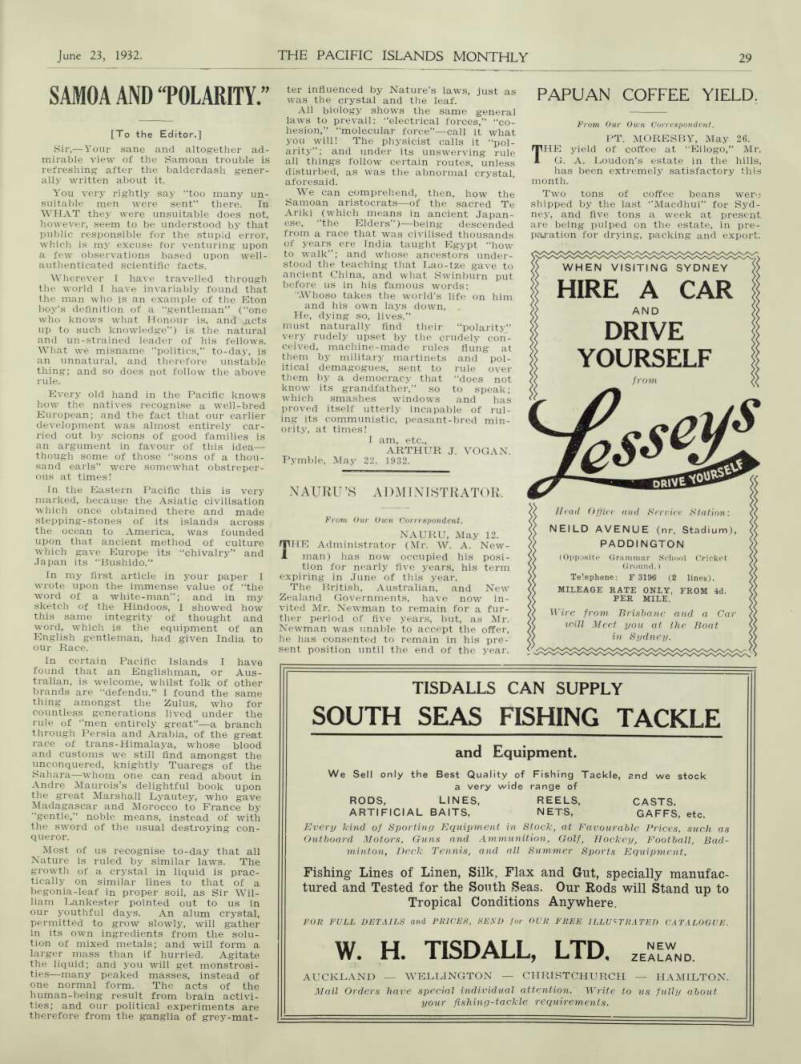
[To the Editor.] Sir, —Your sane and altogether ad mirable view of the Samoan trouble is refreshing after the balderdash gener ally written about it.
You very rightly say “too many un suitable men were sent” there. In WHAT they were unsuitable does not, however, seem to be understood by that public responsible for the stupid error, which is my excuse for venturing upon a few observations based upon well authenticated scientific facts.
Wherever I have travelled through the world I have invariably found that the man who is an example of the Eton boy’s definition of a “gentleman” (“one who knows what Honour is, and acts up to such knowledge”) is the natural and un-strained leader of his fellows.
What we misname “politics,” to-day, is an unnatural, and therefore unstable thing; and so does not follow the above rule.
Every old hand in the Pacific knows how the natives recognise a well-bred European; and the fact that our earlier development was almost entirely car ried out by scions of good families is an argument in favour of this idea — though some of those “sons of a thou sand earls” were somewhat obstreper ous at times!
In the Eastern Pacific this is very marked, because the Asiatic civilisation which once obtained there and made stepping-stones of its islands across the ocean to America, was founded upon that ancient method of culture which gave Europe its “chivalry” and Japan its “Bushido.”
In my first article in your paper I wrote upon the immense value of “the word of a white-man”; and in my sketch of the Hindoos, I showed how this same integrity of thought and word, which is the equipment of an English gentleman, had given India to our Race.
In certain Pacific Islands I have found that an Englishman, or Aus tralian, is welcome, whilst folk of other brands are “defendu.” I found the same thing amongst the Zulus, who for countless generations lived under the rule of “men entirely great”—a branch through Persia and Arabia, of the great race of trans-Himalaya, whose blood and customs we still find amongst the unconquered, knightly Tuaregs of the Sahara—whom one can read about in Andre Maurois’s delightful book upon the great Marshall Lyautey, who gave Madagascar and Morocco to France by “gentle,” noble means, instead of with the sword of the usual destroying con queror.
Most of us recognise to-day that all Nature is ruled by similar laws. The growth of a crystal in liquid is prac tically on similar lines to that of a begonia-leaf in proper soil, as Sir Wil liam Lankester pointed out to us in our youthful days. An alum crystal, permitted to grow slowly, will gather in its own ingredients from the solu tion of mixed metals; and will form a larger mass than if hurried. Agitate the liquid; and you will get monstrosi ties—many peaked masses, instead of one normal form. The acts of the human-being result from brain activi ties; and our political experiments are therefore from the ganglia of grey-mat
ter influenced by Nature’s laws, just as was the crystal and the leaf.
All biology shows the same general laws to prevail: “electrical forces,” “co hesion,” “molecular force” —call it what you will! The physicist calls it “pol arity” ; and under its unswerving rule all things follow certain routes, unless disturbed, as was the abnormal crystal, aforesaid.
We can comprehend, then, how the Samoan aristocrats—of the sacred Te Ariki (which means in ancient Japan ese, “the Elders”) —being descended from a race that was civilised thousands of years ere India taught Egypt “how to walk’’; and whose ancestors under stood the teaching that Lao-tze gave to ancient China, and what Swinburn put before us in his famous words: “Whoso takes the world’s life on him and his own lays down, He, dying so, lives.” must naturally find their “polarity” very rudely upset by the crudely con ceived, machine-made rules flung at them by military martinets and pol itical demagogues, sent to rule over them by a democracy that “does not know its grandfather,” so to speak; which smashes windows and has proved itself utterly incapable of rul ing its communistic, peasant-bred min ority, at times!
I am, etc.,
Arthur J. Vogan.
Pymble, May 22, 1932.
Nauru’S Administrator.
From Our Own Correspondent.
Nauru, May 12.
THE Administrator (Mr. W. A. New man) has now occupied his posi tion for nearly five years, his term expiring in June of this year.
The British, Australian, and New Zealand Governments, have now in vited Mr. Newman to remain for a fur ther period of five years, but, as Mr.
Newman was unable to accept the offer, he has consented to remain in his pre sent position until the end of the year.
Papuan Coffee Yield.
From Our Own Correspondent.
Pt. Moresby, May 26.
THE yield of coffee at “Eilogo,” Mr.
G. A. Loudon’s estate in the hills, has been extremely satisfactory this month.
Two tons of coffee beans were shipped by the last “Macdhui” for Syd ney, and five tons a week at present are being pulped on the estate, in pre paration for drying, packing and export.
Advertisements & other items, p. 31 (1 item)
W. H. Tisdall, Ltd.
WHEN VISITING SYDNEY
HIRE A CAR
AND
DRIVE
YOURSELF
from Head Office and Service Station : NEILD AVENUE (nr. Stadium),
PADDINGTON
(Opposite Grammar School Cricket Ground.) Telephone: F 3196 (2 lines).
MILEAGE RATE ONLY, FROM 4d.
PER MILE.
Wire from Brisbane and a Car will Meet you at the Boat in Sydney.
TISDALLS CAN SUPPLY
SOUTH SEAS FISHING TACKLE
and Equipment.
We Sell only the Best Quality of Fishing Tackle, and we stock a very wide range of
RODS, LINES, REELS, CASTS,
ARTIFICIAL BAITS, NETS, GAFFS, etc.
Every kind of Sporting Equipment in Stock, at Favourable Prices , such as Outboard Motors, Guns and Ammunition, Golf, Hockey, Football, Bad minton, Deck Tennis, and all Summer Sports Equipment.
Fishing Lines of Linen, Silk, Flax and Gut, specially manufactured and Tested for the South Seas. Our Rods will Stand up to
Tropical Conditions Anywhere.
FOR FULL DETAILS and PRICES, SEND for OUR FREE ILLUSTRATED CATALOGUE.
W. H. TISDALL, LTD.
AUCKLAND WELLINGTON CHRISTCHURCH HAMILTON.
Mail Orders have special individual attention. Write to us fully about your fishing-tackle requirements.
Shall Mr. Cowley, Of Tonga,
Be Taken Seriously?
From Our Own Correspondent.
Nukualofa, May 1.
PURPOSEFUL, and serious minded readers in Tonga must have felt pained, if not actually hurt, at the tone of a letter to the Editor under the caption, ‘‘Tonga’s Economic Condi tion,” appearing in the December P.I.M.
We are sure that each reader started off this article feeling that here at last he would get what he was waiting for—some concrete sugges tions that would make for his betterment —some progressive policy, profoundly expressed and ex pounded—something not abstract, but solid and sure —something, in fact, that would rattle into his brain and give his intellect some scope to swing around in. 1 venture to say that, before he had finished the article, his intellect was swinging around alright, but without the acces sary scope.
We suspect that every reader fell into the trap, as we did, and did not realise till near the conclusion of the letter that the whole was a grand burlesqua.
We congratulate Mr. Cowley on having that very rare phenomenon—a sense of the ridiculous —a sense far more subtle than a sense of humour—and he has the happy knack of convey ing that sense to paper.
We were not even suspicious when he spoke of giving £5 to slngletless and poverty-stricken Tongans. though, goodness knows, we should have been, because £5 is five pounds, and Tongans, in the state described, are about as plentiful as snowballs in Hades. Then we reached his par. 4, where there is a lot of confusing talk about disrobing before the High Commissioner. We certainly should have taken a tumble here. But no! We read the paragraph over three or four times, forwards and back wards, scratched our head, and passed it as read.
Still unsuspicious, we solemnly gleaned all that stuff about the “booted and spurred bureau cracy” and ‘‘get off his back” and then, in a
blue funk, our eyes chased up the column to see, if by some mischance, we had got tangled up with some racing news. We think we started to feel there was a ‘‘catch’ when we got to the paragraph stating that the Queen of Tonga said, “There are 1,200 taxpayers without a bit of land.”
Here we sat up, because, as far as we recol lected, Her Majesty had stated that there was plenty of land for 1,200 taxpayers who had ap parently njt availed themselves of the gift. (We would like to digress here and say that the Queen’s statement did surprise us, because we had no idea that as mechanics, storemen, yardmen, carpenters, drivers, etc., the trade warranted so many—1,200 is a lot).
From there on, in his article, we began to get a glimmer cf Mr. Cowley’s leg-pulling tactics.
These tactics were emphasised when we got to the statement that three small consignments of kumaras glutted New Zealand. Just think over that and smile! We know that, right here, we felt an admiration for the writer, second only to our youthful worship of Mark Twain and Stephen Laycock. (I wonder if any other reader saw daylight at this stage).
Having got ‘‘en rapport,” we found no diffi culty, then, in finishing the article right down to the penultimate paragraph where the sug gestion is made that the prosperity and posterity of Tonga is better catered for in a Government position than in the cultivation of the soil.
The final pronouncements concerning Charles and James of happy memory are really good. (By the way, there w r as another fellow called Pepys living around about that time, and we would like to write a few of his historic pro nouncements but, as space is limited, we let it pass).
Most readers will congratulate Mr. Cowley on ‘‘putting over” a thundering good hoax, and for those who do not incline to Mr. Cowley’s levity in dealing with a serious subject, we would simply add ‘‘tuku aibe”
Energetic Cook Islanders.
From Our Own Correspondent.
Rarotonga, May 22.
SOME two years ago, the native people of the village of Matavera set themselves the task of creating a full-sized football ground from a rough area on the roadside near the village.
The work was done by free labour and, as a co-operative undertaking, the scheme was a big one. Much of the levelling was carried out with the aid of a light railway and trucks.
From time to time a canvass was made of those interested in sport, the most welcome gifts being tins of bully beef and bard biscuits.
The sinews of war were provided in this way.
The work has been now finished for some months, but the opening of the ground has been allowed to await the commencement of the foot ball season.
On Wednesday, May 11, the villagers arranged for the ground to be formally opened in the presence of representatives of the leading sports body—the Sports Association.
The Resident Commissioner, Judge Ayson, who is president of this body, accompanied by the chief Ariki, Makea Tinirau (vice-president), warmly congratulated the villagers on their fine effort, and declared the ground open for play.
Mr. J. G. Fowler, of the Papuan Ad ministrative service, who is spending long leave in Australia, left Sydney early in June for Brisbane, where he will reside for three months before re turning to Misima, Eastern Papua.
Shipping Arrange
Ments In Cook Islands
From Our Own Correspondent.
Rarotonga, May 22.
DURING the fruit season proper, which com menced in April, the Union Steamship Com pany provides two distinct services, which embrace the Cook Group.
First, there is the mail-boat service. The mail-boats maintain a four-weekly time-table.
The boat going northwards from Wellington to San Francisco regularly calls at Rarotonga on the Saturday and the downward vessel from the States calls on the following Monday. From Saturday to Monday is known on the island as the ‘’Boat week-end.”
Secondly, there is a ‘‘fruit steamer” service to these islands from Auckland. This service is arranged, so that the visit to the islands falls about midway between mail-boat calls.
This year the Union Company has announced its cargo boat the ‘‘Kanna,” as the fruit vessel to run down to the Cook Islands from Auck land.
The mail-boats touch at Rarotonga only—they do not make a call at any of the other islands.
The ‘‘Kanna” (if it conformed to past itin eraries) would call at Aitutaki, Atiu, Mauke and Mangaia as well as at Rarotonga—the port of entry and clearance.
Two privately-owned schooners ply between Rarotonga and the group of islands mentioned —a distance of between 110 and 140 miles.
The two schooners visit the northern islands (Penrhyn, Manihiki and Rakahanga) perhaps two or three times duryig the year.
These services constitute our lines of com munication between the Islands themselves and New Zealand.
The fruit season is now with us, and at the commencement the outlook for the season has been damped by the cancellation of the ‘‘Kanna” of her first trip to the islands of the Lower Group.
It seems almost certain that her expected second visit will not eventuate. The Union Company’s cargo boat ‘‘Waikawa,” now on her way down from San Francisco, will, in all probability, call at Mangaia and Aitutaki and pick up fruit for Auckland.
If she does call, it might create a dilemma, because of the fact that the cargoes picked up by her will deplete the two islands of their shocks without landing any for the next steamer that calls.
Both the schooners are away on a long cruise to the northern islands, returning to Rarotonga via Papeete. There is no means, therefore, of landing fruit cases at Aitutaki and Mangaia in readiness for a shipment of oranges by the ‘‘Kanna.” Positions such as these are, to say the least, extremely tormenting for our local shipping representatives.
However, so far as Rarotonga is concerned, a fair quantity of space for fruit is generally to be had on the mail-boats. ‘‘Makura’s” Orange Shipment.
By the R.M.S. ‘‘Makura,” which called here on April 25, remaining for two days loading fruit, some 13,300 cases of oranges went for ward to New Zealand.
Growers were paid something like 4/- a case (fruit only), the gross return of which, for the whole cargo, represent a timely accretion to the very limited amount of spending money that lately has come into the island.
Advice posted up at the Administrative offices is to the effect that the shipment sold at from 11/- to 14/6 a case (portion unsold).
In print, the difference between the price paid to the grower and that received at the market end, would indicate that those who consigned direct had done well.
After allowing for wastage, and meeting all incidental charges up to the time the fruit is knocked down to the buyer, 4/- or 5/- a case for the oranges is about all that would come back to the consignee—as a maximum.
Oranges going forward per the R.M.S. ‘‘Mono wai” on May 23 have had the benefit of a period of cooler and drier weather and will be firmer and sweeter possibly than the ‘‘Makura’s” shipment.
Advertisements & other items, p. 32 (1 item)
Joyce
Creamy and Crisp
Here’s a delicious assort ment of Golden - brown Biscuits with smooth, creamy centres, or topped with cream and conserve.
They almost melt in the mouth, and they offer the most appetising flavours.
Packed with utmost you get them fresh and fragrant.
Joyce
Assorted Creams
Write to P.O. Box 31, Camperdown, N.S.W., if Joyce Gold Medal Biscuits are unobtain able locally. FPL4
Samoan Settlers’ Petition For Leasing Of
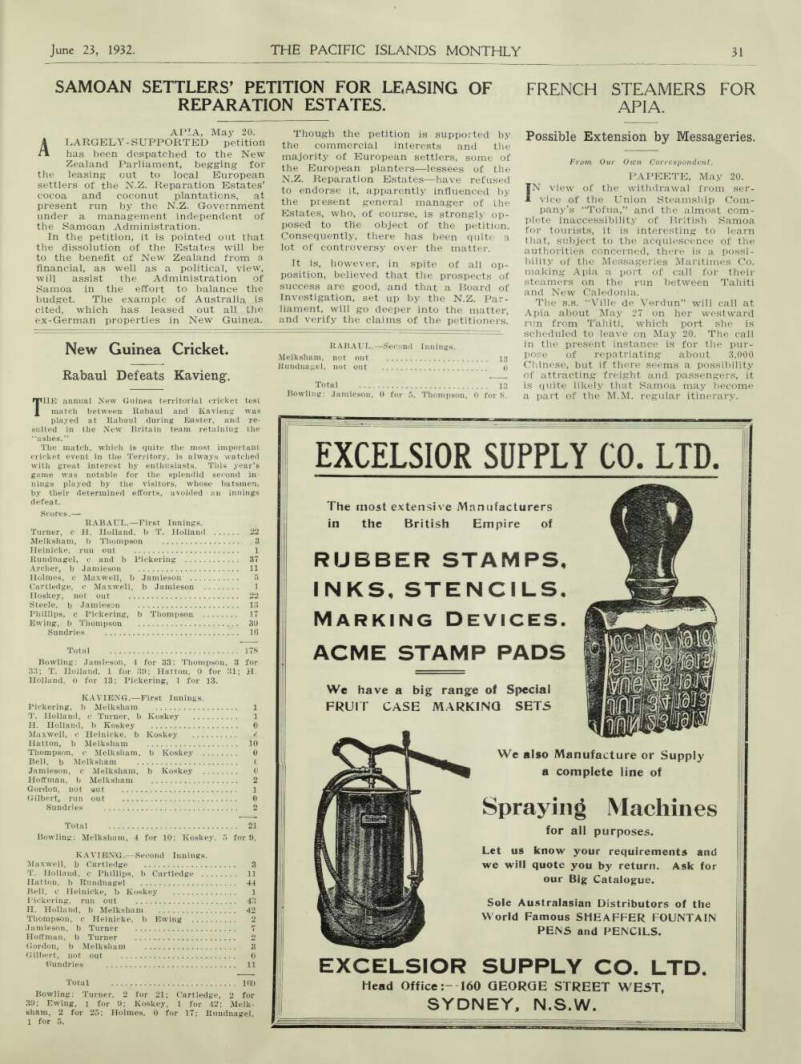
Reparation Estates.
Apia, May 20.
A LARGELY-SUPPORTED petition has been despatched to the New Zealand Parliament, begging for the leasing out to local European settlers of the N.Z. Reparation Estates' cocoa and coconut plantations, at present run by the N.Z. Government under a management independent of the Samoan Administration.
In the petition, it is pointed out that the dissolution of the Estates will be to the benefit of New Zealand from a financial, as well as a political, view, will assist the Administration of Samoa in the effort to balance the budget. The example of Australia is cited, which has leased out all the ex-German properties in New Guinea.
Though the petition is supported by the commercial interests and the majority of European settlers, some of the European planters—lessees of the N.Z. Reparation Estates —have refused to endorse it, apparently influenced by the present general manager of the Estates, who, of course, is strongly op posed to the object of the petition.
Consequently, there has been quite a lot of controversy over the matter.
It is, however, in spite of all op position, believed that the prospects of success are good, and that a Board of Investigation, set up by the N.Z. Par liament, will go deeper into the matter, and verify the claims of the petitioners.
New Guinea Cricket.
Rabaul Dfeats Kavieng.
THE annual New Guinea territorial cricket test match between Rabaul and Kavieng was played at Rabaul during Easter, and re sulted in the New Britain team retaining the “ashes.”
The match, which is quite the most important cricket event in the Territory, is always watched with great interest by enthusiasts. This year’s game was notable for the splendid second in nings played by the visitors, whose batsmen, by their determined efforts, avoided an innings defeat.
Scores.—
Raraul.
—Second Innings.
Melksham, not out Runduagel, uot out Total Bowline: Jamieson, 0 for 5. Thompson, 0 for 8.
RABAUL. —First Innings.
Turner, c H. Holland, b T. Holland ...
Me Ik sham, b Thompson . . . 22 3 Heinicke, run out 1 Rundnagel, c and b Pickering Archer, b Jamieson . . . 37 .. . 11 1 Hoskev, not out oo Steele, b Jamieson . . . 13 Phillips, c Pickering, b Thompson Ewing, b Thompson .. . 17 . . . 30 Sundries .. . 16 Total Bowling: Jamieson, 4 for 33; Thompson, 33; T. Holland, 1 for 39; Hatton, 0 for Holland, 0 for 13; Pickering, 1 for 13. , 3 for 31; H.
KAVIBNG. —First Innings.
Pickering, b Melksbam 1 T. Holland, c Turner, b Koskev 1 H. Holland, h Koskev 0 Maxwell, c Heinicke. h Koskev Hatton, b Melksham . . . 10 Thompson, c Melksham, b Koskey 0 Bell, b Melksham t Jamieson, c Melksham, b Koskey Hoffman, b Melksham 0 2 Gordon, not aut 1 Gilbert, run out 0 Sundries 2 Total . . . 21 Bowling: Melksham, 4 for 10; Koskey, .1 i for 9.
KAVIEINIG. —Second Innings.
Maxwell, b Cartledge 3 T. Holland, e Phillips, b Cartledge . . 11 Hatton, b Rundnagel 44 Bell, c Heinicke. b Koskev 1 Pickering, run out 43 H. Holland, b Melksbam 42 Thompson, c Heinicke, b Ewing 2 Jamieson, b Turner fj Hoffman, b Turner 2 Gordon, b Melksham 3 Gilbert, not out o Sundries 11 Total Bowling: Turner, 2 for 21; Cartledge, 2 for 39; Ewing, l for 9; Koskey, 1 for 42; Melksham, 2 for 25; Holmes, 0 for 17: Rundnagel, 1 for 3.
French Steamers For
Apia.
Possible Extension by Messageries.
From Our Own Correspondent.
Papeete, May 20.
IN view of the withdrawal from ser vice of the Union Steamship Com pany’s “Tofua,” and the almost com plete inaccessibility of British Samoa for tourists, it is interesting to learn that, subject to the acquiescence of the authorities concerned, there is a possi bility of the Messageries Maritimes Co. making Apia a port of call for their steamers on the run between Tahiti and New Caledonia.
The s.s. “Ville de Verdun” will call at Apia about May 27 on her westward run from Tahiti, which port she is scheduled to leave on May 20. The call in the present instance is for the pur pose of repatriating about 3,000 Chinese, but if there seems a possibility of attracting freight and passengers, it is quite likely that Samoa may become a part of the M.M. regular itinerary.
Advertisements & other items, p. 33 (1 item)
Excelsior Supply Co. Ltd.
The most extensive Manufacturers in the British Empire of
RUBBER STAMPS,
INKS, STENCILS.
Marking Devices.
ACME STAMP PADS
We have a big range of Special
FRUIT CASE MARKING SETS
a a m m m K We also Manufacture or Supply a complete line of
Spraying Machines
for all purposes.
Let us know your requirements and we will quote you by return. Ask for our Big Catalogue.
Sole Australasian Distributors of the World Famous SHEAFFER FOUNTAIN
PENS and PENCILS.
EXCELSIOR SUPPLY CO. LTD.
Head Office:- 160 GEORGE STREET WEST,
SYDNEY, N.S.W.
Bligh And The Darnley Islanders.
Peep Into History of Well-known Torres Strait Island
(By our Thursday Island Correspondent.)
THE modern Darnley Islander seems to have a natural objection to be ing “protected.” But, truculent as he sometimes is, his conduct is mild compared to that of his forebears in the days of Captain Bligh, of Bounty fame.
Bligh made his second voyage through Torres Strait in 1792, as Com mander of H.M.S,. '/’Providence” his first was in the open boat in which he was set adrift after the mutiny), and he entered through the Barrier Reef, near its northern end, close to Darnley Island. He was accompanied by Lieu tenant Portlock, in the brig “Assist ant,” and on Bligh’s own ship one of the junior officers was that Matthew Flinders who still remains the premier explorer of our reef-strewn waters.
Bligh anchored off Darnley Island on September 4, and bestowed on it its very aristocratic name. But it was not long before he learnt the nature of the “Indians” whose solitude he had dis turbed. They swarmed out in canoes to interview the men on the “Providence’s” boats —which had been sent on in ad vance to find a passage through the reefs—making signs of friendship and holding out green coconuts for ex change.
The officer-in-charge disliked their appearance so much, that he started back to safety, what time the islanders did their best to cut him off. Finding themselves frustrated in this scheme, the natives openly prepared their bows by stringing arrows on them. How ever, the Englishmen got in first and a discharge of muskets sent the sally ing party home.
That the Darnley natives of that day were skillful sailors is proved by the
following extract from Flinder’s Journal: “No boats could have been man oeuvred better in working 'to windward than were these long canoes by the naked savages. Had the four (canoes) been able to reach the cutter, it is dif ficult to say whether the superiority of our arms would have been equal to the great difference of numbers, consider ing the ferocity of these people and the skill with which they seem to manage their weapons.”
More amicable relations were estab lished the next day, when the natives came right out to the two ships and bartered their bows and arrows for articles of iron, known to them as “Three.” The canoes, according to Flinders, were fifty feet long and made from a single tree. As the vegetation is sparse on Darnley, the logs must have been either procured from New Guinea or else been carried there by currents, as at the present time.
Before leaving this part of Torres Strait, Bligh named Nepean, Stephens and Campbell Islands.
A few days later the “Provi dence” was again in trouble.
While passing through an opening in the reefs, near Warrior Island, the two vessels were directly attacked by seven canoes full of plucky but misguided natives, and the ships’ guns loaded with grape shot had to be fired before the battle terminated, Bligh’s life must have been a stormy one, owing to his arbitrary character, reflected in the mutiny on the “Bounty” and in his deposition from the govern orship of N.S.W.; yet it was not devoid of honours. He was personally thanked by Nelson after the battle of Copen
hagen, and was successively created Rear and Vice Admiral after his de parture from Australia. But he was of a breed that could never exist for any time in authority to-day. “A sea wolf; a brutal, intrepid, indefatigable man.
All his words were words of wrath. All his orders were threats. All his threats were of the lash.” Thus wrote a famous French naval surgeon of the man whose tyranny induced a mutiny—the man, too, whose pluck and endurance brought to a safe completion one of the most famous small-boat voyages in history.
Nine months later Darnley again be came notorious. In 1793, two sailing vessels, “Hormuzeer” and “Chester field,” left Norfolk Island with the in tention of traversing Torres Strait by a route not hitherto attempted. In due course, “Bligh’s Darnley Island” was sighted, and there the two ships struck immediate trouble.
Bartering had been taking place be tween the visitors and the natives; and re-assured, no doubt, by the latter’s friendly attitude, the chief mate of the “Chesterfield,” another officer,) and a passenger named Hill belonging to the N.S.W. Corps, went ashore with five seamen in a whaleboat.
On the fourth day of their absence a search was made, and Mr. Dell with two other boats went right round the island without finding any traces of the missing men. They were followed round the beaches by a large crowd of natives, who used every inducement in their power to get them to land. At Treachery Bay, indeed, it was found that a party was lying in ambush wait ing for them to do so and, when this failed, hostilities broke out, resulting in the death of one of the natives.
On July 10, a strongly-armed party landed, and found some of their lost friends’ possessions, but no other signs of them. In the huts they found human skulls and dried hands hanging up, and other marks of savagery. The Union Jack was first hoisted; and then retribution was exacted by the burning of 135 huts, 16 canoes, and the destruc tion of many gardens. This annexation of Darnley, which included all the neighbouring islands and the adjacent coast of New Guinea, was not attended by the people most concerned. They were hiding in the hills, and must have seen the two vessels finally sail away with great relief.
From information gained at Stephens Island, it was learned that Captain Hill and four seamen had been murdered on Darnley, but their bodies were never found.
Three of the party who had gone ashore escaped, however, and then started on one of those amazing small boat ventures which seem to have been the final stage of many a shipwrecked party in Torres Strait. In this case, the survivors managed to get to their boat. They cut the rope and got away —without provisions, without a com pass. The mother ships being five leagues to windward and, therefore, be yond their reach, these three intrepid men sailed westward through the Straits, and finally reached the islands of Timor Laut.
Many years later, however, in 1843, Blackwood and Yule, in the Fly and Bramble, came to a good understanding with the natives of Darnley—although the latter did show fight when pressed to help in the search for certain men of the expedition who had been lost along the Papuan coast.
Advertisements & other items, p. 34 (1 item)
Freez-All
Wherever you live — Refrigeration
In spite of you being- ever so far out of reach of Ice-Works or Electricity, all the benefits of refrigeration have been brought within the reach of every home by the
Home Refrigerator
Will hold a whole carcase of mutton, half a box of butter, as well as drinks.
Cheaper, more Efficient and Reliable than any other Selfcontained Refrigerator. Operates at the trifling cost of V/zd. per day.
Ml
Price Complete: £27/10/-
Australian Currency f.o.b. Sydney, Many thousands are now in use in Australian country homes, and we provide a Guaranteed Service with every machine. We Specialise in Repairs for “Icyball” and Ice-stove Refrigerating Units.
Write to Sole Pacific Island Distributors:
McLEOD BOLTON & CO. LTD.,
THE ISLAND MERCHANTS,
249 GEORGE STREET, SYDNEY. Name
Established 20 Years. Cables: “NOTLOB,” SYDNEY. Address Please send me copy of your descriptive Leaflet.
Value Of New Guinea.
Gold Production and Total Administration Cost.
fN reply to questions, the Prime Minister of Australia stated, on on May 24, that gold of the value of £1,149,333 has been produced in New Guinea from May 9, 1921, to March 31, 1932. During that period, gold of the value of £1,148,703 has been exported from the territory, all of which has been sent to Australia.
Asked what had been the cost of administering the Territory since Aus tralia was given the mandate, the Prime Minister replied: Payments, other than loans, have been made by the Commonwealth Government in respect of the adminis tration of New Guinea from May 9, 1921, to June 30, 1931, as follow: (i) Grants totalling £65,000, to be utilised fer the welfare of the natives. (ii) Bounties under the Papua and New Guinea Bounties Act, 1926, £3,817. (iii) Miscellaneous expenditure total ling £8,584. (iv) Portion of the annual subsidy for the maintenance of shipping services to several territories in the Pacific, including the Tenitory of New Guinea, esti mated at about £160,000.
Papeete.
Petrol Bowsers Appear in Papeete.
From Our Own Correspondent.
Papeete, May 20.
MESSRS, a. B. DONALD have re cently opened their new gasoline filling station on one corner of their property. It is of the most modern construction with two bright red filling pumps, an ornate little cottage and a flower bed. We have recently heard that the Societe Commerciale de L’Oceanie is about to follow suit, with a station within a block of Donald’s.
A price-cutting competition on gaso line would be very welcome to our local drivers.
Record Copra Shipment.
From Our Own Correspondent.
Pt. Moresby, May 26.
THE Royal Dutch Packet vessel, “Van Rees,” arrived in Port Moresby, on May 25, from Java ports. She had on board 180 tons of general cargo for this port.
This is her first visit to the territory.
She proceeds to Rabaul, Noumea and Sydney. From Sydney she returns via Port Moresby to Java.
The “Montoro” arrived on May 25 from New Guinea and Samarai and the “Macdhui,” on her way to Australia, is expected on the 26th and is leaving the same day for Samarai and New Guinea.
The “Pentor” cleared Port Moresby on May 18 for Batavia, Marseilles and London. Altogether 2,483 tons of copra were loaded from Papua, Port Moresby, and Samarai —a record single shipment from this Territory,
Solomons’ Copra.
Reduction in Output.
From Our Own Correspondent.
TULAGI, April 30.
OUR Protectorate financial year, which ended on March 31, showed our year’s output of copra to be 21,209 tons, which was a fall of about 2,400 tons on the previous year.
This is mostly accounted for by the low price prevailing, which effectively cut off native production (about 3,000 tons).
Besides this, many plantations showed a reduced output, which is charged up to nut-fall. The cause of this, by the
way, has not yet been definitely ar rived at; though I understand that Mr.
Lever (our entomologist) is of opinion that want of fertiliser and cultivation is mostly to blame. But while this would be true up to a point, it is hard to believe that such huge reductions of output, which have taken place on a few of the plantations, can altogether be charged up to this cause.
Mr. Cqppjiut, who so largely feeds on sunlight and air, has been in existence and done his job for a large number of years, and many refuse to believe that he will suddenly “down tools” and go on strike unless he is given the dole, so to speak. Of course, he may have heard about Mr. Lang, in which case anything would be understandable.
Pests everywhere come and go, or, as Mr. Stevens was reported last night as having said at Canberra, “boils come to a head and break and leave the system cleaner.” So let us hope our coconut pest, together with Mr. Lang, is but a passing phase.
Advertisements & other items, p. 35 (1 item)
Rott
M \ 4 ft I % .J art P These Famous MILK COFFEE Biscuits are so popular that it does not matter when surprise visitors drop in. They are always ready, and never fail to please.
Manufactured by
WILLIAM ARNOTT LTD.
THE BISCUIT SPECIALISTS,
of sixty-four years’ experience Made in Australia, Financed by Australians, and producsd by highly trained Australia i Workers.
rOTT
FAMOUS
I I
BISCUITS
l:
YOUR STOREKEEPER WILL SUPPLY YOU.
Morinda’s Itinerary.
Norfolk Island Wants
Two Markets.
AN urgent plea for the revision of the Burns, Philp timetable, covering Sydney-Norfolk Island-New Heb rides-Auckland has been received from Norfolk Island.
It is pointed out that the “Morinda” now proceeds Sydney-Norfolk Is.-New Hebrides-Norfolk Is.-Auckland-Norfolk Is.-Sydney. It is contended that this is not fair to the Norfolk Is. producers.
They collect their produce and ship it to Auckland. Within five days, the “Morinda” is back again, en route to Sydney. The islanders do not get a chance, in that short time, to collect another good consignment. Then they must wait five weeks before the “Mor inda” sails for Auckland on her next round trip.
But, they say, if the “Morinda” were to run Sydney-Norfolk Is.-Auckland- Norfolk Is.-New Hebrides-Norfolk Is.- Sydney, there would be a longer inter val between the ship’s departure for Auckland and Sydney respectively, and they could arrange their consignments more profitably.
At first glance, this is an eminently reasonable request. But a careful study of the proposed itinerary shows that it would at once open the way for the sale of goods to the New Hebrides by Auckland merchants. And Aus tralia cannot approve of that. Aus tralia subsidises this shipping service very substantially, in the hope that it will open the New Hebrides market to Australian exporters. It is, naturally, not Australia’s policy to subsidise a shipping service for New Zealand’s en terprising merchants.
However, the welfare and encourage ment of Norfolk Is. producers are sub jects of primary consideration; and the “Morinda’af’i itinerary is again under consideration at Canberra.
International Courtesies in Samoa.
From Our Own Correspondent
Apia, May 2.
HIS Excellency the Administrator, and Mrs. Hart departed on Friday, May 20 by the U.S.S. “Lark” to Pago Pago on an official visit to the Gov ernor of American Samoa. The party included several other Administrative officials.
A return visit by the Governor of American Samoa will be made on the King’s Birthday. The party will at tend the various sports and festivities planned for that day.
Another Sugar Plan.
For the Solomons.
A PLAN to grow sugar in the British Solomon Islands is being submitted to Sydney investors.
It is proposed to lease 10,000 acres of grass lands on the northern side of Guadalcanal, about 30 miles from Tu lagi, and plant 1,000 acres in Queens land varieties of cane, as soon as pos sible. The new British preference on colonial-grown sugar is an important factor in the plan.
Mr. King, who has been a plantation manager in the Solomons for some years, is interested in the proposal.
American Millionaires.
Solomon Islands Attractive to American Millionaires.
From Our Own Correspondent
Tulagi, June 7.
THE Solomon Islands have suddenly jumped into prominence as a place of call for the yachts of American millionaires, with the result that almost every few weeks there is a palatial ves sel anchored in Tulagi Harbour.
The most recent visitor was Harry S.
Bissell (of carpet-sweeper fame), of La Cresenta, Cal., in- his fine aux. Diesel schooner “Ariadne,” a vessel of some 250 tons gross.
The party intends touring the Solo mons and Java, and thence home, via Cape of Good Hope, West Africa, and Panama.
Advertisements & other items, p. 36 (2 items)
Marine Engine
CADY
Astonishing- offer for May and June only, prior to stocktaking: J-4 H.P. 3£m. bore, with genuine SCH EBLER Carburettor; ROBERT BOSCH High-tension Magneto; Bronze Plunger Pump, thrust bearing; Muffler, Spark Plug and Wire; sft. best British Bronze Shaft; 3-blade Propeller: Stuffing Box with lag screws; Starting Handle. Suit boats 16 to 20 feet.
Price of above Outfit, £29 F. 0.8. Sydney.
This is half present price. Cady engines have been made for 40 years, and hundreds are in use through Australia and the Islands.
ACT PROMPTLY.
HALL BROS. LTD.
(Established 40 years),
The Engine House,
CAREENING COVE,
MILSON’S POINT, NORTH SYDNEY,
N.S.W, - AUSTRALIA.
Cables: "Halbros,” Sydney.
Union
PORTLAND CEMENT
U
91 $ to TO E
PDRU>*§
BRAND
GUARANTEED HIGHEST QUALITY.
Considerably exceeds strength required under British and Australian Standard Specifications.
ALSO
‘ 1 UNIONITE ’ ’ Quick Hardening Cement. (High Early Strength).
COMPETITIVE PRICES. :: ENQUIRIES INVITED.
THE COMMONWEALTH PORTLAND CEMENT COMPANY LTD.,
SYDNEY and PORTLAND, N.S.W.
Postal Address: Telegraphic Address: Box 1571 E, G.P.0.,
SYDNEY,
“LIMERIEZ”
SYDNEY.
Asiatics For Solomons.
[To the Editor.]
Sir, —1 note in the May issue of ‘‘The Pacific Islands Monthly,” that Mr. Geof.
Clift again comes out in advocacy of Asiatic labour for the Solomons.
Let’s examine his arguments. He says, “Like many other Groups, the Solomons are in the unfortunate posi tion of being wholly dependent on copra.” Well! for the five years ending March, 1930 (the last figures at hand), our average annual exports showed £20,000 worth of shell, £13,200 worth of ivory nuts, and £6.809 worth of timber.
All self-grown natural resources: surely not too insignificant to mention!
We have no bananas, pineapples, rubber, cotton, sugar, or coffee, but is this not a circumstance to rejoice over rather than lament?
If one only has toothache, he can give it his undivided attention to effect a cure or relief, but if he has cancer, rheumatism, haemorrhoids and menin gitis, and a few other minor complaints thrown in to make good measure, it follows that recovery is likely to be somewhat delayed. Mr. Clift more or less agrees with this, when he says, “We hope that the rising price of copra means the end of the depression as far as we are concerned,” and so it would be if copra held the price it was when he made this remark (about £l7 per ton) but alas! even to hope for such a thing- shows a lack of study of the world’s maladies.
Why does the world (or rather its human element) so consistently ignore the laws of average and of supply and demand? Surely, it is not reasonable fo expect caviare prices in this industry, while the average standard of living is so reduced!
The most important reason for im ported labour can be only “to produce more.” Well, then (pardon my Socra tical tendencies) but how much better off will the Solomons, or the world, be if we increase our output a hundred fold? Why produce more of a com modity that is already over-supplied?
Surely, it is wiser to have the world’s markets properly regulated rather than glutted, and so unable to return to the producer a fair margin of profit!
Then comes the argument that the Government would benefit because each Asiatic would pay £1 poll tax and that imports and exports would increase ac cordingly. Truly this is a crushing de nunciation of the White Australia policy; for how ridiculously easy it would be for Australia to become af fluent by flooding her shores with the overflew of the surplus populations of the northern countries?
Again, Mr. Clift says, “An interming ling between Asiatics and natives would improve the native race.” This is a rather rash statement. If “The Pacific Islands Monthly” articles are at all reliable, to say nothing of hearsay, Solomon Islands labour is close to being the best for copra production in the Pacific. Where, for instance, will we find labour averaging a better daily task than 800 lbs. of green copra (gathering and cutting out) which is claimed on some of the better super vised plantations here? Would an in termingling of blood improve on this?
Well, hardly!
The intermingling question, of course, takes us somewhat beyond our depth, though it is within the bounds of pos
sibility that if the world goes on long enough, there will come a time when its whole population will blend into one huge family, but, for the meantime, it is a questionable policy to pursue, for, “Better the devil we know.”
I am etc ’
Solomonoo.
TnGcH t,, n o 7 ll, la*i, June 7 -
Bulolo’s Gold Yield.
ffIHE secretarv of Bulolo Gold Drcde- I hec^ rar y or Euioio Gold iJredg mg: Ltd - sports that the yield for the 28-day period ended May 23 amounted to 4,887 ozs. of bullion from 248,300 cubic yards, of an approximate value of 66,000 gold dollars.
Advertisements & other items, p. 37 (1 item)
Everyone knows
that when you
say “Batteries”
you mean Exide
For there are more Exides in use than all other makes put together.
There are Exide Batteries for ringing door bells, for telephones, signalling, wireless, motor cycles, cars, aeroplanes, submarines, broadcasting stations, trains, talkies, power stations and house lighting.
Houselighting Batteries
Whether it be for lighting or power, primary or emergency, the Exide Battery is the final answer to every problem of electrical storage. Exide Batteries are the result of over 40 years’ specialisation.
I
The 8.8. C. Co., 2BL, 2FC,
2GB, 2UE, 2SM,
All Use Batteries
Why not follow the example of these big Wireless organisations and instal Exide in your own set?
There are Exides for High and Low Tension purposes.
Send for Free Literature.
When It’s an Exide
Your Car will Start.
Every Exide is so priced that inferior batteries prove expensive. Low first cost, together with uniform quality and dependable service over a long period of time makes Exide your best buy. .51
BATTERY
TTp tV?H.E ...
10 VOLTS
Queensland Distributor: EXIDE BATTERY SERVICE (Q.), LTD., Adelaide Street, Brisbane.
New South Wales Distributor; EXIDE BATTERY SERVICE (Gibson, Battle & Co., Ltd.), Hunt and Commonwealth Streets, Sydney.
EXIDE BATTERIES OF AUSTRALIA LTD.,
GRACE BUILDING York Street, SYDNEY.
Samoan Planters
Meet.
From Our Own Correspondent.
Apia, May 20.
THE annual general meeting of the Planters’ Association of Samoa was held on April 30 and attended by 17 members.
The first annual report of the com mittee was presented and adopted, also the financial statement showing a sat isfactory balance on hand.
The present officers of the Associa tion, including the president, Mr. F. L.
A. Gock, were re-elected, as also was the previous committee of six members.
It was proposed that the Association endorse a petition to cut up and lease out the N.Z. Reparation Estates. After a discussion, the motion was defeated by 13 votes to 4.
Means and methods to fight the dreaded black-pod disease of the cocoa trees were discussed, especially a sug gestion to make use of blasting for the purpose, on which opinions were divided. It is hoped, that a mycologist from Fiji will be available for a short visit to Samoa to help planters in this and similar problems.
The Banana.
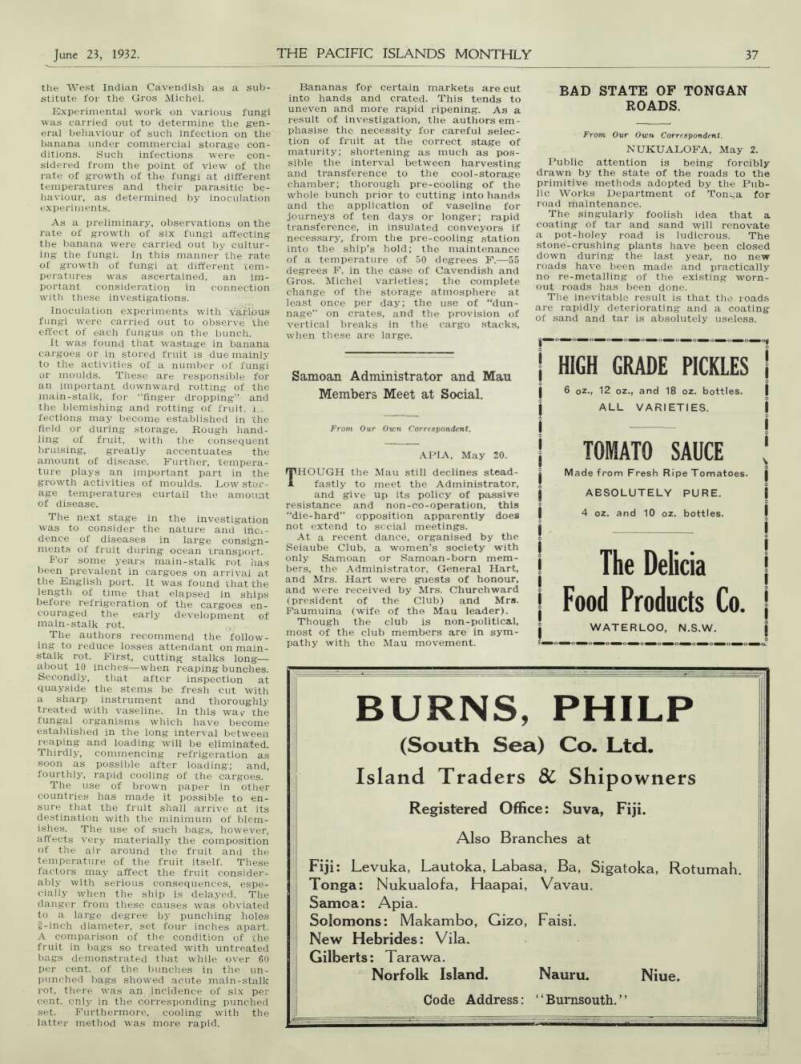
Its Behaviour and Diseases in Storage and Transport.
(By C. W. Wardlaw and L. P. Maguire, in the “Fiji Times and Herald.’')
THE research dealt with in this pub lication was carried out by the authors at the Low Temperature Station, Imperial College of Agricul ture, Trinidad, 8.W.1.
Panama disease, which first appeared in Central America in 1903, has caused heavy losses in the West Indies, and has been responsible for the abandon ment of thousands of acres of planta tions. In view of the fact that the export of bananas from the British West Indies amounts to about £2,000,000 annually, the success of the research work indicated above is of great mo ment to the Empire.
The prevalence of Panama disease, to which the Gros Michel banana, the chief variety of commerce, is susceptible, has not only necessitated a study of the disease in question, but also the breed ing of suitable immune or highly dis ease-resisting hybrids, and the selec tion of the most suitable varieties of proved immunity or high resistance. In addition it has been necessary to de termine the precise set of conditions suitable to the successful transport overseas of each such hybrid or variety and to its subsequent ripening to an attractive colour.
The principal causes of wastage in banana shipments are due to main stalk rot resulting from the attacks of various fungi diseases, and “finger dropping,” which may be due to the advanced stage of main-stalk rot, to mechanical injury to individual fingers, or to late maturity.
The Gros. Michel, Lacatan and Caven dish were found to be varieties of de cided value. The earlier trials estab lished the following facts: correlation between the conditions in respect of soil and climate under which the fruits were grown before storage and the be haviour in storage and ripening, exces sive tenderness and susceptibility to bruising usually attributed to the Cavendish variety, and believed to ne cessitate its cratings were not con firmed, careful handling obviating the major objection of breaking off of fin gers; and, thirdly, much of the irre gular colouring up of fingers and pre mature ripening of lower hands was found to be due to fungal attack as a result of insect punctures or mechani cal damage during harvesting and transport.
There is a wide range of maturity at which the Cavendish variety may be picked, so that it will stand, uncrated, the usual bulk storage conditions for as long as 18| days. While on being ripened it has not the rich hue of the Gros Michel, the better and more vig orous bunches were extraordinarily systematised and attractive, especially before the onset of freckling, concomi tant with late maturity in this variety.
If these results are confirmed in later storage trials, a hopeful note may be sounded regarding the possibilities of
the West Indian Cavendish as a sub stitute for the Gros Michel.
Experimental work on various fungi was carried out to determine the gen eral behaviour of such infection on the banana under commercial storage con ditions. Such infections were con sidered from the point of view of the rate of growth of the fungi at different temperatures and their parasitic be haviour, as determined by inoculation experiments.
As a preliminary, observations on the rate of growth of six fungi affecting the banana were carried out by cultur ing the fungi. In this manner the rate of growth of fungi at different tem peratures was ascertained, an im portant consideration in connection with these investigations.
Inoculation experiments with various fungi were carried out to observe the effect of each fungus on the bunch.
It was found that wastage in banana cargoes or in stored fruit is due mainly to the activities of a number of fungi or moulds. These are responsible for an important downward rotting of the main-stalk, for “finger dropping” and the blemishing and rotting of fruit, L. fections may become established in the field or during storage. Rough hand ling of fruit, with the consequent bruising, greatly accentuates the amount of disease. Further, tempera ture plays an important part in the growth activities of moulds. Low stor age temperatures curtail the amount of disease.
The next stage in the investigation was to consider the nature and inci dence of diseases in large consign ments of fruit during ocean transport.
P’or some years main-stalk rot has been prevalent in cargoes on arrival at the English port. It was found that the length of time that elapsed in ships before refrigeration of the cargoes en couraged the early development of main-stalk rot.
The authors recommend the follow ing to reduce losses attendant on main stalk rot. First, cutting stalks long— about 10 inches—when reaping bunches.
Secondly, that after inspection at quayside the stems be fresh cut with a sharp instrument and thoroughly treated with vaseline. In this wav' the fungal organisms which have become established in the long interval between reaping and loading will be eliminated.
Thirdly, commencing refrigeration as soon as possible after loading; and, fourthly, rapid cooling of the cargoes.
The use of brown paper in other countries has made it possible to en sure that the fruit shall arrive at its destination with the minimum of blem ishes. The use of such bags, however, affects very materially the composition of the air around the fruit and the temperature of the fruit itself. These factors may affect the fruit consider ably with serious consequences, espe cially when the ship is delayed. The danger from these causes was obviated to a large degree by punching holes i-inch diameter, set four inches apart.
A comparison of the condition of the fruit in bags so treated with untreated bags demonstrated that while over 60 per cent, of the bunches in the un punched bags showed acute main-stalk rot, there was an incidence of six per cent, only in the corresponding punched set. Furthermore, cooling with the latter method was more rapid.
Bananas for certain markets are cut into hands and crated. This tends to uneven and more rapid ripening. As a result of investigation, the authors em phasise the necessity for careful selec tion of fruit at the correct stage of maturity; shortening as much as pos sible the interval between harvesting and transference to the cool-storage chamber; thorough pre-cooling of the whole bunch prior to cutting into hands and the application of vaseline for journeys of ten days or longer; rapid transference, in insulated conveyors if necessary, from the pre-cooling station into the ship’s hold; the maintenance of a temperature of 50 degrees P, —55 degrees F. in the case of Cavendish and Gros. Michel varieties; the complete change of the storage atmosphere at least once per day; the use of “dun nage” on crates, and the provision of vertical breaks in the cargo stacks, when these are large.
Advertisements & other items, p. 38 (1 item)
Chev. Parts
SPRINGS
Axles
Henderson's is the largest Spring factory in the Southern Hemisphere, and manufactures every conceivable type of spring for cars and trucks and all other purposes. Huge stocks are always on hand, and single leaves as well as complete motor springs may be supplied.
We specialise also in drop forging and manufacturing hardware of all kinds.
Send your orders direct or through any Islands storekeeper, enclosing exact particulars, and goods will be sent by next return steamer.
Catalogues and Price Lists on all lines sent on request. Write for it I $ TirV^ ,(■ We Specialise in
SPRINGS, SHACKLES,
U-BOLTS, AXLES, etc.,
for all Cars and Trucks.
Also Miners’ Picks, Eyebolts, Tug - hooks, Springs and Tines for Agricultuial Machinery, and All classes of
SHOPKEEPERS’ .
HARDWARE.
Hendersons Federal Spring Works
PROPRIETARY LIMITED,
6 HUNT STREET, SYDNEY, N.S.W.
Telegraphic Address: “Springs, Sydney.”
Head Office and Factory:
ALFRED STREET - - NORTH MELBOURNE.
EUCRASY BANISHES ALL DESIRE FOR DRINK.
It is a priceless boon to all who use it, VOLUNTARILY or SECRETLY, for their relatives or friends. If you suffer in any way through the liquor habit, let the voluntary testimonials of actual users convince you that EUCRASY will soon sober the drinker and make you happy.
Letter received: “I have been waiting to see if my husband would drink again. 1 ca safely say he has been cured by Eucrasy. It has made quite a different man of him. cannot speak too highly.—Mrs. 8.L.”
EUCRASY is guaranteed harmless, and can be given SECRETLY" or Voluntarily. NOT COSTLY. Call or write to-day for FREE SAMPLE. Booklet and Testimonials.
Dept. 8., THE EUCRASY CO., CANBERRA HOUSE, 297 ELIZABETH ST., SYDNEY.
Samoan Administrator and Man
Members Meet at Social.
From Our Own Correspondent.
Apia, May 20.
THOUGH the Mau still declines stead fastly to meet the Administrator, and give up its policy of passive resistance and non-co-operation, this “die-hard” opposition apparently does not extend to social meetings.
At a recent dance, organised by the Seiaube Club, a women’s society with only Samoan or Samoan-born mem bers, the Administrator, General Hart, and Mrs. Hart were guests of honour, and were received by Mrs. Churchward (president of the Club) and Mrs.
Paumuina (wife of the Mau leader).
Though the club is non-political, most of the club members are in sym pathy with the Mau movement.
Bad State Of Tong An
Roads.
From Our Own Correspondent.
Nukualofa, May 2.
Public attention is being forcibly drawn by the state of the roads to the primitive methods adopted by the Pub lic Works Department of Tonga for road maintenance.
The singularly foolish idea that a coating of tar and sand will renovate a pot-holey road is ludicrous. The stone-crushing plants have been closed down during the last year, no new roads have been made and practically no re-metalling of the existing worn out roads has been done.
The inevitable result is that the l oads are rapidly deteriorating and a coating of sand and tar is absolutely useless.
Advertisements & other items, p. 39 (1 item)
Burns, Philp
HIGH GRADE PICKLES
6 Q z., 12 oz., and 18 oz. bottles.
ALL VARIETIES.
TOMATO SAUCE
Made from Fresh Ripe Tomatoes.
ABSOLUTELY PURE.
4 oz. and 10 oz. bottles.
The Delicia
Food Products Co.
WATERLOO, N.S.W.
BURNS, PHILP
(South Sea) Co. Ltd.
Island Traders & Shipowners Registered Office: Suva, Fiji.
Also Branches at Fiji: Levuka, Lautoka, Labasa, Ba, Sigatoka, Rotumah.
Tonga: Nukualofa, Haapai, Vavau.
Samoa: Apia.
Solomons: Makambo, Gizo, Faisi.
New Hebrides: Vila.
Gilberts: Tarawa.
Norfolk Island. Nauru. Niue.
Code Address: ‘ ‘ Burnsouth. ’ ’
Guinea Airways Reduce Rates And
Announce Larger Profits.
THE balance-sheet of Guinea Airways, Ltd., Which is the senior air transnort comnanv on tbp Kpw r„i noci + dflelds, shows a net profit Of £28,725 tor the year ended February 29, compared with £22,077 in 1930-31.
Quarterly dividends absorbed £16,875. Depreciation allowed on aeroplanes, buildings, etc., is £15,009, as against £8,291 in the previous year.
A transfer of £12,075 to reserve is made the amount comparing with £2,500 a year earlier The increased appropriation brings * the reserve to £20,000, the object being chiefly to provide an adequate insurance fund for r epla cements.
Tlie allocations amount to £2B 950 or £225 more than the profit, and the carry forward is reduced to £145 from £370. The company’s f;. r .°® s xc- V noo e^ iS .f hown at *95,618, compared n *"7,922 previous 12 months. fl X al at 41 i<5 > 000 has been increased by oJvo ,° n tl f Sundry creditors are £4,808 lower at £14,000. Buildings, plant, aeroplanes, etc., are valued at £64,915, or £8,876 less than last year. Sundry debtors are £24,464, an increase of_ £8,527, and cash balances have risen to £20,171 from £155.
The directors’ report stated that a reduction duriug the year in the rate of the quarterly dividend from 2/- to 1/- per share was deemed advisable and. at the same time, various econo mies were effected in administration and oper ating expenditure. Further savings in costs are to be made in the current year to accord with the policy of the Board to render air transport m New Guinea as cheap as the special local conditions will allow. ... .. - Wltl * thls ot) 3 ect in Vlew - a considerable cut 111 freight waa made recently. With careful management, it was hoped that the lower level of charges could be maintained this year with impairing the efficiency or further reducing divide nds. If so, the average freight cost to the public during the five year life of the Com pany will not have exc eeded s*d. per lb.
The Company’s main operation during last year was the carrying in of two dredges for Bulolo Gold Dredging Ltd. Tliis work was com pleted in the allotted time and without mis hap. The Company has contracted for the transport of two additional dredges for Bulolo.
The report stated that during the year all world’s records for air transport of freight were broken. The staff, under the management
of Mr. A. 9. Cross, deserve the highest praise for this achievement.
Reference was made in the report to the death in January of Mr. C. J. Levien, who had been a member of the Board from its incep tion. Mr. Levien, it was stated, was rightly regarded as the founder of aviation in New Guinea and his loss would be severely felt.
Sir Hubert Murray,
We are informed that, although Sir Hubert Murray, Lieut.-Governor of Papua, is coming to Sydney in August to attend a scientific congress, he will return to Papua in September, and will not, for the present, take the 10 months’ leave recently granted to him.
It appears to have been wrongly as sumed that his Excellency was taking this long leave at an early date, pre paratory to retirement.
A Litigious Tangle.
THE Port Komilly sawmill case still occupies the attention of the Central Court, Papua.
Application was made by the Company on February 5 for an injunction restraining the liquidator from completing the sale of the Com pany’s sawmill for a sum which creditors and shareholders considered far below its value. At the resulting trial certain creditors and share holders asked the court for a declaratory order that A. S. Fitch was never properly appointed liquidator; alternatively for his removal and an order for complete accounts as between him and the Company. Judgment was given on April 29 in favour of the plaintiffs, whose costs were ordered to be paid by the Company.
Since that date an application has been made to the Court by A. S>. Fitch and others for the compulsory winding-up of the Company; and a counter-application by the Company, supported by a number of shareholders and creditors, for a winding-up under supervision. These appli cations, after three postponements, are at pre sent set down for hearing on June 17.
There has also been an action by Fitch in the Small Debts Court for immediate payment of a sum due for native wages. A verdict was given for the plaintiff, and the case is to be further considered in the Central Court.
Writs .were issued at the instance of a former employee of the Company, demanding specific performance by the Company of an agreement between him and the liquidator regard. A g tne sale of the sawmill, and for payment to him of- wages accrued but not paid during the liquidator’s term of office. The Company admit his right to claim for wages in the liquidation, but resist his demand for specific performance on five separate grounds. Judgment in these two cases is to be given on June 17.
Application has also been made to the Court by the Port Romilly Co. for a summons calling Fitch to submit to a private examination on a matter of accounts as between him and the Company. The granting of the summons is held up pending the decision of other cases.
Mr. J. P. Guinane, of Townsville, is acting for Captain Fitch, and Mr. R. D. Bertie, of Port Moresby, for the Romilly Co.
Banana Prospects in Tonga,
From Our Own Correspondent.
Nukualofa, May 21.
IHE banana prospects are not too encouraging.
The April shipment of 3,900 cases just paid expenses, but as the price paid to producers was 1/- per case, they are not satisfied.
The s.s. “Karetu” took away 4,000 cases odd on the 20th inst. It is understood that the Government had an f.o.b. price of 5/- per case guaranteed by an Auckland firm for 3,500 cases.
Presumably, the balance will be sold on consign ment.
It is rumoured that the shippers of the vari ous island groups are coming to an agreement with regard to the terms upon which they will dispose of their produce in the future. This is a good proposition for, though the Auckland buyers are eager to obtain fruit, the price real ised by the growers is seldom profitable when sold on consignment. Some form of control to prevent flooding of the market is most necessary.
Advertisements & other items, p. 40 (1 item)
Mcilrath’S
Everyone gets Hungry — it’s the natural course of events .
WELL—
Sell Table JSecessities at Profit-Splitting Prices.
C. and B. Herrings in Sauce, 14oz. tins.. lOd. tin, 9/6 doz.
Brunswick Sardines, tins . . . . 4d. tin, 3/9 doz.
Unification Pink Salmon, 11b. tins .. 8/- doz., 29/- case Libby’s Luncheon Beef, 12oz. tins .. .. 9d. tin, 8/6 doz.
St. George Pork Chops in Apple Sauce, 14oz. tins 2/1 tin, 24/- doz.
Globe Sheep’s Tongues, 12oz. tins . . . . 1/- tin, 11/6 doz.
Nestle’s Condensed Milk, 14oz. tins .. 8/6 doz., 30/- case Capital Wheat Biscuits, 12oz. pkts. . . 5%d. pkt.. >5/4% doz.
Rosa Breakfast Pood, 21b. pkts 5%d, nkt., 5/- doz.
I.X.L. Solpak Apples (no juice), 240 z. tins 1/0% tin, 12/- doz.
I.X.L. Cherries in Syrup, 30oz. tins . . 1/2% tin, 14/- doz.
Bourneville Cocoa, %lb. tins 1/2 tin, 13/9 doz.
Kream Cornflour, 11b. pkts 7d. pkt., 6/6 doz.
Eta Peanut Butter, 12oz. tins 1/4 tin, 15/6 doz.
Sydies French Beans, 16oz. tins . . . . Bd. tin, 7/9 doz.
Champion Ruby Tobacco, 2oz. tins (101 b. lots only) 7/1 lb.
Capstan Medium Cigarettes, round 50s. (box of 2000) . . 51/- box Caustic Soda, 21b. tins 1/6 tin, 17/- doz.
Selmore Toilet Paper, soz. rolls . . . . 2d. roll 1/10 doz.
All Prices F. 0. 8. Sydney.
WRITE FOR PRICE LISTS AND QUOTATIONS.
McILRATH’S Ltd.
Export Dept.
202 PITT ST.,
SYDNEY (Aust.)
One Way Out.
Mr. W. R. Carpenter Discusses a World Problem.
The following is a copy of a letter by Mr. W. R. Carpenter (head of the well known Islands firm), which has ap peared in a number of Australian news papers. It is an interesting contribu tion to the most difficult problem before the world to-day.
IT has been apparent for at least two years that there can be no real pro gress towards the economic rehabili tation of the world until there has been a review of international debts and a general cancellation of the war debt obligations too hurriedly assumed by the various nations in the years im mediately following the war. The lat est news messages from Europe indi cate that all the Chancelleries have now adopted this view, and at this moment there is pending an international agree ment having for its basis the condition described by Mr. Neville Chamberlain on February 2 —namely, “a general cancellation of reparations and war debts.”
This is the obvious course to follow —for the debtor nations. But one must be reasonable and look at the situation also from the point of view of the creditor nation, the United States. Am erica financed the war —and it was not a war of America’s seeking nor one in which America was primarily con cerned. American statesmen realise, just as clearly as do the Europeans, that the world cannot get out of the present impasse so long as the present position remains, and Europe is com pelled to pay huge sums to America by way of war-debt principal and interest.
But, say the Americans—and quite rea sonably—why should Europe’s liability to America be cancelled, thus placing upon the shoulders of the American people the whole financial burden of a war for which America was not respon sible. It is apparent to the least intel ligent that if America does not receive interest and repayments on her loans to Europe, she must make good the amount thereby lost by increased taxa tion of the American people. There is the situation that has defied solution by the world’s economists ever since the depression settled down upon the world and made revision and readjust ment imperative.
It is my opinion—and I think it is the opinion of many thinking men who are trying to see a way out of the most difficult situation that has ever con fronted the modern world —that a solu tion which is practicable and which will represent fair treatment of the vital interests concerned is as follows: 1. Germany must not be allowed to escape al together from her responsibility for the world war, and the subsequent crippling of the world’s economic system. 2. The interests of the American nation which found such huge sums to permit the Allies to carry the war to a successful conclusion must be protected. 3. That the Reparations Councils should agree among themselves upon an amount which would fairly capitalise the amount of Ger many’s Reparations Debt to the Allied nations. 4. That the Allied nations should agree among themselves to abandon all further claim upon Germany for Reparations; and that they should collectively and individually assign all their reparations interest to the United States, as a means of cancelling an equal
amount of their indebtedness to the latter nation. 5. That all capital repayments of international debts cease for a period of three years and that only interest payments be made during that time. 6. That during the three years period all in terest payments on international debts be kept down to three per cent.
The more one studies the situation, the more clear it becomes that this is the only possible solution. All -the na tions except the Central Powers in re turn for foregoing their reparations claims upon the Central Powers should be permitted to cancel their obligations for the same amount to the United States, so that they may be free to attack the vital problem of re-building their trade and industry. Germany’s present liabilities to all the other na tions would be consolidated in one de finite debt to the United States; and the United States would not then be called upon to face the dangerous eco nomic collapse which otherwise is rep resented in the world’s insistent demand for “the cancellation of war-debts and reparations.”
The above suggested solution is a business-like re-arrangement of existing debts and obligations. It would impose no hardships because the allied nations, theoretically at any rate, are already paying out in war-debts everything that they receive in reparations; and it would clear the way for the world’s economic rehabilitation. Much, of course, depends upon what is going to happen in Germany within the next few months—but that does not alter the argument. If Germany is determined to repudiate her obligations under the post-war settlements, the ultimate loss is going to reach the American bond holders, either directly (under the scheme outlined above) or through the European nations (which, obviously, cannot pay America if Germany cannot pay them).
Fiji Seeks Lower Freights said
Fares.
THE question of freights and passen ger fares between Fiji and Aus tralia and New Zealand was dis cussed at the annual meeting of the Suva Chamber of Commerce recently.
It was decided to urge upon the ship ping companies that, in view of special circumstances, some concessions should be granted.
The following report is taken from The Fiji Times: A report was read, in the shape of a draft letter, from the sub-committee appointed (the president, Major Joske, and Mr. A. H. Marlow) to the Union Steam Ship Company, pointing out the losses to shippers of bananas and the need of a reduction in freight, to say 2/6 per case, and also commenting on the unduly high ratio of freights for general goods from New Zealand and Sydney.
Mr. Lawlor suggested that a similar letter be written to the Matson Com pany.
Mr. M. Brodie said that 70 per cent, of the Sydney cargo was flour and sharps. He also pointed out that the passenger fares by the cargo boat (the Waipahi) were the same as had been charged by the Tofua. The fares and freights ought to be reduced.
As the drafted letter dealt largely with bananas, which did not affect Sydney, the committee was asked to re-draft the letter in two sections, one about bananas shipped to New Zealand and the other about general cargoes from Australia and New Zealand.
Advertisements & other items, p. 41 (1 item)
After Thirty Years’ Trading
with the Islands
AUNT MARY’S PURE FOOD
PRODUCTS ARE STILL SUPREME
Only goods of the highest standard are packed under the “Aunt Mary’s”
Brand. All are specially manufactured and packed to meet Island conditions.
“DEFIANCE” BRAND
CANNED GOODS.
These pure food products, like Aunt Mary’s, are all hermetically sealed and specially prepared to withstand the heat of the tropics, thus guaranteeing satisfaction to consumers.
The Proprietors of these goods keep faith with their clients, thus ensuring pure and wholesome products.
Aunt Mary’s Pure Food Products and “Defiance” Brand Canned Goods are prepared and packed only by
TILLOCK & CO. LTD.,
PURE FOOD
MANUFACTURERS.
Kent and Liverpool Streets, SYDNEY, N.S.W.
Power Fuel Distribution In Pacific.
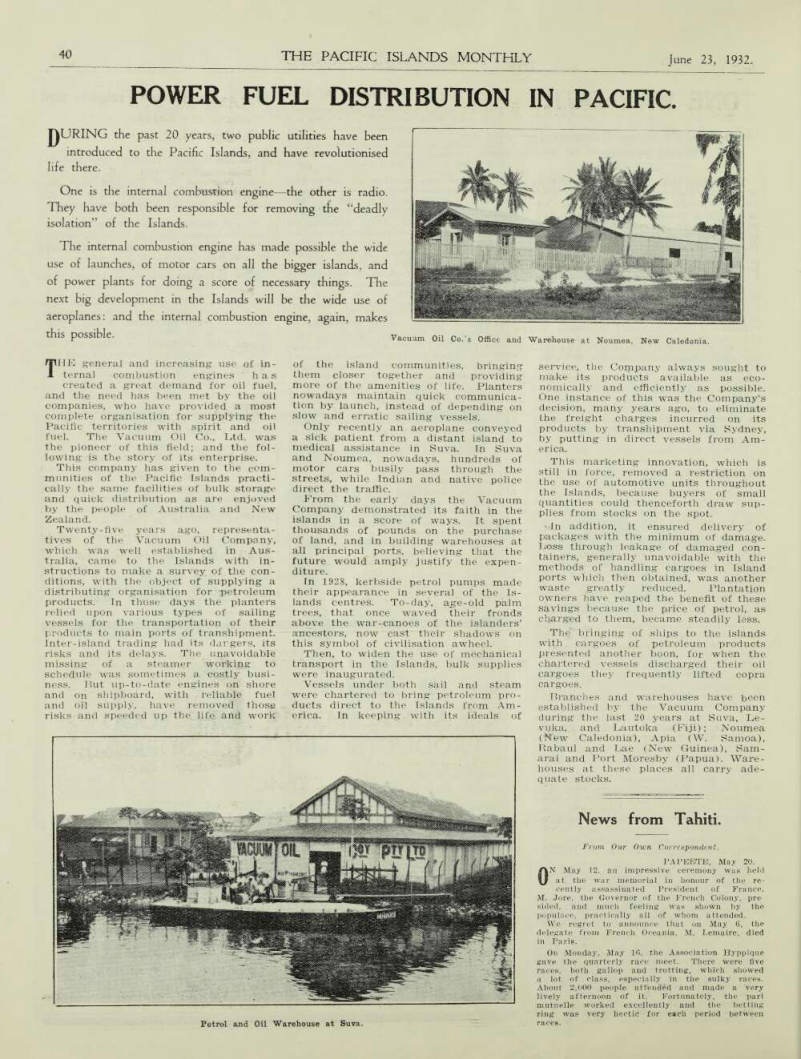
J)URING the past 20 years, two public utilities have been introduced to the Pacific Islands, and have revolutionised life there.
One is the internal combustion engine—the other is radio.
They have both been responsible for removing the “deadly isolation” of the Islands.
The internal combustion engine has made possible the wide use of launches, of motor cars on all the bigger islands, and of power plants for doing a score of necessary things. The next big development in the Islands will be the wide use of aeroplanes: and the internal combustion engine, again, makes
this possible.
THE general and increasing use of in ternal combustion engines has created a great demand for oil fuel, and the need has been met by the oil companies, who have provided a most complete organisation for supplying the Pacific territories with spirit and oil fuel. The Vacuum Oil Co., Ltd. was the pioneer of this field; and the fol lowing is the story of its enterprise.
This company has given to the com munities of the Pacific Islands practi cally the same facilities of bulk storage and quick distribution as are enjoyed by the people of Australia and New Zealand.
Twenty-five years ago, representa tives of the Vacuum Oil Company, which was well established in Aus tralia, came to the Islands with in structions to make a survey of the con ditions, with the object of supplying a distributing organisation for petroleum products. In those days the planters relied upon various types of sailing vessels for the transportation of their products to main ports of transhipment.
Inter-island trading had its dangers, its risks and its delays. The unavoidable missing of a steamer working to schedule was sometimes a costly busi ness. But up-to-date engines on shore and on shipboard, with reliable fuel and oil supply, have removed those risks and speeded up the life and work
of the island communities, bringing them closer together and providing more of the amenities of life. Planters nowadays maintain quick communica tion by launch, instead of depending on slow and erratic sailing vessels.
Only recently an aeroplane conveyed a sick patient from a distant island to medical assistance in Suva. In Suva and Noumea, nowadays, hundreds of motor cars busily pass through the streets, while Indian and native police direct the traffic.
From the early days the Vacuum Company demonstrated its faith in the islands in a score of ways. It spent thousands of pounds on the purchase of land, and in building warehouses at all principal ports, believing that the future would amply justify the expen diture.
In 1928, kerbside petrol pumps made their appearance in several of the Is lands centres. To-day, age-old palm trees, that once waved their fronds above the war-canoes of the islanders’ ancestors, now cast their shadows on this symbol of civilisation awheel.
Then, to widen the use of mechanical transport in the Islands, bulk supplies were inaugurated.
Vessels under both sail and steam were chartered to bring petroleum pro ducts direct to the Islands from Am erica. In keeping with its ideals of
service, the Company always sought to make its products available as eco nomically and efficiently as possible.
One instance of this was the Company’s decision, many years ago, to eliminate the freight charges incurred on its products by transhipment via Sydney, by putting in direct vessels from Am erica.
This marketing innovation, which is still in force, removed a restriction on the use of automotive units throughout the Islands, because buyers of small quantities could thenceforth draw sup plies from stocks on the spot.
In addition, it ensured delivery of packages with the minimum of damage.
L<oss through leakage of damaged con tainers, generally unavoidable with the methods of handling cargoes in Island ports which then obtained, was another waste greatly reduced. Plantation owners have reaped the benefit of these savings because the price of petrol, as charged to them, became steadily less.
The bringing of ships to the islands with cargoes of petroleum products presented another boon, for when the chartered vessels discharged their oil cargoes they frequently lifted copra cargoes.
Branches and warehouses have been established by the Vacuum Company during the last 20 years at Suva, Le vuka, and Lautoka (Fiji); Noumea (New Caledonia), Apia (W. Samoa), Rabaul and Lae (New Guinea), Sam arai and Port Moresby (Papua). Ware houses at these places all carry ade quate stocks.
Petrol and Oil Warehouse at Suva.
Vacuum Oil Co. s Office and Warehouse at Noumea, New Caledonia.
News from Tahiti.
From Our Own Correspondent.
Papeete, May 20.
ON May 12, an impressive ceremony was held at the war memorial in honour of the re cently assassinated President of France.
M. Jore, the Governor of the French Colony, pre sided, and much feeling was shown by the populace, practically all of whom attended.
We regret to announce that on May 6, the delegate from French Oceania, M. Lemaire, died in Paris.
On Monday, May 16, the Association Hyppique gave the quarterly race meet. There were five races, both gallop and trotting, which showed a lot of class, especially in the sulky races.
About 2,000 people attended and made a very lively afternoon of it. Fortunately, the pari mutuelle worked excellently and the betting ring was very hectic for each period between races.
Cook Islands Have Many Sportsmen
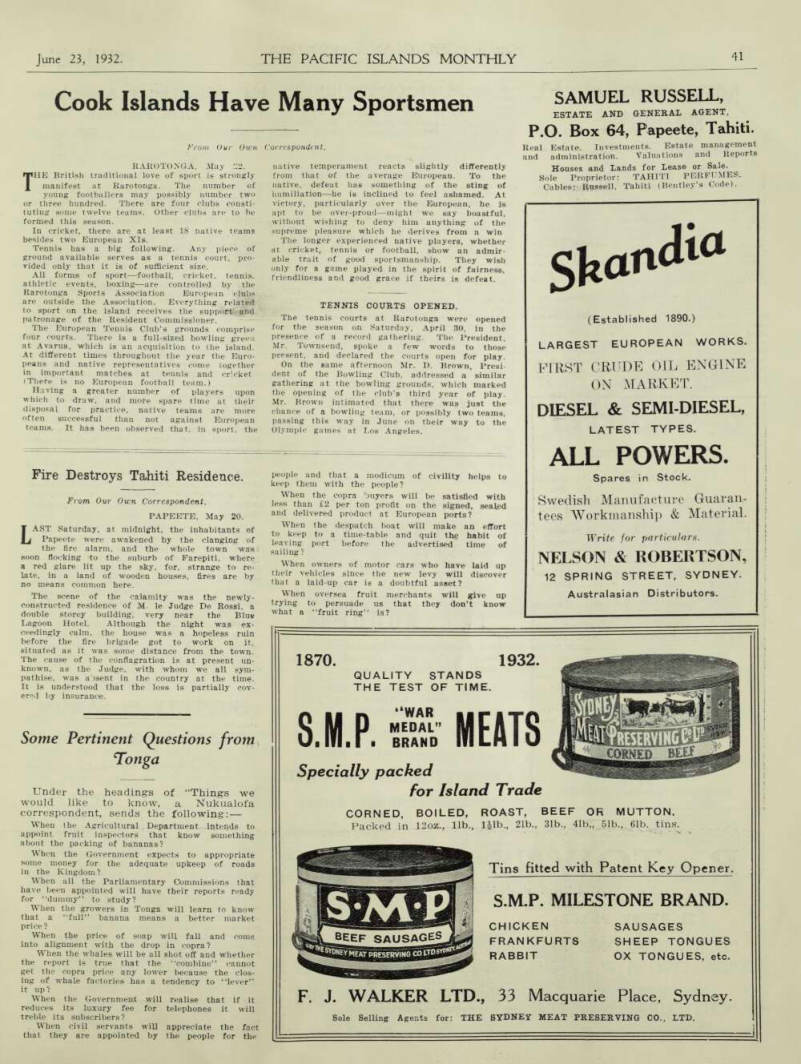
From Our Own Correspondent
Rarotonga, May 22.
THE British traditional love of sport is strongly manifest at Rarotonga. The number of young footballers may possibly number two or three hundred. There are four clubs consti tuting some twelve teams. Other clubs are to be formed this season.
In cricket, there are at least 18 native teams besides two European Xls.
Tennis has a big following. Any piece of ground available serves as a tennis court, pro vided only that it is of sufficient size.
All forms of sport—football, cricket, tennis, athletic events, boxing—are controlled by the Rarotonga Sports Association European clubs are outside the Association. Everything related to sport on the island receives the support- and patronage of the Resident Commissioner.
The European Tennis Club’s grounds comprise four courts. There is a full-sized bowling green at Avarua, which is an acquisition to the island.
At different times throughout the year the Euro peans and native representatives come together in important matches at tennis and cricket (There is no European football team.) Having a greater number of players upon which to draw', and more spare time at their disposal for practice, native teams are more often successful than not against European teams. It has been observed that, in sport, the
native temperament reacts slightly differently from that of the average European. To the native, defeat has something of the sting of humiliation—he is inclined to feel ashamed. At victory, particularly over the European, he is apt to be over-proud—might we say boastful, without wishing to deny him anything of the supreme pleasure which he derives from a win The longer experienced native players, whether at cricket, tennis or football, show an admir able trait of good sportsmanship. They wish only for a game played in the spirit of fairness, friendliness and good grace if theirs is defeat.
Tennis Courts Opened.
The tennis courts at Rarotonga were opened for the season on Saturday, April 30, in the presence of a record gathering. The President, Mr. Townsend, spoke a few words to those present, and declared the courts open for play.
On the same afternoon Mr. D. Brown, Presi dent of the Bowling Club, addressed a similar gathering at the bowling grounds, which marked the opening of the club’s third year of play.
Mr. Brown intimated that there was just the chance of a bowling team, or possibly two teams, passing this way in June on their way to the Olympic games at Los Angeles.
Fire Destroys Tahiti Residence.
From Our Own Correspondent.
Papeete, May 20.
LAST Saturday, at midnight, the inhabitants of Papeete were awakened by the clanging of the fire alarm, and the whole town was soon flocking to the suburb of Farepiti, where a red glare lit up the sky. for, strange to re late, in a land of wooden houses, fires are by no means common here.
The scene of the calamity was the newly constructed residence of M. le Judge De Rossi, a double storey building, very near the Blue Lagoon Hotel. Although the night was ex ceedingly calm, the house was a hopeless ruin before the fire brigade got to work on it, situated as it was some distance from the town.
The cause of the conflagration is at present un known, as the Judge, with whom we all sym pathise, was aasent in the country at the time.
It is understood that the loss is partially cov ered by insurance.
Some Pertinent Questions from Tonga
Tonga
Under the heading’s of “Things we would like to know, a Nukualofa correspondent, sends the following: When the Agricultural Department intends to appoint fruit inspectors that know something about the packing of bananas?
When the Government expects to appropriate some money for the adequate upkeep of roads in the Kingdom ?
When all the Parliamentary Commissions that have been appointed will have their reports ready for “dummy” to study?
When the growers in Tonga will learn to know that a “full” banana means a better market price?
When the price of soap will fall and come into alignment with the drop in copra ?
When the whales will be all shot off and whether the report is true that the “combine” cannot get the copra price any lower because the clos ing of whale factories has a tendency to “lever” it up ?
When the Government will realise that if it reduces its luxury fee for telephones it will treble its subscribers ?
When civil servants will appreciate the fact that they are appointed by the people for the
people and that a modicum of civility helps to keep them with the people ?
When the copra r ouyers will be satisfied with less than £2 per ton profit on the signed, sealed and delivered product at European ports?
When the despatch boat will make an effort to keep to a time-table and quit the habit of leaving port before the advertised time of sailing?
When owners of motor cars who have laid up their vehicles since the new levy will discover that a laid-up car is a doubtful asset?
When oversea fruit merchants will give up trying to persuade us that they don’t know what a “fruit ring’’ is?
Advertisements & other items, p. 43 (1 item)
ska n^ a
SAMUEL RUSSELL,
ESTATE AND GENERAL AGENT,
P.O. Box 64, Papeete, Tahiti.
Real Estate. Investments. Estate management and administration. Valuations and Reports Houses and Lands for Lease or Sale.
Sole Proprietor; TAHITI PERFUMES.
Cables: Russell. Tahiti (Bentley’s Code).
ska n^ a
(Established 1890.)
LARGEST EUROPEAN WORKS.
FIRST CRUDE OIL ENGINE
ON MARKET.
DIESEL & SEMI-DIESEL,
LATEST TYPES.
ALL POWERS.
Spares in Stock.
Swedish Manufacture Guarantees Workmanship & Material.
Write for particulars.
NELSON & ROBERTSON,
12 SPRING STREET, SYDNEY.
Australasian Distributors.
1870. 1932.
QUALITY STANDS
THE TEST OF TIME.
B.M.P. = MEATS
Specially packed
for Island Trade
BEEF
CORNED
CORNED, BOILED, ROAST, BEEF OR MUTTON.
Packed in 120 z., lib., l|lb., 21b., 31b., 41b„ 51b., 61b. tins. £1
SAUSAGES
beef Tins fitted with Patent Key Opener.
S.M.P. MILESTONE BRAND.
CHICKEN
FRANKFURTS
RABBIT
SAUSAGES
SHEEP TONGUES
OX TONGUES, etc.
F. J. WALKER LTD., 33 Macquarie Place, Sydney.
Sole Selling Agents for; THE SYDNEY MEAT PRESERVING CO., LTD.
Notes From The
Solomons.
From Our Own Correspondent
Tulagi, June 7.
IHAVE at hand the balance-sheet of one local copra-producing company, which turned out over 240 tons last year, yet showed a loss of over £5OO.
Other producers, I am told, mostly in the Gizo district, have suspended operations. There is a growing feeling—whether well-founded or not—that, in view of their published balance sheets, the exporting firms, as a matter of policy, might, while copra is so low in value, reduce the margin between local and London price, in order to assist the producer to keep the wheels of industry turning.
Visit Of Mr. Fulton.
Gavutu, the Solomon headquarters of Levers Pacific Plantations, has been indulging in a new suit of clothes, so to speak, per medium of a lick of paint here and a dab of white wash there, in honour of the visit of Mr.
George Fulton (the Managing Director), who is accompanied by Mrs. Fulton. They came by the “Vacdhui” to Samarai and were met by the company’s vessel “Kurimarau,” in which they
will tour the Company’s holdings in the Solo mons, and, later, will return to Rabaul to meet the steamer for Sydney.
Gavutu, by the way, is somewhat noted for its mosquitoes and fish-ponds, to say nothing of being the most elaborately equipped centre in the Solomons.
Enterprising Planter.
Tulagi at last basks in the sunshine of a very much needed dairy, poultry and vegetable farm of its very own, where the needy vitamines are now dispensed at a modest figure. “Be British” was certainly the slogan of its stout-hearted in stigator, Robert Siim, who, when copra prices fell and he and his small family were faced with ruin, gave his coconuts a holiday, shifted his cows, etc., into Tulagi and. dug himself in.
After a great deal of hard work, he now feels confident of success.
Personal Items.
So far, nothing definite has been announced as to when our Resident Commissioner (Mr.
Ashley, will leave on his well-earned furlough.
We are sorry to lose two very popular citizens by this “Mataram” in Mr. Bert Tims, account ant for Messrs. Burns, Philp, at Makambo, who goes a step up the ladder to the managership for this firm at Norfolk Island; and Mr. Rob inson (Robbie), manager for the S.I.D. Co. at Eerande who, I understand, goes to an inspec torship in New Guinea.
Pacific Recipes.
LEMON MARMALADE.—Take 4 large, rough skinned lemons; boil whole until tender; cut in half and scoop out centres; slice up very small; cover with water and boil half an hour; add cup of sugar to cup of fruit and boil till golden brown (average 4 hours). —K.D.B.
Returns from Profitable Tour.
N.G. Director of Agriculture Returns from Profitable Tour.
From Our Own Correspondent
Rabaul, May 21.
THE Director of Agriculture (Mr. G.
Murray) recently returned to the Territory, after an absence of 12 months on long and accumulated leave.
Practically the whole of his furlough was spent as a sort of “busman’s holi day,” and, as a result, the Administra tion, the Territory generally and the planter should benefit greatly from his experiences and the valuable knowledge which he gained.
Being a great believer in the “per sonal touch,” Mr. Murray, during this and previous periods of furlough, spent in a similar manner, has now person ally visited every Department of Agri culture in the tropical world, with the exception of those of East and West Africa.
Too much credit cannot be given in these times to an officer like Mr. Mur ray, who, at very considerable personal expense, has the interests of his de partment, and those of the Territory so much at heart, as to undertake the trip which he did.
Mr. Murray speaks in most glowing terms of the treatment received, and the courtesies extended to him by every Department of Agriculture visited; during his stay in their Ter ritories, an officer was invariably de tailed to show him everything he de sired to see, to take him over their ex perimental and research stations, and also to make the acquaintance of planters and inspect their properties.
During his travels, Mr. Murray con ducted special investigations regarding the coffee, cocoa, copra, and coir fibre industries, of which he has told me much that will be of great value to planters in the Pacific Islands. A resume will be published in “The Pacific Is lands Monthly.”
Property In Samoa.
Big Depreciation in Value.
From Our Own Correspondent
Apia, May 21.
A SERIOUS drop in property values in and around Apia is indicated by the result of the sale by auction of a valuable property and residential home near Apia, recently.
The house, which was erected only a few years ago at a cost of nearly £2,000, with an area of about 9i acres planted in bananas and coconuts, brought only £l,OOO at the auction, one solitary bid only being received for the property.
There have been, and will be, quite a number of forced sales of bankrupt and other estates, and it is obviously im possible, for lack of demand, to obtain anything like adequate values for them. That the depression has not reached bedrock, as far as Samoa is concerned, is proved beyond doubt by notices of bankruptcies filed and the announcements of court sales of pro perties in practically every issue of the local paper.
Advertisements & other items, p. 44 (2 items)
C. S. Smith,
4 Bridge Street,
SYDNEY,
One of the oldest established Brokers operating in the South Seas.
Is prepared to accept additional Buying Agencies for the Exportation of General Merchandise an d Stores, also Importation of Island Produce.
Correspondence is invited, and should be addressed to —
Box 2841 N, G.P.0.,
Sydney.
Registered Telegraphic Address:
“LUTMIS, SYDNEY.”
Telephone Number: BW 6953.
R. Towns & Co
GUARD AGAINST
MALARIA
and its Attendant Ills.
The New Drug
PLASMOQUENE
is a Preventive of Malaria that has been Tested and Proved by the Medical Profession.
If you are in doubt, ask your Medical Adviser about Plasmoquene.
FROM ALL STORES.
Wholesale Supplies from
FASSETT & JOHNSON LTD.
36 Chalmers Street, Sydney.
R. TOWNS & CO
Established 1842.
31 REIBY PLACE - SYDNEY.
“LORD BEACONSFIELD” 26’s Island Twist Tobacco.
“EDGEWORTH” Extra High Grade Smoking Tobacco, in 2oz. vacuum airtight Tins, and lib. Glass Jars.
“CUTICURA” Soap, Ointment and Talcum Powder.
Burns, Philp, Ltd.
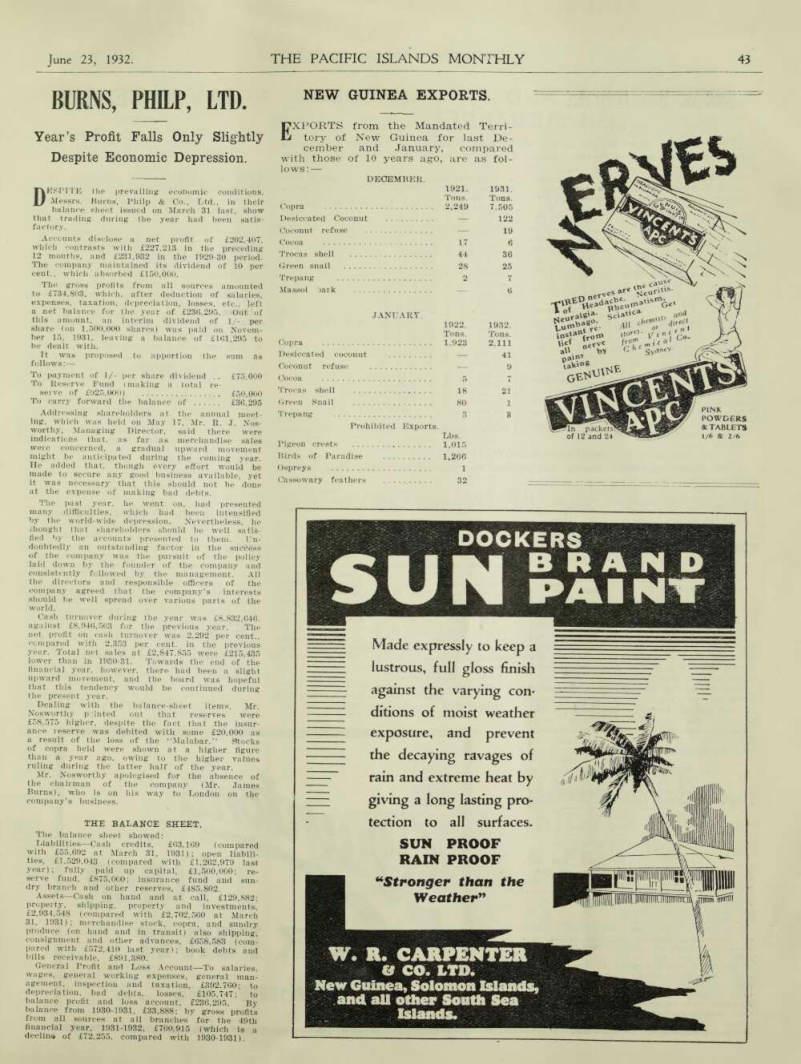
Year’s Profit Falls Only Slightly Despite Economic Depression.
DESPITE the prevailing economic conditions, Messrs. Burns, Philp & Co., Ltd., in their balance sheet issued on March 31 last, show that trading during the year had been satis factory.
Accounts disclose a net profit of £202,407, which contrasts with £227,213 in the preceding 12 months, and £231,932 in the 1929-30 period.
The company maintained its dividend of 10 per cent., which absorbed £150,000.
The gross profits from all sources amounted to £734,803, which, after deduction of salaries, expenses, taxation, depreciation, losses, etc., left a net balance for the year of £236,295. Out of this amount, an interim dividend of 1/- per share (on 1.500,000 shares) was paid on Novem ber 15, 1931, leaving a balance of £161,295 to be dealt with.
It was proposed to apportion the sum as follows: To payment of 1/- per share dividend . . £75,000 To Reserve Fund (making a total re serve of £925,000) £50,000 To carry forward the balance of £36,295 Addressing shareholders at the annual meet ing, which was held on May 17, Mr. R. J. Nos worthy, Managing Director, said there were indications that, as far as merchandise sales were concerned, a gradual upward movement might be anticipated during the coming year.
He added that, though every effort would be made to secure any good business available, yet it was necessary that this should not be done at the expense of making bad debts.
Tire past year, he went on, had presented many difficulties, which had been intensified by the world-wide depression. Nevertheless, he thought that shareholders should be well satis fied by the accounts presented to them. Un doubtedly an outstanding factor in the success of the company was the pursuit of the policy laid down by the founder of the company and consistently followed by the management. All the directors and responsible officers of the company agreed that the company’s interests should be well spread over various parts of the world.
Cash turnover during the year was £8,832,646. against £8,946,563 for the previous year. The net profit on cash turnover was 2,292 per cent., compared with 2.353 per cent, in the previous year. Total net sales at £2,847,855 were £215,435 lower than in 1930-31. Towards the end of the financial year, however, there had been a slight upward movement, and the board was hopeful that this tendency would be continued during the present year.
Dealing with the balance-sheet items, Mr.
Nosworthy pointed out that reserves were £58,575 higher, despite the fact that the insur ance reserve was debited with some £20,000 as a result of the loss of the “Malabar.” Stocks of copra held were shown at a higher figure than a year ago, owing to the higher values ruling during the latter half of the year.
Mr. Nosworthy apologised for the absence of the chairman of the company (Mr. James Burns), who is on his way to London on the company’s business.
The Balance Sheet.
The balance sheet showed: Liabilities—Cash credits, £63,169 (compared with £55,692 at March 31, 1931); open liabili ties, £1,529,043 (compared with £1,262,979 last year); fully paid up capital, £1,500,000; re serve fund, £875,000; insurance fund and sun dry branch and other reserves, £485.802.
Assets—Cash on hand and at call, £129,882; property, shipping, property and investments. £2,934,548 (compared with £2.702,560 at March 31, 1931); merchandise stock, copra, and sundry produce (on hand and in transit) also shipping, consignment and other advances, £658,583 (com pared with £572,410 last year); book debts and bills receivable, £891,380.
General Profit and Loss Account—To salaries, wages, general working expenses, general man agement, inspection and taxation, £392.760; to depreciation, bad debts, losses, £105,747; to balance profit and loss account, £236,295. By balance from 1930-1931, £33,888; by gross profits from all sources at all branches for the 49th financial year. 1931-1932, £700,915 (which is a decline of £72,255, compared with 1930-1931).
New Guinea Exports.
EXPORTS from the Mandated Terri tory of New Guinea for last De cember and January, compared with those of 10 years ago, are as fol lows: —
December.
1921. 1931.
Tons.
Tons.
Copra 2,249 7,505 Desiccated Coconut — 122 Coconut refuse — 19 Cocoa 17 6 Trocas shell 44 36 Green snail 28 25 Trepang 2 7 Massoi mik — 6
January.
1922. 1932.
Tons.
Tons.
Copra 1,923 2,111 Desiccated coconut — 41 Coconut refuse — 9 Cocoa 5 7 Trocas shell 18 21 Green Snail 80 1 Trepang 3 8 Prohibited Exports.
Pigeon crests Lbs. 1,015 Birds of Paradise 1.26G Ospreys 1 Cassowary feathers 32
Advertisements & other items, p. 45 (1 item)
giving a long lasting pro-
E X k at» s,t Q e t »« ca . ai i<* r ves •'*
ss-s.
»\\ 0 b-V C»* c y rfmrv pa»? s „ r,v>
PINK
POWDERS
«TABLETS
•In packets of 12 and 24
Made expressly to keep a lustrous, full gloss finish
against the varying con-
ditions of moist weather exposure, and prevent the decaying ravages of rain and extreme heat by
giving a long lasting pro-
tection to all surfaces.
SUN PROOF
RAIN PROOF
“Stronger than the Weather”
H
W. R. CARPENTER
& CO. LTD.
New Guinea, Solomon Islands, and all other South Sea Islands.
Sharemarket
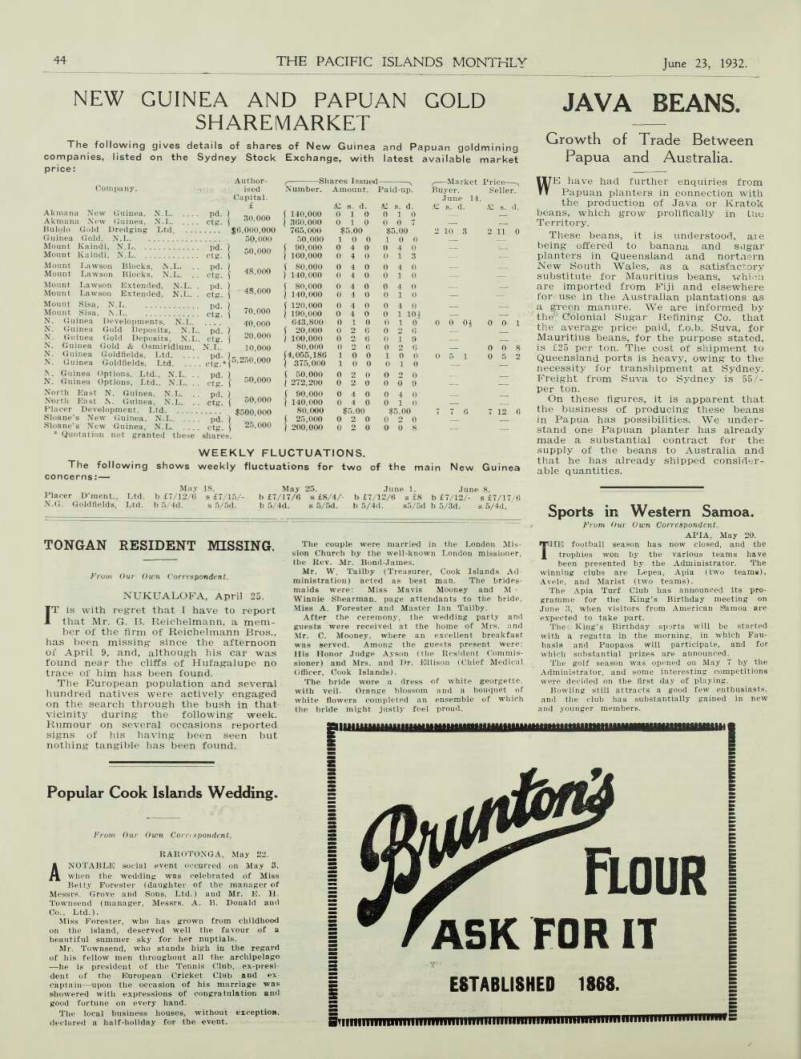
New Guinea And Papuan Gold
The following gives details of shares of New Guinea and Papuan goldmining companies, listed on the Sydney Stock Exchange, with latest available market price:
Weekly Fluctuations.
The following shows weekly fluctuations for two of the main New Guinea concerns:—
Author- , Sh ares Is sued , —Market Price Company. 908 '41' ised Number.
Amount.
Paid-up.
Buyer.
Seller.
Capital.
June 14. £ £ 8. d. £ s. d. £ s. d. £ s. d.
Akraana New Guinea. N.I ■ Pd. ] ( 140,000 0 1 0 0 1 0 Akmana New Guinea, N.L. . . . • ctg. ( ) 300,000 0 1 0 0 0 7 Bulolo Gold Dredging Ltd *(1,000,000 705,000 $5.00 $,- 1.00 2 10 3 2 11 0 Guinea Gold, N.L 50,000 50,000 1 0 0 1 0 0 Mount Kaindi, N.L pd. ( 90,000 0 4 0 0 4 0 Mount Kaindi, N.L
. ctg. f
100,000 0 4 0 0 1 3 — — Mount Lawson Blocks, N.L. ■ Pd. ) ( 80,000 0 4 0 0 4 0 Mount Lawson Blocks, N.L. . ■ ctg. 1 48,000 ) 140,000 0 4 0 0 1 0 — Mount Lawson Extended, N.L. • Pd. ( 80,000 0 4 0 0 4 0 Mount Lawson Extended, N.L.
■ ctg. (
48,000 \ 140,000 0 4 0 0 1 0 — Mount Sisa, N.L. pd. ( 120,000 0 4 0 0 4 0 Mount Sisa, N.L.
• ctg. (
70.000 ( 190,000 0 4 0 0 1 ioj N. Guinea Developments, N.L. 40,000 043,800 0 1 0 0 1 0 0 0 Oi 0 0 1 N. Guinea Gold Deposits, N.L . pd. ) \ 20,000 0 2 0 0 o 6 N. Guinea Gold Deposits, N.L
. ctg. (
20,000 ) 100,000 0 2 6 0 1 9 N. Guinea Gold & Osmiridium, N.L. 10,000 80,000 0 2 6 0 2 6 0 0 8 N. Guinea Goldfields, Ltd. . . . ■ Pd. (4,055.180 1 0 0 1 0 0 0 5 1 0 5 2 N. Guinea Goldfields, Ltd.
• ctg.*('
5,250,000 375,000 1 0 0 0 1 0 N. Guinea Options, Ltd., N.L. . pd. ) ( 50.000 0 2 0 0 2 0 N. Guinea Options, Ltd., N.L. .
• ctg. f
50,000 272,200 0 2 0 0 0 9 — — North East N. Guinea, N.L. . pd. ) S 90,000 0 4 0 0 4 0 North East N. Guinea, N.L. .
■ ctg. (
50,000 140,000 0 4 0 0 1 0 Placer Development, Ltd $500,000 80,000 $5.00 $5.00 7 7 6 7 12 6 Sloane’s New Guinea, N.L. . . .
Pd. ) ( 25,000 0 2 0 0 2 0 Sloane’s New Guinea, N.L. ... • ctg. j 25,000 200,000 0 2 0 0 0 8 * Quotation not granted these shares.
'lacer LKment., May 18.
May 25.
June 1.
June 8.
Ltd. b £7/12/0 s £7/15/b £7/17/6 s£8/4/b £7/12/6 s £8 b £7/12/- s £7/17/6 LG. Goldfields, Ltd. b 5/4d. s 5/5d. b 5/4d. 8 5/5d. b 5/4d. s5/5d b 5/3d. s 5/4d,
Tongan Resident Missing.
From Our Own Correspondent.
Nukualofa, April 25.
{T is with regret that I have to report that Mr. G. B. Reichelmann, a mem ber of the firm of Reichelmann Bros., has been missing since the afternoon of April, 9, and, although his car was found near the cliffs of Hufagalupe no trace of him has been found.
The European population and several hundred natives were actively engaged on the search through the bush in that vicinity during the following week.
Rumour on several occasions reported signs of his having been seen but nothing tangible has been found.
Popular Cook Islands Wedding.
From Our Own Com spondent.
Rarotonga, May 22.
A NOTABLE social event occurred on May 3, when the wedding was celebrated of Miss Betty Forester (daughter of the manager of Messrs. Grove and Sons, Ltd.) and Mr. E. H.
Townsend (manager, Messrs. A. B. Donald and Co.. Ltd.).
Miss Forester, who has grown from childhood on the island, deserved well the favour of a beautiful summer sky for her nuptials.
Mr. Townsend, who stands high in the regard of his fellow men throughout all the archipelago —he is president of the Tennis Club, ex-presi dent of the European Cricket Club and ex captain—upon the occasion of his marriage was showered with expressions of congratulation and good fortune on every hand.
The local business houses, without exception, declared a half-holiday for the event.
The couple were married in the London Mis sion Church by the well-known London missiouer, the Rev. Mr. Bond-James.
Mr - W - Tailb y (Treasurer, Cook Islands Ad ministration) acted as best man. The brides maids were: Miss Mavis Mooney and M Winnie Shearman, page attendants to the bride, Miss A. Forester and Master lan Tailby.
After the - party and guests were received at the home of Mrs. and Q Mooney, where an excellent breakfast W as served. Among the guests present were: His Honor Judge Ayson (the Resident Commis sioner) and Mrs. and Dr. Ellison (Chief Medical Officer, Cook Islands).
The bride wore a dress of white georgette. with veil - Orange blossom and a bouquet of White flowers completed an ensemble of which bride mi ht A stly feel proud.
Java Beans.
Growth of Trade Between Papua and Australia.
WE have had further enquiries from Papuan planters in connection with the production of Java or Kratok beans, which grow prolifically in tlio Territory.
These beans, it is understood, aie being offered to banana and sugar planters in Queensland and nortnern New South Wales, as a satisfactory substitute for Mauritius beans, which are imported from Fiji and elsewhere for use in the Australian plantations as a green manure. We are informed by the' Colonial Sugar Refining Co. that the average price paid, f.o.b. Suva, for Mauritius beans, for the purpose stated, is £25 per ton. The cost of shipment to Queensland ports is heavy, owing to the necessity for transhipment at Sydney.
Freight from Suva to Sydney is 55/per ton.
On these figures, it is apparent that the business of producing these beans in Papua has possibilities. We under stand one Papuan planter has already made a substantial contract for the supply of the beans to Australia and that he has already shipped consider able quantities.
Sports in Western Samoa.
From Our Own Correspondent.
Apia, May 20.
THE football season has now closed, and the trophies won by the various teams have been presented by the Administrator. The winning clubs are Lepea, Apia (two teams), Avele, and Marist (two teams).
The Apia Turf Club has announced its pro gramme for the King’s Birthday meeting on June 3, when visitors from American Samoa are expected to take part.
The King’s Birthday sports will be started with a regatta in the morning, in which Fau basis and Paopaos will participate, and for which substantial prizes are announced.
The golf season was opened on May 7 by the Administrator, and some interesting competitions were decided on the first day of playing.
Bowling still attracts a good few enthusiasts, and the club has substantially gained in new and younger members.
Advertisements & other items, p. 46 (1 item)
Flour
9
ASK FOR IT
ESTABLISHED 1868.
Market Quotations
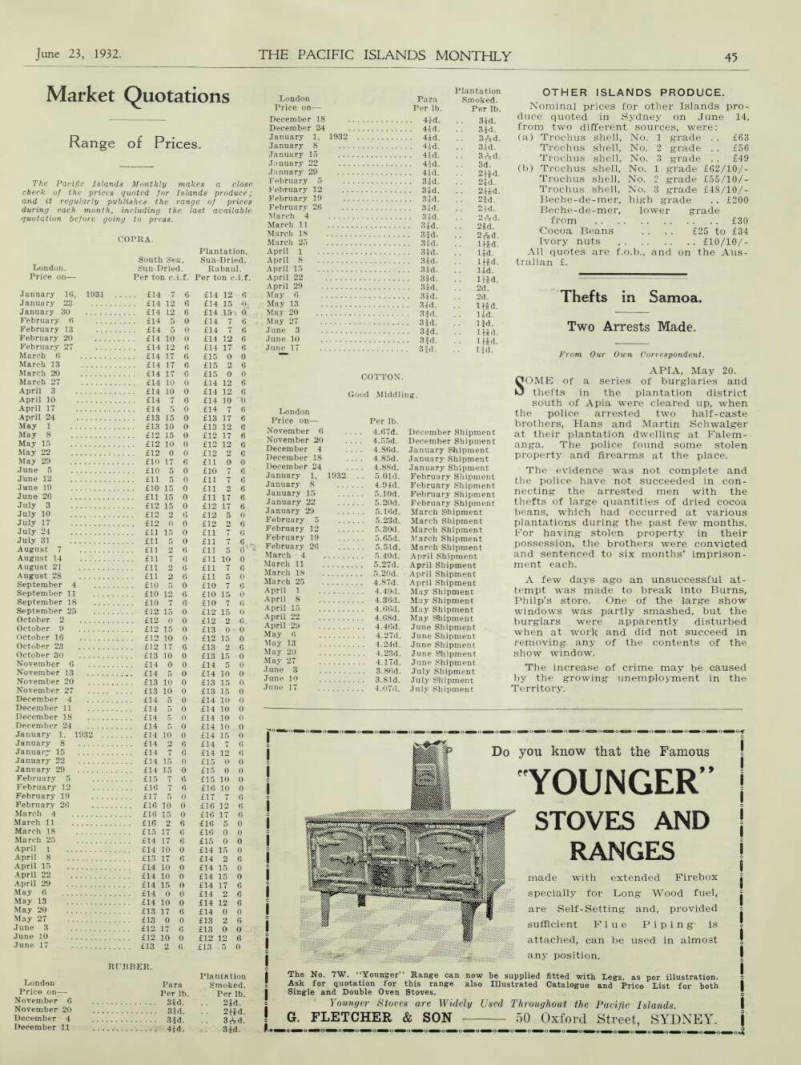
Range of Prices.
The Pacific Islands Monthly makes a close check of the prices quoted for Islands produce; and it regularly publishes the range of prices during each month, including the last available quotation before going to press. •
Other Islands Produce.
Nominal prices for other Islands pro duce quoted in Sydney on June 14, from two different sources, were: (a) Trochus shell, No. 1 grade . . £63 Trochus shell, No. 2 grade . . £56 Trochus shell, No, 3 grade . . £49 (b) Trochus shell, No. 1 grade £62/10/- Trochus shell, No. 2 grade £55/10/- Trochus shell, No. 3 grade £4B/10/- Beche-de-mer, high grade .. £2OO Beche-de-mer, lower grade from £3O Cocoa Beans . . . . £25 to £34 Ivory nuts £lO/10/- All quotes are f.0.b., and on the Aus tralian £.
London Para Plantation Smoked.
Price on — Per lb.
Per lb.
December 18 4gd. 3id.
December 24 4Jd. 3Jd.
January 1, 1932 4id. .. 3Ad.
January 8 4id. 3Jd.
January 15 4id. .. 3*d.
January 22 4Jd. 3d.
January 29 4Jd. 23|d.
February 5 3|d. .. 2Jd.
February 12 . . 2Hd.
February 19 3 Id. .. 23d.
February 26 Sid. 2id.
March 4 3id. 2&d.
March 11 3id. 23d.
March 18 33d. .. 2Ad.
March 25 35d. • • U3d.
April 1 33d. .• lid.
April 8 Iffd.
April 15 33d. lid.
April 22 3|d. • • IfSd.
April 29 33d. 2d.
May 6 33d. 2d.
May 13 3 id.
Ifgd.
May 20 8»d. lid.
May 27 33d. 13d.
June 3 IHd.
June 10 3 id. l«d.
June 17 33d. 13d.
London.
Copra.
South Sea, Stan-Dried.
Plantation, Sun-Dried, Rabaul.
Price on— Per ton c. i.f.
Per ton c.i.f.
January 16, 1931 £14 7 6 £14 12 6 January 23 ... £14 12 6 £14 15 0; January 30 6 £14 15-i 0 February 6 £14 5 0 £14 7 6 February 13 £14 5 0 £14 7 6 February 20 £14 10 0 £14 12 6 February 27 £14 12 6 £14 17 6 March 6 £14 17 6 £15 0 0 March 13 £14 17 6 £15 2 6 March 20 £14 17 6 £15 0 0 March 27 £14 10 0 £14 12 6 April 3 £14 10 0 £14 12 6 April 10 £14 7 6 £14 10 0 April 17 £14 5 0 £14 7 6 April 24 0 £13 17 6 May 1 £13 10 0 £13 12 e May 8 0 £12 17 6 May 15 0 £12 12 6 May 22 0 £12 2 6 May 29 6 £11 0 0 June 5 0 £10 7 6 June 12 0 £11 7 6 June 19 £10 15 0 £11 2 6 June 26 £11 15 0 £11 17 6 July 3 £12 15 0 £12 17 6 July 10 £12 2 6 £12 5 0 July 17 0 £12 2 6 July 24 0 £11 7 6 July 31 0 £11 75.
August 7 £11 2 6 £11 5 • August 14 £11 7 6 £11 10 0 August 21 £11 2 6 £11 7 6 August 28 £11 2 6 £11 5 0 September 4 0 £10 7 6 September 11 6 £10 15 0 September 18 6 £10 7 6 September 25 0 £12 15 0 October 2 0 £12 2 6 October 9 0 £13 0 0 October 16 0 £12 15 0 October 23 6 £13 2 6 October 30 £13 10 0 £13 15 0 November 6 . .. . 0 £14 5 0 November 13 ... 0 £14 10 0 November 20 . . . . £13 10 0 £13 15 0 November 27 ... £13 10 0 £13 15 0 December 4 ... £14 5 0 £14 10 0 December 11 ... £14 5 0 £14 10 0 December 18 . .. . £14 5 0 £14 10 0 December 24 ... £14 n 0 £14 10 0 January 1, 1932 . £14 10 0 £14 15 0 January 8 £14 2 6 £14 7 6 January 15 £14 7 6 £14 12 6 January 22 £14 15 0 £15 0 0 January 29 £14 15 0 £15 0 0 February 5 ... £15 7 6 £15 10 0 February 12 £16 7 6 £16 10 0 February 19 0 £17 7 6 February 26 0 £16 12 6 March 4 £16 15 0 £16 17 6 March 11 £16 2 6 £16 5 0 March 18 £15 17 6 £16 0 0 March 25 6 £15 0 0 April l 0 £14 15 0 April 8 £13 17 6 £14 2 6 April 15 0 £14 15 0 April 22 0 £14 15 0 April 29 0 £14 17 6 May 6 0 £14 2 6 May 13 0 £14 12 6 May 20 6 £14 0 0 May 27 0 £13 2 6 June 3 6 £13 0 0 June 10 0 £12 12 6 June 17 6 £13 5 0 London
Rubber.
Para Plantation Smoked.
Price on— Per lb.
Per lb.
November 6 2Jd.
November 20 3Sd. 2f$d- December 4 3*d.
December 11 . .. 3id.
Cotton.
Good Middling.
London Price on— Per lb.
November 6 ... 4.G7d.
December Shipment November 20 ... 4.55d.
December Shipment December 4 ... 4.S6d.
January Shipment December 18 ... 4.85d.
January Shipment December 24 ... 4.88d.
January Shipment January 1, 1932 5.Old.
February Shipment January 8 4.94d.
February Shipment January 15 5.10d.
February Shipment January 22 5.20d.
February Shipment January 29 5.16d.
March Shipment February 5 5.23d.
March Shipment February 12 5.30d.
March Shipment February 19 5.65d.
March Shipment February 2G 5.51d.
March Shipment March 4 5.40d.
April Shipment March 11 5.27d.
April Shipment March 18 5.20d.
April Shipment March 25 4.87d.
April Shipment April 1 4.49d.
May Shipment April 8 4.3Gd.
May Shipment April 15 4.0Gd.
May Shipment April 22 4.G8d.
May Shipment April 29 4.4Gd.
June Shipment May 0 4.27d.
June Shipment May 13 4.24d.
June Shipment May 20 4.23d.
June Shipment May 27 4.17d.
June Shipment June 3 3.8Gd.
July Shipment June 10 3.81d.
July Shipment June 17 4.07d.
July Shipment
Thefts in Samoa.
Two Arrests Made.
From Our Own Correspondent.
Apia, May 20.
SOME of a series of burglaries and thefts in the plantation district south of Apia were cleared up, when the police arrested two half-caste brothers, Hans and Martin Schwalger at their plantation dwelling at Falem anga. The police found some stolen property and firearms at the place.
The evidence was not complete and the police have not succeeded in con necting the arrested men with the thefts of large quantities of dried cocoa beans, which had occurred at various plantations during the past few months.
For having stolen property in their possession, the brothers were convicted and sentenced to six months’ imprison ment each.
A few days ago an unsuccessful at tempt was made to break into Burns, Philp’s store. One of the large show windows was partly smashed, but the burglars were apparently disturbed when at work and did not succeed in removing any of the contents of the show window.
The increase of crime may be caused by the growing unemployment in the Territory.
Advertisements & other items, p. 47 (1 item)
Younger”
Do you know that the Famous
STOVES AND
RANGES
made with extended Firebox specially for Long - Wood fuel, are Self-Setting and, provided sufficient Flue Piping- is attached, can be used in almost any position.
The No. 7W, “Younger” Range can now be supplied fitted with Legs, as per illustration.
Ask for quotation for this range also Illustrated Catalogue and Price List for both Single and Double Oven Stoves.
Younger Stoves are Widely Used Throughout the Pacific Islands.
G. FLETCHER & SON 50 Oxford Street, SYDNEY.
Exchange Quotations
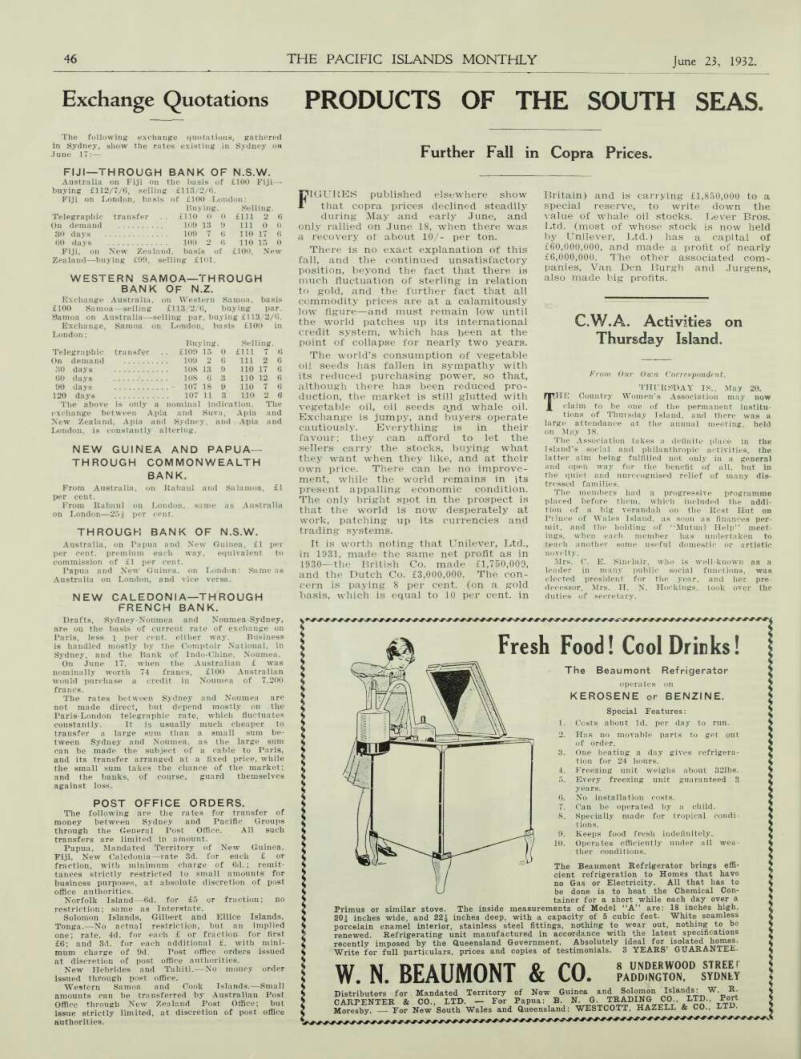
The following exchange quotations, gathered in Sydney, show the rates existing in Sydney oh June 17:—
Fiji—Through Bank Of N.S.W.
Australia on Fiji on the basis of £lOO Fiji— buying £ll2/7/6, selling £ll3/2/6.
Fiji on London, basis of £lOO London:
Western Samoa—Through
Bank Of N.Z.
Exchange Australia, on Western Samoa, basis £lOO Samoa—selling £ll3/2/6, buying par.
Samoa on Australia—selling par, buying £ll3/2/0.
Exchange, Samoa on London, basis £lOO in London:
The above is only a nominal indication. The exchange between Apia and Suva, Apia and New Zealand, Apia and Sydney, and Apia and London, is constantly altering.
New Guinea And Papua
Through Commonwealth
Bank.
From Australia, on Rabaul and Salamoa, £1 per cent.
From Rabaul on London, same as Australia on London—2sl per cent.
Through Bank Of N.S.W.
Australia, on Papua and New Guinea, £1 per per cent, premium each way, equivalent to commission of £1 per cent.
Papua and New Guinea, on London; Same as Australia on London, and vice versa.
New Caledonia—Through
French Bank.
Drafts, Sydney-Noumea and Noumea-Sydney, are on the basis of current rate of exchange on Paris, less l per cent, either way. Business is handled mostly by the Comptoir National, in Sydney, and the Bank of Indo-Chine, Noumea.
On June 17, when the Australian f was nominally worth 74 francs, £lOO Australian would purchase a credit in Noumea of 7,200 francs.
The rates between Sydney and Noumea are not made direct, but depend mostly on the Paris-London telegraphic rate, which fluctuates constantly. It is usually much cheaper to transfer a large sum than a small sum be tween Sydney and Noumea, as the large sum can be made the subject of a cable to Paris, and its transfer arranged at a fixed price, while the small sum takes the chance of the market; and the banks, of course, guard themselves against loss.
Post Office Orders.
The following are the rates for transfer of money between Sydney and Pacific Groups through the General Post Office. All such transfers are limited in amount.
Papua, Mandated Territory of New Guinea, Fiji, New Caledonia—rate 3d. for each £ or fraction, with minimum charge of 6d.; remit tances strictly restricted to small amounts for business purposes, at absolute discretion of post office authorities.
Norfolk Island—6d. for £5 or fraction; no restriction; same as Interstate.
Solomon Islands, Gilbert and Ellice Islands, Tonga.—No actual restriction, but an implied one; rate, 4d. for each £ or fraction for first £6; and 3d. for each additional f, with mini mum charge of 9d. Post office orders issued at discretion of post office authorities.
New Hebrides and Tahiti.—No money order issued through post office.
Western Samoa and Cook Islands.—Small amounts can be transferred by Australian Post Office through New Zealand Post Office; but issue strictly limited, at discretion of post office authorities.
Buying. Selling.
Telegraphic transfer . . £110 0 0 £111 2 6 On demand 109 13 9 111 0 0 30 days 109 7 6 110 17 6 00 days 109 2 6 110 15 0 Fiji, on New Zealand, basis of £100, New Zealand —buying £99, selling £101.
Buying. Selling.
Telegraphic transfer .. £100 15 0 £111 7 6 On demand 109 2 6 111 2 6 30 days 108 13 9 110 17 6 60 days 108 6 3 110 12 6 90 days 107 18 9 110 7 6 120 days 107 11 3 110 2 6
Products Of The South Seas.
Further Fall in Copra Prices.
FIGURES published elsewhere show that copra prices declined steadily during May and early June, and only rallied on June 18, when there was a recovery of about 10/- per ton.
There is no exact explanation of this fall, and the continued unsatisfactory position, beyond the fact that there is much fluctuation of sterling in relation to gold, and the further fact that all commodity prices are at a calamitously low figure—and must remain low until the world patches up its international credit system, which has been at the point of collapse for nearly two years.
The world’s consumption of vegetable oil seeds has fallen in sympathy with its reduced purchasing power, so that, although there has been reduced pro duction, the market is still glutted with vegetable oil, oil seeds and whale oil.
Exchange is jumpy, and buyers operate cautiously. Everything is in their favour; they can afford to let the sellers carry the stocks, buying what they want when they like, and at their own price. There can be no improve ment, while the world remains in its present appalling economic condition.
The only bright spot in the prospect is that the world is now desperately at work, patching up its currencies and trading systems.
It is worth noting that Unilever, Ltd., in 1931, made the same net profit as in 1930 —the British Co. made £1,750,000, and the Dutch Co. £3,000,000. The con cern is paying 8 per cent, (on a gold basis, which is equal to 10 per cent, in
Britain) and is carrying- £1,850,000 to a special reserve, to write down the value of whale oil stocks. Lever Bros.
Ltd. (most of whose stock is now held by Unilever, Ltd.) has a capital of £60,000,000, and made a profit of nearly £6,000,000. The other associated com panies, Van Den Burgh and Jurgens, also made big profits.
Thursday Island.
C.W.A. Activities on Thursday Island.
From Our Own Correspondent.
Thursday Is., May 20.
THE Country Women's Association may now claim to be one of the permanent institu tions of Thursday Island, and there was a large attendance at the annual meeting, held on May 18.
The Association takes a definite place in the Island’s social and philanthropic activities, the latter aim being fulfilled not only in a general and open way for the benefit of all, but in the quiet and unrecognised relief of many dis tressed families.
The members had a progressive programme placed before them, which included the addi tion of a big verandah on the Rest Hut on Prince of Wales Island, as soon as finances per mit, and the holding of “Mutual Help’’ meet ings, when each member has undertaken to teach another some useful domestic or artistic novelty.
Mrs. C. E. Sinclair, who is well-known as a leader in many public social functions, was elected president for the year, and her pre decessor, Mrs. H. N. Hockings, took over the duties of secretary.
Advertisements & other items, p. 48 (1 item)
Fresh Food! Cool Drinks!
The Beaumont Refrigerator operates on
KEROSENE or BENZINE.
Special Features: 1. Costs about Id. per day to run. 2. Has no movable parts to get out of order. 3. One heating a day gives refrigeration for 24 hours. 4. Freezing unit weighs about 321bs. 5. Every freezing unit guaranteed 3 years. 6. No installation costs. 7. Can be operated by a child. 8. Specially made for tropical conditions. 9. Keeps food fresh indefinitely. 10. Operates efficiently under all weather conditions.
The Beaumont Refrigerator brings efficient refrigeration to Homes that have no Gas or Electricity. All that has to be done is to heat the Chemical Container for a short while each day over a Primus or similar stove. The inside measurements of Model “A” are: 18 inches high. inches wide, and 22£ inches deep, with a capacity of 5 cubic feet. White seamless porcelain enamel interior, stainless steel fittings, nothing to wear out, nothing to_ be renewed. Refrigerating unit manufactured in accordance with the latest specifications recently imposed by the Queensland Government. Absolutely ideal for isolated homes.
Write for full particulars, prices and copies of testimonials. 3 YEARS’ GUARANTEE.
8 UNDERWOOD STREET
PADDINGTON, SYDNEY
Distributors for Mandated Territory of New Guinea and Solomon Islands: W. R.
CARPENTER & CO., LTD. For Papua: B. N. G. TRADING CO., LTD., Port Moresby. For New South Wales and Queensland: WESTCOTT, HAZELL & CO., LTD,
W. N. BEAUMONT & CO.
Shipping Services in the Pacific
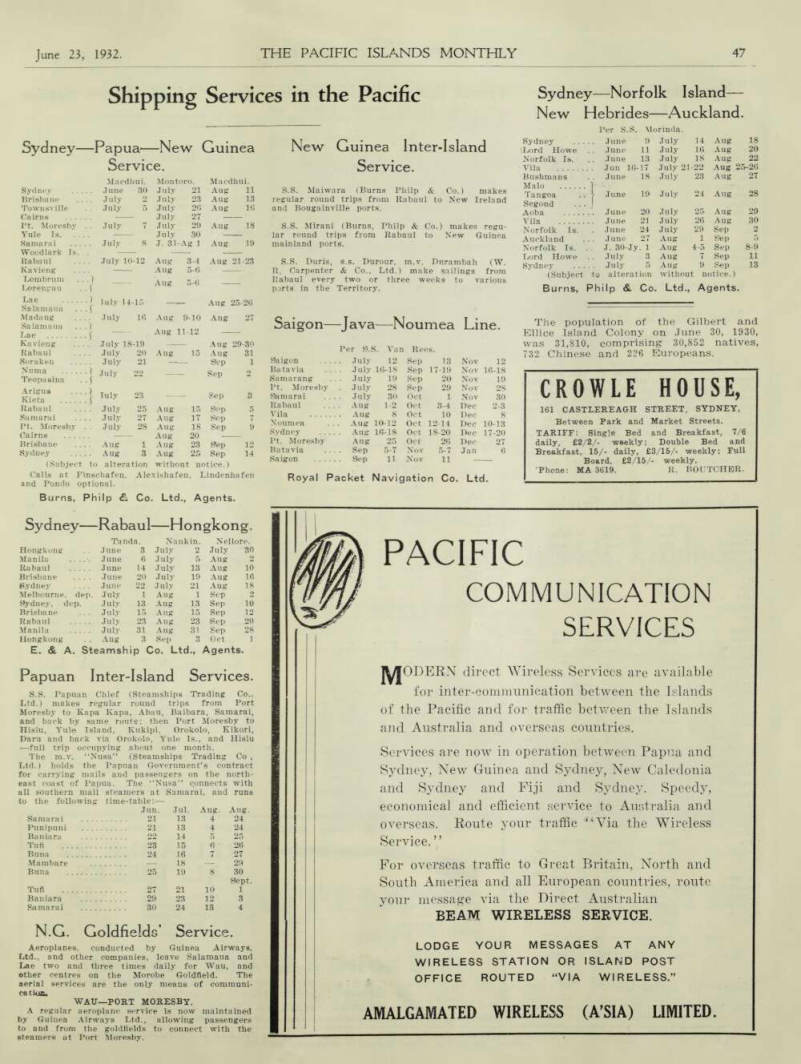
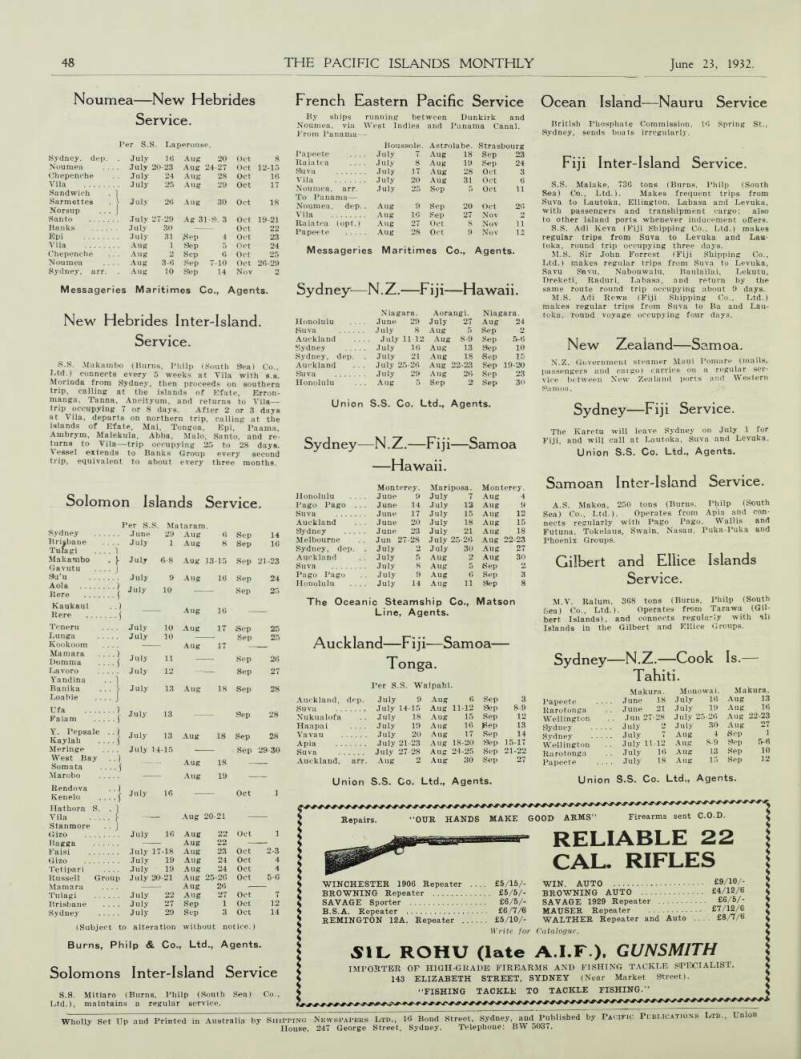
Sydney—Papua-—New Guinea Service.
Sydney—Rabaul—Hongkong.
Papuan Inter-Island Services.
S.S. Papuan Chief (Steamships Trading Co., Ltd.) makes regular round trips from Port Moresby to Kapa Kapa, Abau, Baibara, Samarai, and back by same route; then Port Moresby to Hisiu, Yule Island, Kukipi, Orokolo, Kikori, Daru and back via Orokolo, Yule Is., and Hisiu —full trip occupying about one month.
The m.v. “Nusa” (Steamships Trading Co , Ltd.) holds the Papuan Government’s contract for carrying mails and passengers on the north east coast of Papua. The “Nusa” qonnects with all southern mail steamers at Samarai, and runs to the following time-table:—
N.G. Goldfields’ Service.
Aeroplanes, conducted by Guinea Airways, Ltd., and other companies, leave Salamaua and Lae two and three times daily for Wau, and other centres on the Morobe Goldfield. The aerial services are the only means of communi cation.
Wau—Port Moresby.
A regular aeroplane service is now maintained by Guinea Airways Ltd., allowing passengers to and from the goldfields to connect with the steamers at Port Moresby.
New Guinea Inter-Island
Service.
5.5. Maiwara (Burns Philp & Co.) makes regular round trips from Rabaul to New Ireland and Bougainville ports. 5.5. Mirani (Burns, Philp & Co.) makes regu lar round trips from Rabaul to New Guinea mainland ports. 5.5. Duris, s.s. Durour, m.v. Durambah (W.
R. Carpenter & Co., Ltd.) make sailings from Rabaul every two or three weeks to various ports in the Territory.
Saigon—Java—Noumea Line.
Royal Packet Navigation Co. Ltd.
Sydney—Norfolk Island — New Hebrides —Auckland.
The population of the Gilbert and Ellice Island Colony on June 30, 1930, was 31,810, comprising 30,852 natives, 732 Chinese and 226 Europeans.
Macdhui.
Montoro.
Macdhui.
Sydnev June 30 July 21 Aug 11 Brisbane .. July 2 July 23 Aug 13 Townsville July 5 July 26 Aug 16 July July 27 29 Ft. Moresby . . July 7 Aug 18 Yule Is. . .
Samarai July 30 J. 31-Ag 1 July 8 Aug 19 Woodlark I;-. — — Rabaul . . July 10-12 Aug 3-4 Aug 21 -23 Kavieng Lombrmn Aug Aug 5-6 5-6 Lorengau • S Lae ...
■ I July 14-15
Auer 25-26 Salamaua • f Madang .. July 10 Aug 9-10 Aug 27 Salamaua .) Lae ■ \ Aug 11-12 — Kavieng . . July 18-19 k ii rr *>C_Qn Rabaul July 20 Aug 15 Aug 31 Soraken Julv 21 g e p 1 2 Numa Teopasina •J July 22 Sep Arigua Kieta j July 23 Sep 3 Rabaul July 25 Aug 15 Step 5 Samarai .. July 27 Aug 17 Sep 7 Ft. Moresby July 28 Aug 18 Sep 9 Cairns Aug Aug 20 23 Brisbane . . Aug 1 Sep 12 Sydney Aug 3 Aug witho 25 Sep dice.) 14 (Subject to alteration ut no Calls at Finschafen. Alexishafen, Lindenhafen and Pondo optional.
Burns,
Philp & Co. , Ltd
Agents.
Per 9.S. Van Rees.
Saigon . July 12 Sep 13 Nov 12 Ba tavia . July 10-18 Sep 17-19 Nov 10-18 Samarang . July 19 Sep 20 Nov 19 Pt. Moresby July 28 Sep 29 Nov 28 Samara! . July 30 Oct 1 Nov 30 Rabaul . Aug 1-2 Oct 3-4 I>ec 2-3 Vila 8 Oct 10 I >ec 8 Noumea . Aug 10-12 Oct 12-14 Dec 10-13 Sydney . ...
Aug 10-18 Oct 18-20 Dec 17-20 Pt. Moresby Aug 25 Oct 20 Dec 27 Batavia . . Sep 5-7 Xov 5-7 Jan 0 Saigon ... 11 Xov 11
Sydney Per S.S.
Morinda. 9 July 14 Aug 18 Jyurd Howe June 11 July 16 Aug 20 Norfolk Is. .. June 13 July 18 Aug 22 Vila 17 July 21 -22 Aug 25-26 Bushmans . . June 18 July 23 Aug 27 Malo Tangoa
}■ June
19 July 24 Aug 28 Segond Aoba J 20 July 25 Aug 29 Vila June 21 July 26 Aug 30 Norfolk Is.
June 24 July 29 Sep 2 Auckland .. June 27 Aug 1 Step 5 Norfolk Is. . . J. 30-Jy . 1 Aug 4-5 Sep 8-9 Ix>rd Howe . . July 3 Aug 7 Sep 11 Sydney July 5 Aug 9 Sep 13 (Subject to alteration without notice.)
Burns,
Philp &
Co.
Ltd.,
Agents.
Tanda.
Nankin.
Nellore.
Hongkong June 3 July 2 July 30 Manila 6 July 5 Aug 2 Babaul . . . . June 14 July 13 Aug 10 Brisbane . . . June 20 July in Aug 16 Sydney . .. . June 22 July 21 Aug 18 Melbourne. dep. July i Aug i Sep <> Sydney, dep. July 13 Aug 13 Sep 10 Brisbane July 15 Aug 15 Sep 12 Rabaul July 23 Aug 23 Sep 20 Manila July 31 Aug 31 Sep 28 Hongkong . . Aug 3 Sep 3 Oct 1 E. & A,
. Steamship Co. Ltd
Agents,
Jun. Jul. Aug. Aug.
Samarai 21 13 4 24 Punipuni 21 13 4 24 Baniara 22 14 a 25 Tuft 23 15 6 26 Buna 24 16 7 27 Mambare — 18 — 29 Buna 25 19 8 30 Stept.
Tuft 27 21 10 1 Baniara 29 23 12 3 Samarai 30 24 13 4
Noumea—New Hebrides Service.
New Hebrides Inter-Island.
Service.
S.S. Makambo (Burns, Philp (South Sea) Co., Ltd.) connects every 5 weeks at Vila with s.s.
Morinda from Slydney, then proceeds on southern trip, calling at the islands of Efate, Erron manga, Tanna, Aneityum, and returns to Vila— trip occupying 7or 8 days. After 2or 3 days at Vila, departs on northern trip, calling at the islands of Efate, Mai, Tongoa, Epi, Paama, Ambrym, Malekula, Abba, Malo, Santo, and re turns to Vila—trip occupying 25 to 28 days.
Vessel extends to Banks Group every second trip, equivalent to about every three months.
Solomon Islands Service.
Solomons Inter-Island Service
S.S. Mitiaro (Burns, Philp (South Sea) Co., Ltd.), maintains a regular service.
French Eastern Pacific Service
By ships running between Dunkirk and Noumea, via West Indies and Panama Canal.
From Panama—
Sydney—N. Z.—F i ji—Hawaii.
Sydney—N.Z.—Fiji—Samoa —Hawaii.
Auckland—Fiji—Samoa— Tonga.
Ocean Island —Nauru Service
British Phosphate Commission, 1G Spring St., Sydney, sends boats irregularly.
Fiji Inter-Island Service.
5.5. Malake, 736 tons (Burns, Philp (South Sea) Co., Ltd.). Makes frequent trips from Suva to Lautoka, Ellington, Labasa and Levuka, with passengers and transhipment cargo; also to other island ports whenever inducement offers. 5.5. Adi Keva (Fiji Shipping Co., Ltd.) makes regular trips from Suva to Levuka and Lau toka, round trip occupying three days.
M.S. Sir John Forrest (Fiji Shipping Co., Ltd.) makes regular trips from Suva to Levuka, Savu Savu, Nabouwalu, Baulailai, Lekutu, Dreketi, Raduri, Labasa, and return by the same route round trip occupying about 9 days.
M. Adi Rewa (Fiji Shipping Co., Ltd.) makes regular trips from Suva to Ba and Lau toka, round voyage occupying four days.
New Zealand—Samoa.
N. Government steamer Maui Pomare (mails, passengers and cargo) carries on a regular ser vice between New Zealand ports and Western S'amoa.
Sydney—Fiji Service.
The Karetu will leave Sydney on July 1 for Fiji, and will call at Lautoka, Suva and Levuka.
Union S.S. Co. Ltd., Agents.
Samoan Inter-Island Service.
A.S. Makoa, 250 tons (Burns, Philp (South Sea) Co., Ltd.). Operates from Apia and con nects regularly with Pago Pago, Wallis and Futuna. Tokelaus, Swain, Nasau, Puka-Puka and Phoenix Groups.
Gilbert and Ellice Islands
Service.
M.V. Ralum, 368 tons (Burns, Philp (South Sea) Co., Ltd.). Operates from Tarawa (Gil bert Islands), and connects regularly with aB Islands in the Gilbert and Ellice Groups.
Sydney—N.Z.—Cook Is.—
Tahiti.
Per S.S.
Laperouse.
Sydney, dep. . July 1G Aug 20 Oct 8 Noumea . July 20-23 Aug 24-27 Oct 12-15 Ohepenche July 24 Aug 28 Oct 16 Vila 25 Aug 29 Oct 17 Sandwich 1 Sarmettes
July
26 Aug 30 Oct 18 Norsup J Santo July 21 -29 Ag 31-S. 3 Oct 19-21 Banks . July 30 — Oct 22 Dpi . July 31 »Sep 4 Oct 23 Vila Aug 1 Sep 5 Oct 24 Chepenche Aug 2 Sep 6 Oct 25 Noumea Aug 3-6 Sep 7-10 Oct 26-29 Sydney, arr.
Aug 10 Step 14 Nov 2
Messageries Mari
times Co., Agents.
Boussole. Astrolabe. Strasbourg Papeete ... July 7 Aug 18 Sep 23 Raiatea ... July 8 Aug 19 Sep 24 Suva July 17 Aug 28 Oct 3 Vila July 20 Aug 31 Oct 6 Noumea, arr. July 25 Sep 5 Oct 11 To Panama— Noumea, dep.. Aug 9 Sep 20 Oct 20 Vila Aug 10 Sep 27 Nov 2 Raiatea (opt.) Aug 27 Oct 8 Nov 11 Papeete Aug 28 Oct 9 Nov 12
Messageries Maritimes Co., Agents.
Niagara. Aorangi.
Niagara.
Honolulu ...
June 29 July 27 Aug 24 Ruva July 8 Aug 5 Sep 2 Auckland . July 11-12 Aug 8-9 Sep 5-6 Sydney July 16 Aug 13 Step 10 Sydney, dep. .
July 21 Aug 18 Sep 15 Auckland July 25-26 Aug 22-23 Sep 19-20 Suva July 29 Aug 26 Sep 23 Honolulu Aug 5 Sep 2 Sep 30 Union
S.S. Co. Ltd., Agents.
Monterey.
Mariposa.
Monterey.
Honolulu ...
June 9 July 7 Aug 4 Pago Pago . . .
June 14 July 12 Aug 9 Suva June 17 July 15 Aug 12 Auckland June 20 July 18 Aug 15 Sydney June 23 July 21 Aug 18 Melbourne Jun 27 -28 July 25-20 Aug 22-23 Sydney, dep. .
July 2 July 30 Aug 27 Auckland July r.
Aug 2 Aug 30 Suva July 8 Aug 5 Sep 2 Pago Pago July 9 Aug 6 Sep 3 Honolulu ...
July 14 Aug 11 Sfcp 8 The Oceani
ic Steamship
6 O Matson
Line,
Agents.
Per S.S. Waipahi.
Auckland, dep. July 9 Aug 6 Sep 3 Suva July 14-15 Aug 11-12 9ep 8-9 Nukualofa . . July 18 Aug 15 Sep 12 Haapai ... July 19 Aug 16 £ep 13 Vavau July 20 Aug 17 Sep 14 Apia July 21-23 Aug 18-20 Sep 15-17 Suva July 27-28 Aug 24-25 Sep 21-22 Auckland, arr. Aug 2 Aug 30 Sep 27 Union S.S. Co. Ltd., Agents.
Makura.
Monowai.
Makura.
Papeete ■ ■ • June 18 July 10 Aug 13 Rarotonga June 21 July 151 Aug 10 Wellington . Jun 27-28 July 25-20 Aug 22-23 Sydney July 2 July 30 Aug 27 Sydney July 7 Aug 4 Sep 1 Wellington July 11-12 Aug 8-0 Sep 5-0 Rarotonga July 10 Aug 13 Sep 10 Papeete July 18 Aug 15 Sep 12 Union
S.S. Co. Ltd., Agents.
Sydney Brisbane Turagi Makambo Gavutu Per S.S. . . . . June July .. 1
. }• July
• • 1 Matarara. 29 Aug 6 1 Aug 8 6-8 Aug 13-15 Sep 14 Sep 16 Sep 21-23 Su’u July 9 Aug 16 Sep 24 Aola . .) Rere ... • • \ July 10 — Sep 25 Kaukaul Rere ... ...] — Aug 16 Teneru Lunga July July 10 10 Aug 17 Sep 25 OK Kookoom Aug 17 P At) Mamara Domma •••f July 11 12 13 — Sep Vj t I 26 27 Yandina Banika Loabie •• 1 July Aug 18 Sep 28 Ufa ... . .7 July 13 Sep 28 Faiam ■ i — Y. Pepsale Kaylah Meringe West Bay ■I July July 14 13 -15 Aug 18 Sep Qpn OQ 28 i-30 Aug Aug 18 19 Somata Marobo •I Rendova •1 July 16 Oct 1 Kenelo •••) Hathorn S.
Vila •!
Aug 20- 21 Stanmore Gizo ... • ■ j July 16 Aug 22 Oct 1 Un fT (T Q 22 Faisi . . .
July 17 .1111 V -18 Aug 23 Oct 2-3 19 Auer 24 Oct 4 Tetipari ...
Russell Group Mamara ...
Tiilaei July 19 July 20-21 Julv 22 Aug 24 Aug 25-26 Aug 26 Aue 27 Oct Oct Oct 4 5-6 7 Brisbane Sviinpv July July alterai 27 29 Sep Sep 1 3 Oct Oct 12 14 (Subject to tion without notice. )
Burns,
Philp &
Co.
, Ltd.,
Agents.
Advertisements & other items, pp. 49-52 (2 items)
Pacific
CROWLE HOUSE,
161 CASTLEREAGH STREET, SYDNEY,
Between Park and Market Streets.
TARIFF: Single Bed and Breakfast, 7/6 daily, £2/2/- weekly; Double Bed and Breakfast, 15/- daily, £3/15/- weekly; Full Board, £2/15/- weekly.
Phone: MA 3619. R. BOUTCHER.
PACIFIC
COMMUNICATION
SERVICES
direct Wireless Services are available for inter-communication between the Islands of the Pacific and for traffic between the Islands and Australia and overseas countries.
Services are now in operation between Papua and Sydney, New Guinea and Sydney, New Caledonia and Sydney and Fiji and Sydney. Speedy, economical and efficient service to Australia and overseas. Route your traffic “Via the Wireless For overseas traffic to Great Britain, North and South America and all European countries, route your message via the Direct Australian
BEAM WIRELESS SERVICE.
LODGE YOUR MESSAGES AT ANY
WIRELESS STATION OR ISLAND POST
OFFICE ROUTED “VIA WIRELESS.’'
AMALGAMATED WIRELESS (A’SIA) LIMITED.
Service. ”
Repairs. “OUR HANDS MAKE GOOD ARMS" Firearms sent C.v.u.
WINCHESTER 1906 Repeater £5/15/- BROWNING Repeater £5/5/- SAVAGE Sporter £6/5/- B.S.A. Repeater £6/7/6 REMINGTON 12A. Repeater £5/10/-
RELIABLE 22
CAL. RIFLES
WIN. AUTO £9/10/-
BROWNING AUTO £4/12/6
SAVAGE 1929 Repeater . £6/5/- MAUSER Repeater £7 A2/6 WALTHER Repeater and Auto £B/7/b Write for Catalogue.
SIL ROHU (late A.1.F.), GUNSMITH
IMPORTER OF HIGH-GRADE FIREARMS AND FISHING TACKLE SPECIALIST, 143 ELIZABETH STREET, SYDNEY (Near Market Street).
“FISHING TACKLE TO TACKLE FISHING.”
9H W'. /In Islands Wharf under Reconstruction by W. R. Carpenter and Co. Ltd.
W. R. CARPENTER & CO. LTD,
Specialise in Supplying the Requirements
of Islands Residents, Planters, and Traders
Buyers and Shippers of:
Copra, Trocas, and all classes of Islands Produce Agents for Australian, European and American Manufacturers, and Distributors of Every Description of Merchandise. Full and complete range of all stocks carried.
Agents for : Ford Cars, Trucks and Fordson Tractors, Dodge Brothers Cars, Graham Dodge Trucks, Bolinder Marine and Stationary Engines, Coates’ Plymouth Gin, McCallums’ Perfection Whisky, Rimmel’s Perfumes, Houbigant’s Perfumes and Powders, Carlton V.B.
Beer, Goodyear Tyres. % I m M ■ mm Engineering and Garage Depts., W. R. Carpenter and Co. Ltd., Rabaul.
W. R. CARPENTER & CO. LTD.
Head Office :
19-21 O’CONNELL STREET
SYDNEY
\ Branches at: LONDON, RABAUL (New Britain), KAVIENG (New Ireland), MADANG (New Guinea) SALAMOA (New Guinea), TULAGI (Solomon Islands), and other Pacific Islands.
ff Lower away"— and what a welcome cargo it is!
Resch’s Pilsener—in the famous long bottle—the drink which eases the white man’s burden!
Call for a bottle to-night and relish its malt and
hop flavour.
RESCH'S
PILSENER
2f c* 1 X 'ftZl W 7 Piu.. 27 b
IL^N
P» p us^’s7r^
48
June 23, 1932.
THE PACIFIC ISLANDS MONTHLY
Wholly Set Up and Printed in Australia by Shipping Newspapers Ltd., 16 Bond Street, Sydney and Published by Pacific Pdblications Ltd., Union House, 247 George Street, Sydney. Telephone: BW 5037.