Advertisements & other items, pp. 1-4 (2 items)
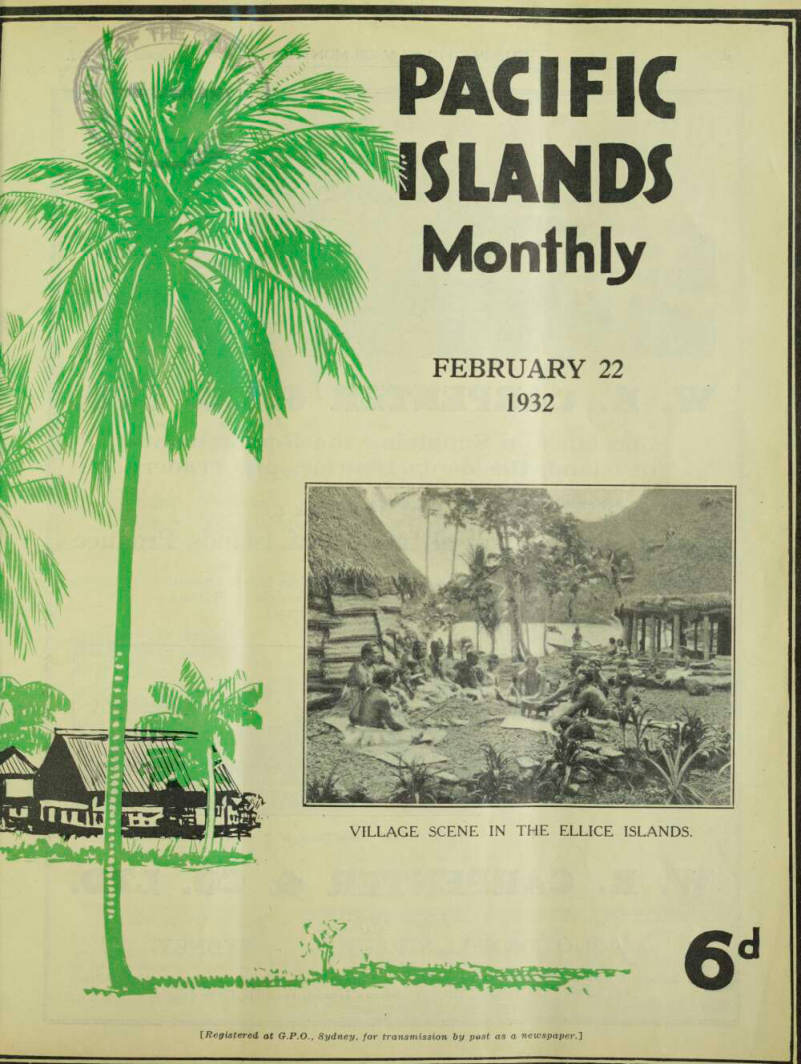
Pacific
ISLANDS
Monthly
FEBRUARY 22
1932
[Registered at G.P.O., Sydney, for transmission by post as a newspaper . ]
6 d
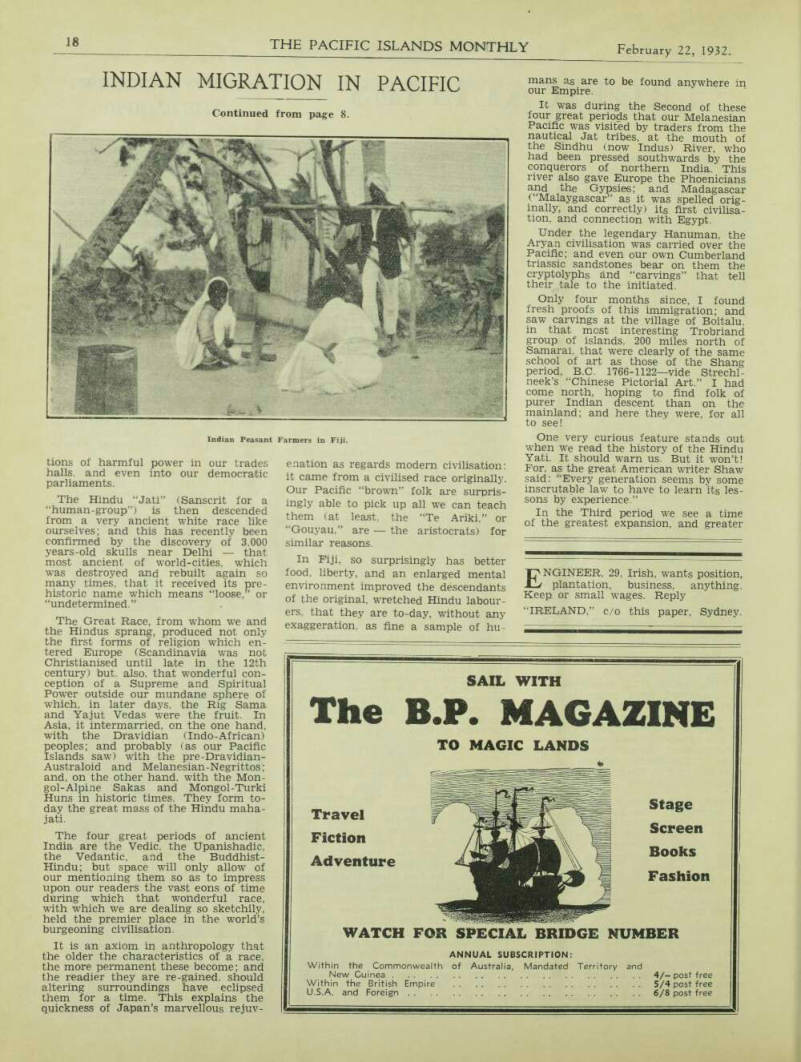
VILLAGE SCENE IN THE ELLICE ISLANDS.
W. R. Carpenter & Co. Ltd.
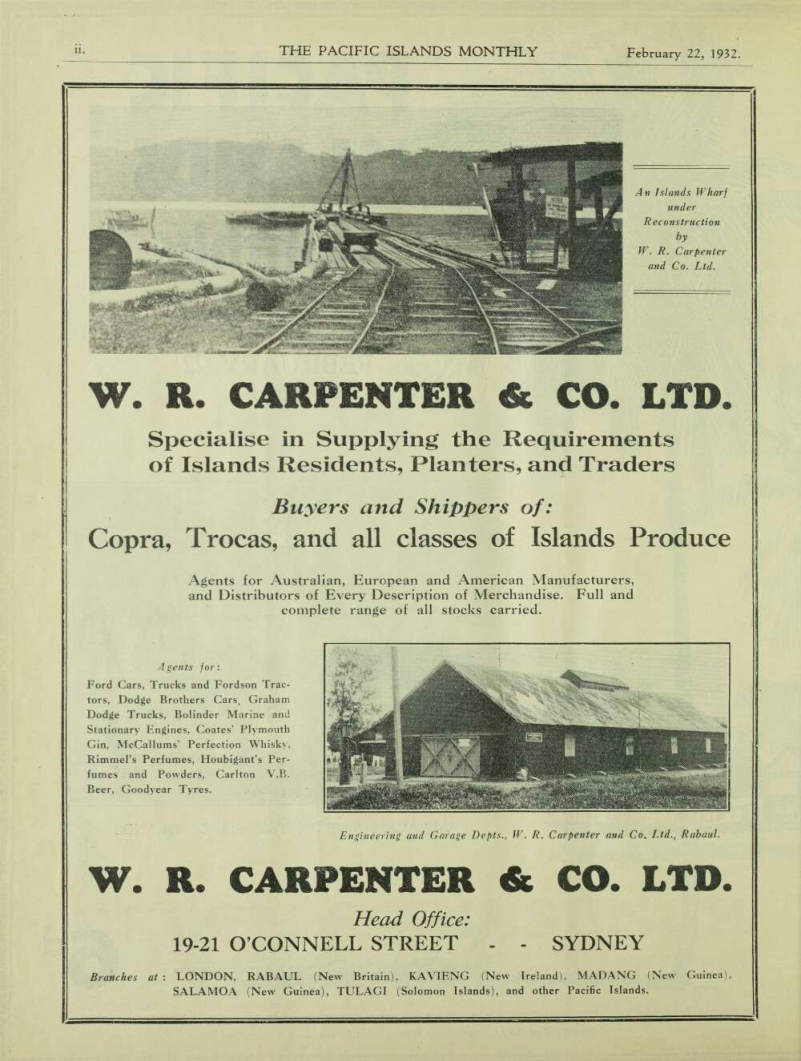
An Islands Wharf under Reconstruction by W. R. Carpenter and Co. Ltd.
W. R. CARPENTER & CO. LTD
Specialise in Supplying the Requirements
of Islands Residents, Planters, and Traders
Buyers and Shippers of:
Copra, Trocas, and all classes of Islands Produce Agents for Australian, European and American Manufacturers, and Distributors of Every Description of Merchandise. Full and complete range of all stocks carried.
Agents for: Ford Cars, Trucks and Fordson Trac tors, Dodge Brothers Cars, Graham Dodge Trucks, Bolinder Marine and Stationary Engines, Coates’ Plymouth Gin, McCallums’ Perfection Whisky.
Rimmel’s Perfumes, Houbigant’s Per fumes and Powders, Carlton V.B.
Beer, Goodyear Tyres.
Engineering and Garage Depts., W. R. Carpenter and Co. Ltd., Rabaul.
W. R. CARPENTER & CO. LTD.
Head Office:
19-21 O’CONNELL STREET - - SYDNEY
Branches at : LONDON, RABAUL (New Britain), KAVIENG (New Ireland), MADANG (New Guinea), SALAMOA (New Guinea), TULAGI (Solomon Islands), and other Pacific Islands.
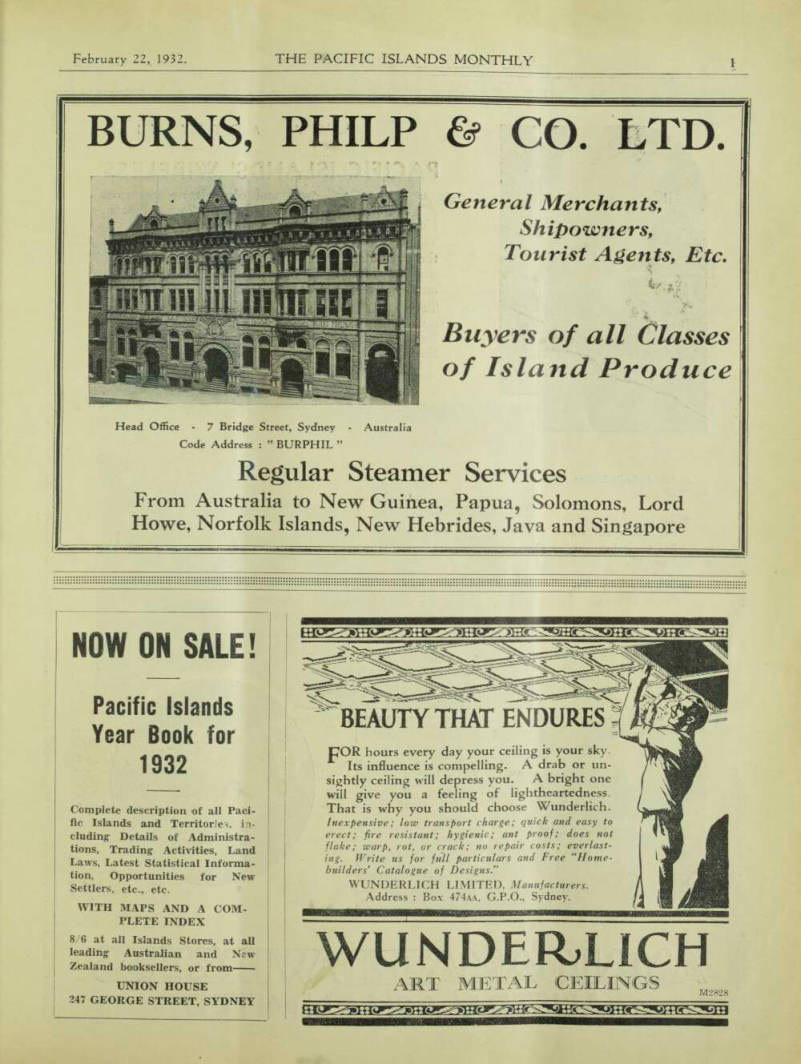
BURNS, PHILP & CO. LTD.
General Merchants, Shipowners, Tourist Agents, Etc.
Buyers of all Classes of Island Produce Head Office - 7 Bridge Street, Sydney - Australia Code Address : "BURPHIL ”
Regular Steamer Services From Australia to New Guinea, Papua, Solomons, Lord Howe, Norfolk Islands, New Hebrides, Java and Singapore
BEAUTY THAT ENDURES
FOR hours every day your ceiling is your sky.
Its influence is compelling. A drab or un sightly ceiling will depress you. A bright one will give you a feeling of lightheartedness.
That is why you should choose Wunderlich.
Inexpensive; low transport charge; quick and easy to erect; fire resistant; hygienic; ant proof; does not flake; warp, rot, or crack; no repair costs; everlast ing. Write us for full particulars and Free “Homebuilders’ Catalogue of Designs.”
WUNDERLICH LIMITED. Manufacturers.
Address : Box 474aa, G.P.O., Sydney.
WUNDERTICH
ART METAL CEILINGS M2828
NOW ON SALE!
Pacific Islands
Year Book for
1932 Complete description of all Paci fic Islands and Territories in cluding Details of Administra tions, Trading Activities, Land Laws, Latest Statistical Informa tion, Opportunities for New Settlers, etc., etc.
WITH MAPS AND A COM
PLETE INDEX
8/6 at all Islands Stores, at all leading Australian and New Zealand booksellers, or from
UNION HOUSE
247 GEORGE STREET, SYDNEY
A. W. A. ACTIVITIES
PACIFIC ISLANDS' WIRELESS
A.W.A. owns and controls no less than fourteen Island stations —eight in New Guinea, two in Papua and four in Fiji.
The development of Australian wireless interests in the Pacific and the development of Australia as the wireless centre of the Southern Pacific has long been an objective of the Company.
To-day the main Island centres are in direct com munication with Sydney, and through Sydney, per Beam Wireless, with Great Britain, the Continent of Europe and North and South America.
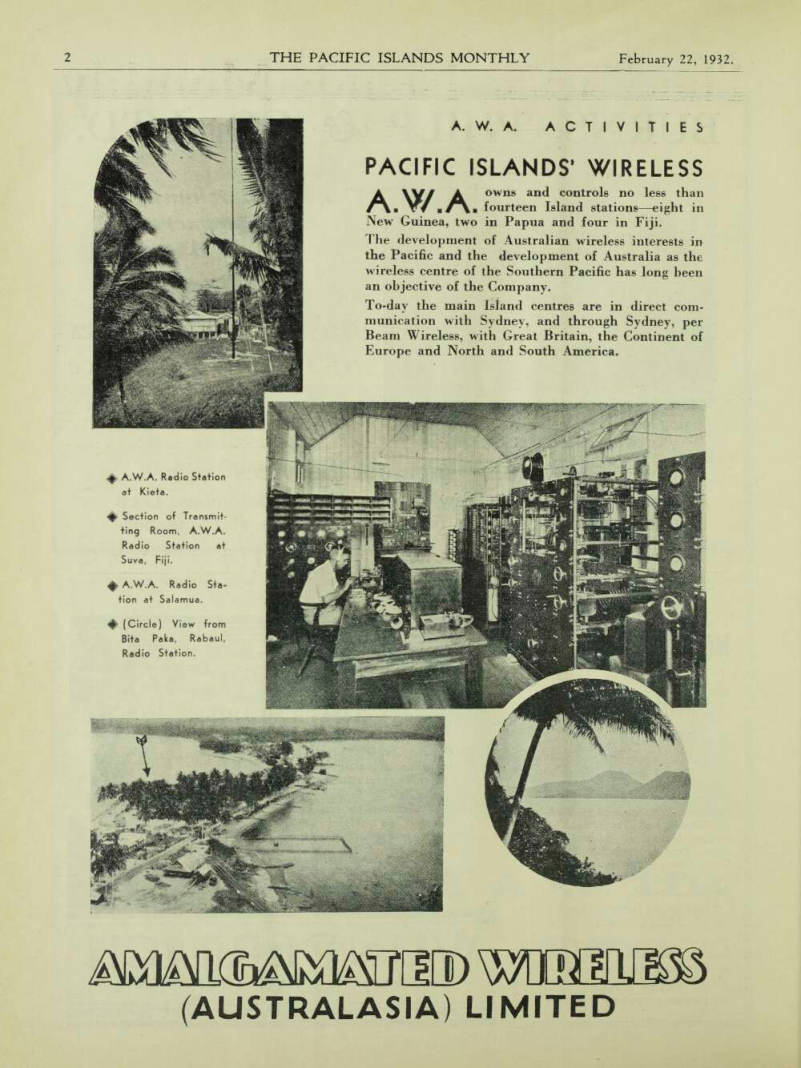
A.W.A. Radio Station at Kieta.
Section of Transmit ting Room, A.W.A.
Radio Station at Suva, Fiji.
A.W.A. Radio Sta tion at Salamua. (Circle) View from Bita Paka, Rabaul, Radio Station.
(AUSTRALASIA) LIMITED
The Pacific Islands Monthly
The Newspaper-Magazine Of The South Seas
[Registered at G.P.O., Sydney, for transmission by post as a newspaper.]
Published about 15th of Each Month and Circulated in Australia and New Zealand and in the following Pacific Territories and Island Groups:
Crown Colony of Fiji Australian Territory of Papua.
Mandated Territory (Australia) of New Guinea.
Bismarck Archipelago, and Northern Solo mon Islands Mandated Territory (Japan) of Marshall, Caroline and Ladrone Islands
American Territory of Guam Mandated Territory of Nauru British Crown Colony of Gilbert and Ellice Islands French Territory of New Caledonia British and French Condominium of New Hebrides American Territory of Samoa
Mandated Territory (New Zealand) of Samoa British Solomon Islands Protectorate British Protectorate of Tongan Islands New Zealand Territory of Cook Islands Australian Territory of Norfolk Island French Colony of Society Islands (Tahiti) American Territory of Hawaiian Islands
Owned and Produced by Pacific Publications Ltd., Union House, 247 George St., Sydney
Telephone - - Bw 5037
P.O. BOX - - - 3408 R
Editor and Publisher:
R. W. Robson
Registered Address for Telegrams and Cables: “PACPUB” --- Sydney
Contributions
Articles. Stories and Photographs dealing with Pacific Islands Subjects are invited, and will be paid for on publication at usual rates.
Subscription Rates
Per Annum, within Postal Convention Territories, Prepaid, Post Free - 6/- Per Annum elsewhere. Prepaid, Post Free 8/- Single Copies - - - 6d.
Advertisements
Advertising Rates: £10 per page; £5/5/- per half page; £2/15/- per quarter page; £1/7/6 per eighth page; Casual Advertise ments - -8/- per inch Colours, etc. by Arrangement Process Blocks made at Advertiser’s expense when required. Screen, 100.
Changes of Advertising Copy should reach this Office by 8th of each month, otherwise previ ous advertisement may be repeated.
Agents
The following are authorised to receive sub scriptions for The Pacific Islands Monthly.
Islands Branches of Burns, Philp & Co. Ltd. and Burns, Philp (South Seas) Co. Ltd.
Islands Branches of W. R. Carpenter & Co. Ltd.
All Branches of Morris, Hedstrom & Co. Ltd.
Greenwood & Laws (Rabaul).
Whitten Bros. Ltd., Port Moresby & Samarai.
All Branches and Representatives of W. H.
Grove & Sons Ltd., Auckland.
S. Russell, Papeete. Tahiti.
Cook Islands Trading Co., Rarotonga.
Mrs. M. Campbell, Cascades, Norfolk Island.
Vol. II.—No. 7.
Sydney: February 22, 1932.
Price 6d. Per Copy Prepaid: 6/- per annum
Copra Prices In The South Seas
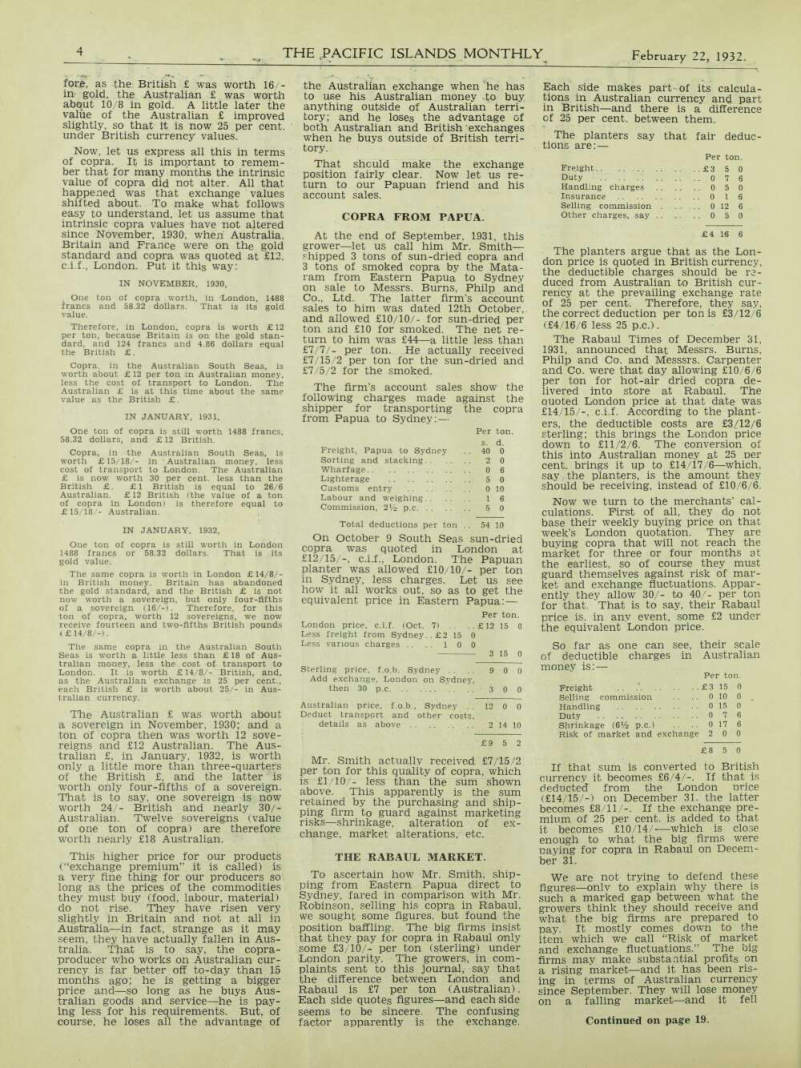
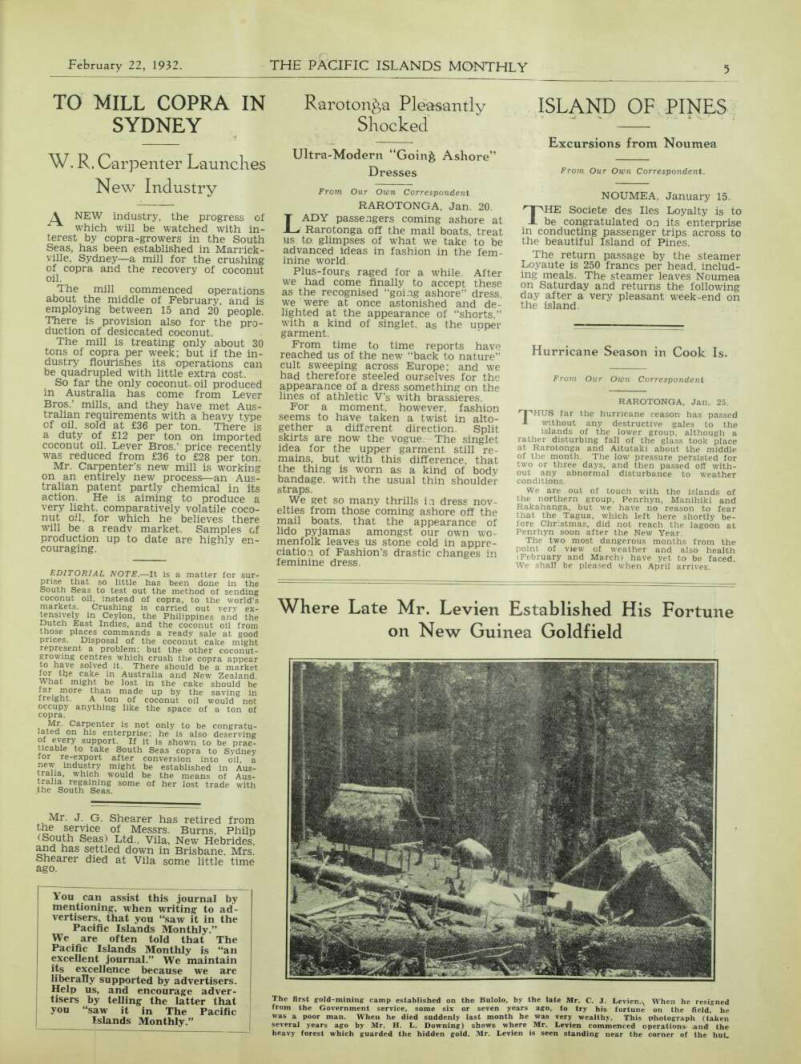
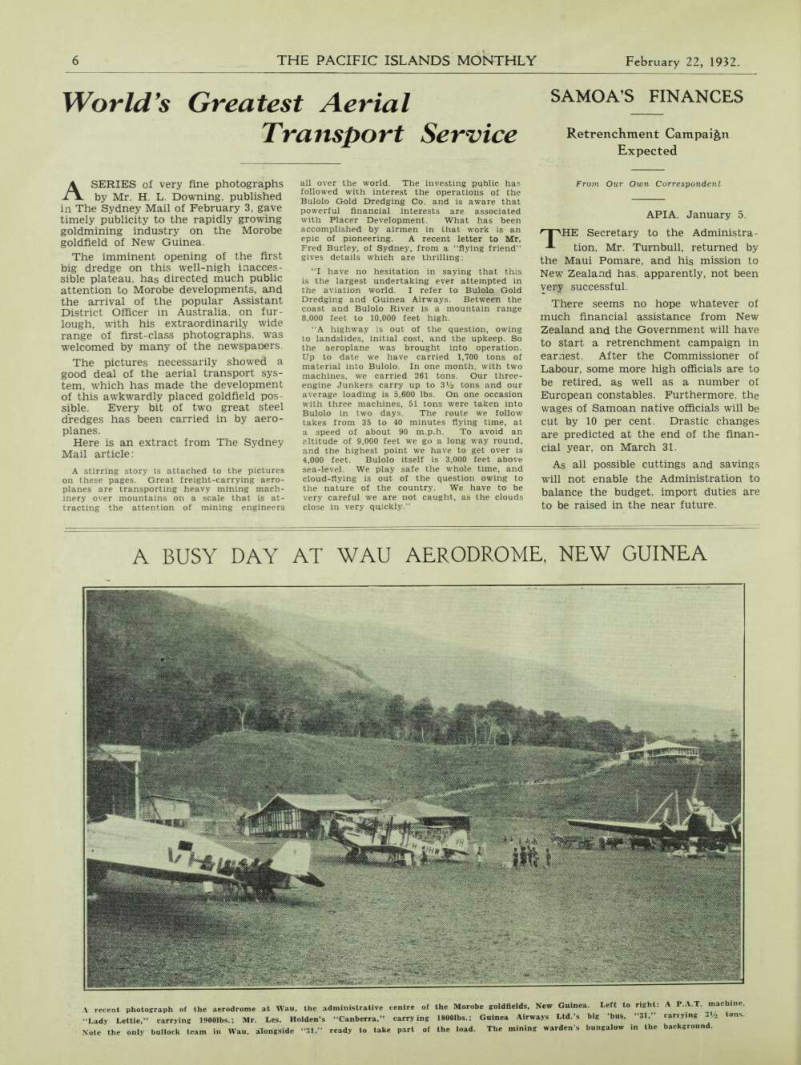
Exchange Movements and Commodity Fluctuations
There is much talk at Pacific Islands centres about the local copra price in relation to the oversea quotations, and many wild charges have been made against some of the big copra merchants. There is also much misunderstanding of the exchange position, and the why and wherefore of price movements in relation to the gold standard. It is all very con fusing; but an attempt has been made in this article to explain the copra position and price movements.
IN recent issues of this journal we have said that, as copra is mostly in demand by countries on the gold standard, and as Britain is 20 per cent, off the gold standard, and as the Aus tralian £ is 25 per cent, under the British £, the copra-grower should be feeling fairly cheerful.
We have now received a letter from a copra-grower in Eastern Papua. He says he is not feeling particularly elated, and he sends along a recent statement of account sales to show why.
The question that has been raised is one of great importance to copra pro ducers everywhere. Before we deal with it, we should perhaps try to clear the air by explaining what has hap pened to copra quotations as a result of exchange movements. It cannot be too strongly emphasised that the
world-value of copra (that is, its gold value) has not increased very much, if at all. All that has happened is that we are receiving more British and Australian currency for it. The French or American grower is not much better off. However, that does not worry us, so long as the British and Australian currency we are getting is buying for us the same quantity of goods or service.
Some fifteen months ago Britain was on the gold standard (one British note for £1 represented one golden sovereign), and the Australian £ was only slightly under the British £. The gold standard means 124 French francs and 4.86 American dollars to the golden sovereign. Therefore, when copra, fifteen months ago, was quoted at 1488 francs, that represented £12 per ton. c.i.f., in London.
A little later the value of the Aus tralian £ fell sharply, so that in Janu ary, 1931, instead of being at par with the British £, it was 30 per cent. less.
In other words, 26/6 Australian was adjudged to be the equal of the British £. This meant that a ton of copra, worth £12 in British money, was worth about £15/18/- in Australian money.
In other words, the copra producers in those groups which work on Aus tralian money—Papua, New Guinea, Solomons—were 30 per cent, better off, provided always that they used their money to buy goods from Australia.
To buy goods from any other country meant that they would have had to convert their Australian money into that country’s currency, and would lose the 30 per cent. That position con tinued for several months.
In October 1931, Britain suddenly abandoned the gold standard—she would no longer promise to pay on demand a golden sovereign for each of her £1 notes. The British £ immedi ately fell 20 per cent, in value in re lation to the franc and the dollar, which remained on the gold standard.
That is to say, the British £, instead of being worth the full golden sove reign, was then worth only four-fifths of it, or 16/-, if expressed internation ally. Within Britain, of course, the £ note (buying the same quantity of goods) is still worth twenty shillings.
The Australian £. despite Britain’s abandonment of gold, remained 30 per cent, less than the British £. There
fore, as the British £ was worth 16/in gold, the Australian £ was worth about 10/8 in gold. A little later the value of the Australian £ improved slightly, so that it is now 25 per cent, under British currency values.
Now, let us express all this in terms of copra. It is important to remem ber that for many months the intrinsic value of copra did not alter. All that happened was that exchange values shifted about. To make what follows easy to understand, let us assume that intrinsic copra values have not altered since November, 1930, when Australia, Britain and France were on the gold standard and copra was quoted at £12. c.i.f., London. Put it this way:
In November, 1930,
One ton of copra worth, in London, 1488 francs and 58.32 dollars. That is its gold value.
Therefore, in London, copra is worth £12 per ton, because Britain is on the gold stan dard, and 124 francs and 4.86 dollars equal the British £.
Copra, in the Australian South Seas, is worth about £ 12 per ton in Australian money, less the cost of transport to London. The Australian £ is at this time about the same value as the British £.
In January, 1931,
One ton of copra is still worth 1488 francs, 58.32 dollars, and £ 12 British.
Copra, in the Australian South Seas, is worth £15/18/- in Australian money, less cost of transport to London. The Australian £ is now worth 30 per cent, less than the British £. £1 British is equal to 26/6 Australian. £12 British (the value of a ton of copra in London) is therefore equal to £15/18/- Australian.
In January, 1932,
One ton of copra is still worth in London 1488 francs or 58.32 dollars. That is its gold value.
The same copra is worth in London £14/8/in British money. Britain has abandoned the gold standard, and the British £ is not now worth a sovereign, but only four-fifths of a sovereign (16/-). Therefore, for this ton of copra, worth 12 sovereigns, we now receive fourteen and two-fifths British pounds (£ 14/8/-).
The same copra in the Australian South Seas is worth a little less than £18 of Aus tralian money, less the cost of transport to London. It is worth £14/8/- British, and, as the Australian exchange is 25 per cent., each British £ is worth about 25/- in Aus tralian currency.
The Australian £ was worth about a sovereign in November, 1930; and a ton of copra then was worth 12 sove reigns and £12 Australian. The Australian £, in January, 1932, is worth only a little more than three-quarters of the British £, and the latter is worth only four-fifths of a sovereign.
That is to say, one sovereign is now worth 24/- British and nearly 30/- Australian. Twelve sovereigns (value of one ton of copra) are therefore worth nearly £18 Australian.
This higher price for our products (“exchange premium” it is called) is a very fine thing for our producers so long as the prices of the commodities they must buy (food, labour, material) do not rise. They have risen very slightly in Britain and not at all in Australia—in fact, strange as it may seem, they have actually fallen in Aus tralia. That is to say, the copra producer who works on Australian cur rency is far better off to-day than 15 months ago; he is getting a bigger price and —so long as he buys Aus tralian goods and service—he is pay ing less for his requirements. But, of course, he loses all the advantage of
the Australian exchange when he has to use his Australian money to buy anything outside of Australian terri tory: and he loses the advantage of both Australian and British exchanges when he buys outside of British terri tory.
That should make the exchange position fairly clear. Now let us re turn to our Papuan friend and his account sales.
Copra From Papua
At the end of September, 1931, this grower—let us call him Mr. Smith— shipped 3 tons of sun-dried copra and 3 tons of smoked copra by the Mata ram from Eastern Papua to Sydney on sale to Messrs. Burns, Philp and Co., Ltd. The latter firm’s account sales to him was dated 12th October, and allowed £10/10/- for sun-dried per ton and £10 for smoked. The net re turn to him was £44—a little less than £7/7/- per ton. He actually received £7/15/2 per ton for the sun-dried and £7/5/2 for the smoked.
The firm’s account sales show the following charges made against the shipper for transporting the copra from Papua to Sydney:—
On October 9 South Seas sun-dried copra was quoted in London at £12/15/-, c.i.f., London. The Papuan planter was allowed £10/10/- per ton in Sydney, less charges. Let us see how it all works out, so as to get the equivalent price in Eastern Papua:
Mr. Smith actually received £7/15/2 per ton for this quality of copra, which is £1/10/- less than the sum shown above. This apparently is the sum retained by the purchasing and ship ping firm to guard against marketing risks—shrinkage, alteration of ex change, market alterations, etc.
The Rabaul Market.
To ascertain how Mr. Smith, ship ping from Eastern Papua direct to Sydney, fared in comparison with Mr.
Robinson, selling his copra in Rabaul, we sought some figures, but found the position baffling. The big firms insist that they pay for copra in Rabaul only some £3/10/- per ton (sterling) under London parity. The growers, in com plaints sent to this journal, say that the difference between London and Rabaul is £7 per ton (Australian).
Each side quotes figures—and each side seems to be sincere. The confusing factor apparently is the exchange.
Each side makes part of its calcula tions in Australian currency and part in British—and there is a difference of 25 per cent, between them.
The planters say that fair deduc tions are:
The planters argue that as the Lon don price is quoted in British currency, the deductible charges should be re duced from Australian to British cur rency at the prevailing exchange rate of 25 per cent. Therefore, they say, the correct deduction per ton is £3/12/6 (£4/16/6 less 25 p.c.).
The Rabaul Times of December 31, 1931, announced that Messrs. Burns, Philp and Co. and Messsrs. Carpenter and Co. were that day allowing £10/6/6 per ton for hot-air dried copra de livered into store at Rabaul. The quoted London price at that date was £14/15/-, c.i.f. According to the plant ers, the deductible costs are £3/12/6 sterling: this brings the London price down to £11/2/6. The conversion of this into Australian money at 25 per cent, brings it up to £14/17/6 —which, say the planters, is the amount they should be receiving, instead of £10/6/6.
Now we turn to the merchants’ cal culations. First of all, they do not base their weekly buying price on that week’s London quotation. They are buying copra that will not reach the market for three or four months at the earliest, so of course they must guard themselves against risk of mar ket and exchange fluctuations. Appar ently they allow 30/- to 40/- per ton for that. That is to say, their Rabaul price is. in any event, some £2 under the equivalent London price.
So far as one can see, their scale of deductible charges in Australian money is:—
If that sum is converted to British currency it becomes £6/4/-. If that is deducted from the London nrice (£14/15/-) on December 31. the latter becomes £8/11/-. If the exchange pre mium of 25 per cent, is added to that it becomes £10/14/ —which is close enough to what the big firms were paying for copra in Rabaul on Decem ber 31.
We are not trying to defend these figures—only to explain why there is such a marked gap between what the growers think they should receive and what the big firms are prepared to pay. It mostly comes down to the item which we call “Risk of market and exchange fluctuations.” The big firms may make substantial profits on a rising market —and it has been ris ing in terms of Australian currency since September. They will lose money on a falling market —and it fell
Continued on page 19.
Freight, Papua to Sydney Per ton. s. d . 40 0 Sorting and stacking 2 0 Wharfage 0 6 Lighterage 5 0 Customs entry 0 10 Labour and weighing 1 6 Commission, 2½ p.c 5 0 Total deductions per ton . 54 10
Per ton.
London price, c.i.f. (Oct. 7) £12 15 0 Less freight from Sydney.. £2 15 0 Less various charges .. 1 0 0 3 15 0 Sterling price, f.o.b. Sydney . . 9 0 0 Add exchange, London on Sydney, then 30 p.c . . .. 3 0 0 Australian price, f.o.b., Sydney 12 0 0 Deduct transport and other costs, details as above 2 14 10 £9 5 2
Per ton.
Freight £3 5 0 Duty 0 7 6 Handling charges 0 5 0 Insurance 0 1 6 Selling commission 0 12 6 Other charges, say 0 5 0 £4 16 6
Per ton.
Freight £3 15 0 Selling commission. 0 10 0 Handling 0 15 0 Duty 0 7 6 Shrinkage ( 6½ p.c.) 0 17 6 Risk of market and exchange 2 0 0 £8 5 0
steadily from 1929 until September, 1931.
It is interesting to compare the Lon don quotations, as published in The Sydney Morning Herald every Monday, with the price quoted in The Rabaul Times every Friday:—
It will be seen that, taking exchange into consideration, the difference be tween the London and Rabaul quo tations remains at about £7 (Austra lian) per ton; and that the Rabaul price generally moved up or down in sympathy with the London quotation.
London.
Rabaul.
Oct. 11, 1931 .. £13 0 0 .. £9 12 6 Oct. 18, 1931 . . 12 15 0 . . 9 17 6 Oct. 25. 1931 . . 13 2 6 9 15 0 Nov. 1, 1931 . . 13 15 0 .. 10 2 6 Nov. 8. 1931 14 5 0 . . 10 10 0 Nov. 22. 1931 . . 13 15 0 . . 10 0 0 Nov. 30, 1931 . . 13 15 0 . . 10 0 0 Dec. 6. 1931 14 10 0 . . 10 6 6 Dec. 13. 1931 14 10 0 . . 10 6 6 Dec. 20. 1931 14 10 0 . . 10 6 6
W.R.Carpenter Launches
To Mill Copra In
Sydney
W.R.Carpenter Launches New Industry
A NEW industry, the progress of which will be watched with in terest by copra-growers in the South Seas, has been established in Marrick ville, Sydney—a mill for the crushing of copra and the recovery of coconut oil.
The mill commenced operations about the middle of February, and is employing between 15 and 20 people.
There is provision also for the pro duction of desiccated coconut.
The mill is treating only about 30 tons of copra per week; but if the in dustry flourishes its operations can be quadrupled with little extra cost.
So far the only coconut, oil produced in Australia has come from Lever Bros.’ mills, and they have met Aus tralian requirements with a heavy type of oil, sold at £36 per ton. There is a duty of £12 per ton on imported coconut oil. Lever Bros.’ price recently was reduced from £36 to £28 per ton.
Mr. Carpenter’s new mill is working on an entirely new process—an Aus tralian patent partly chemical in its action. He is aiming to produce a very light, comparatively volatile coco nut oil, for which he believes there will be a readv market. Samples of production up to date are highly en couraging.
EDITORIAL NOTE. —It is a matter for sur prise that so little has been done in the South Seas to test out the method of sending coconut oil, instead of copra, to the world’s markets. Crushing is carried out very ex tensively in Ceylon, the Philippines and the Dutch East Indies, and the coconut oil from those places commands a ready sale at good prices. Disposal of the coconut cake might represent a problem; but the other coconut growing centres which crush the copra appear to have solved it. There should be a market for the cake in Australia and New Zealand.
What might be lost in the cake should be far more than made up by the saving in freight. A ton of coconut oil would not occupy anything like the space of a ton of copra.
Mr. Carpenter is not only to be congratu lated on his enterprise: he is also deserving of every support. If it is shown to be prac ticable to take South Seas copra to Sydney for re-export after conversion into oil, a new industry might be established in Aus tralia, which would be the means of Aus tralia regaining some of her lost trade with the South Seas.
Mr. J. G. Shearer has retired from the service of Messrs. Burns, Philp South Seas) Ltd.. Vila, New Hebrides, and has settled down in Brisbane. Mrs.
Shearer died at Vila some little time ago.
Rarotonga Pleasantly
Shocked Ultra-Modern “Going Ashore”
Dresses
From Our Own Correspondent
Rarotonga, Jan. 20.
LADY passengers coming ashore at Rarotonga off the mail boats, treat us to glimpses of what we take to be advanced ideas in fashion in the fem inine world.
Plus-fours raged for a while. After we had come finally to accept these as the recognised “going ashore” dress, we were at once astonished and de lighted at the appearance of “shorts.” with a kind of singlet, as the upper garment.
From time to time reports have reached us of the new “back to nature” cult sweeping across Europe; and we had therefore steeled ourselves for the appearance of a dress something on the lines of athletic V’s with brassieres.
For a moment, however, fashion seems to have taken a twist in alto gether a different direction. Split skirts are now the vogue. The singlet idea for the upper garment still re mains, but with this difference, that the thing is worn as a kind of body bandage, with the usual thin shoulder straps.
We get so many thrills in dress nov elties from those coming ashore off the mail boats, that the appearance of lido pyjamas amongst our own wo menfolk leaves us stone cold in appre ciation of Fashion’s drastic changes in feminine dress.
Island Of Pines
Excursions from Noumea
From Our Own Correspondent.
NOUMEA, January 15.
THE Societe des lies Loyalty is to be congratulated on its enterprise in conducting passenger trips across to the beautiful Island of Pines.
The return passage by the steamer Loyaute is 250 francs per head, includ ing meals. The steamer leaves Noumea on Saturday and returns the following day after a very pleasant week-end on the island.
Hurricane Season in Cook Is.
From Our Own Correspondent
Rarotonga, Jan. 25.
THUS far the hurricane season has passed without any destructive gales to the islands of the lower group, although a rather disturbing fall of the glass took place at Rarotonga and Aitutaki about the middle of the month. The low pressure persisted for two or three days, and then passed off with out any abnormal disturbance to weather conditions.
We are out of touch with the islands of the northern group. Penrhyn, Manihiki and Rakahanga, but we have no reason to fear that the Tagua, which left here shortly be fore Christmas, did not reach the lagoon at Penrhyn soon after the New Year.
The two most dangerous months from the point of view of weather and also health (February and March) have yet to be faced.
We shall be pleased when April arrives.
Where Late Mr. Levien Established His Fortune
on New Guinea Goldfield
The first gold-mining camp established on the Bulolo, by the late Mr. C. J. When he resigned from the Government service, some six or seven years ago, to try his fortune on the field, he was a poor man. When he died suddenly last month he was very wealthy. This photograph (taken several years ago by Mr. H. L. Downing) shows where Mr. Levien commenced operations and the heavy forest which guarded the hidden gold. Mr. Levien is seen standing near the corner of the hut.
Advertisements & other items, p. 7 (1 item)
You can assist this journal by
mentioning:, when writing: to ad vertisers, that you “saw it in the Pacific Islands Monthly.”
We are often told that The Pacific Islands Monthly is “an excellent journal.” We maintain its excellence because we are liberally supported by advertisers.
Help us, and encourage adver tisers by telling the latter that you “saw it in The Pacific Islands Monthly.”
Transport Service
World’s Greatest Aerial Transport Service
A SERIES of very fine photographs by Mr. H. L. Downing, published in The Sydney Mail of February 3, gave timely publicity to the rapidly growing goldmining industry on the Morobe goldfield of New Guinea.
The imminent opening of the first big dredge on this well-nigh inacces sible plateau, has directed much public attention to Morobe developments, and the arrival of the popular Assistant District Officer in Australia, on fur lough, with his extraordinarily wide range of first-class photographs, was welcomed by many of the newspaners.
The pictures necessarily showed a good deal of the aerial transport sys tem, which has made the development of this awkwardly placed goldfield pos sible. Every bit of two great steel dredges has been carried in by aero planes.
Here is an extract from The Sydney Mail article: A stirring story is attached to the pictures on these pages. Great freight-carrying aero planes are transporting heavy mining mach inery over mountains on a scale that is at tracting the attention of mining engineers
all over the world. The investing public has followed with interest the operations of the Bulolo Gold Dredging Co. and is aware that powerful financial interests are associated with Placer Development. What has been accomplished by airmen in that work is an epic of pioneering. A recent letter to Mr, Fred Burley, of Sydney, from a “flying friend” gives details which are thrilling: “I have no hesitation in saying that this is the largest undertaking ever attempted in the aviation world. I refer to Bulolo Gold Dredging and Guinea Airways. Between the coast and Bulolo River is a mountain range 8.000 feet to 10,000 feet high.
“A highway is out of the question, owing to landslides, initial cost, and the upkeep. So the aeroplane was brought into operation.
Up to date we have carried 1,700 tons of material into Bulolo. In one month, with two machines, we carried 261 tons. Our three engine Junkers carry up to 3½ tons and our average loading is 5,600 lbs. On one occasion with three machines, 51 tons were taken into Bulolo in two days. The route we follow takes from 35 to 40 minutes flying time, at a speed of about 90 m.p.h. To avoid an altitude of 9,000 feet we go a long way round, and the highest point we have to get over is 4,000 feet. Bulolo itself is 3,000 feet above sea-level. We play safe the whole time, and cloud-flying is out of the question owing to the nature of the country. We have to be very careful we are not caught, as the clouds close in very quickly.”
Samoa’S Finances
Retrenchment Campaign Expected
From Our Own Correspondent APIA, January 5.
THE Secretary to the Administra tion, Mr. Turnbull, returned by the Maui Pomare, and his mission to New Zealand has, apparently, not been very successful.
There seems no hope whatever of much financial assistance from New Zealand and the Government will have to start a retrenchment campaign in earnest. After the Commissioner of Labour, some more high officials are to be retired, as well as a number of European constables. Furthermore, the wages of Samoan native officials will be cut by 10 per cent. Drastic changes are predicted at the end of the finan cial year, on March 31.
As all possible cuttings and savings will not enable the Administration to balance the budget, import duties are to be raised in the near future.
A Busy Day At Wau Aerodrome, New Guinea
A recent photograph of the aerodrome at Wau, the administrative centre of the Morobe goldfields, New Guinea. Left to right: A P.A.T. machine.
“Lady Lettie,” carrying 1900Ibs.; Mr. Les. Holden’s “Canberra,” carrying 1800lbs.; Guinea Airways Ltd.’s big bus, “31," carrying 3 ½ tons.
Note the only bullock team in Wau, alongside “31,” ready to take part of the load. The mining warden’s bungalow in the background.
To Ongtong Java
A White Woman's Visit
Ongtong Java lies about 150 miles north of the Solomon Group, and it comes under the administration of the Resident Commissioner of the Solomons. The group is inhabited by an entirely Polynesian race—and this, in the midst of Melanesia, is hard to understand.
These islands grow nothing but coc nuts, and are only about three feet above sea level. No other vegetation of any kind exists, and the natives live entirely on coconuts and fish.
I was quite prepared, after leaving Ysabel, to encounter rough seas, as the nor’-west season had set in, but both coming and going it was dead calm— a record trip, I have been told.
After two days and one night of travel this wonderful group of islands came in sight. Just a line of coconuts, apparently growing in the ocean, was my first impression. Then, as we got closer, I could see miles and miles of reefs and palms, extending for forty miles, forming a perfect oval, with an immense lagoon in the centre.
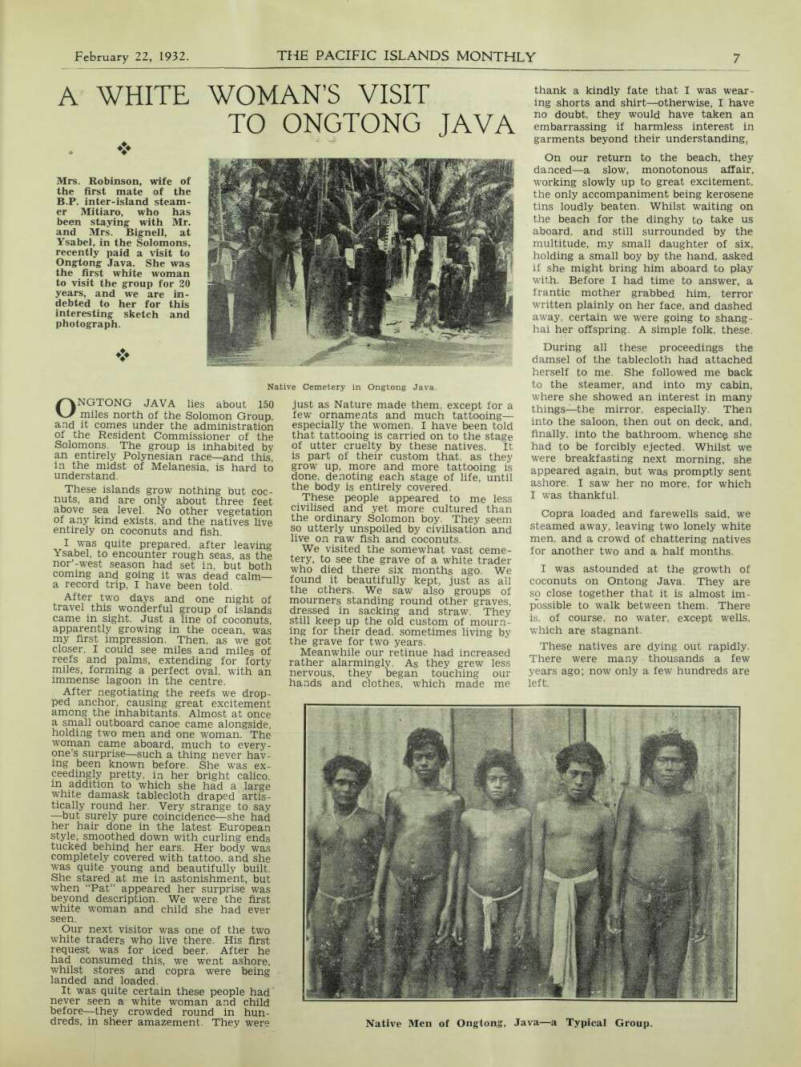
After negotiating the reefs we drop ped anchor, causing great excitement among the inhabitants. Almost at once a small outboard canoe came alongside, holding two men and one woman. The woman came aboard, much to every one's surprise—such a thing never hav ing been known before. She was ex ceedingly pretty, in her bright calico, in addition to which she had a large white damask tablecloth draped artis tically round her. Very strange to say —but surely pure coincidence—she had her hair done in the latest European style, smoothed down with curling ends tucked behind her ears. Her body was completely covered with tattoo, and she was quite young and beautifully built.
She stared at me in astonishment, but when “Pat” appeared her surprise was beyond description. We were the first white woman and child she had ever seen.
Our next visitor was one of the two white traders who live there. His first request was for iced beer. After he had consumed this, we went ashore, whilst stores and copra were being landed and loaded.
It was quite certain these people had never seen a white woman and child before—they crowded round in hun dreds, in sheer amazement. They were
just as Nature made them, except for a few ornaments and much tattooing— especially the women. I have been told that tattooing is carried on to the stage of utter cruelty by these natives. It is part of their custom that, as they grow up, more and more tattooing is done, denoting each stage of life, until the body is entirely covered.
These people appeared to me less civilised and yet more cultured than the ordinary Solomon boy. They seem so utterly unspoiled by civilisation and live on raw fish and coconuts.
We visited the somewhat vast ceme tery, to see the grave of a white trader who died there six months ago. We found it beautifully kept, just as all the others. We saw also groups of mourners standing round other graves, dressed in sacking and straw. They still keep up the old custom of mourn ing for their dead, sometimes living by the grave for two years.
Meanwhile our retinue had increased rather alarmingly. As they grew less nervous, they began touching our hands and clothes, which made me
thank a kindly fate that I was wear ing shorts and shirt —otherwise, I have no doubt, they would have taken an embarrassing if harmless interest in garments beyond their understanding, On our return to the beach, they danced —a slow, monotonous affair, working slowly up to great excitement, the only accompaniment being kerosene tins loudly beaten. Whilst waiting on the beach for the dinghy to take us aboard, and still surrounded by the multitude, my small daughter of six, holding a small boy by the hand, asked if she might bring him aboard to play with. Before I had time to answer, a frantic mother grabbed him, terror written plainly on her face, and dashed away, certain we were going to shang hai her offspring. A simple folk, these.
During all these proceedings the damsel of the tablecloth had attached herself to me. She followed me back to the steamer, and into my cabin, where she showed an interest in many things—the mirror, especially. Then into the saloon, then out on deck, and, finally, into the bathroom, whence she had to be forcibly ejected. Whilst we were breakfasting next morning, she appeared again, but was promptly sent ashore. I saw her no more, for which I was thankful.
Copra loaded and farewells said, we steamed away, leaving two lonely white men. and a crowd of chattering natives for another two and a half months.
I was astounded at the growth of coconuts on Ontong Java. They are so close together that it is almost im possible to walk between them. There is, of course, no water, except wells, which are stagnant.
These natives are dying out rapidly.
There were many thousands a few years ago; now only a few hundreds are left.
Mrs. Robinson, wife of the first mate of the B.P. inter-island steam er Mitiaro, who has been staying with Mr. and Mrs. Bignell, at Ysabel, in the Solomons, recently paid a visit to Ongtong Java. She was the first white woman to visit the group for 20 years, and we are in debted to her for this interesting sketch and photograph.
Native Cemetery in Ongtong Java.
Native Men of Ongtong, Java —a Typical Group.
India’s Influence on Pacific Races
Scientist’s Jottings on Indian Immigration in Fiji, and Elsewhere
Written for the Pacific Islands Monthly by A. J. Vogan, F.R.G.S., etc.
NOTHING is clearer to the student of such matters than the fact that our original ancestry, the pre historic Great Race of what is now the Gobo desert and Altai Mountains of Central Asia (which gave the first civil isation to a semi-human world) was also the blood-fount from which sprang the Hindu —originally a fair skinned race.
As the Ant or Bee can produce the highly specialised Queen from the same insignificant maggot—that, un der ordinary condi tions, would have been a lowly “work er” through the medium of certain exotic foods and “massages,” so the early immigrants from Asia devel oped differently under the stern vicissitudes of the Baltic sea-lands or
in those “Isles of Eden,” the beauti fully dangerous, coral isolations of the Pacific.
Two main characteristics of the Great Race (as I have termed it in my writings, for this prehistoric people still remain amongst the innomenata of Science) stand out differentiating them from other “breeds without the law.” They are born navigators; and they have a pushing, pioneering genius for business—sometimes combined with piracy, as dear old Herodotus had already noticed over 400 years before our era!
This business rapacity, driven at all costs against opposition, has been the cause of most of the trouble in Bur mah, where Hindu traders and minor officials swarmed in, owing to the backwardness of the Burman to qualify himself for government. One could point out similar cases nearer home, but for fear of the editorial blue pencil: for, as all anthropologists know full well, many of our so-called “white men” have less of this Great Race in their make-up than have other equally wrong designated “Black” or “Brown” folk—take the black Berbers, who are Arabs, really.
The reason for the friction between Hindus and Mussalmans in India is at bottom, also just that. The latter were attracted to India by that root cause of all human movements: Hunger. The Mussalmans, disciplined for war, pre served, throughout the days of then rule, a purely military outlook, until Auranzeb found it necessary to trans form the personnel of the civil govern ment, declaring that “The Hindus are the axle-tree of the administration.”
With the advent of their distant cou
sins, the British, the Hindus came once more into power, as being pre-eminent in trade. “Men are seldom so well em ployed as when making money!” wrote the great Dr. Johnson 200 years ago.
The Pacific Monthly reader who goes to see the large “home-circle” of Mr. Le Soeuf, at Taronga Park, may find there evidence of his own connection with this Great Race of ancient Asia; and, through it, with the Hindus. Here, amongst the most interesting of all the poor creatures “in for life,” and “cribbed, cabin’d and confined,” are the sturdy, pointed-tailed, rather quick tempered Prejavalski ponies who would be greater favourites, per haps, than they are with the horse-lov
ing young Australian, but for their troublesome name. We are glad to simplify this for them. It is approxi mately pronounced: “Chevalski”; and means “Cavalier.”
When the writer was a boy, the vastly ancient cave-drawing of Spain and France were just attracting the notice of science. But the artists (who drew and painted about 5000 years be fore the Great Pyramid was planned) were criticised. “Who ever saw a horse like that?” Their other sketches of pre-historic rhinoceros, etc., were therefore discounted. But, later, in 1870, Lieut.-Colonel Prejavalski, the great Russian explorer, brought down from Mongolia specimens such as you see to-day in Taronga which were bred from the originals in the New York Zoo. These archaic drawings are very faithfully exact; and we know now that our ancestors brought these ponies with them when they reached the Baltic and Danube.
I remember that in 1900, we were supplied with Hungarian-bred re mounts during the Boer War, which are almost exact replicas. And in Stockholm, and in many places along the German littoral, similar steeds called in northern India “Yarkandis” —are still occasionally to be seen.
Again, when we examine the old Baltic Pantheon, we find it founded upon legends and mysteries identical with those of the Nature-worshippers of ancient Central Asia as Mrs.
Murray-Aynsley (aunt of our own Mrs.
Western of Hornsby), the great archae ologist of India, General Sir G. M.
Birdwood, and other authorities, have shown conclusively.
The experience of a lifetime has shown us that it is generally safe to look upon any “popular” belief as erroneous though some certainly originated in truths, long since twisted by ignorance beyond recognition. One such is the popular idea about “the mild Hindu” that he is invariably unwarlike. It was the Warrior caste of this People, the Rajputs, or Moun tain people, who held back the Mo guls—the ancestors of those moderns who have been made the vehicle for foisting Communism upon an unwilling world; and who have crept into posi
Continued on page 18.
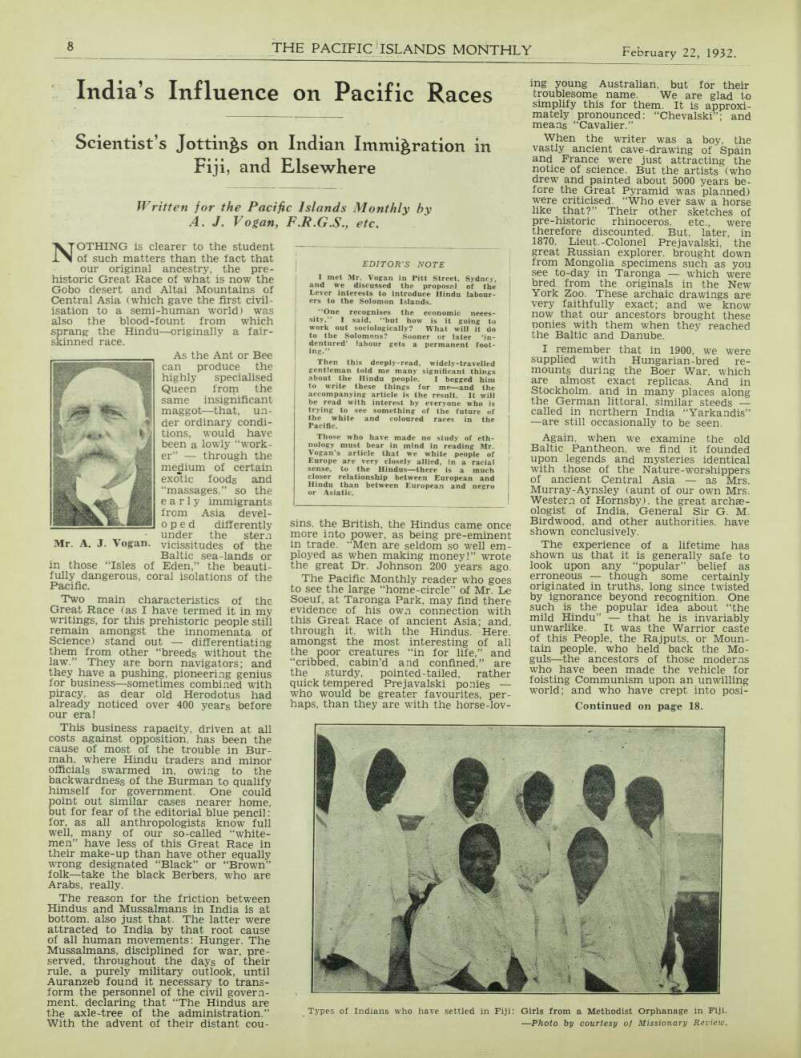
Mr. A. J. Vogan.
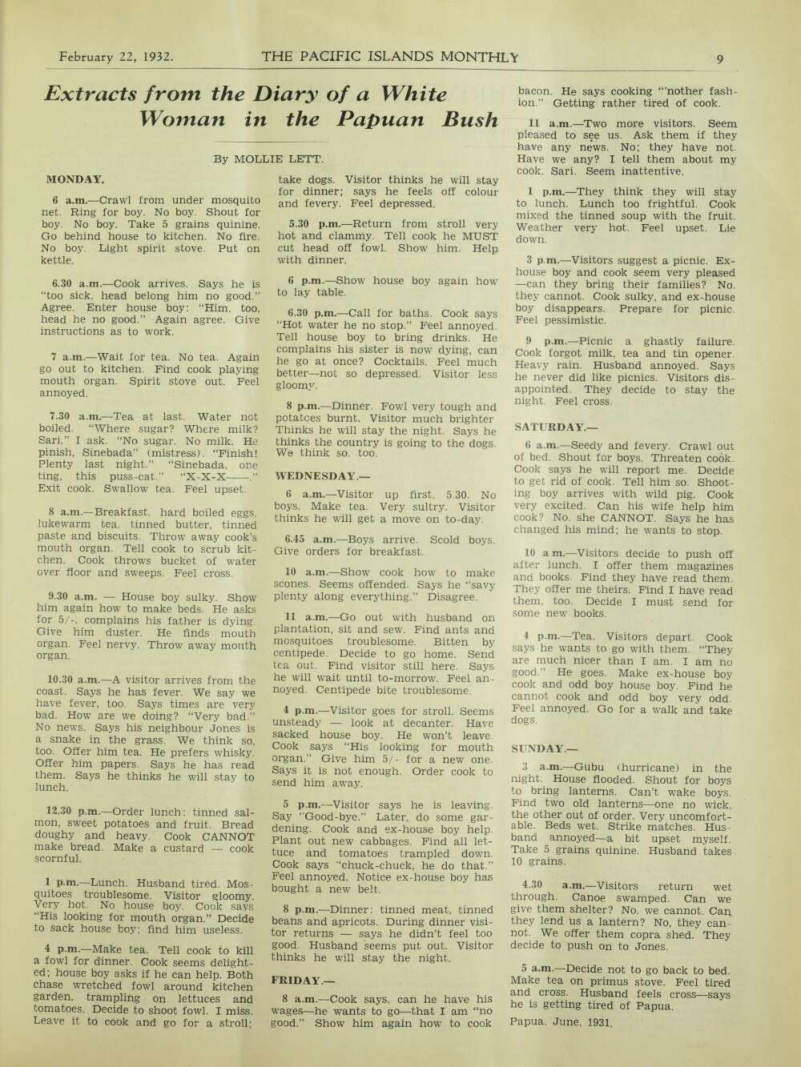
Types of Indians who have settled in Fiji: Girls from a Methodist Orphanage in Fiji.
Photo by courtesy of Missionary Review.
tions of harmful power in our trades halls, and even into our democratic parliaments.
The Hindu “Jati” (Sanscrit for a “human-group”) is then descended from a very ancient white race like ourselves: and this has recently been confirmed by the discovery of 3,000 years-old skulls near Delhi that most ancient of world-cities, which was destroyed and rebuilt again so many times, that it received its pre historic name which means “loose,” or “undetermined.”
The Great Race, from whom we and the Hindus sprang, produced not only the first forms of religion which en tered Europe (Scandinavia was not Christianised until late in the 12th century) but, also, that wonderful con ception of a Supreme and Spiritual Power outside our mundane sphere of which, in later days, the Rig Sama and Yajut Vedas were the fruit. In Asia, it intermarried, on the one hand, with the Dravidian (Indo-African) peoples; and probably (as our Pacific Islands saw) with the pre-Dravidian - Australoid and Melanesian-Negrittos; and, on the other hand, with the Mon gol-Alpine Sakas and Mongol-Turki Huns in historic times. They form to day the great mass of the Hindu maha jati.
The four great periods of ancient India are the Vedic. the Upanishadic, the Vedantic, and the Buddhist- Hindu; but space will only allow of our mentioning them so as to impress upon our readers the vast eons of time during which that wonderful race, with which we are dealing so sketchily, held the premier place in the world’s burgeoning civilisation.
It is an axiom in anthropology that the older the characteristics of a race, the more permanent these become; and the readier they are re-gained, should altering surroundings have eclipsed them for a time. This explains the quickness of Japan’s marvellous rejuv
enation as regards modem civilisation; it came from a civilised race originally.
Our Pacific “brown” folk are surpris ingly able to pick up all we can teach them (at least, the “Te Ariki,” or “Gouyau,” are the aristocrats) for similar reasons.
In Fiji, so surprisingly has better food, liberty, and an enlarged mental environment improved the descendants of the original, wretched Hindu labour ers, that they are to-day, without any exaggeration, as fine a sample of hu
mans as are to be found anywhere in our Empire.
It was during the Second of these four great periods that our Melanesian Pacific was visited by traders from the nautical Jat tribes, at the mouth of the Sindhu (now Indus) River, who had been pressed southwards by the conquerors of northern India. This river also gave Europe the Phoenicians and the Gypsies; and Madagascar (“Malaygascar” as it was spelled orig inally, and correctly) its first civilisa tion, and connection with Egypt.
Under the legendary Hanuman, the Aryan civilisation was carried over the Pacific; and even our own Cumberland triassic sandstones bear on them the cryptolyphs and “carvings” that tell their tale to the initiated.
Only four months since, I found fresh proofs of this immigration; and saw carvings at the village of Boitalu, in that most interesting Trobriand group of islands, 200 miles north of Samarai, that were clearly of the same school of art as those of the Shang period, B.C. 1766-1122—vide Strechl neek’s “Chinese Pictorial Art.” I had come north, hoping to find folk of purer Indian descent than on the mainland; and here they were, for all to see!
One very curious feature stands out when we read the history of the Hindu Yati. It should warn us. But it won’t!
For, as the great American writer Shaw said: “Every generation seems by some inscrutable law to have to learn its les sons by experience.”
In the Third period we see a time of the greatest expansion, and greater
Indian Peasant Farmers in Fiji.
synthesis still. Then was born that extraordinary science of spiritualism which is not of any particular creed, or dogma; but which contains that analy sis of the path of mind-discipline which is applicable as much to Islam and Christianity, as to Buddhism and Hinduism. It is contained in the unique four-chaptered Vedas. The Sankhya, Patanjala, and other systems of philosophy, as well as the astron omy, mathematics, medicine, chemis
try, literature of that period all testify to the genius of the Hindus.
It was then, centreing round the vast conquests of the Pandavas, that many races on the outskirts of India got their first admission into the Hindu fold.
One part of the Aryans had constantly to take care that the limited handful of their Race did not get themselves lost amidst the countless non-Aryans.
This is our object lesson. Are we not seeing this very process at work within our own homeland —here in Australia, for instance, since democracy went “luny” over the “something for no thing” promises of paid professional politicians, who are proposing to bring about a millennium for millions of pa tient workers, toiling under slave con ditions —as in Russia, with an overlord ship of a few hundred New York Cen tre high financiers.
The pendulum always swings too far!
Pretend to ignore religion as we may, the fact remains that it still remains the greatest force, second only to hun ger, in the World. Those vast multi tudes in ancient India held their faith in the higher and more intellectual religions; but later we find them grad ually sinking, and settling down into the swamps of ritualistic forms, leaving to a higher, professional-caste all direction of their methods of worship.
Thus, when Buddha appeared on the stage of Indian history, about 2,500 years ago, the misery of India was shown in decadent forms of belief— full of animal, and even human sac rifices, and countless numbers of deit ies, and bewildering sacerdotalisms which now hid the older, more under standable, and simpler faiths.
As Christianity came to Europe, so Buddhism came as a cleansing wave to India; and the progress of the whole continent was marvellous. Then ap peared the great teacher Sankar acharya; and by the force of logic and the renowned hopes he raised in the minds of miserable men, he disposed of decadent Buddhism, which was often frightfully indecent another lesson for us moderns. Indecency is ever the child of disease and decad ence, as General Ulysses Grant used to proclaim. A little before the birth of Sanka, which took place in 778 of our era, and 200 years after that of Mu hammad, the Mohammadans attacked Sind; and later conquered Northern India.
This brief history of that great birthplace of religions will serve our purpose: but a satisfying one has yet to be written. It should take external events as the expression of the inner, finer and spiritual ideas of the time.
The Indians (mostly Hindus) in Fiji number about 70,000, as against 90,000 Fijians, and 4,500 Europeans: a total of 176,000.
Emigration from India for the pur pose of providing plantation labourers dates from the beginning of the 19th century; but the first officially re corded instance of such occurred in 1830, when a French merchant impor ted 150 East Indians (Hindus) to the Island of Bourbon. Between the years of 1860 and 1877, Solomon Islanders were introduced into Fiji; and I have seen their little settlements, which still remain in places. In 1879 East In dians were first brought to Fiji—from New Caledonia. But the real immigra tion began from 1884, when an exten sion of the sugar industry took place.
“Where the carcase is, there will the vultures be gathered together.” Vari
ous attempts by American and other anti-British agitators have been made to combine these Fijian-Indian lab ourers and immigrants into trades unions and “clubs,” that bear a strik ing family likeness to Communist affairs. There is one now which has some 10,000 members.
But, having had to report to Lon don upon Australian Communism in 1919 and 1924, and having superficially investigated the Suva affair, and read the “Vriddhi.” whose editor is Dr. I.
H. Beattie, M.A., I do not anticipate that the highly intellectual Hindus will succumb to what is so tempting to the automatism of the Mongol and Slav mind —and to a certain “foreign” type of alleged “white-man” in our trades unions. The Mohammadans certainly will not fall victims to these agents of the New York Center. It was in 1927 that Sayyid Abdallah Mukhlis, a mem ber of the Arabic Academy of Damas cus, in a lecture entitled “Muslims and Christians,” in which a number of texts from the Koran sayings by the Prophet, and anecdotes were quoted, showing the friendly relations that have always obtained between the two communities, deplored the fact that this ideal state of affairs should have been spoiled by European intervention.
There has been a revival of interest in the fate of Henry Jacobson, a re tired Islands planter, who disappeared mysteriously from his bungalow on Dangar Island, in the Hawkesbury River, north of Sydney, on August 1, 1929. It will be remembered that Jacobson left the adjoining postal township in a rowboat on his way home and was never seen again, and that there were persistent reports of foul play. The Sydney police have now received a letter-card in a woman’s handwriting, and a sketch plan, and were told to search at a spot marked “X.” Two constables consequently spent a strenuous few days digging in the broiling sun, but they discovered nothing to throw any light on Jacob son’s fate.
Editor’S Note
I met Mr. Vogan in Pitt Street. Sydney, and we discussed the proposal of the Lever interests to introduce Hindu labour ers to the Solomon Islands.
“One recognises the economic neces sity,” I said, “but how is it going to work out sociologically? What will it do to the Solomons? Sooner or later ‘in dentured’ labour gets a permanent foot
ing.”
Then this deeply-read, widely-travelled gentleman told me many significant things about the Hindu people. I begged him to write these things for me—and the accompanying article is the result. It will be read with interest by everyone who is trying to see something of the future of the white and coloured races in the Pacific.
Those who have made no study of eth nology must bear in mind in reading Mr.
Vegan’s article that we white people of Europe are very closely allied, in a racial sense, to the Hindus—there is a much closer relationship between European and Hindu than between European and negro or Asiatic.
Extracts from the Diary of a White
Woman in the Papuan Bush
By Mollie Lett.
Monday.
6 a-m.—Crawl from under mosquito net. Ring for boy. No boy. Shout for boy. No boy. Take 5 grains quinine.
Go behind house to kitchen. No fire.
No boy. Light spirit stove. Put on kettle. 6.30 a.m.—Cook arrives. Says he is “too sick, head belong him no good.”
Agree. Enter house boy: “Him, too, head he no good.” Again agree. Give instructions as to work. 7 a.m. —Wait for tea. No tea. Again go out to kitchen. Find cook playing mouth organ. Spirit stove out. Feel annoyed. 7.30 a.m.—Tea at last. Water not boiled. “Where sugar? Where milk?
Sari,” I ask. “No sugar. No milk. He pinish, Sinebada” (mistress). “Finish!
Plenty last night.” “Sinebada, one ting, this puss-cat.” “X-X-X .”
Exit cook. Swallow tea. Feel upset. 8 a.m—Breakfast, hard boiled eggs, lukewarm tea, tinned butter, tinned paste and biscuits. Throw away cook’s mouth organ. Tell cook to scrub kit chen. Cook throws bucket of water over floor and sweeps. Feel cross. 9.30 a.m. House boy sulky. Show him again how to make beds. He asks for 5/-, complains his father is dying.
Give him duster. He finds mouth organ. Feel nervy. Throw away mouth organ. 10.30 a.m.—A visitor arrives from the coast. Says he has fever. We say we have fever, too. Says times are very bad. How are we doing? “Very bad.”
No news. Says his neighbour Jones is a snake in the grass. We think so, too. Offer him tea. He prefers whisky.
Offer him papers. Says he has read them. Says he thinks he will stay to lunch. 12.30 p.m.—Order lunch: tinned sal mon, sweet potatoes and fruit. Bread doughy and heavy. Cook CANNOT make bread. Make a custard cook scornful. 1 p.m.—Lunch. Husband tired. Mos quitoes troublesome. Visitor gloomy.
Very hot. No house boy. Cook says “His looking for mouth organ.” Decide to sack house boy; find him useless. 4 p.m.—Make tea. Tell cook to kill a fowl for dinner. Cook seems delight ed; house boy asks if he can help. Both chase wretched fowl around kitchen garden, trampling on lettuces and tomatoes. Decide to shoot fowl. I miss.
Leave it to cook and go for a stroll;
take dogs. Visitor thinks he will stay for dinner; says he feels off colour and fevery. Feel depressed. 5.30 p.m.—Return from stroll very hot and clammy. Tell cook he MUST cut head off fowl. Show him. Help with dinner. 6 p.m.—Show house boy again how to lay table. 6.30 p.m.—Call for baths. Cook says “Hot water he no stop.” Feel annoyed.
Tell house boy to bring drinks. He complains his sister is now dying, can he go at once? Cocktails. Feel much better —not so depressed. Visitor less gloomy. 8 p.m.—Dinner. Fowl very tough and potatoes burnt. Visitor much brighter Thinks he will stay the night. Says he thinks the country is going to the dogs.
We think so, too.
Wednesday
6 a.m.—Visitor up first, 5.30. No boys. Make tea. Very sultry. Visitor thinks he will get a move on to-day. 6.45 a.m.—Boys arrive. Scold boys.
Give orders for breakfast. 10 a.m. —Show cook how to make scones. Seems offended. Says he “savy plenty along everything.” Disagree. 11 a.m.—Go out with husband on plantation, sit and sew. Find ants and mosquitoes troublesome. Bitten by centipede. Decide to go home. Send tea out. Find visitor still here. Says he will wait until to-morrow. Feel an noyed. Centipede bite troublesome. 4 p.m.—Visitor goes for stroll. Seems unsteady—look at decanter. Have sacked house boy. He won’t leave.
Cook says “His looking for mouth organ.” Give him 5/- for a new one.
Says it is not enough. Order cook to send him away. 5 p.m.—Visitor says he is leaving.
Say “Good-bye.” Later, do some gar dening. Cook and ex-house boy help.
Plant out new cabbages. Find all let tuce and tomatoes trampled down.
Cook says “chuck-chuck, he do that.”
Feel annoyed. Notice ex-house boy has bought a new belt. 8 p.m.—Dinner; tinned meat, tinned beans and apricots. During dinner visi tor returns says he didn’t feel too good. Husband seems put out. Visitor thinks he will stay the night.
Friday
8 a.m.—Cook says, can he have his wages—he wants to go—that I am “no good.” Show him again how to cook
bacon. He says cooking “’nother fash ion.” Getting rather tired of cook. 11 a.m.—Two more visitors. Seem pleased to see us. Ask them if they have any news. No; they have not.
Have we any? I tell them about my cook, Sari. Seem inattentive. 1 p.m.—They think they will stay to lunch. Lunch too frightful. Cook mixed the tinned soup with the fruit.
Weather very hot. Feel upset. Lie down. 3 p m.—Visitors suggest a picnic. Ex house boy and cook seem very pleased —can they bring their families? No. they cannot. Cook sulky, and ex-house boy disappears. Prepare for picnic.
Feel pessimistic. 9 p.m.—Picnic a ghastly failure.
Cook forgot milk, tea and tin opener.
Heavy rain. Husband annoyed. Says he never did like picnics. Visitors dis appointed. They decide to stay the night. Feel cross.
Saturday.—
6 a.m.—Seedy and fevery. Crawl out of bed. Shout for boys. Threaten cook.
Cook says he will report me. Decide to get rid of cook. Tell him so. Shoot ing boy arrives with wild pig. Cook very excited. Can his wife help him cook? No, she CANNOT. Says he has changed his mind; he wants to stop. 10 am.—Visitors decide to push off after lunch. I offer them magazines and books. Find they have read them.
They offer me theirs. Find I have read them, too. Decide I must send for some new books. 4 p.m.—Tea. Visitors depart. Cook says he wants to go with them. “They are much nicer than I am. I am no good.” He goes. Make ex-house boy cook and odd boy house boy. Find he cannot cook and odd boy very odd.
Feel annoyed. Go for a walk and take dogs.
Sunday
3 a.m.—Gubu (hurricane) in the night. House flooded. Shout for boys to bring lanterns. Can’t wake boys.
Find two old lanterns—one no wick, the other out of order. Very uncomfort able. Beds wet. Strike matches. Hus band annoyed—a bit upset myself.
Take 5 grains quinine. Husband takes 10 grains. 4.30 a.m.—Visitors return wet through. Canoe swamped. Can we give them shelter? No, we cannot. Can they lend us a lantern? No, they can not. We offer them copra shed. They decide to push on to Jones. 5 a.m.—Decide not to go back to bed.
Make tea on primus stove. Feel tired and cross. Husband feels cross—says he is getting tired of Papua.
Papua, June, 1931.
Durian Trees Thrive In Tahiti
From Our Tahiti Correspondent.
THIS year, two more of the Durian trees introduced from Borneo some ten years ago by Mr. Harrison W.
Smith, are producing fruit.
Some of us will recall the occasion, last year, when the first Durian fruit to ripen in Tahiti was conveyed in a hermetically sealed case to the Yacht Club at Papeete, and there partaken of —with all the appropriate rites —by a few very special friends of the owner.
The Durian, which is a native of the Malay Archipelago, has an odour which is extremely offensive to the uniniti ated. Its qualities have been described by various writers in most contradic
tory terms. Some say that the eating of Durians produces a sensation well worth a voyage to the East. The Chin ese have faith in the Durian as a medicine of great virtue.
However this may be, the arrival of Mr. Smith in Tahiti with his cargo of Durian trees was sufficient to inspire Mr. Nordhoff to some remarkable verses, which cannot now be omitted in any reference to this fruit.
This amusing poem, entitled “Saved by the Durian.” was written by Mr.
Charles B. Nordhoff, and is well known in Eastern Polynesia:
Saved By The Durian
High on a hill above the bay, Where trading ships at anchor lay.
The signal-tower stood.
“A ship! A ship!” the watchman cried As far beyond the reef he spied What seemed a floating wood.
“A ship?” he muttered. “Am I sane?
A forest came to Dunsinane, But that was not at sea.
She moves—she trails a cloud of smoke — Ha! This is getting past a joke!
I’ll warn the town,” said he.
From north, and south, and east, and west, The folk came running, fearing lest They miss so strange a sight.
So dense a crowd was never seen Upon Papeete’s village green At dance, dispute, or fight.
The ship drew near, she reached the pass, Her funnels smoked above a mass Of vegetation strange.
Langsat and lofty Durian, The foliage of the Rambutan, Far from its natural range.
Her anchor dropped with clanking sound.
The people whispered all around; “Look! Who is yonder man?”
A savage figure strode the deck.
Pierced teeth about his stalwart neck Gleamed white against the tan.
A bristling beard adorned his face, Blue clan-marks of the Kayan race Were traced on arms and back.
They whispered as he stepped ashore “He wears a chawat —nothing more.
Run! Fetch a copra-sack!
“In Borneo he’s spent his days— Kayan and Dyak sing his praise In all their nursery rhymes.
He was a friend of Raja Brooke — ’Twas whispered at the court he took A head or two at times.”
The governor and all his suite Were waiting on the dock to greet This celebrated chief.
He said: “I’ve braved the tempest’s foam To make your sunny isle my home— Safe in its barrier reef!
“I’m done with Borneo!” he cried; “And every other land beside— They’re all too civilised!
Once wild headhunters lay in wait, And savage chieftans sat in state — That was the life I prized!
“But now headhunting’s defendu — It makes me ill—it makes me blue To mark the saddening change.
They’ve chopped the finest jungles down— The savages have moved to town — The monkeys have the mange!
“Tahiti’s good enough for me, And by this distant, tranquil sea I’ll settle down for life.
Beneath these palms I’ll meditate, Forgetting jazz, and real estate.
And politics, and strife.
“I’ve brought a hundred kinds of fruit.
And ornamental trees to boot, To plant about my door.
Not one man in this crowd, I ween, Has tasted of the Mangosteen Or Rambutan before!
“Langsat, Jackfruit and Soursop, You’ll all declare the last tip-top— The finest of the three.
Yon giant Victoria blooms in Spring- From hot Sumatra’s isle I bring The curious Traveller’s Tree.
And when my trees begin to bear I hope one day I’ll see you there To act the jury on The fruit which cheers, rejuvenates.
And strengthens Eastern potentates— The royal Durian!”
The stranger bowed and walked away— He was not seen for many a day And many a year to boot.
A generation passed before The noble tree beside his door Flowered and bore its fruit.
His hair was scant, his beard was snow; He could no longer walk, and so They wheeled him in a chair, Wheeled him to watch with rheumy eyes The ripening fruit that Sultans prize, The Durian hanging there.
The longed-for day arrived at last, The fruit was ripe, the waiting past, And patience had its ends.
His messengers rode forth in haste.
Without a moment’s time to waste, To call his aged friends.
Some came in breechclouts —some in pants; In stretchers and by ambulance They hastened to his door.
He held aloft in palsied hand The fruit no man in all that land Had seen or smelled before. ’Twas strange to see each ancient friend Grip tight his suffering nose. “Quick, send Plates and a knife,” he cried.
A thick mephitic perfume rose — Each dotard swore despite his nose He’d taste it ’ere he died.
Bananas, garlic and ice cream.
Onions and chocolate would seem A horrid blend enough— But what is this? Each palsied guest Feels rising in his withered breast An urge to action rough!
With brightened eyes, all in amaze.
Each ancient turned a piercing gaze Upon the others there.
Each voice grew strong, each back grew straight, Past-sprouting on each shining pate They saw a growth of hair.
Spurning his chair —on legs grown strong— The host leaped up in gay sarong With Dyak battle-cry.
“The Durian has saved our lives!
Each man will need a hundred wives!
We’re off! Let’s go, say I!
“Break up this chair! Discharge my nurse!
Run for my cheque book and my purse!
Cut up another fruit!
Tell all the dancing girls to come!
Send in for twenty casks of rum, And wine and beer to boot!”
That day was many months ago.
But still the man from Borneo Makes merry in his house.
And now, throughout that sunny land.
Old men are young on every hand — Their lives one long carouse!
L’Envoi.
So men whose hair is spare and grey Should travel east without delay, In ships, canoes, or boats — To eat the fruit that fires the mild — The fruit that helps the growing child— The fruit that makes tame women wild, And old men skip like goats!
Talkies For Suva
New Era of Entertainment
From Our Own Correspondent SUVA, January 24.
SUVA had its first real experience of the talkies on January 20, when the Universal Theatre opened with its new equipment under the joint man agership of Miss Bayly and the Noerr Brothers.
For a long time past there has been talk of such an installation being made in Suva, and experiments have been made with a couple of low-priced plants. These did not prove satisfac tory, at any rate, on a commercial scale, and so the opportunity has been offering for a combination of skill and capital to explore this new field of en tertainment in Suva.
We have had two picture theatres for many years in Suva and are shortly to have a third. Dr. Beattie is putting up a large concrete picture theatre, which will be equipped in the most modern manner and wired for “talkies.”
As the doctor is also an expert on acoustics, the result should be as nigh
perfect as possible.
The “talkies” at the Universal The atre were produced on “Vocal-tone” equipment installed by an Australian, Mr. George Glynne, and as he aptly re plied to a critic in a letter to our local paper, “Sound has routed the local blacksmith or street sweeper from the easy job of projecting silent pictures with single projectors, to the discom fort of the audience.”
In the opinion of those who have heard talkies in Australia and New Zea land, the installation at the Universal Theatre is an unqualified success.
But the fact that the films chosen were American productions, with the “American language” very pronounced, caused a good deal of hostile comment among those who know that first-class British films, employing the English language, are now available.
Papua’S Nipa Palms
Believed to be Source of Enormous Unexploited Wealth
little has been done to investigate the value of the nipa palm, which grows wild in incalculable abundance along the waterways of Western Papua.
This palm, in the Philippines and Borneo, has an acknowledged commercial value, and is now being cultivated in those regions. It has been also introduced into South Florida, U.S.A.
The main value of the palm seems to lie in the use of the sap, whence is derived power alcohol, which has many uses and is an alternative for petrol in driving engines. However, its chief market to date is for drinking, in the form of spirituous liquor. For this pur pose many distilleries have been estab lished in the Philippines, and to these the sap of the nipa palm is taken for treatment.
During the last decade considerable work has been done in the Philippines and elsewhere in ascertaining the prac ticability of producing power alcohol from the sap of the palm.
It has been calculated that power alcohol could be produced and profit ably marketed as a motor fuel at 1/6 per gallon.
Some few years back the Automotive Industries Journal, published in New York, stated that in 1925 an experi mental plant for the purpose was erec ted in the State of North Borneo, under the direction of the Department of Agriculture there. The article stated that there were 300,000 acres of nipa in North Borneo, and it occurred in nearly solid stands of 5,000 acres or more. The sap flowed for only six months of the year, but it was esti mated that during that period 900,000,000 gallons of sap. capable of producing nearly 60,000,000 gallons of alcohol, could be obtained. The results of the first year’s working of the plant came up to expectations in every way.
Details Of The Palm.
Nipa is a perennial, in that it con tinuously reproduces itself through its
branching rhizomes.
The sap is collected by cutting into the fruit at its point of attachment to the stalk, and fixing a container under neath into which the sap drips. How
ever, a preliminary treatment is neces sary. This consists of kicking or hand shaking the fruit stalks once a week for from three to six weeks, depend ing on the locality, the condition of the palms, or the whim of the tappers. It is claimed that fruit stalks which have
not received this treatment do not bleed when tapped. Filipino tappers turn in as much as 90 gallons of sap for alcohol manufacture a day.
The Philippine Islands Agricultural Review, 1917-18, shows interesting
photos of the collection of the nipa sap and of the distilleries for the treating of the tuba.
The Science Journal of those Islands for 1911 says that the sap of nipa palm
is the cheapest source of alcohol in the world.
The best-managed nipules, or nipa groves, in the Philippines, continues the Journal, are divided into sections of about one hectare, containing 700 to 800 producing plants in every hec tare, each of which is assigned to the care of one or more men. Usually two men are required to handle one hectare and the work of cutting the plants, gathering and transporting the tuba to the distillery and the general care of the grove is divided between them.
Since the sap not only has a recog nised commercial value at the distil lery, but is also greatly prized by the natives as a beverage, a close watch by the guards is necessary.
The sap, as it drops from the flower stalks, is collected in hollow joints of bamboo. Each plant is visited daily and the sap brought to the distillery in bancas, a light canoe, which natives paddle in and out of the waterways.
Sometimes the tuba is emptied into large earthenware jars, which are transported to the distillery, or else it is emptied directly into the boat.
The labourer in the nipa grove builds himself a house of nipa leaves, thatch
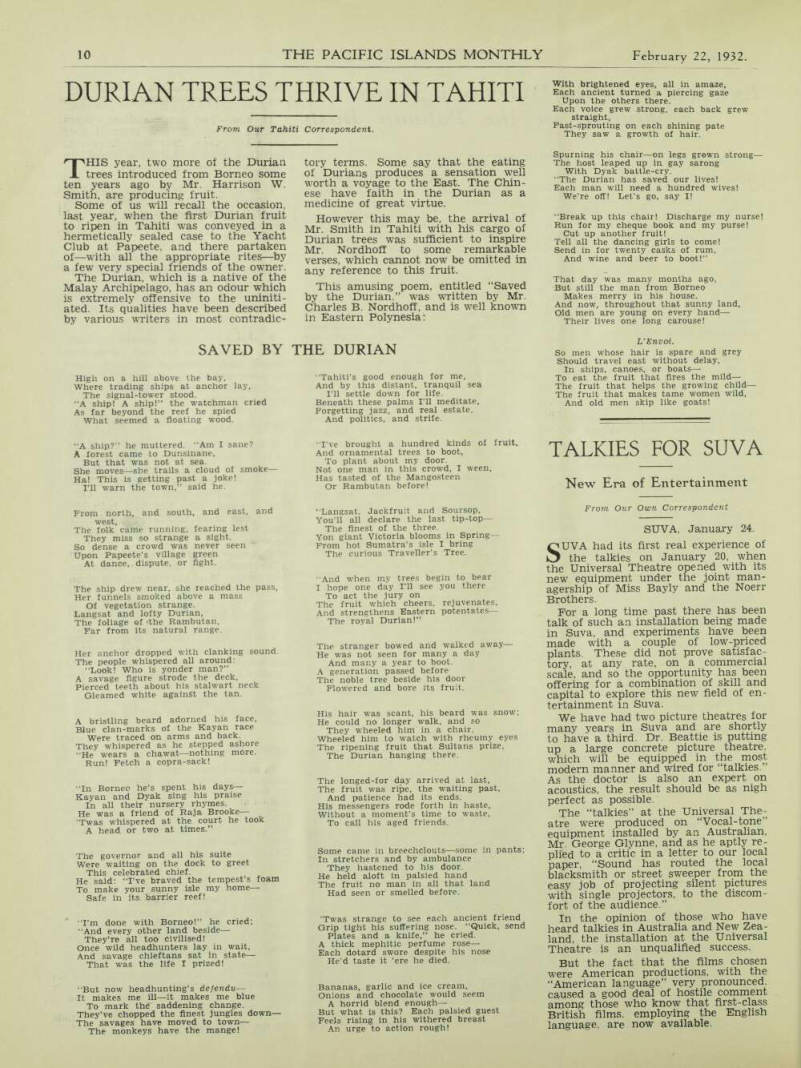
A pile of nipa leaves. These leaves are used extensively for thatching in Papua, the Philip pines and Borneo.
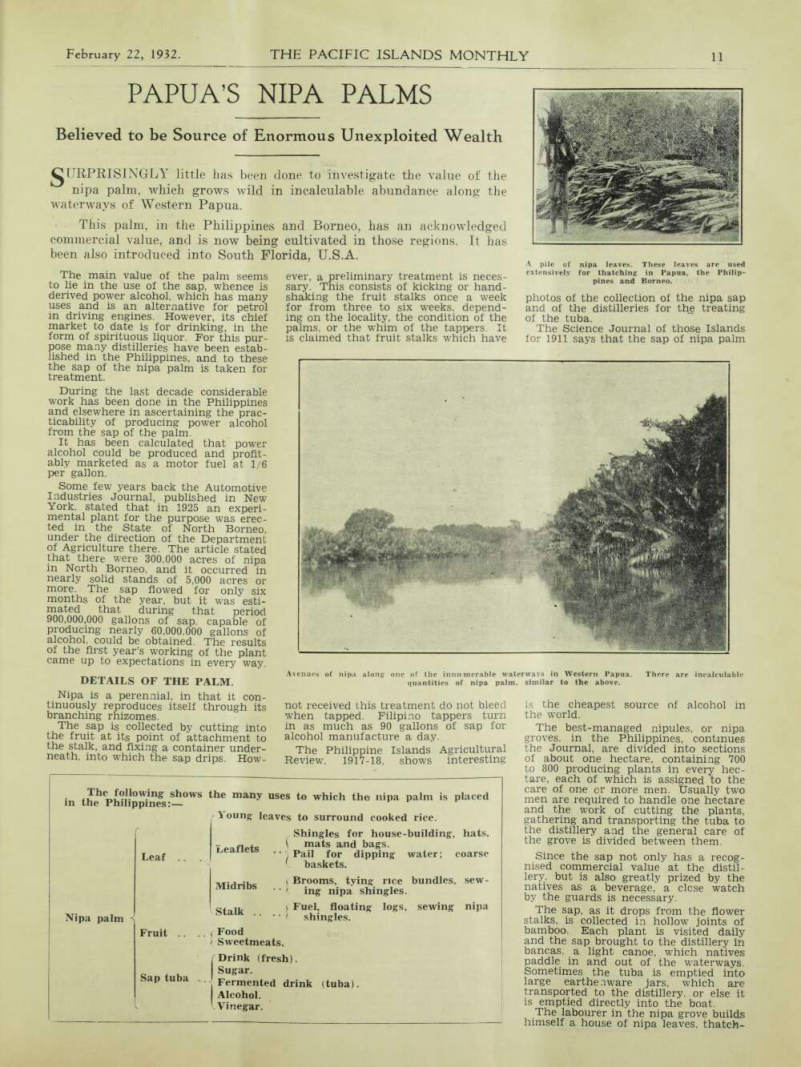
Avenues of nipa along one of the innumerable waterways in Western Papua. There are incalculable quantities of nipa palm, similar to the above.
ed with bamboo framework, on the bank of a stream on the nipa estate.
Fish is the principal article of food and is easily caught in these places.
Here, usually with a large family, he lives in peace and contentment.
It is probable that the natives of the Philippines fermented beverages from nipa sap before the arrival of Europeans in 1521.
Tapping The Nipa.
Since the nipa sends its inflorescence up from the base and, hence, is near the ground, the flower stalk is con veniently situated for the gathering of the sap. Four years after planting the seed the nipa bears small fruit, but it is not tapped for its tuba until the fifth year. Some time after the fruit has formed, the stalk is cut across near its top, usually just below the fruit and. each day, a thin slice is removed to keep the wound fresh and to facilitate exudation. One stalk normally flows for about three months.
The tuba season is usually of six months’ duration. In some areas, only a portion of the palms are cut at the beginning of the season, in order to supply the distilleries with tuba throughout the year, and thus avoid shutting down the plant. As these palms are exhausted, others are brought into production by cutting, and thus the season becomes continuous.
The Malayan Agricultural Journal. 1927, also contains a reference to nipah, which is the Malayan spelling of the word. It is stated that the coconut and the nipah palm are the two main sources of alcohol in that country, but the former must be discounted by the fact that it is a valuable food producer and would require a labour force of skilled toddy tappers or trained mon keys to exploit it. Nipah, however, is tapped at a height of only four feet from the ground, and, moreover, shows promise of giving yields greater than any obtained from other sources.
Some 2,000 acres of nipa have been now cultivated in the Federated Malay States and the production is said to be 1,300 gallons of 96 per cent, alcohol per acre per annum.
Investigations In Papua.
An attempt to exploit the Papuan nipa palms was made about 1920 by a strong Sydney company, called Poweral Ltd. with which Captain
Morgan and the late Mr. W. Scott Fell were associated. The Steamships Trad ing Co., of Papua, were agents for the company and, for a time, its prospects were bright. But a very serious mis understanding arose between the com pany and the Administration. The company believed that an arrangement it had made with an official was final; but it turned out that the official con cerned had not authority to give the concession sought by the company, and the Administration would not confirm the official’s action, and demanded cer
tain guarantees regarding re-planting
and other matters. As a result of the dispute, Poweral Ltd. did not proceed with its scheme.
Since then, a couple of other com panies have interested themselves in
this possible new industry, but nothing
of a concrete nature has been yet achieved. One of these was the Nata lite Company, which took up a lease near the Turama River.
Mr. C. E. Lane-Poole, Inspector-Gen eral of Forests of the Commonwealth of Australia, made the following re marks about the nipa palm and power alcohol in his report on the forestry resources of Papua and New Guinea: Alcohol is an excellent liquid fuel, and it is more satisfactory than petrol, for, according to the authorities, a thermal efficiency of 30 per cent, can be obtained against 20 per cent, for petrol. This means a reduction in the quantity of fuel used, and the cost of running the engine. While Australia has no prima facie cheap source of industrial alcohol, her molasses, now wasted, is the best, but is not large enough.
Papua has in her nipa palm a very large source of this motor fuel. It has the advan tage that it has been used for the manufac ture of alcohol in other countries.
In the Philippines, not only is the sap col lected from the forests of wild nipa palms, but this species is cultivated for its sap, which is distilled into alcohol: it has an advantage over grain, as it does not require milling.
It is a short palm, so that the fruit is at a handy height, and it only takes four years to develop from seed. The production of alcohol exceeds 10,000 litres a year. The yield per year of the sap from one palm is 43 litres, and they count on 750 fruiting palms to the acre, or a yield of sap per acre of 32,250 litres. This is taken to the distillery and a yield of from 4.1 per cent to 7.5 per cent, is obtained. The average yield from 33 distiller ies is 5.6 per cent. According to the esti mates of H. D. Gibbs, from whose work the above has been extracted, nipa is the cheapest known source of alcohol.
Just as I am unable to give exact figures of the area of mangrove swamps in Papua, so I am unable to give an estimate of the area under nipa. It is a social soecies in the mangrove swamps, of which vast areas exist between the Alele mouth (Purari River) and the Fly River.
The development of this industry looks very promising and, with proper regulation and control, and the denaturing of the product, to make it unfit for consumption by natives, there seems little possibility of it becoming a beverage.
It must however, be borne in mind that in motor engines built for petrol one gallon of alcohol is equivalent to less than three quarters of a gallon of petrol, although by altering the engine to higher Compression ratio, this difference would be diminished.
Power Alcohol’S Future.
Regarding power alcohol, the Hand book of the Territory of Papua for 1927 says: It is believed that power alcohol will in the future play an important part in the enormous motor-power required in the world’s transport.
In France, Germany and other continental countries, power alcohol is frequently used in place of petrol. The raw materials for the manufacture of alcohol are, unlike min eral oils, constantly renewed by Nature.
It is also apparent that the economic pro duction of alcohol is best suited to tropical and sub-tropical countries, where the differ ent kinds of vegetation for its manufacture grow rapidly, and in some cases can be ob tained from raw material that is growing wild, and which is not even an essential foodstuff. . .
Australia now imports 120,000,000 gallons of petrol per annum, and if power alcohol is to gradually take its place, this Territory should be in a position to render material assistance, as there are vast areas of nipa palms (nipa fructicans) and also land in every way suit able for the cultivation of cassava and sweet potatoes. . . .
The Sydney Morning Herald of Jan uary 4, 1932. stated that much atten tion was being paid to the production of power alcohol in Natal. There, how ever, the molasses resources were be ing used. It was estimated that the output from a plant just established would be 2,000 gallons of 100 per cent, alcohol per day.
It is significant that the main ex periments to date have been carried out in countries which, so far as is known, do not possess commercial sup plies of indigenous oil —i.e., the Philip pines. Australia and her Territories and Natal. It would therefore appear as though power alcohol has a future in those countries. The whole question must come down to one of production cost, especially as there are still large supplies of mineral oil, with which it would have to compete.
New Papuan Industry?
A casual observation of conditions in Papua shows that an enormous un estimated supply of wild nipa is avail able at very little cost and, with care, the areas would take a long time to become exhausted.
A big labour force would be available to work the nipa, the pay of each in dividual labourer being about 10/- per month and keep. The feeding cost of a large army of workers would be small, as sago palms, which provide the staple food of most of the Papua natives, grows in among the nipa. Tapping of the palms could be done by the nat ives with a little white supervision.
Then would come the question of establishing a distillery at some central position for the treatment of the sap.
It appears that this would provide the main problem, because of transport difficulties. If the enterprise were equipped with a fair-sized vessel to maintain communication with the Queensland coast, the transport of the treated sap to the main market, which would doubtless be Australian, would be comparatively cheap.
From experiments, it is known that power alcohol possesses definite advan tages over motor spirit, so if the price was right, a fair market should be at hand.
A company, which was started some months ago in Sydney to exploit the sago and nipa resources of Papua, pro posed to develop the nipa, not by the tapping of the wild palms, but by gathering the leaves and crushing them. Analysis obtained from the juice showed that 5 gallons of alcohol could be obtained from 100 gallons of sap.
The crushed leaf was found to be ideal for paper pulp. Therefore, there would be a minimum of waste. By judicious cutting, it is not considered that the palms would be injured and would quickly produce more leaves.
The plans of this company have been retarded by the existing depression.
It seems certain that before long further steps will be made to exploit Papua’s nipa wealth. Should the wild palms not give sufficient recovery of sap to make a proposition successful, nipa plantations, similar to those es tablished in the Federated Malay States, could be perhaps cultivated in sufficient quantity to supply Australia with some of its petrol needs. Huge areas of suitable land are available, the labour supply is there, and doubtless a market is obtainable.
Advertisements & other items, p. 14 (1 item)
Lighting Plants
The reliable LISTERLITE, the “powerhouse” of thousands of homesteads. Unfailingly de livers electric current on the most economical basis. Plants in stock to suit every possible requirement, with or without storage batteries. Ask us to quote for your installation
Diesel (crude oil)
Engines
Famous British Lister-Diesel crude oil engines start per fectly from dead cold, on regular crude oil fuel. From ½ b.h.p. upwards. Shortly available in marine type also.
Petrol Engines
The most reliable petrol en gines in the world. British built for sheer reliability and economy. Thousands of owners have proved that Lister main tenance costs are hardly worth regarding. In all sizes from 1½ to 14 b.h.p. Petrol and korosene types available.
Auto Trucks
Here is a neat little labour saving vehicle for haulage on road or rails, especially on long jetties. Equipped with air cooled engine; carries one ton or hauls three tons. Simple to operate, and available in varying body types for dif ferent classes of work. The most economical motor trans port vehicle yet produced.
Pumps
of all kinds. If you have water to move you will find exactly the kind of pump in the “Nevertire” line. From the simple well pump to the powerful self-oiling “Bull dozer” we have the right type of pump at the right price, for every job.
Windmills
Put the wind to work for you. We have proved makes of mills available in all regu lar sizes, with or without lowers. Tell us your water problem, and we can recom mend the proper mill to do the work.
Enquiries
lines will have our careful attention. Prices will be quoted free of Australian Customs’ Duty, in original cases.
Agents Wanted
We shall be glad to hear from respon sible Island parties willing to undertake the sale and representation of these lines. Write us.
Dangar, Gedye & Co.
LIMITED
10-14 Young Street, Sydney
Where to Stay in Sydney
An [deal Home where Islands visitors congregate.
THE
ORIENTAL HOTEL
Overlooking
KING’S CROSS
THE PREMIER RESIDENTIAL HOTEL
IN SYDNEY
Centrally situated, five minutes from C.P.O. or Railway Station. Trams and buses stop at our door.
This Hotel is lavishly furnished. Hot and Cold water in each room. Laundry, Spacious Lounges, Dancing, Splendid Table, and every convenience.
Tariff: Full beard and residence from 10/- to 13/6 per day; 50/- to 73/6 per week.
Room and Breakfast, from 5/6 to 8/6 per day, or 30/- to 45/- per week Cable or Radio, NEWOR, SYDNEY
Prospects
New Guinea’s Oil
Result of Matapau Survey
MUCH valuable oil prospecting has been carried out by Oil Search Ltd. in the Matapau district of the New Guinea mainland.
This work was referred to by the chairman of the company (Mr. W. A.
Freeman) at the annual meeting, re cently held in Sydney.
“It is satisfactory,” he said, “to record the excellent work now nearing comple tion on the Matapau area of the Man dated Territory. A detailed Geological Survey of 340 square miles and a Reconnaissance Survey of 150 square miles have produced results referred to by the Government as—to use its own words —the most hopeful contribution towards the discovery of oil in New Guinea which has ever appeared.
“The key to the oil series has been discovered—structures or formations have been located—there is still work to be done before a main drilling act ivity can be recommended. It is best to hasten slowly and to take all the necessary steps to prove the best struc ture on which such work could be un dertaken. That extensive oil seepages have been found to exist in the district, that structures have been located and that the key to the oil series has been discovered, justifies the further work to be undertaken.”
The Matapau area of this company lies to the west of Aitape. near the Dutch boundary.
1,000 Tonkinese Repatriated
From Our Own Correspondent.
NOUMEA, January 15.
It is anticipated that fully 1,000 Ton kinese will be repatriated by the La perouse, which is to leave for Indo china this month.
Advertisements & other items, p. 15 (1 item)
Gillespie’S
“ANCHOR”
FLOUR
TRADE
MARK
The Standard of Quality
BURNS, PHILP
(South Sea) Co. Ltd.
Island Traders & Shipowners Registered Office: Suva, Fiji Also Branches at Fiji: Levuka, Lautoka, Labasa, Ba, Sigatoka, Rotumah.
Tonga: Nukualofa, Haapai, Vavau.
Samoa: Apia.
Solomons: Makambo, Gizo, Faisi.
New Hebrides: Vila.
Gilberts: Tarawa.
Norfolk Island. Nauru. Niue.
Code Address: "Burnsouth”
Kumaras For N.Z.
Tonga Preparing Shipment
From Our Own Correspondent.
NUKUALOFA, January 30.
GROWERS with vision and foresight have already planted their seed kumaras so that they will have a crop for shipment to New Zealand at a time when the Dominion market (so far as the New Zealand sweet potato is con cerned) will be bare.
The low price of copra has thus been not altogether an evil in this Kingdom, for, had that price been maintained which obtained prior to three years ago, it is safe to say that neither the banana nor kumara, as a marketable product, would have interested the Islanders at all.
As it is, from all accounts, there is the certainty of copra prices improv ing to a figure which will give the growers a respectable profit, even if that time cannot yet be definitely dated. And so it follows that, when that happy state is reached, the Ton gan planter will find himself “sitting pretty,” with three strings to his bow —bananas, kumaras and copra.
Now, you “dismal Daniels,” can you find anything wrong in that?
Prospects
Cocoa In Demand
Samoan Industry Has Good Prospects
From Our Own Correspondent APIA, January 5.
THE cocoa market continues to be firm and Samoan cocoa is in good demand in all the markets.
In England and Germany stocks are sold out, in fact there has been no Samoan cocoa shipped to Germany since beginning of 1930, though some may have been reshipped from Eng land and U.S.A. Up to September 30. 1930, 350 tons of Samoa cocoa beans were imported into New York (for the nine months of the year). The stocks on hand on September 30, 1930, at New York, included 2,439 sacks of Samoan cocoa beans, or approximately 160 tons. These stocks have probably much decreased since, as part was re exported to Germany, while the balance was disposed of for the Christmas trade in October and November.
In spite of the world depression the consumption of cocoa and chocolate is still growing. A German periodical recently announced that there would be a bright and increased Christmas trade in chocolate as, owing to the bad times, people were unable to buy more expensive presents and would go in more for chocolates, which are very clieap now and are at the same time nourishing and attractive.
Fiji's Crops
Sugar and Copra Prospects Bright
From Our Own Correspondent SUVA, January 21.
THE year opened with prospects of better crops in the three export ing industries of sugar, copra and bananas.
Owing to the favourable climatic con ditions, the recovery from the hurri canes of 1929-31 has continued un checked, and, as this improvement seems to coincide with the prospect of better prices in the not far distant future for sugar and copra, there may be said to be a brighter aspect all round.
Beneficial rains have fallen in the sugar districts and all mills report that the cane is growing splendidly. It is common talk that the tonnage will run into six figures in sugar and that, if the same conditions continue, 1933 may easily see a record output. The Indian cultivators will benefit directly, but in directly the whole of the Colony will share in the good things.
Opinions vary somewhat about copra prospects. Mr. Edward Duncan, a re cognised authority, forecasts an export from the Colony of only 20,000 tons during 1932. In 1929, our export was 33,000 tons, but this fell in 1931 to 17,000 tons. Other authorities are in clined to put the figures somewhat higher. Like sugar, the recovery is on account of favourable climatic condi tions.
Bananas have jumped tremendously.
In February last year, 6,000 cases were exported, but low water mark was touched in April with only 2,500 cases.
It is not too much to say that if market conditions and shipping oppor tunities suited, we could ship 25,000 to 30.000 cases in February this year.
Bananas have been planted up all over Fiji and the quality of the ship ments going to New Zealand is the best for many a long day. The Tofua, in the middle of January, took 20,000 cases, but cables advised that the top price realised was 10/-. After deduction of the freight to Auckland (4/-) and the selling agents’ commission, there will probably remain not much more than 4/- to 5/- to be returned to ship pers in Fiji.
Out of this the shippers must pay for the cost of the cases (1/6), the cost of Government inspection (6d.) and the cost of transport of the fruit from the nlace where it is grown to Suva (about 1/6). However, this sort of thing hap pens every now and again in the banana industry, and a cheap banana in New Zealand means increased con sumption, eventually better prices and, finally, a healthier industry all round.
At the end of 1930, 121 private cars and 81 commercial trucks were regis tered in Tonga. Benzine in the King dom costs 2/6 per gallon.
Copra exported from Tonga for 1930 totalled 14,134 tons and was valued at £169,610. For the previous year, 16,841 tons were exported, the value being £252,911.
Advertisements & other items, p. 16 (2 items)
For Sale
FETTER MARINE OIL ENGINE,
36/42. Slightly used but in first-class condition. Full particulars from—
GIBSON. BATTLE & CO. LTD.
535 KENT ST. SYDNEY
Cables & Tele.: “Cibbsbattle, Sydney”
Albert Gregory
SHIPCHANDLERY
W. Kopsen & Co. Limited
Manufacturers of PIONEER BRAND ASH OARS AND IMPLEMENT HANDLES.
Sole Agents for: KOPSEN’S SPECIAL YELLOW METAL SHEATHING AND NAILS.
Large stocks of Chains, Anchors, Manilla and Wire Ropes, Wood and Iron Blocks. Oakum, Tar, Pitch, Oils, Paints, Leads, Zincs, Varnishes, Shackles. Rigging, Screws, Sheathing, Felt, Lampware, etc.
Prices and Particulars on Application.
68-70 CLARENCE ST., SYDNEY
Cables: “Kopsen” ’Phone: BW 1114-5
ALBERT GREGORY
107 YORK STREET, SYDNEY
SADDLERS’ IRONMONGERY, SADDLES, HARNESS,
SPURS. STIRRUPS AND WHIPS, ETC.
EVERYTHING CONNECTED WITH THE TRADE.
Leather for Art Work, Basils, Roans, Suedes. Boot and Harness Leathers.
CRECOLINE —Raw, Pure and Pearl White. Nothing so good for the Home, Stable and Dairy and a great rust preventative.
Distributing Agents for :
DOCKER’S AND BORTHWICK’S PAINTS.
CORRESPONDENCE SOLICITED
Rev. Michelsen
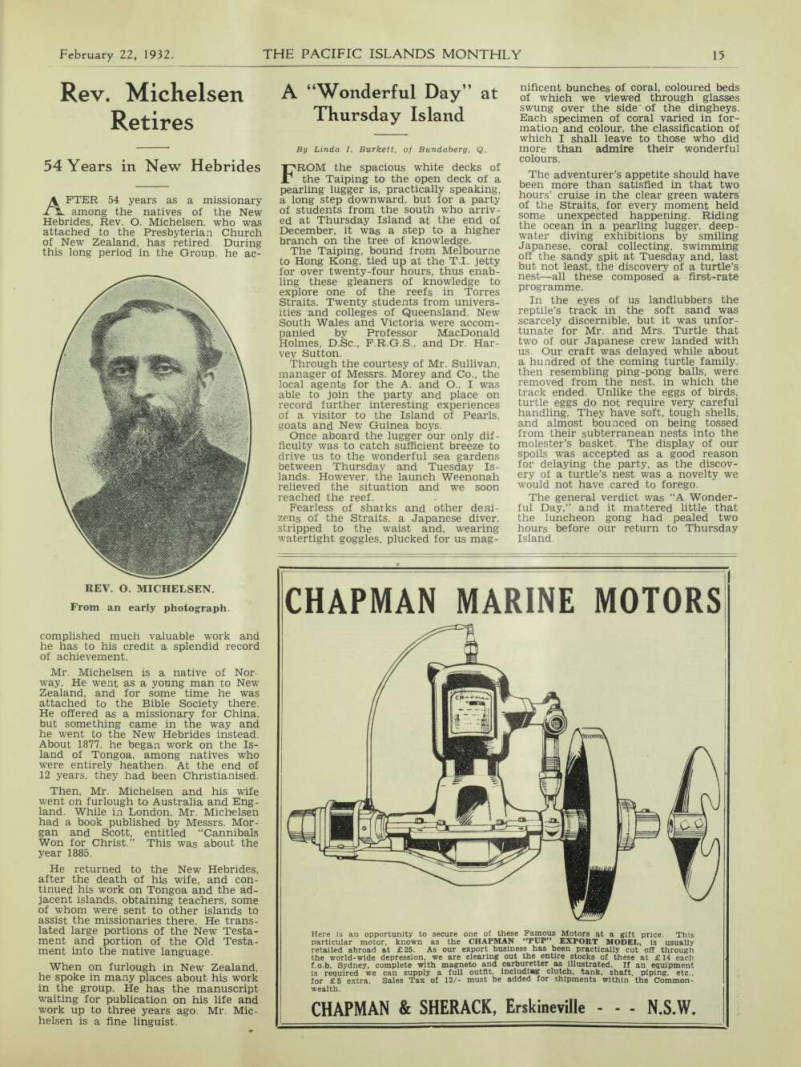
Retires 54 Years in New Hebrides
AFTER 54 years as a missionary among the natives of the New Hebrides, Rev. O. Michelsen, who was attached to the Presbyterian Church of New Zealand, has retired. During this long period in the Group, he ac
complished much valuable work and he has to his credit a splendid record of achievement.
Mr. Michelsen is a native of Nor way. He went as a young man to New Zealand, and for some time he was attached to the Bible Society there.
He offered as a missionary for China, but something came in the way and he went to the New Hebrides instead.
About 1877, he began work on the Is land of Tongoa, among natives who were entirely heathen. At the end of 12 years, they had been Christianised.
Then, Mr. Michelsen and his wife went on furlough to Australia and Eng land. While in London, Mr. Michelsen had a book published by Messrs. Mor gan and Scott, entitled “Cannibals Won for Christ.” This was about the year 1885.
He returned to the New Hebrides, after the death of his wife, and con tinued his work on Tongoa and the ad jacent islands, obtaining teachers, some of whom were sent to other islands to assist the missionaries there. He trans lated large portions of the New Testa ment and portion of the Old Testa ment into the native language.
When on furlough in New Zealand, he spoke in many places about his work in the group. He has the manuscript waiting for publication on his life and work up to three years ago. Mr. Mic helsen is a fine linguist.
Rev. O. Michelsen,
From an early photograph.
Thursday Island
A “Wonderful Day” at Thursday Island
By Linda I. Burkett, of Bundaberg, Q.
FROM the spacious white decks of the Taiping to the open deck of a pearling lugger is, practically speaking, a long step downward, but for a party of students from the south who arriv ed at Thursday Island at the end of December, it was a step to a higher branch on the tree of knowledge.
The Taiping, bound from Melbourne to Hong Kong, tied up at the T.I. jetty for over twenty-four hours, thus enab ling these gleaners of knowledge to explore one of the reefs in Torres Straits. Twenty students from univers ities and colleges of Queensland, New South Wales and Victoria were accom panied by Professor MacDonald Holmes, D.Sc., F.R.G.S., and Dr. Har vey Sutton.
Through the courtesy of Mr. Sullivan, manager of Messrs. Morey and Co., the local agents for the A. and O., I was able to join the party and place on record further interesting experiences of a visitor to the Island of Pearls, goats and New Guinea boys.
Once aboard the lugger our only dif ficulty was to catch sufficient breeze to drive us to the wonderful sea gardens between Thursday and Tuesday Is lands. However, the launch Weenonah relieved the situation and we soon reached the reef.
Fearless of sharks and other deni zens of the Straits, a Japanese diver, stripped to the waist and, wearing watertight goggles, plucked for us mag
nificent bunches of coral, coloured beds of which we viewed through glasses swung over the side of the dingheys.
Each specimen of coral varied in for mation and colour, the classification of which I shall leave to those who did more than admire their wonderful colours.
The adventurer’s appetite should have been more than satisfied in that two hours’ cruise in the clear green waters of the Straits, for every moment held some unexpected happening. Riding the ocean in a pearling lugger, deep water diving exhibitions by smiling Japanese, coral collecting, swimming off the sandy spit at Tuesday and, last but not least, the discovery of a turtle’s nest—all these composed a first-rate programme.
In the eyes of us landlubbers the reptile’s track in the soft sand was scarcely discernible, but it was unfor tunate for Mr. and Mrs. Turtle that two of our Japanese crew landed with us. Our craft was delayed while about a hundred of the coming turtle family, then resembling ping-pong balls, were removed from the nest, in which the track ended. Unlike the eggs of birds, turtle eggs do not require very careful handling. They have soft, tough shells, and almost bounced on being tossed from their subterranean nests into the molester’s basket. The display of our spoils was accepted as a good reason for delaying the party, as the discov ery of a turtle’s nest was a novelty we would not have cared to forego.
The general verdict was “A Wonder ful Day,” and it mattered little that the luncheon gong had pealed two hours before our return to Thursday Island.
Advertisements & other items, p. 17 (1 item)
Chapman Marine Motors
Here is an opportunity to secure one of these Famous Motors at a gift price. This particular motor, known as the CHAPMAN “PUP” EXPORT MODEL, is usually retailed abroad at £25. As our export business has been practically cut off through the world-wide depression, we are clearing out the entire stocks of these at £14 each f.o.b. Sydney, complete with magneto and carburetter as illustrated. If an equipment is required we can supply a full outfit, including clutch, tank, shaft, piping, etc., for £5 extra. Sales Tax of 12/- must be added for shipments within the Common wealth.
CHAPMAN & SHERACK, Erskineville - - - N.S.W.
Samoan Lepers for Makogai
From Our Own Correspondent APIA, January 5.
THE auxiliary schooner Tamanina, which left Apia Dec. 19 for Mako gai, Fiji, took 5 Samoan lepers along for treatment at Makogai leper sta tion.
This brings the total number of lep ers from Samoa, at Makogai, to 25, of whom 18 are Samoans, 3 black boys, 1 Chinese and 3 half castes.
Advertisements & other items, p. 18 (1 item)
Levuka’S New Mayor
At a recent meeting of the Municipal Council of Levuka, Fiji, Councillor Chisholm was elected Mayor for the ensuing year.
Spirit of the Old Polynesian
Navigators is Not Dead
From Our Own Correspondent
PAPEETE, January 2.
THAT the spirit of enterprise and adventure displayed so strongly by the old-time Polynesian navigators is not yet completely dead was shown at the Papeete Tribunal recently.
A native of Tahiti, whose name mat ters little, was before the court to an swer a charge of gaol breaking, and under stress of examination revealed, bit by bit, the full story of his escape and subsequent recapture.
Seizing a moment when the warder’s back was turned, he darted into the bush, which in Tahiti presents a dense wall of vegetation on either side of the road in many places, and was quickly out of sight. For many days after wards, while the hue and cry was on, the escapee kept to the unfrequented valleys of the interior, and subsisted without difficulty on crayfish, eels, breadfruit, plantains and other natural island products, which are to be found in abundance.
Finally, he left the hills, stole quietly down to the beach at night, lifted the first canoe he found drawn up there, and paddled off to the west ward, on a journey that came near costing him his life.
He reached Moorea. which is some 12 miles distant, before dawn and
again took to the bush, for pursuit was pretty certain up to this point. With the fall of darkness he made the jour ney overland to the extreme western point of the island, stole another canoe there and paddled off to Maiao, an un frequented island, without any white people on it, some 40 miles distant.
Luck was with him until close to the island, when the weather changed, and he had to cope with heavy seas and treacherous currents, but he finally made a landing, minus his canoe, which was battered to pieces in the surf. Here, by giving out a plausible tale to the natives, he hoped to re main for many a day unmolested.
As luck would have it, however, at this place, where ships are seldom seen, a cutter blew along from Papeete three days after his arrival, and, of course, brought the story of his escape.
There was nothing to be done now but purloin another canoe and set forth again—this time on a much more risky journey, for the nearest island on which he could have a hope of safety was at least 80 miles away to the north west.
Ill-fortune dogged him from now on.
The weather grew boisterous and kept him constantly bailing out his frail canoe, so that he had little time to paddle along towards his destination.
His supply of coconuts was lost over board. the lashings of his outrigger came apart and put him in an ex tremely perilous situation. Nothing daunted, however, he tore his dunga ree pants into strips, said a prayer to his shark god, and succeeded in restor ing his outrigger to its proper position.
While doing so, the canoe got com pletely swamped, so that his paddle floated awav beyond recovery, and he had to do the best he could from then on with one of the seats of the canoe.
After three days of thus battling with the elements, he finally made the south end of Raiatea. He landed there safely, but in an exhausted condition, only to be sent back to Papeete a few days later.
Meditation Concerning Whale
Oil (To the Editor.)
Sir—One of our opulent wags, not affected by “consols of the East,” wrote this gem whilst giving a square meal to a down-and-out copra bug:— In days of old, so we are told, a big whale swallowed Jonah, And for a day hid him away from his beloved Donah.
But in our time the oily whale a dif ferent caper cuts: Instead of swallowing Jonahs he swal lows coconuts.
No more we style the coconut “Consol of the East”— That title has been sadly damned by this aquatic beast.
No eye prophetic saw the fate which would the nut assail, And certainly none ever dreamed a knockout by a whale.
The moral is, don’t cultivate ingredi ents for a dish Which runs the risk of a being knocked out by an oily fish. J.H.. Fiji.
Advertisements & other items, p. 18 (2 items)
Special Service For Visitors
FROM PACIFIC ISLANDS
Accommodation arranged; shopping commissions carried out; travel by train, car or steamer carefully planned and booked; baggage insurance.
Send full particulars and everything will be done for you, at no additional cost.
MISS LYAL HILLIARD
Personal Travel Consultant The Block, 424 George St., Sydney Tel.: M 3592. Cables: “Lyalhill,” Sydney
against the varying con
Made expressly to keep a lustrous, full gloss finish
ditions of moist weather exposure, and prevent the decaying ravages of rain and extreme heat by
giving a long lasting pro
tection to all surfaces.
SUN PROOF
RAIN PROOF
“Stronger than the Weather”
W. R. CARPENTER
& CO. LTD.
New Guinea, Solomon Islands, and all other South Sea Islands.
Tropicalities
Written for The P.I.M. by Sea Serpent.
A PRIVATE resident of Apia, in a letter to us, comments severely on some of the attacks which Mr. O. F.
Nelson is making in his newspaper (published in Auckland) on the Sa moan Administration. The reduction of the very heavy fine imposed on Mr.
Nelson’s firm is generally approved, says this writer, but he is losing sym pathy by his irresponsible newspaper criticism. “To bring up, in a news paper, the most trivial incidents of pri vate life, in order to attack officials, is not a good method of fighting, and will not benefit a political cause,” is the concluding remark in this letter. * * * THE construction of the Maui Pom are—the steamer owned by the Government of New Zealand, which maintains more or less regular com munication between Auckland and Samoa—was a faulty job. The rivets in parts of the vessel were not prop erly inserted, so that the least tension drew them out of their sockets. Other grave constructional defects were dis covered after the vessel was put into commission and, before she was run ning satisfactorily in the Island ser vice, many thousands of pounds were spent on overhauls and repairs. It is now being very pertinently asked why the large sums lost on the Maui Pom are since she was put into commission have all been charged on the Cook Islands Department of the New Zea land Government, while the vessel is used almost exclusively in maintain ing communication between Auckland.
Samoa and Niue. It seems tough on the Cook Islands even although lonely Niue, which is equidistant from the Tongan. Samoan and Cook Groups, is sometimes described as one of the Cook Islands. * * * THE Sunday Sun, of February 7, contained some appreciative re ferences to Sir Hubert Murray’s work in Papua. The story written around his achievements was quite interesting, but the newspaper man, with the aver age Australian journalist’s usual know ledge of the Pacific islands, persist ently referred to Papua as being held under a Mandate.
The following extract from the article is interesting: “Sir Hubert says that there is a picture show at Port Moresby but he has been forced to forbid nat ives to attend. Pictures too often show white women in undignified roles and wearing a minimum of clothing, while the aim of his administration is to set white women on such a pedestal that natives will think of them as beings apart.”
Incidentally, we apologise to Sir Hub ert Murray, on behalf of newspaper dom, for the black and white sketch of his genial self, which was published with the article in question. No one could possibly have recognised “the dic tator of Papua”; and for some reason best known to himself, the artist placed
upon his victim’s face an extraordinary expression, which one might see there only once in a lifetime —if Sir Hubert Murray came unexpectedly upon a Daru sorcerer gnawing the shin-bone of his mother-in-law, for instance. And did anyone ever see Sir Hubert Mur ray wearing a topi? Or cream trousers? * * * SEVERAL months ago we expressed the opinion that the fine of £5,600. imposed by a Samoan Court upon Messrs. O. F. Nelson & Co. Ltd., for trading with the Mau (the firm claim ed that all it did was to receive from the Samoans small debts due to Mr. O.
F. Nelson, now in exile) was an ex ample of sheer savagery, not justified by reason or common sense, even if permitted by law. It is interesting to note that the New Zealand Supreme Court of five judges, just before Christ mas, gave a decision in Messrs. Nel son’s appeal against the Samoan ver dict, by which it reduced the fine from £5,130 to £470. That is a big conces sion; yet the firm still has to pay £470 plus huge costs —a very heavy punish ment for breach of a law that has no thing to do with criminal intent. The Supreme Court verdict amounts to a censure of the Samoan Court; and, as the latter has given a number of deci sions which do not suggest that neces sary tempering of justice with mercy, it might be worth the while of the Dominion Government to look into the whole subject of legal machinery in this mandated territory.
ISLAND medical officers are occasion ally called out to deal with some queer cases of sickness. It is reported that Dr. Ellison, the chief medical officer in the Cook Islands, in response to an urgent call for medical atten tion, found on his arrival that the patient was a horse! The doctor sank his professional pride and prescribed successfully for the animal, much to the relief of the native owner. * * * RESIDENTS of New Guinea, who pay substantial taxes, but have no voice whatever in the government, watch the increasing administration costs with a certain grimness. The story of how “mother welfare” is being introduced to wild bush mothers has been told elsewhere. The critics have other things to complain about. “Three years ago, we had three white police men in Rabaul,” writes one gentle man. “Now we have seventeen! And we have hundreds of native police— all decked out now in dinky blue and red uniforms. It makes us feel mighty important—but who’s paying for it all?
A little less spent on the things that the officials think are important, and a little more spent on developmental works would make those of us with a stake in the country feel a little hap pier about the country’s future.”
The Pacific
Rupert Brooke In
I SHALL go out and wander through the forest paths by the grey moon light.
Fiji in moonlight is like nothing else in this world or the next. It’s all dim colours and all scents. And here where it’s high up, the most fantastically shaped mountains in the world tower up all around, and little silver clouds and wisps of mist run bleating up and down the valleys and hillsides like lambs looking for their mother.
There’s only one thing on earth as beautiful; and that’s Samoa by moon light. That’s utterly different, merely Heaven, sheer loveliness.
You lie on a mat in a cool Samoan hut, and look out on a white sand under the high palms, and a gentle sea, and the black line of the reef a mile out, and moonlight over every thing, floods and floods of it. . . . And then among it all are the liveliest people in the world, moving and danc ing like gods and goddesses, very quietly and mysteriously, and utterly content.
It is sheer beauty, so pure that it’s difficult to breathe in it—like living in a Keats world, only it’s less syrupy Endymion without sugar. Completely unconnected with this world. —From “The Collected Poems of Ru pert Brooke, with a Memoir .”
Advertisements & other items, pp. 19-21 (3 items)
Residential Hotel
IMPERIAL
221 DARLINGHURST RD., KING’S CROSS
SYDNEY, N.S.W.
PULL BOARD AND RESIDENCE :
Weekly, from 45/- to 63/-. Daily, 10/-.
Management : Mr. and Mrs. Cyril Edwards
ENGINEER, 29, Irish, wants position, plantation, business, anything.
Keep or small wages. Reply “IRELAND,” c/o this paper, Sydney.
SAIL WITH
The B.P. MAGAZINE
TO MAGIC LANDS
Travel Fiction Adventure
WATCH
Stage Screen Books Fashion
WATCH FOR SPECIAL BRIDGE NUMBER
ANNUAL SUBSCRIPTION:
Within the Commonwealth of Australia, Mandated Territory and New Guinea 4/-post free Within the British Empire 5/4 post free U.S.A. and Foreign 6/8 post free
IMPROVE
YOUR CAR
fit
THE NEW
KLG
K
PLUGS
6/6 each Smith Sons & Rees,
LIMITED
30-32 Wentworth Avenue,
SYDNEY.
Exclusive Territory Available.
Indian Migration In Pacific
18
Continued from page 8.
February 22, 1932.
THE PACIFIC ISLANDS MONTHLY
Copra Prices and Exchange
19
Copra Prices and Exchange Continued from page 4.
THE PACIFIC ISLANDS MONTHLY
February 22, 1932.
Dogs Are Useful At
Rarotonga’S Race Meeting
From Our Own Correspondent
Rarotonga, Jan. 30.
THE island race meeting was held at Nikao on January 8. A down pour of rain during the morning mar red the outing and conduced to many people staying away. No charge is made for admission, so numbers do not much matter although actually there were about 500 people present.
A feature of island gatherings such as this is the noticeable neatness in dress and colour displayed by the nat ive women and girls.
The meeting is held on the beach.
At Rarotonga there is no cleared area of sufficient size for a racecourse.
A Union Jack, hoisted on a pole sunk into the sand (it resembled Amund sen’s flag at the South Pole) denoted the starting point, as well as the fin ishing post. A second flag, about half a mile along the beach, marked the turning point for each race.
About 20 horses competed. Many had the finishing touches put on them by a morning’s work in the planta tions—dragging a plow. The Inspector of Police (Mr. Caldwell) acted as star ter by dropping a white handkerchief.
Jockeys differed in weight from about 5 to 10 stone. Strangely enough weight is not taken into consideration at all by our racing officials.
Records, which come to light only when local racing matters are working up to red hot pitch, disclose the infor mation that many of our jockeys (now on the retired list) have been somer saulted off their mounts in the saddl ing paddock and some hooked under
the chin by clothes lines strung be As a matter of fact, it is scarcely correct to refer to a saddling paddock.
The jockeys ride bareback. The usual form of bridle is a piece of rope with one end knotted round the lower lip of the horse. Bits are a rarity.
The Rarotonga Cup (presented by Judge Ayson) was won this year by a horse owned by Taripo. A dark mare, owned by John Tuapai, fancied by some, unfortunately fell over in the and was not seen again until some time after the race finished.
Native spectators climbed the iron wood trees to obtain a bird’s eye view of the finish. Others waded into the lagoon and perched themselves on rocks for an unobscured view of the dash past the judges, Many dogs joined in the race at the second furlong, on the outward stretch, and did much to keep the rear horses from falling too far behind. From the vicinity of the finishing post one could scarcely make out just what was hap pening between jockeys, horses and dogs in the piece of scrub surrounding the flag at the turning point for home, The refreshment stall conducted by the local picture house proprietor, Mr.
W. Browne, appeared to do good busi ness in ice cream, apricot pie and water melon.
An orchestra provided a variety of musical items, which everyone enjoy ed. There were no swindles, broken punters or fashion parades.
Morinda’s Schedule
Will Auckland be Cut Out?
From Our Own Correspondent
Norfolk Is., Feb. 12.
THERE is yet another alteration in the existing itinerary of the s.s.
Morinda, as it affects Norfolk Island, under consideration.
When her regular runs from Sydney were extended to include a hasty trip over to Auckland on her return here from the New Hebrides, a large traffic in tourists was anticipated, and it was also supposed that she would carry a heavy and profitable shipment of ban anas by every sailing.
But the N.Z. Government has now contracted with the administrations of various tropical islands under their own mandate for regular consignments at regular prices, and the tourist traffic has failed to materialise to any satis factory extent.
This is partly due, no doubt, to the fact that the dominion is also lament ably hit by the world-wide financial crisis, and there are few tourists trav elling overseas for pleasure; but, un doubtedly, it is also a sad outcome of the inability of Messrs. Bums, Philp, Ltd., to see the wisdom of reducing the single fare for a two and a half days’ passage at its cheapest to less than eight guineas. There is a reduc tion of 10 per cent, on the return eight guineas, but this is so infinitesimal as to. partake of the nature of a further affront.
However, be the cause what it may, it appears that the shipping company is steadily losing on each trip to the mournful tune of hundreds of pounds, and not even the most rabid critic of the Islands policies of Messrs. Burns, Philp can expect them to continue long with that.
So something has to be done about it; and a new scheme is already being considered, subject to the approval of the N.I. Administration, the Planters’
Association —which is growing increas ingly in power—and Burns, Philp themselves. They, naturally, will speak the last word.
Advertisements & other items, p. 22 (2 items)
Fresh Food!
Cool Drinks!
The Beaumont Refrigerator
operates on
KEROSENE or BENZINE
Special Features : 1. Costs about 1d. per day to run. 2. Has no movable parts to get out of order. 3. One heating a day gives refrigera tion for 24 hours. 4. Freezing unit weighs about 32 lbs. 5. Every freezing unit guaranteed 3 years. 6. No installation costs, 7. Can be operated by a child. 8. Specially made for tropical condi tions. 9. Keeps food fresh indefinitely. 10. Operates efficiently under all wea ther conditions.
The Beaumont Refrigerator brings efficient refrigeration to Homes that have no Gas or Electricity. All that has to be done is to heat the Chemical Container for a short while each day over a Primus or similar stove. The inside measurements of Model “A” are: 18 inches high, 20½ inches wide, and 22½ inches deep, with a capacity of 5 cubic feet. White seamless porcelain enamel interior, stainless steel fittings, nothing to wear out, nothing to be renewed. Absolutely ideal for isolated homes. Write for full particulars, prices and copies of testimonials.
3 YEARS’ GUARANTEE
W. N. BEAUMONT & CO. 8 underwood street,
PADDINGTON, SYDNEY
The Delicia
HIGH GRADE PICKLES
6 oz., 12 oz. and 18 oz. bottles
ALL VARIETIES.
TOMATO SAUCE
Made from Fresh Ripe Tomatoes.
ABSOLUTELY PURE.
4 oz. and 10 oz. bottles.
The Delicia
Food Products Co.
WATERLOO, N.S.W.
S.S. Tofua
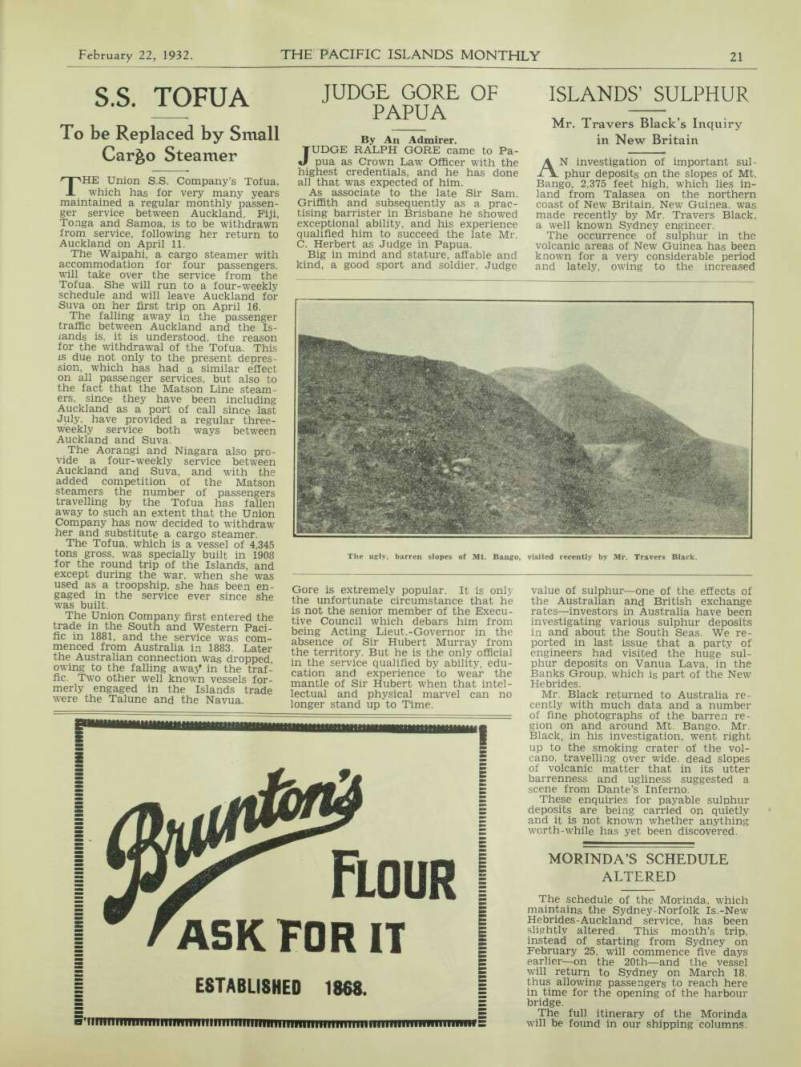
To be Replaced by Small Cargo Steamer
THE Union S.S. Company’s Tofua, which has for very many years maintained a regular monthly passen ger service between Auckland, Fiji, Tonga and Samoa, is to be withdrawn from service, following her return to Auckland on April 11.
The Waipahi, a cargo steamer with accommodation for four passengers, will take over the service from the Tofua. She will run to a four-weekly schedule and will leave Auckland for Suva on her first trip on April 16.
The falling away in the passenger traffic between Auckland and the Is lands is, it is understood, the reason for the withdrawal of the Tofua. This is due not only to the present depres sion, which has had a similar effect on all passenger services, but also to the fact that the Matson Line steam ers, since they have been including Auckland as a port of call since last July, have provided a regular three weekly service both ways between Auckland and Suva.
The Aorangi and Niagara also pro vide a four-weekly service between Auckland and Suva, and with the added competition of the Matson steamers the number of passengers travelling by the Tofua has fallen away to such an extent that the Union Company has now decided to withdraw her and substitute a cargo steamer.
The Tofua, which is a vessel of 4,345 tons gross, was specially built in 1908 for the round trip of the Islands, and except during the war, when she was used as a troopship, she has been en gaged in the service ever since she was built.
The Union Company first entered the trade in the South and Western Paci fic in 1881, and the service was com menced from Australia in 1883. Later the Australian connection was dropped owing to the falling away in the traf fic. Two other well known vessels for merly engaged in the Islands trade were the Talune and the Navua.
Judge Gore Of
Papua
By An Admirer.
JUDGE RALPH GORE came to Pa pua as Crown Law Officer with the highest credentials, and he has done all that was expected of him.
As associate to the late Sir Sam.
Griffith and subsequently as a prac tising barrister in Brisbane he showed exceptional ability, and his experience qualified him to succeed the late Mr.
C. Herbert as Judge in Papua.
Big in mind and stature, affable and kind, a good sport and soldier, Judge
Gore is extremely popular. It is only the unfortunate circumstance that he is not the senior member of the Execu tive Council which debars him from being Acting Lieut.-Governor in the absence of Sir Hubert Murray from the territory. But he is the only official in the service qualified by ability, edu cation and experience to wear the mantle of Sir Hubert when that intel lectual and physical marvel can no longer stand up to Time.
Islands’ Sulphur
Mr. Travers Black’s Inquiry in New Britain
AN investigation of important sul phur deposits on the slopes of Mt.
Bango, 2,375 feet high, which lies in land from Talasea on the northern coast of New Britain. New Guinea, was made recently by Mr. Travers Black, a well known Sydney engineer.
The occurrence of sulphur in the volcanic areas of New Guinea has been known for a very considerable period and lately, owing to the increased
value of sulphur—one of the effects of the Australian and British exchange rates —investors in Australia have been investigating various sulphur deposits in and about the South Seas. We re ported in last issue that a party of engineers had visited the huge sul phur deposits on Vanua Lava, in the Banks Group, which is part of the New Hebrides.
Mr. Black returned to Australia re cently with much data and a number of fine photographs of the barren re gion on and around Mt. Bango. Mr.
Black, in his investigation, went right up to the smoking crater of the vol cano, travelling over wide, dead slopes of volcanic matter that in its utter barrenness and ugliness suggested a scene from Dante’s Inferno.
These enquiries for payable sulphur deposits are being carried on quietly and it is not known whether anything worth-while has yet been discovered.
The ugly, barren slopes of Mt. Bango, visited recently by Mr. Travers Black.
Morinda’S Schedule
Altered
The schedule of the Morinda, which maintains the Sydney-Norfolk Is.-New Hebrides-Auckland service, has been slightly altered. This month’s trip, instead of starting from Sydney on February 25, will commence five days earlier—on the 20th —and the vessel will return to Sydney on March 18, thus allowing passengers to reach here in time for the opening of the harbour bridge.
The full itinerary of the Morinda will be found in our shipping columns.
Advertisements & other items, p. 23 (1 item)
Ask For It
9
ESTABLISHED 1868.
French Colonial Inspector Visits N.
Caledonia
From Our Own Correspondent.
NOUMEA. December 2.
A recent arrival in the Colony is Monsieur Cazeaux, who arrived from Paris, and is making a detailed visit
of inspection through New Caledonia and the New Hebrides.
No doubt he will make himself fully acquainted with many of the peculiar difficulties which present themselves in New Caledonia and the New Hebrides, and which would probably be rather obscure from an armchair in Paris.
N.G. Goldfields
Ltd.
New Accounts Show Co.’s Position
THE second annual report of the directors of New Guinea Gold fields Ltd. was presented to share holders on December 9 and adjourned to allow a complete statement of the financial position as on September 30 to be made.
These accounts are now to be pre sented at a meeting on February 22 and are as follows:
An examination of these figures in dicates one reason for the slow pro gress being made in the development of this company’s properties on the Morobe field.
More than 4,000,000 £1 shares have been issued, mostly for the purpose of
Capital And Liabilities.
Nominal Capital— £ £ 5,250,000 Shares of £ 1 each — £ 5,250,000 of which there have been issued — 4,074,182 Shares called up to £1 per share 4,074,182 375,000 Shares called up to 1/- per share 18,750 4,449.182 4,092,932 Less Calls in arrear ... 7 4,092,925 Shai'es to be allotted for purchase of leases 9,075 Sundry Creditors 20,723 Premiums on Share Capi tal Account 31,170 £4,153,893
Assets.
£ Mine Property and Mining Interests 3,709,976 Buildings. Plant and Equipment 103,568 Stores, etc., on hand 42,415 Sundry Debtors 19,028 Cash at Bank and on hand 88,305 Payments in Advance 5,474 Prospecting and Develop ment Account—Balance at 30/9/30 £110,688 Add Expenditure for year ended 30/9/31 74,435 185,124 £4,153.893
Debits.
Profit and Loss Account for Year Ending 30th September, 1931.
To Expenditure at Mine— £ s. d.
Prospecting and Development . . 60,689 14 11 Road Surveys and Construction 10,747 7 1 Geological Survey. Sampling and Assaying 9,503 17 8 Depreciation on Buildings, Plant and Machinery 18,504 6 9 Administrative Expenses, Sydney and London: Directors’ Fees. Salaries, Tech nical and Consulting Fees and Expenses 8,908 11 6 Designing Expenses and Experiments 2,382 1 3 Travelling Expenses. Postages.
Stationery, Cablegrams. Legal Expenses and Sundries . . 2.031 14 7 Taxes 570 19 8 £113,338 13 5
Credits. £
s. d.
By Sale of Gold 34,662 11 7 Sundry Revenue at Mine . . 953 17 0 Interest Received 3,221 15 8 Transfer Fees 64 15 6 Balance Transferred to Pros pecting and Development Ac count 74,435 13 8 £113,338 13 5
purchasing mining properties and leases from the original holders. To pay even 10 per cent, on its issued capital, this company must earn £400,000 per annum. To bring the Mo robe establishment into the condi tion in which it can earn even half of that, a very large further capital expenditure is required on plant and in providing communications. The mill, which the company is now estab lishing, is capable of treating 100 tons of ore daily; and it would be a remark able thing if such a mill could pro duce gold to the value of £150,000 annu ally, from which, of course, would have to be deducted all operating expenses.
In other words, it is perfectly clear that if this company is to bring itself into a profit-earning condition within a reasonable time, it must eventually get rid of a portion of its present enormous load of capital. The shares are valued on the market at between 5/- and 6/-, and, on present prospects, that is about their fair market value.
If the company is to do any good, it must first of all sacrifice about two thirds of its present issued capital; provide a few hundred thousand pounds of additional capital for the construction of a suitable road to the coast and the installation of adequate plant; and then it may go ahead and produce quite rich profits for its share holders. It will be impossible to bring in new capital so long as the present huge load of capital remains.
The gold is there there is little doubt that the present large areas held by this company contain large, pay able quantities of the precious metal.
But it is equally obvious that the com pany is at present being suffocated under its load of unproductive capital and that all those concerned realise this and are making no special effort to achieve anything worth while, until the main body of shareholders recog nise the position and agree to a writ ing down of capital.
However, there are likely to be lively developments before that. The adjoin ing “dollar” companies are at the point of production and, presently, will be returning rich dividends. The hun dreds of people who sold their rich interests to New Guinea Goldfields Ltd. for shares, viewing these rich profits from next door, are not going to sac rifice a big slice of their share values without sharp protests and bitter criticism.
Probably, they have reason for com plaint. But the position is there in the figures, plain for anyone to see, and the sooner the shareholders recog nise it, the sooner will something be done.
The New Guinea Administration would be doing a public service by forcing the position a little. There is an enormous amount of undeveloped wealth in the Morobe goldfields, and it is of national importance that it be brought out. From the public point of view, it is wrong that such develop ment should be prevented because this huge and swollen New Guinea Gold fields Ltd. has got astride of a large section of the goldfields and, because of its organisation, cannot produce the gold itself or permit anyone else to do so.
It is no use blaming the present directors of N.G. Goldfields Ltd. They are no more responsible for the position they find than Mr. Lyons is responsible for the Australian national debt.
Advertisements & other items, pp. 24-26 (2 items)
Exide
If you want any information
on Batteries write to us
As far back as 1891, the Chloride Electrical Storage Co., commonly known as the Exide Company, began the manufacture of Electrical Storage Batteries near Manchester, England. To-day Exide Batteries are made in five countries: Eng land, Canada. America, Italy and AUSTRALIA—and the Australian Exide is the equal of Exide quality the world over. Everywhere where there is need for a battery you will find Exide Batteries giving unfail ing service. If you desire informa tion on any battery, write to us.
The whole of our forty odd years’ battery experience is at your service ... we’ll send you free full information, together with literature. Ask for our free book let, “Taking Care of Your
Battery.”
There arc Exide
Batteries for . . .
CARS - - CYCLES
RADEO, LAUNCHES
HOUSELICHTINC, etc.
EXIDE
BATTERIES
of Australia Ltd.
Grace Building,
YORK STREET - - SYDNEY
All Exide literature is FREE.
Mark Foys
“The Home of Good Values” - SYDNEY
SPORTS WEAR VALUES
ELASTA-STRAP WOOL
GABARDINE
7 TROUSERS
29/6 Men’s Elasta Strap Cream Wool Gabar dine Trousers, no belt or braces re quired. Made, with side hip and fob pockets.
Foy’s Price 29/6
Foy’s Special
‘No. 100’ Flannel
TROUSERS
wear equal to two pairs ordinary flannel
Wool Tweed
Sports Coats
24/11 Men’s Superior Qual ity All Wool Tweed Sports Coats, made with inverted pleat, half belt at back. In the new Fawn, Brown and Grey shades.
Foy’s Price ... 24/11
Popular Striped
Blazers 35/“
Men’s Striped Blazers, best quality Venetians with buggy back, taped armholes and pockets, strongly stayed. Smart striped effects in the latest Blue, Red and Green tones. Foy’s Price 18/6 35/-
WOOL (GABARDINE
RAINCOATS
Men’s Superior Quality Wool Gab ardine Raincoats, made with bluffed edge, vertical pockets; full belt and Check lined. In Navy, Fawn and Mole shades.
Foy’s Price 67/6 Foy’s No. 100 Flannel Trousers; wear equal to two pairs of ordinary flaanel. All sizes. 10 designs. Plain Greys, Fawns, Fancy Fawns and Greys. All inside seams are sewn with thread, and all outside stitchings are sewn with Silk.
Write for patterns. Foy’s Price 18/6
WHITE BEACH
SHORTS
Men’s White or Khaki Drill Beach Shorts, strongly stitched throughout. Made with hip pocket. Size 32 to 44 waist. Foy’s Price 4/6
F.O.B. SYDNEY.
MARK FOY S LIMITED
“A Great Store in a Great City ”
NEWBOLD SILICA
FIRE-BRICK Co. Ltd.
Manufacturers of High Grade Refractories Silica Bricks, High Alumina Fire Bricks, Siliceous Fire Bricks, Chrome Bricks, Bauxite Bricks, “Sealtite” (hot patching cement), Dia tomaceous insulation.
Enquirers are requested to give full particulars of temperatures and purposes for which refractories are required.
The Newbold Silica Fire-Brick Co. Ltd.
109 ELIZABETH ST., SYDNEY
Lottery At Tahiti
Proposed
From Our Own Correspondent
Papeete, Jan. 29.
A scheme which may bring a few welcome dollars into Tahiti in these bad times, and incidentally find em ployment for a number of people, is the promotion of a permanent lottery by a couple of Australians who arrived recently to negotiate with the Govern ment and make tentative arrange ments for premises, etc. It now seems fairly certain that the proposition is going through, and will soon be in operation.
Mr. P. C. Hubbard, recently acting as British Judge on the Condominium Joint Court of the New Hebrides, has been spending a few weeks in Sydney, prior to leaving for London. Mr. Hub bard probably will return to the Solo mon Islands, where he was formerly chief magistrate, and from which ser vice he was transferred to the New Hebrides about two years ago.
Mauritius Beans
Papuan Product May Find Market in Australia
THE successful cultivation of Maur itius beans in Papua has caused inquiries to be made as to the market available for this product in Australia.
The Commonwealth at present imports the bean mainly from the island of Mauritius and from Fiji.
The chief use of the bean is for growing on sugar plantations, for green manuring purposes. The seeds are sown, and when the plant grows, it is ploughed into the ground, where it decomposes, thus preparing the soil for the planting of the cane. Although the bean grows in Australia for cropping purposes, it will not mature, so fresh supplies of seed have to be constantly obtained from abroad.
Imports of Mauritius beans, through the port of Sydney, for the year ended June 30, 1931, were valued at £483.
The imports through Queensland ports, in the same period were;
The beans enter Australia free of duty and primage, under the heading of “unspecified articles,” but they are subject to a sales tax of 6 per cent.
Besides the Queensland market for this bean, it is thought that a market might be also found on the banana plantations on the North Coast of New South Wales.
It appears that at present some plan ters throughout New South Wales and Queensland use cow-peas, which will mature in Australia, for green manur ing on many of their properties. They probably would have to be satisfied that they were obtaining a bigger ton nage to the acre and a superior man ure before they would turn exclusively to Mauritius beans. If the Common wealth Government were convinced that Papua could supply the existing needs in Australia, it seems likely that some preference might be granted, in order to exclude shipments from else where.
Another bean which grows in Papua, being originally imported from Java, is the Kratok or Java bean (Phaseolus lunatus). This bean is grown exten sively in Java for green manuring and is considered nearly equal to the Maur itius variety.
What is known as the rice bean is a third species, which would grow well in the tropics. It is quite as good as the Mauritius for manuring purposes, and, like the Mauritius, the bean, when ground up, makes a nutritious food for stock.
Another variety of bean, which might be tried in the Islands, is the flower bean, which is grown on a com mercial scale in Manchuria, and is used for food as well as for grinding into face powder.
From From From N.
Papua.
Fiji. Guinea.
Brisbane .. £122 £280 — Mackay .. .. — £121 — Townsville .. — £1,022 — Cairns .. .. .. £659 £527 £132
Advertisements & other items, p. 26 (1 item)
Let Mcilrath’S
A POUND SAVED IS A POUND MADE
OF SYDNEY
ASSIST YOU TO “MAKE MONEY”
Kraft Cheese, ½lb. pkts 10d. pkt., 9/6 doz.
Globe Assorted Beef, 12oz. tins (4 doz. in case), 21/6 case 3-case lots 20/6 case Castle Fancy Meats, assorted, 16oz. tins, 10/6 doz., 38/- case Schooner Medium Red Salmon, lib. tins, 1 /4y tin, 16/- doz.
Brunswick Canadian Sardines, 4oz. tins, 4d. tin, 3/9 doz.
Rosa Breakfast Food, 21b. pkts syd. pkt., 5/- doz.
Best Australian Sultanas, loose 9yd. lb., 9/3 doz.
Rosa Pure Garden Honey, 21b. tins . . . . 1/3 tin, 14/6 doz.
Rosa Round Mixed Pickles, large bots., lid. bot., 10/6 doz.
Rosa Worcestershire Sauce, med. bots., 7½d. bot., 7/3 doz.
Pure Mocha Coffee, 11b. tins 2 9 tin, 32 - doz.
Excelsior Coffee Essence, large bots. . . l/3y bot., 15/- doz.
Schweppe’s Lemon Squash Cordial, Ige. 1/3 bot., 14/6 doz.
Selmore Toilet Paper, soz. rolls 2d. roll, 1/10 doz.
Mcllrath’s Bath Soap, giant cakes . . 2yd. cake, 2 4 doz.
All Prices f.o.b. Sydney
FRESH VEGETABLES, FRUIT, MEAT, HARDWARE,
CLOTHING, AND TRADE STORES, at Lowest Rates.
Export Price Lists available on request.
McILRATH’S Ltd.
Export Dept.
202 PITT ST.
Sydney (Aust.)
Australia And The Pacific
What is Her Interest in New Hebrides?
AN article in last month’s issue, in which we suggested that Australia should seriously consider the consoli dation of her Islands interests by seek ing to extend her administration over the Solomons and the New Hebrides, has caused a good deal of comment.
It is likely that, as a result of the publicity given, the matter will pre sently have the attention of the Com monwealth authorities.
The most interesting development has been in connection with our com ments on the New Hebrides. We gave the history of Australasian and New Hebrides Co. Ltd., and showed that when that concern was taken over by Messrs. Burns, Philp & Co. Ltd., its land interests were given to the Com monwealth Government; and it was pointed out that for many years the Commonwealth Government has paid a retainer to a Mr. Wallace, a solicitor, who lives at Port Vila, and whose main interest, it is understood, is to protect Australian land claims generally and advance them before the Condominium Joint Court.
We emphasised that the total lack ef interest by Britain and Australia in the New Hebrides in recent years had permitted French interest to be come dominant in the Group; and that, if the present policy were pur sued much longer, the Group would pass into the hands of France. Not that France particularly seeks this possession—on the contrary, the New Hebrides are so distant from most other French possessions that the ad
ministration is probably a source of embarrassment to that nation and the French colonial authorities would be probably quite glad to part with their interests there for concessions in some other part of the world where administration would link up more conveniently with other territorial in terests.
We have formally sought informa tion from the Federal Government concerning Australia’s interests in the New Hebrides and have received a somewhat baffling reply. The Govern ment makes no reference whatever to its supposed land interests in the Group, in which we are particularly interested, and simply says that Messrs. Burns, Philp & Co. Ltd. have trading activities in the New Hebrides and receive from the Commonwealth Government a subsidy towards the maintenance of shipping services, The Government’s letter proceeds:— “The Commonwealth Government pays a retainer to Mr. Wallace, a solicitor, who assists Australian and other British settlers in land cases, in which they may be interested, be fore the Joint Court. I may mention that he is not required to watch the Commonwealth Government’s in terests.”
However, the wheels are beginning to revolve, even though slowly, and it is likely that there will be develop ments in connection with the New Hebrides within the next few months which will be of considerable interest to Australia.
Tahiti’s People
Oceania Now Has Over 40,000
From Our Own Correspondent
Papeete, Jan. 29.
THE results of the 1931 census, just published in the “Journal Officiel,” show a total population in French Oceania, which includes the Society, Marquesas, Tuamotu, Austral and Gambler Groups, of 39,713 persons.
The returns from three small, iso lated islands have yet to come in, and these will bring the total to well over 40,000, which is an increase on the 1926 figures of more than 4000.
According to the returns, this in crease is almost entirely accounted for under the heading of “French,” the numbers given being 870 and 5280 for 1926 and 1931 respectively. Here there obviously has been a change made in the system of classification, and it may safely be assumed that the latter figures includes a majority of people of mixed French and Polynesian blood who were formerly classed under the heading of “natives.”
Natives are shown as 29,101 for 1931, as compared with 29,644 in 1926, an apparent decrease; but in the light of
what has been said in the preceding paragraph it will be realised that there is an actual increase in the native population of nearly 4000.
Another interesting fact brought out by the census is that the Chinese ele ment is not overrunning the colony to the extent portrayed by writers of sen sational fiction. The figure for 1931 is 4056, a gain of 67 only since 1926.
Other Asiatics total 356, a decrease of 168 during the period under considera tion.
English and Americans (470), other foreigners (307) and floating popula tion (307) all show small increases on the 1926 returns.
Advertisements & other items, p. 27 (2 items)
Answer to Correspondent
Solomon Islander.—Thanks for the information about shipping. The de tails we publish are supplied by the Sydney offices. The necessary altera tion has been made.
Kermath
Marine Engines
are 100% marine, made specially for marine work. They are NOT converted car engines.
Statistics prove that 30% of the marine engines exported from U.S.A. (not in cluding Outboard) are Kermaths, thus proving the enormous sale and popu larity of these engines. There is nothing on the market to compare with them for quality and value.
We are the sole distributors for Aus tralia and the South Pacific Islands, and keep very large stocks of Engines and parts in Sydney.
Write for prices. They will interest you.
We also have large stocks of UNIVERSAL and CADY Marine Engines, Lauson and Powell Stationary Engines, and Lauson Tractors.
HALL BROS. LTD.
(Established 40 years)
The Engine House
CAREENING COVE
AUSTRALIA
RACQUETS
ALL FIRST-CLASS MAKES
STOCKED
Any Frame selected can be strung to order—Tropical Gut our speciality RE-STRINGING AND REPAIRS BY RETURN ISLAND STEAMER
23 PITT STREET,
SYDNEY
Ellis & Goldsmith
N.I. Hospital
Mr. Love Enters a Hornets’ Nest
From Our Own Correspondent
Norfolk Is., Feb. 12.
On this casual island we never take seriously an invitation to render our selves at any given spot at any given time, and we turn up so late to any entertainment, as a rule, that any where else the promoters would have given us up in despair and gone home to bed.
But on the evening of February 8, long before the appointed hour of 8 o’clock, the Rawson Hall was packed and jammed to the door with an audi ence eager to hear a special lecture on the aims and methods of the modern hospital, prepared by a Mr. Love who, over the other side —as we broadly des ignate the whole of Australia —is something very exalted in the official world of hospital management.
For some months past we have been sailing very stormy seas indeed in re gard to the control and administration of our little local hospital—which ap pears to be a public institution when it comes to our obligations towards it, and private when patients are called upon to pay fees —and it was finally considered advisable by all concerned to clear up the situation once and for all by a semi-official invitation to Mr.
Love to make a sort of holiday visit to the island and meet all the officials involved.
Mr. Love, therefore, accompanied by two friends—Dr. Colvin and Mr. Fitz patrick, both concerned also in the ad ministration of hospitals—arrrived by the Morinda on January 28, and this address to the general public was the outcome of the passionate feeling ex isting throughout the whole island and expressed in no uncertain words.
“An Island From Heaven.”
Mr. Love is a man of vast experi ence, and his advice and suggestions were extremely interesting; but we here on Norfolk are faced with pecu liar problems duplicated nowhere on any continent, and his counsels were counsels of an impossible perfection and, in many cases, of a nature that we cannot possibly apply. However, during his short stay of something over a fortnight he gathered enough of local conditions and sampled our glorious climate sufficiently to assure us that he would do his utmost to bring before the public of Australia our desirability as a health resort. In his own words: “Norfolk Island should be a para dise for convalescents. So far as cli mate and conditions are concerned, it is an island straight from heaven.”
And he intends to broadcast this fact and to induce persons in need of sunshine, peace and beauty to flock over here in ever increasing numbers.
We shall he much obliged if that happy state of affairs should come about, and Mr. Love will not have paid his visit and attempted to regularise us in vain.
His address concluded about 9.30, and the meeting—for which he, Dr.
Colvin and Mr. Fitzpatrick remained, while the administerial party retired — was taken over by the Hospital Board,
who ranged themselves in the vacated chairs on the platform, with Mr. Love in their midst, and the public were invited to go ahead and to subject the Commissioner, or whatever he is, to a bombardment of questions, enquiries and information of urgent import.
He had come prepared to be ham mered, he said, and by the time the chairman of the board closed the meeting towards midnight he must have felt as though the weapon em ployed was a steam hammer. But it was a God-given opportunity for the ventilation of serious grievances, and no doubt Mr. Love knew a good deal more of our actual problems and diffi culties by the time he wearily climbed into his car than when he rather com placently took the platform some four hours earlier.
What will come of the clash of official opinion and public sentiment we do not yet know; but we under stand that Mr. Love intends to formu late a policy and submit it for con sideration to our existing administra tion —which is still headed by Colonel A. J. Bennett, with Mr. Cyril Leonard, late of Papua, as private secretary— and in due course our Hospital Board —which at present is declared to be unconstitutionally elected —will be ad vised of its clauses, and from thence it will trickle through to the public, who are so vitally interested.
All sorts of side issues and personal considerations are concerned, and it is hoped that Mr. Love knows enough to know how little he knows the situation.
Pearl Culture
Experiment at Tahiti
From Our Own Correspondent PAPEETE, January 29.
THAT the market for pearls and mother-of-pearl shell is not com pletely dead is shown by the return to Tahiti of Mr. Victor Berge, who was here some years ago with a submarine equipment, invented by himself, for looking at the bottom of the sea and taking under-water pictures.
Mr. Berge then worked secretly and in remote places, so that the local people knew little of what he was about. But he evidently met with some success, for he went away and wrote a book called “Pearl Diver,” which had a good circulation, and he has now returned with a wife, and is well backed by capital, so he says, from one of the principal jewellery houses of Paris.
Just now Mr. Berge is investigating the lagoon island of Tetiaroa to ascer tain its suitability for the project he has in view—the planting of pearl oysters and subseouent culture of pearls artificially. What he needs is a lagoon without an entrance from the ocean, so that predatory fishes may be kept under control to some extent.
We wish him luck with his new enter prise.
Advertisements & other items, p. 28 (1 item)
Fresh Fruits—Vegetables
GREENWOOD & LAWS
MINING, LAND AND MANUFACTURERS’ AGENTS
COMPANY SECRETARIES AND REPRESENTATIVES. IMPORTERS AND
EXPORTERS.
RABAUL - - NEW GUINEA
ORIGINAL IMPORTED—
CINZANO
ITALIAN
VERMOUTH
Is made with the finest Italian white wines. It is very wholesome. It is not a liqueur. Some ways of using it: PLAIN: It’s not too sweet and not too dry. IN ALL COCKTAILS: Where Vermouth is used. AS A LONG DRINK IN SUMMER: With mineral aerated waters.
Agents.:
FRANCESCO CINZANO & CIA (Australia) LTD.
G.P.O. BOX 3708 S.S., SYDNEY. N.S.W.
FRESH FRUITS—VEGETABLES
F. CHILTON
WHOLESALE DISTRIBUTOR, CITY MARKETS
SYDNEY - - Established 1894 Quality—BEST. Price—LOWEST. Attention—PROMPT.
Codes: Bentley’s and Private. Cable Address : Chiltons, Sydney Agent for —Celebrated "Vallo” Brand Spray Preparations, used successfully by Orchardists throughout Australia.
Ambulance Convey Child-Welfare
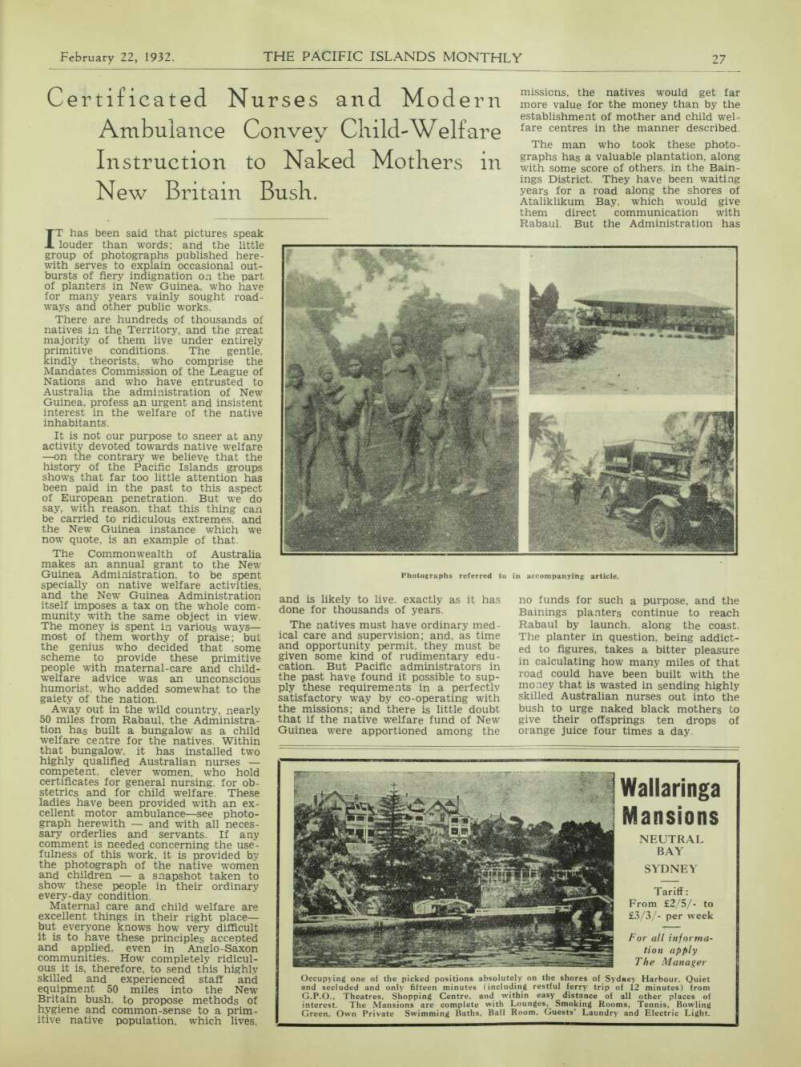
Certificated Nurses and Modern Ambulance Convey Child-Welfare Instruction to Naked Mothers in New Britain Bush.
IT has been said that pictures speak louder than words; and the little group of photographs published here with serves to explain occasional out bursts of fiery indignation on the part of planters in New Guinea, who have for many years vainly sought road ways and other public works.
There are hundreds of thousands of natives in the Territory, and the great majority of them live under entirely primitive conditions. The gentle, kindly theorists, who comprise the Mandates Commission of the League of Nations and who have entrusted to Australia the administration of New Guinea, profess an urgent and insistent interest in the welfare of the native inhabitants.
It is not our purpose to sneer at any activity devoted towards native welfare —on the contrary we believe that the history of the Pacific Islands groups shows that far too little attention has been paid in the past to this aspect of European penetration. But we do say, with reason, that this thing can be carried to ridiculous extremes, and the New Guinea instance which we now quote, is an example of that.
The Commonwealth of Australia makes an annual grant to the New Guinea Administration, to be spent specially on native welfare activities, and the New Guinea Administration itself imposes a tax on the whole com munity with the same object in view.
The money is spent in various ways— most of them worthy of praise; but the genius who decided that some scheme to provide these primitive people with maternal-care and child welfare advice was an unconscious humorist, who added somewhat to the gaiety of the nation.
Away out in the wild country, nearly 50 miles from Rabaul, the Administra tion has built a bungalow as a child welfare centre for the natives. Within that bungalow, it has installed two highly qualified Australian nurses competent, clever women, who hold certificates for general nursing, for ob stetrics and for child welfare. These ladies have been provided with an ex cellent motor ambulance—see photo graph herewith and with all neces sary orderlies and servants. If any comment is needed concerning the use fulness of this work, it is provided by the photograph of the native women and children a snapshot taken to show these people in their ordinary every-day condition.
Maternal care and child welfare are excellent things in their right place— but everyone knows how very difficult it is to have these principles accented and applied, even in Anglo-Saxon communities. How completely ridicul ous it is, therefore, to send this highly skilled and experienced staff and equipment 50 miles into the New Britain bush, to propose methods of hygiene and common-sense to a prim itive native population, which lives,
and is likely to live, exactly as it has done for thousands of years.
The natives must have ordinary med ical care and supervision; and, as time and opportunity permit, they must be given some kind of rudimentary edu cation. But Pacific administrators in the past have found it possible to sup ply these requirements in a perfectly satisfactory way by co-operating with the missions; and there is little doubt that if the native welfare fund of New Guinea were apportioned among the
missions, the natives would get far more value for the money than by the establishment of mother and child wel fare centres in the manner described.
The man who took these photo graphs has a valuable plantation, along with some score of others, in the Bain ings District. They have been waiting years for a road along the shores of Ataliklikum Bay, which would give them direct communication with Rabaul. But the Administration has
no funds for such a purpose, and the Bainings planters continue to reach Rabaul by launch, along the coast.
The planter in question, being addict ed to figures, takes a bitter pleasure in calculating how many miles of that road could have been built with the money that is wasted in sending highly skilled Australian nurses out into the bush to urge naked black mothers to give their offsprings ten drops of orange juice four times a day.
Photographs referred to in accompanying article.
Advertisements & other items, p. 29 (1 item)
Wallaringa
Mansions
NEUTRAL
BAY
SYDNEY
Tariff: From £2/5/- to £3/3/- per week For all informa tion apply The Manager Occupying one of the picked positions absolutely on the shores of Sydney Harbour. Quiet and secluded and only fifteen minutes (including restful ferry trip of 12 minutes) from G.P.O., Theatres, Shopping Centre, and within easy distance of all other places of interest. The Mansions are complete with Lounges, Smoking Rooms, Tennis, Bowling Green, Own Private Swimming Baths, Ball Room, Guests’ Laundry and Electric Light.
Financial Trouble
Oil Producers in Financial Trouble
THE troubles of the vegetable oil producers are indicated by the following article, published by the Fiji Coconut Planters’ Union: The United Africa Co. was formed a couple of years ago by the amalgama tion of the interests of the Margarine Union, the Niger Co. (a subsidiary of Levers) and the independent African and Eastern Corporation. The capital of the amalgamation was in excess of £15,500,000. Of the shareholding roughly 40 per cent, was held by Uni lever. The interests of the concern are in West Africa, from which are drawn large supplies of palm oil, palm
kernels and other commodities used in the crushing industry.
The accounts of the United Africa Co. show a loss of £1,500,000 for last year. The concern is in financial diffi culties owing to its credit being re stricted. It has thus become necessary to introduce further capital.
The proposals are that capital shall be written down by £7,500,000, and an other £3,500,000 capital shall then be introduced. If the African and Eastern Corporation cannot contribute their entire quota, Unilever have offered to find £3,000,000 if the Africa and East ern Corporation will put up the other half-million; but the consideration is that Unilever will then hold approxi mately 80 per cent, of the issued share capital, and African and Eastern Cor poration will be reduced to 20 per cent.
Association
Pacific Islands’
Association Growth of Membership
THE organisation of the Pacific Islands Association—formed a few months ago to generally advance the interests of residents in the Pacific Islands—is proceeding slowly and
steadily.
A number of the Sydney members and their friends have arranged to dine together in Sydney during “Bridge Week” in March, and there will be some discussion then concern ing the association’s future activities.
It is felt that as the association now has a substantial membership it may soon begin to function as originally in tended.
At recent meetings of the executive committee applications for member ship were received from the following and granted:— A: N. Lussick, Logagon, Kavieng, New Guinea.
Aleyn Bird, Messrs. H. S. Bird & Co. Ltd., 7 Macquarie Place, Sydney.
R. L. Dick, 1 Mansfield Mansions, 35 Ben nett Street, Bondi.
J. Colclough, Wingello House, Angel Place, Sydney.
Captain S. G. Green, c/o Burns, Philp & Co. Ltd., 7 Bridge Street, Sydney.
Charles Booth, 4 St. Ann’s Flat, Kings Cross Road, Sydney.
Captain Edward Clay, Port Moresby, Papua.
Reginald A. Vivian, Port Moresby, Papua.
Sir J. Hubert Murray, K.C.M.G., Papua.
W. J. Turner, Jenene, 17 Vicars Avenue, Bondi J. G. Fowler, Glenlea Flats, 37 Milson’s Point, Sydney.
Dr. Colin C. Simson, c/o Union Club, Bligh Street, Sydney.
Bertram W. Bramell, Box No. 603 F.F., G.P.O., Sydney.
Mrs. Alice J. Keelan, Otuaroa, Thirroul.
J. F. Keelan, Otuaroa, Thirroul.
Jas. W. Baldie, 7 Macquarie Place, Sydney.
Mrs. Elizabeth Mahony, 184 William Street, Bathurst.
W. B. Rainsford, 350 George Street, Sydney.
R. W. Robson, Pacific Publications, 247 George Street, Sydney.
H. A. Ross. 30 Grosvenor Street, Sydney.
Sidney Smith, Port Moresby, Papua.
J. P. Fitzgerald, 158 Hawthorne Parade, Haberfield.
Dr. W. L. Calov, 157 Macquarie Street, Sydney.
Rev. M. A. Warren, Secretary, Australian Board of Missions, 242 Pitt Street, Sydney.
A Native Regatta
From Our Own Correspondent
Rarotonga, Jan. 25.
The harbour of Ngantangiia was the scene of a native regatta on January 27, held by the people of Muri.
The stores and Government offices closed for the afternoon, permitting the attendance of many Europeans at the event.
At Ngantangiia there is a deep water opening through the reef into the lagoon.
Three small islands lie strung out along the reef with a body of water (shallow for the most part) washing up on to a saucer-shaped beach of white sand.
The small village of Muri is situated on the main road within a hundred yards of the beach, and is a favourite spot for picnic par ties. The small islands are not inhabited, and may be reached by wading or swimming across the lagoon. Exploring the islands is most interesting for newcomers and tourists.
The native women’s catamaran race (one woman to each canoe) provided the most interesting event of the afternoon. One woman fouled another competitor on one or two occasions. A canoe capsized and the occupant disappeared for a moment. One or two competitors zig-zagged badly. The win ner deserved the garland of flowers placed on her head by some of the onlookers.
Advertisements & other items, p. 30 (1 item)
Guinea Airways Ltd.
When Transport is the Problem—
These planes supply the answer.
For over four years Guinea Airways have been carrying freight for the New Guinea gold mines. Business has grown and now 600 tons of cargo and 250 passengers are carried monthly in their aircraft.
Wherever transport is the prob lem, Guinea Airways' unique experience of handling heavy mining plant by air is available.
GUINEA AIRWAYS LTD.
Lae - - - Salamaua
EUCRASY BANISHES ALL DESIRE FOR DRINK
It is a priceless boon to all who use it. VOLUNTARILY or SECRETLY, for their relatives or friends. If you suffer in any way through the liquor habit, let the voluntary testimonials of actual users convince you that EUCRASY will soon sober the drinker and make you happv.
Letter received: “I have been waiting to see if my husband would drink again. I can safely say he has been cured by Eucrasy. It has made quite a different man of him. I cannot speak too highly.—Mrs. B.L.”
EUCRASY is guaranteed harmless, and can be given SECRETLY or Voluntarily. NOT COSTLY. Call or write to-day for FREE SAMPLE. Booklet and Testimonials.
Dept. B., THE EUCRASY CO., CANBERRA HOUSE, 297 ELIZABETH STREET, SYDNEY.
Goldfields’ News
Reduction of Air Transport Rates.
From Our Own Correspondent WAU. N.G., January 26.
A bombshell was dropped on Wednesday last when Pacific Aerial Transport Ltd. announced that freights would in future be 5d. per lb.; and many wondered what form Guinea Airways’ reply would take. On Thurs day, this company advertised that a new com pany had been formed, to be known as Pacific Trading Co. Ltd., and that it would have stores at Salamaua and Wau. Rice ‘is adver tised at £40 per short ton, which is £10 per short ton less than the freight per ton ruling up till that date. Allowing 1½d. per lb. as landed cost of rice at the beach, Guinea Air ways freight therefore works out at 3¼d. per lb.
It is not expected that the private citizen or Government servant will be able to take advantage of this rate, as it is presumed that these quotations are made for ton lots only.
However, to the miners and companies on the field it will be of very great assistance, in re ducing the terrific costs of the past. Trade meats, tobacco, flour, sugar and other items are to be sold at similarly reduced rates.
The great advances made by the air trans port companies are to be seen in the reduction from 1/- per lb. freight, of some 12 or 18 months ago, to the present rate; and the ques tion is now being asked, can the small aviation companies carry on against the big ger company’s opposition, or will they have to give way and leave the field open, and allow freights to rise again?
Aeroplane Accident.
Large stones have recently started to show above the ground on the Wau aerodrome, and on January 16 Pilot O’Dea, in Les Holden’s “Waco,” had the misfortune to hit one with his tail skid, with the result that the tail portion of the ’plane was considerably dam aged. Since that date the District Officer has been busy with a line of boys removing stones from the ’drome.
More Gold Production.
The greatly enhanced price of gold, and the added premium, together with the threat of the closing down of tributes by New Guinea Gold fields Ltd., has spurred up the production of gold during the last six months, and it is understood that figures for the first six months of this financial year are greatly in excess of figures for the whole of last year.
The Administration has at last given per mission for three shifts to be worked by nat ives employed in alluvial mining and, while it is expected that only the employers of large numbers of natives will be able to take advan tage of the night-shift, production should increase considerably.
Wireless Station.
The wireless station has been removed from Edie Creek to Wau, and is now operating there. As practically the whole of the Edie Creek Area is held by New Guinea Goldfields Ltd., whose head office is at Wau, it was felt that the business offering would not justify the retention of the station at Edie Creek.
Mr. C. Beckett, who has been in charge of the station at Edie Creek for some years, will continue to operate at Wau.
A Fatal Date.
It was rumoured in Wau on Wednesday last the Mr. Charles Graham, who has been mining at Poverty Creek and Bitoi River, in partnership with Mr. Andy Smeaton, had died at Trists Lake, about three and a half days’ walk from Wau. The District Officer immediately despatched Mr. R. Foulkes, medi cal assistant, with Mr. Smeaton and patrol to enquire into the rumour.
News has also arrived that Mr. Godfrey Bond, who brought an all-metal Junker ’plane to this field about two years ago, and which he later sold to P.A.T., has disappeared in Europe whilst on his way to England. The death or disappearance of three Wau citizens —Mr. Levien, Mr. Graham and Mr. Bond—in different parts of the world in one day has caused quite a sensation among the few resi dents here.
Advertisements & other items, p. 31 (1 item)
rfsheS of ftgseS
Not alone the wondrous fragrance of the Marechal Kiel rose. And not the honeyed fragrance of the Sweet-briar. Nor the full rich odor of the old Red rose. And again, not the shy perfume of the Tea rose. Not one of these, nor of these alone. In “Ashes of Roses” Perfume, Monsieur Bourjois caught the elusive and joyous fragrance of whole garden of roses, its spirit and its atmosphere.
Because of this, “Ashes of Roses” is famous throughout the world. While fashions come and fashions &o, “Ashes of Roses” remains constant, ever new and delightful, presenting ever afresh its sensations of joy.—Always an added charm to beautiful womanhood!
ume
Sold by all Chemists, Perfumers, Coiffeurs and Stores.
A. BOURJOIS ET CIE, 177-9 Clarence St. & 47-49 Kin& St., Sydney
BOURJOIS TOILET
PREPARATIONS
PERFUMES
COMPACT POWDER
BATH POWDER
BABY POWDER
FACE POWDER
TALCUM POWDER
VANISHING CREAM
NIGHT CREAM
LIP STICK
TOILET AND BATH SOAP
COLOGNE
To A. BOURJOIS et CIE (Aust.)Ltd.
Broughton House, 177-9 Clarence St., Sydney I enclose 2/6; please send, post free, the ASHES OF ROSES Presentation Case containing Perfume and Face Powder.
Name, Street.
Town
Recent Papuan Massacre
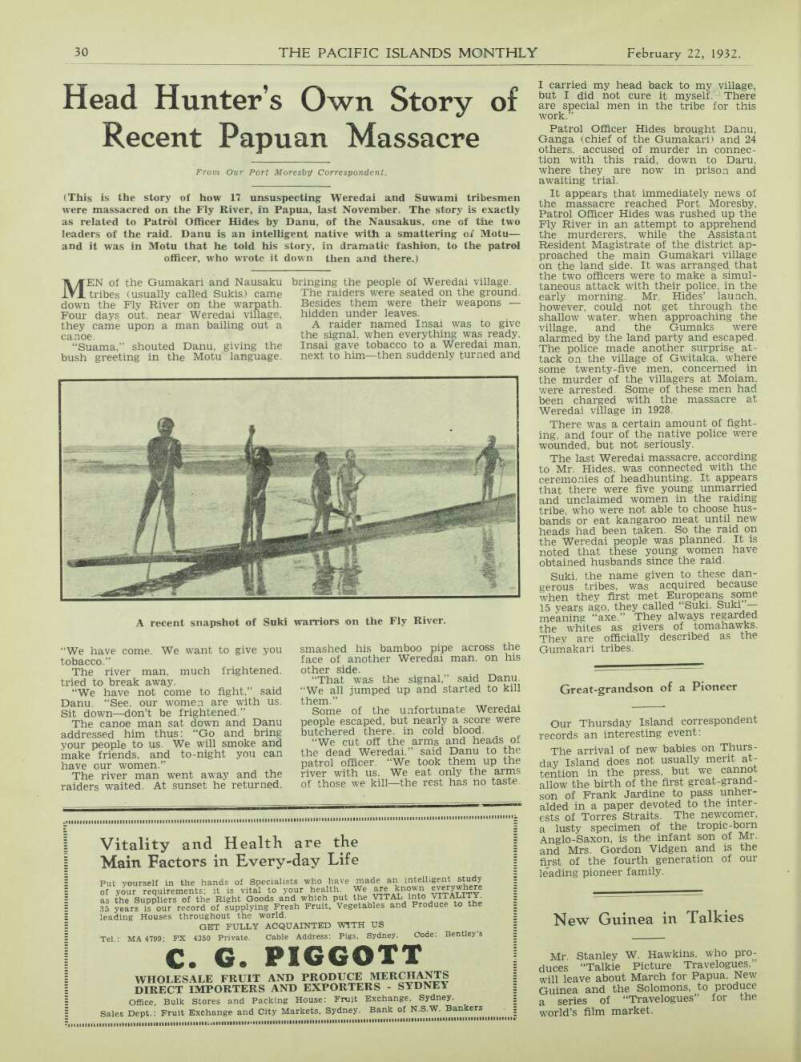
Head Hunter's Own Story of Recent Papuan Massacre
From Our Port Moresby Correspondent. (This is the story of how 17 unsuspecting Weredai and Suwami tribesmen were massacred on the Fly River, in Papua, last November. The story is exactly as related to Patrol Officer Hides by Danu, of the Nausakus, one of the two leaders of the raid. Danu is an intelligent native with a smattering of Motu— and it was in Motu that he told his story, in dramatic fashion, to the patrol officer, who wrote it down then and there.)
MEN of the Gumakari and Nausaku tribes (usually called Sukis) came down the Fly River on the warpath.
Four days out, near Weredai village, they came upon a man bailing out a canoe.
“Suama,” shouted Danu, giving the bush greeting in the Motu language.
“We have come. We want to give you tobacco.”
The river man, much frightened. tried to break away.
“We have not come to fight,” said Danu. “See, our women are with us.
Sit down—don’t be frightened.”
The canoe man sat down and Danu addressed him thus: “Go and bring your people to us. We will smoke and make friends, and to-night you can have our women.”
The river man went away and the raiders waited. At sunset he returned,
bringing the people of Weredai village.
The raiders were seated on the ground.
Besides them were their weapons hidden under leaves.
A raider named Insai was to give the signal, when everything was ready.
Insai gave tobacco to a Weredai man, next to him —then suddenly turned and
smashed his bamboo pipe across the face of another Weredai man, on his other side.
“That was the signal, said Danu.
“We all jumped up and started to kill
them.” .
Some of the unfortunate Weredai people escaped, but nearly a score were butchered there in cold blood, “We cut off the arms and heads of the dead Weredai said Danu to the patrol officer. We took them up the river with us. We eat only the arms of those we kill—the rest has no taste.
I carried my head back to my village, but I did not cure it myself. There are special men in the tribe for this work.”
Patrol Officer Hides brought Danu, Ganga (chief of the Gumakari) and 24 others, accused of murder in connec tion with this raid, down to Daru, where they are now in prison and awaiting trial.
It appears that immediately news of the massacre reached Port Moresby, Patrol Officer Hides was rushed up the Fly River in an attempt to apprehend the murderers, while the Assistant Resident Magistrate of the district ap proached the main Gumakari village on the land side. It was arranged, that the two officers were to make a simul taneous attack with their police, in the early morning. Mr. Hides’ launch, however, could not get through the shallow water, when approaching the village, and the Gumaks were alarmed by the land party and escaped.
The police made another surprise at tack on the village of Gwitaka, where some twenty-five men, concerned in the murder of the villagers at Moiam, were arrested. Some of these men had been charged with the massacre at Weredai village in 1928.
There was a certain amount of fight ing, and four of the native police were wounded, but not seriously.
The last Weredai massacre, according to Mr. Hides, was connected with the ceremonies of headhunting. It appears that there were five young unmarried and unclaimed women in the raiding tribe, who were not able to choose hus bands or eat kangaroo meat until new heads had been taken. So the raid on the Weredai people was planned. It is noted that these young women have obtained husbands since the raid.
Suki, the name given to these dan gerous tribes, was acquired because when they first met Europeans some 15 years ago, they called “Suki. Suki. meaning “axe.” They always regarded the whites as givers of tomahawks.
They are officially described as the Gumakari tribes.
A recent snapshot of Suki warriors on the Fly River.
Great-grandson of a Pioneer
Our Thursday Island correspondent records an interesting event: The arrival of new babies on Thurs day Island does not usually merit at tention in the press, but we cannot allow the birth of the first great-grand son of Frank Jardine to pass unher alded in a paper devoted to the inter ests of Torres Straits. The newcomer, a lusty specimen of the tropic-born Anglo-Saxon, is the infant son of Mr. and Mrs. Gordon Vidgen and is the first of the fourth generation of our leading pioneer family.
New Guinea in Talkies
Mr Stanley W. Hawkins, who pro duces “Talkie Picture Travelogues.” will leave about March for Papua. New Guinea and the Solomons, to produce a series of “Travelogues” for the world’s film market.
Advertisements & other items, p. 32 (1 item)
C. G. Piggott
Vitality and Health are the
Main Factors in Every-day Life
Put yourself in the hands of Specialists who have made an Intelligent study of your requirements; it is vital to your health We are known as the Suppliers of the Right Goods and which put the VITAL. into VITA!l*t 35 years is our record of supplying Fresh Fruit, Vegetables and Produce to the leading Houses throughout the world.
GET FULLY ACQUAINTED WITH US
Tel • MA 4799; FX 4350 Private. Cable Address; Pigs, Sydney. Code: Bentley s
C. G. PIGGOTT
Office, Bulk Stores and Packing House: Fruit Exchange, Sydney.
Sales Dept.: Fruit Exchange and City Markets, Sydney. Bank of N.S.W. Bankers
Tahiti News
Farewell to Popular Naval Commander
From Our Own Correspondent PAPEETE. January 29.
THE British Consulate, which has lately been entirely rebuilt, and occupies one of the most attractive sites along the Papeete waterfront, was the scene of a very success ful party on the night of January 23, the occasion being the departure for France of Commandant Bastard, who for a long time past has been stationed in Papeete in com mand of the gunboat Bellatrix.
Dr. Williams, Consul here for nearly twenty years, together with his popular and accom plished wife, did not spare either money or work in order to make this function one of the most memorable in the annals of Tahiti’s social life. Over a hundred guests, including His Excellency Governeur Jore, were present, and the crowd showed no signs of thinning till well on toward daylight, and did not finally fade away till Papeete’s housewives were returning home from market with the Sabbath provisions. What better compliment could a successful hostess desire?
Commandant Bastard goes home for pro motion, and the good wishes of this com munity go with him wherever he may be.
All we can hope is that his successor on this station—who, we understand, is detained by illness in Panama —will prove equally hos pitable, and as quickly win the warm regard of Tahiti’s heterogeneous inhabitants.
A Wanderer Returns.
Mr. Bissel, who is well known in America as the proprietor of Bissel’s carpet sweeper, arrived in Tahiti last week in the three masted yacht Ariadne, and plans to proceed to Samoa and the islands of the Western Pacific in a few days’ time. The Ariadne was formerly owned by Governor Pinchot, of New York, who made a South Sea voyage in her a couple of years ago; she was then known as the Mary Pinchot. For some reason her topmasts have been removed, changing her appearance considerably from the well remembered Governor’s yacht.
The return of Mr. Bissel and family to the Islands adds another prominent name to the long list of those who, having once visited here, find the longing to return almost irresistable. We remember with pleasure Mr.
Bissel’s first visit to Tahiti on his yacht Wanderlust, which, under the able guidance of Captain Brisson. made several interesting cruises about the Group.
Popular Tahiti.
The fact that Tahiti is becoming increas ingly important as a pleasure resort for tourists is indicated by the increasing number of world cruises which are making this port a stopping point.
We are at present awaiting with interest the arrival of the large around-the-world cruiser Stella Polaris, due here early in Feb ruary with a full list of passengers on a cruise through the South Pacific. She left New York in January, and is coming via the Panama Canal. Needless to say, extensive arrangements are under way for the enter tainment of our guests with native feasts, dancing and a general carnival spirit, which, combined with the natural beauties of scenery and climate which we have to offer, should leave a permanent happy memory with all of them.
Artistic Success.
We wish to compliment the firm of A. B.
Donald, Ltd., and Mr. Alistair Macdonald, the noted artist, for their co-operation in producing one of the most beautiful calen dars for the New Year which we have ever seen.
Mr. Macdonald has lived here during the last ten years, which he has devoted exclu sively to the portrayal of local scenic beauty in watercolour. His latest picture, “Papeete Harbour in the Early Morning.” was justly considered by Messrs. A. B. Donald as a masterpiece, and its reproduction in colour on their new calendar indicates a high de gree of artistic as well as commercial ability on their part. It is certain that many of these reproductions will be carefully framed and preserved long after the calendar itself has become obsolete.
Advertisements & other items, p. 33 (1 item)
H. H. Groth & Co.
THESE sweet, crisp morsels are most convenient, popular and appetising. When you come home from the theatre, they are ready without fuss or bother. Packed in air tight tins—light and delicious.
(Est. 1852)
ISLAND TRADERS
Groths for— Building Materials, Wallpaper, Paints, Pictures, etc.
COMMISSIONS TAKEN FOR ALL
CLASSES OF MERCHANDISE.
H. H. GROTH & Company
51 YORK STREET - - SYDNEY
Brisbane Rep.: J. A. C. KINGSFORD, Griffiths House, Queen Street, Brisbane.
“Gavit” Copra for London
Exhibition
The product of Mr. D. M. Forsyth’s Gavit Plantation, Baining District.
New Guinea, has been selected by the Department of Agriculture, New Guinea, to go to a special exhibition in London as a first-class sample of hot-air (Chula) dried copra.
Mr. R. H. Kirkwood, at one time Assistant Auditor of the Colony of Fiji, died in Auckland, N.Z., recently, at the age of 72 years.
Papuan Outlook
Improves
From Our Own Correspondent
Port Moresby, Feb. 12.
Sir Hubert Murray (Lieut.-Gover nor) on his return to Port Moresby from Canberra has given us the wel come news that Australia will continue to give preference to Papuan rubber for at least another year. In the meantime, it is hoped that the rubber market will improve.
This news, together with the subs tantial rise in copra prices, has given new heart to our primary producers, and may put an end to the stringent conditions under which we have been living for the last nine months.
Sydney-Suva-
Vavau New Steamer Service
A SHIPPING development of very considerable interest to the Cen tral Pacific will take effect shortly, when the Union S.S. Co. Ltd., acting in co-operation with Messrs. W. R.
Carpenter & Co. Ltd., will despatch the Union Company’s vessel Hauraki, on the following itinerary: Sydney, Suva, Rotuma, Vavau, Sydney, with possible calls, if required, at intermediate ports.
Messrs. W. R. Carpenter & Co. Ltd., who have business affiliations in the ports mentioned and who are steadily extending their operations, have prom ised the Union Company a definite amount of business, and, as a result, the Union Company has undertaken that this or another vessel will main tain this itinerary on a regular schedule.
It is intended that the service shall be maintained by a vessel capable of carrying passengers, and this is im portant as, since the Matson liners were diverted to include Auckland, there is no direct communication be tween Sydney and Suva.
The development is also important from a purely Australian point of view, because a good deal of the ordinary trade of Fiji and Tonga has been di verted to New Zealand in recent years; and Messrs. Carpenter & Company’s interest in the new venture represents an attempt to make use of the Austral ian exchange position in an effort to recover some of the lost trade for Aus tralia.
The service may also prove to be specially useful to Tonga, in view of the withdrawal of the Tofua from the Fiji-Tonga-Samoa service, to which reference is made elsewhere.
Travellers
Pacific Islands’
Passengers Per S.S. Montoro, Which
Arrived In Sydney On January 25
From New Guinea And Papuan Ports:
Miss I. H. Balmer, Miss L. Barbour, Mr. C.
J. Bartlett, Miss N. Buckingham, Miss M.
Carnell, Miss E. D. Glasson, Mr. and Mrs.
J. Gray, Miss H. V. Humphries, Miss K.
Idriess, Miss F. E. Martin, Mr. A. H. Mc- Masfer, Misses H. I. and M. (3) McNamara, Miss C. L. Page, Mr. S. G. Pickering, Messrs.
J. C. and H. J. Sartain, Miss M. G. Surtees, Miss B. Whitehouse, Mrs. R. Pickwell, Mrs.
L. R. Bennett, Mr. C. E. Hopkins, Dr. I.
Dickson, Mr. and Mrs. J. Meeks, Mr. H Meeks, Mr. L. Ankers, Father J. Bender, Father Borchardt, Mr. A. B. Bogie, Mr. F.
Burrows, Mr. F. Flannery, Mr. H. J. Gale, Mr. W. G. Gibson, Mr. P. D. Good, Mr. R.
Hooper, Brother Knepper, Brother Licanerski, Miss M. Moulder, Mr. and Mrs. L. E. Rob ertson and 2 children, Father J. Schneider, Master D. J. Washington, Mr. R. N. Wayne, Mr. J. R. Brazier, Mr. and Mrs. D. G.
Irvine, Mr. W. Shedden, Mr. L. W. Brossey, Mrs. L. W. Brossey, Mrs. H. Champion and child, Mrs. B. M. Clarke and child, Mrs.
D. Dettman and infant, Mr. W. M. Dupain, Mrs. C. Miller. Mrs. P. Murray & son, Mr. and Mrs. S. Watson and 2 children, Mrs. M.
Allen.
Passengers Per S.S. Montoro, Which
Sailed From Sydney On February 3,
1932, For Papuan And New Guinea
Ports:
Mrs. Len. Murray, Mr. H. R. Niall, Mrs.
Niall, Mrs. A. P. Dowsett and two children, Miss M. Gibson, Mrs. E. W. Thompson, Mrs.
C. M. Brereton, Miss R. Bryant, Miss P.
Bryant, Mrs. A. Campbell and infant, Sir Hubert Murray, Mr. I. Clark, Mr. W. A. P.
Gill, Mr. L. Thornton, Mrs. Thornton, Mrs.
Waldby and two infants, Mrs. R. M. Allan, child and infant, Mr. W. J. Jeffries, Mr. C.
Hughes, Mr. B. B. Bowles, Mr. L. W. J.
Vincent, Mr. D. F. Spankie, Mr. A. G. Allen, Mr. L. Bridger, Mr. E. F. Clay, Mr. S. D.
Anderson, Mr. G. Washington, Mr. W. D.
Voysey, Mrs. Voysey, Mr. A. R. Haviland, Mrs. Haviland, Mr. R. A. Vivian, Mr. P. F.
Griffin, Mr. H. G. Carter, Mr. W. J. Knox, Mr. D. C. G. Phillips, Mr. W. J. Read, Mr. A. A. Bloxham, Mr. K. W. H. Bridge, Mr. D. Walch, Mr. J. A. L. Capron, Mr. A.
W. Allen, Mr. N. L. Robinson, Miss I.
Corry, Mr. L. H. Thompson, Mr. F. L.
Flannery, Miss E. Froomes, Mr. D. Honey sett.
Passengers Per S.S. Mataram, Which
Sailed From Sydney, January 27, 1932,
For Solomon Island Ports:
Mr. E. F. Stephens, Mrs. Mines, Miss L.
Parkinson, Mr. J. Farrar, Miss Stringer, Mr.
M. H. Hall, Mrs. Hall, Mr. A. Campbell, Mr.
W. R. Wood, Mr. H. Ransley, Miss B. Mc Cosker, Miss E. Raymont, Rev. Father Van Mechelen, Rev. Father Schlieker, Mr. J. M.
McLaren, Rev. A. A. Bensley, Mrs. Bensley.
Passengers Per S.S. “Morinda,”
From New Hebrides, Arrived Febru
ARY 16, 1932: Mr. and Mrs. L. Chmitelin, Mr. and Mrs. F. J. Dawson, Mr. W. L. Bell, Mr C. D. Elliott, Mr. N. J. Warton, Mr. I.
Cassidy, Miss H. K. Kirk, Mr. and Mrs. A. J.
Nathan, Mr. D. Brown, Mrs. K. A. Burgess and child, Mr. A. E. Carter, Mrs. H. Christ ian, Dr. A. E. Colvin, Mr. G. Fitzpatrick, Mr. R. J. Love, Miss H. Laurence, Messrs.
M. and B. Lapin, Mr. J. G. Mac Gibbon, Mr.
J. McPhail, Miss M. C. Nobbs, Mrs. M. Quin tal, Mr. C. G. Quintal, Mrs. M. E. Quintal and child, Mrs. I. Rennie, Mrs. C. Scott, Mrs. E.
Stock, Miss E. F. White, Mr. and Mrs. H.
Walton, Miss O. Young, Miss L. Anderson, Mr. P. Andreas, Mr. R. Baxter, Miss I. Bax ter, Mr. and Mrs. Beale, Mr. and Mrs. P.
Cameron, Mr. and Mrs. Cook and child, Mr.
J. Cox, Mr. L. Crommelin, Miss M. Daniel, Mr. T. C. Douglass, Mr. and Miss C. Davies, Mr. W. Hammill, Miss M. Hammond, Master A. Harford, Mr. Darcy Johnson, Miss C. Mc Lerie, Misses J. and M. McLean, Miss S.
O’Brien, Mr. J. and Miss M. Merrick, Mr. N.
Morrow, Mr. S. B. Morton, Mrs. A. Norman, Miss A. Paton, Miss G. Patten, Mr. H. Pay ten, Misses B. and R. Ramsay, Mr. D. Rea, Mr T. Rich, Mr. R. M. Simmons, Miss D.
Rowland. Mr. G. Solomon, Mr. J. Stewart, Mr.
O. C. Thompson, Mr. A. Thomas, Mr. W.
McDonald, Mrs. R. Winning, Miss G. Watson, Miss M. Whitfield, Miss E. Yeend.
Advertisements & other items, p. 34 (1 item)
J. Mullock
Waterproof Coats
For Ladies and Gentlemen we carry a full range of the world famous “AQUAMAC”
Raincoats. Light in weight. Strong in texture. Attractive in appearance.
Ladies’ prices : “Regal” Quality 50/- “Clarice” Quality --- 38/6 Including a FREE HAT to match each coat.
Men’s Prices : “Indiana” (lightweight) - - - - 357- Heavy rubber surface, from - 25/-
Cuaranteed Waterproof
For the Outdoor Man
THE “STORMGUARD” COAT
This coat is our latest production.
It is made en tirely from canvas and is superior to the best Oilskin ever made.
Some Features; Double breasted.
Riding fan if desired.
Storm cuffs Velvet or leather collar Epaulet shoulder capes.
Reinforced at Bend of arm Special Note : Being free from oil, this coat cannot possibly become sticky “STORMGUARD” Prices : Birkmyre’s Canvas --- 79/6 18oz. Khaki-proofed Duck - - - 59/6 Wholesale and Retail. Send for Price List.
J. MULLOCK
Manufacturer
19 Rowe Street, Sydney
Growers Complain
New Banana Contract for Samoa
From Our Own Correspondent APIA, January 5.
THE Government Secretary, Mr.
Turnbull, has closed a new ban ana contract on behalf of the Adminis tration with N.Z. fruit importers on what are regarded as unfavourable terms.
The contract is only for 4½ months, and the price, which is not published, is much below the former contract price. The price to be paid to growers will be 3/6 per case, less freight to Apia, which, up to the amount of 9d. per case, has to be borne by the pro ducers for all bananas, whether ac cepted for shipment or not.
A few years ago the Administration urged European, as well as native grow ers to plant bananas to their utmost capability. It was stated at the time that the Administration would be able to take up to 30,000 cases a month for export to New Zealand. As a conse quence of this campaign, and especially when the copra price began to drop, a large number of Europeans and natives turned to bananas and planted large areas, trusting that the Administration would ensure a market for the fruit— especially after an Ordinance was en acted, securing to the Administration an exclusive monopoly in the hand ling and export of bananas.
At the present time the limit given by the Administration—-30,000 cases per month—is already produced and avail able. But, to the sore disappointment of the growers, the shipments are wholly inadequate to cope with the production. The Maui Pomare, leaving on December 31, takes about 7,200 cases, when over 20,000 cases were ap plied for.
The situation is bad enough for the large European and the native produc ers, but some Samoan districts of the South and East coast of Upolu, and of Savaii, have been cut out of shipments altogether. It is altogether ruinous for the small European growers, who de pend on bananas for a living and for payment of Government taxes, and who have in some cases invested their last savings in small banana planta tions.
The Inspector of Produce is severely criticised for his method of dealing with applications for banana boxes.
While some of the large European and Chinese growers are given all the boxes they want, the small man, in many instances is given no share whatever.
It surely should be possible to give out shipping space on a fair percentage basis and avoid unnecessary hardship to the small planters who depend on ban anana shipping for a living.
Great dissatisfaction was expressed by banana growers that no shipments were despatched to New Zealand to ar rive before Christmas, when probablv good prices would have been obtained.
Samoan as well as European growers had hoped to ship some bananas before Christmas, and obtain some cash for seasonal purchases, EDITORIAL NOTE. —Growers cannot very well blame the Administration, which is obvi ously doing its best in very difficult circum stances. We have repeatedly pointed out that the shipment of bananas from Samoa to the N.Z. market is obviously a gamble, because
much fruit is already going down from Cook Islands and Fiji, and now Tonga has entered the banana market. The main cause of the trouble described, however, appears to be an insufficiency of freights, and if Western Sa moan producers are being thus handicapped, the New Zealand Government must take the blame. If New Zealand cannot provide ade quate shipping. New Zealand has no right to undertake the administration of important
Islands territories. No Islands shipping ser vices are profitable to-day. Therefore, how can the N.Z. Government, running its own steamer in these difficult times, in competi tion with private enterprise, expect to secure the goodwill of the Union Company? Without the goodwill and co-operation of that com pany, the Dominion must make a poor show ing in its relations with the important islands territories in which it is interested.
Advertisements & other items, p. 35 (1 item)
Lysaght
The Famous Brands of
Galvanized Iron
ARE NOW MADE IN AUSTRALIA
At Newcastle, N.S.W.
CORRUGATED
PLAIN
Every Sheet Guamnteed
The first cost of these brands is so very little more than that of inferior qualities that to buy
“ORB” or “QUEEN’S HEAD” is a
proved sound investment.
The 15th edition of "The Referee,” a handbook of useful information, containing a ready-reckoner of much value to all engaged in building operations, may be obtained post free on application to John Lysaght (Aust.) Ltd., c/o. Box 196 D, G.P.O., Sydney.
A Suva Poet
Mrs. Parham, the well-known botan ist and poet of Suva, whose articles upon the neglected flora of “Fair Fiji’’ often grace the columns of The Fiji
Times, has just produced another little
work, neatly set up, printed and bound by her own clever daughters. We are glad to give an example from its pages of this versatile lady’s poesy;
Naicobocobo Point
In the waves’ cadence, far below.
The thoughtful hear a whisper plain; And on the winds that come and go Is borne aloft the sad refrain: “All are like grass, and all must pass, ‘Kai-si’*, or of the Chiefly class.”
Yet in God’s love, so full and wide, We sinners all may shelter find; He is our rock —where we may hide, Our comforter in stress of mind.
Yes, ours the truest spirit-road.
Leading us surely up to God. *Poor folk. Literally, “those who may be eaten.”
"Wreck” Season Takes Early Toll
In Solomons
From Our Own Correspondent.
TULAGI, January 10.
THE north-west or wreck season began taking toll somewhat early this year, for on December 13 the “Mendana,” a 15-ton auxiliary vessel, owned by Mr. Geoff. Clift and cap tained by Ernie Palmer, was piled up at Iyo, near the south-east end of San Christoval, and became a total wreck.
Capt. Palmer, it will be remembered, had a most thrilling experience in this vessel last October, during the earth quake upheaval on this island, what time he narrowly escaped being cast up by the tidal wave.
The vessel was insured, but for con siderably less than the full value.
N.G. Timber
Fine Samples From Bulolo
A REMARKABLY fine range of timbers has been brought to Syd ney from the Bulolo, by Mr. Chas.
Booth, one of the pioneers of the Mor obe Goldfield.
Mr. Booth has settled down on rich land on a hillside overlooking She Bulolo River, in New Guinea, and is building for himself a large new house.
On his holding he has planted all kinds of fruit trees and vegetables be longing to the temperate and sub-trop ical zones, and they are flourishing amazingly. This is an indication that up on this high plateau, where the Morobe Goldfield is situated, the clim atic conditions are temperate, and com fortable for Europeans.
All down the Bulolo River, where gold is now being intensively sought, there are good forests of valuable timber, and Mr. Booth has made a plan to float this timber down the Bulolo, Watut and Markham Rivers to the coast, where it will be prepared for shipment to the available markets by a saw-mill located near the mouth of the Markham.
Mr. Booth and his associates intend to form a company, but are being held up because the timber leases covering the area in question, which were ap plied for about the end of 1926, have not yet been supported by the issue of the official license. No reason for the delay has been given. The ap proval of the Administrator was ad vised in a formal letter from the Sec retary of the Lands and Mines De partment at Rabaul. dated December 23, 1930; but since then all efforts to secure the licenses have been in vain.
Mr. Booth and his friends, however, are still hopeful.
The timber in greatest abundance along the Bulolo is hoop pine and bunya pine, which are quite suitable for the making of butter boxes and for similar purposes. There is a fair quan tity of beautiful cedar and a good deal of Pacific maple—both timbers very suitable for fine cabinet-making. There is also a quantity of a timber called pometia pinnata, and an oak that closely resembles English oak.
Mr. Booth’s display of these timber samples in Sydney was examined with much interest by various people.
Advertisements & other items, p. 36 (2 items)
“The Younger” Cooking Stove
If You Want the Best ...
Will supply all require ments both regarding lasting and cooking qualities.
Also
DOUBLE OVEN
RANGES
suitable for Hotels or large establishments, etc.
These Stoves are being used in practically every district throughout the Pacific Islands.
Send for Illustrated Catalogue and further information.
G. FLETCHER & SON
50 OXFORD STREET SYDNEY
Residents of Rabaul can inspect sample of "Younger” Stove and obtain quotations from CAMPBELL 8C CO., General Agents, Rabaul.
The Grainger Glass Company
Stocks all kinds of PLATE, SHEET and FANCY GLASS. Send us Specifications, or a description of your requirements, and we will pack and ship to you at PRICES EQUAL TO THE WORLD’S BEST.
Leadlight Artists - - Mirror Manufacturers Buy from Australia and get the full benefit of the Exchange.
GRAINGER GLASS CO., 32 Chalmers St., Sydney
Rev. R. Bartlett
What He Did in Samoa
MANY residents of Western Samoa will remember the Rev. Reginald Bartlett, of the London Missionary Society, who arrived there in 1929, to become principal of the Theological College at Malua. Mr. Bartlett inter ested himself in Samoan politics and, according to the following lunch-hour address at the Memorial Hall, London, on 9th December last (as reported in The Australian Christian World) he did something towards preventing bloodshed. Samoan residents gener ally will be interested in his story: “Before I had been there long I took a trip round the island. I found that the trouble was seriously interfering with the work of the Church. I wrote a strong letter of protest to the Secre tary of the Mau Council, one of the four kings of Samoa, asking for an opportunity of meeting him. He replied offering a date and I met the Council at 9 o’clock one morning.
“The temperature oi that meeting was rather warm! The leaders felt strongly about my butting into their quarrel. It was no place for a mis sionary, they said. I made it clear that I was not a bit concerned with their quarrel, except as it interfered with the work of the Church. 'Is it the custom when you quarrel in Samoa to turn round and hit your best friend,’
I asked them. ‘The Church in Samoa is your best friend’.
"After a conference lasting three hours they were all my friends except one. My difficulty was that I did not know the language, but I was picking it up as quickly as I could. One of the things I could say in their tongue was ‘my friend.’ I went up to the one and gripped him by the hand so that he could not get away and said, ‘My friend.’ For a long time he would not reply, but I did not release his hand until at last he replied with the same words, ‘my friend.’
“That was on December 21st, 1929.
On December 28th, one week later, the clash came. It was the custom of the Mau to organise an anti-Govern ment procession. The Government had no objection, but issued a warn ing that if any of a number of wanted men made their appearance they would be arrested. A number of wanted men were put in the front of the proces sion. The police stepped forward to arrest them, and in the struggle which followed one of the police and thirteen Samoans were killed. The Govern ment was in difficulties. The police force was small. Samoa is mandated to New Zealand. New Zealand marines were landed with rifles, bayonets and machine guns.
“The Samoans took to the bush.
Practically the whole of the male popu lation went. Every day raiding parties went into the bush and searched for their camps, but among the mountains and forests of Samoa they might have searched for months without ever find ing them. I, too, was hunting for them, but I made my raids by night.
One morning I had just returned to the mission house in Malua to find on my verandah a young man, who gave me greeting and said, 'I want to help you. Every day you go into the bush?’ ‘Yes,’ I replied. ‘You cannot find them.’
‘No,’ I replied. ‘l’ll take you to them,’ and he explained that he was a secret messenger employed by the Mau to carry messages from one camp to another. This boy became my guide and every night we went together into the bush.”
Mr. Bartlett and his guide found the camps one by one, but it was a long time before he was able to persuade the leaders to come down and meet the Governor. In the meantime he heard that a battleship was preparing to leave New Zealand with a force of picked and intensively trained men to quell the trouble in Samoa.
“I had a week in which to prevent that ship sailing,” he said, “and still the Mau would not give in. Every night we went up into the bush and on the very eve of the day on which the ship was to sail we were able to take to the Governor at Vailima a dirty piece of paper with the names cf 35 leaders who had all promised to meet him. ‘Will you stop that ship?’ I asked. That ship never sailed, the party of men was dispersed, and peace was made without bloodshed.”
American Samoa
Polynesian Psychology
AN article by Margaret Mead, in The World To-day, gives some interesting sidelights on conditions in American Samoa.
The Polynesian separated from his land (she says) is a doomed man. He will not work for wages, he knows no trade, he has no means of subsistence except sponging upon his relatives.
Wherever the white or Chinese trader has penetrated, unless deterred by gov ernment, he has tended to extend to the native long credits which the lat ter is unable to meet. Ultimately the native’s land finds its way to the trader as payment for the debt.
All such exploitation is effectively prevented in American Samoa.
Justice is administered by a civilian judge appointed by the Navy for a period of two years, and by a series of native magistrates selected from am ong the more venerable chiefs in the native communities.
Fines have been found to be the most effective form of punishment. The Samoans were familiar with them be fore “the coming of the light” (a eu phemism in Oceania for the coming of the white man). Every Samoan pre fers to compound an offence if possible; even adultery is settled by the co-res pondent, male and female, making atonement in fine mats to the injured spouse. Gaoling, which lacks the power to confer social degradation in Samoa, is found to be less effective.
Old residents still tell the story of the time when a village asked permis sion to go upon a malaga—a visit to another village. It had been found ne cessary to institute some sort of traffic regulation in these wholesale village exoduses, since the introduction of cric ket has made them so popular that often the gardens are badly neglected.
The judge therefore refused permission to the whole village to go and live upon
the other village for a week, and then found to his great chagrin that the chiefs had made a visit first and asked for permission afterwards. They were ordered to gaol and came into the Naval Station singing gaily, happy at the thought of living upon the Govern ment for a month. The Government has wisely profited by such occurrences and changed its tactics.
Advertisements & other items, p. 37 (1 item)
Highly Contagious
EXAMINE
WHITE
THICK
SKIN
YOUR
TOES
Perhaps you have in flammation, redness, or skin cracks be tween the toes, tiny itching blisters, white thick skin which is always moist, or dry skin which becomes scaly, accompanied by an unpleasant and characteristic odour. These are all definite symptoms of
“TINEA” or TROPIC RING
WORM. This disease is very prevalent in all Tropical or Semi-Tropical climates
WHICH
BECOMES
Highly Contagious
This disease is highly contagious and may spread to other parts of the body—scalp, ears, arms, hands, legs. etc. — if immediate steps are not taken to check same. To the many thousands who are suffering from these irri tating skin diseases. “ANTINEA.” the definite cure, will come as a blessing.
For Dhobie Itch
Use “Antinca”
“ANTINEA” is a specific preparation for Trnea or ringworm infections. The penetrative power of “ANTINEA” rapidly destroys the “Tinea” fungi, relieves discomfort, restores skin whole ness and ensures normal condition. "AN TINEA" also relieves “DHOBIE ITCH,” Ring worm, Perionychia. Ringworm of the Nails and other similar skin troubles “ANTINEA" will not harm the living tissues.
Obtainable from all branches of Burns, Philp and Co. Ltd.. W. R. Carpenter and Co. Ltd., and A. J. Swann and Co. Ltd. (Suva).
PMC£
2/6 Or direct from
ANTINEA DRUG CO.
WINCELLO HOUSE.
ANGEL PLACE. SYDNEY
Postage, 3d. extra.
Industry
New Caledonian Cattle Over-Production Threatens Industry
From Our Own Correspondent.
NOUMEA December 20.
NO improvement can be reported in the cattle industry, and the con dition of a number of the graziers is rather precarious.
Sales of cattle on the hoof are now taking place at 1 franc 25 per kilo, which is only about one-third of the price prevailing some months ago.
It would appear that there is an over-production of cattle at the pre sent time, although the low price of meat should materially increase the consumption. As against this, however, the reduction in the number of Ton kinese and Javanese labourers by re patriation will reduce the number of mouths to be fed.
The question of opening a freezing works has been discussed at great length, but no practical solution has yet been put forward in regard to this method of exporting cattle. Unfortu nately, the Island lacks scientifically trained men who have had practical experience in this section of the meat industry, and advice in this direction, coupled with expert financial assist ance, is absolutely necessary to make the proposal a success.
It would be thought that, with the great field of experience available in Australia, advice would be sought in this direction, but apparently nothing has yet been done by the authorities or by the graziers themselves. To get the latter together would, no doubt, be a difficult matter, in view of their large numbers, the varying sizes of their herds, and also their different temperaments.
Finally, the low rate of the English and Australian exchanges makes it a difficult matter to develop an export trade of live cattle, or canned and frozen meat, as the British prices are now considerably below those quoted in francs.
Motor Cars In New
Caledonia
From Our Own Correspondent.
NOUMEA, January 15.
AS giving some indication of the re markable growth of motor trans port, the following figures are of interest. Five or six years ago. the total number of motor vehicles did not exceed 200, while to-day there are more like 1,000 registered.
Most of the cars are of French make and high duties have been imposed to prevent foreign-made automobiles be ing brought into general use.
Bulolo Gold
Placer Co. Secures Widubosh
Property
AN option has been taken by Placer Development Ltd. over a large area on New Guinea goldfields, known as the Widubosh, adjoining the Bulo wat property, below the junction of the Watut and Bulolo Rivers. Prospecting of this new area is to commence at an
early date.
Two New Dredges for
Additional Area
AN agreement has been concluded lor the sale by Placer Development Ltd. to Bulolo Gold Dredging Ltd. of the Bulowat and Burn side areas, situated immediately down stream from the Bulolo Company’s dredging pro perty on the Bulolo River, New Guinea.
Placer Development Ltd., having extensively drilled somewhat over eighty per cent, of the Bulowat and Burnside areas, estimates that fifty million cubic yards of gravel of an aver age recoverable gold content of approximately thirty-two gold cents per cubic yard can be dredged therefrom. It is believed that the untested ground will contain up to a further ten million cubic yards of payable ground.
Dredging costs, including gold royalty, are estimated at about twelve cents per cubic yard.
Bulolo Gold Dredging Ltd. will complete the testing of the areas and at once proceed to instal two electrically driven dredges, each of ten cubic feet bucket capacity.
The entire purchase consideration is pay able to Placer Development Ltd. in fully-paid shares of Bulolo Gold Dredging Ltd. Of the above consideration, 75,000 shares will be allotted two months after the first of the dredges commences operating, and a further 75,000 two months after the second commences operating.
After dredging has proceeded for two years on the new areas, a further allotment of shares to Placer Development Ltd. in com pletion of the purchase is contemplated. The number of further shares, if any, to be allot ted will be dependent on the results obtained by Bulolo Gold Dredging Ltd. from the drill ing of the untested portion of the Bulowat Burnside area, and will also be governed by the actual gold recoveries and working costs on the original Bulolo area, and also on the Bulowat Burnside areas now being acquired.
The sale agreement also provides for Bu lolo Gold Dredging Ltd granting Placer De velopment Ltd. the right to recover gold from an area of about ten acres, located outside the Bulolo dredging area and adioining the Arnold leases, owned bv Placer Development Ltd. In consideration of this, Placer Develop ment Ltd. is transferring to Bulolo Gold Dredging Ltd. two dredging claims, compris ing the Placer West area, located to the west of the Bulolo Company’s original holdings.
by Mau
Tamasese’s Death Remembered by Mau
From Our Own Correspondent APIA, January 5.
THE anniversary of the death of Ta masese, December 28, 1929, was again remembered, when the Mau fol lowers attended a Requiem Mass at the Catholic Cathedral, on Monday last.
About 500 women members of the Mau, in their blue and white striped lava-lavas, marched through Apia in an impressive procession, to the graves of Tamasese and the other victims of the 1929 shooting at Lepea Village, where a solemn service of remembrance was held.
Advertisements & other items, p. 38 (1 item)
Brandts Ltd.
IF YOU WANT SATISFACTION AND SERVICE
CANVAS PRODUCTS LTD.
YACHT AND BOAT SAIL MAKERS
Manufacturers of AUTOTENTS, TENTS, TARPAULINS, BLINDS AND ALL CANVAS GOODS
35 SUSSEX STREET - - SYDNEY
Foreman Sailmaker : ROBERT (BOB) BOYCE Let us have your enquiries. We shall be pleased to quote. ’PHONE, B 1613 SPECIALISTS IN ALL CLASSES OF BOAT RIGGING
The COMFORT
Iron
A Time Saver A Labour Saver and A Temper Saver “Comfort” Irons Nulite” Lanterns and Lamps (Operate on Petrol) These are indispensable in the Tropics.
Unsurpassed for efficiency and simplicity.
Write tor Particulars
Brandts Ltd.
371 PITT ST., SYDNEY. P.O. Box 36265.
Telegraphic Address: “BRANDTLAMP,” SYDNEY Everything for Light and Heat.
Kerosene, Gas or Electrical. 400 r.p.
Chinese and Samoan
Women New Ordinance Passed
From Our Own Correspondent APIA, January 5.
THE Legislative Council has had several meetings latelv at which some new ordinances were passed. The most important of these was “The Overseas Labourers’ Control Ordin ance, 1931.”
The object of this Ordinance is to replace a former proclamation which prohibited the cohabitation of Samoan women and Chinese coolies. This pro clamation had been in existence prac tically since the military occupation of Samoa by New Zealand in 1914, but had never been enforced by the authorities, with the well-known and unfortunate results which were published in this paper.
The Hon. Mr. Johnston, elected member of the Council, very properly asked at the meeting whether it was the intention of the Administration to enforce the Ordinance. He pointed out that there has never been an attempt to do so on the part of the Administra tion and that it would be farcical to issue regulations if the Administration is either unwilling or unable to enforce same.
The Administrator’s reply to the question was regarded as evasive, as he did not give a promise that the new law would be strictly enforced. It may be that this Ordinance is for the bene fit of the Mandate Commission of the League of Nations, which has repeat edly expressed strong views in regard to miscegenation of Chinese and Sa moans. But there seems to be no rea son whatever why the law in this mat ter should not be enforced.
Later.
At a meeting of the Legislative Coun cil, on December 15, the Samoan mem ber of the Council, Chief Mataafa, also asked a question regarding the above Ordinance. He enquired whether the police would inspect Chinese labour quarters to prevent Samoan females from entering same. He believed that inspections would reveal not only Samoan women, but also many chil dren living in these quarters.
The Crown Solicitor answered shortly that the police will make inspections when the Ordinance recently passed becomes law.
Cook Islands’ Sports Meeting
From Our Own Correspondent RAROTONGA, January 5.
Boxing Day, the Island Sports Associ ation held its track meeting at Titika veka The winner of the cricket ball throwing event. Karika Oramatua, established a local record with a throw of 315 feet. Spectators wondered how this throw compares with that of say, a first-class fieldsman, or with the standard throw in open competition elsewhere.
The tug-of-war was won by a team from Aorangi, which pulled against Titikaveka in the final round. The victory for Aorangi compensated for loss of the “Au Vaine” Cup year by that village, at the hands of Titikaveka.
Mishaps Near Apia
Double Motor Accident
From Our Own Correspondent APIA, January 5.
A SERIOUS motor car accident, with fatal results, occurred on December 16 on the west coast main road.
A car owned by Mr. F. Stewart and driven by a young boy, Willie Stewart, from Apia to Leulumaega, struck a young Samoan boy, Prula, who tried to cross the road in front of the car at the village of Tuanai. The boy, who was six years old, was struck by the bumper and knocked insensible.
As apparently the boy was seriously hurt, he was put into the car and taken to the hospital by another driver. On the way to the hospital, at the corner of Taufusi and Vae Roads, close to Apia, one of a group of Sa
moan children, Ali’va’a, six years old, rushed in front of the approaching car and was also struck by the mudguards and sustained injuries to the head.
He was promptly loaded into the car, which, with the two injured boys, pro ceeded on its way to the hospital.
The boy Prula died shortly after ad mission to hospital from a fractured skull. The second boy, Ali’va’a, was operated upon and his life will prob ably be saved.
An investigation has been started by the police. The driver Stewart was only learning to drive, and seems not to have held a driver’s license. After the accident the excited Tuanai nat ives tried to lynch the responsible driver and only the interference of the Samoan missionary at Tuanai saved the boy from serious injury.
The death occurred at Levuka, Fiji, recently of Jekopi Levau, a well known native teacher, who had been connected with the Methodist Mission at Levuka for some 15 years.
Advertisements & other items, p. 39 (1 item)
Excelsior Supply Co. Ltd.
The most extensive Manufacturers in the British Empire of
RUBBER STAMPS,
INKS, STENCILS.
Marking Devices.
ACME STAMP PADS
We have a big range of Special
FRUIT CASE MARKING SETS
We also Manufacture or Supply a complete line of
Spraying Machines
for all purposes.
Let us know your requirements and we will quote you by return. Ask for our Big Catalogue.
Sole Australasian Distributors of the World Famous SHEAFFER FOUNTAIN
PENS and PENCILS.
EXCELSIOR SUPPLY CO. LTD.
Head Office:--160 GEORGE STREET WEST,
SYDNEY, N.S.W.
Titikaveka
Prize Winning Cook Is. Village
From Our Own Correspondent RAROTONGA, January 5.
THE yearly tour of inspection, or “Tutaka,” of native villages, took place during the month.
The following four officials comprise the committee of inspection: Resident Commis sioner, Chief Medical Officer, Registrar of Courts, and Director of Agriculture.
The officials are met at each village by a local committee of native women termed the “Au Vaine.” The “Au Vaine” movement was introduced in 1926 and has for its function co-operation with the authorities on the fol lowing specified lines: (a) Cleanliness of villages and plantations, (b) Proper tethering of horses, pigs and goats. (c) Planting of domestic and export crops, (d) General beautifying of village surround ings.
The cup, which goes to the village scoring the greatest number of points for sanitation, cropping, general appearance, etc., was won this year by Titikaveka. The villages of Aorangi and Ngatangila, it is understood, were given higher points than the winner under one or two headings, but the honour went to Titikaveka for the general, all-round standard attained by the “Au Vaine” at that village.
Titikaveka is a charming spot. Its long avenue of flamboyant trees is now a mass of scarlet blossom. Plots of flowers are to be seen here and there on the closely cropped grass of the unfenced allotments. The native huts and tropical bungalows set back from the roadside, nestling beneath shady trees and coconut palms, make a pleasing picture for the eye. The long beach of coral sand and the splendid bathing spots in the lagoon at Titikaveka, make it a favourite resort with the European section of the community here.
“Money-Making” Missions
To the Editor.
Sir, —The Reverend General Secretary of the Methodist Mission Society of Australasia has courteously challenged my statement that cer tain of his Society’s missionaries assist their mission-funds by trading. He also threatens to ‘deal with” any such if I can prove them to have been guilty of what he declares is against the regulations of the M.M.S. of A.
In the first place, I was writing generally of the Pacific Missions, and not solely of those of Papua. All the same, I confess that I am most astonished to read Mr. Burton’s denial, as I thought the M.M. were generally known to go in for trading, and in this diff ered from the no-trading policies of other missions. But whilst I think such trading a mistake, I may, and do, recognise certain of these trading missionaries as very fine fellows. Certainly it is not my business to bring such “to the mat.”
If no trading is permitted, how comes it that certain of these fine M.M. folk receive, compared with those of other missions, fairly high salaries? The wonderful people of the other missions, I understand, only receive the nominal ten shillings a week.
When I was introduced to Mr. Gilmour, who is principal at the Dobu H.Q. of the M.M., by the Resident Magistrate of Samarai (acting on instructions from His Excellency) last June, with a view to my visiting the thermal wonders of that most exquisitely lovely spot, that gentleman said fas nearly as I can recall words) : “If you’re thinking of going there for nothing you’re quite mis taken. You’ll have to pay me £25 to go in my yacht; and you must buy your provisions from our store or take what you need with you—each of our stations has to pay for itself!”
Perhaps “Nuff sed!” As the run is only that of about seven hours, and I did not want to find myself amongst inhospitable, and perhaps, unfriendly people, I did not accept Mr. Gilmour’s suggestion, and that great Christian teacher, Dr. Newton, Anglican Bishop of New Guinea, took me with him. thrice as far, for nothing: and showed me the way to most remarkable archaelogical discoveries —as did Mr. Abel, of the Kwato Mission, later on. When my projected book appears I may deal further with this matter. —I am, etc..
Arthur J. Vogan.
Sydney, 3rd February, 1932.
Chichester Honoured
Pilot Who Put Norfolk on Aerial Map
From Our Own Correspondent.
NORFOLK IS., January 11.
IT is a matter of personal satisfac tion with us that the flying man, Chichester, who visited us last year, was presented by the Prince of Wales at the annual meeting of the Empire Air Pilots’ Guild, on November 19, with the Johnston Trophy for the year’s best feat of civil aerial navigation.
The trophy was presented for com petiton by Mrs. Johnston, widow of the hero of the RlOl disaster, and at the same function Mr. Chichester met and talked with Amy Johnston, whom he had last seen in Japan, when he was recovering from the injuries sustained in the world flight upon which he had set out when he called upon us en route from New Zealand to Australia.
The particular feat that gained the trophy for him was his achievement in picking up this island of Norfolk while still 30 miles distant, and swooping upon us from the blue, like a sea eagle dropping on its prey.
Now we feel that in some obscure manner we won that trophy with him.
Advertisements & other items, p. 40 (1 item)
R. Towns & Co.
PINK
POWDERS
In packets of 12 and 24
& TABLETS
1/6 & 2/6
R. TOWNS & CO.
Established 1842 31 REIBY PLACE - - - SYDNEY “LORD BEACONSFIELD” 26’s Island Twist Tobacco “EDGEWORTH” Extra High Grade Smoking Tobacco, in 2oz. vacuum airtight Tins, and lib. Class Jars.
“CUTICURA” Soap, Ointment and Talcum Powder.
GUARANTEED M&S PRODUCTS
Fish Paste in tin and glass jars Illawarra Prawns packed as required Curried Prawns in Boz. food tumblers All Kinds of Fresh and Smoked Fish
“EXCELSIOR” MEAT AND BONE MEALS
MIDDLEBROOK & STONE LTD.
Merchants and Manufacturers 38-40 Mountain St. & 6 Cunningham St., SYDNEY
Nothing In Fifty Years.
Metropolis Of The South Seas
Suva, Now a Beautiful, Modernly-Equipped City of 15,000, Has Grown From Nothing In Fifty Years.
From Our Own Correspondent.
TWO Councillors retired from the Suva Municipal Council by ef fluxion of time this year, and so the usual elections were held to fill the vacancies.
Some time ago it would have been difficult to find candidates suitably qualified who had the necessary en thusiasm for public service to allow themselves to be persuaded to stand for election. It is a thankless task at the best of times, and especially so in a small community where personal jealousies obtrude themselves. How ever, during the last couple of years, there seems to have been a stirring of the public conscience, and the last two annual elections have been remarkable for the profusion of talent which has offered itself. It is a pleasing sign that the ratepayer realises more and more the privileges bestowed upon him by Downing Street in regard to self-gov ernment.
The Municipality of Suva is like a little republic of its own, living happily and prosperously under the protection of Great Britain; and, as its develop ment is set a stage further on than its sister towns in the Pacific, it may not be out of place to describe it briefly.
In 1909 the Municipal Institutions Ordinance was passed and Suva and Levuka were proclaimed as Municipal ities. The Ordinance provides that for the government of every town a council should be constituted to consist of 6 members for up to 600 ratepayers; 600- 2,000 ratepayers, 8 members; and 2,000 and upwards, 10 members. Any per son over 21, of whatever nationality, who pays rates on any property and who is capable of reading, etc., the English language, can be put on the electoral roll and can be elected as a councillor. In the case of Suva the principle is one man one vote; but Levuka has not reached this stage and is still at the point where cumu lative voting is permissible—i.e., for property assessed at under £25 per annum the ratepayer gets one vote, but if the annual value is over £150 he gets 4 votes.
The Municipal Council of Suva con sists of 8 members, because the num ber of ratepayers is held to be over 600—the population is, in fact, over 15,000. Three members retire in each year, except in the third year, when only two members retire. Elections take place annually and the members thus elected sit for three years.
Immediately after the annual elec tion the new Council meets to elect their Mayor for the coming year, who on this occasion is Mr. G. F. Grahame (of Newcastle, N.S.W.) a member of the well known legal firm of Ellis and Grahame. The Mayor is entitled to be addressed as “His Worship”; and after election is solemnly invested by the Town Clerk with the robes and chain of office. He is accorded every courtesy and recognition by the Fiji
Government, and takes a prominent place in all “ceremonial occasions.” The office of Mayor is highly esteemed and is often the subject of unrecorded battles for supremacy!
Recent previous holders include names so well known in the life of the community as those of Sir Henry Scott, K.C., the Honourable Henry Marks, C.B.E.. the Honourable Alport Barker, M.L.C., and that of the pre sent Mayor.
The Council has a staff which con sists of the Town Clerk, who is the Chief Administrative Officer and who is invariably possessed of qualifications under Local Government Acts in Aus tralia. The present Town Clerk, for example, came to Suva from Inverell (N.S.W.) and his work in Suva has been so successful and his genial per sonality so well received that his term of office has been extended time and again.
Under him are the Deputy-Town Clerk, the Town Engineer and the El ectrical Engineer, the three next most important officers. Then come sani tary inspectors, a town gardener, a town librarian, etc., etc. It is the usual framework upon which is draped the cloak of local self-government in any enlightened community, and like every where else it is the framework which does the work whilst using the Council as the cloak for its activities.
The ratepayers on the electoral roll number 522, of which about 70 are Indians. Of these, 424 went to the poll to elect two out of the 6 candidates offering at the last election, which shows how much the franchise is ap preciated and how vivid is local in terest in civic affairs, especially when it is remembered that a certain per centage of those on the roll must in evitably be absentees at the time of the election.
The estimates of expenditure and revenue for 1932 show that the annual Income will be close on £4,500, a reduc tion on last year due to a pruning of expenditure and economies in various directions which permitted a reduc tion of the rates from lOd. in the £ on the unimproved capital value down to 9Sd. This reduction is more in the nature of a gesture compatible with the times, since there has been no extravagance in civic administration, nor is there any overwhelming burden of civic debt.
Altogether Suva has a public debt to-day of about £105,000 —not a very large sum for a town of which the revenue in 1931 from rates alone was just under £20,000, and whose ratable value of property exceeds £500,000. Of that amount of debt, approximately £35,000 is owing to the Fiji Govern ment, from which the town took over (many ratepayers think unwisely) the responsibility for the expensive and inefficient sewerage works carried out by the Government in Suva about two decades ago. From the public itself
the town has borrowed £88,000, but by means of sinking funds it has already paid back £13,400, and each year sets aside as high as 2 per cent, of certain loans, quite apart from such items as a denreciation reserve of 4 per cent, on the Joan capital of £55,500, employed in the electricity undertaking. It will be obvious that conservative finance is a feature of the civic administration of Suva.
That the ratepayers have had value for their money is evidenced by the miles of tar-macadam streets and con crete pavements, the well-kept public buildings and the beautiful patches of garden which surround the town. The sports ground at Albert Park, built out of reclaimed land, is an expanse of turf which accommodates three cric ket grounds and was sufficiently large for Air-Commodore Kingsford Smith to land upon it in 1928. in the South ern Cross, on his epoch-making flight from San Francisco to Sydney.
The municipal activities are varied.
One of the most important is that of generating and supplying electric light and power. Originally this was from a steam plant, but this proved unsatis factory and was later superseded by Diesel engines. The town has erected concrete poles and a system of mains under such capable supervision that the service has been practically unin terrupted for more than a few hours during our last two hurricanes.
Electric light is to be charged for at 9d. and power at during the com ing year, a reduction from 4d. in the case of power, which it is hoped will stimulate use of household electrical appliances, such as stoves, kelvinators, etc.
Public health figures very largely in the civic programme, and two Euro pean inspectors are continually em ployed going round the town, testing milk samples, etc. Very fine public baths were constructed on the sea front at a cost of over £10,000, whilst the existing Carnegie Library was much enlarged and now houses the Tourist Bureau and the Museum. The library itself is under the care of a live lib rarian and an arrangement has been made with a well known circulating library in London whereby continual supplies* of recently published books, just withdrawn, are shipped to the Car negie Library in Suva.
Altogether Suva forms a very inter esting study in development under pat ernal guidance—especially so when it is remembered that in 1871 it was en tirely non-existent. It shows, too, that European, Fijian, Indian and Chinese interests can be successfully harmon ised —at any rate up to the present stage of development.
To the outside observer. Suva to-day appears at least a safe and stable place.
Investigation Into Nut-fall in Solomons
Solomons
TULAGI, January 10.
THE Agricultural Committee held a meeting in Tulagi towards the end of December to discuss progress of investigation into the cause of nut fall, which has resulted in such drastic reductions of output on several plan tations, mainly Levers. But—so far as I have heard—no real success has been disclosed.
Waterfront
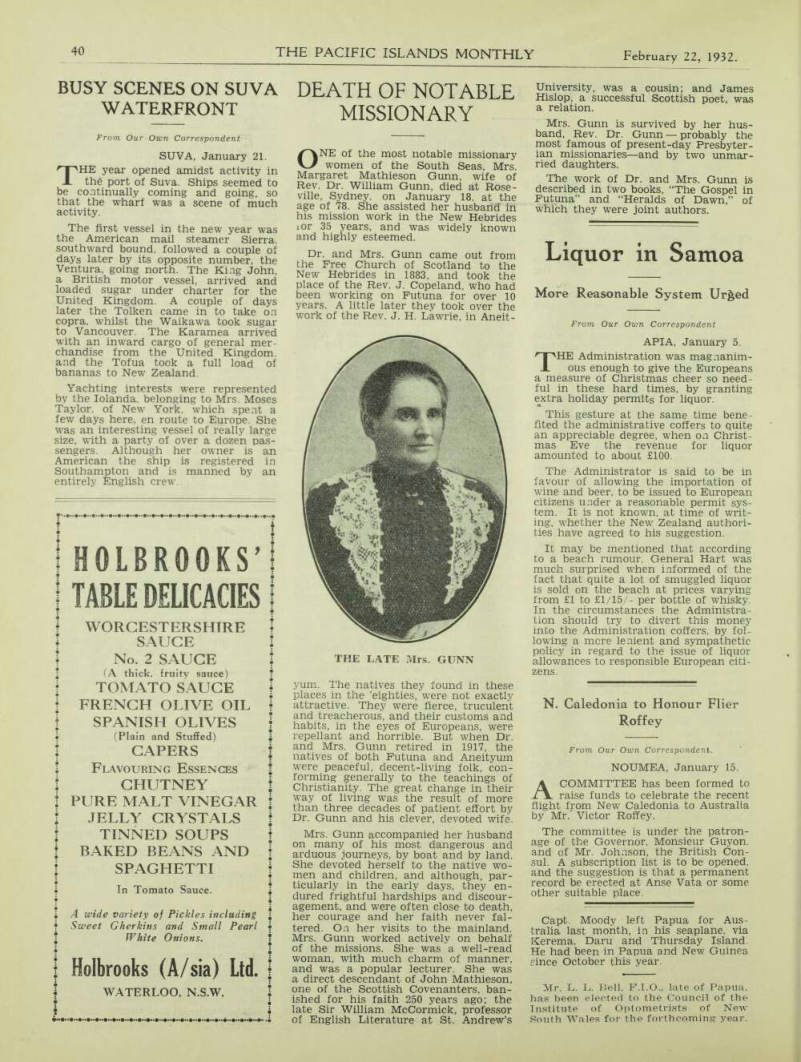
Busy Scenes On Suva
From Our Own Correspondent SUVA, January 21.
THE year opened amidst activity in the port of Suva. Ships seemed to be continually coming and going, so that the wharf was a scene of much activity.
The first vessel in the new year was the American mail steamer Sierra, southward bound, followed a couple of days later by its opposite number, the Ventura, going north. The King John, a British motor vessel, arrived and loaded sugar under charter for the United Kingdom. A couple of days later the Tolken came in to take on copra, whilst the Waikawa took sugar to Vancouver. The Karamea arrived with an inward cargo of general mer chandise from the United Kingdom, and the Tofua took a full load of bananas to New Zealand.
Yachting interests were represented by the Iolanda. belonging to Mrs. Moses Taylor, of New York, which spent a few days here, en route to Europe. She was an interesting vessel of really large size, with a party of over a dozen pas sengers. Although her owner is an American the ship is registered in Southampton and is manned by an entirely English crew.
Death Of Notable
Missionary
ONE of the most notable missionary women of the South Seas, Mrs.
Margaret Mathieson Gunn, wife of Rev. Dr. William Gunn, died at Rose ville, Sydney, on January 18, at the age of 78. She assisted her husband in his mission work in the New Hebrides ior 35 years, and was widely known and highly esteemed.
Dr. and Mrs. Gunn came out from the Free Church of Scotland to the New Hebrides in 1883, and took the place of the Rev. J. Copeland, who had been working on Futuna for over 10 years. A little later they took over the work of the Rev. J. H. Lawrie, in Aneit
yum. The natives they found in these places in the ’eighties, were not exactly attractive. They were fierce, truculent and treacherous, and their customs and habits, in the eyes of Europeans, were repellant and horrible. But when Dr. and Mrs. Gunn retired in 1917, the natives of both Futuna and Aneityum were peaceful, decent-living folk, con forming generally to the teachings of Christianity. The great change in their way of living was the result of more than three decades of patient effort by Dr. Gunn and his clever, devoted wife.
Mrs. Gunn accompanied her husband on many of his most dangerous and arduous journeys, by boat and by land.
She devoted herself to the native wo men and children, and although, par ticularly in the early days, they en dured frightful hardships and discour agement, and were often close to death, her courage and her faith never fal tered. On her visits to the mainland.
Mrs. Gunn worked actively on behalf of the missions. She was a well-read woman, with much charm of manner, and was a popular lecturer. She was a direct descendant of John Mathieson, one of the Scottish Covenanters, ban ished for his faith 250 years ago; the late Sir William McCormick, professor of English Literature at St. Andrew’s
University, was a cousin; and James Hislop, a successful Scottish poet, was a relation.
Mrs. Gunn is survived by her hus band, Rev. Dr. Gunn probably the most famous of present-day Presbyter ian missionaries—and by two unmar ried daughters.
The work of Dr. and Mrs. Gunn is described in two books, “The Gospel in Futuna” and “Heralds of Dawn,” of which they were joint authors.
The Late Mrs. Gunn
Liquor in Samoa
More Reasonable System Urged
From Our Own Correspondent APIA, January 5.
THE Administration was magnanim ous enough to give the Europeans a measure of Christmas cheer so need ful in these hard times, by granting extra holiday permits for liquor.
This gesture at the same time bene fited the administrative coffers to quite an appreciable degree, when on Christ mas Eve the revenue for liquor amounted to about £100.
The Administrator is said to be in favour of allowing the importation of wine and beer, to be issued to European citizens under a reasonable permit sys tem. It is not known, at time of writ ing, whether the New Zealand authori ties have agreed to his suggestion.
It may be mentioned that according to a beach rumour, General Hart was much surprised when informed of the fact that quite a lot of smuggled liquor is sold on the beach at prices varying from £1 to £1/15/- per bottle of whisky.
In the circumstances the Administra tion should try to divert this money into the Administration coffers, by fol lowing a mere lenient and sympathetic policy in regard to the issue of liquor allowances to responsible European citi zens.
Roffey
N. Caledonia to Honour Flier Roffey
From Our Own Correspondent.
NOUMEA, January 15.
A COMMITTEE has been formed to raise funds to celebrate the recent flight from New Caledonia to Australia by Mr. Victor Roffey.
The committee is under the patron age of the Governor, Monsieur Guyon, and of Mr. Johnson, the British Con sul. A subscription list is to be opened, and the suggestion is that a permanent record be erected at Anse Vata or some other suitable place.
Capt. Moody left Papua for Aus tralia last month, in his seaplane, via Kerema, Daru and Thursday Island.
He had been in Papua and New Guinea since October this year.
Mr. L. L. Bell, F.I.O., late of Papua, has been elected to the Council of the Institute of Optometrists of New South Wales for the forthcoming year.
Advertisements & other items, p. 42 (1 item)
Holbrooks’
TABLE DELICACIES
WORCESTERSHIRE
SAUCE
No. 2 SAUCE
(A thick, fruity sauce)
TOMATO SAUCE
FRENCH OLIVE OIL
SPANISH OLIVES
(Plain and Stuffed)
GAPERS
Flavouring Essences
CHUTNEY
PURE MALT VINEGAR
JELLY CRYSTALS
TINNED SOUPS
BAKED BEANS AND
SPAGHETTI
In Tomato Sauce.
A wide variety of Pickles including Sweet Gherkins and Small Pearl White Onions.
Holbrooks (A/sia) Ltd.
WATERLOO, N.S.W.
Change In Laperouse
Schedule
As will be seen from our shipping columns, a change has been made in the schedule of the Laperouse, which maintains the Sydney-Noumea service.
With the approval of the French Colonial Government, the vessel after its January trip was sent to the East to return 1,000 indentured Tonkinese labourers. During her absence, the shipping company made arrangements with the owners of the St. Vincent de Paul and St. Joseph to provide the New Caledonian settlers with communi cation with Sydney.
The Laperouse is due to leave Syd ney on her next trip to Noumea, on March 11. This voyage was not previ ously scheduled. According to the old itinerary, after her return from Nou mea on March 9. the vessel would re main in Sydney until April 2. Her trip to the East will therefore not alter the number of trips which she would ordinarily make during the year be tween Sydney and Noumea.
Caledonia
News From New
From Our Own Correspondent.
NOUMEA, January 15.
MR. A. UNGER, a member of the Conseil- General, has been recently decorated with the Legion of Honour, after very many years of faithful service to the Colony. Mr. Unger’s voice has been always raised on various mat ters of importance, and, as one of New Cale donia’s leading business men, he has taken particular interest in those matters affecting the welfare of the Colony.
Natives Return From Paris
Exhibition.
The hundred New Caledonian natives who went to Prance to take part in the big col onial exhibition in Paris returned during last month by the Dumont d’Urville, by way of Indo-China. They left France on November 12, embarking at Marseilles.
Personal.
Recent visitors to Noumea from Sydney in cluded Messrs. C. Sullivan (Island Agent) and N J. Warton (chartered accountant).
Mr. A. Huet, who has been residing in France for some time past, recently returned to the Colony.
Thursday Is. Notes
From Our Own Correspondent THURSDAY IS., February 1.
MR. E. J. Martin, one of T.I.’s regular travellers and well-known in many parts of the Pacific, has visited us again, after a rather longer absence than usual. He expects to make his next trip to Moresby, Samarai and Rabaul during May.
Just before Christmas, one of the best known of the coming generation of Thursday Islanders, Mr. Jim Fergusson, junior, left for Brisbane to join the Queensland Police Force.
His many friends here will be pleased to hear that Jim considers he has fallen on his feet and is very happy in his new surroundings.
Thanks to his training as a naval cadet and at the rifle range, our young representative from T.I. has made a very good beginning and we are quite confident he possesses just the right qualities for a successful career in the police.
The S.S. Mangola passed through on her way to Melbourne, six days late. On her outward voyage to Singapore, she struck a reef off the eastern end of Timor, and lost one of her propeller blades. The necessary repairs at Singapore accounted for the ves sel’s late arrival here.
Pacific Islands
Year Book
THERE have been many flattering references made in the news papers to the Pacific Islands Year Book for 1932, which was published in De cember. We have pleasure in quoting the following reference to the book from The Melbourne Herald of Febru ary 4: Many interesting articles and a mass of useful information are to be found in “The Pacific Islands Year Book, 1932,’’ compiled and edited by R. W. Robson (Sydney: Pacific Publications Ltd.). It will be of particular value to business men and others who have, or hope to have, interests in the islands. The thousands of islands in the Pacific are ruled over by half-a-dozen nations and governed by a score of different administrations. Each year their economic and political importance is increasing. Particularly is this so for Australia, for this potential market is at our very doorstep. Every aspect of island life is covered in this altogether admirable year book —administration, communications, sta tistical and business figures, missionary work, island history, customs tariffs and tourist attractions. There is also a number of maps
and many illustrations and the book is fully indexed.
In a brief introduction the editor apolo gises for any shortcomings and stresses the difficulties experienced in gathering the in formation for this first issue. He promises a more detailed and enlarged book for 1933, and hopes to make the book the standard work of reference in all matters relating to the Pacific. Mr. Robson is to be congratu lated on what he has done. There are hun dreds who will call down blessings on his head for making available facts and figures hitherto only available after a trying search.
The book is selling remarkably well in all parts of Australia and New Zea land, as well as in the South Seas, and a very large number of orders have been received from reference libraries in Great Britain and America. Copies may be had from booksellers and Islands stores: or by sending 8/6 direct to Pacific Publications Ltd., Union House, 247 George Street, Sydney.
The census, which was taken in the British Solomon Islands some months ago and was the first accurate one ever taken, has revealed that whereas the native poplation was supposed to be around 150,000, it was actually only 90,719.
Advertisements & other items, p. 43 (1 item)
Bumpers,
SPRINGS,
Forgings
Henderson's is the largest Spring factory in the Southern Hemisphere and manufactures every conceivable type of spring for cars and trucks and all other purposes. Huge stocks are always on hand and single leaves as well as complete motor springs may be supplied.
We specialise also in drop forging and manufacturing hardware of all kinds.
Send your orders direct or through any Islands storekeeper, enclosing exact particulars, and goods will be sent by next return steamer.
Catalogues and Price Lists on all lines sent on request. Write for it!
We specialise in
SPRINGS, SHACKLES,
U-BOLTS, AXLES, etc.,
for all Cars and Trucks.
Also Miners’ Picks, Eye-bolts, Tug-hooks, Springs and Tines for Agricultural Machinery, and All classes of
SHOPKEEPERS’
HARDWARE
Henderson’s Federal Spring Works
PROPRIETARY LIMITED
6 HUNT STREET, SYDNEY, N.S.W.
Telegraphic Address: “Springs, Sydney.”
Head Office and Factory:
ALFRED STREET - - NORTH MELBOURNE
Liquor In Tahiti
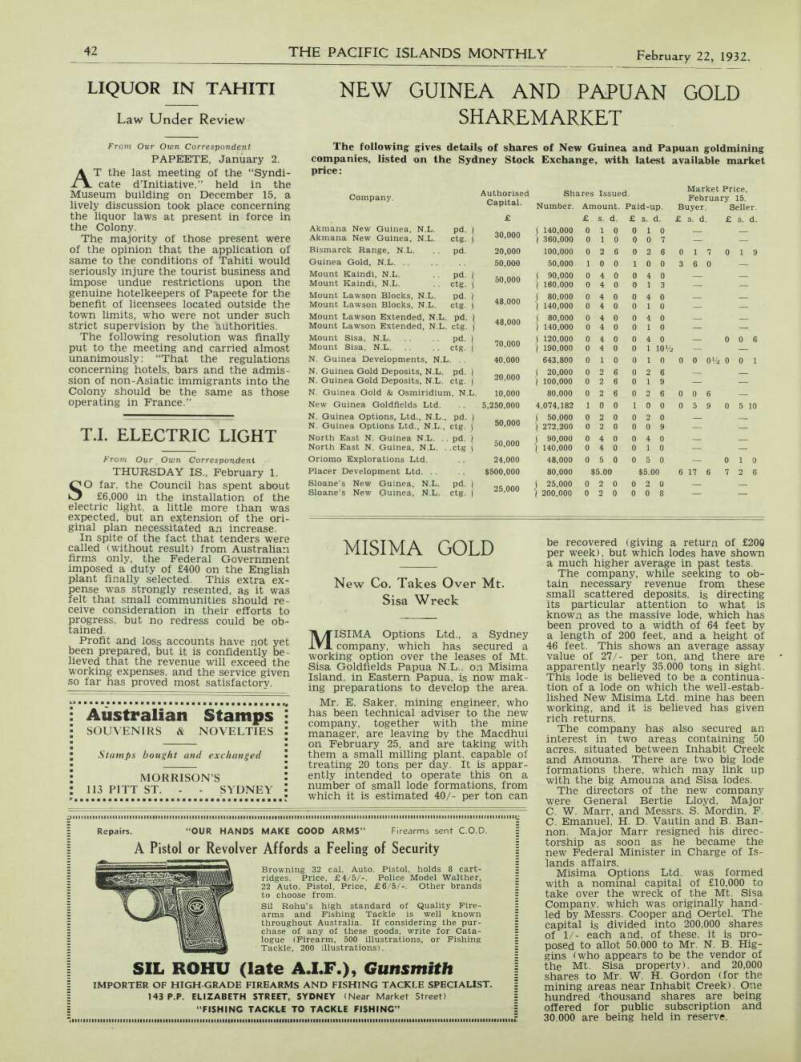
Law Under Review
From Our Own Correspondent PAPEETE, January 2.
AT the last meeting of the “Syndi cate d'Initiative,” held in the Museum building on December 15, a lively discussion took place concerning the liquor laws at present in force in the Colony.
The majority of those present were of the opinion that the application of same to the conditions of Tahiti would seriously injure the tourist business and impose undue restrictions upon the genuine hotelkeepers of Papeete for the benefit of licensees located outside the town limits, who were not under such strict supervision by the authorities.
The following resolution was finally put to the meeting and carried almost unanimously; “That the regulations concerning hotels, bars and the admis sion of non-Asiatic immigrants into the Colony should be the same as those operating in France.”
T.I. Electric Light
From Our Own Correspondent THURSDAY IS., February 1.
SO far, the Council has spent about £6,000 in the installation of the electric light, a little more than was expected, but an extension of the ori ginal plan necessitated an increase.
In spite of the fact that tenders were called (without result) from Australian firms only, the Federal Government imposed a duty of £400 on the English plant finally selected. This extra ex pense was strongly resented, as it was felt that small communities should re ceive consideration in their efforts to progress, but no redress could be ob tained.
Profit and loss accounts have not yet been prepared, but it is confidently be lieved that the revenue will exceed the working expenses, and the service given so far has proved most satisfactorv.
Sharemarket
New Guinea And Papuan Gold
The following gives details of shares of New Guinea and Papuan goldmining companies, listed on the Sydney Stock Exchange, with latest available market price:
Company.
Authorised Capital.
Shares Issued.
Market Price.
February 15.
Number.
Amount.
Paid-up.
Buyer.
Seller. £ £ s. d. £ s. d. £ s. d. £ s. d.
Akmana New Guinea, N.L. pd. 30,000 f 140,000 0 1 0 0 1 0 Akmana New Guinea, N.L. ctg. 1 ( 360,000 0 1 0 0 0 7 — Bismarck Range, N.L. pd. 20,000 100,000 0 2 6 0 2 6 0 1 7 0 1 9 Guinea Gold, N.L 50,000 50,000 1 0 0 1 0 0 3 6 0 Mount Kaindi, N.L. pd. 50,000 f 90,000 0 4 0 0 4 0 Mount Kaindi, N.L.
ctg. j
160,000 0 4 0 0 1 3 — Mount Lawson Blocks, N.L. pd. ) 48,000 f 80,000 0 4 0 0 4 0 Mount Lawson Blocks, N.L. ctg. ) 140,000 0 4 0 0 1 0 Mount Lawson Extended, N.L. pd. ) 48,000 J 80,000 0 4 0 0 4 0 Mount Lawson Extended, N.L. ctg. ) \ 140,000 0 4 0 0 1 0 — —.
Mount Sisa, N.L pd. 70,000 \ 120,000 0 4 0 0 4 0 0 0 6 Mount Sisa, N.L. ctg. ) 190,000 0 4 0 0 1 io y 2 — N. Guinea Developments, N.L. . . 40,000 643,800 0 1 0 0 1 0 0 0 0½ 0 0 1 N. Guinea Gold Deposits, N.L. pd. 20,000 J 20,000 0 2 6 0 2 6 N. Guinea Gold Deposits, N.L. ctg. i \ 100,000 0 2 6 0 1 9 — — N. Guinea Gold & Osmiridium, N.L. 10,000 80,000 0 2 6 0 2 6 0 0 6 — New Guinea Goldfields Ltd. 5,250,000 4,074,182 1 0 0 1 0 0 0 5 9 0 5 10 N. Guinea Options, Ltd., N.L., pd. 50,000 ( 50,000 0 2 0 0 2 0 N. Guinea Options Ltd., N.L..
ctg. j
) 272,200 0 2 0 0 0 9 — — North East N. Guinea N.L. . . pd. 50,000 ( 90,000 0 4 0 0 4 0 North East N. Guinea, N.L. .
• ctg )
I 140,000 0 4 0 0 1 0 — — Oriomo Explorations Ltd. 24,000 48,000 0 5 0 0 5 0 — 0 1 0
Placer Development Ltd. . .
$500,000 80,000 $5.00 $5.00 6 17 6 7 2 6 Sloane’s New Guinea, N.L. pd. 1 25,000 ( 25,000 0 2 0 0 2 0 Sloane’s New Guinea. N.L.
ctg. \
200,000 0 2 0 0 0 8 — —
Misima Gold
New Co. Takes Over Mt.
Sisa Wreck
MISIMA Options Ltd., a Sydney company, which has secured a working option over the leases of Mt.
Sisa Goldfields Papua N.L., on Misima Island, in Eastern Papua, is now mak ing preparations to develop the area.
Mr. E. Saker, mining engineer, who has been technical adviser to the new company, together with the mine manager, are leaving by the Macdhui on February 25, and are taking with them a small milling plant, capable of treating 20 tons per day. It is appar ently intended to operate this on a number of small lode formations, from which it is estimated 40/- per ton can
be recovered (giving a return of £200 per week), but which lodes have shown a much higher average in past tests.
The company, while seeking to ob tain necessary revenue from these small scattered deposits, is directing its particular attention to what is known as the massive lode, which has been proved to a width of 64 feet by a length of 200 feet, and a height of 46 feet. This shows an average assay value of 27/- per ton, and there are apparently nearly 35,000 tons in sight.
This lode is believed to be a continua tion of a lode on which the well-estab lished New Misima Ltd. mine has been working, and it is believed has given rich returns.
The company has also secured an interest in two areas containing 50 acres, situated between Inhabit Creek and Amouna. There are two big lode formations there, which may link up with the big Amouna and Sisa lodes.
The directors of the new company were General Bertie Lloyd, Major C. W. Marr, and Messrs. S. Mordin, F.
C. Emanuel, H. D. Vautin and B. Ban non. Major Marr resigned his direc torship as soon as he became the new Federal Minister in Charge of Is lands affairs.
Misima Options Ltd. was formed with a nominal capital of £10,000 to take over the wreck of the Mt. Sisa Company, which was originally hand led by Messrs. Cooper and Oertel. The capital is divided into 200,000 shares of 1/- each and. of these, it is pro posed to allot 50,000 to Mr. N. B. Hig gins (who appears to be the vendor of the Mt. Sisa property), and 20,000 shares to Mr. W. H. Gordon (for the mining areas near Inhabit Creek). One hundred thousand shares are being offered for public subscription and 30,000 are being held in reserve.
Advertisements & other items, p. 44 (2 items)
Australian Stamps
SOUVENIRS & NOVELTIES
Stamps bought and exchanged
MORRISON’S
113 PITT ST. - - SYDNEY
SIL ROHU (late A.1.F.), Gunsmith
Repairs. “OUR HANDS MAKE GOOD ARMS” Firearms sent CO D.
A Pistol or Revolver Affords a Feeling of Security Browning 32 cal. Auto. Pistol, holds 8 cart ridges. Price, £4/5/-. Police Model Walther, 22 Auto. Pistol, Price, £6/5/-. Other brands to choose from.
Sil Rohu’s high standard of Quality Fire arms and Fishing Tackle is well known throughout Australia. If considering the pur chase of any of these goods, write for Cata logue (Firearm, 500 illustrations, or Fishing Tackle, 200 illustrations). .
SIL ROHU (late A.1.F.), Gunsmith
IMPORTER OF HIGH-GRADE FIREARMS AND FISHING TACKLE SPECIALIST. 143 P.P. ELIZABETH STREET, SYDNEY (Near Market Street)
“FISHING TACKLE TO TACKLE FISHING”
Cook Is. Fruit Trade
“Kanna” to Replace “Waipahi”
Rarotonga, Jan. 25.
FRUIT prices for the January shipment were disappointing after the good returns received for the December picking, which went forward to New Zealand on December 6 and reached there in time for the Christ mas trade.
Prices for the January shipment of bananas ranged from 10/- to 14/- per case.
The first shipment of oranges is not yet in sight, although a ripe orange or two have been picked off trees growing in an elevated position, sheltered and exposed to a maxi mum of sunshine.
Packing-sheds have been painted, and the equipment is now being overhauled in readi ness for the orange season. Several packing sheds are being further improved by the lay ing of concrete floors.
Shipments of fruit for the New Zealand market go forward by the mail boats once monthly. The inter-monthly boat, which takes up her running about April or May, lands our fruit at Auckland. Previously the Union Company’s steamer Waipahi was put on the running for our fruit season, but latest advices state that she is to replace the Tofua, which is to be withdrawn from the Fiji-Samoa-Tonga service.
We anticipate that the s.s. Kanna will re place the Waipahi on the Cook Islands-Auck land run.
Tariff Protection Sought From N.Z.
The free entry into New Zealand of oranges from sources in the Pacific, outside New Zea land-controlled territory, appears to be a little disheartening to the native growers here.
The poor prices now ruling for all pro ducts exportable from these islands show no signs of improving. There is no stimulus urging the native to work his plantations up to the highest pitch of production.
The questions of protection on the New Zealand market for its own territories and marketing are always to the front for dis cussion amongst our growers.
It is believed that the local administration is disturbed at the effect upon the Cook Group of fruit going into New Zealand from sources in the Pacific, which, but for the tariff barrier surrounding Australia, would have an outlet in the Commonwealth.
The Resident Commissioner, Judge Ayson, who is at present in New Zealand, will no doubt place the position fully before the New Zealand Government.
at Rarotonga
Unpleasant Weather Conditions at Rarotonga
From Our Own Correspondent
Rarotonga, Jan. 20.
VERY harsh things have been said about the weather here, particularly during December and the early part of January.
Heavy showers have fallen almost daily.
The persistent showers have deepened the green in the trees and vegetation over the whole island. Many flamboyant trees about Avarua which but a short while ago looked as though they would never again bear leaves, much less flowers, have blossomed with al most miraculous suddenness.
On January 13 the weather took up and we realised once more that we were living under the tropical sun. Despite the cooling effect of trees and vegetation, the tempera ture rose to 88deg. F. in the shade, and has since hovered at about this point.
Our highest temperature for the island Is 91 degrees. This perhaps is not to be com pared with the heat registered in parts of Northern Australia—124 degrees—but the hur ricane season here is nevertheless trying for for women and children accustomed to New Zealand conditions.
The three o’clock closing of shops and offices, which extends from January 1 to March 31, has come as a welcome relief.
Palatial Yacht Visits
Tahiti
From Our Own Correspondent PAPEETE, January 15.
THE yacht Iolanda, owned by Mrs.
E. B. Taylor, of New York City, arrived in Papeete on December 22, via Panama and the Galapagos Islands.
It is said that this palatial three decker was originally built for a royal personage in Italy, and was bought and reconditioned in Southampton to suit the ideas of her present owner; she now carries an all-British crew. The guests aboard, who included Mr. Tay lor, Jr., and Miss Tiffany, numbered in all about 16 persons, and were an un usually quiet party.
While here, the Iolanda lifted 1,600 drums of fuel oil left for her last month by a Swedish freighter and, after a few days in port, cleared for Borabora, in the Leeward Group of the Society Islands, where a programme of stone fishing, firewalking and other events had been arranged for the party.
Thence the lolanda will proceed to Brisbane and through the East Indies to the Mediterranean where, at Casa blanca, Mrs. Taylor, has a residence.
T.I. Has Wet January
From Our Own Correspondent THURSDAY IS.. February 1.
STRONG winds and heavy rain marked the greater part of January, and we seem to have renewed acquaintance with the old-time rainy season.
The weather has been cooler than usual at this time of the year and Thursday Island’s hot season, though a prolonged and trying one, never brings the high temperature and discomforts of the heat waves that visit the rest of the Continent.
Fancy Dress Ball at Noumea
From Our Own Correspondent.
NOUMEA, January 15.
THE “Terpsichore” recently gave its annual dance at the Town Hall, Noumea, in order to celebrate the end of 1931 and to usher in 1932.
The large hall was crowded and the original costumes of the dancers, under the coloured electric lights, made a fine showing. The Gov ernor was present at the ball with his daugh ters. The Mayor, Monsieur Vernier, also took part in the festivities.
Advertisements & other items, p. 45 (1 item)
A. E. Luen
SYDNEY
Controlled by Sydney Ferries Ltd.
GARDENS
Hotel isrighton the Harbour. Regular ferry service. Baths and shark proof beach. Tennis.
Garages. Excellent cuisine. Pre-war tariff. (Single room above the baths, and breakfast, 35/- per week.) Write Clifton Gardens Hotel.
Mosman Sydney
Teeth in one day for visitors to my surgeries. Painless extractions, reli able fillings, gold crowns and Bridge work. Old plates remodelled.
Have Teeth By Post
Let me send you free full particulars of my well known and successful method of
“SELF TAKEN IMPRESSIONS”
by which I can make you teeth by post.
All details by return mail.
Natural gum, unbreakable sets, comfortable and long lasting.
SPENCER NOLAN,
DENTIST
28 OXFORD ST., over Winns; 177 OXFORD ST., opposite Mcllraths; 139 ELIZABETH ST., two doors from Market St., Sydney.
Beam Wireless, Telegraphic and Cable Address: “Fastplate,” Sydney. P.I.M.
A. E. LUEN
51 Day St., Sydney
(Bottom of King Street)
’Phone: MA 4574 Codes used: and A.8.C., Bentley’s 6th Ed.
Tarpaulins & Tents
Made and Hired
Sails of all descriptions by expert workmen.
COOLA VERANDAH BLINDS
of all descriptions made from a large selection of multi-coloured .9, 6 . q r , e5S Alune. Sydney
New Hebrides Invention
Electro-Plating of Wood and Glass
THE discovery of a new electro-plating pro cess, which it is claimed by the inventor will be epoch-marking, has been made by Mons. W. Henry Caporn, of Suranda, Santo New Hebrides.
It is known as the Caporn Electro Chem ical Process and, it is stated, it enables both conductors and non-conductors of electricity to be covered with a large variety of metals.
The most successful results, however, are obtained with copper on which is superim posed a further coating of nickel, or chromium or cobalt. The inventor sends us the follow ing details: When the process is employed it is pos
sible to coat wood fabric and glass with a surface of non-corrosive metal, whilst a simi lar prospective coat can be applied to any metal, thus wood can be coated and ren dered impervious to the action of steam heat, chemical, fumes, water or acids. There is practically no limit to the thinness of the material, which can be so treated, and it is even possible for cardboard, or laminations of plywood to be given a protective coating.
The application of metallised timber, as wood treated by this process is called, are immense, for not only is the material ren dered corrosion proof, but its mechanical strength is increased to an enormous extent.
In connection with ae;ronauticaa ouilding work, metallised wood can be of the greatest use. Thus, it is possible to make seaplane floats of extremely cheap material and metal ise them as a whole, when they become im pervious to moisture and amazingly strong.
Absorption of moisture into the timber is rendered impossible and hence water-logging is obviated.
Cook Islands Notes
From Our Own Correspondent RAROTONGA, January 5.
THE schooner Tagua has gone north to Penrhyn to be up in the lagoon until after the hurricane season. The Tiare Taporo followed on December 31, calling at Palmers ton Island on the way. The two schooners are expected to return to Rarotonga early in April.
On New Year’s Day, a privately-owned yacht, Iolanda (1,600 tons) anchored off Ava rua for a few hours. She left the same day for Pago Pago, via Palmerston.
Shooting Case Before Court
The Watson-McBirney shooting case came before His Honour, Judge Ayson, during the month. On the first and major charge (at tempted murder) the jury found Watson “Not guilty,” but “Guilty” on the alternative charge of causing actual bodily harm to Mc Birney. A sentence of one year’s imprison ment was passed on Watson by the Judge.
It is likely that the term of imprisonment will be served in New Zealand.
The outcome of the trial was followed by each party taking civil proceedings against the other. The matter was finally settled in court, between the persons involved in the trouble.
Sharks Plentiful In Outer Group.
Mr. Linton, of the Department of Lands and Survey (New Zealand), and his wife, returned from Penrhyn and Manihiki, by the Tiare Taporo, on December 6. Mr. Linton mentions that the lagoons at both Penrhyn and Manihiki are swarming with sharks, of which he shot somewhere about two hundred.
Mail advices report nothing of special inter est from the outer groups, except the serious illness of Mr. Shepherd, branch manager of Cook Islands Trading Co.’s store at Mangaia.
Later news is to the effect that Mr. Shepherd is recovering satisfactorily.
Advertisements & other items, p. 46 (2 items)
Clean Your
LINOS . .
with Pearson’s Carbolic Sand Soap. It brings out the full freshness- of the colouring . . . removes every scrap of dirt. And the linos afterwards polish better and more easily than ever.
PEARSON’S CARBOLIC
SAND SOAP
Made by Pearson Soap Co. Ltd., Rozelle,
N.S.W.
J. H. Macgregor Dowsett
For
CARS, SERVICE
and DRIVERS
RELIABLE
Gramophones and Latest Records - Musical Instruments and Sundries Cameras and Photographic Goods (Developing, Printing, Enlarging and Framing)
Recruiter, Mining and General Agent
BUILDER AND CONTRACTOR
Agent for The Australian Provincial Assurance Assoc. Ltd.
Sub-A&ent for The Central Assurance Co. Ltd.
Outstation Orders Promptly Executed
Sample Rooms: Malaguna Road, Rabaul ’Phone: 149
Exchange Quotations
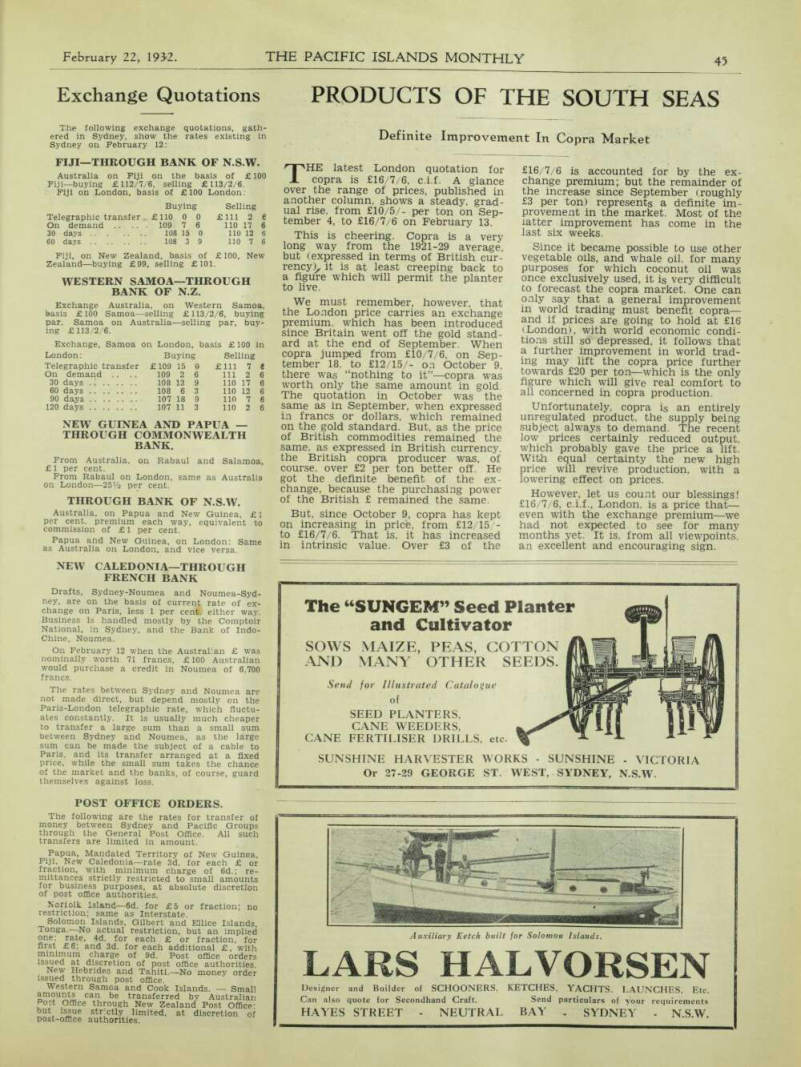
The following exchange quotations, gath ered in Sydney, show the rates existing in Sydney on February 12:
Fiji—Through Bank Of N.S.W.
Australia on Fiji on the basis of £100 Fiji—buying £112/7/6, selling £113/2/6.
Fiji on London, basis of £100 London;
Western Samoa—Through
Bank Of N.Z.
Exchange Australia, on Western Samoa, basis £100 Samoa—selling £113/2/6, buying par. Samoa on Australia —selling par, buy ing £113/2/6.
New Guinea And Papua
Through Commonwealth
Bank.
From Australia, on Rabaul and Salamoa, £1 per cent.
From Rabaul on London, same as Australia on London —25½ per cent.
Through Bank Of N.S.W.
Australia, on Papua and New Guinea, £1 per cent, premium each way, equivalent to commission of £1 per cent.
Papua and New Guinea, on London: Same as Australia on London, and vice versa.
New Caledonia—Through
French Bank
Drafts, Sydney-Noumea and Noumea-Syd ney, are on the basis of current rate of ex change on Paris, less 1 per cent, either way.
Business is handled mostly by the Comptoir National, in Sydney, and the Bank of Indo Chine, Noumea.
On February 12 when the Australian £ was nominally worth 71 francs, £100 Australian would purchase a credit in Noumea of 6,700 francs.
The rates between Sydney and Noumea are not made direct, but depend mostly on the Paris-London telegraphic rate, which fluctu ates constantly. It is usually much cheaper to transfer a large sum than a small sum between Sydney and Noumea, as the large sum can be made the subject of a cable to Paris, and its transfer arranged at a fixed price, while the small sum takes the chance of the market and the banks, of course, guard themselves against loss.
Post Office Orders.
The following are the rates for transfer of money between Sydney and Pacific Groups through the General Post Office. All such transfers are limited in amount.
Papua, Mandated Territory of New Guinea.
Fiji. New Caledonia—rate 3d. for each £ or fraction, with minimum charge of 6d.; re mittances strictly restricted to small amounts for business purposes, at absolute discretion of post office authorities.
Norfolk Island—6d. for £5 or fraction; no restriction; same as Interstate.
Solomon Islands, Gilbert and Ellice Islands, Tonga.—No actual restriction, but an implied one; rate, 4d. for each £ or fraction, for first £6; and 3d. for each additional £, with minimum charge of 9d. Post office orders issued at discretion of post office authorities.
New Hebrides and Tahiti.—No money order issued through post office.
Western Samoa and Cook Islands. Small amounts can be transferred by Australian Post Office through New Zealand Post Office: but issue strictly limited, at discretion of post-office authorities.
Buying Selling Telegraphic transfer... £110 0 0 £111 2 6 On demand .. ... 109 7 6 110 17 6 30 days 108 15 0 110 12 6 60 days 108 3 9 110 7 6 Fiji, on New Zealand, basis of £100, New Zealand—buying £99, selling £101.
Exchange, Samoa on London, basis £ 100 in London: Buying Selling Telegraphic transfer £109 15 0 £111 7 6 On demand ... 109 2 6 111 2 6 30 days 108 13 9 110 17 6 60 days 108 6 3 110 12 6 90 days 107 18 9 110 7 6 120 days 107 11 3 110 2 6
Products Of The South Seas
Definite Improvement In Copra Market
THE latest London quotation for copra is £16/7/6, c.i.f. A glance over the range of prices, published in another column, shows a steady, grad ual rise, from £10/5/- per ton on September 4, to £16/7/6 on February 13.
This is cheering. Copra is a very long way from the 1921-29 average, but (expressed in terms of British cur rency), it is at least creeping back to a figure which will permit the planter to live.
We must remember, however, that the London price carries an exchange premium, which has been introduced since Britain went off the gold stand ard at the end of September. When copra jumped from £10/7/6, on Sep tember 18, to £12/15/- on October 9. there was “nothing to it”—copra was worth only the same amount in gold The quotation in October was the same as in September, when expressed in francs or dollars, which remained on the gold standard. But, as the price of British commodities remained the same, as expressed in British currency, the British copra producer was, of course, over £2 per ton better off. He got the definite benefit of the ex change, because the purchasing power of the British £ remained the same.
But, since October 9, copra has kept on increasing in price, from £12/15to £16/7/6. That is, it has increased in intrinsic value. Over £3 of the
£16/7/6 is accounted for by the ex change premium; but the remainder of the increase since September (roughly £3 per ton) represents a definite im provement in the market. Most of the latter improvement has come in the last six weeks.
Since it became possible to use other vegetable oils, and whale oil, for many purposes for which coconut oil was once exclusively used, it i s very difficult to forecast the copra market. One can only say that a general improvement in world trading must benefit copra— and if prices are going to hold at £16 (London), with world economic condi tions still so depressed, it follows that a further improvement in world trad ing may lift the copra price further towards £20 per ton—which is the only figure which will give real comfort to all concerned in copra production.
Unfortunately, copra is an entirely unregulated product, the supply being subject always to demand. The recent low prices certainly reduced output, which probably gave the price a lift.
With equal certainty the new high price will revive production, with a lowering effect on prices.
However, let us count our blessings! £16/7/6, c.i.f., London, is a price that— even with the exchange premium—we had not expected to see for many months yet. It is, from all viewpoints, an excellent and encouraging sign.
Advertisements & other items, p. 47 (1 item)
Lars Halvorsen
The “SUNGEM” Seed Planter
and Cultivator
SOWS MAIZE, PEAS, COTTON
AND MANY OTHER SEEDS.
Send for Illustrated Catalogue of
SEED PLANTERS.
CANE WEEDERS,
CANE FERTILISER DRILLS, etc.
SUNSHINE HARVESTER WORKS - SUNSHINE - VICTORIA Or 27-29 GEORGE ST. WEST, SYDNEY, N.S.W.
Auxiliary Ketch built for Solomon Islands.
LARS HALVORSEN
Designer and Builder of SCHOONERS, KETCHES, YACHTS. LAUNCHES, Etc.
Can also quote for Secondhand Craft. Send particulars of your requirements HAYES STREET - NEUTRAL BAY . SYDNEY - N.S.W.
Market Quotations
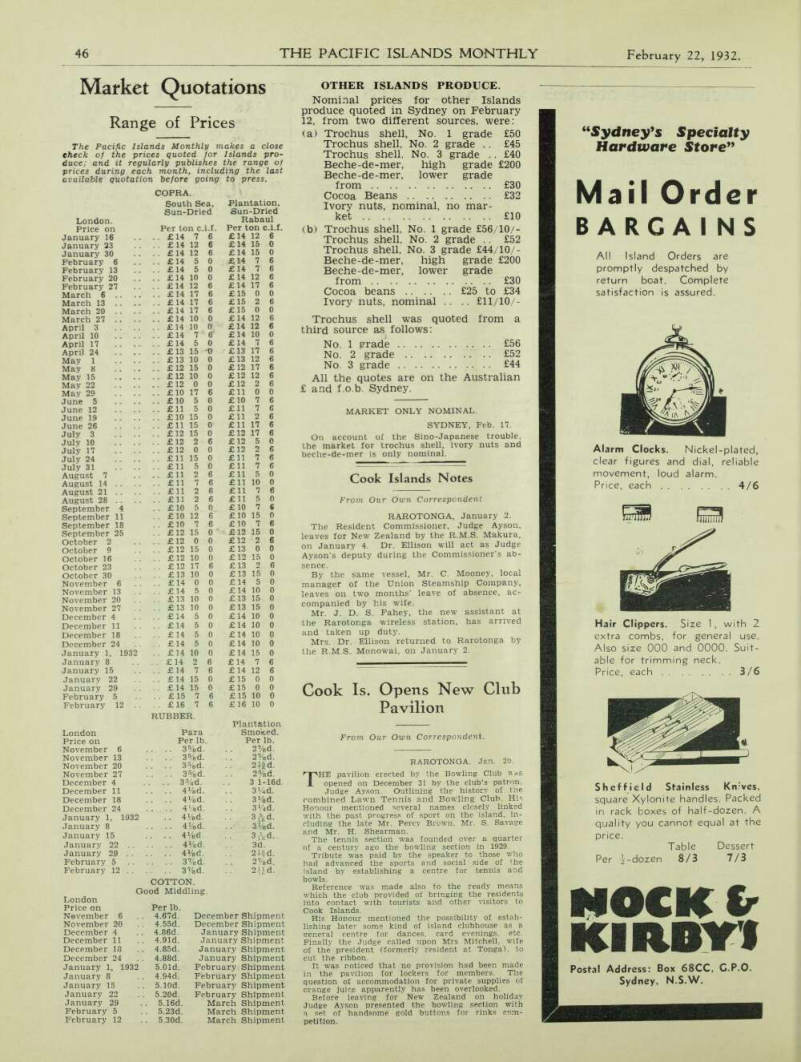
Range of Prices
The Pacific Islands Monthly makes a close check of the prices quoted for Islands pro duce; and it regularly publishes the range of prices during each month, including the last available quotation before going to press.
Other Islands Produce.
Nominal prices for other Islands produce quoted in Sydney on February 12, from two different sources, were: (a) Trochus shell, No. 1 grade £50 Trochus shell, No. 2 grade .. £45 Trochus shell, No. 3 grade .. £40 Beche-de-mer, high grade £200 Beche-de-mer, lower grade from £30 Cocoa Beans £32 Ivory nuts, nominal, no mar ket £10 (b) Trochus shell, No. 1 grade £56/10/- Trochus shell. No. 2 grade .. £52 Trochus shell. No. 3 grade £44/10/- Beche-de-mer, high grade £200 Beche-de-mer, lower grade from £30 Cocoa beans £25 to £34 Ivory nuts, nominal .. .. £11/10/- Trochus shell was quoted from a third source as follows: No. 1 grade £56 No. 2 grade £52 No. 3 grade £44 All the quotes are on the Australian £ and f.o.b. Sydney.
Market Only Nominal.
Sydney, Feb. 17.
On account of the Sino-Japanese trouble, the market for trochus shell, ivory nuts and beche-de-mer is only nominal.
Copra.
South Sea, Plantation.
Sun-Dried Sun-Dried London.
Rabaul Price on Per ton c.i.f.
Per ton c.i.f.
January 16 .. £14 7 6 £14 12 6 January 23 . . £14 12 6 £14 15 0 January 30 .. £14 12 6 £14 15 0 February 6 . . £14 5 0 £14 7 6 February 13 . . £14 5 0 £14 7 6 February 20 . . £14 10 0 £14 12 6 February 27 .. £14 12 6 £14 17 6 March 6 .. £14 17 6 £15 0 0 March 13 . . £14 17 6 £15 2 6 March 20 .. .. £14 17 6 £15 0 0 March 27 .. .. £14 10 0 £14 12 6 April 3 .. £14 10 0 £14 12 6 April 10 . . £14 7 6 £14 10 0 April 17 .. £14 5 0 £14 7 6 April 24 . . £13 15 -o £13 17 6 May 1 . . £13 10 0 £13 12 6 May 8 .. £12 15 0 £12 17 6 May 15 .. £12 10 0 £12 12 6 May 22 .. £12 0 0 £12 2 6 May 29 . . £10 17 6 £11 0 0 June 5 . . £10 5 0 £10 7 6 June 12 .. £11 5 0 £11 7 6 June 19 . . £10 15 0 £11 2 6 June 26 . . £11 15 0 £11 17 6 July 3 .. £12 15 0 £12 17 6 July 10 . . £12 2 6 £12 5 0 July 17 . . £12 0 0 £12 2 6 July 24 .. £11 15 0 £11 7 6 July 31 . . £11 5 0 £11 7 6 August 7 . . £11 2 6 £11 5 0 August 14 .. . . £11 7 6 £11 10 0 August 21 . . . . £11 2 6 £11 7 6 August 28 . . . . £11 2 6 £11 5 0 September 4 . . £10 5 0 £10 7 6 September 11 . . £10 12 6 £10 15 0 September 18 . . £10 7 6 £10 7 6 September 25 . . £12 15 0 * £12 15 0 October 2 . . £12 0 0 £12 2 6 October 9 .. £12 15 0 £13 0 0 October 16 . . £12 10 0 £12 15 0 October 23 . . £12 17 6 £13 2 6 October 30 . . £13 10 0 £13 15 0 November 6 . . £14 0 0 £14 5 0 November 13 . . £14 5 0 £14 10 0 November 20 . . £13 10 0 £13 15 0 November 27 . . £13 10 0 £13 15 0 December 4 . . £14 5 0 £14 10 0 December 11 . . £14 5 0 £14 10 0 December 18 .. £14 5 0 £14 10 0 December 24 .. £14 5 0 £14 10 0 January 1, 1932 . . £14 10 0 £14 15 0 January 8 . . £14 2 6 £14 7 6 January 15 .. £14 7 6 £14 12 6 January 22 . . £14 15 0 £15 0 0 January 29 . £14 15 0 £15 0 0 February 5 . . £15 7 6 £15 10 0 February 12 . . £16 7 6 £16 10 0
Rubber.
Plantation Smoked Per lb.
London Price on Para Per lb.
November 6 .. .. 3 5 /sd. 2 7 /sd.
November 13 .. . . 3%d. 27'sd.
November 20 .. .. 3%d. d.
November 27 . . . . 3%d. 2%d.
December 4 . . .. 3 3 / 4 d. 3 1- 16d December 11 . . . . 4V 8 d. sy 4 d.
December 18 .. .. 4V 8 d. 3 y 8 d.
December 24 . . . . 4 'sd. sy 4 d.
January 1, 1932 .. 4V 8 d. 3&d.
January 8 .. .. 4V 8 d. 3y 8 d.
January 15 . . .. 4y 8 d. 3 A d.
January 22 .. . . 4y s d. 3d.
January 29 . . . . . 4Ved. 2!;ld.
February 5 . . . . 3 7 /sd. 2% id.
February 12 . .. .. 3 7 / 8 d. 2 n d.
Cotton.
Good Middling.
London Price on Per lb.
November 6 4.67d.
December Shipment November 20 4.55d.
December Shipment December 4 4.86d.
January Shipment December 11 4.91d.
January Shipment December 18 4.85d.
January Shipment December 24 4.88d.
January Shipment January 1, 1932 5.Old.
February Shipment January 8 , 4.94d.
February Shipment January 15 . 5.10d.
February Shipment January 22 5.20d.
February Shipment January 29 . 5.16d.
March Shipment February 5 . 5.23d.
March Shipment February 12 . 5.30d.
March Shipment
Cook Islands Notes
From Our Own Correspondent RAROTONGA, January 2.
The Resident Commissioner, Judge Ayson, leaves for New Zealand by the R.M.S. Makura, on January 4. Dr. Ellison will act as Judge Ayson’s deputy during the Commissioner’s ab sence.
By the same vessel, Mr. C. Mooney, local manager of the Union Steamship Company, leaves on two months’ leave of absence, ac companied by his wife.
Mr. J. D. S. Fahey, the new assistant at the Rarotonga wireless station, has arrived and taken up duty.
Mrs. Dr. Ellison returned to Rarotonga by the R.M.S. Monowai. on January 2.
Cook Is. Opens New Club
Pavilion
From Our Own Correspondent.
Rarotonga, Jan. 20.
THE pavilion erected by the Bowling Club was opened on December 31 by the club’s patron, Judge Ayson. Outlining the history of the combined Lawn Tennis and Bowling Club. His Honour mentioned several names closely linked with the past progress of sport on the island, in cluding the late Mr. Percy Brown, Mr. S. Savage and Mr. H. Shearman.
The tennis section was founded over a quarter of a century ago the bowling section in 1929.
Tribute was paid by the speaker to those who had advanced the sports and social side of the island by establishing a centre for tennis and bowls.
Reference was made also to the ready means which the club provided of bringing the residents into contact with tourists and other visitors to Cook Islands.
His Honour mentioned the possibility of estab lishing later some kind of island clubhouse as a general centre for dances, card evenings, etc.
Finally the Judge called upon Mrs Mitchell, wife of the president (formerly resident at Tonga), to cut the ribbon.
It was noticed that no provision had been made in the pavilion for lockers for members. The question of accommodation for private supplies of orange juice apparently has been overlooked.
Before leaving for New Zealand on holiday Judge Ayson presented the bowling section with a set of handsome gold buttons for rinks com petition.
Advertisements & other items, p. 48 (1 item)
Kirby's
“Sydneys Specialty
Hardware Store ”
Mail Order
BARGAINS
All Island Orders are promptly despatched by return boat. Complete satisfaction is assured.
Alarm Clocks. Nickel-plated, clear figures and dial, reliable movement, loud alarm.
Hair Clippers. Size 1, with 2 extra combs, for general use.
Also size 000 and 0000. Suit able for trimming neck.
Sheffield Stainless Knives. square Xylonite handles. Packed in rack boxes of half-dozen. A quality you cannot equal at the price.
Table Dessert Per ½-dozen 8/3 7/3
NOCK &
KIRBY'S
Postal Address: Box 68CC, C.P.O.
Sydney. N.S.W.
Price, each 4/6 Price, each 3/6
Shipping Services in The Pacific
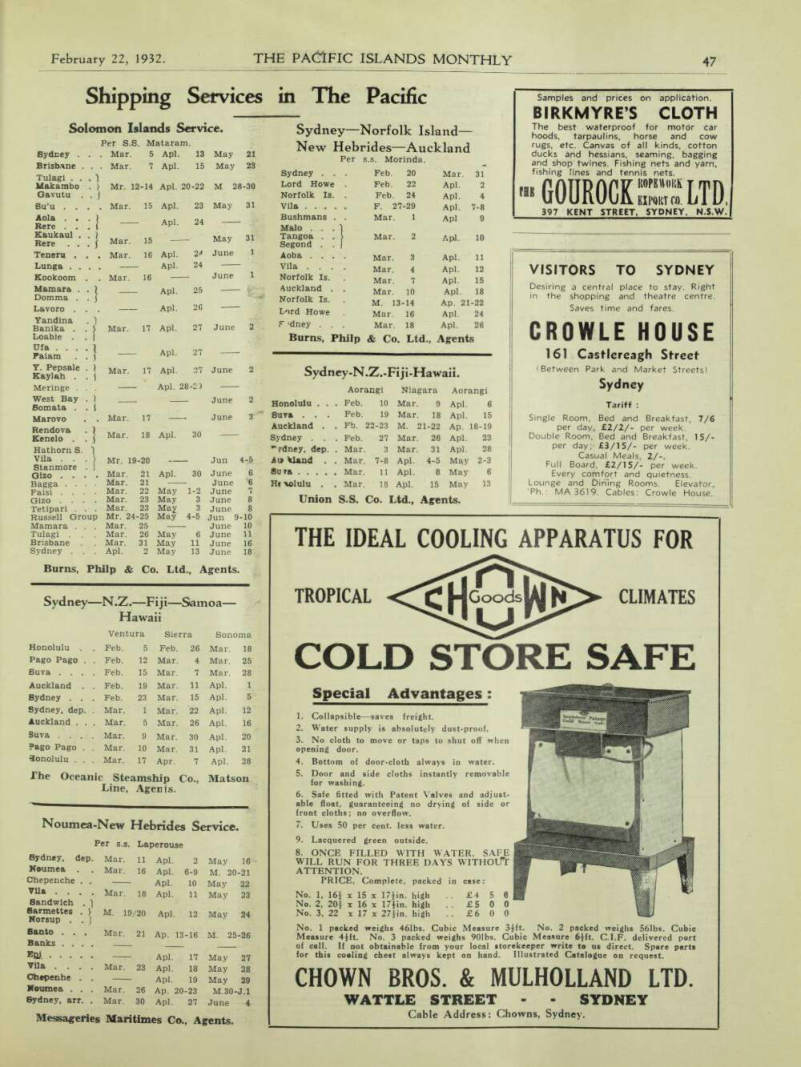
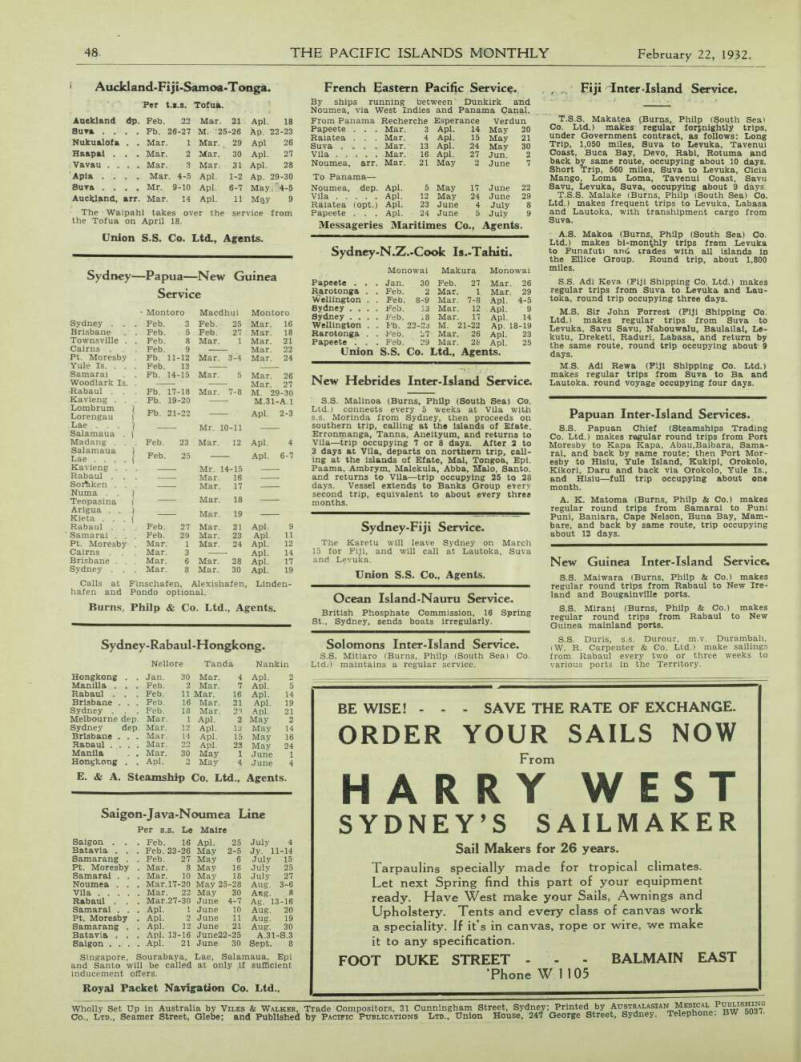
Solomon Islands Service.
Sydney—N.Z.—Fiji—Samoa— Hawaii
Noumea-New Hebrides Service.
Sydney —Norfolk Island — New Hebrides —Auckland
Sydncy-N.Z.-Fiji-Hawaii.
Per S.S. Mataram.
Sydney . . , Mar. 5 Apl. 13 May 21 Brisbane . . . Mar. 7 Apl. 15 May 23 Tulagi . . , Makambo i Mr. 12-14 Apl. 20 -22 M 28-30 Gavutu . .
Bu’u . . . . Mar. 15 Apl. 23 May 31 Aola . . .
Here . . .
Apl. 24 — Kaukaul . .
Here . . .
j Mar.
15 — May 31 Teneru . . . Mar. 16 Apl. 2 J June 1 Lunga . . .
Apl. 24 — 1 Kookoom . Mar. 16 — June Mamara . .
Apl. 25 IT Domma . .
Lavoro . .
Apl. 26 — Yandina Banika . .
\ Mar.
17 Apl. 27 June 2 Loabie . .
Ufa ...
Paiam . .
Apl. 27 — Y. Pepsale .
Kaylah . .
Mar.
17 Apl. 27 June 2 Meringe . . — Apl. 28 ■23 — West Bay .
June 2 Somata . .
Marovo . Mar. 17 June r Rendova Kenelo . .
Mar.
18 Apl. 30 — Hathorn S. 1 Vila . . .
Mr. 19-20 Jun 4-5 Stanmore .
Gizo . . . . Mar. 21 Apl. 30 June 6 Bagga . . .
Mar. 21 — June 6 Faisi . .
Mar. 22 May 1 -2 June 7 Gizo .
Mar. 23 May 3 June 8 Tetipari . .
Mar. 23 May 3 June 8 Russell Group Mr. 24-25 May 4-5 Jun 9- 10 Mamara . .
Mar. 25 — June 10 Tulagi . .
Mar. 26 May 6 June 11 Brisbane Mar. 31 May 11 June 16 Sydney . . . Apl. 2 May 13 June 18 Burns, Philp & Co. Ltd., Agents.
Per s.s. Morinda Sydney . .
Feb. 20 Mar. 31 Lord Howe Feb. 22 Apl. 2 Norfolk Is.
Feb. 24 Apl. 4 Vila . . . .
F. 27-29 Apl. 7-8 Bushmans .
Mar. 1 Apl 9 Malo . . .
Tangoa . .
Mar. 2 Apl. 10 Segond . .
Aoba . . .
Mar. 3 Apl. 11 Vila . . .
Mar. 4 Apl. 12 Norfolk Is.
Mar. 7 Apl. 15 Auckland Mar. 10 Apl. 18 Norfolk Is.
M. 13- •14 Ap. 21 -22 Lord Howe Mar. 16 Apl. 24 r T dney . .
Mar. 18 Apl. 26 Burns, Philp & Co. Ltd., Agents
Aorangi Niagara Aorangi Honolulu . . . Feb. 10 Mar. 9 Apl. 6 Suva . . .
Feb. 19 Mar. 18 Apl. 15 Auckland . . Fb. 22-23 M. 21-22 Ap. 18-19 Sydney . . . Feb. 27 Mar. 26 Apl. 23 "7dney, dep. . Mar. 3 Mar. 31 Apl. 28 Ai> kland . . Mar. 7-8 Apl. 4-5 May 2-3 Sura , Mar. 11 Apl. 8 May 6 Hi v>lulu . . . Mar. 18 Apl. 15 May 13 Union s.s. Co. Ltd., Agents.
Ventura Sierra Sonoma Honolulu . Feb. 5 Feb. 26 Mar. 18 Pago Pago . . Feb. 12 Mar. 4 Mar. 25 Suva . . . . Feb. 15 Mar. 7 Mar. 28 Auckland . Feb. 19 Mar. 11 Apl. 1 Sydney . . . Feb. 23 Mar. 15 Apl. 5 Sydney, dep.
Mar. 1 Mar. 22 Apl. 12 Auckland . .
Mar. 5 Mar. 26 Apl. 16 Suva . . .
Mar. 9 Mar. 30 Apl. 20 Pago Pago .
Mar. 10 Mar. 31 Apl. 21 Honolulu . .
Mar. 17 Apr. 7 Apl. 28 The Oceanic Steamship Co., Matson
Line, Agents.
Per s.s. Laperouse Sydney, dep.
Mar. 11 Apl. 2 May 16 Noumea Mar. 16 Apl. i 6-9 M. 20 -21 Chepenche . . — Apl. 10 May 22 Vila ...
Mar. is Apl. 11 May 23 Sandwich . ] Barmettes . y Norsup . . J M. 19/20 Apl. 12 May 24 Santo . . .
Mar. 21 Ap. 13 -16 M. 25-26 Banks ... — Epi — Apl. 17 May 27 Vila ...
Mar. 23 Apl. 18 May 28 Chepenhe . . — Apl. 19 May 29 Noumea . . .
Mar. 26 Ap. 20-23 M.30-J.1 Sydney, arr. .
Mar. 30 Apl. 27 June 4 Messageries Maritimes Co., Agents.
Auckland-Fiji-Samoa-T onga.
Sydney—Papua—New Guinea Service
Sydney-Rabaul-Hongkong.
Saigon-Java-Noumea Line
French Eastern Pacific Service.
Sydncy-N.Z.-Cook Is.-Tahiti,
New Hebrides Inter-Island Service,
S.S. Malinoa (Burns, Philp (South Sea) Co.
Ltd.) connects every 5 weeks at Vila with s.s. Morinda from Sydney, then proceeds on southern trip, calling at the islands of Elate.
Erronmanga, Tanna, Aneityum, and returns to Vila —trip occupying 7 or 8 days. After 2 to 3 days at Vila, departs on northern trip, call ing at the islands of Efate, Mai, Tongoa, Epi.
Paama, Ambrym, Malekula, Abba, Halo, Santo, and returns to Vila —trip occupying 25 to 28 days. Vessel extends to Banks Group every second trip, equivalent to about every three months.
Sydney-Fiji Service.
The Karetu will leave Sydney on March 15 for Fiji, and will call at Lautoka, Suva and Levuka.
Union S.S. Co., Agents.
Ocean Island-Nauru Service.
British Phosphate Commission, 16 Spring St., Sydney, sends boats irregularly.
Solomons Inter-Island Service.
S.S. Mitiaro (Burns, Philp (South Sea) Co.
Ltd.) maintains a regular service.
Fiji Inter-Island Service.
T.S.S. Makatea (Burns, Philp (South Sea) Co. Ltd.) makes regular fortnightly trips, under Government contract, as follows; Long Trip, 1,050 miles, Suva to Levuka, Tavenui Coast, Buca Bay, Devo, Rabi, Rotuma and back bj same route, occupying about 10 days.
Short Trip, 560 miles, Suva to Levuka, Cicia Mango, Loma Loma, Tavenui Coast, Savu Savu, Levuka, Suva, occupying about 9 days.
T.S.S. Malake (Burns, Philp (South Sea) Co.
Ltd.) makes frequent trips to Levuka, Labasa and Lautoka, with transhipment cargo from Suva.
A.S. Makoa (Burns, Philp (South Sea) Co.
Ltd.) makes bi-monthly trips from Levuka to Funafuti and trades with all islands in the Ellice Group. Round trip, about 1,800 miles.
S.S. Adi Keva (Fiji Shipping Co. Ltd.) makes regular trips from Suva to Levuka and Lau toka, round trip occupying three days.
M.S. Sir John Forrest (Fiji Shipping Co.
Ltd.) makes regular trips from Suva to Levuka, Savu Savu, Nabouwalu, Baulailai, Le kutu, Dreketi, Raduri, Labasa, and return by the same route, round trip occupying about 9 days.
M.S. Adi Rewa (Fiji Shipping Co. Ltd.) makes regular trips from Suva to Ba and Lautoka. round voyage occupying four days.
Papuan Inter-Island Services.
S.S. Papuan Chief (Steamships Trading Co. Ltd.) makes regular round trips from Port Moresby to Kapa Kapa. Abau, Baibara, Sama rai, and back by same route; then Port Mor esby to Hisiu, Yule Island, Kukipl, Orokolo, Kikori, Daru and back via Orokolo, Yule Is., and Hisiu—full trip occupying about one month, A. K. Matoma (Burns, Philp & Co.) makes regular round trips from Samarai to Puni Puni, Baniara, Cape Nelson, Buna Bay, Mam bare, and back by same route, trip occupying about 12 days.
New Guinea Inter-Island Service,
S.S. Maiwara (Burns, Philp & Co.) makes regular round trips from Rabaul to New Ire land and Bougainville ports.
S.S. Mirani (Burns, Philp & Co.) makes regular round trips from Rabaul to New Guinea mainland ports.
S.S. Duris, s.s. Durour, m.v. Durambah, (W. R. Carpenter & Co. Ltd.) make sailings from Rabaul every two or three weeks to various ports in the Territory.
By ships running between Dunkirk and Noumea, via West Indies and Panama Canal.
From Panama Recherche Esperance Vejrdun Papeete . . .
Mar. 3 Apl. 14 May 20 Raiatea . . .
Mar. 4 Apl. 15 May 21 Suva . . , .
Mar. 13 Apl. 24 May 30 Vila Mar. 16 Apl. 27 Jun. 2 Noumea, arr.
Mar. 21 May 2 June 7 To Panama — Noumea, dep.
Apl. 5 May 17 June 22 Vila Apl. 12 May 24 June 29 Raiatea (opt.) Apl. 23 June 4 July 8 Papeete . . .
Apl. 24 June 5 July 9
Messageries Maritimes Co., Agents.
Monowai Makura Monowai Papeete . . . Jan. 30 Feb. 27 Mar. 26 Rarotonga . . Feb. 2 Mar. 1 Mar. 29 Wellington . . Feb. 8-9 Mar. 7-8 Apl. 4-5 Sydney ... Feb. 13 Mar. 12 Apl. 9 Sydney ... Feb. i8 Mar. 17 Apl. 14 Wellington . . Fb. 22-23 M. 21-22 Ap. 18-19 Rarotonga . . Feb. 27 Mar. 26 Apl. 23 Papeete . . . Feb. 29 Mar. 28 Apl. 25 Union S.S. Co. Ltd., Agents.
Per t.a.s.
Tofua.
Auckland dp.
Feb. 22 Mar. 21 Apl, 18 Sura . . . .
Fb. 26-27 M. 25-26 Ap. 22-23 Nukualofa . .
Mar. 1 Mar. 29 Apl 26 Haapai . . .
Mar. 2 Mar. 30 Apl. 27 Vavau . . . .
Mar. 3 Mar. 31 Apl. 28 Apia . . , .
Mar. 4-5 Apl. 1-2 Ap. 29-30 Sura . . . .
Mr. 9-10 Apl. 6-7 May '4-5 Auckland, arr.
Mar. 14 Apl. 11 M§y 9 The Waipahi takes over the service from the Tofua on April 18.
Union S.S. Co. Ltd., Agents.
* Montoro Macdhul Montoro Sydney . . .
Feb. 3 Feb. 25 Mar. 16 Brisbane Feb. 5 Feb. 27 Mar. 18 Townsville . .
Feb. 8 Mar. 1 Mar. 21 Cairns . .
Feb. 9 Mar. 22 Pt. Moresby Fb. 11- -12 Mar. 3-4 Mar. 24 Yule Is. . .
Feb. 13 — Samarai Fb. 14- -15 Mar. 5 Mar. 26 Woodlark Is. — — Mar. 27 Rabaul . .
Fb. 17- ■18 Mar. ' 7-8 M. 29 -30 Kavieng . .
Fb. 19-20 — M.31- A. 1 Lombrum Lorengau i Fb. 21 -22 — Apl. 2-3 Lae . . .
Mr. 10 -11 Salamaua . Madang . .
Feb. 23 Mar. 12 Apl. 4 Salamaua Lae . . . .
Feb. 25 — Apl. 6-7 Kavieng . .
Mr. 14 -15 Rabaul . .
Mar. 16 Sortiken . .
Mar. 17 Numa . .
Teopasina f — Mar. 18 Arigua . .
Kieta . . . — Mar. 19 Rabaul . .
Feb. 27 Mar. 21 Apl. 9 Samarai . .
Feb. 29 Mar. 23 Apl. 11 Pt. Moresby Mar. 1 Mar. 24 Apl. 12 Cairns . .
Mar. 3 — Apl. 14 Brisbane . .
Mar. 6 Mar. 28 Apl. 17 Sydney . .
Mar. 8 Mar. 30 Apl. 19 Calls at Finschafen, Alexishafen, Lindenhafen and Pondo optional.
Burns, Philp & Co. Ltd., Agents.
Nellore Tanda Nankin Hongkong . . Jan. 30 Mar. 4 Apl. 2 Manilla . . . Feb. 2 Mar. 7 Apl. 5 Rabaul . . . Feb. 11 Mar. 16 Apl. 14 Brisbane . , . . Feb. 16 Mar. 21 Apl. 19 Sydney . . . Feb. 18 Mar. 2?
Apl. 21 Melbourne dep. Mar. 1 Apl. 2 May 2 Sydney dep. Mar. 12 Apl. 13 May 14 Brisbane . , . . Mar. 14 Apl. 15 May 16 Rabaul . . . . Mar. 22 Apl. 23 May 24 Manila . . Mar. 30 May 1 June 1 Hongkong . . Apl. 2 May 4 June 4 E. & A. Steamship Co. Ltd., Agents.
Per s.s. Le Maire Saigon . . . Feb. 16 Apl. 25 July 4 Batavia . . . Feb. 23-26 May 2-5 Jy. 11-14 Samarang . . Feb. 27 May 6 July 15 Pt. Moresby . Mar. 8 May 16 July 25 Samarai . . . Mar. 10 May 18 July 27 Noumea . . . Mar. 17 -20 May 25-28 Aug. 3-6 Vila . . . . 22 May 30 Aug. 8 Rabaul . . . Mar.27-30 June 4-7 Ag. 13-16 Samarai . . . Apl. 1 June 10 Aug. 20 Pt. Moresby . Apl. 2 June 11 Aug. 19 Samarang . . Apl. 12 June 21 Aug. 30 Batavia . . . Apl. 13- -16 June22 -25 A.31-S.3 Saigon . . . . Apl. 21 June 30 Sept.8 Singapore, Sourabaya, Lae, Salamaua, Epi and Santo will be called at only if sufficient inducement offers.
Royal Packet Navigation Co, Ltd.,
Advertisements & other items, pp. 49-50 (2 items)
Cold Store
Samples and prices on application.
BIRKMYRE’S CLOTH
The best waterproof for motor car hoods, tarpaulins, horse and cow rugs, etc. Canvas of all kinds, cotton ducks and hessians, seaming, bagging and shop twines. Fishing nets and yarn, fishing lines and tennis nets.
ni GODROCKZmLTD.
397 KENT STREET, SYDNEY. N.S.W.
VISITORS TO SYDNEY
Desiring a central place to stay. Right in the shopping and theatre centre.
Saves time and fares.
CROWLE HOUSE
161 Castlereagh Street
'Between Park and Market Streets)
Sydney
Tariff : Single Room, Bed and Breakfast. 7/6 per day, £2/2/- per week.
Double Room, Bed and Breakfast, 15/per day; £3/15/- per week.
Casual Meals, 2/-.
Full Board, £2/15/- per week.
Every comfort and quietness.
Lounge and Dining Rooms. Elevator. ’Ph.: MA3619. Cables: Crowle House.
THE IDEAL COOLING APPARATUS FOR
TROPICAL
CLIMATES
COLD STORE
Special Advantages :
1. Collapsible—saves freight. 2. Water supply is absolutely dust-proof. 3. No cloth to move or taps to shut off when opening door. 4. Bottom of door-cloth always in water. 5. Door and side cloths instantly removable for washing. 6. Safe fitted with Patent Valves and adjustable float, guaranteeing no drying of side or front cloths; no overflow. 7. Uses 50 per cent, less water. 9. Lacquered green outside.
8. ONCE FILLED WITH WATER, SAFE
WILL RUN FOR THREE DAYS WITHOLfT
ATTENTION.
PRICE, Complete, packed in case: No. 1, 16} x 15 x 17}in. high £4 5 6 No. 2, 20} x 16 x 17}in. high £5 0 0 No. 3, 22 x 17 x 27}in. high £6 0 0 No. 1 packed weighs 461bs. Cubic Measure 3}ft. No. 2 packed weighs 56Ibs. Cubic Measure 4}ft. No. 3 packed weighs 901bs. Cubic Measure 6}ft. C.I.F. delivered port of call. If not obtainable from your local storekeeper write to us direct. Spare parts for this cooling chest always kept on hand. Illustrated Catalogue on request.
CHOWN BROS. & MULHOLLAND LTD.
WATTLE STREET - - SYDNEY
Cable Address: Chowns, Sydney.
BE WISE! - - - SAVE THE RATE OF EXCHANGE.
ORDER YOUR SAILS NOW
From
HARRY WEST
SYDNEY’S SAILMAKER
Sail Makers for 26 years.
Tarpaulins specially made for tropical climates.
Let next Spring find this part of your equipment ready. Have West make your Sails, Awnings and Upholstery. Tents and every class of canvas work a speciality. If it’s in canvas, rope or wire, we make it to any specification.
FOOT DUKE STREET - - - BALMAIN EAST ’Phone W 1 105
48
February 22, 1932.
THE PACIFIC ISLANDS MONTHLY
Wholly Set Up in Australia by Viles & Walker, Trade Compositors, 31 Cunningham Street, Sydney; Printed by Australasian[Medical■ p^ B i Is g®L G Co., Ltd., Seamer Street, Glebe; and Published by Pacific Publications Ltd., Union House, 247 George Street, Sydney. Telephone. BW wn-
Pacific Islands Association.
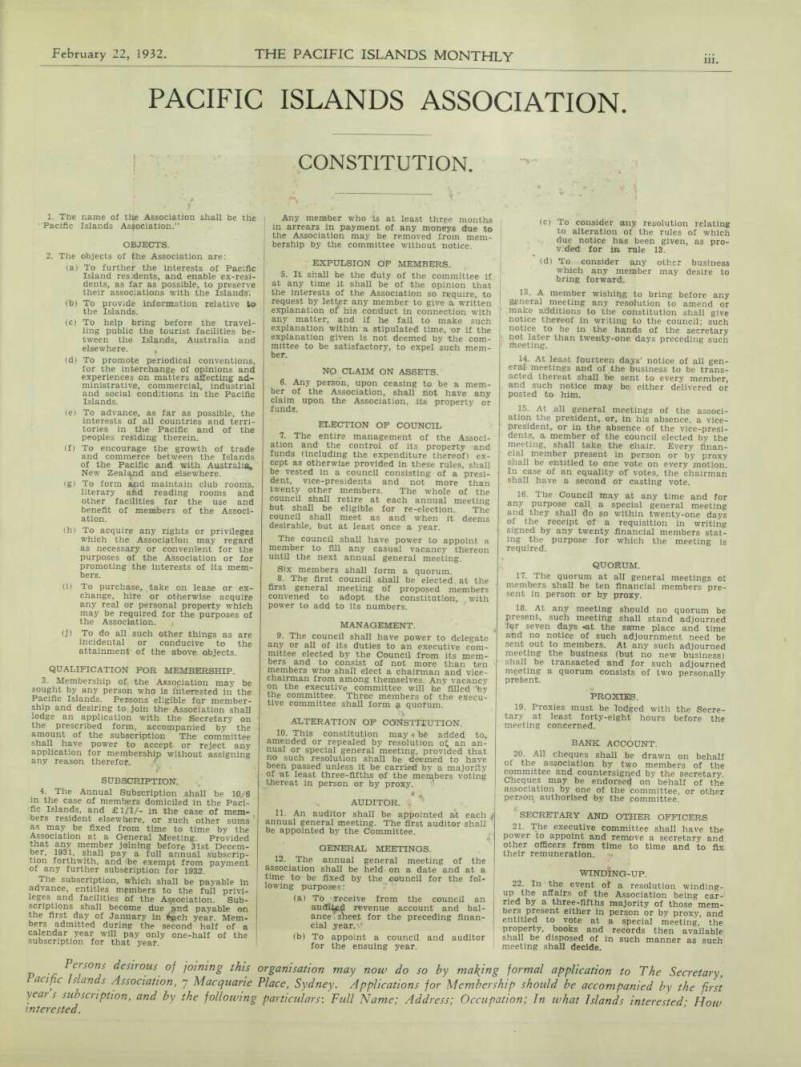
Constitution.
1. The name of the Association shall be the Pacific Islands Association.
Objects.
2. The objects of the Association are: (a) To further the interests of Pacific Island residents, and enable ex-resi dents, as far as possible, to preserve their associations with the Islands. (b) To provide information relative to the Islands. (c) To help bring before the travel ling public the tourist facilities be tween the Islands, Australia and elsewhere. (d) To promote periodical conventions, for the interchange of opinions and experiences on matters affecting ad ministrative, commercial, industrial and social conditions in the Pacific Islands. (e) To advance, as far as possible, the interests of all countries and terri tories in the Pacific and of the peoples residing therein. (f) To encourage the growth of trade and commerce between the Islands of the Pacific and with Australia, New Zealand and elsewhere. (g) To form apd maintain club rooms, literary and reading rooms and other facilities for the use and benefit of members of the Associ ation. (h) To acquire any rights or privileges which the Association may regard as necessary or convenient for the purposes of the Association or for promoting the interests of its mem bers. (i) To purchase, take on lease or ex change, hire or otherwise acquire any real or personal property which may be required for the purposes of the Association. (j) To do all such other things as are incidental or conducive to the attainment of the above objects.
Qualification For Membership.
3. Membership of, the Association may be sought by any person who is interested in the Pacific Islands. Persons eligible for member ship and desiring to, join the Association shall lodge an application with the Secretary on the prescribed form, accompanied by the amount of the subscription The committee shall have power to accept or reject any application for membership without assigning any reason therefor.
Subscription.
4. The Annual Subscription shall be 10/6 in the case of members domiciled in the Paci fic Islands, and £1/1/- in the case of mem bers resident elsewhere, or such other sums as may be fixed from time to time by the Association at a General Meeting. Provided that any member joining before 31st Decem ber, 1931, shall pay a full annual subscrip tion forthwith, and be exempt from payment of any further subscription for 1932.
The subscription, which shall be payable in advance, entitles members to the full privi leges and facilities of the Association. Sub scriptions shall become due snd payable on the first day of January in each year. Mem bers admitted during the second half of a calendar year will pay only one-half of the subscription for that year
Any member who is at least three months in arrears in payment of any moneys due to the Association may be removed from mem bership by the committee without notice.
Expulsion Of Members.
5. It shall be the duty of the committee if at any time it shall be of the opinion that the interests of the Association so require, to request by letter any member to give a written explanation of his conduct in connection with any matter, and if he fail to make such explanation within a stipulated time, or if the explanation given is not deemed by the com mittee to be satisfactory, to expel such mem ber.
No Claim On Assets.
6. Any person, upon ceasing to be a mem ber of the Association, shall not have any claim upon the Association, its property or funds.
Election Op Council
7. The entire management of the Associ ation and the control of its property and funds (including the expenditure thereof) ex cept as otherwise provided in these rules, shall be vested in a council consisting of a presi dent, vice-presidents and not more than twenty other members. The whole of the council shall retire at each annual meeting but shall be eligible for re-election. The council shall meet as and when it deems desirable, but at least once a year.
The council shall have power to appoint a member to fill any casual vacancy thereon until the next annual general meeting.
Six members shall form a quorum. 8. The first council shall be elected at the first general meeting of proposed members convened to adopt the constitution, with power to add to its numbers.
Management.
9. The council shall have power to delegate any or all of its duties to an executive com mittee elected by the Council from its mem bers and to consist of not more than ten members who shall elect a chairman and vice chairman from among themselves. Any vacancy on the executive committee will be filled hy the committee. Three members of the execu tive committee shall form a quorum.
Alteration Op Constitution.
10. This constitution may ahe added to, amended or repealed by resolution of an an nual or special general meeting, provided that no such resolution shall be deemed to have been passed unless it be carried by a majority of at least three-fifths of the members voting thereat in person or by proxy.
Auditor. -
11. An auditor shall be appointed at each annual general meeting. The first auditor shall be appointed by the Committee.
General Meetings.
12 - The annual general meeting of the association shall be held on a date and at a time to be fixed by the council for the fol
lowing purposes:
(a) To receive from the council an audited revenue account and bal ance sheet for the preceding finan cial year. (b) To appoint a council and auditor for the ensuing year.
(c) To consider any resolution relating to alteration of the rules of which due notice has been given, as pro vided for in, rule 13. (d) To consider any other business which any member may desire to bring forward. 13. A member wishitjg to bring before any general meeting any resolution to amend or make additions to the constitution shall give notice thereof in writing to the council; such notice to be in the hands of the secretary not later than twenty-one days preceding such meeting. 14. At least fourteen days’ notice of all gen eral meetings and of the business to be trans acted thereat shall be sent to every member, and such notice may be either delivered or posted to him. 15. At all general meetings of the associ ation the president, or, in his absence, a vice president, or in the absence of the vice-presi dents, a member of the council elected by the meeting, shall take the chair. Every finan cial member present in person or by proxy shall be entitled to one vote on every motion.
In case of an equality of votes, the chairman shall have a second or casting vote. 16. The Council may at any time and for any purpose call a special general meeting and they shall do so within twenty-one days of the receipt of a requisition in writing signed by any twenty financial members stat ing the purpose for which the meeting is required.
Quorum.
17. The quorum at all general meetings of members shall be ten financial members pre sent in person or by proxy. 18. At any meeting should no quorum be present, such meetihg shall stand adjourned for seven days «at the same place and time and no notice of such adjournment need be sent out to members. At any such adjourned meeting the business (but no new business) shall be transacted and for such adjourned meeting a quorum consists of two personally present.
Proxies.
19. Proxies must be lodged with the Secre tary at least forty-eight hours before the meeting concerned.
Bank Account.
20. All cheques shall be drawn on behalf of the association by two members of the committee and countersigned by the secretary.
Cheques may be endorsed on behalf of the association by one of the committee, or other person authorised by the committee.
Secretary And Other Officers
21. The executive committee shall have the power to appoint and remove a secretary and other officers from time to time and to fix their remuneration.
Winding-Up.
22. In the event of a resolution winding up the affairs of the Association being car ried by a three-fifths majority of those mem bers present either in person or by proxy, and entitled to vote at a special meeting, the property, books and records then available shall be disposed of in such manner as such meeting shall decide.
Persons desirous of joining this organisation may now do so by making formal application to The Secretary, Pacific Islands Association, 7 Macquarie Place, Sydney. Applications for Membership should be accompanied by the first year's subscription, and by the following particulars: Full Name; Address; Occupation; In what Islands interested • How interested.