Advertisements & other items, p. 1 (1 item)
The
Pacific Islands Monthly
THE ONLY JOURNAL CIRCULATING THROUGHOUT THE ISLAND TERRITORES AND GROUPS
OF THE CENTRAL AND SOUTH PACIFIC.
Vol. 2—No. 4.
Registered at G.P.O., Sydney, for transmission by Post as a Newspaper
SYDNEY: MONDAY, NOVEMBER 23, 1931.
Subscription: Single Copy 6d. Per Annum, posted, 6/-. ———
Japanese Entomologist to Visit Fiji
MR. KUMITO, an entomologist of the Japanese Department of Agriculture, is due to arrive in Suva from Honolulu.
He will spend one or two weeks in Fiji, his special mission being to study insect life which is hostile to the growth of forest trees. ... ===
Solomons’ Oldest
Inhabitants
From Our Own Correspondent.
Tulagi, Oct. 26.
The oldest white residents of the Solomons, in the persons of Mr. and Mrs. Sam Atkinson, of Faisi, go south by this boat on a much-tobe-regretted mission of health. Mr.
Atkinson requires expert attention and it is hoped the tender care of Mrs. Atkinson will be rewarded.
Born in the Solomons in the days when white residents could be counted on the fingers of one hand, Mrs.
Atkinson can relate tales of the most stirring adventure and early pioneering hardship. It is one of the heart breaking phases of the depression that just when they required the best of health to help them over the economic stile, these staunch old pioneers have been singled out for Fate’s unkindest kick—ill health. ... ===
Alternative Islands Crops
Some Further Information
World Markets For Various Oil-Seeds
There is a keen interest among planters throughout the South Seas in the subject of planting new, quickly-maturing crops which will give them an alternative income when the demand for their staple products falls away. Many inquiries for reliable information about these crops have been received, and the following article has been prepared.
THE three most promising crops are castor seeds, sesame plants and tung oil plants. Each of these produces an oil much in demand on the world’s markets.
Castor Oil.
Particulars of castor oil, which provides a valuable lubricant, were given in our issue of September, 1931. Since then, inquiries have been received as to what market exists for this oil in Australia.
The Statistical Register of the Commonwealth Government shows that in 1929-30, over £23,000 worth of the oil was imported. Details were as follows :— ... From ... Gallons. ... Value.
Britain ... 31,644 ... £7,424 India ... 23,300 ... 4,162 France ... 31,915 ... 7,922
U.S.A. ... 15,923 ... 4,737
Besides this oil, castor seeds were imported from India and Java and crushed at a mill, which has been established in Melbourne. The average price of the oil in Australia at present is 5/9 per gallon.
Not only does Australia provide a big market, but, by reason of the fact that it would be produced by cheap native labour in the Islands, it could doubtless favourably compete with the products of other countries on the world’s markets.
Castor seeds, c.i.f. London, were lately quoted by London merchants at about £10/15/- per ton. This price probably has improved since the alteration of the exchanges.
Messrs. Abel Lemon & Co. Pty. Ltd., of Sydney, are prepared to handle shipments of seeds from the Islands.
Sesame Or Gingelly Oil.
Sesame, which was dealt with in our July, 19 31, issue, is a hardy an nual plant. The oil crushed from the seeds comes under the liquid oil class and thus competes with peanut and cottonseed oil.
Inquiries made in Sydney show that there is a very poor chance of a market being obtained in the Commonwealth for this oil. Prior to the war, it was used very extensively here for margarine manufacture. In fact, the Pure Foods Act here, as elsewhere, stipulated that 5 per cent, of sesame had to be used in margarine as a “chemical indicator” —that is, in order to give margarine a distinct colour, so that it could be easily distinguished from butter. During the war sesame oil was unobtainable in Australia and a substitute became necessary.
Queensland arrowroot was allowed, and now this has completely displaced sesame in Australia as an essential constituent of margarine.
For liquid oil supplies, Australia is catered for mainly by cottonseed oil and to a lesser degree by peanut oil.
Cottonseed is marketed by the Queensland Cotton Board. In a fair average season, there is just about sufficient for the market, and in a bumper season the market is flooded.
In the last two or three years, only a very small quantity of sesame has been imported—it is not actually enumerated among the imports into Australia.
An Australian authority on oils states that he would not recommend the growing of sesame in the Islands, if it was only with the idea of supplying the Australian market.
However, a leading technical oil man, in touch with the markets of the world, considers sesame in altogether a different light. He is of the opinion that a world market awaits
it. There is a big demand for it in Europe, and the price of the oil at present is about £38 per ton. It is in much demand by the margarine manufacturers, as in most European factories it is still used as an essential constituent for the colouring purposes previously mentioned Comparing castor seeds and sesame as potential crops, it therefore appears as if castor is preferable, be cause a market nearer at hand is assured, whereas sesame would have to find a market overseas. India is practically the main source of supply of both seeds at present.
Results Of Tung Oil
Experiments
As anticipated by this journal the Fordii variety of the tung oil plant is not proving successful in the Pacific Islands. Experiments are now proceeding with the Montana variety, which does not produce the same quantity of this valuable oil; but it is thought that this plant will be better suited to Pacific conditions. Even tually, it is hoped that by grafting the two varieties, a plant suitable for Islands cultivation will be obtained and that this will be a better producer than Montana, and nearly equal to the Fordii.
Disappointment will be no doubt felt at the failure of Fordii in the groups where it has been tried, but it must be remembered that the home of the Fordii is in the great Yangtze Valley of China, over 35 degrees north of the equator, where, to quote The Pacific Islands Monthly of April, 1931, “the summers are warm enough for such crops as rice and giant millet, while wheat is grown in the cold weather when slight frost and snow may occur on high ground.”
The Montana grows in the region from the province of Chekiang, in the south-east, to Tonkin, and it is also grown in the Shan States of Burma.
This is an area which, in its distance from the equator, approximates that of the Pacific Islands, being about 10 degrees north of the line.
To reach an equal distance south of the equator to the Yangtze Valley for the successful cultivation of the Fordii, one must go as far south as, say, Sydney. This argument is substantiated by the report that the large plantation of Fordii plants, on the Johnstone River, Queensland, is not making the progress that was anticipated. Again, the efforts of tung oil companies in New Zealand, Auckland province, to be precise, give every promise of being successful ventures.
Here is a case of Fordii thriving well south of 35 degrees. Florida, U.S.A., where there are big Fordii plantations, is about 30 degrees north.
It is now a matter of waiting on results of Montana experiments and seeing what the scientists can then suggest in order to secure a better oil.
Meanwhile, a world market is available for tung oil, which is in growing demand as a paint ingredient. Imports into Australia alone for 1929-30 show that 139,967 gallons were imported, valued at £40,205. Of this China supplied £39,132 worth and Japan £751.
The price of tung oil in London in 1930 was £69/10/- per ton. It maintained this price for 12 months.
Desiccated Coconut.
The Australian market for desiccated coconut is now supplied exclusively by New Guinea and Papua. This
(Continued on Page 4) ... ===
on imports from other countries as from March 3, 1931.
Previous to this, Ceylon was the largest supplier of desiccated coconut to Australia, the 1929-30 figures showing that Ceylon supplied 1,553,335 lbs., of a value of £51,897.
The total value imported for the year was £105,796. Of this Papua supplied £40,735 worth and New Guinea £11,738. Since then, with the impetus provided by the Commonwealth Government, this industry has progressed rapidly. Plants are now operating at Lindenhafen, Pondo and Finschafen in New Guinea, and at Giligili, Galley Reach and Ahioma, Papua.
As the output increases new markets are being sought. It was thought that Canada might provide a new market, especially in view of the recent Australian-Canadian Trade Treaty. However, inquiries made of the Canadian Government Agent show that there is nothing in the Treaty applying to desiccated coconut.
Desiccated coconut, sweetened or not, from the Pacific Islands, is only provided for under the British Preference Tariff, the duty under this classification being 5 cents, per lb.
The general duty is 6 cents per lb.
The Canadian market is mainly supplied by Ceylon. Imports for 1929, under the various groupings for desiccated coconuts were: Sweetened or not, 2,106,825 lbs., of which 2,018,613 lbs. came from Ceylon.
Unsweetened, 174,025 lbs., all from Ceylon and Straits Settlements.
N.O.P., 53,426 lbs., all from Ceylon.
Coffee.
The coffee growing industry has been little exploited in the British Islands, although, of late, definite steps have been taken to carry out planting on a commercial basis. Good grades of coffee have been produced.
The market price at present is about £39 per ton, c.i.f., Sydney, for Java coffee.
Messrs. Abel Lemon & Co., Sydney, are prepared to handle shipments for planters Altogether, Australia during 1929- 30 imported coffee to the value of £186,557. Of this, only £379 worth came from the Islands, being made up as follows: ... Lbs. ... Value.
New Caledonia ... 1,815 ... £ 90 Papua ... 9,408 ... 283 New Guinea ... 13 ... 1
The bulk of Australia’s supplies came from the Dutch East Indies and India.
Cocoa Beans.
Australia provides a good market for cocoa beans. The price for the beans at present is about £32 per ton f.o.b. Sydney.
In the year 1929-30, Australia imported cocoa to the value of £256,769.
British West Africa supplied £88,000 worth and the West Indies £74,000.
Although a fine quality cocoa is produced in the Pacific Islands, these groups contributed only £17,000 worth to the total Australian importation for the year. The Pacific figures were as follows: ... Lbs. ... Value.
New Hebrides ... 594,466 ... £ 13,216 New Guinea ... 169,437 ... 3,844 Other Pacific Islands—
Western Samoa, where much cocoa is grown, does not figure at all among the supplying countries.
Green Ginger.
There is only a very small market in Australia for green ginger. In 1929-30, it was supplied exclusively by China, which country exported to Australia 100,285 lbs., of a value of £1,711. Ginger from China is subject to 1d. per lb. duty. Ginger imported to Australia from Papua or New Guinea is allowed in duty free.
Peanuts.
Peanuts are a prohibited import into Australia, even from Australia’s Island Territories —New Guinea and Papua. Peanuts are now grown extensively in Queensland.
Therefore, other outlets would have to be found for crops from the Islands. Canada suggests itself, for in 1929 this Dominion imported 354,051 dollars worth. China and United States supplied the majority of these peanuts.
Since that year, the Australian- Canadian trade treaty came into force, carrying definite preference for the Australian product. The exact text of the clause under the treaty is as follows: 109a — green, in the shell or not further processed than shelled —free (that is, free if coming from Australia).
The Canadian Governor-in-Council, when satisfied Australia can supply Canada’s requirements, may, by Order-in-Council, direct that there be substituted for tariff item 109a in Schedule A of Customs Tariff, 1907, and the enumeration of goods and the rates of duties of customs set
opposite the said item in Schedule A, the following : 109b —Peanuts, green, in the shell or not further processed than shelled —free.
British preference tariff: 4 cents per lb.
Intermediate tariff: 4 cents per lb.
General tariff: 4 cents per lb.
From and after the publication of such Order-in-Council in “The Canadian Gazette,” tariff item 109a as it appears in the said schedule at the time of the publication of the said order shall be repealed and the provisions of tariff item 109b shall be substituted therefor.
Apparently, this means Australia will have 4 cents per lb. preference over peanuts from other countries.
Australia's Preference
Tariff.
The following produce from New Guinea and Papua is allowed into Australia duty free under a preference tariff brought into effect in 1926: Coffee, raw and kiln dried.
Fruits, viz., Chicomamey, Litchie, Longan, Akee, Pulasam, Rambutam, Avocado, Mangosteen, Sapote, Sapodilla, Abiu, Starapple, Langsat, Imbui, llama, Durian, Jaboticaba, Grumichana, Kao pan, seedless Pummelo, and Jack fruit.
Fungi edible.
Ginger, green.
Grain and pulse, viz., Rangoon beans.
Nuts, viz,, Coconuts, whole.
Coconuts, prepared.
Coconuts, shelled or unshelled.
Seeds, viz., Kapok and sesame.
South Seas planters, contemplating the shipment of any kind of oil-bearing products to the London market, and desiring first-hand information regarding the market, could write to any of the leading agents there who handle oil-seeds. The following are two addresses: L. M. Fischel & Co. (1931) Ltd., 36 Mincing Lane, London, E.C.3, England.
Faure, Blattman & Co. Ltd., Holland House, Bury Street, London, E.C.3, England. ... === ...
The expenditure on education by the Fiji Government for 1930 amounted to £46,838. Prior to 1915, it amounted to only £3,000, and since then it has gradually increased to its present figure. ... === ...
Papuan Raid
"Massacre!”
Newspaper Shrieks Over Papuan Raid
The Sukis Again
IT was announced from Canberra, early in the month, that a radiogram had been received from Sir Hubert Murray, Administrator of Papua, to the effect that raiding parties of Sukis had come down from the upper regions of the Fly River and attacked villages on the lower part of the river, had killed some 17 natives and had thereafter returned up the river with their loot.
It was stated, also, that Mr. Woodward, the Resident Magistrate at Daru, had gone out with a party to investigate the position; and it is assumed that he will send a punitive expedition up the river after the Sukis with a view to administering some sort of punishment.
This is a common occurrence in Papua. It must be remembered that only the eastern portion of the Territory and the coastal districts of the remainder are definitely under Government control. The whole of the huge area represented by the north western portion of the Western
Suki Look-Out Man On Upper Fly
River
Division is not under control and is absolutely untamed and primitive.
Within this region are scores of savage and treacherous natives who have supplemented their means of livelihood, when occasion demanded, since time immemorial, by raiding their more peaceful and better-supplied neighbours. The Sukis, on the Upper Fly River, are notorious raiders.
White influence has succeeded in discouraging these raids; but that there has been so few of them in recent years is a matter for wonder.
It is probably due to the fact that, whenever possible, the Administration
A Suki Dried Head
sends an expedition
against the marauders and prompt punishment is applied. Sometimes, however, this takes months to accomplish.
Islands people, therefore, viewed with considerable amusement the shrieking headlines with which the
latest Suki raid was announced in Australia’s sensational papers. It was called a “massacre,” and an “uprising,” and a “rebellion”; and generally presented in an atmosphere of typographical excitement which suggested that the whole of the natives of New SUKIS IN THEIR PECULIAR TYPE OF CANOES
Guinea were up in arms and that half of the Administration officials had been scalped. ... ===
Prince Thakombau
Sydney Student is the Direct Descendant of Famous Fijian King
STUDYING at one of Sydney’s most exclusive colleges, with a view to taking the Arts course at Sydney University, and thence going on to Oxford or Cambridge, is young George
Prince Thakombau
Thakombau, of the Royal Family of Fiji. (He spells it “Cakobau,” but the old-style spelling is the better known.) King Thakombau, great-grandfather of this young Islands prince, was a very famous man in Fiji between 1835 and 1870. When he first came into notice he was the supreme chief of the tribe of Bau, but he was rivalled in power by Maasu, a Tongan chief, who had become head of the Fijian confederacy of Laua. There was considerable fighting and turbulence in the forties, and Thakombau gradually became the supreme power, so that he became recognised as King of Fiji. There was much cannibalism at Fiji at this time, and Thakombau in his early days was noted as the great est cannibal of them all. The literature of the second half of last century is full of references to “Thakombou, the Cannibal King.” Later, he was converted to Christianity and was a good friend of the missionaries.
About 1858 the United States demanded £9,000 from Thakombau as damages for certain outrages committed on American citizens, and the King, being much embarrassed, decided to get out of his trouble by offering the whole Fijian Group to Britain. This was declined, so Thakombau presently offered the group to the United States. America, at that time was busy with her Civil War, and did not even reply. There was another 10 years of turmoil and then, in 1873, Thakombau did succeed in persuading Britain to take over the group. Thakombau thereafter settled down and became a highly respectable old gentleman, one of the trusted native advisers of the British Administration, and lived for many years.
Thakombau sent his son, Joseph Thakombau, to Newington College, in Sydney, and his son in turn, the father of the present George Thakombau, was also well educated.
The present George Thakombau proposes to study law at Oxford and, also, Colonial Administration, so that when his time comes to follow his father as the paramount chief in Fiji, he will be well qualified to undertake his duties. He has an attractive personality and is a first-class athlete. ... ===
Advertisements & other items, p. 1 (1 item)
Residential Hotel
IMPERIAL
221 DARLINGHURST RD., KING’S CROSS
SYDNEY, N.S.W.
FULL BOARD AND RESIDENCE :
Weekly, from 45/- to 63/-. Daily, 10/-.
Management : Mr. and Mrs. Cyril Edwards ... ===
MISS JESSICA HARCOURT
The beautiful theatrical and film star says: "I find mercolized wax invaluable and use it regularly . It is certainly a very good skin cream being ideal under
powder ”
Follow the example of this very lovely girl. Use mercolized wax regularly for beauty. It is guaranteed pure and harmless ; it makes and keeps skin clear, charming. Does not grow hair. Buy this best of all beautifiers in 2/6 or 5/6 packages at chemist or store. Use it tonight.
Splendid for freckles, sunburn and skin imperfections.
In Western Samoa
League Of Nations’
Report
A VERY brief summary of the statement made before the League of Nations by New Zealand’s High Commissioner (Sir Thomas Wilford), explaining the present condition of Western Samoa, was received in Sydney by cable on November 8.
Sir Thomas pointed out that the decrease of unrest in Western Samoa was partly due to the centenary celebrations of the London Missionary Society, which had occupied the natives’ attention for some months.
The chiefs of the Mau, who had hitherto been the opponents of the Government, said Sir Thomas, were now attending the sittings of the Land Titles Commission, which was a striking change since last year.
Economic conditions in the Islands, he added, were recovering from the damage done by the recent hurricane and efforts were being made to find more varied sources of income. New Zealand was employing Samoans to an increasing degree as district officials. ———
Incorrect Chart
Niua-Foou Island
WE are much indebted to Mr. P.
W. Glover, B.Sc., F.R.A.S., of Samoa, for supplying- the accompanying accurate sketch map of Niua-
The Admiralty Chart
It is noted that the village of Haafoi (destroyed bu the 1909 hurricane) is shown on the wrong side of the island.
Fo’ou —the interesting place that is otherwise known as the “Tin-can Island,” in the Tongan group.
“The Admiralty Chart of Niua- Fo’ou is incorrect,” says Mr. Glover.
“I enclose a photographic reproduc-
Sketch Map Of Niua-FoÓU
Altitudes in metres: Lake level, 25 metres above sea. Lake depth, about 90 metres. The shore consists of steep basalt cliffs, except in the region of Futu, where several pieces of beach exist as a result of the 1929 eruption, the craters of which are along the dotted line between the two marks X.
tion, to show how untrustworthy it is.
The chart was compiled only from an eye-sketch, and as such is fairly good—and there was probably little time available to be spent on such an island by the crew of the survey ship.
“I enclose a rough sketch map. The shape is based on a survey made by Mr. F. J. Fuller, of Vavau, and the details of height, etc., are from my own observations last year. The island is very picturesque—especially so to one who, like myself, has had the opportunity of travelling round the ridge and of visiting the islands in and the shores of the great crater lake which forms its interior.” ... ===
Cook Islands Trade
IMPORTS into the Cook Islands for the quarter ended September 30, 1931, totalled £19,306, compared with £32,430 for the same quarter in the previous year. The main supply ing countries for the 1931 period, with the total value of the goods, were as follows: New Zealand . . . . £14,262
U.S.A. ... 1,947
U.K. ... 1,693 Australia ... 776 Exports for the 1931 quarter were valued at £26,187, compared with £37,198 for the same period in 1930.
The bulk of the exports were shipped to New Zealand. ... ===
Tongan Bananas
Big Contract With New Zealand
Another Loss To
Australia
From Our Own Correspondent.
Nukualofa, Oct. 28.
IT is now definitely stated that the Union S.S. Co. of New Zealand will send to our group every month a vessel for the direct carriage of Tongan bananas to the Dominion.
In anticipation of the arrival of the first of these ships, scheduled for early December, we learn that the Government has placed orders in New Zealand for a continued supply of crates—a supply commencing with a modest 2,000, and which it can reasonably be expected will extend to 10,000 a month by the middle of next year. It is predicted that the group will be in a position to actually fill 20,000 cases per month by the end of 1932; but these future shipments will, presumably, be controlled by demand.
As a starter, we understand that the Tongan Government has accepted, for a short term, a satisfactory contract price offered by a Dominion firm of buyers.
It is worthy of note that, although the price submitted by New Zealand for empty crates was far in excess of quotes received from other countries, the Tongan Government wisely decided to import from the Dominion. Thus our fruit destined for the New Zealand market will be packed in New Zealand containers.
We cannot refrain here from charging the Commonwealth of Australia with a lack of foresight in the matter of its Islands policy. It is to be expected that, owing to Fiji’s reciprocal agreement with New Zealand, Australia will gradually cease to interest that group to any extent,
and now Tonga is likely to follow suit.
For the past three months we here have heard nothing but shipping suggestions and fruit buyers’ offers. Did any of these come from the Commonwealth? Not on your life! New Zealand, with all her domestic troubles, has had sufficient vision to realise the necessity of not only retaining her “Islands” trade, but to extend it considerably, at the expense of a Com monwealth, which is apparently so busy scrapping in its own back yard that it is blind to the fact that Maori land by assiduous effort, is on the way to securing a monopoly of trade in the South Pacific Islands.
The little kingdom of Tonga has been purchasing from Australia goods to the value of £50,000 per annum.
But if a long-term banana contract is signed up with the Dominion, then “good-bye to all that.”
What is the matter with Australia, anyhow? ... ===
Big Domestic Crops
Planting in Cook Islands Big Domestic Crops
From Our Own Correspondent RAROTONGA, October 2.
ON account of the poor returns obtained during the past season for fruit, and the resultant scarcity of money, heavy plantings of domestic crops have been made at Rarotonga.
Good crops have resulted, with an absence of disease generally.
Tomatoes, particularly, have been prolific, but, unfortunately, much of the fruit could not be got away owing to the lack of shipping.
The fruit steamer, the s.s. “Waipahi,” withdrew her running this year earlier than usual. Large quantities of tomatoes had over-matured by the time the monthly mail-boat arrived.
Many fine crops of bananas are to be seen on the island, but again the low prices offering are poor inducement to the grower to keep the cultivation up to the standard desired. ... ===
Five Months’
Drought
Rabaul Suffers
Need For Permanent
Water Supply
From Our Own Correspondent.
RABAUL, October 30.
RABAUL is suffering from one of the driest spells on record, as the present drought is now well in its fifth month.
The heat has been terrific; whilst conditions, with clouds of thick dust, are most unpleasant. Very few houses have water in the tanks and recourse has had to be made to the few public wells scattered through out the town.
Whilst residents of Rabaul are suffering from this abnormally dry spell, places within a comparatively short distance are enjoying fairly heavy and frequent falls.
Last year we experienced a dry spell, and it was rumoured at the time that the Administration would take steps to ensure a sufficient water supply to provide against similar droughts. Possibly this second and more severe visitation will bring the need for some such arrangement more prominently before the authorities. ... ===
Advertisements & other items, p. 2 (3 items)
“Omnistat”
The
Automatic
Engine Control
For the first time in Australia the patented “Omnistat” Automatic Engine control provides for the petrol engine that full degree of automatic operation hitherto only associated with the electric motor.
It enables a petrol engine to be started and stopped automatically to meet certain predetermined conditions.
It re-sets itself for an indefinite number of cycles of operation.
In the event of failure of any important part of the plant it controls, the Omnistat operates an alarm indicating that some attention is required.
A True Robot!
So varied are its applications, and so ingenious the way in which it performs., automatically, any or several of a group of related electric and mechanical control operations, that it is impossible to describe in the space available the versatility of this precision instrument.
Not only does it perform its function regularly, unfailingly and automatically, but it resets itself after each cycle of operations. Recent tests have shown that at the conclusion of 2,000 automatic engine re-starts the “Omnistat” in use was still functioning perfectly and unhesitatingly.
Automatically Con-
trols any Mechanical
or Electrical Device
A most interesting illustrated brochure has just been prepared and is available to enquirers desiring fuller particulars of the possibilities of the “Omnistat” in its application to the control of internal combustion engines, particularly with automatic refrigerating, pumping and lighting plants.
An enquiry will bring you a copy of this publication by return post.
DANGAR, GEDYE
& COMPANY LIMITED
“MALLOCH HOUSE”
10-14 YOUNG STREET - - SYDNEY
Made expressly to keep a lustrous, full gloss finish
against the varying con-
ditions of moist weather exposure, and prevent the decaying ravages of rain and extreme heat by
giving a long lasting pro-
tection to all surfaces.
SUN PROOF
RAIN PROOF
“Stronger than the Weather"
W. R. CARPENTER
& CO. LTD.
New Guinea, Solomon Islands, and all other South Sea Islands. ... ===
CROWN and WARATAH
HAMS & BACON
Sydney
SPECIAL SERVICE FOR VISITORS
FROM PACIFIC ISLANDS
Accommodation arranged; shopping commissions carried out; travel by train, car or steamer carefully planned and booked; baggage insurance.
Send full particulars and everything will be done for you, at no additional cost.
MISS LYAL HILLIARD
Personal Travel Consultant
The Block, 424 George St., Sydney
Tel.: M 3592. Cables : "LyalhillSydney ... ===
SYDNEY
Controlled hy Sydney Ferries Ltd.
CLIFTON GARDENS
Hotel is righton the Harbour. Regular ferry service. Baths and shark proof beach. Tennis.
Garages. Excellent cuisine. Pre-war tariff. (Single room above the baths, and breakfast, 35/- per week.) Write Clifton Gardens Hotel.
Mosman ::: Sydney ... ===
Duxbac
You can’t buy a
better cartridge
for Pacific Islands use than the “Duxbac,” because it is specially loaded for Pacific Islands conditions.
Eley Duxbac are a water-resisting smokeless powder cartridge that can be relied upon to give maximum satisfaction.
Velocity, pattern and penetration are combined so that the good shooter is always assured of a maximum bag if game is about.
Produced by the most modern scientific methods and loaded by an automatic machine that throws out any faulty cartridge.
The name ‘Nobel ’ stamped on case is your guarantee of satisfaction.
Specially Loaded For
Pacific Islands Conditions
DOCKERS
SUN BRAND PAINT
When ordering Ham or Bacon remember
CROWN AND WARATAH
Brands.
Wholesale only from
FOLEY BROS. LTD.
353 SUSSEX STREET, SYDNEY
N.S.W.
Manchurian Trouble Upsets Plan
for Exodus ... ———
From Our Own Correspondent PAPEETE, October 8.
THE local trading schooner, “Pro Patria,” was recently chartered by one of the Chinese tongs for a voyage to China, and about 100 Chinese, discontented with present conditions in Tahiti, and finding it impossible to get home by way of America, bought tickets for the trip.
Much expense was incurred in altering the vessel in order to accommodate such an unusual number of passengers, and a huge deck house, resembling a Chinese pagoda, was erected amidships. Sailing day arrived and the Chinese all went aboard with their various domestic appendages. All was ready for sailing and the lines were about to be cast off, when the first news of the Japanese and Chinese trouble reached Tahiti, and the trip was promptly abandoned.
A good many of the local Chinese, particularly those who have relied on manual labour and the working of small properties on a share basis, have been put out of business by the present depression, and it was anticipated that several hundreds of these would have returned to China in batches of about a hundred at a time.
The Chinese market gardeners and small shopkeepers, appear to be hold ing their own in spite of bad times. ===
New Guinea News
... ——— More Confident Feeling—Club’s Enterprise ... ———
From Our Own Correspondent.
RABAUL, October 30.
THE gradual rise in the price of copra, coupled with the reduction in the export duty, has given a feeling of renewed confidence. But, although the price has advanced appreciably, it is still far below the figure required to give the planter a fair return for his efforts and, at the same time, allow him sufficient margin to meet the instalments due to the Custodian on the purchase price of his property and the interest on the unpaid balance.
Rumours are rife that the exchange rate on London, at present standing at 31½ per cent., may be reduced in the near future. As the present rate represents a bonus to the planter of approximately £2/15/- per ton, it will be understood that the reduction will be a serious matter.
Serious Motor Accident.
Mr. Harry Woolcott, a well-known planter and owner of Kabanga Plantation in the Kokopo district, met with a serious motor accident on the Malaguna Road. In passing between the trees
in the centre of the road, Mr. Woolcott struck one with great force, completely smashing one side of the car.
Mr. Woolcott was rendered unconscious and remained in this state for three days. His right hand and wrist were badly injured, and it is exceedingly fortunate that the injuries will not be permanent. Mr. Woolcott has made a good recovery and is now out of hospital.
Rabaul Club’S New Premises.
The new premises' of the Rabaul Club were opened this month and an inaugural ball was given to celebrate the occasion. The function, which was by invitation, was largely attended; in fact, so much so, that it is believed even in Rabaul “gate-crashing” is practised!
The buildings are both extensive and commodious, comprising a large and cool vestibule, reading, card and billiard rooms. There is also an associates’ club room for the use of lady members and a number of bedrooms for visiting country members. The constructional work was carried out by Bay Loo Co. Ltd., at a cost of £4,000.
Death Of Mrs. Pennefather.
We regret to announce the death of Mrs.
Pennefather, wife of Mr. V. B, Pennefather, of Tokua Plantation, Kokopo District, after a long and distressing illness. Mrs. Pennefather had been resident in the Territory for over twelve years. She was exceptionally popular and held the respect of all with whom she came in contact. She was a loyal friend and will be greatly missed by residents of Kokopo District. The funeral service was held at St. George’s Church and was attended by the Acting Administrator (Mr. Justice Wanliss, C.M.G.), and a large number of friends. The service at the graveside was crowded. The greatest sympathy is felt for Mr.
Pennefather and his two small children.
Fine Amateur Production.
The Rabaul Amateur Dramatic Society treated us to another performance this week, and this occasion staged “Tilly of Bloomsbury,” adapted from the novel, “Happy Go Lucky,” by Ian Hay. As the play requires 16 players, it was an ambitious attempt by Mr. E. B. Ayriss to put this on with an amateur cast, but the results fully justified his decision. Notable work was done by Mr. Leo Tracey, a newcomer to Rabaul, in the part of Mr. Welwyn, the amiable but worthless father of Tilly; and a very fine performance was given by Mrs. Eva Banks, as the
illiterate and hard-working wife, who treated the part with sympathy and understanding. The difficult and big part of Tilly was bravely tackled by Miss Marjorie Hawnt.
In this particular production the acting of the smaller parts, with the exception of those mentioned, was more meritorious than the leading players and, in particular, Miss Lofts’ performance of the aged grandmother was the most skilful piece of acting we have yet seen here.
Another very clever impersonation was that of Mr. Arthur Smith, as the curate. Mr. V. Gordon did excellently in the low comedy part of Percy Welwyn, and was responsible for most of the hearty laughter heard at each of the three performances. It is unfortunate that better parts were not found for Mr. J, E. Savage and for Miss Dorothy Burston, another newcomer who shows much promise.
Personal Items.
Mrs. G. H. Luxmore, the popular manageress of the Rabaul Hotel and a well known identity in New Guinea, left here for Australia by S.S.
Nankin. The esteem in which she was held was demonstrated by the functions arranged in her honour and by the numerous presentations made to her by sections of the permanent guests at the hotel.
Mr. W. R. Carpenter, chairman of the firm bearing his name, accompanied by Mrs. Carpenter, and his two daughters, travelled from Sydney by M.V. Macdhui and made the round trip to the outports. On this occasion a special call was
made at Pondo to lift a shipment of desiccated coconut, and this gave Mr. Carpenter an opportunity to inspect this plantation, which is under the control of his company. Passengers on the Macdhui were entertained on shore and shown over the factory. Mr. J. A. Carpenter, who had been on a business visit to Rabaul, returned to Sydney with his brother.
Mr. G. H. Roberts, stores manager of Burns, Philp & Co. Ltd., at Rabaul, was married on the 5th instant to Miss N. Coffey. The honeymoon was spent on the Macdhui on a tour of the outports.
Another recent wedding was that of Mr. F. R.
Jolley to Mrs. Watson, which took place at the Catholic Mission, at Vunapope.
Dr. N. B. Watch, who has been on holiday to Sydney, returned by S.S. Tanda. Dr. Spence, who, until recently, has been in the Government Medical Service, has now joined Dr. Watch in partnership in private practice at Rabaul.
Dr, and Mrs. H, C. Hosking, of the Medical Department, left by S.S. Tanda on long leave and intend visiting China, Japan and England.
Mr. E. Taylor, District Officer for New Britain, who has been on leave, has returned and taken up his duties at Kokopo.
On the 14th instant S.S. Nankin, the new vessel of the E. and A. Line, made her first call at Rabaul and a large number of residents were entertained by the commander of this very fine vessel. ===
Unique Aerial Transport Service
Photo. by H. Hotz, Lae.
This interesting photograph gives some idea of the kind of freight transport service which Guinea Air ways Limited is supplying to the Morobe Goldfields, in the interior of New Guinea. This big Junker ’plane has just arrived at the Wau aero-
drome, on the goldfields, from Lae, on the coast, and it has discharged, as part of its one load 1 Baby Austin motor car, 1 office safe and 38 bags of rice—a total weight of 5,262 lbs. (nearly 2½ tons). ===
Eradicating Pests
Solomons Problem
Nutfall Reduces Copra
Output
From Our Own Correspondent TULAGI, October 20.
OUR own entomologist (Mr. Lever) has not so far run to earth the bug, reptile or cussedness that causes Nutfall, which, according to a local authority, reduces our output of copra by fully 5,000 tons per annum.
It is a curious fact that plantations which have had probably thousands of pounds spent upon them in the matter of pest eradication and fertilisers, seem to suffer more from this complaint than those whose owners are unable to afford the luxury. If this is really a fact, it would seem that the coconut resents pampering— at least, on certain lines.
No doubt, we are inclined to be over-fearsome that a pest will spring up in a night and wipe out our industry, forgetful of the fact that it has been exposed to this possibility since Adam.
Certain it is that thousands have been spent on pests that are here to-day and gone to-morrow, so to speak. The chief danger seems to lie in creating new pests which may not be entirely confined to bugs. ===
Advertisements & other items, pp. 3-4 (2 items)
Arnott’S
Baked to the Fraction of a Second
WITH OVER 60 YEARS’ EXPERIENCE BEHIND
THEIR DELICIOUS PERFECTION
ARNOTT’S
FAMOUS
XMAS CAKES and
PUDDINGS
Are unequalled in Quality and Excellence. ===
D & H HATS SUIT ALL CLIMATES Send for a Sample Range of our Quick-selling Lines and increase your Turnover.
Smart, washable style in fadeless fabric.
A very popular line. All colours.
Shady and fashionable style in good range of shades.
DECENT & HUTCHISON
Hat Manufacturers Cable Address : “Decency,” Sydney.
Bentley’s Code.
52-54 BAY STREET
SYDNEY
GILLESPIES
ANCHOR
FLOUR
SYDNEY
The Standard of Quality ———
RACQUETS
ALL FIRST-CLASS MAKES
STOCKED
Any Frame selected can be strung to order —Tropical Gut our speciality RE-STRINGING AND REPAIRS BY RETURN ISLAND STEAMER
23 PITT STREET,
SYDNEY
Ellis & Goldsmith
GROTH'S WALLPAPERS
B.A.L.M. PAINTS
Brushing ‘Duco ’ for Chairs, etc.
Floor Stains Roof and Bridge Paints Marine Varnishes.
PICTURES AND PICTURE FRAMING
Write for samples and wallpaper suggestions. Colour cards for paints.
H. H. GROTH & CO.
51 YORK STREET - SYDNEY
Est. 1852. ... Cable: “GROTH, SYDNEY.’ ———
WHY YOU SHOULD
USE THE LEJOHN
Roller Fly Screen
It is of sound mechanical construction and first-class materials.
It is absolutely Fly and Mosquito Proof It is simple to erect and easy to operate.
It is fitted inside the window and is simply rolled up when not in use.
It will outlast the old-fashioned fixed screen, because it is not directly exposed to the weather.
It is hidden from view when not in service It permits easy cleaning of windows.
It is suitable for box frame and casement windows.
It is supplied in standard sizes, from 18ins by 3ft. to 36ins. by 6ft.
It is made in Australia.
ALL STEEL CONSTRUCTION
WRITE FOR ILLUSTRATED
FOLDER AND PRICE LIST TO
Sole Agents :
WILLIAM ADAMS & COMPANY
LIMITED
175 CLARENCE STREET - SYDNEY
THE GRAINGER GLASS COMPANY
Stocks all kinds of PLATE, SHEET and FANCY GLASS. Send us Specifications, or a description of your requirements, and we will pack and ship to you at PRICES EQUAL TO THE WORLD’S BEST.
Leadlight Artists - - Mirror Manufacturers Buy from Australia and get the full benefit of the Exchange.
GRAINGER GLASS CO., 32 Chalmers St., Sydney
R. Towns & Co
5 SYMPTOMS
of TINEA or
TROPIC
RINGWORM
REDNESS
OR
SKIN CRACKS
TINY
ITCHING
BLISTERS.
INFLAMMATION
WHITE
THICK
SKIN
DRY SKIN
WHICH
BECOMES
SCALY
EXAMINE YOUR TOES
Perhaps you have in flammation, redness, or skin cracks be tween the toes, tiny itching blisters, white thick skin which is always moist, or dry skin which becomes scaly, accompanied by an unpleasant and characteristic odour. These are all definite symptoms of
“TINEA” or TROPIC RING
WORM. This disease is very prevalent in all Tropical or Semi-Tropical climates
Highly Contagious
This disease is highly contagious and may spread to other parts of the body—scalp, ears, arms, hands, legs, etc. —if immediate steps are not taken to check same. To the many thousands who are suffering from these irritating skin diseases. “ANTINEA." the definite cure, will come as a blessing.
For Dhobie Itch
Use “Antinca”
“ANTINEA” is a specific preparation for Tinea or ringworm infections. The penetrative power of “ANTINEA” rapidly destroys the “Tinea” fungi, relieves discomfort, restores skin wholeness and ensures normal condition. “AN - TINEA” also relieves “DHOBIE ITCH,” Ringworm, Perionychia, Ringworm of the Nails and other similar skin troubles. “ANTINEA” will not harm the living tissues.
Obtainable from all branches of Burns, Philp and Co. Ltd., W. R. Carpenter and Co. Ltd., and A, J. Swann and Co. Ltd. (Suva).
Antinea . . REGD.
PRICE 2/6
Or direct from
ANTINEA DRUG CO.
WINCELLO HOUSE,
ANGEL PLACE, SYDNEY
Postage, 3d. extra. ===
R. TOWNS & CO
Established 1842 31 REIBY PLACE - - - SYDNEY “LORD BEACONSFIELD” 26’s Island Twist Tobacco ‘‘EDGEWORTH” Extra High Grade Smoking Tobacco, 2oz. vacuum airtight Tins, and 1 lb. Glass Jars.
“CUTICURA” Soap, Ointment and Talcum Powder.
Higher Taxes
... ——— Planters' and Traders' Sacrifices
A correspondent who recently was in the Solomons writes: Keen resentment is felt by residents of the Solomons at the recent increase in taxes.
The duty on tobacco, matches, beer and cigars has recently been raised; a poll or head tax of £1 has recently been enforced; and a new tax on fire arms has just been introduced— while the Government are even trying to collect taxes upon firearms that are hung up as mementos, such as old Sniders, and such like.
At the present time, in the Solomons, employment is very hard to obtain. Prices of produce have fallen but taxes have been increased, and the wages of natives have not fallen —except in the matter of recruiting fees. In the matter of tobacco issue to indentured labourers, the cost has increased.
There would not be such strong feeling against the new taxes if any attempt had been made to reduce administrative salary costs. But, while planters and traders have “taken it in the neck,” the official class has suffered no sacrifices worth mentioning. ... === ...
Economy Demanded
... ——— Is There Over-staffing in N.G.?
To the Editor.
Sir, —May I beg a small space in your valuable paper, to suggest a few economical changes that could well be made in the administration of the district of Kavieng, New Ireland.
First, I would like to deal with the positions of “copra inspector” and customs officer. Both these officers are receiving about £400, respectively, per year, for working about 2 hours per day, with a little extra work on the few and far between boat days.
These two positions could well be combined and worked by one man, who even then would by no means be over-worked.
I was working the labour line of B.P.’s some days ago, loading an overseas copra ship, and had the opportunity of observing the copra inspector and the customs officer. (Here follow details of a day in the life of the two officials, which need not be published. But it certainly does not appear that either gentleman need die at an early age from over-exertion.—Ed. P.I.M.).
The two position of C.I. and C.O. could well be filled by one man of average intelligence, without overworking him at all. The firm of B.P. keeps a shipping clerk at the wharf all the time and he appears to do all the Customs work, bond, etc., while the C.O. is absent.
It is high time these matters were looked into. In the district of Kavieng alone there are nine civil servants —district officer, assistant district officer, police master, two clerks in district office, postmaster (which position could well be combined with that of the junior clerk in D.O.), copra inspector, customs officer and road master. The positions mentioned, of course, do not include the officers of the P.H.D., who do work hard for their salaries.
We civilians here in the Territory have to work very hard, 10 hours a day, for a small return, out of which we pay high taxes to help pay the exorbitant wages of the public service.
I am not vindictive and have nothing against either the copra inspector or customs officer; but the case of these two officers is so glaring—and typical —that one cannot help noticing it. —I am, etc.
Observer.
Pacific Islands Assn.
... ——— Support From Cook Islands ... ———
From Our Own Correspondent ... ———
RAROTONGA, October 20.
THE announcement in the last issue of The Pacific Islands Monthly to hand, of a movement towards the formation of a Pacific Islands Association, with head quarters at Sydney, is regarded here as a step in the right direction.
Such an institution as is proposed will be of immense value to the peoples of the Pacific Islands in the various capacities outlined by the chairman at the preliminary meeting. ... ———
Constitution Adopted
———
The Pacific Islands Association was formally constituted at a general meeting held in Sydney on September 12.
The draft provisional committee, appointed at the first meeting some months ago, submitted the draft constitution, which was published in the October issue of The Pacific Islands Monthly. This was considered at length and a number of amendments, designed to protect the interests of Pacific Islands residents who seek membership, and who may not be able to attend meetings very often, were made. All those present formed themselves into the Pacific Islands Association, and the constitution as amended was formally adopted.
The following were appointed members of council and office bearers: W.
Bruce Rainsford, R. W. Robson, J.
P. Fitzgerald, H. A. Ross, Rev. M. A.
Warren, Dr. W. L. Calor, Jas. W, Baldie.
It was resolved to defer for the present the appointment of president, vice-presidents, and of other councillors required to complete the full council of twenty, so as to give members residing in the Pacific Islands an opportunity of having a voice in the selections. A committee of six was appointed to make arrangements for increased membership. ———
Advertisements & other items, p. 4 (1 item)
Holbrooks’
Visitors to Sydney
who desire a REFINED GUEST HOUSE at a moderate price, can be accommodated at
KIRKETON HOTEL
(Unlicensed)
229 DARLINGHURST ROAD,
KING’S CROSS
(5 minutes from G.P.O.) where, in addition to our exclusive and artistic furnishings and appointments, comfortable Lounge (equipped with Wireless and Wurlitzer Player Piano), Card Rooms and unsurpassed Table, this modern Hotel has hot and cold water in every bedroom. Telephones on all floors.
MOTOR TOURS ARE ALSO
ARRANGED
and intending Guests can be assured of every courtesy and excellent service.
TARIFF:
10/6 per day, or from £3 per week.
Bed and Breakfast, £2/2/- per week.
Night Porter in attendance Phones: F 3640 and FL 1368 Cable and Radio Address :
“KIRKETON, SYDNEY”
HOLBROOKS’
DELICIOUS SOUPS
In 8 oz. and 16 oz. Tins Ready to serve.
TOMATO, VEGETABLE,
MULLIGATAWNY, OX TAIL
AND MOCK TURTLE.
Holbrooks’ Spaghetti
IN TOMATO SAUCE
In 4 oz. and 8 oz. tins.
Holbrooks’ Baked Beans
WITH PORK
In 4 oz. and 8 oz. tins
Holbrooks (A/sia) Ltd.
WATERLOO, N.S.W.
Generally Satisfactory
Goldfields Labour
Problem Of Discipline
IT is estimated that there are now 3,000 native labourers employed on and about the Morobe goldfields.
These natives have been recruited mostly from the Sepik and Markham Valleys and are generally of a good type. There are also a few Kavieng natives and a number have been brought from Rabaul to act as house servants. There are very few Bukas.
A strict system of inspection is fol lowed, and it is generally conceded by the Administration that the native labourers are being well treated by the gold mining companies.
The problem of feeding these la bourers is a serious one, because all goods have to be transported from the coast to the goldfields by aeroplane.
However, in the past year or two, the companies have started very exten sive gardens and plantations, where increasingly large quantities of na tive foods are being produced. The country in and about the goldfields, although very rough and broken, is also very fertile, and vegetables, etc., grow luxuriantly.
There is a good deal of anxiety on the part of the goldfields employers in regard to the maintenance of dis cipline among the labourers. The policy of the Administration, as poin ted out in last issue, is to maintain discipline by a kind of moral suasion; no employer is allowed to inflict cor poral punishment —the offending na tive must be brought before an ad ministration officer and prosecuted and, if guilty, he is sent to gaol, or, as it is termed, “given a spin in the calaboose.”
This method of maintaining discip line among natives is regarded by em ployers with the contempt it deserves.
These New Guinea tribesmen do not understand moral suasion, or any thing of the sort, and official kind ness is regarded by them as weak ness. The result is that employers find it very difficult to suppress cheekiness and insolence, and there is no doubt that some of them have their own methods of enforcing white man's discipline.
On account of the lack of author ity allowed to employers, there has been a great deal of desertion among goldfield labourers. Parties of eight and ten at a time disappear into the bush and make down towards Sala maua. When they are caught, they are solemnly reproved by the Admin istration and sent to the calaboose for varying periods. There is no such thing as personal chastisement. The native quite enjoys the calaboose — regular food and not excessive work.
The employer receives him back eventually, cheekier and more undis ciplined than ever. He receives no compensation for the loss of that man's services for two or three weeks or months, as the case may be,
although he has paid substantial money to have him recruited.
Fortunately the administration offi cers on the goldfields up to date have been broadminded, sensible men, who thoroughly understand New Guinea conditions; and they have assisted the employers of labour by co-operating with them in a reasonable way in maintaining discipline while, at the same time, conscientiously discharg ing their official duty in seeing that labourers are not harshly or unjustly treated.
The result has been that on the whole native labour conditions on the goldfields have been satisfactory.
There has been a good deal of petty theft and much desertion; but, as against that, the great majority of the natives have behaved themselves and there has been no suggestion of offences against the few white women on the goldfields.
The Bell Apple
Luscious Fiji Fruit
Should Command Wide
Sale
THERE is no greater delicacy among all the tropical fruits that grow in the Fiji Islands, than the de lectable bell apple.
As the name signifies, the shape of this fruit is not unlike a bell, as it hangs suspended from the vine. Origi nally introduced from the West Indies, it is now growing wild all over Viti Levu, and it is a prolific bearer.
Though not intensely cultivated, it has been proved, when nurtured, to give a yield beyond all expectations.
The fruit closely resembles a passion fruit, as it grows under similar con ditions, on a vine, and the flower is much the same. The fruit, itself, is exactly the same size as the ordinary passion-fruit; but, when ripe, it is of a rich yellow, with a soft, leathery skin, smooth, and like velvet. In its green state, it can hardly be distinguished from the passion-fruit.
The contents of this yellow case are identical with that of the passion fruit; only, with the bell apple, the flavour is very much more rich, and sweeter, and more juicy. The flavour has more of the richness of the grena dilla, and is a fruit salad on its own.
So attractive are these little yellow pods to the eye of ubiquitous Indian larrakee that, even in their wild state, where the vines climb all over the trees, they are continually assailed, and are pulled off and eaten almost as fast as they ripen. It is a difficult matter to ever find a vine with fruit hanging from it.
This fruit is rarely seen in the Suva shops, on account of its scarcity, and it has been selling in Suva for 3d. each.
It is only gathered in its wild state, and the demand for it for local con sumption gives some indication of its possible marketable value in Australia and New Zealand. If there is a de mand for the passion-fruit banana, or the grenadilla, then the bell apple would excel, if readily obtainable.
It is a hardy vine, and grows in Fiji under conditions which suggest that under cultivation it would flour ish. It is not a soft fruit, and, with proper care, should be capable of be ing transported tor a considerable distance from its tropical home.
Banzai!
Plan to Penetrate South Seas
On Japan’S Behalf
AN article, urging that the time has come when Japan should commence the commercial pene tration of the South Sea Islands, with a view to paving the way to the settlement in the Pacific Groups and Territories of her large surplus popu lation, is published in a newspaper called The New Freedom, a copy of which has been kindly sent to us by a Sydney merchant.
This is a weekly journal published in Honolulu. It is written in aggres sive fashion, and its main purpose seems to be to attack American and British interests.
The writer, in fantastic fashion, urges Japan immediately to set about the establishment of a chain of stores throughout the Pacific groups, de voted mainly to the purchase of copra. It is suggested that, at the same time, factories might be estab lished in Japan for the purpose of making soap and otherwise dispos ing of the copra from the South Seas.
It is suggested that Japan should, commence operations at Suva, and at that point purchase all the copra and trochus available in the Fijian Group. Says the writer: “In order to save both time and loss, it would be advisable to take advantage of the experience of white firms on the spot and, wherever they maintain a branch store, to follow suit.”
The writer then expresses his be lief that Japan should give similar attention to Papua, New Guinea, Sol omon Islands, New Britain and the adjacent groups. All, he says, offer good fields for Japanese enterprise; but every group should be occupied by Japan.
The article says that Japan, in order to properly control the South Sea Islands trade, should establish a special bureau, to function as a South Pacific Trade Board. Its main function would be, to assist all regis tered Japanese stores with a subsidy on all copra purchased by them. It would also attend to the adequate stocking of such stores.
An inter-islands fleet of at least 20 vessels, with a cruising speed of from 9 to 10 knots, fitted with Diesel engines, would also be necessary.
There would be a certain number of vessels allotted to each group to maintain communication with the various branch stores; and it is sug gested that three of the main ports, where vessels could tie up in hurricane seasons, would be Suva, Vavau and Port Vila. It would be necessary says this ingenious writer, to set up fuel stations at these ports, and three or four tankers of moderate size would be required to supply the storage tanks of benzine and kerosene.
The article deals with the plan in detail. It is explained that each store must be managed by a well-educated Japanese, with a knowledge of the English language, and that each sta tion must be equipped with wireless, capable of maintaining communica tion with Japan.
The writer concludes; —“Should the project be taken up in the usual thorough-going Japanese manner, there can be but little doubt that the white trading firms now operating in the South Seas would in a few years have to retire from business and leave a fair field, for the hardy sons and daughters of Nippon. Banzai!”
There is not much doubt that the article was written by a semi-lunatic, profoundly ignorant of conditions in the South Seas. It is amusing—and it is also interesting as an example of the kind of rubbish that may find its way into print, even in a place so closelv connected with the South Sea Islands as is Plonolulu.
Advertisements & other items, pp. 5-6 (2 items)
Fully Charged —Ready for Action
6 VOLT
11 PLATE
HEAVY DUTY
Fully Charged —Ready for Action
Mark Foy’s meet the new conditions with outstanding value in 6 volt, 11 plate, heavy duty Automobile Batteries, fully charged and ready for action.
This Battery will suit almost any make of 6 and 4 cylinder car—
CHEVROLET
RUGBY
WHIPPET
OVERLAND
CHRYSLER
ESSEX
AND LIGHT TRUCKS
Outstanding Battery Value To-day at 4 Volt Radio Battery Special at F.O.B. Sydney. 34/- 28/6
MARK FOY’S LIMITED
THE HOME OF GOOD VALUE
SYDNEY
ALBERT GREGORY
107 YORK STREET, SYDNEY
SADDLERY AND SADDLERS’ IRONMONGER
LEATHER AND PAINT MERCHANT
Leather for Art Work, Sole and Harness t “Remington” Cartridges and Guns. The Griffith Rabbit Traps Distributing Agents for : Docker's and Borthwsck’s Pty. Co. Celebrated Paints and Varnishes Sole Proprietor of CRECOLINE— Raw, pure and Pearl White. Nothing quite so good for the Home, Stable and Dairy—great rust preventative.
CORRESPONDENCE SOLICITED.
W. R. CARPENTER & CO. LTD.
Head Office
19-21 O’CONNEL L STREET, SYDNEY
Buyers and Shippers of: Copra, Trocas, and all classes of Islands Produce.
Agents for Australian, European and American Manu fiacturers, and Distributors o£ Every Description of Merchandise. Full and complete range ofi all stocks carried.
Agents for: Ford Gars, Trucks and Fordson Tractors, Dodge Brothers Gars, Graham Dodge Trucks, Bollnder Marine and Stationary Engines, Coates’ Plymouth Gin, McGallums’ Perfection Whisky, Rimmel’s Perfumes, Houbigant’s Perfumes and Powders, Carlton V.B. Beer, Goodyear Tyres.
Branches at LONDON, RABAUL (New Britain), KAVIENG (New Ireland), MADANG (New Guinea), SALAMOA (New Guinea), TULAGI (Solomon Islands) and Other Pacific Islands WE SPECIALISE IN SUPPLYING THE REQUIREMENTS OF ISLANDS RESIDENTS, PLANTERS and TRADERS.
Two years ago, where the Bulolo Aerodrome now stands, there was only virgin forest and the Bulolo River. The gold was there, but the transport problem was great.
Guinea Airways, even then servicing Wau, were called in; and now, to that once lonely spot tri-motored aeroplanes carry ton pieces of machinery every day . . . maintaining dependable transport always.
GUINEA AIRWAYS LTD.
Lac Salamaua
Write for Catalogue of —
Surveying and Scientific Instruments, Field Classes, Telescopes, Ships' Clocks and Barometers, Drawing Instruments, Meteorological Instruments, Thermometers (household and industrial), Compasses, Rain Gauges, Microscopes, and all Optical Goods.
WE SPECIALISE IN REPAIRS OF ALL DESCRIPTIONS A good all-round Telescope for general purposes, touring, signalling, rifleshooting, etc., day and night eyepieces, tan leather covered £6/10/-
E. ESDAILE & SONS
42 HUNTER ST.
SYDNEY
SPRINGS
Bumpers,
Forgings
Henderson’s is the largest Spring factory in the Southern Hemisphere and manufactures every conceivable type of spring for cars and trucks and all other purposes. Huge stocks are always on hand and single leaves as well as complete motor springs may be supplied.
We specialise also in drop forging and manufacturing hardware of all kinds.
Send your orders direct or through any Islands storekeeper, enclosing exact particulars, and goods will be sent by next return steamer.
Catalogues and Price Lists on all lines sent on request. Write for it!
We specialise in
SPRINGS, SHACKLES,
U-BOLTS, AXLES, etc.,
for all Cars and Trucks.
Also Miners’ Picks, Eye-bolts, Tug-hooks, Springs and Tines for Agricultural Machinery, and All classes of
SHOPKEEPERS’
HARDWARE
Henderson’s Federal Spring Works
PROPRIETARY LIMITED
6 HUNT STREET, SYDNEY, N.S.W.
Telegraphic Address: “Springs, Sydney.”
Head Office and Factory:
ALFRED STREET - - NORTH MELBOURNE
CHALMERS & O’LEARY, 73 Liverpool St., Sydney
SAMUEL RUSSELL
ESTATE AND GENERAL AGENT
P.O. Box 64 Papeete, Tahiti
Real Estate investments. Estate management and Administration. Valuations and Reports. Houses and lands for lease or sale. Sole Proprietor, Tahiti Perfumes, Cables: Russell, Tahiti (Bentley’s Code).
CHALMERS & O’LEARY, 73 Liverpool St., Sydney IMPORTERS AND EXPORTERS OF OILS, COLOURS, BRUSHWARE AND
PAINTING MATERIALS OF EVERY DESCRIPTION.
Special attention to ISLAND ORDERS and inquiries.
CABLE ADDRESS ... "CHARMOL,” SYDNEY
The Word of a White
Man Importance In Pacific Traveller Urges Value of "Good Faith”
Written for Pacific Islands Monthly, by Mr.
Arthur J. Vogan, F.R.G.S., who has recently returned from the Tobriand Islands.
THIS is not a sermon! But the Editor, having honoured me with a request to give his far-flung clientele something useful from the information I have gleaned during many years of visiting the Pacific lesser-known islands, I respectfully offer the following: “Man does not live by bread alone!”
We all know this; but we don't ACT according to our knowledge. Just before I left for Samarai, last May, I found my spare cash for the journey lost, with the lifetime savings of hun dreds of our finest folk, in the Sav ings Bank disgrace. I went to see an old business friend who had often helped me with my reports to London and is well known throughout the Pacific (and the world). He laughed at me. “You, Vogan! Fancy YOU being taken in like that! You that have reported about Communism, and SHOULD know what is going to hap pen here! You should have learned that in this day of Democracy gone luny, no Government institution is safe —for the guarantee of an unstable thing like a Labor Government is like the new accounts by old depositors in the present Savings Bank; words and credits having no real meaning.”
What is an Aristocracy founded on?
Honour! Its Honour is recognised as a solid asset; and of value to the com munity. What is the real bed-rock and foundation of any tried and valued religion? FAITH! But a “Democratic” government has no Faith, nor has it a Sense of Honour!
It represents the muscular, rather than the mental part of the commun ity, “practical,” superficial, ephemeral things! It ignores those essential needs of a nation, without which it is a soulless, empty and inefficient thing.
What has all this to do with the Pacific? Please wait a moment.
The same idea was put before me yesterday, at Taronga Park, where I lunched with that world-famous nat uralist, Le Soeuff, and the world-tra veller, Ernest Bryce, who has just returned from studying birds in Per sia, and Communism in Russia. The World Depression came up between sandwich nibbles. “It is due,” said one of these truly great men, “mainly to a gradual lapse from the old codes of right and wrong, which maintain Civilisation —that sense of Duty to wards one’s Neighbour. There is a criminal trend against the well-tried teachings of Religion.”
The other student of Nature empha sised his opinion that it was due to a moral decadence, such as history teaches us always follows an indul gence in the poisoned honey of luxury.
“Pleasure,” he pointed out, “is al ways, in Nature, a bait to ensure a necessary functioning; or a reward for work properly done. Unearned pleasures create exactly what we see in our modern world: —false values, degradation, decadence of literature, art and religion; and in that uncer tainty, discredit and distrust which is paralysing business, science (properly so-called) and everything else to-day.”
A few years ago I had occasion to visit a mountain village near Table Unio, in the French island of New Caledonia. The gendarme in charge of the district did not like my going there; but finally gave me a guide.
Armed opposition at first obstructed my entrance to the eyrie of the fierce eyed brown folk; but, finally, I was received, not only with kindness, but abundant hospitality. The Chief ex plained, “We like the Australians! We LOVE the English! Had you been of any other nation you would not have been permitted to enter!”
I found that this good opinion of British folk arose in great measure from our treatment of the Maoris; and above all because those splendid aborigines had their own representa tives in the Parliament of New Zea land.
I must needs go that way again shortly. I am wondering what will have been the effect of modern New Zealand’s Labor-folly in sending the man she did to deal with the ancient aristocracy of the Samoan folk —who come of a more ancient lineage than our own Baltic, Grecian and Arab forebears, who gave the first civilisa tion to the ancient world.
The Pacific Monthly, which has in “less than no time” become the recog nised organ (and “much needed want”) of Pacific commerce and social-news, has already dealt with the astounding Domara murder case, where our Federal Labor Government commuted the death sentence pro nounced by local Papuan Chief Jus tice, and confirmed by our very able Lieut.-Governor, Sir Hubert Murray.
The Dedera (mountain) people were promised by the authorities that if they would leave the matter in the hands of the Papuan Court, full jus tice would be done. The Dedera folk did so —sending twenty men to attend
the trial. The verdict and sentence confirmed their growing faith in the honesty and honour of the adminis tration. When I left Papua this faith, so long and painfully a building, had been shattered by the Canberra inter vention.
“We will take our own, old fashioned methods to ensure the safety of our traders in future,” the Dedera folk said. “We will never trust these fool whites again!”
Since then, an internecine war has commenced; and many murders of defenceless field labourers lie to the debit of Australia’s political muddlers.
Any experienced island traveller will endorse my statement that Good Faith is the greatest asset when dealing with primitive peoples. Nothing can be done without an established base (or “departure,” as we sailors call it) to prospect, build or reason from. When we have in power elements whose avowed objective is the destruction of all the foundations of previous well tested and workable methods of life, thought and business, what should we expect but dislocation, decay of that good faith and trust upon which all trading really depends, and just what we see going on around us to day?
Australia’s biggest, or nearly big gest, financier has left Australia per manently, leaving the message that Australia will not recover until a sane form of government by men trained to conduct affairs is inaugurated.
I have received letters from France, America and elsewhere which show that the disgraceful exhibitions we have had of total want of the sense of honour, or of duty by our Labor government —especially the Savings Bank confiscation of hard-earned sav ings—has so disgraced Australia throughout the world that, as one fair correspondent put it, “I'll be glad to get back to Sydney! Australians are now looked upon with contempt here, nowadays!”
When I was among the dear primi tives of the Trobriands recently, their paramount chief told me that they loved their present Resident Magis trate, Mr. Hall (one of the finest men I have ever come across) because he was “as reliable as one of their own Gonyau.”
This word means aristocrats, nobles, like the Ariki of the Maoris —a word coming from an obsolete Japanese one meaning “Old folk,” or Elders, as the late consul for Japan told me.
Here, then, is the asset which we are not using as of old. Are we wise in neglecting Good Faith in our polit ical and commercial dealings?
The word of a Chinese merchant of standing; of a London merchant, when I was a boy; of a Hebrew, of the old stamp was, until recently, bet ter than any written bond is to-day!
Now that we have lost our one reli able commercial standard —that of Gold —and when even Bishops advo cate Birth-control instead of mental control, and abandonment of luxuri ous living, what can we expect but what we are getting? “All national sin is punished on this earth, as it brews its own poison,” wrote the sage.
Supply
Solomons’ Labour
Problem That Will Become Acute
(To the Editor.) Sir, —As a resident of some 26 years in the British Solomon Islands, a great deal of which has been spent in recruiting labour, I wish to point out that the articles contributed by your correspondent here convey a wrong impression of what I consider the great problem this Group will have to face in the near future — viz., a shortage of labour.
At the present time, this short age, owing to the depression, is not felt, but immediately conditions im prove, it will become serious indeed.
The Solomon Island native has never been an enthusiastic worker, and, owing to various causes, epidemics, etc., the numbers available are be coming greatly depleted.
This will continue for some time, at least, owing to the difficulty of reaching them with medical atten tion and their apathy in regard to their own well-being. If these islands are ever to progress and produce what they are certainly capable of, instead of remaining in a rut, de pendant on one industry, it must be through the agency of some imported labour supply.
These could be confined to two groups of islands here. Kulanbangra and the Russell Group, at first, till the residents of the other islands be come convinced of their value and ask that immigration be unrestricted. On these islands they would have little contact with natives and, though the immediate benefit of their services would only be enjoyed by two large firms, still, a start must be made, and it would be a step in the right direction.
With an assured labour supply capi tal would be attracted to these islands as even now is the case with New Guinea, and other industries would be started to add to the prosperity of the Solomons, as well as its one sick ewe-lamb, “copra.”
I am, etc.,
A. Olsen.
Guadalcanal, 20/10/31.
Advertisements & other items, p. 6 (1 item)
Exide
Have your own
Electric Li&ht
Supply . . . .
Exide
BATTERIES
For forty years the people making Exide Batteries have made nothing but batteries.
Whether it be for lighting or power, primary or emergency, the Exide Battery should be the final answer to every prob lem of electrical storage.
Interesting booklets free on request.
WHEN IT’S AN...
Early morning or late at night, in the tropic, temperate or frigid zones, you want action from your starter. When you have an Exide in your car you get ACTION.
Tremendous reserve power is built into every Exjde Battery.
Ask for our Free Books on Car Batteries.
You can
choose
from 12
Wireless
Batteries
Bring in the broadcast as pure and powerful as it leaves the great transmitters. Endow your own radio with the clarity and constancy of EXIDE.
You can choose from 12 Exide wireless batteries.
Send for Free Booklets on High and Low Tension Wireless Batteries.
Batteries of Australia Ltd.
G.P.O. Box 3344 PP.,
SYDNEY.
Islands Earthquakes
A Woman’s Experiences in the Solomon Islands Earthquakes
Written for The Pacific Islands Monthly by Mrs. Kathleen D . Bignell, of Fulakora, Ysabel, B.S.I.
THE earthquakes which have dis turbed the equilibrium of the Solomons lately were felt more severely in some places than others.
The mainland newspapers doubt less have been full of the news and we, who are actually in the islands, will not hear many details until the next Mataram returns from Sydney.
The newspapers will be sure to de scribe wharves being destroyed, vil lages swept away, stores damaged, etc., but the more intimate details of every day life wall be overlooked.
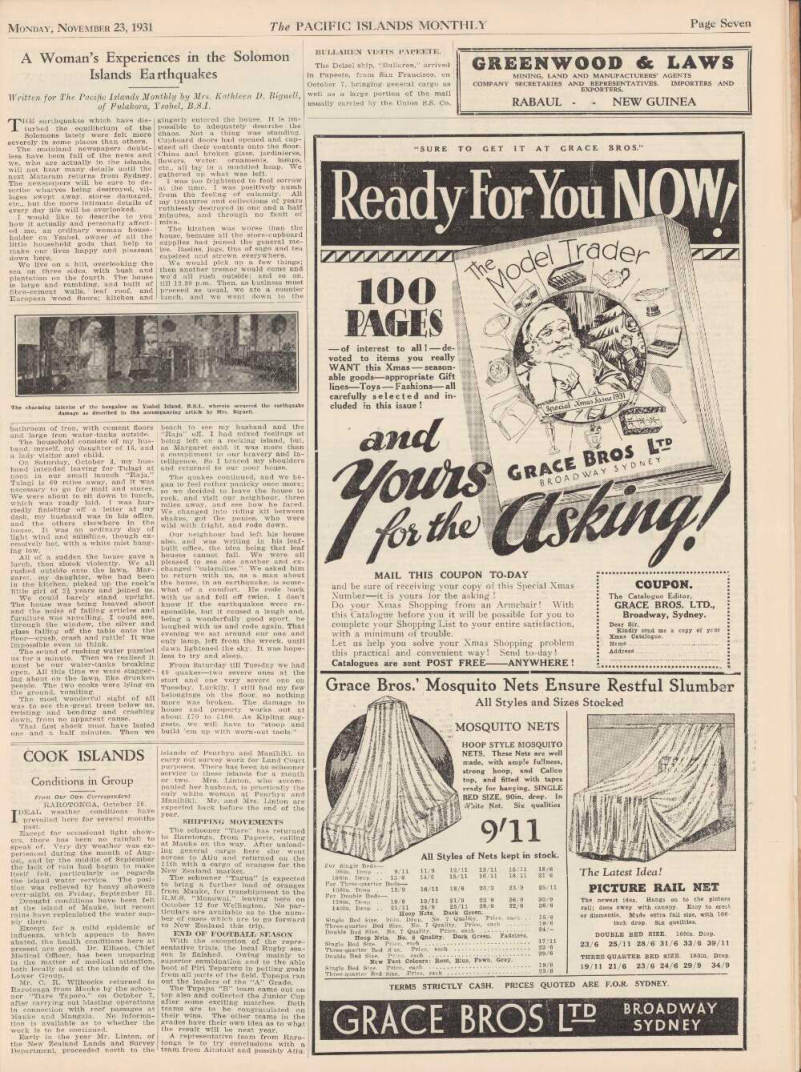
I would like to describe to you how it actually and personally affect ed me, an ordinary woman house holder on Ysabel, owner of all the little household gods that help to make our lives happy and pleasant down here.
We live on a hill, overlooking the sea on three sides, with bush and plantation on the fourth. The house is large and rambling, and built of fibro-cement walls, leaf roof, and European wood floors; kitchen and
bathroom of iron, with cement floors and large iron water-tanks outside.
The household consists of my hus band, myself, my daughter of 15, and a lady visitor and child.
On Saturday, October 3, my hus band intended leaving for Tulagi at noon in our small launch “Raja.”
Tulagi is 60 miles away, and it was necessary to go for mail and stores.
We were about to sit down to lunch, which was ready laid. I was hur riedly finishing off a letter at my desk, my husband was in his office, and the others elsewhere in the house. It was an ordinary day of light wind and sunshine, though ex cessively hot, with a white mist hang ing low.
All of a sudden the house gave a lurch, then shook violently. We all rushed outside onto the lawn. Mar garet, my daughter, who had been in the kitchen, picked up the cook’s little girl of 2½ years and joined us.
We could barely stand upright.
The house was being heaved about and the noise of falling articles and furniture was appalling. I could see, through the window, the silver and glass falling off the table onto the floor —crash, crash and rattle! It was impossible even to think.
The sound of rushing water puzzled us for a minute. Then we realised it must be our water-tanks breaking open. All this time we ware stagger ing about on the law, like drunken people. The two cooks were lying on the ground, vomiting.
The most wonderful sight of all was to see the great trees below us, twisting and bending and crashing down, from no apparent cause.
That first shock must have lasted one and a half minutes. Then we
gingerly entered the house. It is im possible to adequately describe the chaos. Not a thing standing.
Cupboard doors had opened and cap sized all their contents onto the floor.
China and broken glass, jardinieres, flowers, water, ornaments, lamps, etc., all lay in a muddled heap. We gathered up what was left.
I was too frightened to feel sorrow at the time. I was positively numb from the feeling of calamity. All my treasures and collections of years ruthlessly destroyed in one and a half minutes, and through no fault of mine.
The kitchen was worse than the house, because all the store-cupboard supplies had joined the general me lee. Basins, jugs, tins of sago and tea capsized and strewn everywhere.
We would pick up a few things; then another tremor would come and we’d all rush outside; and so on, till 12.30 p.m. Then, as business must proceed as usual, we ate a counter lunch, and we went down to the
beach to see my husband and the “Raja” off. I had mixed feelings at being left on a rocking island, but, as Margaret said, it was more than a compliment to our bravery and in telligence. So I braced my shoulders and returned to our poor house.
The quakes continued, and we be gan to feel rather panicky once more; so we decided to leave the house to rock, and visit our neighbour, three miles away, and see how he fared.
We changed into riding kit between shakes, got the ponies, who were wild with fright, and rode down.
Our neighbour had left his house also, and was writing in his leaf built office, the idea being that leaf houses cannot fall. We were all pleased to see one another and ex changed “calamities.” We asked him to return with us, as a man about the house, in an earthquake, is some what of a comfort. He rode back with us and fell off twice. I don’t know if the earthquakes were re sponsible, but it caused a laugh and, being a wonderfully good sport, he laughed with us and rode again. That evening we sat around our one and only lamp, left from the wreck, until dawn lightened the sky. It was hope less to try and sleep.
From Saturday till Tuesday we had 69 quakes—two severe ones at the start and one very severe one on Tuesday. Luckily, I still had my few belongings on the floor, so nothing more was broken. The damage to house and property works out at about £70 to £100. As Kipling sug gests, we will have to “stoop and build ’em up with worn-out tools.”
The charming interior of the bungalow on Ysabel Island, B.S.I., wherein occurred the earthquake damage as described in the accompanying article by Mrs. Bignell.
Cook Islands
Conditions in Group
From Our Own Correspondent RAROTONGA, October 20.
IDEAL weather conditions have prevailed here for several months past.
Except for occasional light show ers, there has been no rainfall to speak of. Very dry weather was ex perienced during the month of Aug ust, and by the middle of September the lack of rain had begun to make itself felt, particularly as regards the island water service. The posi tion was relieved by heavy showers over-night on Friday, September 25.
Drought conditions have been felt at the island of Mauke, but recent rains have replenished the water sup ply there.
Except for a mild epidemic of influenza, which appears to have abated, the health conditions here at present are good. Dr. Ellison, Chief Medical Officer, has been unsparing in the matter of medical attention, both locally and at the islands of the Lower Group.
Mr. C. R. Willcocks returned to Rarotonga from Mauke by the schoo ner “Tiare Taporo,” on October 7, after carrying out blasting operations in connection with reef passages at Mauke and Mangaia. No informa tion is available as to wdiether the work is to be continued.
Early in the year Mr. Linton, of the New Zealand Lands and Survey Department, proceeded north to the
islands of Penrhyn and Manihiki, to carry out survey work for Land Court purposes. There has been no schooner service to these islands for a month or two. Mrs. Linton, who accom panied her husband, is practically the only white woman at Penrhyn and Manihiki. Mr. and Mrs. Linton are expected back before the end of the year.
Shipping Movements
The schooner “Tiare” has returned to Rarotonga, from Papeete, calling at Mauke on the way. After unload ing general cargo here she went across to Atiu and returned on the 11th with a cargo of oranges for the New Zealand market.
The schooner “Tagua” is expected to bring a further load of oranges from Mauke, for transhipment to the R.M.S. “Monowai,” leaving here on October 12 for Wellington. No par ticulars are available as to the num ber of cases which are to go forward to New Zealand this trip.
End Of Football Season
With the exception of the repre sentative trials, the local Rugby sea son is finished. Owing mainly to superior combination and to the able boot of Piri Tepuretu in potting goals from all parts of the field, Tupapa ran out the leaders of the “A” Grade.
The Tupapa “B” team came out on top also and collected the Junior Cup after some exciting matches. Both teams are to be congratulated on their wins. The other teams in the grades have their own idea as to the result will be next year.
A representative team from Raro tonga is to try conclusions with a team from Aitutaki and possibly Atiu.
Bullaren Visits Papeete.
The Deisel ship, “Bullaren,” arrived in Papeete, from San Francisco, on October 7, bringing general cargo as well as a large portion of the mail usually carried by the Union S.S. Co.
Advertisements & other items, p. 7 (1 item)
Greenwood & Laws
MINING, LAND AND MANUFACTURERS’ AGENTS
COMPANY SECRETARIES AND REPRESENTATIVES. IMPORTERS AND
EXPORTERS.
RABAUL - - NEW GUINEA
“SURE TO GET IT AT GRACE BROS.” —of interest to all ! de voted to items you really WANT this Xmas season
able goods—appropriate Gift
lines —Toys Fashions— all
carefully selected and included in this issue !
MAIL THIS COUPON TO-DAY
and be sure of receiving* your copy of this Special Xmas Number —it is yours for the asking!
Do your Xmas Shopping from an Armchair! With this Catalogue before you it will be possible for you to complete your Shopping List to your entire satisfaction, with a minimum of trouble.
Let us help you solve your Xmas Shopping problem this practical and convenient way! Send to-day!
Catalogues are sent POST FREE ANYWHERE !
COUPON.
The Catalogue Editor,
GRACE BROS. LTD.,
Broadway, Sydney.
Dear Sir, Kindly send me a copy of ycur Xmas Catalogue.
Name ,1 Address ...
Grace Bros.’ Mosquito Nets Ensure Restful Slumber
All Styles and Sizes Stocked
MOSQUITO NETS
HOOP STYLE MOSQUITO
NETS. These Nets are well made, with ample fullness, strong hoop, and Calico top, and fitted with tapes rea dy for hanging. SINGLE BED SIZE, 90in. drop. In White Nat. Six qualities 9'11 All Styles of Nets kept in stock.
For Single Beds— 90in. Drop . . 9/11 108 in. Drop , . 13/6 For Three-quarter Beds — 108 in. Drop . . 15/9 For Double Beds 120 in. Drop . 140 in, Drop . 11/9 14/6 12/11 15/11 16/11 18/6 13/11 16/11 20/3 15/11 18/11 23/9 18/6 21/11 26/9 32/6 Single Bed Size. 19/11 21/9 22 9 24/9 25/11 28/6 Hoop Nets. Dark Green. 90in. Drop. No. 7 Quality. Price, each .
Three-quarter Bed Size. No. 7 Quality. Price, each Double Bed Size. No. 7 Quality. Price, each Hoop Nets. No. 8 Quality. Dark Green. Fadeless.
Single Bed Size. Price, each Three-quarter Bed S ; ze. Price, each.
Double Bed Size. Price, each • New Fast Colours: Rose, Blue, Fawn, Grey.
Single Bed Size. Price, each ' Three-quarter Bed Size. Price, each 18/6 21 6 25/11 30/9 36/6 15/6 19/6 24/- 17/11 23 6 29/6 19/6 23/6
The Latest Idea!
PICTURE RAIL NET
The newest idea. Hangs on to the picture rail; does away with canopy. Easy to erect or dismantle. Made extra full size, with 160inch drop. Six qualities.
DOUBLE BED SIZE. I6oin. Drop.
23/6 25/11 28/6 31/6 33/6 39/11 THEBE QUAETEE BED SIZE, 160 in. Drop. 19/11 21/6 23/6 24/6 29/9 34/9 TERMS STRICTLY CASH. PRICES QUOTED ARE F.O.R. SYDNEY.
Pacific Islands Monthly
Published once a month, and circulated among residents of:
Read also by residents of Australia and New Zealand who are interested in Pacific Islands trade and activities.
Publishers : Pacific Publications Ltd.
Union House, 247 George Street, Sydney Tel.: BW 5037 Editor: R. W. Robson.
London Representative: R. M. Hodge, 80 Fleet Street, London, E.C. 4., from whom copies of this journal, . and advertising rates, may be obtained. Tel.: City, 2062.
Subscription Rates:
Advertising :
Casual : Per single column inch ... 9 0 Contract : 7/-, 7/6 and 8/- per inch, according to conditions.
Changes of advertising copy should reach publishers by 7th of each month.
Contributions :
Contributions on matters of interest to Pacific Islands residents and traders are invited.
Distribution :
In Australia, New Zealand and Great Britain copies may be obtained from, ana subscription orders lodged with, Messrs. Gordon & Gotch Limited.
In the Pacific Islands, copies may be obtained from, and subscription orders lodged at, any of the stores of Messrs. Burns, Philp & Co. Ltd., Messrs.
Burns, Philp (South Seas) Co. Ltd., Messrs. W.
R. Carpenter & Co. Ltd., and Messrs. Morns Hedstrom & Co. Ltd.
In Eastern Polynesia, Mr. S. Russell, Papeete, is agent for Tahiti and the adjoining French terri tories; and the Cock Islands Trading Co. Ltd., Rarotonga, carries supplies of the journal for the Cook Islands.
Vol. 2. No. 4.
November, 19 31
New Guinea Fiji Solomon Is.
Papua Tonga New Hebrides Norfolk Is.
Samoa New Caledonia Cook Is.
Nauru Ocean Is.
Gilbert Is.
Tahiti Thursday Is.
Per annum, post free, within British Empire; in advance, , 6/-; booked 6 6 Per annum, post free, beyond British Em- 8 0 pirc
How Australia
"Advances”!
IN this issue there are no less than four different news articles, giving details of the manner in wffiich the Pacific Islands trade is being captured by New Zealand, mostly at the expense of Australia. We have referred to this subject on several occasions, but nothing is done, and the drift goes on.
The position is a remarkable com mentary upon the political short sightedness and commercial indiffer ence of Australia.
It is not so long ago since Sydney was the active trading centre and exchange mart for the whole of the South and Central Pacific, from the Marshalls and Carolines, in the north, to Tonga and Samoa in the south east. Lines of ships ran regularly and directly to most of the groups.
Almost all the Islands produce—and particularly copra —came to Sydney for sorting, classification and tran shipment; and payment was made in Sydney for such produce, and that payment in turn converted into goods which went back to the Islands stores and plantations. The wealth which Sydney, as a port and as a trading centre, was deriving from South Seas commerce, was huge.
Then the Sydney Harbour Trust, with the incredible fatheadedness of a certain type of officialdom, imposed port regulations which drove the copra trade away from Sydney. Angry merchants arranged direct shipments to Europe and America, and so much business left the port that the Sydney Harbour Trust hurriedly reversed its harassing regulations. But it was too late. Various other official acts as sisted in driving the Islands trade away—and no one seemed to care.
Sydney is no longer the copra ex change of the South Seas, and with that huge traffic there has also dis appeared a large proportion of the attendant trade with the South Seas.
Australia’s trade with the Islands is still large and very valuable; but in proportion to the total trade done by the Islands —which has grown enor mously in the last decade —it is only a small part of what it should be.
One would suppose that, having sacrificed so much to officialdom, Aus tralia would try to at least hold her present Islands connection. But, no!
Within recent weeks Fiji has imposed a new tariff against Australia and is diverting her trade to New Zealand; Norfolk Island is now buying in Auck land more than half of what she once bought in Australia; New Caledonia, retaliating against Australia’s un friendly tariff, has abruptly shut out Australian rice; Tonga, even now, is completing a new trade arrangement with New Zealand which will give her trade almost entirely into the hands of the enterprising Dominion.
And there has not been even one feeble protest, by Australia! Her Ministers, questioned about it, pro fess blank ignorance and indifference.
Yet, with one eye on the approaching elections, they rush about the country shouting that they are working their fingers to the bone in an endeavour to “restore Australia’s trade balance.”
An amazing country!
Tropicalities
Written for The Pacific Islands Monthly by “Sea Serpent.’’
A NORTHERN correspondent writes: I was in Papua for three weeks and visited the Oriomo and Fly River districts. It was rather distressing to note how the oil-boring enterprise at Oriomo failed; and one cannot help but think that the con siderable expenditure undertaken there should have been on a smaller scale, until justified by definite oil in dications. Decay is setting in very rapidly among the buildings, and the remains of part of the plant —but the caretaker is very active, and is doing his best to repel the inroads of the jungle. * * * THE finest yams in the Pacific are sold in the Trobriands at 15/per ton,” says Mr. A. J. Vogan, who has just returned from that little visited group. “They can be landed in Sydney at £7 per ton. The food of yams is four times that of potatoes, and there is no waste. If Sydney wants to find new wealth and regain true prosperity, let it give up horse-gambling and State lotteries for real things, and develop some of the enormous wealth that lies neglected in the Pacific Islands, only a few hundred miles away.” * * * THE Pacific Islands Year Book is now being printed and will be issued to subscribers and for gen eral sale, about the end of this month.
The work of compilation has been very heavy and has involved inquir ies in many parts of the world. This has somewhat delayed publication, which was originally fixed for the end of October, 1931. However, the slight delay has allowed us to include later statistics and general data, and the book will be entitled The Pacific Islands Year Book, 1932, instead of 1931. The 1933 edition will be pub lished a year hence, at the end of 1932. This Year Book will be found to be one of the most useful and inter esting publications of the kind yet issued in Australia. Pacific Publica tions Ltd., 247 George Street, Sydney, are the publishers. * * * THE Lae correspondent of The Rabaul Times, referring to the recent attack on A. D. O. Down ing, by natives, in the New Guinea goldfields hinterland, says: The murder of our old friend Baum is still green in our memory, and Mick and Paddy Leahy have not forgotten their little adventure with our black brother, who left quite an impression on them. Mr. Downing is so far the latest victim, and we are glad to hear he is well again. Someone has sug gested that our present-day politicians should take a run out to the Ramu and Watut Dis tricts for a bit of a spell, and if ever they were lucky enough to get back —well, they sure would have something to remember.
The suggestion anent politicians will will receive strong support in Aus tralia.
CORRESPONDENTS in Samoa have sent us particulars, taken from official documents, of the hideous cruelty displayed by Administration officials towards three Chinese who were condemned to death about the middle of 1928 —Ah Mau, Wong See and Chu Fook. This matter was ven tilated in the New Zealand Parlia ment, and an inquiry promised; but nothing (say our correspondents) was ever done, and the officials re sponsible for the brutalities remain ed in authority and were the same officials who were implicated in the riots in which Tamasese and others were killed. There seems to be some thing here demanding investigation— officials are always ready to “let has beens be by-gones,” and so save themselves trouble —but this probably, is not the time to raise the question.
A new Administrator is now in Sa moa, trying to induce the natives to forget past unpleasantnesses and settle down peacefully; and such an agitation would only embarrass him in his difficult wokk. Time enough to make a row about this three-years old matter when General Hart’s efforts have failed.
“FUR cryin' out loud!” Somehow, the dreadful, intriguing Ameri canism came to my mind on November 6, when I saw how a sec tion of the Sydney press dealt with the recent tribal clash in Papua. The facts are given elsewhere —simply that a raiding party of Sukis came down the Fly River, attacked some tidal-water villages, killed a couple of score of natives and returned up stream with their spoils. They have done it thousands of times in the past, and they will do it many times in the future, until the white man’s rule is completely asserted. At pre sent, white influence in Western Papua is slight, and in the North west it is practically non-existent.
The fact that raiding and head-hunt ing, in certain districts where white supervision is only nominal, have al most disappeared, is a great tribute to the Papuan Administration.
A raid from the completely un tamed region by natives like the Sukis, into the semi-tamed districts, is not a bit surprising. Probably in the isolated, untamed districts such raids and killings are of very frequent occurrence. But the Sydney news papers published headlines about “massacres” and “uprisings in Papua” and generally bawled their silly heads off. They published photographs from the Papuan central districts and des cribed the village scenes as “Fly River natives”! Only a few days before a Sunday newspaper published, as “a Papuan,” a photograph of a typical Fijian, Which is the frontispiece of the Fijian Government’s Handbook.
Is it any wonder that Islands people complain of Australian indifference, when leading newspapers display such abysmal ignorance of Pacific Islands life and conditions? * * * IT seems to me that the point which needs clearing up in relation to Chinese settlement in Samoa, is hot whether the N.Z. Government is discouraging Chinese immigration but whether that Mandatory is sufficiently strict in preventing cohabitation be tween the Chinese Coolies and Samoan women. A recent statement by our Samoan correspondent that there are now 1,500 Chinese halfcastes, in a population of 40,000 Samoans, seems to us to indicate an appalling condition. Mr. Rowe, in his recent book on Samoa, declares that any close association between Chinese and native Samoans was “rigorously disallowed” by the Ger mans and by the N.Z. military admin istration under Colonel Bogan. This seems to throw the responsibility directly upon the N.Z. civil adminis tration. More information on this point would be welcomed. * * * “BULOLO BILL” speaks his piece
bitterly:
Who gave you the fool report, Mr. Editor, that there are lots of festivities and money in Wau? I have quite enough trouble in my house in ordinary times, with out having my wife following me round, waving your confounded paper, and charging me with keeping her in the dark regarding local festivities and social activities.
We used to have a pretty good time, in the old days, but now its too darned civil ised to be pleasant. People have become class-conscious and stuck-up, and we all sit at home at nights and read the papers.
There was a dance two months ago. I took my wife to the dance and she took me home from the dance. My goodness, how that woman can talk! Certainly, I had some beer.
Who wouldn’t, when beer and I make res pectful greetings once in a blue moon.
There won’t be another dance till Christmas, so there won’t be any more beer. Beer needs money up here, and the missus has all the money in our house. I would like to know who told you there was lots of money in Wau.
Women are scarce up here, so all the young bucks make a fuss over them and we old blokes have a pretty henpecked sort of time.
And then you go and write rot about festi vities in Wau. If you doubt me, come on up here and have a look. You would go back to Sydney and call at the morgue, so as to give yourself a bright and happy time.
And money—it’s as scarce as this social life we’ve been reading about. Some of you folk may think that life in the Islands is pretty nice. You can have all my share, for just one hour of Sydney and a real mug of Tooth’s best. Gripes, she’s bawling again!
Goodbye.
N. Caledonia’s Population
Census Shows 5,000 Increase Many Europeans in Noumea
From Our Own Correspondent.
Noumea, Nov. 4.
THE figures, as a result of the cen sus taken on July 1 last, are now available and show an increase since the last census, taken in 1926, of 5,289 and a total population in the Colony of 57,165, made up of 17,215 whites, 11,448 coloured indentured labourers and 28,502 indigenous na tives.
Most of the increase can be attribut ed to the large influx during the last few years of coloured indentured la bour. It is quite likely that in view of the slackening off of industry gen
erally these figures will show some what of a decrease in the future.
The local native population has re mained at about the same figure for the past 30 years, but in the last 25 years the penal element (whites only) has been reduced from 8,000 to 623, with a steady reduction at each of the five-yearly census dates.
A satisfactory feature to note is that the free white population is in creasing at the rate of nearly 1,000 persons per census period of five years.
The population of the town of Nou mea is over 12,000, of which nearly 8,000 are whites and the remainder Javanese, Tonkinese and New Heb ridian and local natives.
These figures show an increase for the capital of 2,000 inhabitants since the last census in 1926, of which in crease approximately one-third is white and two-thirds coloured. In these figures is included a total of 1,000 inhabitants at Nouville, which is the old convict settlement across the bay, formerly known as Ile Nou.
Giant Sugar Cane, 25 feet from the ground to leaves, growing in village of Kwaibwaga, Kiriwina, Trobriand Islands (east of Papua). The photograph shows native food-houses, full of yams; and in the foreground, in the white suit, a Methodist native teacher.
Photo. by A. J. Vogan.
Mrs. E. A. Wisdom
Death in Sydney
Popular N. Guinea Figure
NEW GUINEA residents will re ceive with deepest regret the news of the death of Mrs. Agnes Bell Wisdom, wife of Brigadier-Gen eral E. A. Wisdom, which occurred in Sydney on November 9.
Mrs. Wisdom, who had been in New Guinea since her husband was appointed Administrator of the Ter ritory, in 1921, was one of the most popular personalities there, and the leader of social life. As hostess at the beautifully situated Government House at Rabaul, she was always most charming to residents and visitors alike. She will be very sadly missed in the Islands capital.
Mrs. Wisdom, in May last, had to suffer the amputation of both her legs above the knees, owing to the arteries in her feet having ceased to
function. She made satisfactory pro gress and her health appeared to have greatly improved when she returned to Sydney from Rabaul, by the Sep tember trip of the Macdhui.
The deceased lady was the second daughter of Mr. A. Jackson, of Edin burgh, who celebrated his 90th birth day last August.
She married Mr. E. A. Wisdom in Edinburgh, when she was 18 years of age, and went to West Australia with him 36 years ago. She paid many visits to her homeland and did notable war work.
When Brigadier-General Wisdom went to Egypt she followed, and did Red Cross work until he moved to Gallipoli. Mrs. Wisdom then went to London and became a parlormaid in Princess Christian’s Red Cross Hos pital. She was secretary to Lady Robinson, Commandant of the Austra lian Red Cross, in London, and for her various services, lasting till the end of the war, was awarded three war medals.
Upon the cessation of hostilities, Brigadier-General and Mrs. Wisdom returned to Western Australia and made their home at Cottesloe, of which town Brigadier-General Wis dom became Mayor, and later repre sented his division in the Western Australian Parliament.
While in New Guinea, Mrs. Wisdom accompanied her husband on many long tours of inspection and she had the distinction of having gone fur ther up the Sepik River than any other white woman.
The interment, which was attended by many residents and ex-residents of New Guinea, took place at South
Head Cemetery. According to The
Sydney Morning Herald, the mourners
included: Brigadier General E. A. Wisdom, Messrs. R. W.
Hamilton (representing Mr. J. T. Heathershaw, sec retary to the Commonwealth Treasury). E. W.
Hulle (chief inspector of the Commonwealth Bank, representing the Governor and Deputy-Governor), G. F. Murphy (Sheriff of New South Wales), Wal ter Lucas (ex-chairman, Expropriation Board, New Guinea), the Rev. M. A. Warren (Australian Board of Missions and St, George’s Church. Rabaul), Dr. H. V. Hordern, Mr. and Mrs, A. E. Hughes, Captain J. A. Broadbent (secretary Imperial Ser vice Club), Colonel A. H. Moseley (Returned Medical Officers’ Association), Messrs. J. O’Grady and C. E. Leake (New Guinea Trade Agency), Lieutenant-Colonel E. J. Munro (secretary Country party of New South Wales), Messrs. F. S. Boyce, M.L.C., G. A. Watson (Deputy Crown Solicitor), F. T. D. Meares and P. E. Walcott (Public Ser vice Commissioner), Major C, W. C. Marr, M.P., Commander G. J. Banks, R.A.N.R. (retired), Colonel E. C. Norrie, Commandant Rupert Roscoe, Brigadier-General J. Lamrock, Mr. R. J. Nos worthy (managing director, Burns, Philp and Co.
Ltd.), Major R. H, Norman, Mr. W. R. Carpenter, Major J. N. Doyle, Brigadier-General J. Paton, Captain H. J. Feakes, Captain E. Butler, Lieut. W.
S. Moore, Messrs. F. Wallin (Burns, Philp and Co. Ltd.), Major H. L. Bruce, Mrs. Samuel Hor dern, Lady Waley, Mr. D. L. Dowdell (Orient Line), Messrs. J. O. Meeks (director, Harrison Ramsay Pty. Ltd.), W. L. Moors, G. Jeffrey, jun., and W. M. Macfarlane, Mr. and Mrs. S. Wharton Kirke, Mr. Clem Wharton-Kirke, Mr. and Mrs.
Roystone Davey, Dr. G. C. Byrne, Mr. and Mrs.
Neville Hall, Mr. and Mrs. W. J. Bloomfield.
Messrs. G. C. McCully, D. C. Hall, A. A. Hall and Colin Hall, Mr. and Mrs. J. G. McLaren, Dr.
M. J. O’Shea, Mr. and Mrs. E. A. Sagar, Mr. and Mrs. W. Mirow, Mrs. G. Schmidt and Miss Schmidt,, Messrs. Burleigh Gorman, Alban Gee, J. J. Feain, C. G. Hudson, C. J. W. Gillan, A. A.
Gaffney, Essington Moore, T, C. Wright, R.
Strelitz and H. J. Aylward.
There were many wreaths, including those from the Prime Minister (Mr. Scullin), Judge Wanliss (Chief Justice of Rabaul), Judge Phillips, Sir Samuel Hordern, the New Guinea Trade Agency, Burns, Philp and Co. Ltd., W. R. Carpenter Ltd , the New Guinea administrative staff, and many gold-mining companies, plantation owners and friends.
Mrs. E. A. Wisdom
Photo by Falk
Papuan Sorcery
Sir Hubert Murray at a Demonstration
A demonstration of the alleged sor cery powers of Papuan natives in bringing the dead back to life, was given near the police bar racks at Konedobu, Port Moresby, recently, in the presence of the Lieut.- Governor (Sir Hubert Murray), mem bers of the Executive Council, some senior Government officers and a couple of private citizens.
From the European viewpoint the result of the experiment was disgust ing and quite discredited any sorcery powers the natives concerned could boast about; but so great is the be lief in these so-called sorcerers among their own race, that they convinced natives, who also witnessed the “stunt,” that it had been successful.
The victim of this demonstration was an unfortunate dog. The ani mal’s mouth was first bound with some material —doubtless in order to muffle its howls —and then it was slowly punched to death. This opera tion, so it is said, took about 20 min utes.
The creature remained dead, and that was the end of the experiment so far as the white men were concerned.
The sorcerers’ story, which it is said was accepted by all the natives, was that they quite successfully brought the dead animal back to life, but some person who does not like sorcerers then killed the dog again, and the sorcerers failed to do the deed a sec ond time, as they had run out of the necessary “mura-mura” or medicine.
The sorcerers later left for their villages in the Gaile district of the Territory, saying that they would re turn when the next warship visited Port Moresby in order to give an other demonstration.
The fact that the Lieut.-Governor and some senior officials were present at the demonstration was reported in the local newspaper and adversely commented on. This was copied into one of Australia’s sensation-hunting newspapers, under flaring headlines and, inferentially, became an attack on Sir Hubert Murray.
We know nothing of the reasons which led Sir Hubert Murray to at tend this demonstration. But we do know that he is a wise and experi enced administrator, with a profound knowledge of the native mind, and that he would be about the last man to do anything officially to encourage native sorcery and superstition.
Drought Breaks in Tahiti
From Our Own Correspondent PAPEETE, October 8.
THE long drought, which has afflicted Tahiti and the neigh bouring islands for some months past, appears to have broken at last, and some nice rains have fallen during the past week.
Nevertheless, the country is still extremely dry and much more rain is required to restore the brown hill sides to their usual greenness and set the watercourses flowing at normal capacity.
This year’s figures constitute a re cord for dryness, and while this may be all to the good for European vege tables grown on irrigated land, the result is disastrous for all the per manent crops of the island.
New Caledonian Sport
Enormous Herds of Deer Chance for Riflemen
THE movement in the exchange (both Australian and sterling) during the last 12 months, has thrown awry all New Caledonia’s plans for building up a substantial tourist traffic between Australia and Noumea. But when the Australian £ recovers a little of its value in French eyes, it may be that Austral ian sportsmen will recognise that in New Caledonia —the great Pacific Is land which lies nearest to their east ern coast —there is a sportsman’s paradise.
New Caledonia is literally overrun by Sumatran deer —a well grown species that provides excellent sport .and a first-class food. Enormous num bers of these animals range over the New Caledonian coastal plains and uplands, and they do such destruction to plantations and pasturage that the majority of the bigger planters and pastoralists regularly employ deer killers, whose job is to keep the ani mals away.
Captain R, W. Tate (son of a for mer administrator of Western Sa moa), who was recently a planter in New Caledonia, informs us that at a place near Bouloupari, Ouamenie, he saw not less than 60,000 head in one herd, in a huge incredible moving mass of deer. Not long ago, exasper ated planters in Southern New Cale donia organised a drive, and thous ands of deer were compelled to run across a narrow isthmus, on either side of which machine guns had been placed. In this way, thousands of animals were slain and numbers of natives were employed skinning them.
Receipts from the sales of hides more than paid the cost of organising the drive.
The French administration wel comes and assists anyone prepared to shoot the animals and will provide Them with free ammunition. There are hotels scattered throughout the Colony, but the ideal way to under take the sport would be for a party of men to supply themselves with camping equipment and cars (which are to be had in Noumea) and spend a few weeks in the back country.
There is also excellent fishing in New Caledonia. Rouget, a salt water fish, is caught freely off the coast; while the rivers are very well stocked with a good fresh-water fish called grosyeux, running about to 2 pounds in weight. They are similar to the freshwater fish found in the streams of Samoa, and they will take a dry fly and provide magnificent sport.
Robbery at Mauke
Cook Is. Trading Co.’s Loss
From Our Own Correspondent.
ON the night of September 18, or early the following morning, the Cook Islands Trading Company’s store at Mauke (Cook Islands) was broken into and the safe and con tents were stolen. The safe is said to have contained £88/6/8.
A back window of the store was forced and the storeroom door was left open. On September 19, the safe was found about a mile away by some women, washing in a taro swamp. The safe had been cut into several pieces, an axe apparently having been used. So far no trace of the thief has been found.
A Terrifying Earthquake
Solomon Islands Visitation
THE earthquakes in the Solomon Islands between October 3 and 11, with attendant tidal waves, did most damage on Malaita and San Christoval; but the ’quakes were felt severely on the neighbouring islands of Florida and Guadalcanal.
The first and heaviest disturbance, apparently, occurred early on Sunday morning, October 4, and it seemed to centre off the south-east coast of San Christoval. The latter island was badly shaken and a great tidal wave shortly afterwards swept upon its south-east coast, submerging 14 vil lages and rendering 700 people home less. No details are available, but it is estimated that 10 natives were drowned. Messrs. J. Bee and J. Wil son, of the South Seas Evangelical Mission, at villages 15 miles apart, were caught in the rush of water and carried inland, but both miracu lously escaped.
The whole of the southern islands felt frequent tremors during the en suing week, and on Saturday, October 11, there came another great shock, which centred near Su’u, on Malaita.
The Malaita Company’s concrete wharf was completely destroyed, and most of its buildings (the majority being staff bungalows) were shaken off their foundations. Practically all European houses were damaged.
Landslides occurred everywhere throughout Malaita. Some of the na tive villages, particularly Takataka, were damaged and a number of na tives were killed.
Fortunately, the chief town, Tulagi, escaped most of the visitation, but considerable damage was done to buildings there.
The earthquakes at times were ter rifying in the extreme. The whole country rocked, and it was impossible to stand upright. Trees fell, huge landslides occurred, enormous bould ers came crashing down through the bush, and the bed of the ocean moved so that rocks rose and fell.
The houses of Dr. Fox at Pawa, on Ugi Island, and of Rev. Mason, at Fiu, Malaita, were partly destroy ed; the Roman Catholic School at Wainoni Bay, San Christoval was dam aged. Water and sewerage services at the Government residence, Kirakira, San Christoval, were destroyed.
At Tulagi, Messrs. W. R. Carpenter and Co.’s wharf was damaged and left in shallow water, preventing the berthing of ships. The floor of Messrs.
Burns, Philps’ wharf store at Mak ambo subsided. It is estimated that the harbour bottom at Tulagi has risen 10 feet. Similar coastal disturb ances are being reported from all parts of the group. The salt water islands constructed by the natives of the Langa Langa lagoon, near Auki, were shaken down, and the natives thrown into the water.
Tulagi experienced a violent shake at 11.20 a.m. on October 10, which damaged the contents of the stores, and of the hotel kept by Mr. Masher, The quakes continued for 18 hours
and were the worst since the Roman Catholic Church at Yasali was des troyed in 1926.
Mr. E. Palmer had a terrifying ex perience in his auxiliary schooner, Mendana, at Maraunga, off the south eastern coast of San Christoval, at daylight on October 4. Suddenly, he saw great landslides ashore and the water running back off the beach.
Great rocks appeared above the water of the bay, and a tremendous sub marine disturbance occurred around the vessel. The water rushed back ashore in the form of a great tidal
wave, boiled and rushed around the schooner, while patches of rock and sand appeared. The schooner miracu lously got clear away to sea.
The Resident Commissioner left immediately for the more seriously affected portions of the group, and no official report of the damage has yet reached Australia.
The landing station at Su’u, Malaita , B.S.I. . which felt the full force of the earthquake. The Malaita Company’s buildings (shown above) and wharf (in right hand corner) were severely damaged.
The Malaita Company’s Wharf, at Su’u, which was practically destroyed by the earthquake.
Ready Early in 1932
Rabaul’s Electric Light Ready Early in 1932
From Our Own Correspondent.
RABAITL, October 30.
WE understand that Messrs.
Donoghue and Carter, consult ing engineers, of Sydney, who sponsored the Rabaul and District Electricity Supply Co. Ltd., formed for the purpose of providing Rabaul with electric light and power, are well ahead with their preparations for the installation of the plant.
It is hoped that the current will be available in March or April next.
Where Pearls Are
Cheap
There is no money in the Trobriand Islands, that large group east of Papua, which has just been visited by Mr. A. J. Vogan, F.R.G.S.
“Payment,” says Mr. Vogan, “is made in tobacco —and American to bacco at that! If Australian tobacco were used as currency, a great im petus would be given to Australian trade. As there is no sale just now for pearls or copra, there is no to bacco; and the natives will sell any thing at any price to get it.
“I saw pearls in the Trobriands that, four years ago, would have fetched from £200 to £400 in London, sold for 2/- worth or 3/- worth of tobacco. As pearls will regain their position in a few years—or so I am assured by fashion experts—some thing ought to be done about it. Per haps something will, but the Tro briands, although so fertile and popu lous, are far off the beaten track.”
New Gold Company
N.Z. Capital Interested Sluicing in Upper Waria, N.G.
NEGOTIATIONS have been com pleted between a New Zealand Syndicate and the Waria Syndi cate of New Guinea to work and ex ploit six dredging and sluicing leases on the Waria River, which drains the Morobe goldfields country.
According to estimates only £24,000 will be required for this preliminary company to work the concessions. It is anticipated that later a bigger com pany will be promoted to carry on the work. Using only 15 to 20 heads of water pressure, it is estimated that the conservative value of fourpence a cubic yard will produce a handsome profit for the company for at least 35 years.
Mr. A. Morris Dunkley, of Welling ton, N.Z., who visited New Guinea on behalf of the New Zealand syndicate, has stated that the Upper Waria con tains auriferous terraces similar to the Shotover River, in the South Plains of New Zealand, which, for many years was successfully and pro fitably worked. He considered that alluvial sluicing was the easiest, quickest and cheapest method of mining in the world.
Whale Oil
May Be Controlled by New Convention
A special League of Nations Com mittee of international jurists and ex perts met at Geneva on September 9 and agreed on the final text of a convention for the international con trol of the whaling industry. Most of the nations represented there im mediately appended their signatures.
The object of the convention is to prevent the extinction of whales by wholesale, indiscriminate slaughter, such as has been going on in the Antarctic for some years. Such agreements usually are quite worth less: but if this one should be ob served, it may have an important effect on the coconut planters of the world, as the enormous over-produc tion of whale oil by Norwegian whalers in the Antarctic between 1927 and 1931 was one of the chief factors in bringing down copra to the calam itous prices which were ruling last August.
Pacific Shipping
War
Governments Take a Hand Political Considerations
THE agitation against the Matson Line of steamers, which has been going on ever since the Americans announced the introduc tion of new liners, and which became more active when the Matson Line added Auckland to its itinerary, is now beginning to bear political fruit.
The first developments occurred in New Zealand, where the Prime Min ister was repeatedly asked whether he thought it fair that this American subsidised line should be permitted to engage, without restrictions, in the traffic between the British countries of Fiji, New Zealand and Australia.
The New Zealand Prime Minister side-stepped the question for some time. Obviously, he did not wish to be in a dispute or struggle between the powerful institutions affected. He pointed out that, nothing very much could be done to discourage the Americans, unless it were done jointly by the four Governments con cerned —namely, Britain, Fiji, New Zealand and Australia.
However, there has recently been a further important development. A deputation representing the maritime unions has made very strong and urgent representations to the Federal Government of Australia, insisting that something must be done to check the expansion of the Matson Line.
The arguments placed before the Government included the following: (1) The Matson Line is more or less dir ectly subsidised by the American Government. (2) British ships are not permitted freely to engage in all-American maritime traffic. (3) British ships are not permitted to en gage in the traffic between Honolulu and San Francisco. (4) The United States Government places a prohibitive tariff against the impor tation into the United States of the primary products of Australia, New Zealand and Fiji.
The deputation therefore asked why the powerful Matson Line should be permitted unchecked to engage in the important maritime traffic between Fiji, New Zealand and Australia.
The Federal Government has an nounced that it regards the position thus placed before it as one of first rate importance; and it has given the impression that it is taking up the matter vigorously and at once with the British, New Zealand and Fijian Governments.
The Matson Line, for many years, has been growing steadily in strength and influence. It did particularly well in the boom years of 1924-1929, when the tremendous trade drive made by American manufacturers in Australia and New Zealand gave it a huge cargo business. It is now setting out to capture the passenger traffic, and two magnificent liners are shortly to come on to the run. The present itinerary is San Francisco, Honolulu, Pago Pago, Suva, Auckland and Sydney, and back by the same route. Devel opments in regard to the Matson Line therefore; are of great importance to the Islands groups of the Central Pacific.
If the four British Governments mentioned are to act jointly, in a policy of making the South Seas Ter ritories more or less of a close preserve for British shipping, it is likely that Islands Territories, other than Fiji and Samoa will be affected.
The questions raised may possibly embrace the operations of the German N.D.L. steamer. Bremerhaven, whose activities in the out-ports of New Guinea have been a source of irrita tion to Australian-owned shipping companies. There appears to be no objection by British shipping com panies against regular calls at main ports by steamers of foreign lines; but there does seem to be a very strong objection to foreign-owned ships engaging irregularly in the carrying trade as between British South Sea ports—and this is the gravamen of the charge made against foreign ship ping companies in the particular cases under note.
Thrips Aid Fiji Settlers
Killing Koster’s Curse Thrips Aid Fiji Settlers
MESSRS. X. and H. Faddy, two settlers in Fiji, recently advised the Polynesian Gazette, Levuka, that the thrips liberated at Tailevu were doing great work in exterminat ing Koster’s Curse.
They stated that two colonies of thrips were liberated and they have extended to millions and are spread ing rapidly. The thrips can be ob served eating the stem, and they kill it very quickly, but time will have to elapse before it can be ascertained whether extermination is completely effected.
These two settlers are of the opinion that the thrips are doing even greater work than was expected of them.
“We are all very enthusiastic about them,” they added, “and we think it will prove a greater miracle than the Levuana.”
“Steamer-Day” On Port Moresby Wharf, Papua.
Norfolk Island Trade
THE following are the Norfolk Island Customs figures for September, 1931, compared with the figures for September, 1930:
Imports.
From Aust.
From N.Z. 1930 £1,238 10 0 ... £2,379 5 0 1931 2,013 5 0 915 15 0
Exports.
To Aust.
To N.Z.
1930 £931 15 0 .. £801 0 0 1931 608 0 0 .. 695 10 0
The Solomons
Plea for Reduced Administrative Costs
From Our Own Correspondent TULAGI, October 20.
THE annual Advisory Council meeting is timed to go off on October 28, when our four “good men and true,” representing planters and settlers, will again endeavour to bring about reduced administrative costs as opposed to increased taxation, to meet a dwindling revenue.
This last trip, the “Montoro” brought in only about 400 tons of cargo and 16 passengers, so some thing simply must be done to “bal ance the budget,” and as the truth of the assertion that “you cannot get blood out of a stone” cannot be denied it would seem that, outside of, an unexpected boom in produce mar kets, administrative reduction is the one sane remedy.
Strange as it may seem, a section of the community really favours in creased taxation and suggests an in come tax; but as it is true that “there is one born every minute” and “two married oftener,” it is always pos sible to find advocates of foot-warm ers in hades, or some such pleasantry.
Such a suggestion can only be taken as an ill-considered “swipe” at the creditor firms, whose balance sheets are about the only ones showing a credit balance these days, and it goes without isaying that iany handicap placed upon this fraternity must surely be passed along to their clients in one form or another.
The “Montoro” is to be taken off the run after three lean trips, but if we can retain the “Mataram” we will not think ourselves hardly done by.
Please God and B.P., we are not to descend to, say, the “Makambo.”
News of a 10/- improvement in the parity price of copra, due pos sibly to improved freight rates over seas, has been received with much thanks, and as the market seems on the mend, several planters have taken a risk and ordered an extra tin of cigarettes.
Increased Fees On Guns
In furtherance of the amended re gulation whereby we now pay a lic ence fee of 10/- per annum, per gun, in place of 10/- for any number of guns, the Tulagi sleuths have been hot upon the scent of unlicensed guns or anything that looks like one, and those who do not make a prac tice of keeping up with amended regulations are apt to find themselves sentenced to the “utmost rigour of the law.” It is to be hoped that the extra revenue derived therefrom will not be offset by a reluctance on the part of parents to import Christmas stock ings for their children, out of fear that they may contain pop-guns.
Half-Caste S Heavy Sentence
That “the law is a hass” may not be true in all cases is agreed; but the recent sentencing of a young half caste woman to three years’ gaol for breaking and entering a Chinaman’s trade store during the owner’s ab sence, is strongly felt to, be an argu ment in favour of the assertion —espe cially in view of the circumstances surrounding this unfortunate’s be haviour.
A half-caste deserves the sympathy of the community under any consid eration —particularly a female, since she is more or less despised by both branches of her parental species. She is usually considered “fair game” by a certain type of “white” who, is not over-burdened with consideration of her well-being. If such sentences as the above were passed along to this class of individual, perhaps the ends of justice would better be served.
New Broadcast
At Townsville With Pacific Radius
A NEW broadcasting station, which will serve many of the Pacific Islands, was opened at Towns ville by Amalgamated Wireless (A/sia.) Ltd., on October 5.
The radius of the new station, which is known as 4TO, Townsville, will embrace Thursday Island, Papua, New Guinea, Solomon Islands, New Hebrides and New Caledonia, and it is quite possible that it will be picked up in Fiji and the Gilbert and Ellice Islands.
The inaugural programme was a very successful one. Mr. E. T. Fisk, managing director of the A.W.A., gave a short address from Sydney, by tele phone, his words being broadcast over the air.
During the evening, congratulatory telegrams were received from listen ers at Thursday Island, Flinders Is land, Madang (New Guinea), Sam arai (Papua) and other places.
Station 4TO is of the very latest type, having been designed and manu factured by Amalgamated Wireless, in accordance with the most modern principles. It operates on a wave length of 256.4 metres (1170 kilo cycles) and has a power of 200 watts in the aerial.
News From Norfolk Island
Glut of Strange Eggs —H.M.A.S. Canberra Strikes Bad Weather —Big Fruit Shipment for Auckland
From Our Own Correspondent,
NORFOLK IS., October 22.
IF all the hens on Norfolk Island went on strike for the next month and cackled not over a single egg, we should still have custards and cakes and so on, although with a faint, quaint taste, as though the cook had forgotten what she was making and had dropped in a casual seasoning of anchovy sauce.
For this is the whaley bird season, when from some unknown northern shore, the continuous plaintive ar rival of a small, smoky seabird, known elsewhere, I believe, as the Sooty Petrel, heralds the appearance of schools of whales and shoals of roly poly porpoises and dolphins.
Uttering a hoarse and querulous cry, the birds make unerringly for Phillip Island, a bare, bright rock a mile or so off shore, and there nest for a crowded month; and, day after day, when the weather permits, happy bands of picnickers cross the wide waters and return with thous ands and thousands of new laid eggs.
They are about the size of a plover’s egg, with a greeny, creamy shell, blotched with chocolate, and they are excellent as omelette or scrambled eggs.
For this month, too, the whales frolic in huge innocence and safety, while island elders tell us of other days when their oil was a golden har vest of the sea and whaling was a staple industry. Rusty old try-pots still lurch in back yards, serving as emergency tanks or watering troughs for stock. But the whaling days are gone for ever, no matter how provo catively Leviathan sports around — broaching, sounding, sending up taunting columns of breath-blown spray.
Canberra's Visit
ai dawn on Saturday morning, October 3, our lonely waters were invaded by H.M.A.S. “Canberra,” flag ship of the Australian squadron, homeward bound to Sydney, after a Pacific cruise. She intended to stay until Monday morning, but, after dis appointing weather throughout the week-end, a real gale arose towards the evening on Sunday and the Com modore did not think it safe to risk our open roadstead through the night.
A great programme had been ar ranged and a very pleasant time was enjoyed by all who participated or entertained the various ranks, but on the whole the visit was not such a success as we had hoped, on account of the weather. The Commodore left behind a very courteous message of appreciation, but we felt we could have left a much happier impression of the island on this unit of the navy if the sun had shone and the sea sparkled, as they usually do.
Death Of Hikurangus Mate
Just as the little Hikurangi, from Auckland, dropped anchor off the Cas cades landing, late on the evening of October 6, the mate, a middle-aged man with a wife and family, fell dead on the deck. He had complained of feeling unwell on the passage over and his skipper, young Captain George, had taken over his duties, in order to relieve him as far as pos sible.
Early next morning, our Govern ment Medical Officer, Dr. Lawrence, went aboard and certified the death as a consequence of heart disease, and the Captain then steamed out beyond the three-mile limit and buried the body at sea. Some folks ashore thought it both heartless and extra ordinary conduct, when we have a cemetery ashore and kind and rever ent hands would have borne him to rest and strewn his bed with flowers.
But, in the first place, a sailor almost invariably prefers to sleep for ever in the element he chose in life; and in the second, a funeral ashore would
have held up the working of the ship for practically a whole day.
The “Hikurangi” carried away her very biggest shipment to date —some thing close upon 3,000 cases of mixed . produce —bananas, potatoes, tomatoes, carrots, and our last few oranges, bought f.o.b. upon our little jetty, and is due here again within a few days. With the B.P. vessel, the “Morinda,” calling here to-morrow, seeking cargo for Sydney, a silent life and-death struggle is proceeding be tween the various agents, buying for shipment to one country or the other.
Sydney will lose, because business with her is a gamble, no matter what heartening reports come over the wireless. Auckland offers us a cer tain market at a guaranteed price, although we are not left under any false impression that the buyers there are philanthropists or are engaged in the tropical fruit trade solely for reasons of health.
Preparations For Horticul
Tural Show
On Friday, November 13 —to the superstitious the unluckiest day of the week, the unluckiest day of the month, and the unluckiest month of the year—we are to hold our annual Horticultural Show, and exhibits are already being carefully groomed and hurried forward or retarded, accord ing to their state of preparedness for competition.
In addition to the usual classes and sections, there are several new prizes to be won —notably one offered by Messrs. Burns, Philp for the best essay upon Norfolk Island, the win ning entry to become the property of the Company, to do as they like With.
In conjunction with Mr. Grey, local manager for B.P.’s, and Captain Flet cher Quintal, representing the island, your correspondent has been asked to judge the competition, and, while accepting the honour, is already won dering how three divergent tastes and points of view are coming to any unanimous agreement of merit. There may be something in this supersti tious idea after all.
On December 31, 19 30, Fiji’s police force comprised 19 Europeans, 112 Fijians and 103 Indians. The head quarters of the force is at Suva, with a central station at Totogo and a de pot at Nasova.
Advertisements & other items, p. 10 (2 items)
Fresh Fruits—Vegetables
GOLDFIELDS OF NEW GUINEA
Information supplied by one who has been in close touch with the fields for past eight years.
PHOTOGRAPHS :
Series numbers over 300 photos and is being constantly added to. Subjects include: Morobo Goldfields Area, New Guinea Aerial Activities, Island Scenic Studies and Native Life and Types. Prints: 9/- per dozen, post free.
Native Implements, Weapons and Curios.
G. MACDONALD
Trader and Importer Mining, Customs, Recruiting & General Agent
SALAMAUA
TERRITORY OF NEW GUINEA
FRESH FRUITS—VEGETABLES
F. CHILTON
WHOLESALE DISTRIBUTOR, CITY MARKETS
SYDNEY - - Established 1894 Shipments Direct from Source of Supply. All Goods Personally Selected and Carefully Packed for Tropical Requirements.
Quality—BEST. Price—LOWEST. Attention—PROMPT.
Codes'. Bentley’s and Private. Cable Address: Chiltons, Sydney Agent for —Celebrated "Vallo” Brand Spray Preparations, used successfully by Orchardists throughout Australia.
If You Want the Best ...
“THE YOUNGER” COOKING STOVE
G. FLETCHER & SON
Made with Extended Fire Box, specially for long wood fuel.
Also
DOUBLE OVEN
RANGES
suitable for Hotels or large establishments.
We always stock dupli cate parts, and they can be easily fixed in posi tion because the topplate of each stove is moveable.
Send for a copy of our Illustrated Catalogue and further information.
50 OXFORD STREET SYDNEY
Residents of Rabaul can inspect sample of “Younger” Stove and obtain quotations from: CAMPBELL & GO., General Agents, Rabaul.
EXCELSIOR SUPPLY CO. LTD.
The most extensive Manufacturers in the British Empire of
RUBBER STAMPS,
INKS, STENCILS,
Marking Devices.
ACME STAMP PADS
We have a big range of Special
FRUIT CASE MARKING SETS
We also Manufacture or Supply a complete line of
Spraying Machines
for all purposes.
Let us know your requirements and we will quote you by return. Ask for our Big Catalogue.
Sole Australasian Distributors of the World Famous SHEAFFER FOUNTAIN
PENS and PENCILS.
SUPPLY CO. LTD.
Head Office:—160 GEORGE STREET WEST,
SYDNEY. N.S.W.
James Sandy & Co. Ltd.
In packets
of 12 and 24
PINK
POWDERS
& TABLETS
1/6 & 2/6
EUCRASY BANISHES ALL DESIRE FOR DRINK
It is a priceless boon to all who use it, VOLUNTARILY or SECRETLY, for their relatives or friends. If you suffer in any way through the liquor habit, let the voluntary testimonials of actual users convince you that EUCRASY will soon sober the drinker and make you happy.
Letter received; “I have been waiting to see if my husband would drink again, I can safely say he has been cured by Eucrasy. It has made quite a different man of him. I cannot speak too highly.—Mrs, B.L.”
EUCRASY ,is guaranteed harmless, and can be given SECRETLY or Voluntarily. NOT COSTLY. Call or write to-day for FREE SAMPLE. Booklet and Testimonials.
Dept. 8., THE EUCRASY CO., CANBERRA HOUSE, 297 ELIZABETH STREET, SYDNEY.
James Sandy & Co. Ltd.
268-270 GEORGE STREET - - SYDNEY
Glass, Paint and Wallpaper Merchants Manufacturers of : High Grade Mirrors Zinclights Plate Glass Shelves Table Tops headlights Etc., etc.
Designs sent on application
Thursday Island Prays
To Fashion Gods
From Our Orcn Correspondent THURSDAY IS., October 20.
TROCHUS shell prices have drop ped again to a price that allows very little profit, and they probably will remain low until Japan and China settle their differences.
As an offset to this, beche-de-mer prices—chalk fish in particular —have risen slightly. A good deal of high quality beche-de-mer has been com ing in lately, mixed lots fetching an all-round price of about £85 per ton little enough when the expenses are taken into consideration.
There are rumours that new uses, or rather, old uses revived, are being found for pearl shell. Paris is said to be in favour of large buttons on its women folk. This fashion worked out very well for Thursday Island many years ago, and it is to be hoped history will repeat itself.
Fiji Planters
The Problem of Carrying On
Plea For Moratorium
Written for The Pacific Islands Monthly, by N. C. Hunt, Korolevu Estate, Ban, Fiji.
It’s all very well to write reviews, Carry umbrellas and keep dry shoes, And say what everyone’s saying here, etc. (With apologies to “Lasca”) IT’S all very, well for those “Arm Chair Critics” to sit back in their swing’ back office chairs in Suva, and elsewhere, and boast of Fiji’s comparative prosperity. Where is it?
I will admit that in some quarters it is not being felt so badly, but we are certainly “getting it in the neck,” just like other countries. It is the planter community who are feeling the business depression and financial stringency. It is they who know how prosperous the Colony is at present.
With copra in the doldrums and a new low level in price (£6/5/- deliv ered in Levuka —our nearest market) there is “nothing left for father,” after paying labour and shipping ex penses. Is this what is called pros perity?
Let those who criticise come and try it themselves. Although the cost of labour has been reduced, copra is not a paying proposition at present.
Labour can be procured from 1/- per day to 2/-, with and without food. In fact, the natives are glad of work at any figure.
Nothing at present seems to take the place of copra, as it is a perman ent crop and always coming on. Ban anas seem to be uncertain, as there is no knowing when the market will be glutted, when all those that have been planted start bearing. They all say “plant bananas,” but if everyone plants, with the before mentioned re sult, down comes the price. At the time of writing good prices are being realised. Then, again, we are very near our hurricane season, which now commences in November, when they will be blown down. Bananas are very easily damaged, even in sheltered places.
There are numerous noxious weeds, with fancy Latin names, which we have to contend with. We have also uncontrolled animals, such as cattle, pigs, and mongooses, and, in some places, dogs, which have gone wild.
Cattle seem to get out of hand very quickly in this country if not pro perly dealt with. Pigs have been here since Captain Cook, and they are a great pest. In some places, and on some plantations, it is quite impos sible to plant anything. Before root foods, such as yams, taro and sweet potatoes are properly formed and ripe, the pigs clean up the lot. They are particularly fond of tapioca and yams, and the taro and sweet potatoes are usually last on the menu.
The mongoose was originally brought in to destroy the rats; but now fraternise with them instead.
Wild pigs have also been known to husk cocoanuts and crack open the inside shell with their teeth, and eat the kernel. I know one plantation where it is quite impossible to leave any bags of copra on the ground. The bags will be ripped open and the con tents greedily devoured.
Last, but not least, there is the damage by rats. We seem to have been treated to a plague of them recently. A small area of maize was totally devoured, while green, and they destroy sweet potatoes (kumalas) by the ton, by gnawing them hollow.
It is all very well also for the Gov ernment and others to say “grow other crops,” “go in for other things.” Yes —but how and where is the money coming from to do all this extra planting"? We have no agricultural bank where we can get an advance.
Our only alternative is to go to the merchants, who make us pay to the tune of 8 per cent, per annum.
The Government does not offer very much help. In many cases, however, it has reduced leasehold rentals by a third, and less in some cases. This, of course, is some help, but the balance still has to be paid. With the price of our main product —copra —down to what it is, how are we going to man age? Where are we to obtain the cash to meet our obligations?
Why not declare a moratorium?
Those with freeholds, in many cases, have heavy mortgages and interest to pay, or are in debt to the merchants at 8 per cent, per annum.
Whether there is any truth in the rumour that New Zealand is going to impose a penny per lb. import duty on our bananas remains to be seen. This would just about settle
the industry, with bananas out of the field of operations.
Thing's appear anything but encour aging and the planters’ lot is not as easy as many think it is. So much for “prosperity.” We are in a deep hole and in a very bad way, and unless help is forthcoming in some form or other, it will be an utter impossibility to carry on under the present cir cumstances.
The banks and firms should make a start in reducing their exorbitant interest charges, and food prices.
Commodity prices here have not been considerably reduced, and the retail price of coconut products practically remains the same. The price of soap should be reduced proportionately.
Someone is benefiting from the low prices we receive for our copra.
The Government have been very hard pressed, but have done a lot in alleviating distress in many quarters.
There is still quite a lot to be done, though. With the drought and the series of hurricanes and floods we have experienced, coupled with the business depression, our lot is not a happy one.
The finances of Fiji may be in a very sound condition, but we are cer tainly passing through one of the worst periods in history. When one reads overseas financial reports and finds that one bank made a profit of 3½ millions, and a certain company paid 40 per cent, dividend and have had a “bad year,” one wonders if it is not all for the shareholders, at the expense of the producer and planter.
Dick Roche Is Lost
Famous N.G. Pioneer
Hero Of Many Exploits
From Our Own Correspondent
Thursday Is., Nov. 1.
THE news of the mysterious dis appearance of Mr. Dick Roche from his coconut plantation in Dutch New Guinea reached Thursday Island during October in a cable from a friend in Dobo. The curt announce ment, “Dick Roche missing fifty days; hopeless,” caused universal re gret.
So far, no further details have reached us; and whether Dick per ished in his launch at sea, or in the jungle remains unknown, though the latter solution seems the more likely.
Outside of Merauke, right up to the boundary of British territory, the south-east part of Dutch New Guinea can hardly be said to be under thorough administrative control. The temper of the native tribes inhabit ing this part of the country, round the Bensbach River and Java Creek, which Dick was in the habit of visit ing, is not definitely known, but the fact that adjoining natives belonging to the British side of the border have given trouble of late makes it almost certain that the whole of. this region is inclined to be hostile to white pene tration.
Dick has had several close calls during his travels in Dutch New Guinea, having had to make fighting retreats from savages who resented intrusion into their domains on more than one occasion. Alas, we all know the proverb of the pitcher that went once too often to the well.
Dick will be greatly missed by people of all classes, who welcomed his regular visits here. No more in teresting, not to say romantic, per sonality than the kindly ex-bird shooter and planter, lived in these districts. Possessed of the true pio neering spirit, Dick struggled against odds for upwards of twenty years, in and about the unknown Dutch ter ritory.
When Birds of Paradise comman ded sales in Europe, he was one of the foremost and most venturesome of those who embarked in the trade —in fact, in 1924, when prices were dropping, he held the distinction of being the only licensed European bird shooter in the world. The wild coun try which that solitary white man explored, the unknown rivers he as cended, the many tribes he got into touch with (many of whom had never before seen a white man), his contests against fierce savages and relentless Nature, his many thrilling adventures by sea and land —all the moving tale of his life in the wilds — will now be lost. Dick was urged, many times, to write the story of his later years and, indeed, it would have been worth the telling.
Dick Roche was well known in Port Moresby, whence he set off in 1913, in the company of Mr. Jackson, a former partner, to a life of toil and adventure in the western (or Dutch) part of the great island. He came of warm-hearted Irish stock in New Zealand.
Mr. Roche’s relatives live in Gore, Southland, New Zealand, and the editor of The Pacific Islands Monthly, who hails from the same town, ten ders them his sincere sympathy and a tribute to one who was truly a pioneer of the Pacific.
Advertisements & other items, p. 11 (2 items)
Lysaght
Recommended by all Skin Specialists
throughout the
World.
Recommended by all Skin Specialists throughout the World.
There is no satisfactory
substitute for the genuine
(BOURJOIS)
JAVA RICE
FACE POWDER
The only genuine JAVA RICE Face Powder is made in Paris by expert French Perfumers. Bourjois JAVA RICE Face Powder has been used by women of all Nations for several generations. It has always given entire satisfaction and has increased in popularity, year by year, as evidenced by its ever extending sales.
LADIES! Keep to the Face Powder whose qualities you know.
It is of the finest consistency. It is composed of the purest ingrediente. There is nothing to harm the tcndcrcst skin.
Obtainable in all shades .
All Chemists and Stores throughout the World.
A. BOURJOIS ET CIE (Aust.) LTD.
177-179 Clarence Street and 47-49 King Street, Sydney.
A. E. LUEN
51 Day St., Sydney
(Bottom of King Street)
’Phone: MA 4574 Codes used: Bentley’s and A.8.C., 6th Ed.
Tarpaulins & Tents
Made and
Sails of all descriptions by expert workmen.
COOLA VERANDAH BLINDS
of all descriptions made from a Cab[e Address large selection of multi-coloured 'Alune' Sydney canvas.
The Famous Brands of
LYSAGHT
Galvanized Iron
ARE NOW MADE IN AUSTRALIA
At Newcastle, N.S.W.
CORRUGATED
PLAIN
Every Sheet Guaranteed
The first cost of these brands Is so very little more than that of inferior qualities that to buy
“ORB” or “QUEEN’S HEAD” is a
proved sound investment.
The 15th edition of "The Referee,” a handbook of useful information, containing a ready-reckoner of much value to all engaged in building operations, may be obtained post free on application to John Lysaght (Aust.) Ltd., c/o. Box 196 D, G.P.O., Sydney.
Plugs
Manufacturer of Sai's, Tents, Tarpaul ins and ail Canvas goods. All classes of rigging work executed. Rope of all gauges in stock. Shackles, Thimbles and Blocks. Motor Car Tents, Birk myre Coats, Verandah Blinds, Tennis Nets.
Horse and Cow Rugs, Bowling Mats.
178 CLARENCE STREET
SYDNEY
Tel., MA 5730.
IMPROVE
YOUR CAR
fit
THE NEW
KLG
PLUGS
6/6 each
Smith Sons & Rees,
LIMITED
30-32 Wentworth Avenue,
SYDNEY.
Exclusive Territory Available.
News From New Caledonia
From Our Own Correspondent.
NOUMEA, November 4.
THE export tax on copra exported from Wallis and Futuna Is lands, has been increased as from September 1, 1931, to 62 francs per ton, or 10/- sterling. The old rate was 12.50 francs per ton, or 10/sterling. It will be seen that an anom aly has been rectified.
Government Officials On
Leave
It was recently announced in the Conseil-General that no less than 30 Government officials were on leave at the present time in France.
Although the actual cost of main taining them abroad is not available, it makes one think that some effort should be made to reduce expense of this nature by increasing the percent age of New Caledonians employed in
the Government service, and also insisting on holidays being taken either in New Caledonia, Australia or some of the neighbouring Pacific Is lands.
Loan From Paris
There has, unfortunately, been a delay in receipt of the first instalment of the big loan to be accorded by the French Government to the Colony.
Cables sent to Paris, asking for the money to be made available, have not so far received a reply.
It was anticipated making a start with the work on the Baie de la Mos elle on the first of October, and by this means solve the local unem ployment problem. Unfortunately, this object has not yet been achieved.
On the recommendation of the Gov ernor of New Caledonia, Monsieur
Henri Segaert, Consul-General for Belgium, at Sydney, has been awarded the decoration of Commander of the Order of the Dragon of Annam.
Paris Colonial Exhibition
In view of rumours having been circulated that the New Caledonian natives now taking part in the Col onial Exhibition at Paris were not receiving fair treatment, the Governor took the matter up with Paris.
As the result of the inquiries made it would appear that, generally speak ing, the natives are satisfied wdth their treatment and are actively taking part in this great French Colonial demon stration. The few who are not satis fied with conditions at Paris will probably be repatriated this month.
New Caledonia’S Anniversary
September 24, 1931, was the 78th anniversary of the taking of pos session by France of New Caledonia.
The usual celebrations took place.
The attendances were rather less than usual, although the various functions were favoured with very fine weather.
The gymnastic society gave a good demonstration and during the morn ing ten crack riders took part in the bicycle race. There was also foot racing and public games in the square.
The Fanfare Scolaire gave a concert in the evening.
The celebrations on the following days, Saturday and Sunday, included a football match, a ball at the Town Hall, and also a large party for the children.
Legion Of Honour
The popular Mayor of Noumea, Monsieur Vernier, was recently decor ated by the French Government as a chevalier of the Legion of Honour, and in this connection has been re ceiving congratulations from his num erous friends.
Nickel Exports
For the half year ended 30th June, 1931, the exports totalled 2,832 tons as against 3,337 tons for the first half of 1930. In all 925 tons were shipped during the month of July last.
Visit Of The “Canberra”
Last month, Noumea received a visit from the Australian warship, “Canberra,” with Commodore Hol brook on board.
The Municipality and local citizens were at great pains to make the visit of the Australian sailors an enjoyable one and social functions of all kinds were arranged. The navy men had a splendid time and enjoyed their stay ashore enormously. Included in the sports were several games of football.
The Noumea players were too good for the visitors.
Chrome Exports
During the half year ended 30th June, 1931, 17,798 tons of chrome ore were exported as compared with the total of 19,289 tons for the first six months of 1930.
Bourail Races.
These races took place on the last Sunday in October and were favoured with good weather, a large gathering and good racing. The Governor and his daughter, Mademoiselle Guyon, were present, together with members of the Conseil General and other well known citizens.
The leading events were all captur ed by horses from the New Caledon ian Meat Co. Ltd., the Grand Prix and Vitesse races being won by Mueo.
The Andromede.
News has been received from France that this ship, which has been well known on the line from France to New Caledonia and belonging to Messageries Maritimes, has been sold into foreign hands and will no longer be seen in the Colony.
Lands Commission.
The Lands Commission recently car ried out a tour of inspection along the west coast. The Commission con sisted of Messieurs Barot, Chief of the Lands Department, Verges, veter inary officer, Paladini, of the Con seil General, and Lafleur, represent ing the Returned Soldiers’ Associa tion. The tour of inspection covered approximately one week, and a good deal of useful work was done by those taking part.
Economy Commission.
The Governor has instituted a com mission to go into the question of the possibility of making economies in the administration of the Colony.
The following have been appointed members of the commission: Messrs.
The Secretary General (President), Deros, Poupon, Cane, Reverce, Varin, Dupont and de la Vaissiere.
New Caledonian
Rice
France’s Retaliation
Ministers’ Fatuous
Statements
AS an indication of the apparent hopelessness of persuading the Federal Government to take any sort of intelligent interest in Austral ian trade with the Pacific Islands, we quote the following from Federal Hansard of November 7: Mr. ARCHDALE PARKHILL. —Having regard to the fact that the French authorities in New Caledonia have imposed an import duty of £4 a ton on Australian rice, in retaliation for the Commonwealth tariff policy, does the Minister for Markets propose to make representations to the French Government with a view to its removal?
Mr. PARKER MOLONEY.—The allegation of the honourable member is similar to the statement recently made that Japan was adopting a certain attitude towards Australian wool because of the tariff polipy of the Commonwealth. When such statements are investigated they are found to be without foundation. I have no evidence that the New Caledonian tax on Australian rice is a re taliatory measure.
Mr. LATHAM.—I ask the Minister for Trade and Customs (1) has a duty of £4 a ton been im posed in New Caledonia on Australian rice; (2) has the Minister any information regarding the reason for the imposition of the apparently dis criminatory duty; (3) if so, what is the informa tion, and from what source was it obtained?
Mr. FORDE. —I read in the newspapers the state ment that such a tax had been imposed in New Caledonia, but there is no evidence that it is retaliatory. Communications I have received in dicate that the people of New Caledonia, and the French people generally, entertain the utmost good feeling towards Australia. We want to en courage that sentiment in every possible way.
The statements of the two Ministers would be funny if they were not so feeble. There is as much resemblance between Australian wool in relation to Japan, and Australian rice in rela tion to New Caledonia, as there is between sunshine and moonshine.
Australia completely dominates the merino wool market, and Japan must buy there. But Australian rice is the product of a new industry, which meets merciless competition from a dozen cheap labour countries. Yet, if the industry is going to be of any use to Australia, it must find a mar ket outside the Commonwealth —the home demand is comparatively small.
The market lies at Australia’s very doors: almost all the Pacific Territor ies import large quantities of rice.
Enterprising Australian merchants quickly found a good market in New Caledonia; and the French, who are still smarting under certain aspects of Australia’s amazing tariff, just as quickly closed the open door. There is no duty in New Caledonia against rice generally—only against Austral ian rice.
The facts are well-known and the explanation quite simple. The situa tion is almost an exact counterpart of that which recently developed in Fiji. Australia, in framing her tariffs, has treated the produce of Fiji as if it were the produce of Paraguay or Hayti, or some place equally remote and unfriendly. Fiji, with proper re sentment, has imposed an equally nasty tariff against Australian pro ducts, and Australia is likely, in con sequence, to lose trade worth anything up to a quarter of a million annually.
But has anything been done about it? Not a solitary thing! It is proof ably news to the Federal Ministers that Fiji has erected a retaliatory tariff against them. The fatuousness of their replies to questions about New Caledonia is typical of their hopeless tariff policy and their appal ling lack of knowledge of the simple fundamentals of international trade.
The Scullin Government, however, is not more guilty than its predeces sors, in regard to Pacific Islands trade. The Bruce-Page administration displayed an equal ignorance and a similar deadly indifference concerning Australia’s lost opportunities in the Pacific. Trade worth hundreds of thousands of pounds annually was literally driven away to Britain, Amer ica, France and New Zealand —and the Federal Ministers did not even turn over in their sleep!
How They Vary
Wages In Fiji
Three Classes Of Labour
IN the belief that prosperous Fiji may offer chances of employment, we have had many inquiries about wages in that Crown Colony.
Information is given hereunder, but it should be made clear that Fiji also is suffering from depression and unemployment, and the chances of obtaining work there are little better than in Australia or New Zealand.
The following particulars are taken from the Governor’s annual report for 1930.
The employment of Fijians falls mainly into five classes: agricultural labourers, casual labourers, artisans, seamen and domestic servants.
Agricultural labourers are usually employed under a contract of service for a period of 12 months. The aver age wage is £24 a year on copra plantations and, for those who sign agreements wdth the Sugar Company, £18 a year and a bonus of £5 at the conclusion of the contract, with food, lodging, medical attention and some clothing. The hours of labour are nine per day from Monday to Friday,
and five on Saturday, making a work ing week of 50 hours.
The number of Fijians employed as artisans is comparatively small, but is slowly increasing. They are mostly carpenters, boatbuilders, mar ine engineers and firemen. Carpenters and boatbuilders get from 7/- to 12/a day, marine engineers £6 to £10month (according to the size of the vessel) and food, firemen on inter-insular vessels £5 per month, Fijian master of a vessel £6 to £10 a month.
Very few Fijians are employed as domestic servants. Native cooks get from £4 to £6 a month, and house boys and waiters £2 to £4, with food and quarters.
The Indian labourer standard wage in Suva is 2/6 a day, and in country districts 2/- to 2/6. Wages are apt to vary markedly with price of food stuffs in the locality. Skilled Indian, agricultural labourers earn up to 17/a week of 5½ days, with a bonus for a full week’s work. Mill wages range from 10/- to 21/- a week, with higher rates for special employment. For domestic servants, wages range from £3 a month for garden hands to £6 for indoor servants. Car drivers earn £8 a month and upwards.
Europeans are employed as road, overseers, lorry, crane and steam roller drivers, fitters, machinists, motor mechanics, blacksmiths, boiler makers, etc.
No fixed rate is paid to skilled workmen, the rates ranging from 14/to 20/- a day, according to the profi ciency displayed. Half-castes are em ployed as boat-builders, house car penters, blacksmiths and fitters. The following figures give an idea of the wages paid to the various classes of workmen: Carpenters and joiners, 3/6 to 20/- per day, depending on the degree of skill.
Boatbuilders, 8/- to 20/-. Some skilled Fijians employed in the boatsheds are paid from 3/9 to 8/- per day.
Mechanics (including motor mechanics, fitters, turners, blacksmiths, boilermakers, etc.), up to 20/- per day. Apprentices (usually Europeans and half-castes), 5/-, rising to £2/5/- per week.
Painters (usually Indians), 3/6 per day. Leaders up to 9/- per day.
Lorry and steam roller drivers (mostly Euro peans), 15/- to 18/- per day. The average wage is about £4/15/- per week.
Road overseers (chiefly Europeans), £18 to £25 per month. Road gang sirdars (Indian), £4/10/up to £10/8/- per month. Average wage £7 per month.
Advertisements & other items, p. 12 (2 items)
Brunton's Flour
GUARANTEED M&S PRODUCTS
FISH PASTES in tin and glass jars ILLAWARRA PRAWNS packed as required CURRIED PRAWNS in Boz. food tumblers ALL KINDS OF FRESH AND SMOKED FISH
“EXCELSIOR” MEAT AND BONE MEALS
MIDDLEBROOK & STONE LTD.
Merchants and Manufacturers 38-40 Mountain St.G? 6 Cunningham St., SYDNEY
Brunton's Flour
ASK FOR IT
ESTABLISHED 1868.
CHAPMAN MARINE MOTORS
Here is an opportunity to secure one of these Famous Motors at a gift price. This particular motor, known as the CHAPMAN “PUP" EXPORT MODEL, is usually retailed abroad at £25. As our export business has been practically cut off through the world-wide depression, we are clearing out the entire stocks of these at £14 each f.o.b. Sydney complete with magneto and carburetter as illustrated. If an equipment is required we supply a full outfit, including clutch, tank, shaft, piping, etc., for £5 extra. Sales Tax of 12/- must be added for shipments within the Common wealth.
CHAPMAN & SHERACK, Erskineville - - - N.S.W.
The Wonderful Alloy of Nickel & Coppci The Best Metal for Propeller Shafts, etc Strong as Steel. Is not affected by salt water. Stocks include Sheets, Rods, Bars, Wire, Tubes, etc.
Distributors:
PERRIER & DICKINSON LTD.
26 CLARENCE STREET - - SYDNEY - - N.S.W. - - AGENTS
Pacific Islands
“OZO"
TABLE SALT
In the patent pourer packets. Runs freely in any climate Enquiries for all kinds of salt in bulk invited.
BENNETT LORIMER
& CO. LTD.
KNOX STREET - - SYDNEY
Cables: “Prunes,” Sydney.
PACIFIC ISLANDS
YEAR-BOOK
(Published in November, 1931, and Annually thereafter) A valuable work of reference, filling a longfelt want.
This Handbook, which comprises several hun dred pages, contains a great mass of carefullyarranged and well-indexed information relating to the following Territories, Colonies, Groups and Islands of the Pacific; FIJI (British Crown Colony), NEW GUINEA (Australian Mandated Territory), PAPUA (Aus tralian Territory), HAWAII (American Territory), NEW CALEDONIA (French Colony), DUTCH EAST INDIES, NEW HEBRIDES (Condominium), MAR SHALL and CAROLINE ISLANDS (Japanese Man dated Territory), GUAM (American Territory), SAMOA (New Zealand Mandated Territory), SOLOMON ISLANDS (British Protectorate), PHIL IPPINES (American Territory), TONGA (British Protectorate), COOK ISLANDS (New Zealand Ter
ritory), SOCIETY and MARQUESAS ISLANDS
(French Colony), NORFOLK ISLAND (Australian Territory), GILBERT and ELLICE ISLANDS (British Crown Colony), EASTERN SAMOA (American Territory).
The available Year Books and Handbooks con tain only meagre information about these Pacific countries, most of which are growing rapidly in European populations, trade and industry, and providing an ever-widening field for new settle ment and enterprise. The Pacific Islands Year Book has been compiled to meet a steadily in creasing demand for an annual giving all parti culars of the Groups and Territories, and which will supply the latest trade and administrative statistics. The material relating to each Terri tory, Group or Island has been arranged under the following heads and fully and carefully in dexed: Name, position and area.
History—Containing much matter of unique interest, emphasising the romantic character of these Pacific countries.
How owned and administered.
Opportunities for trade, industries and land settlement. - Description of principal tourist attractions.
Population, trade, industry, finance, communi cations, taxation, port facilities, health, education, post and telegraph facilities, religions, climate — with latest statistics, all classified and analysed.
Special articles on interesting aspects of Islands life.
Information and advice for planters and traders.
Lists of Administration officials, chief trading firms and financial institutions, etc.
Maps of all the principal Territories and Islands.
Size: Medium Octavo. Bound in stiff board, with linen backing.
Price: 8/6 PER COPY, POST FREE.
Publishers:
PACIFIC PUBLICATIONS LIMITED
UNION HOUSE, 247 GEORGE STREET, SYDNEY.
Australian Navy Men
Praise From Fiji
From Our Own Correspondent SUVA, November 2.
VISITORS to the port of Suva re cently, included H.M.A.S. Can berra, which came here on her way back to Australia from the New Hebrides.
We do not see ships of the Austra lian Navy very often in these waters, though in pre-war days Suva was always included in the Australian sta tion. The Canberra is quite one of the biggest ships we have seen here for some time, and her complement of 750 Australians succeeded in im parting a lively appearance to the town.
Perhaps our Australian friends will forgive us if we say that before the arrival of the Canberra our pleasure of her approaching visit was mingled with a certain degree of apprehension as to how the Australian tempera ment would re-act to the influence of the six “pubs” of Suva. We are used to the very orderly behaviour of Royal Naval personnel of ships of the New Zealand Squadron, so it is no mean compliment to the ship’s company of H.M.A.S. Canberra when we say that the universal opinion in Suva was that all of them behaved themselves in the most exemplary manner possible.
One of the striking features was the way in which the traditions of the British Navy seemed to be perpetu ated in the best manner possible in the Canberra. This was particularly noticeable in the courtesy which the various sailors detailed for the duty, escorted parties of Boy Scouts, Girl Guides, Indians, Chinese, Fijians, etc., around the ship on the days when she was open to visitors.
Suva has the happiest recollection of the visit of the Canberra —and its excellent concert party —and hopes that the town will be regularly in cluded in future in the itineraries of the R.A.N. ships.
News From Mauke
MAUKE (Cook Is.), Sep. 24.
BOAT passage has been blasted through the reef at the princi pal landing, and this should be of help when fruit is being shipped over the reef. The passage is 50 feet wide and 258 feet long. The work was carried out by Captain Willcocks, late harbour master at Apia.
The island has been without a good fall of rain for several months, and everything is very dry.
Newington College
New Headmaster
Mr. P. R. Le Couteur, M.A., the recently appointed headmaster of Newington College Boys’ School, Stanmore, N.S.W., is a native of Victoria.
From Melbourne University he was awarded the Rhodes Scholarship in 1908, and the same year proceeded to Oxford. From that seat of learning he went to Bonn University, Ger many, to study under the leaders of the new investigations in the psychology of thinking.
He is a Master of Arts of both Melbourne and Oxford, and in 1931 was appointed from
44 candidates to take charge of the Depart ment of Mental and Moral Philosophy in the University of Western Australia. Subsequently he assumed charge of Hale College, Western Australia, from which, after three years, he has come to take over the headmastership of Newington.
Mr. Le Couteur is not only brilliantly equipped on the academic side, but his accom plishments in the realm of sport fit him peculiarly to take charge of a boys’ college.
It is safe to say, therefore, that the high traditions which have been built up by Newington in the 68 years since it was estab lished, will be well safeguarded by the new head.
Many youths come from the Pacific Islands to this famous school.
Mr. P. R. Le Coitteur.
Fancy Dress Ball
On Thursday Island
From Our Own Correspondent.
THURSDAY IS., October 15.
THE fancy dress ball held on September 25, in aid of the Roman Catholic Con vent building funds proved a great suc cess financially and socially, and it is evident that an entertainment of this sort, which was so happily inaugurated last year, has caught the public taste.
The attendance was very large and as most of the participants chose a humorous costume, more than the usual fun and gaiety was in evidence—and a very good thing in these days when we want something to cheer us up.
There seemed to be a wish on the part of many people to change their sex for the evening. Thus two ladies who went as Mack and Moran caused endless amusement during the evening, their acting being as comic as their appearance. The runners-up in this section were undoubtedly a bright pain of Garrison lads, who appeared in voluminous skirts, sashes, mittens and large hats but whose faces, gait and manners plainly indi cated that they were not genuine “Misses.”
The fancy sets were very striking, the prize going to a brightly clad octette of Pierrots and Pierrettes. The Sailor Set, which in cluded many of the prettiest island flappers, was a very charming one, while “Lavender and Violets,” though more quietly dressed, was most artistically turned out and con trasted well with the more flamboyant cos tumes in the hall.
A number of prizes were given, the two best dressed ladies (both very effective) tied, and the general opinion was that the deci sion of the judges could hardly have been bettered. A prize winner of last year added considerably to the amusement of the evening by actually living up to his representation of a popular corned an.
Space will not permit of mentioning the many other excellent costumes, but the popular verdict was that a jollier evening could hardly be imagined.
We commend this form of entertainment to any island community that wants livening up. Even the low price of copra would be forgotten in such cheerful surroundings.
Native Debtors
In New Guinea
Further Aspects Of
Growing Difficulty
Written for The Pacific Islands Monthly by Gordon Thomas.
A SHORT article appeared in the August issue of The Pacific Islands Monthly dealing with native debtors in Papua and compar ing conditions in that Territory with those in the Kingdom of Tonga.
The Papuan correspondent should congratulate himself that he is not re siding in Mandated New Guinea, where the trading firms have no claim whatsoever against native debtors.
A native may have obtained monies or goods in advance on the promise of copra or shell to be delivered and, in the event of his failure to meet his obligations, the white man is un able to take any legal steps for the recovery of the debt; rather is he making himself liable to a charge of illegal trading.
It is common knowledge that the extension of credit to natives is gen erally practised throughout the South Seas. In fact, in many areas, there would be little trading done at all were it not for the credit system.
The economic change which has come about in the native’s life during recent years, makes him dependent to a large degree upon the local trader for cash and goods that are often required for unexpected events —e.g., death, feasts, tax collecting, etc. — when copra supplies are not always available for bartering. Credit at such times is given in good faith and in the interests of the native. In other islands, there are stipulated times for cutting copra or fishing shell, and credit is often extended (even as it is extended to the man on the land in Australia) between the various periods to enable the native to purchase lines which his metamor phosis from the primitive savage has made necessaries, where previously they were luxuries, to be obtained only in times of affluence.
The average native recognises these debts as a first call upon his produce; and there is a very high degree of honour amongst them, which com pels them to discharge the debt with out equivocation. Unfortunately, there fire some natives (and their number is increasing with the amount of their contact with civilisation) who contract these debts with little inten tion of ever liquidating them; and in some cases with a knowledge that the trader has no legal recourse for their recovery. Other natives are often in a position to pay off the debt; but have a strong aversion to parting with money and “cry poor,” with the result that the trader may be paying 6 to 8 per cent, on his overdraft, which could be decreased if his native debtors, from whom he receives no interest, would pay up.
It is contrary to the rudiments of fair play; for the large profits, which were made in the past and covered all these bad debts, are but dreams of a distant past to the present-day trader. As native sophistication has isen, so have prices fallen.
The present position in many places is that the traders are carrying large numbers of small debts contracted by natives prior to the slump in copra who cannot, or do not desire to, understand that twice as much copra is now required to meet a debt con tracted when copra prices were higher.
The argument is advanced that if the trader is such a fool as to make advances to natives, when he knows full well that he has no avenue to recover, then he must grin and bear the consequences.
There is the other side of the ques tion: If the native is to be allowed to have the advantages of civilisation, then he must also be prepared to accept his responsibilities as a civil ised individual, and not shelter be neath a protecting law for primitive and unsophisticated natives. There is ample scope here for the mission aries to exert their influence, by im pressing upon their converts to moral responsibilities pertaining to civilisation. Native missionaries are by no means exempt from being num bered amongst the delinquents when it comes to store debts.
When a native receives the favour of goods or cash from a trader, and voluntarily agrees to make payment by a certain date, there should oe some machinery whereby he can be forced to carry out his agreement.
Otherwise, it is encouraging the dis honest practice of evading legitimate responsibilities and is liable to have a detrimental effect on the character of the future generation.
The idea of not recognising the necessity of granting credit to natives is ridiculous, and only shows crass ignorance of this time-old Islands practice. The principles and practices of commerce are universally applied, whether it be a case of the large combine and the merchant, or an island trader and a native cocoanut grove owner.
Advertisements & other items, pp. 13-14 (3 items)
Newington
‘‘Comfort” Irons ‘Nulitc’ Lanterns and Lamps A Time Saver (Operate on Petrol) A Labour Saver and a Temper Saver These are indispensable in the Tropics.
Unsurpassed for efficiency and simplicity.
WRITE FOR PARTICULARS.
Brandts Ltd.
371 PITT ST., SYDNEY. P.O. Box 3626 S Telegraphic Address: “BRANDTLAMP,” SYDNEY.
Everything for Light and Heat.
Kerosene, Gas or Electrical. 400 c.p.
METHODIST LADIES’ COLLEGE
BURWOOD
Founded 1886.
DAY AND BOARDING SCHOOL
Kindergarten to Leaving Certificate Honours Principal: Rev. T. F, POTTS. Headmistress: Miss SUTTON, 1 B.A.
Prospectus on application to the Principal.
NEXT TERM - - - FEBRUARY 2, 1932.
Newington
STANMORE
College
- N.S.W.
DAY and BOARDING SCHOOL for BOYS
(Established in 1863 by the Methodist Church —one of the “Great Public Schools of N.S.W.”) Headmaster: P. R. LE COUTEUR, M.A. (Oxon.) The College is situated within three miles of the G.P.O., Sydney, and is surrounded by twenty acres of magnificent grounds, with three playing ovals, tennis courts, gymnasium and swimming baths.
Boarders, of whatever age, are specially catered for, and a trained nurse is in permanent attendance.
The great record of old Newingtonians in the public, professional and commercial life of Australia, is the best evidence of the soundness of the school curriculum.
Newington offers unrivalled facilities for Boys from homes in the Islands.
PROSPECTUS AND ALL PARTICULARS MAY BE HAD FROM
THE HEADMASTER
McILRATH'S
Sell Quality Foodstuffs
and our Prices leave no doubt as to savings Australian Crystal Sugar, 701 b. bags 15/6 bag Nestle’s Condensed Milk (4 doz.) 30/- case “Ideal” Unsweetened Evap. Milk, 6oz. tins (8 doz.) . 25/- case “Capital” Powdered Skim Milk, 11b. tins . . . . 9/3 doz.
“Globe” Ration Beef, 12oz. tins (4 doz.) . . 23/- case “Globe” Asstd. Fancy Meats, lib. tins (4 doz.) 40/- case “Rosa” Baking Powder, 11b. tins . . . . 1/6, tin, 17/6 doz.
“Rosa” Pure Coffee, 11b. tins 2/6 tin, 29/- doz.
“Rosa” Self Raising Flour, 21b. pkts. . . 6yd. pkt., 6/- doz.
“Rosa” or “1.X.L.” Peaches, 30oz. tins, 91d. tin, 9/- doz.
“1.X.L.” Tomato Sauce, lOoz. bots. . . 7yd. bot., 7/4J doz.
“Rex” Assorted Soups, Boz. tins . . . . 6d. tin, 5 6 doz.
Gartside’s Medium Peas, 14oz. tins . . 7yd. tin, 7/- doz.
“Yoga” Tea (Finest Ceylon Blend) lib., 2/- pkt., 2/4 tin All Prices f.o.b. Sydney
WE GAN SUPPLY EVERYTHING YOU NEED
Export Price Lists available on application.
McILRATH’S Ltd.
Sydney (Aust.)
NEWBOLD SILICA
FIRE-BRICK Co. Ltd.
Manufacturers of High Grade Refractories Silica Bricks, High Alumina Fire Bricks, Siliceous Fire Bricks, Chrome Bricks, Bauxite Bricks, “Sealtite” (hot patching cement), Dia tomaceous insulation.
Enquirers are requested to give full particulars of temperatures and purposes for which refractories are required.
The Newbold Silica Fire-Brick Co. Ltd,
109 ELIZABETH ST., SYDNEY
SHIPCHANDLERY
W. Kopsen & Co. Limited
Manufacturers of PIONEER BRAND ASH OARS AND IMPLEMENT HANDLES.
Sole Agents for : KOPSEN’S SPECIAL YELLOW METAL SHEATHING AND NAILS.
Large stocks of Chains, Anchors, Manilla and Wire Ropes, Wood and Iron Blocks, Oakum, Tar, Pitch, Oils, Paints, Leads, Zincs, Varnishes, Shackles, Rigging, Screws, Sheathing, Felt, Lampware, etc.
Prices and Particulars on Application.
68-70 CLARENCE ST.. SYDNEY
Cables: “Kopsen” ’Phone: BW 1114-5
Teeth in one day for visitors to my surgeries. Painless extractions, reli able fillings, gold crowns and Bridge work. Old plates remodelled.
Have Teeth By Post
Let me send you free full particulars of my well known and successful method ot
“SELF TAKEN IMPRESSIONS”
by which I can make you teeth by post.
All details by return mail.
Natural gum, unbreakable sets, comfortable and long lasting.
SPENCER NOLAN,
DENTIST
28 OXFORD ST., over Winns; 177 OXFORD ST., opposite Mcllraths; 139 ELIZABETH ST., two doors from Market St.. Sydney.
Beam Wireless, Telegraphic and Cable Address; “Fastplate,” Sydney. P.I.M.
ORIGINAL IMPORTED—
CINZANO VERMOUTH
Is made with the finest Italian white wines. It is very wholesome. It is not a liqueur. Some ways of using it: PLAIN: IPs not too sweet and not too dry. IN ALL COCKTAILS: Where Vermouth is used. AS A LONG DRINK IN SUMMER: With mineral aerated waters.
Agents.:
FRANCESCO CINZANO & CIA (Australia) LTD.
G.P.O. BOX 3708 S.S., SYDNEY, N.S.W.
‘CUPID’ REAL CAKE CONE
HAS A FLAVOUR ALL ITS OWN
Increase your Sales With Quality
"CUPID
CONES ”
Make Real Ice Cream Taste Better Large or Small Orders Despatched with Greatest Care
NATIONAL CAKE CONE COMPANY
“CUPID HOUSE,” 52-56 SHEPHERD STREET. SYDNEY
Phillips & House
CREDIT GUARANTEES LIMITED
350 George Street, Sydney
Est. 1927. Authorised Capital, £50,000 Services undertaken in the Pacific Islands.
INSURANCES COLLECTIONS
TAXATION GUARANTEES
INVESTMENTS
Confidential Reports Supplied TELEPHONE: B 50G7, Cables: “Certac.”
WILLARD
BATTERIES
CAR TYPE OR RADIO
Highest Quality for Good Service in any climate.
We also stock a full range of Car Accessories and Engineer’s Tools; also Radio Sets and Parts.
LET US SEND PRICE AND DETAILS.
Westcott Hazell
& Co. Ltd.
125 Castlcrcagh Street, Sydney
PHILLIPS & HOUSE
SPICERS BUILDING, KENT AND DRUITT STS.
SYDNEY
Manufacturers of the famous
“SHELTA”
Brand Reg.
UMBRELLAS and SUNSHADES
Write us for samples. (Wholesale only)
Position Wanted
Experienced baker and pastrycook seeks suitable position in South Pacific Island centre. First class tradesman. Write to G.A., 616 Barkly St., West Footscray, Melbourne.
Electric Light For T.I.
From Our Own Correspondent THURSDAY IS., October 20 Electric lighting is now an accom plished fact on Thursday Island and the streets are now sufficiently, if somewhat distantly, illuminated.
The Inauguration of the service took place on October 8, at 8 p.m., the current being turned on by the Mayoress, Mrs. Corran, in the pres ence of a large number of citizens.
The ceremony was followed by a dance in the newly-lighted town hall.
Owing to changes in the staff at the outset, the service has so far been discontinued at midnight, but on the arrival of Mr. Partridge, the Coun cil’s newly-appointed engineer, an all night service will be given. So far, complete satisfaction has been shown by consumers, and there is every in dication that the undertaking has been well planned and will give per manent good results.
Why Is Nothing Done?
A Council For New
Guinea
Provision Needed For
Future
Written for The Pacific Islands Monthly by Gordon Thomas , THE need for the establishment of a Legislative Council —either nominated or elected (the latter for preference) —for the Mandated Territory of New Guinea, as men tioned in the September issue of The Pacific Islands Monthly, is one of the Territory’s most urgent require ments.
It is difficult to understand the reason for the continued shelving and the procrastinating policy which has been adopted both by the Common wealth Government and the Adminis tration of the Territory. The Terri tory’s administration should welcome, during these times of stress, the co operation of the various sections of the community, who naturally would be represented on such a Council.
A glance at the Pacific Year Book —or any other collation of trade sta tistics of the Pacific —will readily show the extent of New Guinea’s trade, and its large commercial, agri cultural and mining activities, which exceed many of the island groups which already have the privilege of a Legislative Council.
There have been big questions at stake in the Territory which have given rise to varied expressions of public opinion. The normal channel for these expressions should have been on the floor of the Council Chamber, where authorised represen tatives of the white community could discuss their views, together with officials of the Administration. This, however, has been impossible for two very good reasons: First, there was no Council Chamber in which the dis cussion could take place; and, sec ondly, there were no representatives!
The result was that, when vital questions affecting the immediate welfare of the people arose, it was left for such organisations as the Planters and Traders’ Association, the Returned Soldiers’ League and the Miners’ Association to organise inde pendent publicity campaigns in order that their views might reach the legis lators in Australia who hold, to a great extent, the destinies of New Guinea in their hands.
The proper channel for such ex pression of opinion is through a pro perly constituted Legislative Council and not from protesting —and in some cases indignant associations, who are smarting beneath a feeling of in justice, and at times look upon the Administration with an unfriendly eye. Such channels, as a means for grievance-airing, are too apt to be come tainted with the Bolshevist virus, and once that is implanted in a country’s blood it is difficult to say where it may end if it ends at all.
New Guinea has had many weighty questions to face in the past; there are questions of more weight to be faced in the future. The eyes of the world are already focussed on The Territory as one with colossal min eral possibilities. Give the Territory every chance, therefore, to enable its affairs to be handled by legislators whose actions will be above suspicion, and open for the scrutiny of the pub lic. There can be no murmurings or grumblings (or at least not so much) from the people if their own properly elected representatives are numbered amongst the legislators.
When the present crisis of the dis organised copra market is past there will be many adjustments to be made: Commercial shoals —and sharks — must be avoided and dealt with; trade combines may need watching and preventive measures taken; adequate public services must be maintained: and these matters can only be satis factorily dealt with by the united forces of the various interests in the Territory assisting the Administra tion with expert advice gained from years of experience.
The Commonwealth Government would be well advised at this junct ure to “bring forward” that long neglected file of papers, that was shelved when the late Government re tired from office, dealing with New Guinea and its Legislative Council and mark it “For Action —Urgent.”
'Flu in Solomons
Deaths Among Natives
From Our Own Correspondent TULAGI. October 20.
INFLUENZA or kindred complaints have been taking toll of the nat ives for some time, but probably not more so than is or has been the case in Sydney or Melbourne.
A number of whites, too, have had their turn. Reports as to the number of deaths resulting in native villages are somewhat conflicting, but it is safe to say that there has been a fair (or unfair) number.
Tourists for Torres
Straits Fascinating Islands Practically Unknown Queensland Minister Is Enthusiastic
From Our Own Correspondent
Thurs. Is., Oct. 15.
FOR more than fifteen years, no Ministerial inspection has been made of the native settlements in Torres Straits, but last month the
Queensland Minister (Mr. Peterson)
paid a visit to fifteen stations.
“I had no idea that Thursday Is land was surrounded by such beauti ful marine scenery, the view from
Garrison’s Hill ‘being magnificent.”
said Mr, Peterson. “The numerous islands, cosy beaches and blue and green waters held us spellbound.
“What is wrong with developing a tourist trade? Thursday Island has all that is necessary. Adjacent is lands lend themselves for the making of golf courses, bowling greens, etc.
Suitable launches could be made available to convey tourists to fishing grounds, reef trips and numerous marine beauty spots. I know this all means money, but someday sufficient enterprise wall be forthcoming, and when that day comes, the tourists from the cold South will realise what they have missed.
“For a start, I think the Chamber of Commerce should get moving in the direction of advertising their territory more. Even now the hotel accommodation is very good and if an initial effort were made to offer Southern tourists certain launch facilities at a reasonable cost, I am sure a number could be induced to come. These would, later, become good propagandists for the Torres Straits, and thus gradually Thursday Island would come into its own. The people there have shown enterprise in providing a good water supply, and for embarking upon an electric light scheme.”
“The islands visited were most picturesque,” said Mr. Peterson. “The beautiful coconut palm avenues, with the acalapha and croton nodding in between, were wonderful to behold.
The natives were profuse in their welcome, their dances being really splendid. Native dancing was different at every island and each had its own ritual. Good work has been accomplished by all concerned, some of the islands being veritable Gardens of Eden.
“What appealed to me most was the beau tiful singing of the natives at Mabuiag, I sincerely hope these native rites will always be preserved, despite the education they are receiving.
“These islands, particularly Murray Island, are worth going out of the beaten track to see—not only for marine and land beauty, but to note the wonderful physique of the men and women who live there.
“The people all seemed happy and with wise counsellors governing, they make as little unpleasantness as possible.
“What a pity all these beautiful islands are unknown from a tourist standpoint. With Thursday Island as a base, no better holiday could one have than to wander at leisure through these beautiful places.
“1 am of the opinion that we in the South do not know nearly enough about Thursday Island, and those adjacent to it.
That is our loss. Given enterprise, finance, grit and energy, there is no reason why Thursday Island should not become the source of much that is manufactured from pearl and other shells, and thus become an ex porter of the finished product.
“To secure this, it will be necessary to have Government sympathy and no restrict ive awards. With suitable skilled labour, thousands of pounds more can be made for Thursday Island, which money in its turn will make more work for tradesmen and others.
Ultimately, combined with a tourist trade, there is no reason why Thursday Island should not become a thriving outpost of the State of Queensland.”
Mr. Peterson's remarks are encouraging at a time when local enterprises tend to stagnate.
Probably a hundred travellers pass through Thursday Island every month; and some of these could be tempted to spend the few hours that are allowed ashore in thoroughly exploring the port instead of aimlessly wan dering around, unshepherded and at a loss to find out the spots of interest. Any plan to improve matters in this respect must necessarily be on a small scale at first.
Cars, or even lorries, could pick up pas sengers at the jetty, visit the Quetta cath edral, boat slips and pearling stores, and then drive round the charming military road to the back of the island, where small motor boats could meet them. From here there are plenty of spots, such as Hammond Island, Wai Weer or Friday Island, where fishing, followed by a picnic lunch, could be indulged in, and a return made in the launch to the vessel. The trip would make a memorable day’s outing, and voyagers would no longer be able to complain of hav ing nothing to do. Such day trips could be advertised on the steamers themselves, before arrival at Thursday Island, and no doubt
the ship’s officers would co-operate.
Mr. Peterson speaks of more distant voy ages around the Straits, to regions that many residents even have never visited, and his enthusiasm will be shared by those who follow his example. But to enjoy such a tour it is necessary to be a good sailor and, all of us are not gifted in that respect.
Tahiti Yacht Club
Determined Effort to Keep Afloat
From Our Own Correspondent PAPEETE, October 8.
AN extraordinary general meeting of the Tahiti Yacht Club was held last week, to consider fin ancial problems brought about by the prevailing lack of funds.
The club, which occupies very com fortable quarters on the coolest por tion of the Papeete waterfront, has had a hard struggle to keep afloat during the past two years, and has had to rely to some extent upon the generosity of visiting yachtsmen in order to make ends meet.
The balance sheet presented at the meeting revealed a much better state of affairs than was generally antici pated, and a concerted effort is now being made to keep the organisation alive. A ball is to take place in the club premises shortly, and an inno vation, which will help popularise the club and, incidentally, assist fin ances, is a provision for the entrance of regularly introduced visitors on payment of a small fee.
Advertisements & other items, p. 14 (1 item)
Harry West
Beecraft Engines
HEAVY DUTY
5 and 10 h.p.
MEDIUM SPEED
3-4 h.p.
W. R.BEECRAFT
THE SPIT
MOSMAN - N.S.W.
BLACKLOCKS
R. E. FORSSBERC - Proprietor
Manufacturer's Representative
381 PITT STREET - SYDNEY
Buying Agents for all requirements, at lowest prices, on commission basis.
Cable Address: “Diamondess” Sydney
“REEDTEX”
Wicker Furniture Invalid Chairs Invalid Lounges “Tubgrip” Washboards Dolls’ Perambulators and wheel Toys of every description.
Wholesale enquiries only to
Lloyd Reed Loom
COMPANY LIMITED
601 BOTANY ROAD,
WATERLOO
Australia
BE WISE! - - - SAVE THE RATE OF EXCHANGE.
ORDER YOUR SAILS NOW
From
HARRY WEST
SYDNEY’S SAILMAKER
Sail Makers for 26 years.
Tarpaulins specially made for tropical climates.
Let next Spring find this part of your equipment ready. Have West make your Sails, Awnings and Upholstery. Tents and every class of canvas work a speciality. If it’s in canvas, rope or wire, we make it to any specification.
FOOT DUKE STREET - - - BALMAIN EAST ’Phone W 1105
Plantation Discipline

How to Treat Natives Experienced Official’s Observations
Written for The Pacific Islands Monthly, hy W. J. Ewins, “Raiwai,” Suva.
I HAVE been much interested in the article published in your paper dated October 23, under the head ing “Undisciplined Natives,” emanat ing from Capt. Milton. As an old planter in Fiji, he has my sympathy; for the planters here have passed through similar trials regarding plan tation labourers.
When I arrived in Fiji, in the late seventies, the position between the Government, the planters and their labourers was much the same as it is at the present time in New Guinea; and a few remarks on the subject from me may not come amiss, for the guidance of planters in the latter place.
The remarks of Capt. Milton on the ineptitude of some young Aus tralians, when placed in positions of authority, applied equally to some of
the cadets sent out by the Colonial Office to Fiji. Much depends on the personality and breeding of the man and whether he has common sense in dealing with his fellow man, be he black or white. And to keep one’s temper is essential. The calm, delib erate man, who avoids impulsive action, always scores against his op ponent. A stoney eye is a most potent weapon.
Many planters in Fiji passed through the same disabilities as those complained of by Capt. Milton; and any unwarranted interference with labourers, and encouraging frivolous complaints, which might interfere with the authority of their masters, when reported to the proper authority in the administration of the Government, was promptly remedied —and the offence was not repeated.
Bumptious district officers got no sym pathy from the Governor, when the matter was promptly placed before him and a good case stated. He might not be removed —for policy and the Governor might not express his opinions to the planter on an over zealous young officer. But it would be found that the latter would, if he had any good sense, in future avoid repeating an indiscretion.
The planter, if he is to maintain discipline, must be to a certain extent, when dealing with a semi-savage or a low class of labourer, a law unto himself —and that applies to this day even in Fiji. But, as your informant states, the better disposed labourers who have been treated fairly will not support the scamp in giving informa tion that may injure a good master.
Patience, firmness, and discretion, will always carry the planter or overseer through, but nagging and indiscrim inate punishment will have the op posite effect. Properly-fed labourers are always amenable to discipline and they despise the rogue and the loafer, laughing at his discomfiture, for I have found that there is always a certain amount of chivalry, even among the people described in your paper, with whom we were fami liar in past days, when thousands of labourers were recruited from Melan esia and as far north as New Ireland.
Regarding Capt. Milton’s descrip tion of the garb and manners of some of the district officials in his part of New Guinea, and comparing them with the former German officials, I am in agreement with him in respect to the necessity of impressing the natives by appearances. A decently dressed official is regarded as a leader or chief, in their primitive minds, where they look with respect on trappings. Arrogance is not neces sary, and a firm, calm demeanour of personality gives an impression of a hidden force, which the native res pects. Kindly patronage the native likes, but vulgar familiarity, which may amuse him, secretly arouses his contempt, which among themselves they express. The steady, quiet pres sure of a strong man keeps them up to their required duties.
The foregoing observations have been the result of fifty years’ experi ence of an Australian, an overseer, and planter. When I sold my plant ing interests I was persuaded to give my services to the Government in the capacity of inspector of native plantations, and I finally retired as a district commissioner. This will serve to show that I am not advancing mere theories, but actual knowledge, gained through many dangers and difficulties, too numerous to enumer ate.
Primary production is the job of the man on the land; and a wise government will assist rather than retard the good work.
Planter Convicted
of Theft Sabine’s Sentence Remarkable Case in New Guinea
From Our Own Correspondent.
Rabaul, Nov. 1.
A CASE that aroused considerable interest was the charge brought by the Crown against J. E. Sa bine, planter, of Gunanuar Plantation, Kokopo.
The charge was one of stealing 10/from a native by threats; but allega tions of serious offences against the Native Labour Ordinances were also brought into the case.
The prosecution alleged that in 1928 Sabine, who was then on a re cruiting trip and travelling from Ra baul to Madang on S.S. Montoro, came in contact with nineteen natives who were also travelling on the Montoro, from Kavieng to Salamaua. These na tives had been recruited by a Mr.
Kirchner and were being sent to Messrs. Pryke and Joubert, to whom they were under a three years’ con tract. Sabine is alleged to have told the natives that Salamaua was a very unhealthy place, and induced them to desert at Madang. After remaining there for some time they signed on to Sabine under assumed names and went to work on his plantation at Kokopo, near Rabaul. The disap pearance of these natives was repor ted to the authorities, but all trace of them was lost.
In July of this year the contracts made with Sabine expired, and the na tives were taken to the District Office at Kokopo to be paid off. It is alleged Sabine did his utmost to induce the natives to sign on with him again and threatened if they did not do so to report them to the District Officer for their desertion three years ago.
On their return to the plantation, after being paid off, Sabine and his assistant demanded from certain of the natives a payment of 10/-, which it was stated had been advanced to them when they made contracts at Madang and which it was understood was to be repaid on the completion of the contracts.
One native, Papa, reported this to the District Office, with the result that the disappearance of these nine teen natives in 1928 was then cleared up, and proceedings were immediately instituted against Sabine.
The Chief Judge (Mr. Justice Wan liss) in a lengthy summing-up, com mented on the seriousness of the case, found Sabine guilty, and sentenced him to eighteen months’ imprison ment with hard labour and a fine of £400; or, if the fine be not paid, a further term of eighteen months, with hard labour. This, in effect, is the maximum penalty for the offence of which Sabine was convicted.
The case aroused considerable local interest, as Sabine is very well known and has been an exceptionally success ful planter. Some people are of the opinion that the sentence was too severe, and lesser sentences imposed by the Rabaul Court, for what might be regarded as more serious offences, have been quoted.
But, against that, it is pointed out that the really serious nature of Sa bine’s offence is not the theft of an other man’s labour and of money from the labourers; it lies in the lowering of the white man’s prestige among natives who already are difficult enough to control. The Judge very strongly commented on this aspect of the case. Sabine had ten previous con victions against him for breaches of the Labour Ordinances, etc.
Disturbances In The
Far West
From Our Own Correspondent
Thurs. Is., Oct. 25.
Meagre but authentic news of trouble among the natives of the Morehead River in the Far West of Papua, between the Fly River and the Dutch border, is to hand.
The A.R.M. of the western division set out on his usual patrol there to wards the end of August, but he en countered so much hostility that he was forced to send to Daru for rein forcements. These were duly afforded by the arrival of the R.M. from Daru, and from latest reports a return to normal peaceful relations followed.
The A.R.M. will, however, it is stated, remain in the district till the trouble, whatever it is, dies down.
The tribes in question are probably those living very close to the Dutch border and well to the westward of the dreaded Tugeri people, who were once the bullies of that division. It is probable that Mr. Dick Roche met his end somewhere in the vicitity about the same time, but there may be no connection between the two events.
Such occurrences are likely to be come unknown in the near future, as white influence extends. The writer can vouch for the contentment and well-being of natives nearer Daru, and along the Fly River estuary. It is a pleasure to visit the villages thereabouts, to note the general hap piness of the people and to find them offering a warm and hospitable wel come to white strangers,
Hindu Teacher In Fiji
On his arrival at the Lawai Temple (Fiji) on September 29, 1931, Pundit Ramchandra, Sanatan Charm preach er, was welcomed by the Hindu com munity of Nadroga, and on the same day a Sanatan Charm Sabha, which the young men joined in large num bers, was established.
There was a huge gathering of In dians at the same place on October 4 to hear the Pundit, who spoke for three hours, giving musical recitations from the holy books Gita, Ramayan and Mahabharat. He laid stress on the need for unity which, he said, must exist between various sections of the Indian community in Fiji if they desired progress.
The Pundit’s lecture was praised by those present, especially the nar ration of that portion of Mahabharat which deals with Prince Abhaimanu.
Hardeo Maharaj, who presided, thanked the Pundit for his lecture and hoped that he would make a long stay in the district, so that the Hin du community might benefit by his wisdom.
Advertisements & other items, pp. 15-16 (2 items)
Resch's
“KEEP AWAY!”
“KEEP AWAY!”
This is very possibly the unspoken thought of YOUR friend to YOU. There is simply nothing more embarrassing to friendship than the odour of perspiration.
Without JEXYL, and Jexyl
only, none can be certain of freedom from this intolerable and (now) un necessary burden.
JEXYL
Instantly banishes every semblance of body odour under all conditions. JEXYL is just a fine white powder with which you dust the essential parts every few days at first —later, once a week, and in many cases once a fortnight only.
Harmless, Certain, Instantaneous.
SEND P.O. 1/6 FOR 60-DAY SAMPLE
Money immediately refunded if dissatisfied. JEXYL is sent to you privately under plain cover.
JEXYL LABORATORIES
195 GEORGE STREET, SYDNEY
Agency for Islands is open to reputable distributors.
The game is well worth the winning when a glass of this satisfying Pilsener awaits the players!
There’s an old-world flav our of malt and hops in
every glass—that’s why it
has proved so popular.
RESCH'S
PILSENER
AN ISLANDS RECIPE
A lady, resident in Ysabel, Solomon Islands, sends the following Pacific Islands recipe:
NGARLI NUT PIES
Pastry cases, 1 cup sultanas, 1 cup cur rants, 1 cup raisins, dates, etc., 2 cups ngarli nuts (fresh), 1 cup sugar, 2 eggs, beaten.
Put fruit, nuts, etc., through large-tongued mincer, or chop; add eggs and a few drops of almond essence; fill pastry cases; cover with top of pastry and bake 20 minutes.
Samples and prices on application.
BIRKMYRE’S CLOTH
The best waterproof for motor car hoods, tarpaulins, horse and cow rugs, etc. Canvas of all kinds, cotton ducks and hessians, seaming, bagging and shop twines. Fishing nets and yarn, fishing lines and tennis nets.
GOOROCKSSSLTD,
397 KENT STREET, SYDNEY, N.i.VV.
Repairs. “OUR HANDS MAKE GOOD ARMS”
QUALITY FIREARMS AND FISHING TACKLE
The Police Model 32 cal. Walther Auto. Pistol is the finest Pistol yet produced, Price £ 6/5/-.
Other 32 cal. Pistols: Colt, £7; Webley & Scott, £4/10/-; Browning, £4/5/-. All Post Free.
Sil Rohu’s high standard of Quality Firearms and Fishing Tackle is well known throughout Australia. If considering the purchase of any of these goods, write for Catalogue (Firearms, 500 illustrations; or Fishing Tackle, 200 illustrations).
SIL ROHU (late A.I.F.), Gunsmith
IMPORTER OF HIGH-GRADE FIREARMS AND FISHING TACKLE SPECIALIST. 143 P.P. ELIZABETH STREET, SYDNEY (Near Market Street)
“FISHING TACKLE TO TACKLE FISHING”
PALM
KALSOMINE
Famous for 30 years.
All leading brands of Paints, Oils, Varnishes, White Lead, Brushes, Enamels, Lacquers, Wallpapers Wallpaper patterns and booklets and Paint Colour Cards on request
WILLIAMSON CROFT & Co. Ltd.
268-272 CASTLEREAGH STREET
SYDNEY
LARS HALYORSEN
Designer and Builder
SCHOONERS KETCHES YACHTS
LAUNCHES, Etc.
Quotations Free.
Hayes St., Neutral Bay, Sydney, N.S.W.
THE IDEAL COOLING APPARATUS FOR
TROPICAL
CLIMATES
COLD STORE SAFE
Special Advantages:
1. Collapsible—saves freight. 2. Water supply is absolutely dust-proof. 3. No cloth to move or taps to shut off when opening door. 4. Bottom' of door-cloth always in water. 5. Door and side cloths instantly removable for washing. 6. Safe fitted with Patent Valves and adjustable float, guaranteeing no drying of side or front cloths; no overflow. 7. Uses 50 per cent, less water. 9. Lacquered green outside.
8. ONCE FILLED WITH WATER, SAFE
WILL RUN FOR THREE DAYS WITHOLrT
ATTENTION.
PRICE, Complete, packed in case: No. 1, 161 xl5 x 171 in. high . . £4 5 0 No. 2, 201 xl6 x 17|in. high . . £5 0 0 No. 3, 22 xl7 x 271 in. high .. £6 0 0 No. 1 packed weighs 461bs. Cubic Measure 31ft. No. 2 packed weighs 56lbs. Cubic Measure 41ft. No. 3 packed weighs 901bs. Cubic Measure 61ft. C.I.F. delivered port of call. If not obtainable from your local storekeeper write to us direct. Spare parte for this cooling chest always kept on hand. Illustrated Catalogue on request.
CHOWN BROS. & MULHOLLAND LTD.
WATTLE STREET - - SYDNEY
Cable Address: Ghowns, Sydney.
The Delicia
PUBLICATIONS FOR SALE
RUTHERFORD’S PLANTER’S NOTE BOOK
1931 EDITION.
A most comprehensive collection of facts and figures relating to all planting industries, with, special reference to Tea, Rubber and Coconuts, as well as Engineering, Legal, Architectural, Medical, Agricultural, Veter inary, Insurance, etc.
The book is a standard work in its class and admitted to be a necessity for every planter, wherever he may be.
Published by The Times of Ceylon, Colombo.
For sale by Pacific Publications Ltd., Union House, 247 George Street, Sydney.
Price: 20 Rupees (30/- Sterling; 40/- Aus tralian).
COCONUT PLANTERS’ MANUAL
Compiled by late J. Ferguson, C.M.G., of Ceylon; and revised, rearranged and brought up to date (1923) by C. Drieberg, B.A. (editor of Ceylon Observer). A complete guide to the cultivation of the coconut.
Published by Ceylon Observer Press, Col ombo, Copies for sale by Pacific Publications Ltd., Union House, 247 George Street, Sydney.
Price; 10 Rupees (15/- Sterling; 20/- Aus tralian).
The Universal
6-8 H.P,
Marine Engine
This is the highest grade One-cylinder Marine Engine on the market. A 2in. heavy counterbalanced Crankshaft, with oversize bearings, plus duralumin con necting rod and De Luxe pistons, make possible extreme smoothness of opera tion. Every part is balanced.
It is fitted with the famous Ricardo Cylinder head, Tillotson Carburettor, Wico Magneto, Highest Grade Reverse Gear and multiple disc clutch, bronze gear-type water circulating pump, and many exclusive features not found in any other engine of this kind.
Owing to the heavy duty and exchange we cannot sell this engine in Australia under £150, but we have a few in Bond which arrived just before the exchange came into force, and we offer same f.o.b. Sydney, in bond for
£65 each.
HALL BROS. LTD.
(Established 40 years)
The Engine House
CAREENING COVE
MILSONS POINT, NORTH SYDNEY
N.S.W. - - - AUSTRALIA
HIGH GRADE PICKLES
6 oz., 12 oz. and 18 oz. bottles
ALL VARIETIES.
TOMATO SAUCE
Made from Fresh Ripe Tomatoes.
ABSOLUTELY PURE.
4 oz. and 10 oz. bottles.
The Delicia
Food Products Co.
WATERLOO, N.S.W.
Vitality and Health are the
Main Factors in Every-day Life
Put yourself in the hands of Specialists who have made an intelligent study of your requirements; it is vital to your health. We are known everywhere as the Suppliers of the Right Goods and which put the VITAL into VITALITY. 35 years is our record of supplying Fresh Fruit, Vegetables and Produce to the leading Houses throughout th» world.
GET FULLY ACQUAINTED WITH US
Tel : MA 4799; FX 4350 Private. Cable Address: Pigs, Sydney. Code: Bentley’s
C. G. PIGGOTT
WHOLESALE FRUIT AND PRODUCE MERCHANTS
DIRECT IMPORTERS AND EXPORTERS - SYDNEY
Office, Bulk Stores and Packing House: Fruit Exchange, Sydney.
Sales Dept.: Fruit Exchange and City Markets, Sydney. Bank of N.S.W. Bankers
Asiatics in Fiji
Interesting Experiment
Indians’ Economic Value
The development of the Crown Colony of Fiji by four distinct races—namely, Europeans, Fiji ans, Indians and Chinese —is one of the most interesting features of South Seas administration and is being closely watched because of its definite bearing upon the future of the Pacific Territories.
It is the policy of the Powers, which hold these Pacific Islands, to encour age the education of the indigenous races; but where that is not possible, the question of establishing a new race in the Islands —particularly an Asiatic race —becomes one of primary importance. Events in Hawaii and Tahiti, for instance, show clearly that Chinese and Japanese make admirable immigrants. The successful settle ment of the Indians in Fiji as peas ant farmers also has a direct bearing.
Is it the policy of Britain, there fore, to reserve the lands where an indigenous race is decreasing for settlement by white people; or should Asiatic immigration be encouraged?
If so, what particular Asiatic race should be introduced?
The annual report for 1930 of Sir Murchison Fletcher, Governor of Fiji, contains interesting sections bearing upon this important question. In re gard to population the Governor shows that the movement of popula tion in Fiji, between the census of 1921 and the end of 1930, has been as follows:
Further analysis of population sta tistics shows that the Fijian birth rate and the Indian birth-rate per 1,000 have increased in the last few years; but the fact remains that the Indians are now only 17,000 less in numbers than the Fijians, and their natural increase is more than twice as rapid. The death-rate among Fiji ans is only slightly less than the birth-rate, whereas the death-rate among the Indians is 12.3 per thous and, compared with a birth-rate of 36 per thousand. The number of marriages registered among Fijians is almost stationary, whereas the num ber of marriages among Indians has increased steadily from 174 in 192 5 to 1,926 in 1930. The significance of these figures need not be emphasised.
Fijians As Farmers.
The Fijians are employed as labour ers to only a limited extent. Under their tribal customs, supported by British law, they are all landowners and they remain essentially an agri cultural people dependent for their livelihood upon the cultivation of their own lands. They are skilled agriculturists and, although they generally use the simplest instru ments, their planting operations are very successful. The Governor makes this interesting note: “Apart from their agricultural pur suits many of the better educated Fijians occupy administrative and clerical positions in the Government service. Some have qualified as na tive medical practitioners and others as native stipendiary magistrates.
Others are employed as clerks and shop assistants in several of the larg er business houses. A few own and conduct their own stores and a con siderable number earn their living as masters, engineers or seamen on interinsular vessels or as carpenters and artisans.
The C.S.R. Plan.
Agriculture remains the main occu pation of the Indians. More than two thirds of the Indians derive their livelihood from the sugar industry, under the share farming and other systems devised by the Colonial Sugar Refining Company. The company’s farm settlement scheme, for stabilis ing the Indian population on the land and thus ensuring a dependable sup ply of sugar cane, has been remark ably successful. The company’s far mer tenants hold 31,000 acres. In dian farmers now supply nearly 80 per cent, of the sugar cane crushed at the company’s mills.
In addition, the Indians in Fiji have settled down successfully to other occupations. There are over 1,000 Indian storekeepers and 784 licensed motor drivers. The driving of motor transport for hire in Fiji is now largely an Indian monopoly.
Generally speaking the Indians have settled down very peacefully in Fiji; they make industrious peasant far mers and their activity has added enormously to the per capita pro ductiveness of this prosperous colony.
The demand for repatriation has dwindled remarkably. In 1926 1,180 Indians were repatriated at their own wish, and since then the figures have been: 1927 977 1928 . . . 924 1929 546 1930 502
The Chinese
The Chinese in Fiji, while com paratively small in numbers are also
increasing rapidly. They are mostly storekeepers and tradesmen and, gen erally speaking, are very good citi zens.
Class.
Census Estimated Percentag 1921 21/12/30.
Increase Europeans 3,878 5,078 30.9 Half-castes 2,781 3,333 19.8 Fijians 84,475 92,189 9.1 Polynesian 1,564 1,828 16.8 Indians 60,634 75,117 23.8 Chinese 910 1,503 65.1 Rotumans 2,235 2,331 4.3 Others 789 1,197 53.3
Norfolk Island
The High Hand In
That Dictation Test To the Editor.
Sir, —Your correspondent’s article in “The P.I.M.” for September, head ed “Norfolk Island Farce,” dealing with the deporting of so-called un desirables, would be amusing were it not so inaccurate.
I am the “undesirable,” “delin quent,” or what you will, who was compelled to undergo a dictation test in French, and who “unfortunately,” as your correspondent would have it, passed with “flying colours.”
Whether I passed with flying col ours, I know not, nor care, but as I am still polluting the otherwise pure Norfolk Island air, I take it that I was not altogether unsuccessful.
Insofar your correspondent is quite correct. But I did not have to under go this test for making and selling a “mild, illicit beer.” There was no charge whatsoever against me when I was called upon by the Powers That Be to pass a dictation test. (I might mention, by the way, that our local constable had received written authority to go and “forcibly arrest without a need of a warrant,” should I fail to put in an appearance!) My premises were searched during my absence and some bottles taken away which might have contained water, or anything else, until proved by the Government analyst in Syd ney to contain alcoholic liquor. But, three days after this search, and before the samples taken away had even been sent to Sydney and, there fore, before there was any charge against me, I was compelled to sub mit to the indignity and humiliation of a dictation test in a language with which I “unfortunately,” and by mere chance, happened to be familiar.
I might mention that I am also conversant with Spanish, Hindustani, African Dutch, and two African nat ive languages.
As an ex-officer and, I trust, a gentleman, of the British and Indian Armies, with a good record of 51 years’ war service, I submit that I was most unfairly treated, and that the procedure was contrary to our conception of British justice.
It was not until two months later that the Government analyst’s re port came back, and I was further punished by being fined £10, or three months, for being found in posses sion of liquor containing over 2½ per cent, of alcohol.
Quite 60 per cent, of the “main landers” here brew their own beer, and if the same procedure was ap plied to them as to me, and they were not cognisant of any European language but English, then Messrs.
Burns, Philp would have to extend the accommodation of the “Morinda” in order to make room for the exodus of banished “undesirables”!
I respectfully suggest that your correspondent should have made sure of the facts before sending them up for publication.
I think, in fairness to me, that you will publish this letter, and thank you in anticipation of such courtesy.
I am, etc.,
Magna Est Veritas.
Although the accounts furnished by our own correspondent and by “Mag na Est Veritas” differ in a few de tails, they are agreed on the main facts, which suggest that the man in question was treated in an extra ordinarily high-handed manner by the Norfolk Islands Administration. No doubt, there is another side of the story—the official side —which we have not heard; and if there is a law relating to liquor, no matter how absurd and most liquor laws are absurd —it must be administered. But this Norfolk Islands method of ap plying a sudden, far-fetched dictation test, in order to get rid of persons whom someone dressed in a little brief authority considers “undesir able,” is about the most ridiculous thing we have ever heard in connec tion with Islands administration. It savours more of South American re publicanism, or the mediaeval prac tices of Mediterranean potentates, than of modern government. N.I. should not rest until the liberty of His Majesty’s subjects there is freed
from this kind of threat.
Ed. P.I.M.
Attracting Tourists
Tahiti’s Bold Bid Abolition of Tax on Foreigners
From Our Own Correspondent PAPEETE, October 8.
ANEW regulation, of considerable importance to the tourist vis iting Tahiti, was promulgated in The Journal Offlciel of October 1.
By this enactment the “taxe d’im matriculation” and the tax on pass port visas, hitherto imposed on foreigners entering the Colony, are abolished, from January 1, 1932.
From that date foreigners will also be exempt from the residential tax for a period of two months after their arrival. If they elect to remain longer than two months, however, they become liable to pay the resi dential tax amounting to 500 francs (about £7 in Australian money) which will hold good for one year; renewals will cost 25 francs per annum. Thus one of the most irritating restraints upon the visiting foreigner is re moved.
Credit for the above achievement is largely due to the efforts of the “Syndicat dTnitiative de la Colonie de Tahiti” and its energetic Presi dent, M. Pere Rougier. This body which was formed recently, has for its chief object the organisation of the Colony from a tourist point of view, the attraction of strangers and the rendering of their stay in Tahiti easy and agreeable.
Correspondence has been estab lished with various tourist agencies abroad, and a certain amount of pub licity is afforded locally by the publi cation monthly of The Tahiti Tourist Guide, the first copy of which was issued in September. This is distri buted gratis on board the mail steamers. The Syndicate is to be con gratulated on the good work already accomplished.
Advertisements & other items, p. 16 (1 item)
Chemicals
Evinrude Outboard Motors
No Price increase due to Exchange In terms of our Special Offer, we Announce that we have only ONE motor left-
16 h.p. SPEEDITWIN EARLY 1929
Model. Speed up to 35 m.p.h., or can be used for utility work. Price as origin ally advertised, £40 f.o.b. under Bond, Sydney. (Sydney price to-day, with ex change, is £100).
This offer cannot remain open long, as it is subject to sale. Lose no time, Radio your order at once.
Evinrudes for Reliability
Duval Trading Co. Ltd.
KEMBLA BLDG. - - SYDNEY
“Duvalco,” Sydney, for cables
HOUSEHOLD
CHEMICALS
B.T. 9
TOILET PREPARATIONS
Musk Brill ian tine Eau de Cologne Face Creams Lime Cream Milk of Magnesia White Pine and Tar Tincture of lodine Glycerine and Linseed Syrup of Figs Zinc Ointment Highest Pharmaceutical Quality of a wide range of chemical and toilet goods at Manufacturers' prices.
Oil Extracts Chemical Co.
Manufacturers and Merchants
9, 11, 13 BRISBANE ST.
SYDNEY
Also at Melbourne, Brisbane, Adelaide Eucalyptus Glycerine Phenyle Fly Spray Peroxide Lysol Petroleum Jellies Mosquito Panic Lavender and Bay Rum
MEDICINES
THE CARTER PAINT CO. LTD.
IB LITTLE BOURKE STREET - - SYDNEY Manufacturers of : Mixed Paints Cold Water Paints Kalsomines Dry Colours Varnish Stains Putty, etc.
Lines Specially Manufactured for Tropical Conditions.
Write for particulars of prices.
Copra Recovers
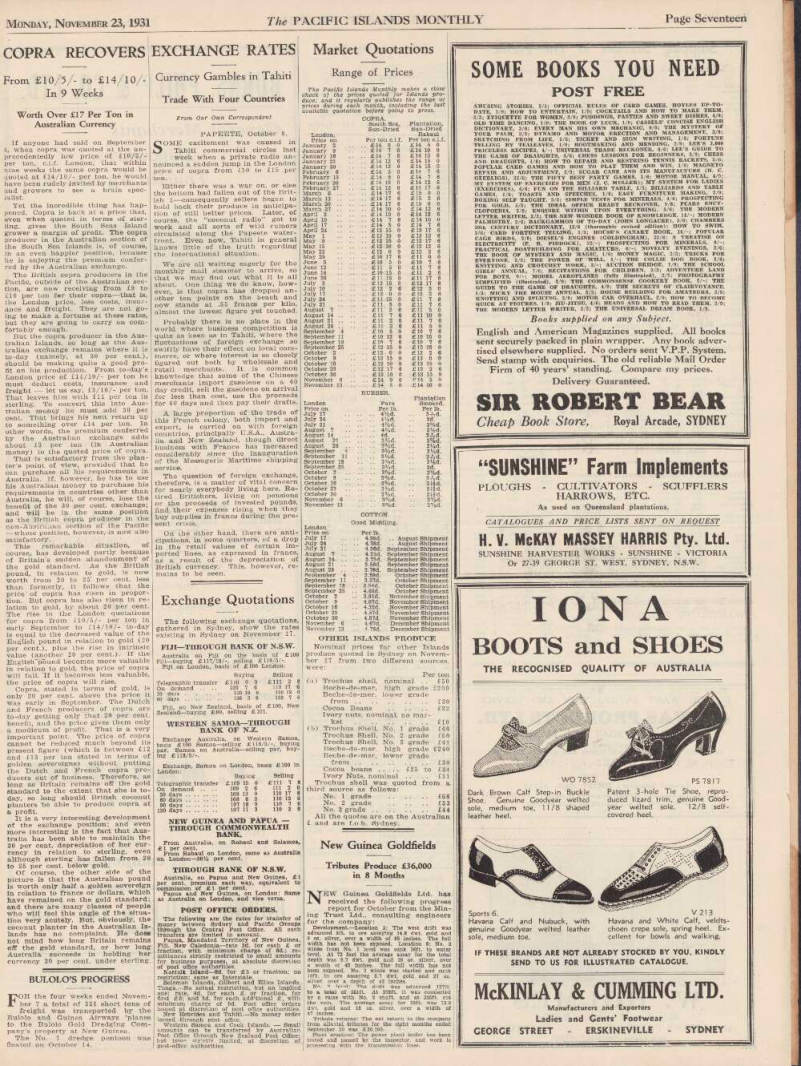
From £10/5/- to £14/10/-
In 9 Weeks Worth Over £17 Per Ton in Australian Currency
If anyone had said on September 4, when copra was quoted at the un precedentedly low price of £10/5/per ton, c.i.f. London, that within nine weeks the same copra would be quoted at £14/10/- per ton, he would have been rudely invited by merchants and growers to see a brain spec ialist.
Yet the incredible thing has hap pened. Copra is back at a price that, even when quoted in terms of ster ling, gives the South Seas Island grower a margin of profit. The copra producer in the Australian section of the South Sea Islands is, of course, in an even happier position, because he is enjoying the premium confer red by the Australian exchange.
The British copra producers in the Pacific, outside of the Australian sec tion, are now receiving from £9 to £10 per ton for their copra—that is, the London price, less costs, insur ance and freight. They are not go ing to make a fortune at these rates, but they are going to carry on com fortably enough.
But the copra producer in the Aus tralian Islands, so long as the Aus tralian exchange remains where it is to-day (namely, at 30 per cent.), should be making quite a good pro fit on his production. From to-day’s London price of £14/10/- per ton he must deduct costs, insurance and freight let us say, £3/10/- per ton.
That leaves him with £11 per ton in sterling. To convert this into Aus tralian money he must add 30 per cent. That brings his nett return up to something over £14 per ton. In other words, the premium conferred by the Australian exchange adds about £3 per ton (in Australian money) to the quoted price of copra.
That is satisfactory from the plan ter’s point of view, provided that he can purchase all his requirements in Australia. If, however, he has to use his Australian money to purchase his requirements in countries other than Australia, he will, of course, lose the benefit of the 30 per cent, exchange; and will be in the same position as the British copra producer in the non-Australian section of the Pacific —whose position, however, is now also satisfactory.
This remarkable situation, of course, has developed partly because of Britain’s sudden abandonment of the gold standard. As the British pound, in relation to gold, is now worth from 20 to 25 per cent, less than formerly, it follows that the price of copra has risen in propor tion. But copra has also risen in re lation to gold, by about 20 per cent.
The rise in the London quotations for copra from £10/5/- per ton in early September to £14/10/- to-day is equal to the decreased value of the English pound in relation to gold (20 per cent.), plus the rise in intrinsic value (another 20 per cent.). If the English pound becomes more valuable in relation to gold, the price of copra will fall. If it becomes less valuable, the price of copra will rise.
Copra, stated in terms of gold, is only 20 per cent, above the price it was early in September. The Dutch and French producers of copra are to-day getting only that 20 per cent, benefit, and the price gives them only a modicum of profit. That is a very important point. The price of copra cannot be: reduced much beyond its present figure (which is between £12 and £13 per ton stated in terms of golden sovereigns) without putting the Dutch and French copra pro ducers out of business. Therefore, as long as Britain remains off the gold standard to the extent that she is to day, so long should British coconut planters be able to produce copra at a profit.
It is a very interesting development of the exchange position; and even more interesting is the fact that Aus tralia has been able to maintain the 30 per cent, depreciation of her cur rency in relation to sterling, even although sterling has fallen from 20 to 25 per cent, below gold.
Of course, the other side of the picture is that the Australian pound is worth only half a golden sovereign in relation to francs or dollars, which have remained on the gold standard; and there are many classes of people who will feel this angle of the situa tion very acutely. But, obviously, the coconut planter in the Australian Is lands has no complaint. He does not mind how long Britain remains off the gold standard, or how long Australia succeeds in holding her currency 30 per cent, under sterling.
Bulolo’S Progress
FOR the four weeks ended Novem ber 7 a total of 221 short tons of freight was transported by the Bulolo and Guinea Airways ’planes to the Bulolo Gold Dredging Com pany’s property at New Guinea.
The No. 1 dredge pontoon was floated on October 14.
Exchange Rates
Currency Gambles in Tahiti Trade With Four Countries
From Our Own Correspondent PAPEETE, October 8.
SOME excitement was caused in Tahiti commercial circles last week when a private radio an nounced a sudden jump in the London price of copra from £10 to £15 per ton.
Either there was a war on, or else the bottom had fallen out of the Brit ish £ —consequently sellers began to hold back their produce in anticipa tion of still better prices. Later, of course, the “coconut radio” got to work and all sorts of wild rumors circulated along the Papeete water front. Even now, Tahiti in general knows little of the truth regarding the international situation.
We are all waiting eagerly for the monthly mail steamer to arrive, so that we may find out what it is all about. One thing we do know, how ever, is that copra has dropped an other ten points on the beach and now stands at .55 francs per kilo, almost the lowest figure yet touched.
Probably there is no place in the world where business competition is quite as keen as in Tahiti, where the fluctuations of foreign exchange so swiftly have their effect on local com merce, or where interest is so closely figured out both by wholesale and retail merchants. It is common knowledge that some of the Chinese merchants import gasolene on a 60 day credit, sell the gasolene on arrival for less than cost, use the proceeds for 60 days and then pay their drafts.
A large proportion of the trade of this French colony, both import and export, is carried on with foreign countries, principally U.S.A., Austra lia and New Zealand, though direct business with France has increased considerably since the inauguration of the Messagerie Maritime shipping service.
The question of foreign exchange, therefore, is a matter of vital concern for nearly everybody living here. Re tired Britishers, living on pensions or the proceeds of invested pounds, find their expenses rising when they buy supplies in francs during the pre sent crisis.
On the other hand, there are anti cipations, in some quarters, of a drop in the retail values of certain im ported lines, as expressed in francs, as a result of the depreciation of British currency. This, however, re mains to be seen.
Exchange Quotations
The following exchange quotations, gathered in Sydney, show the rates existing in Sydney on November 17.
Fiji—Through Bank Of N.S.W.
Australia on Fiji on the basis of £ 100 Fiji—buying £117/10/-, selling £118/5/-.
Fiji on London, basis of £100 London;
Western Samoa—Through
Bank Of N.Z.
Exchange Australia, on Western Samoa, basis £100 Samoa —selling £118/5/-, buying par. Samoa on Australia —selling par, buy ing £118/5/-.
Exchange, Samoa on London, basis £100 in London:
New Guinea And Papua
Through Commonwealth
Bank.
From Australia, on Rabaul and Salamoa, £1 per cent.
From Rabaul on London, same as Australia on London —30½ per cent.
Through Bank Of N.S.W.
Australia, on Papua and New Guinea, £1 per cent, premium each way, equivalent to commission of £1 per cent.
Papua and New Guinea, on London: Same as Australia on London, and vice versa.
Post Office Orders.
The following are the rates for transfer of money between Sydney and Pacific Groups through the Central Post Office. All such transfers are limited in amount.
Papua, Mandated Territory of New Guinea, Fiji, New Caledonia —rate 3d. for each £ or fraction, with minimum charge of 6d.; re mittances strictly restricted to small amounts for business purposes, at absolute discretion of post office authorities.
Norfolk Island —6d. for £5 or fraction; no resiriction; same as Interstate.
Solomon Islands, Gilbert and Ellice Islands.
Tonga.—No actual restriction, but an implied one; rate, 4d. for each £ or fraction, for first £6; and 3d. for each additional £, with minimum charge of 9d. Post office orders issued at discretion of post office authorities.
New Hebrides and Tahiti. —No money order issued through post office.
Western Samoa and Cook Islands. Small amounts can be transferred bv Australian Post Office through New Zealand Post Office; but issue stwctlv limited, at discretion of post-office authorities.
Buying Selling Telegraphic transfer £110 0 0 £111 2 (3 On demand .. .. 109 7 6 110 17 6 30 days 108 15 0 110 12 6 60 days 108 3 9 110 7 6 Fiji, on New Zealand, basis of £100, New Zealand —buying £99, selling £101.
Buying Selling Telegraphic transfer £109 15 0 £111 7 0 On demand .. .. 109 2 6 111 2 6 30 days 108 13 9 110 17 6 60 days 108 6 3 110 12 6 90 days 107 18 9 110 7 6 120 days 107 11 3 110 2 6
Market Quotations
Range of Prices
The Pacific Islands Monthly makes a close check of the prices quoted for Islands pro duce; and it regularly publishes the range of prices during each month, including the last available quotation before going to press.
Other Islands Produce
Nominal prices for other Islands produce quoted in Sydney on Novem ber 17 from two different sources, were:
All the quotes are on the Australian £ and are f.o.b. Sydney.
Copra.
South Sea, Plantation, Sun-Dried Sun-Dried London.
Rabaul Price on Per ton c.i.f.
Per ton c.i.f.
January 2 .. .. £14 0 0 £14 5 0 January 9 . . .. £14 7 6 £14 10 0 January 16 . . .. £14 7 6 £14 12 6 January 23 . . . . £14 12 6 £14 15 0 January 30 . . . . £ 14 12 6 £14 15 0 February 6 . . .. £14 5 0 £14 7 6 February 13 . . . . £14 5 0 £14 7 6 February 20 . . . . £14 10 0 £14 12 6 February 27 . . . . £ 14 12 6 £14 17 6 March 6 . . . . . . £14 17 6 £15 0 0 March 13 .. . . . . £14 17 6 £15 2 6 March 20 . . . . . . £14 17 6 £15 0 0 March 27 . , . . . . £14 10 0 £14 12 6 April 3 . . . . £14 10 0 £14 12 6 April 10 . . .. £14 7 6 £14 10 0 April 17 . . . . £14 5 0 £14 7 6 April 24 . . . . £13 15 0 £13 17 6 May 1 . . . . £13 10 0 £13 12 6 May 8 . . . . £12 15 0 £12 17 6 May 15 . . . . £12 10 0 £12 12 6 May 22 . . . . £12 0 0 £12 2 6 May 29 . . . . £10 17 6 £11 0 0 June 5 .. .. £10 5 0 £10 7 6 June 12 .. .. £11 5 0 £11 7 6 June 19 . . . . £10 15 0 £11 2 6 June 26 . . . . £11 15 0 £11 17 6 July 3 . . . . £12 15 0 £12 17 6 July 10 .. . . £12 2 6 £12 5 0 July 17 .. .. £12 0 0 £12 2 6 July 24 . . . . £11 15 0 £11 7 6 July 31 . . . . £11 5 0 £11 7 6 August 7 . . . . £11 2 6 £11 5 0 August 14 . . . . . . £11 7 6 £11 10 0 August 21 .. . . ..£1126 £11 7 6 August 28 . . .. . . £11 2 6 £11 5 0 September 4 .. £10 5 0 £10 7 6 September 11 .. £10 12 6 £10 15 0 September 18 .. £10 7 6 £10 7 6 September 25 .. £12 15 0 £12 15 0 October 2 . . . . £12 0 0 £12 2 6 October 9 .. .. £12 15 0 £13 0 0 October 16 . . . . £12 10 0 £12 15 0 October 23 . . . . £12 17 6 £13 2 6 October 30 . . . . £13 10 0 £13 15 0 November 6 . . . . £14 0 0 P 14 5 0 November 13 . . . . £14 5 0 £14 10 0
Rubber.
Plantation London Para Smoked.
Price on Per lb.
Per lb.
July 17 .. . . 4%d. 3 Ad.
July 24 . . . . 4V 2 d. 3d.
July 31 . . . . 4VS>d. 2%d.
August 7 4V 4 d. 2%d.
August 14 .. ., 4d. 2 Ad.
August 21 . .. .. 3%d. 2%d.
August 28 3 3 / 4 d. 2V 4 d.
September 4 .. .. 3V 2 d. 2y 4 d.
September 11 .. .. 3V 4 d. 2 Ad.
September 18 .. .. 3Vsd. 2%d.
September 25 .. .. 3%d. 3d.
October 2 3%d. 2%d.
October 9 .. . 3%d. 3 Ad.
October 16 .. .. 3%d. 2**d.
October 23 . . .. 3%d. 24*d.
October 30 . . . . 3%d. 2**d.
November 6 .. .. 3 5 / 8 d. 2y 8 d.
November 13 . . . . 3%d. 2%d.
Cotton.
Good Middling.
London Price on Per lb.
July 17 .. 4.9Sd. ., August Shipment July 24 ,. 4.78d. .. August Shipment July 31 .. 4.56d. September Shipment August 7 .. .. 4.21d, September Shipment August 14. .. ., 3.73d. September Shipment August 21 .. 3.56d. September Shipment August 28 ..
3.70d. September Shipment
September 4 ., 3.59d. October Shipment September 11 .. 3.57d. October Shipment September 18 .. 3.54d. October Shipment September 25 .. 4.88d. October Shipment October 2 .. 3.91d. November Shipment October 9
.. 4.07d. November Shipment
October 16 .. 4.32d. November Shipment October 23 .. 4.57d. November Shipment October 30 .. 4.67d. November Shipment November 6 .. 4.67d. December Shipment November 13 4 76d. December Shipment
Per ton (a) Trochus shell, nominal . . £50 Beche-de-mer, high grade £200 Beche-de-mer, lower grade from £30 Cocoa Beans . . £32 Ivory nuts, nominal, no market £10 (b) Trochus Shell, No. 1 grade £60 Trochus Shell, No. 2 grade £50 Trochus Shell, No. 3 grade £41 Beche-de-mer, high grade £240 Beche-de-mer, lower grade from £30 Cocoa beans . . £25 to £34 Ivory Nuts, nominal • • • • £11 Trochus shell was quoted from a third source as follows: No. 1 grade £58 No. 2 grade . . £53 No. 3 grade . . £44
New Guinea Goldfields
Tributes Produce £36,000 in 8 Months
NEW Guinea Goldfields Ltd. has
received the following' progress report for October from the Min
ing Trust Ltd., consulting engineers
for the company: Development.—Location 3: The west drift was advanced sft. in ore assaying 14.8 dwt. gold and 9 oz. silver, over a width of 85 inches. The full width has not been exposed. Location 8: No. 2 winze from No. 1 level was sunk 16ft. to water level. At 72 feet the average assay for the total depth was 9.7 dwt. gold and 19 oz. silver, over a width of 42 inches. The full width has not been exposed. No. 3 winze was started and sunk 16ft. in ore assaying 5.7 dwt. gold and 27 oz. silver, over a depth of 42 inches.
No. 2 level: The drift was advanced 137 ft. to a total of 351 ft. At 275 ft. it was connected by a raise with No. 2 shaft, and at 325 ft. cut the vein. The average assay for 25ft. was 12.8 dwt. gold and 15 oz. silver, over a width of 47 inches.
Tribute returns: The net return to the company from alluvial tributes for the eight months ended September 30 was £36,190.
Plant erection: The power plant boiler has been tested and passed by the inspector, and work is proceeding with the transmission lines.
Advertisements & other items, p. 17 (1 item)
Lona
SOME BOOKS YOU NEED
POST FREE
AMUSING STORIES, 3/3; OFFICIAL RULES OF CARD GAMES, HOYLES UP-TO- DATE, 2/9; HOW TO ENTERTAIN, 1/9; COCKTAILS AND HOW TO MAKE THEM, 3/3; ETIQUETTE FOR WOMEN, 2/9; PUDDINGS, PASTIES AND SWEET DISHES, 4/9; OLD TIME DANCING, 1/9; THE BOOK OF LUCK, 1/9; CASSELS’ CONCISE ENGLISH DICTIONARY, 3/6; EVERY MAN HIS OWN MECHANIC, 9/6; THE MYSTERY OF YOUR PALM, 3/3; DYNAMO AND MOTOR ERECTION AND MANAGEMENT, 2/9; SKETCHING FROM LIFE, 1/6; TICKET AND SIGN WRITING, 1/6; FORTUNE TELLING BY TEALEAVES, 1/9; BOOTMAKING AND MENDING, 2/9; LEE’S 3,000 PRICELESS RECIPES, 4/-; UNIVERSAL TRADE RECKONER, 4/6; LEE’S GUIDE TO THE GAME OF DRAUGHTS, 4/6; CHESS LESSONS FOR BEGINNERS, 2/9; CHESS AND DRAUGHTS, 1/6; HOW TO REPAIR AND RESTRING TENNIS RACKETS, 3/6; POPULAR CARD GAMES AND HOW TO PLAY THEM AND WIN, 1/6; MAGNETO REPAIR AND ADJUSTMENT, 2/9; SUGAR CANE AND ITS MANUFACTURE (H. C.
GEERLIGS), 35/6; THE FIFTY BEST PARTY GAMES, 1/6; MOTOR MANUAL, 4/9; MY SYSTEM OF EXERCISES FOR MEN (J. C. MULLER); MY (SYSTEM FOR LADIES (EXERCISES), 6/6; FUN ON THE BILLIARD TABLE, 3/3; BILLIARDS AND TABLE GAMES, 1/6; TOASTS AND SPEECHES, 1/6; EASY FURNITURE MAKING, 2/9; BOXING SELF TAUGHT, 2/3; SIMPLE TESTS FOR MINERALS, 4/6; PROSPECTING FOR GOLD, 5/3; THE IDEAL OFFICE READY RECKONER, 9/8; PEARS ENCY- CLOPOEDIA, 5/9; ENQUIRE WITHIN UPON EVERYTHING, 5/6; THE MODERN LETTER WRITER, 3/3; THE NEW WONDER BOOK OF KNOWLEDGE, 14/-; MODERN PALMISTRY, 2/6; BACKGAMMON OF TO-DAY (JOHN LONGACRE), 5/6; CHAMBERS 20th CENTURY DICTIONARY, 12/6 (thoroughly revised edition); HOW TO SWIM, 3/6; CARD FORTUNE TELLING, 3/3; HOUSE’S CANARY BOOK, 16/-; POPULAR CAGE BIRDS, 2/9; DIESEL’S ENGINES (GOLDINGHAM), 33/6; A TREATISE ON ELECTRICITY (F. B. PIDDOCK), 32/-; PROSPECTING FOR MINERALS, 9/-; PRACTICAL BOATBUILDING FOR AMATEURS, 6/-; NOVELTY EVENINGS, 2/6; THE BOOK OF MYSTERY AND MAGIC, 1/6; MONEY MAGIC, 3/3; TRICKS FOR EVERYONE, 3/3; THE POWER OF WILL, 1/-; THE COLLIE DOG BOOK, 3/6; KNITTING AND CROTCHET WORK, 2/-; AUCTION BRIDGE, 1/9; THE SCHOOL GIRLS’ ANNUAL, 7/6; RECITATIONS FOR CHILDREN, 3/3; ADVENTURE LAND FOR BOYS, 9/-; MODEL AEROPLANES (fully illustrated), 2/7; PHOTOGRAPHY SIMPLIFIED (illustrated), 2/9; THE COMMONSENSE COOKERY BOOK, 2/-; THE GUIDE TO THE GAME OF DRAUGHTS, 4/9; THE SECRETS OF CLAIRVOYANCE, 1/3; MICKY THE MOUSE ANNUAL. 5/3; HOUSE BUILDING FOR AMATEURS, 2/9; KNOTTING AND SPLICING, 2/9; MOTOR CAR OVERHAUL, 2/9; HOW TO BECOME QUICK AT FIGURES, 1/9; JIU-JITSU, 4/6; HEADS AND HOW TO READ THEM, 2/9; THE MODERN LETTER WRITER, 3/3; THE UNIVERSAL DREAM BOOK, 1/9.
Books supplied on any Subject .
English and American Magazines supplied. All books sent securely packed in plain wrapper. Any book adver tised elsewhere supplied. No orders sent V.P.P. System.
Send stamp with enquiries. The old reliable Mail Order Firm of 40 years’ standing. Compare my prices.
Delivery Guaranteed.
SIR ROBERT BEAR
Cheap Book Store, Royal Arcade, SYDNEY
“SUNSHINE” Farm implements
PLOUGHS - CULTIVATORS - SGUFFLERS
HARROWS, ETC.
As used on Queensland plantations.
CATALOGUES AND PRICE LISTS SENT ON REQUEST H. V. McKAY MASSEY HARRIS Pty. Ltd.
SUNSHINE HARVESTER WORKS - SUNSHINE - VICTORIA Or 27-39 GEORGE ST. WEST, SYDNEY, N.S.W.
lONA
BOOTS and SHOES
THE RECOGNISED QUALITY OF AUSTRALIA
WO 7852 Dark Brown Calf Step-in Buckle Shoe. Genuine Goodyear welted sole, medium toe, 11/8 shaped leather heel.
PS 7817 Patent 3-hole Tie Shoe, reproduced lizard trim, genuine Goodyear welted sole. 12/8 selfcovered heel. 88)8*** Sports 6.
Havana Calf and Nubuck, with genuine Goodyear welted leather sole, medium toe.
V 21 3 Havana and White Calf, veldtschoen crepe sole, spring heel. Excellent for bowls and walking.
IF THESE BRANDS ARE NOT ALREADY STOCKED BY YOU, KINDLY
SEND TO US FOR ILLUSTRATED CATALOGUE.
McKINLAY & GUMMING LTD.
Manufacturers and Exporters Ladies and Gents’ Footwear
GEORGE STREET - ERSKINEVILLE - SYDNEY
Shipping Services in The Pacific
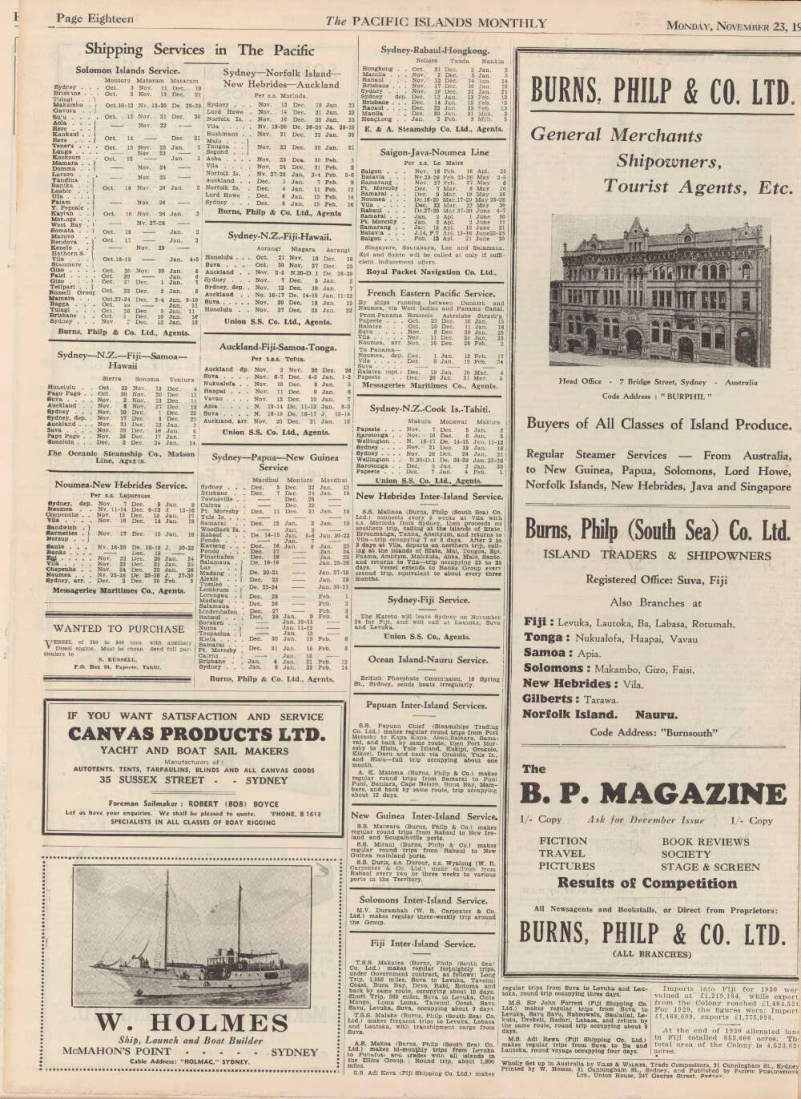
Solomon Islands Service.
Montoro Mataram Mataram
Sydney—N.Z.—Fiji— Samoa— Hawaii
Noumea-New Hebrides Service.
Per s.s. Laperouse
Sydney —Norfolk Island — New Hebrides —Auckland Per s.s. Morinda.
Sydney-N.Z.-Fiji-Hawaii.
Auckland-Fiji-Samoa-T onga.
Per t.s.s. Tofua.
Sydney—Papua—New Guinea Service
Sydney-Rabaul-Hongkong.
Saigon-Java-Noumea Line Per s.s. Le Maire
Singapore, Sourabaya, Lae and Salamaua, Epi and Santo will be called at only if suffi cient inducement offers.
Royal Packet Navigation Co. Ltd.,
Sydney-N.Z.-Cook Is.-Tahiti.
New Hebrides Inter-Island Service.
S.S. Malinoa (Burns, Philp (South Sea) Co.
Ltd.) connects every 5 weeks at Vila with s.s. Morinda from Sydney, then proceeds on southern trip, calling at the Islands of Elate.
Erronmanga, Tanna, Aneityum, and returns to Vila —trip occupying 7or 8 days. After 2 to 3 days at Vila, departs on northern trip, call ing at the islands of Efate, Mai, Tongoa, Epi.
Paama, Ambrym, Malekula, Abba, Malo, Santo, and returns to Vila —trip occupying 25 to 28 days. Vessel extends to Banks Group every second trip, equivalent to about every three months.
Sydney-Fiji Service.
The Karetu will leave Sydney on November 24 for Fiji, and will call at Lautoka, Suva and Levuka.
Union S.S. Co„ Agents.
Ocean Island-Nauru Service.
British Phosphate Commission, 16 Spring St., Sydney, sends boats irregularly.
Papuan Inter-Island Services.
S.S. Papuan Chief (Steamships Trading Co. Ltd.) makes regular round trips from Port Moresby to Kapa Kapa. Abau, Baibara, Sama rai, and back by same route; then Port Mor esby to Hisiu, Yule Island, Kukipi, Orokolo, Kikori, Daru and back via Orokolo, Yule Is., and Hisiu—full trip occupying about one month.
A. K. Matoma (Burns, Philp & Co.) makes regular round trips from Samarai to Puni Puni, Baniara, Cape Nelson, Buna Bay, Mam bare, and back by same route, trip occupying about 12 days.
New Guinea Inter-Island Service.
S.S. Maiwara (Burns, Philp & Co.) makes regular round trips from Rabaul to New Ire land and Bougainville ports.
S.S. Mirani (Burns, Philp & Co.) makes regular round trips from Rabaul to New Guinea mainland ports.
S.S. Duris, s.s. Durour, s.s. Wyalong (W. R.
Carpenter & Co. Ltd.) make sailings from Rabaul every two or three weeks to various ports in the Territory.
Solomons Inter-Island Service.
M.V. Durambah (W. R. Carpenter & Co.
Ltd.) makes regular three-weekly trip around the Group.
Fiji Inter-Island Service.
T.S.S. Makatea (Burns, Philp (South Sea Co. Ltd.) makes regular fortnightly trips, under Government contract, as follows: Long Trip, 1,050 miles, Suva to Levuka, Tavenui Coast, Buca Bay, Devo, Rabi, Rotuma and back by same route, occupying about 10 days.
Short Trip, 560 miles, Suva to Levuka, Cicia Mango. Loma Loma, Tavenui Coast. Savu Savu, Levuka, Suva, occupying about 9 days.
T.S.S. Malake (Burns, Philp (South Sea) Co.
Ltd.) makes frequent trips to Levuka, Labasa and Lautoka, with transhipment cargo from Suva.
A.S. Makoa (Burns. Philp (South Sea) Co.
Ltd.) makes trips from Levuka to Funafuti and irades with ail islands In the Ellice Group. Round trip, about 1,800 miles.
S.S. Adi Keva (Fiji Shipping Co. Ltd.) makes
regular trips from Suva to Levuka and Lau toka, round trip occupying three days.
M.S. Sir John Forrest (Fiji Shipping Co.
Ltd.) makes regular trips from Suva to Levuka, Savu Savu, Nabouwalu, Baulailai, Le kutu, Dreketi, Raduri, Labasa, and return by the same route, round trip occupying about 9 days.
M.S. Adi Rewa (Fiji Shipping Co. Ltd.) makes regular trips from Suva to Ba and Lautoka. round voyage occupying four days.
Imports into Fiji for 19 30 wer valued at £1,219,184, while export from the Colony reached £1,484,526 For 1929, the figures were: Import £1,468,609, exports £1,775,998.
At the end of 1930 alienated lam in Fiji totalled 8 5 3,606 acres. The total area of the Colony is 4,523,62' acres.
K.
Sydney .
Oct. 3 Nov. n Dec. 19 Brisbane • .
Oct. 5 Nov. 13 Dec. 21 Tulagi . . . 1 Makambo . t Oct.10-12 Nv. 18 -20 De. 26-29 Gavutu . . J Bu’u . .
Oct. 13 Nov. 21 Dec. 30 Aola . .
Rere . . ;} Nov. 22 — Kaukaul . . \ • i Oct. 14 Dec. 31 Here . .
Teneru .
Oct. 15 Nov. 23 Jan. 1 Lunga . . . .
Nov. 23 Kookoom \ \ Oct. 15 Jan. 1 Mamara .
Domma . . j Nov. 24 Lavoro .
Yandina • w . 1 :[ Nov. 25 Banika .
Loabie .
Oct. 16 Nov. 26 Jan. 2 Ufa . . . . 1 Paiam . J Nov. 26 Y. Pepsale • 1
Kaylah .
• j Oct. 16 Nov, 26 Jan. 2 Mer.nge .
Nv. 27- -28 West Bay . I Somata . . i Oct. 16 Jan. 2 Marovo Oct.
Rendova 11 Jan. 3 Kenelo . . i Nov. 29 Hathorn S. 1 Vila . . . y Oct.18 -19 Jan. 4-5 Stanmore . J Glzo . . • • Oct. 20 Nov, 30 Jan. 6 Paisl . . . .
Oct. 20 Jan. 6 Gizo . . . Oct. 27 Dec. 1 Jan. 7 Tetipari . . f Oct. 22 Dec.
Russell Group 2 Jan. 8 Mamara .
Oct.23 -24 Dec. 3 -4 Jan. 9-10 Bagga . .
Oct. 2o - Jan. 11 Tulagi . Oct. 26 Dec. 5 Jan. 11 1 Brisbane .
Oct. 3 Dec. 10 Jan. 16 1
Sydney .
• • Nov. r» Dec. 12 Jan. 3.8:
Burns,
Philp &
Co
Ltd.,
Agents, j
Sierra Sonoma Ventura Honolulu . . Oct. 23 Nov. 13 Dec. 4 Pago Pago . . Oct. 30 Nov. ’20 Dec. 11 Suva , . . . Nov, 2 Nov. , 23 Dec. 14 Auckland . . Nov. 6 Nov. 27 Dec. 18 Sydney . . . Nov. 10 Dec. 1 Dec. 22 Sydney, dep. . Nov. 17 Dec. 8 Dec. 20 Auckland . . . Nov. 21 Dec. 12 Jan. 2 Suva . . . . Nov. 25 Dec. 16 Jan. 6 Pago Pago . . Nov. 26 Dec. 17 Jan. 7 Honolulu . . . Dec. 3 Dec. 24 Jan. 14
Xhe Oceanic Steamship
Co., Matson
Line,
Ageij IS.
Sydney, dep.
Nov. 7 Dec. 5 Jan. 9 Noumea .
Nv. 11 -14 Dec. 9-12 J. 13-16 Chepenche . .
Nov. 15 Dec. 13 Jan. 17 Vila ...
Nov. 16 Dec. 14 Jan. 18 Sandwich . - — Barmettes . f Nov. 17 Dec. 15 Jan. 19 Norsup . . J Santo . . .
Nv. 18 -20 De. 16-18 J. 20-23 Banks ...
Dec. 19
EaL ...
Nov. 22 Dec. 20 Jan. 24 Vila ...
Nov. 23 Dec. 21 Jan. 25 Chepenhe . .
Nov. 24 Dec. 22 Jan. 26 Noumea . . .
Nv. 25-28 De. 23-26 J. 27-30 Sydney, arr. .
Dec. 2 Dec. 30 Feb. 3
Messageries Maritimes Co., Agents.
Sydney . . . Nov. 12 Dec.
ID Jan. 21 Lord Howe . Nov. 14 Dec. 21 Jan. 23 Norfolk Is. . Nov. 16 Dec. 23 Jan. 25 Vila . . . . . Nv. 19 -20 Dc, 26-28 Ja. 28-29 Bushmans .
Malo . . . Nov. 21 Dec. 29 Jan. 30 Tangoa . .
Segond . .
Nov. 22 Dec. 30 Jan. 31 Aoba . . . . Nov. 23 De«. 30 Feb. 1 Vila . . . . Nov. 24 Dec. 31 Feb. 2 Norfolk Is. . Nv. 27-28 Jan. 3-4 Feb. 5-6 Auckland . . Dec. 1 Jan. 7 Feb. 9 Norfolk Is. . Dec. 4 Jan. 11 Feb. 12 Lord Howe . Dec. 6 Jan. 13 Feb. 14 Sydney . . . Dec. 8 Jan, 15 Feb. 16
Burns,
Philp &
Co
. Ltd.,
Agrents
Aorangi Niagara Aorangi Honolulu . . . Oct. 21 Nov. 18 Dec. 16 Suva . . .
Oct. 30 Nov. 27 Dec. 25 Auckland . . Nov. 2-3 N.30-D. 1 De. 28 -29 Sydney . . . Nov. 7 Dec. 5 Jan. 2 Sydney, dep. . Nov. 12 Dec. 10 Jan. 7 Auckland . . No. 16-17 De. 14-15 Jan. 11- -12 Suva ... 20 Dec. 18 Jan. 15 Honolulu . . Nov, 27 Dec. 25 Jan. 22 Union s.s.
Co. Ltd., Agents.
Auckland dp.
Nov. 2 Nov. 30 Dec. 28 Suva . . . .
Nov. 6-7 Dec. 4-5 Jan. 1-2 Nukualofa . .
Nov, 10 Dec. 8 Jan. 5 Haapai . . .
Nov. 11 Dec. 9 Jan. 6 Vavau . . . .
Nov. 12 Dec. 10 Jan. 7 Apia . . . .
N. 13-14 De. 11-12 Jan. 8-9 Suva . . . .
N. 18-19 De. 16-17 J. 13 -14 Auckland, arr.
Nov. 23 Dec. 21 Jan, 18 Union
S.S. Co. Ltd, Agents.
Macdhui Montoro Macdhui Sydney . , Dec, 5 Dec. 22 Jan. 12 Brisbane .
Dec. 7 Dec. 24 Jan. 14 Townsville .
Dec. 28 Cairns . .
Dec, 29
Pt, Moresby
Dec. 11 Dec. 31 Jan. 18 Yule Is. . . — Samarai Dec. 12 Jan. 2 Jan. 19 Woodlark Is Jan. 3 Rabaul . .
De. 14 -15 Jan. 5-6 Jan. 20 -22 Pondo . . —— Jan. 7 Kavieng . .
Dec. 16 Jan. 8 Jan. 23 Pondo . . .
Dec. 17 Jan. 24 Pinschafen Dec. 18 Jan. 25 Salamaua ) f De. 18 -19 Jan. 25 -26 Lae . . .
Madang . .
De. 20- -21 Jan. 27 -28 Alexis . . f Dec. 22 Jan. 29 Tumleo . .
Lombrum .
De. 23- 24 Jan. 30- 31 Lorengau . f Dec. 26 Feb, 1 Madang . .
Salamaua .
Dec. 26 Feb. 2 Lindenhafen Dec. 27 Feb. 3 Rabaul . .
Dec. 28 Jan. 9 Feb. 4 Soraken . .
Jan. 10 -11 Numa . . . Jan. 11 -12 Teopaslna .
Jan. 13 Kieta . . .
Dec. 30 Jan. 15 Feb. 6 Samarai . .
Dec.
Feb.
Pt. Moresby
31 Jan. 16 8 Cairns . .
Jan. 18 Brisbane .
Jan. 4 Jan. 21 Feb. 12 Sydney . . • Jan. 6 Jan. 23 Feb. 14
Burns, Philp &
Co
. Ltd.,
Agents.
Nellore Tanda Nankin
Hongkong
. . Oct. 31 Dec. 2 Jan. 2 Manilla . . . Nov. 3 Dec. 5 Jan. 5 Habaul . . . Nov. 12 Dec. 14 •Jan. 14 Brisbane . . . Nov. 17 Dec. 19 Jan. 19 Sydney . . . Nov. 19 Dec. 21 Jan. 21 Sydney dep. Dec, 12 Jan. 13 Feb. 13 Brisbane . . . Dec. 14 Jan. 15 Feb. '5 Raoaul . . . . Dec. 22 Jan. 23 Feb. 13 Manila . . Dec. 30 Jan. 31 Mcll. 2
Hongkong
. . Jan. 2 Feb. 3 Mch. 5 E. & A.
Steamship Co. Ltd.,
Agents.
Saigon . . .
Nov. 16 Feb. 16 Apl. 25 Batavia . . .
Nv.23 -26 Feb. 23 -26 May 2-5 Samarang . .
Nov. 27 Feb.. 27 May 6 Pt. Moresby .
Dec. 7 Mar. 8 May 16 Samarai . . .
Dec. 9 Mar. 10 May 18 Noumea . . .
Dc.16 -20 Mar.17 -20 May 25 -28 Vila Dec. 22 Mar. 22 May 30 Rabaul . . .
Dc.27 -30 Mar.27 -30 June 4-7 Samarai . . .
Jan. 2 Apl. 1 June 10 Pt. Moresby .
Jan. 3 Apl. 2 June 11 Samarang . .
Jan. 13 Apl. 12 June 21 Batavia . . .
J.14, P.7 Apl. 13 -16 June22 -25 Saigon ...
Feb. 12 Apl. 21 June 30
French Eastern Pacific Service.
By ships running between Dunkirk and Noumea, via West Indies and Panama Canal.
From Panama Boussole Astrolabe Strasb’e Papeete . . .
Oct. 29 Dec. 10 Jan. 15 Raiatea . . .
Oct. 30 Dec. 11 Jan. 16 Suva ...
Nov. 8 Dec. 20 Jan. 25 Vila Nov. 11 Dec. 23 Jan. 28 Noumea, arr.
Nov. 16 Dec. 28 Feb. 2 To Panama— Noumea, dep.
Dec. 1 Jan. 12 Feb. 17 Vila Dec. 8 Jan. 19 Feb. 24 Suva Raiatea (opt.) Dec. 19 Jan. 30 Mar. 4 Papeete . . .
Dec. 20 Jan. 31 Mar. 5
Messageries
Maritimes Co
Agents
Makura Monowai Makura Papeete . . . Nov. 7 Dec. 5 Jan. 2 Rarotonga . . Nov. 10 Dec. 8 Jan. 5 Wellington . . N. 16-17 De. 14-15 Jan. 11 -12 Sydney . . . . Nov. 21 Dec. 19 Jan. 16 Sydney . . . . Nov. 26 Dec. 24 Jan. 21 Wellington . . N.30-D.1 De. 28-29 Jan. 25 -26 Rarotonga . . Dec. 5 Jan, 2 Jan. 30 Papeete . . . Dec. 7 Jan. 4 Feb. 1
Union
S.S. Co. Ltd.,
Agents.
Advertisements & other items, p. 18 (2 items)
Monday, November 23, 19
18
The PACIFIC ISLANDS MONTHLY
Wholly Set up in Australia by Viles & Walker, Trade Compositors, 31 Cunningham St., Sydnev Printed by W. Homer, 31 Cunningham St., Sydney, and Published by Pacific Publications Ltd., Union House, 247 Georee Street,
Burns, Phjlp & Co. Ltd
General Merchants
Shipowners ,
Tourist Agents , Etc .
Head Office - 7 Bridge Street, Sydney - Australia Code Address : " BURPHIL ”
Buyers of All Classes of Island Produce.
Regular Steamer Services From Australia, to New Guinea, Papua, Solomons, Lord Howe, Norfolk Islands, New Hebrides, Java and Singapore
Burns, Philp (South Sea) Co. Ltd.
ISLAND TRADERS & SHIPOWNERS
Registered Office: Suva, Fiji Also Branches at Fiji; Levuka, Lautoka, Ba, Labasa, Rotumah.
Tonga • Nukualofa, Haapai, Vavau Samoa : Apia.
Solomons ; Makambo, Gizo, Faisi.
New Hebrides : Vila.
Gilberts : Tarawa.
Norfolk Island. Nauru.
Code Address; "Burnsouth”
WANTED TO PURCHASE
VESSEL of 350 to 500 tons, with auxiliary Diesel engine. Must be cheap. Send full par ticulars to
S. RUSSELL,
P.O. Box 64, Papeete, Tahiti.
IF YOU WANT SATISFACTION AND SERVICE
CANVAS PRODUCTS LTD.
YACHT AND BOAT SAIL MAKERS
Manufacturers of : AUTOTENTS. TENTS, TARPAULINS, BLINDS AND ALL CANVAS GOODS
35 SUSSEX STREET - - SYDNEY
Foreman Sailmaker : ROBERT (BOB) BOYCE Let us have your enquiries. We shall be pleased to quote. ’PHONE, B 1613 SPECIALISTS IN ALL CLASSES OF BOAT RIGGING
The 1/- Copy Ask for December Issue 1/- Copy
FICTION
TRAVEL
PICTURES
BOOK REVIEWS
SOCIETY
STAGE & SCREEN
Results o£ Competition
All Newsagents and Bookstalls, or Direct from Proprietors:
BURNS, PHILP & CO. LTD.
CALL BRANCHES)
W. HOLMES
Ship, Launch and Boat Builder
McMAHON’S POINT SYDNEY
Cable Address; “HOLMAC,” SYDNEY.