Advertisements & other items, p. 1 (1 item)
The
Pacific Islands Monthly
THE ONLY JOURNAL CIRCULATING THROUGHOUT THE ISLAND TERRITORIES AND GROUPS
OF THE CENTRAL AND SOUTH PACIFIC.
Vol. 2 — No. 1
Registered at G.P.O., Sydney, for transmission by Post as a Newspaper
SYDNEY: SATURDAY, AUGUST 22, 1931
Single Copy, 6d.
Per Annum, posted, 6/-. ===
Chinese Labour
Complaints In Samoa
Industrial And Social
Problems
From Our Own Correspondent APIA, July 15.
A GREAT problem for the European planters of Samoa has always been that of labour.
The present rate of wages for the Chinese coolie is 3/- a day, and over head expenses of about 15/- a month.
The planters consider that these wages are far too high in comparison with other cocoa-producing countries, and that the Chinese coolies have of late years grown less and less efficient.
The newly founded Planters’ Association of Samoa is trying to get cheaper and more efficient labour imported; but, so far, there are no prospects of success.
Many planters have had to reduce their labour staffs and as a result a few hundred coolies are unemployed at present. They are loafing about in the Chinese quarters of Apia and only recently a coolie was knifed by an other in one of the gambling and opium-smoking dens and fatally injured. The police seem to benevolently overlook the existence of the Chinese slums and there are no raids nor any effort made to clean the vice out.
A complaint of long standing is that nearly 100 of the Chinese coolies who were brought to Samoa for the sole purpose of providing plantation labour, have been granted the rights of settlers by the administration, and are free of the obligation to return to China. These so-called “free restricted settlers” have taken up all kinds of trades and professions — taxi-owners, lorry drivers, salesmen, peddlers, bakers, mechanics, refreshment room owners, etc./ and they constitute a serious competition to Europeans and half-castes, which is keenly resented.
Strenuous efforts are being made to induce the Government to repatriate these Chinese at a time when so many settlers are out of employment, but the administration has refused to accede to these requests.
A Chinese transport is expected in September next, to bring 200 new coolies and take about 400 old and time-expired coolies back to China.
Many of the latter have been living with Samoan women and have numerous offspring. These women and children will have to return to their Samoan relations, and it is extremely doubtful whether they will find a hearty welcome there in these hard times. ===
Levuka
May no Longer be Port of Entry Protests Against Economy Suggestion
FROM various sources it is reported that a movement is on foot to close the port of Levuka, Fiji, as a port of entry. This action is proposed on the grounds of economy.
The Auckland Star recently stated: “There is a strong rumour that the Governor thinks of closing Levuka as a port of entry. At present, the shipping has decreased to such an extent that it seems a luxury to keep many public officers in the old capital, necessitating a considerable annual expenditure, and at a time when stringent economy is necessary. The closing of the port would mean extra expense to all vessels loading and discharging at Levuka, as they would have to come to Suva to clear.”
Vigorous protests against the suggestion have appeared in The Polynesian Gazette, Levuka.
In an editorial, this paper points out that Levuka, geographically, is A view of Levuka
eminently suited to command the position of being the Colony’s distributing centre and the export port for the copra industry. Levuka’s facilities afford expeditious handling and economical working. It is the oldest port of the Colony and the centre of an important productive and agricultural Province. It is the port for Ovalau, where great areas of pineapples are under cultivation. Levuka is the home port for the only vessels trading from Fiji to the Ellice Group and to the Islands of Wallis and Futuna.
The paper suggests that a deputation should be sent from Levuka to the Governor, in an endeavour to convince the Government of the folly of even considering such an action. ... ===
T.I.’S Electric Light
Crowning 20 Years’ Effort
From Our Own Correspondent.
Thursday Island, July 30.
THE electric lighting scheme is going steadily forward, and the installation of the engines is expected next month.
The power house is nearly completed and most of the wiring has been done.
The townspeople are beginning to get ready for the festivities which will no doubt accompany the opening ceremonies.
The switching-on of the light will crown 20 years of steady work towards that end. ... ===
Papua’S Subsidy
Cut By £10,000
From Our Own Correspondent.
PT. MORESBY, August 4.
Commonwealth grant towards the expenses of administration of the Territory of Papua, originally £50,000 per annum, has been reduced 20 per cent, for the year commencing July 1 last. This brings the amount down to £40,000.
The reduction is not as drastic as would at first appear, as during the past two years the subsidy had been reduced to £45,000 for last year and to £42,000 for the previous year. ... ===
Rabaul Residents Go
North
From Our Own Correspondent
Rabaul, July 10.
Quite a number of our residents seem to be spending their furlough in the East and at places other than Australia now.
The round trip to China and Japan, by the E. & A. Line steamers, is be coming popular. ... ===
“Bootleggers”
Tahiti And The
A Sensational Story
Liquor Transhipment
Business
From Our Own Correspondent
Papeete, July 20.
PEOPLE who are of serious mind are asked not to regard seriously a highly-coloured story which appeared recently in an Australian weekly newspaper, about the operations of a “bootlegging syndicate” in Tahiti, an alleged battle on the steamer, Lake Galewood, and the holding up of Papeete by gangs of armed ruffians, primed on whisky filched from the vessel’s holds.
All this was cure sensationalism, fabricated probably by a disgruntled sailor from the Lake Galewood, and published to the discredit of those concerned.
Apparently, there was trouble on the Lake Galewood at Tonga, for the story reached Tahiti on her return voyage. But it had nothing to do with the liquor cargo, which had all been safely landed here weeks before, with out a single case being broached.
No doubt, also, the cargo of whisky landed here was destined for the United States, though nobody could swear to the fact. What of it, anyhow!
The distillers of Scotland and Ireland must have a shrewd idea of the ultimate destination of the great whisky cargoes going westward across the Atlantic, to say nothing of the Canadian distillers. But I have never heard any one suggest that Scotland is a booze depot for Scarface Al Capone. The whole story is too ridiculous for words.
So far as Tahiti’s transhipment business is concerned, it is well and efficiently conducted, like any other big and successful concern—so much so that one scarcely hears about it outside the Customs sheds. ... ===
Influenza Epidemic at Rabaul
Rabaul
From Our Own Correspondent.
Rabaul, July 10.
AT the present time we have a very unpleasant form of gastric influenza amongst us which is causing a good deal of inconvenience in business, as both Europeans and natives are affected.
So far, about 400 indentured labourers are down, and the Rapindik Native Hospital is taxed to its full capacity. ===
By Transport Costs
N. G. Goldfield Is Strangled
Why Has No Road Been Built?
Administration’s Laissez Faire Policy May Seriously Affect Future of Territory
By R. W. Robson
The richest known goldfield in the world to-day is in New Guinea, awaiting development for the enrichment of New Guinea and the Man datory Power (Australia). No country in the world needs gold more urgently than Australia.
Yet this great enterprise—the development of the New Guinea goldfields—is being strangled at birth. It is definitely being killed by lack of reasonable transport facilities. There is a strong suspicion that the absence of a road, five years after the opening of the field, is the result of greed, muddling and chicanery.
This is the story of the attempts made to build a road from the coast to the goldfields. It has been compiled from many sources. We believe it is the truth—grains of fact winnowed from a great mass of chaff. We have compiled it carefully, in the hope that the administrative short sightedness (to use a mild term) it represents will receive the attention of the public and the Federal Government.
BEFORE dealing with the lamentable
story of the goldfields road (or
lack of it) it perhaps would be well
to recite the following pertinent facts:
1. In her present economic condition, Australia urgently needs gold. The whole continent, just now, is being combed for gold. New Guinea is not part of Australia, but it is under Australian administration and is being developed partly by Australian enterprise and capital. The N.G. administration receives a royalty of 5 per cent, of the value of the gold won. 2. Estimates vary widely—but it is calculated that there is at least £30,000,000 worth of gold on the discovered goldfields of N.G.—and the region is only partly explored. The industry, under ordinary conditions, possibly would not be worked out for 50 years. 3. The goldfields are only 40 miles from the coast, but the country is extraordinarily broken and rugged—so much so that no roads have been built and transport is carried out entirely by aeroplanes. 4. These aerial transport services are highly efficient, but their cost is enormous. It is calculated that 60 per cent, of the £900,000 of gold
won from this field since 1925 has been absorbed by transport costs. 5. The huge cost of transport is crippling enterprise and actually strangling the industry before it has become established. The rates for aeroplane carriage from Salamoa or Lae to Wau (40 to 50 miles) are £5 per passenger and 6d. per lb. for goods. A ton of rice, which costs £13 on the coast, is over £50 on the goldfield. Sugar is more than doubled in price. A bottle of beer costs about 6/-. The cost of transport of machinery and tools is enormous. 6. Obviously, under such conditions, only the highest-grade ore propositions can be profitably worked. If the field is to be dependent in the future on aerial transport, its value will be comparatively small and limited. Gold-bearing areas which otherwise would be profitable cannot be worked under present conditions. 7. If there were a road available, even if suitable only for slow, heavy transport, the production of gold from the N.G. fields might easily be from £500,000 to £1,000,000 yearly. The Administration’s royalty on £500,000 would be £25,000—enough to pay interest on a road costing
(Continued On Page 2)
the goldfields—it would also permit the development of New Guinea’s other huge natural resources. 8. Guinea Airways Ltd., the biggest service transport company, has made enormous profits.
Its dividends have been huge and it has increased its capital, from accumulated profits, two or three times. No one blames this company. Shrewdly and capably managed, and efficiently conducted, it must get big profits and build up big reserves, to guard against the heavy risks of its operations.
Its shareholders, at any rate, have found the New Guinea Goldfields to be a Bonanza. Good luck to them! 9. It is estimated that, using native labour instead of machines, a graded road from Salamoa to Wau could be built for £100,000. It would be a practicable, heavy-traffic road, maintained by native labour. The surfaced highway, for motor cars, could come later. Meanwhile, the aerial services would take care of passenger, mail and light, urgent, goods traffic.
Now, why has such a road not been built? The Administrator of the Territory, in his annual report to the League of Nations, in 1927, simply said the building of a road to the goldfields would be too costly, and with that brief statement the matter ended—so far as the official annual reports are concerned.
But a very great deal has happened to which no public references have been made.
An examination of the data submitted to this journal indicates: (a) There is a thoroughly practicable route available direct from Salamoa to Wau. (b) There is another practicable route, from Lae to Wau, via the Markham Valley, the Wampit Valley, the Upper Watut and the Bulolo. (c) If native labour is intelligently used, instead of expensive machines, the direct road from Salamoa to Wau can be built for less than £100,000. The Lae - Markham - Watut road would be much more expensive. (d) Powerful influences have been at work to prevent the building of any kind of road. The Administration, apparently anxious to do the right thing, has allowed itself to be scared off its duty (the building of a road) by talk of murderously heavy costs,
Search Started In 1926
The search for a practicable route commenced early in 1926, when the enormous potentialities of the new field were recognised. The Administrator engaged Mr. E. G. Sheldon to undertake the job. He was a skilled surveyor, experienced in plotting roads through rough country—he had spent 20 years surveying roads, etc., on the Dividing Range, in Queensland.
By the end of 1926, Mr. Sheldon had been over most of the country between the Bulolo and the coast. He said that a road from Salamoa to Wau was possible and practicable, and he was instructed to proceed with the job with all despatch. He seems to have gone ahead with enthusiasm and energy, because four months later (in April, 1927) it was reported that he had found his route and planned his road, all the way to Wau. It was ofiicially stated that the grade would not exceed 1 in 12. There is reason to believe that it would not have exceeded 1 in 16.
During April and May, 1927, Sheldon used natives to cut a mule track,
with side cuttings, averaging 6ft. wide, and this had reached a point 12 miles from Salamoa when a whole series of petty official interferences caused a hold-up of the work, A Mr. Cooper was sent to take charge of the track cutting—but after two months’ argument he resigned.
Sheldon carried on again. He appears to have cut a foot track right throught to Wau (a road distance from Salamoa of 51 miles) and to have planned his grade cutting to a point 21 miles from Salamoa. Officialdom appears to have butted in again, there were more interferences—and finally, about September, 1927, Sheldon was called off the job.
Wau Versus Watut
No one knows why this work was discontinued, never to be resumed. But there is no doubt that “strings were pulled.” Important gold companies had located themselves in the Watut area, 21 miles North-west of Wau; and they, apparently, were much impressed by the fact that a section of the officials, who were opposed to Sheldon favoured a road from Salamoa via the Buang route. Let it be shown this way: Sheldon’s Route. —Salamoa to Wau, 51 miles; additional, along Bulolo to Watut, 21 miles; total 72 miles.
Buang route. —Salamoa, via Buang and Snake rivers, to Watut, 85 miles; additional, along Bulolo to Wau, 21 miles; total, 106 miles.
Men of considerable influence were interested in the Watut leases Mr.
Frank Anstey, M.P., and Mr. John Wren, for instance—and it was natural that, if Buang route was practicable, they should want the road, when built, to go first to the Watut. Presumably, they feared that if the Sheldon road, to Wau and Edie Creek, were built, it might never go on to Watut.
Mr. Sheldon seems to have been mislaid, for a time, by the Administration.
One hears of him surveying township sites at Salamoa and Lae, while all sorts and conditions of gentlemen spent thousands of pounds of public money in trying to find a route through the precipitous ranges.
Before we leave the Sheldon road, let us put on record Mr. Sheldon’s deliberate opinion of this route. It was given privately by him not long ago, and we have taken the liberty of quoting this: “If anyone should want a road to the goldfield they can start and build it, and they won’t have much trouble to complete it.” Then follows particulars of the route, which climbs the ranges between the Francisco and Bu-Tou Rivers, and avoids the saturated watersheds— which proved to be the Waterloo of several other road-planners.
Mr. Sheldon gave that opinion in 1926. It has never been seriously challenged. Yet no further attempt has been made to build the road. Why?
Various Roadseekers
Now we come to. an extraordinary series of events —attempts to find an alternative to the Sheldon route— strange vacillation and hesitancy by the Administration.
After Mr. Sheldon was pulled off his Salamoa-Wau survey, a Mr. Underwood, whose engineering knowledge appears to have been acquired in the motor industry, was given the task of finding a route. He could not make the grade, and resigned.
Next, the Administration gave the job to a Mr. Johnston, whose experience had been gained largely in the Burns, Philp stores. He ingeniously started on top of the range, and tried to work down.
Then a qualified surveyor, Mr. Livingstone, was appointed and seriously tackled the Buang route. The Administrator (General Wisdom) was in Canberra about the end of 1927, and he very unwisely promised that a road would be constructed, via Buang, within a year. General Wisdom does not usually leap before he looks. What pressure was being put on him in Canberra, and by whom?
Just about this time a road master, Mr. Green (brother of Mr. Roland Green, M.P.) arrived in Salamoa, with full equipment, to start the building of a road along the Sheldon route, direct from Salamoa to Wau. He suddenly received radio instructions to divert his activities from the Sheldon to the Buang route. He examined the route and radioed that it was impossible.
The next development appears to have been the arrival of the Administrator himself. He received a personal report from Mr. Livingstone on the Buang route, which was unfavourable.
Markham-Wampit Route
The Administrator, apparently, was by now regarding the road question as a nightmare. He brought Mr. Sheldon back and Messrs. Sheldon and Livingstone were told that they must find a route from the coast to Watut. They reported that the Markham Valley- Wampit route was practicable, but long and expensive (about 100 miles). About March, 1928, Sheldon started out to survey this route, and a gang under a young mining graduate commenced construction. There was amateurism and muddling—it is impossible, here, to
say whose was the fault—costs soared —and the Markham-Wampit scheme also collapsed.
Towards the end of 1928 (two years after the search for a road had seriously commenced) the Bulolo Dredging Co. engaged Mr. R. Wilson (Concrete Construction Ltd.) to plan a road along the Markham-Wampit route. He estimated £225,000 for a main road type— a pioneer road would have cost much less. The figures evidently scared the Bulolo Co. —it decided on aerial transport, and subsequently introduced its own fleet of high-class aeroplanes.
In 1928, New Guinea Goldfields Ltd., having acquired vast interests, commissioned a Mr. Jensen, a School of Mines graduate and former railway draftsman, to find a practicable route to the coast. He planned a railway, which was to run down the Buang route to the coast in about 90 miles, at an estimated cost, it was rumoured, of about £250,000. Other experts said the railway would have to take two or three times that mileage to get the grade, and it would cost millions. The scheme was rejected.
Mr. Jensen then set out to get a road from Wau down to Lababia—a place on the coast, south of Salamoa, without a port—and he planned a route which is favoured by some. But it traverses swampy, shifting, treacherous country; and it ends at Lababia, which is of no use to shipping.
That about completes the lamentable story. While the Administration was hesitating and vacillating, probably swayed by the contending interests of powerful companies, the enterprising and highly-efficient Guinea Airways Ltd. and some smaller organisations, “hopped in” and solved the problem of transport; and the Administration, with a sigh of relief, gave up the nightmare problem of the road. But did it escape from a nightmare by plunging into a drugged sleep?
Administration S Policy
The fact that the problem was solved at a transport cost that has already partially crippled the goldfields companies does not seem to have worried the Administration. It complacently reports: “Transport of goods and machinery is being efficiently carried out by aeroplanes.” It calmly ignores the fact that (in the words of one of our correspondents) “local finance is exhausted and outside finance is withering under the stress of transport costs.”
It is said—but for this we cannot vouch—that the attitude of the Administration towards the goldfields is: “You private companies expect to get enormous profits out of Morobe. Very well, provide your own communications —it’s your picnic!” If that really is the official policy—and it certainly fits in with events, and with the fact that the Administration placed a merciless 10 per cent. duty on all mining and aviation equipment entering the Territory—it is the most stupid and shortsighted policy in the history of golddevelopment.
What Gold Can Do
History shows that the exploitation of gold discoveries in a country is invariably followed by a rapid, profitable development of that country’s agricultural and pastoral resources. No country in the tropical zone is richer than New Guinea in natural wealth.
An Administration with any wisdom or vision would use the providential discovery of gold and the development of the gold industry—which, probably, has a transient value —to permanently establish great agricultural and allied industries throughout the Territory.
For instance, why should the Bulolo region not have two outlets—the direct one, from Wau to Salamoa, and the indirect and expensive one, from Watut out to the Markham Valley, and thence to Lae? The Salamoa-Lae road would make normal transport possible, and the connection between Wau and Watut would come, from sheer necessity (just as the road has been already built from Wau to Edie Creek); while the Watut-Markham Valley road enterprise would tend to open up the great Markham Valley-Ramu region, lying north and east of the goldfields, to settlement and agriculture. Articles have been prepared, for publication in this journal, to show that the possibilities of developing this section of the New Guinea mainland, with its fertile soil, reliable rainfall and unlimited and willing native labour, are tremendous. Why not use the gold fields money and transport facilities, from the adjoining mountains, to open up these rich valleys and wide plateaus?
To Sum Up
Our investigations show that: The Sheldon road. Salamoa to Wau, about 50 miles, can be built in a few months with native labour, at a cost of perhaps less than £100,000.
The Markham Valley-Wampit road can be built, in a longer time, at a greater cost, because of its length, and the number of bad crossings; but it would be worth while, because it would help to open up the Markham Valley.
If no road is built, and present conditions continue, the present goldfields industry will not make anything like the progress anticipated. Road communication will give new impetus to prospecting and quickly bring new gold fields into life, for the enrichment of the whole Territory. ———
Advertisements & other items, p. 1 (1 item)
Miss Jessica Harcourt
The beautiful theatrical and film star says: “I find mercolized wax invaluable and use it regularly. It is certainly a very good skin cream being ideal under powder"
Follow the example of this very lovely girl. Use mercolized wax regularly for beauty. It is guaranteed pure and harmless; it makes skin clear, charming. Does not grow hair. Buy this best of all beautifiers in 2/6 or 5/6 packages at chemist or store. Use it tonight.
Splendid for freckles, sunburn and skin imperfections. 505 ===
Melanesia Co.
... ——— Progress of Transfer to B.P. Interests ... ———
Negotiations for the acquisition by Burns, Philp interests of the properties of the Melanesia Co., and of those owned by Messrs. Jolley, McAnderson and Griffith, which are associated with the Melanesia Co., are making steady progress.
Another small company, with a nominal capital of £10,000, was registered during the month by Burns, Philp directors, to take over the Rondab Plantation properties.
It is expected that the next step in this slow progress will be that the Melanesia Co., in London, will be placed in liquidation and that authority to take certain steps will be sent from London to the Melanesia Company’s representatives in Melbourne. Following upon that, it is probable that the various documents covering the transfer of ownership will be sent to Rabaul for registration and that the Melanesia Co., which was originally registered in New Guinea, will thereupon be liquidated. Probably, a good many more months will elapse before the Melanesia properties are completely transferred to the new ownership. Mean while, they are being conducted under temporary arrangements, for and on behalf of the newly-registered companies. ... ===
Papuan Council
Meets ... ———
4 % Primage Imposed
Balancing the Budget
... ——— From Our Own Correspondent
PT. MORESBY, August 4.
THE annual session of the local Legislative Council commenced on
July 13, when His Excellency the
Lieut.-Governor presided. All members of the Council with the exception of the Hon. A. H. Bunting, were present.
Interest in the session was centred mainly round the proposals of the Treasurer to balance his 1931-32 Bud get by the imposition of a primage duty of 4 per cent, on all imports. The alternative proposal was the reduction of civil servants’ salaries.
The primage duty was passed eventually through all stages and assented to after the following additions had been made: The Lieut.-Governor may suspend operation for any specified period and may reduce the rate of duty for any specified period by proclamation.
Bills in relation to the Native Labour Ordinance were repealed and amended.
A Superannuation Bill was passed for making the services of a public servant for superannuation 28 years instead of 20 years. This amendment will affect only officers joining the public service after the passing of the Bill.
The export tax of 5 per cent. on pearls, previously included in the Export Duties Tariff, was lifted.
Certain suggestions by the nonofficial members that the Native Taxation Fund should be drawn upon to defray the expenses of those depart ments which were purely conducted in the natives’ interests, were defeated by the votes of the official members. ... ———
Public Meeting Opposes
Primage Duty
... ——— A public meeting of residents of Port Moresby and district was held on July 14 in the Institute Hall to consider the proposals of the Government Treasurer to balance his Budget by the imposition of a 4 per cent. primage duty on all imports.
A large number of representative citizens and three non-official members of the Council attended the meeting.
The chairman, in opening the meeting, explained that their object was to consider the imposition of this additional taxation and the possibility of recommending to the Government some other means as an alternative for the balancing of the Budget, which for 1931-32 showed a deficit of from £7,000 to £8,000.
The alternative suggestions put forward were: 1. Further economies in Government expenditure. 2. Payment from Native Taxation Fund of a fair amount, representing services rendered by the Administration for that fund for the benefit of natives. 3. Income tax with elective representation.
The primage tax it was considered would fall amost entirely on the commercial community and on industry, planters and retail traders. The meeting opposed it on the grounds that it was unfair. Plantations, it was stated, were having a bad time, industry was down and out, there were no profits but many terrible losses, and this further burden could not be borne.
The meeting thought the case should be put before the Government for a sound investigation of expenditure, with a view to its reduction where possible.
The minutes of the meeting have been communicated to the Commonwealth Government through the Lieut.-Governor, Sir Hubert Murray. ———
Advertisements & other items, p. 2 (1 item)
With Australia & Overseas
Lighting Plants
The reliable LISTERLITE, the “powerhouse” of thousands of homesteads. Unfailingly delivers electric current on the most economical basis. Plants in stock to suit every possible requirement, with or without storage batteries. Ask us to quote for your installation.
Diesel (crude oil)
Engines
Famous British Lister-Diesel crude oil engines start perfectly from dead cold, on regular crude oil fuel. From 5 b.h.p. upwards. Shortly available in marine type also.
Petrol Engines
The most reliable petrol engines in the world. British built for sheer reliability and economy. Thousands of owners have proved that Lister maintenance costs are hardly worth regarding. In all sizes from 1½ to 14 b.h.p. Petrol and kerosene types available.
Auto Trucks
Here is a neat little labour saving vehicle for haulage on road or rails, especially on long jetties. Equipped with air cooled engine; carries one ton or hauls three tons. Simple to operate, and available in varying body types for different classes of work. The most economical motor transport vehicle yet produced.
Pumps
of all kinds. If you have water to move you will find exactly the kind of pump in the “Nevertire” line. From the simple well pump to the powerful self-oiling “Bulldozer” we have the right type of pump at the right price, for every job.
Windmills
Put the wind to work for you. We have proved makes of mills available in all regular sizes, with or without towers. Tell us your water problem, and we can recommend the proper mill to do the work.
Enquiries - for any of these lines will have our careful attention. Prices will be quoted free of Australian Customs’ Duty, in original cases.
Agents Wanted
We shall be glad to hear from responsible Island parties willing to undertake the sale and representation of these lines. Write us.
Dangar, Gedye & Co.
LIMITED
10-14 Young Street, Sydney
Use
The Direct Wireless Service
With Australia & Overseas
for your communications MODERN high-speed direct wireless services are now in operation between Port Moresby and Sydney, Rabaul and Sydney, Noumea and Sydney, and Fiji and Sydney.
Speedy, economical and efficient service to Australia and overseas. Route your traffic “Via the Wireless Service”
Lodge your message at the Wireless Stations. and all European Countries, route your message For Great Britain, North and South America “VIA BEAM " the longest direct wireless telegraph service in the world.
AMALGAMATED WIRELESS (AUSTRALASIA) LTD.
Papuan Labour
Supply Exceeds the Demand Indenture System Discussed
THE native labour question in Papua has taken on a new aspect of late years.
In his annual report, just published, the Lieut.-Governor, Sir Hubert Mur ray, says that the supply now exceeds demand, and you find “boys” walk ing out looking for work. Labourers can be employed now without inden ture in certain cases, but it is a curious thing that both employers and em ployed often prefer the indenture sys tem.
The labourer argues that, if he is “signed on” under contract of service, there can be no doubt about the rate of wages, or the date on which they begin to be payable, or anything else -it is all provided in the contract or the regulations. And the employer is equally appreciative of the certainty ensured by the indenture system, and be cannot be well satisfied with a labour force which may leave him at moment’s notice. But according to the report furnished by the Commissioner for Native Affairs “free labour” is now becoming more popular.
“The great advantage that the em ployer has under the Papuan indenture system,” states Sir Hubert, “is that it gives him a criminal remedy for a civil wrong; for by our Ordinance a native labourer who, for instance, deserts or neglects his duty, may be punished with fine or imprisonment. These ‘penal sanctions,’ which, of course, are not peculiar to Papuan labour legislation and which apply to employer as well as employed, put the employer in a position to exercise great control over his labour force; and they have met with disapproval in many quarters, on the ground that, in case of a breach of contract, both parties should be left to their civil remedy.
Satisfying A Breach Of
Contract
“Theoretically, it is (impossible to justify the enforcement of a civil claim by criminal procedure, and the first and very natural feeling of any one who has a regard for justice must be one of resentment against what he would regard as a gross abuse of the criminal law.
“But actual experience of the admin istration of a Territory such as Papua will induce him to modify this feeling very considerably and to realise that, if there is to be a contract at all, there must be a remedy for its breach, and that the civil remedy is useless where the defendant has no property of any value, except the few shillings that may be due to him for wages; he is not worth powder and shot, and so may break his contract with impunity And in fact it appears that he does break his contract with impunity in those countries where the penal sanc tions are not in force —e.g., in the British Cameroons —and, I believe, the Federated Malay States.
“The only alternative that I can imagine would be to allow the em ployer to hold the judgment debt over the head of the labourer indefinitely, until it was satisfied; and this might easily lead to a form of debtor slavery which would be quite intolerable.
“Practical difficulties also arise in the case of a breach of contract by the employer.
“Admittedly, it is illogical to enforce a civil contract by criminal process; but, on the other hand, to bring up a primitive race like the Papuans in the belief tha,t contracts may be broken with impunity, seems to be hardly con
sistent with the highest principles of administration. We realise that it is bad to be illogical; but we think that it would be very much worse to encour age our natives to break their con tracts.
“Doubtless conditions are different in the Cameroons and the Federated Malay States, and the dilemma which I have indicated does not arise.
“The time will come for the repeal of the indenture system altogether, but in Papua it has not come yet, and in the meantime we may congratulate ourselves that the system works more smoothly every year, as employers and employed become more used to one another.
“The Commissioner reports that in spection by his officers, far from being resented as once was the case, is wel comed and even invited by plantation managers.”
Some Relief
For Solomon Islands High Commissioner’s Decisions
From Our Own Correspondent
THE visit of the High Commissson
er of the Western Pacific (Sir
Murchison Fletcher) to the Solo
mon Islands, in July, was a huge social
success. Whether economic and polit
ical results of any importance are to
follow remains to be seen.
Thirteen requests were placed before
His Excellency by the Planters and
Commercial Association, and the ans
wers appear to have been about as
follows:
1. Economy of Government expenditure and a reduction of official salaries and concessions.— There is to be no reduction of official salaries; yearly furlough is to be taken when it is due; there is to be no “long leave” in future; con cessions are to be accorded officials’ wives once every two years only. 2. What was the result of the inquiries made by the Labour Commission a considerable time ago?—Some doubt exists as to when this report will be available, if at all. 3. It was requested that employers should not be responsible for payment of the taxes of in dentured natives.—Request not agreed to; and an intimation given that the word “indentured” is not liked by the Colonial Office. 4. Request that the duty on trade and issue tobacco be reduced.—This is possible. 5. Compulsory issue of tobacco to labour should be discontinued.—This was not favoured. 6. It was urged that the wages of indentured labour be reduced to 10/- per month. —This was regarded as probable. 7. It was suggested that the term of service of indentured labour be extended to three years. —Emphatically, no. It was disclosed that the Colonial Office is inclined towards the abolition of “contract labour,” and favours “peasant occu pation”—whatever that may mean. 8. It was suggested that dynamite, for obtain ing fresh fish for labour, be allowed. —No! 9. Rentals of Crown Leases, it was asked, should be either remitted or reduced. —It was indicated that there probably would be a remission of either two or three years’ rent. 10. It was urged that Immigration Bond res trictions should be revised.—This is likely. 11. Permission was sought to import labour from outside the group.—This probably will be allowed; but only free labour. 12. The suggestion was made that the advice of the Advisory Council should receive more sym pathetic consideration. —This is not likely. 13. It was asked that the quarantine regulations be revised.—They will be amended insofar that the embargo now placed on New Guinea ports will be lifted.
Meantime, so far as the economic
situation is concerned, it seems the
planter is still on the toboggan, and having the devil of a ride. So much so, in fact, that a Brisbane company, in the group for over 25 years, has just
recalled its manager, to confer with
him in an effort to arrest the descent
into the chasm of oblivion.
Our old friend, the tax-gatherer, is
again on the warpath; and with his
proverbial lack of imagination demands
another red corpuscle—to wit, a poll
tax of £1 p.a. on non-natives of the
male variety.
Protection Sought
For Cook Is. Fruit
N. Zealand Considering
THE report of the Cook Islands Ad ministration, for the year ending March 31, 1931, states that pro ducers in the group have appealed to the N.Z. Government for protection against the heavy importations of cit rus fruits and bananas from sources outside of the Dominion’s territories.
It is pointed out that at present New Zealand is importing from foreign countries citrus fruits to the value of about £75,000. Australia is coming into the market with extensive new citrus plantings and is able to swamp the New Zealand market at will. Bananas also are imported from Tahiti, Norfolk Island and Australia and in large quan tities from Fiji; while Tonga is re ported to be preparing to enter the trade with large shipments.
Given reasonable protection and suitable shipping facilities, it is be lieved that New Zealand’s territories (Cook Islands, Nuie and Western Samoa) would be able to provide the Dominion with all citrus fruits, orange juice, bananas, and tomatoes required, and the islands named would to a greater measure become self-support ing.
In the April issue of The Pacific Is lands Monthly it was stated that the N.Z. Government was giving attention to the following proposals: That a duty of 2d. per lb. be imposed on foreign bananas.
A duty of 1d. per lb. on bananas from outside of New Zealand Territory.
Similar duties on citrus fruits from April to October.
So far as is known no decision has been yet reached regarding the imposi tion of these duties.
Tongan Vegetables
Plea For New Markets
From Our Own Correspondent
Nukualofa, July 7
THE high market prices quoted for many products of the soil indi genous to Tonga during the over sea “off season,” has caused local planters to think a little further than bananas.
Sweet potatoes (kumaras) are here in abundance, when, in New Zealand and Australia, they are conspicuous by their absence. New potatoes are to be found on the dinner table in Tonga at a time when the housewife farther south is vainly struggling to make a six months old tuber look like a near delicacy.
And maize! Corn seems to grow here anywhere, at any time, without effort, to say nothing of tomatoes and cab bages.
As at present 60 per cent, of our im ports come from Australia and New Zealand, whilst only 2 per cent, of our exports enter those countries, there can be surely no deterring factor if we now hasten in a proper reciprocal spirit to give either the Dominion or the Commonwealth the benefit of our seasonable produce, when it is out of season over there.
The little kingdom has quite a big schedule of ground products in a small way, and this should be an urge to the local Agricultural Department to get into close touch with like depart ments overseas, and by an interchange of courtesies arrive at a clear under standing.
We now know that New Zealand and Fiji have come to a very satisfactory trade agreement whereby, in exchange for preference on the part of Fiji, New Zealand allows practically all that group’s fruit and vegetables into the Dominion free of duty.
Advertisements & other items, pp. 3-4 (1 item)
A Delicious
LABOUR SAVER
SAO BISCUITS are rich and crisp, you will find them delicious in many and varied forms, with butter and cheese, with fresh or stewed fruit, ham or paste; and on cold nights heated in the oven with a little cheese and cayenne pepper.
They are most delicious supper items.
Ships’ Barometers.
E. Esdaile & Sons
Schutz Binoculars; 8 magnification; exceptionally large field, suitable for field and marine, £9.
Meteorological Instruments, Baromet ers, Rain Gauges, etc., Ships’ Clocks, Compasses, Logs, Marine and Field Glasses. Repairs of all descriptions.
Opticians and Scientific Instrument Makers for over 40 years
42 HUNTER ST., SYDNEY
Write for Catalogue
SHIPCHANDLERY
W. Kopsen & Co, Limited
Manufacturers of PIONEER BRAND ASH OARS AND IMPLEMENT HANDLES.
Sole Agents for ; KOPSEN’S SPECIAL YELLOW METAL SHEATHING AND NAILS.
Large stocks of Chains, Anchors, Manilla and Wire Ropes, Wood and Iron Blocks, Oakum, Tar, Pitch, Oils, Paints, Leads, Zincs, Varnishes, Shackles, Rigging, Screws, Sheathing, Felt, Lampware, etc.
Prices and Particulars on Application .
68-70 CLARENCE ST., SYDNEY
Cables: “Kopsen” ’Phone: BW 1114-5
W. R. CARPENTER & CO. LTD.
Head Office
19-21 O’CONNELL STREET, SYDNEY
Buyers and Shippers of: Copra, Trocas, and all classes of Islands Produce.
Agents for Australian, European and American Manufacturers, and Distributors o£ Every Description o£ Merchandise. Full and complete range of all stocks carried.
Agents for: Ford Gars, Trucks and Fordson Tractors, Dodge Brothers Cars, Graham Dodge Trucks; Bolinder Marine and Stationary Engines, Coates’ Plymouth Gin, McGallums’ Perfection Whisky, Rimmel’s Perfumes, Houbigant’s Perfumes and Powders, Carlton V.B. Beer, Goodyear Tyres.
Branches at LONDON, RABAUL (New Britain), KAVIENG (New Ireland), MADANG (New Guinea), SALAMOA (New Guinea), TULAGI (Solomon Islands) and Other Pacific Islands WE SPECIALISE IN SUPPLYING THE REQUIREMENTS OF ISLANDS RESIDENTS, PLANTERS and TRADERS.
GROTH’S WALLPAPERS
PAINTING MATERIALS,
“DUCO ” BRUSHWARE,
PICTURE FRAMING, Etc.
Beautiful Wallpapers to make your home more home-like; good paint to preserve your property.
Write for samples of Wallpapers, Colour cards, etc.
H. H. GROTH & GO.
51 YORK STREET - - SYDNEY
Est. 1852. Cable : “Groth, Sydney."
EIGHT HOUR TA t ART UNION
£ 1745
VALUE OF
PHIZES
This may be your Lucky Year!
DON’T DELAY
Drawn 18th NOV., 1931 Winner Last Year: Mrs. HALSTEAD, Kogarah, RS.W, Buy your ticket to-day from Local Agent, or send direct to —
A. W. YAGER, A.BAS„ M-Lk
Secretary, Trades Hall, Sydney
What Are Your Needs?
We have the following high
grade products, carrying the
reputation of this old-estab lished English Firm: —
POWDER SHEEP DIP.—
For the destruction parasites on sheep. of external
CATTLE DIP
For the destruction of Cattle Ticks. Also Lice and Mange on Cattle and Horses. for
MILK OIL FLUID.—
For general disinfection of premises, Ships, Launches, etc.
Lie A T TMC For t^ie treatment of cuts, wounds, rihiALJINLi iJIL*. etc on Lumans and animals.
ARSINETTE.—
For the destruction of all leaf-eating insects infesting trees and plants.
KATAKILLA.—
For the destruction of all sucking insects infesting trees and plants.
ALBOLEUM.—
For the destruction of all Scale insects infesting trees and plants.
A non-poisonous dusting Powder for the destruction PULVEX.— of Fleas, Lice and other parasites on Dogs, Cats, Poultry, etc.
KUR-MANGE.—
FLY KILLER.—
For curing parasitic Mange and Skin diseases in Dogs, Horses, etc.
For killing House Flies and Mosquitos.
For removing and preventing rust, BOILER COMPOUND.— scale and corrosion in boiler pipes, etc.
Enquiries in respect o£ the above are
invited from Planters, Cattle Owners,
Storekeepers and all Island Residents.
William Cooper & Nephews (Australia)
Limited
4 O’CONNELL STREET - - SYDNEY
Cook Islands
Visit of N.Z. Flagship From Our Own Correspondent
Rarotonga, July 18.
THE H.M.S. “Diomede,” flagship of the New Zealand squadron, flying the ensign of Rear-Admiral Blake, C.B.E.,D.S.O., drop ped anchor at Rarotonga on July 8. The cruiser remained four days and continued her island cruise. Her next call is at the island of Moorea, off Tahiti —noted for its deep sea fishing grounds.
The arrangements made for the entertain ment of the officers and men were all that could be desired. Many private people placed their cars at the disposal of the officers and men. The residents of the island co-oper ated with the Resident Commissioner in rising to the occasion. The gifts of fruit made by the native people to the Flagship were on a very liberal scale —in conformity with their time-honoured custom.
The ship’s orchestra and the brass band played ashore at the dances, providing a treat much to the heart of the native race and incidentally bringing from the outside world something new in the way of fox-trots, etc., for local talent to catch on their uku leles, guitars, and so forth.
An “At Home” was given aboard the flag ship by the Admiral to the residents of the island.
H.M.S. Veronica Arrives
On July 18 H.M.S. Veronica anchored off the reef, under the command of Commander H. L. Morgan, C.M.G., D. 5.0., who rendered distinguished services at Napier (N.Z.) at the time of the recent earthquake.
H.M.S. Veronica remains at Rarotonga until the 23rd, after which she is scheduled to visit the islands of Mangaia, Atiu, Aitutaki and Palmerston. Unfortunately, the visit clashed with the arrival of the two mail steamers, affecting to some extent the desire of the local people to make the fullest pos sible arrangements in the direction of enter tainment.
Inter-Island Shipping
The schooner Tiare Taporo returned to Rarotonga on June 27, from Penrhyn Island, Manihiki and Rakahanga.
Mr. Wilkinson, manager of Messrs. A. B.
Donald’s branch store at Penrhyn Island, was a passenger to Rarotonga.
The northern islands are, unfortunately, re turning to somewhat of a hand-to-mouth ex istence. Their once promising trade in pearls, mother-of-pearl shell and copra has almost gone by the board. The tragedy of copra is all the more felt in the northern group, inas much as these islands are completely out side the fruit trade to New Zealand.
The Tiare Taporo re-sailed for Manihiki and Rakahanga on July 6.
The schooner Tagua, owned by the Cook Islands Trading Company, left Penrhyn Is land on June 29 for Rarotonga, with a ship ment of copra. On the way down she was becalmed for several days and was then struck by a troublesome storm. She put into Aitutaki for supplies and later pro ceeded to Rarotonga, completing the trip of 700 miles in 19 days. Slight damage was sustained to the ship.
Praise For Administration
Some complimentary remarks concerning the local administration appear in The Auck land Star of June 17. The much-travelled journalist, Mr. Marc T. Greene, is reported to have said that the Administrator, Judge Ayson, has won the respect and affection of the people here.
Considering that the life of the islands has probably for hundreds of years run along in a groove of an easy-going existence, and, having regard to the fact that the island people do not easily grasp the significance of new ideas —even for their own best interests —the fact that contentment reigns in the group must be very satisfactory to those charged with the task of winning the good will and confidence of the people, both native and European.
Fish Plentiful
At this time of the year, when the weather is so much more settled than in the summer, the native fishermen proceed further out beyond the reef and in greater numbers than usual. Netting in the openings of the reef and deep-sea line fishing yield fair quantities and an appreciable variety of fish, some of good size. The flying fish, so popular as food both with the natives and Europeans, are no longer to be found feeding off the reef, having departed to more northern waters to spawn.
Fruitgrowers’ Disappointing
Month
The month has been somewhat disappoint ing as regards the shipping of fruit. The usual mid-monthly boat from Auckland—the Waipahi—did not make the trip, resulting in a considerable quantity of tomatoes and or anges becoming too far advanced for holding for the mail boat. Prices are low, particu larly for oranges. So far as Rarotonga is concerned, the orange crop is finished. It is understood that quantities are available at Mauke, Atiu and Mangaia.
Mr. Leo Gors
Death in Papua
From Our Own Correspondent
Port Moresby, July 7.
MR. LEO GORS, a well known resi dent of Papua, died on his way into Port Moresby, while on the vessel H. & S.
He was, on June 17, on his way from his plantation and had been suffering from malaria for some time. Mr. Gors was one of four notable brothers who have been in the territory for over 30 years.
Mr. Walter Gors, the eldest, arrived as far back as Sir William MacGre gor’s time. Besides holding positions in the Government and with Burns Philp, the four brothers have all held a considerable amount of property and interests in the Territory.
The deceased, Mr. Leo Gors, had served nine years in the Public Service and at the outbreak of war had served in the A.I.F. Since then he had inter ested himself solely in the plantations owned by himself and his brothers.
Mr. Gors leaves a widow, two sisters and a brother in the Territory.
Notes From Tonga
Parliament Opens Further Taxation Mooted Big Fish at Vavau
From Our Own Correspondent.
Nukualofa, July 6
HER Majesty, the Queen of Tonga, opened the 31st Session of the Tongan Parliament on June 25, and our Ministers and Representatives are, at time of writing, wrestling with those many problems that are common to every Parliament at present.
The executive, we learn, will present its budget in the course of the coming week, when it is expected that the community will glean full tidings of further taxation.
It is now generally known that the duties will be increased on spirits, beer, wines and tobacco, and that privately owned motor cars (immune in the kingdom up to the present) will be saddled with a tax. Practically all of the liquor increases will affect the pockets of European residents only. The tobacco increase, too, will mainly effect the foreign resident, as the native usu ally prefers his own leaf to the im ported article.
Probably only one-fourth of the revenue to be derived from cars will come from native born.
Thus, it will be seen that, to balance the budget, the executive has been particularly careful to protect the na tional at the expense of the foreigner —and once again the Tongan will “smile one time.”.
Cuts For Civil Servants
Apart from the certainty of further taxation to balance the budget, we hear that civil servants, as a body, are particularly “jumpy” just now, owing to a persistent rumour that Parliament intends making a mass at tack on salaries.
We may safely prophesy that the civil servants will get hit to leg to the tune of a 10 per cent, “cut” when the estimates come under review.
It is to be hoped that the executive with this saving (about £4,000) will devote it towards a progressive “Roads Improvement” policy—that is, of course providing there are any roads left to improve by the time the powers that be make up their minds to push on with some sort of a roads policy.
“Foreign Investment” Plan
Continues
Notwithstanding the crying need for increased development throughout the kingdom, the Government (or its ex ecutive or financial advisers) seem tied to the “Foreign Investment” plan.
It is a fact that Tonga continues to invest her capital in foreign countries at 4 and 5 per cent., for the develop ment of those countries, while the little kingdom itself needs money for devel opment. The surplus seems to go up from year to year, and looks fine on the Treasury balance sheet, but many hold the opinion that farseeing finan ciers would, at the present time, de nounce the continuance of foreign investment.
Two-thirds of the money at present invested overseas, if sanely devoted to the kingdom’s development, would probably increase the country’s pros perity; and the other third would be an ample reserve for any contingency.
Zane Grey At Tonga
Zane Grey, author and deep-sea fisherman, in his well-appointed yacht, has been saun tering through our archipelago, searching with rod and line to discover and land the “biggest ever.”
Did he succeed? An extraordinary man, curiously retiring and reticent for an author, no one in the group seems to have been able to get intimate speech with him at all. It is said, though, that before leaving us he did break a couple of records in the deep waters of Vavau. What they were, and how he caught them, will undoubtedly ap pear in print at the appointed time, under say, the caption, “My Toughest Tug in Tonga.” (All rights reserved).
Club Ball
At Nukualofa, the “affaire” of the year is the Nukualofa Club Ball. Right from the Club’s inception, in 1914, this annual function has called forth volumes of praise for the munificent spread, the superb lighting effects, the glassy floor, the bewildering array of assorted drinks, and the highest priced band in the land.
All this is historic, and the 60 or 70 couples who were wont to arrive at their proper dwellings in the early hours of the morning after, would keep on talking about the great time they had had for weeks following the event, Alas! This year’s function, scheduled for July 17, has already cast a gloom over the island. Is it that the price of copra, coupled with the recent regrettable death of the Pre sident, to say nothing of the loss of its secre tary of 15 years’ standing, has thrown the Club completely off its balance?
Whatever the cause, the dread news has gone forth that finances demand that only 40 couples be provided for, which means that some 20 or 30 couples, on refection night, will be among the discards. Farseeing members of committee, in a state of terror at their own temerity, are now hurriedly arranging to be away on all sorts of duties in other parts
of the Group, immediately following the selec tion of guests.
One supposes that those unfortunate com mitteemen who can’t wangle a temporary transfer somewhere, or anywhere, will at least be provided with ear pads and boxing gloves. They will need them!
Warship S Visit
The H.M.S. Diomede has been with us for a week, and the usual round of entertain ments has taken up a good slice of the officials’ time.
The main shore function was a race meet ting, scheduled for Saturday, July 4, but the inclemency of the weather curtailed the number of events, and the whole outing was, unfortunately, rather a bedraggled affair. A function fixed for the same evening, on the ship, had for the same reason to be abandoned, and those who had been lucky enough to receive invitations were reluct antly compelled to relegate their “glad” at tire back to the lavender chest. (Your cor respondent, who had been at no little ex pense in getting his “swallowtail” recondi tioned, felt personally aggrieved at the necessity).
As occurred in Suva last year (according to the correspondent in your initial issue) there was here once again that undercurrent of bitterness over invitations that seems co incident nowadays with the visit of every warship. It would appear that, whereas up to recent years the Commodore’s Aide used to ask a couple of officials to submit a list of the European residents to him, and which he was wont to accept in toto, the compiling of the list has been latterly delegated to any ladies who happen to be energetic and worthy for the time being in the eyes of the officers of the ship. The result can hardly be satis factory to everybody.
Mrs. A. recalls that Mr. B. did not sub scribe to a guild fund, or some such worthy object, and so Mr. and Mrs. B. are elimin ated; then she remembers that Mrs. C. omitted to return her call, so that poor lady is ruled out—the whole sorry business resulting in dissatisfaction which would be obviated did the responsible ladies pay more attention to the broader values of social amenities as a whole and forget, for the time being at any rate, those transitory, parochial and distinctly personal animosities which are always a source of amazement and wonder to the mere male of the species.
Advertisements & other items, p. 4 (1 item)
Highly Contagious
Tropic
Ringworm
REDNESS
OR
SKIN CRACKS.
TINY
ITCHING
BLISTERS.
INFLAMMATION
YOUR
TOES
EXAMINE
WHITE
THICK
SKIN
itching Perhaps you have in flammation, redness, or skin cracks be tween the toes, tiny blisters, white thick skin which is always moist, or dry skin which becomes scaly, accompanied by an unpleasant and characteristic odour. These are all definite symptoms of
“TINEA” or TROPIC RING-
WORM. This disease is very prevalent Tropical or Semi-Tropical climates.
DRY SKIN
WHICH
BECOMES
SCALY
Highly Contagious
This disease is highly contagious and ma) spread to other parts of the body—scalp, ears arms, hands, legs, etc.—if immediate step; are not taken to check same. To the man) thousands who are suffering from these irritating skin diseases, “ANTINEA,” the definite cure, will come as a blessing.
For Dhobie Itch
Use “Antinea”
“ANTINEA” is a specific preparation for Tine, or ringworm infections. The penetrative powe of “ANTINEA” rapidly destroys the “Tinea’ fungi, relieves discomfort, restores skin whole ness and ensures normal condition. “AN- TINEA” also relieves “DHOBIE ITCH,” Ringworm, Perionychia, Ringworm of the Naili and other similar skin troubles. “ANTINEA* will not harm the living tissues.
Obtainable from all Burns, Philp & Co. Ltd Stores.
Or direct from
ANTINEA DRUG CO*
WINCELLO HOUSE,
ANGEL PLACE, SYDNEY
Postage, 3d. extra.
CHALMERS & O’LEARY, 73 Liverpool St., Sydney IMPORTERS AND EXPORTERS OF OILS, COLOURS, BRUSHWARE ANP
PAINTING MATERIALS OF EVERY DESCRIPTION.
Special attention to ISLAND ORDERS and inquiries.
CABLE ADDRESS ... "CHARMOL,” SYDNEY
The “Maui Pomare”
Government Will Not Sell Claims On Behalf of Service
THE Prime Minister of New Zealand in replying to inquiries made by the Auckland Chamber of Com merce, has stated that there is no intention of inviting tenders for the purchase of the service carried on with the Government steamer, “Maui Pom are,” and that a shipping service direct from Samoa and Niue to southern parts of New Zealand, with insulated accommodation for fruit cargoes, is regarded by the Government as a per manent necessity.
The Prime Minister further stated that the payment of a subsidy to any private enterprise that may offer to take over the service would in no cir cumstances be considered, and that there was no intention on the part of the Government to sacrifice the vessel, which was running to a satisfactory timetable.
The South Island of New Zealand, apparently, is not slow to recognise the value of the direct connection the ves sel affords with Island ports, and the recent suggestion, emanating from Auckland, that the vessel should be sold, has met with an emphatic protest from trading interests from Christ church to the Bluff.
The Government’s attitude in con nection with this service has been clearly defined from time to time and has remained consistent since the in auguration of the service three years ago—namely that unless or until pri vate enterprise supplies an equivalent service, with satisfactory guarantees as to its continuance, the Government in tends to continue its operations.
Despite the difficulties of the past the vessel has certainly rendered a very useful service. She has put Niue “on the map” by giving to that island its first regular service and thus enabled a banana trade to be developed. With her advent, the banana trade with Samoa became possible and has de veloped until, in the words of the Administrator of Samoa, it has be come “a most valuable trade, the ces sation of which would cause great loss, monetary and otherwise, to Samoa and, incidentally, to New Zealand.”
The Norfolk Island service was also pioneered by the Cook Islands Depart ment during the last few years and developed by the “Maui Pomare” into a prosperous trade, which has now been taken up by private enterprise The future operations of the “Maui Pomare” service will be watched with interest. The vessel has certainly been dogged with ill luck. But there are many who commend the Government’s enterprise in opening up new avenues of trade; persistence in maintaining the service in face of obstacles; and leading the way in providing insulated stowage for its perishable cargo when private enterprise would provide no thing better than general cargo ac commodation.
The total population (both European and native) of Niue Island, at Decem ber 31, 1930, was: Males, 1,828; females, 2,006; a total of 3,834.
Pacific Aerial Co.
Standardising On Fokkers
THE Pacific Aerial Transport Co., which has been conducting a fly ing service on the New Guinea gold fields for some months, intends to standarise with Fokker planes.
Mr. E. C. N. Helton, a director of this transport company, who is at pre sent in Sydney, told a representative of The Pacific Islands Monthly that the new Fokker arrived in Port Moresby on July 17, and it was expected that it would make its initial flight about August 17.
It is of the single-engined type, with a Bristol-Jupiter engine. The mach ine has accommodation for ten pas sengers and is capable of a 11-ton lift.
An order has been already placed for another Fokker of a similar type.
The Pacific Transport Co. has been carrying on its service with a Junker and a Moth. It operates direct from Salamoa aerodrome to Wau, the trip occupying 25 minutes.
Messrs. Parer, Ross and Shoppe are the pilots for this company.
Industry’s Prospects
New Guinea Gold
Industry’s Prospects Geologist Says It Is Good for 20 Years
IT is hoped that the report of Mr.
B. Dunstan (former Chief Govern ment Geologist in Queensland) on the New Guinea goldfields, of which he recently made a close examination, will be published soon. At present he is in Papua, preparing a report on Papuan gold prospects.
Interviewed by a Brisbane newspaper on his way to Papua, in July, Mr.
Dunstan said: “The prospects of gold mining in New Guinea are particularly bright, and there are many years ahead in which the gold yields of New Guinea probably will be greater than any of the annual yields of the past. The Edie Creek and Bulolo River areas are going to produce a lot of gold when once the dredging machinery is all installed, and, later on, we will see gold prospecting carried on more scientifically in the country beyond Edie Creek and towards the Papuan border, where, from all those who have gone through, reports indicate that gold exists over a very large area of coun try. So far, It has only been ‘scratched,’ and encouragement is given to parties to go there prospecting who have enough capital to stand a six months’ or a 12 months’ campaign.
“As a forecast, I anticipate that gold mining will be flourishing in New Guinea during the next 20 years, and perhaps a large timber industry will also be established.
“Consequently, I have been advocat ing road construction from the coast to Wau and Edie Creek, and the estab lishing of emergency landing grounds for planes on areas further up in the ranges, where only tracks are now known and which could be made the ‘starting off’ points for gold prospecting operations further inland.”
Patrols Increased
On Morobe Goldfields
Peaceful Penetration
Methods
From Our Own Correspondent RABAUL, August 1.
THE six Kukukuku prisoners who were brought out to the coast by D.O. Feldt, after he had been far inland investigating the murder of Hellmuth Baum, have escaped. They were mowing the aerodrome lawn, at Salamoa, and the native guard fell asleep. When he awoke the Kukukus had “gone bush.”
It was really a happy solution of a difficult problem. They were Kuku kukus, of the tribe which killed Baum, but there was nothing to show that they had any share in the crime itself.
But they were taught enough to ensure that they will now go back to their primitive community and let the latter know that white prospectors may not be attacked with impunity.
In view of the recent unrest in the Morobe district, the Administration, to enable the District Officer to cope with the situation, has increased his field staff, which now consists of two Assist ant District Officers and four Patrol Officers.
The Native Constabulary has been also reinforced to the strength of a full division, which is made up as follows: 1 Serg.-Major, 1st class 1 Serg.-Major, 2nd class, 4 Sections, each of which consists of 1 Sergeant, 1 Corporal, 2 Lance-Corporals and 20 Constables.
In the settled communities of the Morobe district, one Warrant Officer of European Constabulary is stationed at Salamoa, at Wau and at Edie Creek.
The dangerous area, which has been closed to the public, will be constantly and intensively patrolled by armed par ties of native police, in charge of experienced Patrol Officers, who will endeavour, by methods of peaceful penetration, to make friends with the natives and explain that fighting must cease, except in cases of protection of life and property.
By means of these Government pat rols the cannibals become used to the presence of the white people and their methods, and so, as time passes (in the opinion of the officers of the Adminis tration) it will be safe to allow free access to the closed areas.
This may take one, or perhaps two, years, and is rather costly to the Ad ministration; but is considered the best and only method of bringing civilised influences to bear on what are now nothing more or less than savage can nibals.
Set Of Currents
In Torres Straits
Interesting Discoveries
From Our Own Correspondent
Thursday Is., July 30.
SOME natives of the island of Boigu (right up on the north-west border of Queensland, close to Dutch New Guinea) picked up on the beach re cently a lifebelt with the name “Eula lie” painted on it.
Apparently it is a relic of the adven turous voyage of Captain Blyth early this year, from Thursday Island to Port Moresby, in a small launch of that name. It may be remembered that when he was in trouble off Naghir Island the captain sent a New Guinea boy ashore with a line in an attempt to secure the launch, but the effort was unsuccessful; a life-buoy was thrown over to aid the boy, who man aged to reach shore safely and was later brought into Thursday Island.
The way in which the currents run in Torres Strait has always been a mat ter of interest, and from time to time various tide-current papers thrown over by American and Japanese ships in the Pacific are washed up in the cen tral group of islands after their run of several hundred miles, indicating that the set of the current is in to wards the Australian coast, probably up inside the Barrier, and that then the currents converge towards the Yorke Island and Burke Island group.
By an arrangement made a couple of years ago (through the efforts of the Thursday Island branch of the Royal Geographical Society of Aus tralia) copies of these “bottle papers” are now retained for information by the Defence Department.
In the case of the lifebuoy mentioned it had been carried up towards New Guinea and then along the channels separating Boigu and adjacent islands from New Guinea itself.
There was a case, years ago, of a ship being carried up by these power ful currents and deposited somewhere about the Fly River. She had been wrecked in the Eastern Fields, a dan gerous place for navigators to the west of Murray Island, and a Thursday Is land syndicate bought the vessel as she lay. When they went out to collect however, she was missing, and later turned up in the Ely River.
Advertisements & other items, pp. 5-6 (2 items)
Mark Foy’S
Values for Men 22/6
Sport Shirts
4/11 Men’s White Mercerised Twill Shirts, new style sport collar, best make, double sewn, lull cut. Sizes 14 to 18 neck. FOY’S PRICE
Wear Equal to 2 pairs of
Ordinary Flannels
“No. 100” FLANNEL
TROUSERS
New Flannel Trousers called “No. 100.” In sizes for every man and youth. 10 designs in selection. Plain greys, fawns, fancy fawns and greys. These trousers will wear equal to 2 pairs of ordinary flannel trousers and will keep their appearance. All inside seams are sewn with thread and all outside stitchings are sewn with silk. Write for patterns.
FOY’S PRICE, Pair 18/6
Men’s Cream Cricketing Trousers, made with side straps, belt loops. In plain or herring bone design. All sizes. FOY’S PRICE, Pair
SPORTS
COATS
19/6 Men’s Sports Coats, made with Half-belt, Pleat-back.
In fawn, brown, grey, fancy tweeds.
All sizes.
FOY’S PRICE
19/6 Each ' W 11 j lull 4/11
SPRINGS!
Bumpers, Forgings, etc.
We can fill your order immediately from large stocks of
SPRINGS, SHACKLES, U-BOLTS
for every standard make of car and truck
GAR AND TRUCK AXLES OF
EVERY KIND.
MINERS’ PICKS, EYE-BOLTS, and
All Classes of
STOREKEEPERS’ HARDWARE
Send your orders direct or through any Islands storekeeper, enclosing exact particulars, and the goods will be sent by the next return steamer.
Our Catalogue sent on request Quality Goods since 1892
Henderson’s Federal Spring Works
Proprietary Limited
6 HUNT STREET, SYDNEY
Telegraphic Address: Springs, Sydney Head Office and Factory:
ALFRED STREET, NORTH MELBOURNE
Norfolk Island
M. B. Blake, Builder
PLANS DRAWN
Joinery and Furniture
Factory.
LAND AND COMMISSION
AGENT
Properties to suit all A visit from intending settlers would be to their advantage.
INQUIRIES PROMPTLY
ATTENDED TO.
THE IDEAL COOLING APPARATUS FOR
COLD STORE SAFE
2. Water supply is absolutely dust-proof. 3. No cloth to move or taps to shut off when opening door. 4. Bottom of door-cloth always in water. 5. Door and side cloths instantly removable for washing. 6. Safe fitted with Patent Valves and adjust able float, guaranteeing no drying of side or front cloths; no overflow. 7. Uses 50 per cent, less water.
8. ONCE FILLED WITH WATER, SAFE
WILL RUN FOR THREE DAYS WITHOIfT
ATTENTION.
9. Lacquered green outside.
PRICE, Complete, packed in case; No. 1, 16| xl5 x 17|in. high . . £4 5 0 No. 2, 20} xl6 x 17|in. high . . £5 0 0 No. 3, 22 xl7 x 27|in. high .. £6 0 0 No. 1 packed weighs 461bs. Cubic Measure 3{ft. No. 2 packed weighs 561bs. Cubic Measure 4}ft. No. 3 packed weighs 901bs. Cubic Measure 6ift. C.I.F. delivered port of call. If not obtainable from your local storekeeper write to us direct. Spare parts for this cooling chest always kept on hand. Illustrated Catalogue on request.
CHOWN BROS. & MULHOLLAND LTD.
WATTLE STREET - - SYDNEY
TROPICAL
CLIMATES
1. Collapsible—saves freight.
Special Advantages:
Cable Address: Chowns, Sydney.
T
JCa//w
CHIPHEATERS
Proved and Tested absolutely the most efficient Chip Heater. Costs nothing to operate, safe, easy to instal, so simple a child can operate it.
JUST A HANDFUL OF CHIPS—A FEW PAPERS— A MATCH, AND THERE YOU ARE !
MALLEYS* are the Original Chip Heaters
Manufactured from : Best Copper, Nickel-plated £4 17 6 Best Black Iron, Galvanised 112 6 Best Galvanised Iron 14 0 Best Black Iron, Mottled Enamelled Finish 116 6
HALLEYS LTD.
VENTILATING ENGINEERS, SHEET METAL WORKERS, PORCELAIN ENAMELLERS,
GALVANISERS, SHERARDISERS AND TINNERS
Cable Address: “MALLEYS, SYDNEY.”
Postal Address : Box No. 2 P.O. GEORGE STREET WEST, SYDNEY
GARDNER HEAVY OIL ENGINES
7 to 300 H.P. HORIZONTAL AND VERTICAL COLD STARTING - - SUITABLE FOR MARINE AND GENERAL INDUSTRIAL PURPOSES
FERRIER & DICKINSON LTD.
26 CLARENCE STREET - - SYDNEY - - N.S.W. - - AGENTS
Guinea Airways Limited
Lae Aerodrome
Daily from Lae —hourly in fact —Guinea Airways' planes are safely carrying cargo to inland dromes over some of the worst country in the world; maintain ing a dependable transport service always.
New Guinea Aerodromes Serviced by Guinea Airways’ Planes: Wamput Zenag Bulowat Sangan Bulolo Wau Saiamaua Lae Watut
Success of Imported Seedlings
Cook Island Oranges
An increase is noticeable in the Cook Islands in the planting of budded orange trees of approved varieties.
It is becoming apparent each season that the Valencia Late and Washington Navel oranges, shipped to New Zea land, stand handling and keep better than the native seedling. This fact is being constantly brought under the notice of native growers. It is hoped that more extensive planting of ap proved varieties will result.
Much of last season’s surplus orange crop in the Cook Islands was utilised by the Rarotonga Pure Food Products Co. in the making of orange-juice.
Pacific Is. Association
Movement Launched In Sydney
PRELIMINARY steps to form a Pacific Islands Association were taken at a meeting held in Sydney on Wednesday, July 29. About 30 persons attended and a provisional committee was set up to get into touch with Islands residents, draw up a practicable scheme and a consti tution, and submit same to a general meeting early in the new year, when, it is hoped, many Islands people will be in Australia on leave.
THE circular calling the meeting
stated that the objects and pur pose of the proposed Association were briefly as follows: 1. To provide an organisation which will, if and when occasion demands, present the views of Pacific Islands residents and ex-residents. 2. To promote, if possible, periodical Con ventions, at which there may be an interchange of views on numerous mat ters affecting Pacific Islands adminis trative, trading, industrial and social conditions, by representatives of the various Islands groups and Territories. 3. To provide club-room facilities and a central address in Sydney for members, and particularly members from the Is lands who are visiting Australia. 4. To provide facilities by which ex-resi dents of the Pacific (and particularly retired Public Servants from New Guinea, Papua and other Australian territories) may meet together socially.
Mr. R. W. Robson (editor of The Pacific Islands Monthly) was elected chairman for the meeting; and Mr.
Jas. W. Baldie (formerly of the Papuan civil service) acted as secretary.
Apologies for inability to attend were received from a large number of people, all of whom expressed their
approval of the proposed Association
and willingness to support it.
The chairman, on behalf of the Con venors, submitted the following state ment of the objects and purpose of the proposed Association: Within a comparatively short distance of Australia and New Zealand lie the following important Pacific Island groups and terri tories: The Crown Colony of Fiji.
Mandated Territory of New Guinea.
Australian Territory of Papua.
Mandated Territory of Samoa.
British Protectorate of Tonga.
French Colony of New Caledonia.
British Protectorate of Solomon Islands.
The Condominium of New Hebrides.
Australian Territory of Norfolk Island.
New Zealand Territory of Cook Islands.
In addition to various smaller groups and more distant, large territories, such as the Society and Marquesas Islands, the Marshalls and Carolines, Philippines, Hawaii, etc.
Within the groups and territories close to New Zealand and Australia there is a land area larger than the two smallest Australian States; a white population of 40,000; an Asiatic population of over 100,000; and a native population of about 1,250,000. They are, for the most part, territories of vast undeveloped natural wealth, and the value of their export and import trade, in a nor mal year, is about £12,000,000 sterling.
For many decades, the Pacific Islands were comparatively unknown —a happy hunting ground for descriptive writers and story tellers, who pictured it as a region of beauty, romance and mystery. To-day, with the rapid development of the internal combus tion engine, wireless and aviation, the Pacific Islands territories are coming quickly into prominence, as lands where capital may be profitably invested and Europeans comfort ably settled. When the present depression passes development will be very rapid. Be cause it is essentially a region of primary oroduction it provides a vast potential mar ket for manufactured goods—and particu larly for the secondary products of Australia and New Zealand. Every native who aban dons primitive life and carries a lavalava and a knife, and craves canned beef, adds to that great and growing market.
Within the South and Central Pacific there are between 15 and 20 separate and more or less independent administrations, directed respectively from London, Paris, Washington, Tokio, Canberra and Wellington. There is some communication between them; but, for the most part, they function quite inde pendently of each other. There are only a few hundred miles between Suva and Noumea and Rabaul; yet, if there is to be consultation between the respective adminis trators of Fiji, New Caledonia and New Guinea, the channel of communication is via London, Paris, London and Canberra, and probably, back to London and Paris again.
As is quite well known to you, conditions of life in these various Islands territories are very similar —each administration has to deal with the same, or very similar problems affecting trade, production, settlement, edu cation, health, labour, currency, communi cations. transport, and above all Math mat ters affecting the welfare and protection of the native races. As development proceeds rapidly—and it certainly will in the future — such problems will arise more frequently and acutely, and the need for consultation will become more marked.
It is hoped that the Pacific Islands Asso ciation will (provide machinery for holding periodical conferences, for the interchange of opinions and experiences and the general discussion of the many subjects connected with present conditions and future devel opment, affecting Pacific Islands interests in common. Such conferences might be held at suitable central points—Sydney, Auckland and Suva are three which suggest them selves. Some very wise, broad-visioned men
have been connected with the Pacific Islands territories in the past—some as administrat ors, some as missionaries, some as merchants.
Except for books they may have written, the fruits of their wisdom, experience and know ledge have been partly lost. There are men of outstanding ability in the Pacific to-day— administrators, merchants and missionary educationists —and the Pacific Islands Associ ation would, in our opinion, be justifying its existence if it did no more than bring these gentlemen together under conditions which would enable their opinions—the result of their experience and knowledge—to be ex pressed and placed on permanent record for the benefit of future development in the Pacific.
One could speak for hours on the political importance of the Pacific Islands territories, in relation to world affairs, but time forbids.
Quite recently, I have read the opinions (in speeches, articles and books) of three men— Sir Hubert Murray, Administrator of Papua, Sir Henry Scott, of Suva; and Mr. C. Bruns don Fletcher, editor of The Sydney Morning Herald—concerning the future of the Pacific; and the thought occurred to me that it would be a fine thing if we could get men of this type together, to discuss, in a broad way, the future of the Pacific Islands in relation to the future of the great nations —some of European and some of Asiatic culture—which lie around the Pacific.
That is the bigger idea behind the plan to form such an Association. But there are smaller, though very important, purposes to be served. There is a great demand for information about the Pacific Islands —not only in connection with trade development and settlement opportunities, but also as a region of growing attractiveness to tourists.
We have a plan, for submission to the execu tive of the Association in due course, by which it may be possible, by catering for this demand for information, to provide head quarters and club-room facilities free of cost to the Association.
There is a definite demand for some sort of central office or club-room, preferably in Sydney, for the use of residents and ex residents of the Pacific Islands —a place where they may meet and attend to correspondence when in Sydney; where they may see the various Islands newspapers and magazines; where the numerous reports, Bluebooks, rec ords, etc., relating to the Pacific territories, may be filed—a place, which will be, in short, a focussing point for all Pacific Islands inter ests, from Tahiti in the East, to Papua in the West; and from Norfolk Island in the South, to Hawaii in the North. It will be a place where groups of men and women from the different territories may meet together socially. Why not a New Guinea section, a Papuan section, a Fiji section, and so on.
There might be more than one branch of the Association: if there were a branch office, or room, in Auckland, it might be more suitable for members in the Eastern and Central groups.
That is the general idea, presented for your consideration.
The convenors wish to emphasise that there is no thought of making the Pacific Islands Association serve any interest or section. The plan is wide open for the reception of any suggestion or idea you may put forward. It is hoped that membership may be sought primarily among Islands residents; but there is no thought of limiting it to any parti cular people. Membership should be available to anyone of good standing, who is suffi ciently interested in Pacific Islands affairs to desire membership. What is wanted is simply a genuine, co-operative effort to advance the interests of the Pacific Islands, make the attractions of these beautiful lands far more widely known, and do everything possible to protect and assist the various native races.
The following motion was moved by Mr. H. A. Ross (formerly of Papua): That, in the opinion of this meeting, it is desir able that an organisation, to be called the Pacific Islands Association, be formed; that its objects be generally those outlined in the circular calling this meeting; and that a provisional committee be appointed to seek support for such a move ment, arrange the details of the organisation, pre pare a draft constitution, and embody all such proposals in a general plan, to be submitted to a general meeting early in the new year, such provisional committee to hold office only until the appointment of office-bearers and executive by the first general meeting.
Mrs. Elizabeth Mahony (formerly a well known trader and planter at Sud est, in the Louisade Archipelago) sec onded the motion and commended the objects of the movement.
Mr. W. Bruce Rainsford said that, while he was not an Islands resident, he was a very frequent visitor to New Caledonia, where he had various inter ests. There were possibilities of big developments in connection with the South Sea Islands, and an Association of the kind proposed could do much to assist in that direction. He laid parti lar stress on the importance of better communications.
Mrs. Hamilton Lewis (formerly of
Papua) urged the importance of the
proposed organisation from the point
of view of the women residents of the Pacific. A women’s committee could do valuable work by looking after the
children of Pacific residents, when they
were coming to school in Australia and New Zealand, or departing therefrom.
They could perform such functions as arranging hotel or flat accommodation, or private hospital accommodation, or making purchases for members com ing down from the Islands. There was great scope for a women’s bureau at tached to the Association, and such an organisation would be very valu able.
Mr. J. W. Baldie declared that the practical usefulness of an Association was almost limitless, and he believed it would be heartily supported by Is
lands residents.
Various speakers emphasised that from the beginning, the Association
must be regarded as an organisation
for the benefit and help of Island residents, rather than of ex-residents The interest and co-operation of to latter were essential, however, as much of the executive work would have to be done by members resident in Aus tralia and New Zealand.
The motion was carried unanimously.
The meeting agreed to the appoint ment, until the first regular general meeting, of a provisional committee with power to add to its numbers, so that it may be representative of the various Islands groups and territories.
The hon. secretary, pro tem., is Mr Jas. W. Baldie, P.O. Box 3408 R, Gen eral Post Office, Sydney.
Good Customers of Australia
N. Guinea’S Liquor Bill
Alcoholic liquors imported into the Man dated Territory of New Guinea for the 12 months from June 30, 1929, were valued a over £30,000.
The main sources of supply were: Ale, beer, stout, cider, etc, —
Australia, United Kingdom Germany .. £17,235 501 1,571 Spirits—• Australia United Kingdom France 175 6,529 1,388 Wines — Australia France 1,390 913 Customs Duty collected on of these liquors amounted £26,563. the imporl to no less t at ioi tha The rate of duty is— Ale, beer, stout, etc. ..
Cider and sherry Spirits Wines, still Wines, sparkling . 2/6 per gallo 1/6 per gallo . 30/- per gallo: . 12/6 per galloi . 30/- per gallo:
Advertisements & other items, p. 6 (1 item)
Diabolo Dairy
ECONOMISE
You can have fresh crean
and butter every day with a
Diabolo Dairy
It is a Separator and Churn in one unit, viz.: Size 00. —Separates 10 gallons milk per hour. Churns 3 quarts cream.
PRICE £9
Size 0.. .Separates 15 gallons milk per hour. Churns 5 quarts cream.
PRICE - - - - - £l3 Size I.—Separates 27 gallons milk per hour. Churns 9 quarts cream.
PRICE ... £l5/10/-
5 PER CENT DISCOUNT FOR
CASH SETTLEMENT
We will supply either separator or churn separately on following prices :— Separator—Size 00 - - £5/15/- Separator—Size 0 - - £B/15/- Separator—Size 1 - - £lO/10/- Churn—Size 00-H - - £3/12/6 Churn—Size 0-A - - £4/10/- Churn—Size 1-B - - £5/10/-
5 PER CENT. DISCOUNT FOR
CASH SETTLEMENT
You save by purchasing the Dairy (Separator and Churn combined) .
Distributed by the Manufacturers:
Diabolo Separator Co.
LIMITED
305 Sussex Street, Sydney
G.P.O. Box 102 CC.
Eastern Polynesia

Mecca of Big-game Fishermen - Trading Conditions - July Fetes Were Dull This Year
From Our Own Correspondent.
Papeete, July 17.
WE REGRET to record the death, very suddenly, in California, of Capt.
Mitchell, the well known fisherman, who for many years had accompanied Mr. Zane Grey on his various expedi tions. The deceased gentleman had just left Tahiti to join his wife and ta'f I, after a stay of several months in the Islands. Heart failure is stated to have been the cause of his unex pected demise. Capt. Mitchell was about 65 years of age.
The waters adjacent to Tahiti, and the Society Group generally, are becoming noteworthy as a playground for big game fishermen, and several enthusiastic amateurs now make Tahiti their sporting headquarters. Some good catches have been made, apart from the record black marlin mentioned in one of my previous letters.
Mr. Jasper Moore, who recently bought a home in Tahiti, and now owns a high-power, twin-screw launch, had the luck a few days ago to land a sail fish weighing about 131 lbs. The fish measured an inch over ten feet in length, had a sail spread of 381 inches, and took fifty minutes to land. The world’s record fish of this species, which weighed 170 lbs., was captured by the late Capt. Mitchell, also in these wat ers, off the island of Raiatea.
To anglers interested in sword-fish ing and kindred sport, Tahiti certainly has a good deal to recommend it, es pecially to those who would prefer a warm and comfortable climate to make holiday in. Here the temperature is very seldom oppressively hot, even on land, and never so at sea; and, during the season of trade winds, from April to November, the weather is apt to be uniformly pleasant and breezy, with only an occasional off day. Benito, the usual bait for sword fish, can be had all the year round, but are most plentiful from November to March Sport of this sort is, of course, only for the well-to-do, necessitating as it does expensive tackle and boats, but the incidentals, such as boat hire, assist ants, gasoline, and accommodation, would appear to be much cheaper than
in some other places—New Zealand for example. Moreover, a fishing trip in this locality may easily be combined with holiday-making of a different var iety, for both Tahiti and Moorea, as well as other high islands of the Society group, have plenty of entrances for small craft, and the natives ashore, besides being most hospitable, can upon occasion provide entertainment of a unique sort.
Our monthly mail steamers, the Mak ura and Maunganui, which arrive a couple of days apart, from San Fran cisco and Wellington, respectively, brought over 50 passengers for Tahiti.
A good number of these have found accommodation at the Blue Lagoon Hotel, including Mr. Vanashe, presi dent of the New Zealand Law Society, and Mr. Gramman, Australasian re presentative of the old established firm of Sandeman and Co., of Edinburgh.
The Depression
Commercial conditions show no im provement since my last letter. One large French house, the Compagnie Navale et Commercial de l’Oceanic, closely allied to Ballande and Co. (who formerly owned large mining and other interests in New Caledonia) is in pro cess of liquidation; and some of the
smaller merchants are in consequence replenishing stocks at less than landed cost, instead of importing more.
Another sign of the times is that the Banque de l’ Indo Chine has notified its clients that they will no longer be allowed the 1½ per cent, interest on current accounts that they have been accustomed to.
Nevertheless, our local schooners and trading craft continue to comb the Tuamotu Archipelago for copra, and return to Papeete loaded to the rails with its odorous commodity.
Naturally, the natives in these far-away islands will continue to make copra so long as vessels go there to pick it up and buy it from them, but the native in most cases has no capital invest ment to worry about. It is the white planter, with overhead and wage bill to meet, who is feeling the pinch most during the present slump.
Major Douglas, who may be remem bered in connection with the St.
George research expedition to the South Seas some years ago, is spend ing a honeymoon on the neighbouring island of Moorea, where he has leased Lord Hastings’ residence, on Openohu Bay.
The New Zealand schooner yacht, “Valkyre,” which has been tied up in
Papeete Bay for some months, owing to a variety of difficulties, has now been taken over on a long-term charter by Mr. Preston Moore, together with her owner, Mr. Gilling, who remains as skipper. Mr. Moore plans to use the Valkyre for inter-island tourist traffic, thus providing a more comfortable means of travel to out-of-the-way is lands than has hitherto been avail able.
Papeete En Fete
The Cinquantenaire fetes have been in full swing for some days past, and attracted a fairly large crowd, in spite of the prevailing shortage of cash.
Luckily, the Administration came to the rescue with substantial sums as prizes for the various events, and the French warship, Bellatrix, was also brought into service to provide free transportation for natives who wished to come in from outlying districts.
Nevertheless, there was lack of the old time spontaneity and zest in the celeb rations. Some of us can remember the days when the end of a July fete would find three-quarters of French Oceania camping along the Papeete waterfront, and the road ankle deep in confetti. But the Tahitian July is not dead by any means —far from it.
Perhaps the most spectacular event on the present occasion, and the one that evoked most enthusiasm, was a long procession of decorated vehicles resplendent in richly coloured foliage and purple bougainvillea, and odorous with frangipani, gardenia and other strange perfumes that only the Islands can produce. Some of these equipages had mammoth superstructures of greenery, brown-skinned singing girls and bouquets of lovely children.
The official part of the programme ends to-day, but the celebrations, in time-honoured style, will probably con tinue in a sporadic fashion and peter out finally with the departure of the mail beat for San Francisco on the 21st.
Sailfish, weighing: 130 lbs., caught by Mr. Jasper Moore, at Tahiti.
Successful Experiments
Special Flytrap
Experiments have been carried out in Fiji with success with a fly-trap called the “Meteor.”
The trap involves the use of a spe cial glass vase —the D. S. Donkin (of Sydney)—and a kerosene tin. The vase, which is globe-shaped, has a small round hole on top and a large one on the bottom. The edge of the bottom hole is turned in to form a lip inside, about three inches deep. This lip is filled with water. A piece of gauze is fixed over the top hole. The vase is then placed over a kerosene tin, which contains a little water and a bait. The flies are captured in the lip of the vase, after they have gained entrance to the kerosene tin in pursuit of the bait.
Experiments made in the country, in New South Wales, show that one such trap to every 1,000 acres of land is very effective. It is hoped that this trap, if proved efficient, will be intro duced into all the Islands groups and will be successful in ridding the Pacific of some of the germ-carrying flies.
Advertisements & other items, p. 7 (2 items)
Kynoch
Sturdy, strong and dependable, "J.M."
Storage Batteries are in keen demand wher ever long life and heavy duty qualities are essential.
Specially manufactured for MARINE, AUTO AND RADIO WORK, they are guaranteed of full capacity and to function perfectly. Island orders are despatched by return steamer, in special steel bound hardwood export cases.
THOUSANDS SOLD. ESTABLISHED 1920
I 6-volt, 6-volt, 6-volt, 6-volt, 12-volt, 12-volt, 11-plate, 13-plate, 15-plate, 17-platc, 7-platc, 9-plate, F.O.B. Sydney 80-amp. 100-amp. 120-amp. 140-amp 50-amp. 68-amp.
Sydney. 42/6 47/6 57/6 67/6 67/6 79/6 Head Office : 335-7 PITT STREET, - - - - SYDNEY.
Cable Address: “Hisloyd,” Sydney.
329 a
The
World’s Foremost
Cartridges
A big claim, indeed, but a claim backed up in sheer merit of performance by
ELEY AND
KYNOCH
CARTRIDGES
Produced under the most advanced scientific methods and rigidly tested, Eley & Kynoch are the outstanding cartridges for the Pacific Is High velocity.
OBEC
The name “Nobel” is your guarantee of sat isfaction.
James Sandy & Co. Ltd.
268-270 GEORGE STREET - - SYDNEY
Glass, Paint and Wallpaper Merchants Manufacturers of : High Grade Mirrors Zinclights Plate Glass Shelves Table Tops headlights Etc., etc.
Designs sent on application
Flour
ASK FOR IT
ESTABLISHED 1868.
PLOUGHS FERNS and HARD GROUND
BETTER THAN ANY PLOUGH OF ITS SIZE
THE
IMPROVED REVERSIBLE DISC PLOUGH
OUTSTANDING FEATURES—
1. It will plough as well on the flat as on the hillside. 2. It has wonderful clearance. 3. It leaves a clean bottom to the furrow. 4. The discs are adjustable both as to breast and undercut. 5. The width of cut can be varied from 7in. to 10in. 6. It does not knock the horses’ collars about. 7. It is light in draught.
PRICES AND TERMS TO SUIT THE TIMES Further particulars , with latest prices and terms , on application to
SIMPLEX BALTIC MACHINERY CO.LTD.
608-614 HARRIS STREET, ULTIMO, SYDNEY
G.P. 1
Pacific Islands Monthly
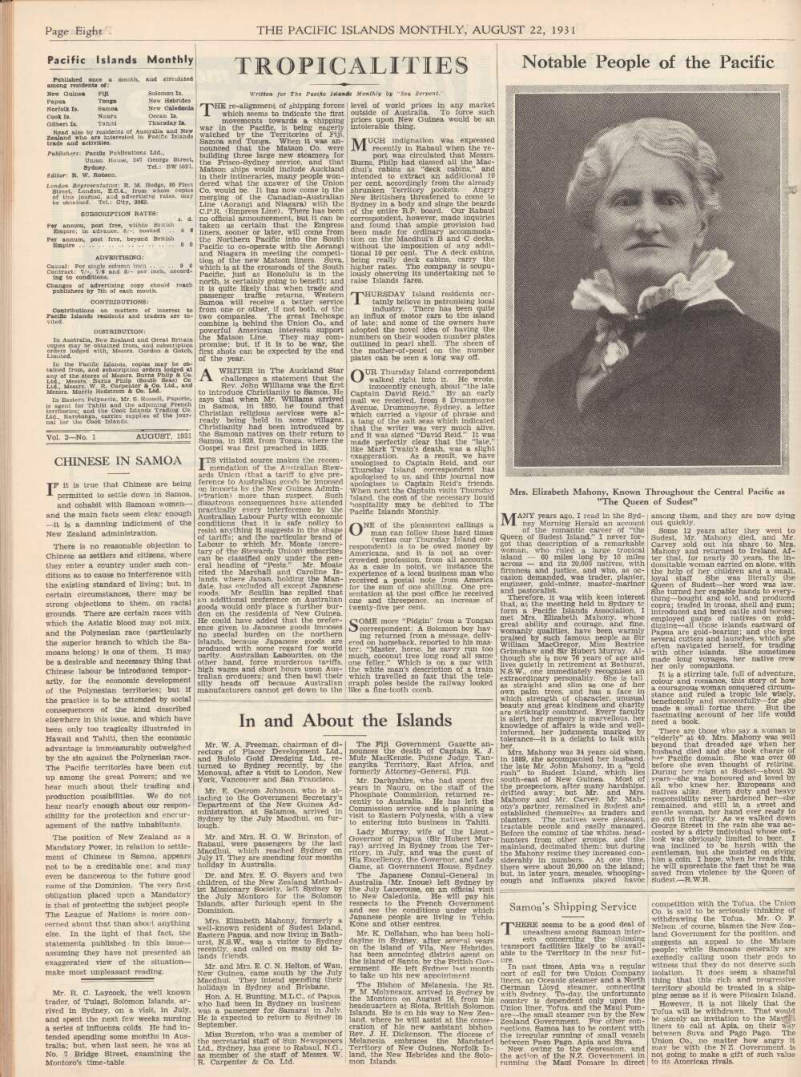
Published once a month, and circulated among residents of: New Guinea Fiji Solomon Is.
Papua Tonga New Hebrides Norfolk Is. Samoa New Caledonia Cook Is. Nauru Ocean Is.
Gilbert Is. Tahiti Thursday Is.
Read also by residents of Australia and New Zealand who are interested in Pacific Islands trade and activities.
Publishers: Pacific Publications Ltd., Union House, 247 George Street, Sydney. Tel.: BW 5037.
Editor: R. W. Robson.
London Representative : R. M. Hodge, 80 Fleet Street, London, E.C.4., from whom copies of this journal, and advertising rates, may be obtained. Tel.: City, 2062.
Subscription Rates:
s. d.
Per annum, post free, within British Empire; in advance, 6/-; booked .. 6 6 Per annum, post free, beyond British Empire 8 0
Advertising:
Casual: Per single column inch 9 0 Contract: 7/-, 7/6 and 8/- per inch, accord ing to conditions.
Changes of advertising copy should reach publishers by 7th of each month.
Contributions:
Contributions on matters of interest to Pacific Islands residents and traders are in vited.
Distribution:
In Australia, New Zealand and Great Britain copies may be obtained from, and subscription orders lodged with, Messrs. Gordon & Gotch, Limited.
In the Pacific Islands, copies may be ob tained from, and subscription orders lodged at any of the stores of Messrs. Burns Philp & Co.
Ltd., Messrs. Burns Philp (South Seas) Co Ltd., Messrs. W. R. Carpenter & Co. Ltd., and Messrs. Morris Hedstrom & Co. Ltd.
In Eastern Polynesia, Mr. S. Russell, Papeete, is agent for Tahiti and the adjoining French territories; and the Cook Islands Trading Co.
Ltd,, Rarotonga, carries supplies of the jour nal for the Cook Islands.
Chinese In Samoa
Vol. 2—No. 1
August, 1931
IF it is true that Chinese are being permitted to settle down in Samoa, and cohabit with Samoan women— and the main facts seem clear enough —it is a damning indictment of the New Zealand administration.
There is no reasonable objection to Chinese as settlers and citizens, where they enter a country under such con ditions as to cause no interference with the existing standard of living; but, in certain circumstances, there may be strong objections to them, on racial grounds. There are certain races with which the Asiatic blood may not mix, and the Polynesian race (particularly the superior branch to which the Sa moans belong) is one of them. It may be a desirable and necessary thing that Chinese labour be introduced tempor arily, for the economic development of the Polynesian territories; but if the practice is to be attended by social consequences of the kind described elsewhere in this issue, and which have been only too tragically illustrated in Hawaii and Tahiti, then the economic advantage is immeasurably outweighed by the sin against the Polynesian race.
The Pacific territories have been cut up among the great Powers; and we hear much about their trading and production possibilities. We do not hear nearly enough about our respon sibility for the protection and encour agement of the native inhabitants.
The position of New Zealand as a Mandatory Power, in relation to settle ment of Chinese in Samoa, appears not to be a creditable one; and may even be dangerous to the future good name of the Dominion. The very first obligation placed upon a Mandatory is that of protecting the subject people The League of Nations is more con cerned about that than about anything else. In the light of that fact, the statements published in this issue— assuming they have not presented an exaggerated view of the situation — make most unpleasant reading.
Mr. R. C. Laycock, the well known trader, of Tulagi, Solomon Islands, ar rived in Sydney, on a visit, in July, and spent the next few weeks nursing a series of influenza colds. He had in tended spending some months in Aus tralia; but, when last seen, he was at No. 7 Bridge Street, examining the Montoro’s time-table.
Tropica Lutes
Written for The Pacific Islands Monthly by “Sea Serpent.”
THE re-alignment of shipping forces which seems to indicate the first movements towards a shipping war in the Pacific, is being eagerly watched by the Territories of Fiji, Samoa and Tonga. When it was an nounced that the Matson Co. were building three large new steamers for the Frisco-Sydney service, and that Matson ships would include Auckland in their itineraries, many people won dered what the answer of the Union Co. would be. It has now come in the merging of the Canadian-Australian Line (Aorangi and Niagara) with the C.P.R. (Empress Line). There has been no official announcement, but it can be taken as certain that the Empress liners, sooner or later, will come from the Northern Pacific into the South Pacific to co-operate with the Aorangi and Niagara in meeting the competi tion of the new Matson liners. Suva, which is at the crossroads of the South Pacific, just as Honolulu is in the north, is certainly going to benefit; and it is quite likely that when trade and passenger traffic returns, Western Samoa will receive a better service from one or other, if not both, of the two companies. The great Inchcape combine is behind the Union Co., and powerful American interests support the Matson Line. They may com promise; but, if it is to be war, the first shots can be expected by the end of the year.
A WRITER in The Auckland Star challenges a statement that the Rev. John Williams was the first to introduce Christianity to Samoa. He says that when Mr. Williams arrived in Samoa, in 1830, he found that Christian religious services were al ready being held in some villages.
Christianity had been introduced by the Samoan natives on their return to Samoa, in 1828, from Tonga, where the Gospel was first preached in 1825.
ITS vitiated source makes the recom mendation of the Australian Stew ards Union (that a tariff to give pre ference to Australian goods be imposed on imports by the New Guinea Admin istration) more than suspect. Such disastrous consequences have attended practically every interference by the Australian Labour Party with economic conditions that it is safe policy to resist anything it suggests in the shape of tariffs; and the particular brand of Labour to which Mr. Moate (secre tary of the Stewards Union) subscribes can be classified only under the gen eral heading of “Pests.” Mr. Moate cited the Marshall and Caroline Is lands, where Japan, holding the Man date, has excluded all except Japanese goods. Mr. Scullin has replied that an additional preference on Australian goods would only place a further bur den on the residents of New Guinea.
He could have added that the prefer ence given to Japanese goods imposes no special burden on the northern islands, because Japanese goods are produced with some regard for world parity. Australian Labourites, on the other hand, force murderous tariffs, high wages and short hours upon Aus tralian producers; and then bawl their silly heads off because Australian manufacturers cannot get down to the
level of world prices in any market outside of Australia. To force such prices upon New Guinea would be an intolerable thing.
MUCH indignation was expressed recently in Rabaul when the re port was circulated that Messrs.
Burns, Philp had classed all the Mac dhui’s cabins as “deck cabins,” and intended to extract an additional 10 per cent, accordingly from the already shrunken Territory pockets. Angry New Britishers threatened to come to Sydney in a body and singe the beards of the entire B.P. board. Our Rabaul correspondent, however, made inquiries and found that ample provision had been made for ordinary accommoda tion on the Macdhui’s B and C decks, without the imposition of any addi tional 10 per cent. The A deck cabins, being really deck cabins, carry the higher rates. The company is scupu lously observing its undertaking not to raise Islands fares.
THURSDAY Island residents cer tainly believe in patronising local industry. There has been quite an influx of motor cars to the island of late; and some of the owners have adopted the novel idea of having the numbers on their wooden number plates outlined in pearl shell. The sheen of the mother-of-pearl on the number plates can be seen a long way off.
OUR Thursday Island correspondent walked right into it. He wrote, innocently enough, about “the late Captain David Reid.” By an early mail we received, from 8 Drummoyne Avenue, Drummoyne, Sydney, a letter which carried a vigour of phrase and a tang of the salt seas which indicated that the writer was very much alive, and it was signed “David Reid.” It was made perfectly clear that the “late,” like Mark Twain’s death, was a slight exaggeration. As a result, we have apologised to Captain Reid, and our Thursday Island correspondent has apologised to us, and this journal now apologises to Captain Reid’s friends.
When next the Captain visits Thursday Island, the cost of the necessary liquid hospitality may be debited to The Pacific Islands Monthly.
ONE of the pleasantest callings a man can follow these hard times (writes our Thursday Island cor respondent) is to be owed money by Americans, and it is not an over crowded profession, from all accounts.
As a case in point, we instance the experience of a local business man who received a postal note from America for the sum of one shilling. One pre sentation at the post office he received one and threepence, an increase of twenty-five per cent.
SOME more “Pidgin” from a Tongan correspondent: A Solomon boy hav ing returned from a message, deliv ered on horseback, reported to his mas ter: “Master, horse, he savvy run too much, coconut tree long road all same one feller.” Which is on a par with the white man’s description of a train which travelled so fast that the tele graph poles beside the railway looked like a fine-tooth comb.
In and About the Islands
Mr. W. A. Freeman, chairman of di rectors of Placer Development Ltd., and Bulolo Gold Dredging Ltd., re turned to Sydney recently, by the Monowai, after a visit to London, New York, Vancouver and San Francisco.
Mr. E. Ostrom Johnson, who is at tached to the Government Secretary’s Department of the New Guinea Ad ministration, at Salamoa, arrived in Sydney by the July Macdhui, on fur lough.
Mr. and Mrs. H. G. W. Brinston, of Rabaul, were passengers by the last Macdhui, which reached Sydney on July 17. They are spending four months holiday in Australia.
Dr. and Mrs. E. G. Sayers and two children, of the New Zealand Method ist Missionary Society, left Sydney by the July Montoro for the Solomon Islands, after furlough spent in the Dominion.
Mrs. Elizabeth Mahony, formerly a well-known resident of Sudest Island, Eastern Papua, and now living in Bath urst, N.S.W., was a visitor to Sydney recently, and called on many old Is lands friends.
Mr. and Mrs. E. C. N. Helton, of Wau, New Guinea, came south by the July Macdhui. They intend spending their holidays in Sydney and Brisbane.
Hon. A. H. Bunting, M.L.C., of Papua who had been in Sydney on business was a passenger for Samarai in July.
He is expected to return to Sydney in September.
Miss Burston, who was a member of the secretarial staff of Sun Newspapers Ltd., Sydney, has gone to Rabaul, N.G., as member of the staff of Messrs. W.
R. Carpenter & Co. Ltd.
The Fiji Government Gazette an nounces the death of Captain K. J.
Muir MacKenzie, Puisne Judge, Tan ganyika Territory, East Africa, and formerly Attorney-General, Fiji.
Mr. Darbyshire, who had spent five years in Nauru, on the staff of the Phosphate Commission, returned re cently to Australia. He has left the Commission service and is planning a visit to Eastern Polynesia, with a view to entering into business in Tahiti.
Lady Murray, wife of the Lieut.- Governor of Papua (Sir Hubert Mur ray) arrived in Sydney from the Ter ritory, in July, and was the guest of His Excellency, the Governor, and Lady Game, at Government House, Sydney.
The Japanese Consul-General in Australia (Mr. Inoue) left Sydney by the July Laperouse, on an official visit to New Caledonia. He will pay his respects to the French Government and see the conditions under which Japanese people are living in Tchio, Kone and other centres.
Mr. K. Dollahan, who has been holi daying in Sydney, after several years on the island of Vila, New Hebrides, has been appointed district agent on the island of Santo, by the British Gov ernment. He left Sydney last month to take up his new appointment.
The Bishop of Melanesia, the Rt.
F. M Molyneaux, arrived in Svdney by the Montoro on August 16, from his headauarters at Siota, British Solomon Islands. He is on his way to New Zea land. where he will assist at the conse cration of his new assistant bishop Rev. J. H. Dickenson. The diocese of Melanesia embraces the Mandated Territory of New Guinea, Norfolk Is land, the New Hebrides and the Solo mon Islands.
Notable People of the Pacific
MANY years ago, I read in the Syd ney Morning Herald an account of the romantic career of “the Queen of Sudest Island.” I never for got that description of a remarkable woman, who ruled a large tropical island 60 miles long by 10 miles across and its 20,000 natives, with firmness and justice, and who, as oc casion demanded, was trader, planter, engineer, gold-miner, master-mariner and pastoralist.
Therefore, it was with keen interest that, at the meeting held in Sydney to form a Pacific Islands Association, I met Mrs. Elizabeth Mahony, whose great ability and courage, and fine, womanly qualities, have been warmly praised by such famous people as Sir William MacGregor, Miss Beatrice Grimshaw and Sir Hubert Murray. Al though she is now 76 years of age and lives quietly in retirement at Bathurst, N.S.W., one immediately recognises an extraordinary personality. She is tall as straight and slim as one of her own palm trees, and has a face in which strength of character, unusual beauty and great kindness and charity are strikingly combined. Every faculty is alert, her memory is marvellous, her knowledge of affairs is wide and well informed, her judgments marked by tolerance —it is a delight to talk with her.
Mrs. Mahony was 34 years old when, in 1889, she accompanied her husband, the late Mr. John Mahony, in a “gold rush” to Sudest Island, which lies south-east of New Guinea. Most of the prospectors, after many hardships, drifted away; but Mr. and Mrs.
Mahony and Mr. Carvey, Mr. Mah ony’s partner, remained in Sudest and established themselves as traders and planters. The natives were pleasant, tractable people and easily managed.
Before the coming of the whites, head hunters from other groups, and the mainland, decimated them; but during the Mahony regime they increased con siderably in numbers. At one time, there were about 20,000 on the island; but, in later years, measles, whooping cough and influenza played havoc
among them, and they are now dying out quickly.
Some 12 years after they went to Sudest, Mr. Mahony died, and Mr.
Carvey sold out his share to Mrs.
Mahony and returned to Ireland. Af ter that, for nearly 20 years, the in domitable woman carried on alone, with the help of her children and a small, loyal staff She was literally the Queen of Sudest—her word was law.
She turned her capable hands to every thing—bought and sold, and produced copra; traded in trocas, shell and gum; introduced and bred cattle and horses; employed gangs of natives on gold digging—all these islands eastward of Papua are gold-bearing; and she kept several cutters and launches, which she often navigated herself, for trading with other islands. She sometimes made long voyages, her native crew her only companions.
It is a stirring tale, full of adventure, colour and romance, this story of how a courageous woman conquered circum stance and ruled a tropic isle wisely, beneficently and successfully—for she made a small fortue there. But the fascinating account of her life would need a book.
There are those who say a woman is “elderly” at 40. Mrs. Mahony was well beyond that dreaded age when her husband died and she took charge of her Pacific domain. She was over 60 before she even thought of retiring.
During her reign at Sudest —about 33 years—she was honoured and loved by all who knew her, Europeans and natives alike. Stern duty and heavy responsibility never hardened her —she remained, and still is, a sweet and gentle woman, her hand ever ready to go out in charity. As we walked down George Street in the rain she was ac costed by a dirty individual whose out look was obviously limited to beer. I was inclined to be harsh with the gentleman, but she insisted on giving him a coin. I hope, when he reads this, he will appreciate the fact that he was saved from violence by the Queen of
Sudest. — R.W.R.
Mrs. Elizabeth Mahony, Known Throughout the Central Pacific as "The Queen of Sudest”
Samoa’s Shipping Service
THERE seems to be a good deal of uneasiness among Samoan inter ests concerning the shipping transport facilities likely to be avail able to the Territory in the near fut ure.
In past times, Apia was a regular port of call for two Union Company liners, an Oceanic steamer and a North German Lloyd steamer, connecting with Sydney. To-day, the unfortunate country is dependent only upon the Union liner, Tofua, and the Maui Pom are—the small steamer run by the New Zealand Government. For other con nections, Samoa has to be content with the irregular running of small vessels between Pago Pago, Apia and Suva.
Now, owing to the depression, and the action of the N.Z. Government in running the Maui Pom are in direct
competition with the Tofua, the Union Co. is said to be seriously thinking of withdrawing the Tofua. Mr. O. F.
Nelson ,of course, blames the New Zea land Government for the position, and suggests an appeal to the Matson people; while Samoans generally are excitedly calling upon their gods to witness that they do not deserve such isolation. It does seem a shameful thing that this rich and progressive territory should be treated in a ship ping sense as if it were Pitcairn Island.
However, it is not likely that the Tofua will be withdrawn. That would be simply an invitation to the liners to call at Apia, on their way between Suva and Pago Pago. The Union Co., no matter how angry it may be with the N Z. Government, is not going to make a gift of such value to its American rivals.
Shipping Rearrangement
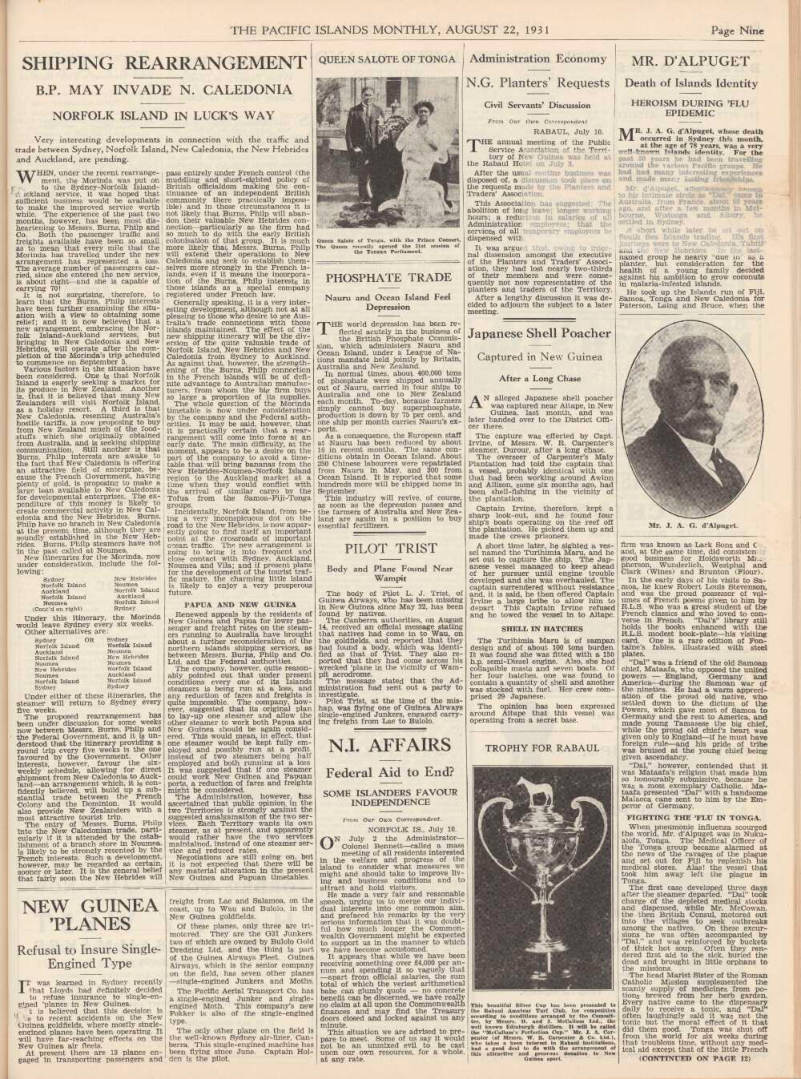
B.P. May Invade N. Caledonia
Norfolk Island In Luck’S Way
Very interesting developments in connection with the traffic and trade between Sydney, Norfolk Island, New Caledonia, the New Hebrides and Auckland, are pending.
WHEN, under the recent rearrange ment, the Morinda was put on * s. to the Sydney-Norfolk Island- Auckland service, it was hoped that sufficient business would be available to make the improved service worth while. The experience of the past two months, however, has been most dis heartening to Messrs. Burns, Philp and Co. Both the passenger traffic and freights available have been so small as to mean that every mile that the Morinda has travelled under the new arrangement has represented a loss.
The average number of passengers car ried, since she entered the new service, is about eight—and she is capable of carrying 70!
It is not surprising, therefore, to learn that the Burns, Philp interests have been further examining the situ ation with a view to obtaining some relief; and it is now believed that a new arrangement, embracing the Nor folk Island-Auckland services, but bringing in New Caledonia and New Hebrides, will operate after the com pletion of the Morinda’s trip scheduled to commence on September 5.
Various factors in the situation have been considered. One is that Norfolk Island is eagerly seeking a market for its produce in New Zealand. Another is, that it is believed that many New Zealanders will visit Norfolk Island, as a holiday resort. A third is that New Caledonia, resenting Australia’s hostile tariffs, is now proposing to buy from New Zealand much of the food stuffs which she originally obtained from Australia, and is seeking shipping communication. Still another is that Burns, Philp interests are awake to the fact that New Caledonia is offering an attractive field of enterprise, be cause the French Government, having plenty of gold, is pronosing to make a large loan available to New Caledonia for developmental enterprises. The ex penditure of this money is likely to create commercial activity in New Cal edonia and the New Hebrides. Burns, Philp have no branch in New Caledonia at the present time, although they are soundly established in the New Heb rides. Burns, Philp steamers have not in the past called at Noumea.
New itineraries for the Morinda, now under consideration, include the fol lowing : Sydney New Hebrides Norfolk Island Noumea Auckland Norfolk Island Norfolk Island Auckland Noumea Norfolk Island (Cont’d on right) Sydney Under this itinerary, the Morinda would leave Sydney every six weeks.
Other alternatives are: Sydney OR Sydney Norfolk Island Norfolk Island Auckland Noumea Norfolk Island New Hebrides Noumea Noumea New Hebrides Norfolk Island Noumea Auckland Norfolk Island Norfolk Island Sydney Sydney Under either of these itineraries, the steamer will return to Sydney every five weeks.
The proposed rearrangement has been under discussion for some weeks now between Messrs. Burns, Philp and the Federal Government, and it is un derstood that the itinerary providing a round trip every five weeks is the one favoured by the Government. Other interests, however, favour the sixweekly schedule, allowing for direct shipment from New Caledonia to Auck land —an arrangement which, it is con fidently believed, will build up a sub stantial trade between the French Colony and the Dominion. It would also provide New Zealanders with a most attractive tourist trip.
The entry of Messrs. Burns, Philp into the New Caledonian trade, parti cularly if it is attended by the estab lishment of a branch store in Noumea, is likely to be strongly resented by the French interests. Such a development, however, may be regarded as certain, sooner or later. It is the general belief that fairly soon the New Hebrides will
pass entirely under French control (the muddling and short-sighted policy of British officialdom making the con tinuance of an independent British community there practically imposs ible) and in those circumstances it is not likely that Burns, Philp will aban don their valuable New Hebrides con nection—particularly as the firm had so much to do with the early British colonisation of that group. It is much more likely that Messrs. Burns, Philp will extend their operations to New Caledonia and seek to establish them selves more strongly in the French is lands, even if it means the incorpora tion of the Burns, Philp interests in those islands as a special company registered under French law.
Generally speaking, it is a very inter esting development, although not at all pleasing to those who desire to see Aus tralia’s trade connections with those islands maintained. The effect of the new shipping itinerary will be the div ersion of the quite valuable trade of Norfolk Island, New Hebrides and New Caledonia from Sydney to Auckland.
As against that, however, the strength ening of the Burns, Philp connection in the French islands will be of defi nite advantage to Australian manufac turers, from whom the big firm buys so large a proportion of its supplies.
The whole question of the Morinda timetable is now under consideration by the company and the Federal auth orities. It may be said, however, that it is practically certain that a rear rangement will come into force at an early date. The main difficulty, at the moment, appears to be a desire on the part of the company to avoid a time table that will bring bananas from the New Hebrides-Noumea-Norfolk Island region to the Auckland market at a time when they would conflict with the arrival of similar cargo by the Tofua from the Samoa-Fiji-Tonga groups.
Incidentally, Norfolk Island, from be ing a very inconspicuous dot on the road to the New Hebrides, is now appar ently going to find itself an important point at the crossroads of important ocean traffic. The new arrangement is going to bring it into frequent and close contact with Sydney, Auckland, Noumea and Vila; and if present plans for the development of the tourist traf fic mature, the charming little island is likely to enjoy a very prosperous future.
Papua And New Guinea
Renewed appeals by the residents of New Guinea and Papua for lower pas senger and freight rates on the steam ers running to Australia have brought about a further reconsideration of the northern islands shipping services, as between Messrs. Burns, Philp and Co.
Ltd. and the Federal authorities.
The company, however, quite reason ably pointed out that under present conditions every one of its Islands steamers is being run at a loss, and any reduction of fares and freights is quite impossible. The company, how ever, suggested that its original plan to lay-up one steamer and allow the other steamer to work both Papua and New Guinea should be again consid ered. This would mean, in effect, that one steamer would be kept fully em ployed and possibly run at a profit instead of two steamers being half employed and both running at a loss It was suggested that if one steamer could work New Guinea and Papuan ports, a reduction of fares and freights might be considered.
The Administration, however, has ascertained that public opinion, in the two Territories is strongly against the suggested amalgamation of the two ser vices. Each Territory wants its own steamer, as at present, and apparently would rather have the two services maintained, instead of one steamer ser vice and reduced rates.
Negotiations are still going on, but it is not expected that there will be any material alteration in the present New Guinea and Papuan timetables.
New Guinea
’Planes
Refusal to Insure Single- Engined Type
IT was learned in Sydney recently that Lloyds had definitely decided to refuse insurance to single-en gined ’planes in New Guinea. fc is believed that this decision is due to recent accidents on the New Guinea goldfields, where mostly single engined planes have been operating. It will have far-reaching effects on the New Guinea air fleets.
At present there are 13 planes en gaged in transporting passengers and
freight from Lae and Salamoa, on the coast, up to Wau and Bulolo, in the New Guinea goldfields.
Of these planes, only three are tri meter ed. They are the G3l Junkers, two of which are owned by Bulolo Gold Dredging Ltd. and the third is part of the Guinea Airways Fleet. Guinea Airways, which is the senior company on the field, has seven other planes —single-engined Junkers and Moths.
The Pacific Aerial Transport Co. has a single-engined Junker and single engined Moth. This company’s new Fokker is also of the single-engined type.
The only other plane on the field is the well-known Sydney air-liner, Can berra. This single-engined machine has been flying since June. Captain Hol den is the pilot.
Advertisements & other items, p. 9 (1 item)
Queen Salote Of Tonga
Queen Salute of Tonga, with the Prince Consort, The Queen recently opened the 31st session of the Tongan Parliament.
Phosphate Trade
Nauru and Ocean Island Feel Depression
THE world depression has been re flected acutely in the business of the British Phosphate Commis sion, which administers Nauru and Ocean Island, under a League of Na tions mandate held jointly by Britain, Australia and New Zealand.
In normal times, about 400,000 tons of phosphate were shipped annually out of Nauru, carried in four ships to Australia and one to New Zealand each month. To-day, because farmers simply cannot buy superphosphate, production is down by 75 per cent, and one ship per month carries Nauru’s ex ports.
As a consequence, the European staff at Nauru has been reduced by about 16 in recent months. The same con ditions obtain in Ocean Island. About 250 Chinese labourers were repatriated from Nauru in May, and 300 from Ocean Island. It is reported that some hundreds more will be shipped home in September.
This industry will revive, of course, as soon as the depression passes and the farmers of Australia and New Zea land are again in a position to buy essential fertilisers.
Pilot Trist
Body and Plane Found Near Wampit
The body of Pilot L. J. Trist, of Guinea Airways, who has been missing in New Guinea since May 22, has been found by natives.
The Canberra authorities, on August 14, received an official message stating that natives had come in to Wau, on the goldfields, and reported that they had found a body, which was identi fied as that of Trist. They also re ported that they had come across his wrecked ’plane in the vicinity of Wam pit aerodrome.
The message stated that the Ad ministration had sent out a party to investigate.
Pilot Trist, at the time of the mis hap, was flying one of Guinea Airways single-engined Junkers, engaged carry ing freight from Lae to Bulolo.
N.I. Affairs
Federal Aid to End?
Some Islanders Favour
Independence
From Our Own Correspondent.
Norfolk Is., July 10.
ON July 2 the Administrator — Colonel Bennett —called a mass meeting of all residents interested in the welfare and progress of the island to consider what measures we might and should take to improve liv ing and business conditions and to attract and hold visitors.
He made a very fair and reasonable speech, urging us to merge our indivi dual interests into one common aim, and prefaced his remarks by the very serious information that it was doubt ful how much longer the Common wealth Government might be expected to support us in the manner to which we have become accustomed.
It appears that while we have been receiving something over £4,000 per an num and spending it so vaguely that —apart from official salaries, the sum total of which the veriest arithmetical babe can glumly quote no concrete benefit can be discerned, we have really no claim at all upon the Commonwealth finances and may find the Treasury doors closed and locked against us any minute.
This situation we are advised to pre pare to meet. Some of us say it would not be an unmixed evil to be cast upon our own resources, for a whole, at any rate.
Administration Economy
N.G. Planters’ Requests Civil Servants’ Discussion
From Our Own Correspondent
Rabaul, July 10.
THE annual meeting of the Public Service Association of the Territory of New Guinea was held at the Rabaul Hotel on July 3.
After the usual routine business was disposed of, a discussion took place on the requests made by the Planters and Traders’ Association This Association has suggested: The abolition of long leave; longer working hours; a reduction in salaries of all Administration employees; that the services of all temporary employees be dispensed with.
It was argued that, owing to inter nal dissension amongst the executive of the Planters and Traders’ Associ ation, they had lost nearly two-thirds of their members and were conse quently not now representative of the planters and traders of the Territory.
After a lengthy discussion it was de cided to adjourn the subject to a later meeting.
Japanese Shell Poacher
Captured in New Guinea After a Long Chase
AN alleged Japanese shell poacher was captured near Aitape, in New Guinea, last month, and was later handed over to the District Offi cer there.
The capture was effected by Capt.
Irvine, of Messrs. W. R. Carpenter’s steamer, Durour, after a long chase.
The overseer of Carpenter’s Maty Plantation had told the captain that a vessel, probably identical with one that had been working around Awinn and Allison, some six months ago, had been shell-fishing in the vicinity of the plantation.
Captain Irvine, therefore, kept a sharp look-out, and he found four ship’s boats operating on the reef off the plantation. He picked them up and made the crews prisoners, A short time later, he sighted a ves sel named the Turihimia Maru, and he set out to capture the ship. The Jap anese vessel managed to keep ahead of her pursuer until engine trouble developed and she was overhauled. The captain surrendered without resistance and, it is said, he then offered Captain Irvine a large bribe to allow him to depart. This Captain Irvine refused and he towed the vessel in to Aitape.
Shell In Hatches
The Turihimia Maru is of sampan design and of about 100 tons burden.
It was found she was fitted with a 150 h.p. semi-Diesel engine. Also, she had collapsible masts and seven boats. Of her four hatches, one was found to contain a quantity of shell and another was stocked with fuel. Her crew com prised 29 Japanese.
The opinion has been expressed around Aitape that this vessel was operating from a secret base.
Trophy For Rabaul
This beautiful Silver Cup has been presented to the Rabaul Amateur Turf Club, for competition according to conditions arranged by the Commit tee, by Messrs. D. and J. McCallum Ltd., the well known Edinburgh distillers. It will be called the “McCallum’s Perfection Cup.” Mr. J. A. Car penter (of Messrs. W. B. Carpenter & Co. Ltd.), who takes a keen Interest in Rabaul institutions, had a good deal to do with the arrangement of this attractive and generous donation to New Guinea sport.
Mr. D’Alpuget
Death of Islands Identity
Heroism During ’Flu
Epidemic
MR. J. A. G. d’Alpuget, whose death occurred in Sydney this month, at the age of 78 years, was a very well-known islands identity. For the past 50 years he had been travelling around the various Pacific groups. He had had many interesting experiences and made many lasting friendships.
Mr. d’Alpuget, affectionally known to his intimate circle as “Da'" came to Australia, from France, about 53 years ago, and after a few months in Mel bourne, Wodonga and Albury, he settled in Sydney.
A short while later he set out on South Sea Islands trading. His first journeys were to New Caledonia, Tahiti and the New Hebrides. In the lastnamed group he nearly "dug in" as a planter, but consideration for the health of a young family decided against his ambition to grow coconuts in malaria-infested islands.
He took up the Islands run of Fiji, Samoa, Tonga and New Caledonia for Paterson, Laing and Bruce, when the
firm was known as Lark Sons and Co., and, at the same time, did consistently good business for Holdsworth Mac pherson, Wunderlich, Westphal and Clark (Wines) and Brunton (Flour).
In the early days of his visits to Sa moa, he knew Robert Louis Stevenson, and was the proud possessor of vol umes of French poems given to him by R.L.S. who was a great student of the French classics and who loved to con verse in French. “Dal’s” library still holds the books enhanced with the R.L.S. modest book-plate—his visiting card. One is a rare edition of Fon taine’s fables, illustrated with steel plates.
“Dal” was a friend of the old Samoan chief, Mataafa, who opposed the united powers England, Germany and America —during the Samoan war of the nineties. He had a warm appreci ation of the proud old native, who settled down to the dictum of the Powers, which gave most of Samoa to Germany and the rest to America, and made young Tamasese the big chief, while the proud old chief’s heart was given only to England—if he must have foreign rule—and his pride of tribe was bruised at the young chief being given ascendancy.
“Dal,” however, contended that it was Mataafa’s religion that made him so honourably submissive, because he was a most exemplary Catholic. Ma taafa presented “Dal” with a handsome Malacca cane sent to him by the Em peror of Germany.
Fighting The ’Flu In Tonga.
When pneumonic influenza scourged the world, Mr. d’Alpuget was in Nuku alofa, Tonga. The Medical Officer of the Tonga group became alarmed at the news of the ravages of the plague and set out for Fiji to replenish his medical stores. Alas! the vessel that took him away left the plague in Tonga.
The first case developed three days after the steamer departed. “Dal” took charge of the depleted medical stocks and dispensed, while Mr. McGowan, the then British Consul, motored out into the villages to seek outbreaks among the natives. On these excur sions he was often accompanied by “Dal,” and was reinforced by buckets of thick hot soup. Often they ren dered first aid to the sick, buried the dead and brought in little orphans to the missions.
The head Marist Sister of the Roman Catholic Mission supplemented the scanty supply of medicines from po tions brewed from her herb garden.
Every native came to the dispensary daily to receive a tonic, and “Dal” often laughingly said it was not the tonic but the moral effect of it that did them good. Tonga was shut off from the world for six weeks during that troublous time, without any med ical aid except that of the little French
(Continued On Page 12)
Mr. J. A. G. d’Alpuget.
nun herbalist, yet the mortality rate was infinitesimal in comparison to Samoa, with its N.Z. Army of Occu pation.
The Queen of Tonga wrote “Dal” a personal letter of thanks, endorsed with the Royal seal, for his services during that trying time.
Mr. d’Alpuget made his last trip to the Islands in March of this year, but an attack of bronchitis brought him back to Sydney late in April, without completing his usual round. Although never really well since then, he did the round of his business houses up to the week he died.
In youth, he went in for a gocd deal of sport and was a crack shot. He was also a strong swimmer. Among the many who attended his funeral was Mr. Leon Cohen, a Sydney soli citor, whom he rescued from drowning when he was a small boy.
Although a good Australian, who brought up his family to be Australian citizens, “Dal” was never naturalised.
His pride of race was too strong to allow him to give up his nationality He was the oldest member of the French community in Sydney, and al ways generously assisted all French projects, as well as every other charity.
He was a great earner, but a better spender, and he gave so generously that he died comparatively a poor man, except in friendship.
Norfolk Island Trade
The following are the Norfolk Island Cus toms figures for June, 1931:
Year
Imports.
From Aust.
From N.Z. 1930 .. . , . £5,800 .. .
Nil 1931 .. . 2,888 . . £1,071 Year
Exports.
To Aust.
To N.Z.
1930 . . £1,845 .. .
Nil 1931 .. . 38 .. £1,112 The following are the returns for July: Year
Imports.
From Aust.
From N.Z. 1930 .. . . £4,749 .. . £1,947 1931 .. . 2,088 .. . 483 Year
Exports.
To Aust.
To N.Z.
1930 .. . . £1,881 .. . £363 1931 .. . 120 .. . 1,563
Inter-Island
Wireless
Small, Portable Sets for Short Transmission
A Plan For Torres Straits
From Our Own Correspondent
Thursday Is., July 25.
AT the extreme north of Australia, between Thursday Island and New Guinea, lie the Torres Straits islands, inhabited by about 3,500 people of native and mixed blood.
These islands are under the adminis tration of the Queensland Government and come within the defined boun daries of that State, although some of them are within a couple of miles of New Guinea itself.
On the larger islands are white Gov ernment teachers, who in addition to the charge of the schools, also have various duties to perform in connec tion with the general work of the islands. The people are largely self supporting, and the Torres Straits is landers are regarded as a valuable asset to the Commonwealth, both from economic and other points of view.
Strategically (to mention one thing) they occupy an important position.
So far as the commercial aspect is concerned, most of the men are en gaged in marine industries; some of them own their own fishing vessels, there is a fleet of over thirty boats (cutters and luggers) bought by the people and controlled by the Protec tor of Aboriginals, and a number find ready employment on the fishing and pearling boats owned by Thursday Is land companies. Somewhere about £30,000 worth of marine produce is brought in annually from the island owned fleet alone; and, indirectly, as well as in direct local taxation, the islanders contribute a good deal to wards the revenue of the country.
When the Queensland Home Secre tary and other Government officials, visited the Islands in June, they had opportunity of seeing the great devel opment that has taken place during the past few years and, incidentally, also became aware of the effect that the impact of outer civilisation is hav ing upon those who were, not so very long ago, reckoned with the head hunters of New Guinea.
There are a number of problems arising in the Islands which will have to be dealt with wisely and understandingly and the fact that the men, by reason of their particular work which takes them into regular and close touch with European towns and their difficulties, are acquiring a know ledge of “white man ways" which is not always productive of good, will not make the position any easier. It is sometimes surprising to find news papers and magazines of the most un expected variety in native homes, brought back by boys who have been “working South”; and a Government official was taken aback the other day when a native asked him for the latest information concerning certain political happenings in another State.
One of the pressing problems just now in these Islands is lack of proper com munication. The Government ketch visits at intervals, but is frequently called off the regular itinerary to go elsewhere. Teachers and others depend upon the Government boat for their mails and supplies, and also look to the fishing, luggers and the Mission ketch to assist in establishing touch with Thursday Island, the headquar ters. But there is nothing whatever in the way of facilities for getting a mes sage through quickly—no wireless, not even a heliograph signalling outfit. Is lands cn which white officials reside are from 30 to 120 miles distant from Thursday Island, so that there should not be insuperable difficulties in ar ranging for some system of ready com munication.
Some time back, a local man pro posed to the authorities that the is lands be equipped with portable wire less outfits, similar to those used with so much success in outback Queensland and in North Australia. The machine is worked by treadle where no other power is available; it has a range of at least 400 miles, and requires only an operating skill of 12 words per minute.
One difficulty, however, is that at present (being a privately-run idea, worked by the Australian Inland Mis sion) there is only one “Mother Sta tion” available, at Cloncurry. which is too far away for the islands; but if arrangements could be made to link up with the Government stations, at such places as Thursday Island, there seems to be no reason why the idea should not be adopted for the Torres Straits islands, as well as for the isolated settlers, mission stations down the Gulf and along the East coast, and even on some of the luggers that travel long distances from home. The Home Sec retary has been approached on the matter to see if something can be done.
On more than one occasion European officials or their families have been seriously ill on an island and cut off absolutely from touch with the out side world; no boats were available, and there was no form of communica tion whatever. As some of these have
young children it is easily understood what a boon some such system of com munication as the above might prove.
It has been suggested that the Thursday Island station could be equip ped with the necessary instruments for wireless telephony, and the islands and other remote places linked up in that way; this might possibly be even better than the Morse sets. Perhaps the suggestion might commend itself to the wireless company, and a definite system inaugurated by them to help meet the need.
Conquering Leprosy
What Nauru is Doing Steady Decline In Cases
SOON after the administration of the phosphate island of Nauru was taken over by Britain, Aus tralia and New Zealand, under the League of Nations mandate, in 1920, it discovered that leprosy was making extraordinary and highly al arming inroads upon the native popu lation.
The official figures published in the last annual report show that cases of the disease were reported as follows: 1920 .. 4 1926 .. 167 1921 .. 10 1927 .. 174 1922 .. 139 1928 .. 132 1923 .. 151 1929 .. 132 1924 .. 193 1930 .. 95 1925 .. 189 The Nauru administration, during the past ten years, has made deter mined efforts to cope with the disease and has created an organisation equip ped with the most modern methods. As a result, medical science, as is indi cated by the above figures, is slowly but surely winning the stubborn battle.
Each month the whole native popula tion is inspected by a medical officer with a view to discovering the first signs of leprosy. Suspicious cases are dealt with immediately and this early treatment is undoubtedly proving ef fective in combating the disease.
The Administrator, Mr. W. A. New man, gives the following details relat ing to the treatment of leprosy, and we publish same for the information of other Pacific administrations interested in this subject: Treatment of Leprosy.—The majority of the patients are treated with intra muscular in jections of Esters of Oleum (Hydnocarpus Wightiana), and in certain selected cases with Potassium lodide orally. The treatment with Potassium lodide is however discontinued if reaction proves severe or prolonged, or if corresponding improvement in condition is not readily forthcoming.
Early and obstinate cases have been treated with subcutaneous injections of a 3 per cent, aqueous solution of Alepol, containing .5 per cent, of phenol. Alepol is a derivative of Hydnocarpus oil and is described technically as the “sodium salt of the lower melting point fatty acids of Oleum (Hydnocarpus Wightiana), with the irritant properties re moved.” Alepol has an advantage over other anti-leprotic drugs in that it is exported in powder form and is ready for use after the necessary quantity has been dissolved in dis tilled water. It was thought, because of the ease of export and its simplicity in prepara tion and use, that Alepol might eventually supersede Oleum (Hydnocarpus Wightiana).
Whilst in certain cases Alepol has proved of distinct advantage, experience in a period of carefully observed usage has shown that uni formly good results follow the general appli cation of Oleum (Hydnocarpus Wightiana).
Intradermal Leprolin Test. —The Adminis tration has been in communication with the Director of the Leprosy Research Laboratory of the School of Tropical Medxine and Hygiene at Calcutta, and has also had the advice and assistance of Sir Leonard Rogers—an eminent authority in Leprosy Research. Realising that the solution of the leprosy problem depends to a great extent on early diagnosis, the intra dermal leprolin test (P. Bargehr) for the detection of early and latent leprosy is, on the advice of Sir Leonard Rogers, being ap plied on this island under carefully recorded conditions, and it is believed that the result ant data will prove of practical value not only in Nauru, but elsewhere. Particulars with regard to the result of this test will be available for inclusion in the next annual report.
As Nauru is an almost completely isolated place, the medical officers have had a unique opportunity of making very thorough tests of leprosy treat ments. Consequently, the Nauru re ports on the anti-leprosy campaign are awaited with keen interest by other experts interested in this class of in vestigation.
Water Shortage Feared
Port Moresby’s Low Rainfall
From Our Own Correspondent
Port Moresby, July 7.
THE water question is causing un easiness to the Public Works Department in Port Moresby.
The rainfall for 1930-31 reached only to 18.48 inches —the general average being 38 inches for the year.
In order to arrange a supplementary supply the Department is cleaning up a spring and is laying a pipe line to a standard in Konedobu, near the town.
Port Moresby has a water catchment with a reservoir on the slope of one of the hills near the town. The water supply is drawn off in pipes and is sold at the rate of £1 a 1,000 gallons to residents. The problem would be seri ous without this supply.
Advertisements & other items, p. 10 (2 items)
Mcilrath’S Ltd.
BLACKLOCKS
R. E. FORSSBERC - Proprietor
Manufacturer’s Representative
381 PITT STREET - SYDNEY
Buying Agents for ail requirements, at lowest prices, on commission basis.
Cable Address: “Diamondess” Sydney
Have Teeth by Post
If you are unable to visit Sydney, I can make you comfortable, natural and long lasting teeth by means of my well known method of “Self Taken Impressions.” Cut out this advertisement, attach your name and address and post to me for full particulars.
Painless extractions. Reliable fillings. Cold crowns and comfortable and lasting plate work. 28 OXFORD ST., over Winns;
SPENCER NOLAN, Dentist
177 OXFORD ST., opposite Mcllraths; 139 ELIZABETH ST., two doors from Market St., Sydney.
Beam Wireless and Cable Address; “Fastplate,” Sydney.
P.I.M.
McILRATH’S Ltd.
EXPORTERS OF GROCERIES, PROVISIONS AND
GENERAL STORES
“OUR PRICES GIVE EXTRA POCKET HELP”
Write for Export Price List and Quotations
McILRATH'S
- 202 PITT STREET •
SYDNEY, AUSTRALIA
FRESH FRUITS—VEGETABLES
F. CHILTON
WHOLESALE DISTRIBUTOR, CITY MARKETS
SYDNEY - - Established 1894 Shipments Direct from Source of Supply. All Goods Personally Selected and Carefully Packed for Tropical Requirements.
Quality—BEST. Price—LOWEST. Attention—PßOMPT.
Codes', Bentley’s and Private. Cable Address'. Chiltons, Sydney Agent for —Celebrated "Vallo” Brand Spray Preparations, used successfully by Orchardists throughout Australia.
EXCELSIOR SUPPLY CO. LTD.
The most extensive Manufacturers in the British Empire of
RUBBER STAMPS,
INKS, STENCILS,
Marking Devices.
ACME STAMP PADS
We have a big range of Special
FRUIT CASE MARKING SETS
We also Manufacture or Supply a complete line of
Spraying Machines
for all purposes.
Let us know your requirements and we will quote you by return. Ask for our Big Catalogue.
Sole Australasian Distributors of the World Famous SHEAFFER FOUNTAIN
PENS and PENCILS.
SUPPLY CO. LTD.
Head Office:- 160 GEORGE STREET WEST,
SYDNEY, N.S.W.
Harry West
BEING SPECIALISTS IN THE
SUPPLY OF
MOTOR ACCESSORIES
MOTOR ENGINEERING
REQUISITES
and
GARAGE TOOLS
We will welcome any enquiries from
ISLAND BUYERS.
SMITH, SONS & REES
LIMITED
30-32 WENTWORTH AYE., SYDNEY
Cable Address: "Speedomet,” Sydney.
Islands-Bred
Cattle
For Sale
The New Caledonian Meat Co.
Ltd., Mueo, New Caledonia, in vites applications for the purchase of Fat Cattle, on the hoof.
These Cattle, bred from New Caledonian herds, by stud bulls specially imported from Australia, are thoroughly acclimatised to Pacific Islands conditions. They are of medium size and provide high quality beef. They are emi nently suitable for stocking plan tations or pastoral areas in the South Sea Islands.
LIGHT HORSES
of good quality, suitable as
hacks, also For Sale.
For full particulars, apply to:
W. Bruce Rainsford & Co.
Chartered Accountants (Aust.)
350 GEORGE STREET,
SYDNEY
Or to F. Russell, Noumea, N. Caledonia.
BE WISE! - - - SAVE THE RATE OF EXCHANGE.
ORDER YOUR SAILS NOW
From
HARRY WEST
SYDNEY’S SAILMAKER
Sail Makers for 26 years.
Tarpaulins specially made for tropical climates.
Let next Spring find this part of your equipment ready. Have West make your Sails, Awnings and Upholstery. Tents and every class of canvas work a speciality. If it’s in canvas, rope or wire, we make it to any specification.
FOOT DUKE STREET - - - BALMAIN EAST ’Phone W 1105
Samoa
Plea For Peace In
Study of 40 Years History May Assist Administrator in Solving Problem
Affairs in Samoa are at a critical stage.
The new Administrator, Brig.-General Hart, is sincerely and tactfully trying to reconcile the old conflicting interests and bring harmony and order to the distressful country. All true friends of Samoa wish him well.
But certain officials —gentlemen of hopeless bias and bitter prejudices— are using their influence, consciously or unconsciously, to defeat the Administrator. Apparently, they think that all the concession should be on one side.
The Pacific Islands Monthly, in this matter, is entirely neutral. It has said, and maintains, that there have been grave faults—incredible stupidity and almost criminal obstinacy—on both sides. Therefore, it hesitated in publishing the following able article, because of the writer's distinct Mau bias. But the writer of it has lived 40 years in Samoa, and is entitled to express an opinion; and his most interesting summary of Samoan history, with its direct bearing on the political situation, demands the attention of both sides. It is hoped that its publication may do something to offset the obstructiveness of officialdom, and help the Administrator.
Written for The Pacific Islands Monthly by G.E.L.W ,
THERE is no earthly reason why the people of Western Samoa, and those who have the mandatory control should not be on the best of terms.
They would have been, but for the attempt of New Zealand to govern and administer Samoa without the Samoan people. A government consisting of paid nominees of the Administrator can hardly be called representative.
If those nomi nees had realised they had certain responsibilities to the people they were supposed to represent all would have been well. Unfortun ately, they appar ently feared to give offence to an Administrator who con trolled their positions. Samoa had its Native Parliament, but it was a docile Par liament under the control of an
authority who did not tolerate opposi tion. This is the cause of most of the trouble.
There is an Opposition Party in Sa moa, known as the “Mau.” This party, consisting of more than 90 per cent, of the people, has been declared by “Order in Council” in New Zealand, a “seditious organisation,” and disloyal.
Whom they are disloyal to is a mystery.
They claim that they are really stand ing up for their country, its traditions and institutions. The 10 per cent of the people whom the N.Z. authorities describe as loyal, consist of those who, as nominees of the Administration, are in the pay of the Government; a few who take no side; and a number of native pastors who are not supposed to take or show any active part in politics.
Quarrel About Kingship
If the New Zealand authorities had reviewed the Samoan trouble in the light of Samoan history—as history repeats itself, and it is the mistakes of the past that guide the future —they would have discovered the real cause of the national unrest.
In 1899 Malietoa, the king of Samoa, recognised by the then three controlling Powers, died. A treaty made at Berlin, in 1889, for the government of the Samoan Islands, by Great Britain.
United States and Germany, provided that in the event of the King dying, the Samoans themselves were to select their new king. In the event of there being more than one claimant, the choice was to be made by the Chief Justice, who was appointed and paid by the three Powers.
There were two claimants for the vacant throne. Mataafa was an eld erly chief of renown, who had been a great warrior, as well as an orator. On account of his age and distinction he was considered far more suitable to fill the vacant throne than Tanu Malietoa, son of the deceased king, who at the time was a schoolboy, quite inexperi enced in affairs of state, and was being educated at a London Mission school.
According to Samoan custom, a lad is considered a minor until such time as he comes of age and succeeds to cer tain titles. He had a small following, which would have been smaller still if his claim had not been supported by the British and American Consuls and
the Protestant missions. The only chief of importance who supported Malietoa at the time was Tamasese, father of the Tamasese who was fatally shot in Apia on December 28, 1929.
“Tau Aso Tasi”
While the Chief Justice was listening to the claims of the two claimants, the Malietoa section were congregated in and around Apia; but they were all being encircled by the Mataafa ad herents. When Chief Justice Chambers gave his fatal decision in favour of Malietoa, Mataafa’s adherents, esti mated at about 76 per cent, of the people, rushed the Malietoa adherents, defeated them in what is known as the “Tau Aso Tasi” (one day battle) and. looted all they had.
Tamasese, although he put up a brave fight, was defeated. He made his last stand, before he retreated, in front of my building, which was riddled with shot.
I and my family got away to the London Mission house, as soon as the firing started. The Mission, where I found quite a number of people shel tering, was guarded by a body of marines from H.M.S. Porpoise, under the command of Lieut. Guy Gaunt.
Captain Sturdee was in command of the Porpoise, the only British warship in harbour, and was very shorthanded, as he not only had to guard the Brit ish Consulate, but the United States Consulate as well. Both Sturdee and Gaunt were afterwards famous in the Great War. Malietoa was also shel tering in the Mission and there was a chance of the place being attacked if the Mataafa people (who were vic torious from the start) had known that Malietoa was there.
As a matter of precaution, men from the Porpoise laid a mine, under the wooden building of the Mission house, which could have been blown up at any time if the Mataafans had made an attack from that direction. There was also a mine under the adjacent building, the Tivoli hotel. The Sa moans were all armed in those days.
Every now and again a native would rush inside the Mission compound, only to be ordered out by the guard For the safety of Malietoa. about 9 o’clock that evening it was decided to get him on board of the Porpoise. This was done by Mr. Holshom (a Queens lander), Norman Macdonald and an other volunteer, who got him down to
the beach during a lull in the fight ing, and into a dinghy with out any oars. He was paddled off to the ship by the use of some of the boards used as a lining for the dinghy.
The Mataafa people afterwards took charge and set up a provi sional Govern ment, which for the time being was recognised by the Consuls.
It was some time before war
ships arrived there being no radio communication in those days. As soon as they did arrive, the Admiral (Kurtz) on board of the United States warship, Philadelphia, took charge, as senior officer. A message was sent to Mataafa and his people to surrender, and as
they refused to do so, a bombardment was carried out daily, for a time. The adherents of Malietoa were collected and went out daily, together with men from the warships, in search of the Mataafan parties.
Three-Powers Commission
When the three Powers realised what was going on, a big mail boat was chartered and sent out, post haste, with a representative from each Power. As soon as they arrived a truca was called and they met the leading nat ives of both parties. Before their arrival, however, Malietoa, to support the decision of the Chief Justice, was brought ashore from the Porpoise and was proclaimed King by Admiral Kurtz and British officers, at Mulinun. After that, he was again taken on board of the Porpoise. Tamasese, his main sup porter, was at the same time pro claimed a kind of vice-king.
The representatives of the three Pow ers were not only successful in stop ping the war, but were the means of getting the natives to promise to live in peace and friendship together, and to disarm.
It was left to the King of Sweden to arbitrate as to who was responsible for the war in Samoa, and who should pay any claims. His decision was that Britain and the United States were responsible and these two countries were to pay the claims. Germany, the other Power, was exonerated, as the Germans had refused to co-operate with the British and Americans in a matter that was purely Samoan —the selection of a king.
In those days, nationals of the vari ous European Powers interested in Samoa had to stand by their Consuls, whether they thought they were right or not. If they did not do so, they were looked upon as disloyal—the same as those who, through better know ledge of the true situation, are classed and treated as disloyal in the present misunderstanding.
The three representatives of the Great Powers, realising that the dis pute and fighting were caused by the claim to the kingship, persuaded the natives that the kingship, the cause of all the friction, should be abolished for ever. Malietoa, the unpopular can didate, was called upon to abdicate.
The Samoans all agreed to live in peace and friendship together.
Promise To Samoans
The kingship, the cause of war, hav ing been abolished, there was no need for the Samoans to remain armed.
Without any pressure, the Samoans willingly consented to hand over their firearms to the representatives of the three Powers, on the promise that they would be paid for all they surrendered.
This was done —and I never saw such a miscellaneous assortment of firearms ranging from old blunderbusses, con verted flintlocks, Tower of London muskets, to the most modern repeaters.
The Samoans were told by this Commission that, in future, any political disputes that might arise would be settled through the me dium of the Courts or by arbitra tion. That has been remembered by the Samoans, and forgotten or ignored by N.Z.
Trouble, or what can be looked upon as a misunderstanding, brought about by the attitude of the Mandatory Power towards the Samoans, has arisen more on account of that Power’s ig norance of the incidents I have related than anything else. The way in which it first started has been lost sight of altogether. According to the New Zea land authorities, everybody is in the wrong except themselves. They think it is impossible for those whom they have appointed to administer and gov ern Samoa to either make mistakes or err in judgment.
More than 90 per cent, of the Sa moans have sent in petition after peti tion, requesting that the whole trouble in Samoa be given a fair hearing and adjusted. Nothing has been done, how ever. Those who have attempted to assist them have, like Messrs. Gurr, Nelson and Smyth, been deported with out trial. The New Zealand solicitors, Mr. T. B. Slipper and Mr. Fitzherbert, have had their licenses cancelled and have been unable to defend natives of the Mau when important cases were pending. Native witnesses have been prevented from coming in and giving evidence on important occasions, as at the inauest regarding the shooting that took place when a number.of natives were killed and the high chief Tama sese was mortally wounded. Natives have been imprisoned for collecting funds to pay legal and other expenses in prosecuting their claims.
The firm of O. F. Nelson and Co. have been fined £5,600 for forwarding moneys collected by natives for de fence purposes to Mr. Nelson, their Attorney in New Zealand. Nearly the whole of the Samoan population have been declared seditious, because they stick together and demand, through the only channels open to them, that certain grievances be adjusted. All these matters, in the first place, could have been easily adjusted at a round table conference, without loss of pres tige to either side.
Samoans Are Educated
Missions established themselves in Samoa more than a century ago. There is not one per cent, of the Samoans who cannot read or write in his own language. They are all Christians, and literate. All ideas of fighting or war they gave up more than 30 years ago. when they willingly surrendered their firearms. In an appeal case, sent to New Zealand, a learned Judge ruled that His Majesty, the King, had no
jurisdiction in Samoa. Yet all war rants are issued in the “name of the King,” and all official stationery is marked “On His Majesty’s Service” — thereby throwing the onus on the Crown of all the harshness that has been practised in Samoa.
General Hart, the new Administrator, it is hoped, will soon discover the true cause of the unhappy state of affairs, and will, by the exercise of tact and diplomacy, once more restore the pres tige of New Zealand in Samoa. But he will not be able to accomplish such while officials who have taken a responsible part in past proceedings are still on his staff. The Adminis trator has a hard row to hoe.
Brig.-Gen. Hart
Mr. O. F. Nelson
Epidemic In Samoa
A stubborn epidemic of dysentery has existed in Western Samoa since January. It is confined mostly to the natives.
From January 20 to May 31, 147 cases have been treated at Apia Hospital, with 3 per cent. of deaths.
Medicines and disinfectants, and bacteriological examinations are given free on application to the hospital.
The death rate among Papuan lab ourers during 1929-1930 was 1.306. Of this, the death rate from disease was only .88.
Advertisements & other items, pp. 11-12 (1 item)
Aladdin Vase Lamps
ALBERT JONES
Manufacturer of Sails, Tents, Tarpaul ins and all Canvas goods. All classes of rigging work executed. Rope of all gauges in stock. Shackles, Thimbles and Blocks. Motor Car Tents, Birk myre Coats, Verandah Blinds, Tennis Nets.
Horse and Cow Rugs, Bowling Mats.
178 CLARENCE STREET
SYDNEY
Tel., MA 5730.
TRINITY
GRAMMAR
SCHOOL
Melbourne
A Church of England Public School for boarders and day boys from 6 to 19 years of age.
Three separate boarding houses are beautifully situated in ideal surroundings on the crest of Kew Hill, the highest part of Melbourne.
The school is approved by the University of Melbourne for the issue of Headmasters’ Certificates.
Holiday arrangements made for boarders from distant parts. Strong Staff. Individual attention.
Illustrated Year Book for 1931 from the Headmaster.
FRANK SHANN, M.A., Dip. Ed. - - - KEW, E. 4., VICTORIA HOLDING together the colossal fabric of the Sydney Harbour Bridge are 5,000,000 rivets, varying in size up to 6j lbs. weight, 15 inches long, and weighing altogether 3,500 tons. Upon their quality depends the safety of the structure. It is significant that every one of those rivets will be a “MACSON” Rivet—every one made in Australia by McPherson’s Pty. Ltd.
Established in the year 1860, McPherson’s have now been supplying the needs of Engineers and tradesmen throughout the Commonwealth with DEPENDABLE GOODS for 71 years.
WE STOCK:—
Shovels, Picks, Tools of all kinds, Mining Drill Steel, Pulley; Shafting, Belting, Lubricating Supplies, Bolts, Nuts and Rivet; Tubes and Fittings, Lathes, Machine Tools, Hoists, Grindin Wheels, Steam Fittings, Air Compressors, Barrows, etc.
Write for a copy of our fully illustrated Catalogues. Post free any 51-65 Bathurst St.
SYDNEY
Proprietary Limited
Also at
MELBOURNE,
ADELAIDE,
and PERTH.
ALADDIN VASE LAMPS
Old legends may amuse you, but their magic enthralls.
New Aladdin models are equally enthralling, and the story the modern Aladdin has to tell is true.
ALADDIN VASE LAMP No. 1241
(also obtainable in electric models)
ALADDIN INDUSTRIES LIMITED
16 Aladdin House
63 WILLIAM STREET, SYDNEY
THE CARTER PAINT CO. LTD.
13 LITTLE BOURKE STREET - - SYDNEY Manufacturers of : Mixed Paints Cold Water Paints Kalsomines Dry Colours Varnish Stains Putty, etc.
Lines Specially Manufactured for Tropical Conditions.
Write for particulars of prices.
Beecraft Engines
HEAVY DUTY
5 and .10 h.p.
MEDIUM SPEED
3-4 h.p.
W. R. BEECRAFT
THE SPIT
MOSMAN - N.S.W.
John L. Peadon Ltd.
Rabaul
TERRITORY OF NEW GUINEA
Engineers and Garage Proprietors
All Classes of General Engineering Undertaken
CARS FOR HIRE
Territory Agents for : Goodrich Products Clyde Batteries Berger’s Lacquers B.E.S. Plugs.
Chas. Hope Ltd., Bris. Lamson Paragon Ltd., Printers ’Phone: 20.
If You Want ike Best ...
“THE YOUNGER” COOKING STOVE
Will supply all require ments both regarding lasting and cooking qualities.
Also
DOUBLE OVEN
RANGES
suitable for Hotels or large estabishments, etc.
These Stoves are being used in practically every district throughout the Pacific Islands.
Send for Illustrated Catalogue and further information.
G. FLETCHER & SON
50 OXFORD STREET SYDNEY
Residents of Rabaul can inspect sample of “Younger” Stove and obtain quotations from; CAMPBELL & CO., General Agents, Rabaul.
ENGINEERS SUPPLIES
We carry In stock a full range of Machine Tools, Lathes, Drills, Shapers, Millers, Grinders, etc., both new and second-hand, at prices to suit the times.
In addition to the above, we stock all Small Tools, Grinding Wheels, Air Compressors, Air Tools, Shafting, Hangers, Bearings, Collars, etc., Woodworking Machines, Circular Saws, Planer Knives, Belting, etc.
H. P. GREGORY & CO. LTD.
ENGINEERS AND GENERAL MACHINERY MERCHANTS
74 CLARENCE STREET - - - SYDNEY Cables: “Gregory, Sydney.” Box No. 446 F, C.P.O.
N. Guinea News
Earth Tremors Continue — Landslides at Aitape
From Our Own Correspondent RABAUL, August 9.
IN and about Rabaul we have had a continuance of the series of earth tremors and on July 23 it was re ported from Manus district that heavy sea disturbances had occurred, accom panied by great clouds of steam.
A new reef appeared about 2 miles long, off Baluan, which is an island about 25 miles south-east of Manus.
A severe earthquake occurred at Ai tape on August 7 and lasted about 40 seconds. Minor shocks continued un til the morning of August 8. The foun dations of 12 bungalows and six tanks were damaged by landslides but no casualites were reported.
The Planters and Traders’ Associ ation held their annual conference in Rabaul from July 13 to 20. Represen tatives from Kieta and Kavieng at tended.
Copra Exports Increase
The following is a comparative state ment of copra exports from the Terri tory:
The figures are rather surprising, in view of the fact that at the low prices offering to natives for green copra and nuts, they would not sell, with a result ing heavy fall off in the receipts of trade copra from natives.
The increase: is accounted for by
plantation copra, new places coming
into bearing and the natural increase in production from the older places.
New Motor Vessel
Last month the M.V. Drina, which was formerly a river steamer in Tas
mania, arrived, and is now carrying
copra and general cargo in the Terri
tory.
The Drina, which has been practic ally rebuilt and refitted, has had Fair banks Morse full Diesel engines in
stalled.
Personal
Mrs. Wisdom, the wife of His Honour, the Administrator, is still progressing slowly but favourably, at Namanula Hospital.
Mrs. W. Griffiths, a resident of some years’ standing, left the Territory a couple of weeks ago, by the St. Albans, to live in Sydney.
Mr. Griffiths, who is Acting-Manager of the Melanesia Company, will later rejoin Mrs.
Griffiths in Sydney, when he can finalise his business interests in the Territory.
Dr. N. B. Watch, our popular and until recently the only private medico in Rabaul, left by the St. Albans, for Australia, on a well-earned holiday.
During the absence of Dr. Watch, Dr.
Spence, who has resigned from the service of the Administration; will attend to the prac tice of Dr. Watch, and we understand, upon the return of the latter, they will enter into partnership.
By the Marsina, recently, Mr. Colin Bell arrived to take charge of the Shell Com pany’s interests in this Territory. Mr. Steel, who has been in charge for some years, will return to Australia, per Macdhui, to take over other duties for the Company.
Mr. E. Featherstone Phibbs, the Chief Col lector of Customs, together with Mrs. Phibbs, returned from leave in Australia, by the Tanda. At Townsville Mr. Phibbs met with an accident on the ship’s gangway, and broke his ankle.
Mr. V. A. Garton, who just completed his term of service with the Administration, as architect to the Public Works Department, left for the East, by the Tanda.
Mr. and Mrs. Ellis, together with their son, also left for the East by the Tanda, on holi day leave.
Mr. D. Waugh, District Officer at Kavieng, together with Mrs. Waugh, returned from Australia, from leave.
Mr. “Pat” Savage, Director of Stores and Supplies for the Administration, together with Mrs. Savage, returned from leave in Aus tralia, by the Macdhui, A lady who is very popular on the gold fields, Mrs. Doris Booth, of “Cliffside,” Bu lolo, also returned by the Macdhui, after a couple of months’ absence in Australia.
On June 22, the S.Y. Southern Cross ar rived, bringing Bishop Molynieux, the Bishop of Melanesia, with his staff, on a visit of inspection of the Anglican activities in this Territory.
The newly appointed Bishop Wade, of the Roman Catholic Church, is at present at Vunapope, on a visit of inspection and busi ness connected with the Roman Catholic Mission.
The popular manager of the Bank of New South Wales at Rabaul, Mr. Arme Hamilton, has returned and resumed duty, after an absence of nearly four months. Mr. Hamilton arrived per S.S. Nellore, looking very fit and well.
Mr, Self, of the Sydney office of the Bank of New South Wales, who came up to relieve Mr. Hamilton, returned to Sydney per M.V.
Thermopylae.
Mrs. Maclean, the wife of the shipping manager for Messrs. W. R. Carpenter and Co. Ltd., Rabaul, has returned per M.V. Ther mopylae, after a holiday of some months in Australia.
Mrs. Pickering, the wife of the manager of the Vacuum Oil Company in this territory, also returned per M.V. Thermopylae, after six months’ absence in Australia. During Mrs.
Pickering’s sojourn in Australia she experi enced a good deal of illness, but now looks well and fit.
Miss Joy Pickering, who has been at school for some years, at the Rose Bay Convent, returned to Rabaul with her mother.
Dr. Illingworth has resigned from the Ad ministration and, with Mrs. Illingworth, re
turned to Australia, per M.V. Thermopylae.
Their movements are but the doc tor, with his lady, may return to the Terri tory and commence in private practice.
Mrs. E. Moore and two children, of Mioko Plantation, Duke of York Islands, returned to Rabaul per S.S. Nellore, after an absence of six months in Australia.
Mr. E. Roberts, of Rabaul. and Mr. E, Rondahl, of Kabakaul, both returned per S.S.
Nellore, from Australia.
Social
On July 24, Mr. F. L. Flannery gave a delightful party and dance at his home at Valaur, near Rabaul. This home, which is right on the sea shore, on the Kokopo road, was beautifully decorated with palms, etc.
About 100 guests were invited and dancing was carried on to the music supplied by the Rabaul Orchestra. A very enjoyable time was spent by the guests. Mrs. Wanliss, the wife of His Honour, the Chief Judge, acted as hostess for Mr. Flannery,
1930 1931 Tons Tons January .. 7,937 5,882 February . . . . 2,263 4,908 March . . 2,263 5.528 April. . . . 5,476 2,871 May ... . . 6 702 2,250 June . . 3,906 7,961 r * 28 547 29,400
New Regulations in Papua
Labour Conditions
Employers’ Objections
From Our Own Correspondent
PT. MORESBY, August 4.
THREE measures in relation to na tive labour have been recently passed by the Legislative Council, which sat in July. They have caused no little comment from planters and employers of native labour.
Up to the present employers of na tive labour have been charged a fee of 6/- on making a contract of ser vice.
The new regulation adds to the pre sent fee a further charge of 3d. in the £ on the amount the native will earn under the contract, bringing the fee for the signing on of a native at 10/a month for 2 years up to 9/-. This new measure is in addition to a for mer one, whereby employers unable to procure assured guarantees must pay their wages in advance, together with the native’s return passage to his vil lage.
The Government announces the ad ditional fee is to be placed to the credit account of a separate fund, to provide against possible default by em ployers in the payment of their wages, an added precaution to the former re gulation.
The second measure states that all casual labourers will be now considered as being engaged under the Native La bour Ordinances. This means that all the provisions of the ordinance apply to casual as well as indentured lab ourers.
It is said the main objection to this measure is that a clause in the ordin ance insists that all wages be paid to casuals in the presence of a magis trate. This entails inconvenience and delay to many plantations in the divi sions which are three to four days distant from Government stations.
The last measure provides for ad vances to be made to natives on their contracts up to an amount equal to one-third of their wages. For the last year or two natives have been unable to obtain any advances whatever, even under long contracts of two to three years. This has been found to be un satisfactory, both for the native as well as the employer.
The Government considers the first two regulations consistent with the un certainty of the market values of to day and the depressed state of the plantations, and enforces them only as a provision against possible default, not in anticipation, but in preparation for such emergencies.
The employers and planters, on the other hand, complain that these new labour conditions, together with the enforced primage duty, when added to their ever-increasing difficulties, make their position well nigh insupportable and that they are suffering inordin ately and are forced to shoulder a bur den which should be shared by the community in general.
Bremerhaven
Planters Radio To
Prime Minister
Issues Somewhat Mixed
THE application made to the Fed eral Government, in June, to im pose some restriction upon the foreign-owned oversea ships which visit the outports of the Territory of New Guinea, was considered by the Planters’ Association of New Guinea at its annual council meeting in Rabaul, on July 20, and the following radio message was despatched to the Prime Minister: This Association enters an emphatic protest against any interference with the sea-borne trade of this Territory, as any such interference will be inimical to the best interests of the Govern ment and the community. The recent enlarge ment of the overseas shipping services has been of inestimable value.
In a lengthy letter to the Prime Min ister, which followed this the Association protests strongly against the suggestion that the coast wise provisions of the Commonwealth: Navigation Act be reimposed on the Territory. It says that its attitude is the same as it was in February, 1929, when the Navigation Act question pre viously arose, and it reiterates that it is opposed to any restriction upon overseas shipping facilities —foreign or otherwise—available to the Territory.
The Association makes the point that the Territory is suffering very much owing to the low price of copra; that it is extremely desirable that no fur ther handicap be placed on the ship ment of copra direct to the world mar kets; and that the foreign shipping facilities to which objection has been taken, give the New Guinea producers increased facilities for getting their copra overseas. They insist that it is undesirable that the export of New Guinea copra be forced through Aus tralian channels: First, because this adds to the freight rates; and second because many of the goods, which the copra producer requires, can be ob tained directly and more cheaply from markets other than Australia. The letter continues: ‘‘Until recent months, these facili ties existed to a very limited extent and were totally inadequate to the requirements of the Territory. The extension lately of the activities of foreign shipping companies to the Ter ritory is supplying an imperative de mand. Should those facilities be with drawn or curtailed the reaction uport the copra industry and the community will be most harmful.”
It is apparent that the Planters’ As sociation has been given a wrong con ception of the request that has been made to Federal Government. There is no attempt being made to prevent the German steamen, Bremerhaven, from visiting the Territory; or to force copra shipments through Australia.
What is asked is that this vessel, which is cheaply manned by Asiatic labour and, it is believed, subsidised, shall not be permitted to visit the outports of New Guinea under conditions which impose an unfair handicap upon the Australian companies. It is pointed out that the latter maintain Australian wage standards and conditions and if they are forced to compete with the German steamer in the outports, they must abandon such standards. They are quite prepared to meet the Ger mans on equal terms in the chief port of Rabaul. There is no suggestion that direct shipments of copra from New Guinea to the world’s markets should be abandoned.
The question, as was explained at length in the last issue of this journal, is entirely one relating to the amount of the freight between the outnorts and Rabaul. When the producer deals with the Australian companies he is: obliged to pay the freight. When he deals with the German ship, which goes to the outports. that amount of freight is saved. Under existing condi tions, the Australian companies can not send ships to the outports to pick up copra in the same way that the Germans do. If they are forced to do so in order to hold their trade against the German competition, they will be obliged to employ Asiatic or native labour and abandon the wage stand ards and conditions which they have hitherto maintained.
Radio Popular In Cook
Islands
An example of how popular radio is becoming in the Pacific is provided by the fact that in the Cook Islands, where the white population is comparatively small, there were 15 radio receiving licenses issued last year. For the pre vious 12 months, only five licenses were issued.
Fourteen more foreign ships Papua in 1929-30 than in 1928-29. Sta tistics show that the number of vessels; that entered and cleared at the ports of the Territory were 180 (157 British, and 23 foreign). The shipping in 1928- 29 was 171 (162 British and 9 foreign).
Advertisements & other items, p. 12 (1 item)
12
Death of Mr. d’Alpuget
(CONTINUED FROM PAGE 9)
THE PACIFIC ISLANDS MONTHLY, AUGUST 22, 1931
Western Samoa
The Need for Peace - Causes of Political Unrest - Copra and Bananas
From Our Own Correspondent.
THE Pacific Islands Monthly has been read in Samoa with great interest and is acknowledged here by the European community, and especially by the planters, to be the most valuable and interesting publica tion in the Pacific, designed to rep resent the interests of the European settlers.
Your remarks on the political situ ation, criticising the N.Z. Administra tion as well as Mr. Nelson and the Mau, in a straightforward manner, and pointing to the urgent need for a speedy settlement of the trouble, are much appreciated here.
It would be worth while to explain the views of the large majority of Europeans here, who are neither Gov ernment officials nor Mau men, nor Nelson supporters. The Europeans and the planters, practically without exception, have from the start of the trouble, in 1926, steadfastly adhered to their policy not to take sides in the fight between the Administration and the natives. They consider the matter to be one of native policy in which Europeans have no right to interfere —though planters, as well as merch ants, have during the past few years suffered in many ways from the dis turbed situation.
At present not much is known about the plans and intentions of the new Administrator, General Hart. He has just finished a tour of inspection around Savaii and, according to some reports, has met with open hostility in the Palauli district, on the South coast of Savaii, inhabited by the most fanatical Mau adherents.
If it is true that the Administrator wants to placate the natives and try to gain their goodwill by patting them on the back, this will not improve the situation. It must not be for gotten that Mr. Nelson, in New Zea land, through his representatives in Samoa, has much influence with the native movement; and an unfavour able feeling was created concerning him by a recent report that his represen tatives tried to persuade the Mau nat ives to deal only with Nelson’s stores.
If this was so the move did not suc ceed.
After all, the Mau is not dead yet, as the Administration would have the
public believe. But, without doubt, the movement would have died a natural death long ago, if it was not for the incessant activities of certain gentle men. The natives themselves are heartily sick of it and especially of the large sacrifices in money they are continuously asked to make for pur poses unknown to them, and which have brought little success so far.
The political troubles, coupled with the trade depression, have created a bad situation in Samoa. And, so far, nobody can see the hoped-for silver lining in the clouds. At a time when all classes of the population should pull together to find ways out of the bad economic position, the people are divided into hostile camps, with little prospect of bringing them together.
The main product of Samoa is still copra, and, as the copra price paid to the natives by the traders is only ¾ cent per lb. at present, the spending power of the natives is much curtailed and, consequently, the traders on the many stations in Upolu and Savaii are very hard up at the present time. The output of copra has much decreased of late and the natives are inclined to cut just enough for their barest needs. How the larger firms can afford to keep running their many outside trading stations, which in numerous cases will show no profits whatever, is something of an enigma. A result of this situation is that almost weekly traders are before the court for short ages and defalcations, and the jail is filled with traders —whites, half-castes and Samoans alike.
Our former Administrator, General Richardson, is blamed for many of the troubles Samoa is passing through.
But if he had not started and pro moted the banana industry, and the banana export trade to New Zealand, things would be very much worse now adays in Samoa. During the first half of 1931 the banana plantations were still suffering from the hurricane of December, 1930; but they have recov ered now, and the output is increasing fast. It is hoped that we will ship over 100,000 cases in 1931, and the only trouble may be that shipping space and the demand in New Zealand will not keep pace with the increased produc tion. A large acreage is newly planted in bananas, by European planters as well as by natives.
Whale Oil
Market in Chaotic Condition Future Effect on Copra
THE chief products, in which whale oil provides the principal raw material, are margarine and soap. As these are also the products for the manufacture of which coconut oil is very largely used, it follows that the progress and development of the whale oil industry are matters of the utmost importance to copra producers.
In the last issue of The Pacific Is lands Monthly a quotation was pub lished from The Financial News, Lon don, of May 23, showing that surplus stocks of whale oil in Norwegian ports, equal to about 100,000 tons, had been sold to a German co-operative concern at £8 per ton.
Further information relating to the whale oil position, taken from London newspapers, about the end of May, is now available. A special survey of the position was made by The Finan cial Times and published on May 30.
It appears that a number of Nor wegian whaling companies, which were formed to carry on Antarctic operations, based all their plans upon a selling price of £25 per ton. That was the rate fixed by contracts entered into by Unilever towards the end of 1930. But early in 1931, before the expiry of the Unilever contracts, Ant arctic oil was being hawked around Europe at £15 per ton. Later reports indicated sales at less than that figure and eventually there was the sale of 100,000 tons at £8. The inevitable effect of all this has been that a num ber of the whaling companies have gone into liquidation.
The whole of the whaling industry is now in process of drastic reorgan isation. Capitalisation is being placed on a lower basis and production is be ing curtailed. It is hoped that by the end of 1931 the selling price of whale oil may have settled down at £18 or £19 per ton, giving a profit of perhaps £5 per ton over average production costs.
Following upon an announcement by Unilever that it would not buy any whale oil from next season’s catch, a representative meeting of all the Nor wegian whaling companies in May de cided that their fleets should lie up wholly during the 1931-32 season.
In this connection, it is interesting to note that the fleets sent out from Norway in 1929-30 comprised 38 float
ing factories (that is, ships specially equipped to lilt whales aboard and treat them while at sea) and 195 catching vessels. In the 1930-31 season the total equipment was 42 floating factories and 230 catcners. When it is known that, within the last three or four years the whalers have learned how to go into the ice channels and catch whales whichare twice as fat as whales caught outside the ice; that new methods of extraction have prac tically doubled the amount of oil taken from a carcase, the following figures showing Antarctic production, while remarkable, are not surprising:
It is also shown that, whereas the whale hunting area was, until 1923, confined to that part of the Antarctic around the Falkland Islands, it has in recent years been increased and now covers the whole region between 20 degrees west and 50 degrees east. In 1919-20 the whaling ships caught 11 369 whales. In 1928-29, whales to the number of 27,566 were killed. The number taken during last season was approximately 36,000. It is very obvi ous that the Antarctic whales will not long survive this onslaught and that they will eventually disappear from the Antarctic, as they have disap peared from other oceans, unless whal ing operations are very considerably restricted.
The opinion of experienced observers is that whale oil will settle down at a price between £18 and £20 per ton, and that, preserving the marginal dif ference between the two commodities which must now be expected, copra probably also will settle down at around £15 per ton. Apparently, it may be taken as certain that the fut ure of copra production is closely linked with the future of the whale oil industry.
An article in The Financial Times of May 30 concludes with this signi ficant paragraph: ‘Tn Norway, energetic endeavours are being made to discover new uses for whale oil, and also to extend the market by finding new purchasers. The necessity of creating competition am ong the buyers of the commodity is keenly felt in many quarters, and the opinion is held that the introduction of new outlets for the oil would do much to help the market.”
The Papuan Government revenue for 1929-30 was £152,567 and the expendi ture £151,874. For 1928-29, revenue was £156,251 and expenditure £152,949.
No. of Barrels No. of Barrels 1906 20,000 1915
. . 500,Coo
1907 30,000 1916 .. 560,000 1908 60,000 1923 . . 620,000 1910 140,000 1925 . . 700,000 1912 400,000 1827 900,000 1C24 . . 425,000 1930 .. 2,500,000
Advertisements & other items, p. 13 (1 item)
Meggitt’s Linseed Oil Meal
SPECIAL SERVICE FOR VISITORS
FROM PACIFIC ISLANDS
Accommodation arranged; shopping commissions carried out; travel by train, car or steamer carefully planned and booked; baggage insurance.
Send full particulars and everything will be done for you, at no additional cost.
MISS LYAL HILLIARD
Personal Travel Consultant The Block, 424 George St., Sydney Tel.: M 3592. Cables : “Lyalhill Sydney
Until September 30th
We offer the famous
CAILLE MODEL 30
Outboard Motor
For £38
F. O.B. Sydney, in Bond
CAILLE RACER
MODEL 30
This is a 12 h.p. Twin Cylinder Motor of the very highest grade. Fitted with BOSCH Magneto It has two propellers. One a 3 blade for general utility and a 2 blade for racing.
The Cailie holds several World’s Records.
Sydney Price of the Model 30 is £78.
HALL BROS. LTD.
(Established 40 years)
THE ENGINE HOUSE, CAREENING COVE,
MILSON’S POINT, NORTH SYDNEY
Australia.
For Dairy Cows, Calves, Pigs, Horses and Poultry Your Storekeeper will obtain Supplies for You.
cytteofsi£t JZimited
HEAD OFFICE ASBESTOS HOUSE.YORK j BARRACK ST* SYDNEY. * * BOX 1555 E C.P.O.
Works-. Parramatta.NSW Metboume.Vic. Port Adelaide. S.A.
Huvcrrt V"
Meggitt’s Linseed Oil Meal
This valuable Food is used on practically every Dairy Farm in
Victoria, New South Wales and Queensland
COWS.—Feed a good double handful night and morning.
CALVES. Scald 4 ozs, daily per calf and mix with the skim milk.
PICS. Feed 1 lb. daily to brood sows and % lb. daily to growing and
fattening pigs.
POULTRY.—Mix 5 per cent, in the daily mash.
HORSES.—Feed H lbs. daily to light horses and 2 lbs. daily to draught
horses. *
Hobwager, Tweed Heads, Ist November, 1930.
Dear Sirs, The result of feeding Meggit(t’s Linseed Meal has been a splendid milk flow com pared to last season. We had our cows tested for the first time on the 18th October, and eight of them gave a record of over 40 lbs. butter fat for 30 days, the highest three being 58.8 lbs., 62.1 lbs. and 64.5 lbs. Our herd is in splendid condition and although the newly calved ones are milking heavily they are not losing any condition which we attribute to the extra feed we give them.
We have been feeding our calves for the past four years with a ration of Meg gitt’s Meal in their milk and we have never had a poor calf on the place.
Yours faithfully, (Signed) BROWN BROS.
Glen View, Newrybar, Ist November, 1930.
Dear Sirs, I have used your Linseed Meal during the last five months —June/October, and I am pleased to be able to inform you that I have obtained some very excellent results.
The quantity of butter produced here during three months has been 32½ per cent, higher than the average for the same period in 1928 and 1929. At the same time the cows have improved in condition right through the winter, and are now in far better condition than was the case at the same time previous years, so I can expect the higher production to continue during the summer.
Yours faithfully,
(Signed) ALF. JORGENSEN.
Upper North Arm, Tweed River, 3rd November 1930.
Dear Sirs, Well, in regard to Meggitt’s Meal, it was a revelation to me. I Was a bit sceptical about it when I started (about the cows taking to it) but they never faltered. I grew no winter feed but milked exclusively off Paspalum Pastures. My returns are about double the returns for the corresponding months of last year. The cattle cleaned up as shiny as a new bob, and are in great l fettle.
Yours faithfully, (Signed) L. LORIMAN.
The Lost £500
Detective Fails to Find Mysterious Thief
ALTHOUGH Detective Macrae, of the Sydney C.I.D., spent some weeks on Norfolk Island, he could not locate the £500 of public funds stolen some three months ago, and he returned by the last Morinda. The fact emphasises, not the shortcomings of the officer —who is, as a matter of fact, a highly successful investigator— but the mysterious character of the theft. One would suppose it would not be hard to locate, in an isolated com munity of 1,000 people, the person who would get away with £500; but, so far, nothing has happened.
It is reported, however, that the de tective found a somewhat curious con dition of affairs on Norfolk Island, and that he may possibly put in a report to headquarters which, if acted upon, may have far-reaching consequences.
Thursday Is. Notes
Motor Car Boom Marine Products Fluctuate
From Our Own Correspondent
Thursday Is., July 30.
DESPITE the depression, Thursday
Island is still adding new motor vehicles to its list, and will soon rival Norfolk Island for the number of cars and trucks it has running about its somewhat limited length of streets, there being round about 40 on the island.
No one has yet invested in a sea plane, although this will be no doubt a development of the near future. One of the mission stations on the other side of the Gulf of Carpentaria, which sends its launch across from Arnheim Land to Thursday Island at periodic intervals, has just added an aeroplane to its equipment, but, so far, this has not made a flight to T.I.
Just recently Mornington Island had an outbreak of sickness, and the “fly ing doctor” from Cloncurry was able to ’plane across and give treatment.
Melbider Laid Up.
The Government ketch Melbider, which patrols Torres Straits Islands, is at present laid up with a broken pro peller. It is stated that a new propeller has to come from England, none being obtainable in Australia, and the delay will cause a good deal of inconvenience to the island officials and people. When the new Melbider came on the run, after a lengthy wait, it was thought that the islands would get a regular monthly visit, but circumstances have conspired to defeat this plan, and con sequently some of the officials and their families have been isolated for lengthy periods without any communication whatever.
After the recent visit of the Home Secretary and party, it was rumoured that the Government would be replac ing the recently-built motor ketch by another, but whether the intention will be carried out remains to be seen.
Pearl Shell Market Firmer.
Trochus shell has dropped again, after scaring to over £80. M.O.P. is a little firmer, and consequently most of the boats are working pearl shell again.
The trochus boats, which have been down the east coast, have come fur ther north, and are working round the island, as trochus is very scarce lower down. These are the cold months of the year, too, when the fish likes to dig in under the rocks, and its col lection under ordinary circumstances is not easy. Just now, a good deal of hard work is required to get a profit able catch.
Two Vessels Carried Off.
A local firm were unfortunate a little while back in having one of their cut ters carried off by a European, who had rented the boat and was working with a crew of Japanese and New Guinea boys. The cutter was last heard of somewhere up in the Phillipine Is lands, but it is an expensive business to get either the boat or the wrong doer so far distant and from the shelter of another flag.
About a month ago a valuable launch was stolen from Cairns by a knock about who took a couple of other hobos on board with him. The vessel was well equipped with oil, etc., and the three sailed her into Torres Straits, where an argument occurred at Naghir Island, and the leader dumped his two companions. They were brought in to T.I. by a native boat, and arrest ed on landing; but the leader cleared off towards Dutch New Guinea, where he no doubt hoped to be safe from pur suit.
So far, no further tidings have been heard of him or the launch, excepting that he landed at one of the western Torres Strait islands and obtained food supplies. The natives were suspicious of his movements and wanted the European officials to take some action, but there was no means of communi cation with the authorities at Thurs day Island, and it was only after the visit of the mission ketch that the people had intimation that their visi tor’s boat was not his own.
Personal Items.
The Bishop of Carpentaria (the Right Rev. S. H. Davies) has just com pleted a tour of the Torres Straits islands and some of the mainland mis sion stations in the ketch “Herald.”
He was accompanied by Mrs. Davies, who was making the visit for the first time, and was received everywhere with true native hospitality and wel come.
Some of the hospital staff are en joying a period of relaxation. The Surgeon-Superintendent, Dr. G. H.
Vernon, M.C., is taking a well-earned holiday and is being relieved by Dr.; Barton. The Matron (Sister Fisher) has gone on five months’ leave of ab sence her place being temporarily fill ed by Sister Grant.
New Shipping Line
The amalgamation between the N.Y.K. and O.S.K. lines would have resulted in a drop of freights, but that the new rates, based on the., adverse
exchange, came into operation at the same time. Southern freights will,
however, remain unchanged.
Thursday Islanders will rejoice to hear that there is a possibility of an
additional regular liner visiting the port
in the near future, though nothing
definite has been decided upon.
Important Ministerial Visit
The outstanding feature of the month here has been the visit of the Home Secretary and leading officials from Brisbane.
The party consisted of the Hon. Mr. J. C.
Peterson and Mrs. Peterson, Mr. J. A. C.
Kenny, the energetic State member for the electorate, Mr. W. H. Gall, C.M.G., Chief Under-Secretary, Mr. Bleakley, Chief Pro tector of Aboriginals, Mr. Ashby, secretary, and Mrs. Ashby.
The visit has been the more notable as it is 17 years since a Minister of the Crown has come here officially, and this naturally gave an opportunity for many outstanding matters to be discussed.
Amongst these, Council affairs take first place. A request for a grant for relief works was favourably received, and it is proposed to use this for repairs of roads not under the Council’s care, which have become neglect ed. A portion may also be applied to the build ing up of the sea walls along the water frontage, part of which has been completed this year. .
Assistance towards providing increased water storage in connection with the town supply was also brought up and a favourable ans wer given, but since the new wells have proved their usefulness further storage space may prove to be unnecessary.
The administration of the various island communities is a matter of great interest and importance to the permanent white residents of Thursday Island. The work of the Abo riginal Department has been eminently suc cessful and the island people are now con sidered by many competent judges to be fitted to develop more independently. Suggestions that island officials be given more authority and that less dependence on Thursday Island is required are by no means out of place and were listened to with interest by the visitors. The standard of education now afforded in the island schools is comparable with that of the rest of Queensland, which implies an ability on the part of the islanders to take their place as more normal citizens of the State than formerly. Mr. Bleakley is expected to return in September, when doubt less this matter will receive his attention.
The lack of facilities of a civilising nature —schooling, medical attention and organisa tion generally—afforded to some mainland aboriginals, was also pointed out, and it is hoped that the Department will set about providing for them and enable these backward tribes to reach the level of their kinsmen in the islands.
Mr. Peterson and Mr. Kenny spoke at a meeting in the Town Hall and their remarks were well received. Everyone is of the opinion that the visit of inspection will be of service to the district and those who rule it.
Besides the many social affairs held in honour of the party on Thursday Island itself, a comprehensive tour of the islands was made, which was thoroughly enjoyed. At every stopping place during the Melbidir’s voyage, a typical native welcome was accorded the party, dances being held and gifts pre sented by the islanders, and a return made by the ladies of the party. On the way home from Mapoon, which was the last place visited, a presentation to Captain Mortensen and the engineer, Mr. Woodhead, was made and reference made to the enjoyable way the trip was carried out.
Significant remarks to the effect that if only southern Queenslanders knew the re markable attractions of Torres Straits they would come here in hundreds for holiday making, were uttered by Mr. Peterson on leaving, and we can certainly, believe this to be true. Perhaps the Government party. having experienced the delights of the far north, may set the fashion.
Transfer Of Popular Bank
Manager
We have to report with regret the ap proaching departure of Mr. MacMahon, man ager of the Queensland National Bank, who with Mrs. MacMahon is being transferred else where after three months’ holiday. Both Mr. and Mrs. MacMahon will be missed from the island, but constant changes are the rule amongst officials here. Mr. Oswald, late manager at Nobby, near Toowoomba, has been appointed in Mr. Machon’s place.
Successful “Band Ball.”
The annual children’s fancy dress ball pro moted by the Town Band was, as usual, a thorough success. Originality was displayed in many of the costumes; in fact, consider ing that after all we are only a small com munity, the variety and splendid display made by the children compares well indeed with the centres of population south. Mr. E.
Vowels was again general organiser, and had the assistance of several enthusiastic ladies.
The hall was well decorated, the Town Band under Conductor Saranealis gave us some of its best music, and after the youngsters had had their grand march and some lively dances, followed by the presentation of prizes, the adults took the floor and completed what was a first-rate evening’s enjoyment.
The parents always enter heartily into this function; in fact, the “Band Ball” is one of the most popular events of the year. The funds benefited to the extent of about £27, which in these days of general tightness of cash, is not bad.
Native Debtors
Papuan Law Criticised
Comparison With
Tonga
From Our Own Correspondent.
Port Moresby, July 9.
THERE has been some discussion and some indignation has been expressed here, over the matter of native debts.
A native died owing some few pounds to a trading firm, which subsequently tendered the account to his relatives.
On asking advice from the Commis sioner of Native Affairs, the relatives were informed that they were not liable for the dead man’s debt legally, but that there was nothing to prevent them paying if they wished to do so.
Out of this grew discussion and cri ticism of the existing law, as to native indebtedness, whereby the trader has no claim against a native for any amount in excess of £5.
Emphasis was placed on the psycho logical effect of this existing law on the native mind, on the damage to his self respect, and it was claimed that nothing could be more calculated to prove to his own inferiority.
In practice traders give credit to natives for amounts considerably in excess of the legal limit, but do so at their own risk and relying upon their own knowledge and judgment of the natives concerned, and it is not often that such debts have to be written off.
It should interest those who com plain of the Papuan law to read the following paragraph in the May issue of the P.I.M., by your Tonga corres pondent, in which he refers to the evils resulting from unrestricted credit given to natives under the laws of that Ter ritory.
The time comes when the trader requires payment and the native finds he cannot satisfy the demands. The trader who gets in early promptly sues him and follows the summons up quickly with a distress warrant.
The debtor comes home one day and dis covers his goods and chattels sold up and his wife and family gone back to mother.
He sets about getting a home together again, only to discover that trader No. 2, awaiting his opportunity, has pounced on him with another distress warrant. Again he is sold up, and so the regrettable process goes on from year to year until probably some six or eight small traders have received satisfaction. . .
A surplus of small stores in the villages is a constant and indispensable inducement to the native to plunge into debt. He never thinks of to-morrow, “sufficient unto the day” is his motto, with the result that he runs up a score with all the little shops in his town.
Papuan Customs
Revenue
From Our Own Correspondent.
PT. MORESBY, August 4.
The following figures of Customs re venue for June have been supplied by the Treasury Department, Port Mores by:
Import duties £1,349 3 8 Export duties on pearl and shell £1 18 2 Shipping and other fees .. £1 0 6 Total £1,352 2 4
Advertisements & other items, p. 14 (3 items)
Canned Vegetables
Sutton’s
Green Peas In 1 lb. and 2 lb. Tins French Beans (Sliced) in 1 lb. Tins Carrots In 1 lb. Tins Beetroot (Sliced) in 1 lb. Tins Packed by
Delicia Food Products Co.
WATERLOO, N.S.W.
Machinery and Engineering Suppliers
GREENWOOD & LAWS
MINING, LAND AND MANUFACTURERS’ AGENTS
COMPANY SECRETARIES AND REPRESENTATIVES. IMPORTERS
EXPORTERS.
RABAUL - - NEW GUINEA
AND
Invincible Marine Motors,
“THE WORLD’S BEST
SINCE 1906.”
Thousands in use all over the world. 30 to 50 H.P. INVINCIBLE “Heavy-Duty-Six” MARINE MOTORS Bore, sin. Stroke, Six Cylinders, Four Cycle, Weight 820 lbs.
PRICE OF THE NEW KEROSENE EXPORT MODEL : £G J f.o.b. Sydney, completely equipped with 100 f& Reverse SiOfc Gear, Electric Starter and Generator, 20in. Bronze Sterling Propeller, etc.
Unconditionally Guaranteed for 5 years. All Spare Parts Always Available.
Other Models of Invincible Marine Engines are made In sizes from 2V 2 H.P. to 160 H.P., using Benzine, Kerosene or Crude Oil as fuel. OUR 4-CYCLE DIESEL ENGINES have a guaranteed fuel consumption of one-farthing per horse-power per hour; we maintain the largest Marine Service Station in Australia.
Write for our 1932 Catalogues—now ready
53 NTH. GEORGE ST., SYDNEY, N.S.W.
And at Chicago, 111., U.S.A. ,
INVINCIBLE MOTORS LTD.
You needn't come to Sydney
for Artificial Teeth
YEARS
Guarantee
Teeth Direct by Post
LOWEST CITY PRICES
You can easily take the impression yourself. Send for particulars (without obligation). dentist Charles I. Harris Established 40 Years
127 KING STREET, SYDNEY
You can take your own impres sions and have the same success that hundreds of patients have had and whose letters I’ll send you upon request.
PAINLESS
EXTRACTIONS AND
FILLINGS
Fve been established 40 years and have twelve surgeries. My reputation for painless work and reasonable fees is known throughout Australia. Every patient is given a signed legal guarantee for three years.
And if you visit Sydney A SET OF TEETH CAN BE MADE IN A DAY.
Dentist CHARLES I. HARRIS
Head Office: Cm-. KING AND PITT STREETS, SYDNEY.
Branches : 244 KING STREET, NEWTOWN (next Govt. Savings Bank) BONDI JUNCTION (over Joe Gardiner’s Boot Store).
Machinery and Engineering Suppliers
IRON AND STEEL MERCHANTS
“Big Chief” Oil Engines Pumps of all kinds Saw Mill Requirements Motor Engineers Plant Mechanics Accessories Fittings for Boilers Bar Iron Tees, Angles, etc.
Picks, Shovels, Axes, etc.
SCRUTTONS Ltd.
161 CLARENCE ST.
SYDNEY, N.S.W.
Established 40 Years
-Goorocksssitd
BIRKMYRE’S CLOTH
The best waterproof for motor car hoods, tarpaulins, horse and cow rugs, etc. Canvas of all kinds, cotton ducks and hessians, seaming, bagging and shop twines. Fishing nets and yarn, fishing lines and tennis nets.
Samples and prices on application.
-GOOROCKSSSITD
397 KENT STREET, SYDNEY, N.S.W.
SELLING AGENTS
WANTED
COMMISSION AGENTS, with connec tion in South Pacific Islands, required, calling on Mills, Factories, Stores, Docks, etc. No samples to carry. Com mission ranging from 3 3/- to £10/10/per article sold. Steady income for active salesman.
Reply in first case to BOX 467 U, T. B. BROWNE LTD., 163 Queen Vic toria Street, London, E.C.4, England.
IF YOU WANT SATISFACTION AND SERVICE
CANVAS PRODUCTS LTD.
YACHT AND BOAT SAIL MAKERS
Manufacturers of * AUTQTENTS. TENTS, TARPAULINS, BUNDS AND ALL CANVAS GOODS
35 SUSSEX STREET - - SYDNEY
Foreman Sailmakcr : ROBERT (BOB) BOYCE Let us have your enquiries. We shall be pleased to quote. ’PHONE, B 1613 SPECIALISTS IN ALL CLASSES OF BOAT RIGGING
New Guinea Bank
Figures
An abstract of average liabilities and assets of the Commonwealth Bank in the Territory of New Guinea for the quarter ended June 30, 1931, compares with those of the previous quarter, and of the corresponding quarter of 1930 as follows:
Quarter ended June 30 Mr. 31 June 30 1930 1931 1931 £ £ £ Deposits— Bearing interest . 199,387 33,227 98,065 Non-interest . 28,793 39.519 44,523 Coin and bullion 4,284 10,985 12,255 1 dances 8,858 - 3.911 3,488
Papuan News
Experiments with Castor Oil Seeds and Soya Bean — Local Coffee in Demand— Improving Coastal Service
From Our Own Correspondent.
PT. MORESBY, August 4 SINCE the excitement and interest caused by the passing of the Prim age Tax Bill (referred to elsewhere) has died down, there is little to report.
Market values remain about the same. A good deal of interest is still centred round mining and the Tauri gold field.
Members of the Mahony’s Gold Syn dicate have returned from the field with good reports and are still optim istic. Mr. Dunstan, the mining expert and former Chief Government Geolo gist for Queensland, has arrived and is proceeding, together with Mr. H.
Garbutt, to the field, to make his re port on the leases taken up recently.
In the Warden’s Court last month, nine applications for mining leases on the Tauri field were heard and all applications were recommended for ap proval, subject to survey.
Since the report of the discovery of a reef formation, the field is receiving more serious consideration.
There have been several applications for exemption of leases for a period of six months, tihe applicants desiring time to raise capital to provide mach inery and to have the ground examined by experts.
Success Of New Crops
The efforts in sisal hemp and millet have been found unsatisfactory, owing to various difficulties, financial and otherwise, but it is satisfactory to learn that castor oil seeds, soya beans and tobacco are being tried, with good hopes and promises of a ready market.
All are being grown a few miles out side Port Moresby and by the Laloki River, and are being given every en couragement by the firms in the town and the Government.
Papuan coffee and desiccated coconut are in quite good favour with the householders of the Territory. Though coffee is in the early stages of produc tion, it is interesting to notice that there is an eager demand for it locally, on account of its freshness and good quality.
Shipping Movements
The Mataram arrived in Port Moresby on July. 30, a little late owing to heavy weather, with very little cargo from Sydney and few passengers.
The steamer Alynbank arrived the previous Tuesday—July 28 —and loaded 7,237 bags of copra for Europe. She sailed the following Tuesday for Rabaul.
The Le Maire called in on her way to Noumea, New Hebrides and Rabaul, bringing cargo and the new Fokker plane for the Pacific Transport Co.
Lt. Ray Parer arrived in Port Moresby to meet the machine, flying over from Salamoa in the Lady Letty, piloted by Lieut. Ross and accompanied by Mr. Downham.
In order to economise the Government is transferring the Government launch, Elevala. to Samarai, and withdrawing the Vailala and
Guitana from the East and South-east divi sions, laying up the Vailala and selling the Guitana.
The Vailala, later on, is to be fitted out with a crude oil engine and sent to the Western Division to replace the launch there which is used for magisterial purposes
Alteration To Mail Service?
Tenders have been called by the Adminis tration for a new coastal mail service, em bracing a monthly call at selected points on the coast, from Samarai to Daru.
Since Burns, Philp and Co. withdrew from this coastal trade some ten or so years ago, the service has been carried on by the Steam ships Trading Co., of Port Moresby and Sam arai. As this progressive firm is the only local concern capable of maintaining such a service, it is likely that they will again secure the contract.
In this connection there is a suggestion that the arrangement of mail services should be altered.
The present system calls for a service from Samarai to Daru and return, and a second service, from Samarai to Buna.
The suggestion now made is that the main service should be from Port Moresby to Buna, on the north-east coast, via Samarai, with a subsidiary service embracing points from Port Moresby to Daru.
The proposed alteration offers a consider able improvement on the old service and would almost certainly result in greater effi ciency and convenience to shippers along the coast.
At present, the S.S. Papuan Chief (Steam ships Trading Co. Ltd.) makes regular ser vice trips from Port Moresby via coastal calls to Samarai, and back by same route, then Port Moresby via coastal calls to Daru and back, full trip occupying about one month.
Social
The Golf Club dinner, presided over by the Captain, His Honor Mr. Justice Gore, was held at the Papua Hotel on July 18, alto gether 28 members of the Club being present.
The dinner was the outcome of a match played in the afternoon between two teams of 12 each, chosen by the President and Captain, the winning team being the hosts of the evening.
Mr. Justice Gore proposed the toast of the winner of the Gore Cup, Mr. J. R. Clay, and in presenting the Cup he expressed his pleas ure in the interest taken in the tournament and the impetus given to the game by the donation. He also referred to the excellent state of the course, due entirely to Mr.
Brossey, the hon, secretary of the Club.
It was agreed that the dinner was the most successful one held in Port Moresby for many years.
The Annual Dinner of the Papuan Club was held at the Club on July 25, and presided over by the President, Mr. G. A. Loudon.
In spite of the depressed times a very suc cessful dance was held at the Institute Hall by the Church of England Ladies’ Guild.
Personal Items
The Hon. E. C. Harris, Treasurer of the Territory, accompanied by his wife and small daughter, left by the Alynbank, for Europe.
Mr. Harris is going on vacation leave for nine months.
Capt. Zimmer, who returned by the Mat aram, has been appointed as Resident Magis trate of the Gulf Division, and will leave shortly for Kerema, the Government station in that division.
Events In New Caledonia
From Our Own Correspondent.
AN official notification in the Gov ernment Gazette draws attention to the fact that foreign lotteries are not permitted either in France or in French colonies, and this includes the solicitation of the sale of tickets and to the subscribing of funds gen erally to such lotteries.
Another announcement in the Gov ernment Gazette formally sets out that New Caledonia is no longer a penal settlement. As, however, the transpor tation of convicts from France ceased in 1894 the decree is apparently an official notification only.
Coastal Service.
The Loyalty—formerly known as the St. Michel—has now been completely repaired and put into service on the coast. It is a stout little craft and is considered to be better suited for its work than its predecessor, the Atalai.
Bank Of Indo-China
As a result of the new law, renewing the privilege of this bank, discount rates have been revised as follows: 6 per cent, for advances up to 3 months, with 3 approved guarantors; 6 per cent, for advances secured by French Government and local author ity bonds, up to 80 per cent, of their value; 7 per cent, for advances made on the security of export bond war rants.
For other advances made on securi ties not specified above, the rate there on is from 6 per cent, to 9 per cent., according to the nature of the advance and the security offered.
Governor At New Hebrides
The Governor of New Caledonia and Dependencies, M. Guyon, recently made an extensive tour, over a period of nearly a month, throughout the New Hebrides.
The visit was carried out on the St.
Andre, and on M. Guyon’s return to Noumea this popular official received a warm welcome from a large gathering of officials and citizens.
Personal.
The wedding took place recently at the Noumea Cathedral of Mademoiselle
Gratiennebrun with Monsieur J. Dela house, the doctor on the Laperouse.
Mr. W. B. Rainsford, chartered ac countant, is expected by the next La perouse, on a business visit from Syd ney.
Monsieur and Madame Max Brun inghausen are at present holidaying in the Colony. Madame Bruninghausen was Miss Louisette Dezarnaulds of Sydney.
Boy Scouts.
The Boy Scout movement has been represented at Noumea for some con siderable time by a strong troop under the leadership of the scoutmaster, Mon sieur Henri Meyer. The troop recently gave a display which was very well received.
The scout movement counts a num ber of adherents in France and is also popular throughout the French colon ies. It would be interesting if troops could be formed in other centres in the Pacific and eventually a combined gathering of island troops held, irre spective of nationality.
Stabilisation Of Cattle
Prices.
A movement has been instituted by pastoralists to stabilise the price of meat, so that a better return will be assured to pastoralists.
It is generally considered that the supply at present exceeds the demand, and it will be interesting to see whether pastoralists can get together solidly with a view to maintaining a price level. Indications are at present that prices are rather on the down ward grade.
Colonial Exhibition.
The large exhibition of French colonial activities instituted at Paris is attracting a good deal of attention and has been well sup ported by the different constituent parts of the French Colonial Empire. New Caledonia is well represented at the exhibition, and it is anticipated that a good deal of publicity and interest in the Colony will result from its participation.
Fiftieth Anniversary Of
Education.
The celebrations in connection with this anniversary were a great success, and it is
estimated that no less than 1,250 children took part in the procession which marched through the streets of Noumea.
In the evening a largely attended dinner was held at the Hotel Grand Central, when the Governor occupied the place of honour.
Lighting Of The Coast.
A commission has been formed by the Gov ernor to go into the question of increasing the lighting facilities along the coasts of New Caledonia. It is considered that a good deal of work is necessary in this direction, and it is felt that the commission will present a useful report with a view to carrying out such work as is required. Money will be provided from the first instalment of the large loan now being negotiated for the Colony in France.
Resident Commissioner For
The New Hebrides.
M. Carlotti recently passed through Nou mea on his way to Vila to take up his post as the French Resident Commissioner for the New Hebrides. During his stay at Noumea he was the guest of honour at a dinner, which was also attended by the Governor and Mesdemoiselles Guyon.
M. Carlotti, who is a Corsican, was sur rounded by many of his compatriots, and it was the local Association of Corsicans which organised the reception.
Japanese Consul-General.
The Japanese Consul-General for Australia has visited New Caledonia, in order to go into Japanese affairs generally in the Colony.
There are more than 1,000 Japanese citizens in New Caledonia, and they constitute an important section of the community.
Advertisements & other items, pp. 15-16 (2 items)
Simplex Challenge Heater
In packets of 12 and 24
PINK
POWDERS
8c TABLETS
1/6 & 2/6
AC IT TPM 51 D ®y st -» Sydney
(Bottom of King Street)
’Phone: MA 4574 Codes used: Bentley’s and A.8.C., 6th Ed.
Tarpaulins & Tents
Made and Hired
Sails of all descriptions by expert workmen.
COOLA VERANDAH BLINDS
of all descriptions made from a large selection of multi-coloured canvas.
Cable Address ‘Alune,* Sydney
W. Holmes
Ship, Launch and Boat Builder McMahon’s Point - Sydney Cable Address: “HOLMAC,” SYDNEY.
THE
Simplex Challenge Heater
The greatest advance of a generation in water-heating.
A Necessity in Every
Country Home
We cannot emphasise too strongly the
Absolute Safety
of this revolutionary heater. It is explosion proof, accident proof, child proof, and corrosion proof. It is fumeless, smokeless and odourless, and is quicker and hotter than any heater on the market.
It Works With Ordinary Kerosene
Simplicity and Economy
As a bath-heater or speedy boiler for any purpose, the Simplex Challenger eclipses gas, electricity, coal, wood, etc., both in speed and economy. You simply turn on the water and kerosene, light the burner, and turn off when finished.
It supplies 40 showers or 16 plunge baths for one gallon of kerosene. The flame does not come in direct contact with water; therefore, it is ft for drinking purposes .
Beautifully made from solid brass or copper, heavily nickelled. All parts and material covered by a
Five Years’ Guarantee
Price - - £9/5/-
All ready to connect with Water Supply or Tank.
We will be pleased to send you further particulars.
Simplex Baltic
MACHINERY GO. LTD.
608-614 HARRIS STREET, SYDNEY
HOLBROOKS’
TABLE DELICACIES
WORCESTERSHIRE
SAUCE
No. 2 SAUCE
(A thick, fruity sauce)
TOMATO SAUCE
FRENCH OLIVE OIL
SPANISH OLIVES
(Plain and Stuffed)
CAPERS
Flavouring Essences
CHUTNEY
PURE MALT VINEGAR
JELLY CRYSTALS
TINNED SOUPS
BAKED BEANS AND
SPAGHETTI
In Tomato Sauce.
A wide variety of Pickles including Sweet Gherkins and Small Pearl White Onions.
Holbrooks (A/sia) Ltd.
WATERLOO, N.S.W.
Simplex
FINGER and TOE
NAIL NIPPERS and
CORN KNIVES
Corn Plane, drawn about half size, 3/3 each, N50. Strong Nail Nipper, nickelplated, 4½in. overall, German make, 6/6 each, 42. — Scalpel or Corn Knife, size overall 6in., all metal, 4/6 each.
Any of above Post Free for Cash With Write for our Illustrated Catalogue, Post Free.
W. JNO. BAKER
3 HUNTER ST., SYDNEY, N.S.W.
Order
THE HOUSE OF STEEL
SIMPLEX
FIRE
EXTINGUISHERS
Will
stop Fires
at once - - You need this quick Fire Extinguisher when away from Fire Brigades. You must depend on chemicals. They are more potent than water, yet non-damaging.
The "SIMPLEX” is just one of our portable chemical extinguishers which are recommended for your conditions. They are all guaranteed to pass all requirements and are used throughout by the Australian Government.
Send for a "Simplex” now and let us then post you full details to suit your own conditions.
Wormald Bros. Ltd.
Young Street, Waterloo,
Sydney
Established 1889,
Rabaul Social Notes
From Our Own Correspondent
Rabaul, July 10.
Possibly the recent low price levels reached in the copra market have set
our hostesses and hosts thinking hard,
as social functions have been very rare
during the past few weeks.
Even about the clubs and hotels quietness seems to prevail to an ex tent unknown in the past.
Salamoa, Edie Creek and the Bulolo appear to be the only places at present where money is plentiful, and there one round of social functions follows close upon another.
On June 23, the Rev. F. Bishop arranged a garden party in the St. George’s Church grounds, by which a large number of resi dents were enabled to meet his Lordship, the Bishop of Melanesia, Bishop Molyneiux.
A delightful birthday party was given by Mrs. G. Schmidt, at her home, “Rainau”
Plantation, in the Kokopo district, on June 29. The party was in honour of the birthday of her daughter, Brigette. After the guests had partaken of a dainty tea, Mr. B. B. Perri man, as a family friend, was asked to an nounce the engagement of Miss Brigette Schmidt, daughter of the late Mr. Walter Schmidt, and Mrs. G. Schmidt of “Rainau," to Mr. Graham Mirfield, son of Mr. T. Mir field, of Gisborne, New Zealand.
On June 25, a very enjoyable social dance was given by the members of the W.R.C.
Club, who entertained quite a number of guests to celebrate the arrival of a new player piano, which was a gift from Mr.
W. R. Carpenter.
Mrs. C. Judd and Mrs. J. J. Gilmore enter tained a large number of friends recently at Wunawuntung, where novel competitions, ten nis and bridge were the order of the after noon.
Newsletter From Fiji
INDIAN COMMUNITY NOW MORE CONTENTED FIJI'S COST OF LIVING —THE THREAT TO LEVUKA —BOY SCOUT ENTHUSIASM — UNION
Co. Versus Matson.
From Our Own Correspondent.
SUVA, August 7.
SUVA seems to be fortunate in its central position in the Southern Pacific, so that large mail steamers, warships and small yachts usually make it a port of call. Recent visitors included the Chilean training ship, “General Baquedano” and the “Nomad” from San Francisco. The Chilians were a very genial crowd and stayed for about 10 days before leaving for Syd ney.
The “Nomad” belongs to a young man called Pease, connected with the California Packing Corporation. She is a small craft—not much larger than the average 20 ton cutter in the Is lands—and we understand the Har bourmaster has advised them that she is rather on the light side to go from here to Sydney.
Indians Without Grievances
The Indian position in Fiji is vastly different from that pictured in Aus tralian papers, where often those who desire to further the doctrine of White Australia hold up Fiji as a lurid ex ample of unrest.
In actual fact, there are not more than 40 to 45 cases of crime a year, which are sufficiently serious to find their way from the District Commis sioners’ Courts to the Supreme Court.
There is no poverty and no oppression, and so the Indians flourish exceed ingly.
The Indian, however, is akin to the Irishman, in that he is unhappy unless he has a grievance.
We notice that in recent years, since the Colonial Sugar Refining Co. adopted the policy of breaking up plan tations and replacing them by settle ments of Indian tenant farmers, the Indian population is much more con tented. Since the Indians were given elected representation in the Legislative Council they have made no use of it; in fact, nowadays, they probably have forgotten about it. The Indian mem bers withdrew two years ago from Council, since they said that they wanted all elected members to be elected from a common roll of Euro peans, Indians, etc.
However, the common roll has faded into the background as an Indian grievance. To-day, their grievances are religious differences among them selves, Hindu versus Moslem, etc. These religious differences have been accen tuated by the fact that the Moslems cut away from the rest of the Indians, and instead of joining in with the common roll they have gone to the other extreme by asking for separate representation in the Legislative Coun cil for Moslems.
Grocery Prices
There has been an amusing corres pondence in The Fiji Times, which ori ginated in a letter from “House Wife,” in which she quoted prices ruling else where for groceries, and corresponding prices in Suva.
This brought forth indignant re joinders from the two Big Firms, in which they quoted their selling prices and showed what little margin, if any, they were making. A third firm, how ever, scored the honours, some couple of days later, by saying they had been too busy attending to their custom ers to write letters, but they were glad to note their competitors’ prices were now down almost to the level of their own.
Some of the prices may be inter esting to your readers in other parts of the Pacific. Here they are: Matches —10/6 gross.
Flour —4/- for 25 lbs.
Tea —2/3 per lb.
White sugar—3d. per lb.
Bread —6d. per loaf.
Jam —1/2 per 240 z. tin.
Cheese —1/3 per lb.
Kerosene —20/- per case.
The last direct steamer from London brought back one of Suva’s interesting personalities in Dr. Hamilton Beattie.
Rumour has it that he is to build a new picture theatre in Suva for the Talkies.
The doctor is one of the few Euro peans who are members of the Indian Reform League, and was garlanded on arrival by representatives of the Indian community. His influence in Indian affairs is considerable and is always exerted in the cause of unity and moderation.
Exports And Imports
Comparative statements of imports and exports for the half-years ended 30th June, 1930 and 1931, were pub lished in a recent Gazette. The value of the imports shrank from £678,300 to £486,600, with a corresponding falling off of £31,000 odd in duty.
The biggest falling off was at Levuka which is dependent solely on the copra trade, whereas Lautoka is all sugar, and Suva a mixture of sugar, copra and bananas.
Levuka has become almost moribund, so much so that there has recently been some talk in the press of shut ting down Levuka as a port of entry.
Naturally, this has evoked strong pro test, as Levuka is almost a tradition in Fiji, and was the capital until the early eighties. Generally speaking, Levuka has probably been over-devel oped in recent years, but it will cer tainly come again when copra revives.
It is significant that Suva tends to become more and more the centre and, for the six months of 1931 three-quar ters of the imports were through Suva.
Burns, Philp seem to favour Suva, and their really huge premises are now nearing completion. Rumour has it that they will cost the best part of £50,000.
H.M.S. Diomede, with Admiral Blake aboard, will be here from 19th to 31st August. The Laburnum is due back from her Western Pacific High Com mission cruise, with Sir Murchison Fletcher, on 26th August; the Veronica, with Commander Morgan, of Napier earthquake fame, is due here on 24th August; and we expect H.M.A.S. Can berra here from September 24 to Sep tember 29.
Scouts From Four Races
Fiji has quite a number of scouting enthusiasts, and is fortunate in having as Chief Scout a Governor such as Sir Murchison Fletcher, who affords prac tical help to the movement. As a con sequence the quarantine island at Nu kulau was made available for the Annual Scout Rally, held at the begin ning of August. In addition, the Gov ernment yacht, Pioneer, arranged to visit Lautoka and return in such a way as to be able to bring in contingents from the sugar districts. Altogether there were close on 500 scouts in camp over the week-end, composed of Euro pian, Fijian, Indian and Chinese troops.
Competition for Fiji Standard, awarded to the best all-round troop, was very keen, and only two points separated the leading three, which consisted of two Indian Troops and a Fijian Troop.
The Shipping War
We have just heard that the C.P.R. have taken over the Aorangi and the Niagara from the Union Co. Presum ably, the stage is being set for the struggle for supremacy between Ameri can and British shipping interests in the Pacific. To us, it means better service and possibly some other inter esting developments. The new Matson boats will commence running from next year.
Parasites Save Orange
Trees
The parasites (chalcld flies) which were introduced to Aitutaki, Cook Is lands, to combat the citrus scale, are doing excellent work.
The orange trees, which were dying, are now in strong growth and are rap idly recovering from the depredations of the citrus scale.
Tung Oil
Where Trees Are Being Cultivated Scientist’s Interesting Lecture
SEVERAL important points regarding the cultivation of tung oil trees of the Aleurites Fordii variety, were dealt with by Mr. A. R. Penfold, Or ator of the Sydney Technological Mu seum, in a lantern lecture before by Royal Society of N.S.W., early this month. Tung oil is in great and grow ing demand in the world for paint and varnish manufacture.
He showed by means of slides the poor class of country used in China— the home of tung oil —for the growing of the Fordii trees, emphasising that the Chinese could not afford to plant on good ground, suitable for edible crops. The crude way the seeds were treated there was also shown.
By means of a chart, Mr. Penfold illustrated the tremendous increase in the cultivation of the trees in Am erica. The first experimental distribu tion of seed was in 1905, and by 1930 there were 550,000 trees planted in Florida.
With regard to cultivation in the British Empire, a start was made in 1902 to plant seeds in Hongkong. The plantation was increased in size in 1904, but was later abandoned. Experi ments were made in the West Indies in 1911, but these also met with no suc cess.
Since then, much progress had been made within the Empire. Among the places where experiments are being now carried out were, besides Australia, the Solomon Islands, Aitape and Ra baul (New Guinea), Woodlark Island and Buna (Papua) and Fiji.
The lecturer was satisfied from ex periments in Australia, that the Com monwealth could produce the Aleurites Fordii, and the main work at present was to discover in what locality it would grow best. The oil from the Australian trees was equivalent to that produced in America and China.
In reply to questions by members, Mr. Penfold said that the oil cake fropi the seeds contained a poisonous substance, and its only use, so far as he knew, was that it could be put into the ground as a fertiliser. The leaves were non-poisonous.
A member drew Mr. Penfold’s at tention to the fact that the leaves of one of the trees shown on the slides were perforated, and he asked whether this had been caused by pests.
The lecturer replied that the perfor ated leaves were due to wind, as the trees were growing in an exposed posi tion. From his observations he had found that the trees were particularly free from attacks by insects and fungus growths.
Experiments With Montana
At the conclusion of the lecture, the President of the Society, Mr. E. Cheel, who is also Curator of the National Herbarium, Sydney, said that there were four kinds of tung oil trees and it was the opinion of chemists that the Fordii was the most profitable to cul tivate. Mr, Penfold had done valuable work in trying to popularise the tree in Australia and thus create an im portant industry in the future. They now had seeds of the Montana variety planted in the Sydney Botanic Gard ens. He hoped that something might be done in grafting the two varieties.
He had learnt that the Fordii plants had been unsuccessful in Papua, and he thought that the Montana might be more suitable for that climate. Mon tana seeds had been already sent there.
Mr. Cheel considered that there was quite a future for tung oil, as it con tained certain properties that linseed oil did not possess. A big market could be found in Great Britain and Canada, where the trees could not be grown.
Mixed Races
Chinese in Tahiti
From Our Own Correspondent
Papeete, July 20.
THE ten-yearly census of French Oceania was taken on June 30, and it will be exceedingly inter esting to learn just what changes have taken place in the population during the past decade. The great epidemic of 1918 took a heavy toll of the nat ives, and since that date the Chinese element has obviously increased very considerably. Of late years, also, num bers of Chinese women have entered the islands, and their prolific offspring, now growing up, will later on be French citizens.
Marriages between Chinese and Nat ives are surprisingly few, and tempor ary alliances are by no means as com mon as generally supposed. Chinese half-castes are almost negligible num erically; but such as have come under my observation display qualities of in
dustry and thrift entirely lacking in the average native. Some of the half caste Chinese girls are remarkably at tractive.
On the other hand, the European and the Polynesian appear to find a mutual attraction and mingle freely together, so that there is now a com paratively large and increasing ele ment in the population of Tahiti of mixed parentage, but with varying degrees of European and native blood.
As a class, these people are attract ive, handsome and ambitious. They fill subordinate Government positions, and engage in commerce and other Island activities within the limits of their opportunities. In Tahiti, at any rate, the pure native, without a dash of European blood, is probably now in the minority.
The value of imports into Papua for 1929-30 was £373,918, an increase of £12,647 over the previous year. The exports showed an almost equal de crease, being £324,775, as compared with £337,365.
Advertisements & other items, p. 16 (2 items)
Lars Halvorsen
Designer and Builder
SCHOONERS KETCHES YACHTS
LAUNCHES, Etc.
Quotations Free.
Hayes St., Neutral Bay, Sydney, N.S.W.
Natural Steel Grey
FERRODOR PAINT
(Now Manufactured in Australia) Is the Ideal Paint fior Steel Structures off
all Descriptions, and ffor Galvanised Iron
Roofis, etc.
IT IS ELASTIC— so that,.expansion and contraction of metals caused by atmospheric changes, leave it quite unaffected.
IT IS ANTI-CORROSIVE —being physically incapable of absorbing more Oxygen than the atmosphere.
IT IS NON-POISONOUS —making it safe in handling and for use on roofs where water is used for domestic purposes.
Used extensively by N.S.W. Government Railways and Public Works Dept. Hawkesbury and Nepean Railway Bridges now painted with Ferrodor.
WILLIAM ADAMS & COMPANY
LIMITED
Other colours obtainable
175 Clarence Street
SYDNEY
Suitable for Iron and Wood
Newbold Silica
FIRE-BRICK Co. Ltd.
High Grade Refractories Silica Bricks, High Alumina Fire Bricks, Siliceous Fire Bricks, Chrome Bricks, Bauxite Bricks, “Sealtite’* (hot patching cement), Diatomaceous insulation.
Enquirers are requested to give full particulars of temperatures and purposes for which refractories are required.
The Newbold Silica Fire-Brick Co. Ltd.
109 ELIZABETH ST., SYDNEY
Manufacturers of
Products Of The South Seas
Copra Affected by Unsettled European Finance
THERE is not much that is new to report about the copra situation.
The fluctuations in price during the month were probably connected directly with the fluctuations in the condition of international finance, which have caused great uneasiness in Europe lately. Copra has reached its rock-bottom price, but the process of market recovery throughout the world is going to be slow. The vast over-pro ducttion of vegetable and whale oils must be reduced, and the world must, i'j gradual improvement in economic conditions, recover its ability to con sume much larger quantities of soap, margarine, etc., before the copra pro ducer will begin to feel any benefit.
Wise planters and traders have scaled everything down to the present level of prices, have budgeted accordingly,
and are now patiently awaiting the recovery. It will come, perhaps within a few months —probably not until next year. Big international movements in finance, including the Hoover morator ium, will probably be reflected in healthier movements in trade and commerce. But it is a slow process, and much remains to be done —par ticularly in the freeing of gold, and the re-establishment of silver Messrs. Brown & Joske Ltd. (Suva), in their circular of August 10, expect a general improvement in copra prices soon, in either Europe or America.
Messrs Faure, Blattman & Co. and Messrs. L M. Fischel &: Co. (London), in mid-July, reported that the market was depressed owing to the unsettled state of European finance. The latter added that “supplies of copra this year are going to be quite heavy,”
Carpenter & Co.
Annual Report
Very Strong Financial Position
A POSITION of marked and con tinued strength is disclosed by the report of W. R. Carpenter & Co.
Ltd. for the year ended June 30 last.
Although, during the year, it met the full force of the depression, the direc tors’ policy of conserving assets and building up strong cash reserves has borne good fruit, and the net profit of £37,712 is only £2,468 less than that of the previous year. The balance sheet figures may be thus summarised:
To minimise further the effect of de pressed copra prices, the report states, the company extended its operations successfully in other directions.
Though regarding the outlook for the ensuing year as obscure, the directors believe the indications point to a par tial revival, and express confidence that the company will maintain its position. They mention having made provision for all bad and doubtful debts.
All the items show managerial vis ion and shrewd judgment. Shipping property has been written down, branch balances have been reduced by over £20,000, stock has been drastically cut down, creditors have been much reduced, and the cash on hand has been increased from a few thousand pounds to £45,460.
It is a balance sheet that conveys a very cheery message to thousands of people in the South Seas who must, in this time of stress, lean somewhat heavily upon the big trading firms.
One may not like to have to seek assistance, but at least it is always comforting to know that the structure on which one depends is secure and safe, and efficiently controlled.
Bulolo’s Equipment
The machinery and equipment for Bulolo Gold Dredging Ltd., which is being transported from Lae to Bulolo, on the Morobe goldfields, by the two triple-engined Junkers, continues to be brought from the coast at a satisfac tory rate.
Since the service commenced, 215 flights have been made by these two planes, and the total cargo carried up to August 8 was 1,084,573 lbs.
During the last three weeks, the planes have been hampered by bad weather.
1929 1930 1931 £ £ £ Net profit 40,034 40,180 37,712 Div., 8 p.c 21,666 23,866 23,866 To reserve 15,000 25,000 10,000 To endowment fund 1,500 — — To repairs and replacement , 3,000 Forward 10,451 1,765 2,344 Gross profit 58,354 55,707 54,165
Liabilities—
Capital 291,666 301,666 301,666 Reserve 60,000 75,000 100,000 Replacement reserve 3,500 7,000 7,000 Creditors 21,903 9,654 7,333 Ventures in abeyance 1,201 — —
Assets—
Investments 115,260 115,002 118,113 Shipping property . . 23,128 18,532 16,075 Branch balances 258,282 269,826 248,829 Debtors 8,112 11,039 12,196 Stock 8,046 3,400 1,237 Cash . . . . 3,560 12,844 45,460 Ventures in abeyance — 24 748
Exchange Quotations
The following exchange quotations, gathered in Sydney, show the rates existing in Sydney on August 15:
Fiji-Through Bank Of N.S.W.
Australia on Fiji on the basis of £100 Fiji—buying £117/10/-, selling £118/5/-.
Fiji on London, basis of £100 London:
Western Samoa —Through
Bank Of N.Z,
Exchange Australia, on Western Samoa, basis £100 Samoa —selling £118/5/-, buying par. Samoa on Australia —selling par, buy ing £118/5/-.
Exchange, Samoa on London, basis £ 100 in London:
New Guinea And Papua
Through Commonwealth
Bank.
From Australia, on Rabaul and Salamoa, £ 1 per cent.
From Rabaul on London, same as Australia on London — 30½ per cent.
Through Bank Of N.S.W.
Australia, on Papua and New Guinea £1 per cent premium each way, equivalent to commission of £1 per cent.
Papua and New Guinea, on London: Same as Australia on London, and vice versa.
Post Office Orders.
The following are the rates for transfer of money between Sydney and Pacific Groups through the General Post Office. All such transfers are limited in amount.
Papua, Mandated Territory of New Guinea, Fiji, New Caledonia—rate 3d. for each £ or fraction, with minimum charge of 6d.; re mittances strictly restricted to small amounts for business purposes, at absolute discretion of post office authorities.
Norfolk Island —6d. for £5 or fraction; no restriction; same as Interstate.
Solomon Islands, Gilbert and Ellice Islands, Tonga.—No actual restriction, but an implied one; rate, 4d, for each £ or fraction, for first £6; and 3d. for each additional £, with minimum charge of 9d. Post office orders issued at discretion of post office authorities.
New Hebrides and Tahiti. —No money order issued through post office.
Western Samoa and Cook Islands. Small amounts can be transferred by Australian Post Office through New Zealand Post Office; but issue strictly limited, at discretion of post office authorities.
Buying Selling Telegraphic transfer £ 109 15 0 £111 7 6 On demand 109 2 6 111 2 6 30 days .. 108 13 9 110 17 6 60 days .. 108 6 3 110 12 6 90 days .. 107 18 9 110 7 6 120 days . . 107 11 3 no 2 6
Buying Selling Telegraphic transfer £110 0 0 £111 2 6 On demand . . .. .. 109 7 6 110 17 6 30 days . . .. .. .. 108 18 9 110 12 6 60 days 108 11 3 110 7 6 Fiji, on New Zealand, basis Zealand —buying £99, selling of £100, New £101.
N. Guinea Gold Share
Market
No changes of any note occurred during the month in the shares of New Guinea and Papuan gold com panies, listed on the Sydney Stock Ex change.
Buyers of Placer Development Ltd. shares, who, a month ago, were offering 88/-, are now offering 86/-.
The quotes for the various shares on August 14 were: Mount Sisa, paid, b /I; New Guinea Developments, s /I; Ori omo Explorations, b 1/2, s 1/10; Placer Development Ltd., b 86/-.
N.G. Goldfields
New Guinea Goldfields Ltd. have advised that the following progress report for July has been issued by the Mining Trust, Limited, consulting engineers for the company: Location 3; West drift was advanced 30ft. to a total of 1035 ft., in ord assaying 4.4 dwt. gold and 320 z. silver per- ton, over a width of 40 inches. Diamond drill hole was ad vanced to a depth of 97ft. Sludge from a width of 4ft. assayed 7dwt. gold and 13ozs. silver per ton.
Location 8, No. 2 level: The adit crosscut cut the vein at 285 ft. from the portal, from whence the drift was advanced 95ft, south east, in ore averaging 11.8dwt. gold and 7oz. silver per ton over a width of 46 inches. The full width has not been exposed. A winze from No. 1 adit was sunk 35ft., in ore aver aging 9.7dwt. gold and 19oz. silver per ton, over a width of 43 inches. The full width has not been exposed.
Location 22: No. 1 drift was advanced 55 ft., in ore averaging 6.6dwt. gold and 4oz. silver per ton, over a width of 34 inches.
Overseas shipping for the year ended March 31, 1931, at the port of Avarua, Rarotonga, reached a total of 35 ves sels. Twenty-four of these were the Australia-New Zealand-San Francisco mail steamers, six the Union Steamship Co.’s fruit steamer from Auckland, and five miscellaneous.
Market Quotations
Range of Prices
The Pacific Islands Monthly makes a close check of the prices quoted for Islands pro duce; and it regularly publishes the range of prices during each month, including the last available quotation before going to press.
Other Islands Produce.
Nominal prices quoted in Sydney on August 18, from two different sources, were:
The above prices are quoted on the Australian £ and are f.o.b. Sydney.
Copra.
South Sea, Plantation, Sun-Dried Sun- -Dried Rabaul London.
Per ton c.i.f.
Per ton c.i.f.
January 2 . . .. £14 0 0 £14 5 0 January 9 . . .. £14 7 6 £14 10 0 January 16 . . .. £14 7 6 £14 12 6 January 23 . .. £14 12 6 £14 15 0 January 30 . . .. £14 12 6 £14 15 0 February 6 . . .. £14 5 0 £14 7 6 February 13 . .. £14 5 0 £14 7 6 February 20 . .. £14 10 0 £14 12 6 February 27 . .. £14 12 6 £14 17 6 March 6 . . .. £14 17 6 £15 0 0 March 13 , . . .. £14 17 6 £15 2 6 March 20 . . .. £14 17 6 £15 0 0 March 27 . . .. £14 10 0 £14 12 6 April 3 , , . . . £ 14 10 0 £14 12 6 April 10 . .. £14 7 6 £14 10 0 April 17 . .. £14 5 0 £14 7 6 April 24 . .. £13 15 0 £13 17 6 May 1 . . . £ 13 10 0 £13 12 6 May 8 . . . £ 12 15 0 £12 17 6 May 15 . .. £12 10 0 £12 12 6 May 22 • • . .. £12 0 0 £12 2 6 May 29 . . . £10 17 6 £11 0 0 June 5 . .. £10 5 0 £10 7 6 June 12 . .. £11 5 0 £11 7 6 June 19 • • . . . £ 10 15 0 £11 2 6 June 26 . .. £11 15 0 £11 17 6 July 3 . .. £12 15 0 £12 17 6 July 10 . . . £12 2 6 £12 5 0 July 17 . , . .. £12 0 0 £12 2 6 July 24 . , . .. £11 15 0 £11 17 6 July 31 . . .. £11 5 0 £11 7 6 August 7 . .. £11 2 6 £11 5 0 August 14 . .. £11 7 6 £11 10 0
Rubber.
Plantation London Para Smoked Price on Per lb Per lb.
June 5 4 V»d. 3y 8 d.
June 12 4Vsd. 3d.
June 19 4Vad. 3d.
June 26 4V 4 d. sy 4 d.
July 3
4Vwl
sy 4 d.
July 10 4V 2 d. 3y 8 d.
July 17 4V 2 d. 3* d.
July 24 4y 2 d. 3d.
July 31 4y 2 d 2%d.
August 7 . 4y,d. 2M>d.
August 14 4d. 2* d.
Cotton.
Good Middling.
London Price on Per lb.
June 5 . • . . . 4.66d. .
July Shipment June 12 . . . 4.57d. ..
July Shipment June 19 . . . 4.62d. . .
July Shipment
June 26 . . . 5.39d July Shipment July 3 . . 5.46d.
August Shipment July 10 4.89d.
August Shipment July 17 .. . . 4.98d.
August Shipment July 24 .. . . 4.78d.
August Shipment July 31 . . . . 4.56d.
September Shipment August 7 . . 4.21d.
September Shipment August 14 . . . . 3.73d.
September Shipment
Per ton (a) Trochus Shell, No. 1 grade £60 Trochus Shell, No. 2 grade £50 Trochus Shell, No. 3 grade £40 Beche-de-mer, high grade . £200 Beche-de-mer, lower grade from £30 Cocoa Beans . • • • ... £32 Ivory Nuts, nominal, no market .. . .. £13/15/- (b) Trochus Shell, No. 1 grade £65 Trochus Shell, No. 2 grade £54 Trochus Shell, No. 3 grade £43 Beche-de-mer, high grade . £200 Beche-de-mer, lower grade from .. .. .. .. £26 Cocoa Beans . • T - .. £32 to £35 Ivory Nuts .. . . . £10/10/-
N. G. Goldfields
Development Proceeding Power Plant and Mill Due Shortly
APART from progress reports, the big organisation of New Guinea Goldfields Ltd. have made few announcements as to actual develop ments on the field.
It has been now ascertained that encouraging results have been obtained from the leases.
A power plant arrived in New Guinea last month and this should be in op eration in a few weeks. This will enable the company to carry out ex tensive sinking on the reefs, which, to date, have been tested mainly by drills.
A mill to operate on the Golden Ridges leases of this company is com ing from England. This will be a special treatment plant, because of the presence of manganese in the deposits.
The mill will be so reduced as to allow of its transport from the coast to Wau by plane. From Wau to the Ridges, a distance of 8 miles, the machinery will be transported by bullock carts.
Bullocks for this purpose were re cently driven overland to Wau.
Arrangements will be made to run power lines to the Golden Ridges from the power plant at Wau, for the work ing of the mill.
Advertisements & other items, p. 17 (2 items)
Q Products
REPAIRS: “OUR HANDS MAKE GOOD ARMS”
A Master’s Choice—
A Mauser Rifile.
I have these Rifles in the following calibres: 6.5 m.m., 250-3,000, 303, and 7.9 m.m.,
PRICE, £15/15/-.
Sil Rohus High Standard of Quality Firearms and Fishing Tackle is well known throughout Australasia and the Pacific Islands. If considering the purchase of any of these goods, write for Catalogue. Firearms, 500 illustrations; Fishing Tackle, 200 illustrations.
SIL ROHU (late A.I.F.),
IMPORTER OF HIGH-GRADE FIREARMS AND FISHING TACKLE SPECIALIST. 143 ELIZABETH STREET, SYDNEY (Near Market Street)
GUARANTEED
Q PRODUCTS
FISH PASTES in tin and glass jars ILLAWARRA PRAWNS packed as required CURRIED PRAWNS in Boz. food tumblers ALL KINDS OF FRESH AND SMOKED FISH
“EXCELSIOR” MEAT AND BONE MEALS
MIDDLEBROOK & STONE LTD.
Merchants and Manufacturers 38-40 Mountain St. &6 Cunningham St., SYDNEY
COOLNESS and COMFORT
For the Man Who “Lives
THE “PALM BEACH” GARDEN HAMMOCK
Deck Chairs Porch Chairs Garden Seats Bridge Tables and Chairs Beach and Garden Umbrellas We are also distributors for the celebrated light weight
“AQUAMAC”
(Reg.) Raincoat, Particularly suitable for the Tropics. (Ladies’ & Gents.’)
CANVAS GOODS
Tents, Tarpaulins, Car Covers Waterbags, Auto Tents.
SUN AWNINGS
and Blinds of all descriptions Camping Requirements Folding Stretchers, Mattresses Stools, Tables Tripods, Stoves Hampers Suit Cases pji Vacuum Flasks Mosquito Nets and The back folds down, thus converting into Nettings, etc., etc. a double bed.
We solicit your enquiries and will post full catalogues and information on application.
If we don’t make it ourselves we will procure it for you cheaper. When visiting Sydney, pay us a visit. It will cost you nothing, yet may pay you.
Every consideration and immediate attention to all orders.
J. MULLOCK
MANUFACTURER. 19 ROWE ST., SYDNEY N.S.W.
The “CUPID” REAL CAKE CONE
(Regd.) Is Manufactured of Pure Biscuit Ingredients They are Delightful alone, and Make the Best Ice Cream Taste Better.
They are a Nourishing Food and Delicacy.
“Party” Boxes contain Delicious Recipes for Use with The Cupid Real Cake Cone.
NATIONAL CAKE CONE COMPANY
“CUPID HOUSE,” 52-56 SHEPHERD STREET, SYDNEY
’Phone, M 3191
Brighten Your Islands Home.
Painting in the tropics is a very important matter. Wood and iron are subjected there to the most trying weather conditions and unless adequately protected by paint of the highest quality, they will rapidly deteriorate, all paints do not stand up to tropical con ations, and buyers should obtain supplies from a firm of experience and established reputation, such as H. H. Groth and Co., of il York Street, Sydney, who were established in 1852. Write them for advice if you need I or for quotations for paint, varnish, brush rare and painting materials generally. Their leading lines in paint and varnish are the B.A.L.M. products, which they claim can be relied upon under all conditions. Cane and ether 4l rniture, particularly that in use on veran ihs, may be made very attractive by i of brushing “Duco,” made in all col ors. Rooms hung with wall paper will prove a refreshing change from other wall treatments. Groths, on request, will send by mail a range of patterns from which to make a selection. —Advt.
Shipping Services in The Pacific
Solomon Islands Service.
Sydney —N.Z. —Fiji—Samoa— Hawaii
Sydney —Norfolk Is. —Auckland —N. Hebrides
Sydncy-Papua Service.
Sydney-New Guinea Service.
Noumea-New Hebrides Service.
Sydncy-N.Z.-Fiji-Hawaii.
Auckland-Fiji-Samoa-T onga.
Sydney-N.Z.-Cook Is.-Tahiti.
French Eastern Pacific Service.
By ships running between Dunkirk and Noumea, via West Indies and Panama Canal.
Sydney-Rabaul-Hongkong.
Saigon-Java-Noumea Line
Singapore, Sourabava, Lae Salamoa will be called at only if sufficient induce ment offers.
Royal Packet Navigation Co Ltd.,
Agents.
New Hebrides Inter-Island Service.
S.S. Malinoa (Burns, Philp (South Sea) Co, Ltd.) connects every 6 weeks at Vila with s.s. Makambo from Sydney, then proceeds on southern trip, calling at the islands of Efate.
Erronmanga, Tanna, Aneityum, and returns to Vila —trip occupying 7 or 8 days. After 2 to 3 days at Vila, departs on northern trip, call ing at the islands of Efate, Mai, Tongoa, Epi.
Paama. Ambrym, Malekula, Abba. Malo. Santo, and returns to Vila—trip occupying 25 to 28 days. Vessel extends to Banks Group everv second trip, equivalent to about every three months.
Sydney-Fiji Service.
The Karetu will leave Sydney on Septem ber 1. for Fiji, and will call at Lautoka, Suva and Levuka.
Union S.S. Co., Agents.
N.Z.—Cook Islands Service
S.S. Waipahi leaves Auckland on her next trip on August 19, and arrives Rarotonga on August 25.
Union S.S. Co., Agents.
Ocean Island-Nauru Service.
British Phosphate Commission, 16 Spring St., Sydney, sends boats irregularly.
Papuan Inter-Island Services.
S.S. Papuan Chief (Steamships Trading Co. Ltd.) makes regular round trips from Port Moresby to Kapa Kapa. Abau, Baibara, Sama rai, and back by same route; then Port Mor esby to Hisiu, Yule Island, Kukipi, Orokolo, Kikori, Daru and back via Orokolo, Yule Is., and Hisiu —full trip occupying about one month.
A. K. Matoma (Burns, Philp & Co.) makes regular round trips from Samarai to Puni Puni, Baniara, Cape Nelson, Buna Bay, Mam bare. and back by same route, trip occupying about 12 days.
New Guinea Inter-Island Service.
S.S. Maiwara (Burns, Philp & Co.) makes regular round trips from Rabaul to New Ire land and Bougainville ports.
S.S. Mirani (Burns, Philp & Co.) makes regular round trips from Rabaul to New Guinea mainland ports.
S.S. Duris, s.s. Durour, s.s. Wyalong (W. R.
Carpenter & Co. Ltd.» makes sailings from Rabaul every two or three weeks to various oorts in the Territory.
Solomons Inter-Island Service.
M.V. Durambah (W. R. Carpenter & Co.
Ltd.) makes regular three-weekly trip around the Group.
Fiji Inter-Island Service.
T.S.S. Makatea (Burns, Philp (South Co. Ltd.) makes regular fortnightly trips, under Government contract, as follows: Long Trip, 1,050 miles, Suva to Levuka, Tavenui Coast, Buca Bay, Devo, Rabi, Rotuma and back by same route, occupying about 10 days.
Short Trip, 560 miles, Suva to Levuka, Cicia Mango, Loma Loma, Tavenui Coast. Savu Savu, Levuka, Suva, occupying about 9 days T.S.S. Malake (Burns, Philp (South Sea) Co.
Ltd.) makes frequent trips to Levuka, Labasa and Lautoka, with transhipment cargo from Suva.
A.S. Makoa (Burns, Philp (South Sea) Co.
Ltd makes bi-monthly trips from Levuka to Funafuti and trades with all islands in the Ellice Group. Round trip, about 1,800 miles.
S.S. Adi Keva (Fiji Shipping Co. Ltd.) makes regular trips from Suva to Levuka and Lau toka, round trip occupying three days.
M.S. Sir John Forrest (Fiji Shipping Co.
Ltd.* makes regular trips from Suva to Levuka, Savu Savu, Nabouwalu, Baulailai, Le kutu, Dreketi, Raduri. Labasa, and return by the same route, round trip occupying about 9 days.
M.S. Adi Rewa (Fiji Shipping Co. Ltd.) makes regular trips from Suva to Ba and Lautoka. round voyage occupying four days.
Per s.s.
Montoro Sydney . .
Aug. 26 Oct. 3 Nov. 11 Brisbane .
Aug. 28 Oct. 5 Nov. 13 Tulagai . 1 Oct.10- 12 Nv. 18- -20 Makambo ) Sep. 2 !-4 Gavutu .
Su’u . . 1 Sep. 5 Oct. 13 Nov. 21 Aola . . 1 Sep. 6 Nov. 22 Here . . i Kaukaul . i Oct. 14 Here . .
Teneru .
Sep. 7 Oct. 15 Nov. 23 ljunga . .
Sep. 7 Nov. 23 Kookoom Oct. 15 Mamara .
Domma . i s Sep. 3 Nov. 24 Lavoro . h Sep, 9 Nov. 25 Yandina i Banika . \ Sep. 10 Oct. 16 Nov. 26 Loabie j Ufa . . .
Paiam i Sep. 10 Nov. 26 Y. Pepsale Kaylah . i i Sep. 10 Oct. 16 Nov. 26 Mennge .
Sp.ll- ■12 ' Nv. 27 -28 West Bav i Oct. 16 Somata .
Marovo • Oct. 17 Rendova Kenelo i Sep, 13 Nov. 29 Hathorn S. i i Vila . .
Oct.18 -19 Stanmore i Nov. 30 Gizo . . 0 Sep. 14 Oct. 20 Bagga . m Oct. 20 Dec.
Faisi . .
Sep. lb Oct. 21 1 Gizo . .
Tetipari . ) s Sep. 16 Oct. 22 Dec. 2 Russell Group Sp.17 -18 Oct.23 -24 Dec. 3-4 Mamara .
Oct. 25 Dec.
Tulagi .
Sep. 19 Oct. 26 5 Brisbane Sep. 24 Oct. 31 Dec. 10 Sydney . .
Sep. 26 Nov. n du Dec. 12
Burns,
Philp &
Co. Ltd.
, Agents.
Ventura Sierra Sonoma Honolulu . . July 31 Aug. 21 Sept. ii Pago Pago . . Aug. 7 Aug. 28 Sept. 18 Suva . . . . Aug. 10 Aug. 31 Sept, 21 Auckland . . Aug. 14 Sept. 4 Sept. 25 Sydney . . . Aug. 18 Sept. 8 Sept. 29 Sydney, dep. . Aug. 25 Sept. 15 Oct. 6 Auckland . . . Aug. 29 Sept. 19 Oct. 10 Suva . . . . Sept. 2 Sept. 23 Oct. 14 Pago Pago . . Sept. 3 Sept. 24 Oct. 15 Honolulu . . . Sept. 10 Oct. 1 Oct. 22
The Oceanic Steamship Co.,
Matson
Line,
Ag*er ts.
Per S.3.
Sydney Morindi.
Sep. 5 Lord Howe Sep. 7 Norfolk Island Sep. 9- -10 Auckland Sep. 14 Norfolk Island Sep. 17 Vila Sep. 20 -21 Bushman’s Bay . ..
Sep. 22 Malo Tangoa
\ Sep.
23 Segond Ch Aoba I Sep. 24 Vila Sep. 25 Norfolk Island Sep. 28 Lord Howe Sep. 30 Sydney Oct. 2 Burns, Philp &
Co. Ltd.,
Agents.
Per s.s.
Mataram Sydney . . .
July 22 Aug. 26 Sept. 23 Brisbane .
July 24 Aug. 28 Sept. 25 Townsville July 27 Aug. 31 Sept. 28 Cairns . . .
July 28 Sep. 1 Sept. 29 Pt. Moresby .
July 30 Sep. 3 Oct. 1 Yule Island .
Sep. 4 Pt. Moresby .
July 31 Sep.. 4 Oct.
Samarai .
Aug. 1 Sep. 5-7 Oct. 3 Woodlark Is.
Aug. 2 Oct. 4 Samarai .
Aug. 3 Oct. 5 Pt. Moresby .
Aug. 5 Sep. 8 Oct. rr 1 Cairns . . .
Aug. 7 Sep. 10 Oct. 9 Brisbane .
Aug. 10 Sep. 13 Oct. 12 Sydney . . .
Aug, 12 Sep. 15 Oct. 14
Burns, Philp &
Co.
Ltd.
, Agents.
Marsina Macdhui Macdhui Sydney . .
Aug. 19 Aug. 26 Sept 26 Brisbane .
Aug. 21 Aug. 28 Sep. 28 T’ville (opt.) Oct. 1 Samarai . .
Aug. 26 Sep. 1 Oct, 3 Rabaul . . .
Aug.28-29 Sep, 3-4 Oct. 5-6 Lindenhafen Sept. 5 Oct. 7 Salamoa . ) Lae . . . f Sep. 6-7 Oct. 8-9 Pinschafen Namatanai 1 Sept. 8 Oct. 10 Karu ... I Ramat . . f Aug.30-31 Bopire . . Kimadan . .
Sept. 1 Kavieng . .
Sept. 2 Lorengau . ) Lombrum .
Sept. 3-4 Tumleo .
Seleo . . . f Sept. 5-6 Madang . ) Alexishafen f Sept. 7 Sept. g Oc. 11-12 Witu . . .
Sep. 8 -10 13 Kavieng . .
Sep. 11 Oct.
Rabaul . .
Sept. 11 Sep. 12 Oct. 14 Soraken . .
Sp. 12 -13 Numa . . ) Sp. 13 -14 Teopasino . ( Kieta . . .
Sept. 14 Samarai . .
Sep. 14 Oct. 16 Sydney . .
Sept. 2''* Sep. 19 Oct. 21 Burns, Philp & Co. Ltd., Agents.
Per s.s. Laperouse Sydney, dep.
Aug. 15 Oct. 10 Nov. 7 Noumea .
Ag. 19-22 Oct.14-17 Nv. 11-14 Chepenhe Aug. 23 Oct. 18 Nov. 15 Vila ...
Aug. 24 Oct. 19 Nov. 16 Sandwich .
Sarmettes . j- Aug. 25 Oct. 20 Nov. 17 Norsup . . j Santo . . .
Ag.26-29 Oct. 21-23 Nv. 18-20 Banks ...
Oct. 24 Epji Aug. 30 Oct. 25 Nov. 22 Vila ...
Aug. 31 Oct. 26
Nov. 23
Chepenhe . .
Sep. 1 Oct. 27 Nov. 24 Noumea . . .
Sep. 2-5 Oct.28-31 Nv. 25-28 Sydney, arr. .
Sen. 9 Nov. 4 Dec. 2
Messageries
Maritimes Co., Agents.
Niagara Aorangi Niagara Honolulu . . .
July 29 Aug, 26 Sept. 23 Suva . . .
Aug. 7 Sept. 4 Oct. 2 Auckland . .
Ag.10-11 Sept. 7-8 Oct. 5-6 Sydney . . .
Aug. 15 Sept. 12 Oct, 10 Sydney, dep. .
Aug. 20 Sept. 17 Oct. 15 Auckland . .
Ag.24-25 Sep.21-22 Oc. 19-20 Suva Aug. 28 Sept. 25 Oct. 23 Honolulu . .
Sep. 4 Oct. 2 Oct. 30 Union
S.S. Co. Ltd., Agents.
Per t.s.s.
Tofua.
Auckland dp.
Aug. 10 Sept. 7 Oct. 5 Suva . . • .
Ag. 14-15 Sep.11-12 Oct. 9-10 Nukualofa • .
Aug. 18 Septt 15 Oct. 13 Haapai . . • Aug. 19 Sept. 16 Oct. 14 Vavau . . . • Aug. 20 Sept. 17 Oct. 15 Apia . . . • Ag.21-22 Sep.18-19 Oc. 16-17 Suva . . • • Ag.26-27 Sep.23-24 Oc. 21-22 Auckland, arr.
Aug. • 31 Sept. 28 Oct. 26 Union
S.S. Co.
Ltd., Agents.
Maunganui Makura Monowai Papeete . . .
Aug. 15 Sept. 12 Oct. 10 Rarotonga . .
Aug. 18 Sept. 15 Oct. 13 Wellington . .
Aug.24-25 Sep.21-22 Oc. 19-20 Sydney . . . .
Aug. 29 Sept. 26 Oct. 24 Sydney . . . . *Sept. 3 Oct. 1 Oct. 29 Wellington . .
Sept. 7-8 Oct. 5-6 Nov. 2-3 Rarotonga . .
Sept. 12 Oct. 10 Nov. 7 Papeete . . .
Sept. 14 Oct. 12 Nov. 9 * Run resumed by Monowai
Union
S.S. Co. Ltd , Agents.
Prom Panama Recherche Esperance Verdun Papeete . . .
June 25 Aug. 6 Sep. 11 Raiatea . . .
June 26 Aug. 7 Sep. 12 Suva . . . .
July 5 Aug. 16 Sep. 21 Vila July 8 Aug. 19 Sep. 24 Noumea, arr.
July 13 Aug. 24 Sep. 29 To Panama—
Noumea, dep.
July 28 Sept. 8 Oct. 14 Vila Aug. 4 Sept. 15 Oct. 21 Suva Raiatea (opt.) Aug. 15 Sept. 26 Oct. 30 Papeete . . .
Aug. 1G Sent. 27 Oct. 31
Messageries Maritimes Co., Agents.
S. Albans Nellore Tanda Hongkong . .
Jljlv Aug. 1 Sept. 2 Manilla . . .
July
6 Aug. 4 Sept. 5 Rabaul . . .
July 15 Aug. 13 Sept. 14 Brisbane . . .
July 20 Aug. 18 Sept. 19 Sydney . . .
July 22 Aug. 20 Sept. 21 Sydney dep.
Aug. 8 Sent. 12 Oct, 14 Brisbane . . .
Aug. 10 Sept. 14 Oct. 16 Rabaul ...
Aug.
IS Sept. 22 Oct. 24 Manila . .
Aug. 26 Sept. 30 Nov. 1 Hongkong . .
Aug. 29 Oct. 3 Nov, 4 E. & A. Steamship Co. Ltd., Agents.
Per s.s. Le Maire Saigon . . . Jun. 26 Sep. 6 Nov. 16 Batavia". . . Jul. 3 -6 Sep. 13 -16 Nv.23 -26 Samarang . . Jul. 7 Sep. 17 Nov. 27 Pt. Moresby . Jul. 1 7 Sep. 27 Dec. 7 Samarai . . . Jul. 19 Sep. 29 Dec. 9 Noumea . . . Jul. 26 -30 Oct. 6 -10 Dc.16 -20 Vila ... 1 Oct. 12 Dec. 22 Rabaul . . . Aug. 6- -10 Oct. 17 -20 Dc.27 -30 Samarai . . . Aug. 13 Oct. 23 Jan. 2 Pt, Moresby . Aug. 14 Oct. 24 Jan. 3 Samarang . . Aug. 24 Nov. 3 Jan. 13 Batavia . . . A. 25- -28 Nov. 4-7 J.14, F.7 Saigon . . . . Sep. 2 Nov. 12 Feb. 12
Pacific Islands
Year-Book
(Published in October, 1931, and Annually thereafter) A valuable work of reference, filling a long felt want.
This Handbook, which comprises several hun dred pages, contains a great mass of carefully arranged and well-indexed information relating to the following Territories, Colonies, Groups and Islands of the Pacific: FIJI (British Crown Colony), NEW GUINEA (Australian Mandated Territory), PAPUA (Aus tralian Territory), HAWAII (American Territory).
NEW CALEDONIA (French Colony), DUTCH EAST INDIES, NEW HEBRIDES (Condominium), MAR SHALL and CAROLINE ISLANDS (Japanese Man dated Territory), GUAM (American Territory), SAMOA (New Zealand Mandated Territory).
SOLOMON ISLANDS (British Protectorate), PHIL IPPINES (American Territory), TONGA (British Protectorate), COOK ISLANDS (New Zealand Ter
Ritory), Society And Marquesas Islands
(French Colony) , NORFOLK ISLAND (Australian
Or; Gilbert And Ellice Islands
CP-;i Tv Crown Corny), EASTERN SAMOA (An *rican Territory).
T - available Yoar Books and Handbooks con mation about these Pacific co vhioh are growing rapidly in r, r popular!onv. trade and industry, and , r- widening field for new settle u.:<! ■■ .itc.-prise. The Pacific Islands Year d to meet a steadily in demand for i annual giving all parti es Urs 'ht O . ad Territories, and which trade and administrative r: u , The muter: 1 relating to each Terri- I Lou. has been arranged under d fully and carefully in dexed ; K 3 i).J area.
L; .• nr .inch matter of unique : vei : • . ie romantic character of these Paclft# countries.
Y•" ■ ex u 1 administered. •• •iivi fo trade, industries and land settlemi nt. i),s : tor of principal tourist attractions. de, industry, finance, communl- Latvr;;.. -axatlcu, port cilities, health, education, a a. tele, raph fa*. ; ities, religions, climate — u statistics, ad classified and analysed.
Special articles on interesting aspects of Islands life.
Information and advice for planters and traders.
Lists of Administration officials, chief trading firms and financial institutions, European resi dents, etc.
Maps of all the principal Territories and Islands.
Size: Medium Octavo. Bound in stiff board, with linen backing.
Price: 8/6 Per Copy, Post Free.
SPECIAL NOTE. —It is not proposed to prin 4 more copies than are justified by orders in hand Therefore, to avoid disappointment, orders shou’d be posted to reach the publishers not later than the first week in September. Cash should accom pany the order.
Publishers:
Pacific Publications Limited
Union House, 247 George Street, Sydney.
S.S. Laperouse
Smaller Steamer for the New Hebrides?
From Our Own Correspondent
Noumea, July 28.
It is rumoured that, in order to economise, the Messageries Maritime Shipping Co. will replace the Laper ouse, on the Noumea-New Hebrides run, with a smaller steamer.
This would tend to make the voy age round the New Hebrides a good deal less attractive to tourists from Australia; but as the present high fare charged by the shipping company from Sydney has already discouraged tour
Ist traffic, it may not perhaps make such an appreciable difference.
It is considered here that if a rea sonable fare was charged, in Austral ian currency, a number of Australians would make the trip, and, incidentally, increase business activities in Noumea, as well as in the interior of the colony.
Papua’S Gold Yield.
Gold won in Papua during the year 1929-30 was valued at £10,059. Alto gether, 32 white miners were engaged and these were assisted by 356 inden tured labourers. The value of the gold. yield of the Territory since 1888 now totals £1,757,536.
Advertisements & other items, p. 18 (2 items)
The Pacific Islands Monthly, August 22, 1931
18
Wholly Set up in Australia by Viles & Walker, Trade Compositors, 31 Cunningham St., Sydmev Printed by W. Homer, 31 Cunningham St., Sydney, and Published by Pacific Publications Ltd., Union House, 247 George Street, Sydney.
Burns, Philp & Co. Ltd.
General Merchants
Shipowners ,
Tourist Agents, Etc .
Head Office - 7 Bridge Street, Sydney - Australia Code Address : " BURPHIL ”
Buyers of All Classes of Island Produce.
Regular Steamer Services From Australia, to New Guinea, Papua, Solomons, Lord Howe, Norfolk Islands, New Hebrides, Java and Singapore
Burns, Philp (South Sea) Co. Ltd.
ISLAND TRADERS & SHIPOWNERS
Registered Office: Suva, Fiji Also Branches at FIJI: Levuka, Lautoka, Ba, Labasa, Rotumah.
Tonga * Nukualofa, Haapai, Vavau Samoa : Apia.
SolOtttOnS J Makambo, Gizo, Faisi.
New Hebrides : Vila.
Gilberts : Tarawa.
Norfolk Island. Nauru.
Code Address: "Burnsouth”
The
B. P. MAGAZINE
1/- Copy NOW AVAILABLE 1/- Copy
FICTION BOOK REVIEWS
TRAVEL SOCIETY
PICTURES STAGE & SCREEN
CHILDREN’S PAGES COMPETITIONS
All Newsagents and Bookstalls, or Direct from Proprietors:
BURNS, PHILP & CO. LTD.
(ALL BRANCHES) j