Monthly
The
Pacific Islands
THE ONLY JOURNAL CIRCULATING THROUGHOUT THE ISLAND TERRITORIES AND GROUPS
Of The Central And South Pacific.
Vol. 1—No. 11.
Registered at G.P.O., Sydney, for transmission by Post as a Newspaper
Sydney: Friday, June 19, 1931.
Single Copy, 6d.
Per Annum, posted, 6/-. ===
N. Caledonia
Trade
Driven From Australia Possibilities of Developing N.Z.
Market
BLOCKED out of Australia by recent developments and by a tariff wall, New Caledonia is looking to New Zealand to see if there are possibilities for trade in the Dominion, according to Miss D. Miller, of the Auckland University College, who has just returned from a holiday there.
The island must have flour, butter, sugar and cheese, and New Zealand could supply at least two of these commodities. Hitherto, New Caledonia had dealt with the Commonwealth, said Miss Miller, in a newspaper interview, but they were being blocked by a hostile tariff and by the depression in Australia.
When Miss Miller went to New Caledonia she changed her Australian money for francs and in return for £1 she received 109 francs. That was in December. When she came away just recently the rate had fallen to 93 francs per £1.
The island was rich in minerals of many kinds and produced fruit of descriptions. Recently, its market for the latter in Australia was blocked, owing to the stipulation from the Commonwealth that each fruit must bear a stem and two leaves.
In France, Miss Miller said, New Caledonian coffee was supposed to be the best obtainable.
The difficulty at present was to obtain finance to develop the island. Under the French colonial system all officials were appointed from France.
Consequently, they did not look upon the island as their home and spent as little money there as possible. The result was obvious.
Members of the New Caledonia House of Representatives had asked Miss Miller whether it was possible for better trade relations to exist between New Zealand and New Caledonia. On their part, they were very anxious that it 'Should be so, as it might mean their salvation. They were struggling hard against overwhelming odds and were prepared to do anything which might ameliorate the position.
They would send a boat to New Zealand via Norfolk Island, with produce from New Caledonia, if given any prospects of being able to dispose of
their produce.
Fiji’S Exports
Trade Holds Well
From Our Own Correspondent.
Suva, May 28.
THE returns for revenue from outside trade for the three months ending Marfth were considerably below the estimates, according to the report cf Mr. Wilson, Comptroller of Customs. The figures are as follow : ... March Qr. ... March Qr. ... 1931 ... 1930 Exports ... £250,644 ... £366,186 Imports ... £222,644 ... £354,308 Details of the exports, compared with the exports in the same quarter of 1930, are as follow : Sugar, 1931, 19,407 tons, £148,239; 1930, 15,154 tons, £181,683.
Copra, 1931, 5,350 tons, £64,419; 1930, 7,385 tons. £122,381.
Bananas, 1931, 21,339 cases, £11,541.
Other products, 1931, £25,677; 1930, £40,871.
The position, however, does not leave the Comptroller very pessimistic. As he points out, the revenue generally picks up after the first quarter, and by the third quarter quite a third of the year’s revenue has come in.
The trade generally is showing signs of holding its own fairly well. The one thing needed to make things recover quickly is a strong, upward tendency in the copra market, as copra, after all, affects more of our white population than any other of our exported commodities. ... ===
Niuafoou’S Mail
———♦——— “Tin-Can” Delivery Suspended
THE “tin-can” mail at Niuafoou has been suspended. On the last trip of the Tofua, the mail was brought out to the steamer in a catamaran. It is not known whether this new method of transporting His Majesty’s mails will be adopted perman-
ently.
A letter from a resident of the island to the purser of the Tofua explained the reason for the departure from the famous old custom of receiving and delivering the mail by a sealed Swimming out with the mail at Niuafoou.
kerosene tin, pushed by swimming natives. A man-eating shark was holding sway around the island, and two days prior to the Tofua’s visit, it had attacked a native fisherman, who was so badly gashed that he died later from shock and loss of blood. This monster was still around and evident ly it was considered too much of a risk to subject the natives, who take the “tin-can,” to the danger of an attack. ... ===
Climatic Dangers
Tung Oil Culture
Climatic Dangers Warning From Auckland
IN forwarding certain pamphlets to The Pacific Islands Monthly, the the Secretary of the New Zealand Tung Oil Corporation Ltd., of Auckland, N.Z., very courteously provides
the following information about tung oil tree culture, gathered as the result of prac-
tical experience:
“The tung oil tree will grow in many places. But your readers should note that where there is no drought or late frosts, and the difference in temperature is not very marked, this tree becomes an evergreen, and then it will not bear nuts. A spread-over rainfall seems to be essential — from 30 to 50 inches per annum is satisfactory, if well
distributed.
“These points
should be considered before one commits himself to planting in a large way. The people up Pennant Hills way (New South Wales) are very wisely going slowly at first.”
Papuan Sugar
... === New Industry Planned Satisfactory Results At Sangara
THE cultivation of sugar cane in Papua is at present receiving a great deal of attention.
Planting has been already carried out in the Sangara District, and our Port Moresby correspondent states that there are rumours that the Sangara Sugar Syndicate is negotiating in Australia for the formation of a company on a fairly large scale.
The initial operations of this syndicate, it is claimed, have proved entirely satisfactory.
Besides the Sangara Company, a new enterprise—Papuan Rural Products Ltd. has been formed, with head quarters in Melbourne, to exploit the natural advantages of the Territory for growing sugar cane and manufacturing sugar and its various by-products. This company, which has a nominal capital of £25,000, is now making a public issue of 40,000 bonds of £30 each.
It has selected 20,000 acres of land a short distance Inland from the shores of Collingwood Bay, in the North- Eastern division of the Territory. The land was chosen by Queensland sugar expert.
In connection with sugar cultivation in Papua, Sir Hubert Murray, the Lieutenant-Governor, in his last report, said: “There is ground for confident hope that our advantages of climate, soil, rainfall and labour will enable Papuan sugar planters to compete successfully on the world’s markets against producers in any other country.” ... ===
to Science Congress
Sir Hubert Murray Invited to Science Congress
From Our Own Correspondent
Port Moresby, May 28.
HIS Excellency, Sir Hubert Murray, has received an invitation from the Australasian Association for the Advancement of Science, to be one of its representatives at the Centenary Meeting of the British Association, to be held in London on September 23 to 30 of this year.
It is not yet certain whether His Excellency will be able to leave the Territory, but if so, Sir Hubert will be accompanied by Lady Murray and will leave Papua in July. He expects to be away for four or five months. ... ===
New Guinea’S Aerial Transport ||
New Guinea’S Aerial Transport
Unloading a boiler weighing 5,900lb. from one of the new Junker 'planes at Bulolo aerodrome, New Guinea Goldfields. In the right background can be seen the main camp of Bulolo Gold dredging Limited.|| ===
Recovery Of Coconut Oil
———♦——— American Chemist Introduces a New Bacterial Process CLAIMED TO BE MUCH CHEAPER AND BETTER
Than Crushing
A DISCOVERY of first-rate importance to the copra industry was made in 1929 by an American chemist, Mr. John W. Beckman, of California.
It is described in the following article, which is taken from a paper written by Mr. Beckman and entitled “Recovery of Vegetable Oils and Fats by a Bacterial Process.”
“The process,” says Mr. Beckman, in a letter to The Pacific Islands Monthly, “works perfectly on coconuts; and one of the largest coconut-oil producers in the world is at present (April, 1931) carrying on extensive experiments and investigation of the process, with the idea of installing same at various points. It may interest you to know that a plant, using the same principle, is going to be installed in India for the manufacture of ground-nut oil.”
Mr. Beckman’s paper, presented to a learned body in America, follows:
FATS have from time immemorial been a food essential to the human race, as well as an accessory in the arts and in the toilette.
The recovery of this essential article has from the very first been by means of pressure after the fat-carrying material had received suitable preliminary treatment. As technical skill has advanced, the methods of applying pressure have been improved and the pressure has been increased, until at present it seems as if the ultimate in pressure has been attained. There remains, so far as the pressure methods are concerned, only the improving of the accessory treatment of the materials crushed.
The vegetable-oil industry is justly rated as a chemical industry, since the ultimate product is a chemical and the material in which the oil is contained is of a chemical nature, though the method of recovery as practiced to date is mechanical only. Some late developments have been made of extracting the oil with a solvent, but the use of this process is so limited that no reference has been made to it here.
And it has seemed as though there were no other possible approach for the recovery of the oil considering the nature of the raw material and the delicacy of the oil.
Take, for example, the coconut, which contains in its dried condition as copra about 64 per cent, of oil. The oil-containing cells are so small that even by passing the dried nut through a grinding mill only a limited amount of oil is freed and the cell walls are so tough that added troubles are encountered when the oil is expelled by mechanical means. Therefore, various
high-temperature treatments of the nut are necessary before the cell walls become brittle enough to crush under the high pressure and so release the oil.
Theoretical Basis of Process The cell walls are composed of cellulose, other carbohydrates like sugars, and proteins. It would appear that these facts might suggest a chemical means of liberating oil from vegetable oilbearing materials. If so, the problem then evolves around how to find some solvent for the cell walls that will liberate the oil, so that it may be ——— ... Bacterial Oil Separation Flow Sheet Calcium Carbonate ... Copra ... Water ... Bacteria ... \ ... ... / ... ... Grinding ... ... \ . ... / ... ... Mixing ______________⏌ ... ... Incubator ... ... ⌐——— Oliver Filter ... ... ... ... Oil, Water, Bacteria ... ... Settling Pulp Drier ... Oil Storage ... ... ... ... ... Evaporators ... Oil ... ... ... ⌞___________ Cattle Feed ———
recovered without any high pressure other than that used on a filter press.
It seems unlikely that any inorganic substance could be found that would attack at least two of these substances and make them water-soluble, and in so doing would not affect either the oil or the residue, which is very valuable as a cattle feed. The other alternative would be to find some organic means in the shape of enzymes or similar substances that might attack the cell walls, making them in whole or part water-soluble, and in such fashion break down the cells and release the oil. Such a process should not involve many steps and should be simple both in principle and in actual operation. Preferably also should the enzymes be formed directly through some action upon the substances contained in the cell walls themselves.
There is a very prevalent hardy and vigorous anaerobic and thermophilic bacterium, Bacillus delbruecki, that is easy to obtain from brewer’s malt, which will attack sugars, changing them into lactic acid, and produce in so doing an enzyme which vigorously attacks proteins, changing them into water-soluble amino acids. This bacterium has been pressed into service in a new oil-recovery process not based upon the old principle of pressure.
The temperature at which these organisms prefer to work is 50 deg. C., and this fact makes it possible to operate under conditions that are selfsterilising, since most organisms are either killed at that heat or inhibited in their activities. If a culture of this organism made from brewer’s malt is mixed with disintegrated nuts, such as copra, together with a weighed amount of ground limestone and sufficient water to form a mush, and the result ing mixture is placed in an incubator at the desired temperature, with exclu-
(Continued On Page 2)
carbon dioxide is given off by the action of the lactic acid upon the calcium carbonate, and free oil begins to appear on the surface; at the same time the mixture becomes more and more liquid. After about 6 days the gas evolution comes to an end and the oil can be recovered from the residue by filtration. Thus the first step has been taken in changing the vegetable oil industry into a truly chemical one.
The quality of the oil depends, of course, much upon the quality of the original copra. For example, a copra showing free-fatty-acid content of 1.94 per cent, gave at the end of the fer mentation 2.1 per cent., while a copra that contained oil of a free-fatty-acid content of 10.6 per cent, gave at the end of fermentation 13.00 per cent, free fatty acids. It is well known that free fatty acids act as catalysts and materially increase the rate of decomposition of the oil. The pH averages uniformly about 4.2. This acid condition is maintained by the use of excess amounts of calcium carbonate. The free fatty acids are readily produced by the lipases formed by the action of molds, but with properly covered incubators the temperature is kept such that the mold has no chance to grow and the danger of oil decomposition due to lipases is practically negligible.
The colour of the oil produced is superior to the average obtained by the usual pressure methods, and its melting point is normal.
If the bacterial process is applied to fresh nuts, a water-white oil of exceptionally high quality is obtained.
Application To Other Oils With at times slight modifications of conditions according to the material General Layout of Plant for Bacterial Oil-Recovery Process Grinder; 2— Storage hopper; 3—Mixer; 4—Incubators; 5—Oliver filter; 6—Storage tanks for water: 7-Oil settling tanks. 8—Evaporator; 9 and 10 —Oil storage tanks; 11—Pulp drier
treated, these bacteria act on practically every oil or fat-bearing material of vegetable or animal origin.
In some cases it may involve schooling and feeding the bacteria to perform the work, but when they are once schooled they are fast and willing workers, if they have suitable food a reasonable amount of warmth, and no air.
Separation and Use of Residue The residue obtained after the oil has been freed and separated by filter ing is composed of bacteria, calcium lactate, and amino acids. The calcium lactate results from the reaction be tween the lactic acid formed and the calcium carbonate mixed into the mash. This neutralisation of the lactic acid is important, since if the free acid were permitted to accumulate the bacterial action would be retarded and secondary undesirable reactions would take place. The amino acids are soluble in water and, when concen trated, have a taste very similar to that of meat products.
The final feed contains in dried condition the amino acids, the calcium lactate, the cellulose pulp, and the bacteria, and constitutes an improvement over the feed product from the pressure method. Calcium lactate is recognised as an excellent conditioning feed, and in some European countries is fed directly to calves and other young animals.
This bacterial treatment of the nut meat produces virtually a pre-digested feed, and therefore makes it available both to non-ruminating and ruminating animals. It can be fed in larger quantities than the press cake. The finished cattle feed contains approximately 5 per cent. fat.
The final separation of the oil from the residue pulp is done commercially by means of a continuous Oliver filter, with modifications especially adapted to this problem. The oil recovery with this filter is comparable with that obtained with the pressure method, and there are indications that in large scale
operation results even exceeding those of the present practice can be expected.
Economic Considerations The labour for a plant of this kind is negligible compared with that needed in operating presses. All the operations are standard and the equipment is all standard except the incubator tanks, which have to be double-walled in order to maintain a constant temperature.
The accompanying sketch shows the general layout for a small plant of this type. As the incubation time is about 6 days, a commercial plant must have sufficient tank space to empty and fill one incubator tank each day.
The cost of operating such a plant is only a fraction of the cost of producing oil by the standard pressing method.
Advantages of Process The outstanding features in this process are the anaerobic conditions and a temperature of 50 deg. C., which eliminate or inhibit the growth of other organisms and molds. Consequently it does not require careful sterile conditions, and the factory operation is materially simplified by the elimina tion of the problems of pure culture necessary if non-thermophilic bacteria were used.
There is no need of close check being kept upon the acidity of the mash, as the limestone present takes care of this.
From an operating point of view this process affords: (1) a method simple and in many respects automatic in its controls, largely eliminating expert technical knowledge of operatives; (2) a method of high promise as to yield in quantity and quality of both oil and cake; (3) a method accurate as to result; and (4) a method requiring low
capital investment per ton of capacity, low power costs, low maintenance and low labour charges.
The process is fully covered by United States and foreign patents. ===
Sea Trading
Cost Of South
What “Small Man” Has To Meet
Interesting Items From
Solomons
From Our Own Correspondent
Tulagi, May 19.
AS a result of the recent increase in the price of tobacco, brought about by exchange and extra duty, the small trader was compelled to pass the difference on to the native and, where he had been giving 3 sticks for a shilling there was nothing for it but to reduce to two, though this showed him a slight extra profit, bringing it up to about 85 per cent, on cost in the local supply stores.
Quite naturally there was, and still is, a lament amongst natives, but unfortunately this finds backing amongst a section of whites, who are always ready to denounce the small trader as an exploiter of the native, without the slightest consideration of facts.
Perhaps, if these people were shown what gross profits they themselves pay on many articles, especially smokes, when they visit “civilisation,” they would hasten to modify their opinions.
Tobacco is one of the trader’s most profitable lines, but, being an absolute luxury there is surely nothing to cavil at in that. Against this there are many articles which show very little profit, as well as a fair proportion which cannot be sold at all. There are bad debts, which also have to be taken into consideration and, thanks to extensive Chinese competition, this is no small item.
Of course, if the natives on outlying islands had means of getting in to the central supply or wholesale stores, they could buy their goods much cheaper, especially if they brought their produce along with them. But, with few exceptions, they cannot do this, so it follows that someone has to go to them.
The system of the larger suppliers running numerous small trading stations and boats has been tried in the past, and had to be given up, after huge losses, as a hopeless failure; and they were only too glad to leave the go-between business in the hands of the small man.
Expenses To Be Met
Now let us consider the small trader’s net profit as it is (or is not) to-day.
To start with, he has to find a 3 to 10 ton vessel, which may put him on the debit side of the books anything up to £1,500. On this and his overdraft for goods he pays 8 per cent. interest.
The boat must be insured, another 10 or 15 per cent. He must allow 10 per cent, depreciation on his boat and anything from 10 to 50 per cent, on his engine, the running repairs of which are a nightmare, unless he is able to do them himself, and he seldom is. He has to recruit and maintain a boat’s crew of about 6, at a cost of £12 per month or more. There are endless other outgoings, including a trading licence for his boat of £5 per year, and £10 for a trading station for which latter he also pays about £5 per year ground rent. He often finds it necessary to take out a number of these station licences. He is now about ready to begin trading.
He sets off on a round which will possibly take him 400 miles, more or less, and the time occupied may be a month. On tallying up results after the trio he is lucky (these days) if he has sold £20 worth of goods and has bought two tons of produce. He certainly does not average 2 tons of trochus, which is about the only line of produce worth handling at all. For this, he is very lucky to show a gross profit of £5 per ton. The “denouncer” can rest assured that competition takes good care of this.
Thus it will be seen that trading in a small way is in a particularly bad state, and, to heap coals on the fire, the trader is now up against a grow-
ing tendency on the part of his suppliers to sell goods to the native retail at the same price which they charge him wholesale. It goes without saying that this short-sighted policy is directly opposed to their own benefit, since it debars the trader from buying those lines at all, or else it encourages him to import his own goods from overseas.
Planters Turning Traders
One other important point which has not rendered the lot of the trader any easier is the fact that a number of planters, owing to the frightful state of the copra market, have come into the game to try and stall off bankruptcy.
On top of all this it is a notorious fact that, where one man has made a success of trading worth mentioning, 19 have gone to the wall or got out before the bump.
High Commissioner’S Visit
The main topic of conversation in the group just now is the visit of the High Commissioner from Fiji. Coming by the New Zealand R.N. Sloop Laburnam, he is timed to arrive at Tulagi on July 6, and after a trip around the group, to leave on July 24.
If preparations for deputations are any indication he will be well advised to provide himself with a pair of seaboots to enable him to wade through the sea of tears which awaits him.
Treasurer Returns
The return from furlough of Mr. (Treasurer) Johnson, who has so ably managed the finances of the Government for a number of years, is looked forward to by many, but it is to be hoped he has not learned any of the Lang-Theodore tricks with the intention of completing the slaughter of a staggering community.
Thanks largely to his ability, the Government balance sheet still shows a substantial credit. But, by the present state of the copra market and the outlook as set out by the P.I.M., Mr. Johnson’s ablest efforts will be taxed to the utmost in the near future.
Hotelkeeper’S Bad Luck
One of the three hotels in Tulagi has had to put up the shutters. Sympathy is felt for the unfortunate licencee (Robert Stirling) who, for the past 12 months and over, has been in Brisbane and Sydney hospitals undergoing a string of operations, what time his affairs here became more and more involved.
It is rumoured that he is left with sufficient “chits” to paper the walls of a room. In view of the circumstances it is hoped that those who tendered them will have the manhood to redeem them. ===
Advertisements & other items, p. 2 (2 items)
Lister
"Reliable”
is its
middle name
Lister
RELIABLE
Lister-lite was specially designed for homes such as yours —homes far away from the services of electrical experts. Tested and retested long before it reaches you, Lister-Lite is as perfect as modern engineering methods can make it. It will bring you all the conveniences of a big city electric supply, day after day, month after month, for years on and with never a hint of trouble.
Free of Australian Customs Duty When you order your Lister-Lite, it will be shipped to you ex bond, thus saving the extra cost which Austrahan Customs duty would entail. Fill in and send the coupon below for particulars of reliable Lister-Lite.
DANGAR, GEDYE & CO.
LTD.
10-14 Young Street, Sydney,
Australia.
Please send me details of Listerlite Name Address ===
Use
The Direct Wireless Service
With Australia & Overseas
for your communications MODERN high-speed direct wireless services are now in operation between Port Moresby and Sydney, Rabaul and Sydney, Noumea and Sydney, and Fiji and Sydney.
Speedy, economical and efficient service to Australia and overseas. Route your traffic “Via the Wireless Service.”
Lodge your message at the Wireless Stations. and all European Countries, route your message For Great Britain, North and South America "VIA BEAM " the longest direct wireless telegraph service in the world.
AMALGAMATED WIRELESS (AUSTRALASIA) LTD.
Riverstone Canned Meats
HOLBROOKS’
TABLE DELICACIES
WORCESTERSHIRE
SAUCE
No. 2 SAUCE
(A thick, fruity sauce)
TOMATO SAUCE
FRENCH OLIVE OIL
SPANISH OLIVES
(Plain and Stuffed)
CAPERS
Flavouring Essences
CHUTNEY
PURE MALT VINEGAR
JELLY CRYSTALS
TINNED SOUPS
BAKED BEANS AND
SPAGHETTI
In Tomato Sauce.
A wide variety of Pickles including Sweet Gherkins and Small Pearl White Onions.
Holbrooks (A/sia) Ltd.
WATERLOO. N.S.W.
Riverstone Canned Meats
Corned, Boiled and Roast Beef; Assorted Meats; Assorted Sausages; Sheep Tongues, Asstd. Mutton Manufactured by
Riverstone Meat Co. Ltd.
HAY STREET - - SYDNEY
Cable Address: "Riversmeat” Tel., M 4031
Thursday Is. Notes
Trochus Shell Price Improves—Opportunity for Local Industries
From Our Own Correspondent
Thursday Is., May 30.
TROCHUS shell took a sudden and decidedly welcome rise in price during the middle of May and was quoted at £80 per ton. This is prob ably due to increased orders for buttons placed with Japanese agents and may only be temporary, but the increase is very welcome in these hard times, when every little helps.
The trochus is only found in com paratively shallow water and obtains its nutriment from seaweed and other marine growths; for this reason it is more often found on the south-easterly aspect of a reef, where feed is more abundant. The eggs are formed dur ing the winter months, and at first the young trochus is a free-swimming or ganism only, later settling down to a fixed existence as a shell fish. In the colder months it is not found so freely as it digs in, so to speak, to keep warm; otherwise it has no migratory habits as is sometimes supposed.
The moderate-sized shell, from two to four inches in diameter, is more acceptable for market purposes. When the shell is landed at Thursday Island it is inspected by a municipal officer and passed as clean if the bodies of the fish have been properly extracted; if not, orders for re-cleaning are given.
Insufficiently cleaned trochus Smells objectionably and in the dirty shells the trochus fly, a particularly ubiquit ous little insect, breeds in large num bers. After grading, the shell is off ered for sale by tender and most of it is sent to Japan, where its manufac ture in the smaller class of shirt button is an important home industry. In that country the materials are bought in quite small amounts and cut into discs in the workman’s own home, where all members of the family lend a hand.
What the Japanese do might be equally well carried out in a producing centre like Thursday Island. The main requirement is not so much capital as an incentive to work on the part of local natives. The possibility of obtain ing electrical power in the near future seems to bring local manufacturing enterprises a stage nearer fulfilment, and the decided economic pressure act ing at present on native bread-winners may bring about more industrious hab its.
In Noumea a factory that dealt with the whole of the local catch was in full swing in 1928, but there a better class of labour —Javanese and Tonkin ese —was available. The great assist ance afforded to the proprietor by the liberal laws of the French Colonial Government no doubt helped to make the trochus manufacture a success. It is hoped that our government will give the same encouragement if a start is ever made.
Theoretical as all this may seem, it is believed that trochus and other mar ine objects will be fully manufactured on Thursday Island in the future; the folly of sending all our raw materials to foreign countries will become gener ally apparent some day and the experiment may be tried again—for trochus has been worked on Thursday Island before and given up merely because less arduous means of liveli hood could be found at the time. Any of the local societies would be con ferring a great boon on this district by trying out one or two machines; as for labour, there are always a few white men unemployed and the col oured men gradually might be drawn in to work. A contract price ought to be found, which would make the trial worth while, both as regards wages and returns to the owners. Relief
money, spent in this way, might lead to the birth of a flourishing industry and in any case it could not be looked upon as wasted.
There were 100 cases of pearl shell, part of last season’s catch, sent south in the s.s. Taipang, on June 1.
‘Goodwill’’ Sold To Papua
The ketch Goodwill, the largest and best-equipped of our local craft, has been sold by Papuan Industries Ltd. to Mrs. Cowling, of Mibu Plantation, Fly River, and will in future be used to transport copra to Port Moresby. It is rather a pity that so fine a vessel has been lost to Torres Straits, but apparently no one could find a use for her when she was under offer here.
Replacement Of Mangola
Desired
The loss of the Malabar and the substitution of the Mangola, which carries a limited number of male pas sengers only, is causing some incon venience here and more so in Darwin.
We hear that the Mangola is to return
for another voyage to Singapore, but hope she will be soon replaced by a more commodious passenger steamer.
Aground Near Bramble Cay.
The s.s. Pinna, bound from Pacific ports to Singapore in ballast, grounded on a reef some miles south of Bramble Cay on the night of April 21, but floated off the following night. She apparently had a narrow escape from disaster, as the scene of her mishap is a maze of reefs and banks.
Bramble Cay is not lighted, though it is the northern tip of the Barrier Reef and marks the entrance from the Coral Sea into the great N.E.
Channel of Torres Straits, a route which is used by many vessels trading between the East and the Pacific. The amount of traffic seems to warrant the erection of an automatic light at this point.
Personal Items
Dr. Darvall Barton, who is coming up to T.I. in July to relieve the hos pital surgeon, is a well-known practi tioner of the Bathurst district, N.S.W., a returned man and a keen fisherman and sportsman. He will remain for about three months and is then going to Java and Singapore.
Friends of Mrs. A. A. Dodt, who knew her in Papua, will be interested to hear that she has resigned from the Torres Straits Hospital and has started in business in the town.
It is rumoured that we are to have a visit from the Home Secretary and the Chief Protector of Aboriginals some time during the next few months, but no official announcement has been made to this effect.
Capt. Cross, Managing Director of Guinea Airways Ltd., standing before one of the new ’planes of Bulolo Gold Dredging Ltd., New Guinea
Unique Transport
Service
How Aeroplanes Supply N. G. Goldfields
Senior Company Makes
£22,000
WHAT is probably the most inter esting transport service in the world—namely, the lines of aero planes which run between the coast and the goldfields in the otherwise inaccessible interior of New Guinea — continues satisfactorily. It is main tained by the following; Goldfields Transport Planes Machines Guinea Airways 8 Bulolo G.D. Ltd 2 Pacific A. T. Co I Capt. Shoppe 1 Although wholly dependent on the aeroplanes for all stores, machinery and mails, the development of these goldfields is proceeding steadily and quickly. Large crushing and dredging plants have been and are being carried over the mountains and forests and,
in a short time, there will be so large an output of gold from New Guinea that it will be an economic factor of great importance to the Territory. The development of so important an in dustry by aerial transport alone is unique.
There are occasional accidents; but the regular maintenance of the ser vice, month in and month out, in all weathers, is sufficient testimony to the marvellous efficiency of the pilots and managers. Important recent additions to the fleets have been the two tri motored Junker planes of Bulolo Gold Dredging Ltd. Both of these are now in commission and are engaged carry ing dredging machinery and equipment from the coast to the Bulolo field.
The senior company, Guinea Airways Ltd., has eight machines with which to fulfil current contracts.
A new concern, Pacific Aerial Trans port Co., commenced operations re cently. At first it carried on work with the Junker plane, which was previously operated by Messrs. Ross and Taylor, and then a Fokker was imported from Holland. Unfortunately this crashed at Salamoa on March 18.
The well-known air liner, Canberra, left Sydney last month on the Morinda for New Guinea, and it is believed that it will be flown for this company.
A service is still maintained by Capt.
Shoppe, who flies between Salamoa and Wau and makes special trips across to Port Moresby.
Meanwhile, there is a constant agi tation for the construction of a vehicular road from the coast to the Edie Creek region mostly on the ground that the heavy cost of transporting machinery, labourers’ food, etc., by air is retarding the devel
opment of the rich goldfields. But the country is so broken and mountainous that the cost of building a road is a proposition at which the Administra tion baulks. Some of the companies are prepared to undertake the work; but the Administration, so far, will not give them the concessions they ask as a qucd pro quo.
Guinea Airways’ Annual
Report
Guinea Airways Ltd. has published
the following annual report:
With gross revenue of £67,922 for the year ended February 28, net profit is shown at £22,077. This compares with £31,567, for the previous year, and is arrived at after allowing £8,291 for depreciation. Four quarterly divi dends have been paid, absorbing £20,000. A sum of £2,500 is transferred to general reserve, making it £10,300, and £370 is carried forward, against £793 brought into the account.
During the year the capital was increased to £60,000 by the issue of 20,000 shares at par in the proportion of one new share for every two shares held. Since the closing of the balance-sheet, the directors state the liquid cash position of the company has been fully re-established by a further new share issue of £15,000 fully subscribed and by the collection of outstanding accounts.
The report is yearly, whereas formerly ac counts have been rendered half-yearly. Capital on February 28 was £60,000. Sundry creditors including taxation, were on February 28, £19,213, against £1,619 a year previously.
Buildings, aeroplanes, plant and machinery were valued at £73,791, an increase of £48,922 on the year. There were sundry debtors of £15,937, against £13,584, and cash had been reduced to £155 from £8,959.
Advertisements & other items, pp. 3-4 (1 item)
W. R. Carpenter & Co. Ltd.
Tropic
Ringworm
REDNESS
MH CRA
TINY
ITCHING
BLISTERS
EXAMINE
YOUR
TOES
WHITE
THICK
SKIN
Perhaps you have inflammation, redness, or skin cracks between the toes, tiny itching blisters, white thick skin which is always moist, or dry skin which becomes scaly, accompanied by an unpleasant and characteristic odour. These are all definite symptoms of
“TINEA” or TROPIC RING-
WORM. This disease is very prevalent in all Tropical or Semi-Tropical climates.
BECOMES
SCALY
Highly Contagious
This disease is highly contagious and may spread to other parts of the body—scalp, ears, arms, hands, legs, etc. —if immediate steps are not taken to check same. To the many thousands who are suffering from these irritating skin diseases, “ANTINEA,” the definite cure, will come as a blessing.
For Dhobie itch
Use “Antinea”
“ANTINEA” is a specific preparation for Tinea or ringworm infections. The penetrative power of “ANTINEA” rapidly destroys the “Tinea” fungi, relieves discomfort, restores skin wholeness and ensures normal condition. “AN TINEA” also relieves “DHOBIE ITCH,” Ringworm, Perionychia, Ringworm of the Nails and other similar skin troubles. “ANTINEA” will not harm the living tissues.
Obtainable from all Burns, Philp & Co. Ltd.
Stores.
Or direct from
ANTINEA DRUG CO.
WINCELLO HOUSE,
ANGEL PLACE, SYDNEY
Postage, 3d. extra.
PUBLICATIONS FOR SALE
RUTHERFORD’S PLANTER’S NOTE BOOK
1931 EDITION.
A most comprehensive collection of facts and figures relating to all planting Industries, with special reference to Tea, Rubber and Coconuts, as well as Engineering, Legal, Architectural, Medical, Agricultural, Veter inary, Insurance, etc.
The book is a standard work in its clasis and admitted to be a necessity for every planter, wherever he may be.
Published by The Times of Ceylon, Colombo.
For sale by Pacific Publications Ltd., Union House, 247 George Street, Sydney.
Price: 20 Rupees (30/- Sterling; 37/6 Australian) .
COCONUT PLANTERS’ MANUAL
Compiled by late J. Ferguson, C.M.G., of Ceylon; and revised, rearranged and brought up to date (1923) by C. Drieberg, B.A. (editor of Ceylon Observer). A complete guide to the cultivation of the coconut.
Published by Ceylon Observer Press, Col ombo.
Copies for sale by Pacific Publication Ltd., Union House, 247 George Street, Sydney.
Price: 10 Rupees (15/- Sterling; 18/6 Aus tralian).
Ships’ Barometers.
E. Esdaile & Sons
Schutz Binoculars: 8 magnification; exceptionally large field, suitable for field and marine, £9.
Meteorological Instruments, Barometers, Rain Gauges, etc., Ships’ Clocks, Compasses, Logs, Marine and Field Glasses. Repairs of all descriptions.
Opticians and Scientific Instrument Makers for over 40 years
42 HUNTER ST., SYDNEY
Write for Catalogue
W. R. CARPENTER & CO. LTD.
Head Office
19-21 O’CONNELL STREET, SYDNEY
Buyers and Shippers of: Copra, Trocas, and all classes of Islands Produce.
Agents for Australian, European and American Manufacturers, and Distributors of Every Description of Merchandise. Full and complete range of all stocks carried.
Agents for: Ford Gars, Trucks and Fordson Tractors, Dodge Brothers Cars, Graham Dodge Trucks, Bolinder Marine and Stationary Engines, Coates’ Plymouth Gin, McCallums’ Perfection Whisky, Rimmel’s Perfumes, Houbigant’s Perfumes and Powders, Carlton V.B. Beer, Goodyear Tyres.
Branches at LONDON, RABAUL (New Britain), KAVIENG (New Ireland), MADANG (New Guinea), SAL AMO A (New Guinea), TULAGI (Solomon Islands) and Other Pacific Islands WE SPECIALISE IN SUPPLYING THE REQUIREMENTS OF ISLANDS RESIDENTS, PLANTERS and TRADERS.
We are Specialists in the supply of
Motor Engineering Requisites
Motor Accessories, etc.
A few main lines are: “K.L.G.” Sparking Plugs (Car, Marine and Aviation) “Brico” Piston Rings (1,150 sizes in stock) “CENTURY” Storage Batteries for Gar and Radio. and Motor Engineering Requisites generally.
Let us have your enquiries.
SMITH, SONS & REES
LIMITED
30-32 WENTWORTH AVE., SYDNEY
THE IDEAL COOKING APPARATUS FOR
TROPICAL
Goods
CLIMATES
COLD STORE SAFE
Special Advantages:
1. Collapsible—saves freight. 2. Water supply is absolutely dust-proof. 3. No cloth to move or taps to shut off when opening door. 4. Bottom of door-cloth always in water. 5. Door and side cloths instantly removable for washing. 6. Safe fitted with Patent Valves and adjust able float, guaranteeing no drying of side or front cloths; no overflow. 7. Uses 50 per cent, less water.
8. ONCE FILLED WITH WATER, SAFE
WILL RUN FOR THREE DAYS WTTHOLfi'
ATTENTION.
9. Lacquered green outside.
PRICE, Complete, packed in case; No. 1, 16½ x 15 x 17½in. high £4 5 0 No. 2, 20½ x 16 x 17½in. high , £5 0 0 No. 3, 22 x 17 x 27½ in. high .. £6 0 0 No. 1 packed weighs 461bs. Cubic Measure 31ft. No. 2 packed weighs 561bs. Cubic Measure 41ft. No. 3 packed weighs 901bs. Cubic Measure 61ft. C.I.F. delivered port of call. If not obtainable from your local storekeeper write to us direct. Spare parts for this cooling chest always kept on hand. Illustrated Catalogue on request.
CHOWN BROS. & MULHOLLAND LTD.
WATTLE STREET - - SYDNEY
Cable Address; Chowns, Sydney.
ALADDIN VASE LAMPS
Old legends may amuse you but their magic enthralls.
New Aladdin models are equally enthralling, and the story the modern Aladdin has to tell is true.
ALADDIN VASE LAMP No. 1241
(also obtainable in electric models)
ALADDIN INDUSTRIES LIMITED
16 Aladdin House
63 WILLIAM STREET, SYDNEY
The Cook Islands
Further Changes in Administration Staff —Fruit Season In Full Swing
Rarotonga, May 28.
CHANGES in the staff of the local administration continue. Mr. R.
Heatley, Private Secretary to the Resi dent Commissioner, took his departure on May 23. In his official work, Mr.
Heatley extended himself fully and the trip on which he is now embarked, through the United States and Eng land, is well-earned. While in England Mr. Heatley purposes to take up flying —eventually to return to New Zealand with a pilot’s certificate.
The transfer to New Zealand of Miss G. Mouat, of the local teaching staff was marked by several pleasant little parties given by both Europeans and natives. Miss Mouat left on May 25.
Regret at her departure was felt by her many friends, particularly the school children and ex-pupils.
Mr. S. Heginbotham, superintendent of the local wireless station and the subsidiary group stations has received notice of transfer to New Zealand.
Big Orange Shipments
Oranges are now coming forward in considerable quantities for shipment
to New Zealand. The Makura will take between 9,000 and 10,000 cases.
The s.s. Kanna completed the first round of the islands of the lower group during the month. She left for Auck land on May 8. Her cargo comprised: Oranges, 9,730 cases; tomatoes, 77 cases; bananas, 62 cases; mandarins, 230 cases; and coconuts, 42 cases.
Some 280 tons of copra are awaiting shipment at Rarotonga.
Lucky Cook Islands!
Miss Beatrice Grimshaw, the well known novelist, recently spent two months here before proceeding to Tahiti, en route to the United States, Miss Grimshaw, who lives at Port Moresby (Papua) stressed the remark able good fortune of this group in its immunity from the malaria mosquito.
Outbreak Of Typhoid
A few cases of typhoid have occurred here. No European cases are reported so far. Hitherto the island has been practically free of typhoid, although native sanitation is always a weak spot in island communities.
The purity of the water has been definitely established and as there is no “fly” nuisance to speak of, the special measures taken by the authori ties ought quickly to clean up the outbreak. The risk of visitors to the island becoming victims to the epi demic is practically nil.
New Medical Officer
Dr. Christie, late chief medical offi cer, and Mrs. Christie, M.D., have returned to New Zealand to enter into private practice. Dr. Christie has been succeeded by Dr. Ellison, who returned to Rarotonga towards the beginning of the month, accompanied by his wife and family.
Bowling Club Well Estab
Lished
The second annual general meeting of the Bowling Club was held on April 10. The Club emerges from its second year with a well laid out green, full plant and equipment, and & member ship of 14, and above all, no debt of any kind. When the trees and hedges which have been planted grow up, and the remaining details of the scheme have been completed, it is felt by the local bowlers that the green will be one of the most beautiful in the southern hemisphere. The Club is looking forward to the opportunity of entertaining teams from the Dominion and even as far afield as Australia.
The green was opened for the sea son’s play on April 17, by Mr. Mitchell, the President. Some 60 visitors were present, including bowlers, their wives and friends and the leadinf native residents of the island.
Improving Port Facilities At
Mangaia
Work in connection with the reef at Mangaia is proceeding steadily. The work consists of blasting passages through the reef and widening existing openings in the coral, which hitherto were not of much use for fruit-loading purposes. Good crops of oranges are reported at Mangaia, also at Atiu and Mauke.
Coastal Survey Of Northern
Group
Mr. Linton, of the Government Sur vey Department, Wellington, has ar rived, en route to the Northern Group (Penrhyn, Rakahanga and Manihiki) to undertake the survey of the coast line of the islands of Penrhyn and Manihiki for Land Court purposes. The work is exnected to occupy upwards of six months.
Inter Island Shipping
The schooner Tiare Taporo pro ceeded north on May 6. Her itinerary is: Palmerston Island and the islands of Penrhyn, Rakahanga and Manihiki.
The schooner Tagua is at present at Raratonga, awaiting transhipment of a quantity of copra picked up from the island of Manuae (Lower group).
Personal
Mr. Hemus and Mr. dagger, both of Auckland, are at present here in con nection with business matters.
Mr. E. J. Newland, the newly appointed Resident Agent at Atiu, has taken up duty.
Radio In The Islands
The enjoyment to be obtained from radio receiving sets throughout the Pacific Islands is quickly being realised by Islands residents, and there is a growing army of “listeners” in all groups.
It is unique that planters in the most isolated parts are in less than a minute able to transport themselves to civi lisation by the simple process of “tun ing-in.”
There is no doubt about the popu larity of radio. Testimony of this is provided in figures supplied by Amal gamated Wireless (A/sia) Ltd., the big Australian wireless organisation. Last year, during the month of March, Amalgamated Wireless sold 300 receiv ers. The company expected to dispose of 800 during March, 1930. Actually, 1,200 receivers were built and sold in March.
Condition Of
Cook Islands
Statements Challenged
(To the Editor.) Sir, —In your issue of April there is an article with reference to “Notable Men of the Pacific.” I desire to chal lenge your statements about the suc cess of the more recent administra tions.
The Cook Islands have steadily been going back, and are now in a poor economic condition. It is true, the world-wide trade depression is felt here, but it is not fair to blame that for the present condition, which has been gradually coming for the last nine years.
The orange industry, which is one of the mainstays, is in a deplorable condition. There is not one decent plantation on the Islands. The trees are subject to blights and diseases and are neither pruned, sprayed or culti vated adequately—in fact, are growing wild in an utterly neglected condition.
This can be borne out by anyone see ing for themselves. A great deal is made out of the improvement in pack ing and grading this last few years.
But what good will that be in a very short time, if the plantations are al lowed to remain in such a neglected state. What would happen to the New Zealand meat export trade, even if its meat was well dressed and landed in England in good condition, if the breed of its cattle was neglected, and likewise the pastures?
It is so with the Cook Islands orange trade, for it is fast going out, due, in my opinion, to the Administration not seeing that the plantations are kept in good order.
The Cook Islands have been asleep, while Australia has been gaining the New Zealand trade. Now that Aus tralia has it, the Administration are beginning to wake up. and put their house in order. But only at one end — the other is let go.
If the Cook Islands are “one of the best governed territories in the Pac ific,” it does not say much for some of the others. What about Tonga? Tonga can boast of a credit bank balance, whereas the Cook Islands are a drain on the New Zealand taxpayers to the tune of over £30,000 per year. Can this be called good Government, where the lands are fertile and everything grows in abundance?
It is not a great many months since the natives sent a largely-signed pub lic petition to the Minister for the Cook Islands, in New Zealand, asking him to appoint Judge Carr, of Gisborne N.Z., as Commissioner, in place of Judge Ayson. This petition was signed bv four of the Islands Councillors, two of whom are big chiefs.
The time is long past when a com plete economic survey and private en quiry on all matters nertainihg to these islands should be undertaken by a body of honest, competent, business men, on behalf of the New Zealand taxpayer, who has to find such a large sum of money each year.
I am, etc.,
Islands Facts.
Rarotonga, May 24.
Mr. G. H. Murray, Director of Agri culture in New Guinea, paid a visit to Canberra recently, prior to proceeding abroad on furlough, and discussed vari ous matters with Dr. Tillyard and Dr.
Dickson, of the Scientific and Indus trial Research Institute. Mr. Murray, who was in the Papuan service before taking up the position he holds in the Mandated Territory, proposes to spend most of his leave in increasing his knowledge in his particular sphere of duty. To this end he intends to visit the West Indies and discuss problems relating to tropical agriculture with the authorities there, and he will also see a number of scientific people in England in regard to agricultural mat ters generally.
Mr. W. A. Newman has resumed duty as Administrator of Nauru, after spend ing three months’ leave in Australia.
Mr. Gable, who was acting as Admin istrator during Mr. Newman’s absence from Nauru, has returned to Australia.
He was formerly private secretary to Mr. Beasley when the latter was a member of the Scullin Cabinet.
Mr. F. H. Harvey, an Australian planter in the New Hebrides, has been awarded by the French Government a silver honour medal of the first-class for brave conduct (“belles actions”) for his services in saving life during the volcanic eruption at Ambrym.
Thursday Island
Shell
For Australian-Made Buttons
A NEW industry recently commenced in Australia is the manufacture of pearl buttons from Thursday Island mother-of-pearl shell.
A factory has been operating in Syd ney for some weeks and the enterprise has been now incorporated and a com pany formed with a capital of £25,000.
Mr. James Burns, of Messrs. Burns, Philp and Co. Ltd., is chairman.
Besides buttons, all kinds of mother of-pearl articles and pearl shell inlay work will be manufactured. These will include sleeve links, earrings, slabs for clocks, pearl buckles, etc. The shell to be used will be genuine mother-of pearl, fished by the Wyben Pearling Company, Thursday Island. Messrs.
Burns, Philp and Co. have been largely interested in this pearling concern for many years.
The Commonwealth Government early this month decided to give the necessary protection to the new indus try. There had been a tendency for buttons made in the East, under East ern conditions, to be dumped in large quantities in Australia. After the local company commenced to operate, prices of Eastern buttons were reduced, pos sibly with a view to checking the suc cessful launching of the enterprise.
The imported buttons, marketed here as pearl-shell buttons, are generally made out of inferior shell. The Aus tralian factory will manufacture but tons from mother-of-pearl and will produce a very superior article.
Mrs. C. H. Rogers, who was well known in Fiji, passed away in Sydney early in May. She lived for many years in Levuka, being at one time proprietress of the Royal Hotel. Two or three years ago she went to Labasa to join her husband, who is attached to the staff of Messrs. Burns. Philp (South Sea) Co. Early this year Mrs.
Rogers came south for medical advice.
Mr. W. Laurenson, a resident of Samoa, died at the Apia Hospital last month. He had been to Falefa and was returning to Apia, when he had a seizure, from which he did not recover.
He was 52 years of age.
Advertisements & other items, p. 4 (1 item)
Cartridges
2 Of The
Best
When it is a matter of cart ridges there is no doubt about Eley Gastight and Nobel Sport ing Ballistite holding premier places.
“Ely Gastight’ is loaded with 36 grains of Smokeless Diamond Powder, or 46 grains Amberite, and is absolutely reliable.
Nobel’s Sporting Ballistite
is also a special gastight cart ridge, loaded with Sporting Ballistite Powder.
Both these popular brands are loaded in water-resisting cases, making them ideal for ‘'lslands” use.
The name "Nobel” is on every case — Your sure guarantee of satisfaction
NOBEL
ALL BRITISH
Cartridges
A. E. LUEN
51 Day St., Sydney
(Bottom of King Street)
’Phone: MA 4574 Codes used; Bentley’s and A.8.C., 6th Ed.
Tarpaulins & Tents
Made and Hired
Sails of all descriptions by expert workmen.
COOLA VERANDAH BLINDS
of all descriptions made from a large selection of multi coloured t Address canvas. ‘Alune,’ Sydney
Credit Facilities
In New Hebrides
Difficult Situation
Complexities Of
Exchange
Some months ago we received letters from residents of the New Hebrides, complaining about the lack of exchange facilities between the Condominium and Australia, and em phasising the point that Australia cannot conveniently trade with the group (except through the Burns, Philp organisation) be cause there is no way of transferring money and credits.
We asked for further particulars and a resident of the New Hebrides has very courteously sent the following article. He explains that it is not written in any spirit of hostility to Burns, Philp and Co. Ltd.— particularly as the “big firm” is carrying about half the planters in the South Seas through this period of economic stress —but he argues that if Australia wants to get any larger portion of the New Hebrides trade, better facilities for the transfer of credit must be provided.
IT would be incorrect to say that we here in the New Hebrides are de pendent upon the trading firms here for the transfer of money. We were, until a year or so ago. Since then, de Bechade has gone into liqui dation, Ballande’s (owing I suppose to their financial position) will no longer give any drafts, and Burns, Philp abso lutely refuse them —although they have given drafts to certain French com panies. I may not even send money to Sydney by the Makambo, for payment into my bank.
We cannot receive nor send money through the post office here, I suppose because it is a Condominium Post Office. In any case, the Postmaster can refuse to accept more than £2 in silver. I cannot say that any attempt has been made to have a Money Order system established here. To do so would require co-operation between the British and French residents and, as the latter already have a Money Order system operated by their national gov ernment through the “Laperouse,” they are not particularly interested in a Condominium Money Order office. The Britishers here are not numerous enough for their wishes to have any influence.
The British Resident Commissioner was asked once if a British system, similar to the French, could be estab
fished here. His reply was that it would cost the purchaser 11 per cent, to get a Money Order. I do not know on what data he based his reply.
Through the French Post Office (on the “Laperouse”) one can obtain a Money Order payable in New Caledonia and dependencies (the New Hebrides
being considered by the French author ities as a dependency of New Caled onia) at a charge of ¾ per cent. For foreign countries the rate is slightly higher. One can even get a French Money Order payable in Australia— but it must go through Paris first!
Of course, this system is quite suit able for people making purchases in France, the U.K. or the Continent, or even in U.S.A.; but it would be too long to wait for a Money Order to go to Paris and then back to Australia.
Our only method of getting coin to Australia is to ship it by the “Laper ouse.” Up till recently it was forbid den by regulation to send coin out of the group; but this regulation has now been withdrawn. How the traders manage who cannot get to the “La perouse” I cannot say. Their only course is to do all their business with Burns, Philp.
There are certain British plantations (three) who sell their copra to Burns, Philp (Sydney). This copra is picked up by the Makambo and the proceeds from sale of same are paid into the Sydney banks of the people concerned.
But in the case of independent traders they usually have a large surplus of coin, after buying produce, and it is often necessary for them to get this money to Sydney.
A trader could certainly open an account with the Bank of Indo-China at Noumea and get drafts from them (the bank) on Sydney; but the trouble is to get French money locally and, when it is obtainable, one can then get only 80 francs for an Australian pound, although the official exchange is over 90.
B.P. Drafts
Concerning the giving of drafts to French companies by Burns, Philp: The Malinoa is now the only inter island steamer trading here; and the local price for copra is about 1,100 francs. B.P.’s convert this at 125 francs and call it, say, £8/15/-. Thus they pay 1,100 francs to a Frenchman; but a Britisher has to be content with £8/15/ —but in Australian money, not sterling. There are certain French companies here which produce a lot of copra; and B.P., by paying an extra 100 francs, secure most of it; but they give these companies drafts. Natur ally, they will say that if they didn’t do so they wouldn’t get the copra. Just so; but the fact remains that they give drafts to a French company but refuse them to a Britisher.
If B.P. were willing to pay the Brit isher in French money he would be satisfied: but, because he is a Britisher he is expected to be content with
£8/15/-, and often less (paid in Aus tralian money). The French trading firms expect the planter or trader, when he sells them his produce, to take half the value in goods and half in cash, so what one gains on the price of the produce one loses on the goods.
French And Australian Prices
I mentioned three planters who sell their copra to Burns, Philp, Sydney and ship it by the Makambo. One of these is very dissatisfied with the arrange ment, for the following reasons. Copra sent by the Makambo is valued in this way: The London price, as per quota tion in The Sydney Morning Herald, is taken on the day of the steamer’s arrival in Sydney (although the copra may have been dumped ashore at Vila) and charges deducted are £6 per ton for kiln-dried and £6/15/- per ton for smoke-dried copra. This works out as follows: London price (say) £14 ton sterling; less charges, £6/15/-; equals £7/5/- ton Australian money.
By shipping copra to Marseilles by the Messageries Maritimes steamer, which takes freight for transhipment only, the return is: Marseilles price (say) £14 Sterling 1,736 frs. (at 124) Freight, island ports to Marseilles 361 frs.
Selling commission, 2½ per cent. .. 43.40 404.40 Price of copra 1,736 frs.
Less charges 404.40 1,331.60 Equals (approx.) £10/14/9 Stg., or (at 96) £13/17/- Australian money.
The buying agent on the M.M. will advance up to 75 per cent, of the value of the copra, by draft. It is therefore argued, that in shinping copra by the Makambo the planter is not making a gcod deal.
Makambo’S Itinerary
The question then arises about get ting goods from Australia. Presumably the Makambo would no longer call on
those who did not ship their copra by her? One planter here, for instance, would be very interested to know if, in the event of his sending copra by the Messageries Maritimes, would the Makambo still call to discharge goods from Sydney? Or, in the event of the Makambo only coming as far as Vila, would the Malinoa be obliged to deliver the Makambo’s cargo for out ports? Could B.P. refuse cargo in Sydney for delivery by either the Mak ambo or Malinoa on the ground that there is no copra to be had at that particular port, or for any other reason?
We understand that, according to her contract with the Commonwealth Gov ernment, the Makambo must call at four ports in the Group, but these ports are not specified. I suppose, if it came to a pinch, the planter could get his goods from Sydney by the Laperouse.
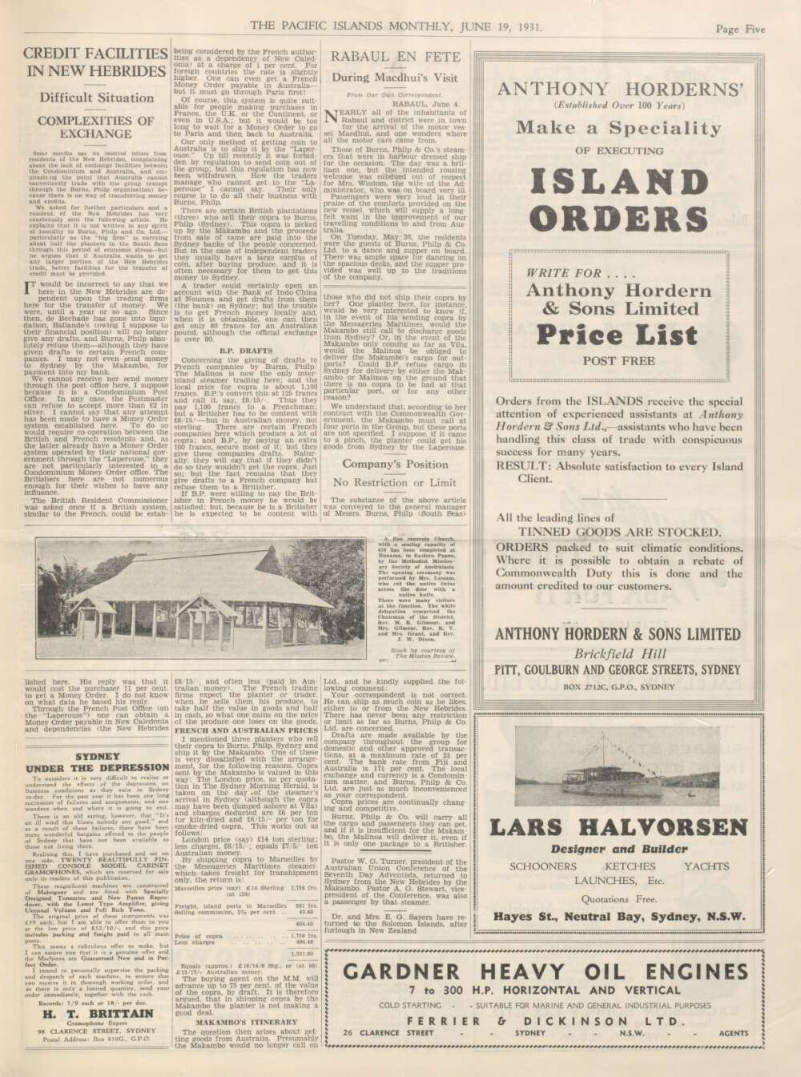
A fine concrete Church, with a seating: capacity of 450 has been completed at Bunama, in Eastern Papua, by the Methodist Mission ary Society of Australasia.
The opening ceremony was performed by Mrs. Lassam, who cut the native twine across the door with a native knife.
There were many visitors at the function. The white delegation comprised the Chairman of the District, Rev. M. K. Gilmour, and Mrs. Gilmour, Rev. R. V. and Mrs. Grant, and Rev.
J. W. Dixon.
Block by courtesy of
The Mission Review.
Rabaul En Fete
During Macdhui’s Visit
From Our Own Correspondent.
Rabaul, June 4.
NEARLY all of the inhabitants of Rabaul and district were in town for the arrival of the motor ves sel Macdhui, and one wonders where all the motor cars came from.
Those of Burns, Philp & Co.’s steam ers that were in harbour dressed ship for the occasion. The day was a bril liant one, but the intended rousing welcome was subdued out of respect for Mrs. Wisdom, the wife of the Ad ministrator, who was on board very ill.
Passengers were very loud in their praise of the comforts provided on the new vessel, which will supply a long felt want in the improvement of our travelling conditions to and from Aus tralia.
On Tuesday, May 26, the residents were the guests of Burns, Philp & Co.
Ltd. to a dance and supper on board.
There was ample space for dancing on the spacious decks, and the supper pro vided was well up to the traditions of the company.
Company’s Position
No Restriction or Limit
The substance of the above article was conveyed to the general manager of Messrs. Burns, Philp (South Seas)
Ltd., and he kindly supplied the fol lowing comment; Your correspondent is not correct.
He can ship as much coin as he likes, either to or from the New Hebrides.
There has never been any restriction or limit as far as Burns, Philp & Co.
Ltd. are concerned.
Drafts are made available by the company throughout the group for domestic and other approved transac tions, at a maximum rate of 2½ per cent. The bank rate from Fiji and Australia is 111 per cent. The local exchange and currency is a Condomin ium matter, and Burns, Philp & Co.
Ltd. are just as much inconvenienced as your correspondent.
Copra prices are continually chang ing and competitive.
Burns. Philp & Co. will carry all the cargo and passengers they can get, and if it is insufficient for the Makam bo, the Malinoa will deliver it, even if it is only one package to a Britisher.
Pastor W. G. Turner, president of the Australian Union Conference of the Seventh Day Adventists, returned to Sydney from the New Hebrides by the Makambo. Pastor A. G. Stewart, vice president of the Conference, was also a passenger by that steamer.
Dr. and Mrs. E. G. Sayers have re turned to the Solomon Islands, after furlough in New Zealand
Advertisements & other items, pp. 5-6 (2 items)
Orders
ANTHONY HORDERNS’
(Established Over 100 Years)
Make a Speciality
OF EXECUTING
ISLAND
ORDERS
WRITE FOR ...
Anthony Hordern
& Sons Limited
Price List
POST FREE
Orders from the ISLANDS receive the special attention of experienced assistants at Anthony Hordern & Sons Ltd., —assistants who have been handling this class of trade with conspicuous success for many years.
RESULT: Absolute satisfaction to every Island Client.
All the leading lines of
TINNED GOODS ARE STOCKED.
ORDERS packed to suit climatic conditions.
Where it is possible to obtain a rebate of Commonwealth Duty this is done and the amount credited to our customers.
ANTHONY HORDERN & SONS LIMITED
Brickfield Hill
PITT, GOULBURN AND GEORGE STREETS, SYDNEY
BOX 2712 C, G.P.O., SYDNEY
LARS HALVORSEN
Designer and Builder
SCHOONERS KETCHES YACHTS
LAUNCHES, Etc.
Quotations Free.
Hayes St., Neutral Bay, Sydney, N.S.W.
GARDNER HEAVY OIL ENGINES
7 to 300 H.P. HORIZONTAL AND VERTICAL COLD STARTING - - SUITABLE FOR MARINE AND GENERAL INDUSTRIAL PURPOSES
PERRIER & DICKINSON LTD.
26 CLARENCE STREET - - SYDNEY - - N.S.W. - - AGENTS
Sutton’s
Canned Vegetables
Green Peas In 1 lb. and 2 lb. Tins French Beans (Sliced) in 1 lb. Tins Carrots In 1 lb. Tins Beetroot (Sliced) in 1 lb. Tins Packed by
Delicia Food Products Co.
WATERLOO, N.S.W.
H. T. Brittain
SYDNEY
UNDER THE DEPRESSION
To outsiders it is very difficult to realise or understand the effects of the depression on business conditions as they exist in Sydney to-day. For the past year it has been one long succession of failures and assignments, and one wonders when and where it is going to end.
There is an old saying, however, that "It’s an ill wind that blows nobody any good,” and as a result of these failures, there have been many wonderful bargains offered to the people of Sydney that have not been available to those not living there.
Realising this, I have purchased and set on
one side, TWENTY BEAUTIFULLY FIN
ISHED CONSOLE MODEL CABINET
GRAMOPHONES, which are reserved for sale only to readers of this publication.
These magnificent machines are constructed of Mahogany and are fitted with Specially Designed Tonearms and New Patent Repro ducer, with the Latest Type Amplifier, giving Unusual Volume and Full Rich Tone.
The original price of these instruments was £39 each, but I am able to offer them to you at the low price of £12/10/-, and this price includes packing and freight paid to all main ports.
This seems a ridiculous offer to make, but I can assure you that it is a genuine offer and the Machines arc Guaranteed New and in Per fect Order.
I intend to personally supervise the packing and despatch of each machine, to ensure that you receive it in thorough working order, and as there is only a limited quantity, send your order immediately, together with the cash.
Records: 1/9 each or 18/- per doz.
H. T. BRITTAIN
Gramophone Expert
98 CLARENCE STREET, SYDNEY
Postal Address: Box 830 G., G.P.O.
Sickness at Pt. Moresby
Severe North-West Season
From Our Own Correspondent
Port Moresby, May 28.
LATELY there have been many cases of sickness in Port Moresby. An epidemic of influenza, colds, and den gue fever has swept through the town and the native villages in the district, causing great inconvenience.
It is approaching the end of the North-west season, which nearly every one agrees, has been on the whole the worst one for many years past. Heat, mosquitoes and fever have made the season pretty nearly unbearable, and it is a great relief to everyone that the south-east season has at last come in, with its cool and invigorating breezes.
Pirates
The Last Of The South Seas
Mortelmans Completes His “Penal Servitude for Life”
NOT long ago, there was released from a New South Wales prison an elderly Belgian named Joseph Mor telmans. He probably was the last man to commit an act of deliberate piracy in the South Seas. He was sentenced to penal servitude for life for piracy and murder; but after the lapse of more than twenty years, he was released from prison and, it is believed, returned to Belgium. The story of his remarkable crime is worth re-telling.
THE true facts of the story came to light almost by accident after the schooner, of which Mortel mans had taken possession, had gone ashore at Apemama, in the Gilbert Islands. The pirate’s companion, a youth named Skerritt, managed to give certain information to a responsible person and, as a result, Mortelmans was arrested at Tarawa on a charge of piracy. He was later committed to the Supreme Court of Fiji and taken to Suva for trial.
At the time they were found wrecked on the reef, the pirate gave his name as John Taylor of Manchester, and that of his companion (Skerritt) as George Jackson, of London.
Skerritt, in his evidence at the Suva Court, said that he and Mortelmans had been shipmates in the barque Glenogil, which left South Shields, in March, 1907, bound for San Diego. The vessel sprang a leak and was forced to return to Liverpool. They there left her and together signed the articles of a Peruvian cruiser, which had been just completed for the Peruvian Navy.
Mortelmans was a leading steward, but was soon disrated, because of his in competency, and reduced to the rank of ordinary seaman. Skerritt was messroom steward. In August, 1907, the cruiser arrived at Callao, and they were both paid off. Some time later, they found themselves shipmates in the little coasting schooner, Nueva Tigre.
The Nueva Tigre was a vessel of nearly fifty tons register and sailed under the Peruvian flag. Though she was new, she had had fitted in her the wheel of the Puelche, of Valparaiso, a vessel which had been broken up be fore the Nueva Tigre was built. She was employed in the coastal trade of Peru. Her captain was Nicholas Melis, an Italian who had been a petty officer in the Italian Navy, and the mate was another Italian, named Juan Boster.
In addition to the Italians, two sea men only were employed, and in No vember, 1907, those seamen were Mor telmans and Skerritt.
On November 18, 1907, the schooner sailed from Callao for Pisco with a cargo of sulphate of potassium and coke. She was never seen again in Callao, and Melis and Boster were never seen again alive or dead.
What Happened On The
Nueva Tigre.
Skerritt told the Court that at 11 a.m. on the day after their departure from Callao, the Nueva Tigre was about 14 miles off the coast of Peru.
Mortelmans was at the wheel and the mate was sitting on the deck prepar ing dinner. Skerritt was in the fore castle. and Melis, the captain, had turned in to sleep.
Suddenly, Skerritt was startled by a shriek. He rushed on deck and saw the mate running forward with blood streaming from the back of his head.
Mortelmans was standing near the cabin hatch with a blood-stained chop per in his hand. Skerritt ran aft and saw the captain come up from his cabins As he appeared Mortelmans struck him on the head with the chop per and he fell backwards into the cabin. Mortelmans followed him and sounds of a fierce struggle were heard Then the captain emerged again and ran forward, followed by Mortelmans, who tried to strike him again with the chopper, but did not succeed.
Mortelmans then got a gun from the cabin, loaded it on deck, and told the captain to jump overboard or he would shoot. The captain, seizing the fore hatch. jumped, taking the hatch with him. Mortelmans then tried to shoot him in the water, but the gun was old and rusty and missed fire.
In the meantime the mate had gone up the foremast. He was bleeding freely—the blood dropping on the sail and deck —and he was dazed. Mortel mans turned upon him. He partly ascended the rigging, pointed the gun at him and told him to jump. The mate appealed to him for mercy, but without success. He then attempted to slide down the jibstay. He grew faint, his hold relaxed and he fell into the sea. For a moment or two he struggled in the water, and then disappeared.
Naturally, Skerritt thought that he would be the next victim, but the pir ate considered him too useful.
“The Ship Is Mine.”
“Those two devils have gone. I have worked for it, and the ship is mine,” exclaimed Mortelmans. He then sent Skerritt to clean up the deck and cabin, which were stained with blood.
He later put Skerritt at the wheel while he ransacked the cabin. The ship’s log and papers he threw over board. The effects of his two victims he went through at leisure, throwing overboard what he thought incrimin ating and of no value, and setting
aside the other things. Then, as if no thing had happened, he lay down for his accustomed sleep and woke up to take his turn at the wheel.
The next day they continued their voyage westward over the Pacific. They took the dinghy aboard, and day after day dumped the cargo of sulphate of potassium and coke into the sea. This work took them a month to complete.
Next they repainted the vessel from green to white. They painted out the name Nueva Tigre and substituted White Rose.
It was Alortelman’s object to make for Australia and sell the vessel and so, by the compass, westward he sailed.
He was favoured by glorious weather at the start of the adventure, but, when a sudden squall arose, he and his companion were terror-stricken. They tried in vain to take in sail until they were forced to chop the sails to pieces.
The foresail went altogether, and to replace it, they rigged up a yard and bent a square sail upon it.
In the meantime the pirate was de termining how he would answer ques which would inevitably await him at the end of the voyage. He had no clearance, no ship’s papers, no log, so he concocted a document which purported to be a bill of sale of the schooner to Taylor and Jackson, as partners.
He knew that he had to sail under some flag, but there was only a Peruv ian flag aboard, and he thought that it would seem strange that a vessel from Valparaiso should sail under the Peruvian flag. He therefore fashioned out of this a Union Jack.
And so the voyage continued. . . .
The White Rose At Apemama.
It was on the morning of January 24, 1908, that the trading schooner Louise J. Kenny, of Sydney, and the auxiliary schooner, Laurel, were lying at anchor in the lagoon at the island of Apemama. The supercargo of the former came up on deck early and ascended the rigging for a look round.
As he gazed across the flat between the lagoon and the ocean he saw through the coconut palms the mast of a schooner rocking as though she was on a reef. The officers of the Laurel had also seen this vessel, and both ship’s launches made for the shore.
The men crossed the narrow strip of land and one of the engineers wad ed out to the vessel which was the White Rose. He was greeted by two men one a powerfully built fellow of about 30 years of age, the other was a pale faced youth of slender build.
The elder man said he was John Tay lor and his companion was George Jackson. Taylor explained that he had been on the reef for about twenty minutes, that in coming in they had
missed stays and failed to come about, and had struck the reef. He said he was the captain and Jackson was the crew, and that his schooner was the White Rose from Valparaiso, bound for Tahiti.
Taylor and Jackson were treated as shipwrecked mariners, and it was ar ranged that they should be taken to Tarawa in the Louise J. Kenny. It happened that the Louise J. Kenny was a trading schooner, and for the purposes of trade, the supercargo had much money in his possession. Taylor soon found this out and made plans to dispose of the white men and seize the vessel, and, but for “Jackson,” he might have succeeded in his plan.
Ever since their arrival at Apemama, Jackson had tried to elude the pirate and tell the true story of the hap penings on the White Rose. Taylor was aware of his intentions, and had told him that if he disclosed the occur rences, he would kill him. In spite of this, the youth got his chance and told the steward his tale. The stew ard reported this to the captain and Taylor was seized and placed in con finement, and then handed over to the police at Tarawa. . . .
The Trial At Suva.
The Supreme Court at Suva was crowded for the trial of Mortelmans.
Skerritt was the main witness for the prosecution and the general outline of his evidence has been already given.
He was corroborated by witnesses brought specially from Callao, who identified the various articles found on the White Rose, and swore to the departure of the vessel Nueva Tigre from Callao with these articles, as well as the Italian master and mate and Mortelmans and Skerritt on board.
Evidence from the Louise J. Kenny and the Laurel as to the arrival of the schooner at Apemama and the happenings there, completed the case.
There was a lengthy list of exhibits in court, including the missing cap tain’s clothes, the wheel of the Puelche, the spurious bill of sale, the makeshift Union Jack, and—perhaps what had more effect on the jury than anything else the nameboard of the din ghy. On this the pirate had painted out the original name, Nueva Tigre, and superimposed the name White Rose. But time had defeated him. For, on the board stood out the old letter ing, Nueva Tigre, with the utmost dis tinctiveness.
The pirate was convicted and re ceived a sentence of penal servitude for life.
This case, embodying as it does pir acy on high seas in its most malicious form, probably will go down in the annals of history as the last of its kind in the South Seas.
Joseph Mortelmans.
Death Of Lady Hedstrom
Well Known Fiji Resident
THE death occurred in Suva, on May 2 of Lady Hedstrom, wife of Sir Maynard Hedstrom.
The deceased lady was born in Fiji and was the fourth daughter of the late Mr. Alexander Eastgate, one of the first stipendiary magistrates of the Colony. She was married in 1895 and leaves a family of five. She did not take a prominent part in public affairs but was a strong supporter of the Church of England.
The funeral was largely attended.
His Excellency, the Governor, was re presented to Capt. M. Godley, A.D.C.
There were many beautiful wreaths and floral tributes and Sir Maynard Hed strom received messages of sympathy with him and his family from all parts of the world.
Advertisements & other items, p. 6 (2 items)
Flour
MALARIA
This scourge of the Tropics is best inhibited and treated by the well-tried remedy which has been on the market for nearly 20 years.
PRICE’S QUINCAPS
Presenting Quinine in the most soluble and active form.
Obtainable from: W. R. Carpenter & Co. Ltd.; Charles Helps, Sargood Gardiner Ltd.; Nelson & Robertson, Elliott Bros. Ltd., and from many local storekeepers.
Sole Manufacturers:
HALLAM LTD. - - SYDNEY
Leading DISPENSING CHEMISTS of Sydney for Nearly 50 years.
Prescriptions, Drugs and Chemicals, all Surgical Appliances and Toilet Sundries forwarded by Parcels Post to any Address.
Flour
ASK FOR IT
ESTABLISHED 1868.
EXCELSIOR SUPPLY CO. LTD.
The most extensive Manufacturers in the British Empire of
RUBBER STAMPS.
INKS, STENCILS.
We have a big range of Special
Spraying Machines
for ail purposes.
Let us know your requirements and we will quote you by return. Ask for our Big Catalogue.
Sole Australasian Distributors of the World Famous SHEAFFER FOUNTAIN
PENS and PENCILS.
EXCELSIOR SUPPLY CO. LTD.
Head Office:- 160 GEORGE STREET WEST,
SYDNEY, N.S.W.
Marking Devices.
ACME STAMP PADS
FRUIT CASE MARKING SETS
We also Manufacture or Supply a complete line of
Eehown Brand
ROSS & BOWMAN Ltd.
MONUMENTAL SCULPTORS
Sydney’s Leading Monumental Masons.
Suppliers of Memorial Works to all Croups of the Pacific Islands.
Designs and Estimates on application Free of Charge.
31 FLINDERS STREET - - SYDNEY
ROPE AND CORDAGE
EEHOWN BRAND
Manufactured by
J. SCOTT LIMITED
Head Office and Stores: 163 CLARENCE ST., - SYDNEY, - N.S.W.
Box 251 DD., G.P.O. Phone, B 2861
WORKS: MASCOT, SYDNEY
Cable & Telegraphic Address: “Ropeyard,” Sydney. Codes: Bentley’s. A.B.C. sth Edit.
Papuan News
Trade Outlook Unfavourable—Success of New Industries —Disappointing Results from Tauri Goldfield.
From Our Own Correspondent.
Port Moresby, May 15.
THE position in Papua is serious, owing to the recent collapse of the rubber market, and general condi tions will become unsatisfactory unless the value rises shortly.
Copra is again down, and there seems to be no likelihood in the near future of it reaching a satisfactory price. The fluctuations in the market are showing a slow but persistent downward trend.
If these recent conditions have come to stay the economic situation of Papua will need adjusting.
In most cases the salaries of white men have been severely reduced and there have been reductions of the more highly paid native, yet very many na tives are still commanding wages which are ridiculous in comparison with their actual values and their com panies’ finances.
For several years previous to the pre sent day slump, the wages of the more competent natives have been rising steadily, far in advance of the coun try’s prosperity.
It is very satisfactory to know that, in spite of other setbacks, Papuan desiccated coconut and coffee are coming along steadily. “Eilogo” coffee from Mr. G. A. Loudon’s Eilogo estate, in the Sogeri district, in the hills north of Port Moresby, is now ready for ex port and for general local sales. This is reported to be an excellent “Ro busta” coffee, both its flavour and aroma being exceptionally good.
The residents of Papua are now in the happy position of being able to support a few home industries—coffee, desiccated coconut, timbers and millet.
The progress of these may perhaps be an inducement for others to follow on similar or diverse lines, with the same success.
There is no news from the Tauri goldfield. Another party has re turned, expressing the opinion, as others before them, that there is no payable gold, that the area is not worth prospecting. However, there are two parties still trying their luck, in spite of the field gradually being de serted.
Trial Of Kuni Murderers.
The trial of the four murderers of the Kuni mountain people was conclu ded in the Central Court on April 17, before His Honour Mr. Justice Murray.
They were all found guilty and sen tenced to death.
These sentences were considered in the Executive Council on April 21, when the following order was made: “Sentence of death to be carried out in the case of Orepu and Koapa. Sentence in the case of Bakai and Philippo to be com muted to ten years’ imprisonment with hard labour. Time and place of execution to be fixed hereafter.”
The Order of the Executive Council will be submitted to the Prime Minis ter of Australia.
The convicted natives are of the more educated type, and have been in touch with Europeans for many years, one being a domestic servant of long standing, and another an ex-Lance Corporal of Police.
The three murdered men came down from the hills, as is their custom, to trade, bringing with them their native wares and money. They were unarmed.
They received a poor welcome on their way down through the villages and, leaving Bailala at dusk, they were at tacked and killed and their bodies bur ied in a scrub hen’s nest, where they
were discovered by the police. The dis appearance of these three men caused alarm amongst the Kuni people, and their friends made four attempts to find them. Fearing treachery they re ported the matter to the Government.
The motive of the crime was robbery.
Other villages nearby Bailala, where the murders were committed, were frightened of reprisals from the moun tain people and were wary of night at tacks, but now, no doubt, hearing the result of the trial, they will realise justice has been done, and the differ ent tribes will again settle down to their former amicable relations.
Well Known Missionary
Arrives.
The Rev. Cecil and Mrs. King have arrived, accompanied by their niece, Miss Kemy, by the last Morinda. Mr.
King is relieving the Rev. H. Matthews, who is going south for a well-earned rest, to the hinterland, behind Cairns, North Queensland, for three months.
Mr. King is not exactly a newcomer to this territory. In 1898 and 1914 he visited these shores, on the first occa sion arriving by the Titus, an ocean liner, compared to which our present day Morinda appears in the light of a floating palace.
Mr. King is a brother of the Rev.
Copland King, a well known missionary of the Anglican Mission, who spent many years on the N.E. coast of Papua. He was very interested in an thropology and wrote interesting notes in his mission reports on the strange customs of the northern tribes in that division, which have been of great in terest to those studying anthropology in the Pacific.
Anzac Day Memorial Service was held in the Institute Hall, when His Excellency Sir Hubert Murray, accompanied by Lady Murray, presided over a large gathering of residents in Port Moresby.
His Excellency addressed the gather ing and was assisted by the Rev. H.
Mathews and the Rev. O. S. Parry, B.Ec.
Social Activity.
Mrs. Champion, wife of the Hon. W.
Champion, Government Secretary, en tertained Lady Murray and several ladies of Port Moresby to afternoon tea at her home at Konedobu last week. Mrs. Champion, in pale yellow, dispensed tea and cakes with consider able success on the verandah of her pretty bungalow.
Following suit, two or three parties have been given in Lady Murray’s honour by different ladies of the town.
Sporting.
Cricket, golf and tennis are again in full swing and very shortly canoe racing will commence, with its usual excitement and vigour.
The annual general meeting of the Port Moresby Aquatic Club was held in the club house, when the Commo dore, Hon. E. C. Harris, took the chair.
The treasurer, Mr. de Groen, repor ted on the club’s finances, and stated that all liabilities were paid, includ ing all costs of the club house, showing a small credit balance. Office-bearers for the new year were elected. Sir Hu bert Murray being made patron and Mr. F. L. Leydin commodore.
It was decided to commence racing on May 16, and that the committee should handicap the first race of the season. During the sailing season last year there was an average of 13 can oes at each race.
Aerial Transport
Salamoa to Wau
(To the Editor.)
Sir —In your issue of May 14, in an article headed “Salamoa to Wau-Need for a Road,” the following paragraph appears: “Only recently that efficient organisation, Guinea Airways Limited, had three minor mishaps to single engined machines, and the company found itself with insufficient planes to cope with the cargo landed at Sala moa."
This information is not correct. At no time has the company found itself with insufficient planes to cope with cargo. Delays may occur when a boat arrives owing to bad flying conditions, but not owing to insufficiency of planes.
I shall be glad if this statement can be corrected in your next issue.
Yours, etc.,
A. E. H. Evans,
Secretary, Guinea Airways Ltd.
Adelaide, May 26.
Anti-Mosquito War
Need for Extensive Campaign
Brisbane Doctor’S Valu
Able Work
From Our Thursday Island Correspondent TO attempt to eradicate or even control that common pest of tropi cal countries, the mosquito, would seem to be a herculean task when countless thousands of them roam at large, in the course of an evening, through most people’s bungalows, in flicting torture on all and sundry.
And yet, thanks to the research of biologists and health workers, the problem does not appear to be so very difficult, when certain facts with re gard to the habits of these pests have been made clear.
Be that as it may, the attempt to make a city like Brisbane, which has many square miles of swampy land in its vicinity, mosquitoless is being tackled, and is even showing signs of eventual success. If this ideal is at tained, and the mosquitoes which carry the three principal mosquito-borne diseases —malaria, dengue and elephan tiasis —are completely driven out of the Queensland capital, its citizens will have to thank Dr. Hamlyn Har ris, D.Sc., of the Public Health Depart ment of Queensland, who has already accomplished much in this direction.
But Dr. Harris is not waging war against these enemies of man in Bris bane only, for, by means of a series of clear diagrams and instructions, he is now bringing the facts of mosquito control to the notice of all Queens landers.
“Species Control.”
Much benefit would result if these diagrams were distributed throughout the Pacific, for no one who takes the trouble to read them could fail to either grasp the principles or to real ise that mosquito control is a perfectly feasible suggestion which can be car ried out by any householder.
The solution of the problem, as Dr.
Harris remarks in one of his press articles on the subject, lies in what is
Called “Species Control.”
He states: Species control ignores mosquitoes taken as a whole, takes no cognisance of general pro miscuous control, but deals with each species of mosquito on its own merits, makes a study first of the habits and life history, and then determines the attack.
From an examination of the dia grams, we find that the mosquitoes of Australia are divided into three main classes, those that do not bite—appar ently they never visit Thursday Island —those whose bite is harmless from a disease-carrying point of view, and those who, when they bite, can, and often do, transmit the germs of dis ease.
The significant fact about this classi fication is that it is only the last named, the virulent carriers of malaria and dengue, that infest houses and breed domestically. The biting pest that hails from the swamps and is occasionally blown into settlements by the wind, is harmless, except in its power to torment and exasperate its victims and does not attempt to enter houses as a rule.
We are therefore only concerned with the purely domestic variety, and the swamp breeder may be left to his, or rather her, swamps, with the know ledge that if she is vicious on her occasional visits to town, she will not start up an epidemic of dengue or other tropical plague.
All tins, tanks or pools containing larval infested water should be emptied, or their surface covered with a thin film of kerosene or olive oil, and special attention paid to satur ated heaps of vegetable or animal re fuse.
It is by these methods that Dr. Har ris is urging Brisbanites to extermin ate mosquitoes, not by vigilance to-day or to-morrow but by everlastingly keep ing at it, and the same measures could be adopted throughout the Pacific by the expenditure of a little energy.
The Position On Thursday Is.
On Thursday Island the problem is no less important. The three disease bearing mosquitoes are all present there and are augmented from time to time by bush or swamp mosquitoes.
Every Anopheles is a potential mal aria-carrier, and our freedom from this disease up to the present is doubtless due to the fact that the mosquitoes themselves have hitherto escaped be coming infected. But how long can we expect to remain immune, when we have a host of Papuans from highly malarial districts living here, just at the time when the Anopheles is most active? Nor must we put the whole responsibility on the unfortunate New Guinea boys, when there are infected centres in our own islands, like Darn ley and Poid, from whence malaria could easily be carried to local mos quitoes by island visitors.
It has been prophesied that Thurs day Island’s immunity from malaria will end in a serious epidemic one day, such as occurred out in the is lands last year, but the danger of this might be averted by a little timely in vestigation and action bv the local council.
Advertisements & other items, p. 7 (3 items)
Mark Foys
Qood Value
in GROCERY &.
PROVISIONS
Only Grocery and Provisions of best known quality find place in the shelves and stands of this important department at Mark Foy’s. You can be sure in knowledge that the prices right through large and comprehensive stocks are in keeping with Mark Foy’s old established policy of "Good Value” giving.
Leggo’s Prepared Mush rooms, lib. tins, per tin -/10½ Leggo’s Prepared Mush rooms, ½lb. tin, per tin -/1\ Dessert Grape Fruit, in Syrup, l|lb. tins, per tin l/lOj "Blue Bird” Loganberries, lib. tins per tin -/8| Old Gold Cocoa —-4oz. tins, 6d. per tin; Boz. tins, ll|d. per tin; l6oz. tins, per tin 1/10 Nestle’s Cocoa—4oz. tins, 6d. per tin; Boz. tins, lid. per tin; 16 oz. tins 1/9 Mark Foy’s Pure Cocoa, 3 lb. bags per bag 1/10^ Pure Ground Coffee, or Coffee Beans ... per lb. 1/8 Mocha Coffee, Roasted Beans or Ground, per lb. 2/3 "Melba” Honey, 2lb. tins, per tin 1/2 "Seabrook’s” Honey, 2lb. tins per tin 1/8 "Globe” Brand Sheep Tongues, 12oz. tins, per tin 1/0-J- -"Agee” Brand Sheep Tongues in glass lib. jars, ea. 1/10-J "Agee” Brand Calves Tongues in glass lib. jars, ea. 2/4 Libby’s Spaghetti, lib. tins per tin -/llj-
Heinz Spaghetti, lib. tins, per tin -/11l "High Tide” Brand Brisling in olive oil, tins per tin -/8| Trefavenne Sardines, £’s, 10|d. per tin; 4’ s > tin -1/4} "Captain” Brand Crab, 6oz. tins per tin 1/3 "Snow Cap” Pilchards, lib. tins per tin -/9j Gartside’s Sweet Corn, 10 oz. tins per tin -/9j Libby’s Asparagus Tips, 10 oz. tins per tin 1/54 Kraft Brand Cheese—4lb. pkts., Hyd.; |lb. pkts. -/6 Colonial Brand Baked Beans, 4oz. tins, per tin -/3 Colonial Brand Concentrated Vegetable Soup, 1 lb. tins per tin -/64 Canned Vegetables, "Aunt Mary’s”— Cabbage, lib. tins, per tin -/74- Carrots, lib. tins, per tin -/74- Celery, lib. tins, per tin -/8| Green Peas, lib tins, tin -/10{- Parsnips, lib. tins, per tin -/I} Spinach, lib. tins, per tin —/74- Turnips (Swede), lib. tins per tin -/I} Turnips (White), lib. tins per tin —/I}
Write for a copy of Foy’s big General Mail Order Catalogue. Post Free on request.
Freight is Additional to these Prices.
MARK FOY’S LIMITED-SYDNEY
GRIPOLY
MACHINE BELTING
The Super Driving Belt for Tropical climates, guaranteed that the hair yarns used in the manufacture are 100%
PURE GENUINE CAMEL HAIR.
Gripoly Belting is woven solid. Heat does not separate it.
Gripoly grips the pulley its surface prevents it from slipping.
Gripoly Belting is not affected by steam and moisture. It is waterproofed and does not stretch.
Gripoly Belting withstands heat and grease, and may be used in cases where other Belting would perish.
Carried in stock in all sizes, 1½ inches to 12 inches wide In addition to Gripoly Belting, we carry full stocks of all transmission requirements, such as
LEATHER AND RUBBER BELTING - PULLEYS
BALL BEARINGS - PLUMMER BLOCKS - COLLARS
SHAFTING, ETC.
H. P. GREGORY & CO., LTD.
ENGINEERS AND GENERAL MACHINERY MERCHANTS
74 CLARENCE STREET SYDNEY, N.S.W.
Established 1875.
Registered Cable address: “Gregory,” Sydney. Box 446 F., G.P.O.
Newbold Silica
FIRE-BRICK Co. Ltd.
Manufacturers of High Grade Refractories Silica Bricks, High Alumina Fire Bricks, Siliceous Fire Bricks, Chrome Bricks, Bauxite Bricks, “Sealtite” (hot patching cement), Diatomaceous insulation.
Enquirers are requested to give full particulars of temperatures and purposes for which refractories are required.
The Newbold Silica Fire-Brick Co. Ltd.
109 ELIZABETH ST., SYDNEY
When Painting White
Specify “CHARMOL” WHITE for all surfaces.
Guaranteed to stand Tropic atmospheric conditions.
Price and full particulars from Sole Proprietors:
CHALMERS & O’LEARY
Oil and Colour Merchants, 73 Liverpool St., Sydney Cable Address: "Chartnol,” Sydney,
Growing Tragedy of Australia's
Pacific Trade
Vol. 1—No. 11
June, 1931
IF there is one thing more than another that Australia wants, it is an oversea export trade for the pro ducts of Australia’s secondary indus tries. Every now and again a Federal minister, making wild and violent ges tures, publicly declares that something really worth while must be done to find a market for Australian manu factured goods. Yet, when one repeat edly shows how a rich and friendly market for Australian goods can be developed no notice whatever is taken.
One would get as much result from singing “Boyne Water” on the top of Kosciusko, as from placing carefully compiled facts and figures before Aus tralian Governments.
In this issue of The Pacific Islands Monthly there are four outstanding news items. The Government of Fiji has erected a further tariff barrier against the goods of unfriendly Aus tralia by giving definite preference to the goods of other British Dominions.
The people of Norfolk Island are eag erly completing arrangements for the development of a new trade with New Zealand and turning away in a corres ponding degree from trade with Australia. The French community in New Caledonia, discouraged by the hostile demonstration made by Aus tralia through the medium of its extreme tariffs, has offered to establish new steamer communication wdth New Zealand with a view to stimulating trade between the two colonies and buying from N.Z. the foodstuffs it usu ally gets from Australia. The British community in the New Hebrides continues to cry out impotently for some method of transferring money to Australia, so that Australia may continue to supply the New Hebrides with a portion of the £300,000 worth of goods which the Group annually imports.
Now, consider the circumstances.
Every one of these Territories is within a few days’ sail of Australia. They are countries of primary production— it is essential that they import all the kinds of manufactured goods required to sustain life in a sub-tropical climate.
Australia, at frightful cost to itself, has established all kinds of manufacturing industries. Australia, because of its proximity, is the market to which these Pacific countries naturally turn. Fiji is a rich and rapidly growing British colony. Norfolk Island is not only wholly European—it is actually a part of the Australian Commonwealth. Yet all this trade, which is worth no less than £3,000,000 annually, is either being ignored by official Australia; or is being actually driven away by hostile tariffs and other short-sighted Govern ment actions.
The expenditure of a few pounds by the Commonwealth Government in making a commercial survey of this market, or even a few friendly ges tures by offiialdom towards these large Pacific communities, would certainly do a great deal towards holding for Australia a market that she has held in the past by geographical advantage, but which she is now rapidly losing in these competitive days by ignorance and indifference.
Tropicalities
Written for The Pacific Islands Monthly by “Sea Serpent.’’
I HEAR that one of the first acts of the new Administrator of Western Samoa, General Hart, was to take definite steps to open up friendly communication with the Mau. The Samoans, after a decade of friction and misunderstanding, are now sullen and suspicious, and much more inclined to sit in their remote villages and brood over their wrongs, than join with a new regime in bringing peace to their territory. General Hart will certainly try to gain the goodwill of Mr. O. F.
Nelson, still an exile from his country, and now resident in Auckland. But what chance is there of co-opting Mr.
Nelson, whose influence with the Mau is paramount, when that tragic man’s firm has just been fined £5,600 by a New Zealand judge in Samoa? Still, General Hart is working along the right lines, and all who want to see real progress in the Pacific will wish him luck. * * * APROPOS of the prosecution of O.
F. Nelson & Co. Ltd., this journal remarked last month that the fine had about it “a suggestion of sheer savagery.” Further particulars show a remarkable state of affairs. The firm has been doing a banking business for many years, and, in that connection, had sent money abroad on behalf of certain Samoans, long before the Mau was declared a seditious organisation.
These Samoans, who in 28 instances were members of the Mau, repaid the sums, ranging from 4/- upwards, to the firm. The transactions were quite open and above board there was no at temnt at concealment. The judge held that this was aiding and abetting a seditious organisation, and imposed the maximum fine of £200 in each of the 28 cases! The iudge, apparently, was influenced by the fact that most of these sums were sent abroad to Mr.
Nelson, to reimburse him for heavy ex penses incurred in carrying on his legal and propaganda campaign against the Administration. One sees the iudge’s viewpoint. But the maximum fine on every one of 28 concurrent charges!
Whew! * * * ONE planter-trader in the Solomon Islands, who has just completed his quarter-century in the group, is pulling the ends together with a view to trying his fortunes down south and intends leaving his plantation in the hands of natives, since there is not sufficient in copra to warrant pay ing a white man. He contends that there will be no worth-while improve ment in the copra industry until the world’s politics have been spring cleaned and that this is going to take years. * * * THIS from one of the most compet ent commentators in the South Seas, is much appreciated: “We are all very grateful for the articles on copra position, whale oil, etc.
“You also strike a, true chord in suggesting that critics of the big firms are too apt to condemn the
whole firm on the doings of the indi vidual. Those of us who know our ‘minnies’ at all now mention ‘The Big Three’ in our prayers—they come in after the price of copra! I may say that Unilever is not mentioned — for it seems to me that this last drop in copra is largely due to the knock they got over the whale oil contracts.” * * * THREE years ago a Sydney news paper was heavily funny at the ex pense of Norfolk Island, because an ordinance to regulate the use of “the three motor cars in Norfolk Island had occupied eleven pages of the Commonwealth Gazette. But times have changed. Last year, the little territory imported no less than 39 mo tor vehicles; and, although N.I. is only five miles long by three broad, there are now so many cars and trucks there that it annually purchases £3,000 worth of benzine and oils. The figures suggest that N.I. requires, not a motor ordinance, but a few traffic policemen. * * * IN his book, “Soldiers of Misfortune,”
P. C. Wren has this to say of plan ters as a class: “Planters are cheery birds as a class, and to vary the metaphor, are of the earth as well as priceless old beans, great nuts, stout fellas, some lads and sound sportsmen. Some times other elements under false pretence of being priceless old beans, intrude and cause friction, until self-revealed for what they are, respectable, prudent, virtuous and narrow or perchance Bumptions and bounderish.”
Present writer would like to meet the coconut planter who can remain a cheery bird, a priceless old bean and a stout fella, with copra at £10/5/- per ton. * * * THE Sunday Island Settlement As sociation has been formed to ac quire 275 acres of freehold in the centre of Sunday Island from the New Zealand Government and settle 14 fam ilies there. Dr. A. J. Ross, of Brisbane, is financially backing the scheme.
There is considerable argument as to whether 275 Sunday Island acres will support 14 families. Sunday (or Raoul) Island is the largest of the Kermadec group, lying about half-way between Auckland and Tonga. It is 20 miles in circumference and contains 7,200 acres, most of it extremely rich volcanic soil.
It rises, at one end to a height of 1,700 feet. When I was ashore there, in 1914, there was a New Zealand fam ily named Bell in occupation; and I have never seen finer vegetables, nor larger and more luscious oranges than those of Sunday Island. The main handicap is lack of a suitable anchor age in stormy weather. Given a regu lar steamer service, the possibilities of maintaining a prosperous, happy community on Sunday Island should be very bright; and, as the island is practically on the direct route between Auckland and Tonga, communication should not be an insuperable difficulty.
The other islands of the group are not big enough to be worth worrying about.
Drought Affects Haapai
Crops Tongan Government Votes £1,000 For Relief
From Our Own Correspondent
Nukualofa, June 1.
THE drought that assailed our Islands at the beginning of the year has had repercussions in our middle group.
Haapai is made up of a number of low-lying atolls, ever exposed to the fury of wind and spray. The heavy “blow,” coincident with the dry spell in January, has evidently set back the yam crops to an amazing extent. A further handicap, in the Haapai group, is the congestion of people. Their tax
allotments are, generally speaking, small compared with those of their luckier brethren in the other islands of the Kingdom.
The Government has, for many years, held out inducements to the inhabitants of the middle islands to form colonies in either Tongatabu or Vavau, where vacant land is plentiful, but the Tongan clans are not easily broken and there has been no general response. The bitter rivalry and the internicine strife of a century ago is not forgotten. The people of Haapai —the stormy petrels of the Tongan archipeligo—stand aloof, and view with suspicion any honest endeavour by the Government to plant them amongst their one-time bitterest clan-enemies.
In view of the state of their crops, the Executive Council, we learn, has voted £1,000 for the purchase of flour for the people of Haapai during their temporary time of stress.
Empty Tins Popular In Papua
Empty tins of all sizes and descriptions are much sought after by the primitive natives of Papua, as they can be put to a variety of uses in domes tic work. In the photo can be seen bush girls from villages around Salamo, Eastern Pa pua, who have just made a good “haul” from the Meth odist Mission Station there.
Block by courtesy of
The Mission Review.
Personal Notes from Rabaul
Rabaul
From Our Own Correspondent.
Rabaul, June 4.
THE arrival of the Macdhui brought back many familiar faces.
Mrs. Wisdom, the wife of His Hon our the Administrator, returned after an absence of some months in Aus tralia. Unfortunately, during the voy age, Mrs. Wisdom became very ill and had to be taken direct to the hospital.
She has since undergone a serious op eration, but is progressing favourably.
Mr. James Burns, of the well known firm of Burns, Philp & Co. Ltd., ar rived by the Macdhui on a visit of inspection.
Mr. and Mrs. Twycross and family, of Amalgamated Wireless Ltd., return
New Guinea
Massacre
Well-Known Prospector Killed
Other Parties Attacked
From Our Own Correspondent.
Rabaul, June 4.
Very little official information is as yet available concerning the murder of Hellmuth Baum and seven of his party.
Private advice, however, from Sur prise Creek, in the Upper Watut area, dated a month ago, advises that on
Hindu Pundits
ed after a few months’ leave in Aus tralia.
Mr. and Mrs. Frank Saunders, of Kavieng, returned to the Territory, after a short holiday and business trip South.
Mr. and Mrs. V. B. Pennefather, of Tokua Plantation, Kokopo District, re turned after an absence of some months in Australia.
Mrs. Max Lees and children, of Ula veo Plantation, also returned after an absence of several months South.
Capt. F. R. Jolley, general manager of the Melanesia Co., returned from a hurried business trip.
Major Ayris, of the Police Depart ment, has returned from Hongkong per the S.S. Bremerhaven.
Mr. G. Furter has returned, after an absence of 12 months in Europe, per the Royal Dutch Packet steamer Le Maire.
The District Officer of New Britain, Mr. T. Taylor, together with Mrs. Tay lor, left per the M.V. Armidale, for a holiday in Europe.
Mr. McAdam, District Officer of Ki eta, is in Rabaul, acting as District Officer, New Britain.
Mr. A. Hunter, District Officer, Ma dang, is due for retirement from the Service, and leaves for Australia per Macdhui. Mr. Hunter was a District Officer under the Military regime, and remained in a similar capacity with the advent of civil administration. He has seen almost the whole of this territory in his official capacity of District Offi cer.
Mr. and Mrs. Pat. Savage proceeded South on leave per M.V. Macdhui. Dur ing their holiday Miss Agnes Savage is the guest of the Crown Law Officer, Mr. G. G. Hogan and Mrs. Hogan.
Mr. R. K. Clark, of Messrs. McLen nan & Clark, barristers and solicitors, Rabaul, left for Australia per S.S. Nel lore for a holiday and rest.
Mr. F. O. Greenwood, formerly man ager for Burns, Philp & Co. Ltd., at Rabaul, has resigned from the B.P. service. Mr. Greenwood had many years’ service with that firm, and dur ing his tenure of office in this terri tory he became very popular. We are advised that it is the intention of Mr.
Greenwood to return to the territory in a few months, when he intends join ing the firm of Handley & Laws, which business will then be styled “Green wood & Laws.”
March 23, Baum with 15 native car riers left on a prospecting expedition between Mt. Lawson and the Papuan border.
On April 27 one of Baum’s boys re turned in a pitiably exhausted state to Surprise Creek, with the news of the murders. Gradually, as time went on, in all, eight of the boys drifted into Surprise Creek, badly wounded by knives and spears. It would appear that Baum and seven of his boys were murdered.
Baum, on his way to Mt. Lawson, made camp on the bank of a river some distance from a native village.
The kanakas came in great numbers, with native fruits and vegetables, also a pig. Sufficient supplies were bought and paid for and Baum with his party then proceeded towards Mt. Lawson.
Apparently, not finding any gold, the party returned to Surprise Creek and camped on the same spot as on the outward journey. The kanakas again came with food to sell, and everything appeared to be quite peaceful and friendly.
During the night of April 23 nothing happened to cause any anxiety, and the following morning at dawn the cook-boy entered Baum’s tent to make his coffee. Baum got up, completed his toilet, and gave instructions to pack up and break camp. Four shot guns and a Winchester rifle were placed in a bag to be carried and his Mauser pistol was packed in a trade box. Baum returned to his bed to drink his coffee.
Meantime, some of his natives set about preparing their breakfast. Many kanakas from the adjacent village visited the camp with more offerings of food, and generally no notice was taken of them.
One big native then entered Baum’s tent, and, taking a club from behind his back, hit Baum over the head. This seemed to be the signal for attack, as many kanakas then entered the tent.
Some held Baum and, with his own axe, they battered his head. The camp was then looted and only eight natives, as mentioned previously, escaped to the bush.
Papuan Patrol And Pros
Pectors Attacked..
It is learned that a Papuan patrol officer, with another white person, and a party of carriers and Papuan na tive police, have been attacked almost continuously for nearly three weeks. On more than one occasion three attacks had been made in one day in broad daylight. This party decided not to return, but to remain in this Territory and proceeded to the Wau in the Mo robe district.
It is also learned by a very brief radio message that the Leahy Brothers have been attacked by hostile natives in the Upper Watut area, in the Surprise Creek district, but that both were safe.
On May 1 District Officer Feldt ar rived at Surprise Creek with a police party, having come some of the dis tance by ’plane.
“Highly Dangerous
Country.”
A brief radio has been received from the district officer, Morobe district, who has been out of touch with civilisation for about three weeks, stating that he is returning with six prisoners, and that the area between the Papuan border and the main dividing range is highly dangerous.
This area has been now declared closed until further notice, and although it is unlikely whites can be actually prevented from entering the area, every obstacle will be put in their wav, and they will go at their own risk.
There are two sec tions of Hindus in Fiji the Arya Sa maj, noted for its advanced thought, and the older Sana tan Dharm. The two
gentlemen pictured
above are the prea chers for the Sana tan Dharm. On the left is Pundit Ram Chander Sharma, Kirtan Visharad, who arrived in Suva in July, 1930, and im mediately rallied the strength of his sect.
On the right is Pun dit Murarilal Jee Kausikiyachaya Sha stri, preacher, who arrived in Fiji last January to carry on the work of the sec tion.
Advertisements & other items, p. 8 (1 item)
Pacific Islands Monthly
8
THE PACIFIC ISLANDS MONTHLY, JUNE 19, 1931.
Published once a month, and circulated among residents of: New Guinea Fiji Solomon Is.
Papua Tonga New Hebrides Norfolk Is. Samoa New Caledonia Cook Is. Nauru Ocean Is.
Gilbert Is. Tahiti Thursday Is.
Read also by residents of Australia and New Zealand who are interested in Pacific Islands trade and activities.
Publishers: Pacific Publications Ltd., Union House, 247 George Street, Sydney. Tel.: BW 5037.
Editor: R. W. Robson.
Melbourne Representative: A. W. Cummins, 167-169 Queen Street, Melbourne.
London Representative: R. M. Hodge, 80 Fleet Street, London, E.C.4., from whom copies of this journal, and advertising rates, may be obtained. Tel.: City, 2062.
SUBSCRIPTION RATES:
s. d.
Per annum, post free, within British Empire: in advance. 6/-; booked .. 6 6 Per annum, post free, beyond British Empire 8 0
ADVERTISING:
Casual; Per single column inch 9 0 Contract: 7/-. 7/6 and 8/- per inch, accord ing to conditions.
Changes of advertising copy should reach publishers by 7th of each month.
CONTRIBUTIONS:
Contributions on matters of interest to Pacific Islands residents and traders are in vited,
DISTRIBUTION:
In Australia, New Zealand and Great Britain copies may be obtained from, and subscription orders lodged with, Messrs. Gordon & Gotch, Limited.
In the Pacific Islands, copies may be ob tained from, and subscription orders lodged at any of the stores of Messrs. Burns Philp & Co.
Ltd., Messrs. Burns Philp (South SeasJ Co Ltd., Messrs. W. R. Carpenter & Co. Ltd., and Messrs. Morris Hedstrom & Co. Ltd.
Luck Of The Macdhui
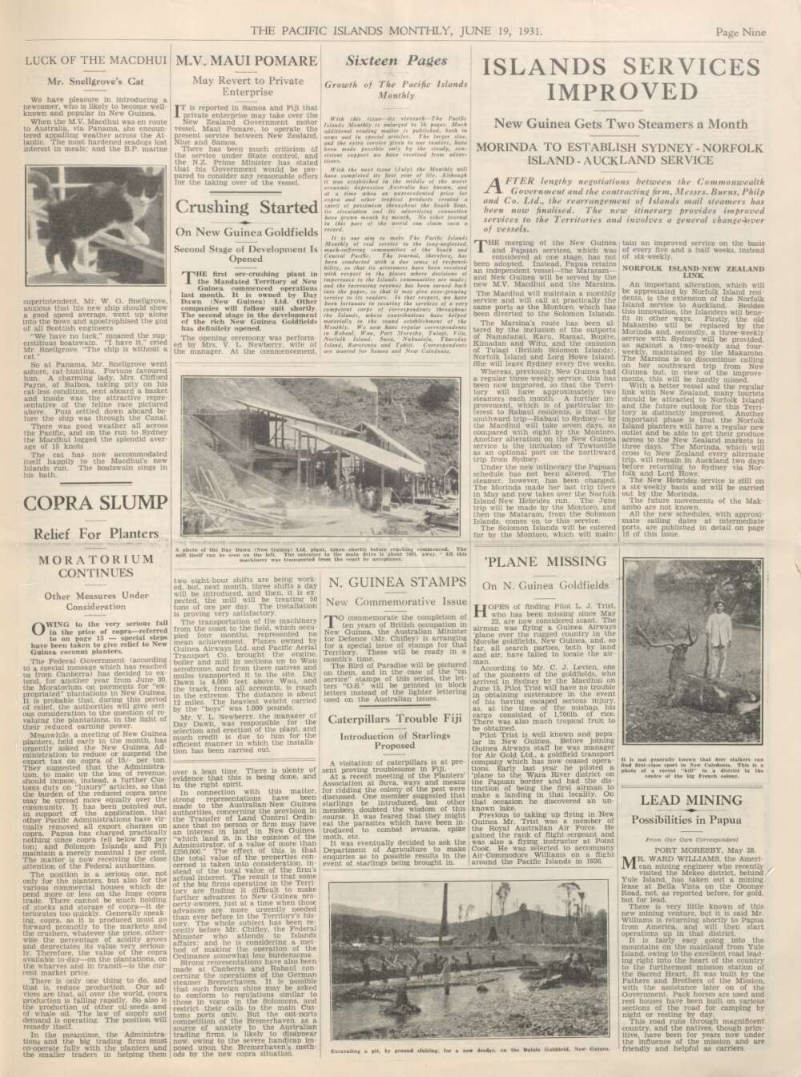
Mr. Snellgrove’s Cat
We have pleasure in introducing a newcomer, who is likely to become well known and popular in New Guinea.
When the M.V. Macdhui was en route to Australia, via Panama, she encoun tered appalling weather across the At lantic. The most hardened seadogs lost interest in meals; and the B.P. marine
superintendent, Mr. W. G. Snellgrove, anxious that his new ship should show a good speed average, went up alone into the bows and apostrophised the god of all Scottish engineers “We have no luck,” moaned the sup erstitious boatswain. “I have it,” cried Mr. Snellgrove. “The ship is without a cat.”
So at Panama, Mr. Snellgrove went ashore, cat-hunting. Fortune favoured him. A charming lady, Mrs. Clifford Payne, of Balboa, taking pity on his cat-less condition, sent aboard a basket and inside was the attractive repre sentative of the feline race pictured above. Puss settled down aboard be fore the ship was through the Canal.
There was good weather all across the Pacific, and on the run to Sydney the Macdhui logged the splendid aver age of 15 knots The cat has now accommodated itself happily to the Macdhui’s new Islands run. The boatswain sings in his bath.
Copra Slump
Relief For Planters
Moratorium
Continues
Other Measures Under Consideration
OWING to the very serious fall in the price of copra—referred to on page 15 special steps have been taken to give relief to New Guinea coconut planters.
The Federal Government (according to a special message which has reached us from Canberra) has decided to ex tend, for another year from June 30, the Moratorium on payments for “ex propriated” plantations in New Guinea.
It is probable that, during this period of relief, the authorities will give seri ous consideration to the question of re valuing the plantations, in the light of their reduced earning power.
Meanwhile, a meeting of New Guinea planters, held early in the month, has urgently asked the New Guinea Ad ministration to reduce or suspend the export tax on copra of 15/- per ton.
They suggested that the Administra tion, to make up the loss of revenue, should impose, instead, a further Cus toms duty on “luxury” articles, so that the burden of the reduced copra price may be spread more equally over the community. It has been pointed out, in support of the application, that other Pacific Administrations have vir tually removed all export charges on copra. Papua has charged practically nothing since copra fell below £20 per ton; and Solomon Islands and Fiji maintain a merely nominal 1 per cent.
The matter is now receiving the close attention of the Federal authorities.
The position is a serious one, not only for the planters, but also for the various commercial houses which de pend more or less on the huge copra trade. There cannot be much holding of stocks and storage of copra—it de teriorates too quickly. Generally speak ing, copra, as it is produced must go forward promptly to the markets and the crushers, whatever the price, other wise the percentage of acidity grows and depreciates its value very serious ly. Therefore, the value of the copra available to-day—on the plantations, on the wharves and in transit —is the cur rent market price.
There is only one thing to do, and that is, reduce production. Our ad vices are that, all over the world, copra production is falling rapidly. So also is the production of other oil-seeds and of whale oil. The law of supply and demand is operating. The position will remedy itself.
In the meantime, the Administra tions and the big trading firms must co-operate fully with the planters and the smaller traders in helping them
over a lean time. There is plenty of evidence that this is being done, and in the right spirit.
In connection with this matter, strong representations have been made to the Australian-New Guinea authorities, concerning the provision in the Transfer of Land Control Ordin ance that no person or firm may have an interest in land in New Guinea “which land is, in the opinion of the Administrator, of a value of more than £250,000.” The effect of this is that the total value of the properties con cerned is taken into consideration, in stead of the total value of the firm’s actual interest. The result is that some of the big firms operating in the Terri tory are finding it difficult to make further advances to New Guinea pro perty-owners, just at a time when those advances are more urgently needed than ever before in the Territory’s his tory. The whole subject has been re cently before Mr. Chifley, the Federal Minister who attends to Islands affairs; and he is considering a met hod of making the operation of the Ordinance somewhat less burdensome.
Strong representations have also been made at Canberra and Rabaul con cerning the operations of the German steamer Bremerhaven. It is possible that such foreign ships may be asked to conform to regulations similar to those in vogue in the Solomons, and restrict their calls to the main Cus toms ports onlv. But the out-ports competition of the Bremerhaven. as a source of anxiety to the Australian trading firms, is likely to disappear now, owing to the severe handicap im posed upon the Bremerhaven’s meth ods by the new copra situation.
M.V. Maui Pomare
May Revert to Private Enterprise
IT is reported in Samoa and Fiji that private enterprise may take over the New Zealand Government motor vessel, Maui Pomare, to operate the present service between New Zealand, Niue and Samoa.
There has been much criticism of the service under State control, and the N.Z. Prime Minister has stated that his Government would be pre pared to consider any reasonable offers for the taking over of the vessel.
Crushing Started
On New Guinea Goldfields Second Stage of Development Is Opened
THE first ore-crushing plant in the Mandated Territory of New Guinea commenced operations last month. It is owned by Day Dawn (New Guinea) Ltd. Other companies will follow suit shortly.
The second stage in the development of the rich New Guinea Goldfields has definitely opened.
The opening ceremony was perform ed by Mrs. V. L. Newberry, wife of the manager. At the commencement,
two eight-hour shifts are being work ed, but, next month, three shifts a day will be introduced, and then, it is ex pected, the mill will be treating 50 tons of ore per day. The installation is proving very satisfactory.
The transportation of the machinery from the coast to the field, which occu pied four months, represented no mean achievement. Planes owned by Guinea Airways Ltd. and Pacific Aerial Transport Co. brought the engine, boiler and mill in sections up to Wau aerodrome, and from there natives and mules transported it to the site. Day Dawn is 4,000 feet above Wau, and the track, from all accounts, is rough in the extreme. The distance is about 12 miles. The heaviest weight carried by the “boys” was 1,000 pounds.
Mr V L. Newberry, the manager of Day Dawn, was responsible for the selection and erection of the plant, and much credit is due to him for the efficient manner in which, the installa tion has been carried out.
A photo of the Day Dawn (New Guinea) Ltd. plant, taken shortly before crushing commenced. The mill itself can be seen on the left. The entrance to the main drive is about 50ft. away. All this machinery was transported from the coast by aeroplanes.
Sixteen Pages
Growth of The Pacific Islands Monthly
With this issue—its eleventh—The Pacific Islands Monthly is enlarged to 16 pages. Much additional reading matter is published, both in news and in special articles. The larger size, and the extra service given to our readers, have been made possible only by the steady, con sistent support we have received from adver tisers.
With the next issue (July) the Monthly will have completed its first year of life. Although it was established in the middle of the worst economic depression Australia has known, and at a time when an unprecedented price for copra and other tropical products created a spirit of pessimism throughout the South Seas, its circulation and its advertising connection have grown month by month, No other journal in this part of the world can claim sucn a record.
It is our aim to make The Pacific Islands Monthly of real service to the long-neglected, much-suffering communities of the South and Central Pacific. The journal, therefore, has been conducted with a due sense of responsi bility, so that its utterances have been received with respect in the places where decisions of importance to the Islands communities are made; and the increasing revenue has been turned back into the paper, so that it may give ever-growing service to its readers. In that respect, we have been fortunate in securing the services of a very competent corps of correspondents throughout the Islands, whose contributions have helped materially in the sound establishment of the Monthly. We now have regular correspondents in Rabaul, Wau, Port Moresby, Tulagi, Vila, Norfolk Island, Suva, Nukualofa, Thursday Island, Rarotonga and Tahiti. Correspondents are wanted for Samoa and New Caledonia.
N. Guinea Stamps
New Commemorative Issue
TO commemorate the completion of ten years of British occupation in New Guinea, the Australian Minister for Defence (Mr. Chifley) is arranging for a special issue of stamps for that Territory. These will be ready in a month’s time.
The Bird of Paradise will be pictured on them, and in the case of the “on service” stamps of this series, the let ters “0.5.” will be printed in block letters instead of the lighter lettering used on the Australian issues.
Caterpillars Trouble Fiji
Introduction of Starlings Proposed
A visitation of caterpillars is at pre sent proving troublesome in Fiji.
At a recent meeting of the Planters’
Association at Suva, ways and means for ridding the colony of the pest were discussed. One member suggested that starlings be introduced, but other members doubted the wisdom of this course. It was feared that they might eat the parasites which have been in troduced to combat levuana, spike moth, etc.
It was eventually decided to ask the Department of Agriculture to make enquiries as to possible results in the event of starlings being brought in.
’Plane Missing
On N. Guinea Goldfields
HOPES of finding Pilot L. J. Trist, who has been missing since May 22, are now considered scant. The airman was flying a Guinea Airways ’plane over the rugged country in the Morobe goldfields, New Guinea, and, so far, all search parties, both by land and air, have failed to locate the air man.
According to Mr. C. J. Levien, one of the pioneers of the goldfields, who arrived in Sydney by the Macdhui on June 15, Pilot Trist will have no trouble in obtaining sustenance in the event of his having escaped serious injury, as, at the time of the mishap, his cargo consisted of 1,7001 b. of rice.
There was also much tropical fruit to be obtained.
Pilot Trist is well known and popu lar in New Guinea. Before joining Guinea Airways staff he was manager for Air Gold Ltd., a goldfield transport company which has now ceased opera tions. Early last year he piloted a ’plane to the Wara River district on the Papuan border and had the dis tinction of being the first airman to make a landing in that locality. On that occasion he discovered an un known lake.
Previous to taking up flying in New Guinea Mr. Trist was a member of the Royal Australian Air Force. He gained the rank of flight-sergeant and was also a flying instructor at Point Cook. He was selected to accompany Air-Commodore Williams on a flight around the Pacific Islands in 1926.
It is not generally known that deer stalkers can find first-class sport in New Caledonia. This is a photo of a recent “kill” in a district in the centre of the big French colony.
Excavating a pit, by ground sluicing, for a new dredge, On the Bulolo Goldfield, New Guinea.
Islands Services
Improved
New Guinea Gets Two Steamers a Month
Morinda To Establish Sydney - Norfolk
Island-Auckland Service
AFTER lengthy negotiations between the Commonwealth Government and the contracting firm, Messrs. Burns, Philp and Co. Ltd., the rearrangement of Islands mail steamers has been now finalised. The new itinerary provides improved services to the Territories and involves a general change-over of vessels.
THE merging of the New Guinea and Papuan services, which was considered at one stage, has not been adopted. Instead, Papua retains an independent vessel—the Mataram — and New Guinea will be served by the new M.V. Macdhui and the Marsina.
The Macdhui will maintain a monthly service and will call at practically the same ports as the Montoro, which has been diverted to the Solomon Islands.
The Marsina’s route has been al tered by the inclusion of the outports of Namatanai, Karu, Ramat, Bopire, Kimadan and Witu, and the omission of Tulagi (British Solomon Islands), Norfolk Island and Lord Howe Island.
She will leave Sydney every five weeks.
Whereas, previously, New Guinea had a regular three-weekly service, this has been now improved, so that the Terri tory will have approximately two steamers each month. A further im provement, which is of particular in terest to Rabaul residents, is that the southward trip—Rabaul to Sydney— by the Macdhui will take seven days, as compared with eight by the Montoro.
Another alteration on the New Guinea service is the inclusion of Townsville as an optional port on the northward trip from Sydney.
Under the new intinerary the Papuan schedule has not been altered. The steamer, however, has been changed.
The Morinda made her last trip there in May and now takes over the Norfolk Island-New Hebrides run. The June trip will be made by the Montoro, and then the Mataram, from the Solomon Islands, comes on to this service.
The Solomon Islands will be catered for by the Montoro, which will main
tain an improved service on the basis of every five and a half weeks, instead of six-weekly.
Norfolk Island-New Zealand
Link
An important alteration, which will be appreciated by Norfolk Island resi dents, is the extension of the Norfolk Island service to Auckland. Besides this innovation, the Islanders will bene fit in other ways. Firstly, the old Makambo will be replaced by the Morinda and, secondly, a three-weekly service with Sydney will be provided, as (against a two-weekly and four weekly, maintained by the Makambo.
The Marsina is to discontinue calling on her southward trip from New Guinea but, in view of the improve ments, this will be hardly missed.
With a better vessel and the regular link with New Zealand, many tourists should be attracted to Norfolk Island and the future outlook for this Terri tory is distinctly improved. Another important phase is that the Norfolk Island planters will have a regular new outlet and be able to get their produce across to the New Zealand markets in three days. The Morinda, which will cross to New Zealand every alternate trip, will remain in Auckland two days before returning to Sydney via Nor folk and Lord Howe.
The New Hebrides service is still on a six-weekly basis and will be carried out by the Morinda.
The future movements of the Mak ambo are not known.
All the new schedules, with approxi mate sailing dates at intermediate ports, are published in detail on page 16 of this issue.
Lead Mining
Possibilities in Papua
From Our Own Correspondent
Port Moresby, May 28.
MR. WARD WILLIAMS, the Ameri can mining engineer who recently visited the Mekeo district, behind Yule Island, has taken out a mining lease at Bella Vista on the Ononge Road, not, as reported before, for gold, but for lead.
There is very little known of this new mining venture, but it is said Mr.
Williams is returning shortly to Papua from America, and will then start operations up in that district.
It is fairly easy going into the mountains on the mainland from Yule Island, owing to the excellent road lead ing right into the heart of the country to the furthermost mission station of the Sacred Heart. It was built by the Fathers and Brothers of the Mission, with the assistance later on of the Government. Pack horses are used and rest houses have been built on various sections of the road for camping by night or resting by day.
This road runs through magnificent country, and the natives, though prim itive, have been for years now under the influence of the mission and are friendly and helpful as carriers.
Gerbault Leaving France On Second Pacific Cruise
Second Pacific Cruise
ALAIN Gerbault, French tennis player and lone voyager, who visited many of the Pacific groups on his long cruise, a few years back, will shortly leave France for another voyage of the Pacific in his Firecrest 11., a new 10-ton sloop.
Gerbault intends again to set out single-handed, but this time he will sail from the Mediterranean eastward, instead of westward.
Distracted
Samoa
Recent Comment In This Journal
Hon. O. F. Nelson’S Reply
(We have received the following letter from the Hon. O. F. Nelson, written in Auckland, N.Z., on 28th May, 1931. Reference is made else where in this issue to the extraordin ary fine of £5,600 recently imposed on Mr. Nelson’s firm, in Samoa, by a New Zealand judge.) UNDER the caption of “Distracted Samoa,” in your issue of May 14, Mr. R. W. Robson, writing edit orially on the subject of a fine of £5,600 recently inflicted by the High Court, at Apia, on O. F. Nelson and Co. Ltd. —a company incorporated under the laws of Western Samoa —stated: “I have no personal knowledge of the con dition of affairs in Samoa.
"At the first opportunity, someone from this journal, as part of our policy of giving service to the Pacific communities, will visit Samoa and try and sum up the situation there truthfully and fairly. . . .
“Therefore, this fine that has been im posed on O. F. Nelson, with its suggestion of sheer savagery, gives a most unfortunate impression. No doubt, O. F. Nelson is a very stubborn, pertinacious, difficult man. . . . . Probably he has been hopelessly embittered by his deportation—which surely was the stupidest thing ever carried out by a bull-necked, swashbuckling, fatheaded administration—and will not permit the dead past to bury its dead.
“Between the brutality of the Adminis tration and the pigheaded obstructiveness of O. F. Nelson and the Mau, there is no sign of compromise. Yet only by con ciliation and compromise can this most unhappy state of affairs be ended. . .
As you admit having “no personal knowledge of the condition of all airs in Samoa,” it seems to me more in keeping with your professed “policy of giving service to the Pacific commun ities had you—as you state in another part of the editorial —"left the whole subject severely alone,” until after a representative of your journal had vis ited the troubled territory and tried to “sum up the situation there truthfully and fairly.”
You state that I have perhaps be come “hopelessly embittered by my deportation and will not permit the dead past to bury its dead”; but as I am still in enforced exile from my native country, I fail to understand how you can refer to this as the “dead past” when it is “the living present.”
You cannot possibly suggest that I should add “premature burial” of what is very much alive to the long list of allegations against me.
You contend that my “pig-headed obstructiveness” is partly responsible for there being “no sign of compro mise,” but do not give one instance of that “pig-headed obstructiveness.”
You have once before commented very derogatively on an article written by me, stating specifically the grievances of the Samoans and what they re quired the Government to give impar tial consideration to. You must, there fore, be aware that I have, within the last seven months, addressed the Mandatory Government, in Welling ton, on five or six occasions, pointing out clearly what I knew to be the views of the Samoans on former and recent developments, and making definite constructive suggestions to wards a reapproachment. On each of these occasions I have respectfully requested the Government for a reply on the matters at issue, but a formal acknowledgment was all I have re ceived, thus proving the unwillingness of the Government to discuss these matters with me.
The unrest in Samoa has developed into a long-drawn struggle, involving many unfortunate and unhappy trag edies; so the demands of the Samoans must naturally include some which might appear to be unreasonable; but what possible compromise can be ob tained when one side refuses to join issue? It is true that, whereas General Richardson at first refused to recog nise the Mau, Colonel Allen invited the discontented Samoan majority to a conference, which they refused to attend unless equal conditions were allowed. But in this respect I refer only to my own position with the Gov ernment, and as you have taken leave to refer to me indiscriminately, I feel confident that your own sense of fair ness will cause you to allow me to reply to some of your charges, through your columns. The Mandatory Government can well attend to vour references to them—if they can find a defence.
In conclusion, I beg leave to state that your attempt to be fair, by crit icising adversely what you consider the mistakes of both sides, might be very interesting to your readers, but you would certainly be “giving service to the Pacific communities” if you would, when discussing the situation in Western Samoa, offer some defin itely constructive suggestions of how that “conciliation and compromise” to which you refer can be brought about so that “this most unhappy state of affairs be ended.”
Copra Inspection
Good Work In New Guinea
Grading And Branding
Have Improved Price
From Our Own Correspondent
Rabaul, June 1.
DURING the German regime of this Territory, the large selling firms carried out a system of inspecting and grading their copra with very satisfactory results to all concerned.
Under this system, the planter was paid for his produce according to grade and quality. But, at that time, hap pier conditions appear to have existed in the copra industry.
Labour troubles were practically non-existent, and production costs were much less than at present. There was not the competition with whale and other oils and, even with the much lower prices ruling for copra before the war, the plantations were good paying propositions.
Copra was placed in four grades or varieties: Kiln dried.
Sun plantation Trade Smoke dried.
A plantation which made a high standard of copra was allotted a special mark, and this copra was always ship ped on a separate Bill of Lading and under the specially allotted mark.
Upon expropriation and the change over of plantations to the new owners, many of whom were inexperienced, the quality deteriorated and there was much trouble with overseas buyers on this account.
The Australian firms then handling the business made strenuous efforts to rectify the trouble about quality, and their travelling plantation inspectors were always ready with their experi enced advice for plantation managers and owners. The Planters’ Association, themselves alive to the position, took the matter up amongst their members and commenced an agitation for Gov ernment inspection.
Commencement Ofcompulsory
Inspection
The Administration, always ready to lend its helping hand, went into the matter thoroughly, and in January, 1929, appointed inspectors and com menced a system of inspection, which has greatly benefited the planters of the Territory.
The system is working satisfactorily and the Copra Ordinance gives the Department of Agriculture more con trol over exports of copra than it had, and is resulting in a generally higher grade of copra, The Department does not, as yet, fix standard samples or send same abroad.
The Administration has now five copra inspectors appointed and at tached to the Department of Agricul ture. They are stationed at Rabaul,
Kavieng, Madang, Kieta; travelling in spector.
It is compulsory that all copra ex ported from the Territory be inspected by the appointed officers, who issue certificates as under: Hot air dried copra.
Plantation sun dried.
Rabaul sun dried (commonly known as trade copra).
Smoke-dried copra.
Uniform markings are encouraged but not compulsory, consequently hot air copra is marked in green ink, plantation sun in black, trade copra either in blue marking ink, or “C X” in black, and smoke dried in red. Overseas buy ers have become conversant with the markings and it simplifies business.
Inspection of copra consists of open ing not less than 10 per cent, of the bags, and in the case of copra which has been rejected and the owner al lowed to recondition, not less than 50 per cent, of the bags so opened.
The Advantages
Since the advent of Government in spection, the importation of second hand bags has been prohibited, thus giving our goods a better appearance and also doing away with the wastage caused by torn bags, which had not been repaired.
It has been found, since Govern ment inspection commenced, that there has been a big falling-off in the quan tity of smoke dried copra submitted in favour of hot air dried. This is mainly on account of the very heavy rainfall, which is so unfavourable to the mak ing of sun dried copra which will pass the inspectors.
It is also found that greater care has been taken in handling and ship ping from outports to places of con centration by inter-island steamers.
Any copra found by the Government Inspector as unfit for shipment, if very bad, is destroyed; but if, in the inspec tor’s opinion, it could be reconditioned, the owner is allowed to take it away, recondition it and again submit it for further inspection.
During the first year of Government inspection quite a large percentage of the copra submitted was rejected and had to be reconditioned: but now the percentage is very small indeed.
The result of the Government in spection of copra exported has had a twofold effect. It has caused an all round improvement in quality and, on the oversea market, copra shipped from this Territory is quoted separately as Rabaul copra, at 5/- per ton higher than the ordinary South Seas copra, which does not carry a Government Certificate The Administration, realising that present prices are not a highly remun erative proposition to the planter, have not made any charge for the copra inspection.
A Government safe on Norfolk Island was broken open during Bounty Day celebrations, and £500 stolen. No clues had been obtained as to the culprit up to June 10.
The output of dry rubber from the plantation of the Koitaki Para Rub ber Estates Ltd., Papua, for May was 26,1121 b.
Advertisements & other items, p. 10 (3 items)
AN official who has been in the service
of a Pacific Islands Administration for over six years as Resident Agent, with a first-class record, is being retired on June 30, for reasons of economy.
He holds an ordinary Master’s Certifi cate, was 17 years in the service of one shipping company, and was in charge of several of their Island steamers for eight years. During that period he never had an accident or lost a bonus.
This man, who has an extensive practi cal knowledge of Islands conditions, and is capable of organising and directing any enterprise, would be prepared to enter into negotiations with any Administration or trading firm, with a view to an en gagement, in any part of the Pacific, from about August next.
Letters in first place to
ISLANDS TRADER,
c/o Pacific Publications, Union House, 247 George Street,
SYDNEY.
W. Holmes
Ship, Launch and Boat Builder McMahon's Point - - - Sydne Cable Address: “HOLMAC ” SYDNEY.
“PERFECTION IN COOKING” BY USING . . .
"THE YOUNGER” COOKING STOVE
Made with Extended Fire-box, specially for Long Wood Fuel.
Also
DOUBLE OVEN
RANGES
Duplicate parts of these stoves and ranges are always kept in stock and can be easily fixed in position.
Send for Illustrated Catalogue and further information
G. FLETCHER & SON
50 OXFORD STREET SYDNEY
Residents of Rabaul can inspect sample of “Younger’' Stove and obtain quotations from: CAMPBELL & CO., General Agents, Rabaul.
FERRODOR PAINT
Antd-i
HAWKES-
BURY
BRIDGE
painted with Natural Steel Grey Ferrodor Paint (Made in Aus tralia) Obtainable Leading Paint Stores, or
WILLIAM ADAMS & COMPANY LIMITED
175 CLARENCE STREET, SYDNEY
’Phones: B 7961, 5 Lines. e and Elastic Affords Perfect Protection for Iron and Wood
McPherson's
A FIRM YOU CAN RELY ON!
Established 1860 Proprietary Limited
For all classes of Tools
and Engineering Requirements
FREE !
Write for copies of our fully illustrated Catalogues Post Free anywhere 71 years of experience in supplying the needs of Engin eers and Trades men throughout the Commonwealth. By following a strict policy —prompt attention to client’s orders and lowest prices compatible with the high standard of quality of all our goods, McPherson’s have created a trade name of which we are justly proud. Out of our large stocks your needs can be quickly supplied. 51-65 Bathurst St.
SYDNEY
Proprietary Limited ' Also at
MELBOURNE,
ADELAIDE,
and PERTH.
Rev. James Chalmers—Missionary and Explorer
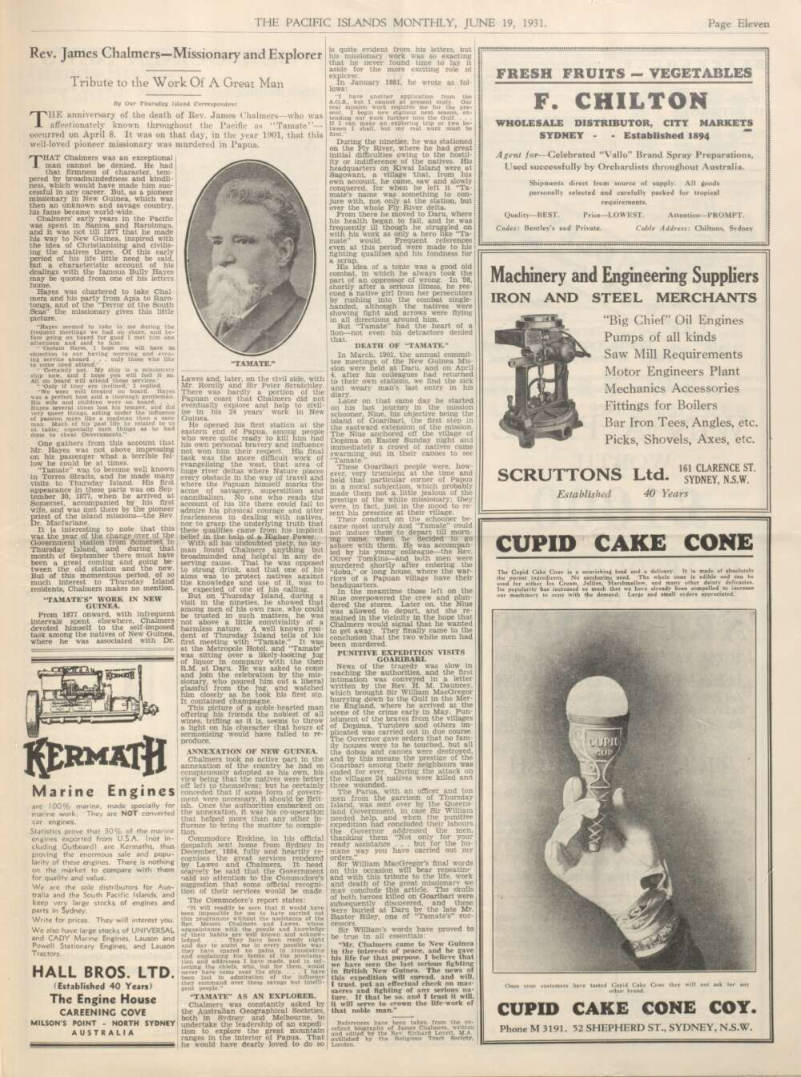
Tribute to the Work Of A Great Man
By Our Thursday Island Correspondent THE anniversary of the death of Rev. James Chalmers—who was affectionately known throughout the Pacific as “Tamate”— occurred on April 8. It was on that day, in the year 1901, that this well-loved pioneer missionary was murdered in Papua.
THAT Chalmers was an exceptional man cannot be denied. He had that firmness of character, tem pered by broadmindedness and kindli ness, which would have made him suc cessful in any career. But, as a pioneer missionary in New Guinea, which was then an unknown and savage country, his fame became world-wide.
Chalmers’ early years in the Pacific was spent in Samoa and Rarotonga, and it was not till 1877 that he made his way to New Guinea, inspired with the idea of Christianising and civilis ing the natives there. Of this early period of his life little need be said, but a characteristic account of his dealings with the famous Bully Hayes may be quoted from one of his letters home.
Hayes was chartered to take Chal mers and his party from Apia to Raro tonga, and of the “Terror of the South Seas” the missionary gives this little picture.
“Hayes seemed to take to me during the frequent meetings we had on shore, and be fore going on board for good I met him one afternoon and said to ham; “ ‘Captain Hayes, I hope you will have no objection to our having morning and even ing service aboard . . . only those who like to come need attend.’
“ ‘Certainly not. My ship is a missionary ship now, and I hope you will feel it so.
All on board will attend those services.’
“ ‘Only if they are inclined,’ I replied.
“We were well treated on board. Hayes was a perfect host and a thorough gentleman.
His wife and children were on board. . . .
Hayes several times lost his temper, and did very queer things, acting under the influence of passion more like a madman than a sane man. Much of his past life he related to us at table; especially such things as he had done to cheat Governments.”
One gathers from this account that Mr. Hayes was not above impressing on his passenger what a terrible fel low he could be at times.
“Tamate” was to become well known in Torres Straits, and he made many visits to Thursday Island. His first appearance in these parts was on Sep tember 30, 1877, when he arrived at Somerset, accompanied by his first wife, and was met there by the pioneer priest of the island missions—the Rev.
Dr. Macfarlane.
It is interesting to note that this was the year of the change-oyer of the Government station from Somerset to Thursday Island, and during that month of September there must have been a great coming and going be tween the old station and the new.
But of this momentous period, of so much interest to Thursday Island residents, Chalmers makes no mention.
“Tamate’S” Work In New
Guinea.
From 1877 onward, with infrequent intervals spent elsewhere, Chalmers devoted himself to the self-imposed task among the natives of New Guinea, where he was associated with Dr.
Lawes and, later, on the civil side, with Mr. Romily and Sir Peter Scratchley.
There was hardly a portion of the Papuan coast that Chalmers did not eventually explore and help to civil ise in his 24 years’ work in New Guinea.
He opened his first station at the eastern end of Papua, among people who were quite ready to kill him had his own personal bravery and influence not won him their respect. His final task was the more difficult work of evangelising the west, that area of huge river deltas where Nature places every obstacle in the way of travel and where the Papuan himself marks the acme of savagery, superstition and cannibalism. No one who reads the account of his life there could fail to admire his physical courage and utter fearlessness in dealing with natives, nor to grasp the underlying truth that these qualities came from his implicit belief in the help of a Higher Power.
With all his undoubted piety, no lay man found Chalmers anything but broadminded and helpful in any de serving cause. That he was opposed to strong drink, and that one of his aims was to protect natives against the knowledge and use of it, was to be expected of one of his calling.
But on Thursday Island, during a visit in the nineties, he showed that among men of his own race, who could be trusted in such matters, he was not above a little conviviality of a harmless nature. A well known resi dent of Thursday Island tells of his first meeting with “Tamate.” It was at the Metropole Hotel, and “Tamate” was sitting over a likely-looking jug of liquor in company with the then R.M. at Daru. He was asked to come and join the celebration by the mis sionary, who poured him out a liberal glassful from the jug, and watched him closely as he took his first sip.
It contained champagne.
This picture of a noble-hearted man offering his friends the noblest of all wines, trifling as it is, seems to throw a light on his character that hours of sermonising would have failed to re produce.
Annexation Of New Guinea.
Chalmers took no active part in the annexation of the country he had so conspicuously adopted as his own, his view being that the natives were better off left to themselves; but he certainly conceded that if some form of govern ment were necessary, it should be Brit ish. Once the authorities embarked on the annexation, it was his co-operation that helped more than any other in fluence to bring the matter to comple tion.
Commodore Erskine, in his official despatch sent home from Sydney in December, 1884, fully and heartily re cognises the great services rendered by Lawes and Chalmers. It heed scarcely be said that the Government naid no attention to the Commodore’s suggestion that some official recogni tion of their services would be made.
The Commodore’s report states: “It will readily be seen that it would have been impossible for me to have carried out this programme without the assistance of the Rev. Messrs. Chalmers and Lawes, whose acquaintance with the people and knowledge of their habits are well known and acknow ledged. . . . They have been ready night and day to assist me in every possible way: they have spared no pains in translating and explaining the terms of the proclama tion and addresses I have made, and in col lecting the chiefs, who, but for them, would never have come near the ship. ... I have been lost in admiration of the influence they command over these savage but intelli gent people.”
“Tamate” As An Explorer.
Chalmers was constantly asked by the Australian Geographical Societies, both in Sydney and Melbourne, to undertake the leadership of an expedi tion to explore the great mountain ranges in the interior of Papua. That he would have dearly loved to do so
is quite evident from his letters, but his missionary work was so exacting that he never found time to lay it aside for the more exciting role of explorer'.
In January 1881, he wrote as fol lows: “I have another application from the A.G.S., but I cannot at present reply. Our real mission work requires me for the pre sent. I begin new stations next season, ex tending our work further into the Gulf. . . .
If I can make an exploring trip or two be tween I shall, but my real work must be first.”
During the nineties, he was stationed on the Fly River, where he had great initial difficulties owing to the hostil ity or indifference of the natives. His headquarters on Kiwai Island were at Sagowani, a village that, from this own account, he came, saw and slowly conquered, for when he left it “Ta mate’s name was something to con jure with, not only at the station, but over the whole Fly River delta.
From there he moved to Daru, where his health began to fail, and he was frequently ill though he struggled on with his work as only a hero like “Ta mate” would. Frequent references even at this period were made to his fighting qualities and his fondness for a scrap.
His idea of a tonic was a good old combat, in which he always took the part of an oppressor of wrong. In ’98, shortly after a serious illness, he res cued a native girl from her persecutors by rushing into the combat single handed, although the natives were showing fight and arrows were flying in all directions around him.
But “Tamate” had the heart of a lion —not even his detractors denied that.
Death Of “Tamate.”
In March, 1901, the annual commit tee meetings of the New Guinea Mis sion were held at Daru, and on April 4, after his colleagues had returned to their own stations, we find the sick and weary man’s last entry in his diary.
Later on that same day he started on his last journey in the mission schooner, Niue, his objective being the island of Goaribari, the first step in the eastward extension of the mission.
The Niue anchored off the village of Dopima on Easter Sunday night and immediately a crowd of natives came swarming out in their canoes to see “Tamate.”
These Goaribari people were, how ever, very truculent at the time and held that particular corner of Papua in a moral subjection, which probably made them not a little jealous of the prestige of the white missionary; they were, in fact, just in the mood to re sent his presence at their village.
Their conduct on the schooner be came most unruly and “Tamate” could not induce them to depart till morn ing came, when he decided to go ashore with them. He was accompan ied by his young colleague—the Rev.
Oliver Tomkins —and both men were murdered shortly after entering the “dobu,” or long house, where the war riors of a Papuan village have their headquarters.
In the meantime those left on the Niue overpowered the crew and plun dered the stores. Later on, the Niue was allowed to depart, and she re mained in the vicinity in the hope that Chalmers would signal that he wanted to get away. They finally came to the conclusion that the two white men had been murdered.
Punitive Expedition Visits
Goaribari.
News of the tragedy was slow in reaching the authorities, and the first intimation was conveyed in a letter written by the Rev. H. M. Dauncey, which brought Sir William MacGregor hurrying down to the Gulf in the Mer rie England, where he arrived at the scene of the crime early in May. Pun ishment of the braves from the villages of Dopima, Turutere and others im plicated was carried out in due course.
The Governor gave orders that no fam ily houses were to be touched, but all the dobus and canoes were destroyed, and by this means the prestige of the Goaribari among their neighbours was ended for ever. During the attack on the villages 24 natives were killed and three wounded.
The Parua, with an officer and ten men from the garrison of Thursday Island, was sent over by the Queens land Government, in case Sir William needed help, and when the punitive expedition had concluded their labours the Governor addressed the men, thanking them “Not only for your ready assistance . . . but for the hu mane way you have carried out my orders.”
Sir William MacGregor’s final words on this occasion will bear repeating and with this tribute to the life, work and death of the great missionary we may conclude this article. The skulls of both heroes killed on Goaribari were subsequently discovered, and these were buried at Daru by the late Mr.
Baxter Riley, one of “Tamate’s” suc cessors.
Sir William’s words have proved to be true in all essentials: “Mr. Chalmers came to New Guinea in the interests of peace, and he gave his life for that purpose. I believe that we have seen the last serious fighting in British New Guinea. The news of this expedition will spread, and will.
I trust, put an effectual check on mas sacres and fighting of any serious na ture. If that be so. and I trust it will, it will serve to crown the life-work of that noble man.”
References have been taken from the ex cellent biography of James Chalmers, written and edited by the Rev. Richard Lovett. M.A. published by the Religious Tract Society, London.
“Tamate.”
Mr. T. Mclntosh, Ambulance Station, Wollongong, N.S.W., writes: “I am desirous of corresponding with some of your readers in the Islands who are interested in the collection of coins and stamps. Anyone sending either coins or stamps can rest assured that I will make a very liberal ex change.”
Advertisements & other items, pp. 11-12 (1 item)
Machinery and Engineering Suppliers
FRESH FRUITS VEGETABLES
F. CHILTON
WHOLESALE DISTRIBUTOR, CITY MARKETS
SYDNEY - - Established 1894 Agent for —Celebrated “Vallo” Brand Spray Preparations, Used successfully by Orchardists throughout Australia.
Shipments direct from source of supply. All goods personally selected and carefully packed for tropical requirements.
Quality—BEST. Price —LOWEST. Attention —PROMPT.
Codes : Bentley’s and Private. Cable Address : Chiltons, Sydney
Machinery and Engineering Suppliers
IRON AND STEEL MERCHANTS
“Big Chief” Oil Engines Pumps of all kinds Saw Mill Requirements Motor Engineers Plant Mechanics Accessories Fittings for Boilers Bar Iron Tees, Angles, etc.
Picks, Shovels, Axes, etc.
SCRUTTONS Ltd.
161 CLARENCE ST.
SYDNEY, N.S.W.
Established 40 Years
CUPID CAKE CONE
The Cupid Cake Cone is a nourishing food and a delicacy. It is made of absolutely the purest ingredients. No saccharine used. The whole cone is edible and can _be used for either Ice Cream, Jellies, Marshmallow, and many other dainty delicacies.
Its popularity has increased so much that we have already been compelled to increase our machinery to cope with the demand. Large and small orders appreciated.
Once your customers have tasted Cupid Cake Cone they will not ask for any other brand.
CUPID CAKE CONE COY.
Phone M 3X91. 52 SHEPHERD ST., SYDNEY, N.S.W.
Marine Engines
are 100% marine, made specially for marine work. They are NOT converted car engines.
Statistics prove that 30% of the marine engines exported from U.S.A. (not in cluding Outboard) are Kermaths, thus proving the enormous sale and popu larity of these engines. There is nothing on the market to compare with them for quality and value.
We are the sole distributors for Aus tralia and the South Pacific Islands, and keep very large stocks of engines and parts in Sydney.
Write for prices. They will interest you.
We also have large stocks of UNIVERSAL and CADY Marine Engines, Lauson and Powell Stationary Engines, and Lauson Tractors.
HALL BROS. LTD.
(Established 40 Years)
The Engine House
CAREENING COVE
MILSON’S POINT - NORTH SYDNEY
AUSTRALIA
BLACKLOCKS
R. E. FORSSBERC - Proprietor
Manufacturer’s Representative
381 PITT STREET - SYDNEY
Buying Agents for all requirements, at lowest prices, on commission basis.
Cable Address: “Diamondess” Sydney
HANDLEY & LAWS
Plantation and Mining Agents Manufacturers’ Representatives Company Local Agents and Public Officers
RABAUL - NEW GUINEA
Established Firm 1844. Oldest Tel. B 1732.
Our Motto: "Quality Counts.”
CANVAS GOODS MANUFACTURER
Manufacturer of: Sails, Marquees, Tents, Tarpaulins, Horse and Cow Rugs, Water Bags, etc. Flags of every description. Any Canvas, Calico or Bunting Goods upplied.
Australia.
Hirer of:
Marquees,
Tarpaulins, Stalls,
Chairs, Tables, Bunting and
Flags of every description.
WIN A PRIZE
WORTH
£1000
IN THE
DEAF DUMB and
BLIND CHILDRENS’
ART UNION
TOTAL VALUE OF PRIZES - - £2,200
Ist Prize—Diamond Necklace, valued at £1000
2nd Prize—Oakland 8 Sedan, valued at - £580 3rd Prize —Marquette Tourer, valued at £365 4th Prize —Ladies’ Complete Outfit - - £100 and 37 other Valuable Prizes.
TICKETS 1/- EACH
RESULTS OF DRAWING POSTED TO
EVERY SUBSCRIBER
This Art Union will be drawn under Police supervision on the Bth August, 1931, by which date all applications must be received in Sydney.
Send for a lucky ticket to-day !
Start your fortune on its way !
COUPON
Mr. E. LLOYD JONES,
Hon. Secretary, Deaf, Dumb and Blind (No. 5) Art Union,
Box 3908 TT., G.P.0., SYDNEY.
Dear Sir Enclosed is shillings, for tickets, and a stamped addressed envelope containing my name and address. Please send the tickets, and a result slip, when the Art Union is drawn.
Name Address (in full)
Preferential
Fiji's Kick
Australian Goods Pay Bigger Duty
Preference For Britain,
N. Z., And Canada
THE Legislative Council of Fiji, at its opening session on June 1, passed into law an amendment
of its Customs Tariff, which places
a definite and direct handicap
upon the importation into Fiji of
Australian goods.
Previously, the Fiji Customs tariff carried two rates—a British preference rate, which applied to the products of the British Empire generally, and a general rate. This tariff gave a pre ference of roughly 15 per cent, to the products of the British Empire.
Under the new law, the Fijian Gov ernment has created a new rate, so that its tariff now provides three dut ies—a rate for scheduled countries, a British preference rate and a general rate. Generally speaking, the rate for scheduled countries is 20 per cent, ad valorem, the British preference rate is 30 per cent, and the general rate is 40 per cent.
The “scheduled countries” are the United Kingdom, Canada, New Zea land and Hongkong.
The British preference rate applies, of course, to all other British countries.
Australia is excluded from the schedul ed countries and included simply as a British Dominion. Australian goods, therefore must pay the British prefer ence rate.
The items to which the new condi tions apply are as follows. Except where otherwise stated the percentage rate is ad valorem:
In regard to all other items the old tariff applies, in which Australia is on the same basis as other British coun tries.
But it will be seen that so far as the particular items enumerated above are concerned, the four scheduled countries have a preference over Australia, rang ing from 10 per cent., in the case of foodstuffs, to 20 and 25 per cent, in the case of liquors.
The new tariff, of course, has been framed as a direct retaliation against Australia, for Australia’s short-sighted policy in keeping out Fiji products, par ticularly bananas. Australia, in order to give “protection” of doubtful value to a comparatively few fruit growers, is now in danger of losing part of an extremely valuable market for her foodstuffs and manufactured articles.
It is net surprising—the only surpris ing thing is that Fiji has held its hand so long.
The next move is up to the Aus tralian Government. In the House of Representatives Mr. Browse recently directed the attention of the Attorney- General (Mr. Brennan), who at the time was representing the Prime Min ister, to the fact that the Fiji Gov ernment had excluded Australia from preferential treatment in regard to numerous articles. “Will the Minister,” he asked, “take steps to maintain trade with Fiji, and ascertain the causes which have led to the exclusion of the Commonwealth from preferential treatment?”
Mr. Brennan replied that the ques tion was one that should be dealt with by the Department of Markets and the Department of Trade and Customs.
He asked for notice of the question.
There the matter has rested.
Miss Lina Jones, of the New Zealand Methodist Missionary Society, arrived from the Solomon Islands by the last Mataram. She is on her way to the Dominion on furlough.
Article.
Rate for
Scheduled
Countries.
British
Preferential
Rate.
General
Rate.
Ale, beer, porter, cider, perry, hop and other beers when containing more than 2 per cent, proof spirit, in wood or jar, per gallon 4/- 5/- 6/- Ale, beer, porter, cider, perry, hop and other beers when containing more than 2 per cent, proof spirit bottled, per gallon 3/- 4/- 5/- Bacon and hams .. .. 20% 30% 40% Biscuits, plain .. .. 20% 30% 40% Biscuits, sweet .. .. 30% 30% 40% Bran 30% 30% 40% Cheese 20% 30% 40% Confectionery, per lb. 3d. 4'/ad. 6d. and in addition .. 10% 10% 25% Flax and hemp .. .. 20% 30% 40% Pish 20% 30% 40% Fruit, dried 20% 30% 40% Fruit, fresh Free 10% 20% Golden syrup, treacle 20% 30% 40% Grease, tallow, fat . . 10% 20% 35% Hay and chaff .. .. 20% 30% 40% Hops, per lb 9d.
V- 1/6 Jams, jellies 10% 20% 35% Lard, dripping . . .. 20% 30% 40% Pipes, earthenware .. 10% 20% 35% Soap, laundry, and soap, per lb sand- Id. 1 '/ad. 2d.
Soap, not otherwise enum. 20% 30% 40% Vegetables, fresh . . ..
Free 10% 20%
New Guinea News
Much Building Activity Round of Social Functions
From Our Own Correspondent.
Rabaul, June 4.
AFTER a period of slackness there appears to be fresh activity loom ing in the near future for build ing in and about Rabaul.
The Public Works Department are proceeding with their plans and speci fications for the native labour houses and other essential buildings in con nection with the proposed native lab our compound at Rapindik.
It is hoped that the Treasurer will be able to make sufficient money avail able to carry out this eminently desir able scheme.
New Premises For Rabaul
Club.
The Bay Loo Co. Ltd., the contrac tors for the new clubrooms for the Rabaul Club are pushing this work ahead rapidly and expect to have the work completed in about six weeks’ time.
The president and committee expect to hold their next annual meeting in the new rooms during June.
The cost of the new club rooms is nearly £4,000.
Other New Works.
There seems to be a consolidation and good grouping of buildings and proposed works taking place amongst the various business interests here, in stead of the scattered methods of the past. The Bay Loo Co. Ltd. have just completed a very fine bungalow as quarters for one of the married staff of the Vacuum Oil Co. Ltd. at their depot in Malaguna Road. In the past the Vacuum Oil Co.’s office was in por tion of the manager’s residence, and to give better control and supervision of the depot, complete new offices are being built. This company is also hav ing a new oil drum store built near the present depot.
Last year, owing to rapidly increas ing business in this territory, Messrs.
W. R. Carpenter & Co. Ltd. secured six hectares of land at Toboi, about 21 miles from Rabaul and on the other side of the harbour. This firm, at a cost of over £30,000, built their own wharf, which has a depth of 30 feet of water at low tide at the pier head.
A copra shed was built with a stor age capacity of 3,750 tons of copra, and 200 tons of fresh water is stored in tanks built alongside the shed. A new bungalow was built for the chief steve dore and concrete roads and ap proaches were put in.
A contract has now been let to ex tend the copra wharf an additional 40 feet, with two new dolphins. Two na tive labour houses, each capable of housing 100 boys, are also included in the new contract, and we understand the contract price for these additions is about £4,000. These new labour houses will be another step towards minimising the risk of assaults by na tives on white women, as it will mean another 200 natives removed from the town area of Rabaul.
Copra Exports.
Social Items.
On Friday, May 8, the Rabaul Swimming Club held a very successful first annual ball at the Rabaul Hotel.
His Honour, the Administrator, was present and presented trophies to the winners of events at the recent Championship Carnival.
A very enjoyable evening was spent and the guests did not disperse until the small hours of the morning.
On May 15 Mr. and Mrs. Cardew loaned their home for a dance, held to finance a new organ for the Church of England. This home particularly lends itself to a function of this nature, and the grounds had been tastefuly decorated and lighted. Great credit is due to Mrs. Cardew and her many lady friends for the organisation of such a successful function. His Honour the Adminis trator attended.
On Saturday, May 16. at the residence of His Honour Judge Phillips the old boys of the Associated Public Schools of Victoria held their third annual boat race dinner. His Honour the Administrator, His Honour Chief
Judge Wanliss, and Judge Phillips were pre sent. During the evening Judge Phillips spoke of the late Mr. E. V. Hayes, who had assisted so ably in the formation of the annual function, and those present joined in a tribute of respect to his memory. Mr. W.
L. Heron, as representative of the Melbourne Grammar School, hung his school badge on a pair of miniature oars, where it will re main until next year.
About nineteen of the bachelors of Rabaul gave a very brilliant ball on May 29 in the Regent Theatre, to which about 100 guests had been Invited. A most enjoyable evening was spent.
Namanula was very gay on the night of May 29, when a dinner party was given at the residence of Mr. and Mrs. J. A. Savage to celebrate the debut of their daughter, Miss Anne Savage, at the bachelors’ ball. Among the guests were Dr. and Mrs. T. C. Backhouse, Mr. and Mrs. G. G. Hogan, Mrs. E. T. Bren nan, Messrs. G. H. Roberts, H. D. Morton, R. P. Bell and P. A. George. After dinner the party proceeded to the Regent Theatre. Miss Savage wore a charming ankle length frock of white ninon, and a shell pink chiffon velvet wrap, trimmed with white fox fur. She carried an early Victorian posy of pink roses, frangipanni and gardenias. Mrs. Savage was gowned in a very distinctive frock of jade green chiffon velvet.
The staff of Messrs. W. R. Carpenter & Co. Ltd gave a complimentary dinner at the Rabaul Hotel on April 15 to Mr. and Mrs.
W. R. Carpenter and Mr. J. A. Carpenter, after which an adjournment was made for dancing to the recently opened W.R.C. club rooms. The usual toasts were honoured, and Messrs. W. R. and J. A. Carpenter proposed the health of their staff.
In an address to the staff Mr. J. A. Car penter made a very able speech on the neces sity of loyalty and team work in any large organisation, and made mention of the fact that in spite of the present conditions pre vailing throughout the world, it was the de clared policy of the firm that there should be no reductions in the salaries of their em ployees.
Mr. Holmes, the popular store manager re sponded.
1930. 1931, January . . . 7,937 tons; 5,882 tons February .. . .. 2,263 tons; 4,908 tons March . . . 2,263 tons; 5,528 tons Anril . .. 5.476 tons; 2,871 tons May .. , 6,702 tons; 2,250 tons
Norfolk Is. Trade
Figures For April
THE following comparative figures showing Norfolk Island trade for April, 1930, and April, 1931, are provided by courtesy of Capt. Stopp, Collector of Customs:
Month.
Imports.
Prom Australia.
From N.Z.
April, 1930 . . .. £2,612 10 0 Nil April, 1931 . . .. £1,365 5 0 £1,277 15 0
Exports.
Month.
To Australia.
To N.Z.
April, 1930 . . .. £2,697 5 0 Nil April, 1931 . £784 15 0 £1,485 10 0
Advertisements & other items, pp. 12-13 (1 item)
John L. Peadon Ltd.
Economical Chip
Heaters
Swan’s Chip Heaters are cheapest in every way, both in first cost and in upkeep. Hot water for bathing in stantly available at practically no expense or trouble. There is nothing to get out of order. No particular fuel to obtain. Ideal for Island conditions.
Galv. N.P. ease with which water is heated. Special attention to shipping orders.
SWANS LIMITED
410-412 ELIZABETH ST., SYDNEY
John L. Peadon Ltd.
Rabaul
TERRITORY OF NEW GUINEA
Engineers and Garage Proprietors
All Classes o£ General Engineering Undertaken
CARS FOR HIRE
Territory Agents for: Goodrich Products Clyde Batteries Berger’s Lacquers B.E.S. Plugs.
Ghas. Hope Ltd., Bris. Lamson Paragon Ltd., Printers ’Phone: 20.
Islands-Bred
Cattle
For Sale
The New Caledonian Meat Co.
Ltd., Mueo, New Caledonia, in vites applications for the purchase of Fat Cattle, on the hoof.
These Cattle, bred from New Caledonian herds, by stud bulls specially imported from Australia, are thoroughly acclimatised to Pacific Islands conditions. They are of medium size and provide high quality beef. They are emi nently suitable for stocking plan tations or pastoral areas in the South Sea Islands.
LIGHT HORSES
of good quality, suitable as
hacks, also For Sale.
For full particulars, apply to:
THE SECRETARY
W. Bruce Rainsford, F.C.A., Aust.
New Caledonian Meat Co.
Ltd.
350 GEORGE STREET,
SYDNEY
Or to F. Russell, Noumea, N. Caledonia.
-ECONOMISE-
You can have fresh cream
and butter every day with a
Diabolo Dairy
It is a Separator and Churn in one unit, viz.: Size 00.—Separates 10 gallons milk per hour. Churns 3 quarts cream.
PRICE £9
Size 0.. .Separates 15 gallons milk per hour. Churns 5 quarts cream.
PRICE £l3
Size I.—Separates 27 gallons milk per hour. Churns 9 quarts cream.
PRICE ... - £l5/10/-
5 PER CENT DISCOUNT FOR
CASH SETTLEMENT
We will supply either separator or churn separately on following prices :— Separator—Size 00 - - £5/15/- Separator—Size 0 - - £B/15/- Separator—Size 1 - - £lO/10/- Churn—Size 00-H - - £3/12/6 Churn—Size 0-A - - £4/10/- Churn —Size 1-H - - £5/10/-
5 PER CENT. DISCOUNT FOR
CASH SETTLEMENT
You save by purchasing the Dairy (Separator and Churn combined ).
Distributed by the Manufacturers:
Diabolo Separator Co.
LIMITED
305 Sussex Street, Sydney
G.P.O. Box 102 CC.
Notes From Fiji
Well-known Priest’s Tragic Death
From Our Own Correspondent.
Suva, May 22.
OP all priests in Fiji, few were more popular and better esteemed than the Rev. Father Trillot. He had been in the Colony for some 40 years and, besides being parish priest, was for some years principal of the Catholic Training College for catechists at Cawaci, on the Island of Ovalau. Some six years ago he was transferred to the Naiserelaig mission, on Viti Levu Bay. There he devoted his best endeav ours to encouraging his natives in agri culture and, as a result, he was able to place for two years agricultural exhibits in the Suva Show, which were generally regarded as the chief attrac tion, or nearly so.
The public was, therefore, greatly shocked to hear of his tragic death.
A native passing the house about 9 p.m. found him lying unconscious in flames on the verandah. The alarm was quickly raised and the body, which was badly charred, taken to a place of safety. In spite of the fearful burns life had not left his body and every effort was made to save him, but in vain. Ere passing away he was heard to whisper something, but his words could not be understood, and so he left behind him a mystery as to the cause of the mishap. He is believed to have been carrying a lamp when a heart attack caught him and, as he fell, the lamp broke and spread the flames around him. The Mission received the sympathy of all sections in its loss.
Zane Grey’S Visit
To the world wide army who have read Zane Grey’s novels, the chance of meeting the great novelist is one that appeals, and it was quite a gala day in Suva when his beautiful yacht Fisherman ran through the reef pas sage. She arrived on Sunday just as the shadows were creeping up over the mountains across the Bay, and pratique was not given until Monday morning. This was a job that had to be carefully done, as the yacht had come from Tonga, where the dreaded beetle lives and thrives. However, all was well, and on Monday morning the wharf was the centre of attraction for all races. The vessel is of 363 tons, commanded by a fine rotund deep-sea skipper, Captain Gunderson. The yacht has no sails and uses two large Deisel erigtnes, with two auxiliary engines for lighting and power. She carries no less than seven launches, all well en gined and models of efficiency. The two largest weigh each 7 tons, but can be launched within five minutes. The yacht is fitted with all sorts of gadgets and patents for making work easier.
The fittings are the last word in com fort and Grey’s cabin and study— where his two secretaries work —are hung with fine works of art, including some beautiful paintings of fish. The vessel carries a Japanese painter who is also a taxidermist, and he is kept busy adding to a large collection of rare fishes, caught during the voyage.
The visit to Fiji was not for fishing, but for refitting. The Fisherman is leaving for New Caledonia, then to Papua, then the Cocos Island (where Mr. Grey hopes for big fishing) then to Mauritius and Madegascar, and so on across to New Zealand for the big fishing season opening in January. The school children were shown over the deck fittings and launches, and His Excellency the Governor was enter tained on board during the week.
Later news concerning the Fisherman is that, for family reasons, Mr. Zane Grey has decided to go north, en route for home. He left on Tuesday after noon, for Pago Pago, and after that may proceed to the Paumotus, where good fishing is expected. The course may then be to Mexico and home to San Francisco.
The Fiji “Bisley”
The Fiji “Bisley” has recently fin ished, after a most successful gather ing. The chief feature was the fine shooting and the good spirit of sports manship shown throughout the meet ing. All sections —European, Fijian and Indian —proved themselves brothers of the range in every sense. The chief event, of course, was “The Fiji King’s.” the conditions including shooting at 200, 300, 500 and 600 yards. The prize went to Lieut. Hollins Crompton, who scored 192 out of a possible of 200. The winner is a successful young barrister and the son of Mr. R. Crompton, K.C., C.B.E., who donated the handsome cup which is the main prize, although the Government added £20 to the winner’s trophy. The shooting was very good in this event. At 200 yards, no less than four made the “possible.” At the last range five men had only two points between them, namely H. Crompton.
H. Lucena, W. Wilder, W. Butler and R. Christoffersen. Perhaps the most exciting event, outside “The Kine’s” was the “Revolver-deliberate.” In this Crompton. Christoffersen and R. B.
Roberts tied with 88, using a service 45. In shooting off Crompton and Chris toffersen again tied and even when they made yet another attempt the points remained equal. Finally they divided the prize.
H. Lucena won the “Aggregate” and D. Ewins the “Rifle,” and W. Beddoes the “Revolver-snap,” and he won with
8 hits on the moving target. The Nandi team won the “Marks Tiles.”
His Excellency, the Governor, pre sented the trophies on the Sunday afternoon, on the Parade Ground, in the presence of a number of interested spectators of both sexes and all races.
Personal
A number of visitors from overseas have recently arrived, many of them being distinguished scientists. Fiji is attracting the scientists for several reasons, the chief being probably the interesting question of race origin and migration. The most recent visitor is Dr. D. S. Davidson, a noted American anthropologist, who is passing through after spending some considerable time among the Australian aboriginals and who is anxious to know something about the Polynesian. He is securing skulls and other evidences of the race for future study. For this purpose he has been visiting several of the oldest and most warlike strongholds of the past, trying to obtain as much first hand evidence as possible.
Lady Braddon, wife of Sir Henry Braddon, of Sydney, arrived by the Sierra. Mrs. Morris’ visit on this occa Pacific Hotel, where she has been cor dially welcomed by local ladies. It is reported that she may remain here over the winter months —those delight ful months when Suva is at its very best.
Mrs. P. A. Morris, wife of Mr. P. A.
Morris, the Sydney director of Morris, Hedstrom Ltd., also came by the Sierra. Mrs. Morris’ visit on this occa sion is saddened by the fact that since she was here last her sister, Lady Hed strom, has passed away.
A notable arrival was the Hon. A. W.
Seymour, Colonial Secretary, with his wife and family. They have been on vacation and it was understood that Mr. Seymour was not returning to the Colony. His place was filled during his absence, by the Hon. Islay Mc Owan, C.M.G., who returns to his sub stantive post of Secretary of Native Affairs.
Sir George Fuller and Lady Fuller renewed acquaintance with friends in Suva during the short stay of the Aorangi, in which they were returning to their home in New South Wales, after a strenuous three years’ stay in London. Sir George was Agent-General for the Mother State. Both looked re markably well.
The many friends of Mr. Sam E.
Ellis, M.B.E., the well known Suva Soli citor, will be glad to know that he is recovering after a long illness and hopes to be again seen in his office be fore long. Mr. Ellis is President of the Returned Sailors and Soldiers’ Associ ation of Fiji.
His Excellency, the Governor, has a strenuous time. He is most attentive to his public duties and shows a charm ing impartiality to all races, treating them alike in connection with their racial functions. The last occasion was his appearance at the opening of the soccer competition, on Saturday last, of the Indian League Association. There was a large attendance and His Excel lency presented a Challenge Cup for the comnetition, which includes five clubs. The Indian lads have taken to the game with great zest and if their science is a little “thin” at times, their zeal leaves no cause for reproach.
A rather unusual visitor is Zimmy, wonderful man with no legs, who is so strong a swimmer. His progress through the streets is like a royal progress, the natives being particularly struck with wonder as to how he can get along.
He is giving displays of swimming in the Municipal Baths and proposes to try to secure the world’s record in en durance swimming. The Suva Baths, according to Arne Borg, who made his 660 yards record here, are specially suited to such record efforts, as the sea water is much more buoyant than in cooler countries.
Gloomy View Of Copra
Position
MAJOR F. R. HEWITT, manager of Lever’s Pacific Plantations Ltd., in the Solomon Islands, considers the condition of the Pacific copra trade practically hopeless, according to an interview recently published in The Sydney Morning Herald.
Major Hewitt, who has been in the Islands for over 20 years, said that there had been a steady decline in the copra trade during the past four years and at the present time many of the smaller traders were unable to carry on operations.
He thought that some help might be given to the copra trade if greater capital was introduced.
The new mission schooner. John Wil liams, will visit Sydney next year, ac cording to Mr. “Tom” Bowling, mate of the old John Williams, who returned to Sydney by the Ventura on June 11, after six months on the new ship as pilot. The new John Williams is even a better seaboat than her predecessor, according to Mr. Bowling.
Cocoa Seeds Wanted
For Trial on Thursday Island
From Our Own Correspondent.
Thursday Is., May 30.
An enthusiast here the other day asked where he could obtain a few cocoa seeds for trial, though he was warned that both climate and soil were unsuitable. Could any reader supply a few seeds per medium of the Editor?
There is no danger of starting any serious competition in this part of the world.
Some years ago a titled Londoner, writing out to a friend on Thursday Island asked, “What do you DO on Thursday Island? Is it cocoa?”
Apparently he had never heard of pearl shell!
Advertisements & other items, pp. 13-14 (1 item)
Harry West
STOP IT
BEFORE IT GETS
STARTED!
PINK
POWDERS
K TABLETS
1/6 8 C 2/6
THE COLONY OF FIJI
For information regarding Fiji read the “Fiji Handbook,” an official publication, beautifully illustrated. Obtainable from: The Government Printer, Suva, Fiji; Dalgety & Co. Ltd., Sydney; L. D.
Nathan & Co. Ltd., Auckland. Price: Cloth board, 6/-; paper cover, 4/-.
BE WISE! - - - SAVE THE RATE OF EXCHANGE.
ORDER YOUR SAILS NOW
From
HARRY WEST
SYDNEY’S SAILMAKER
Sail Makers for 26 years.
Tarpaulins specially made for tropical climates.
Let next Spring find this part of your equipment ready. Have West make your Sails, Awnings and Upholstery. Tents and every class of canvas work a speciality. If it’s in canvas, rope or wire, we make it to any specification.
FOOT DUKE STREET - - - BALMAIN EAST ’Phone W 1 105
What Are Your Needs?
We have the following high
grade products, carrying the
reputation of this old-estab lished English Firm; —
POWDER SHEEP DIP.—
For the destruction parasites on sheep. of external Cattle Dip - for the destruction of Cattle Ticks. Also Lice and Mange on Cattle and Horses. for
MILK OIL FLUID.—
For general disinfection of premises, Shins, Launches, etc.
HEALING OIL.—
For the antiseptic treatment of cuts, wounds, etc. on humans and animals.
ARSINETTE.—
For the destruction of all leaf-eating insects infesting trees and plants.
KATAKILLA.—
For the destruction of all sucking insects infesting trees and plants.
ALBOLEUM.—
For the destruction of all Scale insects infesting trees and plants.
A non-poisonous dusting Powder for the destruction PUL VEX.— of Fleas, Lice and other parasites on Dogs, Cats, Poultry, etc.
KUR-MANGE.—
For curing parasitic Mange and Skin diseases in Dogs, Horses, etc.
FLY KILLER. For killing House Flies and Mosquitos.
For removing and preventing rust, BOILER COMPOUND.— scale and corrosion in boiler pipes, etc.
Enquiries in respect of the above are invited from Planters, Cattle Owners, Storekeepers and all Island Residents.
William Cooper & Nephews (Australia)
Limited
4 O’CONNELL STREET - - SYDNEY
ZERVON
PAIN POWDERS
are a wonderful
PAIN KILLER
safe, sure, speedy.
TRY THEM FOR
DENGUE and MALARIA
I- \'9 and 2'6 a box all chemists, or post free from
LOFBERGS PHARMACY.
'ROCKDALE'
N.S.W
Be Able to Fight
Fires with
Chemicals
SRB
YOUR
surest Protection
“SIMPLEX”
or
“PYROFOAM”
Chemical Fire Extinguishers will put out any Are. They are always ready—instant in action—easy to operate quickly re-charged more potent than water yet non-damaging.
Prices from £2/10/- F.O.B. Sydney Used and recommended by the Australian Government, Insurance Companies, etc.
Send now for full details Wormald Bros. Ltd.
Fire Protection Engineers since 1889 Young Street, Waterloo, Sydney (Agents please enauire)
Norfolk Island
M. B. Blake, Builder
PLANS DRAWN AND ANY TYPE
OF BUILDING ERECTED
All Building Material Imported.
Large, Well Equipped First-class Joinery and turned out.
Workshop.
Furniture
SHIPCHANDLERY
W. Kopsen & Co. Limited
Manufacturers of PIONEER BRAND ASH OARS AND IMPLEMENT HANDLES.
Sole Agents for: KOPSEN'S SPECIAL YELLOW METAL SHEATHING AND NAILS.
Large stocks of Chains, Anchors, Manilla and Wire Ropes, Wood and Iron Blocks, Oakum, Tar, Pitch, Oils, Paints, Leads, Zincs, Varnishes.
Shackles, Rigging, Screws, Sheathing, Felt, Lampware, etc.
Prices and Particulars on Application.
68-70 CLARENCE ST., SYDNEY
Cables: “Kopsen” ’Phone: BW 1114-5
Have Teeth by Post
If you are unable to visit Sydney, I can make you comfortable, natural and long lasting teeth by means of my well known method of “Self Taken Impressions.” Cut out this advertisement, attach your name and address and post to me for full particulars.
Painless extractions. Reliable fillings. Gold crowns and comfortable and lasting plate work.
SPENCER NOLAN, Dentist
28 OXFORD ST., over Winns; 177 OXFORD ST., opposite Mcllraths; 139 ELIZABETH ST., two doors from Market St., Sydney.
Beam Wireless and Cable Address: “Fastplate,” Sydney. P.I.M.
McILRATH’S Ltd.
EXPORTERS OF GROCERIES, PROVISIONS AND
GENERAL STORES
“OUR PRICES GIVE EXTRA POCKET HELP”
Write for Export Price List and Quotations 202 pitt street .
WJL JLI Ok JtA M, AS 9 SYDNEY, AUSTRALIA
News from Norfolk Island
Improved Shipping Service —Influx of Settlers and Tourists Expected —Hopeful Future
From Our Own Correspondent
Norfolk Island, June 1.
WELL! The Morinda is coming on our run at last —her first sailing scheduled for June 25—and not only are we to see her regularly at Norfolk Island, but, every alternate trip, she is to continue on to Auckland, New Zealand, returning thence, we trust, loaded to the gunwales with hope ful and anticipatory visitors.
Settlers, too, are coming to Norfolk.
Mr. Blake, our most prominent builder, tells me that he has been so inundated with demands for plantations and pro perties that he has taken a partner and is extending his business to in clude a land and estate agency.
He assures me that these are not the airy and unsubstantial inquiries with which all residents of desirable tropic isles are familiar; written, ap parently, by dreamers and idlers who, with no real intention of emigration, but with spare time and a pen in their hands, decide that they might just as well write to some obliging stranger and amuse themselves thereafter with building up a fanciful existence based upon information received. Nor do they come from romantically minded dead-beats who see themselves magic ally transported to a lotus land where life is one grand, sweet song and where beneath our non-existent coconut palms they shall dream their days away—living and loving without money and without price.
No, these are solid citizens who, thwarted hitherto for want of trans port and with months in which to make up their minds while their home land trembled beneath their feet, are firmly decided to realise their local investments and come away to where our little isle stands stable in the sea; where the sun shines all the year round, the rains come in their appointed sea son, and there is time for play as well as for work.
Vale, Makambo
And more yet. Not only is the Morinda coming, but the Makambo is going. We can hardly believe it, but
the timetable, drawn up and distri buted, guarantees that it is a solid fact.
So many times have we been assured that after a specific date her smoke would cease to blot our sky; so many times . . . again and again and end lessly ... have we been constrained to accept her for a further period, that we had begun to consider her an unalterable fact or phenomenon of nature; destined to rise and set upon us as inevitably as dawn and dark But she is going. The New Hebrides have already waved a glad farewell and after this very next passage to Norfolk we shall also, for the last time, see her sink into the west with the setting sun. And then, so contrary is the human heart, it is quite likely there will be found many who say with a sigh, “Well, there goes the old Mak
ambo, she wasn’t a bad old ship, after all, and we shall be lucky if the Morinda serves us as well.” But they won’t really mean it, and we wouldn’t really have her back on any consideration.
Golfing Facilities.
We are busy making a second golf course, situated in the centre of the island, in “Nobbs’ Paddock,” where our recent race meetings took place. Its possibilities struck the eye of golf en thusiasts on that occasion and arrangements were made almost instantly to take it over.
It will relieve the conges tion at the Kingston course, where there are already nearly 100 members, all playing on the same two days a week, and will prove an additional attraction for
the boarding houses nearby. Over 50 members are already enrolled, more are coming in every day, and a magni ficent opening is anticipated on King’s Birthday, June 3.
Theatrical Entertainment
On June 23 (the birthday of the Prince of Wales) Mr. Jarvis, our young English actor, is presenting “The Ghost Upstairs,” a thriller written and acted all over Australia by Leon Gordon, who is now writing scenarios in Holly wood.
Mr. Jarvis was in Gordon’s com pany for 18 months and became so well acquainted with the play that, failing to obtain the script in time, he was able to write it out from memory.
A big house is certain.
Maopa Missing
Believed Wrecked Near Labasa
’Plane Search Fails
THE auxiliary ketch, Maopa, owned by Burns, Philp (South Sea) Co.
Ltd., which sailed from Labasa, Fiji, on May 13 for Lautoka, loaded with a cargo of logs, is reported miss ing.
The trip between these ports should have occupied about two days, but, so far no sign of the vessel, crew or cargo has been seen, except that at the end of last month, Captain Giblin, of the Yasawas, reported that one of his “boys” had found a drum of fuel oil and a gallon tin of lubricant, the brands of which were the same as those carried by the missing vessel.
A search by Captain Fenton, in his ’plane, along the various coastlines and over all northern reefs, has failed to reveal any trace of the wreckage or the ketch.
The personnel of the Maopa is Cap tain Anasa, with six Fijians, and one European, Mr. Swann, the engineer.
The ketch recently came down from the Solomon Islands under Captain Culloden, who had the most difficult task of bringing her to Fiji owing to bad weather, which smashed the bul warks and broke the topmast, necessi tating a return to Tulagi. Later she was forced to shelter under Tanna, and then run into Port Vila. Besides, this, owing to a leak, the tank caught fire and nearly ended things for all; only the plucky conduct of the engineer and all hands saved the boat on that occa sion.
It is now believed that the Maopa has foundered, as she had very heavy seas after leaving Labasa, with a semi gale. Logs are an awkward cargo to handle in rough weather.
Two missionaries, recently from the New Hebrides, told the Sydney press of tribal customs still practised on Malekula. These include the burying of children alive and cannibalism. Mo thers frankly admitted that they had killed their children by burying them alive when they became a nuisance.
The missionaries discovered that canni balism. which was involved in the tra ditional rites of tribes was also prac tised, though it was confined to a few occasions when there was no white surveillance.
In Eastern
Polynesia
Tahiti Feels the Copra Slump
Papeete, May 21
THE arrival of the United States cruiser, Chicago, on May 11, created somewhat of a stir in Papeete. She is the latest thing in war vessels and is now on her maiden voy age, during which many new features will be subjected to observation and experiment. She carries a complement of about 750 officers and men, also four planes, which, for some unknown rea son, were not permitted to fly and provide the expected treat for native inhabitants.
During the five days of the Chicago’s stay in port, Papeete recovered some thing of its erstwhile gaiety. The nat ives flocked into town from outlying districts and entered whole-heartedly into the prevailing mood of enjoyment,
which they invariably seem capable of doing in spite of hard times. Perhaps the most enjoyable of all the entertain marked upon the good behaviour of was the open air “bal publique” organ ised by the municipality of Papeete.
This commenced at about 8 p.m. and ended up, in true Papeete style, with wreaths and coffee at the morning market.
Though Tahiti is a wide-open place in the matter of liquor, everyone re marked upon the godo behaviour of the American “Gobs” ashore; indeed a case of downright drunkenness was extremely rare during the whole of their stay here. I fancy that our visitors will not easily forget the good time they had in Papeete, while, for our part, we have seldom had occasion to regret the departure of a visiting warship as sincerely as we do this one.
Low Copra Prices Cause Slump
A deadly dullness reigns along the Papeete waterfront, consequent ppon another drop in copra values. To-day’s price is 60 centimes per kilo on the beach, the equivalent of a little less than a £5 note per ton. Such a situ ation has been scarcely known before since copra entered the world’s mar kets as a stable commodity.
The Tahiti producers have been al ways fortunate in being able to sell locally at round £5 to £6 per ton below the London price, which left little or no margin for the merchants who took all the risk of weight shrinkage and price fluctuations. In fact, the buying of copra here has been so keen right along that the planters probably get a more favourable deal in Tahiti than in any other part of the Pacific. Out side islands with another freight to pay before their copra can reach the main lines of communication, must surely be in a bad way just now.
Prominent individuals interested in Island economics, as well as the Gov ernment, are greatly concerned over this copra situation, as indeed they may well be, seeing that everything here is practically dependent upon this one article of commerce. But no alternative crop has been yet discov ered that can be produced and ex ported at a profit. Obviously, with land values as high as they are in these islands, and labour charges four to eight times as much as in other tropical countries, we can scarcely hope to compete successfully on the world’s markets with places like Africa, India and Ceylon. New Zealand places a heavy duty against French fruit, and America will not allow it in at any price, so there is no chance whatever of a fruit industry being developed.
Tahiti’S Tourist Attractions
But Tahiti has some assets of greater potential value from an economic standpoint than its output of tropical products. It possesses a superb cli mate—for a tropical one the best in the world—is inhabited by a race of neople who are ready at any minute to drop whatever they may be en gaged upon and go skylarking, and can show an unequalled range of gorgeous and colourful scenery.
These are the assets that should be exploited if it is desired to improve our conditions in an economic sense.
But whether we should be any hanpier with thousands of tourists on the beach is an open question.
A party crossing: the Karawot River, New Britain, on the way to the Baining Mountains.
Block by courtesy of The Mission Review.
Morris Hedstrom Ltd.
Last Year’s Profit Company’s Internal Strength
THE net profit made by Messrs.
Morris Hedstrom Ltd., of Fiji, Samoa and Tonga, for the year ended March 31 last, was £49,141; which, considering the circumstances, compares very favourably with £70,375 in 1930, and £73,661 in 1929.
The ordinary dividend has been reduc ed from 8 to 6 per cent.
Balance sheet figures show the wis dom with which this big trading con cern is conducted. £41,025 of distribut able funds was brought forward from last year, so that the 8 per cent, rate could have been maintained without a strain. Instead, the dividend is re duced, and £45,789 is carried into the current year’s account. Further, the directors are taking £20,000 out of the healthy general reserve (which had been built up to £100,000) and using it to write about 221 per cent, off the book
value of plantations (£89,051). This is in addition to £15,000 written off last year.
The company’s chief liabilities are £740,000 of capital (£219,000 prefer ence), £47,868 to the banks (down by £20,000 compared with last year), £30,500 due to depositors, and £20,090 due to creditors. The main assets com prise plantations £89,051; lands and buildings £267,857; merchandise £173,246 (down £24 000 compared with 1930, and £63,000 compared with 1929); produce £55,243 (about half of what it was in 1929); due by branches and sub sidiary companies £142,233 (down by £20,000 compared with last year); deb tors £105,748; and shares and mort gages £205,154. Amounts due by debtors have grown by £17,000 in the year— obviously, signs of the time through which we are passing.
Sir Maynard Hedstrom, in address ing shareholders at the annual meet ing at Suva, alluding to the economic situation, said that in March, 1928, the company sold South Sea sun-dried cop ra in bags on the Continental market at £27 per ton; in March, 1929, similar quality at £22/10/- per ton; in March, 1930, £20/15/- per ton; and in March, 1931, at £14/15/- per ton. Since then the price had reached lower levels. In 1929 the copra exported from Fiji amounted to 33,226 tons; in 1930 the export amounted to 23,882 tons; in 1931, owing to damage done by hurricanes, it is expected that the export will be less than 20,000 tons.
Prospects for the coming year, he said, were not very favourable the spending power of the copra districts had been greatly reduced both by the smaller production and the substan tial reduction in the market value. In the sugar districts the crop had been reduced, but the Colonial Sugar Refin ing Co. Ltd. had maintained the for mer price for the raw product, so that the effect of the low prices ruling for the manufactured article had not been felt by the primary producer.
It is reported that no less than 800 letters were received recently in Aus tralia in response to an advertisement for a married couple to run the Club at Kavieng. in New Guinea.
Advertisements & other items, p. 14 (1 item)
Engines
BEECRAFT
HEAVY DUTY
5 and 10 h.p.
MEDIUM SPEED
3-4 h.p.
W. R. BEECRAFT
THE SPIT
MOSMAN - N.S.W.
Products Of The South Seas
Why Copra Has Fallen to £10-5-0 Per Ton
THE fall in the price of copra dur ing the month to the unpreceden ted rate of £10/5/- per ton, c.i.f.
London, has left all students of the market dumb and numb. When copra was around £13 and £14 per ton, the best-informed market operators declar ed that that was rock bottom—and this seemed a reasonable assumption.
But, apparently, the dominating ele ments of the situation were two namely, the power of the Unilever combine and the tremendous flood of whale oil, which has been poured upon the market during the past 12 months.
Whale oil has been selling at a price definitely below production cost; new chemical processes and discoveries have permitted whale oil to be used in increasingly numerous directions as a substitute for coconut oil; and Uni lever, controlling so large a portion of the world’s demand, has been deter mined, apparently, to get the fullest possible commercial advantage out of an extraordinary situation.
In the May issue of this journal there were published figures which have a direct bearing upon the pre sent position. It was shown that the cost of producing refined coconut oil from copra is £15 per ton; while the cost of reducing raw whale oil to a refined and deodorised oil is £6 per ton. Whale oil has been thrown on the market at £15 per ton or less therefore the estimated cost of the re fined product is £21 per ton. When the cost of copra was £14 ner ton, the cost of refined coconut oil, with the cost of refining (£15) added, was £29 per ton, less whatever amount could be received from the sale of the cake by product. Assuming that the value of the cake is now £4 per ton, it is obvi ous that refined whale oil at £21 per ton has an advantage of £4 or £5 ner ton over refined coconut oil, with copra at £14 per ton and cake at £4.
On this assumption, the course of events seems fairly clear. Unilever has thrown the price of copra back to £10 per ton, so that the price of the refined coconut oil is now practically level with the price of refined whale oil. We sug gested in our last issue that the dan ger to copra producers of the recent
terrific production of Antarctic whale oil could not be exaggerated.
The latest quotation from London for copra shows a recovery in the price of about £1 per ton. Our private ad vices from London are to the effect that this is not a true indication of the position it is merely a nominal quotation, the result of small opera tions by speculators. The European market, we are informed, is “absolutely dead’’ for the present.
The outlook is blue. It is no use dis guising the fact that the position has never been worse. In a search through the records of half a century, we find that the lowest previous European quotation for copra was £12/13/9 per ton in 1897. The combination of un favourable factors, described in our issues of March, April and May, have been too strong for the producers, and have taken control of the market for the present.
But the situation, while bad, is not hopeless, as some Sydney observers are inclined to suggest. The law of sup ply and demand will certainly operate presently in favour of copra producers.
There has been a tremendous reduc tion in the Antarctic whale-catching enterprises; and all over the world pro ducers of oil-seeds are restricting op erations. Certainly, inevitably, the overproduction of oil-bearing sub stances will be reduced. Somewhere about the same time the world will recover from its economic sickness and will be able to resume normal con sumption of the hundred and one things in which refined oil is used.
The pendulum will swing again in the opposite direction to that of 1930-31, and producers will benefit accordingly.
In the meantime, it is simply a ques tion of hanging on. Plantation owners are faced with a lean time there is no getting away from that. But they would be foolish to give up. They must cut costs to the bone, exercise every possible economy and just hang on and keep a bright lookout for signs of re covery. They will not come immediate ly but neither will they be too long delayed. Meanwhile, they will be wise to take steps to bring all capital valu ations, based on copra at anything over £20 per ton. down by 20 to 25 per cent., at least.
Sharemarket
New Guinea And Papuan Gold
Activities of the Companies
RESTRICTED business has been been done of late in shares in New Guinea and Papuan gold companies listed on the Sydney Stock Exchange.
Placer Development Ltd. has been one of the few companies to receive attention. The price of these shares has strengthened until, at present, buyers are offering £4/8/6, with sellers at £4/10/-. The splendid progress be ing made by the big ’planes in trans porting the dredging equipment of Placer’s subsidiary Bulolo Gold Dredging Ltd.—from Lae to the field must be very gratifying to share holders.
Guinea Gold shares have been also attracting attention and have advanc ed in price. Sellers are now asking £1/19/-. The position in connection with this company’s leases is explained in the directors’ half-yearly report, which is published below.
The shares of New Guinea Goldfields Ltd., which are not listed on the Stock Exchange, were unofficially quoted on June 4 at buyer 4/8, seller 4/9. The company is still continuing with its de velopment work There is little enquiry for New Guinea Development shares. The di rectors have announced that the en gineers representing Canadian mining interests have relinquished the option over the company’s leases.
Guinea Gold’S Half Yearly
Report.
With the disposal of the company’s im portant leaseholds in New Guinea, write direc tors of Guinea Gold N.L., in their half-yearly
report, it now remains to receive the balance of proceeds in cash and shares from Bulolo Gold Dredging Ltd., due six months after dredging begins. As that company is confi dent that in less than a year it will be actively producing gold on the Bulolo flats, shareholders may expect that during 1932 Guinea Gold will be in a position to make further distributions to members from these proceeds.
“If the operating company continues with its programme at the present satisfactory rate,” states the report, “there is little doubt that the shareholding in that company to be received by Guinea Gold on behalf of its shareholders will soon become a valuable in vestment.”
The final details In connection with the completion of the purchase of the Northern leases on the Bulolo River are now the sub ject of negotiation with Placer Development Ltd. In August, 1930, a distribution of 10/per share was made, absorbing £25,000 of the first instalment of cash consideration.
The directors anticipate that next year will witness the inauguration of a long period of increasing gold production by the principal operating companies in New Guinea. After active prospecting and writing off in full the cost of the search for gold-bearing properties, the accounts for the year ended February 28 show a nominal loss of £115. Of the pro positions put before the board during the year, only three were considered worthy of preliminary examination. One of these, in New South Wales, is now being examined by a mining engineer. The other two, in Queensland and New Guinea, were rejected on expert advice. The net loss reduced the accumulated credit balance to £5,158, which is carried forward. Capital is £50,000, and reserve £27,906. Of total assets of £83,216, £81,200 is the net balance of purchase con sideration receivable for the sale of Guinea Gold South and Central leases.
The following table shows the price
on June 12 of shares in New Guinea
and Papuan gold companies listed on
the Sydney Stock Exchange.
Authorised Shares Issued. Price. June 12
Company
Capital
Number.
Amount Paid Up.
Buyer.
Seller. £ £ s. d £ s. d. £ s, d. £ s. d.
Akmana New Guinea. N.L pd. 30,000 140.000 0 1 0 0 1 0 Akmana New Guinea, N.L ctg. 360,000 0 1 0 0 0 7
Bulolo, N.L
ctg. 25,000 150.000 0 2 0 0 0 6 Guinea Gold. N.L. . 50.000 50.000 1 0 0 i 0 0 — 1 19 0
Mt. Kaindi, NX. . .
pd. 50.000 90,000 0 4 0 0 4 0 Mt. Kaindi, N.L ctg. 160,000 0 4 0 0 0 10 Mt. Lawson (N.G. >, N.L pd. 17.500 18,000 0 2 6 0 2 6 Mt. Lawson (N.G.i, N.L ctg. 102,000 0 3 6 0 2 3 — Mt. Lawson Blks, (N.G.I, N.L. pd. 48,000 80,000 0 4 0 0 4 0 — Mt, Lawson Blks. (N.G.I. N.L ctg. 140,000 0 4 0 0 1 0 — — Mt. Lawson Extended N.L pd. 48,000 80,000 0 4 0 0 4 0 —
Mt. Lawson Extended, N.L. . .
Ctg. 140,000 0 4 0 0 1 0 — — Mt. Sisa, N.L, . . pd. 70,000 120,000 0 4 0 0 4 0 — — Mt. Sisa. N.L. , ctg. 190,000 0 4 0 0 1 9 — 0 0 9 New G. Development, N.L pd. 40,000 110,000 0 1 0 0 1 0 — — New G. Development. N.L. . . . etc. 510.000 0 1 0 0 1 0 — — N.G. Gold Deposits, N.L pd. 20.000 20.000 p 2 6 0 2 6 — — N.O. Gold Deposits, N.L. ctg. 100,000 0 2 6 0 1 9 — — N.O. Gold & Osmlrldlum. N.L. 10,000 80,000 0 2 6 0 2 6 — — New Guinea Options. N.L pd. 50,000 50.000 0 2 0 0 2 0 — — New Guinea Options, N.L.
'’t*. 279.000 0 2 0 0 0 7 — North East New G , NT.. nd. 50.000 90,000 0 4 0 0 4 0 — — North East New G. N L ctg. 140,000 0 4 0 0 0 10 >4 — Oba River (Papua), NT, pd. 25,000 40.000 0 2 6 0 2 6 — — Oba River (Papua), N.L ctg. 140,000 0 2 6 0 1 0 — — Orlomo Exploration Ltd 12,000 48.000 0 5 0 0 5 0 0 1 9 0 2 6 Papuan Gold Areas, N.L Dd. 18,750 40,000 0 2 6 0 2 6 — —
Papuan Gold Areas. N.L . .
ctg. 100.000 0 2 6 0 0 10 — — Placer Develonment LM 8*00.00 70.000 $5 00 $5 00 4 8 6 4 10 C Sloane’s New Guinea. NX pd. 25,000 25,000 0 2 0 0 2 0 3 0 1 0 0 6 Sloane's New Guinea, N.L ctg. 200.000 0 2 0 0 0 8 — — Solomon Islands Gold, N.L . pd. 26,000 20.000 0 2 6 0 2 8 — Solomon Islands Gold. N.L. .. ctg. 120,000 0 2 6 0 1 0 — —
Market Quotations
Range of Prices
The Pacific Islands Monthly makes a close check of the prices quoted for Islands pro duce; and it regularly publishes the range of prices during each month, including the last available quotation before going to press.
London February 13
Copra
South Sea, Sun-Dried Per ton c.t.L 14 5 0 Plantation, Sun-Dried, Rabaul Per ton c.i.f. 14 7 6 February 20 . . 14 10 0 14 12 6 February 27 .. 14 12 6 14 17 6 March 6 .. 14 17 6 15 0 0 March 13 14 17 6 15 2 6 March 20 .. 14 17 6 15 0 0 March 27 14 10 0 14 12 6 April 3 14 10 0 14 12 6 April 10 ,. 14 7 6 14 10 0 April 17 . . 14 5 0 14 7 6 April 24 13 15 0 13 17 6 May 1 13 10 0 13 12 6 May 8 12 15 0 12 17 6 May 15 12 10 0 12 12 6 May 22 12 0 0 12 2 6 May 29 10 17 6 11 0 0 June 5 10 5 0 10 7 6 June 12 .. 11 5 0 117 6 London
Rubber.
Para Plantation Smoked Price on Per lb Per lb.
May 8 4y 8 d. 3 Vsd.
May 15 4 Vgd. 3 Vsd.
May 22 . 4y s d.
.. 3ftd.
May 29 4Vad. 3 Vsd.
June 5 4 Vsd. 3'«d.
June 12 4»/sd. 3d.
London Price on May 8
Cotton.
Good Middling.
Per lb. . . . 5.29d. . .
June Shipment May 15 . . . 5.10d. . .
June Shipment May 22 . . . 4.96d. . .
June Shipment May 29 . . . 4.66d. ..
June Shipment June 5 . .. 4.66d. . .
July Shipment June 12 . .. 4.57d. . .
July Shipment
Other Islands Produce.
Nominal prices quoted in Sydney on June 15, from two different sources were:—•
The above prices are quoted on the Australian £ and are f.o.b. Sydney.
A nominal quote for rice, c.i.f. Ra baul, is £11 per ton.
Per ton. fa) Trochus Shell, No. 1 grade £68 Trochug Shell, No. 2 grade £58 Trochus Shell, No. 3 grade £48 Beche-de-mer, high grade . £200 Beche-de mer, lower grade from £30 Cocoa Beans . £32 Ivory Nuts .. £13/5/ (b) Trochus Shell, No. 1 grade £70 Trochus Shell, No. 2 grade £60 Trochus Shell, No. 3 grade £50 Beche-de-mer, high grade . £200 Beche-de-mer, lower grade, 130 Cocoa Beans . . £32/10/- to £33/10/ Ivory Nuts .. £15
Passion Fruit
Canada’s Interest Inquiries About Norfolk Is.
DISCUSSIONS continue in regard to Norfolk Island passion-fruit.
It was announced that a well known Australian canning firm con templated sending a representative to N.I. to inquire into the possibility of establishing a small canning plant there —or, alternatively, making con tracts for the purchase of the whole fruit, for shipment to Australia. But inquiries by this journal indicate that the firm has lost interest in the mat ter.
Meanwhile, Mr. F. L. Edwards, sec retary of the Sydney Chamber of Manufactures, who has been Norfolk Island’s very good friend in this mat ter has had a communication from a N.I. planter, saying that he intends pulping next season, and asking for particulars of the passion fruit market; and from a representative of a firm which is introducing Australian pro ducts to Canada, asking about supplies of passion-fruit pulp. Both inquiries are receiving attention.
Inquiries by this journal show that there is a definite, world-wide, growing market for passion-fruit pulp, but the main obstacles at the moment are lack of guarantees of supply and of qual ity. If they can be overcome, much may be done. Up to date, although much hag been said about N.I. passion fruit. no one has given any indication of the quantity available. The last export figures available are:
Tracing through the officials reports, one finds the following figures quoted:
It is evident that the vines per acre, and the yield per vine, are very vari able quantities. The publisher of The Pacific Islands Monthly has written directly to the Planters’ Association, to ask if that body can give any infor mation or advice which may assist in the establishment of the industry.
Passion Fruit.
Pulp.
Cases.
Cases. 1927-28 .. .. ... 358 .. . . 208 1928-29 .. .. ... 243 . . . . 616 1929-30 .. ,. ... 512 .. . . 580
1925 . . ..
Acres.
Vines. 6.500 Est. Yield in Bushels. 3.800 1926 . . . . . . . - 2>'4 1,823 l.’OO 1927 . . . . , . . . 2 >2 1,965 1.600 1928 . . . .. .. 47 3 i 38,159 — 1929 .. . , ... 31 25,028 —
Lucky Mother
Wins £1000 Prize
£25 For Fiji
There was great excitement in the little township of Hilldale, N.S.W. (Aust.) when the news spread that Mrs. Elizabeth Turner, the proud mother of twelve children, had won a prize worth £1,000.
It was just wonderful,” she wrote, “to win all this, because we are having a very great struggle, and now I shall not have to worry any more.”
Mrs. Turner, like many other country resi dents, had often tried her luck in big sweeps, but it took a local Art Union, in aid of the deaf, dumb and blind children of N.S.W., to change her luck. Country women are very lucky in Art Unions, for Mrs. Marks, of Cool amon, N.S.W., also won a £1,000 prize for her lucky 1/- in an Art Union for the same cause.
Many of the big prizes also go to other States and the Islands, and, here again, people living away from the big towns are very lucky. Mr. Thomas, of Morwell, Victoria, won £1,000 prize last year, and Mr. Stewart of Gabbin, West. Australia, won a Motor Car valued at £675 at the same time.
Mrs. Adams, of Pinnaroo, near the border of South Australia, won a beautiful Car and 1,000 gallons of petrol for her lucky 1/- ticket,
and in our last Art Union, Mr. Swann, of Suva, Fiji, won a valuable prize.
Many of these lucky winners simply cut out a paragraph like this and sent it in with a Postal Note for 1/-.
All these Art Unions are drawn under Police supervision, and every subscriber has an equal chance of winning.
Another wonderful chance of winning a £1,000 prize in the Deaf, Dumb and Blind Art Union, which will be drawn on August Bth, is now offered to readers. The first prize is guaranteed to be worth £1,000, and there are beautiful Motor Cars and dozens of other costly prizes to be won. While you feel lucky, clip out this paragraph and send it with a Postal Note for tickets (1/- each) and a stamped, addressed envelope, bearing your own name and address to the Hon. Secretary, Deaf, Dumb and Blind Art Union, No. 5, Box 3908TT, G.P.O., Sydney, and a lucky ticket will be posted to you at once.
Make up your mind to do this now! It may be your turn to win, and you can rest assured that you have a fair chance. Your decision to send in for a ticket now may change the whole outlook in life and, at the same time, you are helping the deaf, dumb and blind children.
As long as your reply is received in Sydney by August 8th, you will be in time to have a ticket sent to you. Read the announcement on page 12.—Advertisement.
Friends Wanted
Mrs. I. Powell, of 88 Collins Street, Kalgoorlie, West Australia, is desirous of opening up a friendly correspondence with some one resident in the Pacific Islands, in which she is much interest ed. Anyone interested should write to the above address.
Advertisements & other items, p. 15 (1 item)
Champion
TRINITY
GRAMMAR
SCHOOL
Melbourne
A Church of England Public School for boarders and day boys from 6 1o 19 years of age.
Three separate boarding houses are beautifully situated in ideal surroundings on the crest of Kew Hill, the highest part of Melbourne.
The school is approved by the University of Melbourne for the issue of Headmasters’ Certificates.
Holiday arrangements made for boarders from distant parts. Strong Staff. Individual attention.
Illustrated Year Book for 1931 from the Headmaster.
FRANK SHANN, M.A., Dip. Ed. - - - KEW, E. 4., VICTORIA
Vitality and Health are the
Main Factors in Every-day Life
Put yourself in the hands of Specialists who have made an intelligent study of your requirements; it is vital to your health.
We are known everywhere as the Suppliers of the Right Goods and which put the VITAL into VITALITY. 35 years is our record of supplying Fresh Fruit, Vegetables and Produce to the leading Houses throughout the world.
GET FULLY ACQUAINTED WITH US
Tel: MA 4799; FX 4350 Private Cable Address: PIGS. SYDNEY. Code: BENTLEYS
C. G. PIGGOTT
WHOLESALE FRUIT AND PRODUCE MERCHANTS
DIRECT IMPORTERS AND EXPORTERS.
SYDNEY.
Office, Bulk Stores & Packing House: Fruit Exchange, Sydney Sales Dept.: Fruit Exchange and City Markets, Sydney Bank of N.S.W. Bankers.
FRESH
This Air-fight Tin guards Champions goodness for you
Champion
TOBACCO
Shipping Services in The Pacific
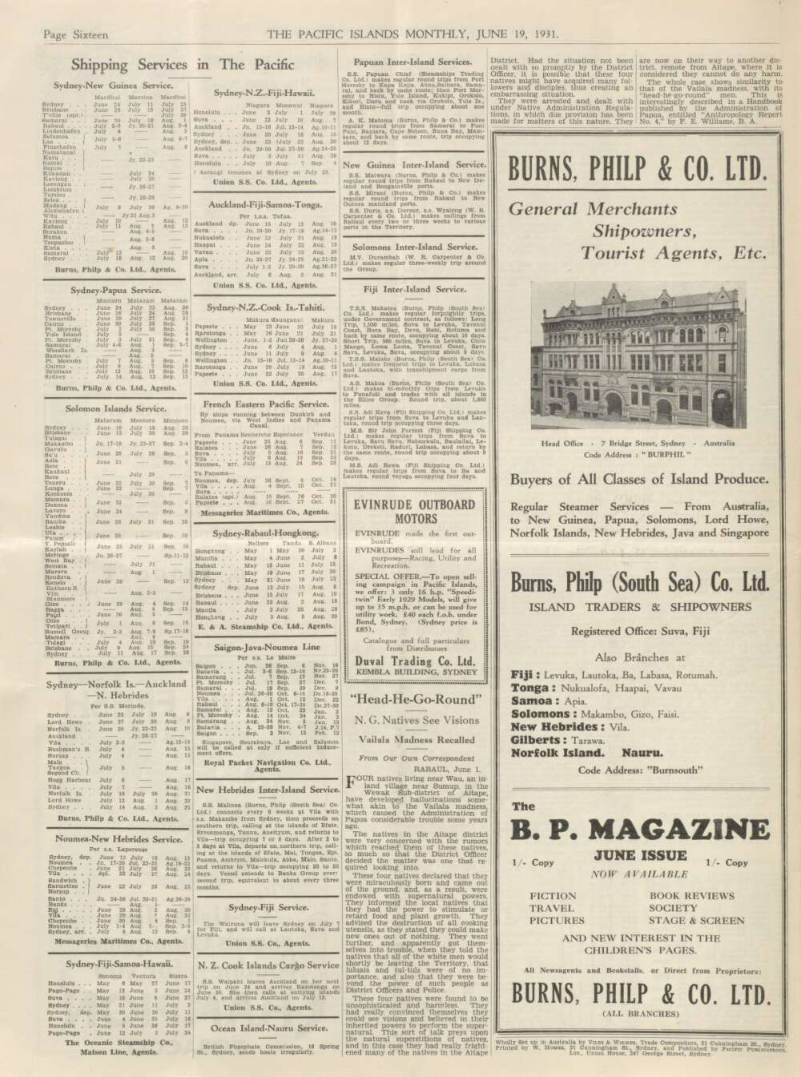
Sydney-New Guinea Service.
Sydney-Papua Service.
Solomon Islands Service.
Sydney —Norfolk Is. —Auckland —N. Hebrides Per S.S. Morinda.
Noumea-New Hebrides Service.
Per s.s. Laperouse
Sydney-Fiji-Samoa-Hawaii.
Sydney-N.Z.-Fiji-Hawaii.
Auckland-Fiji-Samoa-Tonga.
Per t.s.s. Tofua.
Sydney-N.Z.-Cook Is.-Tahiti.
French Eastern Pacific Service.
By ships running between Dunkirk and Noumea, via West Indies and Panama Canal.
Sydney-Rabaul-Hongkong.
Saigon-Java-Noumea Line Per s.s. Le Maire
Singapore, Sourabaya, Lae and Salamoa will be called at only if sufficient induce ment offers.
Royal Packet Navigation Co. Ltd.,
Agents.
New Hebrides Inter-Island Service.
S.S. Malinoa (Burns, Philp (South Sea) Co.
Ltd.) connects every 6 weeks at Vila with s.s. Makambo from Sydney, then proceeds on southern trip, calling at the islands of Efate.
Erronmanga, Tanna, Aneityum, and returns to Vila—trip occupying 7 or 8 days. After 2 to 3 days at Vila, departs on. northern trip, call ing at the islands of Efate, Mai, Tongoa, Epi.
Paama, Ambrym. Malekula, Abba, Malo, Santo, and returns to Vila—trip occupying 25 to 28 days. Vessel extends to Banks Group every second trip, equivalent to about every three months.
Sydney-Fiji Service.
The Wairuna will leave Sydney on July 7 for Fiji, and will call at Lautoka, Suva and Levuka.
Union S.S. Co., Agents.
N. Z. Cook Islands Cargo Service
S.S. Waipahi leaves Auckland on her next trip on June 24 and arrives Rarotonga on June 30. She then calls at outlying islands July 4, and arrives Auckland on July 13.
Union S.S. Co., Agents.
Ocean Island-Nauru Service.
British Phosphate Commission, 16 Spring St., Sydney, sends boats irregularly.
Papuan Inter-Island Services.
S.S. Papuan Chief (Steamships Trading Co. Ltd.) makes regular round trips from Port Moresby to Kapa Kapa, Abau, Balbara, Sama ral, and back by same route; then Port Mor esby to Hisiu, Yule Island, Kukipi, Orokolo, Kikori, Daru and back via Orokolo, Yule Is., and Hisiu —full trip occupying about one month.
A. K. Matoma (Burns, Philp & Co.) makes regular round trips from Samaral to Puni Puni, Baniara, Cape Nelson, Buna Bay, Mam bare, and back by same route, trip occupying about 12 days.
New Guinea Inter-Island Service.
S.S. Maiwara (Burns, Philp & Co.) makes regular round trips from Rabaul to New Ire land and Bougainville ports.
S.S. Miranl (Burns, Philp & Co.) makes regular round trips from Rabaul to New Guinea mainland ports.
S.S. Duris, s.s. Durour, s.s. Wyalong (W. R.
Carpenter & Co. Ltd.) makes sailings from Rabaul every two or three weeks to various ports in the Territory.
Solomons Inter-Island Service.
M.V. Durambah (W. R. Carpenter & Co.
Ltd.) makes regular three-weekly trip around the Group.
Fiji Inter-Island Service.
T.S.S. Makatea (Burns, Philp (South Sea Co. Ltd.) makes regular fortnightly trips, under Government contract, as follows: Long Trip, 1,050 miles, Suva to Levuka, Tavenui Coast, Buca Bay, Devo, Rabi, Rotuma and back by same route, occupying about 10 days.
Short Trip, 560 miles, Suva to Levuka, Cicia Mango, Loma Loma, Tavenui Coast, Savu Savu, Levuka, Suva, occupying about 9 days T.S.S. Malake (Burns, Philp (South Sea) Co.
Ltd.) makes frequent trips to Levuka, Labasa and Lautoka, with transhipment cargo from Suva.
A.S. Makoa (Burns, Philp (South Sea) Co.
Ltd.) makes bi-monthly trips from Levuka to Funafuti and trades with all islands in the Ellice Group. Round trip, about 1,800 miles.
S.S. Adi Keva (Fiji Shipping Co. Ltd.) makes regular trips from Suva to Levuka and Lau toka, round trip occupying three days.
M.S. Sir John Forrest (Fiji Shipping Co.
Ltd.) makes regular trips from Suva to Levuka, Savu Savu, Nabouwalu, Baulailai, Le kutu, Dreketi, Raduri, Labasa, and return by the same route, round trip occupying about 9 days.
M.S. Adi Rewa (Fiji Shipping Co. Ltd.) makes regular trips from Suva to Ba and Lautoka. round voyage occupying four days.
Macdhui Marsina Macdhui Sydney . . . June 24 July 11 July 25 Brisbane .
June 26 July 13 July 27 T’ville (opt.) . — July 30 Samarai . .
June 30 July 18 Aug. 1 Rabaul . . . . July 2-3 Jy. 20-21 Aug. 3-4 Lindenhafen . July 4 — Aug. 5 Salamoa .
Lae . . .
July 5-6
— Aug. 6-7 Finschafen . July 7 — Aug. 8 Namatanai Karu . . .
Ramat . .
Jy. 22-23 Bopire . .
Kimadan . .
July 24 Kavieng . .
July 25 Lorengau .
Lombrum .
Jy. 25-27 Tumleo .
Seleo . . .
Jy. 28-29 Madang Alexishafen
July 8
July 30 Ag. 9-10 Witu . . . - Jy.31 Aug.2 12 Kavieng . .
July 10 — Aug.
Rabaul . .
July 11 Aug. 3 Aug. 13 Soraken . .
Aug. 4-5 Numa . .
Teopasino Aug. 5-6 Kieta . . .
Aug. 6 Samarai . .
July 13 — Aug. 15 Sydney . .
July 18 Aug. 12 Aug. 20 Burns, Philp & Co. Ltd. Agents.
Montoro Mataram Mataram Sydney . . . June 24 July 22 Aug. 26 Brisbane .
June 26 July 24 Aug. 28 Townsville . June 29 July 27 Aug. 31 Cairns . .
June 30 July 28 Sep. 1 Pt. Moresby July 2 July 30 Sep. 3 Yule Island July 3 Sep. 4 Pt. Moresby . July 3 July 31 Sep. 4 Samarai July 4-6 Aug. 1 Sep. 5-7 Woodlark Is. — Aug. 2 Samarai .
Aug. 3 Pt. Moresby . July 7 Aug. 5 Sep. 8 Cairns . . . July 9 Aug. 7 Sep. 10 Brisbane . July 12 Aug. 10 Sep. 13 Sydney . . . July 14 Aug. 12 Sep. 15 Burns, Philp & Co. Ltd., Agents.
Mataram Montoro Montoro Sydney .
June 10 July 18 Aug. 26 Brisbane .
June 12 July 20 Aug. 28 Tulagai .
Makambo Jn. 17-19 Jy. 25-27 Sep. 2-4 Gavutu July 28 Su’u . .
June 20 Sep. 5 Aola . .
Rere . .
June 21 — Sep. 6 Kaukaul .
Rere . .
July 29 — Teneru .
June 22 July 30 Sep. 7 Lunga . .
June 22 Sep. 7 Kookoom July 30 Mamara .
Domma .
June 23 Sep. 8 Lavoro .
June 24 Sep. 9 Yandina Banika .
June 25 July 31 Sep. 10 Loabie Ufa . . v Palam .
June 25 Sep. 10 Y. Pepsale Kaylah .
June 25 July 31 Sep. 10 Meringe .
Jn. 26-27 Sp. 11-12 West Bay July 31 Somata . — Marovo Aug. 1 Rendova Sep. 13 Kenelo .
June 28 Hathorn S.
Vila . .
Aug. 2-3 Stanmore Gizo . .
June 29 Aug. 4 Sep. 14 Bagga .
Aug. 4 Sep. 15 Pajsi . .
June 30 Aug. 5 Gizo . .
Tetiparl .
July 1 Aug. 6 Sep. 15 Russell Group Jy. 2-3 Aug. 7-8 Sp.17-18 Mamara .
Aug. 9 Tulagi . .
July 4 Aug. 10 Sep. 19 Brisbane .
July 9 Aug. 15 Sep. 24 Sydney . .
July 11 Aug. 17 Sep. 26 Burns, Philp & Co. Ltd., Agents.
Sydney . .
June 25 July 18 Aug. 6 Lord Howe June 27 July 20 Aug. 8 Norfolk Is.
June 29 Jy. 22-23 Aug. 10 Auckland .
Jy. 26-27 Vila . . .
July 2-3 — Ag.13-14 Bushman’s B.
July 4 — Aug. 15 Norsup . .
Malo . . .
July 4 Aug. 15 Tangoa . .
Segond Ch.
July 5 Aug. 16 Hogg Harbour July 6 — Aug. 17 Vila . . .
July 7 — Aug. 18 Norfolk Is.
July 10 July 30 Aug. 21 Lord Howe July 12 Aug. 1 Aug. 23 Sydney . .
July 14 Aug. 3 Aug. 25 Burns, Philp & Co. Ltd., Agents.
Sydney, dep.
June 13 July 18 Aug. 15 Noumea .
Jn. 17-20 Jul, 22-25 Ag. 19-22 Chepenhe June 21 July 26 Aug. 23 Vila ...
Apl. 22 July 27 Aug. 24 Sandwich . 1
Sarmettes . f
June 22 July 28 Aug. 25
Norsup . . j
Santo . . .
Jn. 24-26 Jul. 29-31 Ag.26-29 Banks ...
Aug. 1 Epi June 28 Aug. 2 Aug. 30 Vila ...
June 29 Aug. 3 Aug. 31 Chepenhe . .
June 30 Aug. 4 Sep. 1 Noumea . . .
July 1-4 Aug. 5-6 Sep. 2-5 Sydney, arr. .
July 8 Aug. 12 Sep. 9
Messageries Maritlmes Co., Agents.
Niagara Monowai Niagara Honolulu . . .
June 3 July 1 July 29 Suva . . .
June 12 July 10 Aug. 7 Auckland . .
Jn. 15-16 Jul. 13-14 Ag.10-11 Sydney . . . . June 20 July 18 Aug. 15 Sydney, dep. , , June 25 tJuly 23 Aug. 20 Auckland . , Jn. 29-30 Jul. 27-28 Ag.24-25 Suva July 3 July 31 Aug. 28 Honolulu . , . July 10 Aug. 7 Sep. 4 t Aorangi resumes at Sydney on July 23 Union S.S. Co. Ltd., Agents.
Auckland dp. June 15 July 13 Aug. 10 Suva . . . . Jn. 19-20 Jy. 17-18 Ag.14-15 Nukualofa . . June 23 July 21 Aug. 18 Haapai . . . June 24 July 22 Aug. 19 Vavau . . .' . June 25 July 23 Aug. 20 Apia , . . . Jn. 26-27 Jy. 24-25 Ag.21-22 Suva . . . . July 1-2 Jy. 29-30 Ag.26-27 Auckland, arr. July 6 Aug. 3 Aug. 31 Union S.S. Co. Ltd., Agents.
Makura Waunganui Makura Papeete . . . May 23 June 20 July 18 Rarotonga . . May 26 June 23 July 21 Wellington . . June. 1-2 Jun 29-30 Jy. 27-28 Sydney . . . . June 6 July 4 Aug. 1 Sydney . . . . June 11 July 9 Aug. 6 Wellington . . Jn. 15-16 Jul. 13-14 Ag.10-11 Rarotonga . . June 20 July 18 Aug. 15 Papeete . . . June 22 July 20 Aug. 17 Union S.S. Co. Ltd., Agents.
From Panama Recherche Esperance Verdun Papeete . . .
June 25 Aug. 6 Sep. 11 Raiatea . . .
June 26 Aug. 7 Sep. 12 Suva ...
July 5 Aug. 16 Sep. 21 Vila July 8 Aug. 19 Sep. 24 Noumea, arr.
July 13 Aug. 24 Sep. 29 To Panama— Noumea, dep.
July 28 Sept. 8 Oct. 14 Vila Aug. 4 Sept. 15 Oct. 21 Suva Raiatea (opt.) Aug. 15 Sept. 26 Oct. 30 Papeete . . .
Aug. 16 Sept. 27 Oct. 31
Messageries Maritimes Co., Agents.
Nellore Tanda S. Albans Hongkong . . May 1 May 30 July 3 Manilla . . . May 4 June 2 July 6 Rabaul . . . May 13 June 11 July 15 Brisbane . . . May 19 June 17 July 20 Sydney . . May 21 June 19 July 22 Sydney dep. June 13 July 15 Aug. 8 Brisbane . , . June 15 July 17 Aug. 10 Rabaul . . , . . June 23 Aug. 2 Aug. 18 Manila . . July 2 July 25 Aug. 26 Hongkong . . July 5 Aug. 5 Aug. 29 E. & A. Steamship Co. Ltd., Agents.
Saigon . .
Jun. 26 Sep. 6 Nov. 16 Batavia . .
Jul. 3-6 Sep. 13-16 Nv.23-26 Samarang .
Jul. 7 Sep. 17 Nov. 27 Pt. Moresby Jul. 17 Sep. 27 Dec. 7 Samarai . .
Jul. 19 Sep. 29 Dec. 9 Noumea . .
Jul. 26-30 Oct. 6-10 Dc. 16-20 Vila ...
Aug. 1 Oct. 12 Dec. 22 Rabaul . .
Aug. 6-10 Oct. 17-20 Dc.27-30 Samarai . .
Aug. 13 Oct. 23 Jan. 2 Pt. Moresby Aug. 14 Oct. 24 Jan. 3 Samarang .
Aug. 24 Nov 3 Jan. 13 Batavia . .
A. 25-28 Nov 4-7 J.14, F.7 Saigon . . .
Sep. 2 Nov 12 Feb. 12
Sonoma Ventura Sierra Honolulu . . . May 6 May 27 June 17 Pago-Pago . . May 13 June 3 June 24 Suva . . . . May 16 June 6 June 27 Sydney . . . . May 21 June 11 July 2 Sydney, dep. May 30 June 20 July 11 Suva . . . . June 4 June 25 July 16 Honolulu . . June 5 June 26 July 17 Pago-Pago . June 12 July 3 July 24 The Oceanic Steamship Co.,
Matson Line, Agents.
“Head-He-Go-Round”
N. G. Natives See Visions Vailala Madness Recalled
From Our Own Correspondent
Rabaul, June 1.
FOUR natives living near Wau, an in land village near Sumup, in the Wewak Sub-district of Aitape, have developed hallucinations some what akin to the Vailala madness, which caused the Administration of Papua considerable trouble some years ago.
The natives in the Aitape district were very concerned with the rumors which reached them of these natives, so much so that the District Officer decided the matter was one that re quired looking into.
These four natives declared that they were miraculously born and came out of the ground, and, as a result, were endowed with supernatural powers.
They informed the local natives that they had the power to stimulate or retard food and plant growth. They advised the destruction of all cooking utensils, as they stated they could make new ones out of nothing. They went further, and apparently got them selves into trouble, when they told the natives that all of the white men would shortly be leaving the Territory, that luluais and tul-tuls were of no im portance, and also that they were be yond the power of such people as District Officers and Police.
These four natives were found to be unsophisticated and harmless. They had really convinced themselves they could see visions and believed in their inherited powers to perform the super natural. This sort of talk preys upon the natural superstitions of natives, and in this case they had really fright ened many of the natives in the Aitape
District. Had the situation not been dealt with so promptly by the District Officer, it is possible that these four natives might have acquired many fol lowers and disciples, thus creating an embarrassing situation.
They were arrested and dealt with under Native Administration Regula tions, in which due provision has been made for matters of this nature. They
are now on their way to another dis trict, remote from Aitape, where it is considered they cannot do any harm.
The whole case shows similarity to that of the Vailala madness, with its “head-he-go-round” men. This is interestingly described in a Handbook published by the Administration of Papua, entitled “Anthropology Report No. 4,” by P. E. Williams, B. A.
Advertisements & other items, p. 16 (3 items)
The Pacific Islands Monthly, June 19, 1931.
16
Wholly Set up in Australia by Viles & Walker, Trade Compositors, 31 Cunningham St Svdnev Printed by W. Homer, 31 Cunningham St., Sydney, and Published by Pacific Publications' Ltd., Union House, 247 George Street, Sydney. ‘
Burns, Philp & Co. Ltd.
General Merchants
Shipowners ,
Tourist Agents, Etc.
Head Office - 7 Bridge Street, Sydney - Australia Code Address : " BURPHIL ”
Buyers of All Classes of Island Produce.
Regular Steamer Services From Australia, to New Guinea, Papua, Solomons, Lord Howe, Norfolk Islands, New Hebrides, Java and Singapore
Burns, Philp (South Sea) Co. Ltd.
ISLAND TRADERS & SHIPOWNERS
Registered Office: Suva, Fiji Also Branches at FIJI: Levuka, Lautoka, Ba, Labasa, Rotumah.
Tonga : Nukualofa, Haapai, Vavau Samoa : Apia.
Solomons I Makambo, Gizo, Faisi.
New Hebrides : Vila.
Gilberts : Tarawa.
Norfolk Island. Nauru.
Code Address: "Burnsouth”
The
B. P. MAGAZINE
1/- Copy
JUNE ISSUE .
1/- Copy
NOW AVAILABLE
FICTION BOOK REVIEWS
TRAVEL SOCIETY
PICTURES STAGE & SCREEN
AND NEW INTEREST IN THE
CHILDREN’S PAGES.
All Newsagents and Bookstalls, or Direct from Proprietors:
BURNS, PHILP & CO. LTD.
(ALL BRANCHES)
Evinrude Outboard
MOTORS
EVINRUDE made the first out board.
EVINRUDES still lead for all purposes—Racing, Utility and Recreation.
SPECIAL OFFER.—To open sell ing campaign in Pacific Islands, we offer: 3 only 16 h.p. "Speedi twin” Early 1929 Models, will give up to 35 m.p.h. or can be used for utility work. £40 each f.o.b. under Bond, Sydney. (Sydney price is £B5).
Catalogue and full particulars from Distributors
Duval Trading Co. Ltd.
KEMBLA BUILDING, SYDNEY