Monthly
THE Pacific Islands Monthly
THE ONLY JOURNAL CIRCULATING THROUGHOUT THE ISLAND TERRITORIES AND GROUPS
Of The Central And South Pacific.
Vol, 1—No. 8
Registered at G.P.O., Sydney, for transmission by Post as a Newspaper
Sydney: Tuesday, March 17, 1931
Per Annum, posted, 6/-.
Single Copy, 6d. ———
Radio To Papua
Completing Pacific Network New A.W.A Station
THE opening of a new high speed wireless telegraph station at Port Moresby on March 10 by Amalgamated Wireless (Australasia) Ltd. marked the establishment of direct communication between Sydney and Port Moresby, and the completion of another important unit in the wireless network, which now covers a large section of the Pacific Ocean.
The new station at Moresby is situated in the main street of the town, taking the place of the old station, which was located at Konedobu one and a quarter miles distant.
The equipment consists of a 5 kilowatt short wave Beam feeder trans-|| A glimpse of Port Moresby, the capital of Papua.||
mitter, a 5 kilowatt coastal radio transmitter, a 50 watt emergency long waveshort wave transmitter, also modern receiving apparatus. An idea of the power of the main transmitter is given by the fact that it is of the same strength as broadcasting station 2FC, Sydney, or 3LO, Melbourne.
Three 110 feet tubular steel masts have been erected to support the special directional Beam aerial for communication with Sydney over a distance of 1,750 miles.
The opening of the new Port Moresby radio station is in accordance with an arrangement made between Amalgamated Wireless and the Commonwealth Government, when Amalgamated Wireless took over the whole of the coastal stations of Australia, seventeen in number, also two in Papua and eight in the Mandated Territory.
In accordance with the agreement then entered upon, Amalgamated Wireless has modernised—and in the case of Port Moresby completely rebuilt and re-equipped-the whole of these stations.
Realising the development and im-portance of the various British island possessions in the Pacific and the en terprise manifested by other nations in establishing wireless stations on their island possessions there, Mr. E. T.
Fisk, managing director of A.W.A., suggested to the Right Hon. L. S Amery, then First Lord of the British Admiralty, that Amalgamated Wireless take over from the Imperial Government all the wireless stations in the Fijian group, with the object of modernising and operating them as units of the Pacific network already operated by the company.
An agreement was completed between the Imperial Government and the company, and to-day these stations are equipped in the most modern way.
The wireless stations controlled by Amalgamated Wireless maintain communication between Australia, New
Guinea, Papua, Fiji, Samoa, Tonga, Gilbert and Ellice Islands, New Caledonia, New Hebrides and Hawaii.
The aim of Mr. Fisk in establishing a network of British radio stations in the Pacific is rapidly in course of realisation. and the new station at Port Moresby is a further link in making Australia the wireless centre of the Southern Pacific. ... ——— ... Interest in Canberra From Our Canberra Correspondent.
Much interest was taken here in the opening of the new wireless telegraph station at Port Moresby.
The Prime Minister, Mr. J. H. Scullin, regards it as of the very greatest importance, and says that it will greatly facilitate the operations of the Commonwealth in Papua and the Mandated Territory of New Guinea, whilst its importance from a commercial point of view cannot be over-emphasised.
This view is also shared by officials who have charge of the Islands section of the Prime Minister’s Department.
The Lieutenant-Governor of Papua, Sir Hubert Murray, who was prevented from being present in Sydney at the opening, was represented by his official secretary, Mr. Leonard Murray. ———
New Administrator
Appointed
For Western Samoa
From Our Wellington Correspondent IT has been announced that Brigadier- General H. S. Hart, who commanded one of the New Zealand brigades in the War, has been appointed Administrator of Western Samoa, in succession to Colonel S. S. Allen.
General Hart, who has been practising as a solicitor at Masterton, N.Z., will take over his duties on April 3. ... ===
Death of Mr. H. F. Heycock
Well-Known Islands Identity
THE death occurred at Auckland on February 7 of Mr. H. F. Heycock, manager of the Levuka branch of Messrs. Burns Philp (South Sea) Co.
Ltd.
Mr. Heycock was well-known in the Islands. He was accountant for Messrs. Burns Philp at Suva, in 1914, and from there went to the Levuka branch at chief clerk. In 1923 he was appointed manager at Makambo, Solomon Islands, and four years later was transferred to Levuka as manager.
He was proceeding on furlough to Auckland and Sydney, accompanied by Mrs. Heycock and their daughter, when he was taken ill. On arrival at Auckland he was conveyed direct from the ship to hospital.
When news of Mr. Heycock’s death was received in Levuka, flags were flown at half-mast, as a mark of respect.
Deceased was born at Dunedin, N.Z He was fifty-six years of age. ... ===
Volcano Active
In New Hebrides
ABOUT the same time as the disastrous earthquake in the Hawkes Bay District of New Zealand, Tahoi. a volcano 2,000 feet high, in Tanna, New Hebrides, became active.
Huge lumps of lava, some of the blocks being about 20 feet long, were thrown up, and fell back into the crater. No lava ran down the side of the mountain.
The noise of the disturbance could be heard a couple of miles away.
The volcano had not been active for some years. ... ===
Fiji Exchange
Rates Now Revised
THE Fiji rates of exchange have
been recently revised. The Bank of New South Wales notified the new rates as follows: FIJI ON LONDON—Basis £ 100 London.
Buying.
Telegraphic Transfer ... £ 107 .. 9 .. 0 On Demand ... 106 .16 .. 6 30 days ... 106 .. 7 .. 9 60 days ... 106 .. 3 .. 0
Selling.
Telegraphic Transfer ... £108 .11 .. 6 On Demand ... 108 .. 6 .. 6 30 days ... 108 .. 1 .. 6 60 days ... 107 .16 .. 6
Fiji On Australia Basis £100 Fur.
Buying £ll5 12 0 Selling 113 12 0
Fiji On New Zealand—Basis £100
... New Zealand.
Buying ... £99 .. 0 .. 0 Selling ... 101 .. 0 .. 0 The effect of the premium on money coming from Fiji to Australia is that merchants in the Colony purchasing goods here receive £100 worth by send-
ing £88.
Papua’S Future
Views of Sir Hubert Murray
Extension Of Rubber
Industry Expected
ACCORDING to Sir Hubert Murray, Lieut. Governor of Papua, who is on his annual visit to Canberra to discuss administrative affairs, the rubber industry in the Territory is once again in full swing, now that the 4d. per pound preference has been granted by the Federal Government.
Indeed, he is optimistic that a great extension in rubber planting will take place.
Coffee growing is another industry which Sir Hubert considers has good possibilities. He explained that, when he first went to Papua, coffee was being grown, but, owing to there being no bounty on the product, the industry did not extend. A bounty now has been granted on this, and development of the industry is proceeding. ... ===
Money Orders to New Caledonia
THE postal authorities have notified that henceforth money orders issued in Australia payable in New Caledonia will be converted at the rate of 90 francs to the pound. ... ===
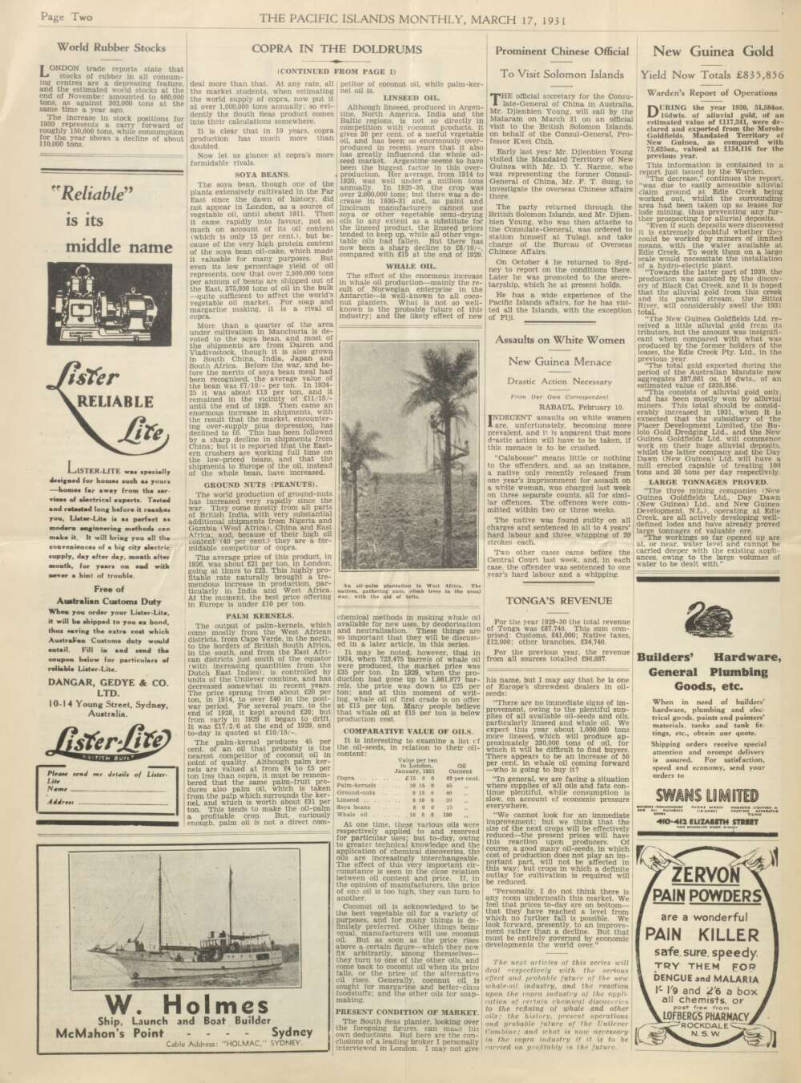
A busy sceen in Dairen Harbour, Northern Manchuria. Screening and sacking Soya beans, ready for shipment.
Copra In The Doldrums
Factors Which Have Caused Low Prices First of Series of Articles Dealing with Position and Probable Future of Coconut Planting
BY R. W. ROBSON, EDITOR OF THE PACIFIC ISLANDS MONTHLY.
London, January 25.
When one sets out to “get a line on the future of copra,” one is faced with some peculiar difficulties.
It is not a matter simply of talking with experienced merchants, discussing the probable consumption of copra products, and trying to make an intelligent forecast of a free market. If the trouble were merely that copra and its rivals were in huge over-supply, the situation would be easily summed up. But it is far worse than that.
Apart from the facts that there is general depression and that the copra market has been invaded in enormous quantities by various oil-bearing “seeds” (as they are called here), the really complicating factors are that the world market is now dominated by Unilever, one of the most powerful combines in the world; and that a very recent development of chemical science has deprived copra of certain advantages which it formerly held over its rivals.
In the course of this short visit to London, I have called upon numerous brokers and merchants who handle oil-seeds and study the market carefully; I have had a look over the Baltic Exchange and the commercial sale rooms; and, through the kindness of these gentlemen and various friends, I have gathered a mass of information which I shall try to co-ordinate for the benefit of the thousands of men in the South Seas whose future welfare is bound up with the future of copra.
It is not possible to summarise this data, and my conclusions, in one article.
In the course of a short series, published monthly, I shall give what information I have concerning the present condition of the copra market; the character and quality of other oil-seeds which are increasingly competing with copra; the serious effect and nrobable future of the new whale-oil industry; the his tory, present effect and probable future of the Unilever combine; and what (in the opinion of the London and German observers) is likely to be the condition of the copra industry in the future.
As the last-mentioned is likely to be the last article of the series, and our readers will naturally want to know what conclusions students of the market have reached, I will say at once that it is not expected that growers will for years, if
ever, again see prices very much over £20 per ton; but that there is quite a good future for those growers who can make a profit on a price over £10 to £11 per ton f.o.b.
We know that the primary factor in the buyers’ domination of the copra market is the enormous over-production, first, of copra and, second, of several oil-seeds and oils, which are in active competition with copra. But few people in the South Seas have seen the figures. After considerable trouble I obtained figures from Germany (which specialises in these kinds of statistics) and from one or two London brokers, which enabled me to compile the following table, showing world production:
The 1930 figures, not available yet in detail, show the same upward tendency, I understand. No comment is needed —the thing speaks for itself. And this huge mass of oils and oil-bearing substances was thrown into the market just when the world, lethargic under an unprecedented economic depression, was reporting a decreased consumption of practically every commodity.
The wonder is that it has been possible to sell our copra at all, at any old price. Yet one London broker, only a few days ago, said: “While prices have been at ridiculous levels, every bit of copra that has come in has been sold. There are no great stocks of oil seeds awaiting buyers in this part of the world.” That, I think, is a very important point to remember when we come to a consideration of Unilever and the future of the market.
With regard to copra, here are some interesting figures showing shipments, in tons, from the various main producing countries of the world, in 1920 and 1929, as shown in the fine “Review” issued by Prank Fehr and Co.:
Those figures, be it noted, do not include South Seas production. As a matter of fact—but I do not know why—none of the various compilations I gathered up in London and Germany take South Seas copra into their calculations. In one place. I saw it vaguely referred to as “about 140,000 tons per annum.” I believe it is a good
(Continued On Page 2 )
1925-26 1928-29 Tons Tons Copra . 625,751 910.908 Palm-kernels 487,796 458,907 Ground-nuts (Peanuts) . 1,250,918 1,375,799 Soya Beans . 1,683,384 2,588,574 Linseed . 1,473.325 2.034,525 Whale-oil (Barrels) . 1,044,272 1,861.877
Philippines 1920 32,148 1929 178,018 Java 42,638 52,888 Macassar 49.523 92.869 Padang, Sangir. etc. .. . 34,399 138.000* Other Dutch E.I 109,600* 186,112 Straits Settlements .. 112.430 Cevlon 68.044 101,453 Malabar 1,470 — Total 340.652 858.340 •Estimated.
the world supply of copra, now put it at over 1,000,000 tons annually; so evidently the South Seas product comes into their calculations somewhere.
It is clear that in 10 years, copra production has much more than doubled.
Now let us glance at copra’s more formidable rivals.
Soya Beans.
The soya bean, though one of the plants extensively cultivated in the Far East since the dawn of history, did not appear in London, as a source of vegetable oil, until about 1911. Then it came rapidly into favour, not so much on account of its oil content (which is only 15 per cent.), but because of the very high protein content of the soya bean oil-cake, which made it valuable for many purposes. But even its low percentage yield of oil represents, now that over 2,500.000 tons per annum of beans are shipped out of the East, 375,000 tons of oil in the bulk —quite sufficient to affect the world’s vegetable oil market. For soap and margarine making, it is a rival of copra.
More than a quarter of the area under cultivation in Manchuria is devoted to the soya bean, and most of the shipments are from Dairen and Vladivostock, though it is also grown in South China, India, Japan and South Africa. Before the war, and before the merits of soya bean meal had been recognised, the average value of the bean was £7/10/- per ton. In 1924- 25 it was about £13 per ton, and it remained in the vicinity of £11/15/until the end of 1929. Then came an enormous increase in shipments, with the result that the market, encountering over-supply plus depression, has declined to £6. This has been followed by a sharp decline in shipments from China; but it is reported that the Eastern crushers are working full time on the low-priced beans, and that the shipments to Europe of the oil, instead of the whole bean, have increased.
Ground Nuts (Peanuts).
The world production of ground-nuts has increased very rapidly since the war. They come mostly from all parts of British India, with very substantial additional shipments from Nigeria and Gambia (West Africa), China and East Africa; and, because of their high oil content (40 per cent.) they are a formidable competitor of copra.
The average price of this product, in 1926, was about £21 per ton, in London, going at times to £23. This highly profitable rate naturally brought a tremendous increase in production, particularly in India and West Africa.
At the moment, the best price offering in Europe is under £10 per ton.
Palm Kernels.
The output of palm-kernels, which come mostly from the West African districts, from Cape Verde, in the north, to the borders of British South Africa, in the south, and from the East Afri can districts just south of the equator (with increasing quantities from the Dutch East Indies), is controlled by units of the Unilever combine, and has decreased somewhat in recent years.
The price sprang from about £20 per ton, in 1914, to over £40 in the postwar period. For several years, to the end of 1928, it kept around £20; but from early in 1929 it began to drift.
It was £17/2/6 at the end of 1929, and to-day is quoted at £10/15/-.
The palm-kernel produces 45 per cent. of an oil that probably is the nearest competitor of coconut oil in point of quality. Although palm kernels are valued at from £4 to £5 per ton less than copra, it must be remembered that the same palm-fruit produces also palm oil, which is taken from the pulp which surrounds the kernel, and which is worth about £31 per ton. This tends to make the oil-palm a profitable crop. But, curiously enough, palm oil is not a direct com-
petitor of coconut oil, while palm-kernel oil is.
Linseed Oil.
Although linseed, produced in Argentine, North America, India and the Baltic regions, is not so directly in competition with coconut products, it gives 30 per cent, of a useful vegetable oil, and has been so enormously overproduced in recent years that it also has greatly influenced the whole oil seed market. Argentine seems to have been the biggest factor in this overproduction. Her average, from 1914 to 1920, was well under a million tons annually. In 1929-30, the crop was over 2,000,000 tons; but there was a decrease in 1930-31 and, as paint and linoleum manufacturers cannot use soya or other vegetable semi-drying oils to any extent as a substitute for the linseed product, the linseed prices tended to keep up, while all other vegetable oils had fallen. But there has now been a sharp decline to £8/10/-, compared with £l9 at the end of 1929.
Whale Oil.
The effect of the enormous increase in whale oil production—mainly the result of Norwegian enterprise in the Antarctic —is well-known to all coconut planters. What is not so well known is the probable future of this industry; and the likely effect of new
chemical methods in making whale oil available for new uses, by deodorisation and neutralisation. These things are so important that they will be discussed in a later article, in this series.
It may be noted, however, that in 1924, when 723,475 barrels of whale oil were produced, the market price was £35 per ton. In 1929, when the production had gone up to 1,861,877 barrels, the price was down to £25 per ton; and at this moment of writing, whale oil of first grade is on offer at £15 per ton. Many people believe that whale oil at £15 per ton is below production cost.
Comparative Value Of Oils.
It is interesting to examine a list of the oil-seeds, in relation to their oil content: ... Value per ton ... in London, ... Oil ... January, 1931 ... Content Copra ... £ 15 .. 0 .. 0 ... 62 per cent.
Palm-kernels ... 10 .15 .. 0 ... 45 ... ,, ...
Ground-nuts ... 9 .15 .. 0 ... 40 ... ,, ...
Linseed ... 8 .15 .. 0 ... 30 ... ,, ...
Soya beans ... 6 .. 0 .. 0 ... 15 ... ,, ...
Whale oil ... 15 .. 0 .. 0 . 100 ... ,, ...
At one time, these various oils were respectively applied to and reserved for particular uses; but to-day, owing to greater technical knowledge and the application of chemical discoveries, the oils are increasingly interchangeable.
The effect of this very important circumstance is seen in the close relation between oil content and price. If, in the opinion of manufacturers, the price of one oil is too high, they can turn to another.
Coconut oil is acknowledged to be the best vegetable oil for a variety of purposes, and for many things is definitely preferred. Other things being equal, manufacturers will use coconut oil. But as soon as the price rises above a certain figure—which they now fix arbitrarily, among themselves— they turn to one of the other oils, and come back to coconut oil when its price falls, or the price of the alternative oil rises. Generally, coconut oil is sought for margarine and better-class foodstuffs: and the other oils for soap making.
Present Condition Of Market.
The South Seas planter, looking over the foregoing figures, can make his own deductions. But here are the conclusions of a leading broker I personally interviewed in London. I may not give
his name, but I may say that he is one of Europe’s shrewdest dealers in oil seeds: “There are no immediate signs of improvement, owing to the plentiful supplies of all available oil-seeds and oils, particularly linseed and whale oil. We expect this year about 1,000,000 tons more linseed, which will produce approximately 330,000 tons of oil, for which it will be difficult to find buyers.
There appears to be an increase of 50 per cent, in whale oil coming forward —who is going to buy it?
“In general, we are facing a situation where supplies of all oils and fats continue plentiful, while consumption is slow, on account of economic pressure everywhere.
“We cannot look for an immediate improvement; but we think that the size of the next crops will be effectively reduced —the present prices will have this reaction upon producers. Of course, a good many oil-seeds, in which cost of production does not play an important part, will not be affected in this way; but crops in which a definite outlay for cultivation is required will be reduced.
“Personally, I do not think there is any room underneath this market. We feel that prices to-day are on bottom— that they have reached a level from which no further fall is possible. We look forward, presently, to an improvement rather than a decline. But that must be entirely governed by economic developments the world over.”
The next articles of this series will deal respectively with the serious effect and probable future of the new whale-oil industry, and the reaction upon the copra industry of the application of certain chemical discoveries to the refining of whale and other oils ; the history, present operations and probable future of the Unilever Combine; and what is now necessary in the copra industry if it is to be carried on profitably in the future. ———
An oil-palm plantation in West Africa. The natives, gathering nuts, climb trees in the usual way, with the aid of belts. ———
World Rubber Stocks
LONDON trade reports state that stocks of rubber in all consuming centres are a depressing feature, and the estimated world stocks at the end of November amounted to 460,000 tons, as against 302,000 tons at the same time a year ago.
The increase in stock positions for 1930 represents a carry forward of roughly 150,000 tons, while consumption for the year shows a decline of about 110,000 tons. ===
Prominent Chinese Official
To Visit Solomon Islands
THE official secretary for the Consulate-General of China in Australia, Mr. Djienbien Young, will sail by the Mataram on March 31 on an official visit to the British Solomon Islands, on behalf of the Consul-General, Professor Kwei Chih.
Early last year Mr. Djienbien Young visited the Mandated Territory of New Guinea with Mr. D. Y. Narme, who was representing the former Consul- General of China, Mr. F. T. Sung, to investigate the overseas Chinese affairs there.
The party returned through the British Solomon Islands, and Mr. Djienbien Young, who was then attache to the Consulate-General, was ordered to station himself at Tulagi, and take charge of the Bureau of Overseas Chinese Affairs.
On October 4 he returned to Sydney to report on the conditions there.
Later he was promoted to the secretaryship, which he at present holds.
He has a wide experience of the Pacific Islands affairs, for he has visited all the Islands, with the exception of Fiji. ===
Assaults on White Women
New Guinea Menace Drastic Action Necessary
From Our Own Correspondent RABAUL, February 10.
INDECENT assaults on white women are, unfortunately, becoming more prevalent, and it is apparent that more drastic action will have to be taken, if this menace is to be crushed.
“Calaboose” means little or nothing to the offenders, and. as an instance, a native only recently released from one year’s imprisonment for assault on a white woman, was charged last week on three separate counts, all for similar offences. The offences were committed within two or three weeks.
The native was found guilty on all charges and sentenced in all to 4 years’ hard labour and three whipping of 20 strokes each.
Two other cases came before the Central Court last week, and, in each case, the offender was sentenced to one year’s hard labour and a whipping. ===
Tonga’S Revenue
For the year 1929-30 the total revenue of Tonga was £87,740. This sum comprised: Customs, £41,000; Native taxes, £12,000; other branches, £34,740.
For the previous year, the revenue from all sources totalled £96,887. ———
New Guinea Gold
Yield Now Totals £835,856 Warden’s Report of Operations
DURING the year 1930, 51,584oz. 16dwts. of alluvial gold, of an estimated value of £117,241, were declared and exported from the Morobe Goldfields, Mandated Territory of New Guinea, as compared with 72,625oz., valued at £154,116 for the previous year.
This information is contained in a report just issued by the Warden.
“The decrease,” continues the report, “was due to easily accessible alluvial claim ground at Edie Creek being worked out, whilst the surrounding area had been taken up as leases for lode mining, thus preventing any further prospecting for alluvial deposits.
“Even if such deposits were discovered it is extremely doubtful whether they could be worked by miners of limited means, with the water available at Edie Creek. To work them on a large scale would necessitate the installation of a hydro-electric plant.
“Towards the latter part of 1930, the production was assisted by the discovery of Black Cat Creek, and it is hoped that the alluvial gold from this creek and its parent stream, the Bittoi River, will considerably swell the 1931 total.
“The New Guinea Goldfields Ltd. received a little alluvial gold from its tributors, but the amount was insignificant when compared with what was produced by the former holders of the leases, the Edie Creek Pty. Ltd., in the previous year.
“The total gold exported during the period of the Australian Mandate now aggregates 387,861 oz. 16 dwts., of an estimated value of £835,856.
“This consists of alluvial gold only, and has been mostly won by alluvial miners. This total should be considerably increased in 1931, when it is expected that the subsidiary of the Placer Development Limited, the Bulolo Gold Dredging Ltd., and the New Guinea Goldfields Ltd. will commence work on their huge alluvial deposits, whilst the latter company and the Day Dawn (New Guinea) Ltd. will have a mill erected capable of treating 100 tons and 20 tons per day respectively.
Large Tonnages Proved.
“The three mining companies (New Guinea Goldfields Ltd., Day Dawn (New Guinea) Ltd., and New Guinea Development. N.L.), operating at Edie Creek, are all actively developing well defined lodes and have already proved large tonnages of valuable ore.
“The workings so far opened up are at, or near, water level and cannot be carried deeper with the existing appliances, owing to the large volumes of water to be dealt with.”
Advertisements & other items, p. 2 (2 items)
W. Holmes
"Reliable”
is its
middle name
LISTER-LITE was specially designed for homes such as yours —homes far away from the services of electrical experts. Tested and retested long before it reaches you, Lister-Lite is as perfect as modern engineering methods can make it. It will bring you all the convenience of a big city electric supply, day after day, month after month, for years on and with never a hint of trouble.
Free of Australian Customs Duty When you order your Lister-Lite, it will be ahipped to you ex bond, thus saving the extra cost which Australian Customs duty would entail. Fill in and send the coupon below for particulars of reliable Liater-Lite.
DANGAR, GEDYE & CO.
LTD.
10-14 Young Street, Sydney,
Australia.
Lister-Lite
BRITISH BUILT
——— Please tend me details of Lister- Lite Name Address ===
W. Holmes
Ship, Launch and Boat Builder McMahon's Point - Sydney Cable Address: “HOLMAC,” SYDNEY.
Zervon
Builders 9 Hardware,
General Plumbing
Goods, etc.
When in need of builders’ hardware, plumbing and electrical goods, paints and painters’ materials, tanks and tank fittings, etc., obtain our quote.
Shipping orders receive special attention and Prompt delivery is assured. For satisfaction, speed and economy, send your orders to
SWANS LIMITED
BUILDERS IRONMONGERY .. PHONE M4301 DOMESITIC LIGHTING & ... AND ALL PLUMBING ... (10 LINES) ... HEATING APPARATUS
... GOODS ... TILING
410-412 ELIZABETH STREET
NEAR DEVONSHIRE STREET, SYDNEY.
ZERVON
PAIN POWDERS
are a wonderful
PAIN KILLER
safe, sure, speedy.
TRY THEM FOR
DENGUE and MALARIA
1/- 1/9 and 2/6 a box all chemists, or post free from
LOFBERG'S PHARMACY,
ROCKDALE
N. S. W
Thursday Island Notes
Erection of Museum Delayed A Bell With a History
From Our Own Correspondent
Thursday Is., March 5.
THE conditions of things, which everyone is pleased to call “finan cial stringency,” has precluded any fur ther progress being made for the time being with the scheme of erecting a Museum for Thursday Island.
Some time back, a committee with representatives of the Thursday Island Town Council and the local branch of the Royal Geographical Society of Aus tralasia, was set up to go into prelimin ary arrangements, and had got as far as preparing to collect £400 or so with which to start building operations.
The collection of ethnological and other exhibits belonging to the Town Council is at present stored away; there are also valuable relics and curios which have been given to the R.G.S.A., and these will be incorporated when the Museum takes definite shape later.
Visitors to the Island frequently en quire for various objects of interest contained in the above, one such being an old bell picked up on the Barrier Reef, which exhibits a double inscrip tion, a somewhat unusual thing.
One side of it carries “Ship Sally A.D. 1807,” and the other “Schooner Tri umph 1847.” Although considerable efforts have been made to discover the
bell’s origin and some particulars of the ships which once carried it, its identity is as mysterious as when it was first discovered.
Possibly this may meet the eye of some roving seafarer or ex-South Sea adventurer, who may be enabled to yield the sought-for information; if so, the local branch of the R.G.S.A., which is working on the collection of informa tion concerning old wrecks of Torres Strait, will be very glad to have it.
Torres Straits Schools
The Aboriginal Department has been re-distributing the teaching staff in the Torres Straits schools for the forth coming year. In accordance with the policy of the department, several of the schools are now in charge of native teachers. An inspector of the education department visits periodically for exam ination purposes and general guidance.
On the larger islands, European teachers are located.
A new venture in the erection of cot tage hospital buildings on the larger islands has been set on foot, but, so far, no provision has been made for training native nurses —on the lines of Samoa and Fiji—but this will probably be at tempted later on.
Personal Items
The Rev. J. W. Schomberg, principal of the Anglican Native Training College at St. Paul’s, Moa, returned from fur
lough in the Malabar in February. In addition to being the training place for Torres Straits island clergy (of whom there are now six ordained) St. Paul’s is the educational centre of the Torres Straits Mission, and includes a recently established hostel and High School for native girls.
Thursday Island stirred in its long social sleep that usually follows the festivities of Christmas, and woke up the other night to give a very enjoyable farewell dance to Sister Hunt, who has resigned from the staff of the Torres Straits Hospital and leaves for the southern States by the Changte. The guest of the evening was presented with a memento of Thursday Island, in the shape of a neatly designed mother-of pearl horseshoe. A little speechifying was indulged in after supper and the opportunity was taken of referring to Sister’s many professional and social activities during her two years service.
This was followed two days later by an afternoon tea at Mrs. F. Hockings house given by the C.W.A., and Sister Hunt will leave with the knowledge that her departure is regretted by many people, whom she has helped in various ways.
The many friends of Mr. Bob Bruce in the Western Division of Papua will
be glad to hear that he reached Thurs day Island safely and is recovering in the local hospital from a severe attack of malaria. Mr. Bruce, who is close on 80 years of age, is no mean example of the old school, who do not allow the weight of years to interfere with their activities. He has spent some months wandering round Torres Straits, now roughing it among friends at his old home —Murray Island—and then dash ing off to the Fly River country to visit old haunts with the Government pat rols. It was while he was staying with Mrs. Cowling, at Mibu, that he became ill, but, shaking that off, he now talks of taking a trip to Scotland, which seems an easier journey than those he has lately undertaken in the wilds of Papua.
New Burns, Philp Motorship, “Macdhui”
Advice has been received by Burns, Philp & Co. Ltd. that its new motorship Macdhui, is about to leave Glasgow for Sydney. During her trials the vessel attained a speed of 15 knots.
She also established a wireless record by communicating direct with Sydney. On the vessel’s arrival here she will be immediately commissioned for Islands trade.
Big River Bores
Southern New Guinea Menace
From Our Thursday Island Correspondent A CHARACTERISTIC, but danger ous feature of the large rivers that drain the south coast of New Guinea is the occasional occurrence of bores, a phenomenon that is held in great res pect by natives and white voyagers alike.
Bores may be described as tidal waves rushing upstream against the flow of the river, and are caused by strong south-east winds forcing the sea into a wide funnel-shaped estuary, where it advances as a threatening flood, bring ing grave danger to canoes and launches on the stream.
Bores are said to come only at low water, but they are not confined to times when the river is in flood. In Dutch New Guinea they are most often seen in June, but they also occur in August and September.
The size of the bore may be gauged by the noise of its advance, which may be heard as much as ten miles away.
The practice in the Dutch Possession when faced with such an emergency in a small boat, is to turn and face the advancing wall of water right in the centre of the stream, avoiding the neighbourhood of the banks.
But at least one traveller in the Fly estuary, Papua, considers he owes his life to the fact that he was able to reach a small creek and get out of the main stream before the avalanche came. It is certain that a number of natives, voyaging in frail canoes, have lost their lives by being capsized by one of these visitations.
The bore may consist of one big wave or there may be a succession, the first always being the highest. Before its advance, the water seems to be drawn into it, so that in very shallow water a boat may ground just before the bore arrives, and disaster may fol low.
Pulp of Excellent Quality
N.I. Passion Fruit Pulp of Excellent Quality Examination by N.S.W. Expert
FOR a stored passion fruit pulp the flavour and appearance are excellent, and altogether the Nor folk Island packers are to be con gratulated on their product.
This important pronouncement was made by Major G. I. Adcock, F.R.H.S., A.A.I.M.M., M.L.S. de L., Managing Director of Jusfrute Ltd., Gosford, N.S.W., after an examination of a sample of Norfolk Island passion fruit pulp, which had been sent by the Fruit
growers’ Association.
This follows on attention being drawn in these columns by our N.I. corres pondent to the tremendous waste of passion fruit each season and the like lihood of a profitable industry being established in the marketing of the pulp. The Secretary of the Chamber of Manufactures (Mr. Frank L. Ed wards) became interested in the possi bilities of developing the industry and, as a result, this sample was sent to Major Adcock.
In a letter to Mr. Edwards, Major Adcock makes the following comments on the sample of pulp which he examined: Flavour.—For a stored pulp it is excellent, the bulk of the delicate aroma has been retained. Like nearly all passion pulp, there is a tendency for an apricot flavour to develop at the expense of the true passion flavour.
The overcoming of this difficulty, which is common to all pulp, would seem to be a subject requiring considerable research. This particular pulp has not been over-cooked.
Appearance. —Excellent. The pulp is still adhering to the seeds and its colour is good.
The seeds are evenly distributed through the sample. Frequently, owing to pasteurisation being carried to an unduly high temperature the seeds become detached from the pulp and form and unsightly mass.
Consistency.—The specific gravity is in the vicinity of 1.150, and the sample would be described as good, heavy, even pulp. The weight and general appearance suggests that an examination for added water would not be necessary.
Time has not permitted for a test for added cane sugar, but judging from the flavour I would say that the sample is 100 per cent. pulp.
Keeping Qualities. —It is, of course, not pos sible for me to comment on these at the present time. In the original sealed container
it kept in excellent condition. Altogether the packers are to be congratulated on their product.
As far as we are concerned, we would like to be put in touch with the local agent, and we think we could build up a trade in this if the price is at all favourable.
Before oifering the pulp on a commercial scale. I would suggest the examination of it for foreign metals, as a cursory examination of the tin gave the impression that the lac quer or surface was not satisfactory.
Further reference to the subject is
made in this month’s newsletter from
our N.I. correspondent.
Conditions in New Caledonia
No Employment Available
A WARNING to Australians against going to New Caledonia in search of employment is contained in a letter received by the Prime Minister’s De partment, Canberra, from Mr. T. John ston, the British Consul at Noumea.
During the last six months, states Mr. Johnston, a number of British sub jects have arrived at Noumea from Australia in search of employment, and arrivals are becoming more frequent.
In view of the present depression in all local trades, there are in Noumea more than 350 Europeans without em ployment. It is impossible for British subjects to obtain employment.
“These persons,” continues Mr. John ston, “having insufficient funds on ar rival, invariably become stranded and being very soon in distress apply to this Consulate for aid.
“I have been able to obtain tempor ary work for them in some cases with British mining firms, but in view of the local distress it can be understood that all employers prefer to give pre ference to New Caledonian residents.”
Twelve agricultural leases were ap plied for on the Island of Bougainville during last year.
Advertisements & other items, pp. 3-4 (2 items)
and buy a chance to
Wet-Proof
Cartridges
Specially Loaded For
Pacific Islands Conditions
"THERE is no other cartridge that puts up such satisfactory performance as the “Duxbac,” for it is specially and scientifically loaded with smokeless diamond powder, and its wet-proof qualities assure its effectiveness under all conditions.
“Duxbac” means sure shooting, for being “ NOBEL ” - Made its reliability is guaranteed from cap to turnover.
“Grand Prix’’ (Smokeless Powder)
“Universal” < Black Powder)
“Kyblack” IBlack Powder) are other “Nobel” productions famous for reliability and effective performance.
The name “Nobel”
Is Your Sure Guarantee
of Satisfaction
NOBEL
TRINITY
GRAMMAR
SCHOOL
Melbourne
A Church of England Public School for boarders and day boys from 6 to 19 years of age.
Three separate boarding houses are beautifully situated in ideal sur roundings on the crest of Kew Hill, the highest part of Melbourne.
The school is approved by the University of Melbourne for the issue of Headmasters’ Certificates.
Holiday arrangements made for boarders from distant parts. Strong Staff. Individual attention.
Illustrated Year Book for 1931 from the Headmaster.
FRANK SHANN, M.A., Dip. Ed. -KEW, E. 4., VICTORIA
and buy a chance to
Read all this twice and see what 1/may do for you.
PRIZE
The second prize that your twelve pennies may bring you is a smart Pontiac Sedan Car. It would cost you £395 to buy.
Surely you’re not going to miss the opportunity of getting it for 1 /-.
44 OTHER VALUABLE PRIZES
There are 46 prizes altogether in this Art Union, totalling £2,000 in value.
Have your share. Send the coupon below for a ticket. But do it now before you forget.
FREE TICKETS
Sell tickets to your friends. For every five you sell, or buy yourself, we will give you a free one as commission. Think what this means; with a little effort you can give yourself a dozen or more free chances to win the £1,000 prize.
To be drawn under Police Supervision on June 10th, 1931
DIAMOND PENDANT
Twelve pennies—you’ll never miss such a small amount; yet by spending them on a ticket in the Royal Prince Alfred Hospital’s No. 3 Art Union you give yourself a wonderful chance to win a beautiful diamond pendant valued at £1,000. Who is going to miss such an opportunity? Not lucky you.
And this diamond pendant is only one of the prizes to be won in this big Art Union. Your twelve pennies may win for you any one of 46 valuable prizes.
Remember, too, that your shilling will be a contribution to the Royal Prince Alfred—the Hospital that has served N.S.W. for nearly half a century.
Not only will it buy you a chance to enrich yourself, but will be a definite help in keeping the doors of a great hospital open. It will be your little bit towards the relief of the sick poor.
Mr. Wm. Epps, F.C.1.5., Hon. Secretary, Box 4246 Y, C.P.0., Sydney. Enclosed please find STAMPED ADDRESSED ENVELOPE and Postal Note for shillings, for tickets in the R.P.A.H. No. 3 Art Union, and/or you may send me book of tickets, which I will hold in trust until I have disposed of them for the R.P.A. Hospital.
NAME - •
ADDRESS (in full, please)
ROSS & BOWMAN Ltd.
MONUMENTAL SCULPTORS
Sydney’s Leading Monumental Masons.
Suppliers of Memorial Works to all Groups of the Pacific Islands.
Designs and Estimates on application Free of Charge
31 FLINDERS STREET - - SYDNEY
Listerine
Millions now Acclaim this
Amazing Dentifrice
LISTERINE Tooth Paste has leapt to leadership solely on its merits.
Millions have discarded old and costly favourites for this marvel lous new dentifrice that cleans teeth whiter and in quicker time than ever before.
You will be delighted to find how swiftly but safely it removes dis colouration and tartar, and the freshness and invigoration that follows its use —the sensation you associate with Listerine itself.
End Halitosis with Listerine The Safe Antiseptic Obtainable Everywhere
LAMBERT PHARMACAL
CO. (Aust.) LTD., SYDNEY
Agents for Papua, New Guinea & Pacific Islands: —Burns, Philp & Co. Ltd., and Burns, Philp (South Sea) Co. Ltd.
LISTERINE
TOOTH PASTE
"Prospecting For Gold”
A Book for the Tyro
WITH prospecting for gold so active in Australia, New Guinea Papua and the Solomon Islands, Mr. Ion L.
Idriess could not have chosen a more opportune time for the publishing of a book, entitled “Prospecting for Gold.”
It is written with the object of saving the inexperienced prospector much labour, time and disappointment. Prov ed methods of seeking and finding alluvial gold and tin are explained.
The book should prove interesting to experienced miners as well, for it de scribes the different methods of work ing deposits throughout Australia and New Guinea.
This most useful wcrk has been pub lished by Messrs. Angus and Robert son, Sydney. It is obtainable for 5/per copy.
A wooden shop, occupied by Mr. Har greaves, tobacconist, and owned by the Garrick estate, was gutted recently at Suva. The brigade, after a hard fight, saved the old wooden block.
The Tongan Islands
Road Upkeep Costly Car Tax Appears Advisable Banana Crops Suffer from Flying Foxes
From Our Own Correspondent
NUKUALOFA, February 20.
NO Government is kinder to motor ists by way of taxation than the Government of Tonga.
On purchasing a car for private use, the buyer registers its number at the police office for a fee of 2/6, and every year he has to renew the registration for that ridiculous fee. With the in creasing number of cars, it is now dis covered that they are “shaking the tar” out of the roads, and the Govern ment is faced with the necessity of heavy appropriations not for new road construction —but for the upkeep of existing routes.
During the last two years the roads have been allowed to get into a dread ful state. Most other countries have imposed either an extra petrol tax, wheel tax, axle tax or H.P. tax, which, under a highways scheme, is earmark ed for their roads. Tonga must follow suit sooner or later; for preference, let it be sooner, says the wise man.
Discussing the subject recently with an irate motorist, who had just com pleted a bone-shaking ride in his car, he surprised his listeners by remark ing: “Of course, the Government should stick a tax on cars, for any one who can afford a car can afford a ‘tenner’ a year towards the roads he knocks about!” And this, mind you, from a car-owner!
As I am not now a car-owner, and, as it is not my intention to buy an other, I simply pass his suggestion on to the Government for action.
Flying Fox Menace.
One of the show spots of interest to tourists visiting Tonga is at the village of Kolovai, where there exists the
original island colony of flying foxes.
Although not protected by law, the natives of that district would assur edly give a sportsman an uncomfort able time did he but attempt to “pot” any of these bate. The quaint little beggars are “tabu,” and, according to the Tongan Christianity notwith standing— each flying mammal is the reincarnation of some departed soul.
And as long as the colony confined itself to the ironbark trees at Kolovai, nobody worried about them, but it is now noticed that they have so multi plied that, not only is Kolovai swarm ing with them, but the pests have spread and made habitation in all the other districts on the main island.
Working silently at night they raid the fruit trees —bananas mostly—and with such increasing damage that planters are beginning to sit up and take notice.
A grower has predicted that at least one-fifth of his present banana crop will go down the throats of the chir optera. It will be interesting to see whether the native Government takes steps towards their extinction, or, in deference to the “reincarnation” belief, allows them to multiply to the extinc tion of the banana.
Trading Stations Plentiful.
According to a New Zealand publica tion, a recent visitor to our island group gained the impression that Tonga “. . . is simply bristling with churches.” One wonders why the num ber of existing trading stations did not equally attract him.
Taking a village at random, a curious traveller discovered that it consisted of 15 homes, 4 churches, 5 trading sta tions, 3 schools and 3 bakeries. This last appears particularly extraordinary, until one realises that the native, hav ing been persuaded, rightly or wrongly, that bread and buns are good for him, consumes prabably three times the quantity that satisfies the European; moreover, bread and buns are said to yield good profit.
If this is a fair sample village, it will be agreed that it is extremely un likely that any country nearly ap
proaches Tonga for service to its people gastronomically, intellectually and spiritually.
“Cabaret” Evening.
A variation in the mundane round of social amenities has been conceived by a progressive section of our young er set. It takes the form of a “cab aret” evening, and so, once a month, the Public Victoria Memorial Hall is to be devoted to this modern form of amusement.
The opening night, January 30, dis closed the whole scheme to ticket-pur chasers. Your correspondent, blunder ing in, found the body of the hall a mass of foliage and people, with here and there on the verandah a cute little table “surrounded by three trees.” Be ing of a retiring nature, he selected the most retiring-looking table in the dark est corner, only to discover, after seat ing himself, that on the darkest side of the table was already seated a love ly blonde who quickly indicated that, although he was occupying someone else’s seat, the cost of two glasses of iced drink only ran to a shilling.
Some time later, I drifted round the hall and came upon those serious folk who delight to pretend that Hoyle in vented bridge after he had found every other game apoalling. Unfortunately, I got roped in as referee to settle a ter rible argument—and I don’t know even now whether she was justified in call ing two in a minor suit over a “no trump” bid by her partner—but I got another iced drink out of it.
Then the music started and dancing commenced. The ladies’ dresses were very beautiful and, to the eyes of a mere male, a revelation. Most of them
were the “below' the knee” style, but a few, following the advice of some Parisian dictator of fashion, appeared in “ankle-deep” creations, and I got tangled up in one of them. . . .
Still, no matter, the various designs and shades were very effective. . . I danced a lot and had some more iced drinks. .. I was happy—l think every body was. It was a great night, and I think the “cabaret” ought to be open every night. ... I’d like to meet that blonde again. . . .
Flying Foxes clustered on the Sacred Trees at Hihifo, Tonga. Flying Foxes have been raiding fruit trees in the Group, causing much damage to crops.
Morobe Goldfields
Comprehensive Map Published
FOR quite a time, there has been a demand for a comprehensive map of the Morobe Goldfields, Mandated Territory of New Guinea.
Such a map has been now published by Messrs. H. E. C. Robinson Ltd., of Sydney.
Mining companies, prospectors and in fact, everybody interested in this rich field will find the map invaluable.
It shows the roads, tracks and air routes from Salamoa and Lae to the field. Also included are gold areas declared, aerodromes, native villager mission stations, anchorages, dredging areas, reefing areas, wireless stations and various other information.
The scale of the map—two miles to the inch —has allowed of very great detail being shown.
The price of the map ranges from 10s. on paper to 15s. on cloth, with spring rollers.
A native hospital has been estab lished by the Methodist Mission at Siwai, Bougainville. There is a medi cal orderly—a native of the Solomon Islands —in charge.
The New Guinea Administration steam yacht, Franklin, has returned to Rabaul, after overhaul in Sydney. The Franklin towed a new schooner, which has been purchased by the Administra tion for work at the out-stations
N.G. Soldiers’ League
Good Work Accomplished Relief for Planters
From Our New Guinea Correspondent RABAUL, February 10.
THE report read at the annual meet ing of the New Guinea branch of the R.S.S.I.L.A., covering the past six months, deserves, in view of the extra ordinary good work that has been accomplished, more than ordinary notice.
It is practically entirely due to the activities of 'the Returned Soldiers’
League and to the representations made to the authorities in Australia that such material relief was granted to returned soldier planters during the latter part of last year.
The Custodian of Expropriated Pro perties has definitely written-off the interest for one year on the unpaid balance due to him this alone repre sents a saving of approximately £115,000. Further, the suspension of all payments in respect of instalments for the period July 1, 1930, to June 30, 1931, was secured.
The merchants have also agreed to reduce their finance rate of interest from 8 per cent, to 6 per cent., which is a very liberal concession.
The President of the Branch (Mr. D.
M. Forsyth) visited Australia in the interests of returned soldier planters and reported that he has the assurance of the Federal Government and the Custodian that, should the price of copra remain at its present low level, the matter of an extension of the sus pension of payments will be favourably considered.
The President also reported that the League has the assurance of the Prime Minister that, when the time comes for instalments to recommence, consid eration will be given to the adjustment of prices paid by returned soldiers for their properties.
Proposal To Form Sub Branch
The New Guinea Branch of the R.S.
S.I.L.A. is now devoting so much atten tion, and with a great measure of suc cess, to the interests of their planter members that it is proposed to form a sub-branch to deal solely with mat ters affecting planting.
The local Branch of the League is anxious to erect a Memorial Hall in Rabaul, and for this purpose a fund was started a year ago. No great pro gress has been made in securing the sum required for building a suitable hall, chiefly due to the lean times through which we have been passing.
A ball was arranged recently which was highly successful and which will appreciably increase the fund.
The Administrator is very sympath etic to the project and has promised the support of the Administration to secure a suitable site.
The suggestion has been made that, if the Hall was used to house the local Museum, the Administration would supply a caretaker and undertake to keep the building in repair.
At the meeting, Mr. D. M. Forsyth was re-elected President, and Messrs F. L. Flannery and R. A. Laws were elected Vice-Presidents for the ensuing year.
Pacific Islands
Monthly
How to Order Your Copy
Pill in the following form, and post direct to Pacific Publications, Union House, 247 George Street, Sydney, or lodge with any of the stores of Burns, Philp & Co. Ltd., W. R. Carpenter & Co. Ltd or Morris, Hedstrom Ltd., or Whitten Bros (Samarai and Port Moresby), or James Muir (Suva).
To Pacific Publications, Union House, 247 George Street.
Sydney.
Please send me The Pacific Islands Monthly for a period of months from receipt hereof.
Herewith find sum of . . being subscription in advance at rate of 6/- per annum, post free. qr Please charge to me at the rate of 6/6 per annum. (Strike out lines not wanted.) Name Full Address: Signature of person sending the order: Date
Advertisements & other items, p. 4 (1 item)
Mcilrath’S Ltd.
“At Your Service!
Exporters of
GROCERIES, PROVISIONS AND STORES
Of all Descriptions
202 PITT STREET, SYDNEY
Special Attention Given to Orders from Pacific Islands and all Goods Specially Packed for Despatch thereto. WRITE FOR EXPORT PRICE LIST.
ASK FOR IT
ESTABLISHED 1868.
SEE NEW STUDENT LAMP MODELS
ALADDIN INDUSTRIES, LTD.,
Aladdin House, Sydney.
AN ALADDIN DEALER IN EVERY TOWN.
Annual Meeting in Sydney
Methodist Missionary Society Annual Meeting in Sydney
THE annual meeting of the Method ist Missionary Association was held in the Conference Hall, Sydney, on February 3. The president-general (the Rev. F. Lade, M.A., of Adelaide) presided.
The balance-sheet showed that the accumulated deficit was £29,282. The income of the Society was approxi mately £5,500 less than for the previ ous year. The total income for 1930 was £88,027.
The Rev. H. H. Nolan, general treas urer of the Society, resigned owing to ill-health, and the Rev. W. E. Ben nett, M.A., was appointed in his place.
Sir John Randles and Lady Randles, members of the Missionary Committee of England, were welcomed by the president.
Serious Fall In Income.
At a meeting of the Board on the following day, the secretary, Rev. J. W.
Burton, reviewed the financial position.
He said that the fall in income was serious. In his 31 years’ connection with missionary work he had never known it to be so bad.
“We ought to examine and overhaul, and, if necessary, scrap some things,” he said. “There is a danger of start ing too many new things.”
Expenditure Reduced.
On the recommendations of a large committee which had been set up to explore the matter, the Board later agreed to considerable reductions of ex penditure in every district.
As a result of these reductions agents are to be withdrawn from several dis tricts. In some cases those who are on leave will not return; in other cases agents now at work will be retired.
Two European missionaries are to re tire from the Fijian work in Fiji, and two from the Indian work there. Other districts will also suffer in the same way. In the meantime, staffs will be re-arranged to make them as effective as possible.
The Board also agreed to a ten per cent, reduction in the salaries of all European workers. This, the workers had agreed to beforehand. Some work ers offered to carry on their work with out salary. Generous offers were re ceived to nrovide the necessary salary in some other cases.
Ment Co.
Samarai Gold Develop
SAMARAI Gold Development Co. Ltd. has been registered in Sydney with a nominal capital of £3,000, divided into 600 shares of £5 each.
The company is to work for gold and other minerals in Papua and New Guinea.
The subscribers are; M. A. H. Cut lack, W. J. Dellow, G. J. A. Moore, A.
A. Turton, T. B. Middleton, E. F. Hotch kiss and F. W. Turton.
On the Raboine River, Bougainville, between Aropa and Kieta, a ferry ser vice has been established. This is pre liminary to the construction of a bridge.
Papuan News
Further Reduction in Plantation Costs Local Timber Now Popular Many Provision Orders Going to Sydney
From Our Own Correspondent
PT. MORESBY, February 10.
THIS month there is little to report on copra and rubber.
The London price for copra has been £14/12/6, which, with most plantations, means selling at a loss. Rubber has again fallen to 35d. per lb, and even the 4d. duty added to this price does not make it sufficient to make things pay.
Further economies have been made everywhere, amounting to almost par simony, so as to enable the planta tions to be run at lowest costs.
Nothing much is heard of hemp and sugar, two new 1 enterprises; either they are lying low, awaiting more prosper ous days, or the tidal wave of depres sion has drawn them, too, into its depth.
Experiments With Millet.
Millet is being tried by a couple of young men a few miles out of Port Moresby, by the Laloki River. Little is known of their venture, though it is reported that they are progressing, in spite of many hardships. They are selling some grain locally, besides packing the straw for south, and ex cept for their execrably rough bush cooks, finding life rather incongruously amusing which, after all, is more than people do here.
Activities Of Port Romilly
Sawmills.
The only sawmill company in Papua, the Port Romilly Sawmills Ltd., has gone into voluntary liquidation. It is reported that this was done not so much from financial necessity as to provide protection from other firms attempting to absorb it. It has now a working agreement with the Steam ship Trading Co. Ltd.
These two companies stand out in Papua as being built up from small be ginnings, and as having progressed in spite of every kind of difficulty, and without reserve capital upon which to draw during their early struggles.
The Steamship Trading Co. is one of
the soundest concerns in Papua finan cially, and its volume of business in creases steadily, while Port Romilly Sawmills Ltd. has gradually overcome the local prejudice against Papuan tim ber, and has increased its turnover and widened its market year by year.
The arrangement between the two firms is likely to be of advantage to both and of benefit to the whole of Papua.
Householders Economising.
All householders in Port Moresby are economising to their utmost and find in most cases, that they simply cannot afford to patronise the local stores.
There is no ill-feeling about it—it is sheer necessity, as they find that it is possible to live so much cheaper by ordering their groceries from south.
Many hundreds of pounds go in orders by every boat to Sydney retail establishments. The local firms should realise the position clearly before their trade has slipped from their hands, for the goods from Sydney arrive well packed and in good condition, and far below the prices in Port Moresby.
Life itself in Port has been very quiet and subdued, a lot of sickness and, in some cases, unhappiness, have occur red, owing to the weather, the heat and the bad times. The news from Aus tralia is hardly reassuring to people who live so far from its centre, and who are dependent on its movements and whims.
His Excellency Leaves For
Canberra.
His Excellency the Lieutenant-Gov ernor, Sir Hubert Murray, K.C.M.G., is leaving by this Morinda for Canberra, to discuss affairs with the Ministers and departmental officers. His Excel lency’s intention is to be away only for a short time.
His Excellency and the heads of the different Government departments have had a very difficult task steering the country through these troublesome timee.
N.G. Goldfield News
Importance of Aerial Transport
From Our Own Correspondent WAU, February 10.
KEEN interest has been aroused at Wau by the arrival of the huge three-engined Junker monoplane, from Germany.
The steadily increasing community, which relies solely on air transport for supplies of every description, is obvi ously conscious of the importance of this event and of the far-reaching re sults that the success of this latest venture will have on their private lives.
Guinea Airways Ltd., the leaders in air transport in New Guinea, are partly responsible for the latest impor tation, which compares favourably with any machine of this description in the world.
In conjunction with the Placer De velopment Co., they have undertaken to transport thousands of tons of heavy machinery to the headquarters of the latter Company on the Bulolo River.
The carrying capacity of the ’plane is in the vicinity of 7,000 lbs., and the process of transhipment promises to be no easy task.
In order to realise the enormity of the undertaking and the many risks it entails, a knowledge of local flying conditions is necessary. To anyone with a personal experience of the usual Weather conditions which prevail be tween Lae, Guinea Airways headquar ters, and Wau, the mere mention of such a contract would be sufficient to enable one to conjure up qualms of doubt as to the ultimate success of the undertaking: but the wonderful record of this company, coupled with their excellent organisation and string of competent pilots, well versed in the intricacies of local flying conditions, is a reassurance in itself.
Moreover, it is undestood that the services of an expert pilot from the Continent have been secured and this move, together with the return of Mr.
A. L. Cross, who has just made an exhaustive study of Junker planes in Germany, augurs well for the project.
Mining Activity
The recent decision of the Common wealth Government of Australia to in crease the bonus on gold has naturally aroused much interest at Wau, the centre of the gold-mining industry in New Guinea.
There is great activity at Edie Creek, the scene of the well-remembered strike of 1926.
Day Dawn (New Guinea) Ltd. are in the midst of preparations for the erec tion of a plant suitable for the efficient working of their interests, and, from latest reports, expect to be in produc tion within a few months. For the past six weeks or so, Guinea Airways planes have been transporting to Wau heavy machinery, which has been quickly transferred to the field of operations.
The distance from Wau to Edie Creek, although only 13 miles by road.
is a particularly severe climb, as the latter is seme 7,000 feet above sea level, whereas Wau is in the vicinity of 3,500 feet; and in order to overcome the difficulty of transport, donkeys have been pressed into service and sleighs have been built in order to make their task as easy as possible.
Many tons of bricks also have been landed on the aerodrome at Wau and are being conveyed to Edie Creek to be used in the construction of furnaces.
The freight on these bricks runs into many thousands of pounds, and it would be no vain boast to say that the cost per brick would exceed the outlay on similar bricks in any other part of the world. This class of work is beset with obstacles and is typical of the work that ever confronts the pioneers of a goldfield.
An excellent roadway is now in the course of construction between the two centres and on its completion the means of communication will be greatly improved.
New Guinea Goldfields Ltd., perhaps the biggest company of its kind in New Guinea, has large interests at Edie Creek and has been instrumental in the preparation of the road. This com pany has been pushing on with its developmental work in a businesslike manner and seems to be doing it with a thoroughness that forebodes well for the future success of the field.
Modern Comforts Now
Available
Up-to-date requirements for the com fort and well-being of the staff have been provided, and the latter are happy in the possession of a modern refri gerator, which is always well stocked with the best meats from Australia.
A comfortable little bakehouse, pre sided over by a competent baker, is also a product of foresight and a decided acquisition to the community.
Water power has been harnessed and sufficient light is generated for com pany requirements. Numerous other activities, coupled with an extensive building programme, simply exude the spirit of progress.
Increased Gold Production
Now that the three months’ statutory exemption for the manning of leases has expired, preparations are being made by the numerous lessees for the maintenance and working of their claims, and an increased production of gold can be expected.
Record Rainfalls
The enormous rainfall for the months of December and January is worthy of note. Records were established both at Edie Creek and Wau, and the con sistency of the falls was remarkable.
In December, the registration at Edie Creek was approximately 25 inches and averaged 80 points per day, whilst Wau, though considerably less, had the imposing average of 50 points, which figure was subsequently exceeded by the registration in January, at an aver age of 57 points per day.
With the advent of February, the rainy season should once more recede and the beautiful weather, of which Wau people are so proud, should once again be with us.
Advertisements & other items, p. 5 (2 items)
of fresh
MARK
SINCE 1883, “THE HOME
OF GOOD VALUES!”*
FOY'S
Outstanding Value in
MEN’S
DOUBLE BREASTED
FLANNEL
SUITS
Light-
Comfortable
Coof
Just the thing for tropical wear. Two-piece D.B. Flannel Suit, smartly cut and splendidly finished. In plain Grey, Fawn and Striped long service Flannel. Trousers have side straps, belt loops, side and hip pockets. Excep tional value at 59/6 Double the wear of Ordinary Trousers, Foy’s “No. 100”
FLANNELS
Foy’s “No. 100” Flannel Trousers wear equal to 2 pairs of ordinary Flannels. New Flannel Trousers called “No. 100” in sizes for every man and youth. 10 designs in selection. Plain Greys, Fawns, Fancy Fawns and Greys. These Trousers will wear equal to 2 pairs of ordinary flannel trousers and will keep their appearance.
All seams are sewn with thread and all outside stitchings are sewn with silk.
Write for patterns. Price pair . . 18/6
“SOU’WESTER” HATS
Light and cool. Made in Khaki drill or Crash. Green lined, strongly finished.
All sizes. Price— Men’s, 2/6; Boys’, 2/3.
SHIRTS.
Men’s White and Cream Fuji de Luxe Sports Shirts, new two tone collar, one pocket, double sewn, ideal for sports wear. Sizes 14 to 18 ins. neck, 6/11 and 7/11.
Men’s Coat Shirts, attached collars, 2 pockets, superior quality Fuji de Luxe, in self colours. Blues, Greys, Cream and White. Sizes_l4.to 17 ins. neck. Unbeatable value at 7/11 Write for a copy of our large and profusely illustrated General Catalogue, just off the press.
MARK
Limited
Liverpool Street
We deliver free to Boat Sydney only.
FOY'S
Store"
Sydney, N.S.W.
Be sure of fresh tobacco
Fires
without fire engines
need
“ SIMPLEX ”
CHEMICAL
EXTINGUISHERS
They will put fires out much quicker than water —are easy to use —only cost a few shillings to re-charge—and are guaranteed to pass all regulations. You need them.
The Australian Governments have installed thousands of Simplex Hand Extinguishers.
Write now for full details to the makers.
Wormald Bros. Ltd.
“PARK WORKS,” YOUNG ST.,
WATERLOO, SYDNEY, N.S.W.
Cost of South Seas Labour
Vol. 1—No. 8.
March, 1931
ONE clear fact emerges from the economic convulsion through which the world is passing—namely, the world is accepting new standards of values. This is affecting nearly everything—and more particularly is it affecting primary products, such as foodstuffs and raw materials. Prac tically everything that is produced in the South Seas has moved to lower price levels, and is expected to remain there. There may be some recovery; but not in this generation are we likely to see again the prices of the 1923-28 era.
Primary producers everywhere can carry on only by adjusting their pro duction costs to the new levels at which they can sell their produce. All over the world, with blood and sweat and tears, the economic readjustment is going on. As soon as it is com plete, the world will return to normal trading—on new standards of values — and our troubles will be over. Men everywhere can hasten recovery by facing facts.
In the South Seas, two fundamental things are necessary a reappraise ment of capital values and a re arrangement of labour costs. In most of the Islands groups and territories, in the last decade, coconut plantations have been established, or bought, on a basis of value fixed by copra at £25-£30 per ton. At present, there is not one solitary indication that that price will return—the signs are all to the contrary. Plantation owners, sooner or later, must bring their capi tal values to accord with a copra price carrying a smaller margin of profit. It is a very big subject, which will be discussed at greater length in future issues of this Monthly.
The fact which must be faced promptly, and to which attention should now be given generally in the South Seas, is that labour must make a sacrifice, equally with capital.
Labour, throughout the world, is be ing made to face the issue. In coun tries where there has been much organisation of the industrial commun ity, there is much kicking and squeal ing, but the thing is inevitable—labour costs must be reduced, equally with capital costs. The adjustment is likely to be as difficult in the Pacific as it is among the white populations, because so much of the South Seas labour is under indenture, with the contracts controlled by the various administra tions. It may not be easy to make the Melanesian labourer understand the need for reduced pay—yet no more difficult, probably, than trying to pre sent the simple facts of economics to the noisy gentlemen of Sydney Trades Hall. In both cases, it has got to be
done. Labour will discover, eventu ally, that reduced pay does not mean a reduced standard of living—simply because all commodities are going to be cheaper.
Capital throughout the world has had a frightful “gruelling,” and it is not fair to ask capital in the South Seas, any more than elsewhere, to bear the whole of the punishment of the economic readjustment.
Tropic Alities
Written for The Pacific Islands Monthly by Sea Serpent.
THE decision of the Ceylon Govern ment to allow the Norwegians to erect a whale-oil factory at Galle has its funny side (writes the editor from Colombo). When the application was made, three months ago, the Ceylon coconut planters found it hard to con tain their feelings. Copra had just reached new and ruinous levels, and everyone connected therewith knew that the chief contributing factor was the Norwegian and the oil from their infernal Antarctic whales. So when the gentlemen of the north said they would like to refine their whale pro ducts in Ceylon (probably because that country has cheap labour and no in come tax) the planters saw insult added to real injury, and almost spat blood. If the exacerbated feelings of the planters should presently be ex pressed in a bonfire out Galle way, no tears will be shed in the coconut groves of Ceylon. * * * MANY friendly messages to folks in New Guinea were given to the edi tor of this journal, when in London, by W. C. Harvey, now comfortably settled down there as buying agent for the big Carpenter organisation. The condition of the copra market natur ally interested one who was so closely connected with the expropriated plan tations; and when “alternative crops” were mentioned, he had some very practical comments to make. “I won der why they do not try Manilla hemp in New Guinea,” he said. “It is one of the few commodities that still com mand a good market. It is grown quite simply from suckers, the same as pine apples, and is easily cultivated. They ought to do more with cocoa in the Territory—l inquired into cocoa possi bilities there once, and was assured by experts that the break of the New Guinea cocoa was the second best in the world. And then there are pine apples. I have never tasted better pines than those grown near Rabaul; and, although pineapple cultivation is steadily extending, there seems to be no limit to the market. Fiji has proved the possibilities of that industry.”
Sound advice. Coconut planting will remain the chief industry of the South Seas, no doubt; but there is no need for planters to sit around with folded hands while these far-reaching eco nomic adjustments are taking place. * * * ARMED with an introduction from Major Clive B. Joske, who has been for years preaching in Fiji the desir ability of copra grading, the editor of this journal called upon Mr. W. J.
Gilbert, president of the London Copra Association; and Mr. Gilbert took him through the Association’s rooms and explained the machinery of the organi sation. Because copra is subject to no system of grading, and arrives from a score of different countries, in a con dition that varies as widely as the poles, the chief function of the Copra Asso ciation is to pronounce judgment con cerning the quality of copra parcels.
The Association conducts about 700 arbitrations per annum, affecting pos sibly 1,000 shipments, and representing last year over 75,000 tons—nearly 10 per cent, of the whole of copra which reaches Europe. It is worthy of note that, out of all these arbitrations, there were only 8 appeals from quality deci sions, and only two from contract con ditions. The standard contract, drawn up by the Association, is almost uni versally used in copra transactions, and seems to work very well.
When Major Joske was in London a few years ago, he and Mr. Roy Fis chel, a well-known oil-seeds broker, got most of the copra men together at a luncheon, and urged upon them the need for a system of grading. But no thing came of it. The buyers were quite interested and favourable; but
the difficulty seemed to be to get pro ducers, working under such an infinite variety of conditions, to conform to any recognised rule or regulation. So. since the mountain would not come to Mahomet, they brought Mahomet to the mountain. In other words, they have tried to make the Copra Associa tion machinery cover a multitude of grades and conditions, so as to get some standards for reckoning quality and value. And It seems to work surpris ingly well. * * * A SIGN of the times may be seen in the membership of the Lon don Copra Association. At one time, when the market was free, and there were more independent brokers and keener competition, the Association was larger and busier than to-day.
Now that the European market is con trolled, firmly and irrevocably, by the Unilever combine, many copra brokers have either gone out of business, or turned their activities elsewhere. The Association still has over 140 members, however—40 of whom are Continental operators. * * * INTERESTING facts are supplied in the latest edition of The Papuan Handbook concerning the desiccated coconut industry, which is now being carried on successfully in that Terri tory. The industry was commenced in Ceylon half a century ago, and is now large and flourishing there. Carefully selected, well-matured nuts are neces sary, and these yield, per 1,000, from 360 to 400 pounds of desiccated coco nut. The nuts are husked and shelled and the while flesh is thrown into long, narrow tanks made of wood or con crete, into which water is poured. The next process is to get rid of the brown ish rind, leaving the pure white ker nel ; this is accomplished by natives with the aid of spokeshaves, kept well sharpened—at the same time the kernel is divided to let the coconut water escape. An expert native will deal with over 1,250 kernels a day. The kernels are then returned to the water, which is sometimes treated with lime to restore the whiteness, as the air and sun discolour the kernels, and pieces of rind not removed are rubbed off with graters. After a thorough washing, the kernels are removed to the machine room, where they are treated according to the grade required. One machine will grade the kernels to a mass, the product being the grated coconut used for curries and cakes. Other machines convert the kernel into chips, strings or threads. The product of the mach ines is removed to the drying room, where it is placed in the desiccator and subjected to a temperature of 160 deg. F. It is then spread out on lead lined tables and, after any discoloured particles have been picked out, the product is graded by sieves and sifters and carefully packed and pressed into lead and paper-lined tea chests. The desiccated coconut is then ready for export. * * * IT is not generally known that some parts of the Central Division of Papua are well provided with clays suitable for the manufacture of earth enware pots and bricks. As a matter of fact, the natives manufacture their cooking pots and water vessels from the clays around Port Moresby. These, the natives trade in large numbers with the tribes in the Purari Delta, from whom they secure sago in exchange.
No analytical work has been yet done on the clays, so consequently nothing definite can be stated concerning their real value to commerce. * * * A WELL-KNOWN Islands traveller, who for the past ten years has held the view that Asiatics will eventually control the destinies of the Pacific, says that after a recent trip around the Groups, he is more convinced than ever that his opinion is correct. From his observations the Chinese were wel comed in the French possessions, be cause they were very successful in de veloping new territory. Another point which impressed him was the way that American firms had captured trade for all classes of goods in Tahiti. Although the consumption of the Group was comparatively small, Americans had made a study of the market, with the result that now few Australian pro ducts could compete.
Notable Men of The Pacific
THE Rev. John Wear Burton, who has been general secretary of the Methodist Missionary Society since 1925, is a man of striking personality and outstanding gifts. The high regard in which he is generally held was forc ibly illustrated only last month, when, at the Methodist Conference in Sydney, he was elected President of the Confer ence for the ensuing year. This tri bute was richly deserved.
In missionary circles he is regarded as one of the advanced and progressive type. Mr. Burton has always taken the modern view in missionary enterprise, and, while emphasising the necessity for the evangelisation of native peo ple, he feels that it is the duty of the missionary societies, in co-operation with the various governments, to fit the people to maintain their positions in the new industrial development that is coming to them.
Mr. Burton believes that the develop ment of every group must be neces sarily through the development of its people. To have an alien civilisation forced upon the native race is one of the worst things that can happen to it. But, if gradually the natives can be brought to introduce into their own lives new elements through another civilisation, without disrupting their own culture, this must be ultimately a great gain.
Mr. Burton was born at Lazenby, Yorkshire, on March 7, 1875. At the age of 10 years he went with his par
ents to New Zealand. He commenced preaching at 16 and was accepted as a candidate for the ministry at the Napier Synod of 1894. He stayed in New Zealand until 1902, and then left and became first superintendent of the Indian Mission in Fiji. He com pleted nine years’ service there, and later was appointed conference foreign mission secretary for Victoria and Tasmania, which office he occupied for ten years. During this time he completed a university course, gaining his Master of Arts degree, with hon ours, in the School of Philosophy.
In 1923 he took up an organising position in Sydney, and shortly after wards succeeded to the position of gen eral secretary of the Foreign Mission Society.
Mr. Burton has become well-known for his literary work, which is of a high standard. His books include: Fiji of To-day (1910), Call of The Pacific (1914), Modern Problems of Missionary Enterprise (1919), Snapshots in India (1921), Our Task in Papua (1926), A Missionary Survey of the Pacific Is lands (1930). He is also editor of The Missionary Review, which position he has occupied since 1922.
He saw war service as chief religious war director with the Australian Y.M.C.A., holding the rank of honor ary major.
In 1902 Mr. Burton married Miss Florence Hadfield, of Christchurch, New Zealand.
Rev. J. W. Burton, M.A., General Secretary of the Methodist Missionary Society of Australasia
In And About The Islands
Mr. E. Neelands, consulting engineer to a Canadian mining house, and Mr.
Morton Webber, a mining engineer of New York, left Sydney on March 7 to inspect the leases owned by the New Guinea Developments and New Guinea Options, over which properties options have been granted.
Mr. J. H. L. Waterhouse, F.R.G.S., left Sydney by the Marsina on March 7 for Kieta. From there he will pro ceed to Siwai to complete his collec tion of plants for the Royal Botanic Gardens, Kew, England. He hopes to carry out experiments with maize and various tropical produce.
The marriage was celebrated, on March 11, at Hunter’s Hill, Sydney, of Mr. Robert D. Fitzgerald to Miss Mar jorie Harris. They will be shortly leaving for Fiji, where Mr. Fitzgerald
will take up a position as surveyor with the Government. The bride’s father, the late Mr. C. W. Harris, was at one time in charge of the Suva Harbour Works.
Captain S. N. McLean, of Oriomo Explorations Ltd., arrived in Sydney by the last trip of the Morinda. Dur ing the past 18 months he has been carrying out extensive prospecting for gold in Papua.
Sir Gould May, a noted London phy sician, and Lady May, returned to Sydney by the Niagara after a visit to Fiji. They left Sydney by the Nar kunda on their homeward journey.
The Rev. W. Green and Mrs. Green, Methodist missionaries in Fiji, were nassengers by the Sierra, which reached Sydney on February 26. Mr. Green will take up ministerial work in Australia.
Mr. H. H. Harbord, an old resident of Port Moresby, died there on March 1, from pleurisy. All Government offi ces and business houses were closed on the morning of the funeral, as a mark of respect.
Mr. J. A. G. D’Alpuget, who is very well known throughout the Islands, was a passenger for Suva by the Sierra, which left Sydney on March 7.
Mr. W. A. Newman, Administrator of Nauru, left that island by the S.S.
Petersfield on February 18 on sick leave. He will spend a few months in Australia before returning.
Mr. C. D. Meares, private secretary to General Wisdom, Administrator of the New Guinea Mandated Territory, is in Canberra at present, but returns to Rabaul by the Montoro on March 28.
Dr. G. W. Pottinger sailed for Rabaul by the Marsina on March 7, and is to be attached to the hospital medical staff there. Miss Mary Mar grie, who is to join the nursing staff, also sailed by the same vessel.
Among the passengers who arrived in Sydney from New Guinea, by the Troja on February 25 were Mr. J. H. Brad shaw, of New Guinea Goldfields Ltd., Mr. J. C. Williamson, who has planta tion interests in New Guinea, and Cap tain E. C. Bye, of Rabaul.
Pastor Carr, who has been in charge of the Buresala Seventh Day Adventist Mission Station, Ovalau, Fiji, for some time, is at present in Australia.
The Rev. A. H. Scrivin, Methodist missionary in Papua, was a passenger by the last Morinda to Sydney. He was accompanied by Mrs. Scrivin and family. They will go to England later on furlough.
The Rev. P. R. Elder, who has been engaged in mission work in Papua for the Australian Board of Missions, reached Sydney by the Morinda on February 20, accompanied by Mrs Elder.
Pilot F. N. Drayton, of Guinea Air ways Ltd., is in Sydney on furlough.
During the past 8 months he has done 725 hours’ flying.
Dr. I. Hamilton Beattie has left Suva on a trip to England.
Mr. E. W. P. Chinnery, who recently returned from an extended trip abroad, and will shortly return to the Man dated Territory of New Guinea to re sume his anthropological work, is at present in Canberra, where he has de livered illustrated lectures on his work to members of the Legacy Club and the Returned Soldiers’ Club. He has been invited to give a lecture in Sydney under the auspices of the Aborigines Board.
Messrs. A. A. N. Pentland, J. M.
Bourke, and R. Holdsworth left Bris bane by the last Marsina for New Gui nea. They are members of a syndicate, which will engage in gold prospecting in the Territory.
Advertisements & other items, p. 6 (1 item)
Pacific Islands Monthly
6
THE PACIFIC ISLANDS MONTHLY, MARCH 17, 1931
Published once a month, and circulated among residents of: New Guinea Fiji Solomon Is.
Papua Tonga New Hebrides Norfolk Is. Samoa New Caledonia Cook Is. Nauru Ocean Is.
Gilbert Is. Tahiti Thursday Is.
Read also by residents of Australia and New Zealand who are interested in Pacific Islands trade and activities.
Publisher!: Pacific Publications, Union House, 247 George Street, Sydney. Tel.: BW 5037.
Editor: R. W. Robson.
Melbourne Representative: A. W. Cummins, 167-160 Queen Street, Melbourne.
London Representative: R. M. Hodge, 80 Fleet Street, London, E.C.4., from whom copies of this journal, and advertising rates, may be obtained. Tel.; City, 1062.
SUBSCRIPTION RATES;
s. d.
Per annum, post free, within British Empire; in advance. 6/-; booked .. 6 • Per annum, post free, beyond British Empire t a
ADVERTISING:
Casual: Per single column inch 9 • Contract: 7/-, 7/6 and 8/- per inch, accord ing to conditions.
Changes of advertising copy should reach publishers by 7th of each month.
CONTRIBUTIONS:
Contributions on matters of Interest to Pacific Islands residents and traders are in vited; and, If accepted, will be paid for, on publication, at the rate of 2½d. per line.
Special payment for photographs. No respon sibility is taken for contributions forwarded; but, if return is desired in the event of rejec tion, a stamped and addressed envelope should be enclosed.
DISTRIBUTION;
In Australia, New Zealand and Great Britain copies may be obtained from, and subscription orders lodged with, Messrs. Gordon & Gotch.
Limited.
In the Pacific Islands, copies may be ob tained from, and subscription orders lodged at any of the stores of Messrs. Burns Philp & Co.
Ltd., Messrs. Burns Philp (South Seas) Co Ltd., Messrs. W. R. Carpenter & Co. Ltd., and Messrs. Morris Hedstrom & Co. Ltd.
Big Hurricane Strikes Fiji
Heavy Damage Over Large Area
Europeans In Death Roll
THE worst hurricane in the history of Fiji struck Ba, Lautoka, Nadi and Singatoka districts at the end of February, and caused heavy damage.
It is reported that 160 persons, including four Europeans, were killed by the hurricane and subsequent floods.
Coming on top of the big floods in the Bewa district, near Suva, and the previous hurricane, which swept the Colony in November last, Fiji, of recent months, has suffered much loss.
AS all communication was cut off between the affected area and Suva, it was not until a Government vessel from Lautoka arrived at the capital on February 26 —six days after the visitation—that the first informa tion was received.
On the same day, the Amalgamated Wireless (Australasia) Ltd., Sydney, re ceived the following radio from its Suva station: “Hurricane and floods at Lautoka, Ba, Nadi, and Singatoka caused heavy death roll and great damage to pro
drowned at Ba, including four Euro peans. The town suffered severely.
During the night the hurricane flood waters, backed up by a big wind and also a rising tide, submerged and swept away 25 houses. Daylight re vealed a terrible sight. From the mill down towards the post office, and also towards the Ba Hotel, only two houses were left standing.
A report from Singatoka states that great damage was done and that a large number of Indians have been
perty. All land communication between Suva and western side of island cut off since 19th inst., and not likely to be restored for some time. H.M.C.S.
Pioneer is leaving to-morrow with food supplies and a relief party.”
When the relief party arrived they found there had been widespread ruin.
At Lautoka, where about 70 Indians and Fijians were killed, the scene was
reported missing. The big bridge over the Singatoka River was washed away.
A new lighthouse, in course of erec tion at Turtle Rock, Nadi, was com pletely destroyed, while the Naikorokoro and Vio Islands lights were damaged.
Fijians have received great praise for their work in the flooded area. As they are renowned swimmers, drowning fatalities were not so heavy among
indescribable. The C.S.R. Company’s mill had been partly unroofed, causing damage to many tons of stored sugar.
The goods store had been demolished and the overseers’ houses, natives’ quarters and engine shops were all either damaged or demolished. Messrs.
Morris Hedstrom’s store suffered sev erely and the manager’s house was demolished. Burns, Philp’s store was also damaged and the hospital un roofed.
It was at Lautoka that Mr. W.
Spowart, an electrician, was killed. He was electrocuted while connecting a hospital line in the height of the storm.
The water supply of the town was broken, but temporary relief was given by the motor steamer, Derek, whose captain landed a number of large tanks of water.
The first news to come through from Ba was brought to Lautoka by a Fijian runner, who swam the flooded Ba River, He reported that the District Commis sioner’s house was blown away, to gether with its contents, the piano being later retrieved from a canefield.
It is estimated that 60 persons were
them as with the Indian population.
It has been estimated that the dam age to Government buildings in Lau toka is in the vicinity of £5,500. So far, estimates of damage to other pro perty have not been received. One report states that losses in the Singa toka district amount to £50,000.
The Governor of Fiji, in a telegram to the Secretary of the Colonies, in London, on March 5, stated that he had just returned from a tour along the north coast of Viti Levu and had ascertained that the deaths numbered 136, including four believed to be Aus tralians. The damage to Government property was considerable, and roads and bridges had suffered. In four districts water supplies had been inter rupted. Great damage had been done to private property and to Fijian and Indian crops, and many Fijian and Indian houses had been completely destroyed. Relief supplies had been made available at all centres. The Colonial Sugar Refining Company had suffered considerable loss.
View of Colonial Sugar Refinery Company’s Rarawai Mill, on the Ba River. This was in the centre of the hurricane and it is reported that much damage was done here. The river rose some 40 feet and the mill was flooded.
The extensive damage caused by hurricanes can be gauged from this picture of the C.S.R. mill at Cabasa. The photo was taken just after the big hurricane in 1929. On the present occasion Labasa was not In the affected area.
Death in New Guinea
Mr. H. S. King
CANBERRA, March 12.
THE news of the death of Mr. Henry S. King, at the Wau, on the Morobe goldfields, on February 21, was received here with feelings of deep regret.
Mr. King was formerly Under-Secre tary for Mines in West Australia, and,
on his retirement from that position, had practised in Perth as a surveyor.
He was recently appointed by the Fed eral Government to proceed to New Guinea to inquire into and report upon the gold-mining conditions there, and he arrived at Salamoa on February 6.
A few days after arrival he contracted pleurisy, and at Wau pneumonia super vened and death resulted.
It is not yet known what steps will be taken to carry on the work for which the late Mr. King was appointed.
The matter is at present under con sideration.
Islands Accounts
Auditor-General’s Comments Difficult Time That Calls for "Sound Economy”
From Our Canberra Correspondent.
CANBERRA, March 10.
IN HIS annual review of the finances of the Commonwealth, the Auditor General, Mr. C. J. Cerutty, makes a detailed examination of the financial condition of Papua, and the mandated territories of New Guinea and Nauru.
Papua,
As compared with the previous year, there was an increase of £4,118 in the Papuan revenue for the year ended June 30, 1930, and a decrease of £1,075 in expenditure.
The increase in revenue was due chiefly to the following: Import duties on ordinary importable goods, £3,025; mining receipts, £1,178; repayment of the Government plantations loan, £2,500; and sale of stores, £3,314.
The last-mentioned figure represents the value of stores issued by the Gov ernment Storekeeper in excess of his purchases for the year.
Against these increases, the follow ing decreases occurred: Commonwealth grant towards expenses of the Admin istration, £8,000, and export duties, £839, due principally to a fall in the price of copra.
The balance of the trust fund (in cluding loan and grant funds) amoun ted to £74,395.
Receipts under the head of Native Taxation Account amounted to £16,524 The expenditure under the head of Native Education Account is mainly devoted to missions, for schools and industrial training, and to the cost of instructional staff on native planta tions. Portion of the Native Taxation Account is used to provide medical and hospital services for natives, in addi tion to the payment of family bonus.
The Auditor-General points out that provision is made in the Estimates for 1930-31 for a transfer of an amount of £8,730 from the Insurance Fund Account to revenue for general expen diture purposes, and it appears to him to be a sound way of disposing of the surplus, which has accumulated in the account over many years.
The net profit from Government plantations for the year amounted to £991 12s. 6d., a reduction of £1,820 com pared with 1928-29, due almost entirely to the fall in price of copra and rubber.
From the inception of this business, the total profits have been £29,611.
Territory Of New Guinea.
The cash position in regard to the New Guinea territory is that, although funds totalling £17,048 are held, as shown, on the debit side of the Ad ministration account, there is an over draft of £15,677 with the Common wealth Bank in Rabaul, the overdraft being secured by the lodgment of fixed deposits.
Of the total of £60,101 at the credit of Trust Fund, investments have been made in the way of fixed deposits and savings bank accounts (£43,967) and advances to the Loan account (£16,000), leaving only a balance of £133 unin vested —a working cash balance which, in the opinion of the Auditor-General, is insufficient.
After an examination of the Con solidated Revenue Account, the follow ing important remarks are made: In round figures, the total revenue was £340,000 and the expenditure £356,000—a deficit for the year of £16,000. Although these figures show an improvement of £10,000 over the transactions of the previous year, when the deficit was £26,000, it is clear that definite steps must be taken either by reduc ing expenditure or increasing revenue to pre vent the small accumulated surplus of £3,700 at June 30, 1930, being converted into a defi ciency. As compared with the previous year, the revenue decreased by £11,000, while the expenditure decreased £21,000. Of the fall in revenue, decreases occurred in Customs, £9,000, and sale of Stores, £20,000.
Against those decreases, there were in creases in Land revenue, £10,000, and mis cellaneous, £6,000. The fall in Customs revenue is attributed to trade Conditions resulting from a depressed copra market and the establishment of a Trust Fund—Stores
Suspense Account. Of the expenditure, de creases are shown under the heads of Trea sury £11,000, Customs £5,000, Public Works £7,000, and New Works £13,000; while in creases are Indicated under Lands £5,000, and Health £5,000.
Included in the Customs Expenditure is the sum of £7,609 for the maintenance of the steam yacht Franklin. While the usefulness of this vessel is recognised, the cost appears to be altogether out of proportion, particu larly under the depressed financial conditions, for it represents over £140 per week and roughly 2½ per cent, of the Revenue collec tions of £340,000.
The continued depression in the copra mar ket has resulted in a general tightening of available credit which has reflected itself in the revenue collections, and while the depres sion appears to be world-wide in its relation to essential primary products, the position in this Territory must be rendered more difficult owing to the fact that the value of copra exports amounts to 80 per cent, of the total.
In the last twelve months the London price of copra has dropped about 30 per cent., practically down to production costs.
Although some relief may be looked for from the further development of the goldfields area, particularly in relation to the Customs duty recently imposed on mining machinery and aeroplanes, the present is a difficult time in the finances of the Territory and neces sitates sound economy if existing services are to be maintained without a deficit arising.
Nauru.
A statement of the liabilities and
assets of the Nauru Administration gives the former as £5,909 16s. sd. and the latter as £24,030 18s. 3d. The ex
cess of assets, amounting to £18,121,
represents the accumulated surplus of
revenue over expenditure during the
administration of the island by the
Commonwealth.
Sir Hubert Murray
Conference at Canberra
From Our Canberra Correspondent.
CANBERRA, March 12.
SIR HUBERT MURRAY, Lieutenant- Governor of Papua, accompanied by his official secretary, Mr. Leonard arrived in Canberra on March 2 for the purpose of completing his annual report and conferring with the Prime Minister and departmental offi cers on Island affairs.
He was the guest of the Governor- General, Sir Isaac Isaacs, and Lady Isaacs at dinner at Yarralumla, and visited the House of Representatives during the debate on the no-confidence motion moved by Mr. Latham.
Sir Hubert went to Melbourne on March 7 to meet Lady Murray, who has just returned from an extended visit to England, and they returned to Canberra on March 11.
By Swedish Motorship
Apia Cargo Refused
Effect Of Union Ban
THE Swedish motorship Parrakoola, which arrived at Auckland from Los Angeles last week, reported hav ing refused an offer of freight at Apia, Samoa, including a large quantity of fruit, on account of the embargo of the New Zealand Seamen’s and Water side Workers’ Union.
The union has refused to handle intercolonial cargo carried by foreign vessels.
Life in the Solomons
Lecture by Dr. Firth
DR. RAYMOND FIRTH delivered a lecture to members of the Geo graphical Society, Sydney, on March 10, on “White Man and Native in the Eastern Solomons.”
In an area of 11,000 square miles, he said, there were about 150,000 natives and only about 500 white people. The protectorate was divided into districts governed by officials under the Resident Commissioner. Education was imparted wholly by missionary societies. The regulations governing the recruiting of labour were very efficient.
The lecturer expressed the opinion that it would be beneficial if adminis trative officers who had to rule the native people were given preliminary instruction regarding native customs and fundamental principles.
John Williams V.
The new E.M.S. Auxiliary Schooner, John Williams V, setting out from Suva on her first missionary cruise in the South Seas. Captain Hope Evans is in command. There are two other European officers and an engineer. The crew comprises 20 Gilbert Islanders.
Tauri Gold
Many Prospectors Attracted
Good Reports From
Field
From Our Papua Correspondent
Port Moresby. Feb. 10.
All eyes and all hopes seem to rest on the success of the Tauri and Tiveri gold finds and the plucky prospectors who have recently gone there so confident of success.
REPORTS are constantly arriving which, although rather conflicting in character, are, on the whole, dis tinctly optimistic.
Messrs. V. Hides and D. M. Johnston, two of the earliest venturers, report payable alluvial gold on Hides Creek, in the Tauri district, and have applied for claims, and since their return, ex ceedingly good reports—if rumours— have been received of yet better values.
Six parties have already gone out Another, known as “Mahony’s Gold Syndicate”—to whom the Government has granted a subsidy, under certain conditions—has made all arrangements and is also leaving.
Rough Country To Be Crossed
It is by no means an easy task for these ardent prospectors, for the pres ent landing to the latest find is 90 miles up the Lakekamu River, and from there a fiercesome trudge of five days through jungle and mountainous country, inhabited by the wily Kuku Kuku tribe, who unexpectedly harass the carriers and parties with a shower of arrows from all quarters—hardly a happy outlook for the average pros pector, unless the results prove worth while.
Mr. R. A. Goodyear, a leader of one of the parties, writes most eloquently on the hardships and the tremendous expenses entailed for the prospecting parties, and suggests and hopes it would be possible to find a track via the Tauri River, which would reduce the present five days’ journey from the river-head to three days.
He writes: “Those who know anything of Papua need scarcely be told that much money and energy can be wasted about the beach at Kukipi (near the mouth of Lakekamu) or in going up river, or in wandering blindly in an unne cessarily rough or circuitous route in to this find. Every pound saved to the prospectors in this dead incidental business means an additional pound to be used in actual pros pecting in the likely locality.”
He also makes suggestions which would prevent the delays and hard ships which the miners had to suffer in the early days of the Bulolo rush.
Government Awaits Definite
Information
The Government advises that it has been decided not to send a Warden to the field until some more definite in formation is received as to the finding of payable gold.
However, Patrol Officer C. S. Speedie will be sent in to the camp at the field, relieving Patrol Officer J. Hides. He will be accompanied by a medical as sistant, probably Mr. H. O. C. Little child.
Measure To Restrict
Prospectors
In the Executive Council on January 26, an Order-in-Council was passed providing that any person desirous of entering the Territory for the purpose of proceeding to the district known as the Tauri River goldfield, must satisfy the Collector of Customs that he has in his possession an amount of £200 in cash or approved credit before being allowed to proceed to the goldfield.
The Commonwealth Government has been advised of this measure and it no doubt will prevent a rush like the old Lakekamu one, when prospectors poured into the Territory, unequipped and unacquainted with the conditions of the country, and without money or means, with the result that many fell by the roadside.
The Government has also restricted anyone entering the Territory seeking employment, unless they can give ap proved security to the Collector of Customs for a sum of £50.
Introduced
Cook Is. Council
New Traffic Ordinance Introduced
From Our Cook Island Correspondent.
Rarotonga, March 2.
A NEW ordinance to regulate the motor traffic in Rarotonga was passed by the Island Council on Feb ruary 20.
Laws in force in this direction were pretty old and had been made in patchwork fashion by different amend ments to an old general traffic ordi nance, and it was decided that, with the rapidly increasing number of motor vehicles, up-to-date laws for motor traffic should be made.
The only alteration in fees is that all motor trucks are charged £1 more than at present for their annual licen ses. All drivers have now to be licensed.
The Island Council also considered and approved of the bringing in (from April 1, 1931) of Stamp Duties Regu lations.
Expenditure in Papua and
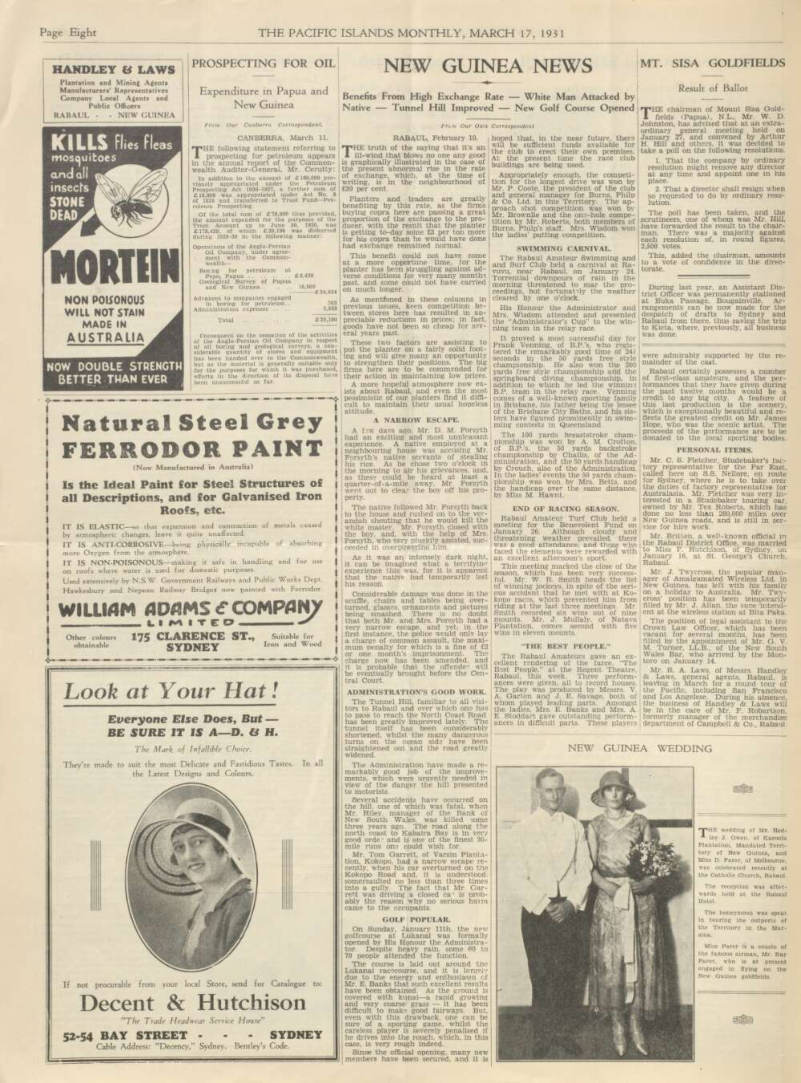
Prospecting For Oil
Expenditure in Papua and New Guinea
From Our Canberra Correspondent.
CANBERRA, March 11.
THE following statement referring to
prospecting for petroleum appears
in the annual report of the Common
wealth Auditor-General, Mr. Cerutty:
In addition to the amount of £ 160,000 pre viously appropriated under the Petroleum Prospecting Act 1926-1927, a further sum of £18,800 was appropriated under Act No. 8 of 1928 and transferred to Trust Fund—Pet roleum Prospecting.
Of the total sum of £78,800 thus provided, the amount expended for the purposes of the Trust Account up to June 30, 1930, was £178,439, of which £29,190 was disbursed during 1929-30 in the following manner: Operations of the Anglo-Persian Oil Company, under agree ment with the Common wealth — Boeing for petroleum at Popo, Papua £8,429 Geological Survey of Papua and New Guinea 16,505
Consequent on the cessation of the activities of the Anglo-Persian Oil Company in respect of oil boring and geological surveys, a con siderable quantity of stores and equipment has been handed over to the Commonwealth, but as the material is generally suitable only for the purposes for which it was purchased, efforts in the direction of its disposal have been unsuccessful so far.
£24,934 Advances to companies engaged in boring for petroleum..
S03 Administration expenses .. 3,953 Total £29,190
New Guinea News
Benefits From High Exchange Rate — White Man Attacked by Native — Tunnel Hill Improved — New Golf Course Opened
From Our Own Correspondent
RABAUL, February 10.
THE truth of the saying that it’s an ill-wind that blows no one any good is graphically illustrated in the case of the present abnormal rise in the rate of exchange, which, at the time of writing, is in the neighbourhood of £30 per cent.
Planters and traders are greatly benefiting by this rate, as the firms buying copra here are passing a great proportion of the exchange to the pro ducer, with the result that the planter is getting to-day some £3 per ton more for his copra than he would have done had exchange remained normal.
This benefit could not have come at a more opportune time, for the planter has been struggling against ad verse conditions for very many months past, and some could not have carried on much longer.
As mentfoned in these columns in previous issues, keen competition be tween stores here has resulted in ap preciable reductions in prices; in fact, goods have not been so cheap for sev eral years past.
These two factors are assisting to put the planter on a fairly solid foot ing and will give many an opportunity to strengthen their positions. The big firms here are to be commended for their action in maintaining low prices.
A more hopeful atmosphere now ex ists about Rabaul, and even the most pessimistic of our planters find it diffi cult to maintain their usual hopeless attitude.
A Narrow Escape.
A few davs ago, Mr. D. M. Forsyth had an exciting and most unpleasant experience. A native employed at a neighbouring house was accusing Mr.
Forsyth’s native servants of stealing his rice. As he chose two o’clock in the morning to air his grievances, and, as these could be heard at least a quarter-of-a-mile away, Mr. Forsyth went out to clear the boy off his pro perty.
The native followed Mr. Forsyth back to the house and rushed on to the ver andah shouting that he would kill the white master. Mr. Forsyth closed with the boy, and, with the help of Mrs.
Forsyth, who very pluckily assisted, suc ceeded in overpowering him.
As it was an intensely dark night, it can be imagined what a terrifying experience this was, for it is apparent that the native had temporarily lost his reason.
Considerable damage was done in the scuffle, chairs and tables being over turned, glasses, ornaments and pictures being smashed. There is no doubt that both Mr. and Mrs. Forsyth had a very narrow escape, and yet, in the first instance, the police would only lay a charge of common assault, the maxi mum penalty for which is a fine of £2 or one month’s imprisonment. The charge now has been amended, and it is probable that the offender will be eventually brought before the Cen tral Court.
Administration’S Good Work.
The Tunnel Hill, familiar to all visi tors to Rabaul and over which one has to pass to reach the North Coast Road has been greatly improved lately. The tunnel itself has been considerably shortened, whilst the many dangerous turns on the ocean side have been straightened out and the road greatly widened.
The Administration have made a re markably good job of the improve ments, which were urgently needed in view of the danger the hill presented to motorists.
Several accidents have occurred on the hill, one of which was fatal, when Mr. Hiley, manager of the Bank of New South Wales, was killed some three years ago. The road along the north coast to Kabaira Bay is in very good order and is one of the finest 30mile runs one could wish for.
Mr. Tom Garrett, of Varzin Planta tion, Kokopo, had a narrow escape re cently, when his car overturned on the Kokopo Road and, it is understood, somersaulted no less than three times into a gully. The fact that Mr. Gar rett was driving a closed cab is prob ably the reason why no serious harm came to the occupants.
Golf Popular.
On Sunday, January 11th, the new golfcourse at Lukanai was formally opened by His Honour the Administra tor. Despite heavy rain, some 60 to 70 people attended the function.
The course is laid out around the Lukanai racecourse, and it is largely due to the energy and enthusiasm of Mr. E. Banks that such excellent results have been obtained. As the ground is covered with kunai —a rapid growing and very coarse grass it has been difficult to make good fairways. But, even with this drawback, one can be sure of a sporting game, whilst the careless player is severely penalised if he drives into the rough, which, in this case, is very rough indeed.
Since the official opening, many new members have been secured, and it is
hoped that, in the near future, there will be sufficient funds available for the club to erect their own premises.
At the present time the race club buildings are being used.
Appropriately enough, the competi tion for the longest drive was won by Mr. P. Coote, the president of the club and general manager for Burns, Philp & Co. Ltd. in this Territory. The ap proach shot competition was won by Mr. Brownlie and the one-hole compe tition by Mr. Roberts, both members of Burns, Philp’s staff. Mrs. Wisdom won the ladies’ putting competition.
Swimming Carnival.
The Rabaul Amateur Swimming and and Surf Club held a carnival at Ra vuvu, near Rabaul, on January 24.
Torrential downpours of rain in the morning threatened to mar the pro ceedings, but fortunately the weather cleared by one o’clock.
His Honour the Administrator and Mrs. Wisdom attended and presented the “Administrator’s Cup” to the win ning team in the relay race.
It proved a most successful day for Frank Venning, of B.P.’s, who regis tered the remarkably good time of 24 s seconds in the 50 yards free style championship. He also won the 200 yards free style championship and the springboard diving championship, in addition to which he led the winning B.P. team in the relay race. Venning comes of a well-known sporting family in Brisbane, his father being the lessee of the Brisbane City Baths, and his sis ters have figured prominently in swim ming contests in Queensland.
The 100 yards breaststroke cham pionship was won by A. M. Crofton, of B.P.’s, the 50 yards backstroke championship by Challis, of the Ad ministration, and the 50 yards handicap by Crouch, also of the Administration.
In the ladies’ events the 50 yards cham pionship was won by Mrs. Betts, and the handicap over the same distance, by Miss M. Hawnt.
End Of Racing Season.
Rabaul Amateur Turf Club held a meeting for the Benevolent Fund on January 26. Although cloudy and threatening Weather prevailed, there was a good attendance, and those who faced the elements were rewarded with an excellent afternoon’s sport.
This meeting marked the close of the season, which has been very success ful. Mr. W. R. Smith heads the list of winning jockeys, in spite of the seri ous accident that he met with at Ko kopo races, which prevented him from riding at the last three meetings. Mr.
Smith recorded six wins out of nine mounts. Mr. J. Mullaly, of Natava Plantation, comes second with five wins in eleven mounts.
“The Best People.”
The Rabaul Amateurs gave an ex cellent rendering of the farce, “The Best People,” at the Regent Theatre, Rabaul, this week. Three perform ances were given, all to record houses.
The play was produced by Messrs. V.
A. Garton and J. E. Savage, both of whom played leading parts. Amongst the ladies, Mrs. E. Banks and Mrs. A.
E. Stoddart gave outstanding perform ances in difficult parts. These players
were admirably supported by the re mainder of the cast.
Rabaul certainly possesses a number of first-class amateurs, and the per formances that they have given during the past twelve months would be a credit to any big city. A feature of this last production is the scenery, which is exceptionally beautiful and re flects the greatest credit on Mr. James Hope, who was the scenic artist. The proceeds of the performance are to be donated to the local sporting bodies.
Personal Items.
Mr. C. S. Fletcher, Studebaker’s fac tory representative for the Far East, called here on S.S. Nellore, en route for Sydney, where he is to take over the duties of factory representative for Australasia. Mr. Fletcher was very in terested in a Studebaker touring car, owned by Mr. Tex Roberts, which has done no less than 280,000 miles over New Guinea roads, and is still in ser vice for hire work.
Mr. Britten, a well-known official in the Rabaul District Office, was married to Miss F. Hutchison, of Sydney, on January 16, at St. George’s Church, Rabaul.
Mr. J. Twycross, the popular man ager of Amalgamated Wireless Ltd. in New Guinea, has left with his family on a holiday to Australia. Mr. Twy cross’ position has been temporarily filled by Mr. J. Allan, the superintend ent at the wireless station at Bita Paka.
The position of legal assistant to the Crown Law Officer, which has been vacant for several months, has been filled by the appointment of Mr. G. V.
M. Turner, LL.B., of the New South Wales Bar, who arrived by the Mon toro on January 14.
Mr. R. A. Laws, of Messrs. Handley & Laws, general agents, Rabaul, is leaving in March for a round tour of the Pacific, including San Francisco and Los Angelese. During his absence, the business of Handley & Laws will be in the care of Mr. F. Robartson, formerly manager of the merchandise department of Campbell & Co., Rabaul.
Mt. Sisa Goldfields
Result of Ballot
THE chairman of Mount Sisa Gold fields (Papua), N.L., Mr. W. D.
Johnston, has advised that at an extra ordinary general meeting held on January 27, and convened by Arthur H. Hill and others, it was decided to take a poll on the following resolutions. 1. That the company by ordinary resolution might remove any director at any time and appoint one in his place. 2. That a director shall resign when so requested to do by ordinary reso lution.
The poll has been taken, and the scrutineers, one of whom was Mr. Hill, have forwarded the result to the chair man. There was a majority against each resolution of, in round figures, 2,500 votes.
This, added the chairman, amounts to a vote of confidence in the direc torate.
During last year, an Assistant Dis trict Officer was permanently stationed at Buka Passage, Bougainville. Ar rangements can be now made for the despatch of drafts to Sydney and Rabaul from there, thus saving the trip to Kieta, where, previously, all business was done.
New Guinea Wedding
THE wedding of Mr. Hed ley J. Owen, of Karoola Plantation, Mandated Terri tory of New Guinea, and Miss D. Parer, of Melbourne, was celebrated recently at the Catholic Church, Rabaul.
The reception was after wards held at the Rabaul Hotel.
The honeymoon was spent in touring the outports of the Territory in the Mar sina.
Miss Parer is a cousin of the famous airman, Mr. Ray Parer, who is at present engaged in flying on the New Guinea goldfields.
Advertisements & other items, p. 8 (2 items)
Norton
HANDLEY & LAWS
Plantation and Mining Agents Manufacturers’ Representatives Company Local Agents and Public Officers
RABAUL - - NEW GUINEA
NORTON
KILLS Flies Fleas
mosquitoes a insects
STONE
DEAD
NON POISONOUS
WILL NOT STAIN
MADE IN
AUSTRALIA
NOW DOUBLE STRENGTH
BETTER THAN EVER
Natural Steel Grey
FERRODOR PAINT
(Now Manufactured in Australia) Is the Ideal Paint for Steel Structures of
all Descriptions, and for Galvanised Iron
Roofs, etc,
IT IS ELASTIC— so that expansion and contraction of metals caused by atmospheric changes, leave it quite unaffected.
IT IS ANTI-CORROSIVE —being physically incapable of absorbing more Oxygen from the atmosphere.
IT IS NON-POISONOUS —making it safe in handling and for use on roofs where water is used for domestic purposes.
Used extensively by N.S.W. Government Railways and Public Works Dept.
Hawkesbury and Nepean Railway Bridget now painted with Ferrodor.
WILLIAM ADAMS & COMPANY
a» B f** 8 T E O —— Other colours 175 CLARENCE ST., Suitable for obtainable Ifon anc * Wooc *
Look at Yo !
Everyone Else Does , But BE SURE IT IS A—D. & H.
T he Mark of Infallible Choice.
They’re made to suit the most Delicate and Fastidious Tastes. In all the Latest Designs and Colours.
If not procurable from your local Store, send for Catalogue to:
Decent & Hutchison
"The Trade Headwear Service House” 52-54 BAY STREET - - - SYDNEY Cable Address: "Decency,” Sydney. Bentley’s Code.
News From Norfolk Island
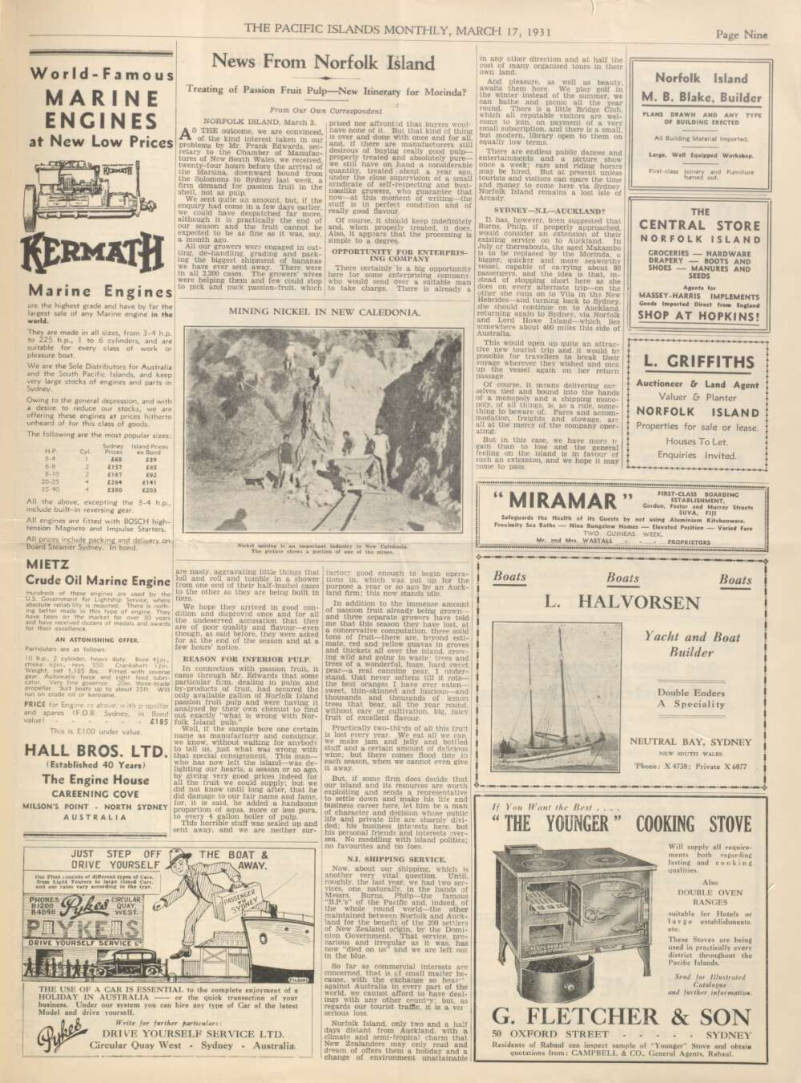
Treating of Passion Fruit Pulp—New Itinerary for Morinda?
From Our Own Correspondent
Norfolk Island, March 3.
AS THE outcome, we are convinced, of the kind interest taken in our problems by Mr. Frank Edwards, sec retary to the Chamber of Manufac tures of New South Wales, we received, twenty-four hours before the arrival of the Marsina, downward bound from the Solomons to Sydney last week, a firm demand for passion fruit in the shell, not as pulp.
We sent quite an amount, but, if the enquiry had come in a few days earlier, we could have despatched far more, although it is practically the end of our season and the fruit cannot be expected to be as fine as it was, say, a month ago.
All our growers were engaged in cut ting, de-handling, grading and pack ing the biggest shipment of bananas we have ever sent away. There were in all 2,200 cases. The growers’ wives were helping them and few could stop to pick and pack passion-fruit, which
are nasty, aggravating little things that loll and roll and tumble in a shower from one end of their half-bushel cases to the other as they are being built in tiers.
We hope they arrived in good con dition and disproved once and for all the undeserved accusation that they are of poor quality and flavour —even though, as said before, they were asked for at the end of the season and at a few hours’ notice.
Reason For Inferior Pulp.
In connection with passion fruit, it came through Mr. Edwards that some particular firm, dealing in pulps and by-products of fruit, had secured the only available gallon of Norfolk Island passion fruit pulp and were having it analysed by their own chemist to find out exactly “what is wrong with Nor folk Island pulp.”
Well, if the sample bore one certain name as manufacturer and consignor, we know, without waiting for anybody to tell us, just what was wrong with that special consignment. This man— who has now left the island—was de lighting our hearts, a season or so ago, by giving very good prices indeed for all the fruit we could supply; but we did not know until long after, that he did damage to our fair name and fame, for, it is said, he added a handsome proportion of aqua, more or less pura, to every 4 gallon boiler of pulp.
This horrible stuff was sealed up and sent away, and we are neither sur
prised nor affronted that buyers would have none of it. But that kind of thing is over and done with once and for all. and, if there are manufacturers still desirous of buying really good pulp— properly treated and absolutely pure— we still have on hand a considerable quantity, treated about a year ago, under the close supervision of a small syndicate of self-respecting and busi nesslike growers, who guarantee that now—at this moment of writing—the stuff is in perfect condition and of really good flavour.
Of course, it should keep indefinitely and, when properly treated, it does.
Also, it appears that the processing is simple to a degree.
Opportunity For Enterpris
Ing Company
There certainly is a big opportunity here for some enterprising company, who would send over a suitable man to take charge. There is already a
factory good enough to begin opera tions in, which was put up for the purpose a year or so ago by an Auck land firm; this now stands idle.
In addition to the immense amount of passion fruit already being grown— and three separate growers have told me that this season they have lost, at a conservative computation, three solid tons of fruit—there are, beyond esti mate, red and yellow guavas in groves and thickets all over the island, grow ing wild and going to waste: trees and trees of a wonderful, huge, hard sweet pear—a real canning pear. I under stand, that never softens till it rots— the best oranges I have ever eaten— sweet, thin-skinned and luscious —and thousands and thousands of lemon trees that bear, all the year round, without care or cultivation, big, juicy fruit of excellent flavour.
Practically two-thirds of all this fruit is lost every year. We eat all we can we make jam and jelly and bottled stuff and a certain amount of delicious wine; but there comes flood tide in each season, when we cannot even give it away.
But, if some firm does decide that our island and its resources are worth exploiting and sends a representative to settle down and make his life and business career here, let him be a man of character and decision whose public life and private life are sharply divi ded; his business interests here, but his personal friends and interests over sea. No meddling with island politics; no favourites and no foes.
N.I. Shipping Service.
Now, about our shipping, which is another very vital question. Until, roughly, the last year, we had two ser vices, one, naturally, in the hands of Messrs. Burns, Philp—the famous “B.P.’s” of the Pacific and, indeed, of the whole round world —the other maintained between Norfolk and Auck land for the benefit of the 200 settlers of New Zealand origin, by the Domi nion Government. That service, pre carious and irregular as it was, has now “died on us” and we are left out in the blue.
So far as commercial interests are concerned, that is of small matter be cause, with the exchange so heavily against Australia in every part of the world, we cannot afford to have deal ings with any other country; but. as regards our tourist traffic, it is a very serious loss.
Norfolk Island, only two and a half days distant from Auckland, with a climate and semi-tropical charm that New Zealanders may only read and dream of offers them a holiday and a change of environment unattainable
in any ether direction and at half the cost of many organised tours in their own land.
And pleasure, as well as beauty, awaits them here. We play golf in the winter instead of the summer, we can bathe and picnic all the year round. There is a little Bridge Club, which all reputable visitors are wel come to join, on payment of a very small subscription, and there is a small, but modern, library open to them on equally low terms.
There are endless public dances and entertainments and a picture show once a week; cars and riding horses may be hired. But at present unless tourists and visitors can spare the time and money to come here via Sydney Norfolk Island remains a lost isle of Arcady.
Sydney—N.I.—Auckland?
It has, however, been suggested that Burns. Philp, if properly approached, would consider an extension of their existing service on to Auckland. In July or thereabouts, the aged Makambo is to be replaced by the Morinda, a bigger, quicker and more seaworthy vessel, capable of carrying about 80 passengers, and the idea is that, in stead of stopping short here as she does on every alternate trip—on the other she runs on to Vila in the New Hebrides —and turning back to Sydney, she should continue on to Auckland returning again to Sydney, via Norfolk and Lord Howe Island—which lies somewhere about 400 miles this side of Australia.
This would open up quite an attrac tive new tourist trip and it would be possible for travellers to break their voyage wherever they wished and pick up the vessel again on her return passage.
Of course, it means delivering our selves tied and bound into the hands of a monopoly and a shipping mono poly, of all things, is, as a rule, some thing to beware of. Fares and accom modation, freights and stowage, are all at the mercy of the company oper ating.
But in this case, we have more to gain than to lose and the general feeling on the island is in favour of such an extension, and we hope it may come to pass.
Advertisements & other items, pp. 9-10 (3 items)
Mining Nickel In New Caledonia.
Nickel mining is an important industry in New Caledonia.
The picture shows a portion of one of the mines.
Marine
World-Famous
ENGINES
at New Low Prices
Marine Engines
are the highest grade and have by far the largest sale of any Marine engine in the world.
They are made in all sizes, from 3-4 h.p. to 225 h.p., 1 to 6 cylinders, and are suitable for every class of work or pleasure boat.
We are the Sole Distributors for Australia and the South Pacific Islands, and keep very large stocks of engines and parts in Sydney.
Owing to the general depression, and with a desire to reduce our stocks, we are offering these engines at prices hitherto unheard of for this class of goods.
The following are the most popular sizes: All the above, excepting the 3-4 h.p., include built-in reversing gear.
All engines are fitted with BOSCH hightension Magneto and Impulse Starters.
All prices include packing and delivery xin Board Steamer Sydney. In bond.
MIETZ
Crude Oil Marine Engine
Hundreds of these engines are used by the U.S. Government for Lightship Service, where absolute reliablity is required. There is noth ing better made in this type of engine. They have been on the market for over 30 years and have received dozens of medals and awards for their excellence.
AN ASTONISHING OFFER.
Particulars are as follows: 10 h.p., 2 cylinder, heavy duty. Bore stroke 63-in., revs. 550. Crankshaft 1 |in.
Weight, net 1,135 lbs. Fitted with reverse gear. Automatic force and sight feed lubricator. Very fine governor. 20in. three-blade propeller. Suit boats up to about 35ft. Will run on crude oil or kerosene.
PRICE for Engine as above, with p opellsr and spares (F. 0.8. Sydney, in Bond value) - - - - - - £185 This is £100 under value.
HALL BROS. LTD.
(Established 40 Years)
The Engine House
CAREENING COVE
WILSON’S POINT - NORTH SYDNEY
AUSTRALIA
JUST STEP OFF
DRIVE YOURSELF
THE BOAT &
AWAY.
Our Fleet consists of different types of Cars, from Light Tourers to large closed Cars, and our rates vary according to the type.
PHONES
81200 84848
DRIVE YOURSELF
ERVICE
FIL&OK
THE USE OF A GAR IS ESSENTIAL to the complete enjoyment of a HOLIDAY IN AUSTRALIA or the quick transaction of your business. Under our system you can hire any type of Gar of the latest Model and drive yourself.
Write for further particulars :
DRIVE YOURSELF SERVICE LTD.
Circular Quay West - Sydney - Australia
G. Fletcher & Son
Norfolk Island
M. B. Blake, Builder
PLANS DRAWN AND ANY TYPE
OF BUILDING ERECTED
All Building Material Imported.
Large, Well Equipped Workshop.
First-class Joinery and Furniture turned out.
THE
CENTRAL STORE
NORFOLK ISLAND
GROCERIES HARDWARE
DRAPERY BOOTS AND
SHOES MANURES AND
SEEDS
Agents for
MASSEY-HARRIS IMPLEMENTS
Goods Imported Direct from England
SHOP AT HOPKINS!
L. GRIFFITHS
Auctioneer fir Land Agent Valuer & Planter
NORFOLK ISLAND
Properties for sale or lease.
Houses To Let.
Enquiries Invited.
“MIRAMAR” r 0
Cordon, Foster and Murray Streets
SUVA, FIJI
Safeguards the Health of its Guests by not using Aluminium Kitchenware.
Proximity Sea Baths Nine Bungalow Homes Elevated Position Varied Fare
TWO GUINEAS WEEK.
Mr. and Mrs. WASTALL - . PROPRIETORS
Boats Boats Boats
L. HALVORSEN
Yacht and Boat Builder Double Enders A Speciality
NEUTRAL BAY, SYDNEY
NEW SOUTH WALES
’Phone: X 4738; Private X 6077
If You Want the Best ...
“THE YOUNGER” COOKING STOVE
Will supply all requirements both regarding lasting and cooking qualities.
Also
DOUBLE OVEN
RANGES
suitable for Hotels or large establishments, etc.
These Stoves are being used in practically every district throughout the Pacific Islands.
Send for Illustrated Catalogue and further information.
G. FLETCHER & SON
50 OXFORD STREET SYDNEY
Residents of Rabaul can inspect sample of “Younger” Stove and obtain quotations from: CAMPBELL & CO., General Agents, Rabaul.
For Scrubbing and Cleaning use
BE WISE! - - - SAVE THE RATE OF EXCHANGE.
ORDER YOUR SAILS NOW
From
HARRY WEST
SYDNEY’S SAILMAKER
Sail Makers for 26 years.
Tarpaulins specially made for tropical climates.
Let next Spring find this part of your equipment ready. Have West make your Sails, Awnings and Upholstery. Tents and every class of canvas work a speciality. If it’s in canvas, rope or wire, we make it to any specification.
FOOT DUKE STREET - - - BALMAIN EAST 'Phone W 1105
Use
The Direct Wireless Service
With Australia & Overseas
for your communications MODERN high-speed direct wireless services are now in operation between Port Moresby and Sydney, Rabaul and Sydney, Noumea and Sydney, and Fiji and Sydney.
Speedy, economical and efficient service to Australia and overseas. Route your traffic “Via the Wireless Service Lodge your message at the Wireless Stations.
For Great Britain, North and South Amercia Vj and all European Countries, route your message “VIA BEAM” the longest direct wireless telegraph service in the world.
AMALGAMATED WIRELESS (AUSTRALASIA) LTD.
iJCT A I The Wonderful Alloy of Nickel & Coppe m vlt CL m C I L. The Best Metal for Propeller Shafts, etc Strong as Steel. - Is not affected by salt water. - Stocks include Sheets, Rods, Bars, Wire, Tubes, etc.
Australian Distributors:
FERRIER & DICKINSON LTD.
26 CLARENCE STREET - - SYDNEY - - N.S.W. - - AGENTS
How Fiji Is Facing the Depression
Interview With Sir Maynard Hedstrom
FIJI, like other tropical colonies, is facing a rather lean period, but its resources are very largely undeveloped, its Government has been sound and sane, and, when the present depression is passed and producers have adjusted themselves to new conditions, there should be a return of a reasonable measure of prosperity.
THIS was the opinion expressed by Sir Maynard Hedstrom, Managing Director of Messrs. Morris, Hedstrom Ltd., and president of the Suva Cham ber of Commerce, who arrived in Sydney by the last trip of the Sierra.
He said that the year 1930 had not been a very prosperous one for Fiji, ow ing to the low price of the two staple products—sugar and copra—and owing also, in a lesser degree, to the dimin ished production of bananas caused by the heavy storm and floods at the end of 1929. In 1930 the export of sugar was 90,976 tons, as compared with 72,275 tons in 1929; the export of copra was 23,833 tons, as compared with 33,226 tons in 1929.
The revenue collected through the Customs House for 1930 was £336,056 as compared with £369,552 in 1929. Sir Maynard said that it was not expected that this year would show any improve ment over 1930—the revenue to be col lected through this source was estimated at £326,130. The total revenue for the Colony was estimated at £603,689 and the expenditure at £622,541. This showed an estimated deficit of £18,852 to be met from surplus funds.
To bridge the gap between revenue and expenditure, additional Customs duties had been imposed.
He stated that unless prices for trop ical products improved. Government finance would offer difficult problems during the next two or three years.
For 1931, the estimated Government ex penditure was equal to more than 50 per cent, of the total estimated value of exports. Primary producers were passing through a very difficult time and further taxation could not be viewed with equanimity: at the same time re duction of public services would be difficult to arrange.
Sir Maynard explained that the sugar industry was still the mainstay of the Colony. Its continued production, how ever, was only rendered possible by the measure of preference extended to Em pire sugar by Great Britain and Canada.
There still existed the anomalous position that, while Fiji sugar was ship ped to those two countries, the require ments of New Zealand were imported from Cuba.
For some years Fiji had granted pre ference to Empire goods—this prefer ence being approximately 15 per cent, on the invoice value of the goods. The most noticeable effect of this prefer ence, he said, had been to transfer a certain amount of trade from the United States to Canada; it also had some effect in encouraging the impor tation of goods from Great Britain rather than from the Continent.
Extension Of Roads
He considered that road development in Fiji had been very slow, but consid erable progress was anticipated during the next three years. It was intended to raise a loan for the completion of the trans-insular road connecting Suva with Lautoka. A further section of road was to be constructed on the south western side of Viti Levu and a large bridge was to be erected over the Rewa River. The Empire Development Board had agreed to assist in these under
takings by granting the colony a sum estimated to be sufficient to pay interest on the loan for three years.
The Pineapple Industry
It was generally agreed, said Sir May nard, that the most hopeful prospect for the near future was the development of the pineapple canning industry. Two small factories were now operating and turning out a very high grade of fruit.
The Hawaiian Pineapple Co. Ltd., of Honolulu, had an option over two blocks of land aggregating about 65,000 acres.
They were now carrying out experi mental operations.
Colonists were hopeful that this in dustry, which has been so prosperous in Hawaii, may be established in Fiji, where conditions for the cultivation and canning of pineapples are at least as favourable as in Hawaii.
Fiji Trade Relations
As a matter of interest, he mentioned that the Government had recently ap pointed a committee to consider the possibility of improving trade relations with other portions of the British Em pire.
This committee found that, according to the trade returns for 1929 —the latest year for which the figures were avail able —imports from foreign countries amounted to 121 per cent, of the whole, and exports to foreign countries am ounted to about 271 per cent, of the whole. Included in the imports from foreign countries were petroleum pro ducts, which could not, under present conditions, be bought within the Em pire. After deducting the value of these, the imports of ordinary trade goods from foreign countries amounted to 9 per cent, of the total.
The committee expressed the opinion that this position was satisfactory from an Empire trading point of view and that it would be inadvisable to take any further action.
Sir Maynard Hedstrom
Adventurous Crossing
From T.I. to Port Moresby Capt. Liston-Blyth Safe
From Our Papua Correspondent.
Pt. Moresby, Feb. 10.
Captain Liston-Blyth, Manager
of transport for the new company, which is developing sago and nipa in the west of Papua, has had adventures lately worthy of de Rougemont.
He was reported to have left Thurs day Island in a small launch on Jan uary 20 for Daru, Papua, with a crew of two natives.
Later, the crew of the David Pitt reported that they had seen Captain Blyth’s launch thirty miles from Thurs day Island on January 21, travelling between the islands of Nagi and Moa, in difficulties, and broken down. Pre viously. the Aramia had made a trip to Thursday Island and back to Daru
without sighting or hearing of the missing launch. The Aramia supposed that she had put back to Thursday Island, but on the Aramia’s arrival there, it was found not to be the case, and that nothing had been heard of her. No trace of the launch was dis covered on the Aramia’s return trip to Daru.
Thursday Island was advised at once, and the David Pitt from Daru left im mediately in search.
Later, the Papuan Government re ceived advice that on January 24. the missing launch had sheltered at Nagi, when the chain parted, and one of the crew had swum ashore and returned by a passing lugger to Thursday Island on January 30, reporting the launch being in a disabled condition and drift ing in a south-easterly direction.
Up to February 5 no news of her whatever had come in and grave fears were entertained for Captain Blyth and his crew of one, owing to the bad weather prevailing, which prevented further search parties going out. The ketch Melbedir had already returned to Thursday Island reporting no trace of the launch.
Port Moresby Reached.
To the amazement of the people in Port Moresby, on the evening of Feb ruary 6, there appeared inside the reef a disabled launch under jury-rig, sig nalling for help. Captain Blyth and his missing crew had arrived!
They had had a miraculous escape.
Wild days had been experienced, dur ing which the launch had been at the mercy of the stormy waves.
Captain Blyth is to be congratulated on his feat of bringing the craft safely to Port Moresby. The native crew, it is reported, became quite out of hand and untractable.
Beche-de-Mer Fishing
The Industry at Torres Straits
From Our Thursday Island Correspondent
Thursday Is., March 5.
THE two minor marine products that contribute to Thursday Island’s wealth beche-de-mer and trochus shell —are likely to supersede pearling as the main source of industry until the market for M.O.P. looks up, and it is satisfying to know that work in these departments will go on in spite of the slump.
Luggers engaged in this class of work are fitted up to prepare either kind of product, both requiring boiling, and beche-de-mer curing by smoke in addi tion.
The whole length of the Barrier, from its lonely northern tip at Bram ble Cay down to the southern extrem ity, which is below the tropic of Cap ricorn, is ransacked every year by the indefatigible Japs, in charge of the fleet. Besides the main reef there are countless smaller ones, including the famous Warrior Reef, which has yield ed so much treasure to the total export, and also many parts of the mainland beaches give a fertile yield.
The demand for beche-de-mer is always steady, but the price fluctuates in sympathy with the exchange be tween China and Australia. The re cent drop in the Hongkong dollar nat urally resulted in a fall in price, but a slight recovery in the former is record ed, and the dollar is now stationery at 21 to the pound sterling.
Some changes in the organisation of the fishing industry is recorded this year. Only three Japanese are allowed on each lugger, and, as these will be fully occupied with curing and navi gating, more responsibility will be thrown on the native divers, who are notoriously lazy, unless watched.
Advertisements & other items, p. 10 (1 item)
Johnstons
IS ALUMINIUM KITCHENWARE POISONOUS?
Learn the facts and judge for yourselves Free Literature to any address, from
A. WASTAUL
“MIRAMAR,” SUVA, FIJI
COLONY OF FIJI
For information regarding Fiji read the
“Fiji Handbook,” an official publication,
beautifully illustrated. Obtainable from :
The Government Printer, Suva, Fiji;
Dalgety & Co. Ltd., Sydney; L. D.
Nathan & Co. Ltd., Auckland. Price: Cloth board 6/-, paper cover 4/-.
SELF INSTRUCTORS FREE WITH ALL
INSTRUMENTS
Portable Phonographs (Micro perophone), £8/8/-.
JOHNSTONS
Musical Instrument Stores
211-215 GEORGE ST., SYDNEY
Australia’s GISt
to Humanity
In Pain!
Vincent’s A.P.C.
Prepared on the scientific formula now in use in the largest hospitals in Australia. Recommended with safety by your Doctor, Chemist, Dentist, Nurse.
Headache, Neuralgia, Neuritis, Sciatica, Rheumatism, Backache, Sleeplessness, Influenza,
STOPS
PAIN
SAFELY
All Chemists and Stores, or direct from Vincent Chemical Co.
Sydney.
Abdominal Pains in Woman
Beware of
Imitations
genuine
Pink
DO NOT AFFECT THE
HEART OR NERVES
Powders and Tablets, 1/6 & 2/6
Products Of The South Seas
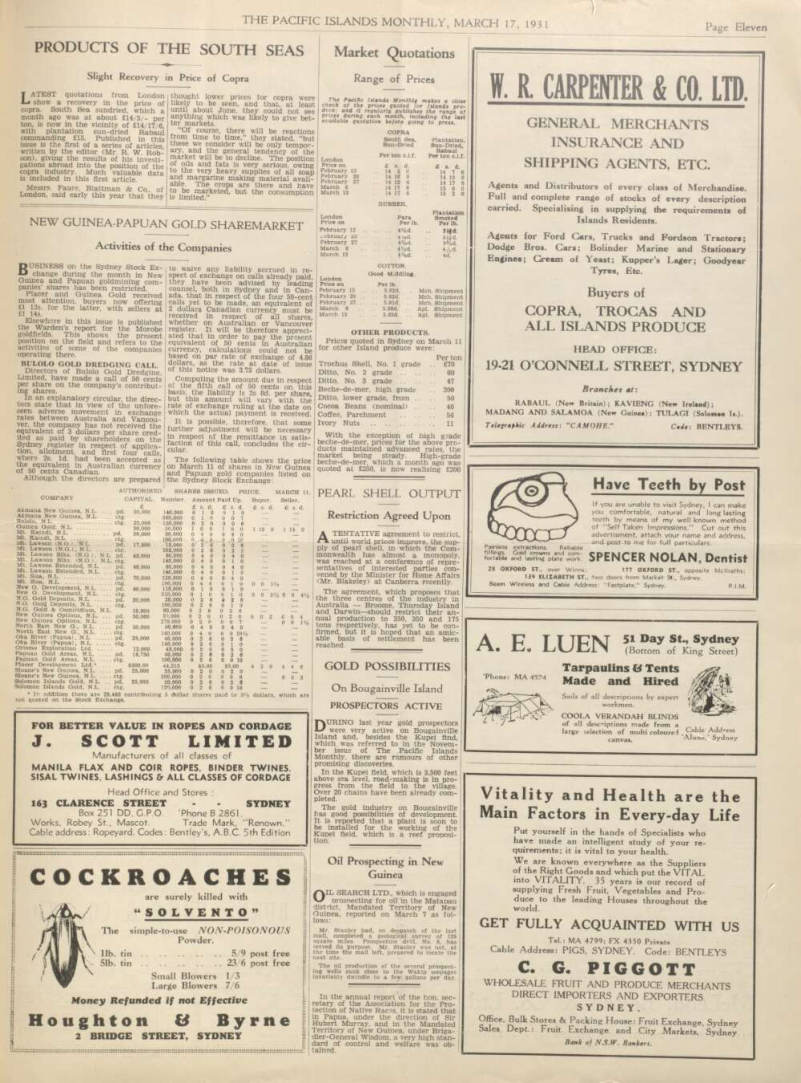
Slight Recovery in Price of Copra
LATEST quotations from London show a recovery in the price of copra. South Sea sundried, which a month ago was at about £14/5/- per ton. is now in the vicinity of £14/17/6, with plantation sun-dried Rabaul commanding £15. Published in this issue is the first of a series of articles written by the editor (Mr. R. W. Rob son), giving the results of his investi gations abroad into the position of the copra industry. Much valuable data is included in this first article.
Messrs. Faure, Blattman & Co of London, said early this year that they
thought lower prices for copra were likely to be seen, and that, at least until about June, they could not see anything which was likely to give bet ter markets.
“Of course, there will be reactions from time to time,” they stated, “but these we consider will be only tempor ary, and the general tendency of the market will be to decline. The position of oils and fats is very serious, owing to the very heavy supplies of all soap and margarine making material avail able. The crops are there and have to be marketed, but the consumption is limited.”
New Guinea-Papuan Gold Sharemarket
Activities of the Companies
BUSINESS on the Sydney Stock Ex change during the month in New Guinea and Papuan goldmining com panies’ shares has been restricted.
Placer and Guinea Gold received most attention, buyers now offering £1 12s. for the latter, with sellers at £1 14s.
Elsewhere in this issue is published the Warden’s report for the Morobe goldfields. This shows the present position on the field and refers to the activities of some of the companies operating there.
Bulolo Gold Dredging Call.
Directors of Bulolo Gold Dredging Limited, have made a call of 50 cents per share on the company’s contribut ing shares.
In an explanatory circular, the direc tors state that in view of the unfore seen adverse movement in exchange rates between Australia and Vancou ver, the company has not received the equivalent of 3 dollars per share cred ited as paid by shareholders on the Sydney register in respect of applica tion, allotment, and first four calls, where 2s. 1d. had been accepted as the equivalent in Australian currency of 50 cents Canadian.
Although the directors are prepared
to waive any liability accrued in re spect of exchange on calls already paid, they have been advised by leading counsel, both in Sydney and in Can ada, that in respect of the four 50-cent calls yet to be made, an equivalent of 2 dollars Canadian currency must be received in respect of all shares, whether on Australian or Vancouver register. It will be therefore appreci ated that in order to pay the present equivalent of 50 cents in Australian currency, calculations could not be based on par rate of exchange of 4.86 dollars, as the rate at date of issue of this notice was 3.73 dollars.
Computing the amount due in respect of the fifth call of 50 cents on this basis, the liability is 2s 8d. per share, but this amount will vary with the rate of exchange ruling at the date on which the actual payment is received.
It is possible, therefore, that some further adjustment will be necessary in respect of the remittance in satis faction of this call, concludes the cir cular.
The following table shows the price on March 11 of shares in New Guinea and Papuan gold companies listed on the Sydney Stock Exchange;
Authorised Shares Issued.
Price. March 11
Company
Capital.
Number.
Amount Paid Up.
Buyer.
Seller Akmana New Guinea, N.L. pd. £ 30,000 140,000 £ 0 S. 1 d. 0 £ 0 S. 1 d. o £ s. d. £ S. d.
Akinana New Guinea, N.L. ctg. 360,000 0 i n 0 0 7
Bulolo, N.L
25.000 150,000 0 2 0 0 0 6 Guinea Gold. N.L 50,000 50,000 1 0 0 1 0 0 1 12 0 1 14 o Mt. Kalndi, N.L . . pd. 50,000 90,000 0 4 0 0 4 0 Mt. Kaindi, N.L
... ctg.
160,000 0 4. 0. 0 .0. 10 Mt. Lawson (N.G.i, N.L • • • • pd. 17,500 18,000 0 2 6 0 2 6 Mt. Lawson (N.G.), N.L. . ... ctg. 103,000 0 2 6 0 •> 3 Mt. Lawson Blks. (N.G.), N L pd. 48,000 80,000 0 4 0 0 4 0 Mt. Lawson Blks. (N.G.) N.L. ctg. 140,000 0 4 0 0 1 0 Mt. Lawson Extended. N.L, ... pd. 48.000 80,000 0 4 0 0 4 0 Mt. Lawson Extended, N L ctg. 140,000 0 4 0 0 1 0 Mt. Sisa, N.L. . 70,000 120.000 0 4 0 0 4 0 Mt. Sisa, N.L. . . 190,000 0 4 0 0 1 9 0 0 5V 2 New G. Development, N.L. pd. 40,000 110,000 0 1 0 0 1 0 New G. Development. N.L.
... ctg.
510.000 0 1 0 0 1 0 0 0 3Va 0 0 41/2 N.u. Gold Deposits, N.L. . . . pd. 20,000 20,000 0 2 « 0 2 6 N.G. Gold Deposits, N.L. . . .. ctg. 100,000 0 2 6 0 1 9 N.G. Gold & Osmlridium, N.L. 10,000 80,000 0 2 6 0 2 6 New Guinea Options. N.L. ... pd. 50,000 51,000 0 2 0 0 2 0 0 0 2 0 0 4 New Guinea Options, N.L. ... ctg. 279,000 0 2 n 0 0 7 0 0 1 >4, North East New G., N.L. . . . . pd. 50,000 90,000 0 4 0 0 4 0 North East New G.. N.L.
. ... ctg.
140,000 0 4 0 0 0 10 V 2 Oba River (Papua). N.L. . pd. 25,000 40,000 0 2 6 0 2 6 Oba River (Papua), N.L. . ctg. 140.000 0 2 6 0 1 0 Oriomo Exploration Ltd. , 12,000 48,000 0 5 0 0 5 0 Papuan Gold Areas, N.L. ... pd. 18,750 40,000 0 2 « 0 2 6 Papuan Gold Areas, N.L. ctg. 100,000 0 2 6 0 0 10 Placer Development Ltd.* $500.00 44,515 $5 00 $5.00 4 2 0 4 4 6 Sloane’s New Guinea. N.L. pd. 25,000 25,000 0 2 0 0 2 0 Sloane’s New Guinea, N L. ctg. 200,000 0 2 0 0 0 8 0 0 3 Solomon Islands Gold, N.L .. pd. 25,000 20,000 0 2 6 0 2 S Solomon Islands Gold. N.L .. ctg. 120,000 0 2 6 0 0 10 — * In addition there are 25.485 contributing 5 dollar shares paid to 3Va dollars, which are not quoted on the Stock Exchange.
Market Quotations
Range of Prices
The Pacific Islands Monthly makes a close check of the prices quoted for Islands pro duce; and it regularly publishes the range of prices during each month, including the last available quotation before going to press.
London Price on
Copra
South Sea, Sun-Dried Per ton c.i.f. £ s. d.
Plantation,
Sun-Dried,
Rabaul Per ton c.i.f. £ s. d.
February 13 14 5 0 14 7 6 February 20 . 14 10 0 14 12 6 February 27 14 12 6 14 17 6 March 6 14 17 6 15 0 0 March 13 .. 14 17 6 15 2 6 London
Rubber.
Para Plantation Smoked Price on Per lb. Per lb.
February 13 4>4d. 3«« * ebruary 20 . 4-,»d. 3}Jd.
February 27 ... . 4%d. 3 3 C,d.
March 6 4 l /zd. 4Ad March 13 4 3 *d. 4d.
London Price on February 13 .
Cotton.
Good Middling Per lb. . .. 5.82d. ..
Mch. Shipment February 20 . . . 5.92d. . .
Mch. Shipment February 27 . ,. 5.91d. ..
Mch. Shipment March 6 .. 5.99d. ..
Apl. Shipment March 13 .. 5.83d. ..
Apl. Shipment
Other Products.
Prices quoted in Sydney on March 11 for other Island produce were:
With the exception of high grade beche-de-mer, prices for the above pro ducts maintained advanced rates, the market being steady. High-grade beche-de-mer, which a month ago was quoted at £250, is now realising £200
Trochus Shell, No. 1 grade Per ton .. £70 Ditto, No. 2 grade .. .. .. 60 Ditto, No. 3 grade 47 Beche- -de-mer, high grade .. 200 Ditto, lower grade, from .. .. 50 Cocoa Beans (nominal) .. .. 40 Coffee Parchment 56 Ivory Nuts 11
Restriction Agreed Upon
Pearl Shell Output
A TENTATIVE agreement to restrict, until world prices improve, the sup ply of pearl shell, in which the Com monwealth has almost a monopoly, was reached at a conference of repre sentatives of interested parties con vened by the Minister for Home Affairs (Mr. Blakeley) at Canberra recently.
The agreement, which proposes that the three centres of the industry in Australia Broome, Thursday Island and Darwin—should restrict their an nual production to 350, 350 and 175 tons respectively, has yet to be con firmed. but it is hoped that an amic able basis of settlement has been reached.
Gold Possibilities
On Bougainville Island
Prospectors Active
DURING last year gold prospectors were very active on Bougainville Island and, besides the Kupei find, which was referred to in the Novem ber issue of The Pacific Islands Monthly, there are rumours of other promising discoveries.
In the Kupei field, which is 3,500 feet above sea level, road-making is in pro gress from the field to the village.
Over 20 chains have been already com pleted.
The gold industry on Bougainville has good possibilities of development.
It is reported that a plant is soon to be installed for the working of the Kupei field, which is a reef proposi tion.
Oil Prospecting in New
Guinea
OIL SEARCH LTD., which is engaged nrosnecting for oil in the Matanau district. Mandated Territory of New Guinea, reported on March 7 as fol lows: Mr. Stanley had, on despatch of the last mall, completed a geological survey of 125 square miles. Prospecting drill, No. 8, has served its purpose. Mr. Stanley was not, at the time the mail left, prepared to locate the next site.
The oil production of the several prospect ing wells sunk close to the Waklp seepages invariably dwindle to a few gallons per day.
In the annual report of the hon. sec retary of the Association for the Pro tection of Native Races, it is stated that in Papua, under the direction of Sir Hubert Murray, and in the Mandated Territory of New Guinea, under Briga dier-General Wisdom, a very high stan dard of control and welfare was ob tained.
Advertisements & other items, p. 11 (2 items)
W. R. Carpenter & Co. Ltd.
GENERAL MERCHANTS
INSURANCE AND
SHIPPING AGENTS, ETC.
Agents and Distributors of every class of merchandise.
Full and complete range of stocks of every description carried. Specialising in supplying the requirements of Islands Residents.
Agents for Ford Gars, Trucks and Pordson Tractors; Dodge Bros. Gars; Bolinder Marine and Stationary Engines; Gream of Yeast; Kupper’s Lager; Goodyear Tyres, Etc.
Buyers of
COPRA, TROCAS AND
ALL ISLANDS PRODUCE
HEAD OFFICE:
19-21 O’CONNELL STREET, SYDNEY
Branches at: RABAUL (New Britain); KAVIENG (New Ireland); MADANG AND SALAMOA (New Guinea); TULAGI (Soloman Is.).
Telegraphic Address : "CAMOHE ." Cede: BENTLEYS.
Have Teeth by Post'
Painless extractions. Reliable fillings. Cold crowns and comfortable and lasting plate work.
If you are unable to visit Sydney, I can make you comfortable, natural and long lasting teeth by means of my well known method of “Self Taken Impressions.” Cut out this advertisment, attach your name and address, and post to me for full particulars.
SPENCER NOLAN, Dentist
28 OXFORD ST., over Winns; 177 OXFORD ST., opposite Mcllraths; 139 ELIZABETH ST., two doors from Market St., Sydney.
Beam Wireless and Cable Address: “Fastplate," Sydney. P.I.M.
A F T ITFNT 51 Day * u s y dM ®y
(Bottom of King Street)
’Phone: MA 4574
Tarpaulins & Tents
Made and Hired
Sails of all descriptions by expert workmen.
COOLA VERANDAH BLINDS
of all descriptions made from a large selection of multi coloured canvas.
Cable Address Alune,’ Sydney
Vitality and Health are the
Main Factors in Every-day Life
Put yourself in the hands of Specialists who have made an intelligent study of your requirements; it is vital to your health.
We are known everywhere as the Suppliers of the Right Goods and which put the VITAL into VITALITY. 35 years is our record of supplying Fresh Fruit, Vegetables and Produce to the leading Houses throughout the world.
GET FULLY ACQUAINTED WITH US
Tel.: MA 4799; FX 4350 Private Cable Address: PIGS, SYDNEY. Code: BENTLEYS
C. G. PIGGOTT
WHOLESALE FRUIT AND PRODUCE MERCHANTS
DIRECT IMPORTERS AND EXPORTERS.
SYDNEY.
Office, Bulk Stores & Packing House: Fruit Exchange, Sydney Sales Dept.: Fruit Exchange and City Markets, Sydney Bank of N.S.W. Bankers.
Cockroaches
FOR BETTER VALUE IN ROPES AND CORDAGE
J. SCOTT LIMITED
Manufacturers of all classes of MANILA FLAX AND COIR ROPES, BINDER TWINES, SISAL TWINES, LASHINGS & ALL CLASSES OF CORDAGE Head Office and Stores :
163 CLARENCE STREET - - SYDNEY
Box 251 DD, C.P.O. ’Phone B 2861.
Works, Robey St., Mascot. Trade Mark, “Renown.”
Cable address: Ropeyard. Codes: Bentley’s, A.B.C. sth Edition
COCKROACHES
are surely killed with
“SOLVENTO”
The simple-to-use NOIV-POISONOUS Powder. 1lb. tin 5/9 post free 5lb. tin 23/6 post free Small Blowers 1/3 Large Blowers 7/6 Money Refunded if not Effective
Houghton & Byrne
2 BRIDGE STREET, SYDNEY
Shipping Services in The Pacific
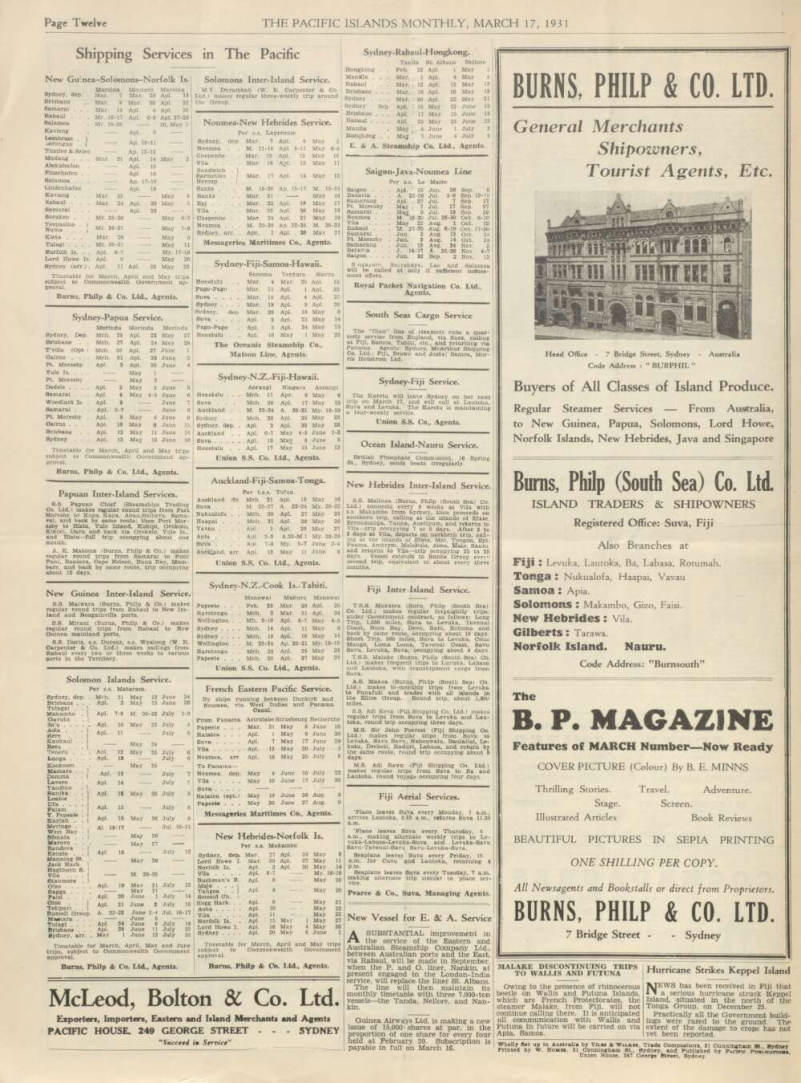
New Gu'nea-Solomons—Norfolk Is,
Sydney-Papua Service.
Papuan Inter-Island Services.
S.S. Papuan Chief (Steamships Trading Co. Ltd.) makes regular round trips from Port Moresby to Kapa Kapa, Abau, Baibara, Sama rai, and back by same route; then Port Mor esby to Hlsiu, Yule Island, Kuklpi, Orokolo, Klkori, Dam and back via Orokolo, Yule Is., and Hisiu—full trip occupying about one month.
A. K. Matoma (Burns, Philp & Co.) makes regular round trips from Samarai to Puni Puni, Baniara, Cape Nelson, Buna Bay, Mam bare, and back by same route, trip occupying about 12 days.
New Guinea Inter-Island Service.
S.S. Maiwara (Burns, Philp & Co.) makes regular round trips from Rabaul to New Ire land and Bougainville ports.
S.S. Mirani (Burns, Philp & Co.) makes regular round trips from Rabaul to New Guinea mainland ports.
S.S. Duris, s.s. Durour, s.s. Wyalong (W. R.
Carpenter & Co. Ltd.) makes sailings from Rabaul every two or three weeks to various ports in the Territory.
Solomon Islands Service.
Solomons Inter-Island Service-
M.V. Durambah (W. R. Carpenter & Co.
Ltd.) makes regular three-weekly trip around the Group,
Noumea-New Hebrides Service.
Sydney-Fiji-Samoa-Hawaii.
Sydney-N.Z.-Fiji-Hawaii.
Auckland-Fiji-Samoa-Tonga.
Sydney-N.Z.-Cook Is.-Tahiti.
French Eastern Pacific Service.
By ships running between Dunkirk and Noumea, via West Indies and Panama Canal.
New Hebrides-Norfolk Is.
Sydney-Rabaul-Hongkong.
Saigon-J ava-Noumea Line
S ngapore, Sourabaya, Lae and Salamoa will be called at only if sufficient induce ment offers.
Royal Packet Navigation Cos. Ltd.,
Agents.
South Seas Cargo Service
The “Clan” line of steamers runs a quar terly service from England, via Suez, calling at Fiji, Samoa, Tahiti, etc., and returning via Panama. Agents; Sydney, McArthur Shipping Cos. Ltd.; Fiji, Brown and Joskef Samoa, Mor ris Hedstrom Ltd.
Sydney-Fiji Service.
The Karetu will leave Sydney on her next trip on March 17, and will call at Lautoka, Suva and Levuka. The Karetu is maintaining a four-weekly service.
Union S.S. Cos„ Agents.
Ocean Island-Nauru Service.
British Phosphate Commission, 16 Spring St., Sydney, sends boats irregularly.
New Hebrides Inter-Island Service.
S.S. Malinoa (Burns, Philp (South Sea) Cos.
Ltd.) connects every 6 weeks at Vila with s.s. Makambo from Sydney, then'proceeds on southern trip, calling at the islands of Efate.
Erronmanga, Tanna, Aneityum, and returns to Vila—trip occupying 7 or 8 days. After 2 to 3 days at Vila, departs on. northern trip, call ing at the islands of Efate, Mai, Tongoa, Epi.
Paama, Ambrym, Malekula, Abba, Malo, Santo, and returns to Vila—trip occupying 25 to 28 days. Vessel extends to Banks Group ever second trip, equivalent to about every three months.
Fiji Inter-Island Service.
T.S.S. Makatea (Burn, Philp (South Sea) Cos. Ltd.) makes regular fortnightly trips, under Government contract, as follows: Long Trip, 1,050 miles, Suva to Levuka, Tavenui Coast, Buca Bay, Devo, Rabi, Rotuma and back by same route, occupying about 10 days.
Short Trip, 560 miles, Suva to Levuka, Cicia Mango, Loma Loma, Tavenui Coast, Savu Savu, Levuka, Suva, occupying about 9 days.
T.S.S. Malake (Burns, Philp (South Sea) Cos.
Ltd.) makes frequent trips to Luvuka, Labasa and Lautoka, with transhipment cargo from Suva.
A.S. Makoa (Burns, Philp (South Sea) Cos.
Ltd.) makes bi-monthly trips from Levuka to Funafuti and trades with all islands in the Ellice Group. Round trip, about 1,800 miles.
S.S. Adi Keva (Fiji Shipping Cos. Ltd.) makes regular trips from Suva to Levuka and Lau toka, round trip occupying three days.
M.S. Sir John Forrest (Fiji Shipping Cos.
Ltd.) makes regular trips from Suva to Levuka, Savu Savu, Nabouwalu, Baulailai, Le kutu, Dreketi, Raduri, Labasa, and return by the same route, round trip occupying about 9 days.
M.S. Adi Rewa (Fiji Shipping Cos. Ltd.) makes regular trips from Suva to Ba and Lautoka. round voyage occupying four days.
Fiji Aerial Services.
’Plane leaves Suva every Monday, 7 a.m., arrives Lautoka, 8.45 a.m., returns Suva 11.30 a.m. ’Plane leaves Suva every Thursday, 6 a.m., making alternate weekly trips to Le vuka-Labusa-Levuka-Suva and Levuka-Savu Savu-Tavenui-Savu Savu-Levuka-Suva.
Seaplane leaves Suva every Friday, 10.' a.m. for Cuvu and Lautoka, returning 4 p.m.
Seaplane leaves Suva every Tuesday, 7 a.m. making alternate trip similar to ’plane ser vice.
Pearce & Cos., Suva, Managing Agents.
New Vessel for E. 8C A. Service A SUBSTANTIAL improvement in the service of the Eastern and Australian Steamship Company Ltd., between Australian ports and the East, via Rabaul, will be made in September, when the P. and O. liner, Nankin, at present engaged in the London-India service, will replace the liner St. Albans.
The line will then maintain its monthly timetable with three 7,000-ton vessels —the Tanda, Nellore, and Nan kin.
Guinea Airways Ltd. is making a new issue of 15,000 shares at par, in the proportion of one share for every four held at February 20. Subscription is payable in full on March 16.
Malake Discontinuing Trips
To Wallis And Futuna
Owing to the presence of rhinocerous beetle on Wallis and Futuna Islands, which are French Protectorates, the steamer Malake, from Fiji, will not continue calling there. It is anticipated all communication with Wallis and Futuna in future will be carried on via Apia, Samoa.
Hurricane Strikes Keppel Island
NEWS has been received in Fiji that a serious hurricane struck Keppel Island, situated in the north of the Tonga Group, on December 25.
Practically all the Government build ings were razed to the ground. The extent of the damage to crops has not yet been reported.
Sydney, dep. .
Marsina Montoro Marsina Mar. 7 Mar. 28 Apl. 18 Brisbane Mar. 9 Mar. 30 Apl. 20 Samarai . . .
Mar. 14 Apl. 4 Apl. 25 Rabaul . . .
Mr. 16-17 Apl. 6-8 Apl. 27-28 Salamoa . .
Mr. 19-20 — 30, May 1 Kavieng . .
Apl. 9 —
Lombrum . ]
borengau .
Ap. 10-11 Tumleo & Seleo — Ap. 12-13 — Madang . . .
Mar. 21 Apl. 14 May 2 Alexishafen — Apl. 15 — Pinschafen . . — Apl. 16 — Salamoa . . . — Ap. 17-18 — Lindenhafen . — Apl. 19 — Kavieng . , .
Mar. 23 — May 4 Rabaul . . .
Mar. 24 Apl. 20 May 5 Samarai . . . — Apl. 22 — Soraken . . .
Mr. 25-26 — May 6-7 Teopasino .
Numa . . . y
Mr. 26-27 — May 7-8 Kleta ...
Mar. 28 — May 9 Tulagi ...
Mr. 30-31 — May 11 Norfolk Is. . .
Apl. 6-7 My. 17-18 Lord Howe Is.
Apl. 9 — May 20 Sydney (arr.).
Apl. 11 Apl. 28 May 22 Timetable foi March, April and May trips subject to Commonwealth Government approval.
Burns, Philp & Co
Ltd., Agents.
Morlnda Morinda Morinda Sydney, Dep.
Mch. 25 Apl. 23 May 27 Brisbane Mch. 27 Apl. 24 May 29 T’ville (Opt ) Mch. 30 Apl. 27 June 1 Cairns . .
Mch. 31 Apl. 28 June 2 Pt. Moresby Apl. 2 Apl. 30 June 4 Yule Is. . .
May 1 Pt. Moresby May 2 Dedele . . .
Apl. 3 May 3 June 5 Samarai . .
Apl. 4 May 4-5 June 6 Woodlark Is.
Apl. 5 June 7 Samarai . .
Apl. 6-7 June 8 Pt. Moresby Apl. 8 May 6 June 9 Cairns . . .
Apl. 10 May 8 June 11 Brisbane Apl. 13 May 11 June 14 Sydney . .
Apl. 15 May 13 June 16 Timetable for March, April and May trips subject to Commonwealth Government approval.
Burns, Philp &
Co.
Ltd.,
, Agents.
Per s.s.
Mataram.
Sydney, dep. . Mrh. 31 May 13 June 24 Brisbane . .
Apl. 2 May 15 June 26 Tulagai . . 1 Makambo . 1 Apl. 7-9 M. 20- -22 July 1 -3 Gavutu . .
J 3u’u . . . . 10 May 23 July 4 Aola . . .
Re re . . .
Apl.
11 July 5 iCaukaul . . ) May 24 Here . . . ( Teneru . . . Anl. 12 May 25 July 6 Lunga . . . . Apl. 12 July 6 Kookoom .
May 25 — Mamara .
Domma . . f Apl. 13 July 7 Lavoro . . • Apl. 1 14 July r.
Yandina Banika . .
Apl. it May 26 July 9 Loataie . .
Ufa . . . .
Faiam . . ( Apl. 15 — July 9 Y. Pepsale .
Kaylah . .
Apl.
15 May 26 July 9 Meringe . . • A1 16 -17 Jul. 10- 11 West Bay .
Ma y 26 86mata . . ( Marovo . .
May 27 Rendova 1 July 12 Kenelo . . ( Apl. 18 Manning St.
May 28 Jack Harb. 1 Hagthorn S. 1 M. 29 - 30 Vila ... r — Stanmore . i July Gizo . . . .
Apl. 19 May 31 13 Bagga .
May 31 Falsi . . . . Apl. 20 June 1 July 14 Gizo . . .
Tetipari . .
Russell Grot
Apl.
21 June 2 July 15 ip A. 22- 23 June : 3-4 Jul. 16- 17 Mwiara . .
June 5 Tulagi . . .
Apl. 24 June 6 July 18 Brisbane .
Apl, 29 June 11 July 23 Sydney, arr. . May 1 June 13 July 25 Timetable for March. April, May and June trips, subject to Commonwealth Government approval.
Burns, Philp & Co.
. Ltd.,
Agents.
Per s.s.
Laperouse Sydney, dep. Mar. 7 Apl. 4 May 2 Noumea . . M. 11 - 14 Apl. 8- 11 May 6-9 Chepenhe . Mar. 15 Apl. 12 May 10 Vila . . . . Mar. 16 Anl. 13 May 11 Sandwich . 1 Sarmettes . V Mar. 17 Apl. 14 May 12 Norsup . • J Santo . . . M. 18 - 20 Ap. 15- 17 M. 13 - 15 Banks . . . . Mar. 21 — May 16 Epi . . . 22 Apl. in May 17 Vila . . . . Mar. 23 Apl. 20 May 18 Chepenhe . . Mar. 24 Apl. 21 May 19 Noumea . , . M. 25-28 Ap. 22- 25 M. 20 - 23 Sydney, arr. . Apr. 1 Apl. 29 May 27
Messa series Mari times Co., Agents.
Sonoma Ventura Sierra Honolulu . . . Mar. 4 Mar. 25 Apl. 15
Pago-Pago
. . Mar. 11
Apl.
1
Apl.
22 Suva . . . . Mar. 14
Apl.
4
Apl.
25 Sydney . . . . Mar. 19 Apl. 9
Apl.
30
Sydney,
dep. Mar.
28
Apl.
18 May 9 Suva . . . . Apl. 3 Apl. 23 May 14
Pago-Pago
. Apl.
3
Apl.
24 May 15 Honolulu . . Apl. 10 May 1 May 22
The
Oceanic
Steamship
Co.,
Matson Line, Agents.
Aorangl Niagara Aorangi Honolulu . . . . Mch. 11 Apr. 8 May 6 Suva . . .
Mch. 20 Apl. 17 May 15 Auckland . . M. 23-24 A. 20-21 My. 18 - 19 Sydney . . . Mch. 28 Apl. 25 May 23 Sydney, dep. . , Apl. 2 Apl. 30 May 28 Auckland . .
Apl. 6-7 May 4-5 June 1-2 Suva . Apl. 10 May 8 June 5 Honolulu . .
Apl. 17 May 15 June 12 Union
S.S. Co.
Ltd.,
Agents.
Per t.s.s.
Tofua.
Auckland dp. Mch. 21 Apl. 18 May 16 Suva . . . . M. 25-27 A. 22-24 My. 20-22 Nukualofa . . Mch. 30 Apl. 27 May 25 Haapai . . . Mch. 31 Apl. 28 May 26 Vavau . . . . A pi. 1 Apl. 29 May 27 Apia . . . . Apl. 2-3 A.30-M.1 My. 28-29 Suva . . . . Anl. 7-9 My. 5-7 June 2-4 Auckland, arr. Apl. 13 May 11 June 8 Union S.S. Co.
Ltd., Agents.
Monowai Makura Monowai Papeete . . , . Feb. 28 Mar. 28 Apl. 25 Rarotonga . . Mch. 3 Mar. 31 Apl. 28 Wellington . . Mh. 9-10 Apl. 6-7 May 4-5 Sydney . . . . Mch. 14 Apl. 11 May 9 Sydney . . . . Mch. 19 Apl. 16 May 14 Wellington . . M. 23-24 Ap. 20-21 My. 18 - 19 Rarotonga , . Mch. 28 Apl. 25 May 23 Papeete . . . Mch. 30 Apl. 27 May 25 Union
S.S. Co. 1
Ltd., Agents.
Prom Panama Astrolabe Strasbourg Recherche Papeete . . .
Mar. 31 May 8 June 19 Raiatea . . .
Apl. 1 May 9 June 20 Suva ...
Apl. 7 May 17 June 29 Vila Apl. 13 May 20 July 3 Noumea, arr.
Apl. 18 May 25 July 8 To Panama— Noumea, dep.
May 4 June 10 July 23 Vila May 10 June 17 July 30 Suva Raiatea (opt.) May 19 June 26 Aug. 8 Papeete . . .
May 20 June 27 Aug. 9 Messageries Mari times Co.
, Agents.
Per s.s.
Makambo Sydney, dept Mar. 27 Apl. 24 May 8 Lord Howe X.
Mar. 30 Apl. 27 May 11 Norfolk Is.
Apl. 2 Apl. 30 May 14 Vila . . . .
Apl. 6-7 My. 18 -19 Bushman’s B.
Apl. 8 May 20 Male . . . I
Tarigoa . . 1
Apl. 8 — - May 20 Second Ch. i Hogg Harb. . .
Apl. 9 May 21 Aoba Apl. 10 — - May 22 Vila Apl. 11 — - May 23 Norfolk Is.
Apl. 15 May 1 May 27 Lord Howe I.
Apl. 18 May 4 May 30 Sydney . . . .
Apl. 20 May 6 June 1 Timetable for March, April and May trips subject to Commonwealth Government approval.
Burns, Philp &
Oo.
Ltd.,
Agents.
Tanda St. Albans Nellore Hongkong . . Feb. 28 Apl. 1 May i Manilla . . . Mar. 3 Apl. 4 May 4 Rabaul . . . Mar. 12 Apl. 13 May 13 Brisbane . . . Mar. 18 Apl. 19 May 19 Sydney . . Mar. 20 Apl. 22 May 21 Sydney dep. Apl. 15 May 13 June 13 Brisbane . . . Apl. 17 May 15 June 15 Rabaul . . . . . Apl. 25 May 23 June 23 Manila . . May 4 June 1 July 2 Hongkong . . Maj 7 June 4 July 5 E. & A,
. Steamship Co. Ltd.,
Agents.
Per s.s.
Le Maire Saigon . . . A pi. 15 Jun. 26 Sep. 6 Batavia . . . A. 23 -26 Jul. : !-6 Sep. 13-16 Samarang . . Apl. 27 Jul. 7 Sep. 17 Pt. Moresby . May 7 Jul. 17 Sep. 27 Samarai . .
. Maj£
9 Jul. 19 Sep. 29 Noumea . . . M. 16 -2u Jul. 26 -30 Oct. 6-10 Vila ... . May 22 Aug. 1 Oct. 12 Habaul . . . M. 27 -SO Aug. 6 -10 Oct. 17-20 Samarai . . . Jun. 2 Aug. 13 Oct. 23 Pt. Moresby . Jun. 3 Aug. 14 Oct. 24 Samarang . . Jun.
IS Aug. 24 Nov. 3 Batavia . . . J. 14- -17 A. 25- -28 Nov. 4-7 Saigon . . . . Jun. 22 Sep. 2 Nov. 12
Advertisements & other items, p. 12 (2 items)
The Pacific Islands Monthly, March 17, 1931
12
Wholly Set up In Australia by Vn.*s & Walks*. Trade Compositors, 31 Cunningham St Sydney Printed by W. Homes, 31 Cunningham St., Sydney, and Published by Pacific PnaiicAnowa Union House. 247 George Street, Sydney.
Burns, Philp & Co. Ltd.
General Merchants
Shipowners,
Tourist Agents, Etc.
at.
Head Office - 7 Bridge Street, Sydney - Australia Code Address : " BURPHIL ”
Buyers of All Classes of Island Produce.
Regular Steamer Services From Australia, to New Guinea, Papua, Solomons, Lord Howe, Norfolk Islands, New Hebrides, Java and Singapore
Burns, Philp (South Sea) Co. Ltd.
ISLAND TRADERS & SHIPOWNERS
Registered Office: Suva, Fiji Also Branches at FIJI: Levuka, Lautoka, Ba, Labasa, Rotumah.
Tonga : Nukualofa, Haapai, Vavau Samoa : Apia.
Solomons : Makambo, Gizo, Faisi.
New Hebrides : Vila.
Gilberts Z Tarawa.
Norfolk Island. Nauru.
Code Address: "Burnsouth”
The
B. P. MAGAZINE
Features of MARCH Number—Now Ready COVER PICTURE (Colour) By B. E. MINNS Thrilling Stories. Travel. Adventure.
Stage. Screen.
Illustrated Articles Book Reviews
BEAUTIFUL PICTURES IN SEPIA PRINTING
ONE SHILLING PER COPY .
All Newsagents and Bookstalls or direct from Proprietors.
BURNS, PHILP & CO. LTD.
7 Bridge Street - Sydney
McLeod, Bolton & Co. Ltd.
Exporters, Importers, Eastern and Island Merchants and Agents PACIFIC HOUSE. 249 GEORGE STREET - - - SYDNEY “Succeed in Service "