THE Pacific Islands
Monthly
THE ONLY JOURNAL CIRCULATING THROUGHOUT THE ISLAND TERRITORIES AND GROUPS
Of The Central And South Pacific.
Vol. 1—No.1 —No. 6
Registered at G.P.O., Sydney, for transmission by Post as a Newspaper
Sydney: Saturday, January 17, 1931
Per Annum, posted, 8/-.
Single Copy, 6d. ———
Tidal Wave
In Northern New Guinea
Houses Washed To Sea
And Natives Drowned
FOLLOWING an earthquake a tidal wave swept northern New Guinea on December 24, and, according to reports so far received in Sydney, missions, trading stations and plantations were damaged. It is reported six natives lost their lives. The wave varied in height from four to 25 feet and reached inland for a distance of 300 yards. About 40 miles of the northern coastline were swept, and also the Western Islands, near Manus.
The first definite news of the wave was received by Amalgamated Wireless (Australasia) Ltd., Sydney, from its station on Manus. It was as follows: "Steamer Duris, belonging to W. R.
Carpenter & Co. Ltd., advises that an earthquake was felt on the morning of December 24, and that a tidal wave struck the Western Islands, at a height of eight feet at Awinn, and four feet at Pellelluhn. Houses, cattle, etc., at Awinn washed to sea, manager and boys escaped by climbing palm trees.
Now living on beach. Anchorites untouched; Hermits struck, but no information. Fate of Matty and Aua, and especially small, unprotected Allison Island unknown. Direction of wave from south-east.”
A later message received by the Prime Minister’s Department, Canberra, from the Administrator of the Territory (General Wisdom) indicated that 40 miles of coastline in the vicinity of Madang had been also swept. The Sapora Mission Station and a trading settlement had been wiped out. It was reported as well that a trading station at Uligen was destroyed. Six natives lost their lives and three others were injured.
No word has been received as to how plantations along the coast fared. It would appear that those in the Western Islands have been damaged, although to what extent is not yet known.
These islands are entirely given over to copra production. The plantation on Pellelluhn is owned by a Mr. Bennett, and that on Awinn by a Mr. Baxter.
Those on the Anchorite Islands are operated by Copra Plantations Ltd. The plantation on the Hermits, it is understood, was recently taken over by the Custodian of Expropriated Properties. ———
John Williams V. at Suva
To replace the steamer John Williams IV., in the London Missionary Society’s service, the new auxiliary schooner, John Williams V., arrived at Suva in December. Unlike her predecessor, the new vessel will make Suva, and not Sydney, her base. ———
Papua’S Giant Peak
———♦——— Patrol Officer Reaches Summit
(From Our Papua Correspondent)
Pt. Moresby, Dec. 23.
MR. S. E. SMITH, a patrol officer, recently ascended to the great peak of Mount Victoria, over 13,000 feet, with a temperature below 40 degrees Fah.
In his report, he gives a vivid description of his ascent and of the wonderful view of all the surrounding coun-
try from the top. He states the height of the summit is 13,175 feet. The natives living near Mount Victoria had never made the ascent.
Mr. Smith followed the route, as far as possible, of the late Sir Wm. Mac- Gregor, the first Governor of Papua, who made the trip in 1889. ———
The late Sir William MacGregor, the first Governor of Papua, who made the ascent of Mt. Victoria in 1889.
The Bellatrix
Arrives in Sydney from Noumea
THE French Sloop, Bellatrix, arrived in Sydney on December 31 from Noumea, in order to undergo her annual overhaul.
On entering the Heads she fired a salute in honour of the Commonwealth, and was replied to by guns from Middle Head.
Since her last visit to Sydney at the end of 1929, the Bellatrix has cruised to Tahiti, the Wallis Group, New Hebrides and New Caledonia. She is under the command of Captain M. Bastard. ———
A typical coconut plantation in the Western Islands, New Guinea. News has been received in Sydney that a tidal wave caused damage to plantations in this part of the Territory.
Society Wedding at Suva
———♦——— Reception at Government House
(From Our Fiji Correspondent)
Suva, Dec. 24.
A FAIR Irish colleen came all the way from the Emerald Isle to wed the Commissioner of Works of Fiji, Mr.
W. Wise.
The wedding proved quite a big social event. The Holy Trinity pro- Cathedral was filled as Sir Maynard Hedstrom led the bride up the aisle, amid a splendid show of native floral decorations. The bride, Miss Irene F. E. Swanzy, looked very sweet in a gown of pale pink satin, the bodice of which was finished with some pretty Chinese embroidery, the skirt being of eggshell pink georgette. She wore a pink veil with a lovely bouquet of pink and pale green flowers. She was accompanied by Miss Doreen Armstrong and Mr. Trevor Johnson was best man.
The reception was held at Government House at the special request of His Excellency and, later, the younger set met at the residence of Sir Maynard Hedstrom, at Tamavua, and dancing and more speeches passed a pleasant evening. ———
New Guinea Public Service
Mr. Walcott’s Report
From Our Canberra Correspondent CANBERRA, January 14.
MR. P. E. Walcott, Commonwealth Public Service officer in Queensland who recently returned from the Mandated Territory of New Guinea, where he made a special investigation of public service conditions, has now furnished his report to the Government.
Mr. Walcott, who was accompanied by Mr. Mulrooney, of the Prime Minister’s Department, as secretary, spent about three months on the work.
Mr. Beasley, Assistant-Minister, is now engaged going through the report, which contains a number of important recommendations. There is little doubt that most of the recommendations will be adopted, for they indicate directions in which considerable economies can be made without interfering with the efficiency of the service. ———
Subsidy
Encouraging Gold Seekers Papuan Government Offers Subsidy
From Our Own Correspondent Port Moresby, January 7.
GOLD mining lately has been regarded as a little more prosperous.
Good reports have been received from Misima and Woodlark Islands and it is considering that now a combined effort should be made by everyone in general to send organised parties to search for gold.
The Government has offered gold seekers £ for £ subsidy on expenditure up to a payment of £250, and already a party has been formed and is going out to the Tauri River on those conditions.
The general public, on the whole, are rather doubtful of success awaiting gold prospectors, for enthusiasm has been somewhat damped of late by the conflicting reports that have been coming in.
But the economic position in the Territory would be so relieved if gold were discovered that every find is worth considering and exploiting to the utmost, especially now that the Government has offered such excellent terms.
The non-indigenous population of New Hebrides is, on the last official report, 6,296, comprising 797 French, 369 British, 56 Asiatics and 5,396 Tonkinese and 30 Javanese labourers. The estimated native population is 60,000, evenly distributed throughout the group. ———
Need For Closer Relationship
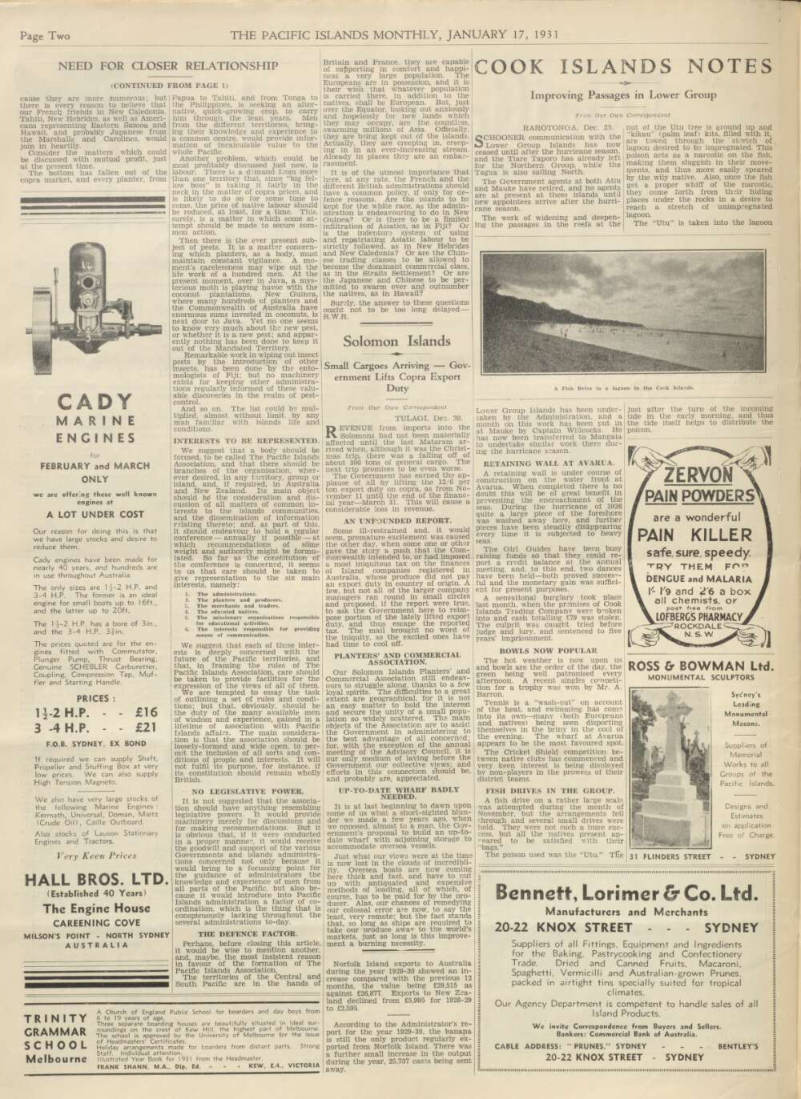
Between Territories ———♦——— Plea for a Pacific Islands Association
A federation of the British island territories and groups of the South and Central Pacific is certain to come, though not in this generation.
In the meantime, for the purpose of consultation, so as to secure united action regarding many vital matters of common interest, the formation of a Pacific Islands Association is advocated.
LOOK at the list on this page. There are shown no less than thirteen different territories, all in more or less intimate trading relationship one with the other, and each under a separate and independent administration.
The only attempt at co-ordination of administrative services is to be found between Fiji, the Solomon Islands, Gilbert and Ellice Colony, Tonga and the British section of the New Hebrides, which are more or less under the control of the British High Commissioner for the Western Pacific, who is also the Governor of Fiji.
In addition, there are shown in the list three other important territories, each under a completely independent administration. They are not in such close trading relationship with the groups of the South and Central Pacific, on account of the distances separating them from the latter, but to the extent of at least 80 per cent, of their interests — particularly the problems connected with administration, immigration, agriculture, etc.—are common ...
In Close Relationship
Territory ... How Held ... Administered From Fiji ... British Crown Colony ... London W. Samoa ... N.Z. Mandate .. ... Wellington and Geneva E. Samoa ... U.S.A. Territory .. ... Washington Tonga .. ... British Protectorate ... Nukualofa, with British ... supervision Norfolk Is. ... Australian Territory ... Canberra Solomon Is. .. British Protectorate ... Suva and London New Hebrides Condominium ... .. Paris and London Gilbert and Ellice Is. ... British Crown Colony ... Suva and London Nauru ... Joint Mandate .. ... London, Canberra, Wel ... lington and Geneva New Caledonia French Colony ... Paris New Guinea . Australian Mandate ... Canberra and Geneva Papua ... Australian Territory ... Canberra Cook Is. ... N.Z. Territory ... Wellington
Not So Closely Related
Society Is. (Tahiti) ... French Colony ... Paris Hawaii ... U.S.A. Territory ... Washington Caroline and Marshall Is... Japanese Mandate ... Tokio ...
to the whole of the Pacific territories.
Not included in the list at all, yet undoubtedly interested in all matters affecting the Pacific territories, are the vast, wealthy, populous groups of the Philippine Islands (American), East Indies (Dutch), Dutch New Guinea and British Borneo.
However, let us not wander too far afield—let us keep our attention to the thirteen territories of the South and Central Pacific, and see what might be accomplished by a closer relationship. How should we seek such a relationship? What formula should be advocated at this early stage?
No Popular Agitation.
At first glance it appears a hopeless proposition. Here are thirteen separate administrations, controlled independently from London, Paris, Washington, Canberra, Wellington and the League of Nations. Presumably, the nations concerned are not prepared to surrender any of their powers and privileges.
Actually, they are well content to continue, undisturbed, as in the past— everything running according to established routine, without fuss or bother; officials jogging comfortably along, in well-defined paths. Who is asking for changes? Why throw a spanner into the placid machinery?
There is no general demand for new forms of government no charge of official oppression. As a matter of fact, taking them by and large, and con-
sidering the remarkable diversity of interests and administrations, the Pacific Islands communities are very well governed.
This is the more notable because, with the possible exception of Fiji and Tonga, the parliamentary form of government is not in operation among the thirteen territories under review. While parliamentary government, in enlightened countries like Australia and Britain, is in a condition bordering on collapse, the red tape administrations of the South Seas are, for the most part, weathering the economic storm very comfortably. Therefore, we cannot ask for a movement directed towards federation, on the ground of present unsatisfactory administration.
In The Name Of Progress.
But, in the name of progress, we can urge a closer association between these islands territories. The Pacific Islands are growing up. They are no longer the Islands of Romance, the enchanted land “where life is different,” the resort of lotus-eaters and world-weary artists.
In the last 20 years, under the impulse of copra production, aided by the extraordinarily rapid development of the petrol engine, tropical hygiene and radio, the islands have become the permanent home of many thousands of European families.
White wives, enjoying complete health, are to-day living with their husbands in scores of regions which, only a decade ago, were regarded as completely unsuitable for white women.
Fiji is almost
notorious for the longevity of its white residents, both men and women.
And this quiet, silent migration of Europeans to the South Seas has only just started. As soon as the world gets over its attack of economic indigestion, and normal conditions return, there will be a notable movement of Europeans to almost all of the rich, undeveloped, tax-free territories mentioned in our list. Therefore, is this not a time when we may examine the possible advantages of closer association be tween the islands groups and prepare the way for a much bigger settlement of white folks in these regions?
A Regular Conference.
If we look closely at the list of thirteen territories, we shall see that except for New Caledonia (French), Eastern Samoa (American) and New Hebrides (Condominium), they are all British.
That simplifies matters considerably.
Why should it not be possible to have a periodical conference of representatives from the several territories held in a central place like Sydney or Auckland or Suva, for an exchange of views concerning scores of matters which vitally affect the common life of the communities of the South Seas?
Such a movement could be initiated among the British administrations be-
(Continued On Page 2)
there is every reason to believe that our French friends in New Caledonia, Tahiti, New Hebrides, as well as Americans representing Eastern Samoa and Hawaii, and probably Japanese from the Marshalls and Carolines, would join in heartily.
Consider the matters which could be discussed with mutual profit, just at the present time.
The bottom has fallen out of the copra market, and every planter, from
Papua to Tahiti, and from Tonga to the Philippines, is seeking an alternative, quick-growing crop, to carry him through the lean years. Men from the different territories, bringing their knowledge and experience to a common centre, would provide information of incalculable value to the whole Pacific.
Another problem, which could be most profitably discussed just now, is labour. There is a demand from more than one territory that, since “big fellow boss” is taking it fairly in the neck in the matter of copra prices, and is likely to do so for some time to come, the price of native labour should be reduced, at least, for a time. This, surely, is a matter in which some attempt should be made to secure common action.
Then there is the ever present subject of pests. It is a matter concern ing which planters, as a body, must maintain constant vigilance. A moment’s carelessness may wipe out the life work of a hundred men. At the present moment, over in Java, a mysterious moth is playing havoc with the coconut plantations. New Guinea, where many hundreds of planters and the Commonwealth of Australia have enormous sums invested in coconuts, is next door to Java. Yet no one seems to know very much about the new pest, or whether it is a new pest; and apparently nothing has been done to keep it out of the Mandated Territory.
Remarkable work in wiping out insect pests by the introduction of other insects, has been done by the entomologists of Fiji; but no machinery exists for keeping other administrations regularly informed of these valuable discoveries in the realm of pest control.
And so on. The list could be multiplied, almost without limit, by any man familiar with islands life and conditions.
Interests To Be Represented.
We suggest that a body should be formed, to be called The Pacific Islands Association, and that there should be branches of the organisation, wherever desired, in any territory, group or island, and, if required, in Australia and New Zealand. Its main object should be the consideration and discussion of all matters of common interests to the islands communities, and the dissemination of information relating thereto; and, as part of this, it should endeavour to hold a regular conference annually if possible —at which recommendations of some weight and authority might be formulated. So far as the constitution of the conference is concerned, it seems to us that care should be taken to give representation to the six main interests, namely : 1. The administrations. 2. The planters and producers. 3. The merchants and traders. 4. The educated natives. 5. The missionary organisations responsible for educational activities. 6. The interests responsible for providing means of communication.
We suggest that each of these interests is deeply concerned with the future of the Pacific territories, and that, in framing the rules of The Pacific Islands Association, care should be taken to provide facilities for the expression of the views of all of them.
We are tempted to essay the task of outlining a set of rules and conditions; but that, obviously, should be the duty of the many available men of wisdom and experience, gained in a lifetime of association with Pacific Islands affairs. The main consideration is that the association should be loosely-formed and wide open, to permit the inclusion of all sorts and conditions of people and interests. It will not fulfil its purpose, for instance, if its constitution should remain wholly British.
No Legislative Power.
It is not suggested that the association should have anything resembling legislative powers. It would provide machinery merely for discussions and for making recommendations. But it is obvious that, if it were conducted in a proper manner, it would receive the goodwill and support of the various Governments and islands administrations concerned not only because it would bring to a focussing point for the guidance of administrators the knowledge and experience of men from all parts of the Pacific, but also be cause it would introduce into Pacific Islands administration a factor of coordination, which is the thing that is conspicuously lacking throughout the several administrations to-day.
The Defence Factor.
Perhaps, before closing this article, it would be wise to mention another, and, maybe, the most insistent reason in favour of the formation of The Pacific Islands Association.
The territories of the Central and South Pacific are in the hands of
Britain and France, they are capable of supporting in comfort and happiness a very large population. The Europeans are in possession, and it is their wish that whatever population is carried there, in addition to the natives, shall be European. But, just over the Equator, looking out anxiously and hopelessly for new lands which they may occupy, are the countless, swarming millions of Asia. Officially, they are being kept out of the islands.
Actually, they are creeping in, creeping in in an ever-increasing stream.
Already in places they are an embarrassment.
It is of the utmost importance that here, at any rate, the French and the different British administrations should have a common policy, if only for defence reasons. Are the islands to be kept for the white race, as the administration is endeavouring to do in New Guinea? Or is there to be a limited infiltration of Asiatics, as in Fiji? Or is the indenture system of using and repatriating Asiatic labour to be strictly followed, as in New Hebrides and New Caledonia? Or are the Chinese trading classes to be allowed to become the dominant commercial class, as in the Straits Settlement? Or are the Japanese and Chinese to be permitted to swarm over and outnumber the natives, as in Hawaii?
Surely, the answer to these questions ought not to be too long delayed.—
R.W.R.
Solomon Islands
———♦——— Small Cargoes Arriving — Government Lifts Copra Export Duty
From Our Own Correspondent
Tulagi, Dec. 20.
REVENUE from imports into the Solomons had not been materially affected until the last Mataram arrived when, although it was the Christmas trip, there was a falling off of about 300 tons of general cargo. The next trip promises to be even worse.
The Government has earned the applause of all by lifting the 12/6 per ton export duty on copra, as from November 11 until the end of the financial year—March 31. This will cause a considerable loss in revenue.
An Unfounded Report.
Some ill-restrained and, it would seem, premature excitement was caused the other day, when some one or other gave the story a push that the Commonwealth intended to, or had imposed a most iniquitous tax on the finances of Island companies registered in Australia, whose produce did not pay an export duty in country of origin. A few, but not all of the larger company managers ran round in small circles and proposed, if the report were true, to ask the Government here to reimpose portion of the lately lifted export duty, and thus escape the reported tax. The mail brought no word of the iniquity, so the excited ones have had time to cool off.
Planters’ And Commercial
Association.
Our Solomon Islands Planters’ and Commercial Association still endeavours to struggle along, thanks to a few loyal spirits. The difficulties to a great extent are geographical, for it is not an easy matter to hold the interest and secure the unity of a small population so widely scattered. The main objects of the Association are to assist the Government in administering to the best advantage of all concerned; for, with the exception of the annual meeting of the Advisory Council, it is our only medium of laying before the Government our collective views; and efforts in this connection should be, and probably are, appreciated.
Up-To-Date Wharf Badly
Needed.
It is at last beginning to dawn upon some of us what a short-sighted blunder we made a few years ago, when we opposed, almost to a man, the Government’s proposal to build an up-todate wharf with adjoining storage to accommodate oversea vessels.
Just what our views were at the time is now lost in the clouds of incredibility. Oversea boats are now coming here thick and fast, and have to put up with antiquated and expensive methods of loading, all of which, of course, has to be paid for by the producer. Alas, our chances of remedying our colossal error are now, to say the least, very remote; but the fact stands that, so long as ships are required to take our produce away to the world’s markets, just so long is this improvement a burning necessity.
Norfolk Island exports to Australia during the year 1929-30 showed an increase compared with the previous 12 months, the value being £29,515 as against £26,877. Exports to New Zealand declined from £5,995 for 1928-29 to £2,595.
According to the Administrator’s report for the year 1929-30, the banana is still the only product regularly exported from Norfolk Island. There was a further small increase in the output during the year, 25,707 cases being sent away. ———
Cook Islands Notes
———♦——— Improving Passages in Lower Group
From Our Own Correspondent
Rarotonga, Dec. 29.
SCHOONER communication with the Lower Group Islands has now ceased until after the hurricane season, and the Tiare Taporo has already left for the Northern Group, while the Tagua is also sailing North.
The Government agents at both Atiu and Mauke have retired, and no agents are at present at these islands until new appointees arrive after the hurricane season.
The work of widening and deepening the passages in the reefs at the A Fish Drive in a lagoon in the Cook Islands.
Lower Group Islands has been under taken by the Administration, and a month on this work has been put in at Mauke by Captain Willcocks. He has now been transferred to Mangaia to undertake similar work there during the hurricane season.
Retaining Wall At Avarua.
A retaining wall is under course of construction on the water front at Avarua. When completed there is no doubt this will be of great benefit in preventing the encroachment of the seas. During the hurricane of 1926 quite a large piece of the foreshore was washed away here, and further pieces have been steadily disappearing every time it is subjected to heavy seas.
The Girl Guides have been busy raising funds so that they could report a credit balance at the annual meeting, and, to this end, two dances have been held —both proved successful and the monetary gain was sufficient for present purposes.
A sensational burglary took place last month, when the premises of Cook Islands Trading Company were broken into and cash totalling £79 was stolen.
The culprit was caught, tried before judge and jury, and sentenced to five years’ imprisonment.
Bowls Now Popular
The hot weather is now upon us and bowls are the order of the day, the green being well patronised every afternoon. A recent singles competition for a trophy was won by Mr. A.
Barron.
Tennis is a “wash-out” on account of the heat, and swimming has come into its own—many (both Europeans and natives) being seen disporting themselves in the briny in the cool of the evening. The wharf at Avarua appears to be the most favoured spot.
The Cricket Shield competition between native clubs has commenced and very keen interest is being displayed by non-players in the prowess of their district teams.
Fish Drives In The Group.
A fish drive on a rather large scale was attempted during the month of November, but the arrangements fell through and several small drives were held. They were not such a huge success, but all the natives present appeared to be satisfied with their “bags.”
The poison used was the “Utu.” The nut of the Utu tree is ground up and “kikau” (palm leaf) kits, filled with it, are towed through the stretch of lagoon desired to be impregnated. This poison acts as a narcotic on the fish, making them sluggish in their movements, and thus more easily speared by the wily native. Also, once the fish get a proper whiff of the narcotic, they come forth from their hiding places under the rocks in a desire to reach a stretch of unimpregnated lagoon.
The “Utu” is taken into the lagoon
just after the turn of the incoming tide in the early morning, and thus the tide itself helps to distribute the poison.
Advertisements & other items, p. 2 (2 items)
Cady
MARINE
ENGINES
for
FEBRUARY and MARCH
ONLY
we are offering these well known engines at
A LOT UNDER COST
Our reason for doing this is that we have large stocks and desire to reduce them.
Cady engines have been made for nearly 40 years, and hundreds are in use throughout Australia.
The only sizes are 1½-2 H.P. and 3-4 H.P. The former is an ideal engine for small boats up to 16ft., and the latter up to 20ft.
The 1½-2 H.P. has a bore of 3in., and the 3-4 H.P. 3⅝in.
The prices quoted are for the engines fitted with Commutator, Plunger Pump, Thrust Bearing, Genuine SCHEBLER Carburetter, Coupling, Compression Tap, Muffler and Starting Handle.
PRICES :
1½-2 H.P. - - £16 3 -4 H.P. - - £21
F. 0.B. SYDNEY, EX BOND
If required we can supply Shaft, Propeller and Stuffing Box at very low prices. We can also supply High Tension Magneto.
We also have very large stocks of the following Marine Engines : Kermath, Universal, Doman, Mietz (Crude Oil), Caille Outboard.
Also stocks of Lauson Stationary Engines and Tractors.
Very Keen Prices
HALL BROS. LTD.
(Established 40 Years)
The Engine House
CAREENING COVE
MILSON’S POINT - NORTH SYDNEY
AUSTRALIA
TRINITY
GRAMMAR
SCHOOL
Melbourne
A Church of England Public School for boarders and day boys from 6 to 19 years of age.
Three separate boarding houses are beautifully situated in ideal surroundings on the crest of Kew Hill, the highest part of Melbourne.
The school is approved by the University of Melbourne for the issue of Headmasters’ Certificates.
Holiday arrangements made for boarders from distant parts. Strong Staff. Individual attention.
Illustrated Year Book for 1931 from the Headmaster.
FRANK SHANN, M.A., Dip. Ed. - - - KEW, E. 4., VICTORIA
Bennett, Lorimer & Co. Ltd.
PAIN POWDERS'
are a wonderful
PAIN KILLER
safe, sure, speedy.
TRY THEM FOR
DENGUE and MALARIA
1'- 1'9 and 2'6 a box all chemists, or post free from
LOFBERGS PHARMACY,
Rockdale
N.S.W.
ROSS & BOWMAN Ltd.
MONUMENTAL SCULPTORS
Sydney’s Leading Monumental Masons.
Suppliers of Memorial Works to all Croups of the Pacific islands.
Designs and Estimates on application Free of Charge.
31 FLINDERS STREET
SYDNEY
Bennett, Lorimer & Co. Ltd.
Manufacturers and Merchants 20-22 KNOX STREET - - - SYDNEY Suppliers of all Fittings, Equipment and Ingredients for the Baking, Pastrycooking and Confectionery Trade. Dried and Canned Fruits, Macaroni, Spaghetti. Vermicilli and Australian-grown Prunes, packed in airtight tins specially suited for tropical climates.
Our Agency Department is competent to handle sales of all Island Products.
We invite Correspondence from Buyers and Sellers.
Bankers: Commercial Bank of Australia.
CABLE ADDRESS: “ PRUNES,” SYDNEY - BENTLEY’S
20-22 KNOX STREET - SYDNEY
Rhinoceros Beetle
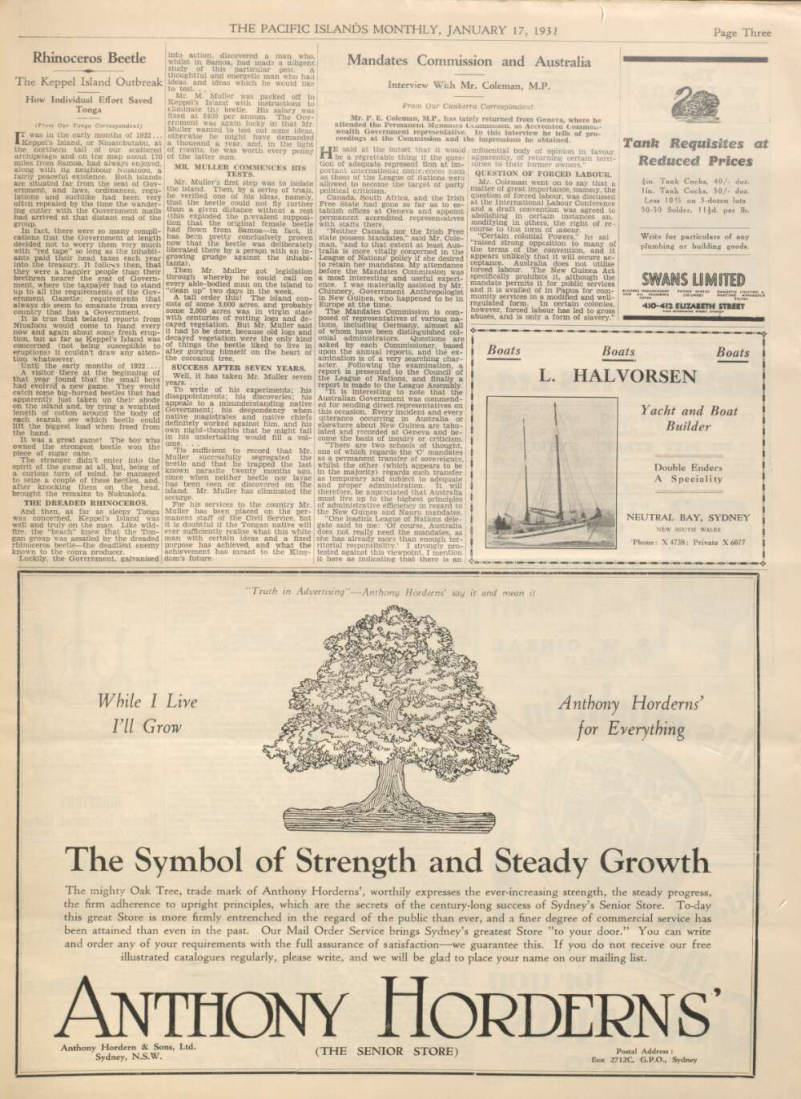
The Keppel Island Outbreak How Individual Effort Saved Tonga
(From Our Tonga Correspondent) IT was in the early months of 1922...
Keppel’s Island, or Niuatobutabu, at the northern tail of our scattered archipelago and on tne map aoout 170 miles from Samoa, had always enjoyed, along with its neighbour huuafoou, a fairly peaceful existence. Both islands are situated far from the seat of Gov ernment, and laws, ordinances, regu lations and suchlike had been very often repealed by the time the wander ing cutter with the Government mails had arrived at that distant end of the group.
In fact, there were so many compli cations that the Government at length decided not to worry them very much with “red tape” so long as the inhabit ants paid their head taxes each year into the treasury. It follows then, that they were a happier people than their brethren nearer the seat of Govern ment, where the taxpayer had to stand up to all the requirements of the Gov ernment Gazette; requirements that always do seem to emanate from every country that has a Government.
It is true that belated reports from Niuafoou would come to hand every now and again about some fresh erup tion, but as far as Keppel’s Island was concerned (not being susceptible to eruptions) it couldn’t draw any atten tion whatsoever.
Until the early months of 1922 A visitor there at the beginning of that year found that the small boys had evolved a new game. They would catch some big-horned beetles that had apparently just taken up their abode on the island and, by tying a weighted length of cotton around the body of each scarab, see which beetle could lift the biggest load when freed from the hand.
It was a great game! The boy who owned the strongest beetle won the piece of sugar cane.
The stranger didn’t enter into the spirit of the game at all, but, being of a curious turn of mind, he managed to seize a couple of these beetles, and, after knocking them on the head, brought the remains to Nukualofa.
The Dreaded Rhinoceros.
And then, as far as sleepy Tonga was concerned, Keppel’s Island was well and truly on the mao. Like wild fire, the “beach” knew that the Ton gan group was assailed by the dreaded rhinoceros beetle—the deadliest enemy known to the copra producer.
Luckily, the Government, galvanised
into action, discovered a man who, whilst in Samoa, had made a diligent study of this particular pest. A thoughtful and energetic man who had ideas, and ideas which he would like to test. . . .
Mr. M. Muller was packed off to Keppel’s Island with instructions to eliminate the beetle. His salary was fixed at £400 per annum. The Gov ernment was again lucky in that Mr, Muller wanted to test out some ideas, otherwise he might have demanded a thousand a year, and, in the light of results, he was worth every penny of the latter sum.
Mr. Muller Commences His
Tests.
Mr. Muller’s first step was to isolate the island. Then, by a series of trials, he verified one of his ideas, namely, that the beetle could not fly further than a given distance without a rest (this exploded the prevalent supposi tion that the original female beetle had flown from Samoa—in fact, it has been pretty conclusively proven now that the beetle was deliberately liberated there by a person with an in growing grudge against the inhabi tants).
Then Mr. Muller got legislation through whereby he could call on every able-bodied man on the island to “clean up” two days in the week.
A tall order this! The island con sists of some 3,000 acres, and probably some 2,000 acres was in virgin state with centuries of rotting logs and de cayed vegetation. But Mr. Muller said it had to be done, because old logs and decayed vegetation were the only kind of things the beetle liked to live in after gorging himself on the heart of the cocoanut tree.
Success After Seven Years.
Well, it has taken Mr. Muller seven years. . . .
To write of his experiments; his disappointments; his discoveries; his appeals to a misunderstanding native Government; his despondency when native magistrates and native chiefs definitely worked against him, and his own night-thoughts that he might fail in his undertaking would fill a vol ume. . . . ’Tis sufficient to record that Mr.
Muller successfully segregated the beetle and that he trapped the last known parasite twenty months ago, since when neither beetle nor lavae has been seen or discovered on the island. Mr. Muller has eliminated the scourge.
For his services to the country Mr.
Muller has been placed on the per manent staff of the Civil Service, but it is doubtful if the Tongan native will ever sufficiently realise what this white man with certain ideas and a fixed purpose has achieved, and what the achievement has meant to the King dom’s future.
Mandates Commission and Australia
Interview Wiih Mr. Coleman, M.P.
From Our Canberra Correspondent.
Mr. F. E. Coleman, M.P., has lately returned from Geneva, where he attended the Permanent Mandates Commission, as Accredited Common wealth Government representative. In this interview he tells of pro ceedings at the Commission and the impressions he obtained.
HE said at the outset that it would be a regrettable thing if the ques tion of adequate representation at im portant international conferences such as those of the League of Nations were allowed to become the target of party political criticism.
Canada, South Africa, and the Irish Free State had gone so far as to es tablish offices at Geneva and appoint permanent accredited representatives with staffs there.
“Neither Canada nor the Irish Free state possess Mandates,” said Mr. Cole man, “and to that extent at least Aus tralia is more vitally concerned in the League of Nations’ policy if she desired to retain her mandates. My attendance before the Mandates Commission was a most interesting and useful experi ence. I was materially assisted by Mr.
Chinnery, Government Anthropologist in New Guinea, who happened to be in Europe at the time.
The Mandates Commission is com posed of representatives of various na tions, including Germany, almost all of whom have been distinguished col onial administrators. Questions are asked by each Commissioner, based upon the annual reports, and the ex amination is of a very searching char acter. Following the examination, a report is presented to the Council of the League of Nations, and finally a report is made to the League Assembly.
“It is interesting to note that the Australian Government was commend ed for sending direct representatives on this occasion. Every incident and every utterance occurring in Australia or elsewhere about New Guinea are tabu lated and recorded at Geneva and be come the basis of inquiry or criticism.
“There are two schools of thought, one of which regards the ‘C’ mandates as a permanent transfer of sovereignty, whilst the other (which appears to be in the majority) regards such transfer as temporary and subject to adequate and proper administration. It will therefore, be appreciated that Australia must live up to the highest principles of administrative efficiency in regard to the New Guinea and Nauru mandates.
“One leading League of Nations dele gate said to me: ‘Of course, Australia does not really need the mandates, as she has already more than enough ter ritorial responsibility.’ I strongly pro tested against this viewpoint. I mention it here as indicating that there is an
influential body of opinion in favour, apparently, of returning certain terri tories to their former owners.”
Question Of Forced Labour.
Mr. Coleman went on to say that a matter of great importance, namely, the question of forced labour, was discussed at the International Labour Conference and a draft convention was agreed to abolishing in certain instances and modifying in others, the right of re course to this form of laoour.
“Certain colonial Powers,” he said “raised strong opposition to many of the terms of the convention, and it appears unlikely that it will secure ac ceptance. Australia does not utilise forced labour. The New Guinea Act specifically prohibits it, although the mandate permits it for public services and it is availed of in Papua for com munity services in a modified and well regulated form. In certain colonies, however, forced labour has led to gross abuses, and is only a form of slavery.”
Advertisements & other items, pp. 3-4 (1 item)
Anthony
Tank Requisites at
Reduced Prices
¾in. Tank Cocks, 40/- doz. 1 in. Tank Cocks, 50/- doz.
Less 10% on 3-dozen lots 50-50 Solder, 1 1 Jd. per lb.
Write for particulars of any plumbing or building goods.
410-412 ELIZABETH STREET
Boats Boats Boats
L. HALVORSEN
Yacht and Boat Builder Double Enders A Speciality
NEUTRAL BAY, SYDNEY
NEW SOUTH WALES
’Phone: X 4738; Private X 6077
Truth in Advertising”—Anthony Horderns’ say it and mean it
While I Live
I’ll Grow
Anthony Horderns'
for Everything
The Symbol of Strength and Steady Growth The mighty Oak Tree, trade mark of Anthony Horderns’, worthily expresses the ever-increasing strength, the steady progress, the firm adherence to upright principles, which are the secrets of the century-long success of Sydney’s Senior Store. To-day this great Store is more firmly entrenched in the regard of the public than ever, and a finer degree of commercial service has been attained than even in the past. Our Mail Order Service brings Sydney’s greatest Store "to your door.” You can write and order any of your requirements with the full assurance of satisfaction —we guarantee this. If you do not receive our free illustrated catalogues regularly, please write, and we will be glad to place your name on our mailing list.
Anthony
Anthony Hordern 8C Sons, Ltd.
Sydney, N.S.W.
(THE SENIOR STORE)
Postal Address : Box 2712 C, G.P.O., Sydney
The
WALDORF
Cremorne Pt., Sydney,
N.S.W.
UP-TO-DATE PRIVATE HOTEL.
Conveniently situated, ten minutes ferry trip from the City. Frequent steamer service.
Large airy rooms commanding extensive Harbour views. The service and attention are all that could be desired. Hot and cold water, laundry and electric iron for guests’ use. Billiards, etc.
INCLUSIVE TARIFF;
£3/3/- per week • 10/6 per day.
Tel. Y 1450. Mrs. R. P. GRAHAM.
Fiji Pineapples
Development of Promising Industry
From Our Own Correspondent
Suva, Dec. 24.
THE new year will mark the pine apple industry beginning to find its feet.
The reports from the two local fac tories, which are now busy canning, are most favourable, and in each case the pack will exceed the estimate. The fruit, despite the hurricane, is of first class quality, and new areas are being planted as quickly as suckers can be found.
The experimental plots which the Hawaiian people have planted are all looking well. So far nothing is known as to what steps the Hawaiian folks will take, but it is hoped that they will make a move before long. The conditions all favour successful pine apple growing and the fruit, when can ned, is of exquisite flavour.
The industry holds out big hopes to the Colony of taking a very prominent place in our development.
It is stated in the annual report for the Territory of Norfolk Island few 1929-30 that the demand for land dur ing that period remained brisk, and high prices ruled.
New Guinea News
Pioneer Missionary Retires—Murder of Mr. Edmonds — New Wharf at Malaguna
From Our Own Correspondent
Rabaul, Dec. 20.
THE prolonged dry spell, which caused a good deal of concern, has now left us and we are now receiv ing a fair share of rain with some heavy storms thrown in to make up.
As usually occurs after a dry spell, storms are accompanied by earth tremors, and we have experienced quite a few distinct and severe shocks, some of which lasted several minutes.
Hard times have made householders watch expenditure, with the result that numerous orders have been re ceived by Sydney retail establishments for groceries, etc. This has given our local stores furiously to think, and
have been greatly facilitated if the frontage had been 80 feet longer. A fur ther drawback that has been discov ered is that it was found impossible to work all hatches of the Montoro simultaneously.
Appointment Of German
Consul.
A very popular appointment has been announced in the notification that Mr. Ernst Paatzsch will fill the position of German Consul for the Ter ritory of New Guinea. Mr. Paatzsch has been a resident of this territory since 1913 and, since 1923, has been in business on his own account. One of Mr. Paatzsch’s claims to fame is
New Aerodrome at Bulolo, New Guinea
strong efforts are being made to regain the trade that is now going to Sydney.
One big Chinese store has been giv ing 10 per cent, discount for cash for some months past on groceries only, and has in consequence maintained sales, but some other stores have suf fered.
Burns, Philp & Co. have taken the lead, and have not only materially re duced prices, but now give a 10 per cent, discount for cash in all depart ments. Carpenter & Co. announce special lines on which they give a 15 per cent, cash discount for a specified period only, other lines still being sub ject to the old 5 per cent, discount.
Rivalry is keen to secure business, which is all to the benefit of resi dents.
One of our pioneer missionaries, the Rev. Dr. Flierl, who came to this country in 1886, has retired and left us in September last. Dr. Flierl foun ded several mission stations on the mainland, and finally settled at Sat tleberg, 3,000 feet above sea level. In 1904 he removed to Heldsbach, about five miles north of Finschhafen, the headquarters of the Lutheran Mission, with which organisation he was asso ciated.
A traveller, from Melbourne, has received a sudden check to his career, as for the next eighteen months he will be a working guest of the Admin istration in one of the Federal prisons.
This man came to the territory as a travelling agent and, it is alleged, passed two worthless cheques on a bank in Victoria for goods received.
Both cheques were dishonoured. In the meantime, he had left the ter ritory, but the Government took imme diate action and had him brought back here for trial.
The Kolai Murder.
Last month the native, Fiona, was brought for trial before the Chief Judge on a charge of murdering Mr.
D. G. Edmonds, manager of the Mel anesia Company’s plantation at Rolai.
It transpired at the trial that Edmonds had habitually brutally ill-treated the natives employed on the plantation and had interfered with native women, some of whom were wives of the native labourers. The evidence was corrobor ated by the European manager of a neighbouring plantation.
The Judge in his summing up stated that the deceased by his gross brutal ity and interference with native wo men had got his labourers into a state of mind which would explain, and might almost be said to justify, an out break. The murder was a natural con sequence of the persecution of the ac cused by the deceased. The accused was found guilty of wilful murder. The Judge did not pronounce sentence of death, but ordered judgment of death to be entered on record. He expressed the opinion that mercy should be shown to the accused.
The miniature golf craze has spread to Rabaul. A course has been installed at the Rabaul Hotel and another is to be built at Wuriawutung Hotel. The latter still continues to enjoy excep tionally busy times, due entirely to the attention and courtesy shown by the management. Wunawutung is quite the most popular resort in this district and since its reorganisation, is filling a long-felt want as a pleasure resort for residents of Rabaul.
On December 1 the new wharf at Malaguna was used for the first time.
SS. Montoro, with Captain C. Wil liams in command, captured the dis tinction. His Honour the Administra tor was present. It appears that the task of berthing and loading would
that he is one of the founders of the popular German Club, and that it is largely due to his efforts that the Club has made such remarkable progress.
After a visit of four months Mr.
Walcott has returned to Australia, having completed his investigation for the re-classification of the public ser vice of this territory. His report is not expected until January, and will cover the whole service, which com prises about 400 officers.
Built by Bulolo Gold Dredging Ltd., the Bulolo aerodrome, on the New Guinea Goldfields, was opened last month. A Guinea Airway’s Junker ’plane was the first to use the new landing ground.
B.N.G. Developments
Annual Meeting in London
(From Our Port Moresby Correspondent)
Port Moresby, Dec. 23.
AT the annual meeting of share holders of the British New Guinea Development Co. Ltd., of Papua, held in London last October, the production of rubber during the last year was stated to have been 519,625 pounds.
The cost of production was reduced to 7.7 d. per pound f.o.b., and the aver age net sale price was 6.8 d.
Copra production for the year was 2,244 tons.
The total revenues from plantations for the year amounted to £50,685.
The B.N.G. Development Co. is one of the biggest companies in Papua and is of long standing, being formed as early as 1910.
Thousands of acres—both of rubber and coconuts —have been planted suc cessfully, and had it not been for the fall of the market, the company would be by now considerably financial, whereas, in the report, the chairman, Brigadier General the Hon. F. C. Stan ley, regretfully states the accounts for the year show a net loss of £60.
There are not many residents in Port Moresby who remember the be ginning of this enterprising company.
The founders arrived somewhere in June, 1910, in the old Bentinck, a steamer especially chartered and brought out from London with trade and all the embellishments of a colos sal venture.
Penal Sanctions
Will Existence Hamper Trade?
Position In Papua
From Our Own Correspondent
Port Moresby, Dec. 20.
The existence of penal sanctions in Papua may hamper that Terri tory’s export trade, in view of the United States Congress having for bidden the importation of any produce from a country where penal sanctions are in force.
THE following memorandum by His Excellency the Lieut.-Governor, Sir Hubert Murray, has been addressed to employers of natives in the Territory;
“Indentured Labour And Abolition
Of Penal Sanctions.”
“There seems to be a general movement for the abolition of what are known as the penal sanctions in legislation relating to native labour. It is urged that a contract of service is an ordinary contract and that breaches such as desertion and neglect of duty should be treated not as criminal but as giving rise to action for damages.
“Under the ordinance at present in force, desertion and neglect of duty are punishable with fine or imprisonment and it is contended that it is inadmissable to provide a penal sanction for a breach of contract and that the employer should be left to his civil remedy, that is to say, that the employer should bring a civil action against the labourer who deserts or is guilty of neglect of duty, and should only be allowed to recover the actual damage that he could prove.”
The Papuan Government is of the opinion that it would be premature to do away with these sanctions, causing great loss to employers and great harm to the natives at this stage of the country’s career, and advises employers to exercise tact and patience so that a good many cases may be kept out of court, for it is feared that anything like an abuse would be seized as excuse for abolition of the sanctions.
Residents feel rather indignant at the high-handedness of the U.S.A. in dealing with affairs that are evidently beyond their scope and understanding.
For Papuans this measure is well nigh ridiculous and the natives would take full advantage of the loopholes it would present. There could not pos sibly be any recovery of actual damages in most cases.
Advertisements & other items, p. 4 (2 items)
Champion
“At Your Service!
McILRATH’S Ltd.
Exporters of
GROCERIES, PROVISIONS AND STORES
Of all Descriptions
202 PITT STREET, SYDNEY
Special Attention Given to Orders from Pacific Islands and all Goods Specially Packed for Despatch thereto. WRITE FOR EXPORT PRICE LIST.
COLD STORAGE WITHOUT ICE
“TRAFALGAR”
COLD SAFE
Suitable for any Home. Invaluable for Hotels, Accommodation Houses. Indispensable to the Housewife.
IT KEEPS FOOD, MILK AND MEAT
FRESH IN THE HOTTEST WEATHER
S. W. O’NEAL
233 GEORGE ST. - SYDNEY
this airtight tin guards all the goodness for you
Champion
tobacco
Johnstons
If You are Interested in the Pacific Islands Shipping, Mining or Trade Write or Cable
W. FARMER WHYTE
Who can give you Direct Representation
at CANBERRA
All communications strictly confidential.
Telephone: Canberra 8070 Code Address, "Farmerite,” Canberra
SELF INSTRUCTORS FREE WITH ALL
INSTRUMENTS
Portable Phonographs (Micro perophone), £8/8/-.
JOHNSTONS
Musical Instrument Stores
211-215 GEORGE ST., SYDNEY
JUST STEP OFF
DRIVE YOURSELF
Our Fleet consists of different types of Cars, from Light Tourers to large closed Cars, and our rates vary according to the type.
THE BOAT & AWAY
DRIVE YOURSELF SERVICE L
THE USE OP’ A CAR IS ESSENTIAL to the complete enjoyment of a HOLIDAY IN AUSTRALIA or the quick transaction of your business. Under our system you Ran hire any type of Car of the latest Model and drive yourself.
Write for further particulars: ..
DRIVE YOURSELF SERVICE LTD.
Circular Quay West - Sydney - Australia.
Passion-Fruit Pulp
Opportunity for Profitable Industry Solving Norfolk Island’s Problem
Written for The Pacific Islands Monthly by Mr. Frank L. Edwards, Secretary of the Chamber of Manufactures of N.S.W.
“'THERE are tons and tons and countless tons of passion-fruit ripening upon Norfolk Island dur ing the months of December, January and February . . . and half of it goes to waste. . . . We lose half of our fruit each season,” writes your Norfolk Island corres pondent, in last issue.
This tale of waste is particularly galling just now in the midst of times so hard that actual cases of starvation are reported in the press. At the present moment (early January) while the Nor folk Island passion fruit rots, some of it is actually selling in Sydney stalls at a penny each.
Only this week, too, an American recently returned to Sydney after a trip to U.S.A., mainly to enquire about pas sion fruit pulp marketing possibilities— an eager would-be agent abroad for Australian canned passion fruit pulp could he but get it —has called upon me and given a dazzling estimate of the huge quantities of pulp which it should be possible for us to dispose of in U.S.A. were we able to provide a continuous and uniform supply of the product attractively canned and packed, accord ing to standards acceptable to the buyers.
The U.S.A. Market
“I consulted the providoring manag ers of a big chain of hotels,” he said.
“Some of these hotels feed five and six thousand people during the one meal hour.
“Providers who cater on such a tre mendous scale are naturally agog to find new foods and new flavours for a clientele that is eager and willing to pay for them, but all I could get from them were promises that they would probably take several tons as a ‘try out.’ Because of the uncertainty of supplies, they were not going to com mit themselves.
“To secure large scale distribution through the various chains of hotels and large grocery wholesale houses, it will be necessary to satisfy their exact ing specifications as to uniformity of product and to give a definite assurance as to supply.
“It is not an uncommon practice—in fact, it is the rule—for intending big buyers to see the factory and its man agement and to follow out the whole of its processes: in the case of food stuffs from the time the seed is planted till the finished article is packed and placed on the freight cars.
“The Sun-Kist Orange people specify how the crop is to be cultivated, irri gated, sprayed, pruned, picked and packed. The handling of passion-fruit will have to come up to the same rigid specifications if it is to succeed in the American market.”
It is a fact, strange but true, that passion-fruit growing has not yet been successful in any but mere experi mental plots in U.S.A. This fruit which grows wild on the Australian coast and probably in many of the Pacific Islands, makes but poor res ponse to the most devoted attention in many districts in America. Here, surely, is our chance.
Co-Operation Of Growers
Necessary
No technical difficulties hinder our pulping and preserving the fruit; in deed, manufacturers have assured me that the only deterrent to their passion-fruit preserving efforts on a scale larger than hitherto attempted has been the uncertainty of adequate supplies. Passion-fruit has been grown mainly with an eye to its sale as fresh fruit, and the pulp manufacturer has been expected to develop an industry on what is practically an unwilling source of supply. Growers only sell to him “faute de mieux,” when fancy prices in the city markets are no more.
It is not to be expected that big manufacturing business will result until such time as the growers recognise that they are producing not for the fruit shop but for the cannery.
Half-way measures will get us no where if this is to be developed as one of the primary industries of Australia.
Given the quantities and due care in processing, there appear to be no reasons why passion-fruit should not soon be another exportable commodity.
Basing one’s judgment on the state ments of your correspondent, it would seem that now is the time for a more securely-based manufacturing effort, and as a step towards helping in the problem of the Norfolk Island growers, I have forwarded to each of my mem bers likely to be interested in it, a copy of your correspondent’s statement on this subject, and in addition I have sent copies to my colleagues, the Secretaries of the Chambers of Manufactures in each of the other States.
But why don’t the Norfolk Island growers arrange with an experienced manufacturer, who is a good technic ian, to visit them and advise them after an examination of their problem qn the spot? The right man could be induced to make the trip, and he would take with him from the mainland a knowledge of marketing and of co operative effort, both of which are essential to the success of the Islanders’ enterprise.
The Tong Islands
Storing of Copra Depresses Trade
From Our Own Correspondent
Nukualofa, Dec. 20.
IT is amazing to learn that copra sold by the natives at the port of Vavau still realises £2 per ton more than Nukualofa offerings.
It is doubtless owing to this discrep ancy that many Nukualofa natives, sensing that something is amiss, are storing copra in the hopes of a better
it has been storing up within the next fortnight, there is going to be a most Rightfully depressing trading Christ mas Tongatabu in this year of grace 1930.
Pensions Bill Delayed,
It was certainly irritating to civil servants when the Legislative Assem bly at its last session turned down the
straight-out cash price from some visi ting vessel. As many of them have been now storing for five months, with out recourse to the local market, this, in itself, rather tends to explode the idea subscribed to in certain quarters that the native is oppressed.
As against this fictional “oppression” of the Native Crown towards its sub jects, it is just stark reality that owing to the natives action in holding up their product, the trading community is suffering intensely from “depres sion.”
It is no secret on the “beach” that if the local buyers (and traders in gen eral) cannot induce the Tongan “kau taha” (company) to unload the copra
revised [Pensions Bill, a Bill which, amongst its many beneficial clauses, gave them opportunity of transfer to the British colonial service on a recip rocal basis. Now, if all we hear can be believed, this scheme will come into force sometime in 1931, either as an Act or a Regulation. So do try and look happy, you servants of the Crown!
The “Overtaxed” Tongan.
The overwhelming burst of prose; the bewildering, if fearfully careless introduction of a hotch-potch of fig ures, to say nothing of the dear little poem about a pig and a hen, all found together in the columns of P.I.M. No. 4, under the caption, “The Overtaxed
Tongan,” has thrown the “beach” into a palpitating flutter of excitement, tinged with envy. I do not know what effect it will have on my Tongan friend, but he must come up to scratch and explain away that £70,000. For the present, I am marking him “Exhi bit A.”
Personal Items.
Our excellent British Consul, Mr. J.
S. Neill, is, we learn, to vacate his post here for some three months. He has been appointed to a special commission which necessitates his departure to Fiji by to-day’s steamer.
After a seven-year residence in Tonga, Mr. Stanley Rankin, our effici ent dentist, has, for health reasons, found it necessary to shift to a colder climate. He and Mrs. Rankin were the recipients of many good wishes on “steamer day.”
The outgoing Tofua will carry, among its complement of passengers, Mr. and Mrs. Cyril Aidney. A live wire business man as Tonga manager for Messrs. Morris, Hedstrom Ltd., and a keen patron of billiards, bowls and golf, he and his good lady are sure to be missed during the few months they will spend in New Zealand.
To practice here as our next Gov ernment dentist, we learn that Mr.
Franz Franzan will arrive next month from the Mandated Territory of Samoa. Mr. Franzan is not new to this group and many old residents will re call the popular “molar man,” who had his shingle up in Nukualofa some six teen years ago.
Mr. N. A. Pyne, genial Collector of Customs at Haapai, has, with his wife and family, sailed for Australia on a six months’ vacation. Mrs. Pyne’s’ health has been a source of anxiety for some time, and her numerous friends hope that a short stay in Aus tralia will have beneficial results.
A glimpse of Varan's beautiful harbour.
Dutch New Guinea
its Slow Denvelopment Vast Territorys Possibilities
From Our Thursday Island Correspondent EVERYBODY knows that the west ern half of the island continent of New Guinea does not belong to Britain, but it is a part of the magnifi cent island empire of the Dutch.
The columns of the P.I.M. contain many items of news from Papua and the Mandated Territory, but Dutch New' Guinea is still a terra incognita, and reliable information of the coun try is hard to obtain.
We wonder how this huge territory would have fared under British rule with administrators like MacGregor and Murray to guide its destinies. As it is, the amount of colonisation at tempted by the Dutch is inconsider able, and they do not appear to show much interest in their possession or to encourage foreigners to do so either.
Dutch New Guinea can wait!
Settlement has proceeded in the north-west (where a big German com pany operates at Manokwari) at Kai mana and Fak Fak on the west coast, and at Merauke in the south. Special attention has been paid to the welfare of the natives round these places. The Dutch have prohibited the age-long custom of separating the sexes in the villages, and each Papuan family there lives in its own home; this measure is said to have improved the birth rate, but, in spite of their rise, the Dutch, in this instance, are rulers of a rapidly vanishing race.
Merauke’S Brief Fame.
Merauke is one of the deadest of dead dogs, and yet, only ten years ago, produce from there and other parts of the country filled many a godown in Makassar and Temate. It drew a lively crowd of Chinese and Malays from all over the archipelago to share in its greatest treasure —the bird of paradise.
In those days, Merauke was a busy place. Launches were fitted up there for the perilous trips far up the rivers in search of birds, and rivalry in trade and the acquisition of skins sent these enterprising bird-hunters further and further into the unexplored interior New Guinea was being opened up in spite of its nominal owners, and the flag followed the trader.
Cases and cases of skins were sent to Europe. There was the giant Bird of Paradise —Paradisea anapoda—often 17 inches in length to tip of tail and worth as much as £6/15/- in 1919 at the peak of the boom, and Paradisea minor from the north —both different from the smaller Paradisea regia of
British New Guinea. Work was plenti ful and everyone had money to spend.
And then, in 1926, the bottom fell out of this trade completely. To-day, in Merauke, birds (that can only be sold if shot prior to ’26) can be bought for three shillings; to-day scores of the old launches are falling to pieces in the river and every Hollander’s gar den is decorated with rusty marine en gines.
As for the other products of this vast territory, they are almost neglig ible. Copra from Dutch New Guinea has already been mentioned in these columns. Whereas a year ago the monthly K.P.M. steamer took 3,000 sacks, she now only gets 300 or 400.
There are many places where sugar cane, tobacco and coffee could be grown, but they are lying idle at pre sent for the best of reasons. Merauke grows most of the rice it needs and from the north comes damar gum, used for making varnishes, but this product shares in the present era of depressed prices.
Is There Gold?
The country has never been scientifi cally prospected and the mining law's do not encourage foreigners to come and find out, for it is a punishable offence to wash a dish of earth for gold in our neighbour’s possession.
Perhaps the Hollanders are wise in this respect. The country is not yet civilised enough to encourage a crowd of gold seekers, and it is certain that much bloodshed would result from such an influx in the present uncon trolled state of the mountainous in terior.
The Diggoel Camp.
A recent enterpise in Dutch New Guinea is the establishment of a big communist camp, four days steaming up the Diggoel, one of the largest rivers in the country. Here four or five thou sand malcontents from Java, Sumatra and Celebes have been interned for the safety of more law-abiding citizens.
The rumour that this settlement has been broken up can hardly be correct, as large numbers are arriving by every steamer. The prisoners are well treated, given land and wages and every attempt at colonisation made.
The site is, however, very unhealthy, and the recent granting of many free pardons may have led to the rumour of its closure. While some of these political exiles are dangerous men, versed in the use of bombs and mach ine guns, quite a number with whom the writer has been personally acquain ted, appear to be merely flashy and misguided youths, who may yet be come decent subjects of Holland.
It cannot be too strongly emphasised that Dutch New Guinea offers no openings for white men at present and that the Dutch officials, in putting difficulties in the way of immigration, are in reality acting in the best inter ests of adventurous men, who would like to try their fortunes.
Advertisements & other items, p. 5 (1 item)
Norton
HANDLEY & LAWS
Plantation and Mining Agents Manufacturers’ Representatives Company Local Agents and Public Officers
RABAUL - - NEW GUINEA
KILLS flies fleas
mosquitoes
and all insects
STONE
DEAD
NORTON
NON POISONOUS
WILL NOT STAIN
MADE IN
AUSTRALIA
NOW DOUBLE STRENGTH
BETTER THAN EVER
Painless extractions. Reliable fillings. Cold crowns and comfortable and lasting plate work.
Have Teeth by Post
If you are unable to visit Sydney, I can make you comfortable, natural and long lasting teeth by means of my well known method of “Self Taken Impressions.” Cut out this advertisment, attach your name and address, and post to me for full particulars.
SPENCER NOLAN, Dentist
28 OXFORD ST., over Winns; 177 OXFORD ST., opposite Mcllraths; 139 ELIZABETH ST., two doors from Market St., Sydney.
Beam Wireless and Cable Address: “Fastplate,” Sydney. P.I.M.
SILVER STAR STARCH
“The Best in the World.”
PIONEER Jelly CRYSTALS
“Set in Any Weather.”
Express Custard Powder
TEAS COFFEES SPICES RICE
Robert Harper & Company Limited
DAY STREET, SYDNEY
MILLERS AND MANUFACTURERS
USE
The
Wireless Service
and Save Time & Money
SPEED -
ACCURACY -
ECONOMY !
Speedy and efficient services to Australia and Overseas.
Route your overseas traffic for Great Britain, Europe and North and South America for transmission
“VIA BEAM”
The Longest Direct Telegraph Service in the World Amalgamated Wireless
AUSTRALASIA LTD.
Opportunities
Where Australia Misses
Vol. 1—No. 6
January, 1931
AN example of how valuable trade is lost to Australia, as a result of the foolish and erratic economic the ories which dominate Australian Gov ernment, is provided by trade figures in the just-issued report of the Brit ish Resident Commissioner in New Hebrides. The group in 1929 imported 1 902 2-dozen cases of bottled ale all from German and Dutch breweries.
Of fine and light wines, New Hebrides in one year purchased £13,400 worth; and practically every gallon came from France. The group imported 6,547 cases of spirits—essentially a British product; but nearly the whole of it came from Britain, 10,000 miles away, and almost none from Australia, dis tant only a few hundred miles. Of tinned food, the group imported no less than 9,537 cases, worth over £20,000. Although Australia can pro duce the finest qualities of canned foodstuffs, almost the whole of these goods were bought from America.
Australia is a dairying country. The New Hebrides people, in 1929, im ported 1,548 4-dozen cases of tinned milk — not from Australia, a few hours’ steam away, but from Switzer land. One would suppose that Aus tralia would be able to supply some substantial part of the £4,700 worth of sugar which this group annually imports—but it nearly all comes from Java.
And so the incredible tale goes on.
About the only thing that Australia sends to the New Hebrides, worth re ferring to, is flour. The group, in 1929, took 11,043 sacks of flour, worth £8,580, nearly all from Australia.
Although Australia ought to be sup plying to the Islands Territories 80 or 90 per cent, of the manufactured foodstuffs they require, actually the only line in which Australian manu facturers have anything approaching a monopoly is flour. Australian mill ers, by some means, have overcome the definite disadvantages of manufac turing in Australia, while holding the advantages given by geographical posi tion and the control of raw material at its source. For the same reasons, Australian biscuit-makers ought to be in a strong position in the Pacific trade. But while they are well placed in some groups, it is disconcerting to notice that practically the whole of the biscuits imported into the New Hebrides come from France and Brit ain. The Australian tobacco manufac turers have built up a solid Pacific trade; yet in New Hebrides practi cally the whole of the £12,400 worth of tobacco imported comes from Europe, simply because the product of Australia, close to New Hebrides, is easily undersold by the product of France and other nations, 10,000 miles distant.
The New Hebrides tariff makes no national discriminations. It is 6 per cent, ad valorem, on most imports,
with 12 per cent, on spirits and tobacco, and 20 per cent, on lace, per fumery and fancy goods.
Of course, the story of the Austral ian manufacturer, in relation to New Hebrides, is simply the story of Aus tralian production generally in rela tion to the trade of the world. With her extraordinary richness in raw materials, primary products, cheap power and skilled men of superior type, Australia ought to be able to sell her goods profitably anywhere in the world. But, instead, she has turned loose in her administrations various kinds of political lunatics, who have tied the hands of her manu facturers with extreme industrialism, and stifled a virile nation with un couth socialistic legislation. Aus tralia, presently, will return to san ity and become, not only a ready sup plier of Islands needs, but also a mighty consumer of Pacific products— just as she promised to be 30 years ago. The present position is a little disheartening; but while we are awaiting the return of Australia to sanity, we can get some slight satis faction from surveying the position, and noting the 'splendid opportunities.
Tropicalities
Written for The Pacific Islands Monthly by “Sea-Serpent”
THROUGHOUT all the Pacific Is lands Territories a keen search is proceeding for crops which may be grown as an alternative to copra— something that will pay labour costs, give a quick return, and help the em barrassed planter to survive this lean period of low prices and depressed ex change.
Fiji, suffering both copra and sugar slumps, is active in the production of pineapples, bananas and dairy pro ducts. Samoa is shipping increased quantities of bananas to New Zealand.
Tonga, unfortunately placed, because copra is not worth while and shipping facilities are against banana exports, is turning anxiously to cocoa. Papua, suffering severely from depressed copra and rubber prices, has been given a new lease of life by Australia’s heavy duty on all non-Papuan rubber. New Hebrides and New Caledonia planters are actively investigating the cultiva tion of tobacco, with apparently excel lent prospects, though New Caledonia, with its nickel and chromium mines giving healthy signs of revival, is more fortunately placed than most copra producing countries.
Only New Guinea seems to be mak ing little effort to find an alternative staple product. Yet New Guinea had more luck than any of them. Just before the copra slump came one of the world’s richest gold fields was found in New Guinea. It seemed as if the future held no terrors for the fortunate Territory. But what has happened? All sorts of petty obstacles have been placed by officialdom in the way of the field’s development, until the corporations which have been formed to exploit the gold field are discouraged: and now the Common wealth Government, or local adminis tration, cr both, have imposed a duty of 10 per cent, ad valorem on mining machinery and aeroplanes (the only means of communication with the geld field). If it were net the act of Australian politicians, it would be in credible. As it is, one can only mar vel. Meanwhile, New Guinea, left with no alternative to copra produc tion, is exposed to the full force of the economic storm.
ALTHOUGH the advances made in tropical medicine have turned into healthy homes for European families regions which were once shunned by whits men, malaria still remains the scourge of the tropics. Much has been done to combat the fever, and some valuable specifics have been intro duced, but quinine is still the main standby of the people who cross the path of Senor Anopheles Mosquito. It is interesting to note that the system of simply swallowing the white powder has been largely supplanted by the more scientific method of injection.
Swallowing quinine frequently de ranges one’s digestive outfit, whereas injection does not affect the interior economy, while it is just as effective, if not more so.
By the way, how may people know how to distinguish the anopheles mos quito from his harmless little cousin culex? A simple way is to note the position of the beast while he stands on the wall. The body of culex is parallel with the wall, while his beak points down at an angle. Anopheles, on the other hand, sticks his stern in the air at an angle with the wall, while his beak is in a straight line with his body. * * * I NOTJCE in newspapers from other parts of the world that warm praise is being given to the Agricultural De partment of Fiji, not only for wiping out the Levuana moth and the scale both of which had made the produc tion of copra impossible in certain large districts —but also for its promise of success in dealing with the Spathe borer. It appears that Mr. Taylor, after spending nearly a year making investigations in Java, returned to Fiji a few months ago with a parasitical fly, which is expected to check the borer. When the fly wishes to deposit its eggs, it seeks out the cocoon of the borer, and when the young flies hatch cut they live on and destroy the young borer. Mr. Taylor has established col onies for the fly culture at Vanua Levu and Taveuni.
The Spathe borer is Fiji’s last coco nut pest and, if it disappears, it will mean that three great enemies of the planter (the Levuana, the scale and the borer) will have been eliminated by the introduction of other insects— surely a remarkable demonstration of the value of entomological science. Of course, there is always a chance of the new arrival itself turning into a pest —but we can only hope for the best. * * * A MYSTERIOUS outbreak of dis ease among the Solomons Islands natives is described in the Resident Commissioner’s annual report, just issued. In May, 1929, there occurred simultaneously, almost to a day, three cases of Poliomyelitis (inflammation of the grey substance of the spinal cord —practically, infantile paralysis)—one at Su’u, in Malaita; one on Savo Is land; and one in Gizo. There could be no connection between these cases, yet there was no doubt about the diagnosis.
The source of infection was never dis covered. The epidemic spread rapidly from these widely separated foci of infection, and 276 cases were reported between May and October—63 of the patients died. The percentage of deaths—nearly one in four cases —was bad, but the really alarming feature was the mystery of its origin. Does the disease start, as has been some where suggested, from a peculiar qual ity of the sunshine, creating a dis eased and infectious condition of the spinal cord? More information about this strange Solomons outbreak would be worth having.
Retirement Of Pioneer Missionary
Rev. J. Flierl, D.D., who is in the centre of this group, retired last year from the service of the Lutheran Mission, in New Guinea. He spent altogether 43 years in the Territory. Reference to Rev. Flierl's activities as a missionary will be found in the New Guinea newsletter in this issue.
Notable Men of The Pacific
ALTHOUGH a comparatively new figure in the Pacific, Sir Murchison Fletcher has quickly won popularity.
Since his arrival in Fiji in Novem ber, 1929, he has earned the good opinion of all sections of the commun ity, for he is far-seeing and business like. He has already achieved much for the steady development of the Col ony.
He has taken a keen interest in im proving inter-island communications throughout the Group. It was through his energy that the flying service was started, and this has been very success ful in the linking-up of the scattered islands.
Recently he advocated the use of more copper coins. It is his opinion that this would help to bring financial relief at the present period by reduc ing the cost of living. He considers the scheme would be ideal in a country where so much native labour was used.
Born in England in 1878, Sir Murchi son Fletcher was educated at Chelten ham College and Trinity College, Ox ford. He entered the British Civil Service as a cadet at Hongkong in 1901. Two years later he was seconded for famine relief work in Kwang Si.
Returning to Hongkong he commenced
a lengthy residence there, during which time he received many promo tions. Eventually, in 1918, he became Assistant Colonial Secretary. This position he occupied for eight years, acting as Colonial Secretary on seven occasions. In 1926 he was promoted to Ceylon as Colonial Secretary, and from there was appointed to his pre sent high position as Governor of Fiji and High Commissioner for Western Pacific.
Sir Murchison is regarded in Fiji as “the man we have been waiting for," as one leading citizen said recently.
This sentiment is generally endorsed throughout the Colony.
His activity knows no bounds. He has displayed a desire to see things for himself, and, as he is a great pedes trian, he is regarded rather shyly by some of his officers, who do not like walking overmuch.
In 1919 he received the C.B.E., and in 1922, the C.M.G. Ere arriving in Fiji, he was honoured by the confer ring of a knighthood and the insignia of K.C.M.G.
Sir Murchison Fletcher married a daughter of Lieut.-Colonel Rogers Har rison, I.M.S. There are two sons, who are at school in England.
Sir A. G. Murchison Fletcher, K.C.M.G., Governor of Fiji and High Commissioner for the Western Pacific
In and About the Islands
Mr. Geoffrey Clift, a member of the Advisory Council of the British Solo mon Islands, has been spending a short time in Sydney. He returned to the Solomons by the Mataram last week.
Miss L. E. Cheeseman, an English entomologist, arrived in Sydney by the Laperouse, from Noumea, on January 9. She has been collecting insects and birds in New Caledonia.
Mr. A. J. Dixon, of Messrs. Dixon and Byrn, analysts, of Sydney, returned by the Laperouse on January 9, after a holiday in the New Hebrides.
Mr. A. C. Koskey, who is attached to the New Guinea administration, left Sydney bv the Montoro, on January 6, for Rabaul.
Mr. A. C. Broad, a Missionary in the New Hebrides, has been transferred to the Solomon Islands. He came to Syd ney by the Laperouse, on January 9.
Mr. D. Mackinnon, a Gizo planter, and a senior member of the Advisory Council of the British Solomons, arrived in Sydney by the December Mataram.
Judge F. B. Phillins. of the Mandated Territory of New Guinea, returned to Rabaul by the Montoro, after a holi day in Sydney.
Dr. P. D. F. Murray, son of the Lieut.-Governor of Papua, Sir Hubert Murray, has been awarded the Smith son Fellowship in Natural Science, at Cambridge. Dr. Murray, who is 30 years of age, recently received a Rocke feller Fellowship, tenable at Cambridge for 12 months, where he has been pursuing natural science research. The Smithson Fellowship will enable him
to continue his research work for about 4 years. Dr. Murray is the first reci pient of the Fellowship, which was not long ago instituted by the Royal Society. It is open to all scientists in the British Empire, under 35 years of age.
Dr. and Mrs. Illingworth, who have been stationed at Rapindik, Mandated Territory of New Guinea, have now gone to Manus.
Rev. Father Chaize, of the Marist Mission, Buka, New Guinea, has re turned there after an eighteen months’ lecturing tour in Europe. Father Chaize made an extended trip through Italy, Germany, France, Holland and Belgium, in which countries he deliv ered lectures on Buka and the Nor thern Solomons.
Mr. H. Page, Government Secretary to the New Guinea Administration, is at present on furlough. Mr. J. Wal stab is acting during his absence.
Mrs. Sim, wife of Mr. James Sim, who is inspector for Lever Bros, in the western districts of the British Solo mon Islands, arrived in Sydney by the December Mataram.
Mr. Frank Short, a diregtor of Bulolo Gold Dredging Ltd., was a passenger last month by the TemeraUe for Sala moa, New Guinea. Mr. O. B. Hart, erecting engineer for the Bulolo, also left Sydney by that vessel for the goldfields.
Mr. O. C. Rossiter returned to Sydney by the last Montoro, after salvaging the engines of the Handley Page ’plane which crashed early in the year in the mountains near Salamoa, Morobe dis trict of New Guinea.
Advertisements & other items, p. 6 (1 item)
Pacific Islands Monthly
6
THE PACIFIC ISLANDS MONTHLY, JANUARY 17, 1931
Published once a month, and circulated among residents of: New Guinea Fiji Solomon Is.
Papua Tonga New Hebrides Norfolk Is. Samoa New Caledonia Cook Is. Nauru Ocean Is.
Gilbert Is. Tahiti Thursday Is.
Read also by residents of Australia and New Zealand who are Interested in Pacific Islands trade and activities.
Publishers : Pacific Publications, Union House, 247 George Street, Sydney. Tel.: BW 5037.
Editor: R. W. Robson.
SUBSCRIPTION RATES;
s. d.
Per annum, post free, within British Empire; in advance, 6/-; booked ... 6 6 Per annum, post free, beyond British Empire .. 8
ADVERTISING:
Casual; Per single column inch 8 0 Contract: 6/6. 7/- and 7/6 per inch, accord ing to conditions.
Changes of advertising copy should reach publishers by 7th of each month.
CONTRIBUTIONS:
Contributions on matters of Interest to Pacific Islands residents and traders are in vited; and, if accepted, will be paid for, on publication, at the rate of 2½d. per line.
Special payment for photographs. No respon sibility is taken for contributions forwarded; but, if return is desired in the event of rejec tion, a stamped and addressed envelope should be enclosed.
DISTRIBUTION:
In Australia, New Zealand and Great Britain copies may be obtained from, and subscription orders lodged with, Messrs. Gordon & Gotch, Limited.
In the Pacific Islands, copies may be ob tained from, and subscription orders lodged at any of the stores of Messrs. Burns Philp Si Co.
Ltd., Messrs. Burns Philp (South SeasJ Co Ltd., Messrs. W. R. Carpenter Si Co. Ltd., and Messrs. Morris Hedstrom Si Co. Ltd.
Cattle-Farming
Agriculture And
Bougainville Possibilities
Views Of Botanist
Definite views of the agricultural and cattle-farming possibilities of the southern end of Bougainville Island, in the Solo mons, are possessed by Mr J H L Waterhouse, F.R.G.S., who returned to Sydney by the Mataram last month. He has been engaged collecting herbarium specimens on behalf of the Royal Botanic Gardens, Kew, England.
HE considers that sugar cane, kapok, pineapples, limes and peanuts would grow successfully, for the soil is wonderfully rich and deep. The coun try is well-watered, which would make
it ideal for cattle-farming and pig raising. Lack of shipping facilities is, in his opinion, the chief drawback.
Another product which Mr. Water house considers may be of commercial value is a species of wild banana which he found growing in thousands in the jungle. This plantain reaches a height of 30 to 40 feet and has an excellent fibre. It is from a plant similar to this that the Manila hemp of commerce is obtained. He has written to the Direc tor of the Royal Gardens with regard to the further investigation of this giant banana.
Mr. Waterhouse is very well known throughout the various Island Groups.
He has spent 22 years in the Pacific and for the greater part cf that time was engaged on educational work for the Methodist Missionary Society. As a Fellow of the Royal Anthropological Institute of Great Britain and Ireland he is also interested in anthropology and linguistics. He has published a dic tionary and ether works in various Is land languages.
During his recent stay in the Solo mons he came across a very primitive race at Siwai. in the south-west corner of Bougainville. These people have an elaborate totem system and practice cremation with most interesting rites.
He found that for signalling they used wooden drums (tui) somewhat resemb ling the “lali” of Fiji.
On Bougainville Mr. Waterhouse was impressed by the excellent roads, which are maintained by natives throughout the coastal areas. Adequate bridges have been placed across the numerous streams and these also are kept in good repair. In many cases they are roofed giving a picturesque effect.
Mr. Waterhouse expects to leave again for the Islands early this year.
Both the Lieutenant-Governor of Papua, Sir Hubert Murray, and the Administrator of the Mandated Terri tory of New Guinea, Brigadier-General Wisdom, will visit Canberra early in February, when they will discuss affairs with the Assistant-Minister, Mr. Beas ley, and departmental officers.
Mr. H. R. Greening was re-elected Mayor of Levuka at a recent meeting of the Council.
Rev. G. S. Shinkfield, who is at tached to the Methodist Missionary Society in Samoa, is expected to arrive in Sydney this month on furlough.
Rev. and Mrs. H. R. Arthur arrived in Sydney from New Britain by the Montoro on December 22.
Mr. Colin Campbell, accompanied by Messrs. H. and C. Wyndham, left Syd ney by cutter on December 26 for New Guinea, via Thursday Island.
Mr. O. Moen, formerly sunerintend ent for Guinea Gold N.L., has joined the staff of Placer Development Ltd. and has sailed for New Guinea.
Dr. B. A. Sinclair, medical officer at Rabaul, arrived in Sydney by the last Montoro, on furlough.
Mr. L. J. Joubert. who was one of the testing engineers on the Bulolo property, Morobe goldfields, New Guinea, has rejoined the staff of Bu lolo Gold Dredslne Ltd. He reached Sydney from United States by the Sierra, on December 23, and later left by the Temeraire for Salamoa.
Mr. J, H. L. Waterhouse.
Native Doctors
High Standard of Efficiency
Praise By Governor
Of Fiji
From Our Suva Correspondent
Suva, Dec. 24.
"IN my visits to various islands I have often been brought into contact with the work of native prac titioners, and I have heard these men spoken of very highly. Those that have gone before you have set a high standard. It is your duty to live up to that standard, and it chould also be your aim to strive to improve upon it.”
These resounding words of encour agement were spoken by His Excellency at the second annual presentation of prizes at the Central Medical School recently.
This institution was originally foun ded in 1886 by the late Dr. Corney.
Then, after years of much good, solid work, by which the group was fur nished with excellent native medical practitioners, other island communit ies sought to share in the scheme. Over three years ago this was arranged, and students came from Samoa, Tonga, Gilbert Islands, Solomons and the Cooks. To-day, there are 35 students, and all are doing splendid work.
Formerly the training of students was limited to three years but, in future, this will be extended to four, to permit of a period of six months in school and six months in hospital.
The extra school time will enable stu dents to get training in biology, and extra hospital training will allow the senior students to obtain midwifery ex perience.
The entrance examination for 1931 was held in November and 33 Fijians applied for 14 vacancies and 14 In dians for one vacancy. The standard last year was much higher than pre viously. Special reference was made at the gathering to the indebtedness of the school to Dr. S. M. Lambert, the Rockfeller Foundation representa tive in Fiji, who has an intimate knowledge of the medical conditions of each one of the Island groups in the Pacific and whose advice and assist ance have been invaluable throughout the year.
Special praise also was given to the tutor, Mr. B. W. Hoodless, B.Sc., and as the chairman, Dr. Hunt said “The school has been very fortunate in se curing his services, as he has also a large knowledge of teaching.”
Dr. Roberts was also thanked for her fine work in connection with child welfare and motherhood among the natives.
His Excellency spoke highly of the work being done by the school and of the value to all the Pacific Island groups of the training given in Suva.
The result would be a greater efficiency and a much greater sense of security of human life among the native races, especially when epidemics appeared
Special Investigator Appointed
Conditions In Papua
Commonwealth Govern
Ment Takes Action
From Our Canberra Correspondent CANBERRA, January 14.
THE Commonwealth Government has selected a well-known mining ex pert of Western Australia to proceed to Papua and make a thorough investiga tion of present conditions.
This follows upon the criticism that has taken place in the Federal Parlia ment respecting Government policy, more especially in regard to the condi tions relating to mining leases in the Territory.
In the middle of next month the Lieutenant-Governor of Papua, Sir Hubert Murray, will visit Canberra, and the Government will then be able to go thoroughly into the whole matter with him.
In his last report, which was only recently printed, the Lieutenant-Gover nor states that the prospects of gold mining in Papua do not look particu larly promising, except in Misima.
“A fair amount of gold.” he says, “has been won from the Territory— about £2,000,000 worth—since the early nineties, but of late years, and especi aly since the closing of the big mine at Misima, in September, 1922, the amount exported has been small. So far, very rich deposits of gold have been found only on the other side of the main range, and have all lain within the Mandated Territory of New Guinea, and though there has been of late considerable activity in looking for gold in Papua, the energy displayed in the search has been scantily rewarded.”
It is understood that the expert who is going to New Guinea will investigate the position both in Papua and the Mandated Territory.
Manganese Deposits
New Guinea Find
Mr. B. Rossi, an Italian civil engi neer, who arrived in Sydney recently from New Guinea, has stated that im mense deposits of manganese had been discovered almost alongside the gold fields, in the Morobe district of New Guinea.
As soon as machinery was available, these deposits would be worked in addition to the goldfields.
Mr. Rossi was of the opinion that there was a great future ahead of the Territory.
Mr. A. D. Robinson, of Oriomo Ex plorations Ltd., was a passenger to Sydney by the December Morinda, from Papua.
Developing Sago and Nipa Palms
New Industries for Papua
From Our Own Correspondent
Port Moresby, Dec. 23.
ANEW company has been formed, called the Pacific Australian De velopment Co., with a capital of £150,000, for the manufacture of sago in the Purari Delta, Western Papua, the home of native sago here.
It is reported that the enterprise is to be on an extensive scale, houses are to be erected near Kikori and machinery to be installed.
Some members of the enterprise have already arrived, and in a short time operations will commence.
Good Opportunities.
Anyone knowing the Delta and the waterways of Purari will realise the opportunities that await this com
pany if operations are carried out in a scientific manner. Sago produced by natives entails considerable waste, their primitive methods being clumsy though picturesque.
It is rumoured that the company also wish to extract spirit from the nipa palm, an idea that was investi gated some eight or nine years ago, but allowed to drop.
It is hoped by all that this under taking will prove a success and will give employment to both whites and natives.
The West of Papua so far has offered few opportunities to settlers, owing to its isolation and to its low swampy areas, though it is in the centre of a good district for native labour.
Nipa palms growing on the banks of a river in the west of Papua
Steamer Services
Proposed Re-Arrangement Of
To New Guinea And Papua
Further Discussion Of Possibilities
Following the article in the November issue from our New Guinea corre spondent, concerning the proposed re-arrangement of northern steamer ser vices, our Rabaul and Port Moresby representatives send further news on the subject.
The whole matter of the rearrangement of the services is still before the Commonwealth authorities and Messrs. Bums, Philp & Co.
From Our Rabaul Correspondent
AS anticipated, the proposed altera tions in the itinerary of the New Guinea mail service is arousing consid erable interest.
Messrs. Burns, Philp & Co. have made further alterations since this matter was last mentioned in your col umns, and now propose to replace the Montoro with the Mataram, a much older vessel, and one with considerably less passenger accommodation. It is likely this proposal will meet with strenuous opposition.
It is further proposed to replace the Mirani, a new vessel specially built for the inter-island trade, with the Mak ambo. Judging by the comments made by your Norfolk Island correspondent, this vessel is entirely unsuited for inter-island work here, and this pro posal also will be opposed.
In fact, residents at our outports are likely to suffer very greatly if the present proposals are adopted. The advantages of a call by a mail steamer would be removed at several outsorts and slow, inter-island vessels, making anything from forty to fifty calls per trip, would be substituted. This would inflict severe hardships, especially on planters, who are having a desperate struggle to keep going.
A further point, and one that is quite inexplicable to most people, is the in tention for the mail steamers to call at North Queensland ports.
New Guinea has no connection with either Townsville or Cairns and, if these ports are included, it is exceed ingly doubtful if any appreciable amount of trade with these centres would result. It is safe to say that not five per cent, of the cargo for Papua comes from either of these ports. The inclusion of these North Queensland towns, however, vexes the question, as the result would be to lengthen the journey and make it more expensive.
The prospects of a new and faster steamer have been before us for a long time, the inference being that when the new steamer was placed in com mission we would benefit by a quicker service between the two main ports— Rabaul and Sydney—and as a quicker trip would mean a cheaper trip, we might have looked for a reduction in fares. Instead of this desirable im provement, we are offered a journey equally as long and consequently at the same cost.
Suggestion By Government
Official.
If we are to have any alteration to the existing schedule, the best sugges tion made so far, and one which would give us the full benefit of a 14-knot vessel, emanates from an important Government official, who suggests that the new motor vessel should maintain the following five-weekly service: Syd ney, Brisbane to Rabaul (six days); thence to Samarai, Port Moresby, Sam arai, Salamoa, Madang, Kavieng to Rabaul; finishing Rabaul direct to Sydney (five days).
Papua would, of course, take excep tion to this, but it is pointed out that her requirements are far less than those of New Guinea and, further that she would still have a direct five weekly service from Australia by the Mataram. The following figures apply to the year 1929-30: Passengers Papua N. Guinea Total From Sydney .. 492 1,250 t 742 To Sydney . . 425 1,075 i’s6o Cargo fin tons)— From Sydney .. 7,262 23,661 30,923 To Sydney .. 5,450 11,880 17,330
Conference Of Interested
Bodies.
The Administration caused a letter, setting out the proposals made by Messrs Burns, Philp and Co. to the Federal Government, to be sent to the Secretaries of the Planters and Trad ers Association, the Public Service Association, and the local branch of the R S.S.I.L.A., with a request for the views and comments of the respective bodies.
A combined conference was held and a resolution was passed protesting against the proposals and strongly urging that the present schedule be adhered to. The resolution emphasised that when any requests for variation of the present contract or of the terms of any future contracts were made, no concessions should be allowed which would penalise residents or planters living at outports.
The E. & A. Service.
Advice has been circulated that the E. & A. Line intends to include Rabaul in its itinerary.
The circular stated that passengers and freight would be carried between Rabaul and Chinese and Japanese ports, but that it was not the inten
tion to cater for passengers or freight to and from Australia. No doubt the E. & A. Line has a perfect right to decide where they will pick up their passengers and freights, but it will be exceedingly galling to residents of this Territory to know that fast, well equipped vessels will be leaving on direct runs to Australia, and that these boats will not be available.
It must be obvious that the object of the call of the E. & a. Line is to com with the N.D.L. service, carried put by S.S. Bremerhaven. This vessel is maintaining a six-weekly service between here and Hongkong, and has recently secured some valuable con tracts for the carriage of copra. It is reported that the N.D.L. company are now considering replacing the Bremer haven with a larger vessel (probably 4,000 tons), and that there is every probability that the run will be ex tended to Sydney.
Papua Favours Combined
Service
From Our Own Correspondent Port Moresby, January 7.
A MEETING of commercial repre sentatives and other interests was held in Port Moresby to consider the alteration of the mail service, providing for a combined service, embracing Papua and New Guinea and connecting with the Commonwealth.
The majority were in favour of the proposed service and considered that it offered many advantages over the pre sent monthly service with Papua as a terminal. A letter to that effect was forwarded to the Government, with the request that the resident’s views be communicated to the Commonwealth Government.
The assurance of the contractors to allocate proportiipnate space and ac commodation. which would be adequate lor the requirements of Papua, was ac cepted.
New Burns Philp Motorship
According to advice received in Syd ney the new Burns ’ Philp island liner Macdhui was launched at Glasgow on December 23.
Proceeding via Panama, the vessel is expected to reach Sydney at the end of April, and will be immediately commissioned for Island trade. The Macdhui is a single-screw vessel, with a length of 340 feet, a beam of 51 feet and a moulded depth of 25 feet. She will accommodate 146 first-class pas sengers. and special attention has been given to ventilation, the thermotank system being installed. The propelling machinery consists of an eight-cylin der single-acting four-cycle engine of the Burmeister and Wain type, built by T G. Kincaid and Company, and a Buchi super-charger has been instal led, giving the vessel a sea speed of 14 knots.
All cargo appliances and steering gear will be electrically driven.
Mr. E. W. P. Chinnery
Returns From Abroad
MR. E. W. P. Chinnery, anthropologist to the Administration of the Man dated Territory of New Guinea, return ed to Sydney on January 13, by the Sonoma, after an absence of 11 months during which he visited Europe and the United States to study human biology on a Rockefeller research fellowship, and later went to Geneva to advise Mr.
P. Coleman, M.P., at the discussions on the discharge of Australia’s mandate in New Guinea.
Mr. Chinnery, in an interview, said among many lectures given by him was one at the centenary of the Royal Geographical Association, in London.
He found the keenest interest every where—particularly in the United States—in Australia’s methods of handling native problems.
He intends to return to Rabaul in March.
Mr. G. V. M. Turner, LL.B., of Syd ney, has been appointed to the position of legal assistant attached to the Crown Law Office in the Territory of New Guinea. Mr. Turner sailed for Rabaul by the Montoro, on January 6.
Governing of The Tongan Group
How Admiral’s "12 points" Conflict With Constitution
(From Our Own Correspondent)
AWAY back in the middle of the last century, we find traces of an en deavour to build up some system of (government for the Tongan people.
The Wesleyan missionaries, realising that the Gospel could only function with law and order, made a bold and worthy attempt to found a quasi-con stitution; but, although they had the loyal support of George Tubou I., it was not until 1875 that the King, directed by the powerful personality and acumen of Shirley Baker, pro duced the real Constitution which is
the “foundation of the legal and ad ministrative system” existing in Tonga to-day. The main features of the Con stitution may be summarised: All men in the Kingdom are to be free for ever, and no person shall serve another against his will. There shall be but one law for chiefs, and commoners, and all men are free to practice their religion. It shall be lawful for all people to speak, write and print their opinions, and the Sabbath Day shall be sacred in Tonga for ever.
To continue our summary, it may be said that, according to the Constitution the “business of Government” in minor
matters is vested in the Premier and his Cabinet; in major matters it is car ried to the Sovereign in Council, and the whole is reviewed by the Legislative Assembly in session once a year.
Now, it is this “business of Govern ment” to which we will give our atten tion. The Constitution is quite clear and easy reading, but since its incep tion in ’75 a complication has crept in.
The First Treaty
A Treaty of Friendship with Great Britain was drafted in 1879, and duly ratified in September, 1881. A further Treaty, more clearly defining the posi tion of His Britanic Majesty’s Agent and Consul in relation to Tongan af fairs, and abrogating to a certain ex tent the original Treaty was ratified in 1901. This last is the standing Treaty between the little Kingdom and her powerful protector.
For our purpose, Article 3 of the Treaty is the only one requiring atten tion. It reads: Her Majesty will appoint a suitable person to act as British Agent and Consul in Tonga, who will be the authorised medium of all communications between Her Majesty’s Gov ernment and the Government of Tonga. And His Majesty the King of Tonga may appoint his Representative to conduct such negotia tions. The Agent will not interfere in any way in the internal affairs and administration in matters where the interests of British sub jects or foreigners are not concerned, but will at all times be ready to advise the King and his Government in any matter as to which they wish to seek his advice, and exercise the jurisdiction vested in Her Majesty by Article 5 of this Treaty until such time as other ar rangements may be made by Her Majesty in that behalf.
This is all in order, but now we come to a most disturbing factor in this “business of Government.” It would seem that during the four years following the signing of the Treaty, the finances were allowed to get into a fearful state; in fact, the whole Gov ernment must have “gone to the dogs” to such an extent, that on a bright January morning in 1905, Commander Douglas Wilkin, of H.M.S. Clio, hopped ashore and had a sharp interview with His Majesty of Tonga.
The Next Development
We do not know exactly what hap pened at that eventful meeting—it would doubtless be interesting reading if one could get access to the archives— but we have before us on page 711 of the Tongan Law Book the extraordin ary “12 Points” which His Majesty signed “without reservation.” The whole twelve are abrupt in the extreme, so much so, that one cannot read them, without conjuring up somebody with a double-barrelled gun or an outsize axe; but for our “business of Government” we pick the only section which has caused continuous trouble since Wilkin put it there. It reads: The British Agent and Consul to be consulted and his advice taken.
There you have it! How do you, gentle reader, construe these exaspera ting twelve words of the “12 Points”?
What was in the worthy Commander’s mind when he put them there? Were they inserted temporarily, and for the specific purpose of securing an early stable Government—after which, nul lity—or were they meant to stand in contravention of the Treaty for all time?
A Consul’S Dilemma
In view of the fact that these twelve words do seriously infringe the excel lent Treaty, and in view of the second fact that within a decade Great Britain had appointed a Chief Justice and an Auditor-General to the Tongan Minis try at the request of the Tongan Sov ereign, and in view of this third fact that since their appointment the little Kingdom has probably the most stable Government in the world, with no national debt and a Treasury surplus of £150,000; many men, not unquali fied to offer an opinion, have stated that even if Wilkin meant this second point to stand, it should now be elimi nated; not only for the peace of mind of the reigning monarch and her coun cillors, but for the peace of mind of any new Consul who finds himself be tween the devil and the deep sea. And what is his position?
If he abides by the Treaty and something particularly unusual hap pens, under Wilkins’ Point 2 he is liable to be “matted” before the Western High Pacific Commission.
If he adheres to Point 2, he is not only infringing the Treaty, but has thrust upon him a Plenipotentiary power over Sovereign, Legislative Council and Cabinet—a power which is not vouchsafed to the highest of the high in a Crown Colony, much less an allegedly self-governing little Kingdom.
Consider this! One man and the des tiny of 26,000 natives!
Possibly, some day, some member of Parliament in the “old country” will find Tonga on the map, and then, out of curiosity, start asking questions. If his curiosity only leads him to a solu tion, one way or the other, I venture to say that I know of a Consul and an Island Privy Council that will acclaim him. And the certainty of his name going to posterity is there if he can only decide between the Treaty with Great Britain of 1901 and Wilkins’ “12 Points” of 1905.
If the Treaty stands, then we have a Government according to the Consti tution; if the Treaty is subservient to the “12 Points” then, to save a lot of unnecessary expense, eliminate a costly Assembly and an equally costly Minis try that cannot function in the shadow of the “12 Points,” and have a straight out one-man Government.
There has to be a decision sooner or later. Let it be sooner, for the good of the little Kingdom and the “better ment of Government” the country never needed it more!
Papuan News
Good Market for Desiccated Coconut —Rubber Plantations Again Producing—Successful Coffee Growing—Rain Badly Needed
From Our Own Correspondent
Port Moresby, Dec. 20.
The price of copra is still low, and the plantations, not able to avail themselves of the desiccated coconut factories, are still having a thin time.
It would appear to be an excellent opportunity for yet another factory to open and avail itself of the good sales of desiccated coconut in Australia, due to the revised tariffs.
Rubber plantations are getting into their old swing now the duty is in force and by exercising strict economy they hope to make a profit above their expenses.
Papua’S Pests.
So far there have been no com plaints here of pests entering from Java ports. We have our own pests unique to Papua, and a little time ago we were paid a visit by a scientist, examining and investigating our own particular diseases, pests and parasites
ure to enable such deductions to be made should the financial position of the Territory make it necessary to do so. It will be noted that the word deductions is used, hot reductions, the savings being in the nature of a tax and not likely to affect the pensions.
The Treasurer of Papua, the Hon. E.
C. Harris, has been having a very worrying time of late. He has the sym pathy and consideration of everyone.
Repairs To Wharves.
Extensive repairs are being carried out by the Government on the wharves at Samarai and Port Moresby. The entire reconstruction is being done by native labour, with a minimum of white supervision. A timber camp is in full swing on the south coast, under the supervision of a departmental en gineer, Mr. V. A. Williams, and the Director of Public Works the Hon. A.
P. Lyons, left Port Moresby for a visit
peculiar to rubber, coffee, as well as coconuts and their different treat ments. Coffee has been suffering from the mealie bug pest, but effective meas ures have been taken and it has been kept in check by constant supervision.
Promising reports have been heard of the coffee up in the hills, where the conditions are ideal, and it is expec ted to be a successful enterprise. The newly-formed Sugar Company “San gara” is reported to be planting coffee as a side line. This is in the east of Papua.
“Le Maire’S” Improved
Service.
There is little to report in the way of change of enterprise in this terri tory, though the residents were pleased to read that a new timetable has been made up for 1931 for the K.P.M. steamer Le Maire, providing for five voyages a year instead of four.
Also, Lae and Salamoa, New Guinea, are to be included as ports of call if sufficient inducement offers. The company hopes to improve the service still further as the trade increases, and it is rumoured a steamer is likely to run from Sydney to Java, calling at Port Moresby en route.
Legislative Council Meets.
A short meeting of the Legislative Council of Papua will be held this month. Among a few Bills to be brought down at this session is a Bill to enable deductions to be made from the salaries of Government officials.
The Bill is not an enactment to make deductions from the salaries of Gov ernment servants, but merely a meas
of inspection. He is very pleased with the excellent results of this economic enterprise and with the natives’ handl ing of the timber.
With The “Discovery.”
A former resident of this territory, Mr. A. M. Stanton, is now chief officer of the Discovery, which has just left for the Antarctic. He has many friends here who will follow his movements with interest, for he held the position of master of the Vanapa, then belong ing to Messrs. Houldon Bros., and he also one time took charge of the Queenscliffe, a local coastal boat, call ing in at all the trading ports. It will be interesting to learn how Mr. Stan ton is able to stand the differences in temperature and whether malaria will affect him, for it usually attacks the system after an extreme change of cli mate.
Little has been heard of mining lately, though there are a few miners steadily trying out their luck near the old Laloki goldfield. The Tauri field seems deserted the experienced miners calling it unprofitable.
Social life is exceptionally quiet, most people seem intent on going south, away from the heat and dryness of Port Moresby. Never has the coun try looked so barren and dry. Since June there has been practically no rain and there is likely to be a shortage of water. Even up in the hills, they have suffered from a slight drought, and there is a fear of bush fires.
The interest in golf is waning slightly, owing to both the extreme heat and the renewed interest in cricket.
Rubber workers on a Papuan plantation. Production of rubber has been resumed now that a bounty of 4d. per pound has been granted by the Commonwealth Government.
German Club
Rabaul
Questions in Federal Home
IN the House of Representatives re
cently Mr. Yates, M.H.R., asked the
Acting Prime Minister: (1) Has a permit been granted and license given to a German club in Rabaul? (2) Does the license allow of this club, to gether with others, to remain open at all hours, while the licensed hotels In Rabaul must be closed within prescribed hours? (3) Will the Minister state the regulations governing (a) clubs in Rabaul, and (b) licensed hotels in Rabaul?
The Acting Prime Minister replied:
(1) Notice of hearing of an application by the German Club, Rabaul, for a club or association license was given in the New Guinea Gazette of March 15, 1929.
I have no information as to the result of the application, but inquiries will be made of the Administrator. (2) Under the Intoxicating Liquors Ordin ance 1921-1924, there may be granted to any club or association, approved by the Administrator, a license in a form similar to an hotel license, but contain ing the conditions that no Intoxicating liquor shall be sold outside the premises of the club or association, nor to any person other than a member of the
club or association. The hours during which licensed premises may remain open for the sale, supply or consump tion of liquor are the same in respect of all classes of licensed premises. (3) The Intoxicating Liquors Ordinance 1921-1924.
Missionaries For New
Guinea
A PARTY of 12 missionaries, 11 of whom are Germans, and the other Dutch, sailed for New Guinea by the Montoro on January 6.
The Rev. Fathers Bender and Ober reiter, of the Congregation of Mission aries of the Sacred Heart of Jesus, are bound for the Vicariate of Rabaul. Rev.
Dr. May and the Rev. Father Lebberts, of the Society of the Divine Word, will go to the Prefecture of Central New Guinea, Aitape district, and Rev.
Fathers Boehm, Herget, Fastenrath, Brothers Bonfllius, Symettus, Bono sius, Alcuin and Agnellus, of the Society of the Divine Word, to the Vicariate of East New Guinea, Ma dang, and Wiwlak districts.
With the exception of Fathers Ben der and Oberreiter and Brother Bon filius, all of whom have spent about 20 years on the New Guinea mission fields, the missionaries are making their first visit to the territory.
Advertisements & other items, p. 8 (1 item)
Flour
9
ASK FOR IT
ESTABLISHED 1868.
Vitality and Health are the
Main Factors in Every-day Life
Put yourself in the hands of Specialists who have made an intelligent study of your requirements; it is vital to your health.
We are known everywhere as the Suppliers of the Right Goods and which put the VITAL into VITALITY. 35 years is our record of supplying Fresh Fruit, Vegetables and Produce to the leading Houses throughout the world.
GET FULLY ACQUAINTED WITH US
Tel: MA 4 799; FX 43 50 Private Cable Address: PIGS. SYDNEY. Code: BENTLEYS
C. C. PIGGOTT
WHOLESALE FRUIT AND PRODUCE MERCHANTS
DIRECT IMPORTERS AND EXPORTERS.
SYDNEY.
Office, Bulk Stores & Packing House: Fruit Exchange, Sydney Sales Dept.: Fruit Exchange and City Markets, Sydney Bank of N.S.W. Bankers.
GEO. A. STEWART
SHIP AND BOAT BUILDER
SLIP PROPRIETOR
PORT MORESBY, PAPUA
P.M. SLIP: For vessels up to 400 tons Length of carriage 120 ft.
Samarai Slip: For vessels up to 150 tons Length of carriage 90ft.
ALL KINDS OF SALVAGE WORK EXECUTED
General Engineering & Blacksmithing Work Undertaken in complete New
Shop at PORT MORESBY SLIP
WORKMANSHIP GUARANTEED
Punts and Launch for Hire or Charter Sole Agent in Papua for the British Anti-Fouling Composition Paint Co. Ltd.
GABLES: Stewart, care Burphil, Pt. Moresby or Samarai.
Favourable Analysis Obtained
Papain from Cook Islands Favourable Analysis Obtained
(From Our Rarotonga Correspondent)
Rarotonga, Dec. 20.
THE Imperial Institute, London, has reported very favourably on the samples of papain forwarded by the Administration for analysis.
The report states that the quality of the papain is above the average, and it should realise a premium over the current market prices of the ordin ary Ceylon grade. It is suggested that a commercial shipment of ½ and 1 cwt. be sent forward for trial.
It is pointed out in the report that the market is a comparatively small one, and any attempt to develop the industry should be made through brokers or merchants in London.
The question of preparing and for warding a commercial quantity to Lon don is being held over until the Raro tonga Pure Fruit Products Company commence operations this year, when it will be ascertained if they are pre pared to purchase the papain from the growers and market the commodity as recommended by the British Insti tute.
Well-known Papuan Identity
Mr. Robert Boyd, the discoverer of St. Aignan goldfields, Misima, Eastern Papua came to Sydney by the last Moririda on his way to New Zealand.
Mr. Boyd, who had not been south for 15 years, first settled on Misima Island in 1904. After years of pros pecting he was successful in finding gold. He now has a plantation, but still retains an interest in goldminirig.
Chinese Carpenters’
Wages
Reduction of 25 Per Cent.
Move by Solomons Administration
From Our Own Correspondent
Tulagi, Dec. 20.
The rumour that Chinese carpen ters in Government employ are to be reduced in wages by 25 per cent, has been well received by those who understand the true position of affairs, and the move shows the keen sense of observation of our authori ties.
ILL-JUDGED competition some few years ago raised wages to such a point that it became as cheap, say, to have a boat built in Sydney, as in the Solomons—a frightful state of affairs in view of the high cost of Australian labour, materials and middlemen, to say nothing of the high freight and import duty of 12½ per cent.
Naturally, the Solomons became the El Dorado of Chinese mechanics or near mechanics, as nine-tenths of them can only be called. They have been paid far above their value for years, and 25 per cent, is not a penny too big a reduction; especially in these days, when most of us have been re duced considerably more.
It is now up to the companies and individuals employing this class of labour to follow the good example set by the Government and help to re duce costs generally.
On being told of this proposal, one Chinaman asked, and not without a measure of reason: “Are the local stores going to reduce their goods by 25 per cent?”
Without going quite so far as that, one feels that, in these cold water days, champagne profits are still asked, and that not enough attention is paid to reducing "overhead" . Worse still, one sees evidence of certain lines being reduced in Australia without a corre sponding reduction here. One sees two men on high wages doing the work that was done some years ago by one on a much lower scale. All these lax ities have to come back to “scratch,” and the firm that gets back first is the firm that will win the appreciation and support of all concerned.
Our Fijian Newsletter
Suva's New Mayor — Effect of Hurricane —Good Rains Reported— Punjab Population Increasing
From Our Own Correspondent
Suva, Dec. 24.
THE most important event during the past few weeks was the elec tion of mayor in succession to the Hon.
Henry Marks, who has held the posi tion with great success for five years.
The new council consists of four old members and four new ones. Cr. Alport Barker, who has been cleputy-mayor for the past year, was proposed by Cr.
Johnson, while Cr. G. F. Grahame (who was a new councillor, but who had been mayor previously for three years) was proposed by Cr. Terry.
The election resulted in Cr. Barker being elected by 5 votes to 3.
The new mayor is the proprietor of The Fiji Times and Herald and a member for Suva, or the Southern Division, in the Legislative Council.
The Mayor has always been a keen worker in public matters, including the Suva Show, Planters’ Association, foot ball and in other matters. He showed, while deputy-mayor, an activity which impressed everybody. Among his re cent activities was his persistence to get a bridge across the Rewa River, which has been agreed to, after five years or more agitation.
Hurricane’S Toll,
The hurricane, which hit parts of the Colony on November 23, caused a great deal of damage. It was most unfortunate that Fiji should have to suffer another disaster, just as she was recovering from the dual hurricanes of last year. The storm seems to have come from the northern part of the Yasawa Group, and, hitting the north coast about Penang, and Nananu Is land, glanced off at a tangent and then recurved down, hitting Ovalau and Moturiki, then going south-east over Gau and thence south to south easterly.
In all, some 12 to 14 vessels were wrecked, including some mission launches. The mission which suffered most was the Catholic Mission, whose stations at Cawaci and Loreto, on the island of Ovalau, were considerably damaged.
The Government was perhaps the greatest sufferer, as the Customs House and Post Office at Levuka were
wrecked, in so far as the concrete foundation, which was a breakwater, was washed away. The wooden part of the wharf was much damaged.
Sugar Centres Escape.
Suva escaped, as did all the big sugar centres, except Penang and Ellington.
At the former the mill roof was partly taken off, while the chimney was blown away and other damage done.
At Ellington the C.S.R. Co. had a lucky escape from heavy damage, as the big shed was full of bagged sugar, awaiting shipment. One end of the store was stripped partly of the iron and a good) deal of sugar wetted, but this has been shipped to be reconditioned, so the damage will not be great. Ba, Lautoka and Labasa, with Nausori, escaped.
The weather is not too satisfactory yet, and fears are expressed that we may have another visitation. Every body hopes that these pessimists are very much out in their calculations.
Fiji has quite enough to shoulder, without another hurricane.
The worst feature for many planters was the wholesale destruction of
bananas. The plantations had shown signs of recovering from the storm of December last, and the new fruit was just coming in. Now, all the work will have to be done over again and planting commenced afresh.
Tahiti Mementoes.
It is a far cry from the scene where the Tahiti foundered, and it is inter esting to note how the ocean currents run. Some little time ago parts of the wireless office of the ill-fated ship were picked up on the beach of a Ton gan island. Now another find is re ported further away, at the small is land of Oneata, in the Lau Group of Fiji. Some traders saw, and picked up, a lifebelt with the name Tahiti quite legible on it. This wreckage must have drifted 1,200 miles from the scene of the disaster.
Suva Merchant’S Close Call.
For the second time within a month Mr. Honson, managing director of Jang King Loong Co. Ltd., has had a close call. On the first occasion he narrowly escaped drowning when his ketch was hurled across the reefs during the hur ricane on November 23.
Last week he was going down the Dreketi River in a small launch, when the engine backfired, and in a moment the cabin was a mass of flames. There was nothing wherewith to put out the fire, so his suit case was torn open and blankets and good suits of clothes taken and forced upon the fire. After a long struggle the blaze Was extin guished. The party was assisted by Mr. Bull, a planter, who lent his launch to tow the disabled craft to safety.
Distinguished Visitor.
The entente cordiale was to the fore when the M.M. Ville de Verdun brought to us M. Guyon, the distin guished Governor of New Caledonia, who has been visiting France in order to raise a loan to promote greater facilities in Noumea Harbour. He was entertained at luncheon by the Suva Chamber of Commerce during the short stay of the steamer in port.
School Holidays.
Every day for the past fortnight has been taken up with prize-givings and His Excellency and Lady Fletcher have attended some of them. The school reports show that good progress has been made, and a feature has been the great keenness of the Indians, who are paying increasing attention to edu cation, especially for their girls. The schools are now closed for the holi days. As we obtain our teaching staffs from .the Government schools from New' Zealand, many of the teachers have left for the Dominion.
A Popular A.D.C.
Very great regret is felt at the an nouncement that Captain Sir Wilfred Graham-Moon, Bart., A.D.C. to His Excellency, has resigned and is leaving for England. His wife left the Colony some time ago.
During his stay here Sir Wilfred endeared himself to many by his genial bonhomie and, among others who will miss him, is the Suva Amateur Dram atic Society, of which he was the suc cessful producer and leading actor.
Suva’S Sanitation.
In a hot climate like this, sanitation is a most important matter. The sev eral epidemics in Suva in recent years have drawn special attention to the need of closer investigation. This has resulted in finding that the sewerage system (which was laid by Govern ment engineers) is in a bad state, with many leaking pipes. The Municipal Council, which has lately taken over the service at a considerable cost, is now engaged jn the heavy task of re laying the whole service in solid con crete, as should have been done at the beginning. Then it was found that many water mains in the city were also leaking badly, and this must have seri ously affected the sanitary conditions of the town. This also has been remedied, and the prospects are much brighter for less sickness in the hot months. So far, it is gratifying to know that no infectious diseases have been reported this month.
Welcome Rain.
The best Christmas box has come in the shape of good general rains. The fall in Suva is over four inches, and in the country good falls are reported.
Mr. Duncan reported that 3.81 inches have fallen at Mua, on Taveuni, and other stations report good rain. The country has suffered badly during the past year from lack of rain. Most coconut palms show small sized nuts, owing to the drought. This will surely affect yields considerably for some time. Owing to the low price of copra, many small planters are trying minor crops, such as Mauritius beans, to help pay expenses.
Punjabi Festival.
The number of Punjabis in Fiji is increasing greatly. This fact was spe cially apparent to-day when numbers flocked into Suva for a church cere mony to one of their gurus, or early prophets. The Punjabis appear to be well behaved and, in some way or other, must be able to find work. It
has been noticeable for some time that they are quietly pushing out Fijians as labourers in heavy work about town and on the wharf.
Personal.
The Mayor of Suva, Cr. Alport Bar ker, has oeen given six weexs’ leave of absence and has left on a holiday for New Zealand. Cr. W. H. Johnson has been appointed deputy-mayor.
The Town Clerk of Suva, Mr. S. G.
Davey, has left for a nine weeks’ holi day in Sydney after a strenuous sea son of hard work. Mr. Davey has lately agreed to continue in office for another two years.
Mr. M. Brodie, managing director for the Pacific Biscuit Co. and Union Soaps Ltd. (which took over the busi ness recently of the Pacific Oil Mills Ltd., with their soap works), is going to Sydney for a well-deserved holiday for three months. His place is being taken by Mr. Carroll, from Hackshalls Ltd., Sydney.
A warm welcome has been given to Captain Hope-Evans, of the new L.M.S. auxiliary schooner John Wil liams V, which reached here on Tues day. It is, by the way, typical of the man, that he cabled from Panama that he would arrive here on Tuesday, and he did so. He was welcomed at a com munity singing at St. Andrew’s Church on Tuesday night. Two reunions have taken place since the vessel has arrived Mr. H. Bowling, first officer, met Cap tain Mullins of H.M.C.S. Pioneer at the pictures and found in him an old pal.
Then the second officer met a Customs officer at the wharf, and discovered in him an old schoolfellow.
A new arrival, who will reach Suva to-morrow by the Niagara, will be Dr.
Pearce, who comes from far away Bahamas, to take up the duties of Chief Medical Officer. He will succeed Dr. J. W. Hunt, who has been acting for eleven months.
During the month Mrs. H. E. Snell passed away. She was a daughter of the late Mr. Eastgate, a stipendiary magistrate, and wife of Mr. H. E. Snell, now secretary of Morris Hedstrom Ltd., and lately a District Commissioner in the Fiji Civil Service. Lady Hedstrom is a sister.
A snapshot of Levuka. The hurricane caused much damage here.
Advertisements & other items, pp. 9-10 (2 items)
Ferrodor
FIRES
without fire engines
need
“SIMPLEX”
CHEMICAL
EXTINGUISHERS
They will put fires out much quicker than water-T-are easy to use—only cost a few shillings to re-charge—and are guaranteed to pass all regulations. You need them.
The Australian Governments have installed thousands of Simplex Hand Extinguishers.
Write now for full details to the makers.
Wormald Bros. Ltd.
“PARK WORKS,” YOUNG ST.,
WATERLOO. SYDNEY, N.S.W.
Comfort
For Your Eyes
For Reading, Sewing and all near work. Sunglare, Eyestrain and Headaches relieved.
When visiting Sydney call and we will test and examine your eyes and prescribe glasses if necessary. We are the largest and most qualified Opticians in Sydney.
Prices most moderate. We replace broken lenses and repair broken frames.
If unable to visit Sydney, send for Self-testing Eye Chart.
ALEX HALE LTD. Qualified Sight Testing Opticians
113 PITT STREET - - SYDNEY
Also Five Other City Addresses. Established 30 Years
SALE of Slightly Used and
Rebuilt TYPEWRITERS
at PRICES which DEFY
COMPETITION
ROYALS from . . £9
REMINGTONS from £6
UNDERWOODS from £7
Other Makes from £2.
EVERY "MACHINE FULLY GUARANTEED -
SEND COUPON NOW TO
SYDNEY PINCOMBE LIMITED
46-48 Hunter Street, Sydney
Also at MELBOURNE, BRISBANE, NEWCASTLE
SYDNEY PINCOMBE LTD.
46-48 Hunter Street, Sydney Please send full particulars of - Typewriter, priced about £
NAME
ADDRESS -
PERFECT PROTECTION
AGAINST
RUST AND CORROSION
FERRODOR
ANTI - CORROSIVE PAINT
Resists the destructive influences of salt-laden atmosphere.
Used for the past 15 years by the Colonial Sugar Refining Go. on their Fiji and Australian buildings, and by N.S.W, Govt.
Railways for bridges and all exposed iron and steel work.
Write for full particulars, and colour card to Sole Agents—
WILLIAM ADAMS & COMPANY LIMITED
175 CLARENCE STREET, SYDNEY
Opportunity!
HAVE YOU CONSIDERED THE CLAIMS
OF
Norfolk Island?
HERE ARE SOME OF THEM :
The Land is Marvellously Fertile; the Rainfall Regular and Certain; the Climate Equable and Pleasant; the Population (now nearly 1,000) is White, and Rapidly Increasing: the Taxation Very Small; the Cost of Living Remarkably Low; Close to Sydney and Auckland.
The Ideal Home for Retired Professional and Business People.
Particulars can be obtained from any of the N.I. Advertisers on this Page.
Why Not Spend a Holiday in
NORFOLK ISLAND?
FISHING BATHING RIDING
GOLF TENNIS.
All Particulars from
BURNS PHILP & CO. LTD.
Bridge Street , Sydney
Norfolk Island
M. B. Blake, Builder
PLANS DRAWN AND ANY TYPE
OF BUILDING ERECTED
First-class Joinery and Furniture turned out.
THE
CENTRAL STORE
NORFOLK ISLAND
GROCERIES HARDWARE
DRAPERY BOOTS AND
SHOES MANURES AND
SEEDS
Agents for
MASSEY-HARRIS IMPLEMENTS
Goods Imported Direct from England
SHOP AT HOPKINS!
1
White Wings
High Standard Pure Foods Cream Milk Self Raising Flour Wholemeal (Brown) Self Raising Flour XTC Wholemeal Breakfast Flakes Needs only 5 minutes cooking.
Superfine Baking Powder Double Dried Pure Fruit Jelly Crystals 18 Delicate Flavours Pure Fruit Cordial Extract Six Flavours Fruit Flavoured Saline Powder Lemon and Orange. Nonaperient.
Makes a Deliciously Refreshing and Cooling Drink, 1 lb. and Tins.
Please write for Our Price List.
H. L. BUSSELL & CO. LTD.
Bankers, Bank N.S.W.
White Wings Mills. SYDNEY
“Miramar”
IS ALUMINIUM KITCHENWARE POISONOUS?
Learn the facts and judge for yourselves.
Free Literature to any address, from
A. WASTALL
“MIRAMAR,” SUVA, Fill
COLONY OF FIJI
For information regarding Fiji read the “Fiji Handbook,” an official publication, beautifully illustrated. Obtainable from : The Government Printer, Suva, Fiji; Dalgety & Co. Ltd., Sydney; L. D.
Nathan & Co. Ltd., Auckland. Price; Cloth board 6/-, paper cover 4/-.
“MIRAMAR”
FIRST-CLASS BOARDING
ESTABLISHMENT.
Cordon, Foster and Murray Streets
SUVA, FIJI
Safeguards the Health of its Guests by not using Aluminium Kitchenware.
Proximity Sea Baths Nine Bungalow Homes Elevated Position Varied Fare
TWO GUINEAS WEEK.
Mr. and Mrs. WASTALL - - - PROPRIETORS
News From Norfolk Island
Attractions for the Tourist
From Our Own Correspondent
Norfolk Island, Dec. 23.
WITH the promise of a much better steamer to replace the old Mak ambo, from Australia, a regular pas senger service from New Zealand and the persistent rumour of a first-class residential hotel to be erected shortly at Kingston, where our attractive golf course lies beside the sea and our best bathing beach is situated, we live in hope of a renewed and continuous in flux of visitors from both countries.
This article, therefore, is frankly tourist propaganda, and, it is hoped, will catch the eye of many a holiday maker who is wondering how and where he can spend his time and money to the best advantage.
Years and years ago, in a very dif ferent part of the world, this writer read a wonderful description, by some wanderer about the Pacific, of this little magic isle. He spoke of small sweet grapes growing in secret valleys . . . of the eternal roar of surf rolling in upon the encircling reef ... of the tumbled prison ruins, relics of the cruel convict days of a hundred years ago that lay, grey and harsh beneath the sun ... and of the enchanting race that lived, sufficient unto themselves, within the blue boundaries of the sea.
The sea still frets upon the reef; the prison ruins—cold, narrow cells, still reeking of human grief and misery, the rough bulk of the stone-built gal lows, and half a wheel that was the treadmill, rotting in the twilight of a semi-subterranean cellar still litter Kingston shore; the happy, hospitable islanders still live their simple life only moderately complicated by contact with the oversea settlers, who are here in their hundreds now digging and ploughing and planting by day and, by night, dancing, playing bridge or list ening-in with their wireless sets to the restless world so far away.
There is a charm about our island that is difficult to express; an atmos phere, a something different from every other place. One cannot put it into words, but there it is. Of the actual tropics, beautiful and sensuous, one sickens in time; but “Norfolk” mingles tropical charm with the calm reasonableness of the temperate zones.
The summer is very hot but cooled by the breezes that blow over endless leagues of sea; the winter is warm and a joy to visitors from colder climes. A wood fire in the evening is a luxury and a concession to habits formed in other lands.
Every bright flower blooms all the year round given sufficient rain every kind of vegetable does well in all but the four hottest months; coffee grows, and pawpaws grow, though they are rather poor specimens after the luscious globes, squeezed with lemon and sprinkled with sugar, eaten every morning' for breakfast in the real tro pics.
In the deepest depths of the deepest valleys sugar cane grows, but not com mercially; and, on tall, neglected trees, oranges, lemons, figs, peaches and hard, sweet pears hang and are to be had for the picking. But the grapes are gone.
Five days in the week we work hard —harder, many of us, than we have ever worked before —but on Saturdays, unless the steamer is in and we have
to ship away our produce, we play.
We play golf and tennis and cricket and football, and we go for picnics to Emily Bay and Anson Bay and to sweetly named Bamboras.
And on Saturday evenings we go to the weekly pictures; silent on the screen, but loud with laughter and appreciation in the body of the hall.
High Class Theatrical
Performances.
And at present and for so long as our clever young English actor stays with us we have real, professional theatrical performances every few weeks. A box plan is opened at two of the stores and seats are eagerly re served by a public to whom even that simple preliminary is a novelty. And on the night every car and lorry on the island, bulging and brimming with playgoers, rushes over the dark or moonlit roads, with their sentinel pines reaching into heaven, and parks outside the public hall at Longridge.
It is useless to arrange any private entertainment for that evening; every body will be dressed in their best and away to the theatre.
We thought nothing dons by amat eurs coulct beat our first three shows, “Mr. Pirn Passes By,” “The Family Upstairs” and “Tons of Money”—an three comedies, and most excellently put on; but our very last, “The Char iot Revue” (and wouldn’t M. Chariot, the pride of London and Paris, be sur prised to land) suddenly and see his name plastered outside our shabby country hall and billed upon our simple country stores!) has left us open-mouthed and round-eyed with wonderment at the deniction of life as it apparently is lived in cities.
We “Waited for the Bus” with Mai sie Gay, we sat forward, tightly grip ping our benches, through the horror of “The Monkey’s Paw,” we witnessed with our own eyes the broadcasting of a wireless programme from a radio station and, personally, I shall never believe again in the youth or truth or beauty of a single broadcaster; we compared the modest honeymoon con duct of 1890 with the brazen boldness of 1930; we underwent a dozen shat tering experiences with only the space of a “blackout” between them in which to draw cur breath.
And the life and soul of every sketch was Bobbie Jarvis. He played every variety of part and was equally at home as man or woman, in panto mime or bubbling with speech. A great character actor is taking shape within his energetic young body, and, some day, when he is crowding theatres in the biggest cities in the world, we still dreaming on our little island, shall re member him with pride and Bobbie will cast his mind back and tell tales of us that will bring tears of laughter to the eyes of his audience.
Beautiful Mt. Pitt.
To return to those hordes of tour ists we are bent on luring over. No visitor should leave without having climbed our Mount Pitt, a thousand feet high and rising, as near as no matter, in the centre of the island, with bush-clad slopes falling away on every side to the sparkling sea.
There, upon the topmost grassy peak, one surveys with the eyes of the mind the kingdoms of the earth, while actu ally viewing nothing but a waste of waters; a waste unbroken by sail or smoke stack. It makes one feel in credibly small and lost and lonely— as though disaster had overwhelmed all the rest of the world and left us sole survivors upon Ararat.
Half way up the mountain, at the junction of two wandering, leafy roads, is situated “The Mountain Store,” with its swinging signboard and rich with the scent of new lumber, chocolate, cheese and light, hot bread. Only re cently built, and intended primarily for those tourists of whom I have been speaking, it was quaintly opened and advertised by the holding of a mon ster auction sale, to which everybody, with anything to sell, contributed. We bought some envied articles from our neighbour and sold her something on which she had long had her eye; and a marvellous, superlative afternoon tea was carried round by Mrs. Hopkins, whose own particular venture this is and whose husband runs a very popu lar store down in Burnt Pine.
At “The Mountain Store” the pick nicker can stop and buy all the mater ials for his lunch and, on the way down again, call in for tea and home made scones and cakes; and, if he is a reader, he will walk around the turn of the wide verandah and into the little Book Club at the far end. There he will find a small but modern and up-to-date library with books in it that he really wants to read.
Imports into Norfolk Island for the year ended 1929-30 were valued at £46,776. Of this amount, £34,600 worth came from Australia and £11,713 from New Zealand. The imports for the previous 12 months totalled £55,894.
Thursday Is. Topics
Shipping Prospects
From Our Own Correspondent
Thursday Island, Dec. 30.
IT is a good thing to take one's head out of the icebox, knock off studying the thermometer, and look round at the many charming gifts of Nature during this dreaded month of December.
The most striking natural feature of the month is the flowering of the Poin cianas, which turn our untidy, iron roofed village into a thing of beauty.
The hillsides and waste places of the island blaze with the scarlet blossoms, and behind them the bright young foliage ventures out in anticipation of refreshing showers. This lovely tree, the Flamboyant of the Pacific and the Golden Mohur of India, adapts itself
well to our climate, as it sheds its leaves during the long spring droughts, hold ing itself in reserve for a glorious burst of colour just when it is most needed.
There is great beauty in the sea and sky, too, at this season of the year.
Great white clouds, the argosies of the monsoon, mount into the pale blue sky from every quarter, and beneath them the sea, as still and polished as a lake, reflects their shining whiteness. They are the promise of the rains, that life giving tropical springtime that never fails to come in its due season.
Ashore, in the island streets, there is a quickening of dead bones, and the shops burst into a semblance of Street, with their windows gay with Christmas goods. An influx of youths and children from distant islands stares at it spellbound. To us, with our memories of Sydney and Melbourne this display seems rather pathetic, but to these little darkies, looking at it for the first time, shabby old T.I. becomes a place of wonder and delight—a verit able Aladdin’s cave of treasures.
And the nights of December —when the scent of flowering shrubs fills the air—are the climax of the moving year, for the stars shine brighter, the moon sails in a serener sky, than at other seasons. Away on the hillside rises the beat of drums in the romantic music of the tropics; across the sleeping water comes the sound of island songs from the cutters at anchor —songs that sound soft and tender in the distance, that hold in their rich harmonies poignant memories of the savage days of old.
And as the night grows old, sea, sky and shadowed isle sink into an exquis ite silence, trembling with promise of the tropic day to come.
Reported Extension Of
Coastal Service
Living in the far North of Queens land is an expensive luxury. When the resident of Cairns, which is only 40 hours steam away, wants his wife and family to have a change to Brisbane, he only has to put down £14 for a firstclass return ticket by coastal vessel.
But here we have to pay £39 for a journey only 80 hours longer.
It is rumoured that the big coastal steamers, which at present stop at Cairns, are going to extend to Thurs day Island during the tourist season, and if they do, Thursday Island will have an excellent opportunity to prove to Southerners what a splendid holiday ground this district is, while if propor tionate fares are charged to Brisbane there will be further cause for rejoicing.
This rumoured scheme is undoubtedly due to the difficulties and high cost of foreign travel, and many people who cannot afford to go abroad may avail themselves of the opportunity to visit Torres Straits in search of sunshine, during the coming winter.
Fighting The Java Pest
Mention of a new disease in coco nuts in Java was made in a recent number of the P.I.M. An East Indian planter tells me that much damage and loss has resulted from it.
So far, however, the pest has not made its appearance east of Celebes.
The remedy that is being used in Java is proving very effective and is an instance of the use of modern scientific methods in agriculture. Affected plan tations are treated with a poisonous gas (its exact nature he could not say, but it may be allied to cyanide) which is streamed on to the trees from low flying aeroplanes. Every living thing,
cattle, pigs, and even coolies, are re moved before treatment of the area.
From Suva To T.I.
The secretary of the Royal Geograph ical Society reports the finding of a sealed bottle at Moa Island, on October 23, 1930, which had been thrown over board from the American steamer.
Golden Bear, in lat. 14 deg. 48 nr. S., long. 178 deg. 21 hr. E. (west of Suva) on February 6, 1929. Moa is situated in lat. 10 deg. 50 hr. S., long. 142 deg. 50 hr. E.
“Quetta” Memories
The Quetta Wreck “evening” held recently under the auspices of the Royal Geographical Society of Austral asia, elicited some interesting facts in connection with that marine tragedy of the nineties.
It may be recalled that the Quetta, while on a voyage from Brisbane to London, struck an unchartered rock
near Cape York, on the night of Feb ruary 20, 1890. A scene of horror fol lowed, as the vessel sank in less than four minutes leaving 293 souls aboard to their fate in the water and of these no less than 133 perished.
The Quetta Rock as it is now called, situated some 25 miles south-east of Thursday Island, sprang into notoriety as a result of the wreck. The rock was marked on the charts many years previous to the tragedy, but its posi tion was doubtful and, after the visit of the Queensland Government’s steamer Paluma, which was sent from Brisbane expressly to determine its exact site, it was removed from the chart as non-existent, as the expedition found no traces of it. Thus does Fate play with the lives of men. The Quetta, steering direct over the hidden danger, was following a course that had been decided upon as perfectly safe. By an ironical chance, the same vessel came to carry out a new survey after the wreck, and with the correct bearings in their possession, the rock was found.
The ill-fated Quetta was located some 200 yards away in deep w'ater.
At the meeting, the Lord Bishop of Carpentaria read extracts from the log of the Government steamer, Albatros, stationed at Thursday Island, which was despatched to the scene of the wreck immediately after the receipt of the news on the island, but it fell to the lot of Mr. H. G. Vidgen, a son-in law of Frank Jardine’s, to supply some personal reminiscences of great inter est.
The most notable figure among those who assisted in the rescue work was undoubtedly the late Mr. Frank Jar dine, the pioneer of Cape York, who lived at Somerset, the nearest point of the mainland to the scene of the dis aster.
The “Quetta evening” marked the final meeting of the Geographical Soci ety for 1930, and was attended by many visitors, who listened with great interest to the amazing tales that were told of this appalling tragedy.
Colonel A. J. Bennett, Administrator of Norfolk Island, sailed for N.I., by the Makambo, on January 3. During six weeks spent in Australia he con ferred with the Federal authorities at Canberra concerning administration and other matters.
Rev. J. A. Crump, who served for ten years as a Methodist missionary on New Britain, has died at Blenheim, New Zealand. His outstanding work in New Guinea was the starting of mission plantations at Ulu.
“Friday Island”—a sunset view from Thursday Island
Advertisements & other items, p. 10 (1 item)
To Let At Norfolk Island
In central position, on high land, a 9-roomed furnished cottage to let.
Can be subdivided into 2 flats. Stands in 2 acres of land. Many fruit trees. To let, or lease, from 1 to 5 years. Full particulars on application to Mr. A. Campbell, Solicitor Norfolk Island
Products Of The South Seas
Further Weakening of Copra Prices
THE price of copra during the month has further weakened. On January 2, it dropped as low as £14 per ton for South Sea sun dried, in London. Last week it showed a slight recovery and prices were quoted around £14/7/6.
Comments on the copra situation by the well-known London house of Messrs. Faure, Blattman and Co. are
interesting.
This firm on November 14 stated that during the next two months it was their opinion that prices would range between 10/- above and 10/- below the value at that date, which was £15/15/-.
The review continued: “Supplies of copra this year show a decided fallingoff compared with last year, but as other oils and oil seeds are in ample supply copra has riot been able to resist the downward movement. The prospects for the next six weeks are that supplies will be surplus to require ments, but the position is already re fleeted in to-day’s prices.
“There will be a surplus quantity of whale oil next year, which will have -a very depressing effect on the prices of other commodities. Therefore, al though present prices are at such a low level, we fail to see any upward lift for some considerable time to come, but although it is quite possible a further drop might be seen, there is, as only to be expected at these low levels, more resistance to each drop.”
The depressing effect of whale oil on The copra market is still being felt. The rapid development of the whaling in dustry during the last decade is shown in a new volume entitled, “Interna
tional Whaling Statistics.” In this it is stated that the total number of whales caught by all expeditions has nearly trebled since 1919-20, while the yield of oil (in barrels) has increased more than four-fold. In 1919-20 the whales caught totalled 11,389, from which 407,327 barrels of oil were pro duced, whereas in 1928-29 the whales captured totalled 27,566 and the pro duction of oil 1,867,449 barrels.
It was recently stated in The Lon don Financial Times that an official report on the German oil and mar garine industry stressed the dominating influence of Unilever in Germany.
Hamburg, it was reported, was no lon ger so important in the oil trade, while the importance of London, Liverpool and Amsterdam had advanced. The Dutch-English Margarine Combine controlled 46 per cent, of the German oil industry. Margarine production in Germany was now over 480,000 tons, of which 77 per cent, was produced by Unilever. The report stated that a monopoly was unlikely in the oil in dustry, but the margarine industry in Germany was virtually about to be monopolised.
Messrs. Browne and Joske Ltd., of Suva, in their summary of the copra situation during last month, pointed out that copra at £16 per ton meant coconut oil at £24, as compared with the purchase by the Unilever interests of the whale oil catch at £25. The firm did not think that the market could travel either way to any great distance off the parity of the whale oil purchase price.
New Guinea—Papuan Gold Sharemarket
Activities Of The Companies
Placer Development Ltd, Has
shown most activity on the Sydney Stock Exchange during the month. The shares, which a month ago were sold around 48/-, are now commanding 66/-.
The report of its subsidiary (Bulolo Gold Dredging Ltd.) issued on January 6, points to steady progress being made “towards the working by dredges of the rich Bulolo field. The report stated “that the new headquarters camp and dredge construction camp were being built adjoining the new Bulolo aero drome, which was now being regular used by the Junker ’planes of Guinea Airways Limited. The first G.31 Jun ker purchased by the company was suc cessfully landed at Lae, ex Temeraire, on December 31. The second similar machine was due in Sydney on Febru ary 2, in the Troja.
New Guinea Developments.
It is reported that an American group has taken an option over New Guinea Developments leases.
The engineer of the American group leaves New York early in January “to inspect and report on the property.
He will be allowed until April 15 to do this. Should the report be favour able the American company will super
vise development work, and pay New Guinea Developments a minimum of £1,000 a month to cover expenses. At the end of that time, if it is decided to take up the option, New Guinea Devel opments is to be paid £25,000 in cash and will receive a quarter share in fully paid-up shares in a company with a capital of at least £100,000.
Kaindi Share Distribution.
The Directors of Kaindi Gold (N.L.) have decided to make a distribution of New Guinea Goldfield shares in the proportion of 25 for each share held in Kaindi Gold. Of the 55,000 shares received by the Kaindi Gold as consid eration for the sale of a lease in New Guinea, the distribution notified will account of 50,000. When the transfer of another lease has been completed.
Kaindi will receive a further allotment of 5,000 shares.
New Guinea Goldfields received a fair amount of buying support during the month and are now quoted unoffi ally at around 7/6.
The following table shows the price on January 13 of shares in New Guinea and Papuan gold companies listed on the Sydney Stock Exchange:
Authorised Shares Issued.
Price. January 10
Company
Capital.
Number.
Amount Paid Up.
Buyer.
Seller. £ £ s. d. £ s. d. £ s. d. £ s. d.
Akmana New Guinea. N.L. pd. 30,000 140,000 0 1 0 0 1 0 — — Akmana New Guinea, N.L. ctg. 360,000 0 1 0 0 0 6 — —
Bulolo, N.L
25,000 150,000 0 2 0 0 0 6 — — •Guinea Gold. N.L 50,000 50.000 1 0 0 1 0 0 — — .“Mt. Kaindi, N.L ... . pd. 50,000 90.000 0 4 0 0 4 0 — C 0 6 Mt. Kaindi, N.L ctg. 160.000 0 4 0 0 1 0 0 0 3 Mt. Lawson IN.G.), N.L. .. pd. 17,500 18,000 0 2 6 0 2 6 — Mt. Lawson (N.G.). N.L. . ctg. 102,000 0 2 6 0 2 3 Mt. Lawson Blks. (N.G.),
N.L. pd.
48,000 80,000 0 4 0 0 4 0 Mt. Lawson Blks. (N.G.i, N.L. ctg. 140,000 0 4 0 0 1 0 Mt. Lawson Extended. N.L. ... pd. 48,000 80,000 0 4 0 0 4 0 TVIt. Lawson Extended, N.L.
... ctg.
140,000 0 4 0 0 1 0 -Mt. Sisa, N.L ... pd. 70.000 120.000 0 4 0 0 4 0 0 0 10 0 0 11 Mt. Sisa. N.L 190,000 0 4 0 0 1 9 0 0 3 New G. Development, N.L. ... pd. 40,000 110,000 0 1 0 ■ 0 1 0 New G. Development, N.L. ... ctg. 510,000 0 1 0 0 1 0 0 0 4 .0 0 6 N.G. Gold Deposits, N.L. . . pd. 20.000 20.000 0 2 6 0 2 6 N.G. Gold Deposits, N.L. . ctg. 100,000 0 2 6 0 I 7 N.G. Gold & Osmiridinm, N.L. 10,000 80,000 0 2 6 0 2 6 0 1 0 New Guinea Options, N.L. ... pd. 50,000 50,000 0 2 0 0 2 0 0 0 1 0 0 3 New Guinea Options, N.L.
.. . ctg.
279,000 0 2 0 0 0 7 0 0 0V 2 0 0 1 North East New G., N.L. pd. 50,000 90,000 0 4 0 0 4 0 — North East New G.. N.L, ctg. 140,000 0 4 0 0 0 10 — — Oba River (Papua), N.L. .. pd. 25,000 40,000 0 2 6 0 2 6 — ■Oba River (Papua), N.L. .
ctg.
140,000 0 2 6 0 1 0 — Oriomo Exploration Ltd. . 12.000 48,000 0 5 0 0 5 0 — Papuan Gold Areas, N.L. . ... pd. 18,750 40,000 0 2 6 0 2 6 — — Papuan Gold Areas, N.L. ctg. 100,000 0 2 6 0 0 10 — — Placer Development Ltd.* $500.00
44 Sir
$5.00 $5.00 3 5 6 3 6 0 Sloane's New Guinea, N.L. pd. 25,000 25,000 0 2 0 0 2 0 — — JSloane’s New Guinea, N.L. ctg. 200,000 0 2 0 0 2 0 — 0 0 2 Solomon Islands Gold. N.L . .. pd. 25,000 20,000 0 2 6 0 2 6 — — Solomon Islands Gold, N.L. .. ctg. 120,000 0 2 6 0 0 10 — — * In addition there are 25,485 contributing 5 dollar
shares paid
to 3½
dollars.
which are not quoted on the Stock Exchange.
Market Quotations
Range of Prices
The Pacific Islands Monthly makes a close check of the prices quoted for Islands pro duce; and it regularly publishes the range of prices during each month, including the last available quotation before going to press.
Cotton.
Good Middling.
London Price on Per lb.
December 12 .. .. 5.26d. .. Jan. Shipment December 19 .. .. 5.lid. .. Jan. Shipment December 26 .. .. 5.19d. .. Jan. Shipment January 2 .. .. 5.17d. .. Feb. Shipment January 9 .. . . 5.24d. . . Feb. Shipment
Other Products.
Prices quoted in Sydney on January 12 for other Island produce were: Per Ton Trochus Shell, No. 1 grade .. .. £58 Ditto, No. 2 grade .. £43 Ditto, No. 3 grade £29 Beche-de-mer, high grade .. .. £160 Ditto, lower grade, from £50 Cocoa Beans (nominal) .. .. £40 Coffee, Parchment £56 Ivory Nuts £9 The market during the month for the above products was quiet. The price for all grades of trochus shell again weakened.
South Seas Exchange
Sydney, with Samoa buying O.D., 25/- per cent, disc., selling 15/- per cent, premium.
Telegraphic Transfer, with Fiji, 20/per cent, premium; with Papua, Ra baul, Noumea, 20/- per cent.
London Price on
Copra
South Sea, Sun-Dried Per ton c.i.f. £ s. d.
Plantation, Sun-Dried, Rabaul Per ton c.i.f. £ s. d.
December 12 . 15 12 6 15 7 6 December 19 14 17 6 15 2 6 December 26 14 10 0 14 12 6 January 2 . 14 0 0 14 5 0 January 9 . 14 7 6 14 10 0 London
Rubber.
Para Plantation Smoked Price on Per lb.
Per lb.
December 12 . . . . . 6>/ 8 d. 4%d.
December 19 . . . .. 6>/sd.
4/ffd.
December 26 . . . . . 6 d. 4ftd.
January 2 . . . . 5i' 8 d. • • 4ft d.
January 9 . .. .. 5%d. 4V 4 d.
Rubber Outlook
Production in East Declines ACCORDING to oversea trade re ports, an increase in American consumption of rubber in October and the possibility of lower shipments from Malaya for November caused a better feeling in London, but business at the end of November showed no expansion.
Though forward positions were un changed, some transactions had taken place in London and on the Eastern markets for delivery over 1931 on minimum and maximum terms, the basis being about 4d. to 6d., landed London. The heavy stock position in all centres continued to be a depressing factor. Stocks in the United Kingdom were higher at the close of November by 48,449 tons, compared with a year ago, and a month earlier stocks in America amounted to 185,740 tons, as against 88,483 tons at the correspond ing period the year previous.
Monthly estate returns from the East showed that production had been on the decline, and it was thought the peak of stocks will be seen in the near future, providing consumption is main tained at or about the recent level.
Dealers, however, were nervous, and in the absence of any sustained demand there were no outstanding favourable features in sight to brighten the out look.
New Schooner for Rabaul The new auxiliary schooner Nereus, which is intended for the service of the Administrator of the Mandated Territory of New Guinea, left Sydney on January 6 for Rabaul in tow of the Government steam yacht Franklin.
Although her building was completed several months ago, the vessel was de layed in Sydney pending the Franklin’s visit for annual overhaul, so as to save the expense of a long voyage under her own power.
During the year 1929 there entered Vila, chief port of New Hebrides, 19 vessels (16,787 tons) of British registry, 41 vessels (105,496 tons) of French re gistry, and 3 vessels of other national ities.
Vila, on the Island of Efate, chief town of New Hebrides, has now nearly 60 telephones, operated by a central exchange giving continuous service.
There is also a highly efficient radio station, worked by British and French operators.
Advertisements & other items, p. 11 (2 items)
W. R. Carpenter & Co. Ltd.
GENERAL MERCHANTS
INSURANCE AND
SHIPPING AGENTS, ETC.
Agents and Distributors of every class of Merchandise.
Full and complete range of stocks of every description carried. Specialising in supplying the requirements of Islands Residents.
Agents for Ford Gars, Trucks and Fordson Tractors; Dodge Bros. Gars; Bolinder Marine and Stationary Engines; Cream of Yeast; Kupper’s Lager; Goodyear Tyres, Etc,
Buyers of
COPRA, TROCAS AND
ALL ISLANDS PRODUCE
HEAD OFFICE:
19-21 O’CONNELL STREET, SYDNEY
Branches at: RABAUL (New Britain); KAVIENG (New Ireland); MADANG AND SALAMOA (New Guinea) ; TULAGI (Solomon Is.).
Telegraphic Address: “CAMOHE .” Code: BENTLEYS.
are surely killed with
“ SOLVENTO”
The simple-to-use NON-POISONOUS Powder. . 11b. tin 5/9 post free 51b. tin 23/6 post free Small Blowers 1/3 Large Blowers 7/6 Money Refunded if not Effective
Houghton & Byrne
2 BRIDGE STREET, SYDNEY
Macaroni Macaroni
Spaghetti ftV Spaghetti
Vermicelli & Vermicelli
MANUFACTURED IN AUSTRALIA
FROM PURE SEMOLINA
Savoy Brand Macaroni is claimed by the proprietors to be the only Macaroni manufactured in Australia equal to Italian and American imported.
Solely used by leading makers of Spaghetti and Tomato in tins, and the company’s bulk packing in 221 b. boxes is purchased by a leading Sydney Italian Merchant with sole rights of distribution throughout Australia, The lib. packet grade is stocked by leading grocers.
So, from the above (which is guaranteed correct in every detail by the proprietors) it should be conceded that
SAVOY MACARONI
is of a Special Quality and Worthy of a Trial.
Manufactured in 37 Different Varieties and packed in specially lined boxes for the Tropics.
Prices for 221 b. boxes, F. 0.8. Sydney, will be forwarded urgently upon application by all wholesalers throughout the Pacific Islands
ITALIA - AUSTRALIA DELICACIES
LTD.
23 KING STREET - SYDNEY, N.S.W.
Cable and Telegraphic Address : Breadstuffs - Sydney
Harris &Wagg
12 CUNNINGHAM STREET
PROCESS ENGRAVERS
IN LINE TONE andCOLORJ
ARTISTS, DESIGNERS,
PHOTO-LITHOGRAPHERS,
STEREOTYPERS, NEWS-
PAPER PRINTER
Shipping Services in The Pacific
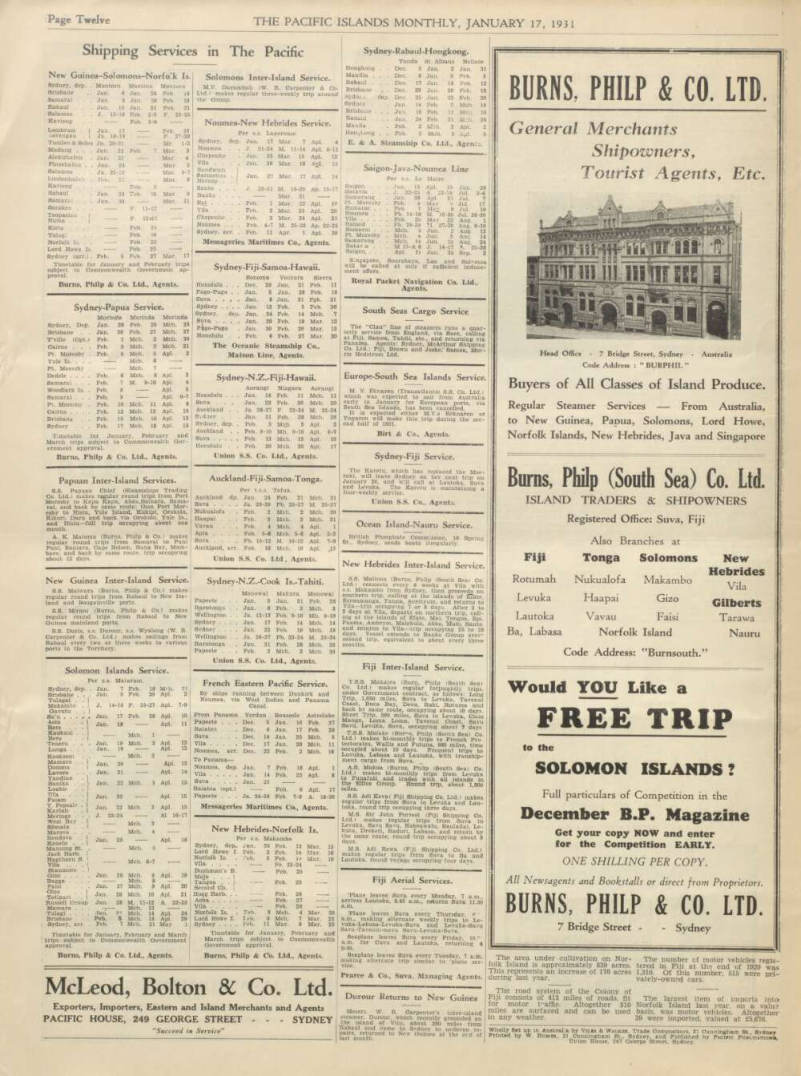
New Guinea—Solomons—Norfolk Is.
Sydney-Papua Service.
Papuan Inter-Island Services.
S.S. Papuan Chief (Steamships Trading Co. Ltd.) makes regular round trips from Port Moresby to Kapa Kapa, Abau, Balbara, Sama rai, and back by same route; then Port Mor esby to Hisiu, Yule Island, Kukipl, Orokolo, Kikori, Daru and back via Orokolo, Yule Is., and Hisiu —full trip occupying about one month.
A. K. Matoma (Burns, Philp & Co.) makes regular round trips from Samarai to Puni Puni, Baniara, Cape Nelson, Buna Bay, Mam bare, and back by same route, trip occupying about 12 days.
New Guinea Inter-Island Service.
5.5. Maiwara (Burns, Philp & Co.) makes regular round trips from Rabaul to New Ire land and Bougainville ports. 5.5. Mirani (Burns, Philp & Co.) makes regular round trips from Rabaul to New Guinea mainland ports. 5.5. Duris, s.s. Durour, s.s. Wyalong (W. R.
Carpenter & Co. Ltd.) makes sailings from Rabaul every two or three weeks to various ports in the Territory.
Solomon Islands Service.
Solomons Inter-Island Service.
M.V. Durambah (W. R. Carpenter & Co.
Ltd.) makes regular three-weekly trip around the Group.
Noumea-New Flebrides Service.
Sydney-Fiji-Samoa-Hawaii.
Sydney-N.Z.-Fiji-Hawaii.
Auckland-Fiji-Samoa-Tonga.
Sydney-N.Z.-Cook Is.-Tahiti.
French Eastern Pacific Service.
New Hebrides-Norfolk Is.
Sydney-Rabaul-Hongkong.
Saigon-Java-Noumea Line
South Seas Cargo Service
The “Clan” line of steamers runs a quar terly service from England, via Suez, calling at Fiji, Samoa, Tahiti, etc., and returning via Panama. Agents: Sydney, McArthur Shipping Co. Ltd.; Fiji, Brown and Joske; Samoa, Mor ris Hedstrom Ltd.
Europe-South Sea Islands Service.
M. V. Eknaren (Transatlantic S.S. Co. Ltd.) which was expected to sail from Australia early in January for European ports, via South Sea Islands, has been cancelled.
It is expected either M.V.s Ecknaren or Yngaren will make this trip during the sec ond half of 1931.
Birt & Co., Agents.
Sydney-Fiji Service.
The Karetu, which has replaced the Moe raki, will leave Sydney on her next trip on January 20, and will call at Lautoka, Suva and Levuka. The Karetu is maintaining a four-weekly service.
Union S.S. Co., Agents.
Ocean Island-Nauru Service.
British Phosphate Commission, 16 Spring St., Sydney, sends boats irregularly.
New Hebrides Inter-Island Service.
S.S. Malinoa (Burns, Philp (South Sea) Co Ltd.) connects every 6 weeks at Vila with s.s. Makambo from Sydney, then proceeds on southern trip, calling at the islands of Efate.
Erronmanga, Tanna, Aneityum, and returns to Vila—trip occupying 7or 8 days. After 2 to 3 days at Vila, departs on northern trip, call ing at the islands of Efate, Mai, Tongoa, Epi Paama, Ambrym. Malekula, Abba, Malo, Santo, and returns to Vila—trip occupying 25 to 28 days. Vessel extends to Banks Group every second trip, equivalent to about every three months.
Fiji Inter-Island Service.
T.S.S. Makatea (Burn, Philp (South Sea) Co. Ltd.) makes regular forjnightly trips, under Government contract, as follows: Long Trip, 1,050 miles, Suva to Levuka, Tavenui Coast, Buca Bay, Devo, Rabi, Rotuma and back by same route, occupying about 10 days.
Short Trip, 560 miles, Suva to Levuka, Cicia Mango, Loma Loma, Tavenui Coast. Savu Savu, Levuka, Suva, occupying about 3 days T.S.S. Malake (Bums, Philp (South Sea) Co.
Ltd.) makes bi-monthly trips to French Pro tectorates, Wallis and Futuna, 880 miles, time occupied about 10 days. Frequent trips to Luvuka, Labasa and Lautoka, with tranship ment cargo from Suva.
A.S. Makoa (Burns, Philp (South Sea) Co.
Ltd.) makes bi-monthly trips from Levuka to Funafuti and trades with all islands in the Ellice Group. Round trip, about 1,800 miles.
S.S. Adi Keva( Fiji Shipping Co. Ltd.) makes regular trips from Suva to Levuka and Lau toka, round trip occupying three days.
M.S. Sir John Forrest (Fiji Shipping Co.
Ltd.) makes regular trips from Suva to Levuka, Savu Savu, Nabouwalu, Baulailai, Le kutu, Dreketi, Raduri, Labasa, and return by the same route, round trip occupying about 9 days.
M.S. Adi Rewa (Fiji Shipping Co. Ltd.) makes regular trips from Suva to Ba and Lautoka. round voyage occupying four days.
Fiji Aerial Services.
’Plane leaves Suva every Monday, 7 a.m., arrives Lautoka, 8.45 a.m., returns Suva 11 30 a.m. ’Plane leaves Suva every Thursday, P r a.m., making alternate weekly trips to Le vuka-Labusa-Levuka-Suva and Levuka-Savu Savu-Tavenui-bavu Savu-Levuka-Suva.
Seaplane leaves Suva every Friday, 10.3' a.m. for Cuvu and Lautoka, returning 4 p.m.
Seaplane leaves Suva every Tuesday, 7 a.m. making alternate trip similar to ’plane ser vice.
Pearce & Co., Suva, Managing Agents.
Durour Returns to New Guinea
Messrs. W. R. Carpenter’s inter-island steamer, Durour, which recently grounded on the island of Vitu, about 200 miles from Rabaul and came to Svdney to undergo re pairs, returned to New Guinea at the erd of last month.
The area under cultivation on Nor folk Island is approximately 839 acres.
This represents an increase of 176 acres during last year.
The road system of the Colony of Fiji consists of 413 miles of roads, fit for motor traffic. Altogether 310 miles are surfaced and can be used in any weather.
The number cf motor vehicles regis tered in Fiji at the end of 1929 was 1,310. Of this number, 515 were pri vately-owned cars.
The largest item of imports into Norfolk Island last year, on a value basis, was motor vehicles. Altogether 39 were imported, valued at £5,676.
Per s.s.
Laperouse Sydney, dep.
Jan. 17 Mar. 7 Apl. 4 Noumea .
J. 21 -24 M. 11- -14 Apl. 8 -11 Chepenhe Jan. 25 Mar. 15 Apl. 12 Vila ...
Jan. 26 Mar. 16 Anl. 13
Sandwich . 1
Sarmettes . f
Jan. 27 Mar. 17 Apl. 14
Norsup . . J
Santo . . .
J. 28 -31 M. 18-20 Ap. 15 -17 Banks ...
Mar. 21 Epi Feb. 1 Mar. 22 Apl. 10 Vila ...
Feb. 2 Mar. 23 Apl. 20 Chepenhe . .
Feb. 3 Mar. 24 Apl. 21 Noumea . . .
Feb. 4-7 M. 25 -28 Ap. 22 -25 Sydney, arr. .
Feb. 11 Apr. 1 Apl. 29
Messageries Maritimes Co,
,, Agents.
Sonoma Ventura Sierra Honolulu . . . Dec. 29 Jan. 21 Feb. 11 Pago-Pago . . Jan. 5 Jan. 28 Feb. 18 Suva . . . . Jan. 8 Jan. 31 Feb. 21 Sydney . . . . Jan. 13 Feb. 5 Feb. 26 Sydney, dep. Jan. 24 Feb. 14 Mch. 7 Suva . . . . Jan. 29 Feb. 19 Mar. 12
P;\go-Pago
. Jan. 30 Feb. 20 Mar. 13 Honolulu . . Feb. 6 Feb. 27 Mar. 20 The Oceanic
Steamship
Co.,
Matson Line,
Agents.
Tanda St. Albans Nellore
Hongkong
. . Dec. 5 Jan. 2 Jan. 31 Manilla . . . Dec. 8 Jan. 5 Feb. 3 Rabaul . . . Dec. 17 Jan. 14 Feb. 12 Brisbane . . . Dec. 23 Jan. 20 Feb. 18
Sydney,
dep. Dec.
25 Jan. 22 Feb. 20
Sydney
. . Jan. 14 Feb. 2 Mch. 14 Brisbane . . . Jan. 16 Feb. 11 Mch. 16 Rabaul . . . Jan. 24 Feb, 21 Mch. 24 Manila . . Feb. 2 Mch. 2
Apl.
2
Hongkong
. . Feb. 5 Mch. 5
Apl.
5 E. & A.
Steamship Co. Ltd.,
Agent
3.
Per s.s. Le Maire Saigon . . . Jan. 15 Apl. 15 Jun. 26 Batavia . . . J. 22-25 A 23- ■2b 1-6 Samarang . . Jan. 26 Apl. 27 Jul. 7 Pt. Moresby . Peb. b May 7 Jul. 17 Samarai . . . Feb. 7 Ma" 9 Jul. 19 Noumea . . . Fb. 14-18 M. 16- -20 Jul. 26- -30 Vila ...
Mav 22 Aug. 1 Rabaul . . . Pb. 25-28 M. 27 -30 Aug. 6- 48 Samarai . . . Mch. 8 Jun. 2 Aug. 13 Pt. Moresby . Mch. 4 Jun. 3 Aug. 14 Samarang . . Mch. 14 Jun. 13 Aug. 24 Batav.a . . . M 15-A 6 J. 14 -17 V 25- 28 Saigon, . . .
Apl. 11 Jun. 22 Sep. 2 Singapore, Sourabava, Lae and will be called at only if sufficient inducement offers.
Royal Packet Navigation
Co,
. Ltd.,
Agents.
Morlnda Morinda Morinda Sydney, Dep. Jan. 28 Feb. 25 Mch. 25 Brisbane . Jan. 30 Feb. 27 Mch. 27 T’ville (Opt.; Feb. 2 Mch. 2 Mch. 30 Cairns . . . Feb. 3 Mch. 3 Mch. 31 Pt. Moresby . Feb. 5 Mch. 5 Apl. 2 Yule Is. . .
Mch. 6 Pt. Moresby Mch. 7 Dedele . . . . Feb. 6 Mch. 8 Apl. 3 Samara i . . . Feb. 7 M. 9- 10 Apl. 4 Woodlark Is. . Feb. 8 — Apl. 5 Samarai . . . Feb. 9 — Apl. 6-7 Pt. Moresby . Feb. 10 Mch. 11 Apl. 8 Cairns . . . . Feb. 12 Mch. 13 Apl. 10 Brisbane . Feb. 15 Mch. 16 Apl. 13 Sydney , . . Feb. 17 Mch. 18 Apl. 15 Timetable for January, February and March trips subject to Commonwealth Government approval.
Burns, Philp &
Co.
Ltd.,
Agents.
Per s.s.
Mataram.
Sydney, dep. . Jan. 7 Feb. 18 Mch. 31 Brisbane . . . Jan. 9 Feb. 20 Apl. 2
Tulagai . . 1
Makambo . J. 14 -16 P. 25 -27 Apl, 7-9 Gavutu . . 1 Su’u . . . . , , Jan. 17 Feb. 28 Ap}. 10 Aola , . . 1 Rere . . . f Jan. 18 Apl. 11 Kaukaul . . 1 Mch. 1 Rere . . - ( Apl. 12 Teneru . . . Jan. 19 Mch. 2 Lunga . . . . Jan. 19 Apl. 12 Kookoom Mch. 2 —
Mamara . . )
Jan. 20 Apl. 13
Comma . . j
14 Lavoro . . . Jan. 21 Apl.
Yandina . 1 Apl. 15 Banika . . \ Jan. 22 Mch. 3 Loabie . . Ufa . ... 1 Paiam . . ( Jan. 22 — Apl. 15 Y. Pepsale . 1
Kaylah . . (
Jan. 22 Mch. 3 Apl. 15 Merlnge . . . J. 23 -24 A1 16- •17 West Bay . 1 S6mata . . f Mch. 3 — Marovo . .
Mch. 4 — Rendova . 1
Kenelo . . f
Jan. 25 Apl. 18 Manning St.
Mch. 5 Jack Harb. 1 Hagthorn S. 1 Vila ... f Mch. 6-7 Stanmore . 1 Gizo . . . .
Jan. 26 Mch. 8 Apl. 19 Bagga , . . , Mch. 8 Faisi . . . . Jan. 27 Mch. 9 Apl. 20 Gizo . . . ) Tetipari . . f Jan. 28 Mch. 10 Apl. 21 Russell Group Jan. 28 M. 11 -12 A. 22- ■23 Mamara . . .
Mch. 13 — Tulagi . . . .
Jan.
Mch. 14 Apl. 24 Brisbane . . .
Feb. 5 Mch. 19 Apl. 29 Sydney, arr. , Feb. 7 Mch. 21 May 1 Timetable for January, February and March trips subject to Commonwealth Government approval.
Burns, Philp & Co
. Ltd.,
Agents.
Aorangi Niagara Aorangi Honolulu . . . Jan. 14 Feb. 11 Mch. 11 Suva . . .
Jan. 23 Feb. 20 Mch. 20 Auckland . . Ja. 26-27 F. 23-24 M. 23 -24 Svdney . . . Jan. 31 Feb. 28 Mch. 28 Sydney, dep. . Feb. 5 Mch. 5 Apl. 2 Auckland . . Feb. 9-10 Mh. 9-10 Apl. 6-7 Suva . Feb. 13 Mch. 13 Apl. 10 Honolulu . . Feb. 20 Mch. 20 Apl. 17 Union
S.S. Co. Ltd., Agents.
Per t.s.s.
Tofua.
Auckland dp.
Jan. 24 Feb. 21 Mch. 21 Suva . .
Ja. 28-30 Pb. 25-27 M. 25-27 Nukualofa Feb. 2 Mch. 2 Mch. 30 Haapai .
Feb. 3 Mch. 3 Mch. 31 Vavau . .
Feb. 4 Mch. 4 Apl. 1 Apia . .
Feb. 5-6 Mch. 5-6 Apl. 2-3 Suva . .
Pb. 10-12 M. 10-12 Apl. 7-9 Auckland, arr.
Feb. 16 Mch. 16 Apl. .13 Union
S.S. Co.
Ltd, Agents.
Monowal Makura Monowai Papeete . . . Jan. 3 Jan. 31 Feb. 28 Rarotonga . . Jan. 6 Feb. 3 Mch. 3 Wellington . . Ja. 12 -13 Feb. 9-10 Mh. 9 -10 Sydney . . . . Jan. 17 Feb. 14 Mch. 14 Sydney . . . . Jan. 22 Feb. 19 Mch. 19 Wellington . . Ja. 26- ■27 Fb. ; 23-24 M. 23 -24 Rarotonga . . Jan. 31 Feb. 28 Mch. 28 Papeete . . . Feb. 2 Mch. 2 Mch. 30 Union
S.S. Co. Ltd.,
Agents.
By ships running between Dunkirk and Noumea, via West Indies and Panama Canal.
Prom Panama Verdun Boussole Astrolabe Papeete . . .
Dec. 5 Jan. 16 Feb. 27 Raiatea . . .
Dec. 6 Jan. 17 Peb. 28 Suva ...
Dec. 14 Jan. 25 Mch, 5 Vila Dec. 17 Jan. 28 Mch. 11 Noumea, arr.
Dec. 22 Peb. 2 Mch. 16 To Panama— Noumea, dep.
Jan. 7 Feb. 18 Apl. 1 Vila Jan. 14 Feb. 25 Apl. 8 Suva Jan. 23 Raiatea (opt.) Feb. 6 Apl. 17 Papeete . . .
Ja. 24-26 Feb. 7-9 A. 18-20
Messageries Maritimes Co., Agents.
Per s.s. Makambo Sydney, dept, ■Ian. 20 Feb. 13 Mar. 13 Lord Howe I.
Feb. 2 Feb. 16 Mar. 16 Norfolk Is.
Feb. 5 Feb. la Mar. 19 Vila ... .
Pe. 23 -24 Bushman's B.
Feb. 25 Malo ... 1 Tangoa . . }■ — Feb. 25 — Second Ch. i Hogg Harb. . . — Feb. 26 Aoba — Feb. 27 Vila .
Feb. 28 Norfolk Is.
Feb. 6 Mch. 4 Mar. 20 Lord Howe I.
I eo. 9 Mch. 7 Mar. 23 Sydney ...
Feb. 11 Mar. 9 Mar. 25 Timetable for January, February and March trips subject to Commonwealth Government approval.
Burns, Philp & Co.
, Ltd.,
Agents.
Sydney, dep. .
Montoro Marsina Montoro Brisbane Jan. 6 Jan. 24 Feb. 14 Samarai .
Jan. 8 Jan. 26 Feb. 16 Rabaul . .
Jan. 13 Jan. 31 Feb. 21 Salamoa J. 15-16 Feb, 2-3 F. 23-25
Kavleng
— Feb. 5-6 — Lombrum . 1 Jan. 17 Feb, 26
borengau .
( Jn. 18-19 — P. 27-28 Tumleo & Seleo Jn. 20-21 — Mr. 1-2 Madang . .
Jan. 22 Feb. 7 Mar. 3 Alexishafen Jan. 23 Mar. 4 Pinschafen Jan. 24 — Mar. 5 Salamoa , .
Jn. 25-26 Mar. 6-7 Lindenhafen Jan. 27 Mar. 8
Kavieng . .
— Feb. 9 — Rabaul . .
Jan. 28 Feb. 10 Mar. 9 Samarai . , Jan. 30 — Mar. 11 Soraken . . — F. 11-12 — Teopasino .
Numa . . . 1 ( • F, 12 *13 — Kieta . . . — Feb. 14 — Tulagi . . . — Feb. 16 — Norfolk Is. .
Feb. 23 Lord Howe Is. — Feb. 25 Sydney (arr.) .
Feb. 5 Feb. 27 Mar. 17 Timetable for January and February trips subject to Commonwealth Government ap proval.
Burns,
Philp & Co. Ltd., Agents.
Advertisements & other items, p. 12 (2 items)
The Pacific Islands Monthly, January 17, 1931
12
Wholly Set up in Australia by Viles & Walker, Trade Compositors. 31 Cunningham St Sydney Printed by W. Homer, 31 Cunningham St., Sydney, and Published by Pacific Publication* Union House, 247 George Street, Sydney.
Burns, Philp & Co. Ltd.
General Merchants
Shipowners,
Tourist Agents, Etc.
S ri Head Office - 7 Bridge Street, Sydney - Australia Code Address : "BURPHIL”
Buyers of All Classes of Island Produce.
Regular Steamer Services From Australia, to New Guinea, Papua, Solomons, Lord Howe, Norfolk Islands, New Hebrides, Java and Singapore
Burns, Philp (South Sea) Co. Ltd.
ISLAND TRADERS & SHIPOWNERS
Registered Office: Suva, Fiji Also Branches at
FREE TRIP
to the
SOLOMON ISLANDS?
Full particulars of Competition in the
December B.P. Magazine
Get your copy NOW and enter Sor the Competition EARLY.
ONE SHILLING PER COPY.
All Newsagents and Bookstalls or direct from Proprietors.
BURNS, PHILP & CO. LTD.
7 Bridge Street - - Sydney
McLeod, Bolton 8C Co. Ltd.
Exporters, Importers, Eastern and Island Merchants and Agents PACIFIC HOUSE, 249 GEORGE STREET - - - SYDNEY “Succeed in Service ”